




Abstract
During the spring of 2020, a novel coronavirus, SARS-CoV-2, spread globally, resulting in a worldwide pandemic (Huang et al., 2020). SARS-CoV-2 virus infection results in COVID-19 disease, which affects the lungs as well as other organs. In some cases, it evolves into acute respiratory distress syndrome (ARDS), a life-threatening condition (Li et al., 2020).
Because the virus's primary pathway into the human body is via the lungs, it was hypothesised that smoking was a factor that could make people more susceptible to infection with the Sars-CoV-2 virus and more severe outcomes of the disease (van Zyl-Smit et al., 2020). However, the current literature on the relationship between smoking and COVID-19 is mixed (Lippi & Henry, 2020). Recent studies have shown that smokers may be more likely to experience severe COVID-19 outcomes (Clift et al., 2022; Gülsen et al., 2020). However, there are also contradictory results, and the possible difference in outcomes between former smokers and current smokers remains unclear (Farsalinos et al., 2020; Simons et al., 2021). The rates of smoking cessation during the early days of the pandemic varied in the studies. There were indications that smoking cessation increased (Kayhan Tetik et al., 2021); one recent meta-analysis concluded that there had been a relative reduction in overall smoking prevalence (Sarich et al., 2022). In another extensive study conducted in four countries, researchers concluded that 70% of smokers did not change their smoking habits, although 47% considered quitting because of COVID-19 (Gravely et al., 2021).
The smokers’ perceptions of being susceptible to a more severe COVID-19 infection may have been a factor in smoking cessation. Still, some studies found that this was not the case, although interest in cessation has increased (Streck et al., 2021). A Finnish national survey conducted among the general population in 2019 and during COVID-19 in 2020 found that younger women, other than employed/students, experienced increased loneliness, and reduced contact with friends and family was associated with increased smoking. In contrast, reduced working capacity and concerns that someone close to the respondent could be infected with COVID-19 were associated with reduced smoking (Ruokolainen et al., 2023). In addition, another study proposed that daily smoking decreased in Finland between 2018 and 2020, but that other forms of tobacco use did not decrease (Peña et al., 2023).
In Finland, approximately 12% of the 20–64-year-old population smoke cigarettes; 7% of men in this age group use Swedish smokeless tobacco (snus) daily. Snus is a moist powder of fermented ground tobacco placed inside the mouth, either in loose form or a portion bag. The sale of snus is illegal in Finland, but it can be imported from Sweden for personal use (1000 g per person per day). It is also common for snus to be imported illegally for sale. The data on snus use in Finland are based on population surveys and import statistics. On the other hand, nicotine pouches containing 4 mg/g or less nicotine can be legally sold in Finland over the counter (OTC) for nicotine replacement therapy (NRT). Nicotine pouches containing more nicotine are often imported illegally over the Internet or via traveller imports. Finnish law specifically prohibits cross-border distant sales of tobacco products.
NRT products are the most studied and utilised smoking cessation medicines dating back to the 1970s (West et al., 1984). In Finland, they have been sold as OTC medicine in different sale outlets, including food stores, gas stations and kiosks, since 2006. Since their deregulation in 2006, when sales from general stores and pharmacies were permitted, their utilisation and sales increased significantly, from 17 million to 71 million euros annually. According to Finnish Statistics of Medicines, NRT products have been the most-sold pharmaceutical product in recent years (Finnish Agency Medicines Fimea, 2021).
Aims
The aim of the present study was to investigate whether tobacco product sales in Finland increased or decreased during the COVID-19 pandemic and whether NRT product sales changed accordingly. According to previous national surveys in Finland (Peña et al., 2023), we hypothesised that tobacco and other non-NRT nicotine product sales decreased compared to the previous year. Furthermore, we hypothesised that the use of NRT products would increase as the eagerness to quit smoking increased to elude severe COVID-19 infection.
Methods
This retrospective retail study consists of sales information on Finnish sales for S Group, which has 46% of the Finnish grocery trade market share. According to the Finnish Grocery Trade Association, in 2019, S Group had 1055 stores across Finland, from small shops to large markets, including gas stations (Finnish Grocery Trade Association, 2020; S Group, 2020). For tobacco products, we retrieved information about cigarettes and loose tobacco. In addition, we collected data on NRT products, including patches, inhalers, tablets, gums, and other products comprising nicotine pouches and flavour papers.
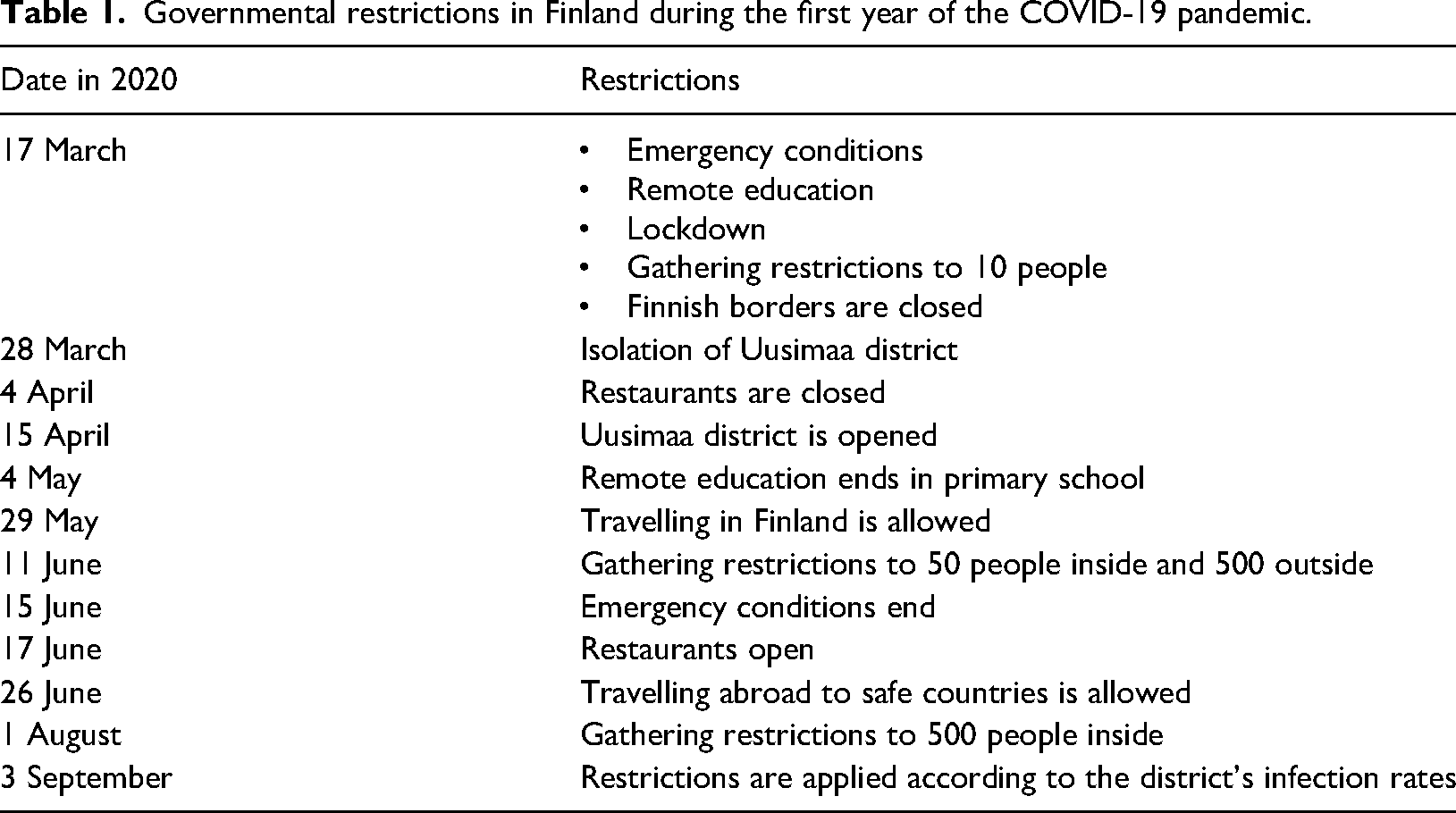
The sales volume of each product was retrieved weekly from February 2020 to December 2020. For comparison, the sales of the products from the corresponding months in 2019 were retrieved. The information on detailed restrictions due to the pandemic was derived from the archives of the Finnish Institute of Health and Welfare (Table 1).
Governmental restrictions in Finland during the first year of the COVID-19 pandemic.
Statistical analysis
For the total sales volume of cigarettes and NRT products, the indexes of sales volume were calculated as the ratio of sales volume in units sold to average sales in weeks 47 and 48 in 2019. For sales of different NRT products, the sales indexes were calculated as the ratio of sales volume in euros compared to average sales in weeks 4 and 5 in 2020 in the “other formulations” group. The index was chosen to represent the beginning of the available time series. For this to be an even more representative starting point, an average of 2 weeks was used instead of a single week as a reference value (100). The resulting time series were analysed using a segmented regression model (Muggeo, 2003), including the autoregressive–moving-average (ARMA) model for autocorrelation. ARMA models are autoregressive–moving average time series models widely used in statistics and econometrics. R statistical packages “segmented” (for segmented regression) and “forecast” (for ARMA) were used for the analysis.
Ethical aspects
Consideration of the Ethics Committee was not needed since no individual data were used.
Results
The data were derived from 1062 sale points, 99 of which were hypermarkets, 447 medium-sized markets, 419 smaller stores and 97 service stations (gas sales, restaurants and small shops). The sale locations were situated all over Finland.
The weekly sales index for cigarettes and NRT products is presented in Figure 1. The data are shown separately for each year from 2019 to the end of 2020.
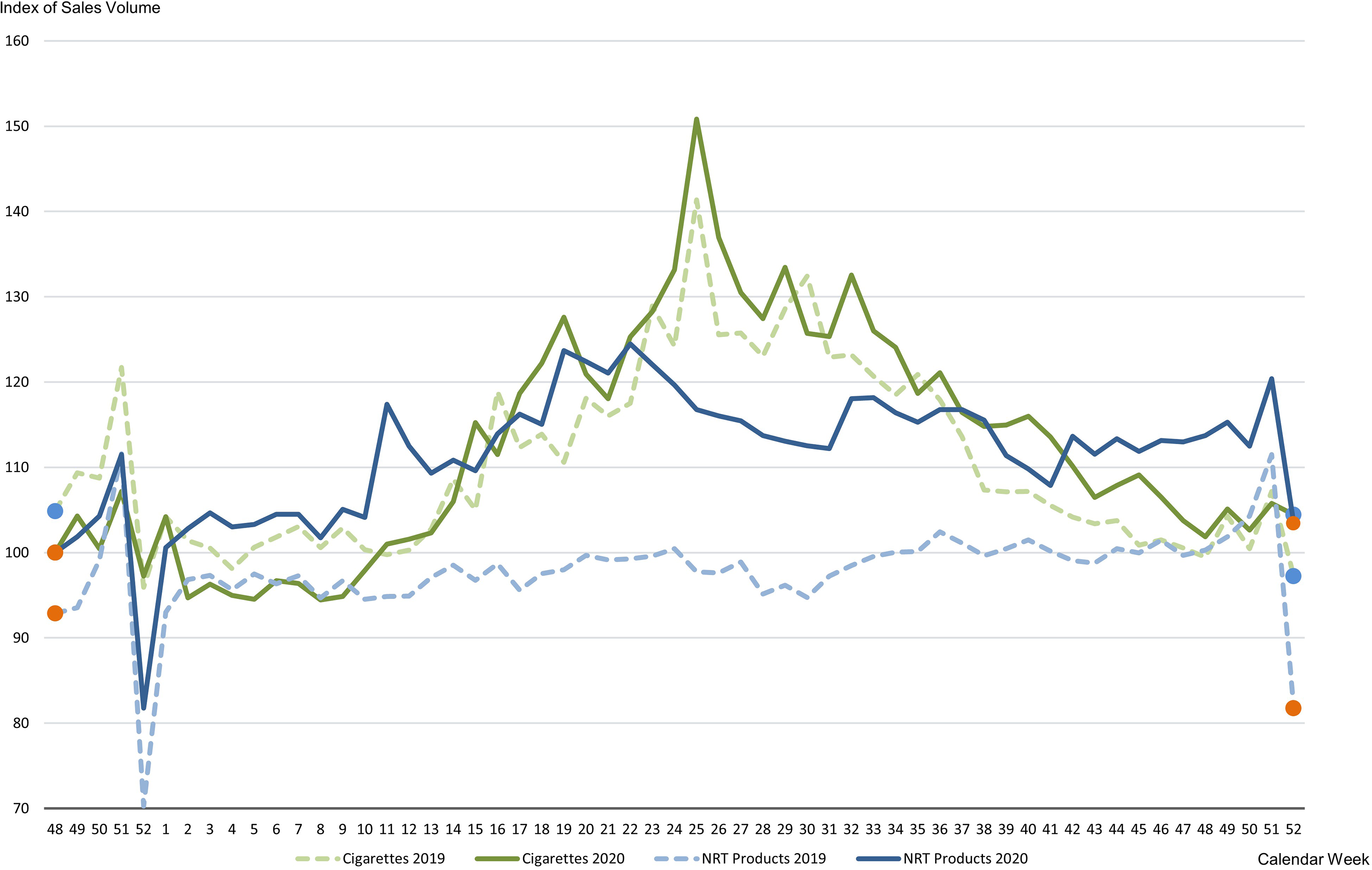
The weekly variation in sales volume of cigarettes in 2019 (green dashed line), and 2020 (green line), and nicotine replacement therapy (NRT) products in 2019 (blue dashed line), and 2020 (blue line). Source: S Group.
The volume of cigarette sales at the end of 2019 and at the beginning of 2020 was lower than later in 2020. The lowest sales volume in 2020 occurred in week 8. The restrictions, or a “lockdown” due to COVID-19 in Finland, were initiated in week 12 of 2020; a significant increase (p < .05) in cigarette sales relative to sales in 2019 was observed. Cigarette sales were the highest in the second part of June, just before Finland's main summer holiday, as in 2019. The compound annual growth rate from the end of 2019 to the end of 2020 was significantly positive (p <0.01) but with large confidence intervals: +8.0% p.a. (+3.5% ± 12.6%).
A steady growth trend existed before the lockdown in the total sales of NRT products. A significant (p < .01) accelerated increase was observed during the lockdown. As the lockdown eased, sales of NRT products started to decrease from their highest level in June. The compound annual growth rate during the period for NRT products was +7.8% p.a. (+7.1% ± 8.4%). The indexes for the different NRT product formulations are presented in Figure 2.
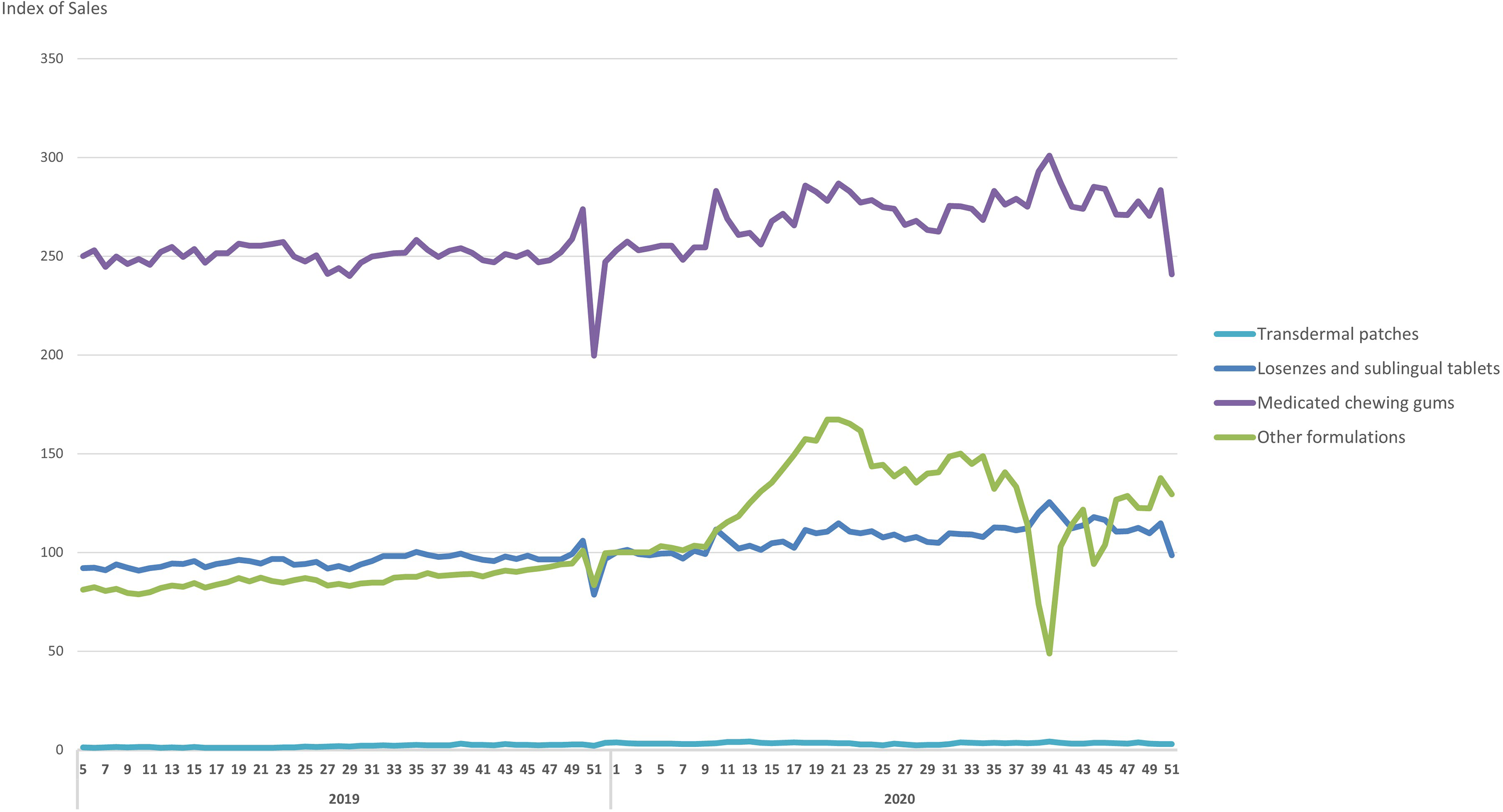
The weekly variation in nicotine replacement therapy product sales depicted separately by main formulations. Source: S Group.
Sales of depot patches, tablets and gums grew steadily during the 2 years included in this study. However, in the “other formulations” category, dominated by nicotine pouches, sales increased significantly (p < .01) simultaneously as the lockdown was initiated. After a few weeks of increasing sales, the sales levelled out and eventually decreased after week 37, only to increase again after a few weeks.
Discussion
Contrary to our expectations, our study found that cigarette sales increased in Finland during the COVID-19 pandemic in 2020. In contrast, the population-level survey suggested that in Finland, smoking did not increase during the COVID-19 pandemic. Moreover, the total sales of NRT products were significantly higher throughout 2020 than in 2019; in particular, the sales of nicotine pouches increased.
Smoking has decreased continuously in Finland for decades (Jääskeläinen & Virtanen, 2019; Koskinen & Virtanen, 2022). However, Finnish youth, in particular, use snus, which seems to be increasing (Koskinen & Virtanen, 2022).
Smokers are often more reluctant to quit smoking during uncertain times and under psychological stress. This could also have been the case during the COVID-19 pandemic, regardless of the possible causal link between smoking and the risk of severe COVID-19. This finding is supported by studies suggesting that smokers tended to smoke more during the early days of the pandemic than previously (Sarich et al., 2022). The lockdown had a considerable impact on the everyday lives of the population. For example, in Italy, smoking increased by 9% during the lockdown period (Carreras et al., 2022). This could also have been the case in Finland, as the increase in sales coincided with Finnish restrictions. However, according to national surveys of smoking and other tobacco product use, smoking did not increase (Peña et al., 2023). This finding is contrary to the sales data collected.
Our findings of increased nicotine product sales during the COVID-19 pandemic could be explained in part by the fact that people who previously used snus could have switched to cigarettes or nicotine pouches sold as NRT due to the unavailability of snus from the neighbouring countries. Furthermore, the illegal import of cigarettes decreased, primarily across the Russian border, when the national borders closed, thus increasing domestic sales of cigarettes. This trend was especially apparent in the first months of lockdown. There were 402 million cigarettes imported and 2.7 million cigarettes confiscated from smugglers in 2019. In 2020, 167 million cigarettes were imported, and 4.5 million were confiscated from smugglers. However, many people use both cigarettes and NRT products, even though smoking cessation is not their primary goal. Thus, NRT products are used for nicotine cravings in places where smoking is prohibited (Timberlake et al., 2019).
As stated before, selling snus is illegal in Finland. There are assumptions that nicotine pouches could have replaced snus during the lockdown, as snus was unavailable due to travel restrictions. Our study supports this finding, as nicotine pouch consumption grew steadily after Finnish borders shut down.
The increase in sales of both nicotine pouches and other NRT products raises concerns about the increasing nicotine dependence in the population; however, recent results show that this is usually not the case (Harris et al., 2022). Furthermore, misuse of NRT is common. One study of NRT use in Finland before the pandemic observed a tendency to either purchase the medication for too short a period (≤4 weeks, 63.5%) or too long a period (>24 weeks, 13.2%) for the treatment to be adequate or effective (Timberlake et al., 2019). The considerable amount of incorrect NRT use, combined with the fact that nicotine is the most frequently purchased medicine in Finland, raises the urgent need for more guidance on NRT use when NRTs are purchased. This was previously the case when NRTs were sold solely in pharmacies but ceased as the sales shifted to the everyday stores that do not have the permission, knowledge or resources to advise NRT customers. In addition to increased nicotine dependence, the Swedish snus available in Finland appears to typically contain excessive amounts of nicotine, more than 20 mg/g (Vedøy & Lund, 2022), possibly amplifying the nicotine addiction even further. Of note, the actual daily use habits of NRTs or snus are challenging to study in Finland, as their use is not controlled in any way.
The strength of our study is that the data used are based on the sales of the leading companies in Finland. Sales data are reliable, giving us objective findings related to consumption. Our data are significant and cover several nicotine products. In addition, nicotine pouch sales during COVID-19 have not been previously considered in Finnish studies.
However, the present study also has some limitations. First, we studied only the sales volume of these products from one sales company. However, the data are comprehensive and cover all nicotine products nationally. Second, based on our data, actual tobacco and nicotine product use habits cannot be investigated. This aspect, however, requires more thorough research, including questionnaires.
Conclusion
Sales of cigarettes and NRT products, especially nicotine pouches, increased in Finland during the COVID-19 pandemic. This calls for further research to reveal the contributing factors and to determine whether the situation is long-standing.
When preparing for future pandemics, it is vitally important to consider the ways of supporting those smoking and suffering from nicotine addiction, especially when the causative virus damages the lungs and smoking exacerbates it. In addition, the results emphasise the need to monitor new nicotine products for up-to-date legislation and supervision.
Footnotes
Data availability
The data that support the findings of this study are available from S Group, but restrictions apply to the availability of these data, which were used under licence for this study, and so are not publicly available. However, the data are available from the authors upon reasonable request and with the permission of S Group.
Declaration of conflicting interests
The authors declared no potential conflicts of interest with respect to the research, authorship, and/or publication of this article.
Funding
The authors disclosed receipt of the following financial support for the research, authorship, and/or publication of this article: This work was supported by the Nummela Foundation.
