




Abstract
Introduction
Although online alcohol sales have grown rapidly in recent years, comprehensive and systematic analyses of alcohol policy solutions to online alcohol sales and their impact on alcohol-related harm are lacking (Colbert et al., 2021). Online shopping and home delivery can contribute to changing alcohol consumption patterns, including the amount of alcohol consumed (Matthay & Schmidt, 2021). There is a growing body of scientific knowledge showing online alcohol purchases contribute to alcohol abuse (Colbert et al., 2023a; Huckle et al., 2021; Monjica-Perez et al., 2019), impulsive alcohol purchases and uncontrolled purchases of alcoholic beverages by minors (Williams & Ribisl, 2012; Williams & Schmidt, 2014). Studies also suggest that online alcohol sales may contribute to excessive drinking. A recent cross-sectional survey by Colbert et al. (2023a) found that one in five Australians who used alcohol delivery services had done so to extend a home drinking session after running out of alcohol. Notably, one-third of the respondents stated they would have stopped drinking if the delivery service was unavailable. Another Australian study by Coomber et al. (2023) reported that high-risk drinkers were more likely to use rapid/same-day alcohol delivery and had greater exposure to delivery service advertising compared to low-risk drinkers. The study also found high-risk drinkers purchased larger quantities per order and were more likely to receive deliveries while intoxicated or use them to continue drinking sessions.
Research in New Zealand showed that during the COVID-19 pandemic, approximately 40% of respondents purchased alcohol from online shops, with nearly half reporting it was their first time doing so (Huckle et al., 2021). Making alcohol purchases online during the pandemic restrictions was associated with a 75% increased risk of excessive alcohol consumption in the week before the survey. At the same time, no such association was observed for purchases in brick-and-mortar outlets. Pre-pandemic research conducted in Australia found that consumers who made online purchases with fast delivery (less than 2 h) were more likely to drink in a risky way than other individuals making online purchases (Monjica-Perez et al., 2019). Furthermore, most studies indicated that online purchases with home delivery were associated with excessive drinking on a single occasion.
Online outlets offer a wide range of alcoholic beverages at relatively low prices and attract consumers with various price promotions (Colbert et al., 2020, 2023b; Williams, 2013). A study conducted in Australia found that most shops offered price promotions for purchases of larger quantities of alcohol, and some allowed postponed payment for alcoholic beverages (Colbert et al., 2020). Online stores are also considered a particularly questionable category of alcohol outlets regarding the potential risk of uncontrolled sales to minors. Existing studies conclude that minors can easily purchase alcoholic beverages online, which has become even more facilitated by the development of online marketplaces and mobile technologies (Freisthler et al., 2006; Paschall et al., 2007; Toomey et al., 2008; Williams, 2013; Williams & Ribisl, 2012; Williams & Schmidt, 2014). Although online retailers may secure their sites with age verification mechanisms, such as aged gates, minors easily bypass such barriers (Colbert et al., 2023a; MacNabb et al., 2022; Williams & Ribisl, 2012; Williams & Schmidt, 2014). Likewise, the policies of large online retailers (e.g., eBay) do not prevent underage individuals from purchasing alcohol (Williams, 2013). Recent research from New Zealand showed that during the COVID-19 pandemic, 58% of underage customers did not go through age verification when purchasing alcohol (Huckle et al., 2021).
The COVID-19 epidemic saw a surge in online alcohol sales in several countries, occurring in the absence of specific regulations. In Canada, during the COVID-19 lockdowns, alcohol retailers were deemed “essential services”. This approach shifted the focus away from public health protections towards supporting commercial interests and expanding alcohol access, including services like home delivery (MacNabb et al., 2022). In India, after the pandemic-related prohibition, a significant increase in Internet searches related to both on-site and online alcohol purchases, as well as alcohol withdrawal symptoms, were observed (Ghosh et al., 2021). Studies conducted in the United States, Canada, the United Kingdom, Ireland, Australia and New Zealand showed that online alcohol sales with home delivery were found in most jurisdictions (Colbert et al., 2021). However, only a few jurisdictions required age verification at the purchase (9%), while most required it at the time of delivery (92%). Furthermore, at the onset of the COVID-19 pandemic, 69% of jurisdictions had temporarily or permanently relaxed regulations on home delivery of alcohol. The study concluded that regulations for online alcohol sales did not meet the same standards as for on-site alcohol sales.
In contrast, the situation in Poland is characterised by less regulation and a lack of comprehensive data. There is no official tracking or reporting mechanism specifically for alcohol sales online. Age verification processes are notably rudimentary; typically, mobile apps require merely a card number to proceed with purchases, implicitly assuming the cardholder's eligibility. Furthermore, websites commonly utilise a simple age gate where users can self-declare their age by stating they are aged 18 years or older, with no further verification. Although Polish law explicitly prohibits the sale and service of alcoholic beverages to minors and intoxicated individuals, there is no standardised system for age verification in online transactions. This makes enforcing the legal purchasing age of 18 particularly challenging in the context of online sales.
As the regulation of online alcohol sales remains ambiguous, no official data are maintained on the volume of these transactions, even during the COVID-19 pandemic. The legal framework, established by the Act on Upbringing in Sobriety and Counteracting Alcoholism (1982), does not explicitly recognise the sale of alcoholic beverages over the Internet. According to Art. 18(1) of the Act, the sale of alcoholic beverages can be conducted only on the basis of a permit issued by the local authority that has jurisdiction over the location of the point of sale. Consequently, health authorities have generally held that mail-order sales and online sales of alcohol are prohibited, even if the business owner possesses a permit for on-premise sales. This interpretation was contested by business organisations and the alcohol industry during the COVID-19 lockdowns, as they sought to expand existing sales channels and protect revenues.
While the law does not explicitly exclude online alcohol trading, this has been acknowledged by administrative courts. Local government authorities and administrative courts have predominantly held that online alcohol sales are prohibited. Nonetheless, a pivotal September 2022 ruling by the Supreme Administrative Court (NSA) provided a significant interpretation, as understood by the Ministry of Health and its agencies. According to the NSA's ruling, existing regulations do not prohibit online alcohol sales, suggesting that such sales could be legal. This interpretation, however, has faced opposition from several legal opinions, including those from the National Centre for Prevention of Addictions (KCPU, 2024). The National Centre maintains that alcoholic beverages can only be sold at the location specified in the license, without the option for delivery to the consumer. Adding to the complexity, Poland is part of the EU's open market, allowing stores based in other EU countries to sell alcohol online and deliver to customers in Poland, provided they adhere to the age requirements in their own country of operation. This backdrop of regulatory uncertainty and market dynamics set the stage for shifts in alcohol consumption patterns during the COVID-19 pandemic.
The advent of COVID-19 brought about radical changes in consumer behaviours in Poland. In March 2020 and March 2021, national lockdowns were implemented, imposing various restrictions on social distancing, mask-wearing, the maximum number of people allowed in retail outlets and designated “senior hours” from 10 a.m. to 12 p.m. to protect those most vulnerable to COVID-19 infections. Despite these measures, and except for the temporary closure of bars, restaurants and other on-site consumption outlets, no specific restrictions on alcohol sales were introduced. Nevertheless, empirical data reveal a slight decline in alcohol consumption, from 9.78 L of ethanol per capita in 2019 to 9.65 L in 2020, with a recent measurement of 9.37 L in 2022 (KCPU, 2023). Moreover, scientific evidence suggests that while overall alcohol consumption did not change significantly during the early waves of the pandemic, there was an increase in consumption among those who had previously been heavy drinkers (Chodkiewicz et al., 2020; Rossow et al., 2021), particularly among men and young people aged 18–30 years (Chodkiewicz et al., 2020; Szajnoga et al., 2021).
As we mentioned, there is a scarcity of evidence regarding online alcohol sales during the COVID-19 pandemic in Poland. The general trend during the pandemic shows that e-commerce has boosted in various segments of the market (forbes.pl; money.pl; strefasprzedawcy.wp.pl), which could include alcohol sales. We assume that several alcohol outlets switched to Internet sales as a result of pandemic restrictions, which was further facilitated by the growing share of mobile technologies, including food/delivery apps (e.g., Uber Eats, Bolt Food, Volt, Glovo) and retail apps (e.g., Lisek, Żappka).
In the context of existing studies, this article explores the association between risky and harmful drinking and alcohol purchases through online stores and mobile apps during the late phase of the COVID-19 pandemic in Poland, focusing on the role of sociodemographic characteristics and alcohol consumption levels. We hypothesise that (1) buying alcohol online is associated with the age of the consumers so that younger consumers prefer mobile apps. In contrast, older consumers purchase alcohol in online stores; and (2) purchasing alcohol through mobile apps increases the odds of risky and harmful drinking.
Methods
Participants
This study presents data from the initial wave of longitudinal study on patterns of alcohol consumption and attitudes towards alcohol policy during the late stage of the COVID-19 pandemic in Poland. The study, titled Changes in alcohol consumption in the late COVID-19 pandemic – analysis of the role of drinking motives and mental health – a longitudinal study, comprised two waves. However, it is important to note that the specific focus on online alcohol purchases during COVID-19 was exclusive to the first wave.
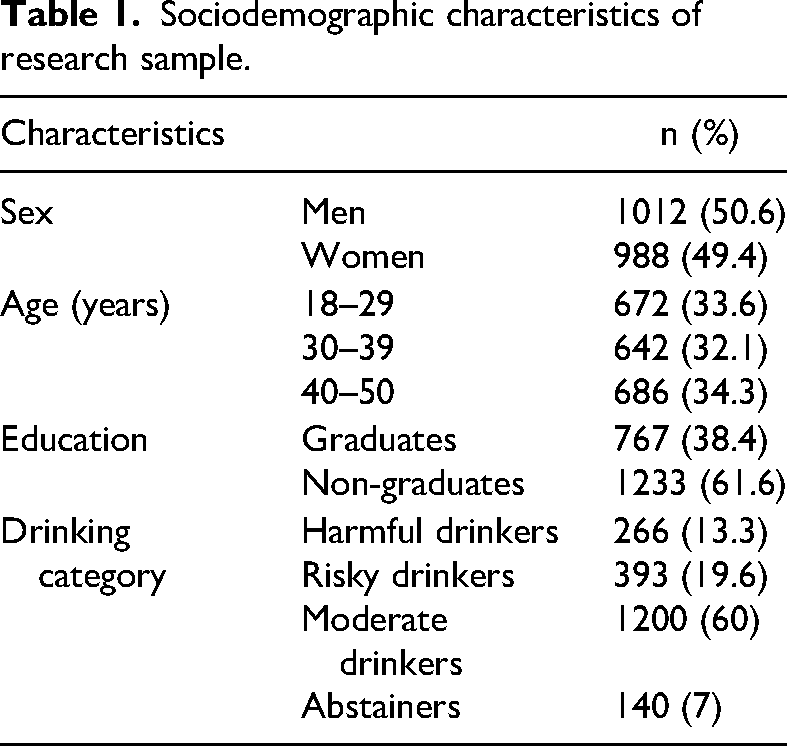
The data were sourced from a sample of 2000 Polish residents aged 18–50 years who were randomly selected from a probability-based web panel designed to represent the Polish population accurately. The survey was conducted in May 2022 by the research company TGM Research (tgmresearch.pl), with a response rate of 28%. The minimum age limit was set at 18 years, the legal age for purchasing alcoholic beverages in Poland, while the maximum age was capped at 50 years. This decision was based on data collected during the initial wave of COVID-19 in 2020, which indicated significant shifts in alcohol consumption among younger and middle-aged adults. The sample was stratified to represent all administrative provinces (voivodeships). Ethical approval for this study was granted by the Ethical Board of APS University (78/2022). The structure of the research sample is shown in Table 1.
Sociodemographic characteristics of research sample.
Survey
The survey explored various aspects of alcohol consumption, including motivations for drinking, actual consumption levels, online alcohol purchases and attitudes toward alcohol policy during the COVID-19 pandemic. The comprehensive research questionnaire consisted of 53 questions, all of which were mandatory to answer. On average it took 25 min to complete the survey. For purposes of the following analysis, only sections pertaining to alcohol consumption and online alcohol purchases were utilised.
The sample selection process involved drawing a sample that meets specified parameters and then sending an invitation to potential participants to join the study. To ensure the reliability of the responses, the survey included control questions designed to monitor respondent attention. On average, participants spent 25 min completing the survey. In addition, the data collection service implemented several measures to ensure data quality and respondent authenticity. These measures included CAPTCHA to verify that the respondent was human and not a bot, blocking mechanisms for AI-generated responses, Digital Fingerprint Technology to ensure response uniqueness and quality check questions. A Trust Score algorithm also flagged any respondents exhibiting typical straight-lining behaviour.
Outcome measures
The outcomes of interest were online alcohol purchases that occurred during the late phase of the COVID-19 pandemic in Poland (2021–2022). We examined three purchasing options: one involving online stores and two through mobile apps. The survey did not employ established questions on online alcohol purchases. Instead, we determined whether participants made such purchases through a series of follow-up questions: Please indicate whether, during the last 12 months, you: (a) purchased alcoholic beverages from online stores; (b) ordered alcoholic beverages from stores or restaurants for delivery using a mobile app, such as Uber Eats, Bold Food, Volt, Glovo, Pyszne.pl; (c) purchased alcoholic beverages with home delivery via a mobile app of a store or retail chain. Next, respondents were asked to specify the types of alcoholic beverages they purchased from each of the aforementioned online outlets. The response options included spirits (such as vodka, whisky, rum, gin, tequila), wine (including wine, prosecco, champagne) and beer. In the following questions, we also asked about price promotions and age verification when buying alcohol in Internet outlets. The question on age verification was formulated in the following way: When buying products online, were you ever required to verify your age using mechanisms such as an age gate or other adult verification processes? The question regarding price promotions was phrased as follows: During your online purchases, did you use any discounts or promotional offers?
Alcohol consumption and drinking behaviours
The volume of alcohol consumption was calculated using the Beverage-Specific Quantity-Frequency method (BSQF) (Sierosławski et al., 2016). The method is based on the aggregation of average consumption of three alcoholic beverage types: spirits, wine and beer. First, we assessed the frequency of drinking each of the beverage type. The questions were worded as follows: How often did you drink beer/spirits/wine in the past 12 months. Was it daily or almost daily, at least once a week, at least once a month or less often? Respondents answered using a scale with 10 levels that recorded the number of drinking occasions in the past 12 months. These levels ranged from daily, 5–6 days a week, 3–4 days a week, 1–2 days a week, 2–3 days a month, 1 day a month, 6–11 days a year, 2–5 days a year, a single day in the past12 months, to never in the past 12 months. In the next step, respondents indicated the number of bottles/cans/glasses of alcohol consumed during a usual drinking day. For example, in the case of beer, the question was phrased: How many bottles, cans or glasses of beer did you usually drink in 1 day when you drank beer during the last 12 months? In the next step, respondents indicated the average capacity of alcohol container. In the beer example mentioned above, the question was formulated as follows: What was the usual capacity of the bottle/can/glass? The answer options ranged from 250 mL, 330 mL to 500 mL. Having acquired this information from each type of alcoholic beverage, we calculated the quantity of pure alcohol consumed per drinking day. This was determined by dividing the individual's annual consumption of alcohol (calculated based on the specific quantity and frequency of beverage intake) by the number of drinking days reported over the past 12 months. As a rule of thumb, the intake of pure alcohol was capped at 500 mL per drinking day (equivalent to 394.5 g) and 182.5 L annually, to eliminate erroneous consumption values reported in the survey.
To determine drinking behaviour category, respondents were divided into four consumer groups as follows: abstainers; moderate drinkers: up to 14 units (10 g) of alcohol/week; risky drinkers: 15–35 units/week (women) and 15–50 units/week (men); and harmful drinkers: 36 + units/week (women) and 51 + units/week (men) (Bhattacharya et al., 2018; Bujalski 2021). In terms of the percentage distribution of consumer groups, moderate drinkers were the largest group of respondents (60%). Risky drinkers accounted for 20%, while 13% of respondents were categorised as harmful drinkers. Abstainers accounted for 7% of all survey participants.
Analyses
In order to assess whether respondents’ sociodemographic or drinking behaviours were associated with purchasing alcoholic beverages online, chi-square tests and binary logistic regression analyses were applied to each of the three types of online purchases (e-stores, food/delivery mobile apps, retail mobile apps). Data on sociodemographic characteristics including age, sex and education were obtained from respondents during the survey. The level of education was ascertained via a self-report question “What is the highest level of education you have ascertained?” Participants could choose from four answer options: (1) elementary, partial elementary or lower secondary; (2) basic vocational or incomplete secondary; (3) completed secondary, post-secondary or incomplete higher education; and (4) higher education. For the purposes of subsequent analyses, responses were dichotomised into a binary variable distinguishing between university graduates and non-graduates.
In logistic regression analyses, we reported adjusted odds ratios (aOR) and their 95% confidence interval (95% CI). The dataset was weighted based on the Statistics Poland data on provinces (voivodships), age and sex totals. Missing values were removed from the analyses.
Results
Although the majority of the survey respondents (93%) reported alcohol drinking in the past 12 months, we found that during the late stage of COVID-19 pandemic, purchases of alcoholic beverages in online outlets were made by relatively small group of consumers. Of the respondents, 19% were buying alcohol in online stores, compared to 17% of respondents purchasing alcoholic beverages through mobile food/delivery apps and 15% of respondents used retail mobile apps. Respondents often made purchases of alcoholic beverages using more than one channel of sale. More than half of the individuals buying online (12% vs. 19%) were making purchases through both food/delivery apps and retail apps. A comparable fraction tended to purchase alcohol in online stores and through food/delivery apps as well as in online stores and through retail apps (11%).
Each type of analysed online outlet had a distinct pattern of purchased beverages. In online shops, customers most often buy spirits (57%), then wine and, least often, beer. In contrast, those who were using food/delivery apps most often tended to purchase beer (60%), then spirits and lastly wine. In turn, those who were buying alcohol through retailers' mobile apps most often choose beer (58%), then wine and spirits.
Online shopping attracts customers with several price promotions. Taking advantage of discounts was relatively common in the surveyed sample, ranging from 69% in case of delivery apps to 75% for online stores. Buying alcohol online usually requires age verification at the time of purchase. The vast majority of respondents declared that age verification during alcohol purchases took place when using food/delivery apps and the retailer's app (68% and 67%, respectively).
Frequencies of using online outlets were tabulated by age group, sex, university graduation and drinking behaviour. As shown in Table 2, men were buying alcoholic beverages online more often than women (p < .001). Individuals aged 18–29 and 30–39 years would make online purchases slightly more often than the oldest group aged 40–50 years (p < .05). Graduated respondents did not significantly differ from non-graduates, except for e-store purchases. In turn, drinking behaviours have gradual patterns of purchase in all types of online outlets, showing that increased drinking translates to more frequent online alcohol purchases (p < .001).
Purchasing alcoholic beverages in different type of online outlets
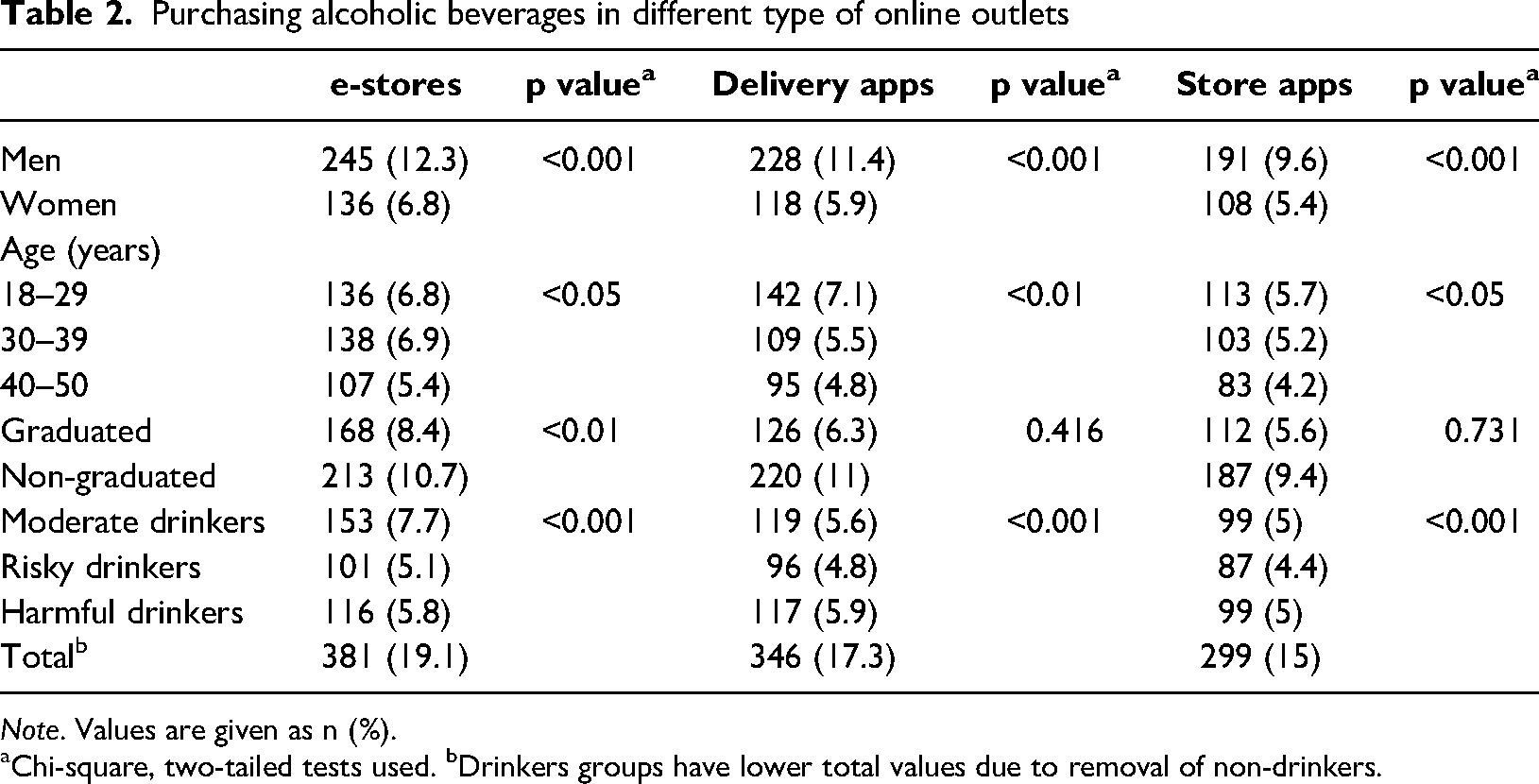
Note. Values are given as n (%).
Chi-square, two-tailed tests used. bDrinkers groups have lower total values due to removal of non-drinkers.
We developed six binary logistic regression models to investigate the effects of demographic and alcohol-related behaviour variables on online alcohol purchases. The odds ratios for both adjusted and unadjusted models are presented in Table 3. Purchasing alcohol beverages online can be predicted by sociodemographic variables such as sex and, to some extent, age and education as well. Interestingly, university education was predictive for online store purchases but no statistically significant effects were found for both delivery and retail applications. Notably, the data show that the odds of purchasing alcohol in all three online outlets were largely increased among harmful (OR 5.258–7.102) and risky drinkers (OR 2.370–3.145). The same was true when controlling for sex, age and education.
Univariate and multivariate analysis of online alcohol purchases.
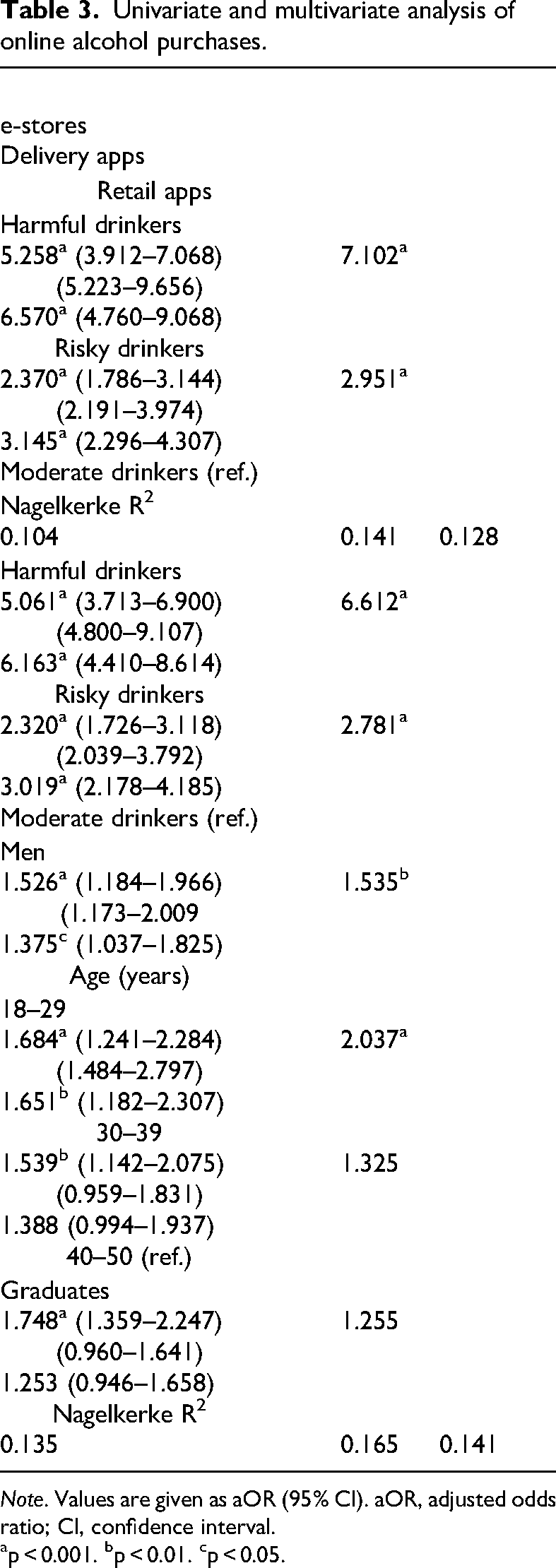
Note. Values are given as aOR (95% CI). aOR, adjusted odds ratio; CI, confidence interval.
p < 0.001. bp < 0.01. cp < 0.05.
Discussion
This study investigated the associations between sociodemographic characteristics, alcohol drinking and online alcohol purchases. In line with the existing literature, our findings suggest that online purchases are linked to extensive drinking, particularly when facilitated with mobile applications.
While most survey respondents reported drinking alcohol in the past year, the use of online channels for purchasing alcohol was relatively low. Specifically, approximately 20% of respondents purchased alcohol through online stores or food/beverage delivery apps, with some individuals using multiple channels. These findings contrast with studies showing accelerated levels of online alcohol sales during earlier COVID-19 lockdowns (Chartier et al., 2021; Colbert et al., 2021, 2023a; MacNabb et al., 2022).
As we expected, the study found that men buy alcohol online more often than women, and young people tend to purchase alcohol online more often than older consumers. Particularly high odds of using food/delivery apps were also found in the youngest group of consumers. In turn, alcohol purchases in online stores are most often made by men aged 30–39 years. These demographic differences match with trends identified elsewhere (Colbert et al., 2023a; Noel & Rosenthal, 2023; Williams & Schmidt, 2014). However, our study shows that education level was not consistently associated with purchasing across channels.
Perhaps the most critical issue found in this study was alcohol purchasing across all online channels strongly associated with higher-risk drinking behaviours. Regression models indicated risky and harmful drinkers had 2–3 times and 5–7 times higher odds, respectively, of using each channel compared to moderate drinkers. This aligns with previous studies reporting links between online delivery purchasing and hazardous drinking (Colbert et al., 2023a; Coomber et al., 2023; Huckle et al., 2021; Mojica-Perez et al., 2019). The results demonstrate that increasing economic and physical availability of alcohol, including through online outlets, can disrupt drinking behaviours and disproportionately enable excessive consumption among higher-risk consumers. This finding reinforces existing research on online alcohol delivery services and underscores the significant risk they pose. It is important that decision makers and public health authorities recognise these risks and act accordingly, even in the face of pressures from business organisations and the alcohol industry aimed at boosting sales and expanding distribution channels.
Moreover, distinct alcoholic beverage preferences were observed across the different online purchasing channels. Those using food/delivery apps and retailer apps tended to purchase beer more often, while online store purchasers favoured spirits and wine. This aligns with the notion that online stores enable stocking up on higher priced or quality products like wines and spirits, while apps facilitate impulse beer purchases tied to occasions like parties and other drinking occasions because of the convenient and fast delivery (Colbert et al., 2023b), as well as options for ordering food and meals.
On the other hand, purchasing alcohol through mobile apps circumvents the ban on selling alcohol to intoxicated individuals at retail locations. When alcohol is ordered through mobile apps, the delivery process complicates enforcement. Delivery workers, who complete the transaction at the customer's door, are not legally required to refuse delivery of pre-paid orders, even if the recipient is clearly intoxicated. This gap in the regulatory framework undermines long-standing efforts to curb excessive and harmful alcohol consumption.
What is of particular importance is that the likelihood of purchasing alcoholic beverages online or through mobile apps significantly increases with the level of alcohol consumption. Compared to moderate drinkers, risky drinkers are 2–3 times more likely to make such purchases, while harmful drinkers are 5–7 times more likely. This way of purchasing is also problematic because of the diffusion of legal responsibility of alcohol sales (Colbert et al., 2021; Coomber et al., 2023). Moreover, we found promotions and discounts highly prevalent across channels (with 69%–75% of individuals reporting using them), which is consistent with evidence that online alcohol retailers heavily utilise pricing incentives (Colbert et al., 2020, 2023b; Coomber et al., 2023; Williams & Schmidt, 2014). This marketing practice raises concerns given research linking promotions to purchasing greater quantities of alcoholic beverage (Coomber et al., 2023; Colbert et al., 2023a; Jones et al., 2015). Inadequate age verification at purchase was also an issue, especially for delivery/retail apps, creating accessibility risks for underage drinkers.
In the context of the wide evidence of decline in youth drinking (Kraus et al., 2018; Looze et al., 2015; Sierosławski, 2020), the move from stores to screens can be critical for producers and vendors of alcoholic beverages for future alcohol sales. However, on the basis of the current study, we cannot come up with conclusions on how mobile apps drive the evolution of alcohol drinking behaviours. More studies are needed to examine the effects of mobile technologies to promote alcohol consumption, including harmful drinking. This also means changing the lenses of scientific inquiry from focus on using mobile apps to reduce alcohol harm to exploring how mobile apps mediate alcohol harm.
Overall, the results of this study reinforce concerns that inadequate regulation of online alcohol marketing and sales may undermine public health efforts by increasing availability and access, particularly for vulnerable high-risk drinking groups. Promising regulatory measures, such as age verification, purchase/quantity limits, delivery trading hours and marketing restrictions, could help mitigate these risks (Colbert et al., 2021, 2023a). Future studies could explore how the shift from in-person to online alcohol purchasing creates new socio-technical networks. These networks include mobile devices, apps, delivery drivers, age verification systems and drinking spaces. In addition, research should examine how these networks facilitate new methods of accessing and consuming alcohol, potentially attracting new customers in a digital society.
The current analysis has several limitations that restrict the scope and applicability of our findings. First, the cross-sectional nature of the data analysis prevents us from drawing conclusions about the impact of lockdowns on the dynamics of online alcohol purchases. In addition, we did not evaluate the reliability of age verification systems used in online sales. Consequently, we cannot ascertain their effectiveness in preventing alcohol sales to minors based on this study alone. Furthermore, the generalisability of our findings is constrained. This limitation stems primarily from the relatively low response rate and the methodological limitations inherent in using a non-random Internet panel sample. Moreover, the specificity of the COVID-19 restrictions in Poland may mean that our results cannot be readily extrapolated to other contexts or countries.
Conclusion
This study has potential practical applications in the field of alcohol policy, as alcohol producers and trade organisations increasingly push for lifting the restriction on alcohol availability and acquiring new channels of sales. It shows that public health experts and decision-makers should consider Internet sales and delivery, particularly through mobile applications as a significant determinant of alcohol harm. Thus, in terms of public health interventions, it is essential to prevent any attempts to broaden the spectrum of alcohol sales, particularly those that offer prompt delivery to the consumer. There is a need for cooperation between companies and developers of mobile apps and public health experts to build app features that discourage risky and harmful drinking, enhance age verification, impede sales to intoxicated persons and provide limits to the amount of alcohol purchased at a single occasion.
Findings suggest that extending the physical availability of alcohol beverages to online and mobile sales correlate with harmful and risky drinking and therefore can amplify the amount of alcohol harm, especially among younger drinkers. Health authorities should consider restricting alcohol sales with prompt delivery through mobile applications. Future studies should continue exploring the associations of online and mobile alcohol purchases and extensive drinking and how numerous emerging features of mobile applications add to alcohol harm.
Footnotes
Declaration of conflicting interests
The authors declared no potential conflicts of interest with respect to the research, authorship, and/or publication of this article.
Funding
The authors disclosed receipt of the following financial support for the research, authorship, and/or publication of this article: This work was supported by the National Center for Prevention of Addictions (grant number 2330/8/11/2.1.2/H/2022/DBMWM/DBMWM/2020.).
