




Abstract
Across jurisdictions, legal frameworks of gambling regulations and measures to reduce gambling-related harm vary considerably. Among existing harm reduction measures, voluntary self-exclusion (VSE) programmes have been widely adopted. For gamblers who perceive they potentially have severe problems, self-exclusion from gambling is a viable option to take a time-out and reconsider their gambling behaviour and the harm it causes to them and others. VSE has been proven effective on the individual level (Devault-Tousignant et al., 2023; Drawson et al., 2017; Gainsbury, 2014; Kotter et al., 2018; McMahon et al., 2019; Motka et al., 2018) but VSE programmes as a measure to prevent psychological, financial and social harm to gamblers and their significant others at the population level are generally not well implemented and are typically under-utilised (Kraus et al., 2022).
In many jurisdictions, VSE regulations are limited to specific venue types (e.g., casinos, online providers). Excluded gamblers can simply go to another type of venue or website to continue gambling during the exclusion period. Even national or license-wide self-exclusion programmes can be circumvented by gambling with foreign operators that are not part of the self-exclusion system (Vincze, 2023). Once self-excluded, individuals’ non-compliance rates in most jurisdictions are high. For instance, in a German study, two-thirds of the sample restarted gambling within the first 6 months after VSE, and 26% of those who continued gambling after the ban were able to continue gambling in the excluded venues (Kotter et al., 2018). In another German study, in 16% of all access attempts by test players, no entry checks were conducted and 28% of gamblers who had self-excluded were reported to have gambled (Hayer et al., 2020). In Alberta, Canada, 77% of disordered gamblers reported having continued gambling at least 1 day within 3 months and 88% within 12 months after VSE enrolment (Yakovenko & Hodgins, 2021). In a recent study among a real-world sample of British online casino gamblers, 43.1% started to gamble again after a VSE. More specifically, 75.3% of the gamblers who opted for a short-term VSE (up to 38 days) started to gamble again during the study period (Hopfgartner et al., 2023). Furthermore, in Sweden, despite strict ID requirements for licensed gambling, 49% of self-excluders reported gambling with unlicensed providers (Håkansson & Komzia, 2023).
Other weaknesses that impair intervention uptake by affected gamblers are structural barriers that deter individuals from enrolment (Gainsbury, 2014; Motka et al., 2018). For instance, in many jurisdictions, individuals are still required to appear in person at each and every venue from which they wish to self-exclude (Thomas et al., 2016). Self-excluders frequently criticised venue staff's attitudes as not sensitive, encouraging or supportive (Hing et al., 2014), as well as the lack of follow-up process during self-exclusion and of additional clinical support (Ladouceur et al., 2000). Moreover, conflicting economic interests were recognised as impeding problem recognition by venue staff (Hing & Nuske, 2012; Kraus et al., 2023). To render existing VSE programmes an effective public health measure to reduce gambling-related harm, VSE utilisation would need to be substantially increased by reforming legal regulations and exclusion conditions (Kraus et al., 2023; Livingstone & Rintoul, 2020; Marionneau & Nikkinen, 2020).
The present study is part of a comparative analysis of gambling frameworks and VSE regulations in several high-income countries and states including Finland, Germany, Italy, Massachusetts (USA), Norway, Sweden and Victoria (Australia) (Kraus et al., 2022). These jurisdictions represent a broad spectrum of regulatory policies and implementations of VSE programmes. In short, the seven jurisdictions differ considerably in how gambling is regulated (state monopoly vs. license system) and VSE regulations (length and termination procedures, utilisation and the implementation of central registers to enforce exclusion). In their previous analysis, the authors concluded that implementation and enforcement of VSE varies with the jurisdiction's gambling policy on what is needed to balance gambling harm and gambling revenue (Kraus et al., 2022).
For the present analysis, we collected expert opinions on and experiences with VSE strategies. We aimed to assess gaps and needs regarding the current self-exclusion regulations and programmes in these jurisdictions. We saw interviewing experts from different sectors around gambling issues across various jurisdictions as an innovative approach that may help to improve VSE programmes by strengthening regulations and enforcement to minimise harm from gambling.
Methods
Survey
Experts from various sectors involved in gambling regulation, research, prevention and harm in Finland (FI), Germany (GE), Italy (IT), Massachusetts (MA, USA), Norway (NO), Sweden (SE) and Victoria (VIC, Australia) were surveyed about their opinions on and experiences with VSE strategies as well as perceived barriers and gaps of the current regulations in their jurisdiction. In each jurisdiction, principal investigators (PIs) informed representatives from (1) the research community (ResCom), (2) professionals in addiction help and care services (HeCaServ), (3) prevention (Prev), (4) the regulatory body (RegBod) and (5) employees of gambling providers (GamInd) about the survey and asked them to provide suggestions on possible participants.
The PIs from the seven jurisdictions were asked to recruit representatives from the five gambling-related sectors mentioned above. To ensure a broad range of experiences and opinions, we aimed to reach up to five representatives from each of the five sectors in each jurisdiction. Participation was voluntary and respondents were informed about the study's aims. They were requested to give written informed consent for using their anonymised responses for publication. After respondents had been introduced to the study, they were asked to indicate their working area. Participants who did not choose one of the five designated working areas had the option to specify the sector they were working in. These participants were labelled “Others”. An online questionnaire was created using SoSci Survey (Leiner, 2021) and made available to users through www.soscisurvey.de in the respective languages. The responses to the questionnaire in countries/states with languages other than English were translated into English by the respective investigator. The questionnaire was accessible between December 2020 and October 2021. The study was not pre-registered.
Questionnaire
The survey contained three types of questions: (1) questions to be answered on a visual analogue scale ranging from 1–10 (no – high agreement); (2) categorical questions to be answered with yes, no or do not know; and (3) open-ended questions along with a list of response options that allowed study participants to provide detailed feedback. The main topics were: (1) need for VSE for people with gambling problems; (2) importance of the option to self-exclude from gambling for people with gambling problems; (3) sufficiency of present regulations for VSE to effectively exclude enrolees; (4) improvements to increase VSE utilisation; (5) linking VSE with gambling help and care services; and (6) sufficiency of enforcement to guarantee enrolees’ exclusion from gambling. The interviewees were requested to comment on each question and express their opinion on particular measures such as a nation-/state-wide register, mandatory gambling cards, strictness of reinforcement, disincentives for those who continue gambling and other measures. For the complete questionnaire, see Appendix 1.
Analysis
Responses to the questions with visual analogue scales are reported as mean scores (M) and standard deviations (SD), and responses to categorical questions as a percentage of “yes” responses by jurisdiction. All calculations were based on “valid cases”, thus non-responses as well as “Do not know” answers were treated as missing values. The comments were narratively summarised or quoted verbatim. To contrast the responses from sectors with competing interests, we followed previous research (Kraus et al., 2023) and analysed the responses from representatives of the gambling industry separately from the remaining responses.
Ethical approval
In sites other than Victoria, collecting expert opinions on a voluntary and anonymous basis was not considered by the relevant ethics system to require ethical approval. In Victoria, ethics approval was granted by La Trobe University's Human Research Ethics Committee (reference number HEC20419).
Results
Overall, 102 invited individuals participated in the study. The distribution of respondents by jurisdiction and working area is shown in Table 1. While not every jurisdiction managed to successfully recruit participants from all sectors, the most substantial participant group (n = 38, 37.3%) was drawn from professionals actively involved in addiction support and care services.
Number of participants by sector and jurisdiction.
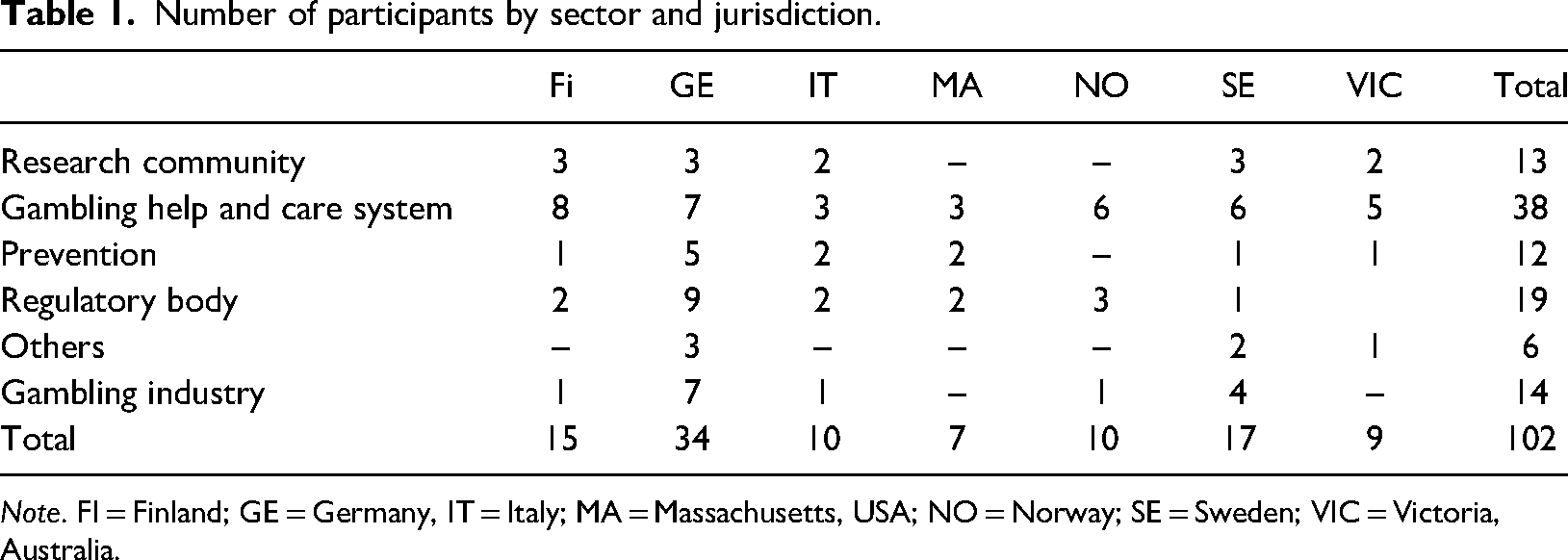
Note. FI = Finland; GE = Germany, IT = Italy; MA = Massachusetts, USA; NO = Norway; SE = Sweden; VIC = Victoria, Australia.
Need for VSE (programmes) for people with gambling problems
The participants from all jurisdictions widely agreed that VSE from gambling is a helpful measure. They concurred that VSE needs to be offered as a preventive step to all individuals experiencing gambling problems (range of mean scores [M] across jurisdictions: 7.5 [IT] – 10 [NO/VIC]) (see Table 2). Respondents from both addiction help and care services and regulatory bodies agreed on the necessity of VSE: “There is definitely a need for self-imposed gambling bans. All measures that help prevent and correct gambling harms, problems, and addiction are necessary.” [HeCaServ/FI] “Self-exclusion is an essential component to any programme that will respond to mitigating gambling-related harm.” [RegBod/MA]
Total opinion scores by jurisdiction (without responses from representatives of the gambling industry).
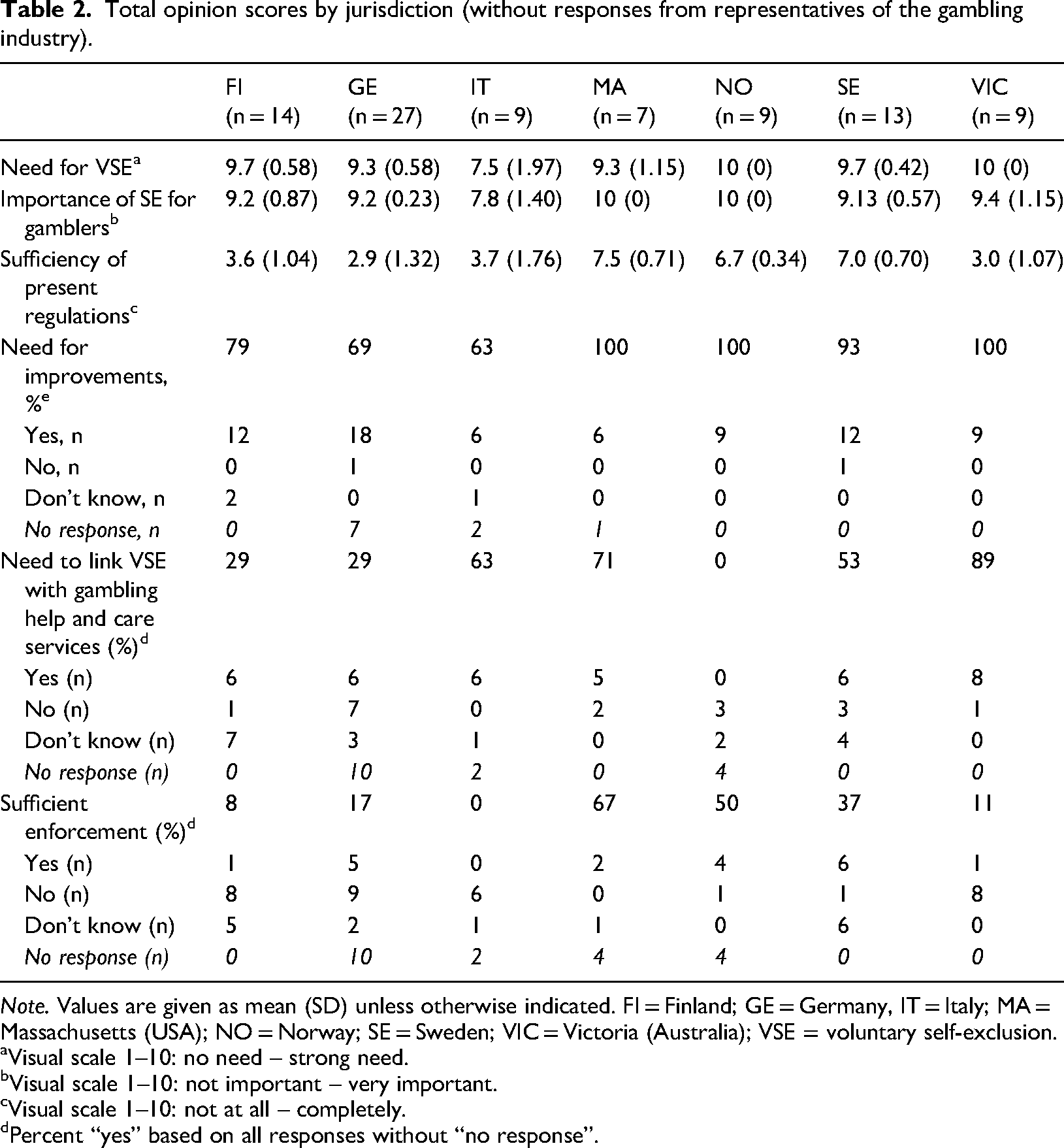
Note. Values are given as mean (SD) unless otherwise indicated. FI = Finland; GE = Germany, IT = Italy; MA = Massachusetts (USA); NO = Norway; SE = Sweden; VIC = Victoria (Australia); VSE = voluntary self-exclusion.
Visual scale 1–10: no need – strong need.
Visual scale 1–10: not important – very important.
Visual scale 1–10: not at all – completely.
Percent “yes” based on all responses without “no response”.
In many cases, the respondents cautioned against too high expectations, adding that VSE is not sufficient and needs to be supported by other measures: “Self-exclusions are not a solution, but a possibility to step out of gambling addiction.” [HeCaServ/GE] “Without [VSE], there would certainly be more problem gamblers. […] but [it is] not the main measure to combat gambling problems.” [ResCom/IT]
Respondents from Sweden and Norway emphasised the preventive function of VSE by pointing out: “It is a helpful strategy on all levels. As a […] preventive step for people that are concerned with their gambling, as well as a harm-reducing step for people with severe problems.” [HeCAServ/SE] “We know of people with gambling problems who have registered for self-exclusion on new offers of gambling they had never tried. Yet, there is a need for this kind of tool, but in addition to other tools (e.g., budget tools and maximum limits for losses).” [RegBod/NO]
Importance of the option to self-exclude from gambling for people with gambling problems
Participants from all jurisdictions also broadly agreed on the importance of VSE to keep individuals with gambling problems away from gambling (range of mean scores: 7.8 [IT] – 10 [MA, NO]) (see Table 2). For instance: “[VSE is] very important. It smoothes the process of taking a pause from gambling and helps people develop other habits for a period. It is definitely a help.” [ResCom/SE]
Some participants considered VSE to be an offer to gamblers to solve their gambling problems themselves: “Many gamblers refuse a longer counselling process or the initiation of rehabilitation and want to ‘first try it on their own’.” [HeCaServ/GE]
Respondents, particularly from the Nordic countries, mentioned the importance of not leaving VSE to the individual alone: “Being able to self-exclude is very important. However, the prevention of the harms of gambling must not be left to the individual alone, i.e., structures must support problematically and addictively playing gamblers even when they themselves are no longer able to limit their gambling.” [Prev/FI]
Sufficiency of present regulations for VSE to effectively exclude enrolees
The participants rated the sufficiency of existing regulations in participating jurisdictions much lower than for the perceived need or importance of VSE, and the variation of scores across jurisdictions was higher (range of mean scores: 3.0 [VIC] – 7.5 [MA]) (see Table 2). The main arguments for VSE not being sufficiently implemented were the ease of circumventing self-bans due to the absence of mandatory identification for all gambling in some jurisdictions,
1
excluded gamblers being able to gamble on unauthorised websites, the cumbrousness of banning procedures and the low utilisation of VSE: “Gambling self-bans are childishly easy to circumvent and remove.” [HeCaServ/FI] “[…] there is no mandatory identification for all gambling, which makes it impossible to self-impose a ban on all gambling.” [RegBod/FI] “[…] providers without concessions are not obliged to enable [VSE], thus they offer a valid alternative for problem gamblers.” [ResCom/IT] “[VSE is] not fail safe in keeping people off the gambling floor.” [RegBod/MA] “[There is] still a need for supervision to exclude the possibility to gamble on sites without a license. There are also several gambling forms that are not included in self-exclusion programmes.” [RegBod/SE]
Need for improvements to increase VSE utilisation
There was general agreement on the need for improvements, particularly regarding measures to increase utilisation of VSE (range of yes responses: 79% [FI] – 100% [MA, NO, VIC]) (see Table 2).
Initiation
Respondents mentioned the need to simplify the initiation process. Enrolment should be easily accessible and initiated rapidly via different platforms and in different settings. Gamblers need to be better informed about VSE and its benefits: “More information about the benefits of self-exclusion, for example, testimonies from gamblers who have been helped by self-excluding.” [ResCom/SE]
Respondents also called for more knowledge and training of venue staff on VSE and the process of assisting people to self-exclude. For instance, the recently implemented 24/7 option of remote VSE initiation, e.g., via helpline or live chats in Massachusetts by trained designated agents, has been welcomed: “[…] [one] can do it remotely, [you] don’t have to be at the casino, can do it 24 h a day. […] People can call the helpline and get the process done that way. People can also use live chat on the Massachusetts Council website […].” [HeCaServ/MA]
Others called for the possibility of online applications at the request of the gambler as well as of the gambler's family or an accredited gambling counsellor, with the latter two subject to independent decision-makers.
Length
Opinions on the desirable length of VSE varied considerably by jurisdiction. Many respondents opted for a permanent self-ban in addition to temporary bans of different lengths. Some argued for flexible temporary bans up to a lifetime, while others preferred a minimum length of 1 year and at least 5 years for people with moderate to severe gambling disorder. There were also calls for a rather flexible approach: “Self-exclusion should have a range of duration options, after which a review can be undertaken. Some people are put off by permanent self-exclusion or may only require a short break from gambling. Others require permanent self-exclusion.” [ResCom/VIC]
Critical voices recommended a cautious use of permanent exclusion. In Sweden, for instance, it can end after 12 months. “People in Massachusetts are not allowed to sign up for permanent exclusion until after completing the first term of self-exclusion, regardless of how long or short that is.” [HeCaServ/MA]
Termination
Termination regulations differ considerably between jurisdictions. Respondents from Germany criticised the regulation in force at the time of data collection
2
: enrolees needed to apply for termination by presenting a detailed assessment by a trained clinician. They opted instead for automatic termination as in most other jurisdictions. In Massachusetts termination of VSE is complicated by the fact that enrolees “[…] remain on the self-exclusion list until they complete their term and go through a re-instatement session. They could be on the exclusion list for [a] lifetime if they complete a 1-year term but don’t complete the re-instatement session.” [RegBod/MA]
The re-instatement session, however, was welcomed as it consists of an informal discussion on “[…] risks and responsibilities of gambling, [and] includes a plan in case the individual recognises that they are not able to control their gambling […].” [RegBod/MA]
However, this process caused controversy, as enrolees may forget to reinstate, or if they do, it takes time for the list to be updated. Respondents from Victoria opted for a stricter approach, suggesting there should be a minimum term before which revocation is not possible and clients should at least go through a termination process, such as an interview or sign in to an online portal: “Self-exclusion should be terminated only subject to effective demonstration of treatment interventions and with the agreement of the initiator.” [ResCom/VIC]
Extent
Respondents across all jurisdictions agreed on VSE and comprehensive bans for all forms of gambling, both online and land-based, for both governmental and commercial providers. Many mentioned the need for a nation- or state-wide register, and the possibility to block unlicensed companies. Central registers in Germany, Italy (only for online providers), Massachusetts, Norway and Sweden enable ID-based identification. A respondent from Victoria suggested: “A simple solution would be a gambler registration card with legally verified ID and linked to legitimate bank accounts. Without such a card, you could not gamble. Self-excluders would not get a card. Such a system would require a high-level automated database with strict privacy controls and should NOT be operated by the gambling industry.” [ResCom/VIC]
Training of gambling venue staff
Most respondents agreed on the importance of staff training in detecting suspicious behaviours. This includes training in motivational interviewing, sensitive conversation and approaches to such conversation. Respondents from Sweden called for major consequences for companies that neglect to intervene in the gambling behaviour of people who cannot afford to gamble or seem to have a serious gambling problem. “It should […] have major consequences for all companies and staff who have allowed or encouraged more gambling for someone who obviously cannot afford it or doesn’t feel good.” [HeCaServ/SE]
However, they also recognised the role conflict inherent in serving the companies’ interests and gamblers’ protection requirements. Norwegian participants reported that registered gambling providers offered training for employees. Victorian respondents were less enthusiastic about staff training and the effectiveness of potential interventions and preferred to first strengthen evidence if “[…] this would lead to interventions (at present this doesn't appear to occur), whether these interventions have effects, and what those effects are.” [ResCom/VIC]
Additional support
Respondents largely agreed that VSE as an exclusive strategy was not enough to help individuals with gambling problems but that corresponding support structures also had to be in place. In addition to treatment and support services, other forms of assistance may include financial counselling, prevention and community programmes, aftercare and specific programmes for ethnic minorities as well as education and support before resuming gambling after being excluded. Services also needed to be extended to weekends and evenings: “The Department of Public Health should ensure that there is a safety net of services available, spanning all the way from intervention to treatment. It's even more complicated when dealing with specific ethnic communities, […] the treatment system […] is non-existent for some populations and communities.” [RegBod/MA] “[…] patrons are generally left to their own devices following self-exclusion. A system of check-ins (e.g., SMS, phone calls) would enhance the efficacy of the restrictions in place. Formal registration systems (with limits applied) would allow self-exclusion to become more normalised, given that all gamblers would be required to apply limits and use the registration system.” [ResCom/VIC] “Aid to families with small, guaranteed loans to get out of debt.” [Prev/IT] “Treatment offered is usually of fairly short duration […]. Many gamblers want some kind of aftercare.” [HeCaServ/NO]
Visibility of VSE
There was general agreement among respondents from all jurisdictions that VSE options need to be made more visible and that “[…] operators should be required to make more prominent reference to exclusion programmes and inform customers […] [via] signage, digital display, websites etc.” [Others/VIC]
In Sweden and Norway, this is already required by law. Respondents from addiction help and care services called for a balanced approach by encouraging communication that avoided stigmatisation. This may be achieved by continuous communications campaigns, flyers or messages on each gambling product. Many respondents saw the potential for improvements.
Other measures
Other measures mentioned by the respondents include strong monitoring of the utilisation and effectiveness of VSE, legal action against providers who violate VSE regulations, mandatory self-tests for problem gambling before any gambling and exclusion initiated by others (third-party exclusion). Furthermore, providers should be obliged to inform the gambler how much money has been spent on gambling and national registration systems should be linked to an account for each gambler where the money for gambling and all winnings (if any) are deposited.
More generally, respondents argued that VSE should be an essential part of the treatment of people with gambling problems. Similarly, VSE should be conceived as a measure in the criminal justice system. For example, parole or probation officers should be given specific training on self-exclusion and VSE should be more available for individuals on probation or parole for gambling-related offences.
Need to link VSE with gambling help and care services
A link between VSE and gambling help and care services was strongly supported by participants from Italy, Massachusetts and Victoria, but less by respondents from Finland, Germany and Sweden, and none of the respondents in Norway (range of yes responses: 0% [NO] – 89% [VIC]) (see Table 2). Many respondents suggested optional offers of getting in contact with help services, for instance, a national support line, as many people who self-exclude wish to limit their gambling themselves without external help (FI, GE, SE). Mandatory links were thought to be potentially counterproductive; they could be stigmatising and deter activating self-exclusion to avoid having “trouble” with help services (FI, IT). In Finnish casinos, gambling customers with a self-ban are offered the opportunity to be contacted by an online help service. The enrolee is then contacted within 2 weeks. Respondents from Massachusetts perceived offering information to enrolees at the point of self-banning to be difficult: “[…] people are very emotional, don’t always hear what resources are available.” [HeCaServ/Mass]
Victorian respondents called for an automatic referral: “People self-excluding should be automatically referred to their local intake line for Gamblers Help. We know that cold referrals (giving someone a brochure) often don’t result in them following up with the service. Warm referrals [are] much more effective.” [HeCaServ/VIC]
The reluctance regarding linking VSE with gambling help and care services in Sweden and Norway reflects concerns about data protection and privacy policy issues.
Sufficient enforcement to guarantee enrolees’ exclusion from gambling
Only a minority of the respondents in Finland, Germany, Italy and Victoria considered enforcement to secure exclusion from gambling as sufficient, while half of the respondents in Norway and Sweden and two-thirds in Massachusetts rated enforcement as sufficient (range of yes responses: 8% [VIC] – 67% [NO]) (see Table 2).
Nation-/state-wide register
Only the Swedish, Norwegian and German registers cover both land-based and online gambling of licensed companies. In all other jurisdictions with an existing register (IT, MA, FI), participants mentioned its incompleteness and called for comprehensive coverage. Respondents from Finland saw the need to include all types of gambling in the existing register but cautioned that it would “[…] not [be] possible to create a register covering the whole of Finland (including Åland), because Åland has its own gambling system.” [RegBod/FI]
Respondents from Norway saw the necessity for an extension of the register beyond the monopoly to include other legal gambling options. All respondents from Victoria agreed that a state-wide register is imperative as VSE registration in Victoria only happens at the venue level and is not ID-based. Italian respondents demanded that the existing register “[…] should also be adopted for land-based games, beyond the single-casino level.” [HeCaServ/IT]
Mandatory card
The majority of respondents considered VSE only effective in combination with strict access control at land-based venues, ID checks at online logins or direct identification through identification cards when using EGMs.
In Sweden, however, “[…] such a card is not needed because you cannot gamble at any regulated company without identifying yourself with physical or electronic ID.” [ResCom/SE]
A similar response came from Norway where strict ID checks are also in place. A mandatory card was even considered obsolete: “The player's card is probably an outdated thing; however, a common player ID for all games would be an improvement. For instance, the gambler could get a complete overview of his/her gambling.” [RegBod/NO]
As a possible drawback, it was mentioned that gambling cards may be shared between friends or acquaintances. German respondents argued that mandatory identification raises questions about data protection and personal rights.
Respondents from Massachusetts commented that mandatory identification is “[…] highly unlikely to be implemented anywhere in the U.S. It would be much better if the casinos did full ID checks as people enter the gaming area.” [RegBod/MA]
In Italy, respondents proposed to use the national healthcare card for this purpose. Although there is no mandatory identification system for all people accessing gambling venues in Victoria, respondents agreed that “[…] without effective identification of gamblers, a system reliant on staff observation will always be prone to missing those breaching and will be ineffective.” [Others/VIC]
Strict enforcement
Enforcement was considered sufficient by two-thirds of the respondents in Massachusetts, half of the respondents in Sweden and Norway and considerably less than half in the remaining jurisdictions. The situation in Massachusetts is summarised in the following statement: “Right now, there is inconsistency in how often [the] self-exclusion list is checked. There are various ways that people provide information to the casinos. If someone checks in to the hotel at Encore, their name is not checked against the self-exclusion list. Encore could be checking their ID at the door, all three operators can run IDs through their systems, but these don’t connect to the self-exclusion list, but should.” [HeCaServ/MA]
In Sweden, respondents called for harsher penalties for those who violate the Gambling Act and criticised the insufficient implementation of legally possible controls. Similar statements of lack of control could be found in the comments from respondents representing regulatory bodies in all jurisdictions, despite it appearing to be well-known that: “[…] supervision is very important since gambling operators cannot be trusted.” [RegBod/SE]
In Norway, respondents from the regulatory body noted that the gambling providers were supervised by the authorities in how to deal with self-excluded gamblers who gamble. In Victoria, there are no penalties for venues that allow self-excluded people to gamble.
Disincentives for those who continue gambling
Penalising enrolees for breaching VSE was generally rejected by the respondents as most gamblers cannot afford even small fines – even small fines would worsen their situation. Most importantly, “[…] it would again transfer [the] responsibility to the player. […]. When it comes to compulsive gambling, fines have hardly any meaning other than that they further aggravate the situation of a gambler. They add both financial distress and shame.” [HeCaServ/FI]
Massachusetts takes a different approach: “People who have excluded can still go in and gamble. As long as they win less than $600 no one will know they are there. They could play any amount of money, as long as they don’t hit a major jackpot. […] This is why it is so important to frame the self-exclusion programme as recovery support.” [HeCaServ/MA] “takes away the incentive to try to get a big win. Hit the jackpot, but [when] the name is run through the database, they can’t take advantage of the gambler rewards programme.” [RegBod/MA]
Victorian respondents mentioned that disincentives exist but not consistently across venues: “[…] disincentives can also result in patrons being wary of self-exclusion in the first place. Requests to leave the venue are usually sufficient. In some cases, winnings are forfeited. However, this is not consistent.” [ResCom/VIC]
Other measures to improve the effectiveness
Recommendations for improving the effectiveness of VSE pertain to the unregulated market, which can serve as an alternative for suspended gamblers, and penalties on providers not complying with VSE regulations. According to Swedish respondents, the system is efficient but might be improved by “[…] tightening up the gambling regulation so that online gambling companies without a license, and not partaking in the Spelpaus VSE register, are kept out of the market.” [ResCom/SE]
In Victoria, independence between the gambling industry and the self-exclusion process was called for. But also “[…] strict enforcement of penalties on providers for not enforcing exclusion orders, allowing third parties to initiate exclusions and greater promotion/advertising of available options would greatly improve the effectiveness of exclusion programmes. Make the process to complain about VSE easier — both at the venue, within the VSE programme and at a regulator level.” [ResCom/VIC]
Responses from representatives of the gambling industry
While the responses of the representatives of regulatory bodies generally match the responses from the representatives of the other sectors, contradicting statements were found in some of the responses from representatives of the gambling industry. While the comments from the gambling industry in Finland, Norway and Sweden generally support the recommendations for improvements from the other sectors, German respondents saw the existing requirements for terminating a ban as a substantial hurdle for gamblers to self-exclude: “The very restrictive requirements for lifting the ban, especially the requirement to submit an expert opinion from a psychologist/psychiatrist, often act as a deterrent for players. A temporary ban, as provided for in the [2021 revision of State Treaty on Gambling], is a step in the right direction.” [GamInd/GE] “Locks must be lifted on a simple application. Excessively high standards such as psychologists’ reports are counterproductive.” [GamInd/GE]
They also asked for more guidance during the games: “More advice when playing in the game. VSE, 10 golden rules, self-test, nearest counselling centre [….]. Before the start of the game, complete [a] self-test on the device.” [GamInd/GE]
Identification with or without a player's card was commented on as “ambivalent”, “urgently needed” or “Legal gambling must not be covered with too many bureaucratic obstacles, otherwise the player will inevitably flee to illegal providers who do not take any protective measures at all.” [GamInd/GE]
Italian representatives of the gambling industry were not in favour of involving social and healthcare workers in the process of addressing gamblers with gambling problems on gambling sites: “Contacting the gambler is useful but it should not be done by social and health workers who have a prejudice about gambling. If they are neutral, they can certainly improve the efficacy of supportive therapy.” [GamInd/IT]
Mandatory identification with a player's card was claimed to conflict with the right to freedom: “The gambler must be adult (18+) and this is the necessary and sufficient condition to exercise his right of freedom. It would not help on the core issues of problem gambling.” [GamInd/IT]
Norwegian gambling industry representatives emphasised the option for gamblers to exclude also from single providers and particular types of gambling: “There should be a common self-exclusion register for the gambling providers in the monopoly model, where those who want to, can self-exclude from gambling across all gambling providers by a single keystroke. This should come in addition to good self-exclusion schemes for each of the gambling providers.” [GamInd/NO]
Linkage with gambling care services was considered voluntary and the act of self-exclusion by gamblers was not necessarily seen as a sign of gambling problems: “I think the gambler should be made aware of the help services available. […]. When a gambler takes a pause from gambling, it does not necessarily imply that he/she has problems, it may just as well mean that the gambler is in good control of [his/her] own expenditures […].” [GamInd/NO]
Discussion
The responses and comments of the participants clearly express the need for and importance of VSE programmes in the participating jurisdictions. VSE regulations at the time of the survey were not considered sufficient in any of the jurisdictions, and the respondents suggested potential improvements. However, there are differences in the degree of the expressed sufficiency and effectiveness of VSE across jurisdictions. Overall, the respondents’ perceptions correspond with the scope of VSE implementation in the participating jurisdictions, as reported in a recent analysis of VSE regulations in these jurisdictions (Kraus et al., 2022). VSE programmes are perceived as more effective in jurisdictions where harm reduction is prioritised as a public health objective.
The participants’ comments on improvements to increase VSE utilisation differ in large part according to the jurisdiction's regulations. Commonalities of recommendations are the focus on simplifications of the initiation process, improvement in the training of staff involved in VSE, more flexibility in the length of bans, but keeping a minimum duration and raising the visibility of VSE options. Recommendations for terminating exclusion vary between bans ending automatically at the end of the term and calls for a stricter revocation process including a written application or demonstrating participation in professional counselling or treatment interventions. Technically, exclusion needs to be controlled by a comprehensive register, ID identification or mandatory gambling cards for gamblers.
The crucial question identified by the respondents is how to inhibit self-excluded individuals from circumventing VSE. Studies from Canadian provinces (Cohen et al., 2011), Australia (Pickering et al., 2018), Sweden (Håkansson & Åkesson, 2022) and Germany (Hayer et al., 2020) showed that breaching VSE by self-excluded individuals is rather common. With no or incomplete national VSE registers, individuals who are self-excluded cannot be prevented from circumventing their VSE. In some jurisdictions (FI, MA, VIC), online providers are not included in the VSE system. Although in Germany's, Italian's (online only), Norway's and Sweden's licence systems a substantial share of the online market is covered, there is still the opportunity for self-excluded individuals to continue gambling with unlicensed companies. A recent meta-analysis reported a strong association between continuous-play formats in online gambling and gambling disorder (Allami et al., 2021). This does not only imply the need for targeted prevention strategies or stronger regulations but also highlights the need to integrate the unlicensed online market into existing VSE systems. However, there have been questions about whether national or license-wide self-exclusion systems can close this gap (Vincze, 2023). Because current self-exclusion solutions are not able to sufficiently block self-excluded gamblers from continuing to gamble, Vincze (2023) argues for the implementation of a global self-exclusion system that allows individuals to block their access to virtually all legitimate online gambling opportunities worldwide. The fact that in the eyes of most respondents, violations of VSE cannot be solved by imposing fines on gamblers whose situation is already precarious, underscores the need for a far-reaching and functioning ban system.
The majority of respondents in our study agreed on the need for additional support of self-excluders in the form of treatment, support services, financial counselling or community aftercare programmes. Studies investigating the effectiveness of counselling or treatment in addition to VSE are scarce. Nelson et al. (2010) reported that self-excluders who engaged in treatment or self-help groups showed more positive outcomes than those who did not. However, a longitudinal assessment comparing non-excluders receiving counselling with two groups of self-excluders (one receiving counselling and the other not) found that all three groups improved on a variety of measures over time (Hing et al., 2015).
Although most respondents stressed the need for venue staff training in detecting problem gamblers, it may not be effective. Previous studies indicated a strong conflict of interest among staff members which – in addition to low pay, little education and fear of negative consequences for approaching affected gamblers – renders the approach in some jurisdictions questionable (Kraus et al., 2023; Riley et al., 2018).
As expected, some comments of the representatives of the gambling industry – although not complete and representative – were less supportive of stricter regulations and enforcement of VSE regulations and criticised overregulation of VSE. This includes that individuals willing to self-exclude should be able to choose to self-exclude from single gambling providers as well as from specific forms of games. They argued for the individual's right of freedom and being an adult (age 18+ years) as necessary and sufficient conditions for gambling. A gambler's choice to VSE was not necessarily considered to imply a gambling problem but rather that the gambler is in control of his or her behaviour. Moreover, too many bureaucratic obstacles to legal gambling options would lead gamblers to inevitably move to illegal providers who do not provide any protective measures. Restrictive requirements for terminating VSE were considered to deter problem gamblers from self-excluding from gambling. Finally, there is the dilemma of conflicting interests between individuals experiencing gambling problems and gambling providers, a dilemma that can only be balanced by comprehensive VSE regulations controlled by independent bodies rather than by the providers themselves (Kraus et al., 2023).
Our results are in line with earlier qualitative studies showing that, although VSE is generally viewed as an effective individual gambling harm minimisation strategy, there are many barriers and limitations to current self-exclusion programmes and there is a need for holistic approaches to prevent problem gamblers from harming themselves by continuing gambling (Devault-Tousignant et al., 2023). These findings are extended by emphasising the gaps in VSE programmes in specific high-income jurisdictions with different VSE regulations and contrasting the opinions of different sectors aiming to protect gamblers from harming themselves with those from representatives of the gambling industry. To make VSE an effective measure, we recommend strict ID checks based on nationwide VSE registers such as in Norway, Sweden and, recently, in Germany. These registers need to include all licensed land-based and online gambling offers. To improve acceptance, initiation must be simple and not stigmatising, and termination straightforward and unbureaucratic. Ideally, VSE in combination with counselling and treatment offers should be propagated and managed as an exit strategy without an alternative.
Limitations
Participation in this study's survey was voluntary. Participants were individually selected by the PIs or suggested by the contact individuals in the five sectors, so we do not claim representativeness of the sampled individuals and their comments. As the respondents are unevenly distributed across sectors, and respondents from some sectors are missing, comparisons between jurisdictions and sectors would be unreliable. In addition, the number of gambling industry representatives included in the sample is small and may not fully represent the views of the gambling industry. The means of the visual scale and the percentage of yes answers should be interpreted as approximations rather than exact statistics. Nevertheless, the comments cover a broad range of barriers and gaps in VSE in the participating jurisdictions and provide important information on gaps and needs for improvements. The survey data cannot cover major changes in regulations that have come into force since the respondents answered the survey (as was the case in Germany and Finland). Finally, we would like to mention that the interpretation of the data represents the view of the authors.
Conclusions
The results of our study revealed drawbacks in the implementation of VSE in some of the participating jurisdictions, such as the need for simplifying the initiation and termination process, allowing flexible VSE periods, and increasing staff training. The results also raise questions about the effectiveness of VSE as a measure to sufficiently prevent vulnerable or addicted players from continuing to gamble. Existing VSE systems do not put sufficient emphasis on preventing self-excluded gamblers from accessing foreign or unlicenced online operators. Even nationwide, multi-operator self-exclusion programmes may not safeguard against breaches by gamblers who are self-excluded. Much of the web-based gambling market is still illegal and not included in any VSE system. Views on whether there is a need to link those signing up for VSE to gambling disorder counselling and treatment varied substantially across jurisdictions.
Supplemental Material
sj-pdf-1-nad-10.1177_14550725241264628 - Supplemental material for Voluntary self-exclusion from gambling: Expert opinions on gaps and needs for improvement
Supplemental material, sj-pdf-1-nad-10.1177_14550725241264628 for Voluntary self-exclusion from gambling: Expert opinions on gaps and needs for improvement by Ludwig Kraus, Andreas M. Bickl, Matilda Hellman, Veera E. Kankainen, Johanna K. Loy, and Marieke Neyer in Nordic Studies on Alcohol and Drugs
Footnotes
Acknowledgements
The authors would like to thank Dr Larissa Schwarzkopf for her valuable comments on earlier drafts of the paper.
Declaration of conflicting interests
The authors declared no potential conflicts of interest with respect to the research, authorship, and/or publication of this article.
Funding
The authors disclosed receipt of the following financial support for the research, authorship, and/or publication of this article: The study was conducted within the framework of the Swedish programme grant “Responding to and Reducing Gambling Problems – Studies in Help-seeking, Measurement, Comorbidity and Policy Impacts (REGAPS)” and the “Bavarian Coordination Centre for Gambling Issues” (Landesstelle Glücksspielsucht Bayern (LSG)). REGAPS received funding from the Swedish Research Council for Health, Working Life and Welfare (Forte; grant number 2016-07091). The LSG was funded by the Bavarian State Ministry of Public Health and Care Services. The State of Bavaria provides gambling services (lotteries, sports betting and casino games) within the State gambling monopoly via the State Lottery Administration and provided funding for the Bavarian Coordination Centre for Gambling Issues as an unrestricted grant. JCÖ, LK, RR, RV, SR and TN were supported by the Forte grant and LK, JKL, AMB and MN by the Bavarian State Ministry of Public Health and Care Services. Funding for VEK and MH stems from a cooperation contract with the National Institute for Health and Welfare. The money is originally debited from the gambling monopoly retrospectively by the Finnish Ministry of Social Affairs and Health according to section 52 in the Lotteries Act; IR was supported by the Norwegian Institute of Public Health.

Supplementary material
Supplementary material for this article is available online.
Notes
References
Supplementary Material
Please find the following supplemental material available below.
For Open Access articles published under a Creative Commons License, all supplemental material carries the same license as the article it is associated with.
For non-Open Access articles published, all supplemental material carries a non-exclusive license, and permission requests for re-use of supplemental material or any part of supplemental material shall be sent directly to the copyright owner as specified in the copyright notice associated with the article.
