



Abstract
Gambling and digital gaming are both growing in popularity online, providing 24/7 access to these activities (Delfabbro & King, 2020; Kim & King, 2020; Kolandai-Matchett & Wenden Abbott, 2022). Both are heavily marketed online, and the businesses are growing globally (Siemens et al., 2015; Sulkunen et al., 2018; Torrance et al., 2021). Research shows that online advertising of gambling and gaming is strategically targeted and thus difficult for users to avoid (Newall et al., 2019; Nieborg, 2016; Torrance et al., 2021). Advertising through mobile platforms and apps, including social media, is typically interactive and prompts user engagement by influencing perceptions and intentions to engage in gambling or gaming activities (Bouguettaya et al., 2020; Nieborg, 2016). These industries are also looking for new models and profit opportunities (Kim et al., 2023; Rockloff, Browne et al., 2020). One particular result has been the convergence of gambling and gaming.
Gambling and digital gaming differ significantly, despite their similarity in offering entertainment via games. In gambling, players risk money, assets or value in hopes of winning something of value in return (Reith, 2002). Digital gaming, on the other hand, is a broad category encompassing video games, computer games and mobile games. Digital games gained widespread popularity in the early 1970s with the rise of mass-produced arcade video game machines, such as Computer Space (published in 1971) (Ivory, 2015; Malliet & De Meyer, 2005). The development of gaming consoles and home computers further accelerated their popularity, with mobile games recently experiencing a surge in popularity (Mäyrä, 2015). Video games themselves offer a diverse range of genres, including action, sports, racing, strategy and adventure games (Arsenault, 2009). The goals of digital games vary depending on design, but usually involve entertainment, problem solving, competition or socialising (Errity et al., 2016).
Due to the development of technology, the business model of digital games has changed. For decades, the main model was pay-to-play. For example, users paid for their game at the arcade hall or bought a physical or digital copy to play at home. More recently gaming via subscription has enabled users to access large libraries of games with a monthly or yearly fee. Over the past 15 years, major video game companies have adopted the free-to-play business model at an increasing rate (Chew, 2016; Davidovici-Nora, 2013). This model is particularly convenient for the market where over 50% of its revenue consists of mobile games (Wijman, 2022). In the free-to-play model, the core gameplay is offered at no cost; however, players have the option to acquire extra functionalities, in-game assets or aesthetic enhancements by spending actual money (Zendle et al., 2023). According to some estimations, in mobile games over one-third (38%) of the revenue comes from the 1% consisting of the most active spenders (Zendle et al., 2023).
The convergence of gambling and gaming is evidenced by the introduction of digital gaming themes and features within gambling games, and vice versa, gambling features and themes within digital games (Kim & King, 2020). Gamification has long been a part of gambling businesses, but the gambling industry is looking for new ways to attract and retain new customers, especially younger gamers (Delfabbro, King et al., 2020). Gaming-like gambling involves the use of digital or other gaming formats within the context of gambling. The introduction of features of traditional arcade games and television game shows to electronic gaming machines (EGMs) exemplifies this integration of gaming into gambling (Gainsbury et al., 2015). Gamblification of digital gaming is the other side of the story, related to a change in games’ revenue model (Johnson & Brock, 2020). Microtransactions have risen in popularity during the last decade, as game developers have provided players the possibility to purchase in-game items that offer cosmetic value, increase their chances of success (pay-to-win) or give random rewards (loot boxes) (Xiao et al., 2021; Zendle et al., 2020). Loot boxes – containers that hold a range of items or abilities that enhance performance and progression in the game – are perhaps the most obvious gambling feature within digital games (Brock & Johnson, 2021; Li et al., 2019; Rockloff, Russell et al., 2020; Wardle, 2021). Some digital games include built-in gambling-affording environments, such as simulated casinos where players may enter to place bets when in the game (Hing, Browne et al., 2022). Other types of gambling-like gaming also take place within digital games. Placing bets on competitive forms of digital gaming, or e-sports, for instance, is an emerging trend that bears a resemblance to more traditional sports betting (Gainsbury et al., 2015; Macey & Hamari, 2018).
A meta-analysis on forms of gambling in the adult population shows that Internet gambling poses the highest risk for problem gambling (Allami et al., 2021). The development of the Internet and social media has created new phenomena around gambling and gaming. Studies have found a virtual ecosystem that supports online gambling behaviour, including a wide range of virtual casinos and gambling communities that are able attract many gamblers and keep them motivated to continue gambling (Oksanen et al., 2021; Savolainen, Sirola et al., 2022; Sirola et al., 2021). Offshore gambling (i.e., gambling on unregulated gambling websites and online casinos) has also been discussed recently (Gainsbury et al., 2018; Hing et al., 2021). Recent studies have associated gambling on offshore gambling websites with greater problem-gambling severity (Gainsbury et al., 2018; Hing et al., 2021; Oksanen et al., 2022). Out of more traditional forms of gambling, EGMs indicate highest risk potential (Allami et al., 2021; Castrén et al., 2018; Delfabbro, King, Browne et al., 2020; Dowling et al., 2005). Rapid continuous-play games that allow the gambler to engage for prolonged amounts of time are considered most harmful (Allami et al., 2021; Castrén et al., 2018: Harris & Griffiths, 2018). In contrast, rather low-paced forms of gambling, such as weekly lotteries, are perceived as less harmful (Binde et al., 2017; Salonen et al., 2020).
Studies investigating risky digital gaming have mostly concentrated on massively multiplayer online role-playing games (King et al., 2019; Melodia et al., 2020). These games tend to require a lot of time and dedication, and players who play a lot tend to have lower well-being (Kirby et al., 2014). In particular, escapism-motivated players can be drawn into these kinds of immersive games, in contrast to simple platform games (Larche et al., 2021). Other game types are far less studied from the perspective of their addictive harm potential. If anything, the focus has been more on how violent or reckless behaviour in games might provoke similar behaviour in the real world (e.g., Burkhardt & Lenhard, 2022; Chang & Bushman, 2019; Fischer et al., 2009) rather than the addictive risk potential of these games. However, recent developments in the gamblification of gaming have intensified the discussion. For example, some mobile games incorporate features reminiscent of gambling, employing mechanisms such as near-misses or frequent reinforcement. These elements are known to elicit frustration among players and can intensify the desire to continue playing (e.g., Larche et al., 2017). In addition, mobile gaming companies often have the ability to gather and analyse customer data for user profiling, enabling customisation of the gaming experience for commercial purposes. This practice is similar to the strategies employed by online gambling operators (Zendle et al., 2023).
Purchasing and opening loot boxes is associated with gambling problems, especially among younger gamers (Brooks & Clark, 2023; González-Cabrera et al., 2022; Hing, Rockloff et al., 2022; Rockloff, Russell et al., 2020; Spicer et al., 2022). Studies have also associated microtransactions with gaming and gambling problems and suggest that the key factor in this association is the frequency of payments (Gibson et al., 2022). Based on a recent systematic review, this applies to loot box expenditure above other forms of microtransaction, and increased spending on loot boxes also increases the risk for gaming and gambling problems (Raneri et al., 2022). Similarly, a study by Syvertsen et al. (2022) investigated issues related to mobile gaming of young individuals and observed that a majority of participants reported playing free-to-play games, indicating probable exposure to in-app purchase options. The study found that participants who identified as problem gamers were more likely to report making in-app purchases (Syvertsen et al., 2022).
This study
The convergence of gambling and gaming necessitates an analysis of risk factors for gambling and gaming problems in the general population. Longitudinal research on the risk of different gaming types (Allami et al., 2021) and novel game features such as loot boxes (Spicer et al., 2022) and micro-transactions (Gibson et al., 2022) is also lacking. It is also important to investigate the types of games played and the platforms used for gaming. For example, prior studies have shown that mixed platform gamers (i.e., those who use more than one platform to game) report increased problems due to gaming (Syvertsen et al., 2022).
The aim of this longitudinal population study was to fill these existing gaps. First, we aimed to assess the risks of different types of gambling and gaming. Second, our study aimed to investigate especially longitudinal within-person effects of gambling and gaming activities on problems caused by gambling and digital gaming. These aims respond to the current need for longitudinal research on risks of both gambling and gaming. The study contributes to the discussion of gambling and gaming as unique activities as well as their converging risks. Our research questions (RQ) were as follows:
The context of our study is Finland, which provides an interesting setting for investigating both gambling and gaming. Gambling is highly prevalent in Finland with 78% of the 15–74-year-old population having gambled during the past year. Finland currently has a state-controlled monopoly for gambling, but the situation will change in the near future due to projected implementing of the new licensing system for online gambling in 2026. One of the background reasons of the new licensing system has been the current offshore gambling, which has been associated with gambling problems in prior research (Hagfors et al., 2023). In addition, Finnish people's attitudes toward gambling have shifted in the last decade, latest reports reflecting slightly more negative attitudes in 2019 than in 2015 (Salonen et al., 2020). Digital gaming is widespread in Finland, which also serves as a hub for the industry. Most notably, Finnish gaming companies have created hugely popular games such as Angry Birds, Clash of Clans, Max Payne, Alan Wake and Cities: Skylines. Approximately 80% of Finns play digital games (Kinnunen et al., 2022). Prior studies have not focused on extensively investigating types of gambling and digital gaming in relation to combined risks of the two, but there is an association between gambling and gaming problems (Savolainen, Vuorinen et al., 2022).
Methods
Participants
The longitudinal survey study was based on a representative sample of 18–75-year-olds from mainland Finland (n = 1530). The sample was collected in April 2021 (time point 1, T1) and the response rate was 31.32%. Data collection was carried out by Norstat Finland utilising an Internet-based platform. Participants were recontacted in 6-month intervals in October–November 2021 (T2, n = 1,198), April–May 2022 (T3, n = 1,100) and October–November 2022 (T4, n = 1,008). Our study includes participants who took part in all four time points (58.95%, n = 902). They were 52.11% male, 47.56% female and 0.33% other genders. They were aged 18–75 years at T1 (M = 50.25, SD = 15.51) and from all regions of mainland Finland (37.25% Helsinki-Uusimaa region, 19.96% Southern Finland, 23.39% Western Finland, 10.75% Eastern Finland and 8.65% Northern Finland).
Based on a non-response analysis, those who took part in all four time points were older than the original T1 participants (mean age 50.25 years vs. 46.67 years). We found no major dropout based on gender, geographical area, education, income, marital status or occupational status. However, there were fewer at-risk gamblers in the final sample than in T1 based on a Problem Gambling Severity Index (PGSI) score of 5 or more (7.72% vs. 9.48%). In this respect, our final data are close to official estimates of the proportion of at-risk gamblers in Finland (Salonen et al., 2020). Considering the general Finnish population, our sample does not include any major biases, except the bias caused by dropout of young participants (Oksanen et al., 2022). Analytical weights were used to correct these deviations.
Procedure
The study protocol was assessed by the Ethics Committee of the Tampere Region in March 2021 (statement 24/2021). No ethical issues were found. Participation was voluntary, and the study complied with the European Code of Conduct for Research Integrity and the General Data Protection Regulation of the European Union. Participants were voluntary and they were informed about the aims of the study. Participants were not directly financially compensated, but they received an incentive compensation in the form of Norstat coins which can be redeemed for gift cards or donated to charity.
The research group designed the study and the survey. The survey was focused on gambling and digital gaming but also inquired about other activities, such as social media and Internet use. Questions concerning gambling and gaming were in the separate sections of the survey. Further measures included participants’ mental well-being and social relationships. As the interval of the survey was 6 months, the participants were typically asked about their activities during the past 6 months. The median response time for the survey was approximately 15 min, T1 being longest, as it included more background variables and questions about COVID-19 that were not remeasured in the other surveys. A translation and back-translation procedure was applied for measures that were not previously used and validated in Finland.
All participants filled out the survey online. After each data collection phase, we reviewed the data in accordance with the project's data-quality protocol stored on the Open Science Framework website before data collection. Rapid-response checks, attention checks, patterned-response checks and nonsensical-response checks were conducted (Curran, 2016; Pickering & Blaszczynski, 2021).
Measures
At-risk gambling was measured with the nine-item PGSI, which has been widely used as a general population screener for excessive gambling, and it has been used extensively in Finland (Castrén et al., 2013; Raisamo et al., 2015; Salonen et al., 2020). The scale had excellent internal consistency in our study, according to McDonald's omega coefficients (T1: ω = 0.94, T2: ω = 0.93, T3: ω = 0.94, T4: ω = 0.94). We used a PGSI scale (potential range of 0–27) as categorised in this study with 5 points or more indicating at-risk gambling. We also report in the descriptive findings the share of those reporting 8 points or more in the PGSI. In the literature, a score of 5 points or more is considered the least moderate risk, and 8 or higher as problem gambling (Currie et al., 2013).
At-risk gaming was measured with the 10-item Internet Gaming Disorder Test (IGDT), which has been considered a reliable instrument for evaluating Internet gaming disorders (Király et al., 2017). The IGDT has been previously used in Finland (Männikkö et al., 2019; Savolainen, Vuorinen et al., 2022). It contains ten statements about gambling problems with answer options 0 (never), 1 (sometimes) and 2 (often). The scale had good internal consistency, ranging from good to excellent (T1: ω = 0.87, T2: ω = 0.90, T3: ω = 0.88, T4: ω = 0.89). For this study, we used the scoring system suggested by Király et al. (2017) and based on the fifth edition of the Diagnostic and Statistical Manual of Mental Disorders. The most severe response option (often) gives risk points for each item, except for items 9 and 10, which together only give 1 point at maximum. This results in a scale of 0–9. The mean score of the IGDT was very low in our data. Those who reported at least some symptoms of Internet gaming disorder (a score of 1 or more) were categorised as at-risk gamers. We also report in our descriptive findings the share of those participants who likely have an Internet gaming disorder. Kiraly et al. (2017) suggested 5 points or more in the IGDT as a cutoff for disordered gaming.
The survey included questions about game types played during the past 6 months. The gambling section asked about types of gambling games, including the following: (1) online casino games (e.g., fruit slots); (2) online poker; (3) offline casino games (e.g., poker, roulette, blackjack) at gambling venues; (4) betting on sports or horse racing; (5) EGMs; (6) lotteries; (7) scratch cards; (8) private betting (e.g., in card games); and (9) games of skill for money. Response options were “never”, “less than monthly”, “monthly”, “weekly”, “once a day” and “several times a day”. Dummy variables for monthly activity were created for each game type.
The section of the survey concerning digital gaming asked about types of digital games played during the past 6 months: (1) action and adventure games; (2) fighting and shooting games; (3) platform games; (4) puzzle games; (5) racing and sports games; (6) role-playing games; (7) social games; (8) educational games; (9) single-player games; and (10) multiplayer games. Response options were “never”, “less than monthly”, “monthly”, “weekly”, “once a day” and “several times a day”. Dummy variables for monthly activity were created for each game type. We also investigated platforms used for gaming (e.g., mobile phone, computer or console). Results report figures for mobile phone gamers and mixed platform gamers who used more than one platform for gaming.
The survey asked about visiting onshore and offshore online gambling sites. The question about onshore online gambling sites involved visiting the Finnish gambling monopoly Veikkaus site. Offshore gambling sites included gambling sites other than those provided by Veikkaus. Visiting the Paf (Ålands Penningautomatförening) site was considered visiting an offshore gambling site. Response options were “never”, “less than monthly”, “monthly”, “weekly”, “once a day” and “several times a day”. For both measures, we created dummy variables indicating those gambling on onshore and offshore online sites monthly.
Items concerning online gambling and gaming communities followed the pattern, “How often do you use following services on the Internet and social media?” The item specifying gambling communities was “gambling-related discussion forums or communities” and the item for gaming communities was digital gaming-related communities on the Internet (e.g., Steam, Pelikone, Reddit r/Games). Response options were “never”, “less than monthly”, “monthly”, “weekly”, “once a day” and “several times a day”. For both measures, we created dummy variables indicating monthly visits to these communities.
Microtransactions within digital games were based on the question, “Have you used money for additional features of digital games during the past 6 months? Choose all that apply.” The options were (1) speeding up the game, (2) virtual objects, (3), additional levels to the game, (4) game characters (e.g., changes to appearance or additional characters), (5) surprise boxes or the like (e.g., loot box, gacha), (6) buying in-game currency, and (7) other additional features. A dummy variable was created on the basis of spending money on at least one of these features. In addition, the survey asked about the total amount of money spent on gambling and digital games during the past month (30 days). Both these questions were asked separately in their own sections.
Background variables included age, gender and education. We created dummy variables for age, indicating those under 30 years (12.20% of the participants), male gender (52.11% of the participants) and having at least a bachelor's degree from a university or a university of applied sciences (41.13% of the participants).
Statistical analyses
We conducted statistical analyses using Stata 17 software. We first report descriptive findings on gambling and gaming. The first analyses include findings based on population-averaged multilevel logistic regression models using a generalised estimating equating approach. This modelling strategy was selected because the intention was to model the general risk associated with various game types and activities. Dependent variables were at-risk gambling and gaming, and each independent variable was added separately. Models were not run for games that were played monthly by only a minor proportion of participants. The reason for this was the small number of cases in each time point. Analytical weights were used. Table 1 reports odds ratios (OR) and statistical significances along with descriptive findings.
Descriptive statistics of gambling and gaming types and activities and associations with at-risk gambling and gaming.
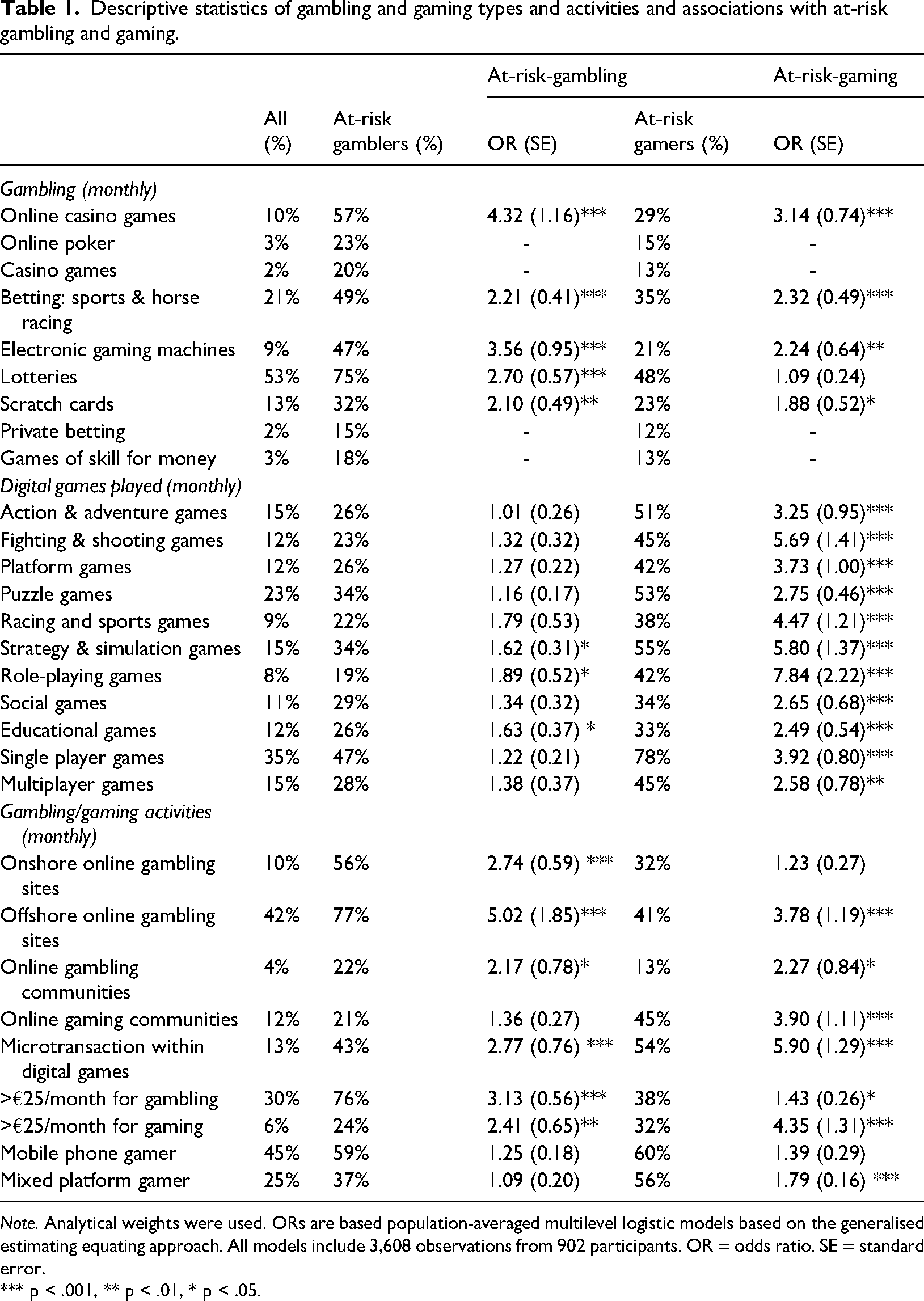
Note. Analytical weights were used. ORs are based population-averaged multilevel logistic models based on the generalised estimating equating approach. All models include 3,608 observations from 902 participants. OR = odds ratio. SE = standard error. *** p < .001, ** p < .01, * p < .05.
The second part of the analysis is based on multilevel hybrid regression models using generalised linear modelling. The models were fitted using the logit link and binomial distribution, because both dependent variables (at-risk gambling and gaming) were binary. Hybrid models (also called between-within models) decompose the associations of dependent and independent variables into within-person and between-person effects, and they solve the shortcomings of fixed-effects and random-effects approaches and utilise both of their strengths (Schunck, 2013). The advantage of hybrid modelling lies in its causal inference potential, as within-person effects show the potential impact of the independent variables on the dependent variable, while the between-person effect is separated (Quintana, 2021; see also Brüderl & Ludwig, 2015). Models were run using the xthybrid command, a shell of the meglm command on mixed-effects generalised linear models (Schunck & Perales, 2017). Table 2 reports regression coefficients (B) and their standard errors (SE), Z values and p values for statistical significance. Furthermore, the table is divided into within-person effects of time-varying independent variables on time-varying dependent variable and between-person effects indicating the average differences between persons. In our model, time-varying independent variables have both within-person and between-person effects, but background variables (age, gender and education) have only between-person effects, as they were measured from one time point only.
Hybrid multilevel logistic regression model showing within-person and between-person effects on at-risk gambling and gaming.
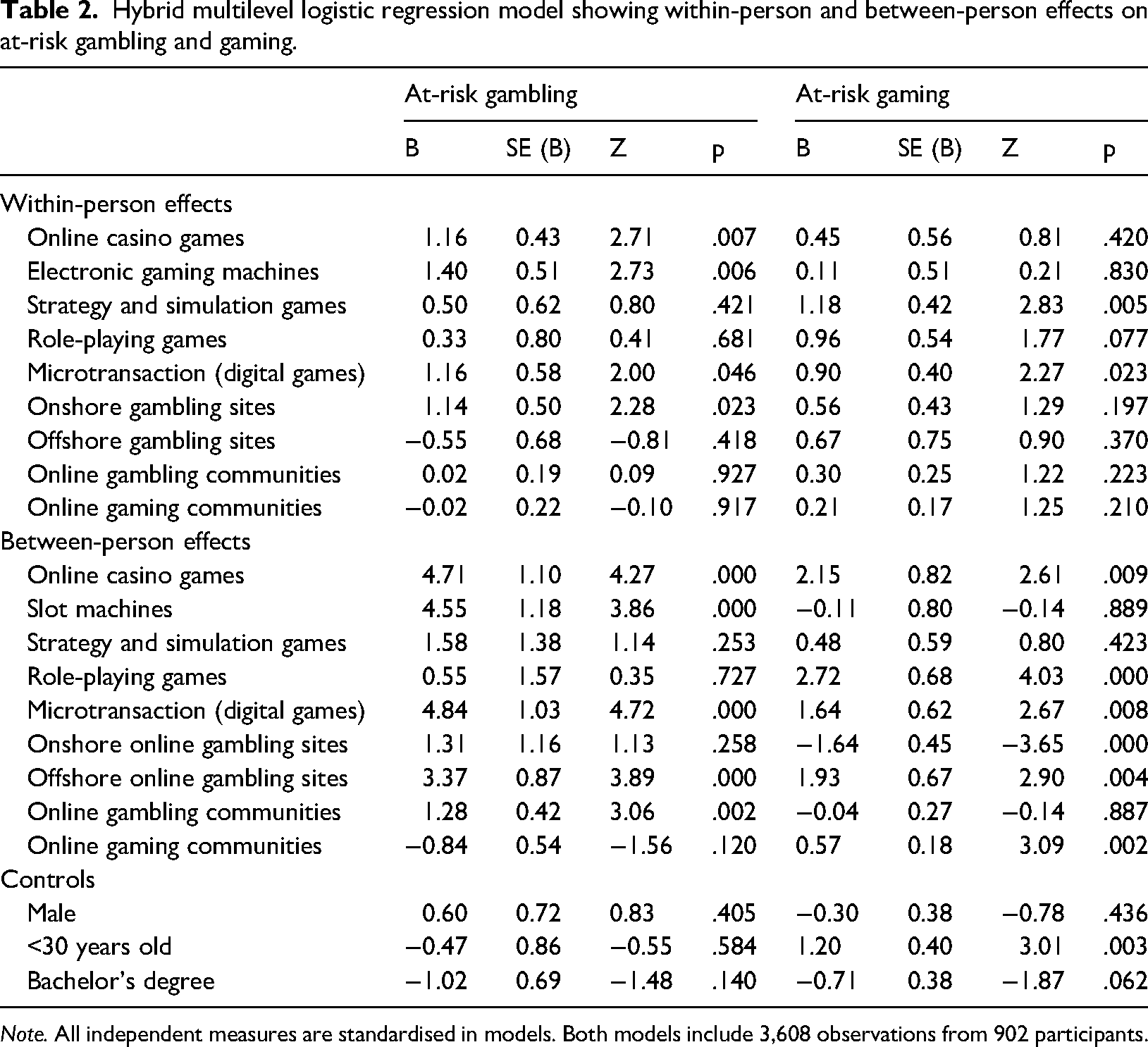
Note. All independent measures are standardised in models. Both models include 3,608 observations from 902 participants.
Results
Gambling games were played by 95.12% of the participants at least once during the four time points in 2021–2022. The corresponding figure for digital games was 77.83%. Larger sums of money were spent on gambling than on digital games monthly. On average, 31.93% of respondents had spent over €25 per month on gambling, and the figure for digital gaming was 5.40%. Although the PGSI and IGDT measures are not comparable as such, more participants reported gambling problems than gaming problems.
Of our participants, 11.75% reported at-risk gambling (PGSI ≥ 5 on a scale of 0–27) in at least one of the four time points. The corresponding figure for likely problem gambling (PGSI ≥ 8) was 7.54%. The average score for PGSI was 1.06 (SD = 2.93). In comparison, 10.53% exhibited at-risk gaming behaviours (IGDT ≥ 1 on a scale of 0–9) in at least one of the four time points. The mean score for IGDT was very low, 0.10 (SD = 0.54), and only 1.11% reported disordered gaming (IGDT ≥ 5). Of the at-risk gamblers (PGSI ≥ 5), 46.32% reported at-risk gaming behaviours during a follow-up.
Table 1 reports percentages of participants playing various types of games on a monthly basis and the shares of those reporting at-risk gambling and gaming. Although only 10% of participants played typical online casino games, such as fruit slots; the number was 57% among at-risk gamblers and 29% among at-risk gamers. ORs based on population-averaged models were also high: 4.32 for at-risk gambling (p < .001) and 3.14 for at-risk gaming (p < .001). All the gambling games were risk factors for at-risk gambling and gaming, except lotteries, which was a risk factor only for the former. According to these results, online casino games and offline slot machines present the highest risks for at-risk gambling. Different digital games were also associated with higher risk for at-risk gaming, but not so much for at-risk gambling. According to our results, role-playing games (OR = 7.85, p < .001) and strategy and simulation games (OR = 5.84, p < .001) pose the highest risk and are also associated with at-risk gambling. Table 1 further presents associations between related activities and at-risk gambling and gaming. For instance, visiting offshore gambling sites, is a major risk factor for at-risk gambling (OR = 5.02, p < .001) and gaming (OR = 3.78, p < .001). Microtransactions within a game have a strong association with at-risk-gaming (OR = 5.90, p < .001) and at-risk gambling (OR = 2.77, p < .001). Also, digital gaming using mixed platforms (i.e., more than one) was associated with a higher risk (OR = 1.79, p < .001).
Table 2 reports results of hybrid models showing both within-person and between-person effects. The models include various gambling activities, the two most risky gambling game types and the two most risky digital gaming types. The results show online casino games and offline slot machines both have statistically significant within-person effects, indicating that these games increase at-risk gambling behaviours. Strategy and simulation games had a within-person effect on at-risk gaming. Microtransactions within digital games increased both at-risk gaming and gambling, and visiting onshore gambling sites had a within-person effect on at-risk gambling. Interestingly, visiting offshore gambling sites did not have a similar effect, but there was a considerably large between-person effect, indicating that those who visit offshore gambling sites report much higher rates of at-risk gambling in general. In addition, online casino sites, offline slot machines, microtransactions within digital games and participating in online gambling communities were associated with at-risk gambling. Between-person effects were also found in the model for at-risk gaming: Online casino games, role-playing games, microtransactions, visiting onshore gambling sites, visiting offshore gambling sites and participating in online gaming communities were associated with at-risk gaming.
Discussion
In our longitudinal study, we investigated which types of gambling and digital gaming are associated with the highest risk of problems caused by gambling and gaming. We also examined longitudinal within-person effects of gambling and gaming activities on problems caused by gambling and digital gaming. The results showed that gambling problems were much more prevalent than digital gaming problems. Those who engaged in gambling were more likely to engage in at-risk gambling and at-risk gaming. Microtransactions were associated with both at-risk gambling and at-risk gaming. Playing EGMs and online casino games was associated with increased at-risk gambling over time.
The popularity of gambling in our study reflects the role of gambling in Finnish society (Castrén et al., 2018; Salonen et al., 2020). Importantly, gambling holds a certain social significance in Finnish society as proceeds made by Veikkaus were, until recently, used to support beneficiaries with common good purposes, such as youth work, culture, sports, science, the social welfare and health industry, and non-profit organisations. Starting from the beginning of 2024, Veikkaus’ profits are credited to the state budget without any indication of the purpose of the use.
Various forms of gambling, such as lotteries, scratch cards and EGMs, are highly popular in Finland and widely available in supermarkets, shopping centres and smaller shops (Salonen et al., 2020; Tammi et al., 2015). Attitudes towards the Finnish gambling provider have also been generally positive in Finland, with most people being satisfied with their service. Only in recent years has there been a more negative trend in attitudes toward gambling in general, especially among younger individuals (Salonen et al., 2020). The prevalence of different forms of gambling is quite high in our study, which is not surprising considering that some gamblers are omnivores in their habits, consuming a wide range of gambling products (Binde et al., 2017; Brosowski et al., 2021; Heiskanen & Toikka, 2016). This is also shown in our results, as most of the types of gambling are associated with at-risk gambling, with the riskiest forms being online casino games and EGMs. These results are in line with work by Allami et al. (2021) and emphasise the importance of addressing fast-paced forms of engagement in these games.
Our results provide support for the notion that the worlds of gambling and gaming are colliding. We found that monthly microtransactions increased at-risk gaming and gambling. This finding generally reflects the convergence of gambling and gaming. As existing studies have shown, the gamblification of gaming might expose young players in particular to gambling and lead to increased gambling-related harm (Gainsbury et al., 2015; Hing, Browne et al., 2022; Hing, Rockloff et al., 2022). The gambling and gaming industries share similarities in that they derive revenue from a small number of the most active customers. For example, in mobile games, the 1% of players generate 38% of the revenue (Zendle et al., 2023).
Our results suggest that, at least in terms of psychological harm and financial losses, gambling remains a greater concern compared to gaming. First, the rates of digital gaming problems reported in the data were quite low; only 1.11% reported disordered gaming (IGDT ≥ 5). Second, the amount of money invested in digital gaming was small, even among those who reported digital gaming problems. This aligns with prior research in gaming studies, which highlighted the importance of subtle and fair monetisation strategies to retain gamers (Hamari, 2015; Harviainen et al., 2018). However, both gambling and gaming can have many indirect consequences, one of which is the time spent on these activities. Both digital gaming and gambling venues, such as casinos, are often designed to spur prolonged activity and engagement.
Strengths and limitations
The major strength of our study relies on the representative longitudinal sample of Finnish adults. We had high response rates and were able to run longitudinal analyses with a significant proportion of the participants of the original sample. This provides much-needed longitudinal evidence on the harms of gaming types, loot boxes and microtransactions in general. Previous studies on these have been mostly cross-sectional (Allami et al., 2021; Spicer et al., 2022). Although we lost some of our younger participants, we noted no major deviations within our sample.
The present study has some limitations. Our study is limited to Finland. It is based on self-reported information and participants may underestimate their engagement to gambling and gaming. In addition, our estimations of gambling and gaming harms were based on two different scales, which limits the direct comparison. Our study did not consider time spent on gambling or gaming. Both activities can consume a significant portion of leisure time, making them similar in how they occupy people's free time. Future studies should consider these aspects and continue longitudinal investigations of harms caused by excessive gambling and gaming.
Conclusion
Our longitudinal study was able to estimate harms related to different types and features of games. Much-needed longitudinal evidence showed that online casino games and EGMs increase at-risk gambling. We were also able to demonstrate that microtransactions within digital games increase at-risk gaming and gambling. However, financial losses involved in microtransactions were rather small, and from an overall perspective the major risks are related to online casinos and EGMs, which have started to take features from traditional arcade games and are able to attract younger gamers. From the policy perspective, EGMs and online casinos are of particular concern, according to our results.
Footnotes
Declaration of conflicting interests
The authors declared no potential conflicts of interest with respect to the research, authorship, and/or publication of this article.
Funding
The authors disclosed receipt of the following financial support for the research, authorship, and/or publication of this article: The study was funded by the Finnish Foundation for Alcohol Studies (Gambling in the Digital Age Project, 2021–2024, PI: A. Oksanen).
