




Abstract
Keywords
Introduction
Social workers play an important role in the prevention of and interventions in substance misuse, as well as the development of methods for addressing it at the societal level. The need for highly skilled and dedicated social work interventions and preventative efforts for alcohol and drug use problems is widely recognised (Galvani & Forrester, 2011; Osborne-Leute et al., 2019). The aim of this paper is to further our knowledge regarding the professional competencies at work in social workers dealings with alcohol use problems.
Social work education and training seek to develop professional competence in terms of knowledge, values and skills to effectively enable students to discharge the core functions of the profession, which is the alleviation of distress and enhancement of well-being (Stanley & Mettilda, 2020). Importantly, the competence includes the enhancement of well-being not only for clients, but also for the professionals themselves. Professional self-care is highlighted as essential for competent and ethical social work practice in the most recent edition of the NASW Code of Ethics (NASW, 2021). Due to the demands of their job, challenging work environments, and exposure to trauma, social workers must prioritize their personal and professional health, safety, and integrity (NASW, 2021).
High quality social work also entails ability to integrate a variety of aspects into attentive, genuine and intense interactions with clients and their environment, which, over time, shape unique social work expression, integrating professionals’ knowledge, value systems and personalities (Poulin & Matis, 2015). A social worker's capacity to integrate their inner self (critical thinking, affective reactions and judgment with regard to unique practice situations) with the knowledge and principles of the profession is a necessary component of mastering the practice (Poulin & Matis, 2015). An acknowledgement of the cognitive and emotional dimensions of social workers’ competency was first mentioned in a report by the Council on Social Work Education (CSWE, 2015, p.6), in which social work competence was described as “the ability to integrate and apply social work knowledge, values, skills and cognitive and affective processes to practice situations in a culturally responsive, purposeful, intentional and professional manner to promote human and community well-being”.
The model of holistic competence by Bogo et al. (2006) incorporates professionals’ uniqueness and personalities into their social workers’ professional competence framework. This model leans on the idea that social work requires a complex combination of profeciencies, including the ability to respond to context-dependent circumstances mastering practice knowledge and professional intuition (Bogo, 2018). Hence, competence encompasses also an integration of one's own personality. The model categorises competencies into two sets: meta-competencies and procedural competencies. Procedural competencies concern the knowledge and skills used in performing various social work tasks and are expressed through observable behaviour, such as communication skills, developing collaborative relationships, performing assessments and making interventions (Bogo et al., 2013; Kourgiantakis et al., 2019a). Meta-competencies go beyond observable task performance and include self-reflection and cognitive and critical thinking capacities (Bogo, 2022; Bogo et al., 2013), as well as self-awareness and self-regulation abilities, all while staying introspective about one's inner emotional and cognitive states (Kourgiantakis et al., 2019a). Importantly, Bogo et al. (2013) emphasise that meta-competencies affect actual performance in practice (procedural competencies) (Bogo et al., 2013). For example, understanding one's own emotional responses (self-awareness) improves one's capacity to endure challenging emotional circumstances with clients and helps in the execution of procedural competencies (Bogo et al., 2013). Flexibility and consideration of when and how to apply different concepts and evidence-based interventions are key components of the capacity to conceive and use knowledge frameworks and ethical principles in social practice. Such cognitive processing requires the use of critical thinking skills and an understanding of the factors that influence decisions (Bogo et al., 2021). Understanding one's emotional processes is related to an ability for self-reflection; that is, becoming conscious of and controlling one's beliefs, presumptions and emotional responses to real-world scenarios. These emotions and beliefs affect the way in which interventions and various social work practices are selected, carried out and assessed (Bogo et al., 2021). Asakura et al. (2021) have stated that social workers need to be conscious of their own assumptions, attitudes, biases and relationship dynamics with each client. They also need to be ready to adapt their interventions to the unique circumstances of their clients rather than only implementing a particular pre-defined strategy. Moreover, professionals’ meta-competencies are essential in psychosocial support as these non-procedural skills allow practitioners to successfully navigate a wide range of knowledge and skills that are consistent with their own cognitive and affective processes, helping them interact authentically with specific client situations (Asakura et al., 2021). As a result, the alignment of procedural and meta-competencies contributes to more efficient social work practices enhancing greater capabilities to handle challenging and frequently stressful assignments.
A holistic understanding of competence has been extensively proposed to encourage the development of procedural and meta-competencies. This has been seen as crucial especially considering that the knowledge and attitudes of social work students are not easily converted into professionally expressed behaviours. This is why social work education should strive for achieving both procedural and meta-competences in a holistic understanding of competence (Lee et al., 2021). According to Lee et al. (2020), meta-competencies should emerge early on in an educational programme for social workers and could be taught through simulation-based learning as this learning can successfully connect the elements that comprise holistic competence (Lee et al., 2020). Subsequently, one study that assessed the use of simulation to teach holistic competence discovered that students valued learning about procedural competencies (knowledge and skills) and meta-competencies (professional judgment, self-awareness and self-regulation). The students also reported feeling more self-awareness and more self-regulation associated with improved self-confidence and anxiety management techniques (Kourgiantakis et al., 2019b). As stated by Sewell (2020), in addition to gaining the procedural and metacognitive skills necessary to enter the social work profession, students must also learn to regulate their emotions regarding client situations and experiences. Self-regulation, as an integral component of a holistic competence model, requires special attention in social work education. This is a reason why Sewell (2020) has provided arguments for neuroscience as a foundation to discuss the role of emotions in social work education and has offered methods (experiential learning, mindfulness, embodied practice, simulation and role playing) for managing emotion during social work education and practice (Sewell, 2020).
In line with the current literature on the needed skills and competencies in social work, it is crucial to have appropriate tools for self-evaluation of competence development. The Perceived Social Work Competence Scale (PSWCS; Wang & Chui, 2017) is based on the previously described holistic competence model by Bogo et al. (2006). The present study analyses and validates this scale with ( the purpose of investigating how the competence model of Bogo et al. (2006), was developed in accordance with it and how it can be applicable for social work with clients who have alcohol use problems in Lithuania.
Social work with individuals with alcohol use problems requires special attention because of the sensitivity of the topic of alcohol use. Non-judgmental attitudes, compassion and an adequate understanding of alcohol use from a holistic perspective should guide social work practice (Galvani & Forrester, 2011). With each client, social workers must be aware of their own presumptions, values, prejudices and relational dynamics, and professionals should be prepared to engage in interventions that work for clients’ specific situations rather than just following a specific empirically supported intervention (Asakura et al., 2021). Professionals’ meta-competencies are crucial, especially in psychosocial support, in which social work typically operates. Non-procedural skills enable practitioners to successfully navigate a vast knowledge base and a variety of skills in congruence with their own cognitive/affective processes to engage authentically in specific client situations (Asakura et al., 2021). As such, meta-competence goes beyond merely knowing “how” to do something; it also involves fostering an empowering relationship and remaining conscious of one's feelings and thoughts. Kourgiantakis et al. (2022) note that the majority of research on education and training related to mental health, addiction and suicide concentrates on knowledge background or attitudes rather than the development of for example assessment abilities, self-awareness and emotion control (Kourgiantakis et al., 2022). The present study aims to fill the knowledge gap regarding the implementation of holistic social work competence in the field of alcohol consumption.
The aim of this study is to analyse Lithuanian social workers’ self-reported professional competencies when working with individuals with alcohol use problems. It assess the validity and reliability of the PSWCS with regard to Lithuanian social workers. The research questions are: (1) How do Lithuanian social workers who work with individuals with alcohol use problems self-report their professional competencies? (2) How reliable and valid is the Lithuanian version of the PSWCS for the measurement of professional competencies in social work with individuals with alcohol use problems?
Methods
Participants
The study included social workers from a variety of Lithuanian social service organisations. These institutions included the five major addiction centres in the main cities of Vilnius, Kaunas, Panevėžys, Klaipėda and Šiauliai; non-governmental organisations concerned with alcohol rehabilitation and intervention centres for families/men/women on the official register in Lithuania; and municipality or district social service centres in the main cities and regions of Lithuania (which are the main departments for managing social services in family and child care, crisis centres and homelessness care, etc.). The Social Workers Association of Lithuania, which has over 1100 members, also sent out invitations to take part in the study. It is important to mention that only those social workers who regularly interacted with individuals with alcohol use problems were invited to participate. Moreover, it was up to the social workers themselves to decide whether they frequently encountered people with alcohol use problems and, as a result, were eligible to participate in the research. The condition for participation was “working with individuals with alcohol use problems” in daily practice, and it was not limited to those working in specialised dependence treatment units.
Data collection
An explanatory letter outlining informed consent to participate in the study was first shared with the managers of the relevant institutions and then sent directly to the participants. An internet-based questionnaire was used. The research scale began with a detailed explanation of the goals of the study and went on to explain the informed consent processes, including the principles of confidentiality and anonymity. Only after participants had clicked the “yes” button to indicate that they agreed to participate would the survey begin automatically. The questionnaire included the PSWCS, the Short Alcohol Attitudes Problem Perception Questionnaire (SAAPPQ), and demographic and socioeconomic data on age, gender, education, employment position and work experience.
PSWCS
To measure professional competencies in social work with individuals with alcohol use problems in Lithuania, the PSWCS (Wang & Chui, 2017) was adapted. The original PSWCS included 48 items divided into nine subscales indicating different professional competencies (procedural and meta-competencies). Using a five-point Likert-type scale that ranged from 1 (I am not at all confident I can do this) to 5 (I am very confident I can do this), the respondents were asked to indicate the extent to which they considered themselves confident in each particular social work skill (with a group of skills constituting a competence dimension) when working with individuals with alcohol use problems.
The PSWCS is a relatively new scale that was developed and validated for assessing social work students’ competence in Mainland China, with the holistic competence model (Bogo et al., 2006) serving as the foundation for its composition (Wang & Chui, 2017). Subsequent large-scale research has successfully used the PSWCS scale, directed at the enhancement of social work in practice and education in China (Wang et al., 2018, 2021; Yi et al., 2018; Zhang et al., 2019). For example, the cross-sectional study by Wang et al. (2018) with 848 master's-level social work students revealed that, with engagement acting as a full mediator, the students’ perceived competence was influenced by their perceptions of support for their autonomy and their achievement motivation. For this reason, it is highly recommended that students’ achievement motivation be increased, that they receive support for their autonomy and that field training be included in their education (Wang et al., 2018). Similarly, Wang et al. (2021) examined the learning process of master's-level social work students with an emphasis on processional competence as a learning goal. Their findings showed how important it is for students to participate in field learning throughout their education to develop their professional competencies. Yi et al. (2018) came to the same conclusion in another study on the significance of field education and supervision in achieving competence. Another investigation examined the effectiveness of a competency-based educational approach for enhancing professional competence in in-service social worker training, which led to a notable improvement in the professional competence of social workers (Zhang et al., 2019).
In accordance with obtaining permission to use the scale for this study (Wang & Chui, 2017), a double-translation design was employed to produce a Lithuanian version of the PSWCS. To improve the equivalence of the source and target languages, it was beneficial to use multiple translators for this design. This procedure involved translating the scale and then resolving any discrepancies in the target language, as recommended by the Organisation for Economic Co-operation and Development (2012). The PSWCS was translated into Lithuanian by an experienced translator (YZ) and the researcher (JK), both of whom were proficient in the target language. After evaluating the versions in the source and target languages, two social work specialists from Lithuania reconciled the initial translation. Discussion was used to settle disagreements.
Other scales and variables collected
The survey also collected information regarding social workers’ attitudes towards individuals with alcohol use problems, which is described in detail in the previous substudy (Kievišienė, 2024). The SAAPPQ (Anderson & Clement, 1987) measures professional attitudes over five dimensions: role adequacy (the feeling of the appropriateness of one's own skills and knowledge when assisting a client with alcohol use problems), motivation (motivation to complete professional tasks), role legitimacy (feelings that working with someone who has alcohol use problems is appropriate or right), satisfaction (expectations of job satisfaction when assisting people with alcohol-related problems) and task-specific self-esteem (self-esteem level when performing professional duties and working with people who have alcohol use problems). When these subscales are added, they reveal two latent variables: therapeutic commitment (a commitment to helping people who struggle with alcohol use) and role security (emotions when working with those who struggle with alcohol, as well as the degree of psychological safety that a practitioner experiences when continuing everyday activities). The 10 items of the SAAPPQ are scored on a five-point Likert scale, with 1 indicating strong disagreement and 5 indicating strong agreement. A higher score indicates the more positive attitude towards individuals who use alcohol.
As the focus of this research was to explore professional competencies using exploratory factor analysis, the variables mentioned above were used only to check the discriminant validity of the translated instrument (i.e., the PSWCS).
Ethical considerations
The study followed the ethical principles detailed in the Ethical Principles of Research in the Humanities and Social and Behavioural Sciences approved in Helsinki (National Advisory Board on Research Ethics, 2009) and ensured that the main ethical principles therein were followed: the autonomy of the research participants, avoiding harm and privacy and protection.
Statistical analysis
SPSS, version 22.0 (IBM Corp., Armonk, NY, USA) was used to run the descriptive statistics to identify the assumptions for the exploratory factor analysis (EFA), which was performed to determine the construct validity of the PSWCS-48. The Kaiser–Meyer–Olkin (KMO) test and Bartlett's test of sphericity were applied to measure sampling adequacy. A sample was considered adequate if the KMO value is more than 0.5 and Bartlett's test is significant (p < .05). The factor structure was examined using both orthogonal (varimax) and oblique (promax) rotations; however, only the promax results were reported (because it was assumed that the extracted factors were correlated).
The principal component analysis method was applied in the extraction of the components. Components with eigenvalues over 1 were retained as factors. Communalities represent the proportion of the variance in the original variables that is accounted for by the factor solution. The factor solution should explain at least half of each original variable's variance, and so the communality value for each variable should be 0.50 or higher. Variables were checked for complex structure if there was more than one factor in the solution. If a variable had a complex structure, it was removed from the analysis. Items with a loading factor of more than 0.60 were considered to have an acceptable loading factor.
The internal consistency (reliability) of the scale was checked by investigating whether the items within each subscale correlated significantly with each other (using Cronbach's alpha). Cronbach's alpha was computed to verify that the variables for factor measuring similar entities are valid to add together. It was expected that each subscale would produce alpha values of 0.6 or above, indicating internal reliability.
To assess discriminant validity, analysis of variance (using a generalised linear model) was conducted to examine whether different social worker characteristics (education, workplace and work experience) and SAAPPQ subscales dichotomised at a cut point higher than the median had overall effects on PSWCS concepts. The effects are reported as F-statistics and their associated degrees of freedom and p-values.
Results
Demographic characteristics of the sample and the response rate
One hundred and forty-nine subjects completed the questionnaire. The final sample was aged 41.28 ± 10.54 years (mean ± SD), ranging from 22 to 63 years, and included a large proportion of females (97.3%), which is in line with the national distribution of social workers in Lithuania. Years of work experience ranged from 1 to 29 years (mean ± SD, 9.93 ± 6.67 years). In terms of education, the majority of participants had a bachelor's degree (n = 100; 67.10%) (Table 1). Social workers are found in every facet of community life. The respondents most frequently reported working in municipality services or family support centres (57%), followed by social services centres (14%), addiction services (6%), foster homes (3%) and crisis services (1%). The response rate to the survey was 33.78%, which is in line with the mean response rate in the social sciences (Lund, 2023). This was determined by dividing the total number of responses (n = 149) by the number of people who opened the link to the online survey (n = 441) and multiplying it by 100.
Baseline characteristics of study sample.
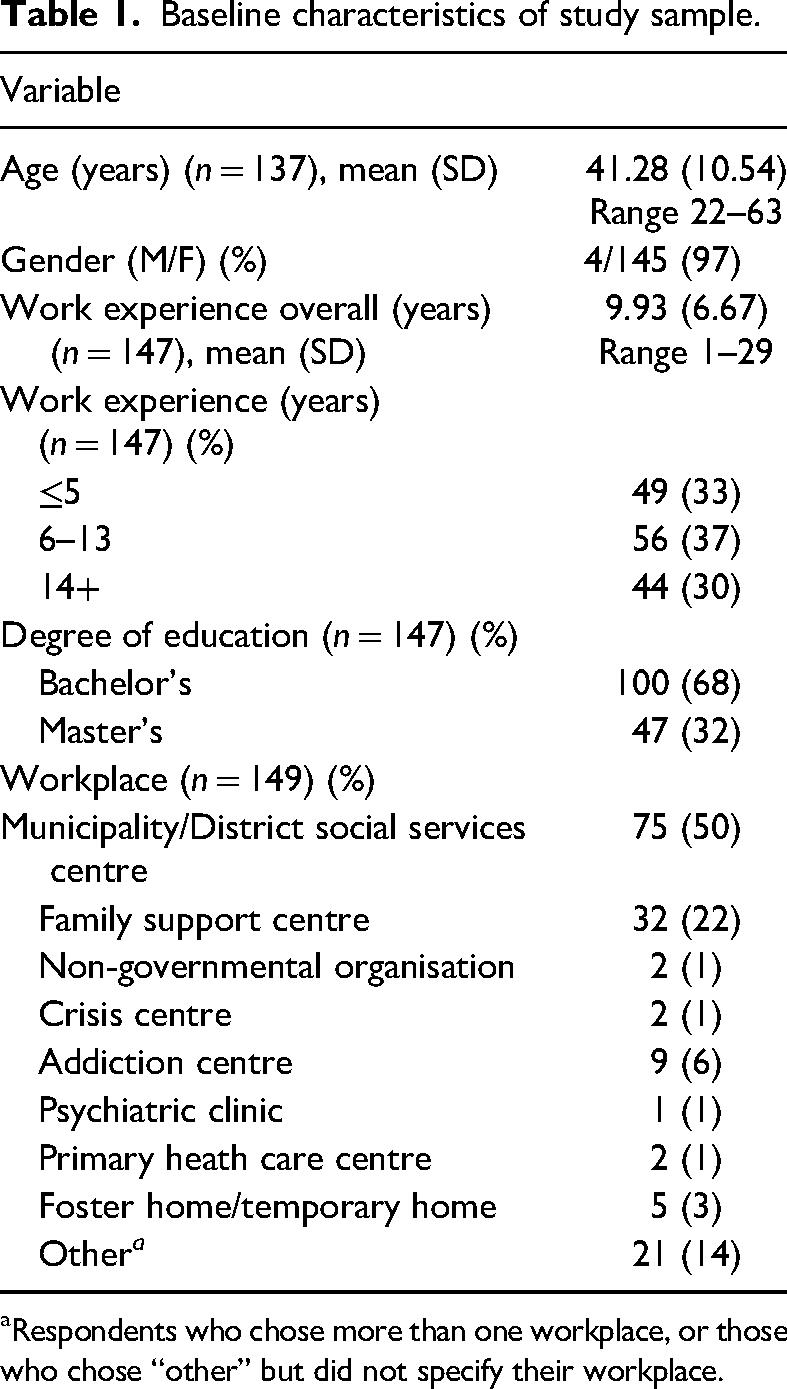
Respondents who chose more than one workplace, or those who chose “other” but did not specify their workplace.
Exploratory factor analysis of the PSWCS
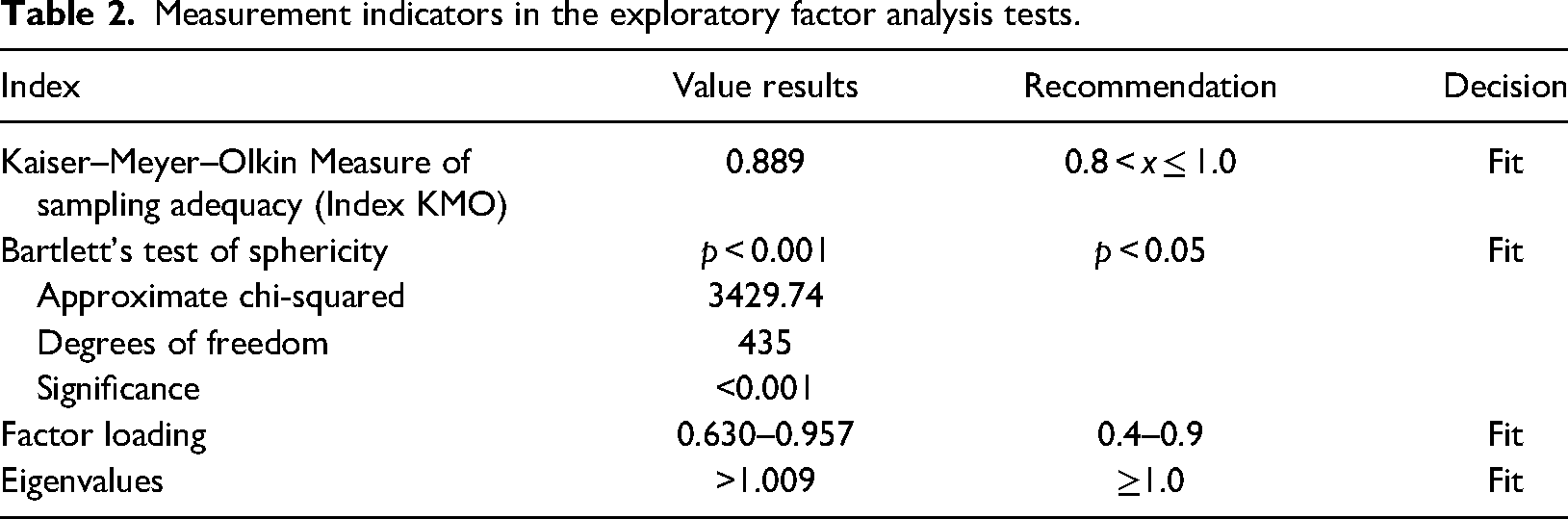
Exploratory factor analysis showed that all assumptions for conducting principal component analysis were met. The KMO index value was 0.889 (well above the minimum standard of 0.5), indicating that the data were appropriate for factor analysis (Kaiser, 1974). Values close to 1.0 are considered to be promising for informative factor analysis and support the possibility that a suitable proportion of variation in research variables may be caused by underlying factors (Kaiser, 1974). The result of Bartlett's test of sphericity was significant (χ2[435] = 3429.74, p < 0.001), showing that the correlation matrix was not random (Bartlett, 1954). Therefore, the data showed suitability for exploratory factor analysis (Table 2).
Measurement indicators in the exploratory factor analysis tests.
The EFA eight-factor solution with 18 original items (questions 3, 4, 5, 9, 11, 13, 21, 27, 28, 29,30, 34, 35, 39, 41, 42, 45 and 48) removed (after eight rotations) had the best model fit. Those items not included in the final model were removed due to high loadings on more than one factor showing a complex structure (variables that load on only one factor are described as having a simple structure). Furthermore, only two items loaded on the factor named relationship formation, which is less than advised to remain on a factor, based on general recommendations (Schreiber, 2021). However, after evaluation of the items’ content, and with theoretical support for the importance of the construct “relationship formation” in social work, the factor was retained in this study. Such a practice is optional in exploratory factor analysis.
The final questionnaire contained 30 items loaded onto eight factors, explaining 77.071% of the total variance in the variables included on the factors, and all final communalities were 0.617 or greater (mean 0.770). The structure of the PSWCS-30 was confirmed by a scree plot showing eight factors with eigenvalues higher than 1 (Figure 1).
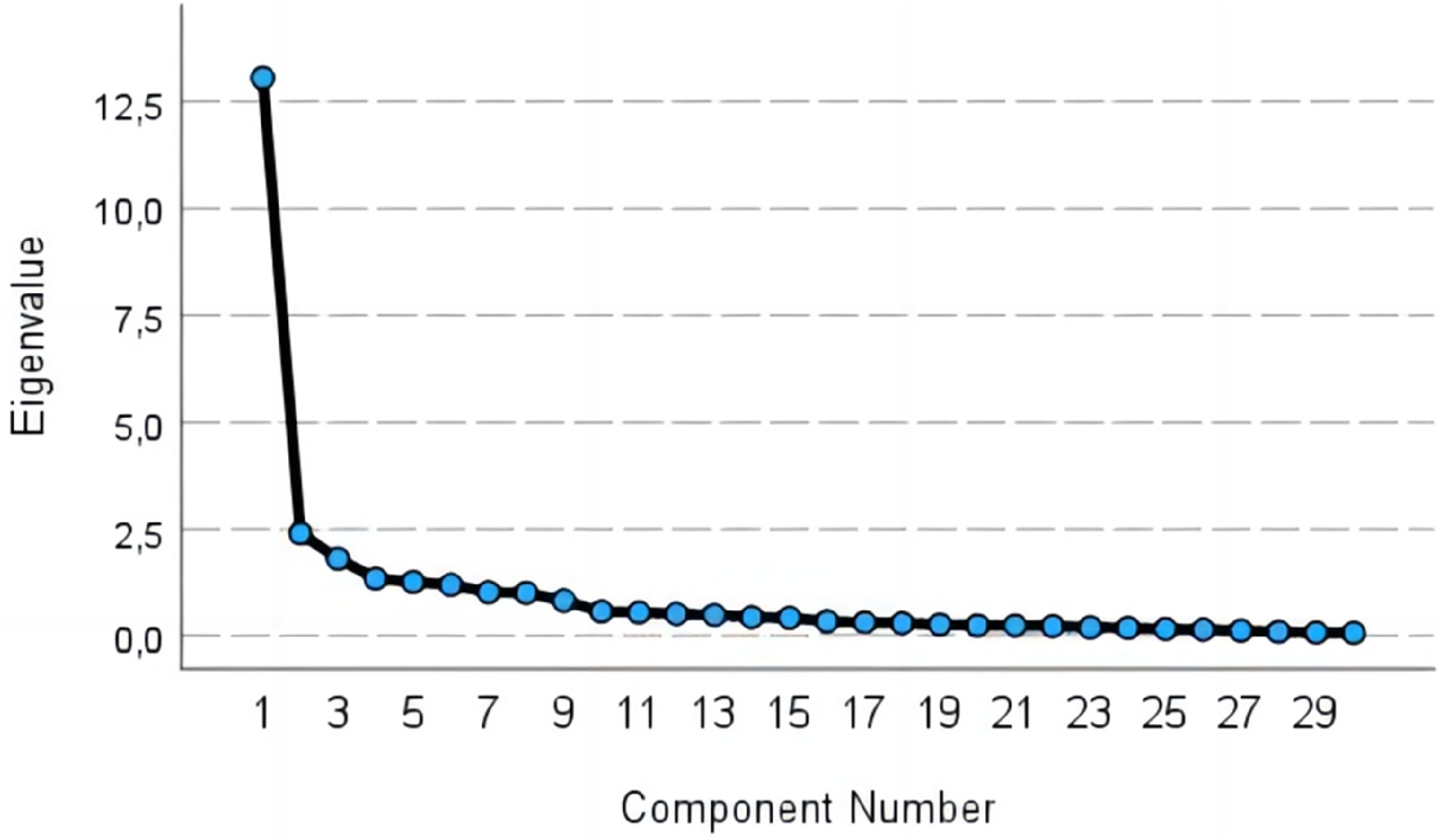
Scree plot showing the eigenvalues for the Perceived Social Work Competence Scale (PSWCS)-30.
To verify that the variables for a factor measured similar entities that could legitimately be grouped together, the internal consistency of Cronbach's alpha was computed. Cronbach's alpha for the PSWCS-30 as a whole was 0.995, suggesting good internal reliability. The subscale reliabilities in the study were good, ranging from α = 0.858 to α = 0.911. If Cronbach's alpha is 0.60 or greater for exploratory research, the interval consistency of the items justifying their use in a summated scale is supported (Table 3).
The Perceived Social Work Competence Scale (PSWCS)-30 descriptive characteristics.
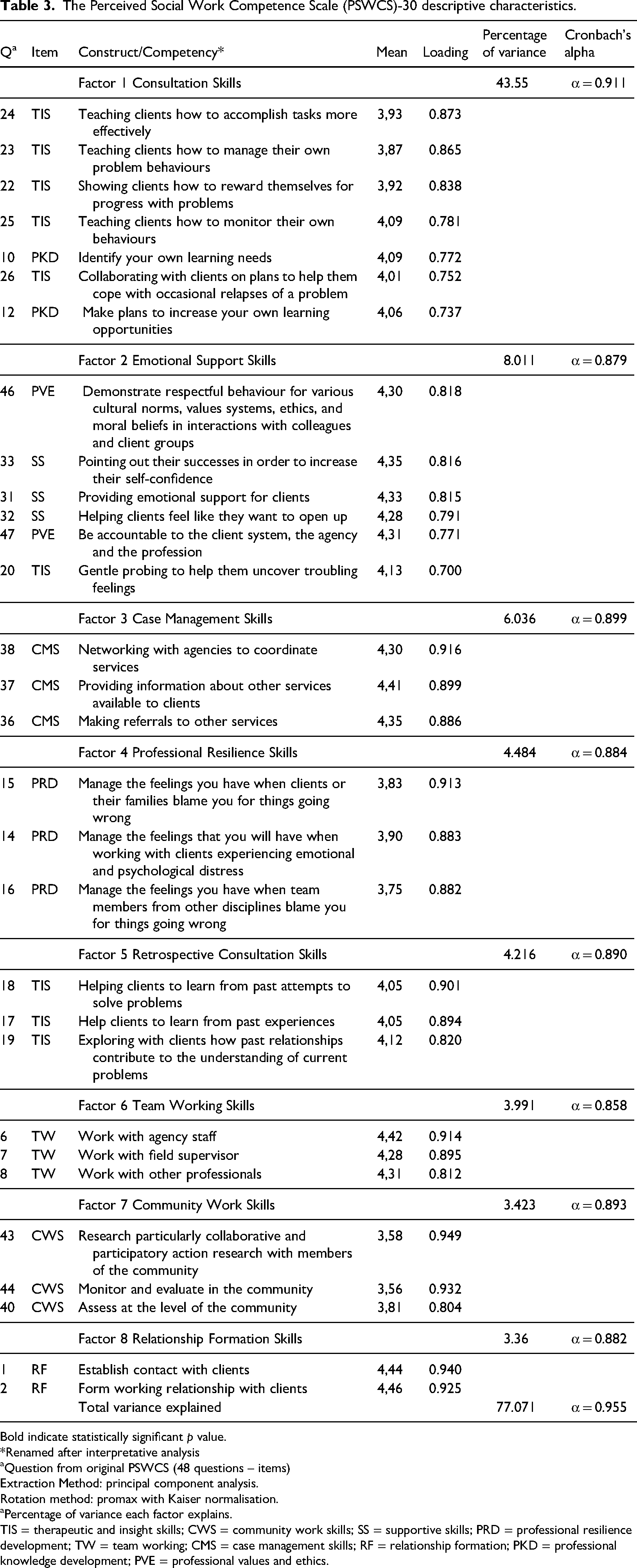
Bold indicate statistically significant p value.
*Renamed after interpretative analysis
Question from original PSWCS (48 questions – items)
Extraction Method: principal component analysis.
Rotation method: promax with Kaiser normalisation.
Percentage of variance each factor explains.
TIS = therapeutic and insight skills; CWS = community work skills; SS = supportive skills; PRD = professional resilience development; TW = team working; CMS = case management skills; RF = relationship formation; PKD = professional knowledge development; PVE = professional values and ethics.
To assess known-group validity, analysis of variance (using a generalised linear model) was conducted to examine whether different social worker characteristics (education, SAAPPQ total and five SAAPPQ subscales dichotomised at a value higher than the median) had overall effects on PSWCS concepts. The effects are reported as F-statistics and their associated degrees of freedom (F1,147) and p-values (Table 4).
Discriminant validity of Perceived Social Work Competence Scale (PSWCS)-30, analysis of variance by factors (F1,147 statistic).
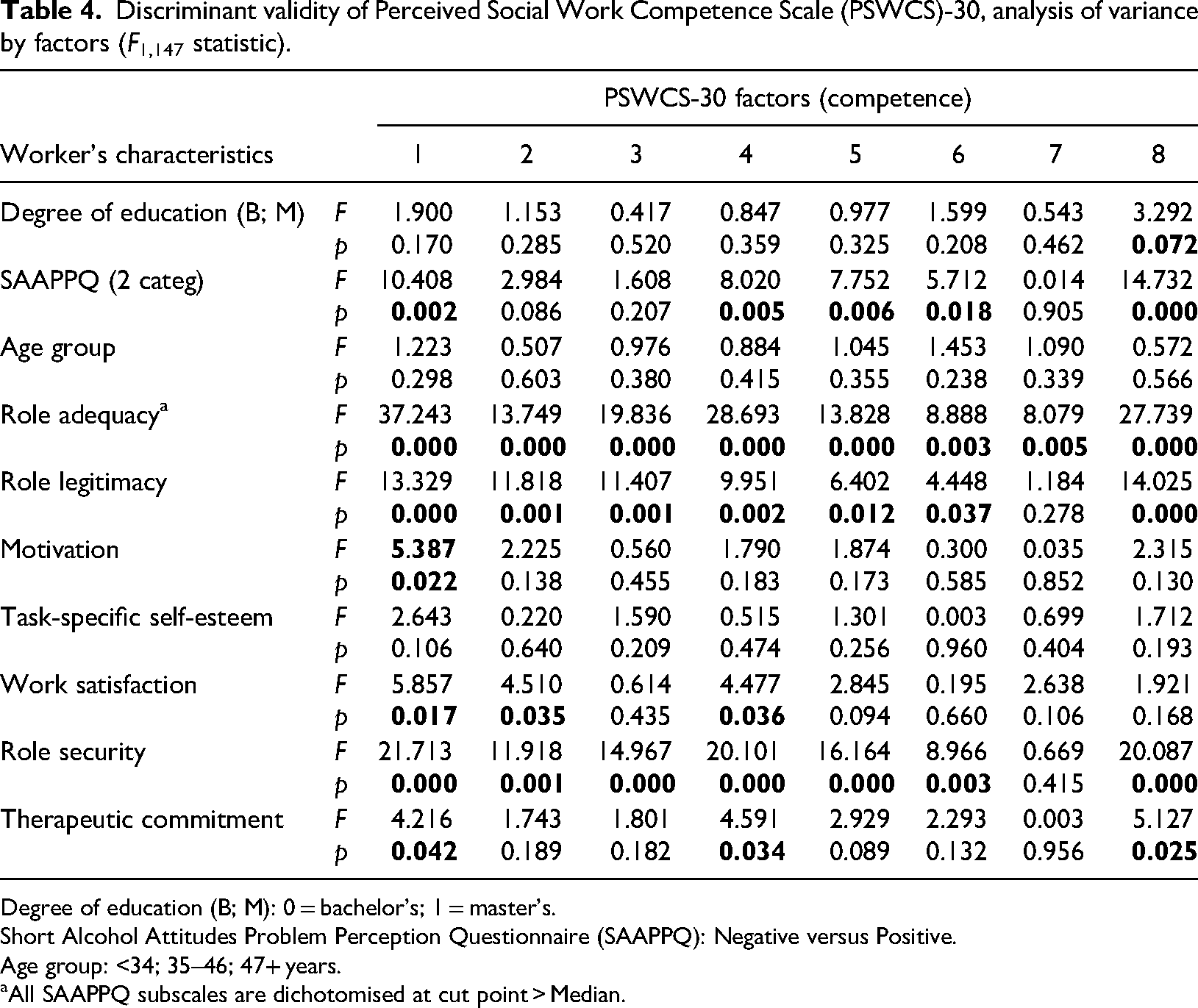
Degree of education (B; M): 0 = bachelor's; 1 = master's.
Short Alcohol Attitudes Problem Perception Questionnaire (SAAPPQ): Negative versus Positive.
Age group: <34; 35–46; 47+ years.
All SAAPPQ subscales are dichotomised at cut point > Median.
The PSWCS-30 was not able to discriminate between workers’ different reported ages, years of experience and task-specific self-esteem scores (Table 4). Education did not play a significant role in differentiating the importance of the eight competencies. However, there was a tendency towards a significant effect of the education group on F8 (relationship formation score) (F1,147 = 3.3, p = 0.72), and role adequacy had a significant effect on all factors of the PSWCS score (all F-tests p < 0.01). Role legitimacy and role security had a significant effect on all factors of the PSWCS, excluding F7 (community work skills). The main effect of therapeutic commitment was on F1 (consultation skills), F4 (professional resilience skills) and F8 (relationship formation skills). Also, it could be seen that social workers’ motivation affected F1 scores (consultation skills) (F = 5.387, p = 0.022) but had no influence on the other seven factors (Table 4).
Discussion
The aim of this study was to explore Lithuanian social workers’ self-reported professional competencies when working with individuals with alcohol use problems through an exploration of the characteristics included in the Lithuanian version of the PSWCS. In addition, because the study evaluated the appropriateness of using the PSWCS, an EFA was conducted to validate the PSWCS. A survey that could quantify social workers’ self-reported professional competencies in the field of alcohol use problems helped identify social work specifics in this particular area. Therefore, by examining the current patterns, continuous competence development in social work with people who have alcohol consumption issues may be enhanced.
Starting with the psychometric properties of the Lithuanian versions of the PSWCS, the data analysis showed that the 30-item, eight-factor PSWCS is a valid and reliable instrument for use. All criteria for conducting EFA were met with the KMO index (0.886), Bartlett's test (p < 0.001) factor loading (0.630–0.957) and eigenvalues (>1.009). The translated questionnaire exhibited strong internal consistency (Cronbach's alpha = 0.955), suggesting that it measured various aspects of the same construct of “perceived competence” in this study. Moreover, the newly developed PSWCS can distinguish between various sample characteristics (education and attitude scores assessed using the SAAPPQ) and show differences for the variables examined, which supports the scale's discriminant validity. Therefore, the results suggest that the translated questionnaire is appropriate for assessing social workers’ professional competencies in assisting individuals in Lithuania who have problems with alcohol use.
Explorative factorial analysis helps in the investigation of correlative relationships among manifest variables (Goretzko et al., 2021). Not only do those interrelated variables reflect latent constructs, but also a deeper look shows that these relationships arise because items share a common cause (Brown, 2015). As such, the results of the EFA provide not only statistical support for the use of the translated scale, but also valuable insight into the professional competence dimensions and their components present in social work with individuals with alcohol use problems. This helps reveal a more detailed picture of the perceived professional competencies manifested in certain skills present in social work with these individuals. In the process of explorative factor analysis, the 48 skills that comprised the original PSWCS's nine perceived social work competence dimensions (community work, therapeutic and insight skills, supportive skills, professional resilience development, teamwork skills, case management skills, relationship formation, professional knowledge development, professional values and ethics) were reclassified into eight perceived competence dimensions. The case management skills, professional resilience skills, teamwork skills, community work skills and relationship formation dimensions stayed in the same structure, but had fewer items. Three perceived competence dimensions (consultation skills, retrospective consultation skills and emotional support skills dimensions) were made up of mixed items drawn from different original dimensions, they demonstrated theoretical and logical alignment, which will be discussed later.
Given that the participants were asked to consider only their professional competence in social work with individuals who have alcohol use problems, it is assumed that the content left in the separate competence dimensions reflects the skills prominent in this type of social work. Therefore, in the following, the content of the newly developed perceived competence dimensions relevant to this particular study is subjectively evaluated to better understand this context-specific social work.
To start with, the majority of the
According to this study, there is a unique pattern in the social work consulting skills used with individuals in Lithuania who are struggling with their alcohol use. Interpretative item analysis revealed that all of the abilities mapped in this competence dimension focused on teaching clients to achieve behavioural change; namely, teaching clients to accomplish tasks more effectively, teaching clients how to manage their own problem behaviours, showing clients how to reward themselves for progress with problems, teaching clients how to monitor their own behaviours and collaborating with clients on plans to help them cope with occasional relapses of a problem. This generally suggests that Lithuanian social workers perceive that they are competent to teach behavioural change when working with individuals with alcohol use problems, as this might enhance a client's possibilities for successful adaptation in their current situation.
In addition, two items from the a priori professional knowledge development meta-competence dimension mapped onto this new factor (identify your own learning needs and make plans to increase your own learning opportunities). Based on EFA processes, observed measures are grouped together because they are interrelated or because they share a common cause (Watkins, 2018). It appears that the perceived ability to recognise one's own learning requirements and use consulting skills focused on behavioural changes in clients was linked to abilities in this sample and shared an underlying cause that may be referred to as teaching/learning.
The
Interestingly, two items from the primary professional values and ethics dimension also mapped onto this dimension (demonstrate respectful behaviour for various cultural norms, values systems, ethics and moral beliefs in interactions with colleagues and client groups and is accountable to the client system, the agency and the profession). The question here is how values and ethics (moral aspects) in this specific sample encompass the emotional sphere, because the fact that those items were grouped together in the EFA means that they share an underlying cause (Brown, 2015). Staying aware of professional values and emotional dynamics is essential to providing the best intervention in every unique client situation (Asakura et al., 2021). Affective processes play an important role in shaping moral judgments rather than just being experienced in parallel with them (Horne & Powell, 2016). Emotional experience also influences decision-making in moral dilemmas (Carmona-Perera et al., 2013). Because social work with individuals who misuse alcohol is emotionally charged and demanding, professionals must be aware of both their current emotional state and their emotional experience to foster professional values and ethics within this specific area of practice.
The
In this study, the perceived case management skills regarding individuals with alcohol use problems manifest through connection functions; that is, the items networking with agencies, providing information about other services available to clients and making referrals to other services. Nonetheless, it is crucial to recognise that case management skills demand extra caution in situations involving alcohol use. Alcohol use problems affect many layers of a client's life. Hence, services that promote recovery and the client's reintegration into society as a healthy, substance-free individual must be comprehensive (SAMSHA, 2015). Therefore, case management in an alcohol use problem context requires organising treatment services at the appropriate intensity, following strategies to maintain long-term sobriety, avoiding gaps in the services provided, ensuring a continuum of care and quickly responding to relapses (Comprehensive Case Management for Substance Abuse Treatment, 2000). In addition, fostering continuous client engagement in the recovery or care process forms a significant component of the social worker's responsibilities (Vanderplasschen et al., 2019). As a result, maintaining client involvement and organising service continuity require additional efforts and expertise when it comes to case management with clients who have alcohol use problems.
The present study demonstrated that when working with individuals with alcohol use problems, social workers perceived their competences in the professional resilience dimension as twofold: those needed (1) to handle their emotions when assisting clients experiencing psycho-emotional distress and (2) when clients or other professionals hold them responsible for problems arising from alcohol consumption (manage the feelings you have when clients or their families blame you for things going wrong, manage the feelings you have when working with clients experiencing emotional and psychological distress and manage the feelings you have when team members from other disciplines blame you for things going wrong). Social work with individuals who struggle with alcohol use can be emotionally draining and stressful. This is because professionals may have to deal with clients who frequently struggle with mental health issues (Jacob et al., 2021; Li et al., 2020) or who are resistant to change, experience relapses or find it difficult to maintain recovery (Tucker et al., 2020). Therefore, resilience skills are crucial to a professional's well-being because they help prevent burnout and work tension and help maintain a positive attitude towards individuals with alcohol use problems.
In this study, one more novel competence dimension emerged in comparison to the basic model proposed by Wang and Chui (2017); namely, a
This retrospective behaviour analysis approach is consistent with social work assessment strategies related to alcohol use problems. For example, NASW (2013) stated that, to increase awareness of the complexity of alcohol consumption, working with persons who have alcohol use problems involves accurate assessment and information evaluation at several levels using a biopsychosocial approach. King and Bordnick (2002) emphasised that a complete and accurate evaluation of a client's behaviour and functioning in connection to alcohol is necessary for effective social work counselling for alcohol consumption issues (King & Bordnick, 2002). As a result, analysing past alcohol use experiences is crucial for thorough evaluations and for the development of holistic interventions that support clients with alcohol-related problems in their overall well-being. This offers a starting point for informed support that considers the unique needs and challenges of each client.
The results of this perceived competition dimension show that the items composing it reflect a focus on the multidisciplinary nature of teamwork in the field of social work, where practitioners consider working together with field supervisors, agency staff and other professionals to be an essential skill when working with clients who have alcohol use problems (work with agency staff, work with field supervisor and work with other professionals). This finding is in line with previously reviewed research that underlined the importance of teamwork in social work. Enabling professionals to share resources, expertise, knowledge and work in collaboration can result in more efficient and productive work. This is particularly relevant when considering the biopsychosocial context of problematic alcohol use, in which a social worker must deal with multiple layers of the problem and a range of ongoing interventions to meet the needs of the client and promote long-term recovery.
The
The study's
The findings reveal that the perceived competences in establishing relationship dimensions include such skills as establishing contact and forming working relationships with clients (establish contact with clients and form working relationships with clients). A professional's capacity to build an honest and trusting relationship, as well as to treat clients respectfully and develop non-judgmental relationships, is essential in social work with clients struggling with alcohol use. Because alcohol use is still stigmatised and discriminated against in today's culture, many people who struggle with alcohol use problems are afraid to seek help (WHO, 2022) and often experience shame about their use problems (Galvani & Forrester, 2011). Thus, a trusting relationship is imperative for collaboration between a social worker and their client to increase well-being and solve the problems faced.
Conclusions
In this study, eight unique but related competence categories were found in Lithuanian social work practice through an EFA of the professional skills common in social work with clients who have alcohol use problems. This examination of professional competencies, in the context of procedural and meta-competencies, provides significant insight into practitioners’ abilities in this field of social work. Given the vital role social work plays in preventing and intervening in alcohol use problems, it is important to acquire information that increases our knowledge and contributes to an understanding of field-specific competence in social work.
The present study, based on a methodological approach to assessing validity and reliability, shows that the Lithuanian version of the PSWCS is applicable in Lithuania. The instrument, which consists of 30 questions spanning eight competence dimensions, met the assessment criteria and demonstrated good reliability and discriminant validity. Therefore, the theoretical claim of this study, namely that perceived competence in social work with individuals who have alcohol consumption issues is composed of a variety of competency categories, is empirically supported by the psychometric properties of the Lithuanian version of the PSWCS.
Furthermore, this study, based on the model of holistic competence by Bogo et al. (2006), demonstrates that social work with people who have alcohol use problems involves a combination of perceived procedural and meta-competencies. This underlines the fundamental principle of the model theory of Bogo et al. (2006), which is that, because social work is a highly complex activity, professionals can only master the practice by integrating a range of skills, professional knowledge and values into their own identities. As a result, in the highly sensitive and intense field of problematic alcohol use social work, professionals’ meta-competencies not only support the execution of procedural competencies (e.g., consultation skills, emotional support, case management and community work), but also provide a foundation for client empowerment (meta-competence in relationship formation), support professionals’ well-being (meta-competence in professional resilience) and provide context for carrying out social tasks in a more efficient manner (meta-competence in team working).
Footnotes
Acknowledgements
For their professional advice, assistance, and shared knowledge on this research project and manuscript writing, I would like to thank my supervisors, Professor Merja Laitinen of the University of Lapland in Finland and Lecturer Pia Skaffari of the same institution. I also express my gratitude to Drs. Valdas Rimkus and Indrė Dirgelienė of Klaipeda University in Lithuania for their assistance in translating and adapting the PSWCS scale. My sincere gratitude goes to the research participants who filled out the questionnaire and shared their own experiences.
Data availability
The data used in this research belong to a larger project and can be accessed only via correspondence with the author.
Declaration of conflicting interests
The author declared no potential conflicts of interest with respect to the research, authorship and/or publication of this article.
Funding
The author received no financial support for the research, authorship and/or publication of this article.

Correction (January 2025):
Since the original online publication, redundant text has been removed from page 2, and the acknowledgments section has been added.