



Abstract
Introduction
Youth drinking has declined in Sweden and in many other developed countries during the last 20 years and researchers have not been able to clarify the reasons for this development (Raninen & Livingston, 2018). As such knowledge has important implications for policy and prevention (Pape et al., 2018), it is vital to find out what factors have caused young people to drink less. A recent review of studies seeking to explain this decline in youth drinking concluded that changes in parenting had the most robust and consistent evidence (Vashishtha et al., 2020). The review identified three studies that ranked especially high with respect to study quality. Two of these studies concluded that stricter parental alcohol-specific rule-setting explained part of the decline in youth drinking in the Netherlands between 2007 and 2015 (de Looze et al., 2017; de Looze et al., 2014). Another study found that increasing parental knowledge of where their children spent their evenings during the weekend was associated with a decline in adolescent drinking in Iceland between 1997 and 2014 (Kristjansson et al., 2016). The importance of parents’ knowledge of their children's social life and whereabouts was also verified in a recent study comparing predictors of the decline in heavy episodic drinking (HED) in Sweden, Finland and Norway (Raitasalo et al., 2021). This study showed that an increase in parental knowledge of where children spent their evenings was associated with the decline in HED in all three countries between 1999 and 2015. The importance of increasing parental knowledge is also supported by other more descriptive studies. For instance, increased knowledge of where their children spend their weekend evenings was associated with declining drinking among Finnish adolescents between 1999 and 2015 (Raitasalo et al., 2018). The role of changes in parental attitudes towards offspring drinking in relation to the decline in youth drinking is less studied. However, more restrictive parental attitudes towards alcohol were linked to the decline in youth drinking in Australia between 1999 and 2015 (Toumbourou et al., 2018).
The mechanisms by which parenting prevents children from drinking alcohol are not clearly established, but differ depending on dimension of parenting. A high level of parental knowledge of the child's whereabouts may be indicative of a high-quality parent–child relationship, which is an important protective factor against early drinking (Ryan et al., 2010). Parental knowledge and parental rule-setting may also prevent drinking by increasing the children's awareness of being monitored by their parents, at least if they believe that their parents disapprove of it. Furthermore, parental attitudes may assert influence through communicating both individual and societal expectations for children's behaviour with respect to alcohol use (Latendresse et al., 2008).
Although there is some evidence for changes in parenting as one explanation for the decline in youth drinking, it is still warranted to replicate these findings with other approaches (Pape et al., 2018; Pennay et al., 2015). One suggested approach is to compare changes in parenting in countries with different trends in youth drinking (Pennay et al., 2015). In relation to analyses of single countries, comparative studies have the advantage of providing more variation in the potential explanatory factors (here parental practices) as well as in the outcome (trends in youth drinking).
Against this background, the present study will compare changes in parenting in Sweden and Denmark, two Nordic countries with markedly different trends in the prevalence of youth drinking but sharing similar population, geographical and welfare characteristics. In 1999, 96 per cent of adolescents in Denmark had consumed alcohol during the last 12 months, whereas the corresponding figure in Sweden was 83 per cent (Kraus & Nociar, 2016). This gap became gradually larger over time, and the prevalence in Sweden declined to 51 per cent in 2015 whereas the prevalence in Denmark only declined slightly to 90 per cent. If parenting is related to these different trends in youth drinking, two results are expected: (1) Parenting influences youth drinking in these countries, and (2) Parenting in Sweden and Denmark developed differently in a way that is theoretically expected from these trends in youth drinking.
The overall aim of this paper is therefore to examine these hypotheses by analysing the association between parenting and youth drinking in Sweden and Denmark during the period 1999/2003 to 2015. Although we start out from the different trends in prevalence of drinking we will also consider trends in the prevalence of frequent drinking in a complementary analysis. Three aspects of parenting practices, assumed to influence youth drinking, will be examined: (1) Parental attitudes towards offspring drinking, (2) General parental rule-setting, (3) Parental knowledge of their children's whereabouts with focus on where they are and with whom. Our research questions are the following:
Is parenting related to the likelihood of drinking alcohol at all and to the likelihood of a high frequency of drinking among youth in Sweden and Denmark? Have parental attitudes towards offspring drinking changed in a more restrictive way in Sweden than in Denmark? Has parental rule-setting changed in a more restrictive way in Sweden than in Denmark? Has parental knowledge of their children's whereabouts increased more in Sweden than in Denmark?
Data and analysis
We used data from the Swedish and Danish subsamples of the European School Survey Project on Alcohol and other Drugs (ESPAD) for the years 1999, 2003, 2007, 2011, and 2015. Table 1 shows some sample characteristics by country and survey year. The number of respondents is lower in Denmark than in Sweden for all five survey waves, especially in 2007. Response rates are also lower in Denmark than in Sweden with the school participation rate below 55 per cent in Denmark and over 80 per cent in Sweden. The distribution of men and women in the sample was stable, ranging between 51 and 55 per cent women in Denmark and between 49 and 51 per cent women in Sweden.
Data characteristics.
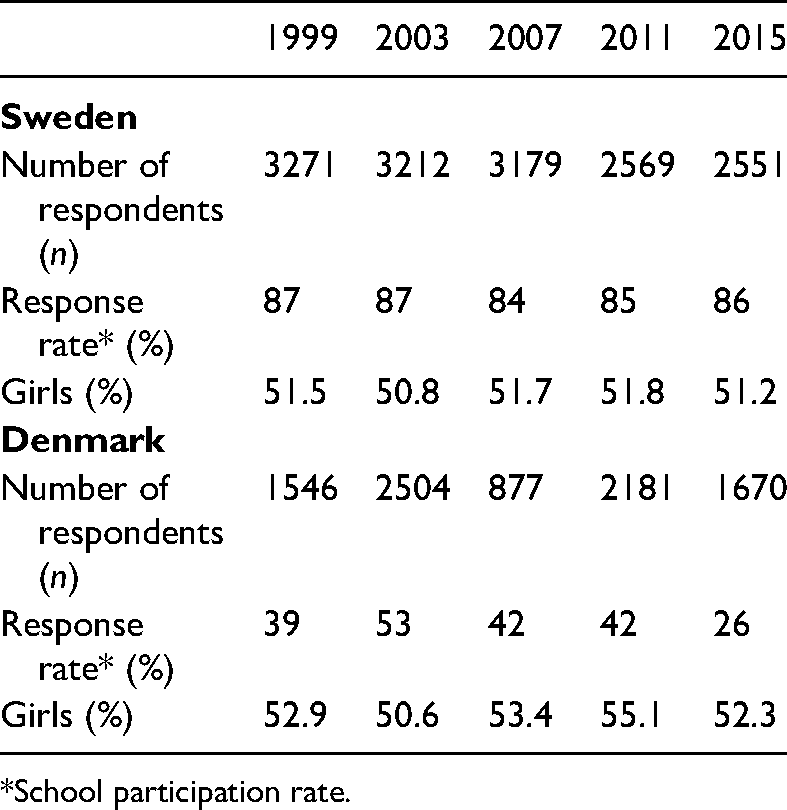
*School participation rate.
As a measure of prevalence of youth drinking, we use “any past-year drinking” based on the question “How many times (if any) have you consumed alcohol during the past 12 months?” and including respondents who answered at least “1–2 times”. We also included a measure of frequent drinking by classifying responses “20–39 times” or “more than 40 times” as frequent drinking.
Parental attitudes towards offspring drinking were based on the question: “How do you believe that your mother/father would react if you got drunk?”. The answers were dichotomised into a restrictive attitude (both parents did not allow it or did discourage it) and a permissive attitude (both parents approved it or did not mind). These items were developed by the ESPAD group (Hibell et al., 2011).
Parental rule-setting was measured by answers to two statements: (1) My parent(s) have certain rules for what I am allowed to do at home, and (2) My parent(s) have certain rules for what I am allowed to do outside home. The answers were rated on a five-category scale with the following options: often, almost always, almost never, seldom, and sometimes. This indicator was dichotomised into strict (often and almost always on both) and allowing (almost never, seldom, and sometimes on at least one).
Parental knowledge was measured by three questions: (1) Do your parents know with whom you associate at night? (2) Do your parents know where you are at night? These two indicators were dichotomised into good knowledge (know almost always and often) and poor knowledge (know almost never, seldom, sometimes). The third question was “Do your parents know where you spend your Saturday nights?” which was dichotomised as good (know always and quite often) and poor (usually don’t know and know sometimes). This indicator was adapted from the Adolescent Health and Lifestyle Survey (Lintonen et al., 2000). These three questions were collapsed into one measure where good knowledge on all three were classified as good parental knowledge.
The proportion of missing data varied between 1 and 5 per cent on the variables and were not included in the analysis. We now report the exact number of observations in each analysis (n) so it is possible to identify the exact number of missing observations.
The analysis starts with bivariate logistic regressions assessing the cross-sectional association between the various measures of parenting and the likelihood of past-year alcohol consumption and frequent drinking among adolescents in Sweden and Denmark. Next, changes in the various indicators of parenting analysed across the study period were tested for statistical significance by logistic regression analyses using survey year as the independent variable. All analyses were performed in SPSS statistics version 26.
Results
Youth drinking in Sweden and Denmark 1999–2015
Table 2 shows the development of youth drinking in Sweden and Denmark in terms of past-year drinking and past-year frequent drinking between 1999 and 2015. Both measures of drinking decline significantly in Sweden and Denmark but the prevalence of drinking declines much more in Sweden (–38%) than in Denmark (–7%). Frequent drinking also declines more in Sweden (–67%) than in Denmark (–46%), but the decline is also substantial in Denmark in this case. A striking finding is the much higher prevalence of youth drinking in Denmark than in Sweden regarding both measures and all study years.
Youth drinking in Sweden and Denmark 1999–2015.
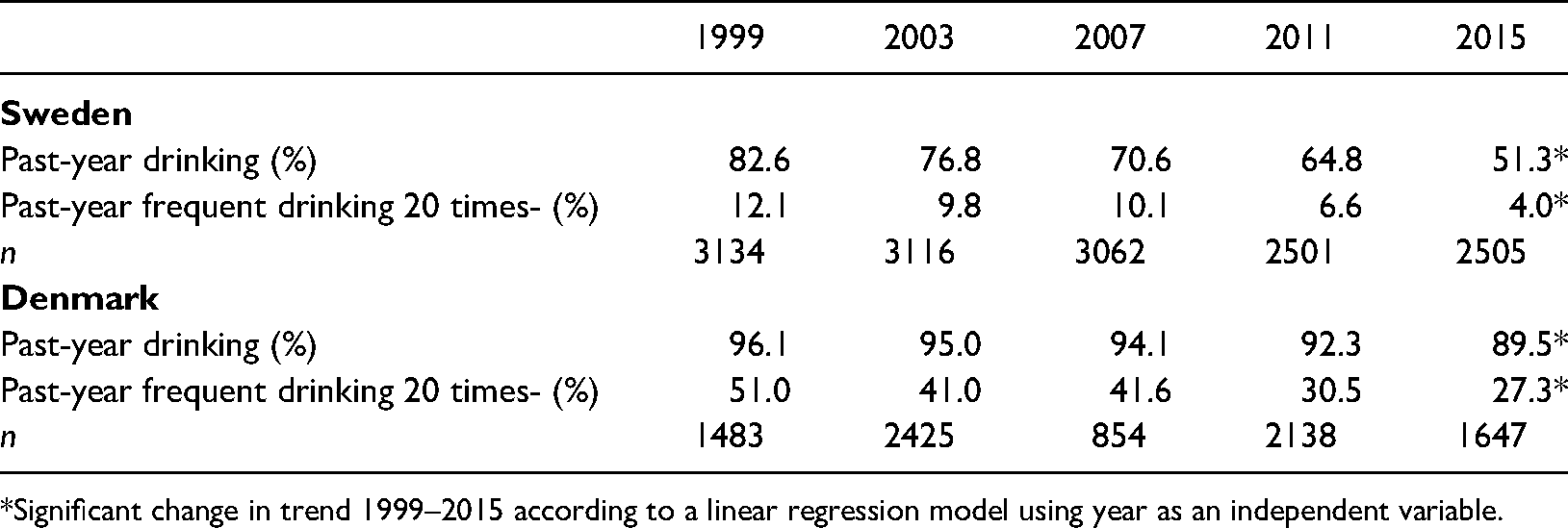
*Significant change in trend 1999–2015 according to a linear regression model using year as an independent variable.
Parenting and the likelihood of offspring drinking
Table 3 shows estimated odds ratios for the likelihood of having consumed alcohol at least 1–2 times during the past year among 15–16-year-olds in Sweden and Denmark in relation to parental attitudes, rule-setting and knowledge of whereabouts. A restrictive parental attitude towards offspring drinking, in terms of both parents reacting very negatively if their child got drunk, was strongly related to a lower likelihood of offspring drinking in both Sweden and Denmark for all studied years. All odds ratios were statistically significant and ranged between 0.37 and 0.40 in Sweden and 0.12 and 0.25 in Denmark. Strict parental rule-setting for what the child is allowed to do was only significantly related to less offspring drinking in 1999 (Denmark) and 2003 (Sweden and Denmark). No significant effect was found after 2003. Furthermore, parental knowledge was related to a lower likelihood of drinking in Sweden for all years but not in Denmark in any year.
Likelihood of any past-year drinking among 15–16-year-olds in Sweden and Denmark in relation to various aspects of parenting. Odds ratios estimated in bivariate logistic regressions (95% confidence intervals in parenthesis).
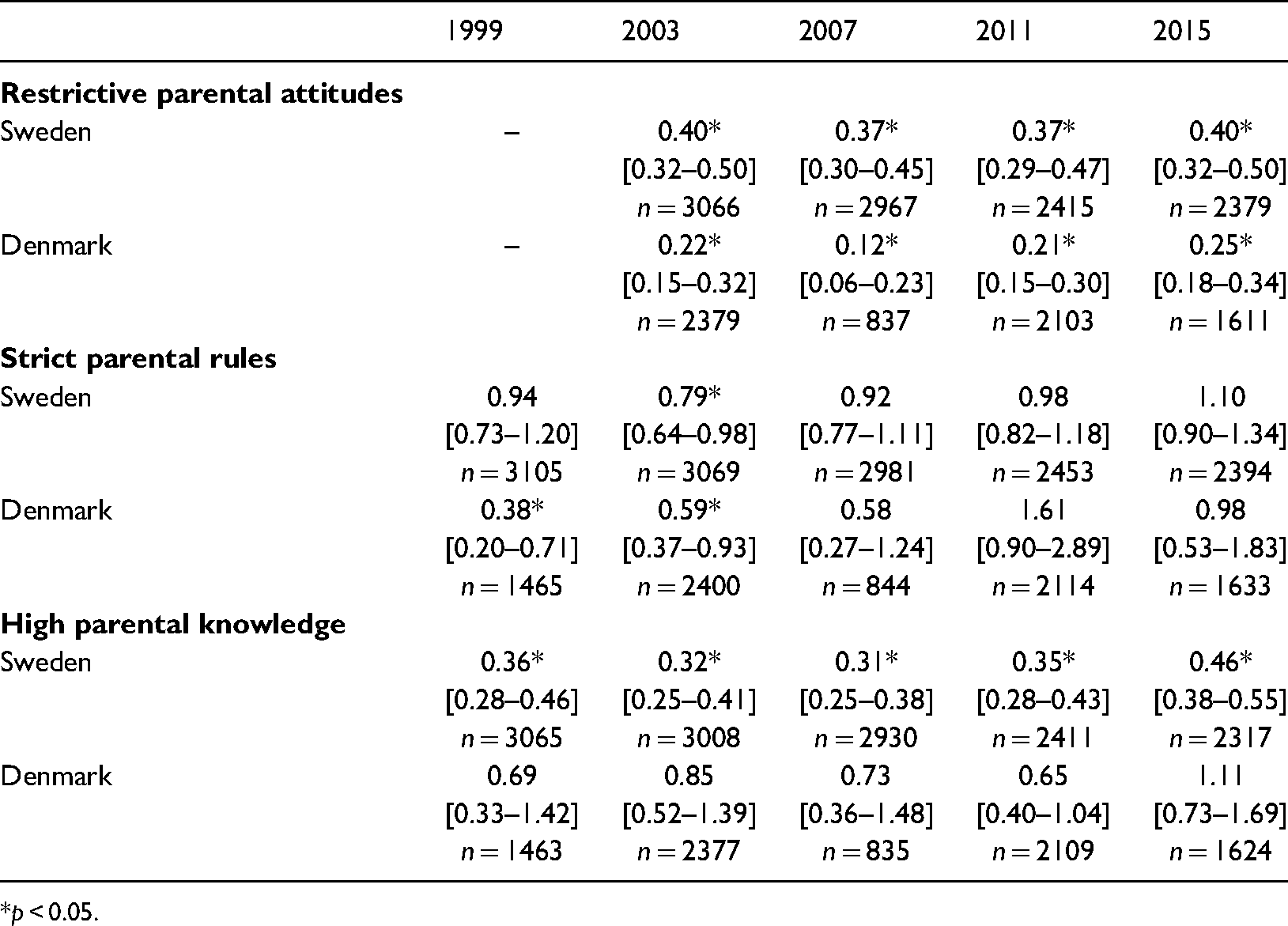
*p < 0.05.
Corresponding results for the association between parenting and prevalence of frequent drinking yielded similar results for attitudes and rule-setting (Table 4). A restrictive parental view of offspring drinking, in terms of both parents reacting very negatively if their child got drunk, was significantly related to a lower likelihood of frequent drinking among offspring in both Sweden and Denmark for all studied years. All odds ratios were statistically significant but with a larger variation, ranging between 0.27 and 0.46 in Sweden and 0.12 and 0.55 in Denmark. Similarly, there was no association between strict parental rules and offspring frequent drinking except for in Denmark in 1999 and 2003. With regard to parental knowledge of offspring whereabouts, a high level of knowledge was associated with less frequent drinking in both countries, thus also in Denmark in this case.
Likelihood of frequent drinking (at least 20 times) among 15–16-year-olds in Sweden and Denmark in relation to various aspects of parenting. Odds ratios estimated in bivariate logistic regressions (95% confidence intervals in parenthesis).
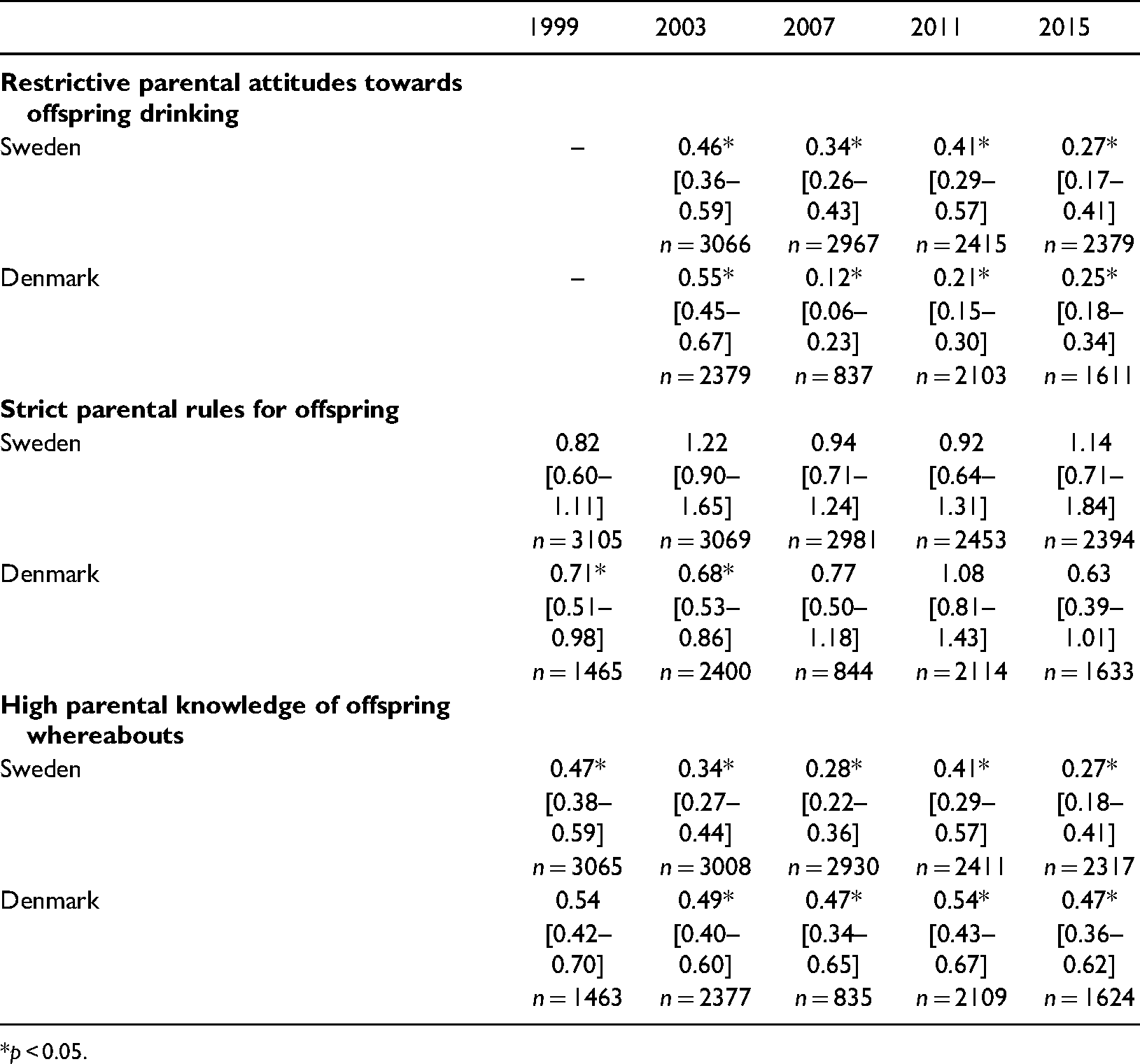
*p < 0.05.
Table 5 presents the development in the three measures of parenting in Sweden and Denmark during the study period. A striking observation is the large difference between Sweden and Denmark with respect to the prevalence of strict attitudes. In 2015, about 82 per cent of children in Sweden reported that their parents would react very negatively if they got drunk, whereas the corresponding figure for Denmark was only 26 per cent. Furthermore, the attitudes became stricter in Sweden during the study period whereas no change was found in Denmark. The proportion of parents with a restrictive attitude increased in Sweden from 72 per cent in 2003 to 82 per cent in 2015 whereas no significant change was found in Denmark.
Changes in parenting in Sweden and Denmark betteen1999/2003 and 2015.
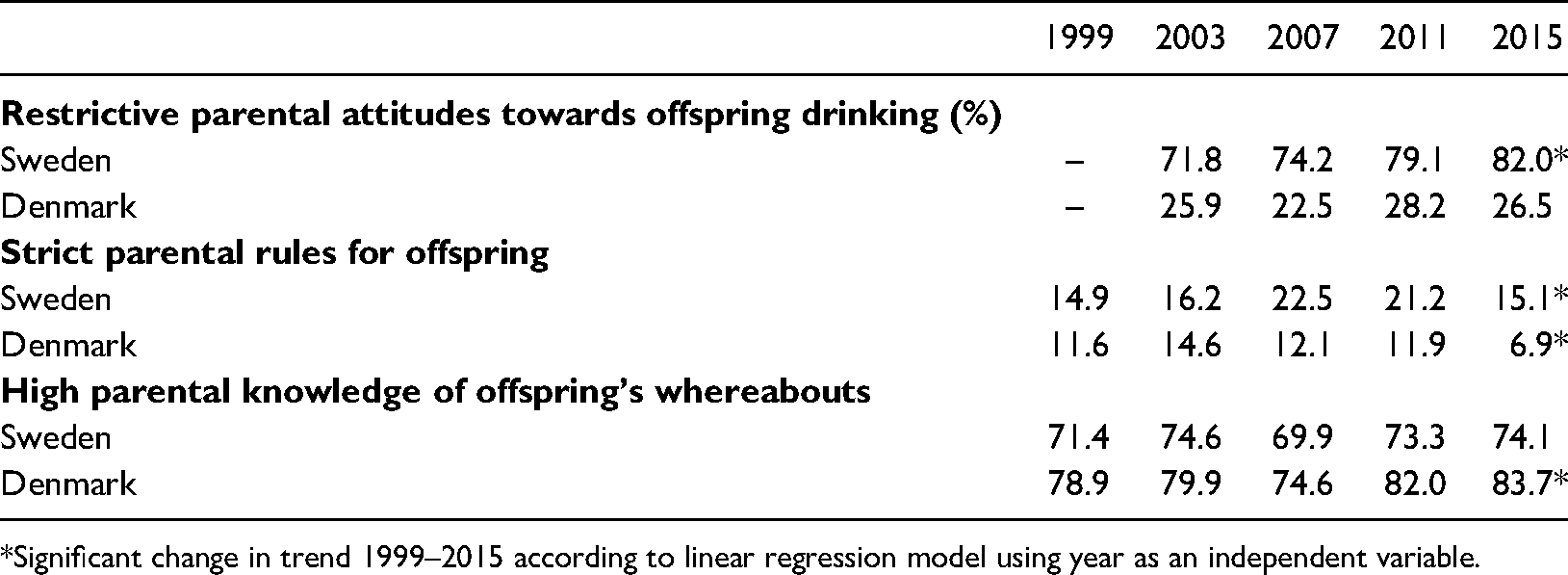
*Significant change in trend 1999–2015 according to linear regression model using year as an independent variable.
Strict parental rule-setting was also more common in Sweden and was estimated at 15 per cent in 2015 compared with 7 per cent in Denmark. No large change occurred in either of the countries between 1999 and 2015, although the overall trend was significant with an increase in Sweden and a decline in Denmark.
A clear majority of parents in both Sweden and Denmark knows with whom their children associate in the evening and where they are; between 70 and 84 per cent had high knowledge according to their children's self-reports. No substantive change occurred during the study period in any country although the weak positive trend in Denmark was significant.
Discussion
The overall aim of the present article was to replicate earlier findings suggesting that changes in parenting have been involved in the broad decline in youth drinking seen in numerous countries. To enable this, the recent development in parental attitudes, rule-setting and knowledge of offspring whereabouts was compared between a country experiencing a sharp decline in prevalence of youth drinking (Sweden) and a country with only a small decline (Denmark). The main hypothesis was that parenting in Sweden had changed in a way assumed to imply less youth drinking in Sweden but not in Denmark. We also examined to what extent these dimensions of parenting were associated with a lower likelihood of drinking at all and drinking frequently in cross-sectional analyses in both countries.
The findings did not offer any consistent evidence for the idea that parenting has been a major factor behind declining youth drinking. Some support was offered by the analysis of parental attitudes towards youth drinking; strict parental attitudes were related to a lower likelihood of drinking in both Sweden and Denmark and the prevalence of such strict attitudes was much higher in Sweden where the prevalence in youth drinking is much lower than in Denmark. In addition, the prevalence of strict attitudes increased in Sweden during the study period with declining youth drinking in contrast to in Denmark. Thus, this supports the idea that stricter parental attitudes may have played a role in the declining trend in youth drinking in Sweden and perhaps also in many other countries.
However, the cross-sectional association between strict parental rule-setting for what children were allowed to do and youth drinking was weak, and mostly not statistically significant. Moreover, there was no consistent change in parental rule-setting in either Sweden or Denmark during the study period. This suggests that a change in general parental rule-setting has not been an important factor behind the decline in youth drinking, although we cannot exclude the possibility that the result would have been different if we had measured rule-setting specifically related to drinking (de Looze et al., 2014).
Finally, parental knowledge of offspring's whereabouts was only linked to a lower likelihood of past-year drinking in Sweden, whereas it was related to a high frequency of drinking in both countries. We have no explanation for this difference, but it suggests that an increase in parental knowledge may help to reduce frequent youth drinking in both Sweden and Denmark, whereas the prevalence of past-year drinking would only be affected in Sweden. However, parental knowledge did not develop differently in Sweden and Denmark and a high and stable proportion was found in both countries. Thus, the stable situation of a high prevalence of parental knowledge in both Sweden and Denmark does not support the idea that parental knowledge has played a major role in reducing youth drinking. It should be noted that this finding is not in accordance with the recent study by Raitasalo et al. (2021) where parental knowledge (in this article denoted monitoring) was found to be associated with the decline in youth drinking in Sweden, Finland and Norway. However, this study had heavy episodic drinking (HED) as an outcome and not the prevalence or frequency of drinking. Thus, it is possible that parental knowledge is more important in preventing binge drinking than in preventing any use of alcohol.
It should be noted that these parenting factors may affect trends in youth drinking in two different ways that are not mutually exclusive: (i) the proportion of parents with restrictive attitudes, strict rule-setting or a high level of knowledge may change, or (ii) the impact of such factors on adolescent drinking may change. For instance, even if parental knowledge of offspring's whereabouts is temporarily stable, it may well be that the importance of knowledge has changed – which in turn may explain changes in youth drinking. It is thus a limitation of the present article that it focuses solely on the first factor. This potential problem was illustrated by the fact that parental rule-setting was only significant in 1999 and 2003 in Denmark but not thereafter. The reason for this change is unclear, but it is interesting to note that there was an increase in age-limits (15 to 16 years) for off-premises purchase of wine and beer in Denmark in 2004. Thus, it is possible that these age-limits changed the importance of parental rule-setting by making it more difficult for young people to obtain alcohol.
The fact that 16-years-olds are allowed to buy wine and beer in Denmark whereas the age-limit is 20 years in Sweden illustrates that Swedish alcohol policy is much stricter with respect to age-limits and other restrictions in availability (Karlsson et al., 2012). The difference is also reflected in major differences in norms towards alcohol between Sweden and Denmark. For instance, whereas 50 per cent of adults in Denmark regard alcohol as an ordinary commodity without a need for restrictions, the corresponding figure in Sweden is 19 per cent (Moskalewicz et al., 2016). It is also more common in Denmark to consider that parents have the responsibility to decide when children may start to drink – 42 per cent against 23 per cent in Sweden. These differences may explain the much lower proportion of Danish youth reporting that their parents would react negatively if they got drunk.
A limitation of the study is that the response rate was much lower in Denmark than in Sweden, and that some caution has been recommended when Danish data are compared with the results from other ESPAD countries (Kraus & Nociar, 2016).
To conclude, the findings in this comparative study of two countries with markedly different youth drinking trends did not find consistent support for the importance of parenting in the decline in youth drinking. Still, there was some evidence that stricter parental attitudes towards youth drinking may have contributed to declining youth drinking, whereas the idea of stricter rule-setting and higher parental knowledge was not supported. Similar support for explaining a decline in frequency of drinking was not found, since this declined significantly in both countries albeit more in Sweden. Further studies including more countries with different trends in youth drinking and parenting are warranted to elaborate these results.
Footnotes
Declaration of conflicting interests
The authors declared no potential conflicts of interest with respect to the research, authorship, and/or publication of this article.
Funding
The authors disclosed receipt of the following financial support for the research, authorship, and/or publication of this article: This work was supported by the Systembolagets alkoholforskningsråd (grant number 2019-0049).
