




Abstract
Aim:
The depiction of alcohol on television is an important explanatory variable for drinking behaviour. Even though alcohol consumption is frequently shown on popular TV shows, research on the impact of TV characters as models of drinking behaviour remains scarce. We theorise that the perceived similarity to a TV character is a key mechanism to explain recipients' expectancies about alcohol consumption.
Methods:
We conducted two experiments in which we manipulated the drinking behaviour of a TV character and the consequences of drinking. We measured perceived similarity to the character as amediating variable and treated participants' alcohol consumption as a moderator.
Results:
In both studies, perceived similarity to models predicted positive expectancies about alcohol consumption, and perceived similarity decreased with the portrayal of an alcoholic character. In Study 1, participants who reported drinking rarely perceived themselves to be more similar to a rare drinker, which suggests that viewers' own alcohol consumption affects similarity judgments. In Study 2, portrayals of consequences of drinking directly affected expectancies about alcohol, moderated by participants' alcohol consumption.
Conclusion:
Overall, our findings suggest that perceived similarity is a key variable to understand how alcohol on television affects viewers’ expectancies toward alcohol.
The negative consequences of heavy drinking behaviour have been documented in decades of research (e.g., Massa, Subramani, Eckhardt, & Parrott, 2019). To understand the drivers of alcohol consumption, scholars have turned to the question of how alcohol is depicted in the media, especially television. Content analyses of TV programmes have repeatedly shown that alcohol consumption is pervasive on TV (e.g., Coyne & Ahmed, 2009; Mayrhofer & Matthes, 2018; van Hoof, de Jong, Fennis, & Gosselt, 2009) and that it affects viewers’ alcohol drinking initiation (Hanewinkel et al., 2014), binge drinking (Hanewinkel et al., 2012), or drinking amount (Osberg, Billingsley, Eggert, & Insana, 2012). Social cognitive theory (Bandura, 1969, 2001, 2004) is a prominent framework to explain these effects. The theory suggests that observational learning can alter viewers’ expectancies and attitudes regarding specific actions and thus their behaviour. Starting with Bandura, Ross, and Ross’s (1963) work on violence, researchers have investigated and supported two pillars of observational learning, the portrayed consequences of an action (de Graaf, 2013; Kulick & Rosenberg, 2001) and the characteristics of models (Bandura, 2001).
We test a model of observational learning focusing on the highly relevant topic of alcohol consumption on television. As such, we are the first to experimentally manipulate both pillars present in observational learning. We ask, how alcohol expectancies are learnt through watching television depending on who the viewer observes drinking, what consequences this model displays, and how similar the viewer perceives himself to this model.
We tackle three crucial research gaps. First, a few prior studies hint toward the influence of perceived similarity with an observed model in observational learning. It can be assumed that the drinking behaviour of TV characters strongly differs in story-relevant ways. For instance, some characters in TV comedies, including Charlie Harper in Two and a Half Men and Hank Moody in Californication, are clearly portrayed as heavy drinkers who struggle with alcoholism. By contrast, for other characters – for instance, Sheldon Cooper in The Big Bang Theory – there is special emphasis on the fact that a character is a rare drinker in scenes where they suffer from consequences of drinking alcohol. This might affect viewers’ perceived similarity with them and, in turn, their alcohol expectancies. However, while alcohol consumption was treated as a driver of similarity (Andsager, Bemker, Choi, & Torwel, 2006), these studies did not examine alcohol consumption or recipients’ expectancies about alcohol consumption as an outcome (de Graaf, 2014). Second, no prior research has considered the role of viewers’ self-reported levels of alcohol consumption. Third, it has to be pointed out that most studies on the mediated observational learning of drinking behaviour used student samples (Kulick & Rosenberg, 2001; Osberg et al., 2012), as did studies on similarity in the context of alcohol-related topics (see Andsager et al., 2006; Pinkleton, Weintraub-Austin, & van de Vord, 2010). Yet comparisons of students and the general population are important because the former tend to consume more alcohol than the latter (O’Malley & Johnston, 2002). Thus, to extend the work of other researchers on the topic, we used a student sample and a more diverse, non-student sample.
Reward and punishment on TV: The depicted consequences of alcohol consumption
Social cognitive theory suggests that observing others endure consequences of a behaviour influences the learning of said behaviour as much as enduring the consequences of it oneself (Bandura, 1969, 2001, 2004). Experimental studies have tested that assumption in the context of mediated depictions of alcohol consumption and observed the effects of televised portrayals of the consequences of drinking on expectancies. Regarding alcohol consumption, expectancies encompass what people think happens to their behavioural, emotional, and cognitive states when they drink alcohol (Fromme, Stroot, & Kaplan, 1993). Especially positive expectancies, such as increased sociability, strongly predict people’s level of alcohol consumption (Palfai & Wood, 2001). Accordingly, TV has the potential to affect the alcohol consumption of viewers by informing their expectancies about drinking (Osberg et al., 2012).
In research on the topic, portrayals of the negative consequences of alcohol consumption have consistently increased negative expectancies about drinking (Bahk, 1997; de Graaf, 2013; Kulick & Rosenberg, 2001). Positive consequence portrayals presented a more complex picture. They increased positive expectancies and attitudes (Kulick & Rosenberg, 2001), as well as negative ones (Kulick & Rosenberg, 2001) or showed no effect compared to a control group (de Graaf, 2013). Based on these findings, and drawing from social cognitive theory (Bandura, 2001), we can clearly derive the first two hypotheses: H1: TV portrayals of positive consequences of drinking alcohol result in more positive expectancies about alcohol consumption than portrayals with no consequences. H2: TV portrayals of negative consequences of drinking alcohol result in less positive expectancies about alcohol consumption than portrayals of no consequences.
The moderating influence of viewers’ characteristics
As we focus on adults, participants have already gathered their own set of alcohol experiences, which shape their alcohol expectancies, attitudes, and current alcohol-related behaviour. As humans are prone to avoiding cognitive dissonance (Aronson, 1969), heavy drinkers cognitively support their drinking behaviour by holding more positive and less negative expectancies toward heavy drinking (McCarty, Morrison, & Mills, 1983). It is still questionable though, how much participants’ own level of alcohol consumption influences potential observational learning. In other words, can participants’ alcohol consumption filter their perception of explicitly shown alcohol consequence portrayals and thereby moderate the effect on expectancies and attitudes toward alcohol?
Studies on alcohol-prevention messages seem to support the fact that heavy drinkers are hardly susceptible to prevention messages (Lee & Chen, 2013). A recent study showed that participants with differing levels of alcohol consumption reacted differently to consequence portrayals. For instance, heavy alcohol consumers expected more cognitive impairment when exposed to negative consequences. Moderate and low alcohol consumers did not react to negative consequence portrayals but their expectancy for cognitive impairment decreased after seeing positive consequences (Mayrhofer & Naderer, 2019). The results might differ due to the difference in content. Narrative content, such as a television show, might not trigger the same reactance as a Public Service Announcement (PSA) clearly trying to persuade the viewer. As it remains unclear how exactly participants’ alcohol consumption influences viewers, we pose the research question: RQ1: Does a person’s alcohol consumption influence how portrayals of the consequences of drinking alcohol affect his or her expectancies about drinking?
Characteristics of models: The depicted drinking behaviour
For the first pillar of observational learning – the depicted consequences of drinking – we predicted direct effects on expectancies about drinking. For the second pillar, the models’ characteristics, we assume a mediation by perceived similarity. It has been theorised that learning from models is enhanced when the learners perceive themselves to be similar to the depicted models (Bandura, 2001; Moyer-Gusé, 2008; Simons, Berkowitz, & Moyer, 1970). Hence, if we examine expectancies about alcohol consumption as an outcome, a key driver is the match between the depicted drinking patterns of the model and the recipients’ own drinking habits. This match may impact the perceived similarity. Perceived similarity, then, shapes expectancies about drinking. We treat similarity as a mediator rather than a moderator. The reason is that any depiction of the model’s drinking behaviour may automatically lead to similarity judgments. In experimental language, similarity is thus a direct outcome of stimulus perception, and therefore, a mediator.
Drivers of similarity judgments
While the literature reflecting the basic idea of observational learning has described the mediating influence of perceived similarity in the learning process (Bandura, 2001), it is less clear what aspects of a model can affect model–viewer similarity. Of the numerous characteristics studied in terms of perceived similarity, including gender, age, nationality (Chen, Bell, & Taylor, 2016; Cohen, Weimann-Saks, & Mazor-Tregerman, 2017), or living arrangement (de Graaf, 2014), alcohol consumption was first examined in the seminal study by Andsager et al. (2006). After experimentally manipulating portrayals of a character’s drinking behaviour, they observed that a participant’s alcohol consumption positively affected perceived similarity to an alcohol-consuming model. However, since their stimulus focused on safe behaviours in the context of sun exposure, information about alcohol consumption was irrelevant to the health-related message. As another caveat, Andsager et al. (2006) manipulated content in a magazine and indicated to participants only that the model was drinking beer in a specific situation. By contrast, since alcohol consumption is a recurring event in most TV series (e.g., Russell & Russell, 2009), viewers who regularly watch those series are likely aware of characters’ drinking behaviours. In other words, if viewers follow a television series, they know whether the main characters are rare drinkers, experienced drinkers, or alcoholics. Also, multiplicity of models increases observational learning (Bandura, 2001; Perry & Bussey, 1979). This could induce a stronger effect than a single, situation-specific piece of information about consuming one alcoholic beverage.
At the same time, as Cohen et al. (2017) have also pointed out, ego-based similarity is a major driver of perceived similarity. Ego-based similarity encompasses traits that most strongly comprise a person’s sense of identity. However, when faced with audio-visual material, viewers can base their perceptions of similarity on numerous characteristics, including the character’s gender, age, origin, or physical attributes and give them varying importance in their similarity judgement (Simons et al., 1970). Therefore, with the available body of literature at hand, we can conclude that the role of similarity in the context of depicted alcohol consumption on television is far from being fully understood. We need studies that directly manipulate a similarity-relevant characteristic, and this characteristic also needs to be relevant to the outcome under investigation.
Based on observational learning, we theorise that the match between the drinking patterns of the models with the recipients’ own drinking behaviours is a key driver of similarity judgments. That is, perceived similarity depends on how strongly the viewers perceive their own drinking habits to be close to the ones of the characters depicted on television. If viewers do not drink alcohol themselves and see a character who is a heavy drinker, perceived similarity – all else being equal – may be low. Likewise, if a viewer who enjoys drinking alcohol watches a show with a character who drinks a lot of alcohol, perceived similarity will be high. Thus, the match between the viewers’ characteristics and the characteristics that are key to the narrative of a story is decisive for similarity judgments. In short, a high match means high perceived similarity. We may therefore expect that the depicted drinking behaviour of a character interacts with the consumption habits of the viewer in explaining perceived similarity. However, one caveat should be noted: it may also be theoretically possible that depicted heavy drinking (i.e., of an alcoholic) may automatically decrease perceived similarity. Based on the theory of cognitive dissonance (see Aronson, 1969), it may be the case that people automatically may feel less similar to depicted alcoholics compared to, say, a rare drinker, simply because people rarely want to be perceived as alcoholics (i.e., even if they are, in fact, alcoholics). But still, this effect should be less pronounced for heavy as compared to rare drinkers. We therefore theorise that people derive a similarity judgment based on the match between a depicted character’s drinking habits and their own alcohol consumption behaviours. We can therefore assume: H3: The depicted drinking behaviour of a model shapes perceived similarity depending on viewers’ own alcohol consumption habits.
Perceived similarity with a character, however, can also change according to the narrative in which a character appears (de Graaf, 2014). As such, one may assume that the depiction of negative consequences of drinking alcohol might decrease a viewer’s perceived similarity to a character, comparable to the depiction of an alcoholic. The reason is that negative consequences are undesirable and therefore distant to an ideal self (for an explanation, see Aronson, 1969). In other words, a viewer might not want to see himself as a person that acts very drunk and in a socially non-acceptable way. Since there is no research on the relationship between consequence depictions and perceived similarity, we pose a second research question: RQ2: Do the portrayed consequences of alcohol consumption influence a viewer’s perceived similarity to a character who endures those consequences?
Similarity judgments and expectancies about drinking
There are some studies that have explored the consequences of similarity judgements for observational learning. For instance, Pinkleton et al. (2010) exposed university students to a message against drunk driving and observed that their perceived similarity to the character in the message decreased their expectancies about drunk driving. Later, Kim, Shi, and Cappella (2016) found that their participants’ perceived similarity to a smoker in an anti-smoking PSA affected the perceived persuasiveness of the PSA, albeit only when mediated by an increase in their engagement (see also Andsager et al., 2006; de Graaf, 2014).
As already discussed above, Cohen et al. (2017) have pointed out that results could differ depending on the manipulated characteristic and whether perceived similarity to characters is story-relevant. For instance, in a PSA encouraging viewers to save electricity, information about a character’s drinking behaviour might not increase viewers’ perceived similarity to the character or the message’s persuasiveness. In a PSA on drunk driving, however, the message might resonate more strongly for viewers who perceive their similarity to the character in terms of drinking behaviour. In our case, we examine the effects of depicted drinking on entertainment television on expectancies about alcohol consumption. We may therefore assume that, first, the depicted drinking behaviour shapes similarity judgments depending on viewers’ own drinking habits (see Hypothesis 3), and that second, such similarity judgments do actually shape viewers’ expectancies toward alcohol. This latter aspect can be formally stated as a hypothesis: H4: In the context of depicted alcohol consumption on television, perceived similarity judgments shape viewers’ expectancies about alcohol.
When we combine H3 and H4, we can formally state a moderated mediation relationship: the effect of a characters’ drinking behaviour on perceived similarity is moderated by viewers’ own drinking behaviours, and perceived similarity serves as a mediator between a characters’ drinking behaviour and expectancies toward alcohol.
Figure 1 depicts a model encompassing all of our hypotheses and research questions.
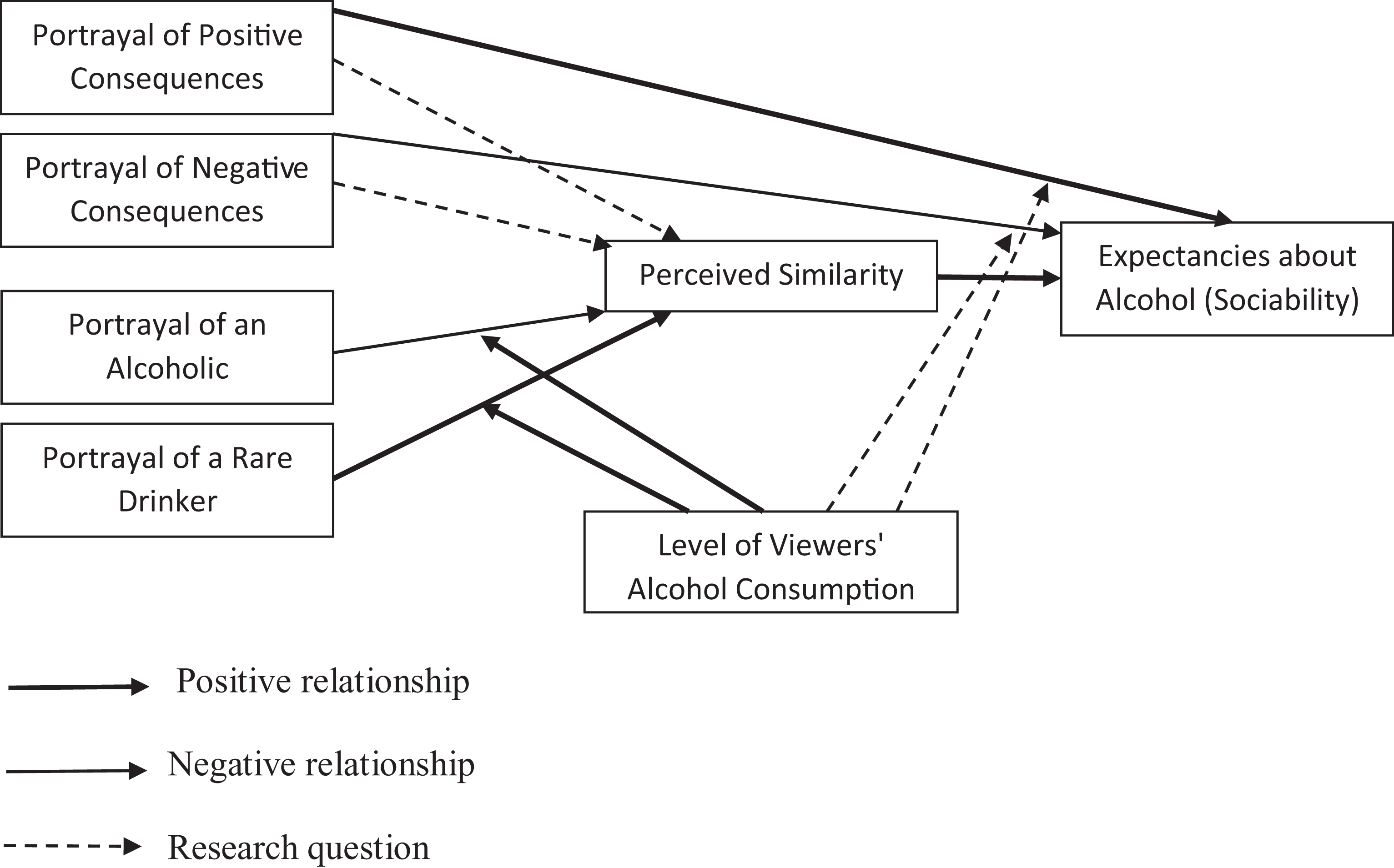
Model of the formulated research questions and hypotheses.
Overview of studies
The hypotheses and research questions were examined in two independent and sequentially reported experimental studies. Both experiments had a 3 (consequence: negative vs. positive vs. no consequence) × 3 (character characteristic: rare drinker vs. experienced drinker vs. alcoholic) between-subjects design. Study 1 applied this design to a student sample. Study 2 was designed to validate the findings of Study 1 with a more diverse non-student sample.
Study 1
Procedure and sample
We conducted Study 1 in December 2017 with a sample of undergraduate students who received course credit in exchange for participation. The study took place in our department’s laboratory. Altogether, 439 students aged 18–46 years (M age = 21.24, SD = 2.91) took part in Study 1. There were 71.5% female participants, which we controlled for in the analysis. Following the Ethics Code of the American Psychological Association, we informed participants that they might see images portraying alcohol or drug consumption and hear explicit language while viewing the stimulus material. We prohibited individuals with pre-existing alcohol-related, drug-related, or psychological conditions from participating. After providing his or her informed consent, each participant viewed one of nine versions of the audio-visual stimulus at random, after which he or she completed the questionnaire and received a debriefing.
Stimulus
We created nine short films based on the first three seasons of the popular TV series The O.C. We chose the show based on three characteristics. First of all, it ended in 2007. As we manipulated a main character’s description, it was crucial that the show was not fresh in participants’ minds. Second, we wanted to investigate real television material, ensuring external validity. Third, one of the characters endured positive and negative consequences of alcohol consumption. Each of the nine storylines centred on Marissa, a young woman. Every participant watched one film. We manipulated character descriptions by having each participant read one of three character introductions before watching the assigned film portraying either positive, negative, or no alcohol consequences. Moreover, between scenes in each film, we inserted brief statements to connect the scenes and supply information about the character. Thus, two factors – the consequences of alcohol consumption (i.e., positive, negative, or non-existent) and the character (i.e., rare drinker vs. experienced drinker vs. alcoholic) – were systematically varied in the stimulus.
In three storylines, Marissa experiences the positive effects of alcohol consumption; her inebriation emboldens her to initiate a conversation with a love interest or else have fun with her friends (movie length 5:32 min; positive consequences condition, n = 132). In three other storylines, she endures the negative consequences of alcohol consumption; she becomes unconscious or fights with her boyfriend (movie length 5:46 min, negative consequences condition, n = 157). In the remaining three storylines, she consumes alcohol without experiencing any consequences, (movie length, 3:36 min, control group, n = 150).
Marissa either experiences the positive, negative, or neutral consequences portrayed as a rare alcohol drinker (i.e., seldom drinks and has little experience with drinking, n = 161), as an experienced drinker (i.e., drinks at parties and enjoys cocktails, n = 139), or as an alcoholic (i.e., explicitly stated that she has an alcohol problem, n = 139). All measurements were conducted after stimuli exposure.
To prevent confounding effects of the series, we assessed participants’ familiarity with The O.C. on a five-point scale (1 = not at all, 5 = seen all episodes). More than half of the participants (54.4%, n = 239) reported never having watched The O.C. and 86.3% (n = 379) reported they had not seen the series within the past six months. Following randomisation, groups of participants differed in terms of familiarity with the series (F(8, 430) = 2.25, p = .023), although not significantly regarding their proportion of participants who reported having watched the series within the past six months (F(8, 430) = 0.69, p = .704). Controlling for familiarity with the series in the model did not influence any effects.
Measures
To assess participants’ expectancies about alcohol consumption, we adapted items from Fromme et al.’s (1993) Comprehensive Effects of Alcohol Questionnaire on a five-point scale (1 = I do not agree at all, 5 = I totally agree) to cover sociability as positive expectancy. We used seven items, translated into the COUNTRY German language (sociable, humorous, easier to talk to people, outgoing, talkative, courageous, easy-going). The scale has been validated in several studies (Fromme & D’Amico, 2000). Following the recommendations by Carpenter (2018), we formed a reliable index (α = .82, M = 4.00, SD = 0.61).
To assess participants’ perceived similarity to the character, we adapted three items from McCroskey, Richmond, and Daly’s (1975) homophily scale, all rated on a five-point scale (1 = I do not agree at all, 5 = I totally agree), in the instrument (i.e., “Marissa is like me”, “Marissa thinks like me”, “Marissa acts like me”). The corresponding index ultimately proved to be reliable (α = .92, M = 2.08, SD = 1.07).
We had participants report their alcohol consumption on a five-point scale (1 = never, 2 = less than once a month, 3 = two to four times a month, 4 = two to three times a week, 5 = four times a week or more; M = 3.03, SD = .89). We also measured their binge-drinking behaviour (i.e., six or more alcoholic drinks in a few hours) on a five-point scale (1 = never, 2 = less than once a month, 3 = monthly, 4 = weekly, 5 = daily or near daily; M = 2.25, SD = .93). We adapted both measures from the Alcoholics Anonymous questionnaire (Alcoholics Anonymous, 2018), combined them on a sum index, and mean-centred them. We included gender (1 = man) as a control variable, since gender can affect expectancies about alcohol consumption (Jones, Corbin, & Fromme, 2001).
Randomisation and manipulation checks
Results of a randomisation check for the enjoyableness of the stimulus (three-item semantic differential, 1 = bad, 5 = good; M = 3.27, SD = 1.23; F(8, 429) = 1.31, p = .236), and age (F(8, 430) = 1.24, p = .272) were acceptable. We had participants rate statements addressing Marissa’s character and the storyline on a five-point scale (1 = I do not agree at all, 5 = I totally agree) as a manipulation check of character presentation. Participants introduced to Marissa as an alcoholic agreed significantly more strongly than other participants that she had a drinking problem (F(2, 436) = 301.34, p < .001), whereas participants introduced to her as a rare drinker agreed significantly more strongly than others that she had little experience with alcohol (F(2, 436) = 470.05, p < .001). Due to a technical problem, we conducted a manipulation check regarding conditions of the consequences of alcohol consumption on a subsample (positive condition, n = 76, negative condition, n = 132). Overall, participants perceived the negative consequences as negative (M = 1.92, SD = .82) and the positive ones as positive (M = 3.68, SD = .97; F(1, 205) = 193.14, p < .001).
Data analysis
We dummy-coded the experimental conditions and used the control conditions indicating the lack of consequences of alcohol consumption and Marissa as an experienced drinker as reference groups. We also included alcohol consumption as a moderator variable, which we therefore mean-centred, and the interaction terms of alcohol consumption and its consequence as well as alcohol consumption and character presentation. When we tested the model with all possible main and interaction effects, the effects remained unchanged. To evaluate the model fit, we used a comparative fit index (CFI), root mean square error of approximation (RMSEA), and a test of close fit (PCLOSE). Results indicated that the model’s fit was excellent (CFI = 1.00; RMSEA < .001, 90% CIs [.00; .02]; PCLOSE = 1.0). Table 1 presents all results.
Path analyses explaining similarity and sociability judgments.
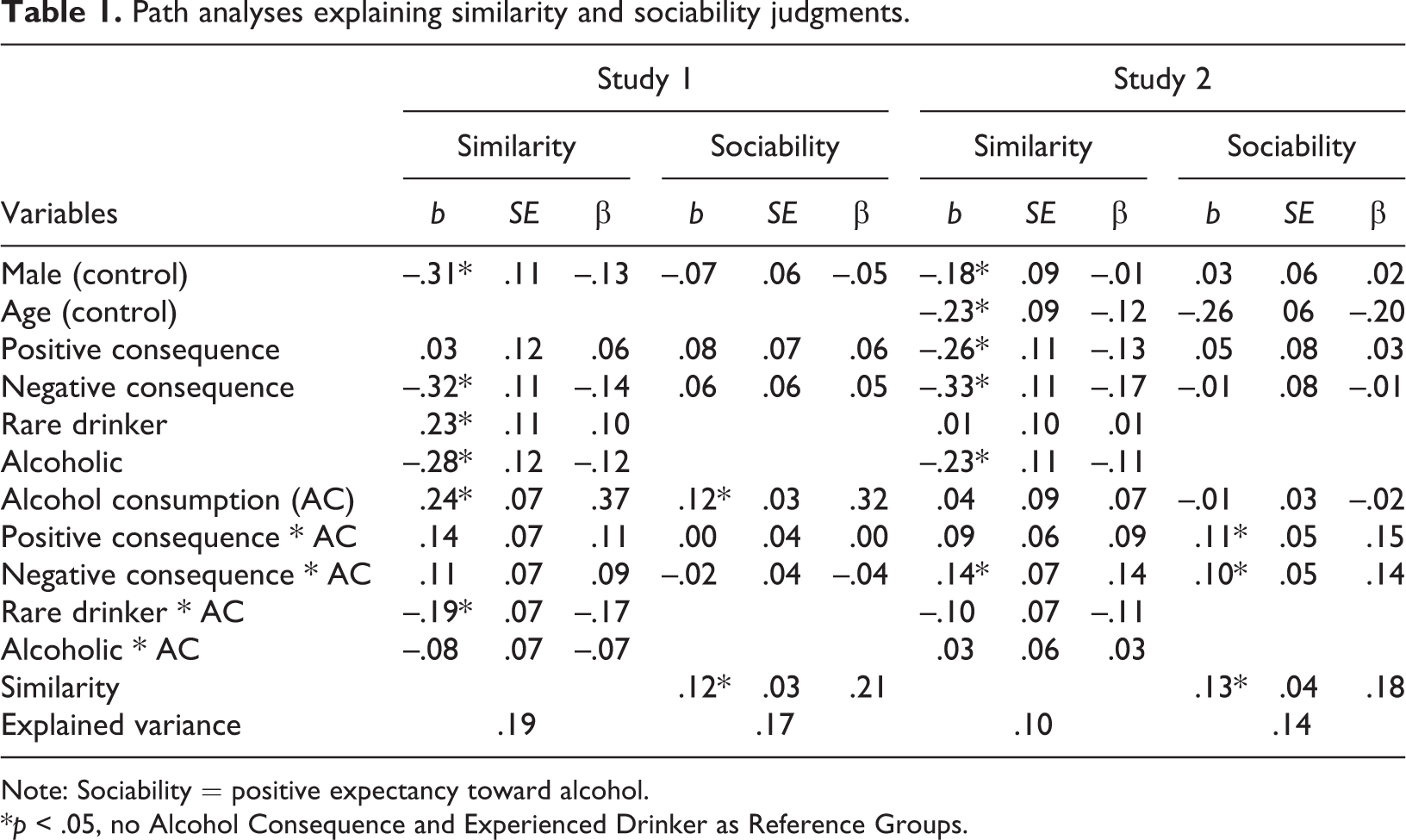
Note: Sociability = positive expectancy toward alcohol.
*p < .05, no Alcohol Consequence and Experienced Drinker as Reference Groups.
Results
Direct effects of portrayals of drinking’s consequences
Concerning direct effects on expectancies, no significant direct effects of the consequences surfaced, which led us to reject Hypotheses 1 and 2. Although direct effects of participants’ alcohol consumption on expectancies (b = 0.12, p < .001) were significant, no significant interaction effects between the conditions and participants’ alcohol consumption emerged (RQ1).
Effects on perceived similarity
Regarding paths mediated by participants’ perceived similarity to Marissa, her portrayal as an alcoholic significantly decreased perceived similarity compared to her portrayal as an experienced drinker (b = –0.28, p = .017). By contrast, her portrayal as rare drinker significantly increased perceived similarity compared to her portrayal as an experienced drinker (b = 0.23, p = .045). A positive main effect for alcohol consumption (b = 0.24, p < .001) and negative main effect of gender (b = –0.31, p = .003) suggested that men felt less similar than women to Marissa.
In terms of the interaction effects of Marissa’s presentation with participants’ own alcohol consumption (H3), the interaction effect of her portrayal as a rare drinker with alcohol consumption on perceived similarity was negative (b = –0.19, p = .007). This means participants who reported low and moderately low levels of alcohol consumption perceived themselves to be significantly more similar to Marissa when depicted as rare drinker (b = 0.23, p < .05; less than 5.28 on a scale from 2 to 10) than as an experienced one (see Figure 2). In response to RQ2, the positive consequences condition had no main effect on perceived similarity compared to the control condition (b = 0.03, p = .805), although the negative consequences condition did exert a significant main effect (b = –0.32, p = .004), suggesting that respondents felt less similar to the character when the character experienced negative consequences after drinking. No other interaction terms exhibited statistical significance.
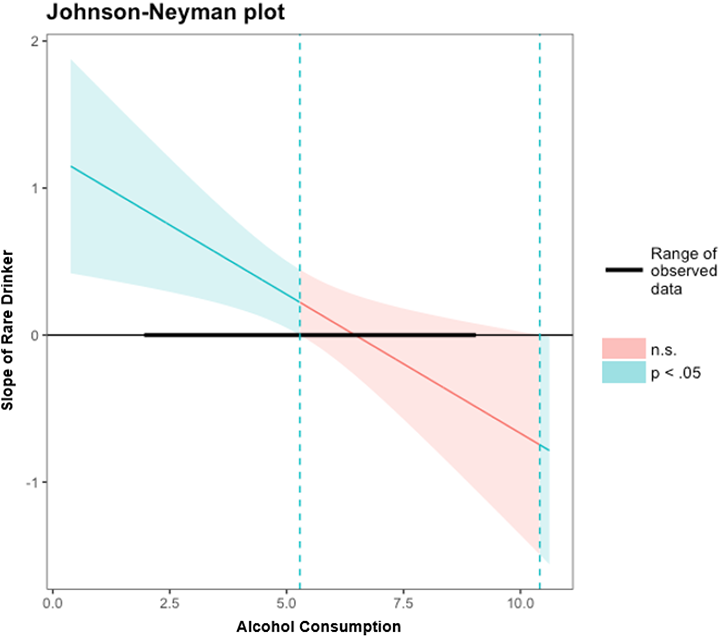
Plot of the interaction effect of the rare drinker condition and alcohol consumption.
Effects on expectancies and attitudes about drinking via perceived similarity
When it comes to H4, perceived similarity did exert a significant positive effect on expectancies about alcohol consumption (b = 0.12, p < .001). In a final step, we tested the indirect effects with 5,000 bootstrapping samples. The indirect effect of portrayal as alcoholic on sociability via perceived similarity compared to the experienced drinker was significant [ab = –.033; lower level confidence interval (LLCI) = –.066; upper level confidence interval (ULCI) = –.007]. Also, the indirect effect of negative drinking consequence portrayals on sociability via perceived similarity compared to no consequence was significant (ab = –.037; LLCI = –.076; ULCI = –.013). Last, the indirect effect of the interaction effect between participants’ alcohol consumption and the rare drinker model via similarity was significant (ab = –.022; LLCI = –.043; ULCI = –.007).
Discussion
The results of Study 1 indicated that mass media content did not directly affect participants’ expectancies about alcohol consumption but indirectly via the perceived similarity to the character. The portrayal of the negative consequences of drinking alcohol, as well as the presentation of a character as an alcoholic influenced participants’ perceived similarity to the character and, in turn, their positive expectancies about drinking. In contrast to H3, these effects were independent of viewers’ level of alcohol consumption. However, when the character was depicted as a rare drinker, we observed that a match between character and recipient characteristics shaped similarity judgments. We can conclude that a match is not always necessary to evoke the impression of similarity. Some aspects, such as negative consequences and the depiction of an alcoholic seem to decrease similarity independent of one’s own drinking habits.
Overall, such findings underline the importance of considering similarity with the model when testing observational learning. While other viewer’s characteristics and judgements on other aspects than the experimental ones were held constant through randomisation, the experimental factors significantly affected perceived similarity. However, there was a strong demographic match between the model and the student sample which could inflate the effect of story-relevant similarity aspects. Furthermore, the student sample was homogenous in terms of demographic factors, which could also influence effects of their similarity judgements. Consequently, research with more diverse samples is needed in order to generalise the results.
Study 2
Procedure and sample
Data were collected in a primary healthcare centre (PHC). Of the 399 participants, between 18 and above 70 years old, nearly half were older than 35 years, 55.9% were women, and 22.1% were students. More than half (61.7%) were part of the workforce, 8.3% were retired and 8% did not provide detailed information. Once healthcare centre personnel had pre-selected individuals appropriate for participation and excluded all individuals with alcohol-related, drug-related, or psychological conditions, we invited the remaining candidates to participate in the study. Presenting stimuli of alcohol depictions to individuals with alcohol-related, drug-related, or psychological conditions would not have been ethically acceptable. We escorted each participant to an office adjacent to the healthcare centre, where he or she sat at a computer to view and respond to the study materials. Because primary healthcare centres do not treat emergency cases, most attendees visit to obtain, for example, prescriptions, treatment for physical injury, referrals, blood tests, and paperwork following sick leave. Nevertheless, we assessed the self-reported health status of participants, who felt healthy (1 = good, 5 = bad; M = 2.4, SD = 1.27).
Stimulus
We used the same stimulus used in Study 1. We again randomly assigned participants to conditions representing drinking’s positive consequences (n = 130), negative consequences (n = 135), or lack of consequences as the control condition (n = 134) and Marissa’s character as a rare drinker (n = 149), experienced drinker (n = 135), or alcoholic (n = 115).
We collected data about participants’ familiarity with The O.C. using a five-point scale (1 = not at all, 5 = seen all episodes). Roughly similar to the sample in Study 1, 55.9% of participants (n = 223) had never seen the series and 95.2% (n = 380) indicated they had not seen the series within the past six months. Comparing the experimental groups, there were no significant differences in participants’ familiarity with the series (F(8, 390) = 1.26, p = .263) or their having watched it within the past six months (F(8, 390) = 0.86, p = .550).
Measures
Using measures identical to Study 1, we analysed sociability (α = .83, M = 3.72, SD = 0.65), perceived similarity to the protagonist (α = .90, M = 1.83, SD = .90), self-reported alcohol consumption (M = 3.04, SD = .97), and self-reported binge drinking behaviour (M = 1.88, SD = .91). For a control, we used age as dummy variable (1 = older than 35 years), since age has affected results in adult samples with broad age ranges (Mayrhofer & Naderer, 2019), as well as gender.
Randomisation and manipulation checks
Our randomisation check for enjoyableness of the stimulus (M = 2.73, SD = 1.19; F(8, 353) = 1.89, p = .060) and age (F(8, 390) = 0.17, p = .995) was successful. We had participants rate statements addressing Marissa’s character and the storyline on a five-point scale (1 = I do not agree at all, 5 = I totally agree) as a manipulation check of character presentation. Participants introduced to Marissa as an alcoholic agreed significantly more strongly than others that she had a drinking problem (F(2, 396) = 153.83, p < .001), while participants introduced to her as a rare drinker also significantly agreed more strongly that she had little experience with drinking (F(2, 396) = 218.69, p < .001). Participants perceived the negative consequences as negative (M = 2.03, SD = .74) and the positive ones as positive (M = 3.17, SD = 1.10; F(1, 213) = 77.93, p < .001).
Data analysis
We used the model shown in Figure 1 and added age as control variable. The model fit was excellent (CFI = 1.00; RMSEA < .001, 90% CIs [.00; .03]; PCLOSE = 1.0).
Results
Direct effects of portrayals of drinking’s consequences
Regarding increased sociability due to alcohol consumption, we detected no main effects of the positive consequences condition (b = 0.05, p = .529) and no effect whatsoever of the negative consequences condition (b = –0.01, p = .932) compared to the control condition. Similar to Study 1, we thus rejected H1 and H2.
Interaction effects of portrayals of drinking’s consequences and participants’ alcohol consumption
To answer RQ1, we examined the interaction effects of the conditions related to drinking’s consequences with participants’ self-reported alcohol consumption. For sociability, we detected a positive interaction effect of the positive consequences condition with alcohol consumption (b = 0.11, p = .019). If participants who reported high levels of alcohol consumption witnessed drinking’s positive consequences in the stimulus (b = 0.19, p < .05; greater than 6.23 on a scale from 2 to 10), then their expectancy about sociability due to drinking rose compared to the control group. Also, we detected an interaction effect of the negative consequences condition and alcohol consumption for increased sociability (b = 0.10, p = .029). If participants who reported very high levels of alcohol consumption witnessed drinking’s negative consequences in the stimulus (b = 0.36, p < .05; greater than 8.47 on a scale from 2 to 10), then their expectancy about sociability due to drinking rose compared to the control group. Therefore, self-reported alcohol consumption indeed influenced the effect of the portrayal of drinking’s consequences on participants’ positive expectancies and attitudes about drinking (RQ1).
Effects on perceived similarity
As in Study 1, Marissa’s portrayal as an alcoholic significantly decreased participants’ perceived similarity (b = –0.23, p = .042), whereas her portrayal as a rare drinker did not significantly affect perceived similarity (b = 0.01, p = .919). Self-reported alcohol consumption (b = 0.04, p = .465) did not exert any primary effect on perceived similarity; however, gender exerted a negative primary effect on perceived similarity (b = –0.18, p = .047), which suggests that men felt less similar to Marissa than women. More importantly, Marissa’s portrayal as a drinker revealed no interaction effects with participants’ alcohol consumption. Accordingly, we rejected H3.
Both the positive (b = –0.26, p = .016) and negative consequences conditions (b = –0.33, p = .002) exerted a main effect on participants’ perceived similarity to Marissa in relation to the control condition. Moreover, the negative consequences condition had an interaction effect with alcohol consumption on perceived similarity with the character (b = 0.14, p = .039). In particular, if participants who reported low and moderate levels of alcohol consumption witnessed drinking’s negative consequences in the stimulus (b = –0.23, p < .05; less than 5.63 on a scale from 2 to 10), then their perceived similarity to Marissa decreased compared to the control group (see Figure 3). Therefore, our findings suggest a complex interplay of different portrayals of drinking’s consequences and participants’ alcohol consumption on their perceived similarity to the character.
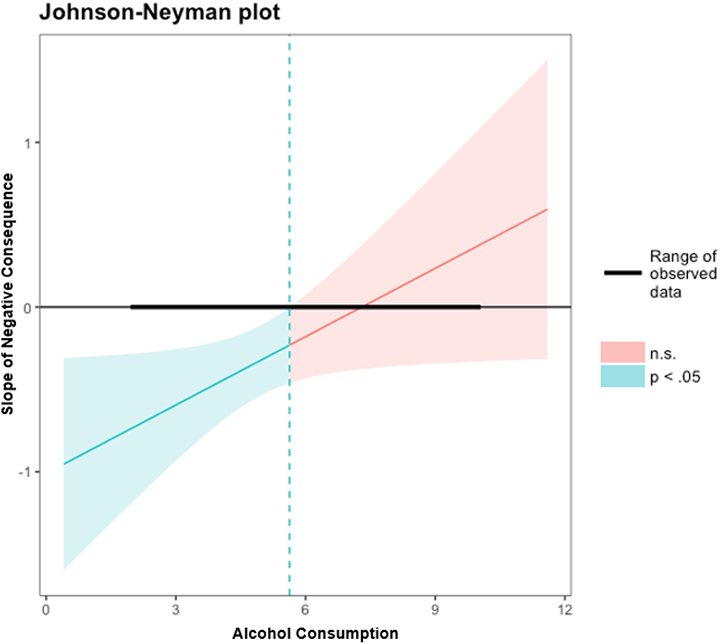
Plot of the interaction effect of the negative consequence condition and alcohol consumption.
Effects on sociability via perceived similarity
In support of H4 and in line with Study 1, perceived similarity did have a significant positive effect on the positive expectancies about increased sociability (b = 0.13, p < .001). We then examined the indirect effects with 5,000 bootstrapping samples. The indirect effect of portrayal as alcoholic on sociability via perceived similarity compared to the experienced drinker was significant (ab = –.028; LLCI = –.072; ULCI = –.003). Also, the indirect effect of negative drinking consequence portrayals (ab = –.042; LLCI = –.089; ULCI = –.012) and positive drinking consequence portrayals (ab = –.033; LLCI = –.078; ULCI = –.005) on sociability via perceived similarity compared to no consequence was significant. Last, the indirect effect of the interaction effect between participants’ alcohol consumption and the negative consequence condition via similarity was significant (ab = .017; LLCI = .001; ULCI = .045).
Discussion
In contrast to Study 1, findings from the diverse sample in Study 2 indicated an interaction effect of the positive and negative consequences conditions and participants’ alcohol consumption increased expectancies about alcohol. Interestingly, both interaction effects were positive, suggesting that as long as consequences are shown this increases positive sociability expectancies for viewers who reported high levels of alcohol consumption. We will revisit this finding in the general discussion.
More importantly, and in line with Study 1, participants’ perceived similarity to Marissa mediated the effects on positive expectancies about drinking. In particular, the portrayal of drinking’s positive consequences and Marissa’s characterisation as an alcoholic decreased participants’ perceived similarity to her. However, the portrayal of drinking’s negative consequences decreased perceived similarity only among participants who reported low alcohol consumption. In turn, perceived similarity affected positive expectancies about drinking. In effect, the results of Study 2 stress the importance of considering model–viewer similarity in observational learning and importance of personal alcohol consumption as a moderator in such learning.
General discussion
Our research is the first attempt to comprehensively test the effects of portrayals of drinking’s consequences and models’ characteristics on viewers. We found that perceived similarity to a model was a key path of influence for both samples as it increased the expectation of sociability. The more similar that participants felt to the alcohol-consuming character, the greater their expectancies about the benefits of drinking. This is an important finding because positive expectancies about drinking strongly predict intentions to drink, even more than attitudes toward drinking and negative expectancies.
Even though similarity drives positive expectancies about alcohol, perceived similarity crucially depends on how a drinking character is depicted on television. In both studies, the character’s portrayal as an alcoholic had a negative effect on participants’ perceived similarity to the character. Several content analyses on the topic of alcohol portrayals have included series in which main characters are explicitly presented as alcoholics. For instance, Russell and Russell (2009) included Two and a Half men or Desperate Housewives. Thus, if viewers distance themselves from alcoholic characters, then the depicted alcohol consumption can contribute to the character’s reception as a negative role model. In that case, observational learning may lead to less positive expectancies about alcohol.
Regarding the difference between portrayals of the character as a rare or experienced drinker, our results varied between the studies. In Study 1, for participants who reported low levels of alcohol consumption, the character’s portrayal as a rare drinker increased their perceived similarity to her. However, in Study 2, no significant difference in perceived similarity to the character presented as a rare or experienced drinker emerged. For an explanation of these results, we underscore the ego-relevance of alcohol consumption as a personality trait for participants – that is, how important it is to a person’s identity to drink alcohol. Especially in collegiate environments, an identity as a drinker is an important predictor of increased alcohol consumption (Ridout, Campbell, & Ellis, 2012). Among students, it is considered an important positive trait to be a drinker, which may even predict selection effects in social networks. Heavy-drinking university students, for example, prefer to associate with other heavy-drinking students (Westgate & Holliday, 2016). Vice-versa, studies state that a non-drinker identity is perceived as “deviant” of the social norm by students and is difficult to maintain in view of peer pressure (Romo, 2012). As being a non-drinker is in opposition to the collegiate norm, establishing a non-drinker identity is highly ego-relevant. For instance, Romo (2012) describes non-drinking students’ tactics to assert their non-drinking identities. Among those strategies is to associate yourself with, bond with, and befriend other non-drinkers as they are seen as easier to identify with. By extension, viewing a rare drinker might be more relevant to the perceived similarity of students who seldom drink than to perceived similarity in the diverse sample in which low alcohol consumption might not be an ego-important decision but simply a result of the participant’s increased responsibility (e.g., as an employee or parent) and felt need to drink less. However, since we did not measure the perceived ego-relevance of participants’ alcohol consumption, researchers in the future should investigate identity as a drinker as a driver of perceived similarity to heavy-drinking characters and how media can be mobilised to decrease the ego-relevance of heavy drinking. Hence, characters known for their alcohol consumption such as Nick Miller (The New Girl) and Chloe (Don’t Trust the B---- in Apartment 23) should be reconsidered, for they suggest that alcohol consumption can be a defining trait of people.
Concerning portrayals of drinking’s consequences, the positive consequences condition in Study 2 exerted a negative main effect on participants’ perceived similarity to the character. According to de Graaf (2014), the effects of perceived similarity stem from a self-referencing process. As such, when participants are confronted with a narrative, the description of certain events makes them remember their own experiences under the same circumstances. That dynamic could be especially true for story-relevant elements. In the stimulus, drinking formed part of a partying environment closely representative of the lifestyles of students. For instance, O’Malley and Johnston (2002) point out a pattern of party and weekend drinking especially present for college students. Since the positive consequences condition depicted young adults dancing, having fun and being silly (see Appendix), participants in Study 2 might have compared the depicted character’s drunken behaviour to their own drunken behaviour. In that condition, such a comparison could have decreased participants’ perceived similarity to the character given their belief that they would react differently to being drunk. For instance, they might drink heavily to relax and have a fun conversation with their friends but not try to flirt with others or dance, as the character in the stimulus did. By the same token, students in Study 1’s sample, for whom the positive consequences of drinking did not decrease their perceived similarity to the drunken character, did not distance themselves from her.
In the negative consequences condition, the character obviously drank too much alcohol. Likewise, participants engaged in a self-referencing process, and students, as well as light and moderate drinkers, perceived less similarity to the character. Consequently, when the character endured the negative consequences of drinking, participants distanced themselves from the character and decreased their positive expectancies about drinking. Although heavy drinkers in Study 2 did not show such a decrease in perceived similarity, we surprisingly did not detect that moderation effect in Study 1. Among possible explanations, heavy-drinking students who engaged in a self-referencing process might not have yet experienced the severe negative consequences of consuming alcohol. Hence, the portrayal of drinking’s negative consequences decreased their perceived similarity to the character compared to that of their peers who reported drinking less. Alternatively, heavy-drinking students might have overestimated their capacity to consume alcohol and during the self-referencing process identified less with the character for “not holding her liquor”, so to speak. In the future, researchers should therefore consider participants’ experiences with binge drinking. Portrayals of drinking’s positive consequences again presented a more complex picture, namely by increasing positive expectancies about drinking for heavy drinkers.
For students, the effects of the portrayals of drinking’s consequences might have triggered a self-referencing process that was relatively uniform among participants. Participants in the sample of students might exhibit alcohol consumption similar to the character’s, whereas participants in the diverse sample might drink in different settings, which stifled their self-referencing process. In such cases, the effect of the portrayal of drinking’s consequences might not unfold through perceived similarity, but participants generalise the consequences. In other words, whereas students could relate to the portrayed situation (i.e., excessive drinking mainly at parties) which triggered their self-referencing process, this might not have happened for all participants in the diverse sample. Those who could not relate to the situation or character whatsoever might have a process independent of perceived similarity to the character. As they have no experience in this type of situation and hence cannot self-reference, they generalise that in situations such as the one displayed, the portrayed consequences occur, independent of the character. That possible explanation can be connected to the findings on other character involvement concepts, such as those of de Graaf (2013) and Mayrhofer and Naderer (2019), for example, that liking a character did not influence the effects of portrayed consequences of actions, possibly because participants generalised the effects of alcohol consumption to people whom they like or dislike.
Limitations and future research
Our research involved some limitations concerning the stimulus materials and the measures used. Regarding the former, we exposed participants to material presenting a specific set of consequences of drinking alcohol embedded in a specific situation. Since the context of alcohol consumption (e.g., social vs. solitary) and its motivation (e.g., partying, relaxing, and coping) can affect self-referencing processes, results could differ depending on the storyline presenting the consequences. We also presented a specific set of consequences, and results could likewise differ if participants witnessed different consequences (i.e., death due to drunk driving). Regarding the experimental design, we decided to focus this work on the character involvement concept of perceived similarity. However, as character involvement is highly complex and consists of further aspects such as liking, wishful identification or para-social relationships, future studies are needed to venture into the influence of those concepts on observational learning. Also, studies are needed that include measurements of the strength of participants’ identities as drinkers as well as experiences with alcohol consumption. These viewer characteristics could also broaden the understanding of observational learning. Viewer characteristics may also affect attention allocation, as for instance, measured by eye-tracking (King et al., 2019).
Conclusion
Overall, our findings suggest that the mass media have the potential to affect viewers’ expectancies about alcohol, clearly echoing calls for a well-reflected and responsible depiction of alcohol on entertainment shows. More specifically, we demonstrated that perceived similarity is a key variable to understand how alcohol on television affects viewers’ expectancies toward alcohol. We show in two studies, employing different samples, that similarity to a model significantly shapes positive alcohol expectancies. We also show that the depiction of alcoholics decreases perceived similarity for all respondents, thereby dampening viewers’ alcohol expectancies. However, when it comes to the depiction of consequences as well as the depiction of rare drinkers, the pattern is more complex, calling for additional research. In fact, we observed important and theoretically meaningful differences in findings between the samples, suggesting that alcohol depictions have different effects for college students as compared to the broader public. These differences cannot be explained by age or consumption habits alone, but point to the relevance of drinking to a person’s identity which appears to be a promising avenue for future research.
Footnotes
Authors’ note
There has been no prior dissemination of the data. We have complied with APA ethical standards in the treatment of the sample.
Declaration of conflicting interests
The author(s) declared no potential conflicts of interest with respect to the research, authorship, and/or publication of this article.
Funding
The author(s) received no financial support for the research, authorship, and/or publication of this article.
