




Abstract
The Problem Gambling Severity Index (PGSI) is a screening instrument frequently used to identify risk and problem gambling. Even though the PGSI has good psychometric properties, it still produces a large proportion of misclassifications.
Aims:
To explore possible reasons for misclassifications in problem gambling level by analysing previously classified moderate-risk gamblers’ answers to the PGSI items, in relation to their own current and past gambling behaviours.
Methods:
Semi-structured telephone interviews were conducted with 19 participants reporting no negative consequences from gambling. They were asked the PGSI questions within an eight-year time frame (2008 to 2016). Ambiguous answers to PGSI items were subject to content analysis.
Results:
Several answers to the PGSI items contained ambiguities and misinterpretations, making it difficult to assess to what extent their answers actually indicated any problematic gambling over time. The item about feelings of guilt generated accounts rather reflecting self-recrimination over wasting money or regretting gambling as a meaningless or immoral activity. The item concerning critique involved mild interpretations such as being ridiculed for buying lottery tickets or getting comments for being boring. Similar accounts were given by the participants irrespective of initial endorsement of the items. Other possible reasons for misclassifications were related to recall bias, language difficulties, selective memory, and a tendency to answer one part of the question without taking the whole question into account.
Conclusions:
Answers to the PGSI can contain a variety of meanings based on the respondents’ subjective interpretations. Reports of lower levels of harm in the population should thus be interpreted with caution. In clinical settings it is important to combine use of screening instruments with interviews, to be able to better understand gamblers’ perceptions of the gambling behaviour and its negative consequences.
Screening and assessment of problematic gambling rely heavily on self-reports. While there are some objective measures against which to evaluate self-reports for many other conditions, this is seldom the case in the gambling field, and there is a call for continuous evaluation and improving of existing measures. The Problem Gambling Severity Index (PGSI; Ferris & Wynne, 2001) is one of the most frequently used instruments to identify and quantify risk and problem gambling. The PGSI was developed specifically to measure problem gambling in the general rather than in a clinical population (Holtgraves, 2009). It comprises a subset of nine of the 18 items from the Canadian Problem Gambling Inventory (CPGI), and the construction was guided by a theoretical rather than an empirical approach (Ferris & Wynne, 2001). In terms of internal consistency and factor structure, the PGSI appears to perform well (e.g., Orford, Wardle, Griffiths, Sproston, & Erens, 2010). The PGSI items seem to constitute a single underlying factor for problem gamblers (Holtgraves, 2009); however, the test seems to be multidimensional for low or moderate-risk gambling subgroups.
Tests that perform well with respect to reliability and validity can still be biased in other ways (cf. Rust & Golombok, 1989). For instance, individuals or groups with similar scores on a test can have different levels of the measured trait or condition. People tend to interpret abstract phenomena differently, and words such as “lying” or “problems” have different connotations and levels of severity between individuals and across subgroups, leading to both false positives and false negatives. The PGSI has been shown to perform differently in different subgroups (Currie, Casey, & Hodgins, 2010). Further, previous research has shown that about half of the people labelled as problem gamblers (using a 3+ criterion) were not classified as problem gamblers by clinical raters (Williams & Volberg, 2014). Similarly, in a study comparing clinical assessments with assessments based on the PGSI (Ladouceur, Jacques, Chevalier, Sévigny, & Hamel, 2005), 88% of individuals classified as probable pathological gamblers were not classified as pathological gamblers in the interviews. Of the at-risk gamblers, 72% did not receive this classification in the clinical interview. One reason may be misunderstood items. A previous study has found that none of the adults understood all items correctly (Ladouceur et al., 2000). On average, 26% of all the items were misunderstood (equally among non-problem and probable pathological gamblers). To prevent misclassifications, it has been suggested that a higher scoring threshold on the PGSI (5+) should be used for defining problem gamblers, rather than setting the threshold at 3+ as is often done today (Currie et al., 2010; Stone et al., 2015).
Further, Svetieva and Walker (2008) argue that the PGSI fails to capture the notion of harm. They argue that several items measure behaviours rather than problems. Chasing losses for example, they say, is not a problem – losing money is. Further, they argue that being criticised may be a result of regular gambling, while feeling guilt may reflect the acceptance level of gambling in different cultures or among different value systems. In line with this thinking is the notion that the concept of losing time depends on what is valued; non-problem poker players were scored as problem gamblers on the PGSI because they gambled for long times and with large bets (Laakasuo, Palomäki, & Salmela, 2016).
This article adds to the discussion on the use of standardised instruments to measure gambling harm, which is of particular concern in the Nordic context with much ongoing debate on the gambling issue. For example, in Sweden, following the legislative changes of the Social Services Act and the Health and Medical Services Act, where gambling problems have been given the same status as alcohol and drugs since 1 January 2018 (Prop. 2016/17:85), more attention is oriented towards detecting and screening for gambling problems in primary care and social services settings. Knowledge of gamblers’ own perceptions of gambling harm is therefore highly relevant, as is knowledge of reasons for potential bias in using screening instruments. Also, the necessity of measuring gambling harm in the Swedish population is topical in light of the forthcoming reform of the gambling policy. While other Nordic countries such as Finland and Norway have decided to retain or strengthen their monopolies, Sweden is following a trend among other European countries to open up markets to new operators (The Swedish Gambling Authority, 2016). A comprehensive reform of the regulation of the gambling sector will take place, where all operators in the Swedish gambling market should have a licence (Prop. 2017/18:220).
The accessibility of gambling is likely to increase, while the licence system is supposed to ensure a high level of consumer protection to limit negative consequences of gambling. It is thus important to be able to accurately measure the changes in prevalence of harm in the population.
The response alternatives in the PGSI are normally never (0), sometimes (1), most of the time (2) and almost always (3). The total score is calculated indicating non-problem gambling (0), low-risk gambling (1–2), moderate-risk gambling (3–7), or problem gambling (8+). In Sweden, 4.2% of the population are categorised as low-risk gamblers (322,000 individuals), 1.3% as moderate-risk gamblers (103,100 individuals), and 0.4% as severe problem gamblers (31,200 individuals) (Public Health Agency of Sweden, 2016a). In Swedish public health reports of gambling problems and research, moderate-risk gamblers and severe problem gamblers are somewhat confusingly often merged into one category of “problem gamblers” (PGSI 3+) (e.g., Abbott, Romild, & Volberg, 2018). The categorisation of moderate-risk gambling is thus relevant for policy and research.
As the PGSI is one of the most frequently used measures in problem gambling prevalence studies, there is a need for a better understanding of the instrument’s potential biases. While previous research primarily has been focused on quantitative validation of gambling screening instruments, the same attention has not been given to the meanings attributed by gamblers to the questions asked. The aim of this study was to explore possible reasons for misclassifications in problem gambling level by analysing previously classified moderate-risk gamblers’ answers to the PGSI items, in relation to their own current and past gambling behaviours.
Methods
Data collection and recruitment procedure
The Swedish Longitudinal Gambling Study (Swelogs) is a population study of prevalence and incidence of gambling problems over time (Romild, Volberg, & Abbott, 2014). It comprises an epidemiological track (EP) with four waves from 2008 to 2014 and an in-depth track (ID) where a subsample from the EP track is followed focusing on consequences and risk and protective factors (see Table 1 for an overview of the data collection schedule of Swelogs). To further explore the fluctuations and contexts of individual gambling behaviours, the qualitative component ID3 was conducted.
Data collection in the Swedish Longitudinal Gambling Study’s epidemiological and in-depth tracks.
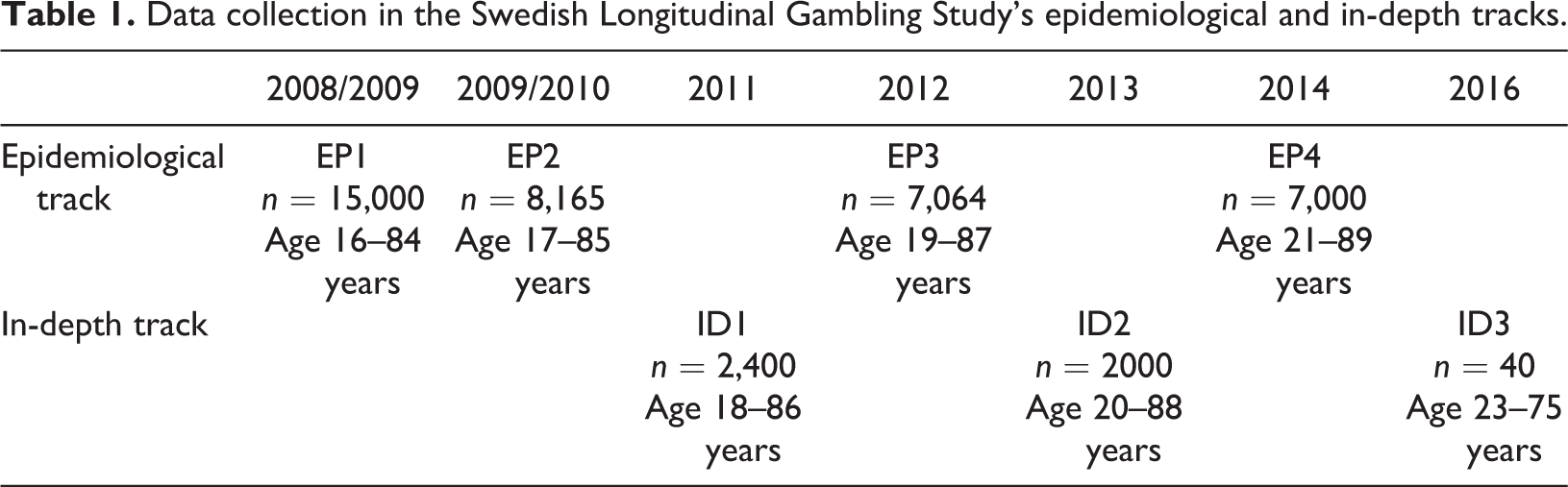
Within ID3, semi-structured telephone interviews were held with 40 individuals who had previously participated in Swelogs and agreed to further participation. To capture variations in gambling habits and problems, the inclusion criteria consisted of having reported monthly gambling during the last 12 months at any previous measure point, and a minimum of a three-point difference in the PGSI score between any two data collection occasions in the EP track. A three-point difference has previously been found to indicate a fairly reliable change in problem gambling severity (Williams et al., 2015). Subsequently, the sample included Swelogs respondents who had reported at least a level of moderate-risk gambling. An advance letter was sent out that described the purpose of the study, and respondents were contacted by telephone to schedule an interview appointment. In total, 45 respondents were reached by telephone and out of these 40 were interviewed. One reason for declining to participate was perceived lack of changes in gambling habits.
Interviews
Ethical approval to conduct the study was obtained from the Regional Ethical Review Board in Sweden (ref. 2015-456-32O). The interview guide was semi-structured, covering current and previous gambling habits and life situation, negative consequences, and reasons for changes in gambling habits and problems. Prior to the interviews, four pilot interviews were conducted which resulted in minor revisions of the interview guide. The telephone interviews lasted for, on average, 30 minutes (10 to 50 minutes), took place in 2016, and were audio recorded. A gift certificate equivalent to EUR 25 was given as compensation for the time offered. The interviewers did not have access to data collected in previous tracks to avoid being influenced in the interview situation. Open-ended and follow-up questions were posed which facilitated the interviewees’ own narratives of their gambling habits and life situations.
All interviewees were asked whether they had experienced any negative consequences from their gambling during the preceding eight years. If the answer was affirmative, the interviewer proceeded by asking more detailed questions of the nature of and possible shifts in problems over the years. The results from this are described elsewhere (Samuelsson, Sundqvist, & Binde, 2018). To our surprise a large proportion of the interviewees, despite previously scoring at least PGSI 3+, could not recall any negative consequences from gambling. We wanted to explore these discrepancies further, and added a focus of interpretations of the PGSI items that might explain possible misclassifications in problem level. Hence, if the answer was negative – no recollection of any negative consequences from gambling – the interviewer posed the nine PGSI questions but used the last eight years as the time frame (2008–2016; “Thinking about the past eight years have you ever…”) to cover the period of participation in Swelogs. If the interviewee endorsed any of the items, the interviewer asked follow-up questions about the frequency and nature of possible consequences, to get a sense of the severity of the consequences and the interviewees’ perception of whether this was problematic, as well as of how they interpreted the question. Of the 40 interviewees, 19 did not report any negative consequences from gambling and were consequently given the PGSI questions, the answers of which constitute the focus of the qualitative analysis of our study. Further, to identify possible reasons for misclassification, we asked the participants at the end of the interview whether it could be possible that they had answered differently to the PGSI questions in past surveys.
Notably, initial comparisons were made between the 19 who did not report any negative consequences from gambling in the interviews with the 21 who did. We found that the 21 had significantly higher PGSI scores in the previous EP track. Those reporting higher levels of problem gambling in the EP track thus had more consistent perceptions of their gambling behaviour over time. This difference could not be explained by completion modality in the EP track (postal questionnaire vs. telephone interview) nor whether participants’ highest PGSI score was obtained earlier (EP1–EP2) or later (EP3–EP4) in the study period. Considering the phenomenon of recall bias, we had expected that inconsistent answers would be more common for participants who had their highest PGSI score earlier in the Swelogs, but that was not the case.
Analysis
The interview material was systematically handled according to the framework approach (Gale, Heath, Cameron, Rashid, & Redwood, 2013). First, the interviews were transcribed verbatim, repeatedly read, and listened to. After each interview, the interviewers (the first and the third authors) wrote analytical memos to construct a complex coding tree. The coding trees were continuously updated during the listening and reading process. The problem level of each case was discussed and categorised based on the interviewers’ assessments and the interviewee’s reports of occurrence of negative consequences from gambling at any time in the past eight years. The accounts have been treated as narratives, by which the participants in the interview situation make sense of their gambling behaviours to structure their experiences and present themselves in a certain way in front of others (Czarniawska, 2004; Riessman, 2008). Coding was carried out in the qualitative coding platform NVivo (QSR International Pty Ltd., 2012). To increase the coherence of the process, five interviews were coded by the first and third authors simultaneously. All codes concerning answers to PGSI questions and interviewees’ perceptions of possible negative consequences from their gambling behaviours were extracted, resulting in a text of around 30,000 words. Answers to endorsed items were charted in a matrix to get an analytic overview (cf. Spencer, Ritchie, O’Connor, Morrell, & Ormston, 2014). Interviewee accounts containing ambiguous or misinterpreted PGSI answers, as well as the participants’ own reasoning about negative consequences and possible reasons for discrepancies in current and previous PGSI endorsements, were treated as units of analysis and subject to content analysis (Graneheim & Lundman, 2004).
Participants
Of the 19 participants in this study, 13 were women and six were men. A majority (63%) were employed at the time of the interview and a majority were single (58%). The mean age was 41 years (SD = 15). For a description of the study participants and their pseudonyms, see Table 2. The reported forms of gambling during the past eight years among the participants irrespective of setting (land-based or internet) were lotteries (reported by 17 of 19), number games and sports betting (7), electronic gaming machines (EGMs, 6), horse racing, casino games, bingo (5), and card games (2). The participants were asked in the interview about their motives for gambling, and all described several motives. The most commonly reported reasons were gambling for excitement and social rewards (reported by 12 of 19 participants each), followed by the chance of winning (hitting the jackpot) (9), and gambling as a habit or tradition (7). Gambling for enjoyment or pleasure (4) and to contribute to charity (3) were also reported. Only one participant reported gambling to escape everyday troubles as a motive, a reason that, in research, is often associated with problem gambling (Binde, 2013).
Description of study participants (N = 19).
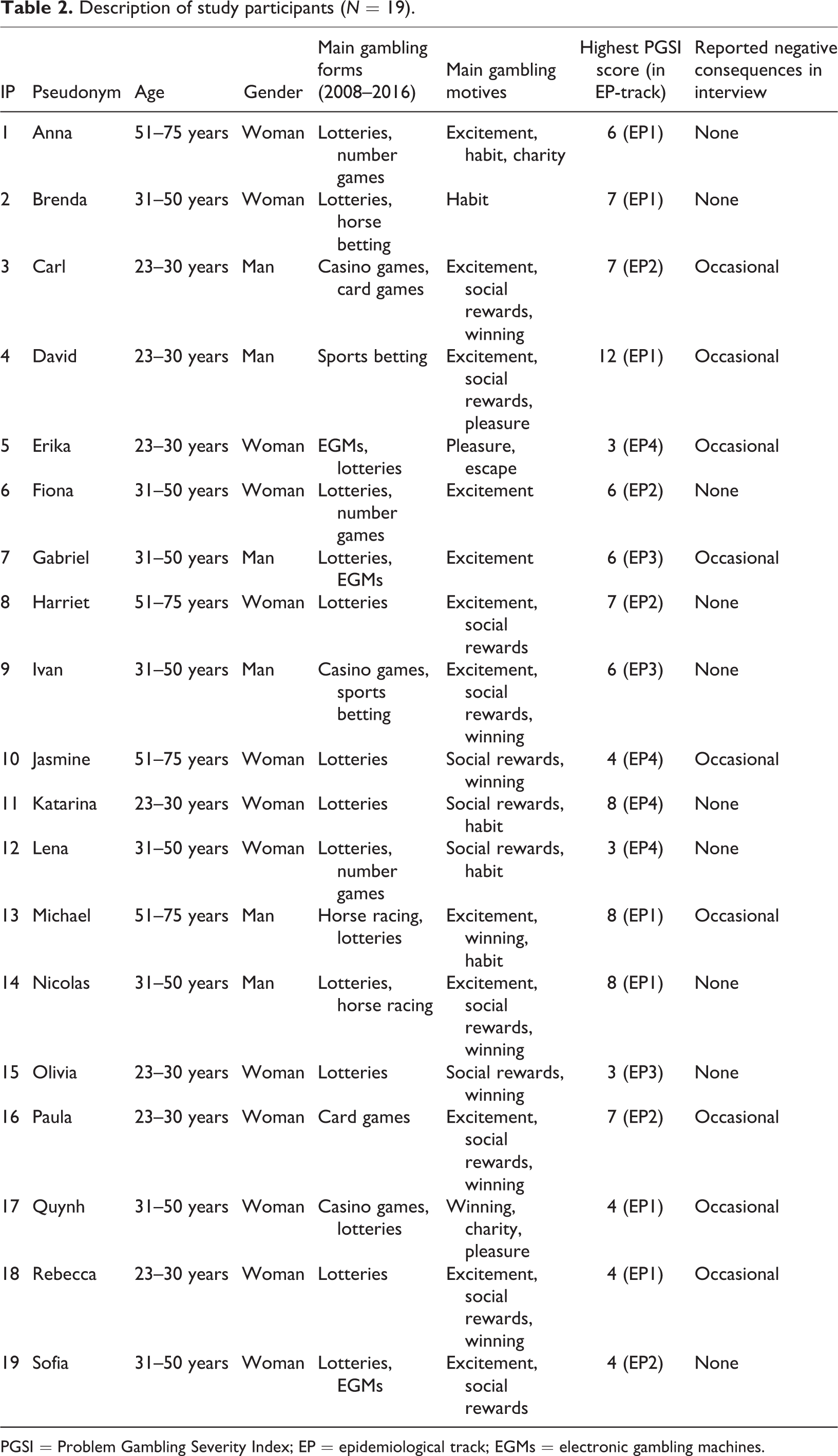
PGSI = Problem Gambling Severity Index; EP = epidemiological track; EGMs = electronic gambling machines.
In the previous EP track of Swelogs, the 19 participants had maximum PGSI scores of between 3 and 12 points (M = 6; SD = 2) over the study period of eight years and four measure points (EP1–EP4). They had thus been categorised as moderate-risk gamblers. In ID3, 10 of the 19 participants did not report any negative consequences from gambling in the interview, including in their answers to the PGSI questions. The other nine participants described occasional marginal consequences, such as having gambled more than intended.
Results: (Mis-)interpretations of PGSI items in the qualitative accounts
The PGSI consists of nine items, four of which are intended to assess problem gambling behaviours and five that are intended to assess adverse consequences of gambling (Holtgraves, 2009) (see Table 3 for a display of the PGSI questions and their dimensions). The most commonly endorsed items in the interviews were Item 2, on having had the need to gamble with larger amounts of money to get the same feeling of excitement (endorsed by five participants), and Item 9, about having felt guilty about gambling (endorsed by four participants). Several answers had ambiguous characteristics, which also applied to Item 7 about receiving critique for gambling, and items measuring problematic behaviours (loss of control, chasing, borrowing). In the following sections we will first present the interviewees’ accounts containing ambiguous or misinterpreted elements when answering items concerning adverse consequences of gambling (Items 7 and 9), and, second, present accounts concerning problematic gambling behaviours (Items 1, 2, 3, and 4).
Problem Gambling Severity Index (PGSI) items (mis-)interpreted in the qualitative interviews.
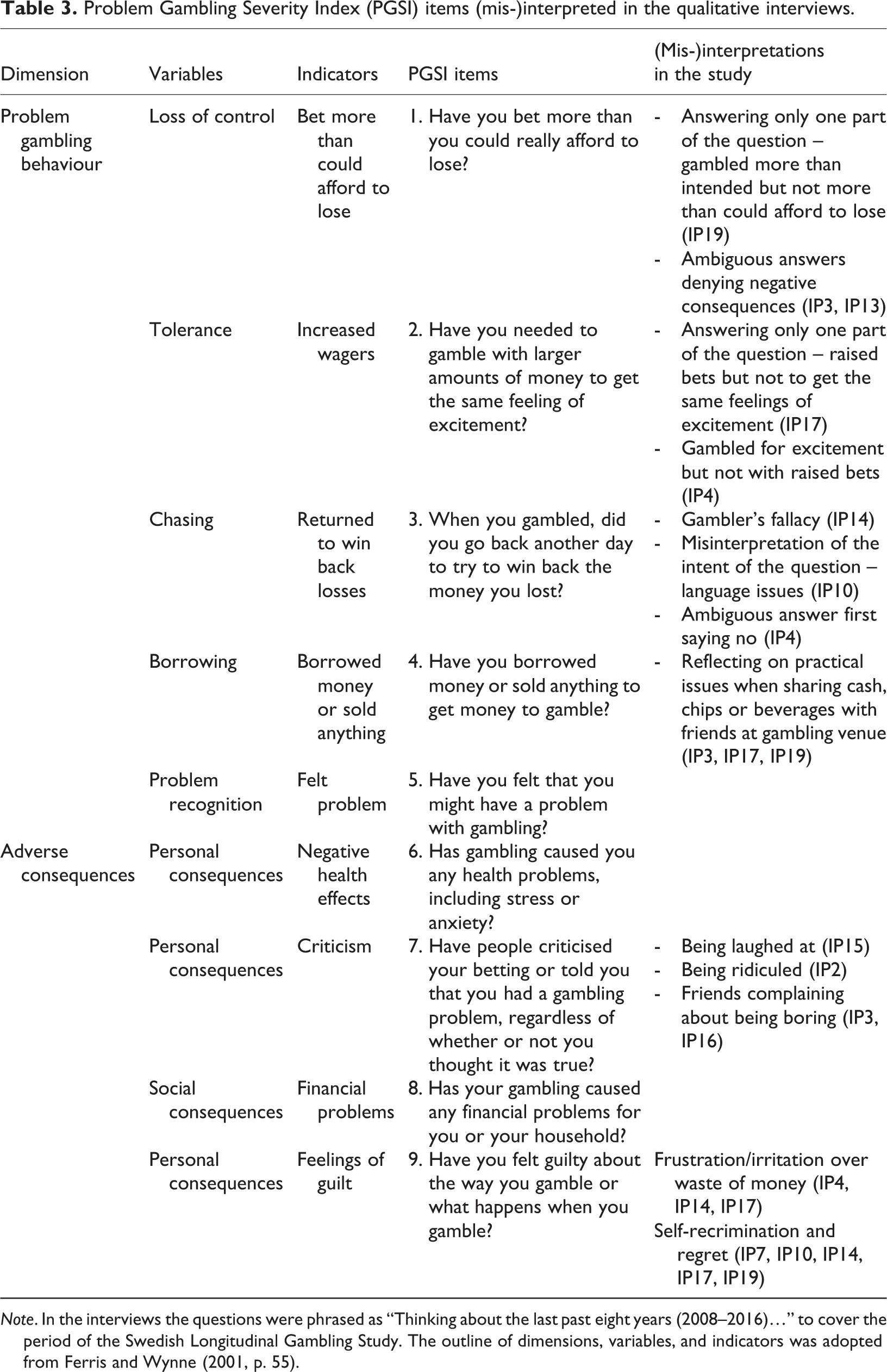
Note. In the interviews the questions were phrased as “Thinking about the last past eight years (2008–2016)…” to cover the period of the Swedish Longitudinal Gambling Study. The outline of dimensions, variables, and indicators was adopted from Ferris and Wynne (2001, p. 55).
Ambiguous answers related to adverse consequences from gambling
Interpretations of critique for gambling: Item 7
A recurring feature among the interviewees was mild interpretation of significant others’ critique of their gambling (Item 7). In the quotation below, Olivia, a younger woman occasionally buying lottery tickets, confirmed having experienced critique from her friends. However, when she continued to explain, it became clear that her friends rather made fun of her than criticised her habit.
Thinking about the last eight years, has anyone criticised your betting or told you that you had a gambling problem, regardless of whether or not you thought it was true?
Yes. Definitely! Not out of concern but more laughing about it, that I’ve bought a lottery ticket…/…/ Not being criticised more than that, my friends think that I’m comical. (IP15)
This was also the case for Brenda (IP2), a middle-aged woman who only endorsed Item 7 and denied having experienced any other drawbacks from her gambling. She described being ridiculed by her husband over buying lottery tickets as a continuous habit, acknowledging that this might have resulted in an affirmative answer to this item in the previous EP track, but concluded that this was not critique but rather teasing. Another interviewee, Carl (IP3), first answered this question negatively, but then claimed that a friend might have commented on his gambling by calling him boring or laughing at him. Similarly, Paula (IP16) first answered “no” to the question of critique, and then continued to describe how her childhood friends could react negatively to her new circle of gambling friends.
No, not that I gambled too much. Well, I moved away from my childhood friends. They thought I was hanging out too much with my [gamblers]. And that was boring. /…/ They said that they never saw me and that I was always tired when I met my friends. Well, that I wasn’t as fun to be with any longer.
Did they relate that to your gambling?
No, I don’t think so. I think they just related it to my new friends. (IP16)
Irrespective of whether they answered the question negatively or affirmatively, the participants’ elaborations of their answers to Item 7 could thus include similar mild interpretations of critique, such as being ridiculed for buying lottery tickets or getting comments from friends for being boring, but not indicating any substantial concern about their gambling behaviour.
Interpretations of feeling guilty: Item 9
The other item intended to measure adverse consequences from gambling which created ambiguous answers was Item 9, concerning feeling guilty about one’s own gambling behaviour. Quynh, a middle-aged woman occasionally playing casino games and buying lottery tickets, endorsed this item.
Thinking about the past eight years, have you felt guilty about the way you gamble or what happens when you gamble?
Yes, sometimes when I’ve bought a lottery ticket I can feel that it has…well, I’ve felt that it was stupid, because I could’ve used that money for something else. /…/ I don’t buy lottery tickets because it’s fun, but it’s really for…What’s that slogan again – “suddenly it happens”. It’s the feeling when I’m gambling, that I might hold in my hand the ticket to another life. Most often it feels like “it was stupid”. (IP17)
Quynh described in the account above that her lottery ticket purchases could make her feel guilty because of the stupidity of believing for a moment in the dream of hitting the jackpot. The slogan she referred to – “suddenly it happens” – is a well-known Swedish advertising campaign for lottery tickets, conveying the possibility of winning a large sum of money that enables a different lifestyle without the hardships of everyday life. For Quynh the motive of gambling was not the excitement or social rewards, but rather the dream of winning and being able to transform her life, to become free of economic troubles, which might increase her self-recrimination. Similarly to what has been described by Orford, Sproston, Erens, White, and Mitchell (2003), gamblers can thus experience a sense of guilt or irritation about spending money on what they perceive in hindsight as unconstructive matters.
Jasmine, an older woman (IP10) who claimed to buy lottery tickets as a habit for a monthly sum of EUR 10, answered the question about guilt in the following way:
Sometimes, yes. I feel guilty for doing it when I don’t win. I didn’t win so I tell myself “No, I shouldn’t have. I’ve done wrong…” I feel that what I’ve done is wrong. (IP10)
This account contained feelings of self-recrimination, where Jasmine described regretting buying lottery tickets against her better judgement. Instead of enjoying a moment of excitement that does not cause her any negative consequences, she instead blames herself for pointless spending.
Gabriel (IP7), a middle-aged man, said that he occasionally had bought lottery tickets and gambled on EGMs. He confirmed having felt guilty after losing EUR 40–50 on EGMs in a few minutes on four occasions. This experience of losing control for a moment scared him and caused him anxiety afterwards. Despite lack of economic or social consequences, his emotional reaction made him refrain from future gambling on EGMs. As expressed by Yi and Kanetkar (2011), gambling losses can evoke negative self-conscious emotions even among low-risk gamblers, where some people might be more prone towards remorse and regret than others.
David (IP4), a younger man betting on sports events, first answered this question negatively and then elaborated:
No. No. Well, like this, maybe it has happened. That’s directly after losing, but not that…/…/ Immediately in the moment maybe. If you’ve placed a bet for EUR 20 and then two hours later they’re gone. Then it feels like a waste of money. /…/ No, I’ve accounted for that money, so no guilt. (IP4)
David thus considered having had feelings of regret in the moment directly after losing, but concluded that it was not guilt, but rather feelings of irritation over wasting money. Similarly, Nicolas (IP14), a middle-aged man, claimed at first that his gambling had not been associated with feelings of guilt, but then continued:
No. Well of course you always…it doesn’t matter. If I go and buy a lottery ticket or if I go and buy five lottery tickets and don’t win, I’m always as irritated with myself every time. And feel that “no, that was a waste of money”. (IP14)
When Sofia (IP19), a middle-aged woman, answered the question about guilt, she acknowledged having felt bad after gambling, thinking “what am I doing?” These experiences, however, appeared in relation to gambling behaviour that took place in her youth, before the eight-year time frame of Swelogs.
The participants above who answered affirmatively on the question of guilt – Quynh, Jasmine, and Gabriel – described low-frequency gambling activities for small sums of money. Regardless of lack of negative consequences, their perceptions of their gambling involved a dimension of self-accusation for activities not perceived as constructive. David and Nicolas at first answered negatively to the question of guilt, but both acknowledged the irritation of wasting money on gambling. Thus, answers to Item 9 also provoked similar reasoning among the participants irrespective of whether they initially answered yes to the question or not.
Low-frequency gambling was perceived as something pointless, in comparison with, for example, buying groceries that was comprehended as meaningful. In contrast, others could describe gambling as an activity that gives pleasure just as any consumption.
I see it as a fun thing to do. I might as well use those EUR 5 on [gambling] instead of buying a bottle of wine or whatever. It’s not the money. It’s the participation that is enjoyable. (IP12)
Answers to the question about guilt revealed feelings of frustration and self-recrimination over spending money or time on gambling, feeling stupid and lured by the appeal of the game and the dream of winning despite the odds. The gambling was then comprehended as an activity that did not match the person’s own morals (cf. Brown & Newby-Clark, 2005) despite the low sums spent and lack of economic consequences. The experiences could more appropriately be described as regretful rather than feelings of guilt. Item 9 can thus generate affirmative answers depending on the person’s own moral attitude towards gambling per se, even if the person gambles infrequently without negative consequences (cf., e.g., Svetieva & Walker, 2008).
Ambiguous answers related to problematic gambling behaviours
Behavioural indicators of problem gambling in the PGSI also caused ambiguous answers in the interviews. A recurring phenomenon was that the participants answered only one part of the question rather than taking the whole question into account.
Interpretations of loss of control: Item 1
The first item on the PGSI concerning the experience of having bet more than one could really afford to lose generated answers to only one part of the question. For example, Sofia (IP19) acknowledged having gambled previously in her life more than she intended, but not more than she could afford to lose. In other cases, participants endorsed this item but elaborated on their answers by claiming that the gambling did not cause any negative consequences. For example, Carl (IP3), a younger man, answered yes to the question related to his casino and card gambling in younger years. He, however, denied that his gambling expenses had caused any negative consequences apart from having to cut down on other expenses. Similarly, Michael (IP13), an older man who was about to sell his house after retiring, confirmed the experience of having bet more than he could afford to lose. He said that this had not happened often and had not resulted in any consequences beyond having to deprioritise non-gambling expenditures.
If you had not gambled, what would have been the difference, economically?
If I hadn’t gambled at all, I could’ve kept my house.
OK, would you have wanted that?
Well, I could’ve kept it but not live as I wanted. I would’ve had to look for special prices and eat pea soup three days in a row and so forth. (IP13)
This quotation illustrates one of the key difficulties in assessing what actually constitutes negative consequences from gambling based on self-reports. Clearly, gambling has been a central activity in Michael’s life, to the extent that he had chosen to sell his house after retiring. He did not frame this as a negative consequence from gambling but as a choice on how to lead his life. That would not indicate loss of control, but rather a rational consideration giving priority to gambling over other expenditures. This could be seen as downplaying the negative aspects of gambling, as a way to present oneself to the interviewer in a positive manner (social desirability bias).
Interpretations of increased tolerance: Item 2
Another example of a participant answering only one part of the question rather than taking the whole question into account concerns Item 2 on increased tolerance. Quynh (IP17) answered this question affirmatively but in her explanation it became clear that the she had only answered the first part of the question (having gambled with larger amounts of money).
Thinking about the past eight years, have you needed to gamble with larger amounts of money to get the same feeling of excitement?
…Maybe during the same evening I’ve said “I’m going to the table” and I want to bet EUR 10. And it lasted for two, three minutes and it was over. And then I have to turn back almost as quick as I came. And then maybe I’ll go back to my friends sitting there drinking and if we’re there for a while longer I might feel that I want to go back because I like standing there. /…/ I’m spending more money than I first planned because I go back there with EUR 10 and I get to gamble for 15 minutes and then I’m happy. (IP17)
Quynh’s answer concerned having bet more money than intended in order to gamble a bit longer but had nothing to do with achieving the same feeling of excitement. In contrast, David (IP4) acknowledged having gambled to experience feelings of excitement, but denied having raised the bets to achieve this feeling.
Thinking about the past eight years, have you needed to gamble with larger amounts of money to get the same feeling of excitement?
Well yes, that would be in football betting. The more you can win the more it tickles you. But /…/ no, I almost always bet the same sum of money. (IP4)
Interpretations of chasing: Item 3
A participant who endorsed the chasing question (Item 3) provided the following rationale for his answer:
Thinking about the last eight years, has it happened that you went back another day to win back the money you lost?
No. Yes. I have to say yes to that one. If I buy a lottery ticket today, well I didn’t win anything today, but tomorrow when I walk home from work or whatever, I’ll buy another because it’s easier to win that day. (IP14)
This answer did not really reflect chasing losses, but rather the gambler’s fallacy of expecting a win to be more likely after having experienced a loss (cf. Delfabbro, 2004). When David (IP4) was asked the question about chasing losses he first answered no, and then continued:
Well it might’ve happened during a period when I first started to go out on bars that I tried those EGMs. But very rarely. I can imagine that it happened occasionally that I felt like that. /…/ I tried it, put in a EUR 5 note or a EUR 10 note occasionally. But I noticed that it didn’t give me anything, so I quit doing it rather quickly. (IP4)
Jasmine’s (IP10) account about chasing losses rather reflected misinterpretation of the question, which could be related to language skills.
Thinking about the last eight years, has it happened that you went back another day to win back the money you lost?
Yes, sometimes I win EUR 3 that comes back to me. Once I won EUR 7–7.5. Well that’s the largest sum I’ve won.
Did you buy new tickets for your wins?
No, no. When I get that, I don’t buy new tickets directly, no, no. (IP10)
Ambiguous answers were thus given in response to Item 3, reflecting mistaken beliefs of the chance of winning and misinterpretation of the question. While David’s (IP4) account did reflect occasional chasing of losses, he did so only after some consideration when he had first answered negatively to the question.
Interpretations of borrowing: Item 4
Another item generating answers not covering the intention of the question was Item 4 about having borrowed money to gamble. Quynh (IP17) answered:
Thinking about the last eight year, have you borrowed money or sold anything to get money to gamble?
Yes. It has happened that I’ve borrowed EUR 10 maybe to go to the gambling table or if one of my friends has chips I get one or two, and instead I buy the next round of beer. It has happened /…/ if I don’t have the money in my pocket. (IP17)
Similarly, Carl (IP3) acknowledged having borrowed EUR 10 from friends at the gambling venue without having had any financial problems. Sofia (IP19) talked about borrowing for gambling previously in life as follows:
I may have borrowed EUR 50 off someone if it was too much to go to the ATM. But not because I couldn’t afford it. (IP19)
As the accounts show, this item could yield answers reflecting practical issues of friends sharing cash, chips, and rounds, rather than constituting a key indicator of problem gambling as intended (Ferris & Wynne, 2001).
Participants’ own reasoning about potential misclassifications
At the end of the interview, the interviewers clarified that the participants had been selected for this study based on previous results from the EP track endorsing at least one of the PGSI items. Further, the participants were asked whether they thought it was possible that they could have given different answers in the past.
Lena (IP12), a middle-aged woman with sporadic gambling habits, did not endorse any of the items in the interview. When asked whether it was possible that she could have endorsed any of the PGSI items in the past, she stated that she could have been referring to the gambling behaviour of a close relative:
Could you have answered yes to any of these questions previously?
No, well I know that in one of the first rounds of these surveys we got questions about close relatives too. If you had anybody close who gambled a lot. There I have answered “yes” a few years ago, but never anything about my own gambling, no. /…/ It was a close relative who was I a muddle in a way. But that has straightened out now, thankfully. /…/ I haven’t been able to contribute that much concerning my own, but I know like I said when there were surveys about gambling and questions about someone else, then I’ve said yes. (IP12)
Another interviewee, Anna (IP1), answered negatively to all PGSI questions. When asked about other possible downsides of gambling she said that her gambling was under control and did not involve any larger sums of money. She doubted ever having endorsed any of the items despite a PGSI score of six during EP1. In the interview she reasoned about the possibility of having forgotten:
Could you have answered yes to any of these questions previously?
Well, it could be. But I don’t think so. Maybe I have. You could feel bad about different things in different periods in life, but that’s nothing that I feel that I’ve ever had any problems with. /…/ Sure I could’ve forgotten, but it doesn’t feel like I had answered differently then and now. (IP1)
Fiona (IP6) was surprised to hear that she had previously endorsed at least one of the items and reasoned about the possibility that her memory could be selective:
What are your thoughts on that, could you have answered yes to any of these questions previously?
Well, that could be the case yes. Maybe it’s easy to forget things that weren’t that pleasant. And when you’re in the middle of it…You can easily forget the things that are not so nice or good. Probably, as I’ve said yes to one of them before. That was quite interesting /…/ it makes you think now at least. (IP6)
Nicolas (IP14) stated that he could have experienced the situation differently at the time, revealing the subjectivity in the moment:
Do you think you have answered yes to any of those questions previously?
Yes, I’m sure. If you call me in a month’s time from now – when I’ve started working again and everything is shit…if you call me in a month and something has happened, I’ll say yes to that question…(IP14)
The interviewees’ own reflections on the possibility of differing answers to the PGSI in previous data collections of Swelogs thus contained both affirmations and negations. Explanations included possible confusion with the excessive gambling behaviour of a significant other, the possible impact of selective memory, reasoning about the subjective and contextual characteristics of self-reports, as well as recall bias.
Recall bias is likely to be an issue when there is a time difference between the measure point and the behaviour in question. This is an important factor to consider when using lifetime measures or long timeframes. Sofia (IP19), who answered all of the PGSI questions negatively in the interview despite endorsing several items in the previous EP track, claimed that her excessive gambling behaviour took place further back in time than eight years ago. In this case, misinterpretation of the time frame could have caused the discrepancy. Likewise, Harriet (IP8), an elderly woman, did not answer any of the PGSI questions in the interview affirmatively, despite scoring 7 in the EP2 survey. She did, however, acknowledge having impaired memory, which might be an explanation. Another explanation for discrepancies in PGSI answers in the qualitative interviews compared to previous EP surveys could be language skills, as it was not always clear whether the participant entirely understood the questions posed (Gabriel, IP7 and Jasmine, IP10).
Discussion
With the overall aim of exploring possible reasons for misclassifications in problem gambling level, we used semi-structured interviews and qualitative methods to analyse gamblers’ answers to the PGSI and to study various interpretations and biases in the interviewee accounts. The 19 interviewees had previously participated in Swelogs, a longitudinal survey with continuous measure points from 2008 to 2014. They reported at least a three-point difference in problem gambling severity between any two data collections, and were thereby categorised as moderate-risk gamblers. When asked about their experiences of negative consequences from gambling, the participants did not report any such problems. To be able to explore the meanings attributed to the PGSI questions, we subsequently asked the participants to consider the nine questions with respect to an eight-year frame to cover the period of Swelogs (2008 to 2016). Several answers to PGSI items contained ambiguities and misinterpretations. Of the items intended to measure adverse consequences from gambling, Items 9 (guilt) and 7 (critique) in particular produced obscure accounts. The question about feelings of guilt generated accounts rather reflecting self-recrimination over wasting money or regretting gambling as a meaningless or immoral activity. The participants had time to develop and reflect on their answers, which revealed that their “yeses” to the question about guilt were often lenient self-reproach. This is in line with the thinking of Svetieva and Walker (2008) that endorsement of the guilt item will vary according to the moral acceptance of gambling within the culture. Elaborations of answers to the item on critique included mild interpretations such as being ridiculed for buying lottery tickets or getting comments from friends for being boring. This tendency of interpreting the question of critique broadly has previously been noted by Ladouceur and colleagues (2000). In our study, similar accounts and reasoning were expressed by the participants irrespective of initial endorsement of the item, making it difficult to assess to what extent their answers actually indicated any problematic gambling over time.
Items 7 and 9 were derived from the South Oaks Gambling Screen (SOGS; Lesieur & Blume, 1987), which has been subject to substantial critique (e.g., Svetieva & Walker, 2008). First of all, SOGS was validated using a clinical sample, which means that the items might not be suitable for the general population. Further, it might not be possible to differentiate problem gamblers from non-problem gamblers due to feelings of guilt and criticism from close ones, as these can occur in respect to gambling per se. Gambling has historically been viewed as a moral vice in some societies (cf., e.g., Rosecrance, 1985) and is increasingly comprehended as a public health concern that can cause harm (Thomas et al., 2017). Perceptions of gambling and problem gambling are influenced not only by cultural aspects (Raylu & Oei, 2004) but also how individuals interpret and comprehend their behaviour in relation to subjective attitudes, norms, and perceived control (Ajzen, 2011). As found by Spurrier and Blaszczynski (2014), gamblers’ perceptions of risks associated with gambling involve idiosyncratic motivations and expectations. Perceptions of what constitutes guilt can thus be related to moral attitudes towards gambling activities. Some people may feel guilty about their gambling habit irrespective of the amount of time and money spent, and in the absence of negative consequences (Svetieva & Walker, 2008). Similarly, despite lack of negative consequences, significant others might be prone to criticise due to their persuasion of the immoral connotations of gambling. Even though problematic gambling can cause severe relational problems and distress for family members, Svetieva and Walker (2008) argue that “criticism” is too vague, could vary according to the moral acceptance of gambling, and does not directly indicate harm. Overall, our findings suggest that gamblers’ views of their gambling habits over time involve an awareness of the potential negative consequences of gambling, but also include reports of experiences of self-recrimination for engagement in an activity perceived as meaningless or stupid, rather than harmful.
Potential negative consequences from gambling can manifest in various ways. Experiences of feeling guilty about gambling, receiving comments from significant others, or having gambled more than intended could be indications of initial problematic gambling behaviours (Holtgraves, 2009). However, the PGSI questions about guilt, criticism, or alleged loss of control can generate answers of being made fun of for buying lottery tickets, feelings of self-recrimination for believing in the dream of hitting the jackpot, or placing another bet to be able to gamble a little bit longer. This is not harm, but interpersonal friction and learning from experience, which are unavoidable consequences of virtually any human activity (Samuelsson et al., 2018). And sometimes it is merely a choice of lifestyle.
Answers to items intended to measure problematic gambling behaviours such as betting more than one can afford to lose (indicating loss of control, Item 1), raising bets to get the same feeling of excitement (indicating tolerance, Item 2), trying to win back lost money (chasing, Item 3), and borrowing money (Item 4) also contained ambiguities and misinterpretations. It was not always clear whether the participants endorsed the item or not. Saying initially yes or no to a question could involve similar reasoning with participants introducing their own interpretations of the question that were unrelated to the intent of the item. The difficulties with assessing gambling problems were especially obvious when the participants only focused on one part of the question. For example, having increased gambling amounts could be confirmed, but not causing negative consequences for the economy. Also, having the need to gamble with larger amounts of money to get the same feeling of excitement could be answered affirmatively but not related to larger bets. As questions containing ambiguous conditions decrease a gambler’s ability to give an accurate response, they may increase the likelihood of respondents answering only one part of the question (MacKenzie & Podsakoff, 2012). This emerged repeatedly in our study.
The 19 participants, a majority of whom were occasional buyers of lottery tickets for excitement or social rewards, reported no or only mild negative consequences from gambling during the past eight years. The changeable characteristics of gambling patterns and problems, where many people tend to go into and out of problem gambling over the course of a year (Public Health Agency of Sweden, 2016b) due to life events and changing circumstances (Samuelsson et al., 2018) may influence gamblers’ perceptions of their past experiences.
Problems with comprehending items in instruments designed to measure gambling problems have been found in previous studies. A five-year study following the gambling careers of a cohort of 50 gamblers (Reith & Dobbie, 2012) found that the interviewees had problems comprehending the items of NODS (NORC DSM-IV Screen for Gambling Problems; Gerstein et al., 1999) due to misinterpretations of the time frame (current perceptions overshadowing previous gambling problems) and the meaning of the wordings. The authors suggested that cognitive guidelines should be developed to clarify the intent of the items (Anderson, Dobbie, & Reith, 2009). In the study by Ladouceur et al. (2000) concerning SOGS, the number of participants categorised as problem gamblers was reduced when the meaning of the misunderstood items was clarified.
A recent study by Mutti-Packer et al. (2017) exploring the congruence between self-reported PGSI scores and qualitative accounts, concluded that gambling fallacies, mental health issues, and dissonant feelings about gambling were more frequent among those with incongruent perceptions. It may, however, be argued based on our findings that (mis)interpretations of the PGSI items could be an additional explanation of incongruent reports of problem gambling severity.
The interviewees’ own reflections on the possibility of differing answers to the PGSI in previous data collections of Swelogs thus contained both affirmations and negations. Explanations included possible confusion with the excessive gambling behaviour of a significant other, the possible influence of selective memory, reasoning about the subjective and contextual characteristics of self-reports, and impaired memory and recall bias. Any of these could have reduced the ability of participants to remember how their gambling had affected them previously. Another explanation could be a reluctance to talk about negative consequences of gambling in an interview with open-ended questions that can be more difficult to answer compared to direct questions, as was the case in the earlier EP track. Yet another factor could be that the participants misunderstood the time frame in the earlier EP track and answered the questions based on experiences from previous periods in life. In support of this, several of the participants talked about problematic gambling habits before 2008 when Swelogs measurements started. Other reasons for bias appear to include language skills problems, social desirability bias, and gambling fallacies.
Our findings illustrate the difficulties in measuring negative consequences from gambling. The PGSI has a dual character in covering both problematic behaviours (chasing losses, increased tolerance, borrowing money, etc.) and harmful consequences (economic, relational and health-related, etc.), which complicates the conceptual discussion. The fact that it is possible to be categorised as a problem gambler based on behavioural items only, and that items are frequently (mis-)interpreted, calls for awareness in the study of the phenomena of problem gambling based on such a group. Reith (2007) argues that supposedly objective gambling screening instruments rely on a range of “socially relative and deeply subjective” criteria (Reith, 2007, p. 48). Identification of problem gambling is based on individuals’ own judgements of experiencing, for example, excitement, loss of control, or various negative emotions, rather than what Reith describes as both the medium and the signifier of gambling and problem gambling: money. Thus, anyone can experience problems, irrespective of economic consequences, as the definition of problem gambling rests on one’s own subjective feelings about wins and losses (Reith, 2007). Respondents in survey research make sense of the questions asked, relate them to their own perceptions and experiences, and answer in accordance with what they feel is expected from and convenient for them in the interview situation (cf., e.g., Schwarz, 1999). It is thus delicate to draw any definitive conclusions based on the PGSI concerning “risk gamblers”, and important to consider the context in which the reports were made. Considering the insecurity in categorisation, and the fluid and subjective characteristics of gambling problems (Samuelsson et al., 2018), reports of lower levels of harm in the population should be interpreted with caution.
Validation of gambling instruments tends to lean heavily on validating self-report instruments against other self-report instruments. Without a gold standard as the outcome, it can be difficult to ascertain which self-report instrument performs better. Consequently, alternative validation approaches are warranted to further improve instruments such as the PGSI. A limitation specific to our study concerns the risk of recall bias among the participants, particularly in cases where gambling has not been a central part of the person’s life. Gamblers tend to overestimate positive outcomes and underestimate negative ones (Griffiths & Wood, 2001). It is possible that our interviewees have forgotten or chosen to under-report previous gambling problems, considering their task of recalling experiences and behaviours over the course of an eight-year period. The risk of recall bias is in this case unavoidable. The accuracy of participants’ perceptions of the extent to which gambling was problematic to them previously is difficult to assess. As time passes, a variety of influences can change people’s normative beliefs, perceptions of control, and subjective attitudes towards previous events and behaviours. The large majority of the interviewees, however, described in detail various life events and changes in their gambling behaviour, which indicates that the narratives were at least not intentionally inadequate. It would have been preferable to perform the qualitative interviews sooner after the EP track, and also to have asked the PGSI questions of all 40 participants (not only the 19 participants with no accounts of problematic gambling). One of the advantages of qualitative research is that interviewees are given the opportunity to reflect on and reason about different aspects, which has deepened our understanding of possible ambiguities involved in PGSI answers. In this study, the participants generously shared detailed information about their experiences and perceptions of gambling. It was clear that gamblers who previously had been categorised as moderate-risk gamblers applied different meanings to their answers of PGSI questions. That said, we believe that it is important to qualitatively evaluate and validate the PGSI items and by doing so add some results to the literature that cannot be found using a more traditional psychometric approach.
Conclusion
Previous studies have shown that the PGSI performs well in relation to identifying the most severe problem gamblers. However, the limitations of the PGSI illustrated in our study point out that the instrument can generate a range of ambiguous answers and (mis-)interpretations, at least among gamblers with lower levels of risk for problems. While problem gambling is a very concrete problem for many individuals, measurement of this construct relies on quite abstract items that are open to interpretation and misunderstanding. This study has increased our understanding of how PGSI items can be interpreted and various reasons for potential bias. Gamblers’ answers to items not only rely on their interpretation of the meaning of the question based on their specific experiences, but could also be influenced by contextual aspects in the moment of the interview or screening depending on social desirability bias and aspects of the gamblers’ current life situations. The results of our study give some support to the approach of being cautious in the interpretations of meaning of the lower levels of moderate risk gamblers, and perhaps using a higher cut-off than three on the PGSI (e.g., Currie et al., 2010; Stone et al., 2015). Screening instruments should be designed to lower the risk of misinterpretation by, for example, not using questions containing ambiguous conditions, and by including additional guidelines about the intention of the item. In clinical settings it is important to combine use of screening instruments with interviews, to be able to better understand gamblers’ perceptions of their gambling behaviour and its negative consequences.
Footnotes
Declaration of conflicting interests
The authors declared the following potential conflicts of interest with respect to the research, authorship, and/or publication of this article: While Kristina Sundqvist has no current or past direct affiliations with the gambling industry, her present postdoctoral research is funded by a grant from the Svenska Spel independent research council.
Funding
The authors disclosed receipt of the following financial support for the research, authorship, and/or publication of this article: This work was supported by the Public Health Agency of Sweden under grant 04178-201 and conducted within the frame of the research programme REGAPS (Responding to and Reducing Gambling Problems Studies). The REGAPS programme is supported by the Swedish Research Council for Health, Working life and Welfare (Forte) under grant 2016-07091 and the Svenska Spel research council under grant FO2016-0017.