



Abstract
Activism has the potential to both positively and negatively impact an athlete’s brand meaning (e.g., the perceptions held by others about the athlete). The present research extends prior work into how this occurs by adopting, for the first time, a multi-actor perspective. The data comes from the Instagram posts of 608 German athletes who participated in one of three mega sporting events (Tokyo 2021 Olympics, Beijing 2022 Olympics, and the 2022 FIFA World Cup in Qatar). Using an qualitative research design, we uncovered ten actor groups that contribute to the co-creation of branding meaning for activist athletes, and four different “levels” of co-creation performances: Autonomous activism, collaborative activism, sports-network activism, and beyond-network activism. We also found that brand meaning co-creation can be influenced by the number of actors involved, independent to the activism issue. Theoretically, the research contributes a novel framework for understanding the co-creation of an athlete’s brand meaning when engaging in activism and offers strategic insights for brand managers on the need to balance activism with other brand building efforts.
Introduction
Athlete activism refers to athletes using their fame, social standing, and media reach to draw attention to, and advocate for, important social and political issues (Cooper et al., 2019; Fleischman et al., 2024; Sarkar & Kotler, 2018; Smith, 2019; Sotiriadou et al., 2024). Being some of the largest and most valuable brands in the world, athletes are in a unique position to engage in activism as they often have wide reach, credibility, and cultural relevance that extends beyond sport (Arai et al., 2014; Bloxsome et al., 2020; Sotiriadou et al., 2024). For example, Cristiano Ronaldo’s engagement on digital platforms (e.g., Instagram, X, YouTube) has made him one of the most marketable athletes worldwide (Garcia, 2024); Michael Jordan’s collaborations with diverse sport brands have established a lasting apparel legacy; and Serena Williams’s activism has made her a leading voice on matters of equality and justice (Anderski et al., 2023; O’Neill et al., 2025).
In light of prominent instances of athlete activism, for example Colin Kaepernick’s decision to kneel during the U.S. national anthem at NFL games in 2016 in protest against police brutality and racial injustice, there has been growing scholarly and managerial interest in the impact that engaging in activism can have on an athlete’s brand; in particular, the impact to an athlete’s brand meaning, or the perceptions individuals hold about a brand, which underpins brand value (Anderski et al., 2023; Brodie et al., 2017). For example, scholars have focused on understanding the conditions when activism is seen as virtue-signaling versus authentic (Vredenburg et al., 2020), as well as the factors that influence whether engaging in activism has a positive or negative impact on an athlete’s brand meaning (Brown et al., 2022; Conway, 2019; Mudrick et al., 2019; Sanderson et al., 2016), or related brand’s meaning, for example, brands that sponsor the athlete (Park et al., 2020; Schmidt et al., 2018). Of managerial interest, there has been growing attention on how to better equip athletes to anticipate backlash and avoid common delegitimization tactics by fans (O’Neill et al., 2025). While this research has certainly contributed to the field, it has so far simplified the impact of activism on actions undertaken by the athlete, and effects to either the athlete’s brand meaning and/or dyadically to one other actor’s brand meaning (e.g., the sponsoring brand). This approach neglects prominent perspectives in branding research, which posit that brand meaning is co-created by multiple actors that engage in collaborative brand meaning co-creation performances (Anderski et al., 2023; Brand et al., 2024). For instance, the media contribute to co-creating an athletes’ brand meaning by giving them memorable nicknames, while fans reinforce this meaning through chants in the stadium or memes on social media. The implication of appreciating a multi-actor perspective is that it is not only the athlete that creates their brand meaning, but various different actors and performances affect its co-creation too, which are important to study. For example, for Colin Kaepernick’s, his club, the NFL league, fan groups, media, his sponsors and politicians all created his brand meaning and the perceptions of him as both a powerful symbol of activism and a polarizing figure.
The present research addresses this oversight and offers a novel examination of athlete activism from a multi-actor perspective. Specifically, the research has three main aims: i) to identify the actors that contribute to the co-creation of branding meaning for activist athletes; ii) to introduce a new framework of brand meaning co-creation performances of activist athletes based on the number of actors involved; and iii) to understand whether the number of actors involved when an athlete engages in activism impacts their co-creation of brand meaning. Drawing on a constructivist grounded theory methodology, we approached the research questions by conducting a qualitative inductive thematic analysis of the activism-related Instagram posts of all German athletes (n = 608) participating in three mega sporting events: the Tokyo Summer Olympics (2021), the Beijing Winter Olympics (2022), and the FIFA World Cup in Qatar (2022). Mega events, such as the Olympics and World Cup, offer a unique and valid context for investigation as they are platforms that attract unparalleled attention across diverse nations, cultures, and audiences. Athlete activism during these events often garners widespread visibility, making it a compelling context to examine. We analyzed German athletes because Germany is widely recognized as a nation with a strong sporting tradition and, importantly, offers access to a diverse set of athletes across multiple sports, levels of prominence, and career stages. This breadth provides a richer context for investigation and potential contribution, as much of the existing research still focuses on single, high-profile cases rather than capturing variation across athlete types.
The research offers several contributions. Theoretically, our research identifies ten actor groups that co-create brand meaning for athlete activists, highlighting the value of a multi-actor perspective to fully understand how engaging in activism affects an athlete brand’s meaning. In addition, the research identifies and introduces a novel framework of co-creation performances by the athlete based on the number of actors involved. Specifically, we identify and classify performances into four levels: autonomous activism, collaborative activism, sports-network activism, and beyond-network activism. Importantly, two of these levels are novel in the literature, and emphasize that athletes can choose not to explicitly co-create their brand meaning (e.g., by not engaging with other actors) and that actors outside of sport can also contribute to brand meaning for activist athletes. Finally, we show that individuals interpret an activist athlete brand’s meaning differently (i.e., respond positively or negatively) depending on the number of actors involved, independent to the issue at hand. Practically, the research informs brand managers (both athletes and their managers/agents) of the need to balance activism with other brand building efforts, and the conditions where activism is safer/riskier, according to the profile the athlete and their sport.
Theoretical background
No singular definition for activism
There is no singular definition for athlete activism (Mueller, 2021; Parsons, 2016). Scholars have defined it as an athlete activity aimed at promoting social change (Presley et al., 2016); as well as when an athlete uses their sporting platforms, either online and or offline, to promote social justice (Agyemang et al., 2010; Kaufman, 2008; Lee & Cunningham, 2019). Athletes themselves have defined athlete activism as “starting advocacy organizations, engaging in symbolic protests during competitions, and resigning from a team as a form of protest” (Kaufman & Wolff, 2010). Nevertheless, there is a general consensus in the literature and for athletes, that activism can be conducted either individually or as a collective, and can utilize a range of strategies from peaceful actions, such as starting a petition (Klar & Kasser, 2009), to more confrontational means, like boycotts and public demonstration (Toledano, 2016). It is this consensus that we adopt in the present research.
Impact of activism on athlete brands
While there is evidence that engaging in activism can have positive effects on an athlete’s brand image, credibility and authenticity (Conway, 2019; Mudrick et al., 2019; Park et al., 2020), research has also shown negative effects. For example, Sanderson et al. (2016) found that activist athletes can suffer severe backlash (e.g., racist taunts and threats) from actors within their brand network. In the context of athlete brands, prior research has discussed several factors that can influence whether the effect on their brand is positive or negative (Mudrick et al., 2019). Mudrick et al. (2019) used an experimental design to explore the effects of athlete brand activism on attitudes toward an athlete and their team, as well as consumption intentions (e.g., buying merchandising, watching or attending games). The authors revealed differences in attitudes and consumer behavior toward the athlete among fans exposed to a message supporting their political beliefs versus those exposed to an incompatible message. Positive attitudes toward the athlete’s brand and consumption intentions were evident when the fans perceived the activist’s message was consistent with their political belief, while consumption intentions decreased for fans receiving an incompatible message. Of note, there were no spill-over effects on the teams the athletes played for (Mudrick et al., 2019).
Furthermore, Brown et al. (2022) explored whether attitudes toward athlete brand activism, activism message, activism communication style, or fan identification impacts the athlete’s brand image. The results showed that activism type (i.e., safe/risky) did not significantly impact fans’ perception of the athlete’s brand image. However, perceived athlete attractiveness decreased when athletes engaged in risky activism. Individuals’ attitudes toward athlete brand activism significantly impacted their perception of an activist athlete.
Counter to Mudrick et al. (2019), several studies have shown that engaging in activism not only affects the athlete’s brand itself, but also brands associated with the athlete. For example, Park et al. (2020) found that positive attitudes toward athlete brand activism spilled over to brands endorsed by the athlete. Similarly, Schmidt et al. (2018) found that risky athlete brand activism could negatively impact a sponsor’s brand image and consumer purchase intentions toward the sponsored brand. This literature clarifies how athlete brand activism effects the athlete brand (and, at times, affiliated brands), and what athletes can do to minimize negative effects (e.g., align with fan’s political beliefs and understand conditions when it’s more likely to be risky/safer). However, this extant literature focuses nearly exclusively on the athlete themselves and overlooks that in line with prominent theories of brand meaning co-creation, other actors collaborate and shape an athlete brand’s meaning (Anderski et al., 2023; Brand et al., 2024). Moreover, it overlooks prominent brand equity perspectives, such as the ability of brands to leverage secondary associations (Keller, 1993). Leveraging secondary associations can occur when, for example, athletes link themselves to other entities when engaging in activism; that is, tagging their team mates or charities in their social media posts. When this happens, perceptions of these linked entities can “transfer” to the athlete brand simply through the association (Fleischman et al., 2024; Oklevik et al., 2020; Osorio et al., 2020; Saint Clair & Cunha, 2024). Correspondingly, the transfer of brand associations plays a role in creating an athlete brand’s credibility, authenticity, and image (Bergkvist & Taylor, 2016; Ilicic & Webster, 2015; Tian et al., 2022). The present research argues that the scholarly discourse to date is therefore missing a key part of understanding the impact of athlete brand activism on an athlete’s brand meaning by not understanding the multiple actors, and their roles, in co-creating the athlete’s brand meaning, which is the focus of the present research.
Co-creation of an athlete’s brand meaning: A multi-actor network approach
A prominent perspective in the branding literature is that of brand meaning co-creation (Merz et al., 2009; Vargo & Lusch, 2004). Brand meaning co-creation refers to the active engagement and interaction of multiple actors in the co-creation of a brand’s meaning (Sarasvuo et al., 2022; Stegmann et al., 2023). For example, it is now well-established that brands are co-created with multiple actors, for instance in the context of athlete brands, clubs, associations, sponsors, fans, other athletes, and the media all contribute to co-creating an athlete brand’s meaning (Brand et al., 2024). This is perhaps most comprehensively demonstrated in Anderski et al.’s (2023) framework of integrative human branding, which we use as a foundational framework for the present research.
Anderski et al.’s (2023) framework is based on the amalgamation of three theoretical concepts: human branding, integrative branding, and performativity theory. The three concepts incorporate both management-oriented approaches to human branding, and multi-actor approaches to co-creation of brand meaning for human brands through specific brand performances, as follows:
Anderski et al. (2023) drew on human branding literature to explain the specific characteristics of individual brands (e.g., athletes, celebrities, entertainers). Human brands share many similarities with corporate brands associated with traditional marketing and brand characteristics. Human brands not only fulfill many of the characteristics, functions, associations, and attributes of traditional brands, but they also offer enhanced opportunities for identification and engagement (Anderski et al., 2023). While human brands, like athletes, can sometimes evolve naturally, they primarily emerge through a strategic process of intentional building, development, and nurturing over time (Osorio et al., 2020; Thomson, 2006). Even more so in the realm of social media, individuals intentionally built, develop and nurture over time their personal social media profiles to engage directly and unfiltered with fans, sponsors, media, and even fellow athletes (Bredikhina et al., 2022; Hofmann et al., 2021; Su et al., 2020). Not only has social media become a communication tool with various actors, but it has also become a strategic marketing instrument (Green, 2016; Kunkel et al., 2022; Panthen et al., 2025). In the context of activism, human brands, including athlete brands, are increasingly using social media to raise awareness about social issues such as human rights, gender equality, or racism (Jain et al., 2024; Vredenburg et al., 2020).
Anderski et al. (2023) used integrative branding and performativity theory as overarching concepts to capture and structure the brand building dynamics of human brands (Brodie & Benson-Rea, 2016; Brodie et al., 2017), and examine the interactions and resource integrations underpinning the co-creation process of brands (Austin, 1975; Butler, 1990). Integrative branding conceptualizes brands as dynamic social processes among multiple actors (Brodie et al., 2017; Conejo & Wooliscroft, 2015; Iglesias & Bonet, 2012). The integrative branding concept consists of two interrelated processes: (1) building brand identity and (2) co-creating brand meaning (Breidbach & Brodie, 2017; Brodie, 2017; Brodie & Benson-Rea, 2016; Evans et al., 2019). Performativity theory has its origins in sociology and is used in the brand management literature to explain how multiple actors co-create brand meaning (Austin, 1975; Butler, 1990; Kristal et al., 2020). It proposes that linguistic and socio-material performances are the fundamental building blocks of social reality (Feldman & Orlikowski, 2011). Therefore, performances (i.e. doing of an activity within a situated context) continuously constitute, stabilize, and co-create brands (Orlikowski & Scott, 2014). Therefore, brand performances do not just describe brands; they actively shape and co-create brand meaning. The underlying premise for brand management from Anderski et al.’s work is that human brand’s meaning is continuously co-created by the performances of multiple actors (Essamri et al., 2019; von Wallpach et al., 2017). As such, the impact of an athlete engaging in activism on their personal brand must take into account the network of actors surrounding the athlete.
Utilizing a single case study, Anderski et al. (2023) identified eight relevant actor groups involved in co-creating an athlete’s brand. These actors include competitors (i.e., teams and athletes), clubs and associations, equipment suppliers, the inner circle (i.e., family and friends), media, sponsors, fans, and agencies that co-create the brand meaning through several performances on the different platforms. While these actor groups seem relevant in the context of sport, they may not comprehensively capture the actors involved in co-creating an athletes’ brand meaning when engaging in activism. For one, activism involves broader social issues, hence one would posit that actors beyond the sporting context could contribute to brand meaning co-creation, such as governmental bodies, non-profit organizations, corporate entities, community leaders and/or academic institutions. The present research explores this and seeks as a first research question to identify any additional actors involved in contributing to the brand meaning co-creation process of activist athletes:
RQ1: Which actors contribute to the co-creation of brand meaning for the activist athlete?
With regard to actor’s performances in co-creating an athlete’s brand meaning, Anderski et al. (2023) identified eight different performances, which were organized into three categories: network-related performances (i.e., cooperating, describing collaborations of various actors regarding the co-creation of brand meaning), human brand-related performances (e.g., reinforcing, communicating, internalizing, contesting, and elucidating, describing activities that are directly affecting the athlete brand), and person-related performances (i.e., individual loving, and individual hating, which mainly target the individual person behind the human brand). As above, these performances are limited to the sporting context of a single athlete. Again, it seems likely that both the same and/or new actors will contribute different performances when an athlete engages in activism. Therefore, we seek to understand actor’s intent of activism and how this can influence an athlete’s brand meaning when they engage in activism.
RQ2: What brand meaning co-creation performances can be classified based on the number of actors involved by the athlete activists?
Previous literature on secondary brand associations explains how meaning can be transferred across actors (e.g., Bergkvist & Taylor, 2016), but it assumes people know the other entity and have some knowledge about them that can be transferred. We posit that when athletes choose to involve other actors, independent to whether individuals know the actors and/or have any knowledge about them, it could still impact how the athlete is perceived and hence any brand meaning that is created. That is, brand meaning will be influenced by whether an athlete chooses to tell their message independently or they bring someone else in to support their message. Moreover, there may be a layering, cumulative or balancing effect if more than one other actor is involved. For example, if multiple actors are involved, each actor may bring different meaning, thereby requiring an understanding of how different meanings are balanced/evaluated overall, and/or whether there are a cumulative or layered effects of the same knowledge transfer. Therefore, we aim to understand:
RQ3: Does the number of actors involved in athlete brand activism impact the co-creation of the athlete’s brand meaning?
Methodological approach
Research methodology
Considering this is the first study to examine brand meaning co-creation performances by athlete activists, we adopted an exploratory research design. Our study employs a grounded theory methodology, which aligns with the research aim to inductively explore and conceptualize the contributions of various actors in the co-creation of brand meaning within the context of athlete activism (Charmaz, 2017; Glaser & Strauss, 1967). This approach is particularly suitable for studying multi-actor interactions because it can reveal actors’ beliefs, values, and perspectives, which collectively shape the athlete’s brand meaning (Cobern, 1993). To complement the inductive nature of grounded theory, we used content analysis, providing a structured approach to systematically answer our research questions (Mayring, 2004). This approach is essential for identifying which actors contribute to the co-creation of brand meaning for the activist athlete (RQ1). The approach also enables us to classify brand meaning co-creation performances based on the number of actors involved within a new scope of brand meaning co-creation performances (RQ2) and to examine whether the number of actors involved in athlete brand activism impacts the co-creation of the athlete’s brand meaning (RQ3). Consistent with previous research examining the interactions of multiple actors on digital engagement platforms (Abeza et al., 2017; Heinonen & Medberg, 2018; Waqas et al., 2020), including research investigating human brand activism (Boatwright, 2022; Eschmann et al., 2021), we analyzed our data using thematic analysis (Braun & Clarke, 2022). Recognizing the dynamic nature of athlete engagement in sociocultural issues, thematic analysis provides a structured approach to identify, analyze, and interpret recurring patterns and themes within qualitative data (Clarke & Braun, 2017).
Data collection
Data were collected from German athletes’ (n = 608) Instagram accounts during three mega sporting events: the Summer Olympic Games in Tokyo 2021 (n = 432), the Winter Olympic Games in Beijing 2022 (n = 150), and the FIFA World Cup in Qatar 2022 (n = 26). We chose German athletes as a sample because they are widely recognized as a sports nation with a rich sporting tradition and with both high and lower profile athletes (see Appendix A for more details on the sample). Data were collected retrospectively by manually capturing all posts and comments on the athletes’ official Instagram profiles. Instagram was chosen for this study due to its visual emphasis, influencer ecosystem and global reach. That is, the platform’s hashtag culture and storytelling features provide insights into how athletes mobilize and coordinate their activism efforts, while its influencer ecosystem highlights athletes’ roles as influential figures in both sports and societal discourse. Furthermore, the platform facilitates high engagement levels, with features such as likes, mentioning and tagging other users, comments, and direct messages. Users tend to actively interact with content, fostering a sense of community (Caliandro & Graham, 2020; Hootsuite, 2022). The data collection period included all three mega sporting events, as well as a fortnight before and after the event. We included the period before and after the events to recognize that athletes may be restricted from engaging in activism during the events.
Data analysis
We applied an open coding procedure to identify activism posts. A post was coded as “activism” if it met three criteria: (1) it contained text (in-image text and/or caption), (2) it was not sponsored (e.g., labeled as advertising), and (3) it referred to a social, political, economic, or environmental issue, including issue-related hashtags. We focused on textual content because text provides the most explicit and stable trace of meaning-making on Instagram and enables more consistent interpretation of stance, claims, and actor relations, compared to purely visual cues which tend to be more ambiguous and difficult to interpret reliably across coders (Kozinets, 2002, 2019; Kuźniarska et al., 2025; Schreiber, 2024). Sponsored posts were excluded because they may be contractually mandated during mega-events (e.g., sponsor activations) and therefore not fully attributable to athletes’ own initiative. Similar text-centered approaches have been effectively used in athlete activism studies relying exclusively on discursive traces (e.g., Frederick et al., 2017) underscoring the appropriateness of analyzing textual data to understand interpretive struggles and co-creation dynamics (Tafesse & Wien, 2017). Netnographic methodology further supports this focus, especially for identifying meaning, stance, and actor relations (Kozinets, 2002, 2019; Kuźniarska et al., 2025). Our data analyses included the following three steps:
Step 1: Descriptive mapping. We calculated descriptive statistics to summarize the sample, the prevalence of activism (e.g., number of activists and activism posts), and engagement indicators (e.g., likes, comments, and derived engagement ratios). These descriptive results provide valuable context for interpreting the subsequent qualitative patterns as well as for comparing reactions across activism types. The results are provided at the start of the results section and in the Appendix A.
Step 2: Inductive thematic analysis. The data analysis followed the thematic analysis procedure proposed by Braun and Clarke (2006), as follows. At phase one of the analysis, the researchers familiarized themselves with the data. This step included taking notes and writing down first impressions. During phase two, initial codes were generated to systematically structure the dataset. To ensure credibility, consistency, and quality of the results, two researchers coded and structured all data independently using MAXQDA 2020 (Lombard et al., 2002; O’Connor & Joffe, 2020). In the third phase, the generated codes were summarized into potential themes, using the second independent researcher to minimize the influence of personal bias. After this step, all codes were reviewed, discussed, and refined (McIntosh & Morse, 2015; Patton, 1990). During phase five, the final themes were selected and named, generating clear and precise definitions to answer the research questions. Lastly, descriptive quotes from the raw data were extracted by the authors to better illustrate the results (Braun & Clarke, 2006). Data collection and analysis was conducted in its original language and corresponding quotations were subsequently translated into English. To enhance the trustworthiness of our study, as per Creswell (2014), we reduced potential bias by using two independent researchers for data collection and coding, and by conducting peer debriefing with two external researchers. Any discrepancies were discussed and resolved by consensus.
Step 3: RQ-specific coding and categorization. To answer RQ1, we identified the actors involved in each activism post by coding visible cues such as mentions, tags, and references to organization’s or individuals (e.g., organizing committees, institutions, politicians, NGOs, and other beyond-network actors). To answer RQ2, we introduced a four-level scope based on how many and what types of actors were involved: autonomous activism, collaborative activism, sports-network activism, and beyond-network activism. To answer RQ3, we examined follower responses to these posts by analyzing engagement indicators (e.g., likes, comments, shares, and tags) and comparing patterns across the four levels to assess whether reactions differed depending on the extent of actor involvement.
Results
Context: Prevalence of activism
Overall, 65 (11%) of the 608 German athletes made at least one activism-related post on Instagram during the time of study. Gender differences were negligible, with females accounting for 49% of the 65 athlete activists. The number of activism posts was highest for the FIFA World Cup 2022 (26.92%), followed by the Tokyo Olympics 2021 (7.64%) and Beijing Winter Olympics 2022 (1.67%). The 65 athletes made a total of 84 posts containing activism, meaning 1.47% of all posts analyzed were activism related. The activism posts received 48,185 comments. The proportion of activism posts never exceeded 3% of all the athletes’ Instagram posts at any of the three events. The activism posts covered eight different topics of activism : (1) Equality (26%), which focused on differences such as media coverage (e.g., male vs. female athletes), infrastructure (e.g., training conditions) or a gender pay gap; (2) Peace and Anti-War (23%), which largely focused on the Ukraine-Russia conflict; (3) Female Empowerment (15%), where posts promoted women’s self-determination and independence; (4) Health and Healthcare (13%), focusing on mental and physical health, including COVID-19; (5) Human Rights and Racial Justice (12%), which referred to posts addressing racism, labor conditions or civil rights; (6) Philanthropic Activism (6%), where posts made calls for donations; (7) Freedom (4%), where posts featured freedom of speech, religion and mind topics; and (8) Environmental Protection (1%), which addressed sustainability and climate change. In addition, there is no link between issue prevalence and audience engagement. Notably, Human Rights and Racial Justice constituted only 12% of activism posts yet accounted for 67% of comments and 64% of likes, underscoring substantial cross-issue heterogeneity in responsiveness. Overall, issues most frequently addressed by athletes were not those eliciting the strongest engagement (see Appendix A for more details).
RQ1: Actors involved in athlete brand activism
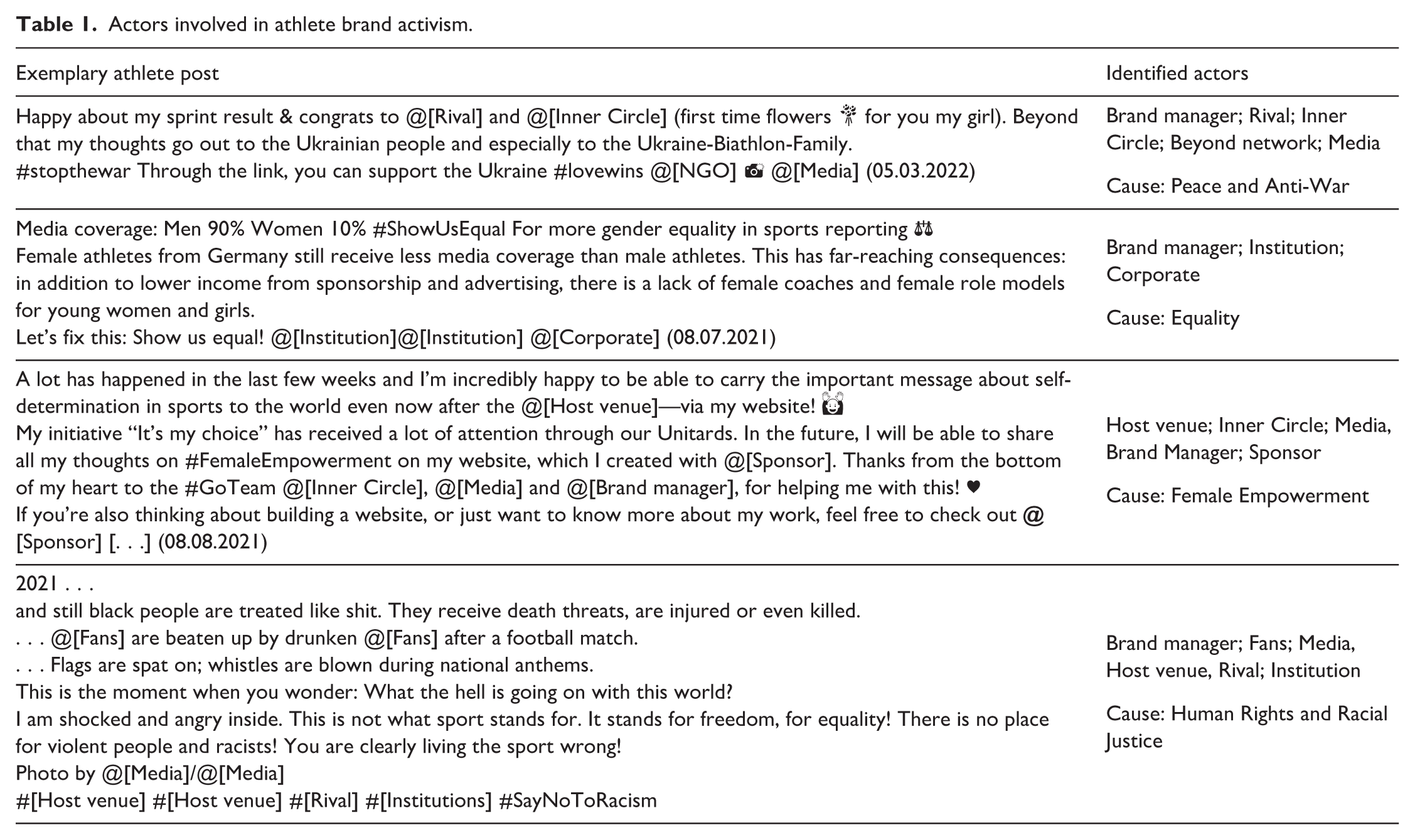
In relation to RQ1, we identified ten actor groups that interact and integrate resources when an athlete engages in activism. Consistent with Anderski et al. (2023), these actors collaborate in the process of co-creating brand meaning via direct interactions and resource integrations with the athlete, but also among themselves (see Table 1). The identified actors were: (1) Brand manager (e.g., athlete brand or brand management managing the content); (2) Organizing committee (e.g., Olympic Games, FIFA World Cup); (3) Fans (e.g., athlete supporters, general sports fans, supporter clubs); (4) Institutions (e.g., clubs, leagues, associations, federations); (5) Media (e.g., digital media, print media, social media); (6) Rivals (e.g., athletes, teams, coaches, representatives); (7) Sponsors (e.g., individual sponsors, team sponsors, competition sponsors); (8) Corporates (e.g., agencies, foundations, unions); (9) Inner Circle (e.g., family, friends, management, staff); (10) Beyond-Network (non-sport related actors; e.g., organizations, industry, government linked to the cause/topic of activism). These results identified two additional actor groups beyond the eight found by Anderski et al. (2023). Their single case study did not include the influence of the organizing committee; it also focused on a within-sport actor network. Hence, they did not identify the beyond-network actors such as politicians, health care institutions, or the government.
Actors involved in athlete brand activism.
RQ2: Scope of brand meaning co-creation initiated by athlete activists
In relation to RQ2, we identified four levels of brand meaning co-creation initiated by athlete activists based on the number and involvement of various actors. These four levels are summarized in our newly introduced scope of brand meaning co-creation initiated by athlete activists: (1) Autonomous activism, (2) Collaborative activism, (3) Sports-network activism, and (4) Beyond-network activism (Figure 1). The performances within the two levels, collaborative activism (i.e., collective endeavor) and sports-network activism (i.e., mobilization of brand network), align with the performance categories identified by Anderski et al. (2023). Collaborative activism involves a single, strategic partnership to co-create brand meaning, whereas sports-network activism mobilizes a broader array of actors within the sports-related ecosystem, creating a more extensive, network-based impact. These distinctions highlight the varying degrees of reach and complexity in brand co-creation, from focused collaborations to larger, multi-actor networks. However, we identified two novel levels of brand meaning co-creation. First, we discovered that there are occasions when athletes chose to not engage with other actors in their posts and named this category autonomous activism. Therefore, athlete activists consciously do not initiate any brand meaning co-creation performance. It is important to emphasize that the co-creation process still takes place (e.g., in terms of reinforcing or internalizing), however it is not actively encouraged by an athlete’s brand meaning co-creation performance. In addition, we identified that athlete branding can extend further than the network and can involve cross-platform engagement when an athlete engages in activism. We termed this fourth level beyond-network activism. These four levels depict different stages of actor involvement, ranging from a low level of actor involvement to a high level, and are described in more detail below. These four levels are summarized in our newly introduced scope of brand meaning co-creation by athlete activists (Figure 1).
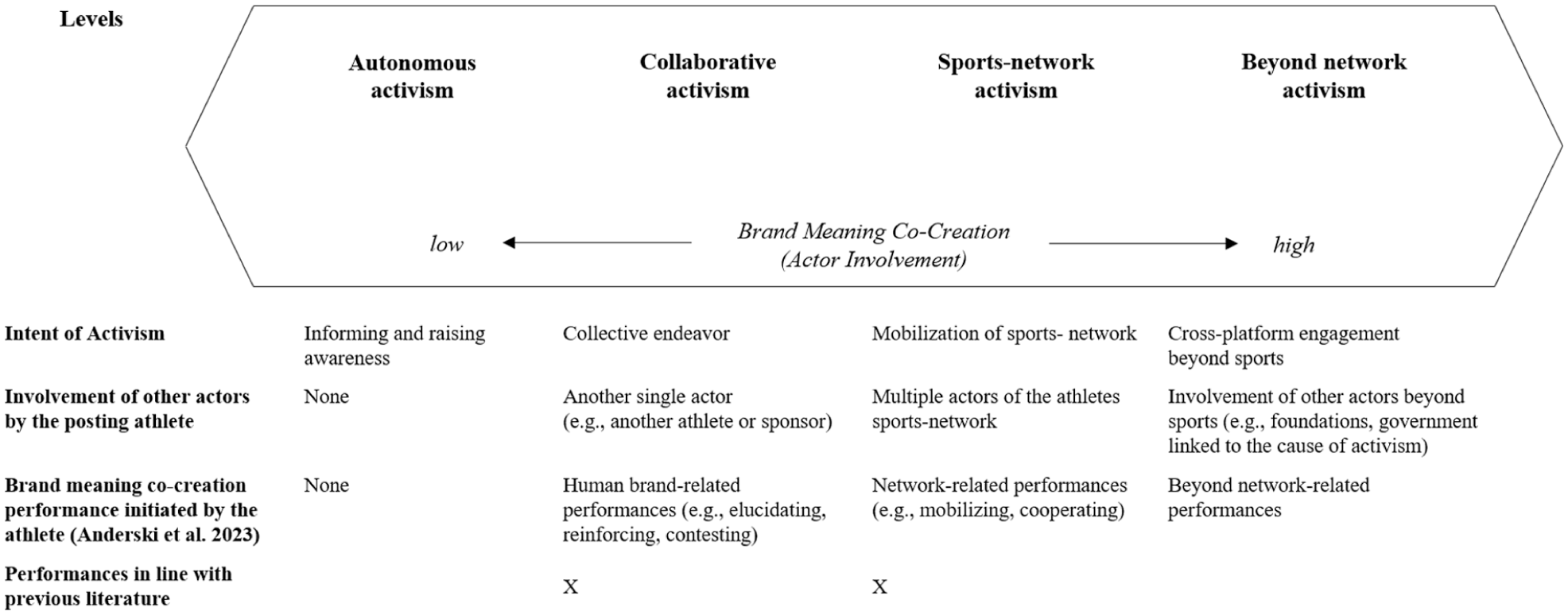
Scope of brand meaning co-creation by athlete activists.
Autonomous activism—Informing and raising awareness
We classified autonomous activism as the proactive engagement of a single athlete in championing social causes. The following quote exemplifies the category: I am grateful. Grateful for having the ability and chance to compete in sports. That applies especially to the Tokyo 2020 Olympics. I know it is a controversial topic. My option was: the games must go on as life on earth must, too. So now it is time to focus right on that. There are many things which we, earth’s occupants, have to start changing right now in order to become less occupying and more inhabiting. (Athlete, Tokyo Olympics, August 9, 2021)
This quote illustrates that athletes can leverage their personal platforms, such as social media channels and public appearances, to disseminate information, share personal narratives, and express their perspectives. By doing so, they can educate their audience and draw attention to pertinent social or political issues, thereby contributing to public awareness and understanding. However, this category is characterized by the deliberate decision of the athlete to not engage with other actors in their posts. Thus, no brand meaning co-creation performance is sought by the activist athlete. The co-creation process will still occur after the posts in terms of resource integration and interactions of several different actors, but at different times in the brand building process. This category reveals that athletes do not always have to actively engage with other actors to co-create brand meaning.
Collaborative activism—Collective endeavor
This levels involves athletes joining forces as a collective to address societal challenges. Rather than pursuing individual efforts, athletes collaborate with another single, like-minded actor. The following quote exemplifies the category: Nothing can stop the future of women in sport. Seeing possibilities with my /// @[Sponsor] #createwith@[Sponsor]. (Athlete, Beijing Olympics, January 26, 2022)
In this level, the athlete collaborates with one other entity in a joint endeavor, allowing the cause to gain visibility across both their platforms. Unlike sports-network activism, collaborative activism is limited to a single external partner rather than multiple actors. The actor can be sponsor, a club, an association, or another athlete. Our posts illustrated that collaborative activism can be performed through the organization of events, campaigns, and/or initiatives that require synchronized efforts, collaboration, and coordination among participating actors. This level consists of a moderate degree of brand meaning co-creation on the respective platforms of all involved actors. It is in line with previous literature on performativity theory as it covers performances such as elucidating, reinforcing or contesting (Anderski et al., 2023).
Sports-network activism—Mobilization of brand network
This level focuses on athletes utilizing and mobilizing multiple actors to advance social change. Athletes mobilize their sport-network and engage with the cause-related activities of other actors: I am me. You are you. We are us. Together we can achieve more. We are part of #germanyunited, a campaign by @[Sponsor]  Especially in the current times it is important to stick together. Become part of the team too!. @[Association] @[Sponsor] /
  @[Photographer] (Athlete, Tokyo Olympics, July 23, 2021)
Our data showed instances of athletes launching initiatives in conjunction with multiple other actors. Athletes go beyond partnering with a single entity and engage a broader array of actors in their sports-related network (e.g., fans, sponsors, media, clubs, or associations). The key difference from collaborative activism is the mobilization of several actors simultaneously, forming a larger network of support that amplifies the cause across multiple platforms. For example, they may cooperate with sponsors and media to secure funding for initiatives, collaborate with marketing agencies and clubs to enhance visibility, or collaborate with fans or associations to implement programs addressing social issues. We consider network activism with a high level of brand meaning co-creation, underpinned by significant cross-channel media attention and responses from multiple sport-minded actors. Compared to the previous level of collaborative activism, this level not only involves a single actor, but rather mobilizes several actors in the sports network. It again aligns with the existing literature on network-related performances by focusing on performances such as mobilizing and cooperating (Anderski et al., 2023).
Beyond-network activism—Cross-platform engagement
Our analysis revealed another novel level of brand meaning co-creation used by athlete activists: beyond-network activism. This level differs from network activism because it transcends existing boundaries and fosters connections that extend beyond an athlete’s conventional sports-related network. The following quote exemplifies the category: Due to the decision of all affected football associations not to wear the armband at the matches, the @[Association] and we players are also under criticism. I can understand and accept the criticism, but I do not share this view! The @[Association] has taken a stand and clearly expressed its position to @[Association]. The association and we players have been involved for years far beyond the green pitch. Many national players have their own foundations or have been supporting various social institutions with great commitment for years. With our team foundation, we have launched various initiatives not only in connection with the tournament in Qatar, but also throughout Germany. (Athlete, Qatar World Cup, November 22, 2022)
We identified beyond-network actors as NGO’s, public and social organizations, or foundations. Beyond-network activists will engage with diverse platforms, such as social media, traditional media, public events, or community outreach.
RQ3: Reactions to athlete activism and the actors involved
RQ3 sought to understand how the number of actors involved in athlete activism impacted reactions toward it. We found that activism can have both positive and negative effects on the athlete’s brand meaning, a finding which applies to all four levels of brand meaning co-creation performances used by athlete activists (Table 2). For example, in the context of autonomous activism, sometimes, the athlete’s opinion is endorsed, and they are celebrated as a role model. However, on the other hand, negative comments ask the athlete to concentrate on his/her core business, the sporting performance (Table 2). Collaborative activism is characterized, for example, by positive support from cooperation partners such as sponsors or associations, as well as negative comments on the cooperation partners involved. This becomes even more evident in sports-network activism, where positive and negative comments relate directly and indirectly to the network. For example, comments both celebrate that the athlete has brought more actors into the conversation (e.g., their team); as well as criticizes the involvement of others. Beyond-network activism is also characterized by both positive and negative effects toward non-sport-related actors, for example, those related to religion, medicine and political and social figures.
Reactions Toward Different Levels of Brand Meaning Co-Creation.
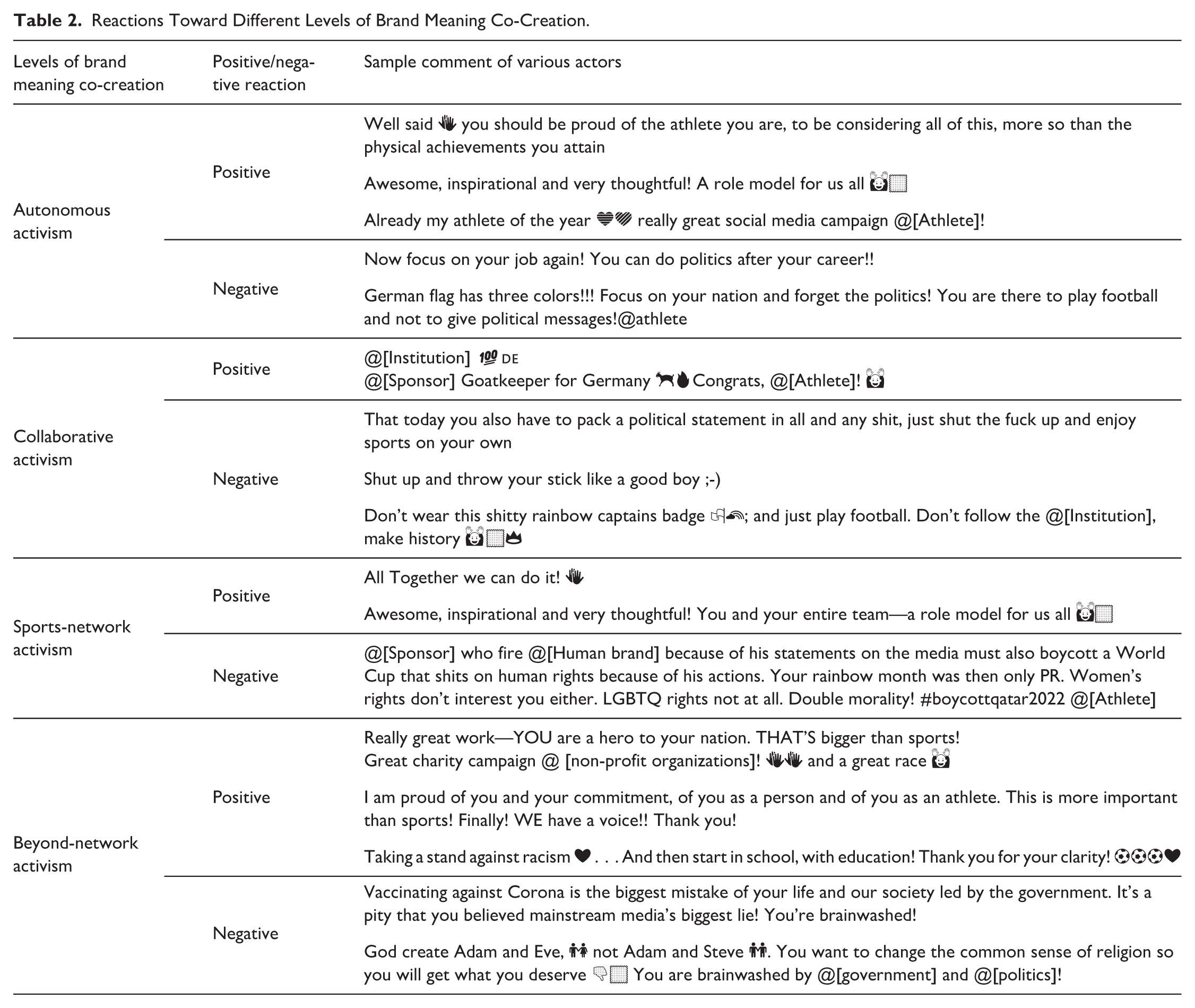
Importantly, commenters were able to identify the different levels of brand meaning co-creation performances used by the athlete activists and react, and therefore co-create brand meaning for the athlete, accordingly. For example, we found that individuals noted that the athlete’s team was involved in the campaign (cf. quote 1), and recognized the involvement of non-sporting actors (e.g., a school or a fundraiser) (cf. quote 2 and 3):
(1) “Awesome, inspirational and very thoughtful! You and your entire team—a role model for us all  (Sports-network activism)
(2) “Taking a stand against racism  . . . And then start in school, with education! Thank you for your clarity!
  (Beyond-network activism)
(3) “Great charity campaign @ [non-profit organizations]!  and a great race
  (Beyond-network activism)
Involvement of other actors was also negative, for example, athletes should concentrate on their core business, their sporting performance, and not allow themselves to be influenced by institutions such as federations or associatio ns (cf. quote 4). Another exemplary comment concerns the collaborative campaign between sports, the government, and the national association to promote LGBTQ+ rights wearing a rainbow captain’s armband, which was also perceived and evaluated negatively by the respondent (cf. quote 5).
(4) “Don’t wear this shitty rainbow captains badge  and just play football. Don’t follow the @[Institution], make history
  (Collaborative activism)
(5) “God create Adam and Eve,  not Adam and Steve
  . You want to change the common sense of @[religion] so you will get what you deserve
 You are manipulated by @[government] and @[association]!” (Beyond-network activism)
Discussion
Summary of findings
The aim of the present research was to adopt, for the first time, a multi-actor perspective to investigate the impact of engaging in activism on an athlete’s brand meaning. In particular, the research aimed to i) identify the actors that can contribute to the co-creation of branding meaning for activist athletes; ii) understand the co-creation performances of activist athletes, based on the number of actors they choose to co-create brand meaning with; and iii) understand whether the number of actors, independent to the topic or issue being activated, impacts an athlete’s brand meaning. In relation to these aims, the present research established three key findings. Firstly, there are ten actor groups that interact and integrate resources when an athlete engage in activism, and hence who contribute to the creation of an athlete’s brand meaning when they engage in activism. These actors are: Brand managers; Organizing committees; Fans; Institutions; Media; Rivals; Sponsors; Corporates; An athlete’s Inner Circle; and Beyond-Network actors (non-sport related actors). Second, we found that athletes initiate four different “levels” of brand meaning co-creation, depending on the number of actors they engage with when discussing an activist topic. These levels ranged from autonomous (solo activist); to collaborative (e.g., with another, single actor); network-related (e.g., with actors within an athlete’s sports network); and beyond-network activism (e.g., with actors that extend beyond an athlete’s conventional sports-related network). In relation to the third aim, we found that an athlete’s brand meaning when engaging in activism can be influenced by the number of actors involved, independent to the topic or issue being discussed.
In practice, co-creation unfolds iteratively: the athlete’s post sets the frame by articulating a stance and signaling which actors are involved (thereby enacting one of the four levels); this configuration provides interpretive cues; meaning is then reinforced or contested through subsequent actor performances (e.g., comments, amplification, backlash); and finally, meanings may evolve beyond the initial post as interactions continue over time and across platforms.
Theoretical contributions
A first theoretical contribution of the research lies in the identification of a new, heterogeneous actor group that contributes to the co-creation of an athlete’s brand when they engage in activism. Specifically, we found a new group of actors, which we termed beyond-network actors, which involves actors from organizations, industry or the government linked to the specific cause or topic of activism. This finding extends previous research into the actors involved in co-creating an athlete brand’s meaning, which has so far only focused on immediate and sports-related relationships surrounding athletes (e.g., Anderski et al., 2023). Our research demonstrates that, in the context of activism, these previous foci may be too limiting, and a broader perspective is needed to understand more completely the co-creation of brand meaning process when athletes engage in activism. In particular, our research points to beyond-network actors as being pivotal to the co-creation of an athlete’s brand meaning when they engage in activism.
A second theoretical contribution is our new scope of brand meaning co-creation for athlete’s engaging in activism, which conceptualizes brand meaning co-creation on four different levels according to the number of actors an athlete chooses to engage with. These levels range from no actors to many. Importantly, two of these levels are consistent with Anderski et al. (2023): collaborative (e.g., collaborative activism—collective endeavors) and network-related (e.g., network activism—mobilization of brand network). However, the present research identified two novel levels: autonomous activism and beyond-network activism. Autonomous activism is characterized by the athlete’s intentional choice to refrain from engaging with other actors. As a result, the athlete does not actively initiate a brand meaning co-creation performance; albeit the co-creation process unfolds later in the brand-building process (Panthen et al., 2025). In addition, we identified beyond-network activism, a new level that includes non-sport actors and online and offline cross-platform. Beyond-network activism takes the athletes’ activism beyond their immediate, sports-related network and most involves actors that have the potential to exert a profound societal influence. Previous research on performativity theory is thus far limited to the brands’ network (Anderski et al., 2023; Essamri et al., 2019; Iglesias & Bonet, 2012; von Wallpach et al., 2017), showcasing this as an important, but thus far overlooked co-creation performance.
Lastly, consistent with previous work (Brown et al., 2022; Conway, 2019; Jain et al., 2024; Park et al., 2020), our research showcases that activism produces both positive and negative brand meaning for an athlete’s brand. Nevertheless, an extension to previous research is that we show that the number of actors involved can influence an athlete’s brand meaning, independent to the topic or issue being discussed. Moreover, our findings show that there are potentially positive and negative effects for all actors within an athlete’s network, depending on the actors the athlete chooses to engage (or not). Previous research that has only focused on the athlete, or dyadic impacts to the athlete and one other actor, have missed thus nuance. Similarly, literature looking at the co-creation of human brands has so far only focused on positive effects of different performances, neglecting its potential threat depending on the actors involved (e.g., Anderski et al., 2023). Our research addresses both limitations, and provides not only insight, but a more comprehensive multi-actor view to guide future research and ensure all actors, and the impact of their presence, are considered when investigating athlete brand activism.
Managerial implications
The present research also offers several managerial implications. In relation to the study’s main aims, the research allows athletes, and their brand managers, to be aware of the many actors that contribute to their brand meaning, beyond just the athlete themselves. It also showcases how involving these actors can impact their brand meaning, independent to the topic/issue of interest. This gives athletes a choice over how to engage in activism; for example, to be autonomous or involve others. In making this decision, our research shows that athletes need to think of more than just “alignment” of values with other actors (Vredenburg et al., 2020), but that the athlete may be perceived differently depending on the number of actors chosen. Each level of activism also requires different implementation and can have other positives and negatives. For example, autonomous activism may allow the athlete to maintain control over the message and directly connect with their audience. It may also be more practical when athletes need to be agile—that is, when under time or resource pressure. In contrast, choosing to engage with other actors opens up new avenues to leverage additional and/or different secondary brand associations to build their brand meaning. Collectively, the research can help empower athletes and their brand managers to make more strategic decisions about their activism engagements.
In addition, activism was infrequent in our sample (11% of athletes; 1.5% of posts), suggesting it should be treated as one element within a wider brand strategy rather than its defining core. Finally, prevalence varied across sports, implying that the normativity of activism within a sport may influence audience expectations and perceived risk: in sports where activism is uncommon, athletes may face stronger surprise effects and greater downside risk, whereas in sports where it is more visible, activism may be less risky but also less differentiating as a long-term positioning strategy (Vredenburg et al., 2020).
Limitations and future research
As with any empirical study, this study has several limitations that need to be considered. Primarily, the data for the study came from one social media platform. While Instagram is the most widely used social media platform in the world (Hootsuite, 2022), future research should focus on a wider range of online and offline platforms to determine similarities and contrasts. For methodological and practical reasons, this study also focused only on text-image posts, excluding image-only content and temporary Instagram stories. While this was theoretically coherent and methodologically suitable—for example, stories are ephemeral and disappear after 24 hr, making systematic data collection and analysis challenging without real-time tracking or external archiving tools; and image-only posts create ambiguity as they are subject to interpretation, making it difficult to make explicit, stable and analytically interpretable insights to uncover the present research’s aims, for example, to determine meaning, stance, and actor relations (Kozinets, 2002, 2019; Kuźniarska et al., 2025)—we nonetheless appreciate the exclusion of images, videos, and ephemeral formats constrains the interpretive boundaries of this study. We acknowledge that our theoretical contributions apply specifically to the discursive dimension of brand meaning co-creation and the generalizability of these insights is accordingly bounded to contexts where meaning is conveyed through language rather than visual symbolism. We welcome future research using multimodal or real-time methods that could build on our work by including visual and ephemeral content, and/or address the gaps through content coding, semiotic analysis, AI-based models, or real-time data collection.
Second, this study represents only a snapshot of athlete activism. Focusing solely on German athletes and posts during three mega sporting events. Future research should investigate the brand meaning co-creation for athletes from other countries, and conduct cross-cultural analysis. It would also be valuable to collect longitudinal and non-event focused studies of athlete activism. The latter will avoid the impact of event policies and competition focus which likely limit the athlete’s voice.
Finally, there are conceptual boundaries inherent in this qualitative research. Qualitative analysis is interpretive, and even with trustworthiness measures like independent coding, peer debriefing, and triangulation, researcher perspectives may influence the framing of themes and insights. Experimental and or survey-based studies with fans, or qualitative interviews with the different actors and athletes will certainly help expand the scope of the research into activism.
Footnotes
Appendix A
Acknowledgements
None
Author’s Note
Rachel Fuller is now affiliated to Ehrenberg-Bass Institute of Marketing Science, Adelaide University, Adelaide, SA, Australia.
Ashleigh-Jane Thompson is now affiliated to Deakin University, Melbourne, VIC, Australia.
Declaration of conflicting interests
The authors declared no potential conflicts of interest with respect to the research, authorship, and/or publication of this article.
Funding
The authors received no financial support for the research, authorship, and/or publication of this article.
