



Abstract
When service failure occurs, the service provide often dispenses compensation to manage customer relations. However, little research has studied who accepts larger or smaller compensation amounts. Presently, we use political ideology as a basis to segment customers. Drawing on prior work on System Justification Theory, we hypothesize that politically conservative customers accept a lower amount of compensation than liberals as conservative customers more likely believe that whatever amount the service provider offers is just and fair. Importantly, we propose that the effects are specific to economic conservatives, not social conservatives. The findings are consistent with our predictions, with (economic) conservatives’ customers’ system justification beliefs serving as a mechanism. Theoretically, our work is the first to examine who accepts different levels of compensation while also broadly suggesting that political ideology is an important customer segmentation basis in the tourism and hospitality sectors. Our work also contributes to the literature on political ideology by being one of the first to empirically tease apart the distinct effects of economic and social conservatism.
Unfortunately, despite the goal of service providers within the tourism and hospitality industries to maintain the highest levels of service, service failure does arise. For example, airlines might overbook passengers or run out of passengers’ first meal of choice; restaurants might have diners waiting for their meals; and barbershops might cut a customer’s hair in a manner not acceptable to their liking, with little ability for a fix. Service failure has the potential to be consequential—of the negative kind—for firms. For example, customers might switch to alternate providers (Keaveney, 1995) or at the least reduce customers’ likelihood of repeating the visit (Ok et al., 2005).
Consequently, service recovery strategies are paramount since the action taken by the service provider significantly influences customers’ reactions to the failure and subsequent repeat visitations (Gohary et al., 2016). Here, the term service recovery refers to the action adopted by the service provider in response to a customer’s dissatisfaction with some aspect of the service and is the process of dealing with a service failure with the aim of returning the customer to a state of satisfaction. Recovery techniques can involve attempts to repair or rectify the service breakdown but may also involve providing customers with explanations about the failure, an apology, or simply being courteous (Blodgett et al., 1997; Butcher & Heffernan, 2006; Karatepe, 2006; Mattila, 1999; Sparks & Callan, 1996).
Another popular method to recover from service failure is to dispense compensation to affected customers (Fu et al., 2015; Grewal et al., 2008; Roschk & Gelbrich, 2017; Wirtz & Mattila, 2004). Compensation can come in many forms. For example, airlines might offer cash or air miles when a passenger is bumped, while restaurants might offer a discount to lower the price of an affected meal. Although compensation might not be needed when other service recovery strategies are well-executed (Roschk & Gelbrich, 2014; Wirtz & Mattila, 2004), nonetheless compensation is popular. So, research has studied how much compensation should be offered (Gelbrich et al., 2015) while there is also work suggesting that non-monetary compensation forms generate higher customer satisfaction in response to service failure than monetary forms (Fu et al., 2015). In addition, “prosocial compensation” (i.e. offering compensation by donating to a charitable cause) could also be a viable service recovery strategy (Thomassen et al., 2020).
Interestingly, there is very little work on who is more likely to accept larger or smaller compensation amounts, compared to the much wider body of literature on the types of compensation or when compensation should be offered. For example, Gelbrich et al. (2016) reported that customers with low and high relationships with firms are equally satisfied with low to moderate compensation, while high relationship customers respond more favorably to high compensation. Yet, we know of no other work examining this question, no other work that segments customers by their acceptance of larger or smaller compensation amounts. This is an important discrepancy in the service and service failure literatures as segmentation is the very basis of marketing, yet the service literatures have not yet segmented customers when it comes to compensation amounts.
In this research, we segment tourism and hospitality customers based on their political ideology and examine this moderating role in acceptance of larger or smaller compensation amounts. Why political ideology? Existing research in tourism and hospitality has focused on many other demographic variables such as age and gender (Freedman & Bartholomew, 1990; Morgan & Pritchard, 2019) yet much less emphasis has focused on political ideology, with only a few notable exceptions. For example, traveler’s political ideology plays a role in destination choice (Gohary et al., 2022; S. S. Kim et al., 2007; Legg et al., 2012), while political ideology also influences’ customers’ acceptance of LGBTQ+ service employees (Y. Li et al., 2020). Many contexts in tourism and hospitality warrant the inclusion of customers’ political ideology. Fundamentally, political ideology is correlated with or can even predict psychographic factors such as openness or traditionalism (Jost et al., 2009; Thorisdottir et al., 2007). As these variables and traits are fundamental underlying human behavior, this means that one’s political attitudes and beliefs can play a role, perhaps even a determinant one, for customers within the tourism and hospitality settings.
Formally, we propose that right-leaning customers are more likely to accept smaller compensation amounts compared to their left-leaning counterparts. To advance this hypothesizing, we draw on how conservatism is linked to system justification (Azevedo & Jost, 2021; Butz et al., 2017; Jost & Hunyady, 2005), which holds that people are motivated to perceive the world as just and fair. Consequently, we expect that conservative customers are more likely to perceive smaller compensation amounts as just and fair, compared to liberal counterparts. We test this possibility in three studies. These findings add to a better understanding of who accepts compensation of different amounts after service failure while at the same time sheds light on the role of political ideology in tourism and hospitality research. Because customers’ political ideology is an assessable and identifiable segmentation basis, our study has implications for managers within the tourism and hospitality sectors.
Theoretical framework
Political ideology and system justification
Political ideology refers to the set of opinions, ideas, and values that influence a person’s worldview (Dawson, 2001), providing guidance on how society should be structured (Jost et al., 2009). People’s political ideology influences their psychological needs, goals, and motives (Jost et al., 2013). Thus, customers act in ways that reinforce their political identity (J. Jung & Mittal, 2020). The result is that contemporary consumption, not just in the U.S. but globally, is “the primary arena in which political ideology is expressed and constructed” (Crockett & Wallendorf, 2004, p. 511). That is, customer choices, from the brands they select to the causes they support, have become a key way for individuals to express and reinforce their political identities.
The political “left” (i.e. liberalism) and political “right” (i.e. conservatism) represent opposing schools of thought dominant in the Western hemisphere. This left-right spatial metaphor dates back to the 1789 French revolution (Jost et al., 2008), and in modern times, the left and right represent liberal and conservative ideologies respectively. The attitudes of conservatives and liberals differ across fundamental psychological traits. For example, uncertainty avoidance is likely a defining characteristic of conservatives (Chan & Ilicic, 2019; J. Jung & Mittal, 2020), partly stemming from conservatives’ preference for the status quo (Eidelman et al., 2012). Consequently, political ideology is likely to influence people’s consumption attitudes and behaviors, influencing contexts from vulgarity (Verhoff & Chan, 2022) to marketing (Chan & Ilicic, 2019), destination choice (Legg et al., 2012), and even humor (Young et al., 2019).
More germane to our present work is that conservative individuals are higher on system justification. Formally, System Justification Theory (SJT; Jost & Hunyady, 2005) argues that human beings are motivated to justify and rationalize the way things are in order to maintain existing social, economical, and political arrangements, allowing them to be seen as legitimate. Differently put, people who hold greater system justification beliefs (such as conservative individuals) perceive the world as just and fair, and are more likely to accept the things the way they are. SJT can explain many paradoxical findings about human psychology. Disadvantaged groups tend to support the system that maintains their disadvantage because the cost of not seeing the system as just and fair is, psychologically, greater than the cost that they otherwise would bear from such a system (Jost et al., 2004; Jost & Hunyady, 2003). Similarly, members of the working class tend to support a social and political system that may restrict their ability for upward movement in the hierarchy (Jost et al., 2003). SJT explains the idealization of capitalism (Jost et al., 2003) as well as minority preference for majorities (Jost et al., 2002).
There is abundant research connecting political conservatism to system justification. Differently put, individuals who are politically conservative tend to hold higher system justification beliefs (Azevedo & Jost, 2021; Butz et al., 2017; Jost & Hunyady, 2005). For example, there are correlations between self-reported political conservatism, Right-Wing Authoritarianism, and system justification-related beliefs such as fair-market ideologies and acceptance of the status quo (Jost et al., 2003; Jost & Hunyady, 2005). Indeed, political conservatism is grounded in the notion that people expect societies to be predictable and that people act in ways that maintain societal order (or at least its illusion), leading conservative individuals to invest in authority and power, under the expectation that authority and power will bring about not only an orderly but also a just and fair society.
Compensation amount and system justification
In the service literature, there has been an increasing appreciation and application of theories from organizational justice (Tax et al., 1998). Organizational justice theories can provide a framework, in particular, to understand the service provider-customer relationship. Consider Blodgett et al. (1997) who examined how complainants perceive justice: When customers perceive injustice, they become angry, engage in negative word-of-mouth, and defect from the service provider. Similarly, perceived fairness is important in customers’ post-recovery satisfaction levels (Mattila, 2001; McCollough et al., 2000; Tax et al., 1998). Generally, there exist three justice “types:” distributive, procedural, and interactional. Distributive justice refers to the perceived outcome; procedural justice involves the processes, policies, and rules by which recovery efforts are made; and interactional justice refers to the interaction customers experience during the recovery process (e.g. apology; Smith et al., 1999).
Compensation, as mentioned, is a common service recovery approach. The amount of compensation offered concerns distributive justice because the amount that compensates for service failure changes the outcome (monetary or otherwise) of the service that customers receive, with little regard to how the compensation is offered by the provider. By contrast, other recovery efforts such the speed of the service recovery involve procedural fairness (Blodgett et al., 1997; Tax et al., 1998) while apology concerns interactive justice (Goodwin & Ross, 1992). Indeed, in service recovery, a higher level or amount of compensation can bring the outcome from undesirable to desirable. The amount of monetary compensation offered, or a free gift, not only reduce the financial cost of the service in which failure is experienced but it also compensates for a psychological loss that customers experience (Wirtz & Mattila, 2004). Consequently, offering an appropriate compensation amount can enhance the service provider-customer relationship and increase the likelihood of continued loyalty (Smith & Bolton, 1998).
The current research
Connecting the above literatures, we posit in the current research that customers with a conservative political ideology are more likely to accept a lower amount of compensation compared to their liberal counterparts. Consider a concrete example: Two customers checking onto a flight find that the flight has been oversold, and they are asked to take the next flight out. Suppose that both are offered a cash compensation of $5 (as an extreme example). Although prior studies on distributive justice predict that acceptance of this amount and satisfaction with the service provider would be low (compared to a compensation of, say, $10,000, as in the example with Delta Air Lines in June 2022; Alund 2022), conservative customers are more willing to accept this amount and be more satisfied compared to those who are politically liberal. This should be because of conservative person’s system justification beliefs—they are more likely to perceive the amount of compensation to be both just and fair, and they are less likely to question the appropriateness of the compensation amount. For cash compensation of the higher amount, we predict that both conservative and liberal customers should be equally accepting and satisfied. Formally:
Importantly, though, we believe our predictions are specific to economic (not social) conservativism. Economic conservatism and social conservatism are two distinct but often interrelated political ideologies that shape individuals’ perspectives on governance and societal issues (Everett, 2013; Johnson & Tamney, 2001; Malka et al., 2014). See Figure 1 for a conceptual diagram of our theoretical model.
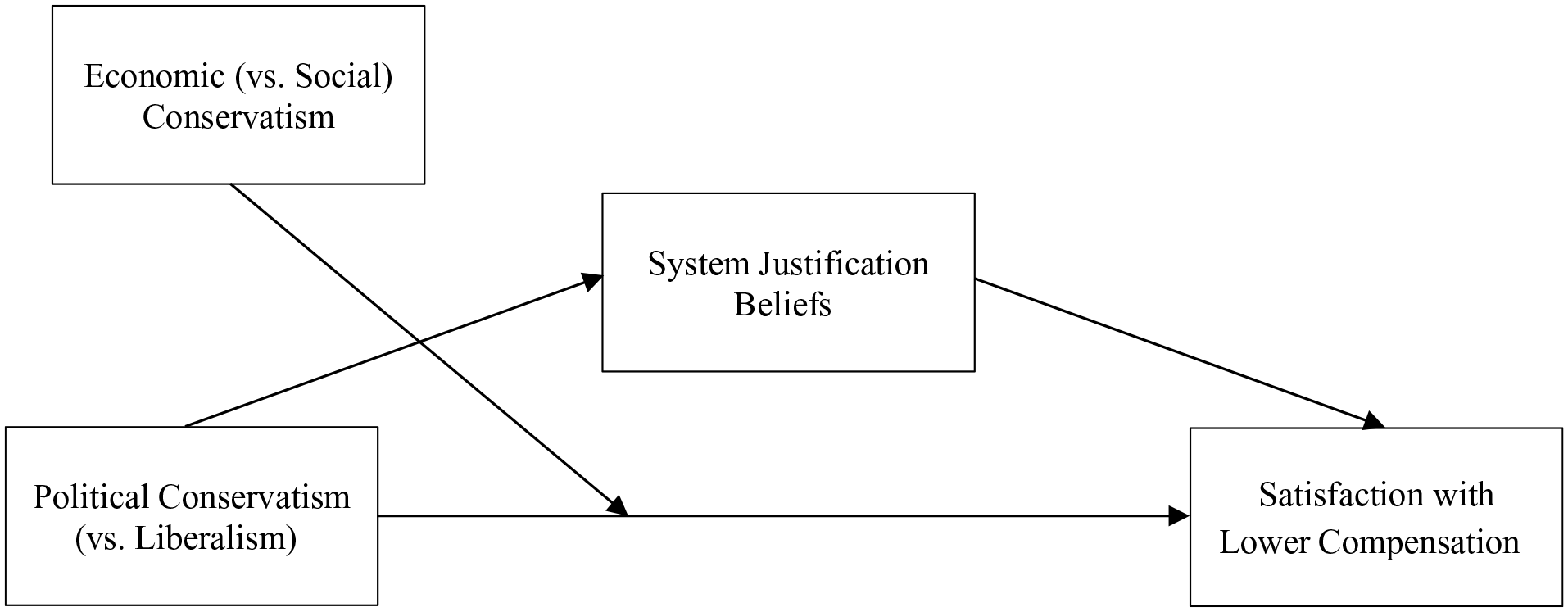
Conceptual model of theoretical framework.
Economic conservatism primarily focuses on fiscal policies and advocates for limited government intervention in the economy. Adherents of this ideology generally support free-market capitalism, emphasizing individual economic freedom, deregulation, and lower taxes as means to stimulate economic growth. On the other hand, social conservatism centers on cultural and moral values, emphasizing the preservation of traditional social institutions and norms. Social conservatives often advocate for a more traditional approach to issues such as family, marriage, and morality, valuing cultural stability and continuity. While economic and social conservatives may find common ground in their preference for limited government involvement, they can differ significantly on social issues. Economic conservatives may prioritize individual liberties and economic efficiency over social regulations, whereas social conservatives may prioritize moral and cultural concerns even if it requires some degree of government intervention. The intersection of these ideologies often defines the broader conservative political spectrum, reflecting a balance between economic and social priorities.
In fact, we expect that economic (but not social) conservatives are higher on system justification. Why might this be the case? Economic conservatives may be higher on system justification compared to social conservatives due to their prioritization of limited government intervention and support for free-market principles. Economic conservatives often perceive the existing economic system, rooted in capitalism and minimal government interference, as inherently just and efficient. Their belief in the merits of free-market competition and individual economic freedom leads to a higher inclination to defend and rationalize the current economic structure as fair and functional. In contrast, social conservatives, who may prioritize cultural and moral values, might not exhibit the same level of system justification, especially when societal changes conflict with their traditional norms, resulting in a nuanced perspective on the fairness of the overall system. Thus, because of economic (but not social) conservatives’ greater system justification, it should also be economic (but not social) conservatives who are more accepting of a lower compensation amount for service failures. Formally:
Study 1
Study 1 relies on scenarios to test our hypothesis that conservative customers are more satisfied with a lower compensation amount, thereby testing
Procedure
We conducted this study with 172 students in a Taiwanese post-secondary hospitality program. The mean age was 22.96 years old (SD = 5.92 years old), and there were 59 men and 108 women. They completed the study on university computers. All stimuli were in English.
We randomly assigned participants to one of two conditions. For everyone, we asked participants to imagine that they were dining in a local restaurant, and when the food came, they realized that the food was improperly cooked. The exact scenario, which we adopted from J. H. Kim and Jang (2014), was as follows:
Some of the dishes you ordered do not taste good and are improperly cooked. You show the dish to the server and mention that it is not properly cooked. After a while, a manager comes to your table and finds that indeed your dishes were improperly cooked. The manager apologizes for the dish defect and asks the server to bring another one. The manager also offered a 5% [20%] discount off of the total bill for the entire party.
We manipulated compensation amount directly in the last sentence of the passage that participants read. All participants indicated their response to three questions: “How satisfied would you be with this dining experience?” (1 = Not at All, 9 = Very Satisfied); “How would you feel about this dining experience?” (1 = Very Negative, 9 = Very Positive); and “How likely would you return to this restaurant?” (1 = Very Unlikely, 9 = Very Likely. We included a compensation amount manipulation check: “I felt that the compensation amount offered was. . .” (1 = Low, 9 = High).
Then, all participants completed a 4-item System Justification Scale (SJS), comprising of items: “In general, I find society to be fair;” “In general, my country’s political system operates as it should;” “Everyone in Taiwan, RoC, has a fair shot at wealth and happiness;” and “Society is set up so that people usually get what they deserve” (1 = Strongly Disagree, 9 = Strongly Agree). We adopted this scale from Vargas-Salfate et al. (2018) who used the same four items in a longitudinal analysis in 18 countries.
We included three items as controls: “How often do you dine out?” (1 = Never, 9 = Always); “How concerned are you with food safety at restaurants?” (1 = Not at All, 9 = Very Concerned); and “How often do you have food delivered?” (1 = Never, 9 = Always). We predicted no effects on these items, which otherwise could pose alternative explanations for our main thesis.
In demographics, participants indicated their age and gender. They also indicated which political party they supported in the 2020 Taiwanese Presidential election (DPP, KMT, other, did/could not vote). Participants who supported another party or did/could not vote (e.g. they were a visiting student) were excluded from data analysis. These participants only amounted to five in total and so our final sample size was 167.
Results
Satisfaction
We averaged the three items for satisfaction (α = .89), such that higher scores indicated higher satisfaction. A 2 (discount: 5% vs. 20%) × 2 (political party supported: DPP vs. KMT) ANOVA revealed a main effect of compensation amount. Perhaps unsurprisingly, offering a 20% discount increased satisfaction overall (M = 7.66, SD = 1.79) compared to offering a 5% discount (M = 6.69, SD = 3.02), F(1, 163) = 12.07, p < .001, Cronbach’s d = .54. There was also a main effect of political party supported. KMT voters reported greater satisfaction (M = 7.68, SD = 1.79) compared to DPP voters (M = 6.57, SD = 3.09), F(1, 163) = 11.83, p < .001, d = 0.53. There was also the interaction, F(1, 163) = 26.52, p < .001, d = 0.79. See Figure 2. When offered a 5% discount, KMT voters reported higher satisfaction (M = 7.94, SD = 1.67) compared to DPP supporters (M = 4.91, SD = 3.60), F(1, 83) = 27.08, p < .001, d = 1.14. But, when offered a 20% discount, KMT voters reported similar satisfaction (M = 7.35, SD = 1.90) as DPP voters (M = 7.95, SD = 1.65), F(1, 80) = 2.35, p = .12.
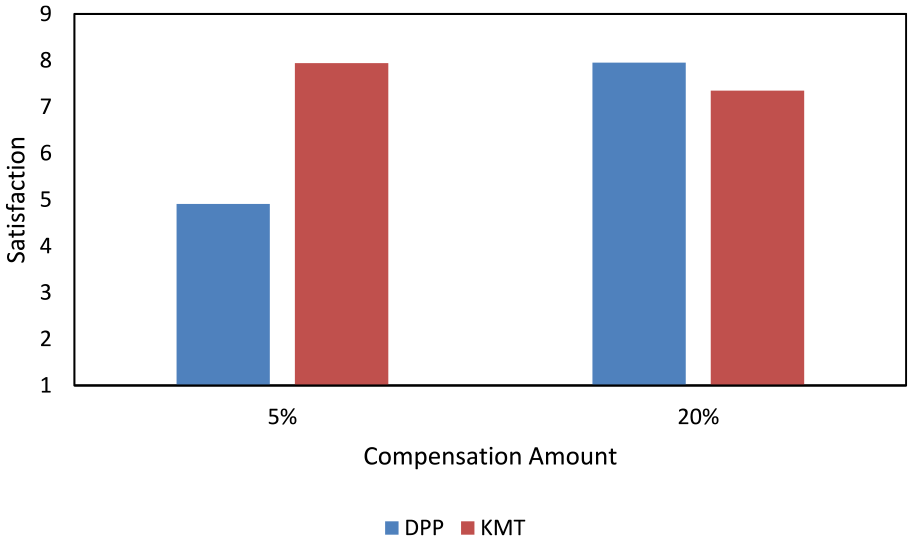
Study 1: satisfaction with restaurant by compensation amount and political party supported.
Looking at the results a different way, for DPP supporters, offering a higher discount increased satisfaction, F(1, 75) = 23.91, p < .001, d = 1.13. However, for KMT supporters, it did not, F(1, 88) = 2.44, p = .12.
System justification scale
We averaged the four items on the SJS (α = .93), with higher scores indicating greater support for system justification. A 2 × 2 ANOVA revealed only a main effect of political party supported, with KMT voters scoring higher (M = 7.58, SD = 1.97) compared to DPP voters (M = 5.06, SD = 3.20), F(1, 163) = 39.00, p < .001, d = 0.97. There was no main effect of amount of compensation, F(1, 163) = 0.93, p = .33, and no interaction, F(1, 163) = 0.01, p = .92.
Moderated mediation analysis
Could KMT voters’ higher system justification beliefs explain their greater satisfaction with the restaurant even with a smaller discount post-service failure? To test for this, we conducted a moderated mediation analysis. Therefore, we used Model 15 of the bootstrapping protocols developed for SPSS by Preacher and Hayes (2008). In this model, political party supported was the IV, satisfaction was the DV, SJS was the presumed mediator, and amount of compensation was the moderating variable acting on the relationship between the mediator and the DV. This allowed us to test the presumed mediating role of SJS, while manipulating the level of compensation allowed us to see if political ideology would influence acceptance of different compensation amounts. The analysis revealed that the index of moderated mediation was significant, β = −1.35, SE = 0.48 (95% CI [−2.43, −0.53]). This meant that the two indirect effects were significantly different from each other. Indeed, when the compensation amount was only 5%, the indirect effect was significant, β = 1.57, SE = 0.39 (95% CI [0.88, 2.42]). That is, KMT supporters’ higher system justification beliefs influenced their satisfaction level with a smaller compensation amount. However, the indirect effect was insignificant when the compensation was 20%, β = .21, SE = 0.25 (95% CI [−0.26, 0.73]).
Control items
On dining out frequency, a 2 × 2 ANOVA revealed no main effects and no interaction, Fs (1, 163) < 2.24, ps > 1.36. There were also no main effects and no interaction on concern with food safety, Fs (1, 163) < 2.12, ps > .14, or with frequency of having food delivered, Fs (1, 163) < 1.68, ps > .19.
Discussion
Study 1 supports
Study 2
This study largely replicates Study 1 with two differences. Importantly, instead of measuring general beliefs in system justification, we measure participants’ perception of the compensation amount (identical to Study 1) as just and fair. Also, we conduct this study with Americans instead of Taiwanese, to ensure that our findings are generalizable to other cultural contexts. In any case, we predict that conservative customers would be more satisfied with a dining experience post-service failure upon receiving a small discount because they perceive the discount to be just and fair.
Procedure
We recruited 300 Americans from the Cloudresearch online panel (Litman et al., 2017). The mean age was 38.49 years old (SD = 17.98 years old); there were 111 men and 189 women. The scenarios were identical to Study 1. But, instead of measuring general system justification beliefs, we asked participants three questions about the perceived fairness of the discount that they received: “The discount I received was fair;” “The discount I received was just;” and “The discount I received was appropriate” (1 = Strongly Disagree, 9 = Strongly Agree). In the demographics section, we asked participants who they voted for in the 2020 U.S. Presidential election (Joe Biden, Donald Trump, another candidate, did/could not vote). The 300 participants in the final same excludes 102 who selected another candidate or did/could not vote. In the final election result, 51.3% of the American population voted for current President Joe Biden, whereas 46.9% voted for then-incumbent Donald Trump.
Results
Satisfaction
We averaged the three items for satisfaction (α = .96), such that higher scores indicated higher satisfaction. A 2 (discount: 5% vs. 20%) × 2 (candidate supported: Biden vs. Trump) ANOVA revealed a main effect of compensation amount, F(1, 296) = 20.25, p < .001, d = 0.40, with a higher compensation increasing satisfaction (M = 7.38, SD = 2.82) compared to a lower compensation amount (M = 6.44, SD = 2.97). There was a main effect of candidate supported also. Trump voters reported greater satisfaction (M = 7.60, SD = 1.78) compared to Biden voters (M = 5.84, SD = 3.09), F(1, 296) = 36.45, p < .001, d = 0.56. There was the interaction, F(1, 296) = 29.49, p < .001, d = 0.69. See Figure 3. When offered a 5% discount, Trump voters reported higher satisfaction (M = 7.70, SD = 1.77) compared to Biden voters (M = 4.63, SD = 3.38), F(1, 168) = 59.03, p < .001, d = 1.18. But, when offered a 20% discount, Trump voters reported similar satisfaction (M = 7.45, SD = 1.79) as Biden voters (M = 7.29, SD = 1.87), F(1, 128) = 0.25, p = .61.
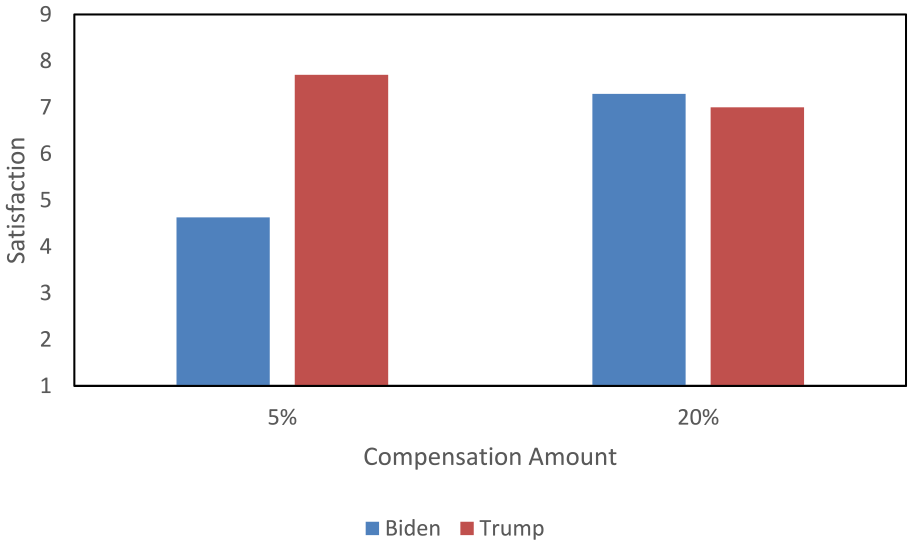
Study 2: satisfaction with restaurant by discount and political party supported.
Looking at the results a different way, for Biden voters, offering a higher discount increased satisfaction, F(1, 127) = 28.86, p < .001, d = 0.95. However, for Trump voters, it did not, F(1, 169) = 0.81, p = .36.
Perceived fairness
We averaged the four items on our perceived fairness measure (α = .92), with higher scores indicating greater fairness perceptions. A 2 × 2 ANOVA revealed only a main effect of political party supported, with Trump voters scoring higher (M = 7.12, SD = 2.19) compared to Biden voters (M = 6.09, SD = 2.75), F(1, 296) = 53.95, p < .001, d = 0.85. There was no effect of amount of compensation, F(1, 296) = 0.99, p = .32, and no interaction, F(1, 296) = 2.26, p = .13.
Moderated mediation analysis
We then conducted a moderated mediation analysis, following Study 2, again using Model 15 by Preacher and Hayes (2008). The analysis revealed that the index of moderated mediation was significant, β = −1.22, SE = 0.34 (95% CI [−1.96, −0.62]). This meant that the two indirect effects were significantly different from each other. Indeed, when the compensation amount was only 5%, the indirect effect was significant, β = 1.36, SE = 0.27 (95% CI [0.88, 1.95]). That is, Trump voters’ higher fairness perceptions influenced their satisfaction level with a smaller compensation amount. However, the indirect effect was insignificant when the compensation was 20%, β = .14, SE = 0.20 (95% CI [−0.22, 0.56]).
Control items
On dining out frequency, a 2 × 2 ANOVA revealed no main effects and no interaction, Fs (1, 296) < 1.03, ps > .31. There were also no main effects and no interaction on concern with food safety, Fs (1, 296) < 1.23, ps > .26, or with frequency of having food delivered, Fs (1, 296) < 2.18, ps > .14.
Discussion
The results replicate those from Study 2, using a different way to testing for politically conservative customers’ system justification beliefs. Here, with an American sample but employing an identical restaurant scenario, we find that Trump voters are more likely to feel a lower amount of compensation to be just and fair, thereby explaining their greater satisfaction with the overall dining experience. Consequently, these findings provide robust evidence for
Study 3
This purpose of Study 3 was to test
Procedure
We recruited 290 Americans from the Cloudresearch online panel (Litman et al., 2017). The mean age was 40.48 years old (SD = 11.22 years old); there were 138 men, 149 women, and 3 participants identified as non-binary or third gender. We used a different service failure scenario in this study. Specifically, we asked participants to consider the following situation:
You recently went to the Caribbean for short holiday. The roundtrip airfare cost you $623 (one person), including all taxes and fees. After your landed back in the United States, you waited by baggage claim for 40 minutes and still your bag did not show up on the conveyor belt. About 2 minutes later, your bag showed up, but it was clearly damaged. You had some glass souvenir from your trip that you wrapped and protected with cushioning, yet upon inspection, you see that this was damaged too. You proceeded to the customer service counter, where they apologized for the incident and offered you a $300 credit for a future trip with the airline.
However, for half of the participants, the airline gave only a credit of $30 (not $300). Thus credit or compensation amount was manipulated as low or high.
Following, participants completed our main dependent variable along two questions: “How likely are you to accept this compensation amount?” (1 = Very Unlikely, 9 = Very Likely) and “How much do you see this compensation amount to be fair?” (1 = Not at All, 9 = Very Much).
Lastly, all participants completed the Social and Economic Conservatism Scale (SECS; Everett, 2013). This is a 12-item scale that measures participants’ attitudes toward 12 politically-charged topics. The topics are in one of two groups: five topics are economic issues (e.g. fiscal responsibility) and seven topics are social issues (e.g. abortion). Particpiants indicate their response on 9-point scales for each topic (1 = Negative, 9 = Positive).
Results
We averaged the two items for compensation amount acceptance (r = .80, p < .001), the five items for economic conservatism (α = .91), and the seven items for social conservatism (α = .89). Not surprisingly, the two types of conservatism correlated highly (r = .69, p < .001). But, could only economic (but not social) conservatism predict acceptance of a lower compensation amount? To test this, we entered our variables into a moderation analysis (Model 1; Preacher & Hayes, 2008). Compensation amount acceptance was our DV, and economic conservatism was our IV. We included social conservatism as a co-variate because the two were correlated highly and thus we needed to statistically ensure that our findings for economic conservatism would be specific to economic conservatism. The credit amount was our moderating variable. The results indicated a significant interaction, F(1, 285) = 6.21, p = .01. When the credit was low, economic conservatism predicted acceptance, B = 0.35, SE = 0.16, p = .03 (95% CI [0.02, 0.67]). When the credit was high, economic conservatism did not predict acceptance, B = −0.08, SE = 0.12, p = .50 (95% CI [−0.34, 0.16]). In other words, when the credit was low, participants who were more conservative economically were more accepting of the amount. But when the credit was high, participants higher or lower on economic conservatism did not differ in their acceptance. In a second analysis, this time using social conservatism as the IV and controlling for economic conservatism, the interaction was not significant, F(1, 285) = 2.18, p = .14. When the credit was low, economic conservatism did not predict acceptance, B = 0.19, SE = 0.11, p = .19 (95% CI [−0.02, 0.42]). When the credit was high, economic conservatism also did not predict acceptance, B = −0.005, SE = 0.11, p = .96 (95% CI [−0.23, 0.22]). In other words, social conservatism does not predict acceptance of differing compensation amounts—only economic conservatism does, while controlling for the effect of one on the other.
Discussion
The results replicate the previous studies by revealing that conservatives (but not liberals) are more accepting of lower compensation amounts for service failures. However, critically, Study 3 also reveals that the prediction is specific to economic (but not social) conservatism. Thus, by teasing apart the two types of conservatism (i.e. the two dimensions of political ideology), we add nuance to our overall predictions.
General discussion
In three studies, we test our hypothesis that politically conservative customers are more accepting of and satisfied with a lower compensation amount post-service failure as they are higher on system justification beliefs. Study 1 examines the main effect and the mediating role of system justification. The results show that conservative tourists are more likely to accept lower compensation after service failure due to scoring higher on system justification. Then, Study 2 replicates the findings and tests the psychological mechanism with a different scale, or perceived justness and fairness of the compensation offered. Finally, Study 3 reveals that our predictions are specific to economic (but not social) conservatives.
Theoretical contributions
The theoretical contributions made in this paper are fourfold. First, our findings provide insight into how customers’ tendency to maintain a specific political ideology shapes their responses to firms’ compensation following a service failure in the tourism and travel industry. Previous work indicated the importance of adopting a unique service recovery strategy in forming a healthy firm-customer relationship (Bagherzadeh et al., 2020; Gohary et al., 2016; Parasuraman, 2006). Therefore, many studies have focused on the effectiveness of such recovery strategies in the post-failure era and recommended marketers provide as generous compensation as possible (H. Kim et al., 2022; Migacz et al., 2018; Sharifi & Aghazadeh, 2016). Other work has also focused on the interpersonal relationship between firms and customers and examined how three interpersonal justices (i.e. procedural, interactional, and informational) help firms to increase satisfaction among customers who have experienced service failure (Cai et al., 2018; Liu et al., 2019; Migacz et al., 2018) and increase their cost of switching (Augusto de Matos et al., 2013; Bergel & Brock, 2018).
Second, this research examines and broadens our understanding of the mechanism of political ideology’s effect on service failure recovery. Previous research has demonstrated perceived justice as the core factor in service failure (del Río-Lanza et al., 2009; Ha & Jang, 2009); however, little was known about how customers’ beliefs and political ideology orientations would impact this effect, especially in tourism and travel service failure. Building on System Justification Theory, our study has found support for the notion that a customers’ post-recovery satisfaction increases toward a service failure recovery via greater system justification by conservative tourists. This then influences how such customers might perceive the fairness of different compensation amounts. In general, most studies on political ideology examine how political ideology shapes customers’ pre-consumption choices, behaviors, and judgments (e.g. Chan, 2020; Han et al., 2019) and the effect of political ideology on post-consumption experiences is limited (e.g. Fernandes et al., 2022). Our wor thus expands the current limited understanding of how political ideology affects post-consumption behavior by examining service recovery in tourism and travel settings.
Third, our research adds greater nuance to the existing literature. Specifically, K. Jung et al. (2017) found evidence that conservatives are less likely to complain. These authors, however, did not tease apart the distinction between economic and social conservatism. While the term “conservatism” is often used broadly, recognizing the dual dimensions of economic and social conservatism provides a more accurate framework for analyzing and predicting political behavior. Researchers can delve into the specific policy preferences and attitudes associated with each dimension, gaining insights into how individuals may prioritize economic principles versus social values. This distinction is vital in explaining variations within the conservative camp and understanding potential conflicts or synergies between economic and social conservative stances. Moreover, it enables researchers to better examine the impact of these ideologies on diverse policy domains, ranging from economic policy and regulation to social issues like marriage equality and cultural norms.
Fourth, some existing research has already shown how customers’ political ideology influences their willingness to complain (K. Jung et al., 2017). However, we argue that understanding how customers’ political ideology influences their acceptance of (lower) compensation amounts is important in its own right. The research on how customers’ political ideology influences complaining behavior and willingness to accept compensation amounts after a service failure represents distinct facets of customer responses. Complaining behavior focuses on the proactive expression of dissatisfaction, encompassing actions such as lodging complaints or writing reviews. Meanwhile, the willingness to accept compensation explores the post-complaint resolution stage, emphasizing how individuals, based on their political ideology, perceive and respond to offered remedies. While both contexts relate to service failure, they illuminate different stages of the customer experience (initial dissatisfaction expression and subsequent negotiation and resolution), providing again a nuanced understanding of how political ideology shapes diverse aspects of customer responses in the service industry.
Practical implications
Now, tourism marketing managers should recognize their customers’ political orientation in their database and apply them in the service recovery process. Tourism marketing managers can ask political ideology questions in research (both offline and online) through which tourists pro-actively reveal their political orientation. Moreover, managers can estimate tourists’ political orientation via the state they are living in; some states support Republicans more, others support Liberals more. Using facial recognition technology to predict customers’ political orientation is also possible these days given modern technological advancements (Kosinski, 2021), although firms should take ethical consideration as the top priority in this case. Having recognized customers’ political ideology, managers can consider tailoring recovery strategies to meet diverse needs and provide the most optimal recovery to the customer. Per our findings, managers are encouraged to adopt a customized approach that addresses the unique expectations of all customers after a service failure.
Indeed, managers in tourism and hospitality settings can use these results to understand and measure the true satisfaction level of customers and to enhance their satisfaction levels by increasing the perception of fairness especially for liberals. In addition to compensation amounts, the current work suggests that increasing fairness through other means in service recovery is advisable. For example, we focus on distributive justice, but post-failure, managers and frontline employees might conceivably improve interactional and procedural justice if fairness of the compensation amount can not be increased (that is, if the compensation amount itself can not be increased). These tactics would be especially paramount when customers are politically liberal, as they evaluate justice and fairness. Our work on compensation amount could conceivably apply to other contexts in which justice and fairness is involved.
For service managers, the knowledge that economically conservative customers are more accepting of lower compensation amounts after a service failure can be of practical benefit in several ways. Firstly, it allows managers to tailor compensation strategies based on customer segments, recognizing that economic conservatives may prioritize fiscal responsibility and be more receptive to modest compensatory offers. This insight can guide resource allocation and help in optimizing compensation practices to enhance customer satisfaction without unnecessarily escalating costs. Additionally, understanding the nuanced preferences of economic conservatives can inform communication strategies during the resolution process, enabling service managers to frame compensation offers in ways that resonate with the values and priorities of this particular customer group. Ultimately, this knowledge facilitates a more targeted and efficient approach to service recovery, contributing to improved customer relations, loyalty, and the overall reputation of the service provider.
Hospitality and tourism managers can employ a multifaceted approach to discern between economically conservative and socially conservative customers. Discerning conservative guests into social and economic dimensions requires a combination of observational skills, data analysis, and subtle engagement. Firstly, analyzing booking patterns and preferences can reveal economic conservatism; individuals who prioritize cost-effective options, seek discounts, and display loyalty to established brands may align with economic conservatism. For example, marketing managers analyze online reservation data to identify patterns such as guests who consistently choose budget-friendly options or look for promotions. A comprehensive study of order history can reveal those who consistently choose value-driven items offered under promotions. Economic conservatives may be more inclined to participate in loyalty programs that offer discounts or exclusive deals. Additionally, the creation of an item section emphasizing affordable options can serve as a subtle indicator. Guests who consistently show a preference for this section likely lean towards economic conservatism, providing valuable information for developing targeted service recovery strategies.
Meanwhile, to identify social conservatism, managers can observe guest behavior within communal spaces, noting indicators such as family-centric activities, participation in traditional events, or interest in community engagement programs. Guests bringing children, joining family gatherings, or expressing interest in community events may signify a preference for an environment aligned with social conservatism. Utilizing discreet customer surveys focused on preferences and values related to both economics and social issues can also provide valuable insights. Moreover, cultivating relationships with guests through personalized interactions can help unveil subtle cues, as conversations about financial planning or lifestyle choices can unveil underlying conservative attitudes. By combining these strategies, hospitality and tourism managers can create a nuanced understanding of their guests, allowing for the customization of services, promotions, and the overall dining experience to cater to both economic and social conservative preferences, especially when faced with service failures.
Limitations and future research suggestions
This research has a few limitations and thus there are ideas for future research. First, the present research only examines one type of fairness, distributive justice, in its empirical studies. While monetary compensations after service failures are the core of every service recovery strategy, prior research showed that some other types of justice and fairness need to be taken into consideration, such as procedural justice, interpersonal justice, and informational justice (Gohary et al., 2016; Ok et al., 2005). Future research can extend the current findings to a broader range of justice components and show if the effect exists for other justices. Furthermore, we conduct three experiments using lab and online samples. Field studies are rare and difficult—at times also ethically impossible—to conduct (Ha & Jang, 2009), but our studies while offering internal validity may be lower on validity of the external kind. Further work might use field or real-world settings, or use secondary data sets.
Additionally, prior research has indicated political ideology as a situated identity such that priming individuals with liberal or conservative ideology can change their political orientation for a short period of time (Oyserman & Schwarz, 2017). Due to global uncertainty and political disputations due to COVID-19 and China-US tensions, we could not try manipulating political ideology in our paper. Therefore, future research on political ideology in a tourism setting can try manipulating political ideology and increase the robustness of the effects and implications of findings. Manipulating political ideology would give insight into how managers can shift tourists’ political orientations in favor of offering a minimum compensatory package followed by a service failure. Indeed, political ideology is not concretely fixed, and shifts are possible at least temporarily to reveal impacts on psychology and behavior that are consistent with more stable conservatism and liberalism tendendies. For example, leaning to the right side and inducing low-effort thought promote conservatism (Eidelman et al., 2012; Oppenheimer & Trail, 2010). Thus practically, tourism and hospitality managers might direct the customer’s orientation to the right or induce time pressure.
Furthermore, we only focus on conservatism and liberalism, which are the two main political ideologies in the Western hemisphere. But, besides Taiwan and the United States, numerous other parts of the globe fall along this broad conservatism-liberalism dimension. Hence, more work can recruit participants from Canada, Australia, or the United Kingdom in order to generalize our effects even more broadly. Speaking of political ideology, other ideologies such as fascism, socialism, and communism exist in many other parts of the world. We say nothing about how customers with these ideologies perceive or react to compensation amounts of differing levels. We believe our work is innovative and novel, but it is clear that many other questions remain about political ideology in travel and hospitality settings—whether the focus is on service failure or outside of it in the literature more broadly.
Footnotes
Declaration of conflicting interests
The author(s) declared no potential conflicts of interest with respect to the research, authorship, and/or publication of this article.
Funding
The author(s) received no financial support for the research, authorship, and/or publication of this article.
