



Abstract
Firms regularly call on multiple social media communication tactics (e.g. influencers, user-generated content and brand messages) to interact with their customers. Drawing on both parasocial relationship and social identity theories, we investigate the relative effectiveness of brand-directed versus influencer-directed social media marketing in stimulating both customer engagement and purchase behaviour. First, we use a survey research design to collect data on customers’ intention to engage with the brand and purchase when exposed to brand-directed and influencer-directed social media marketing. Second, we collect data from a field experiment on a social media platform that captures customer engagement and brand sales at aggregate levels attributed to brand-directed and influencer-directed social media marketing. Consistently across both studies, we find that brand-directed and influencer-directed social media marketing positively impact customer engagement and customer purchase behaviour. Further evidenced across both studies, we find brand-directed social media marketing is more effective than influencer-directed social media marketing in fostering customer engagement, whereas influencer-directed social media marketing is more effective in driving customer purchases. We also find that female customers are more impacted by influencer-directed social media marketing on both dimensions than brand-directed social media marketing. The study provides a strategic direction for brands to optimally allocate their limited digital marketing budget between brand-directed and influencer-directed social media marketing based on their marketing objectives central to customer behaviour – either enhancing longer-term customer relationship building via engagement or generating shorter-term sales.
Introduction
The effectiveness of both traditional and digital marketing communications in enabling brands to attract and persuade customers has come into question (Belanche et al., 2021; Leung, Gu, et al., 2022). Specifically, brands need to contend with digital distraction, limited customer attention, resistance to brand-directed marketing messages, greater trust in electronic word of mouth and increasing use of ad-blocking technologies (Belanche et al., 2021; Hughes et al., 2019; Social Media Today, 2022; Tafesse & Wood, 2021). To overcome these challenges, brands are increasingly turning to influencer marketing on social media due to their ability to generate favourable marketing outcomes such as customer-brand engagement, positive brand attitudes and purchase intent (Delbaere et al., 2021; Hughes et al., 2019; Leung, Gu, et al., 2022; Lou & Kim, 2019). Thus, a brand’s social media marketing strategy, which has been traditionally implemented through firm-generated content (Kumar et al., 206), now consists of content generated from multiple sources (e.g. brands, influencers, sponsors, distributors and retailers). Brands use such a combined social media marketing strategy to positively influence customers’ engagement and purchase decisions (Delbaere et al., 2021; Dumas & Stough, 2022; Jayson et al., 2018; Upadhyay et al., 2022). However, researchers and practitioners are increasingly raising questions concerning the relative effectiveness of brand-directed and influencer-directed social media marketing on customer behaviour (Delbaere et al., 2021; Jacobson et al., 2020; Leung, Gu, et al., 2022; Leung, Gu, & Palmatier, 2022).
There is scattered evidence of their relative effectiveness in helping brands achieve marketing objectives. This is because, generally, existing studies have analysed the effectiveness of a brand’s social media marketing strategy across channels in isolation. That is, research has tended to examine how either brand-directed or influencer-directed social media marketing affects brand engagement or sales (e.g. Delbaere et al., 2021; Dolega et al., 2021; Hughes et al., 2019; Li & Xie, 2020; Tafesse & Wood, 2021). However, marketers go beyond an isolated approach to their social media marketing strategy and subsequent channel selection (Jayson et al., 2018; Kumar et al., 2016), often calling on an integrated marketing communication approach to stimulate a positive customer response towards their brand (Kumar et al., 2016). 1 While some studies document the synergistic effects across different digital media forms (e.g. Kumar et al., 2016; Naik & Raman, 2003), the question remains open about media synergy and potential cannibalization when adopting a brand-directed and influencer-directed social media marketing strategy simultaneously, as both can stimulate customer behaviour with varying effects (Bruce et al., 2012). Therefore, without an accurate understanding of the relative effectiveness of brand-directed and influencer-directed social media marketing, brands could not achieve their marketing objectives, subsequently leading to inefficient allocation of their limited digital marketing budget.
Drawing on two key theoretical underpinnings of social media marketing – parasocial relationship theory (i.e. where followers form long-term bonds with social media influencers) and social identity theory (i.e. where followers view influencers as relatable), we overcome this limitation across extant research. Specifically, we conducted two separate studies to compare the relative effectiveness of brand-directed and influencer-directed social media marketing on two critical dimensions of customer behaviour: customer engagement and purchase. Study 1 used a survey to measure customer engagement and purchase intent when exposed to brand- or influencer-directed social media marketing. As expected, we find that brand-directed and influencer-directed social media marketing positively impact customer engagement and brand sales; however, their relative effectiveness varies. Specifically, we find that brand-directed social media marketing led to stronger brand engagement than influencer-directed social media marketing. On the contrary, influencer-directed social media marketing was more influential on brand sales. Given the atypical nature of these findings, we conducted a second study to confirm the validity of these results in a real-world setting. As such, Study 2 collected data from a field experiment with a firm that used brand- and influencer-directed social media marketing to assess their relative effectiveness, confirming the results from Study 1.
To gather more insight into the synergistic effects of using multiple facets of social media marketing strategy, we conducted a post hoc analysis following Study 2. Exploring the spillover effects of social media marketing, we find that brand- and influencer-directed social media marketing help lift sales from other channels (such as offline and distributors) where these advertisements are not used to direct customers to these sales channels. Additionally, we find that for both brand- and influencer-directed marketing, engagement (captured through clicks) with social media posts has a higher impact on brand sales than mere exposure (captured through impressions).
Given the above, our research makes important contributions to the social media marketing literature. Primarily, we adopt a dual social media marketing strategy perspective by comparing the relative effectiveness of brand-directed versus influencer-directed social media marketing in helping brands achieve two critical marketing objectives – customer engagement and customer sales. This extends the existing marketing literature that has generally adopted a single-lens approach when assessing their effectiveness (e.g. Carlson et al., 2022). Furthermore, based on our findings, we differentiate from existing research that found brand-directed social media marketing effectiveness to be waning (e.g. de Vries et al., 2017; Jacobson et al., 2020) by demonstrating that such an approach can stimulate both brand sales and customer engagement. Additionally, our post hoc analysis provides support for existing research that claims advertising engagement is more effective than advertising exposure in stimulating brand sales (e.g. Liadeli et al., 2023; Rappaport, 2007), but extends on this by examining this when using a combination of a brand-directed and influencer-directed social media marketing. Finally, methodologically, we call on a field experiment with a real-world organization to provide further credence to our findings. In addition to these theoretical insights, our findings have implications for managers. Specifically, the insights from our two studies help brand managers allocate their limited digital marketing budgets more efficiently, enabling greater strategic focus and the opportunity to use different social media options more synergistically.
We proceed as follows. First, we review the related literature, based on which we subsequently develop our conceptual framework. Next, we describe our research settings, data and results from the survey research design and field experiment. Finally, we discuss the managerial implications of this study and conclude with some of the limitations.
Conceptual background
An integrated marketing communication strategy relies on multiple media options to engage audiences, with digital media increasingly becoming more popular (Liadeli et al., 2023). With social media, brands now have multiple options to reach customers. For example, they can converse with customers to bond with them (Edelman, 2010), announce product releases or mentions (Devereux et al., 2020; Gavilanes et al., 2018), encourage engagement by facilitating user-generated content (Timoshenko & Hauser, 2019) and influence customers’ purchase behaviour (Gavilanes et al., 2018; Lee & Hong, 2016).
As customers move towards greater peer-to-peer interaction and influence, influencer marketing is becoming increasingly prominent (Hughes et al., 2019). The market for influencer marketing is estimated to reach $24.1 billion by 2025 (Markets and Markets, 2020). While influencers use different channels (e.g. blogs, streams and vlogs), brands are commonly turning to social media influencers, given the prominence of social media use (Wall Street Journal, 2019).
Existing studies document the positive effect of influencer marketing on critical customer outcomes through social media platforms such as YouTube, Instagram and Facebook. For example, Lee and Watkins (2016) found Vlogger characteristics (e.g. social attractiveness, physical attractiveness and attitude homophily) positively influenced favourable brand perceptions and purchase intention. Likewise, Hughes et al. (2019) found that sponsored blogging affects customer engagement (e.g. via comments and likes). Other positive outcomes include favourable brand attitude, brand persuasion and brand endorsement (Farivar et al., 2021; Hess et al., 2022).
Despite the benefits associated with brands using an influencer, previous studies also highlight the various negative effects that may occur. For example, Audrezet et al. (2020) propose that consumer perceptions of brand authenticity are at risk when influencers disclose their paid promotions, which is becoming increasingly more common as governments build stronger disclosure rules (Dumas & Stough, 2022). Furthermore, Zhou et al. (2021) point to the potential tension between brand and influencer identities, influencer betrayal or low-quality content as having a negative influence on the consumer response, thus harming brand objective achievement and value. Given that previous work has found both positive and negative effects of using an influencer to promote their products, the effectiveness of influencer-directed social media marketing on brand performance has come into question (Zhou et al., 2021), which is further emphasized when considering the cooperation/cannibalization with brand-directed social media marketing.
While brand-directed brand messaging has been a primary way to create customer connection in the brand space, in the digital marketing environment, non-brand-directed conversations in what is viewed as the customers’ space, have become an essential marketing strategy. Thus, a brand’s direct communication with customers is as important as customers conversing about the brands themselves (Kuksov et al., 2013). With this in mind, social media platforms are leveraged by brands to engage with customers directly (in the form of brand-to-customer communication), and indirectly (through brand-induced customer-to-customer communication), therefore transforming the nature of brand communication from monologic to dialogic (Berthon et al., 2012; Hu et al., 2020). However, existing work is seemingly overlooking this approach, despite brands commonly using a combination of brand-directed and influencer-directed social media marketing to foster brand-related conversations in both the brand and customer space in order to promote customer engagement and brand sales (Swaminathan et al., 2020). Thus, to bridge this gap, this study builds on the limited work in this space by comparing their relative effectiveness on customer behaviour.
Customer engagement
On social media, often the focus of a firm’s brand-directed social media marketing is on engaging with customers to build longer-term relationships rather than a narrow short-term transactional focus (Gulati & Oldroyd, 2005). Brands implement a holistic brand-directed social media marketing strategy via online content (e.g. firm-generated content), electronic word-of-mouth (eWOM), relationship marketing (e.g. customer dialogue) and facilitation of online brand communities that have the potential to influence the entire marketing funnel (consisting of brand awareness, brand loyalty, brand trust, brand image, brand quality and brand association), including the bottom of the funnel, that is, sales.
To aid customer engagement, brands also utilize the services of social media influencers, who are considered key opinion leaders that can influence product diffusion (Zhang et al., 2018). However, the main goal of influencers is not just promoting the brands, but also promoting their own identities, which could be a potential source of incongruency between brand-directed and influencer-directed social media marketing (Zhou et al., 2021). Furthermore, influencers’ intrinsic motivation and non-commercial orientation are primary reasons followers value their opinions, which may create potential tension for a brand’s authenticity when influencers collaborate with brands, given their commercial approach (Audrezet et al., 2020). Such problems are more pronounced for brands that operate solely in a digital environment with more reliance on influencer marketing (Haenlein et al., 2020), customers’ strong resistance against online promotions (Gruner et al., 2019), confusion created by disclosure rules (Dumas & Stough, 2022) and short-term effectiveness due to the forgetting effect 2 (Mallipeddi et al., 2022). Furthermore, influencers could be affiliated with multiple brands that may give less command and control to the focal brand utilizing their services. In summary, as against brand-directed social media marketing, influencer-directed social media marketing is limited in its reach to influence the entire marketing funnel as the motivations of social media influencers (i.e. self-promotion) diverge from that of the brand (i.e. customer-centric focus).
Thus, on social media, we argue that influencer-directed social media marketing incorporates a movement away from direct brand communication with followers by involving a third-party representative, thus clouding relationship-building qualities as part of a brand’s holistic marketing approach. Hence, we propose the following research question.
Research Question 1: Is brand-directed social media marketing more effective than influencer-directed social media marketing in fostering customer engagement?
Customer purchase
Influencers act as opinion leaders, potentially making them more persuasive than other marketing communication tactics such as celebrity endorsers or brand advertising (Casaló et al., 2020; Hess et al., 2022). To that end, influencers can be effective advocates whose communications can be construed as true regarding a product’s credibility (Kraft-Todd et al., 2018). Thus, customers perceive messages from influencers as more authentic, reliable, personal and non-commercial (Leung, Gu, & Palmatier, 2022). Furthermore, brands exploit the social capital of influencers consisting of bonding capital 3 and bridging capital 4 to cooperate and communicate with similar and diverse people, respectively (Burt, 2007; Dekker & Uslaner, 2003), potentially swaying customers’ behaviour.
Drawing upon social identity theory (Hogg et al., 1995), which describes how individuals perceive themselves as belonging to particular social groups and the significance and impact of this membership (Tajfel, 1972), we argue that customers following influencers will have a higher propensity to exhibit favouritism towards them, which likely affects their behaviour. Specifically, in a social media influencer-follower scenario, part of a follower’s self-concept is drawn from their involvement with an influencer-led community (Farivar & Wang, 2022).
Social media influencers endorse products exhibited via consumption practices and as such, customers who identify as being part of that influencer’s community may perceive them as more credible, approachable and relatable due to their genuine sharing of experiences and opinions (Lou & Yuan, 2019), potentially enabling brand purchase intent of products endorsed (Farivar & Wang, 2022).
Furthermore, the parasocial relationship between influencers and followers affects the latter’s positive intention to purchase and word-of-mouth (Lou & Kim, 2019). In a digital marketing environment, such intention can create a ripple effect whereby additional new content is generated, or existing messages are propagated further in response to the influencer marketing message (Lu et al., 2019). The parasocial interaction between the customers and influencers may lead the former to develop an illusory friendship distinguished by emotional bonds and affective attachment (Qin, 2020). We suggest that such parasocial relationships on social media platforms result in psychological attachment (caused by emotional bonds and imagined intimacy manifested as an illusory two-way relationship (Dibble et al., 2016)) that are easier to form between customers and influencers, yet brands may struggle to leverage such relationships. This is because consumers may view brand-directed marketing communications as just another sales pitch (Dolega et al., 2021) or that messages from the brand lack the same level of credibility relative to messages coming from influencers (Hwang & Zhang, 2018), even if both are promoting the same brand. Consequently, consumers will generally move more towards those they can trust, such as social media influencers (Fu et al., 2019; Leung, Gu, & Palmatier, 2022).
Together, the key psychological attachments drawn from influencer-directed social media marketing are often lacking in brand-directed social media marketing (Hess et al., 2022; Leung, Gu, & Palmatier, 2022). Specifically, the propensity for strong social identity associations between influencer and follower, as well as the receptiveness to messages from influencers over that of brands, built from parasocial relationship inferences, leads us to the following research question.
Research Question 2: Is influencer-directed social media marketing more effective than brand-directed social media marketing in impacting customer purchases?
To answer our research questions, we analysed data from two studies. Our first study uses a survey research design, while the second explores data from a field experiment. In both these studies, we include additional analyses exploring the role of gender, spillover effect and mechanisms behind advertising effectiveness.
Study 1: Survey research design
Data
We target three distinct customer groups with three different criteria in an online survey research design. Customers in each group were randomly selected based on three criteria: (1) they have shopped online, (2) they have a social media presence and (3) they follow at least one influencer on any social media platform. Customers in the first group served as a base case. These customers were primed with no advertising and were merely informed of a brand launching a new product. The source of messaging was neither brand-directed nor influencer-directed. Customers in group two were exposed to brand-directed social media marketing (via paid social media advertising) in their feeds, while the users in the third group were exposed to advertising content but were told that the content was shared by the influencer they followed on social media. Thus, these customers were primed with influencer-directed social media marketing. Customers in each group completed a questionnaire of items from scales that captured their purchase intention and engagement with the brand (see Supplemental Appendix A for research design). After cleaning the data with valid (those who satisfy the three criteria) and complete responses, we select 1050 customers (350 in each group).
In Table 1, we provide the summary statistics. Both influencer-directed
Summary of the Survey Data.
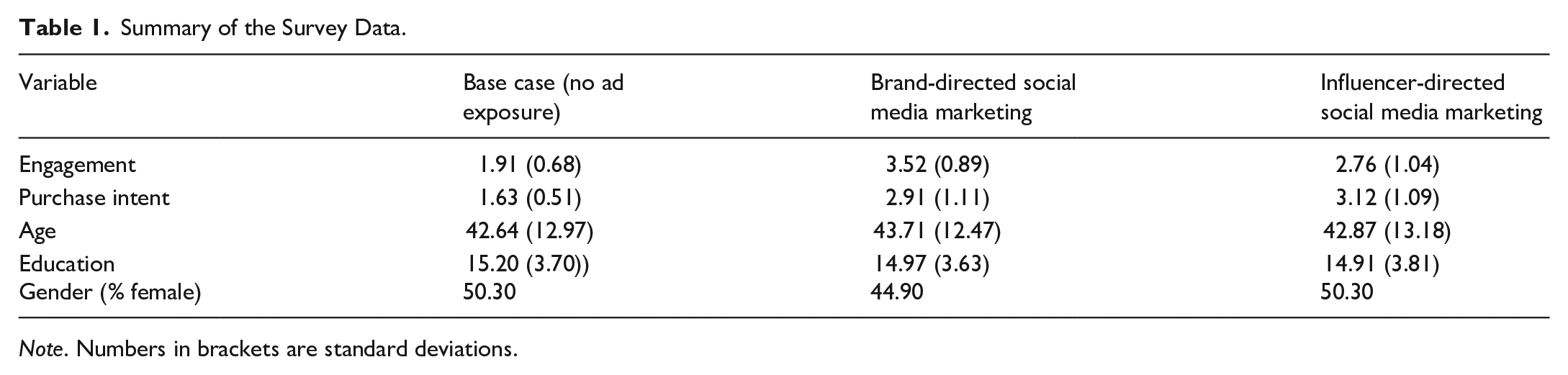
Note. Numbers in brackets are standard deviations.
Methodology and results
Next, we use econometric modelling to capture the direct effects of brand-directed social media marketing
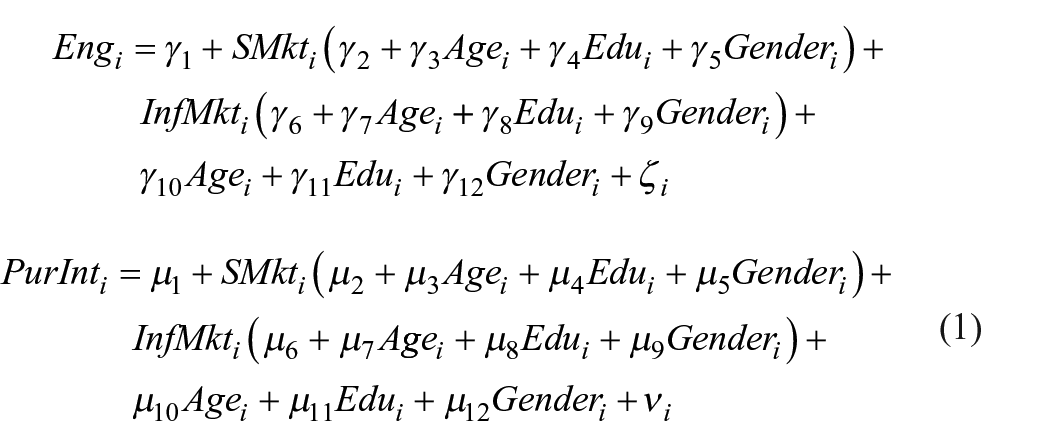
In equation (1), the effects of brand- and influencer-directed social media marketing are captured relative to the base case. The error term of equation (1) is distributed multivariate normal, that is,
In Table 2, we present the parameter estimates of equation (1). We find that brand- and influencer-directed social media marketing are more effective than the base case in spurring engagement. Furthermore, the effect of brand-directed social media marketing
Parameter Estimates from the Analysis of Survey Data.
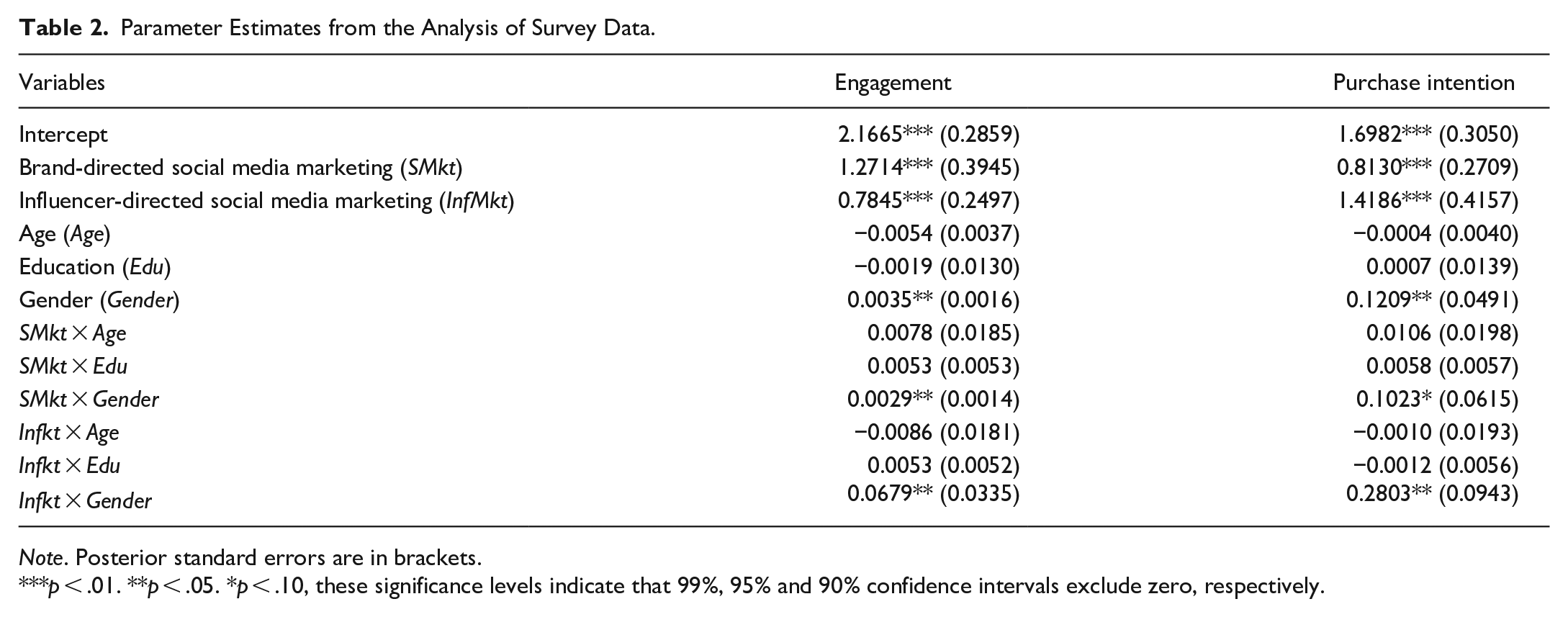
Note. Posterior standard errors are in brackets.
p < .01. **p < .05. *p < .10, these significance levels indicate that 99%, 95% and 90% confidence intervals exclude zero, respectively.
We find contrasting effects of brand- and influencer-directed social media marketing on customers’ purchase intention. While both brand-directed social media marketing
Discussion
The results from the survey research design provide preliminary insights into our research questions. Regarding our first research question, we find empirical evidence that brand-directed social media marketing is more effective than influencer-directed social media marketing in fostering customer engagement. Regarding our second research question, we find a contrasting effect, as influencer-directed social media marketing is more effective than brand-directed social media marketing in impacting customer purchases. Furthermore, we find that influencer-directed social media marketing is a more effective strategy to engage with and influence the purchase decisions of female than male customers. We note that the survey research design captures stated rather than actual behaviour. To overcome this limitation, we conduct Study 2 that explores these effects on outcomes based on consumers’ actual purchase behaviour.
Study 2: Field experiment
Data
We use data from Soul Maté, a food and beverage firm from Finland. The company used TikTok for its social media marketing strategy to launch two new products: Soul Maté Passion Guava and Soul Maté Ginger Lemon. These two products are energy drinks with antioxidants and natural caffeine. A pre-study was conducted based on four focus group discussions to gain insights on attitudes and opinions towards the brands from TikTok’s target audience. Subsequently, such insights were used to hire influencers and produce creative content for the brand- and influencer-directed social media marketing. The firm hired two influencers with more than 82,000 followers. A call-to-action (CTA) link guided customers to a Finnish online retailer to make purchases.
An experiment was conducted for two months to assess the relative effectiveness of brand- and influencer-directed social media marketing. During this period, influencers posted creative content on TikTok using their personal accounts. As part of brand-directed social media marketing, the firm used a bidding process available on TikTok, where creative content was targeted to TikTok users. At the end of the experiment, we collected customer engagement and brand sales data.
The data collected from TikTok for customer engagement included impressions and clicks, while the brand sales data from the online retailer focussed on the number of products sold. A summary of the data can be found in Table 3. Analysing the customer engagement data, we observed that the total daily impressions generated through brand-directed social media marketing exceeded those of influencer-directed social marketing. This difference can be attributed to brands being able to bid for impressions. In contrast, influencer-directed social media marketing impressions are seen as updates or when users specifically visit the influencers’ feeds. Consequently, the daily click rate for brand-directed social media marketing (0.20%) surpassed that of influencer-directed social media marketing (0.15%). The sales data revealed an average daily volume of 257 units sold through the online retailer.
Summary of the Field Experiment Data.
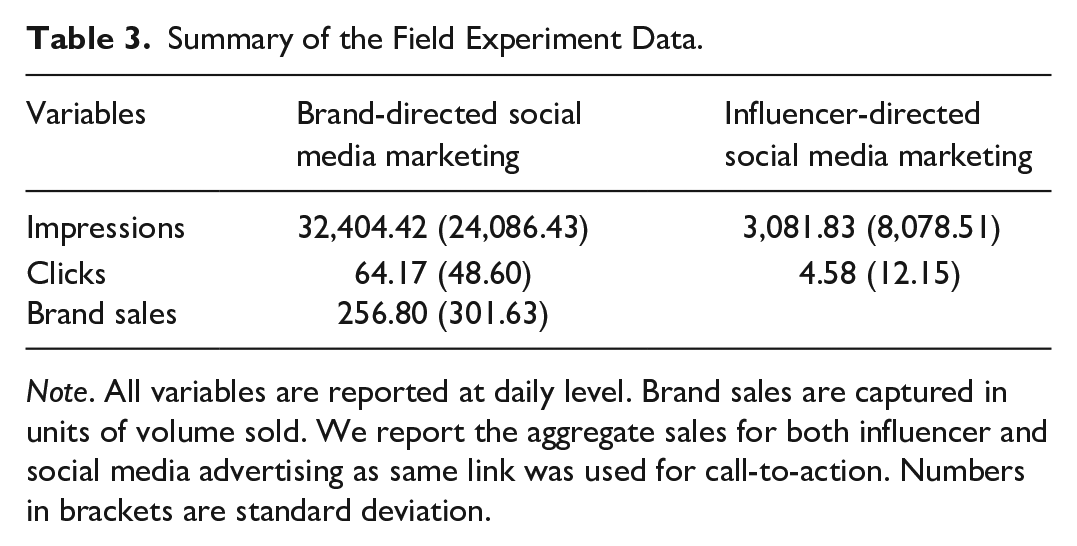
Note. All variables are reported at daily level. Brand sales are captured in units of volume sold. We report the aggregate sales for both influencer and social media advertising as same link was used for call-to-action. Numbers in brackets are standard deviation.
Methodology and results
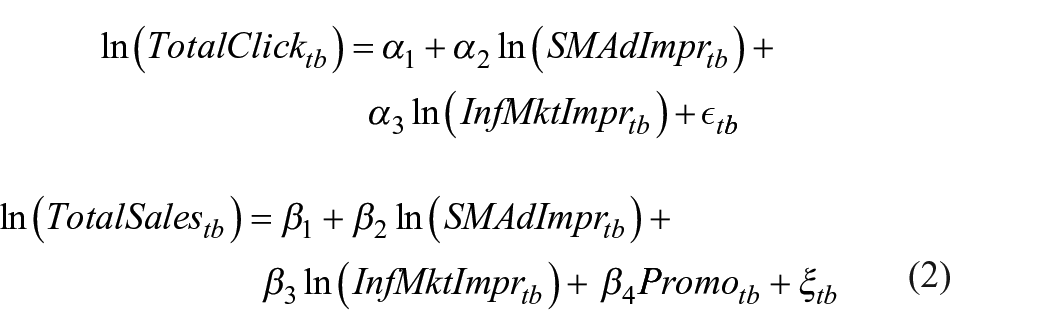
We focus on quantifying the relative effectiveness of brand- and influencer-directed social media marketing on customer engagement and brand sales. Before we outline our econometric modelling, understanding some contextual background is important. First, the firm runs both strategies simultaneously on social media. Second, for simultaneous advertising activities on social media, the social contagion of advertising effects is a concern (Aral & Walker, 2011; Manchanda et al., 2008). Third, sales data in this study captured the aggregate volume sold because of the same CTA link provided in all the campaigns. Thus, we model these customer engagement and brand sales at an aggregate level. We capture customer engagement as total clicks from brand- and influencer-directed social media marketing. Therefore, we model variables total clicks, TotalClickstb, and overall brand sales generated from CTA links, TotalSalestb, at time t for brand b as follows 8 :
where
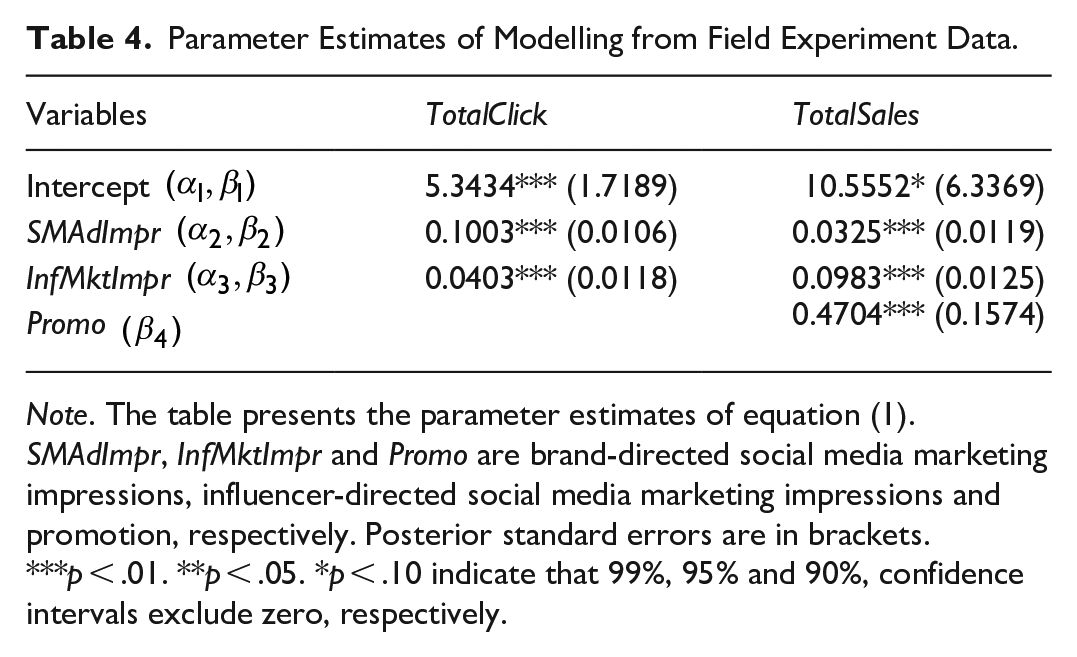
We present the parameter estimates of equation (2) in Table 4. The significance of the parameters is shown at 1%, 5% and 10% levels, that is, their 99%, 95% and 90% confidence intervals based on posterior standard errors do not contain zero, respectively.
Parameter Estimates of Modelling from Field Experiment Data.
Note. The table presents the parameter estimates of equation (1). SMAdImpr, InfMktImpr and Promo are brand-directed social media marketing impressions, influencer-directed social media marketing impressions and promotion, respectively. Posterior standard errors are in brackets.
p < .01. **p < .05. *p < .10 indicate that 99%, 95% and 90%, confidence intervals exclude zero, respectively.
The effects of impression from brand-directed social media marketing (0.1003, p < .01) and influencer-directed social media marketing (0.0403, p < .01) on total clicks are significant and positive. Thus, brand- and influencer-directed social media marketing help drive customer engagement. Furthermore, the effect of brand-directed social media marketing on customer engagement is higher than influencer-directed social media marketing. The difference, (α2 − α3) = 0.06, is significant at a 1% level. 10 Thus, brand-directed social media marketing is 1.5 times more effective in stimulating customer engagement.
The effect of impressions from brand-directed (0.0325, p < .01) and influencer-directed social media marketing (0.0983, p < .01) on total brand sales are significant and positive. Thus, brand- and influencer-directed social media marketing positively impact brand sales. Contrary to the effects on customer engagement, we find the effect of influencer-directed social media marketing on brand sales is higher than the effect of brand-directed social media marketing. The difference, (β3 − β2) = 0.0658, is significant at a 1% level. Thus, influencer-directed social media marketing is twice as effective as brand-directed social media marketing in driving brand sales.
Sales promotion (0.4704, p < .01) has a significant positive impact on brand sales. Furthermore, the correlation between the error terms of customer engagement and brand sales
Post hoc analyses
To gather further insight into the effectiveness of brand-directed and influencer-directed social media marketing, we perform additional analyses using data from the field experiment.
Spillover effect
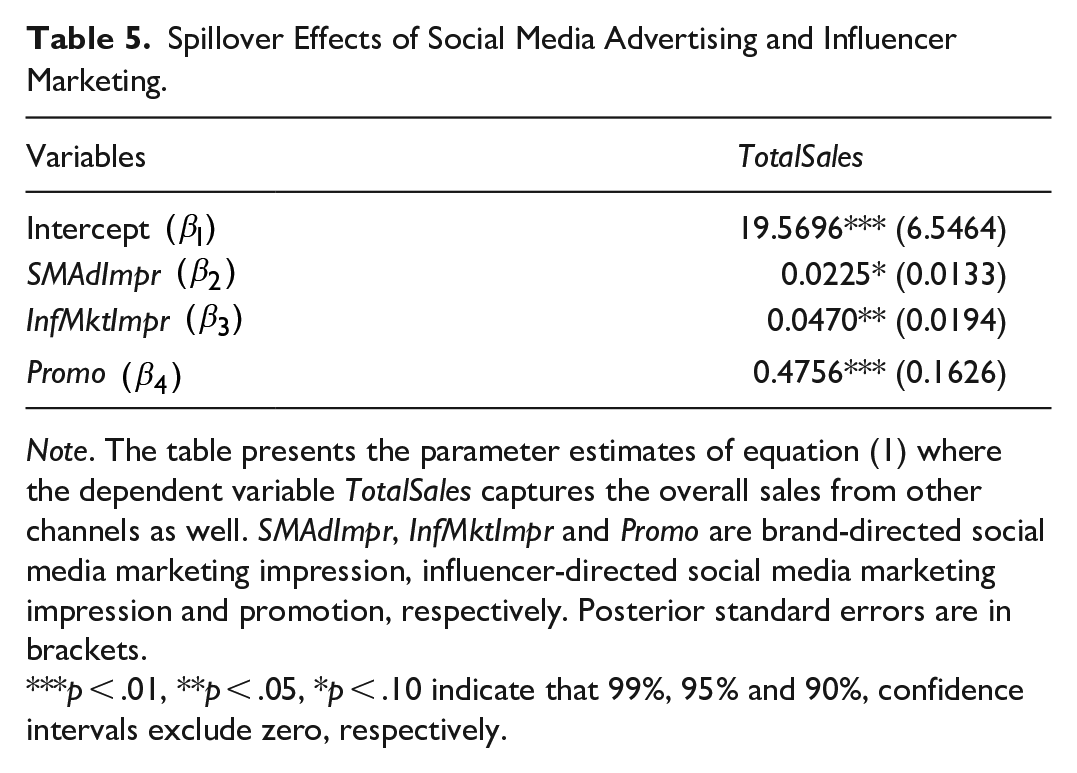
In equation (2), we replace TotalSales, with sales from other channels (offline and other retailers which were not part of the CTA). We note that total sales generated from the CTA link measure sales from just one online store. This additional analysis explores whether the effects of brand- and influencer-directed social media marketing help lift sales from other channels. We present the results in Table 5. Here, brand-directed social media marketing is more effective for customer engagement than influencer-directed social media marketing, and these effects are reversed for brand sales. These significant parameter estimates reveal that the effects of these marketing activities result in sales from other channels, even when not used as principal promotional campaigns.
Spillover Effects of Social Media Advertising and Influencer Marketing.
Note. The table presents the parameter estimates of equation (1) where the dependent variable TotalSales captures the overall sales from other channels as well. SMAdImpr, InfMktImpr and Promo are brand-directed social media marketing impression, influencer-directed social media marketing impression and promotion, respectively. Posterior standard errors are in brackets.
p < .01, **p < .05, *p < .10 indicate that 99%, 95% and 90%, confidence intervals exclude zero, respectively.
Advertising exposure versus advertising engagement
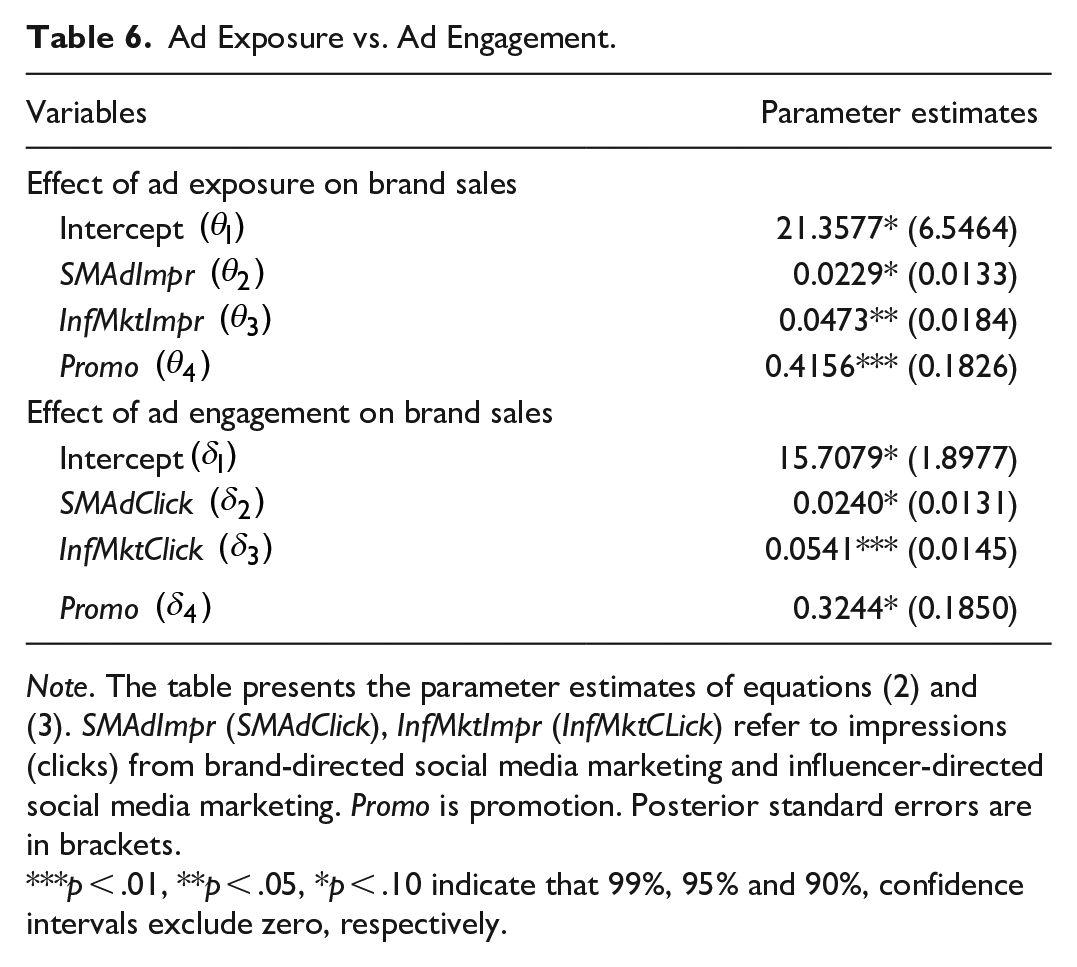
Typically, digital marketing effectiveness is measured via advertising engagement (as measured by clicks) and advertising exposure (as measured by impressions) (Liu-Thompkins, 2019). Given marketing managers’ focus on the impact of advertising on sales as it directly relates to return on investment (ROI), we conducted two further empirical analyses to assess the relative effectiveness of advertising exposure and engagement on sales. First, we modelled total overall sales from all channels,

where error term is distributed normal, that is, τtb ∼ N (0, σ2). θ2 and θ3 capture the exposure effects of the brand- and influencer-directed social media marketing on brand sales, respectively. Second, we model total sales,

where error term is distributed normal, that is, ωtb ∼ N (0, ν2). δ2 and δ3 capture the engagement effects of the brand- and influencer-directed social media marketing on brand sales, respectively.
Table 6 presents the results of parameter estimates of equations (3) and (4). With advertising exposure and advertising engagement, consistent with prior results, we find influencer-directed social media marketing is more effective than brand-directed social media marketing in stimulating sales. Furthermore, we find the effects of advertising engagement (clicks from the brand-directed social media marketing: 0.0240, p < .10; clicks from influencer-directed social media marketing: 0.0541, p < .01) are greater than the effects of advertising exposure (impressions from the brand-directed social media marketing: 0.0229, p < .10; impression from influencer-directed social media marketing: 0.0473, p < .05). This confirms findings from prior studies where online advertising leads to higher engagement (Teixeira et al., 2012). For brand-directed social media marketing, advertising engagement is 4.80% more effective than advertising exposure. For influencer-directed social media marketing, advertising engagement is 14.38% more effective than advertising exposure. The effect of promotion is as expected for both models.
Ad Exposure vs. Ad Engagement.
Note. The table presents the parameter estimates of equations (2) and (3). SMAdImpr (SMAdClick), InfMktImpr (InfMktCLick) refer to impressions (clicks) from brand-directed social media marketing and influencer-directed social media marketing. Promo is promotion. Posterior standard errors are in brackets.
p < .01, **p < .05, *p < .10 indicate that 99%, 95% and 90%, confidence intervals exclude zero, respectively.
Discussion
Social media offers brands various avenues for communication. Specifically, brands can call on brand-directed communication via social media marketing and brand-to-customer messaging. Furthermore, influencer marketing has become a common strategy to reach audiences on social media platforms in the customer space. While previous research has questioned the effectiveness of brand-directed social media marketing (e.g. Jacobson et al., 2020), we demonstrate that it is still important for a brand’s marketing strategy. As such, this research has a number of implications for both theory and marketing practice.
Theoretically, we extend existing studies that have examined social media marketing by adopting a more industry-reflective perspective. That is, predominantly, extant research in this space has analysed social media marketing strategy effectiveness across channels in isolation (e.g. Dolega et al., 2021; Li & Xie, 2020), without considering an integrated marketing communication approach. With this in mind, calling on both parasocial relationship and social identity theories, we provide further insight into this approach by examining both the synergistic and potential cannibalization effects when adopting a brand-directed and influencer-directed social media marketing strategy simultaneously. Therefore, we provide academicians a more developed understanding of social media marketing impacts on two key marketing communication objectives – customer engagement and sales. Specifically, according to parasocial relationship theory, customers/followers form bonds with influencers where an illusory relationship underpinned by perceived reciprocal exchange forms (Qin, 2020). Further, social identity theory stipulates that customers/followers see influencers as relatable, thus influencing their affective and behavioural responses (Farivar & Wang, 2022). We demonstrate that these psychological attachments with an external party (i.e. influencers) as inferred by parasocial relationship and social identity theories play an influential role in stimulating customer sales via influencer-directed social media marketing compared to brand-directed social media marketing. Yet, we show an opposing result whereby brand-directed social media marketing messages lead to positive customer engagement relative to influencer-directed social media marketing messages. This provides interesting insight as typically, customer engagement involves greater psychological attachment (Labrecque, 2014).
Finally, our findings also build on existing literature (e.g. Liadeli et al., 2023) by showing that advertising engagement is more effective than mere exposure in developing brand sales when using a combination of brand-directed and influencer-directed social media marketing.
Managerially, we advocate that managers should be conscious of the key marketing goals they set to achieve when adopting a social media marketing strategy. Drawn from our analyses, brand-directed social media marketing fosters more robust customer engagement, whereas influencer-directed social media marketing drives sales more strongly. Therefore, managers that want to increase brand engagement specifically should call on brand-directed social media marketing (i.e. paid social media advertisements). In contrast, influencer marketing might be more fruitful for managers wishing to improve sales. Simultaneously, brand managers should consider gender differences as we find influencer-directed social media marketing has a relatively higher impact on engaging female customers and influencing their purchase intention than brand-directed social media marketing.
Second, our post-hoc analysis found advertising engagement (via clicks) to be more conducive to brand sales than advertising exposure (via impressions) across both brand- and influencer-directed social media marketing. As a result, we suggest managers invest their time and financial resources in social media engagement activities over that of mere exposure. For example, managers could call on dialogic interaction, competitions, user-generated content or post topical content (Dessart, 2017; Labrecque, 2014; Tsimonis & Dimitriadis, 2014). More profoundly, our results reveal that advertising engagement is higher when employing influencer-directed social media marketing rather than brand-directed social media marketing. For managers, this means calling on influencer-directed social media marketing if they want to increase engagement (i.e. clicks) to influence brand sales. However, managers should also ensure they do not neglect communicating with audiences via brand-directed social media marketing. This is because, as shown in our findings, influencer-directed and brand-directed social media marketing work synergically (vs. cannibalistically) to increase engagement.
Finally, the spillover effect in our results indicates the benefits of adopting social media marketing, where marketing activities on the platform spillover to generate additional sales. The result shows managers that social media marketing can drive customer awareness and enable the brand to sit within the customer’s consideration. As such, managers can leverage brand- and influencer-directed social media marketing to achieve broader brand awareness and sales. For managers, this provides two interrelated courses of action. Specifically, managers can call on social media to increase brand awareness, potentially moving away from mass media communications, which have typically been associated with increasing brand awareness (Sharp & Romaniuk, 2016). As such, managers may want to allocate a larger portion of their marketing budgets to social media if it can achieve residual reach, as shown in our study.
Conclusion and limitations
We conduct multiple studies to empirically explore the relative effectiveness of brand- and influencer-directed social media marketing on customer engagement and brand sales. Our results reveal that the effect of brand-directed social media marketing on customer engagement is higher than influencer-directed social media marketing, and these are reversed for brand sales (i.e. influencer-directed social media marketing has a relatively higher impact on brand sales). Furthermore, we also find that the effects of influencer-directed social media marketing and brand-directed social media marketing generate sales from other channels where advertising campaigns are not launched. We also find support for a higher effect of advertising engagement on sales than advertising exposure.
There are a few limitations to this study, which could provide a fruitful avenue for future studies. First, our research context explored nondurable, fast-moving consumer goods. Exploring the effect of brand-directed versus influencer-directed social media marketing on durable products or those that typically hold higher involvement could provide more insight into which avenue is more effective. Alternatively, conducting a comparative study might show the key differences across product ranges. Second, Study 1 only captured purchase intent, given the nature of the survey study design. While the experimental study incorporated actual behaviour, having both studies capture actual behaviour would have enabled greater accuracy of results. Future research could incorporate multiple studies that capture actual behavioural intents. Thirdly, both studies were conducted over a short timeframe. Whilst this is reflective of a typical social media marketing communication campaign, introducing a longitudinal study to test dynamic changes across multiple campaigns would provide a significant understanding of consumer behaviour over time. Finally, the field experiment setting used information from one social media platform. Measuring customer engagement and sales from brand- versus influencer-directed social media marketing across multiple platforms would enrich the accuracy of results relative to industry practice.
Supplemental Material
sj-docx-1-anz-10.1177_14413582241247391 – Supplemental material for Battle of Influence: Analysing the Impact of Brand-Directed and Influencer-Directed Social Media Marketing on Customer Engagement and Purchase Behaviour
Supplemental material, sj-docx-1-anz-10.1177_14413582241247391 for Battle of Influence: Analysing the Impact of Brand-Directed and Influencer-Directed Social Media Marketing on Customer Engagement and Purchase Behaviour by Ashish Kumar, Daniel Rayne, Jari Salo and Ching Sophia Yiu in Australasian Marketing Journal
Footnotes
Acknowledgements
The authors would like to thank Merkantics/QnA, Sakea and Soul Maté for providing data, insights and comments for this study.
Declaration of conflicting interests
The author(s) declared no potential conflicts of interest with respect to the research, authorship, and/or publication of this article.
Funding
The author(s) received no financial support for the research, authorship, and/or publication of this article.

Supplemental material
Supplemental material for this article is available online.
Notes
References
Supplementary Material
Please find the following supplemental material available below.
For Open Access articles published under a Creative Commons License, all supplemental material carries the same license as the article it is associated with.
For non-Open Access articles published, all supplemental material carries a non-exclusive license, and permission requests for re-use of supplemental material or any part of supplemental material shall be sent directly to the copyright owner as specified in the copyright notice associated with the article.
