




Abstract
Australian higher education is unequal, with regional and remote students under-represented and less likely to succeed at university despite decades of policy initiatives. Regional and remote communities are diverse, requiring tailored marketing communications to improve their university participation and experience. There is often a considerable gap between pre-commencement expectations and perceived experiences of first-year, first-time (FYFT) students. The purpose of this research is to better understand how the pre-commencement expectations of FYFT regional university students are influenced by Fuzzy Trace Theory’s (FTT) gist mental representations and the influence this has on their satisfaction. This study qualitatively explores a theoretical framework linking FTT with expectations, cognitive dissonance, action/inaction responses and satisfaction. The five identified insights were pre-commencement expectations for (1) micro-cohort connections, (2) macro-cohort connections and (3) recreational connections that, when not met, led to FYFT regional university students’ (4) responding with action or inaction, or both; with (5) action responses leading to increased satisfaction and inaction responses leading to decreased satisfaction. This research is novel, exploring and establishing the influence of FTT gist representations on FYFT regional university students’ pre-commencement expectation development to help address educational inequality. These findings confirm the powerful influence university marketing communications have on underrepresented groups.
Introduction
The transition from high school to university can be a daunting experience for many students, especially as they attempt to reconcile their preconceived expectations with the realities of higher education. The COVID-19 pandemic exacerbated the situation, disrupting learners globally. Research conducted by the United Nations (2020) reported that over 94% of the student population was directly impacted by the pandemic, worsening pre-existing education disparities, particularly for regional and remote students and those from identified equity groups. Universities worldwide were forced to quickly pivot to online learning and make sweeping changes to their delivery models (Pangarso & Setyorini, 2023; Parida et al., 2023; Yang et al., 2023) and university marketing communications struggled to keep up with these changes, intensifying the mismatch between student expectations and experiences which became widely observed across the sector (Dangaiso et al., 2023; Rajeh et al., 2021). Even when students could access educational opportunities, living conditions, economic stress, low digital literacy and unstable learning environments for regional and remote students created a failure to support students from these underrepresented groups (Dangaiso et al., 2023; Rajeh et al., 2021). This is particularly troubling for students from equity groups who are typically the first in their families to go to university, relying heavily on university marketing communications to shape their expectations (Napthine et al., 2019).
In Australia, education is unequal, with students from regional and remote areas identified as an equity group. These students face unique and complex challenges, are underrepresented and less likely to stay and succeed at university, often lured back to the workforce by a combination of financial and family pressures (Australian Government, 2023; Napthine et al., 2019). To address this inequity and better prepare students for their studies, it is essential to understand how they interpret information about university life before they commence. This will enable universities to create marketing communication strategies that are more inclusive and better aligned with the needs of underrepresented populations. Achieving diversity, equity and inclusion (DEI) is linked to university marketing functions and efforts to support equity groups and create fairness in opportunity and outcome for these students as they embark on their studies (Australian Government, 2023; Park et al., 2022).
This research examines the role of Fuzzy Trace Theory (FTT) in how students utilise mental gist representations to grasp the fundamental aspects of information, ultimately shaping their expectations of the university experience (Reyna, 2021). FTT states that mental representations are processed on a continuum from verbatim to gist, with verbatim representations based on fact and literal interpretations of information, while gist representations are encoded and recalled based on situations and contexts (Reyna et al., 2015). A mismatch between expectations and experience results in cognitive dissonance (Festinger, 1957) that influences satisfaction (Oliver, 1980).
This article seeks to clarify the role of FTT gist representations in expectations-experience mismatches experienced by first-year, first-time (FYFT) regional university students. Qualitative data obtained via semi-structured interviews were analysed to assess the following propositions: (1) FYFT regional and remote university students use gist-based representations to form their pre-commencement expectations of the university experience, which will result in either a match or mismatch with their perceived experience upon commencement; (2) FYFT regional and remote university students whose gist-based pre-commencement expectations are incongruent with their perceived experience upon commencement will respond with either action or inaction to harmonise the mismatch and (3) FYFT regional and remote university students’ dissonance responses influence their satisfaction with action responses leading to increased satisfaction and inaction responses leading to decreased satisfaction. This article first presents the theory and theoretical framework before describing the methodology used to explore this phenomenon and the resulting empirical framework. The implications are detailed, limitations acknowledged and areas of future research are suggested.
Literature review
Higher education inequality in Australia
Successive Federal Governments have been committed to making Australia’s higher education sector diverse, equitable and inclusive (Australian Government, 2023; Napthine et al., 2019). Indeed, the Australian Government has funded universities since 2003 via the Higher Education Participation and Partnerships Programme (HEPPP) to design and implement strategies to improve access, participation and success for people from low socio-economic status backgrounds, Aboriginal and Torres Strait Islander peoples and those from regional and remote areas (Department of Education, 2023). HEPPP funding supports four types of pre-commencement activities and programmes, including the provision of information directly to equity groups to improve their chances of accessing and succeeding in university study (Robinson et al., 2021)
The decision to attend university is a complex and protracted process, especially for students from equity groups who are often the first in their families to attend university (Raciti, 2019). Addressing educational inequality has been an Australian government priority for decades, with students from regional and remote areas an identified equity group. Students from regional and remote settings face many challenges, including high financial costs associated with relocation and transportation, homesickness and a lack of support and role models, all of which create a distinctly different transition to university experience (Australian Government, 2023; Napthine et al., 2019).
Before the pandemic, the perceived university experience of many FYFT regional and remote students did not always align with what they expected (Zacharias et al., 2018). The expectations-experience mismatch post-pandemic is even more pronounced due mostly to widespread changes to teaching delivery models. Universities were forced to rapidly transform instructional methods, shifting en masse to online teaching and learning, leaving institutions with little opportunity to think through and craft their approach to digital delivery and the resulting fundamental changes to their student experience and associated marketing communications (Parida et al., 2023; Sutton & Jorge, 2020). The marketing literature has long established that expectation-experience mismatches can lead to dissatisfaction (e.g. Oliver, 1980, 1997). This research sought to explore this post-pandemic expectation-experience mismatch for FYFT regional and remote students to determine new, emergent sources of dissonance. Identifying emergent sources of dissonance will help develop university marketing communications that support and actively foster DEI.
Fuzzy trace theory (FTT) and gist mental representations
FTT is an interdisciplinary theory of cognition that centres around memory, reasoning, judgement and decision-making (Reyna & Brainerd, 1995). When exposed to information such as university marketing communications, FTT holds that people will relegate that information to memory, making mental representations that are on a continuum from exact, verbatim recollections to fuzzy, gist representations (Reyna, 2021). Gist mental representations capture the essence of information as opposed to verbatim mental representations that capture exact details (Reyna, 2021). Both gist and verbatim representations shape decision-making by forming the basis upon which an individual encodes, stores and retrieves information (Nolte et al., 2022). While exact, verbatim representations are recalled with precise, factual and literal interpretations, gist representations are recalled with fuzzy, situational meanings and intuition, hence colloquial phrases like ‘to get the gist’ or ‘the gist of it’ (Reyna et al., 2015). Verbatim and gist mental representations are stored separately in memory (Garavito et al., 2018). Thus, gist representations are encoded with context rather than literal truths (Reyna, 2021).
FTT is based on psycholinguistics, with research into gist representations continuing to evolve (Prigerson et al., 2023). Mental representations of information are the basis of decisions. Gist representations capture the essence of information (Reyna, 2021). When making a decision, most people prefer to do so with the simplest yet most meaningful gist representations because it enables them to differentiate options and create gist-based preferences quickly (Garavito et al., 2018).
People tend to rely more on gist memory than verbatim memory when making decisions, particularly when the information is complex or emotionally charged (Garavito et al., 2018; Reyna et al., 2021). Gist memory is also thought to be more resistant to interference and forgetting than verbatim memory (Reyna & Brainerd, 1995). Gist is encoded with emotions, aligned with an individual’s core values and connected cognition and personality, as well as larger social and cultural influences (Garavito et al., 2018; Reyna et al., 2021).
There is a growing body of evidence of the influence of gist representations on decision-making, with researchers seeking to explore the role of gist in different contexts and among different groups (e.g. Nolte et al., 2022). Little is known about how diverse populations use gist representations in unequal and complex service contexts and how this might differ between countries (Prigerson et al., 2023). Exploring how diverse FYFT regional students use gist representations to process information about Australia’s unequal university system and then navigate the consequences of any expectation-experience mismatch will be highly valuable to improving DEI strategies. Furthermore, the influence of gist representation on cognitive dissonance has only been explored in relation to social media (e.g. Domenico et al., 2021). Hence, exploring gist-based dissonance in higher education will make an important contribution to the literature.
To the best of the authors’ knowledge, this paper is the first to introduce FTT and gist representations to educational equity research and to assess the impact of university marketing communications on expectation development and subsequent expectation-experience matches or mismatches. In applying FTT gist representation to the emotional and complex interactions between the FYFT regional and remote university students and institutions will improve understanding of key expectation-experience match and mismatch touchpoints of the decision-making process.
Cognitive dissonance theory
Expectation-experience mismatches result in dissonance (Oliver, 1997). Cognitive dissonance theory (CDT) or ‘dissonance theory’ is well established in the marketing literature, with its origins traced to the seminal work of psychologist Festinger (1957). CDT posits that humans desire cognitive consistency (Festinger, 1957). An expectations-experience mismatch creates inconsistency as there are multiple competing cognitions resulting in psychological discomfort, which the human is then driven to resolve or harmonise by seeking to change one or more of these cognitions (Harmon-Jones, 2019). Mismatched cognitions may result from a person’s perceptions, behaviour, feelings, opinions and environmental elements that create two sets of information that do not psychologically fit together (Harmon-Jones, 2019).
Since Festinger (1957) introduced CDT, it has remained popular in contemporary marketing research. For example, Chatterjee et al. (2023) examined the role of cognitive dissonance in consumers’ processing of online fake reviews. When people experience cognitive dissonance, they respond in different ways to try to correct the situation, such as taking follow-up action (Chatterjee et al., 2023). Research into university student action or inaction responses to dissonance is limited, with Maloshonok and Terentev (2017) examining how dissonance impacts academic outcomes and Jones (2017) examining dissonance and pedagogy.
Cognitive dissonance influences consumer decision-making and satisfaction (Oliver, 1997). In services marketing, it is well established that expectations are developed pre-purchase and are compared to perceptions of the actual experience during and after the service encounter (Sweeney et al., 2000). Mao and Oppewal (2010) examined how post-purchase information affects cognitive dissonance in Australian higher education. This research extends their work by examining how pre-purchase information influences cognitive dissonance, specifically how gist representations create pre-commencement expectations. Exploring gist-informed, pre-commencement expectations and their match or mismatch with perceived experiences and how FYFT regional university students respond will provide valuable insights to improve the effectiveness of DEI supports and strategies for underrepresented students navigating Australia’s unequal higher education sector.
Theoretical framework and proposition development
A theoretical framework was developed from a synthesis of the literature. Upon commencement, expectations are compared with experiences to ascertain if there is congruence (match) or incongruence (mismatch) (Proposition 1). Expectation-experience incongruence (mismatch) results in dissonance, prompting either action where attempts are made to harmonise the mismatch or inaction where no attempt is made to harmonise the mismatch (Proposition 2). An action dissonance response leads to increased satisfaction, while an inaction dissonance response leads to decreased satisfaction (Proposition 3). The propositions presented in the theoretical framework (Figure 1) are discussed next.
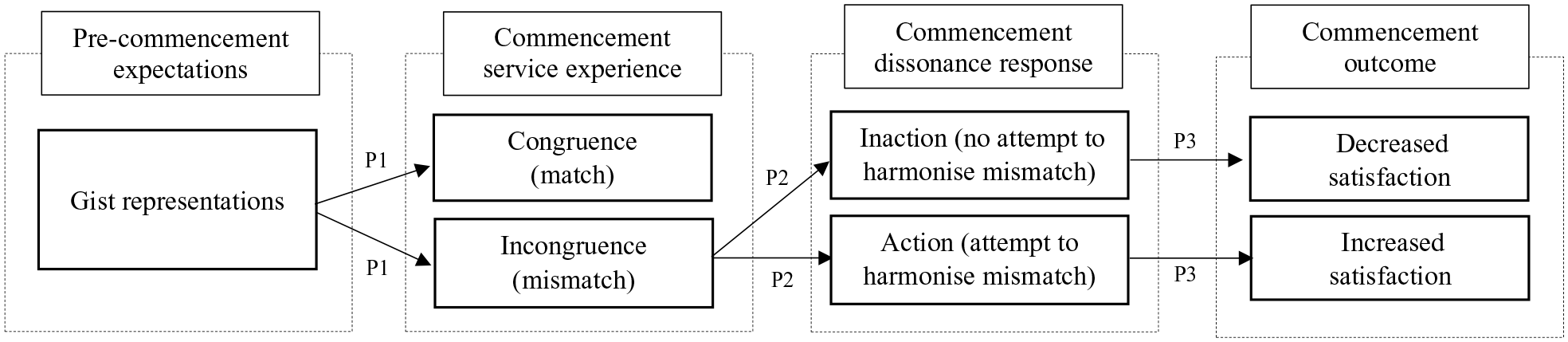
Theoretical framework.
In the context of this study, FYFT regional and remote university students are exposed to a wide range of information over a long period of time as the decision to go to university is complex and highly involved (Raciti, 2019). As the quantum of information over a long period of time is exorbitant and complex, and the decision to go to university involves emotions, gist mental representations are more likely to be formed and recalled rather than exact verbatim mental representations (Picton & Kahu, 2021; Reyna, 2021). FYFT regional and remote university students typically are more reliant on university marketing information about going to university due to the absence of role models in their family or community (Zacharias et al., 2018). Upon commencement of the university service experience, FYFT regional and remote university students make comparisons with their expectations, resulting in either expectation-experience congruence (match) or expectation-experience incongruence (mismatch; Festinger, 1957; Oliver, 1997). Thus, it is proposed that:
In instances where FYFT regional and remote university students’ gist-based pre-commencement expectations are congruent (match) with their commencement experience, no dissonance is experienced (Festinger, 1957). In the case of a mismatch, where gist-based pre-commencement expectations are incongruent with their commencement experience, dissonance is experienced (Festinger, 1957). While some will respond to dissonance by taking some action in an attempt to harmonise the mismatch by trying to change one or more of the opposing cognitions, others will not (Cancino-Montecinos et al., 2020). Emerging research suggests that the choice to respond with action or inaction may be associated with the magnitude of the mismatch (Cooper, 2019). Thus, the following proposition is posited.
Like all services, universities seek student satisfaction, especially among students from identified equity groups, due to the Australian government’s equity agenda (Australian Government, 2023). Satisfied students are more likely to stay and succeed (Zacharias et al., 2018). Satisfaction is a well-established outcome measure of service experiences (Oliver, 1997). Satisfaction is linked to expectations and dissonance and involves cognitive and emotional evaluations of an individual’s personal experience (Mao & Oppewal, 2010). Attempts to harmonise dissonance are linked to outcomes such as relief, serenity and satisfaction (Cancino-Montecinos et al., 2020). Hence, the following proposition is offered.
Methodology
Interviewing
FTT and CDT research typically employ quantitative and experimental design, leading Cancino-Montecinos et al. (2020) to call for more qualitative studies to enrich understanding and balance out the methodological shortcomings of such approaches. Hence, for this research, a qualitative methodology was used to explore the three propositions in the theoretical framework (Figure 1). As recommended by Yin (1989), the research propositions framed the interview questions to ensure the relationships of interest were explored. Semi-structured interviews were used to explore the three research propositions and, via an iterative approach, identify emergent themes or insights. Hence, a convergent-type approach was subscribed to where there were ad hoc pauses in the collection of interview data to review field notes about patterns in the data, discuss this among the research team and identify insights so that the next bank of interviews was informed by the previous. Interview questions established student expectations without bias, allowing participants to share their lived experiences before probing to understand if there was an expectations-experience match or mismatch and their response to this match/mismatch (see Supplemental Appendix). Theoretical saturation marks the end of data collection when no new issues are identified by participants and disagreements in the data are resolved (Yin, 1989). Interviews were conducted in iterative cycles, analysing data continuously, enabling the researchers to observe the results and identify when interviews were no longer yielding significantly different insights, indicating that saturation had been reached (see Supplemental Appendix). Guided by an interview protocol with a clearly defined and narrow scope, 20 in-depth interviews were able to yield insights to a point where no new information emerged.
Sample
The target population was FYFT regional and remote Australian university students over 18 years of age at the commencement of a semester. FYFT students have no previous higher education experience to draw from. Furthermore, regional and remote students come from areas with markedly lower levels of participation and success at university, meaning they are more likely to be the first in their families to attend university (Napthine et al., 2019). As such, FYFT regional and remote Australian university students typically rely on information such as university marketing communications as the basis for their gist representations.
A convenience sample of the target population was approached at a regional university, with 20 interviews conducted. This approach enabled the exploration of the three propositions and constructs in the theoretical framework to reveal insights that can be examined further in future research. Participants were approached via random intercepts on campus or by phone at the commencement of the second semester (July–November) between Orientation Week and Week 2 classes. The sample comprised FYFT regional and remote students about to start their first semester of study (n = 1) and those embarking on their second semester of study (n = 19). The final sample included 12 females, 6 males and 2 nonbinary students, with ages ranging from 18 to 34 years of age and with an average age of 19.35 years. Participants were studying both full-time and part-time across a range of courses. Interviews were approximately 20 to 30 minutes in duration and conducted face-to-face or by phone as per the student’s preference.
Analysis and interpretation
Analysis and interpretation followed a convergent-type approach. On an ad hoc basis, field notes and/or audio recordings of a bank of interviews were reviewed prior to commencing the next bank of interviews. This iterative process allowed continuous reflection on the propositions and refinement of the interview guide probes. Audio recordings were transcribed verbatim by a commercial transcription company at the conclusion of the interview and triangulated to field notes and reviews of the audio recordings to draw out findings, including emergent insights. Manual thematic analysis followed the process recommended by Braun and Clarke (2012). The iterative data analysis and interpretation of the first author were reviewed by the second author, with discussions resulting in a consensus.
Findings
To understand the gist representations participants had gleaned from university marketing communications, they were asked several questions about what sources they had used and how it had informed their decision-making process, as well as some of the key expectations they had developed as a result. They were then asked how this compared with the commencement experience and their feelings, behaviour and attitude responses to any cognitive dissonance between expectation and experience. The data validated all three propositions. The data revealed five insights. Three insights were associated with Proposition 1, one insight was associated with Proposition 2 and one insight was associated with Proposition 3.
In terms of Proposition 1, based on pre-commencement gist representations, FYFT regional and remote students:
■ Expect to experience micro-cohort connections with like-minded peers and academics in synchronous small group classes.
■ Expect to experience macro-cohort connections with like-minded peers and academics in synchronous large group ‘grand lectures’.
■ Expect they will experience recreational connections comprising a vibrant social life with lots of new university friends.
In terms of Proposition 2, based on pre-commencement gist representations, FYFT regional and remote students’ dissonance responses include action and inaction or both. Regarding Proposition 3, based on pre-commencement gist representations, FYFT regional and remote students, an action dissonance response may result in an increase in satisfaction and an inaction dissonance response may result in a decrease in satisfaction.
Each of the five insights is discussed next.
Insight 1: Gist-based expectation of micro-cohort connections (Proposition 1)
Every participant (n = 20) mentioned an expectation of micro-cohort connections that was informed by pre-commencement gist representations from university marketing communications. Participant #3 expressed a desire for connection in post-pandemic times:
‘I’ve been very isolated. . .So, the chance of actually interacting with other students. . .swapping stories, just interacting with other people, learning new things, I think that’s it, the people. . .the human experience.’
High student engagement is linked to student satisfaction and academic achievement, with regional universities demonstrating higher levels of student engagement than their metropolitan counterparts (Picton & Kahu, 2021). The findings revealed a consistent theme around expecting connection on the micro-group level with an overarching desire for synchronous human-to-human connection.
Insight 2: Gist-based expectation of macro-cohort connections (Proposition 1)
Half of the participants (n = 10) mentioned their expectation of the ‘grand lecture’ experience, being a desire for macro-cohort connections with like-minded peers and academics in a synchronous large group, face-to-face learning experience. Many participants felt they were missing out on an important hallmark university tradition, blaming the pandemic for the demise of the synchronous ‘grand lecture’ and the rise of the new, less satisfying, post-pandemic asynchronous virtual delivery format of lecture material that is typically viewed in isolation (Parida et al., 2023). Generating gist representations largely from word of mouth from past and current students, participant #19 described the ‘grand lecture’ mass, synchronous learning experience as a rite of passage and as a keystone of their expectations:
The main thing that people talked about when they spoke about uni was the big lecture halls and sitting in them, but I’ve actually never experienced that though.
Indeed, participants demonstrated negative sentiments at the thought of missing out on the ‘grand lecture’ experience, describing their absence as ‘stripping away the university culture’ (participant #1). The disappointment was palpable, as reflected by participant #3, who shared:
So, the in-person lectures are something I had hoped for, and then I enrolled here, and all the lectures are online. Imagine my disappointment. I wish there was still the option to go to a lecture hall and just sit in whilst it’s being recorded.
Insight 3: Gist-based expectation of recreational connections (Proposition 1)
When asked about the pre-commencement gist representations, almost all participants (n = 19) mentioned an expectation of a vibrant social life with lots of new university friends. Some participants indicated that these gist representations came from sources beyond university marketing communications. Participant #2 shared how American college movies shaped their expectations of the social scene that could be expected at university. While others referred to university advertising, they had seen that had shaped their gist representations, noting the disparity between the university advertising and their experiences in the initial stages of their study. For example, participant #4 stated:
I mean, you see a lot of the University X ads and stuff, and everyone’s just laughing, having coffee, sitting around studying. All the ads that University X put up create this front, and you think it’s going to be exactly like those pictures. There’s definitely a lot less people sitting around drinking coffee and laughing. [Laughs].
Recreational connections were a gist-informed expectation. However, there were variations as to what an active social life looked like. Participant #6, for example, described a social life in its most basic form – making friends. Participant #6 described the fundamental challenges they faced trying to harmonise the dissonance they were experiencing as a result of the expectation-experience mismatch. When asked what they expected from university, Participant #6 responded:
Some friends. [Laughs] No, I’m kidding. I’m not kidding. I hope that I will become better friends with people and actually put myself out there and try to talk to people because, at the moment, I’m kind of just standing around [alone].
Insight 4: Dissonance responses include either action and inaction or both (Proposition 2)
When asked about mismatches between their pre-commencement expectations and their commencement experience, all participants (n = 20) described dissonance resulting from unmet expectations. As two participants shared:
I think that my idea of university before coming to university was really romanticised. I think it was a lot more fun and, like, a lot more just doing things as a young adult; less. . . study and annoying assignments, which is more my experience of it. But yeah, as I said, I’m thinking about changing my degree. (Participant #20)
So instead of being something – like I wake up and I really want to learn it – it becomes something that I have to do to get this job, and then [I] just lose all my motivation. (Participant #1)
Participants’ responses to dissonance included action (n = 18) – where they made attempts to harmonise the expectation-experience mismatch – and/or inaction (n = 13), in which they made no attempt to harmonise the expectation-experience mismatch. CDT posits that the magnitude of an expectations-experience mismatch will influence the decision of if and how to harmonise the situation (Cooper, 2019). It was found that participants experienced multiple mismatches of various magnitudes, and hence, both action and inaction were reported as participants identified those cognitions that they could change and how they might go about making those changes. Where dissonance was mild, participants expressed a sense of acceptance of the circumstances, resulting in inaction. However, when challenged with an experience significantly misaligned with expectations, participants surmised that they would take action to mitigate the mismatch:
I’ll know that, ultimately, it is up to me to change that. . . .that will mainly be my own fault, I believe, because the resources at the uni can help you set your own expectations. (Participant #18)
I think at first, I was really disappointed, but now I think I’m just trying to re-frame it in my head, what the experience is and will be. (Participant #20)
Insight 5: An action dissonance response may result in an increase in satisfaction, whereas an inaction dissonance response may result in a decrease in satisfaction (Proposition 3)
The data confirmed that those participants who were action-oriented (n = 18) in their dissonance response to a mismatch of high magnitude showed signs of increased confidence and satisfaction. All 18 participants indicated they would take steps to improve their situation, even if in small ways. For example,
Well, because I’m a mature-age student. . .if I have challenges or I’m not getting what I want out of it, I go straight to the unit coordinator [laughs]. I wouldn’t let it get to the point that it wasn’t to my expectation. (Participant #13)
Conversely, participants who expressed an inaction dissonance response indicated that if their expectations were not met, they would feel a sense of disappointment and decreased satisfaction (n = 11). The general life outlook of these participants and how this interacts with disappointment was exemplified by Participant #6, who shared:
I’m not that optimistic. . .so if there are [expectations] not met, I won’t be that surprised, but I guess I’ll be disappointed if I don’t make good friends and stuff.
The data also indicated that there may be a small number of inaction-oriented participants who do not attempt to harmonise their dissonance and for whom the outcome of this inaction is indifference. Two participants indicated their inaction response to low-magnitude dissonance would neither increase nor decrease their satisfaction. Participant #2 response reflected the importance of adaptability and hopefulness but being indifferent in that they did not express any likely feelings of dissonance-related disappointment.
I’m pretty good at rolling with the punches. I’ll just try my best and hope that it all works out. I mean, you’ve got to be a little bit adaptable, I guess. I just really hope that I can build a sense of community while I’m here. That’s something really important to me, I think. (Participant #2)
Participant #15 shared how they had low expectations, and it appears that this operates as a mitigating factor to avoid dissonance.
I don’t feel like I had a lot of expectations that could possibly negatively impact the experience here, but, no, I don’t think it would affect me a lot if it wasn’t what I thought it was going to be.
The literature indicates that there are two types of indifferent consumers – (a) those who do not care and, therefore, ignore the issue and (b) those who do care but who choose to strategically ignore the conflicting information that is the basis of potential dissonance (Onwezen & van der Weele, 2016). Strategic ignorance is a coping mechanism where people wilfully ignore conflicting information to avoid the psychological discomfort of dissonance. That is, they choose not to know, and this not knowing may assist them in selecting information that reduces uncertainty and creates cognitive comfort (Onwezen & van der Weele, 2016). The findings suggest that Participants #2 and #15 had cultivated coping approaches akin to strategic ignorance.
Empirical framework
An empirical framework that integrates the five insights is presented in Figure 2. The empirical framework includes the three propositions, with the bolded arrows and shaded boxes and text signalling the five insights.
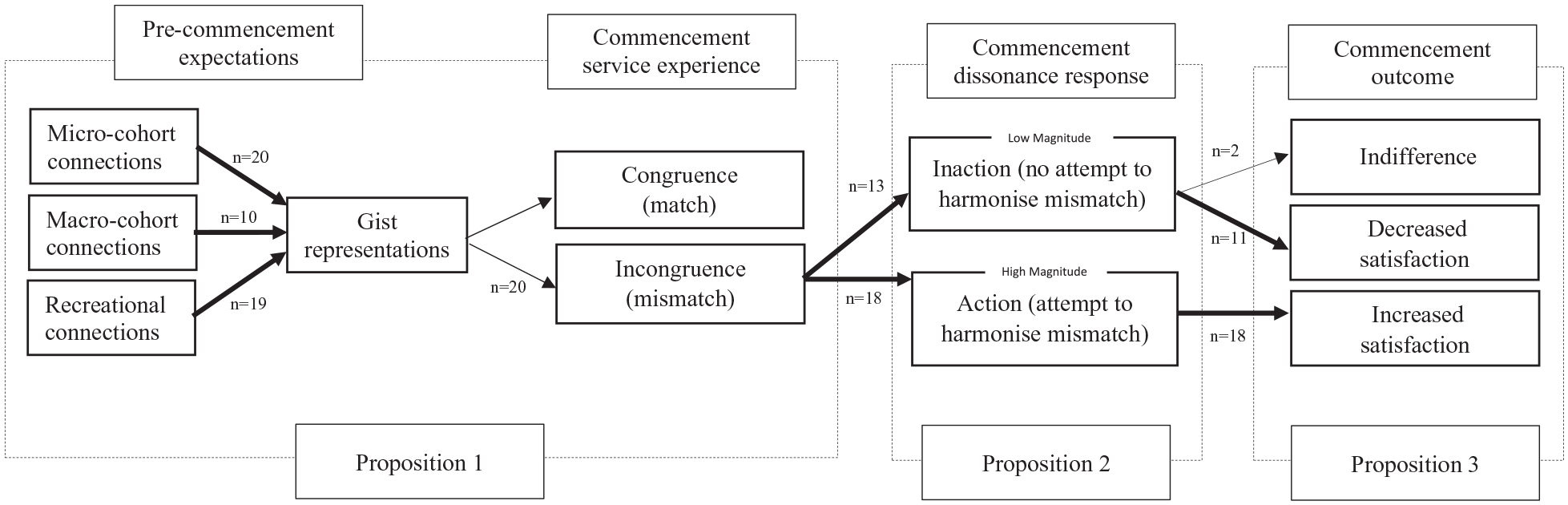
Empirical framework.
The changes to the framework include the addition of three types of connections that were identified by participants as the primary source of gist-based expectation-experience dissonance (Insight 1–3), being micro-cohort connections, macro-cohort connections and recreational connections. Next, the bolded arrows and shaded text from the incongruence box and the associated shaded text above the action and inaction dissonance response boxes reflect Insight 4. Specifically, participants engaged in both action and inaction when experiencing dissonance related to multiple mismatches, with those mismatches of a high magnitude likely to result in harmonisation action while those of low magnitude likely to lead to harmonisation inaction. Lastly, Insight 5 is signalled by the addition of the ‘indifference’ box showing that inaction may lead to indifference, with bolded arrows to the decreased satisfaction and increased satisfaction boxes showing that for most participants dis/satisfaction outcomes occurred as suggested by the literature.
Overall, the empirical framework highlights the power of pre-commencement gist representations formed mostly from university marketing communications on the formation of expectations among FYFT regional and remote students. What is evident is the need for regional universities to update their marketing communications to reflect post-pandemic university life for those from equity groups, as this will better support the alignment of pre-commencement expectations with commencement experiences to achieve DEI outcomes.
Discussion
This article advances current understandings of FTT gist representations, cognitive dissonance, dissonance responses and satisfaction pertaining to underrepresented equity groups in Australian higher education. Equity in Australian higher education has been a policy agenda for successive governments for decades, with regional and remote university students identified as an equity group (Department of Education, 2023; Robinson et al., 2021). First-year students are most susceptible to university dropout, as are those who are the first in their families to attend university (Zacharias et al., 2018). Combined, FYFT regional and remote students experience intersecting disadvantages. To achieve their DEI goals, universities implement a range of strategies to not only increase access to university study but to support participation and success. Universities’ DEI goals are to achieve social justice outcomes as a university degree enables social and economic mobility, the effects of which are intergenerational (Napthine et al., 2019). Much of the research to date on FYFT regional and remote students has centred on the effectiveness of university pre-commencement outreach programmes. This research is novel as it extends this line of enquiry to explore the impact of gist representations formed pre-commencement that are shaped by communications emanating from universities.
Overall, the empirical framework demonstrates how gist-based pre-commencement expectations mismatch with perceived experience, creating dissonance, prompting FYFT regional university students to respond with action/inaction, leading to dis/satisfaction outcomes. Most notably, the empirical framework highlights the mismatch between pre-commencement expectations and the perceived experience of all FYFT students sampled in this research, with most experiencing high-magnitude mismatches and choosing to take action to harmonise their dissonance and achieve a satisfactory outcome. The key takeaway for regional universities is that there is an apparent need to review the fidelity of their marketing communications and to better support and empower commencing FYFT students to take action as they wrangle with dissonance. The findings of this research confirm that university marketing communications generate gist representations, highlighting the importance of authentic marketing messaging to support DEI, particularly in post-pandemic times, as changing delivery models and service scripts increase the likelihood of a mismatch between gist-based expectations and the lived experience. Indeed, the rhetoric and realities of the widespread introduction and reliance on online learning materials have adversely affected student engagement post-pandemic (Parida et al., 2023). University marketing communications play a critical role in setting equity students up for success by reducing or minimising mismatched expectations and experiences (Parida et al., 2023). Indeed, our research reveals that marketing communications are the linchpin to the achievement of the greater goal of a diverse, equitable and inclusive university sector. Going to and succeeding at university leads to a range of positive outcomes for regional and remote communities and enables the creation of a more just society where the doors of opportunity are open to all and no one is left behind (Napthine et al., 2019).
Implications
Theoretical implications
The influence of gist representations on cognitive dissonance is a nascent area of research mostly explored in relation to fake news distributed via social media (e.g. Domenico et al., 2021). Hence, this research contributes to the theory by establishing the relationship between FTT gist representations and dissonance theory in an unequal educational service context, as well as the consequences of the relationship for an equity group who are the focus of ongoing DEI efforts.
The findings of this research provided a deeper understanding not only of the presence of gist representations for this underrepresented group but also of how influential these are in shaping pre-commencement expectations. Importantly, this research identified the three key mismatches that occur – micro-cohort connections, macro-cohort connections and recreational connections. While connection broadly has been discussed in the associated widening participation literature (e.g. Zacharias et al., 2018), this research specifically pinpoints where the connection discrepancies lay. This research adds to the work of Maloshonok and Terentev (2017) who examined how dissonance impacts academic outcomes, and Jones (2017) who identified gaps in relation to pedagogy.
This research also contributes to the literature by demonstrating the presence of dissonance and types of dissonance responses for this equity group. Much of the literature on dissonance resolution approaches is located in the psychology literature and employs experimental design. Cancino-Montecinos et al. (2020) consolidated the literature on dissonance resolution and called out the methodological shortcomings of experimental designs, encouraging qualitative studies, such as ours, to enrich CDT. Furthermore, our research adds to Cancino-Montecinos et al. (2020) general model of dissonance reduction, but organising strategies used to harmonise mismatches as active or inactive meta-categories and finding that people engage in both inactive and active responses. Our research also identified the role of magnitude in determining if an active or inactive response was to be pursued and established the relationship with satisfaction. As such, our research extends Cancino-Montecinos et al.’s (2020) model and confirms that magnitude determines a person’s motivation to harmonise (Cooper, 2019).
The findings confirmed satisfaction was an outcome of dissonance reduction efforts to harmonise mismatches. Satisfaction outcomes are well established in the marketing literature and our findings align with the work of Oliver (1997) but also expand this work by demonstrating the mediating role of dissonance reduction behaviours. Relatedly, the identification of indifference as an outcome contributes to CDT. The literature on consumer indifference is limited; however, what is written suggests that indifference is linked to strategic ignorance (Onwezen & van der Weele, 2016). The research finding that inaction may lead to something other than satisfaction opens a new area for theoretical development.
Practical implications
There is little guidance for marketing professionals with regard to DEI practices that result in meaningful social change (Park et al., 2022). This research provides timely insights for university marketing practitioners who want to make a difference in the lives of people from equity groups. The key takeaway for practitioners from this research is recognising how powerful gist representations of university life are for FYFT regional and remote students. In the absence of role models at home or in their community, FYFT regional and remote students place greater emphasis on and read more into the marketing communications from the university. These marketing communications may be part of university outreach packages or broader advertising, but they lay the foundation for expectations and can significantly influence students’ day-to-day lives when the images, inferences and statements about what the experience will be like do not reflect the reality of the experience (O’Shea et al., 2017). Some communications reflect pre-pandemic times when university life was shaped by different teaching delivery models. In these post-pandemic times, campus life, be it face-to-face, blended or virtual, bears little resemblance to university marketing communications. For example, university marketing communications typically reflect synchronous, human-to-human and campus-based interactions with asynchronous, human-to-computer, off-campus/home-based experiences largely absent. Parida et al. (2023) noted how university marketing communications overstate post-pandemic delivery models describing ‘active engagement’ and implying 24/7 service and sophisticated digital platforms. These inflated communications were developed in haste and on an ad hoc basis. Hence, there is a pressing need for university communications to better reflect post-pandemic teaching delivery models and campus life, be it real or virtual.
When developing communications, practitioners are encouraged to test the gist representations that those from equity groups draw from the communications. The high involvement and emotionally imbued decision to go to university (Picton & Kahu, 2021), as well as the decision being protracted over many years (Raciti, 2019), means that gist representations rather than verbatim representations are recalled by students.
Beyond pre-commencement communications, practitioners are encouraged to consider early touchpoints in the commencement process where targeted efforts might help to calibrate expectations with the perceived experience. For example, the expectations of the ‘grand lecture’ were dashed for many students post-pandemic. The macro-cohort connections made via the ‘grand lecture’ is seen by equity students as part of the tradition of university and a hallmark experience. Practitioners may consider providing ‘grand lecture’ experiences in Orientation Week, possibly with academics in full robes, to satisfy this desire for these ceremonial experiences. Practitioners may consider ways to support those students from equity groups experiencing dissonance. Initiatives that promote micro-cohort connections and recreational connections at strategic points at the beginning of the semester would also be advantageous. Meaningful engagement activities to align with DEI priorities would provide underrepresented and marginalised students much needed opportunities to foster these synchronous human-to-human connections to actively manage the expectation-experience mismatch.
Research limitations and future research
This research, like all research, has limitations. This research is qualitative, cross-sectional and conducted at one institution in Australia with a small convenience sample limiting the generalisability of the results. While acknowledging these limitations, the exploratory nature of this research generated a novel empirical framework that may be the basis for future research to validate and extend what is known about gist representations, expectations, dissonance responses and satisfaction outcomes in unequal service contexts. Insights emerging from this research extend theory and can inform the practice of regional universities in post-pandemic times.
Future research that examines reasons behind the action and inaction responses to dissonance, especially for underrepresented and marginalised equity groups in complex service settings, would be worthwhile. Similarly, understanding how harmonisation occurs in DEI contexts would be fruitful. It is recommended that this research be extended to more universities, particularly those outside of Australia and involve secondary school students. Qualitative methodologies, including arts-based methods and co-design, would be advantageous to develop a deeper understanding of how gist representations are formed by underrepresented groups in unequal service settings.
Conclusion
The impact of FTT gist representations is a nascent area, and this paper draws together gist representations and expectations to better understand the implications for cognitive dissonance and satisfaction as experienced by FYFT regional and remote university students in an inequitable university service context. The findings have important implications for the understanding of how gist-informed expectation-experience mismatches are formed and can influence student satisfaction outcomes to improve university marketing communications linked to DEI priorities aimed at supporting fairness in opportunities for underrepresented students.
Supplemental Material
sj-docx-1-anz-10.1177_14413582231217290 – Supplemental material for Enhancing Equity in Australian Higher Education Using Fuzzy Trace Theory
Supplemental material, sj-docx-1-anz-10.1177_14413582231217290 for Enhancing Equity in Australian Higher Education Using Fuzzy Trace Theory by Courtney Geritz and Maria Raciti in Australasian Marketing Journal
Footnotes
Declaration of conflicting interests
The author(s) declared no potential conflicts of interest with respect to the research, authorship, and/or publication of this article.
Funding
The author(s) received no financial support for the research, authorship, and/or publication of this article.
Ethical approval number
S221732.

Data availability statement
Not available online.
Supplemental material
Supplemental material for this article is available online.
References
Supplementary Material
Please find the following supplemental material available below.
For Open Access articles published under a Creative Commons License, all supplemental material carries the same license as the article it is associated with.
For non-Open Access articles published, all supplemental material carries a non-exclusive license, and permission requests for re-use of supplemental material or any part of supplemental material shall be sent directly to the copyright owner as specified in the copyright notice associated with the article.
