




Abstract
Mindfulness challenges allow consumers to track meditation frequency through posting social media updates documenting their regular meditations. However, little is known about the effects of mindfulness on consumers in these representative online settings. In one study (1a and 1b) the research utilises two types of data to explore how a contemplative practice such as mindfulness influences online behaviour. Specifically, consumers who have completed a 60-day online meditation challenge showed an increase (vs. decrease) in original tweets (vs. retweets) (study 1a), and further, consumers who completed the challenge (vs. did not complete) showed higher (vs. lower) positive sentiment of original tweets. Despite some research showing engagement in social media as maladaptive, we provide a positive and unexpected contribution to show that mindfulness has a positive effect on how consumers may engage with social media. Further, we contribute a novel research method based on Twitter that advances immediate and unique marketing methods. Finally, we expand the practical application of mindfulness by exploring how consumers are organically, and consequentially, practicing mindfulness in field settings.
Introduction
In the last decade, mindfulness has been spreading as a popular cultural (Bahl et al., 2016) and cognitive (Langer, 1992) practice for consumers. Within marketing, mindfulness has broadly been defined as mindful consumption – a conscious attention the consumer pays to the experience and activities surrounding consumption (Brunneder & Dholakia, 2018; Sheth et al., 2011). More narrowly, mindfulness is defined as paying purposeful attention to the present moment with non-judgemental awareness (Brown & Ryan, 2003) and as a quality of consciousness to ongoing internal states (Orazi et al., 2021). The fundamental benefit of this conscious attention is to disengage individuals from automatic thoughts, feelings, or habits that reinforce negative consumption behaviours (Kang et al., 2013). On the other hand, mindfulness has been described as a cultural set of other-oriented values (Sheth et al., 2011). Such research has been associated with sustainability and religious faith as precursors of mindful consumption (Gupta et al., 2023). For instance, caring for the self, community, and nature may maximise consumer welfare and necessitate responsible consumption (Lim, 2017).
Recently, these mindfulness practices have emerged online to provide consumers with digital applications, meditation videos, and mindfulness teachings. Mindfulness now includes online challenges in which consumers track their meditation success through posting social media updates about their daily meditations. One such challenge that emerged in June 2019 was the Naval 60-day mindfulness challenge (Ravikant, 2019). In this vein, mindfulness may be recognised as an online engagement tool that promotes unique and unexpected positive effects for consumers online. Mindfulness has been shown to effect consumer well-being in different ways in controlled experimental settings (Errmann et al., 2022; Orazi et al., 2021), however, little is known about the effects of mindfulness on consumer welfare in online environments.
Mindfulness benefits consumers in reducing stress (S. L. Shapiro et al., 2012), regulating emotions (Lindsay et al., 2018), becoming less reactive (Kang et al., 2013), and becoming more creative (Lebuda et al., 2016). Overall, literature has established that a mindful awareness of internal attention and acceptance in the present moment enhances the regulation of feelings and emotions, making the practitioner more receptive and open to new contexts and information (Chan & Wang, 2019), resulting in a capacity for more creativity (Lebuda et al., 2016). Importantly, the creativity associated with mindfulness has been shown to influence consumers involved in self-creation to be more satisfied with their work, enhancing their emotional well-being (Brunneder & Dholakia, 2018). As mindfulness has been at the forefront of positive change in psychology (Bishop et al., 2004), behavioural studies (Van De Veer et al., 2016), and policy (Bahl et al., 2016), mindfulness has also been shown to have potential for transforming consumers (Luchs & Mick, 2018).
Consumer behaviour change plays a prominent role in addressing behavioural control to activate or discourage certain types of maladaptive behaviour (Lim & Weissmann, 2023). We contribute to understanding consumer behaviour change online using mindfulness theory that explores self-creation and emotions in online user-generated content (UGC), in which users post their own original content (i.e. self-created tweets) (Liu et al., 2017). UGC has been linked to emotional sentiment and creativity. Specifically, original posts, such as original tweets, create parameters for users to generate brief creative content focussing on the essential elements of what they are trying to convey, manifesting in the inclusion of emotional aspects of an experience, which is different than simply re-posting others’ content, such as retweeting (Melumad et al., 2019). Importantly, such relational processing prompts consumers to generate content using imaginative and unconventional thinking, in which they are more focused on creative content (Zhu & Mehta, 2017). We argue that the confluence of the benefits of mindfulness (i.e. emotion regulation, increased openness to creativity) alongside the imaginative aspects and inclusion of emotion in UGC may have beneficial effects for consumers online, and further, support marketing practitioners to understand online behaviour of mindful consumers.
We demonstrate that mindful consumers, observed through following consumers who completed a 60-day online meditation challenge, showed an increase (vs. decrease) in original tweets (vs. retweets) (study 1a). Study 1b demonstrated that consumers who completed the challenge (vs. incomplete) showed higher (vs. lower) positive sentiment of original tweets, whereas consumers who completed the challenge (vs. incomplete) showed lower (vs. higher) sentiment of retweets. We explored how a contemplative practice such as mindfulness may influence online behaviour, which is important for understanding creativity and sentiment in consumers.
We build on existing literature to show that mindfulness increases UGC (i.e. original tweets), while also demonstrating that the mindful consumer shows more positive sentiment in their self-created content (Brunneder & Dholakia, 2018). Second, we contribute a novel social media research method that provides a unique marketing method for marketing researchers. Finally, the current research expands the practical application of mindfulness by exploring how consumers are organically, and consequentially, practicing mindfulness online.
Theoretical framework
Mindfulness, online behaviour, and user-generated content creation
Research has shown mindfulness to be an effective tool in directing what Lim and Weissmann (2023) name as behavioural change and control, to promote or discourage certain types of behaviour. For instance, literature has explored the effects on mindfulness on financial endeavours to show that when consumers are better able to regulate their self-esteem, the need to spend impulsively is reduced (Dhandra, 2020). Other studies report that those who show more mindful behaviour demonstrate better efficacy in saving for the future and regulating debt management (Celsi et al., 2017; Pereira & Coelho, 2019). Research in sustainability extends such evidence, with some studies showing that mindful consumers have less environmental impact on fragile environments (Chan, 2019) and may be more prone to supporting environmentally friendly options due to their less materialistic pursuits (Errmann et al., 2021). This ‘mindful’ change in behaviour has also been shown to extend to prosocial behaviour in general, with mindful consumers volunteering more, purchasing fair-trade, and donating more (Orazi et al., 2021).
In online settings, research suggests that mindfulness can help individuals develop greater emotional regulation (Marchica et al., 2020), ameliorate burnout (Charoensukmongkol, 2016), and increase empathy (Lv et al., 2021). These are important factors in constructing meaningful experiences online and may be an unexpected positive benefit for marketing, given maladaptive behaviours such as envy (Wu & Srite, 2021) or distraction (Koessmeier & Büttner, 2021) attributed to social media use. Additionally, mindfulness may help consumers remain focused and attentive to their interactions, which shares characteristics of heightening engagement (Marc & Rasul, 2022). The practice of mindfulness as the ‘propensity or willingness to be aware and to sustain attention to what is occurring in the present’ (Brown & Ryan, 2003, p. 822) may support consumers in prolonging engagement to activities online that are meaningful. By incorporating mindfulness into their social media use, individuals may be able to increase their engagement.
Of particular interest to how a consumer may remain engaged is the way that contemplation on the present moment enhances one’s creativity. For instance, mindfulness has been shown to increase consumers’ well-being through the effort and satisfaction that goes into self-creating products (Brunneder & Dholakia, 2018). Other research has highlighted that mindfulness may make consumers more abstract in their thinking (Chan & Wang, 2019), leading to more curiosity and openness to content and contexts of information (Errmann et al., 2022). Increasing creativity as an attribute of mindfulness in domains such as product creation or information processing may also lead to increased creativity online.
Such behaviour can be explored through consumer access to online social media platforms that leave the consumer empowered with creative tools (Amar et al., 2021). One way to explore this is to look at how creativity takes place online through UGC (e.g. tweets, restaurant reviews, social media posts). UGC is increasing in daily use by consumers, with as many as 81% of consumers engaging in the creation of UGC (Deloitte, 2021). Understanding UGC is critical, as UGC can help determine how consumers engage in different experiences online and the emotional outcomes of these experiences. For instance, UGC can indicate both how creative consumers are through the content of their posts, and also help unveil their sentiment, since posts are original content about their own experiences, versus retweets of others’ experiences (Bigley & Leonhardt, 2018; Liu et al., 2017).
We argue that mindfulness is particularly amenable to UGC. UGC helps delineate between active versus passive users in social media – being more active and engaged in processes of creativity and posting original content is more likely to occur when an individual is conscious, attentive, and mindful about their experience (Melumad et al., 2019). As discussed, research has shown mindfulness may enhance attention to activities that require engagement (S. Shapiro et al., 2018), self-creation (Brunneder & Dholakia, 2018), and creativity (Lebuda et al., 2016) in consumers. Thus, we argue that if consumers are practicing mindfulness and more fully engaged in online activities that require creativity and creation, they will engage in more original UGC content posting rather than simply retweeting information. Therefore:
H1: Consumers that complete the meditation challenge will show an increase (vs. decrease) in original tweets (vs. retweets).
Mindfulness and consumer sentiment
There is considerable evidence about the benefits of mindfulness on emotion regulation. Researchers have found that mindfulness reduces the activation of the amygdala, the fear centre of the brain, resulting in less fear to stimuli, and subsequently more positive emotions (Kummar, 2018). Further, the non-judgemental acceptance facet of mindfulness may balance a consumer’s orientation to experience and self-regulation as consumers become more aware of their internal states (Bishop et al., 2004), including awareness and acceptance of emotions that arise, rather than attempting to stifle these (Friese et al., 2012). Overall, emotion regulation has been shown to be a benefit of mindfulness that supports consumers in enhancing positive emotions over time as they practice (Lindsay et al., 2018).
Particular to online emotions, it has been shown that mindfulness may reduce reactivity to posts, encouraging positive processing of social media content (Britton et al., 2012). One attribution to the regulation of emotions (Friese & Hofmann, 2016) is that mindfulness allows for more cognitive resources to be available to enable enhanced personal resources (Errmann et al., 2022). Further, mindfulness intersects creation with personal significance and meaning (Lips-Wiersma & Morris, 2009). Producing original content, such as original tweets, over simply retweeting about one’s meditation may have more relevance to the mindfulness experience, and thus consumers may get more satisfaction out of their experience.
As discussed, there is evidence that supports that the creation of something original (i.e. an original tweet) may assign more emotional or economic labour than simply reposting content. For instance, existing research shows that when consumers create or assemble a product themselves, they place greater financial value on it relative to similar ready-made items (Franke et al., 2010). Consumers also get more satisfaction from self-prepared food in comparison to food prepared by others (Dohle et al., 2014). Evidence of mindfulness increasing positive emotions over time in offline environments may show similar effects in online environments for consumers who complete the meditation challenge. Further, as mindfulness may increase UGC (original tweets) as discussed in hypothesis one, we also argue mindfulness will support consumers with increased sentiment within such content, however, will show lower sentiment in retweets. Formally:
H2: After the meditation challenge, consumers who completed the challenge (vs. incomplete) will show higher (vs. lower) positive sentiment of original tweets, whereas consumers who completed the challenge (vs. incomplete) will show lower (vs. higher) sentiment of retweets.
Method
Current data-driven social media research rarely contributes to theory building, instead focussing on empirical findings (Kar & Dwivedi, 2020). Unlike conventional forms of data collection, such as surveys, the nature of large-scale social media data makes it challenging to form causal claims grounded in theory. Previous studies have adopted natural experiments to analyse this type of data (Yang & Peng, 2022). However, this type of research focuses on major events to establish causation instead of evaluating changes in a specific group’s behaviour over time. For example, studies tracking a set of hashtags on Twitter would be analysing a different group of users before and after the occurrence of an event. Therefore, to answer our hypotheses, we collect a sample of data that can identify longitudinal changes in a specific group’s behaviour.
The context of our study involves a 60-day meditation challenge announced on Twitter by Naval Ravikant in June 2019 (Ravikant, 2019). As the challenge gained significant public attention, a large group of users publicly shared their intention to participate in the challenge and regularly tweeted about their progress. Our goal was to collect data from each user comprising of 2 months before, during, and after the meditation challenge – resulting in 6 months in total. However, as the challenge had no predefined start date, each user began the challenge on a different date. Therefore, if we concentrated on one 6-month window across all individuals, our data would inaccurately reflect changes in user behaviour following the meditation challenge. To account for this, we collected a 6-month window of data for each user independently, then aggregated the data into one dataset with six distinct periods.
We first manually identified a group of users that publicly participated in the meditation challenge on Twitter (N = 107). All usernames were recorded on a spreadsheet and verified by the authors. This process involved the authors searching Twitter for mentions of ‘Naval’ and ‘meditation’ which revealed a large volume of tweets demonstrating active engagement with the challenge, for example, ‘Day 31 complete of @naval’s 60-day mediation challenge. I am more than halfway done!’. The public tweets of each user that engaged with the challenge were manually analysed to identify if they completed the challenge. For example, those that posted a tweet mentioning the meditation challenge on a daily basis from the beginning to the end of the 60-day period were assigned to the complete group (N = 26). The rest of the individuals, who posted infrequently and did not publicly announce challenge completion, were assigned to the incomplete group (N = 81).
Once username identification and grouping were complete, we collected data from both the complete and incomplete group to answer our hypotheses. The Python programming language was used to calculate a unique 6-month data collection window for each user. Python was also used to collect the tweets of each user based on their unique data collection window (N = 67,948). All data was collected from Twitter’s V2 full-archive search API, an endpoint which is freely available to all academic researchers upon approval from Twitter (Twitter, 2021). This resulted in separate datasets for each user which spanned from August 2019 to October 2021.
Once data collection was complete, we used Python to identify the earliest tweet posted by each user and assigned categories based on 1-month timesteps. This allowed us to aggregate all tweets into before (first month, second month), during (third month, fourth month) and after (fifth month, sixth month) the meditation attempt. Finally, we aggregated the tweets of the individual users into one file and anonymised the dataset as required by our agreement with Twitter. This comprised of 22,882 tweets from the complete group and 45,066 tweets from the incomplete group. On average, those that completed the challenge tweeted 213.85 times over the 6 month period, whereas those that did not complete the challenge tweeted 556.37 times over the 6 month period. Our methodological approach allows us to collect and analyse social media data where temporality is not the only aspect that differentiates groups. Instead, we can evaluate a specific group’s behaviour before, during, and after a treatment over a set period of time. While our sample size of users is relatively small, our analysis concentrates on understanding changes in tweeting behaviour over time. Therefore, as the sample size of tweets is the focal point for analysis, our sample size is comparatively large. In addition, online longitudinal studies often possess a relatively small sample of participants due to the richness of data provided by each individual (https://www.jmir.org/2018/5/e168/).
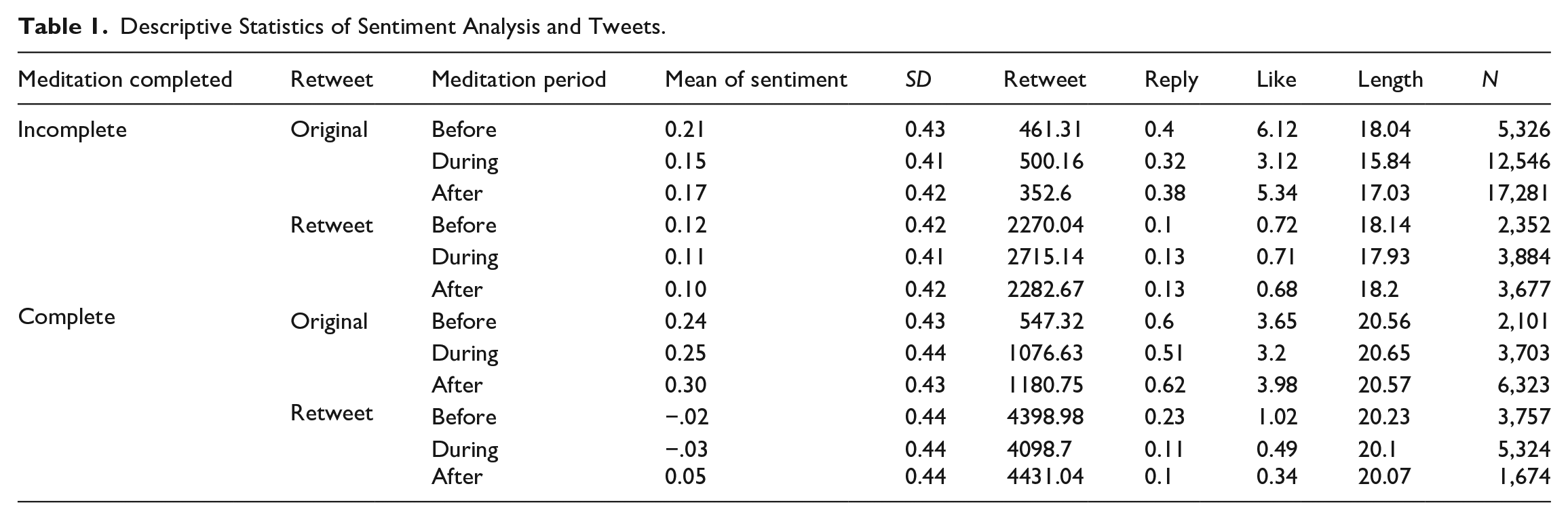
For data analysis purposes, we applied the Valence Aware Dictionary and sEntiment Reasoner (VADER) package, a Python package commonly used for automatic sentiment analysis (Alaei et al., 2019), to calculate the sentiment of tweets. Hutto and Gilbert (2014) argued that VADER can outperform human annotators as it is attuned to sentiments expressed on social media platforms such as Twitter. Table 1 illustrates the descriptive statistics of the sentiment analysis as calculated by VADER as well as retweets, replies, likes, length of tweet, and number of posts (N). Sentiment is stored as an independent variable as consecutive decimal values from -1 (negative) to 1 (positive). As established in prior research, differences less than −0.05 or greater than 0.05 is considered as significantly negative or positive, respectively (Hutto, 2021). The table indicates that the completed group exhibits more positive sentiment than the incomplete group in original tweets. However, in the case of retweets, the completed group displays less positive sentiment compared to the incomplete group. Furthermore, the completed group exhibits higher engagement levels in terms of replies and length of tweet than the incomplete group.
Descriptive Statistics of Sentiment Analysis and Tweets.
Study 1a: Mindfulness on tweets
The purpose of study 1a is to explore the prediction that after completing the online 60-day meditation challenge consumers will show an increase (vs. decrease) in original tweets (vs. retweets) (H1). Study 1a tests our predictions through the number of original tweets and retweets for those groups who completed versus did not complete the meditation challenge.
Procedure
For study 1a, a chi-square test (Momeni et al., 2018) was conducted to analyse the ratio difference between the number of tweets posted in the meditation period (a dependent variable; before, during, and after) by the tweet type (an independent variable; original tweet vs. retweet). The analysis was divided into two parts for the mindfulness incomplete group (N = 45,066) and the mindfulness completed group (N = 22,882).
Results
For the mindfulness incomplete group (N = 45,066), the ratio difference between the number of tweets posted in the meditation period by the tweet type showed a significant difference (
The Ratio Difference Between the Number of Tweets Written in the Meditation Period by the Tweet Type.
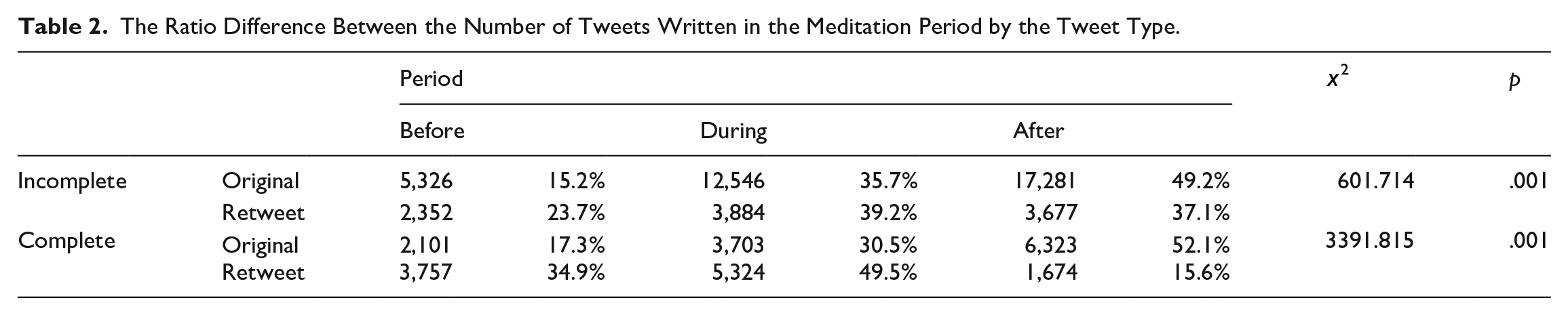
For the mindfulness completed group (N = 22,882), the ratio difference between the number of tweets written in the meditation period by the tweet type showed a significant difference (
Study 1b: Mindfulness on tweet sentiment
The purpose of study 1b is to demonstrate that after completing (vs. not completing) the online 60-day meditation challenge users show higher (vs. lower) positive sentiment of original tweets, whereas completing (vs. not completing) users show lower (vs. higher) sentiment of retweets (H2).
Procedure
The compound sentiment of tweets was analysed using VADER and used as a dependent variable. Tweets consist of original tweets (N = 35,153) and retweets (N = 9,913) from users that did not complete the challenge, and original tweets (N = 12,127) and retweets (N = 10,755) from users that completed the challenge. We conducted a two-way ANOVA (D’Amico et al., 2001) with the mindfulness completion (the mindfulness incomplete group and the mindfulness completed group) and the meditation period (before, during, and after), and their interaction as independent variables and sentiment of tweets as the dependent variable. The analysis was divided into two parts for the original tweets group (N = 47,280) and the retweets group (N = 20,668).
Results
For the original tweets group (N = 47,280), results of a two-way ANOVA showed that there were significant main effects of the mindfulness completion (F(1, 56.154)=312.758, p < .001) and the meditation period (F(2, 4.003)=22.294, p < .001) on sentiment of original tweets. Also, and as predicted, there was a significant interaction between the mindfulness completion and the meditation period (F(2, 4.965)=27.653, p < .001). These results show that completed users (vs. incomplete users) show higher (vs. lower) positive sentiment of original tweets (see Figure 1).
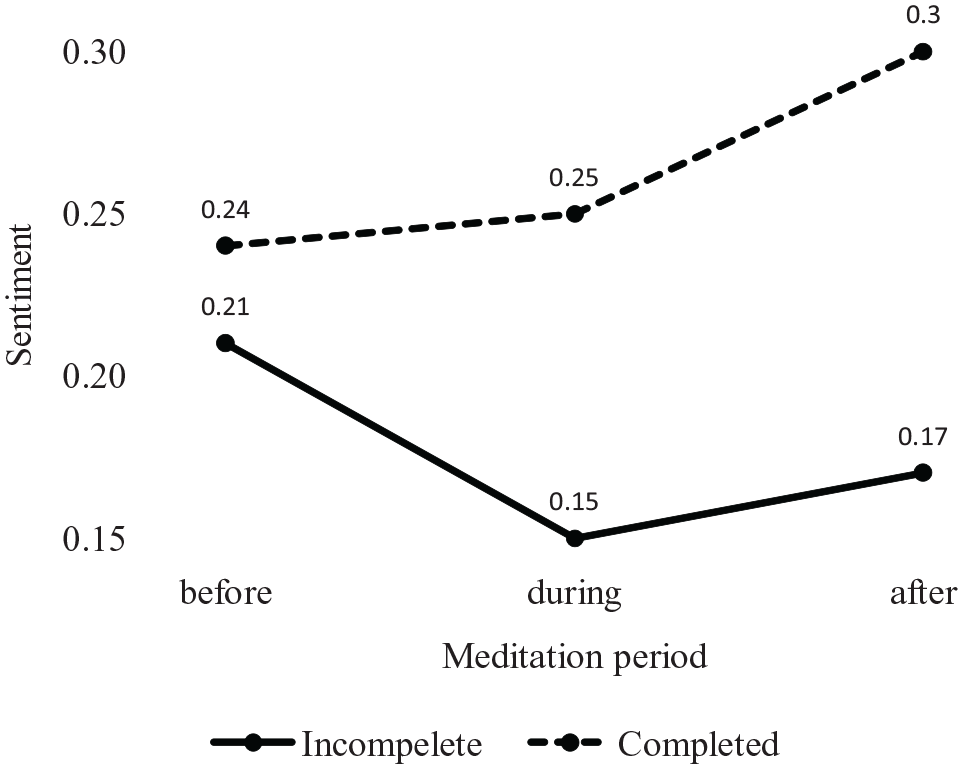
Sentiment changes in original tweets.
For the retweets group (N = 20,668), results of a two-way ANOVA showed that there were significant main effects of the mindfulness completion (F(1, 49.944)=271.123, p < .001) and the meditation period (F(2, 1.760)=9.555, p < .001) on sentiment of retweets. Also, and as predicted, there was a significant interaction between the mindfulness completion and the meditation period (F(2, 3.822)=20.747, p < .001). These results show that completed users (vs. incomplete users) show lower (vs. higher) sentiment of retweets (see Figure 2).
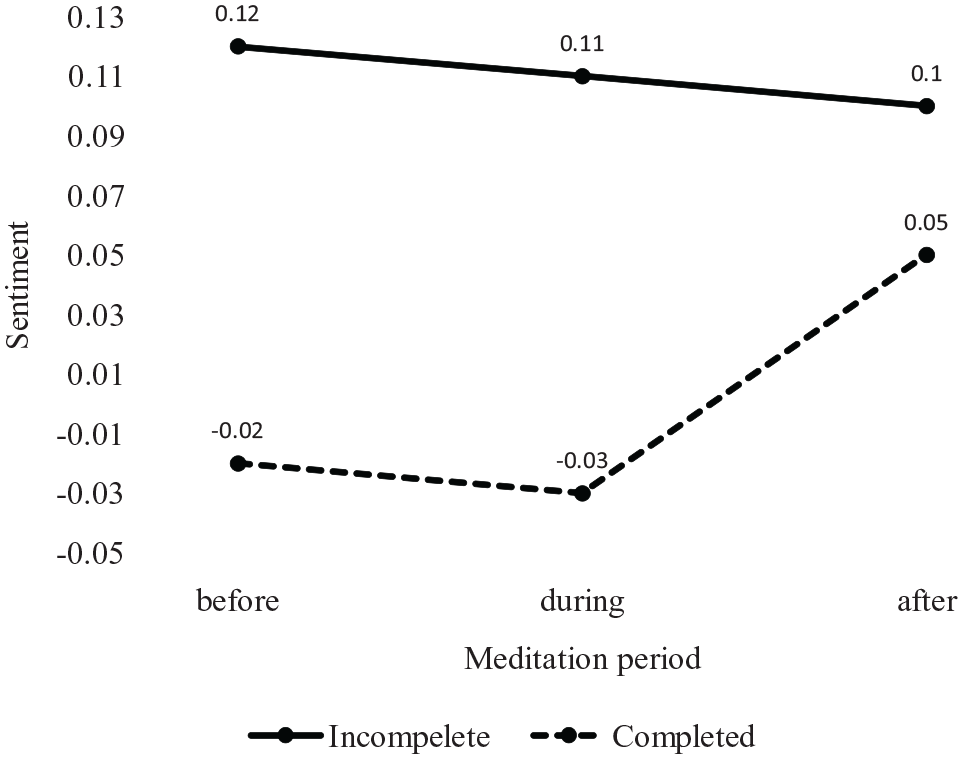
Sentiment changes in retweets.
Discussion
Theoretical implications
We show that mindfulness may in fact be beneficial in online social media environments where users engage with UGC, where the phenomenon has not yet been explored. Interestingly, in online settings, this seems to contrast the negative side of engaging in social media activity. For instance, research has shown that high engagement in social media can increase consumers’ social exclusion (David & Roberts, 2017), polarise audiences (Barberá et al., 2015), and decrease consumer well-being (Voramontri & Klieb, 2019). However, such outcomes may be divergent depending on what type of content consumers engage with. On Twitter, re-posting content has been linked primarily to pragmatic information-seeking via reciprocal re-posting (Holton et al., 2014), whilst posting UGC is more likely to occur when an individual is conscious and mindful about their experience (Melumad et al., 2019). In this way, we contribute that mindfulness is particularly amenable to UGC and may help users in becoming more active and engaged in the process of creativity, subsequently increasing positive sentiment in their content creation. In this way, as consumers may depict maladaptive behaviour online when engaging in social media, contemplative practices such as mindfulness may mitigate this, and in turn have a positive effect on how consumers post UGC.
Further, we contribute a novel social media research method that contributes to immediate and unique marketing methods for researchers. Social media research is often misleading and focused on analysis more so than theoretical contribution. By utilising a user-based approach, we examine how the behaviour of a homogenous group on Twitter changes over time. To the best of our knowledge, this is the first study to track behavioural changes in a group of Twitter user’s before, during and after the attempt of a mindfulness challenge.
Managerial implications
In today’s fast-paced digital world, we argue that mindfulness has emerged as a powerful tool to combat negative emotional sentiment and boost creativity. With the rise of online social media platforms that can be utilised by companies and their brands, mindfulness practices can become increasingly integrated into marketing campaigns, allowing people to access mindfulness techniques anytime, anywhere.
For marketing practitioners, incorporating mindfulness practices into social media campaigns or health and well-being challenges may have profound implications for their engagement with their online audience. For instance, Nike has produced a series of selected ‘mindful runs’ in conjunction with Headspace that users can listen to (see https://www.headspace.com/partners/nike-partnerships). Other companies, such as REI, have integrated mindfulness meditations into their social media campaigns (e.g. see https://www.youtube.com/watch?v=JrQMlzvsLIU), asking consumers to comment on their meditation experience in the platform. As we have shown in the current research, if such mindful activities can promote consumers in positive sentiment and originality, utilising mindfulness meditations or techniques in this way may allow such residual effects to rub off on engagement or positive brand associations with companies promoting such content.
Furthermore, mindfulness practices may help consumers tune into their thoughts, feelings, and surroundings, leading to greater focus and clarity on what meaning brands have for them. By incorporating mindfulness into marketing practices, brands may be able to create more engaging campaigns that resonate more meaningfully with their audiences. For instance, supporting brands that may align authentically with the spiritual or value-based notions of mindfulness (e.g. environmental brands), may increase customer engagement with target audiences (Marc & Rasul, 2022).
Limitations and future research directions
This study should be viewed in the context of its limitations. Currently, this study focuses on publicly available Twitter data. Other platforms, such as Facebook and Instagram, prohibit data collection at an individual level, restricting replicability on those platforms. In addition, as users are self-selected into the meditation challenge, users may be exaggerating their participation in the challenge. However, the authors agree that this is unlikely in this scenario as each individual that completed the challenge publicly posted a daily tweet discussing their progress for 60 days, consecutively.
Furthermore, as our data included field data from Twitter, rather than self-reported or manipulated conditions, we did not include control variables (Homburg et al., 2015). We address this by focussing our analyses on comparing the complete and incomplete groups, using different periods (i.e. before, during and after), and evaluating different types of engagement (i.e. passive vs. active UGC). In the future, causal effects using experiments that manipulate mindfulness may help further validate the findings and shed light on underlying psychological mechanisms driving positive sentiment, creativity, or originality.
Lastly, although Twitter’s API allows for long-term replicability (Kishore et al., 2019), this dataset may change over time. Some users, for example, may delete their accounts or specific tweets which has the potential to effect long-term replicability of the study. To address this, we will maintain a public record of all Tweet IDs to best enable transparency and replicability. In summary, we demonstrate a novel approach to data-driven research that allows us to examine the effects of participating in a meditation challenge on real-world behavioural change demonstrated through social media use.
Regarding future research, our study did not explore the goals or decisions of the meditation users taking the meditation challenge. It would be interesting to explore the effects of mindfulness on goal-oriented consumption behaviour to direct behavioural change (Lim & Weissmann, 2023) associated with increasing well-being of consumers.
Footnotes
Declaration of conflicting interests
The author(s) declared no potential conflicts of interest with respect to the research, authorship, and/or publication of this article.
Funding
The author(s) received no financial support for the research, authorship, and/or publication of this article.
Ethical Approval
We collected the data from Twitter’s Academic Research Application Programming Interface (API), with approval from Twitter. The collected dataset only consists of publicly available information.
