




Abstract
Marketing is commonly considered to be in crisis, losing credibility and in need of reform. Among the many attempts to solve its predicament, one question seems not to be asked: Could there be underlying foundational assumptions that are outdated, and which hinder marketing from being re-invented to fit emergent business and societal challenges? This article demonstrates that marketing is steered by several underlying foundational assumptions, all of which have remained implicit. A dominating focus on activities, as opposed to a discussion of what marketing should be as a phenomenon, constrains marketing in the steadfast grip of tradition. To enable a formulation of marketing as a phenomenon, this paper scrutinises these implicit assumptions and proposes an alternative set of foundational assumptions. Making firms or other institutions meaningful to their customers or other stakeholders with the aim of creating attraction is suggested as a marketing phenomenon. Finally, it is demonstrated that marketing as meaningfulness has important and far-reaching consequences, providing opportunities to develop and reform marketing to make it more relevant and inclusive in the emergent business and societal environment.
Keywords
Introduction
There is general agreement among marketing scholars that marketing is in crisis, losing credibility both as an academic discipline (Hunt, 2020b referring to 13 sources; also Hunt et al., 2022; Key et al., 2020) and in practice (Kerin, 2005; Kohli & Haenlein, 2021; Parvatiyar & Sheth, 2021; Reibstein et al., 2009; Webster, 1981, 2005; Wind, 2019). It has even been noted that marketing has become the least influential of academic business disciplines (Clark et al., 2014) and that the performance of marketing directors and chief marketing officers does not fulfil CEOs’ expectations (Whitler, 2022). Indeed, it would seem that boards do fail to appreciate these roles at the strategy level (Whitler et al., 2022).
Marketing research has become overly focussed on narrowly specified topics instead of on broader issues fundamental to the discipline (Hunt, 2020b; Reibstein et al., 2009; Wilkie & Moore, 2003), and become preoccupied with methods and other topics that are only tangentially related to marketing (Hunt, 2020a, 2020b). It has been noted that marketing neglects customers’ interests to better serve the firm’s interests (Sheth & Sisodia, 2005) and offers poor advice to customers as to how to spend their money (Wilkie, 2005). Recently, Hunt (2020b) emphasised the importance of rebuilding the legitimacy of the marketing discipline to reinstate its role in academia and business practice. At the same time, marketing’s business and societal environment has changed, and new challenges have been presented. Building on Rust (2020), Wichman et al. (2022) related such challenges to advances in technology, socioeconomic and geopolitical shifts and environmental changes influencing marketplace dynamics.
In recent decades, attempts have been made to solve marketing’s problems in special issues of reputable marketing journals (e.g. the Marketing Renaissance (2005) section of the Journal of Marketing). In just the last few years, a large number of scholarly articles (some referenced above) have been published that thoroughly analyse marketing’s challenges (e.g. Hunt, 2020b), pointing out the pressures created by external contextual changes (e.g. Parvatiyar & Sheth, 2021; Rust, 2020) such as new technologies, socioeconomic, business and societal developments and the study of marketing-as-practice (Skålen et al., 2022). The development of grand theories (recently, Parvatiyar & Sheth, 2021 and Hunt et al., 2022) has been explored. The possible developments of the variables involved in the marketing mix–considering different scenarios–have also been discussed in depth (Wichman et al., 2022). Despite these efforts, the foundational, implicit assumptions underlying marketing have remained unchallenged. The very fundamental question has not been asked: As the business and societal environment has changed, could these implicit underlying assumptions be outdated, thus hindering marketing from changing and re-inventing itself? Assumptions underlying a theory or any other entity delineate its boundary (Bacharach, 1989): ‘If a theory is to be appropriately used and tested . . .(its) implicit assumptions must be understood’ (Bacharach, 1989, p. 498). Hence, one must be aware of such assumptions if the goal is to develop new theories or models (Alvesson & Sandberg, 2013).
The purpose of this article is to first scrutinise the implicit foundational assumptions underlying marketing, thereby enabling the introduction of alternative assumptions that would better fit marketing’s challenges. Second, based on this analysis, an alternative perspective on marketing is introduced in which the discipline is understood as a phenomenon. I argue that marketing as meaningfulness describes such a phenomenon. Thus, I contribute to the ongoing discussion about how to resolve marketing’s predicament with the aim of meeting Hunt’s (2020b) call for the re-institutionalisation of the discipline and the rebuilding of its legitimacy. Although the article is crafted mainly from the perspective of commercial business, its implications should be inclusive and applicable in non-commercial contexts as well.
Methodological approach
I adopt a reflexivity approach (Alvesson & Sandberg, 2011), as such an approach enables the researcher to break free from existing frames of reference to reveal what they are not able to say (Alvesson & Sköldberg, 2009). Reflexivity emphasises the importance of the assumptions that underlie theories, models, disciplines or any other entities that govern research as determinants of how this entity is understood, how it is developing and how it is performed. All entities are both grounded in and bounded by some assumption, and theoretical development occurs in part by challenging and rethinking prevailing assumptions. However, as noted by Alvesson and Sandberg (2013), ‘assumptions underlying a specific domain are rarely explicitly formulated’ (p. 58), and underlying assumptions that remain implicit and unarticulated are impossible to problematise, making it difficult to reveal how they steer the evolvement of theories, models or disciplines (Davis, 1971). Davis (1971) stated that ‘interesting theories are those which deny certain assumptions of their audience’ (p. 1; see also Tellis, 2017). Hence, challenging assumptions and formulating alternative ones can play a central role in the development of new theories and open new avenues for theoretical exploration and empirical investigation (Alvesson & Sandberg, 2013).
Reflexivity is based on the principle of problematisation, a technique that is used to reflect on an entity’s implicit or weakly articulated underlying assumptions (Alvesson & Sandberg, 2013). Implicit, and thus hidden, assumptions are highlighted, such that they can be scrutinised. Hence, problematisation is an ‘endeavour to know how and to what extent it might be possible to think differently’ (Foucault, 1985, p. 9). Through problematisation the researcher can reflect on alternatives to existing assumptions and explore whether such alternatives offer a new perspective. 1
Marketing’s foundational assumptions
Underlying assumptions have generally remained implicit in marketing publications. As The History of Marketing Thought (Tadejewski & Jones, 2008) implies, throughout its history marketing has paid attention to activities at the expense of studying its fundamental nature, thereby neglecting its foundational assumptions. Implicit assumptions, although they are hidden and not articulated, still steer researchers’ and practitioners’ actions in a given direction and may make it difficult to see alternative perspectives. Such unchallenged assumptions tend to maintain a steadfast grip that obstructs the re-invention of an entity. This seems to have plagued attempts to explore new avenues for the development of marketing. Given the importance of underlying assumptions to the development of an entity, adopting reflexivity to study marketing’s current predicament seems appropriate and timely.
The definition of marketing issued by the American Marketing Association (AMA) is generally considered to encapsulate the nature of the discipline and is widely reflected in marketing publications. The current definition from 2007 – and recently endorsed again by the AMA (see American Marketing Association [AMA], 2023) – emerged as the result of a long consultation process that included several stages (see Grundlach & Wilkie, 2009). Although this definition replaced a previous one from 1985, both are in the tradition of the management approach to marketing established by Wilkie and Moore (2003) in the period labelled marketing’s re-institutionalisation era (1950–1980): Marketing is the activity, set of institutions, and processes for creating, communicating, delivering, and exchanging offerings that have value for customers, clients, partners, and society at large.
2
The core of the definition is activities categorised in a structure (creating, communicating, delivering, exchanging and presumably also pricing, as disguised in the phrase ‘offerings that have value’). In this context, these activities are interpreted as specialist activities exclusive to marketing. The formulation of the definition also implies a one-sided view, with the marketer as subject and the customer and other stakeholders as objects. It also predominantly emphasises demand stimulation with little focus on the supply side of the marketing system (Wilkie & Moore, 2003), thereby concentrating on making promises about what will be supplied (Grönroos, 2006). The word ‘processes’ in the definition refers to internal processes, not external ones, such as the customers’ processes over the life cycle of their relationship with the organisation. The phrase ‘offerings that have value for customers’ thus clearly implies a provider-centred view of value creation, where value for customers resides in the offerings to be exchanged. The one-sided focus also implies an inside-out approach to marketing, whereby marketing is planned and executed to customers.
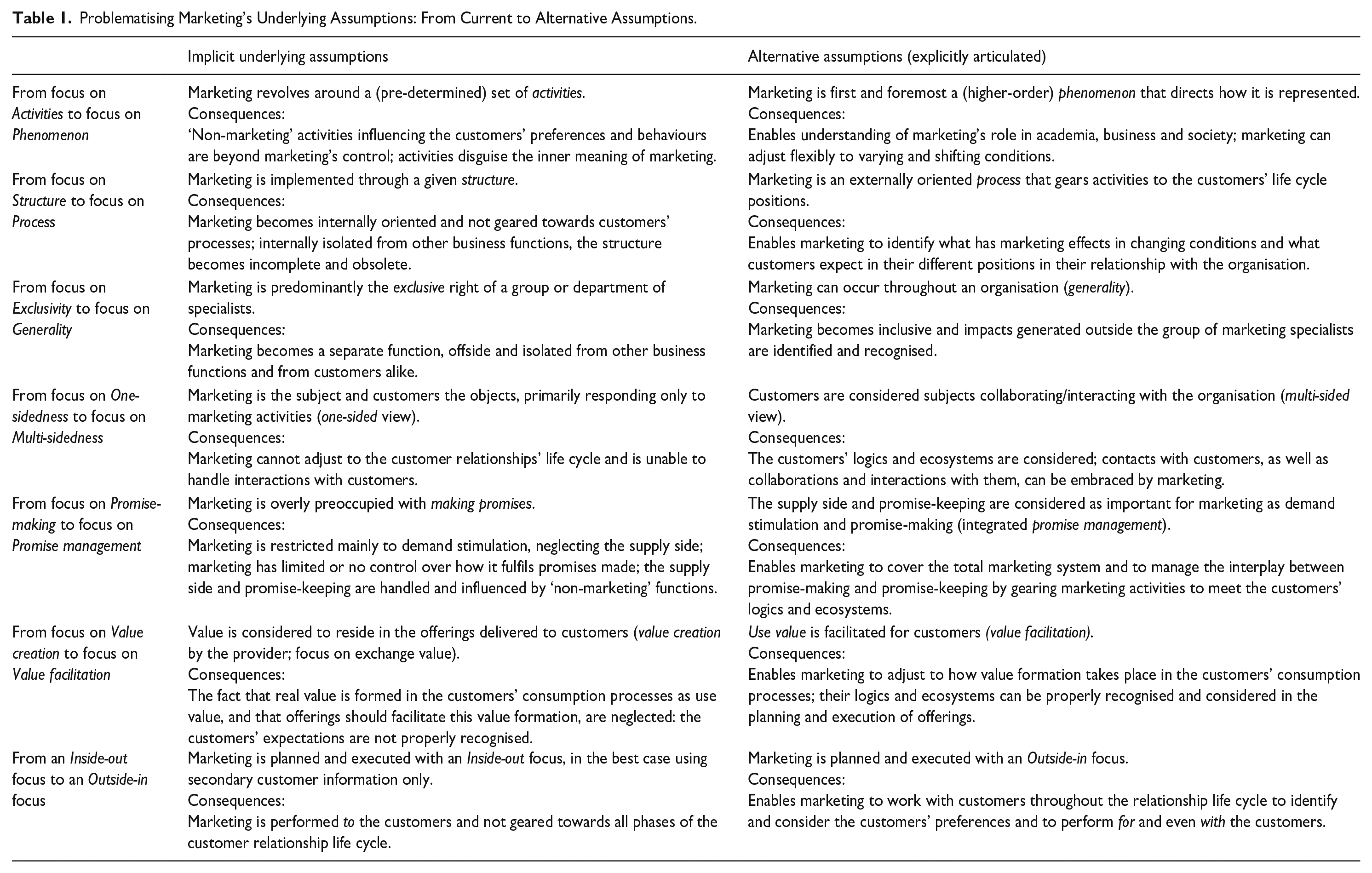
In the above, seven assumptions foundational to marketing have been identified: focus on activity, structure, exclusivity, one-sidedness, promise-making, value creation and inside-out planning and executing. In the next section these assumptions are scrutinised with the aim of exposing problems for the development of the marketing discipline in the context of the emergent business and societal environment. I then suggest alternative assumptions that would enable a development and re-invention of the discipline so as to make it more relevant. Literature outside of mainstream marketing–relationship marketing (e.g. Grönroos, 1996; Palmatier et al., 2006; Parvatiyar & Sheth, 2000), service marketing (e.g. Grönroos, 2015; Zeithaml et al., 2017), customer relationship management (CRM) (e.g. Payne & Frow, 2013; Storbacka & Lehtinen, 2000) and industrial marketing and purchasing (IMP) (e.g. Håkansson & Snehota, 2017; Håkansson et al., 2009) has demonstrated how alternative underlying and steering assumptions have generated new perspectives and advanced the development of theories and models. In this article I suggest that the assumptions identified above be replaced with the following alternatives: focus on phenomenon, process, generality, multi-sidedness, promise management, value facilitation and outside-in planning and execution. Table 1 summarises the nature of the current implicit assumptions, the alternative assumptions and their consequences for marketing.
Problematising Marketing’s Underlying Assumptions: From Current to Alternative Assumptions.
Scrutinising underlying assumptions
From activity to process
Studies in the marketing domain are dominated by a focus on activities, whether referred to as the marketing mix, the 4Ps or some other terminology (for an overview, see Constantinides, 2006). With the emergence of the re-institutionalisation era (1950–80) (Wilkie & Moore, 2003) and the development of the management approach, this focus grew and became dominant, particularly after the publication of McCarthy’s textbook Basic Marketing, which was organised around the 4Ps (Hunt, 2020b). The development of a scientific domain should not end with the identification of activities that at some point in time turn out to be a good representation of it. However, this seems to have happened in marketing. The question needs to be asked why such activities are performed beyond, for example, having value for someone or satisfying someone’s goals. That is, questions should be asked about the inner meaning or mental model of the discipline, which phenomenon in society the discipline is thought to address, and the discipline’s representative activities. Doing so will establish a robust platform for developing the discipline with the capacity to react to inevitable changes in the environment. Instead, however, from time to time marketing suggests new activities, such as AI-driven processes, digital functions, social media influence postings, new payment systems and others. However, extended lists inevitably become obsolete; more importantly, adding new items to a list does not solve any fundamental problems.
Furthermore, it is not reasonable to believe that marketers can determine which activities in an organisation really influence their customers’ preferences and behaviours. As stated by Grönroos (2015), ‘The customers of a firm, not the firm nor its marketers, decide which of the firm’s resources and activities are marketing resources and activities’ (p. 276; emphasis in original). While this should be self-evident, it is not stated explicitly in the marketing literature, nor is it considered in the AMA definition. A list defining what marketing is implies that there are non-marketing activities which are not the concern of marketing. However, activities that are considered ‘non-marketing’ and outside marketing’s control may have a significant influence on customers’ preferences and behaviours. Neglecting these activities likely has unwanted negative effects on customers’ experiences. Moreover, it is ineffective marketing.
Hence, an obsession with activities neither advances the development of marketing nor resolves marketing’s current quandary. Instead of focussing on activities, marketing needs to focus on the phenomenon it represents. Ways of executing marketing should be derived from such a phenomenon. This creates flexibility in choosing ways of performing in various contexts. It also enables institutions other than business organisations to easily embrace marketing thinking, which was a central goal when the AMA definition was renewed in 2007 (Grundlach & Wilkie, 2009). Failing to define marketing as a phenomenon as a point of departure for developing the discipline risks preserving its irrelevance in academia, business and other institutions and society at large. Focussing on the phenomenon increases the likelihood that marketing will become a discipline that is relevant over time and context, as well as to a large number of institutions and stakeholders, such that marketing’s many audiences – marketing scholars, practitioners and policymakers alike – are well served. Marketing as a phenomenon will be further discussed in the final sections of the article.
From structure to process
Emphasising specialised activities has naturally led to the categorisation of such activities and a focus on structure. Culliton (1948) introduced the ‘mixer of ingredients’ metaphor and in 1953 Borden (1964) coined the phrase ‘marketing mix’, which consists of eight categories of activities. This led to efforts to simplify this mix to satisfy managerial and educational purposes. In McCarthy’s (1960) book, Basic Marketing, which is organised around the 4Ps (product, promotion, price, place), a structure was cemented, later characterised by Kent (1986) as ‘the quadruple of. . . the marketing faith. . . manifested in tablets of stone’ (p. 146).
A structure that is considered a more or less indisputable norm creates negative effects over time. As the activities thus categorised gradually become obsolete, incomplete and potentially misleading, so does the structure, which may eventually become detrimental to the discipline. Activities outside the structure may become increasingly important to customers. As stated by Grönroos (2015), ‘Regardless of which organisational process or department they belong to, resources and activities of a firm that influence a customer’s preferences and behaviours are marketing resources and activities’ (p. 276; emphasis in the original). Although this message seems self-evident, it is regularly violated and seldom, if ever, discussed in the marketing literature. As a consequence, marketing’s responsibility to customers is assumed by other functions, such as supply chain management (Key et al., 2020) and production and operations management (Wierenga, 2021). The structural focus on marketing activities disguises marketing’s nature as an integrated system (Key et al., 2020), including both demand stimulation and demand satisfying supply. This, in turn, hinders marketing from breaking its boundaries to re-invent itself. At the same time, marketing becomes internally oriented and less geared towards the customers’ life and processes.
Customers follow a process of becoming interested, buying, using and perhaps buying again as a kind of customer relationship life cycle (Grönroos, 2015). Instead of relying on structured activities, marketing should focus on this external process as the basis of marketing activities. In this way the total marketing system can be managed and needed activities flexibly chosen. It can be ensured that functions otherwise considered ‘non-marketing’ are prepared to perform in a marketing-like way. Once this process has been recognised, marketing can identify and actively use resources needed in the different phases of the relationship life cycle, such that customers are successfully guided through the relationship, from interest to loyalty.
From exclusivity to generality
The marketing discipline has become too narrow in scope (Key et al., 2020; Sheth & Sisodia, 2005). As early as 2005, Wilkie (2005, p. 5) called for ‘a larger conception of marketing’. Marketing specialists have assumed the exclusive right to manage marketing, which has resulted in it being planned separately and excluded from other plans, including the corporate plan. Marketing is mostly performed by a separate department. A business function devoted exclusively to marketing emerges. The downside of this development is that it further emphasises the non-marketing status of other business functions, which easily exclude marketing thinking from their planning. As a result, persons other than marketing specialists at best only vaguely understand what marketing entails. Moreover, they may not want to be associated with marketing. As the marketing function is so intimately associated with customers, non-marketing personnel’s limited interest in marketing is transferred to the organisation’s customers. This may be fatal if its work critically influences customer preferences. Marketing becomes isolated from other business disciplines and functions. Less than favourable attitudes towards marketing easily emerge in such an organisation.
However, the contribution of ‘non-marketing’ functions is increasingly essential for marketing to be successfully performed. As Gummesson (1995) observed, by and large marketing specialists are distant from places and situations where ‘non-marketing’ functions operate in customer interfaces and influence customer preferences. When critical customer contacts are handled, the specialists are in the wrong place, isolated from their customers. Whereas non-marketing personnel have direct, real-time contacts with customers, sales data, media exposures, social media ‘clicks’ and similar measures guide the marketers’ decisions. This may lead to a situation similar to the one observed by Sheth and Sisodia (2005; cf. Dixon & Blois, 1983), where marketing decisions are made to satisfy the interests of the organisation rather than its customers. The focus on exclusivity neglects to consider the marketing impact of non-marketing functions. In an early study, Wilkie & Moore (1999) found that more than half of the activities that influence customers are out of marketing’s control and are considered non-marketing (cf. Brown, 2005). Non-marketing personnel often significantly outnumber marketing specialists (Gummesson, 1995). As these ‘non-marketing’ operations, processes and routines are not planned and executed with their marketing impact in mind, potentially favourable marketing effects are missed. The customers’ contacts with non-marketing functions, with their limited responsibility for customers, easily counteract the efforts of the marketing specialists.
Marketing’s exclusivity focus means that marketing cannot handle the total marketing system, and so much of the organisation’s involvement with its customers’ lives is managed by other business functions. Clearly, a change of focus from exclusivity to generality is required, where marketing is included, such that it is recognised and accepted that marketing resources can exist throughout the organisation and that a division between marketing and non-marketing functions must be avoided.
From one-sidedness to multi-sidedness
Marketing’s focus on activities and its isolation from customer contacts has fostered a one-sided view of the marketing-customer relationship, where marketing is the subject and the customer is the object. Through market research prior to the time and place of exchange, marketers consider the customers, who, in turn, face a ‘take-it-or-leave-it’ situation. However, much of today’s business is different. Customer interfaces beyond the merely well-delineated offering of a product have become increasingly important, including interactive and collaborative situations in which the customer may be as active as the organisation in every phase of their relationship, from idea generation to execution. Here, marketing easily steps out of line, placing itself in a position where it is unable to adjust to the customers’ wants and expectations. As research into customer-dominant logic (CDL) (Heinonen & Strandvik, 2015) has demonstrated, customers have their logics and ecosystems, consisting of alternative offering providers under consideration, expectations and previous experiences with multiple providers’ capacity and willingness to deliver on promises, external influence through social media and real-life word of mouth and more. Marketing has limited contacts with these logics and ecosystems that influence customers’ behaviour; as such, it cannot immediately react to mistakes and problems or adjust to unexpectedly occurring customer wants and wishes. Its isolation from the customers is emphasised.
Customers can no longer be considered objects of marketing. To avoid the problems created by one-sidedness, marketing needs to focus on multi-sidedness, whereby customers and other stakeholders are subjects rather than mere objects – where they are considered partners throughout their relationship with the organisation. In that way, marketing gains better insight into its customers’ logics and ecosystems and becomes better prepared, for example, to develop and deliver offerings that are valuable to customers and to inform them about such offerings. The customers’ actions and reactions can be adequately responded to at the time and place they occur. Marketing becomes better informed about the customers’ needs and expectations.
From demand-stimulating promise-making to promise management
In view of the 1985 and 2007 AMA definitions of marketing, goods and services or, more generally, offerings, form the sole marketing variable focussed on fulfilling customers’ expectations, thus keeping the promises made to them. All other variables in marketing’s conventional toolbox, communication being the most important one, aim to stimulate demand by making promises, raising expectations and promoting sales. Unfortunately, it turns out that marketing has little control over the offering, which is normally given to them. It can mostly make only cosmetic developments or changes. Consequently, marketing has become a function focussing on demand stimulation by making promises about what customers can expect. Its control over what customers will get in the end is increasingly limited. Hence, marketing does not embrace the total marketing system, with its demand stimulation and demand satisfying supply components. As Brown (2005) reported from a study of top executives of major firms associated with the Center for Services Leadership at Arizona State University, ‘notably, none of the executives mentioned marketing as being responsible for the customer. . . . the keeping of promises and building customer loyalty is typically considered the responsibility of others in the enterprise’ (p. 3). It is evident that marketing’s role is considered to be restricted to making promises. It is of critical importance to realise that what may look like successful demand stimulation is bad marketing in the event that promises made are not properly met. Due to marketing’s limited control of promise-keeping, it is always at risk of achieving unfavourable outcomes or of failing altogether.
It is evident that marketing has reverted to a promise-making function focussed only on demand stimulation, without the proper means to handle how promises are fulfilled. To avoid the negative consequences of this, marketing must be able to integrate both demand-stimulating promise-making and demand-satisfying promise-keeping. This again emphasises the need for marketing to regain control of the total marketing system. This demands a focus on promise management (Grönroos, 2006) to replace the obsession with demand stimulation only, whereby, as suggested by Calonius’s (2006) promise theory, the total promise-related process is co-ordinated and actively managed as part of marketing.
From value creation to value facilitation
Value is not a new concept to marketing, but only in recent decades has value for customers become a central issue. In 2007, the AMA emphasised the importance of customer value by replacing the satisfaction-centred phrase in its previous definition with ‘offerings that have value for customers’. In the process of developing the definition, there may have been discussion as to whether value can indeed be created by the providers of offerings (Grundlach & Wilkie, 2009). However, as pricing has presumably been integrated in the phrase ‘exchange offerings that have value for customers’, in the end the conclusion seems to have become that value is created by the organisation and resides in its offerings to be delivered to customers as exchange value. This is also the normal use of the phrase ‘value for customers’ in enterprises.
However, in the service-as-logic research streams (Grönroos & Voima, 2013; Vargo & Lusch, 2016), it has been demonstrated that value is not delivered and exchanged as ready-made value; rather, beneficiaries such as customers or other stakeholders determine the value that can be obtained from goods and services. Service Logic (SL) argues that value is also created by the beneficiaries, alone or co-created together with providers (Grönroos & Voima, 2013). Customer-dominant logic (CDL) emphasises that value is seldom instrumentally created, but rather emerges and is formed as use value in customers’ consumption or usage processes (Heinonen & Strandvik, 2015; cf. Ravald & Grönroos, 1998). This demands a focus on value facilitation, whereby, through its development and delivery of offerings and its handling of the many contacts occurring in customer interfaces, the organisation aims to enable, or facilitate, such value formation. Marketing can then adjust its offerings and customer contacts according to how value formation evolves in the customers’ life and to their logics and ecosystems.
From inside-out to outside-in
As has been shown, marketing is planned and executed to the customers and is not geared towards the different phases of the life cycles of customer relationships. This, as well as marketing’s one-sidedness and offside position in relation to its customers, fosters inside-out behaviour in marketing planning and execution. Marketing research only partly remedies this situation. As a consequence, the distance between marketing and its customers grows and the risk that marketing is not for or even with customers and will not serve them well (Sheth & Sisodia, 2005; Wilkie & Moore, 2003), becomes apparent.
To become customer-centred and to take control of both the promise-making and promise-keeping parts of the marketing system, a shift towards focus on outside-in marketing planning and execution is required, where marketing is well informed about the customers’ needs, wants and expectations throughout the customer relationship life cycle. Only this change in focus will enable marketing for and with customers, as called for by Vargo and Lusch (2016) and others. Marketing will then be prepared to better understand and use insights about the customers’ logics, needs, wants and expectations as they emerge from contacts with them throughout the relationship.
Conclusion
The analysis in this section has shown that marketing’s current underlying assumptions are problematic. They no longer steer marketing in a direction that fits the business and societal challenges it faces. The assumptions scrutinised are inter-connected, with the focus on activities as the root cause. This focus on activities overshadows a discussion of the real or inner meaning of managing marketing activities beyond ‘to satisfy goals’ or ‘to exchange offerings that have value’; that is, a discussion of what marketing as a mindset or a phenomenon is. Given the dated implicit assumptions underlying marketing and the lack of a discussion of marketing as a phenomenon, why would institutions outside business communities be interested in adopting a marketing approach that is basically grounded in what businesses were doing over half a century ago and which no longer works properly for them? Why would other academic disciplines, business functions and top management respect a marketing that is increasingly irrelevant?
The ongoing debate as to how to re-invent marketing is critical to the future of marketing as a discipline. In the next section, marketing as a phenomenon is discussed and an alternative perspective is offered.
The phenomenon: Marketing as meaningfulness
Hunt et al. (2022; cf. Nenonen, 2022) suggested that marketing could be renewed by focussing on marketing phenomena (plural) – that is, on marketing topics or issues central to the discipline. However, to re-invent marketing as a discipline, it is not sufficient to focus on several, possibly disparate marketing topics (phenomena). Instead, a higher-order phenomenon should be in focus – a phenomenon that would guide how the discipline should be understood and investigations directed into marketing topics.
What is meant here by a higher-order phenomenon is the foundational, inner meaning of an entity or concept that can explain what this entity or concept does, or should do, to make sense to involved stakeholders. Customers (and other stakeholders) look for firms (or other institutions) that provide offerings which work satisfactorily for them in their lives and facilitate use value throughout their consumption processes. In sum, they want to do business with organisations that can offer such help. As formulated by Christensen et al. (2016, p. 58), customers want ‘(their) jobs to be done’. In other words, customers are interested in organisations that function in a way that makes them meaningful by, for example, facilitating use value formation in their customers’ individual life or organisational work processes. Thus, I argue that to be meaningful reflects the inner meaning or foundational aspiration of marketing. Hence, marketing as a phenomenon can be described as the process by which an organisation is made meaningful to the users of its offerings. 3 Being meaningful will create attraction among current and potential customers (and other stakeholders) and prevent rejection. Attraction can be expected to stimulate demand and generate sales and, eventually, satisfaction. Thus, attraction is a prerequisite for exchange and value formation.
This definition is inclusive, as it does not distinguish between commercial, public or third-sector organisations. The phenomenon could in a more general form be stated as ‘making the Subject meaningful to the Other’, where the Other is any type of actor the Subject needs to address – for example, an individual or an organisation represented by individuals. It could be a customer, client, supplier, distributor and internal unit, or it could be any relevant stakeholder, such as employees, shareholders, investors and citizens. Thus, users are not only customers, but equally employees, managers, shareholders, clients, partners, citizens and society at large. For example, a firm that is considered meaningful to its customers can be expected to perform successfully. This will benefit its employees and managers as well as its owners and shareholders, making the firm meaningful to them as well and probably also to society at large. However, conflicts between stakeholders sometimes occur. What may be meaningful to some customers, such as alcohol and cigarettes, will not be meaningful to others or from a societal point of view. Such conflicts must be recognised and duly attended to.
The idea of performing in a meaningful way enables marketing to choose appropriate activities without being restricted by a predetermined toolbox. Standard types of activities can probably be found when making promises to stimulate demand, but a larger variety of resources and activities may be needed when keeping promises to manage demand and satisfy supply. While this complicates marketing, it also fosters innovativeness and emphasises the need for good customer insight. What is considered meaningful by one customer or group of customers may very well differ from what others consider meaningful. This also complicates marketing, but is really no different from what marketing is used to and has resolved with segmentation. What needs to be discussed is the best way to categorise customers. Marketing-as-meaningfulness will also encourage marketing behaviour that is in line with the alternative assumptions of what marketing should be and do by, for example, being geared towards the customers’ processes and outside-in thinking, drawing resources from any relevant business function and focussing on facilitating use value formation.
In a major study in the domain of marketing, Schauman (2022) observed that meaningfulness is undertheorised in marketing research and needs further investigation. As a complex subject, meaningfulness has become an awkward subject to discuss (de Mujinck, 2013). Meaningfulness concerns the importance an individual ascribes to something, rather than his or her understanding of it (Schauman, 2022). As Rosso et al. (2010, pp. 94–95) noted, as meaning is about ‘the output of having made sense of something’, meaningfulness is about ‘the amount of significance something holds for an individual’. Coherence, making the world comprehensible, and purpose, a sense of being part of something worthwhile, have been considered preconditions for something to be experienced as meaningful. This means that something is seriously intended, has meaning, is worthwhile for someone and, significantly, makes sense in someone’s life (Martela & Steger, 2016). Something that is meaningful establishes a fundamental connection and creates a sense of purpose that transcends mere need fulfilment. For different individuals, and in the case of different product and service categories, the level of meaningfulness required may differ. Sometimes a lower level of meaningfulness is needed to attract a customer, while in other cases a deeper experiencing of coherence and purpose may be necessary.
In a marketing context, meaningfulness can be described as being relevant and purposeful in customers’ lives, such that they are enabled to manage their individual life or organisational work processes in a way that is valuable to them. This pertains to both commercial and non-commercial contexts. Thus, an inclusive definition of the ultimate objective of marketing can be formulated succinctly as to make an organisation as provider of offerings meaningful to its users with the aim of creating attraction among them.
Implications of marketing as meaningfulness
Understanding marketing as meaningfulness has important and far-reaching implications for both marketing research and practice, as well as perhaps the relationship between the marketing discipline and other business disciplines. Only some major implications, mainly for marketing practice, are discussed in this section. First, marketing-as-meaningfulness resolutely demonstrates that marketing is centred on customers (and other stakeholders) and is grounded in proper knowledge of their logics and ecosystems. Second, it allows marketing to integrate both its demand and supply sides (cf. Key et al., 2020), that is, manage demand stimulation as well as demand satisfying supply (Howard, 1983). Thus, as Key et al. (2020) suggested, marketing embraces the whole marketing system. Third, and following from this, marketing is clearly ubiquitous (Strandvik et al., 2014). Marketing resources exist throughout the organisation (Grönroos, 1999). Non-marketing resources do not exist. Hence, there is no division between marketing and non-marketing functions, only functions with marketing specialists and functions with individuals who, in addition to their main tasks, also have an active responsibility to the customers they serve or with whom they otherwise meet and interact. For the latter, marketing means first and foremost that they perform their tasks and communicate with customers in a way that favourably influences the customers’ preferences and both current and future behaviours.
Fourth, it follows from this that marketing cannot be organised in any conventional way. Employees other than the marketing specialists work in their own functional processes and have their own managers to whom they report. Therefore, marketing cannot be considered one function among other business functions; rather, it is an aspect of the work of all organisational functions, such as production and operations management, supply chain management and also administrative functions, such as being responsible for complaints handling and invoicing. As Alderson (1957) already claimed (p. 23), ‘Marketing should be regarded as a vantage point from which to understand business policy as a whole rather than as a single and narrowly specialized interest’. Therefore, marketing can be thought of as a mindset. For marketing and sales specialists, the marketing aspect is the aspect; for other functions it is one aspect among others, but always an important one. Consequently, marketing is best instilled in the organisation as a customer-focussed attitude of mind (Grönroos, 2015).
Fifth, when marketing is considered an aspect of all organisational functions, it is doubtful whether ‘marketing’ is the most accurate term to describe it (Grönroos, 1999). Marketing is intimately associated with demand stimulation and does not relate to successfully keeping customers, which today is often considered to be more important. Furthermore, by using the term marketing, creating favourable attitudes towards the marketing aspect of their job among employees may be difficult. Moreover, marketing does not communicate the supply side of the discipline or the striving to successfully stay in the market by cultivating on-going customer relationships. The issue of terminology needs to be thoroughly discussed.
Concluding remark
Hunt et al. (2022) argued that marketing as a discipline is still needed. I absolutely agree because marketing offers the customer focus needed in an organisation. However, the form marketing should take, the relation it should have to other disciplines and business functions, and determining who ultimately is responsible for marketing are issues that need to be discussed. Marketing-as-meaningfulness, grounded in the customers’ logics and ecosystems, provides a starting point.
Footnotes
Acknowledgements
I am indebted to my colleagues professors Kaj Storbacka and Tore Strandvik, Hanken School of Economics, for their valuable contribution to the discussion about the need to reform marketing.
Declaration of conflicting interests
The author declared no potential conflicts of interest with respect to the research, authorship, and/or publication of this article.
Funding
The author received no financial support for the research, authorship, and/or publication of this article.
