



Abstract
This conceptual paper defines and gives examples of biometrics, explains how biometric tracking is currently used (e.g. to predict IQ), and presents innovative future uses of biometric tracking (e.g. to customize the price of products in real time). Specifically, this paper outlines a novel biometric pricing technology (BPT) which uses facial tracking to set the price of products using a new participatory dynamic pricing (vs. static pricing) system. Based on the privacy paradox, this paper addresses the acceptance, concerns and usage of a new emerging technology by consumers and its potential applications. To explore this, we develop a typology of perceived benefits and perceived privacy to predict consumer reactions to biometric technology. In addition, we present a research agenda to guide future research on biometric pricing technology. This research agenda offers new insights on how biometric tracking and specifically biometric price setting could be explored from multiple angles, including the consumer experience, technology acceptance, online profiling, governance, public policy, regulation, ethical and future usage-based perspectives.
Keywords
Introduction
“My nightmare scenario is that targeted advertising based on our involuntary biological reactions to stimuli is going to start showing up in the metaverse. . .most people don’t realise how valuable that could be. Right now there are no legal constraints on that” – Financial Times (January, 2022)
Everyday technological advancements are changing society from pioneering new ways to keep the world operating ‘safely and normally’ (e.g. CCTV temperature scans, digital vaccine passports) to new immersive technologies (Synthetic media or Deepfakes; Whittaker et al., 2021, and Virtual Reality; Murphy, 2022) that allow society to live within adaptive environments based on each individual’s preferences and actions (Persiani et al., 2021). Today, almost every organization from health services and retail stores to security firms are tracking consumers to increase service efficiency, personalize experiences and enhance consumer safety (Ciftci et al., 2021). One technology underscoring all these innovations, and which is the focus of this article, is biometric tracking (Adjabi et al., 2020; van Esch et al., 2021).
As new biometric tracking technologies emerge, there is an inconsistency in understanding biometrics and its impacts on consumers, the market and society during the ever-growing artificial intelligence (AI) era. Through an example of a novel application of this technology that differs the prices of offerings (goods and services) based on facial biometric tracking (i.e. dynamic biometric pricing), this paper discusses potential impacts of biometric technologies. The unique concern with using biometric tracking as opposed to other tracking methods to personalize services is the permanent nature of biometric attributes and the potential for their storage for future use. Advancing the privacy calculation theory that consumers can quantify their privacy and benefits to arrive at an equilibrium for what they give and receive, a typology is created between how consumers balance the benefits of biometric technology with the arising privacy implications of being tracked (Dolnicar & Jordaan, 2006). Such a typology helps to classify behaviours consumers may undertake in response to biometric tracking. It also adds to the privacy paradox literature by outlining potential reasons why consumers give up their privacy while claiming privacy matters. From this typology, a research agenda is developed based on these potential consumer responses. It outlines future research which may explore the positive and negative implications of biometrics for marketers and consumers. As well, this agenda looks to contribute to the growing list of perspectives and support issues (governance, ethics) developing in the literature and public policies on how to explore biometric tracking in consumer settings as they continue to emerge in society.
This paper contributes by (1) providing a concise and informative overview of biometrics and its implications for pricing, (2) presenting a typology of consumer archetypes regarding how consumers interact with biometric tracking which can be used for future research and (3) presenting a research agenda of current research opportunities in this rapidly emerging area for biometrics and consumers.
The remainder of the article is structured as follows. First, we define biometrics and outline their origin from safety and security systems, and examine the implications of their usage. Biometric pricing technology (BPT) is then discussed in relation to its impact on current pricing techniques. Finally, the comparison of benefits to privacy in a pricing example is expanded to outline how different parts of society could be influenced by biometric tracking to form a research agenda.
Defining biometrics
Biometrics (also known as biometrical tracking data) is defined as the collection of approaches and algorithms that are used for uniquely recognizing humans based on physical or behavioural cues. This technology relies on who a person is or what a person does, rather than on what a person knows (e.g. a password) or what a person has (e.g. an ID card, Campisi, 2013). Traditional biometric approaches involve technology observing a person’s iris, retina, sclera, facial scans, signatures (Smith, 2003), fingerprints, finger knuckle prints, hand vein patterns their pulse and DNA (Ahmad et al., 2019). Such data sources can be classified as physiological biometrics, as they rely on the physical attributes of a person for recognition. For example, verifying an individual’s identity by raising their hand onto a scanner and having their fingerprints scanned and verified. However, biometric technology has enabled us to move beyond these first-generation sources of physical biometric data. Recent examples of what has been called second-generation biometrics are those that can be determined by observation (North-Samardzic, 2020). These include a person’s unconscious head or body movements (Bailenson, 2018), their walking and gait patterns (Y. Zhang et al., 2019), keystroke typing, vocal pattern recognition (Nagrani et al., 2018), thermal scans, pulse metres and theta brain wave tracking (Dzedzickis et al., 2020). Further, it has been suggested that behavioural patterns and emotional states can be used to track and identify individuals (Kosinski, 2021). Overall, these approaches observe a person’s subtle physical attributes which are unique to one’s personal self and which are unconsciously performed (e.g. how a person walks).
Traditionally, the collection of biometric data has advanced through the widespread adoption of security surveillance (Norval & Prasopoulou, 2017). Over the past 20 years, the mass proliferation of tracking cameras (e.g. for crime prevention) has frequently been promoted as beneficial for people’s safety (Norris et al., 2004). In some instances, government and security CCTV cameras were used to cross reference scanned faces with police databases and facial recognition depositories to identify known criminals or sex offenders (Jain et al., 2007). As technology advances and has become more financially available, facial recognition technology (FRT) has been widely deployed not just by governments but also by not-for-profit and for-profit organizations, making FRT the most common biometric surveillance tool (Roussi, 2020). Biometric technology is also advancing into other areas that have a direct application for marketers. For example, biometric data is being used in the areas of personal technology (e.g. facial scan to photo edit selfies with photo filters; using fingerprints to unlock cars and mobile phones), retailing (e.g. recognizing customers for CRM purposes; adapting prices based on online behaviours), business to business marketing (e.g. detecting facial movements in negotiations, tracking a client’s customer foot traffic) and in education (e.g. recognition of students focussing, or lack thereof, with online teaching; facial recognition to access classrooms and supporting resources, and palm scanning for student identification before students sit exams). Thus, no longer is biometric tracking restricted to state-owned cameras used to identify criminal offenders. Instead, biometric tracking is quickly becoming an everyday technology adapted into our lives (Adjabi et al., 2020).
New biometric collection technology implications
As biometrics have long been conducted (c.f., Jain et al., 2007), it is the recent advancement of AI systems to determine trends and patterns based on depositories of aggregated biometric data which have allowed for biometric tracking to be used in new applications (Feng et al., 2021). Through scanning faces and referencing this information against existing public databases (e.g. Facebook scraping; AR/VR headsets; public school files; health records; grocery stores, retail or financial loyalty programmes), such as done by Face++ (Jinhao et al., 2019), Clearview AI (Rezende, 2020; Sobel, 2020) and Prism (Greenwald & MacAskill, 2013), a myriad of uses emerge. Such AI-oriented biometrics technologies have been used in determining a student’s academic potential (Bailenson, 2018); deciding an ideal military or employee recruitment (van Esch et al., 2021); customizing movie trailers based on individual user’s preferences (C. H. Davis et al., 2016); their income, sexual orientation, ethnicity, marital status, IQ, political affiliation (Kosinski, 2017; Kosinski et al., 2013); and their emotions along with, unfortunately, a potentially long list of malicious attributes (Kosinski, 2017; Kosinski et al., 2013; Kosinski, 2021
The rise of surveillance capitalism
Unconscious biometric tracking removes a consumer’s need to ‘commit to a click’ to generate information about their purchase intentions. Now biometric tracking information about what a consumer is doing (or not doing) can be aggregated to generate financially important information, which is termed Surveillance Capitalism (Zuboff, 2015). A consumer is no longer just exchanging financial considerations (money) to purchase a product or service, but also exchanging their personal behaviours and intentions. This transforms the consumer into part of the purchase exchange process. Such innovations have generated and created digital, data rich, developing markets (Sridhar & Fang, 2019) changing the relationship of consumers and customer engagement. One of the quick adaptations of surveillance capitalism is biometric pricing technology.
Biometric pricing technology
Biometric pricing technology (BPT) is a key emerging application of biometric tracking. BPT involves the harvesting (i.e. collection) of biometric tracking data (e.g. the speed of a person’s typing on a keyboard, Alexandre, 1997; webcams measuring a person’s head, eye or facial movements, Hagestedt et al., 2020; or even a microphone picking up background noise when gaming, Rathore et al., 2021), to determine a user’s preferences and to set a differential price in real time, adjusting to each user’s current state and preferences moment by moment. For example, BPT can recognize observations of the pupils in a consumer’s eyes which have widened in interest, or a micro smirk from enjoyment at seeing a new product. As a result of this data, the price may be elevated (or decreased for a sales promotion) accordingly. This adaptive nature of BPT potentially allows for the mass personalization of a pricing experience, which could offer potentially significant benefits to both customers and retailers.
Hypothetically, BPT could enable consumers to verify their purchases, collect reward points and facilitate returns or exchanges. This would also allow consumers to receive more personalized product and service offerings, such as custom text sizes, interfaces and visuals tailored to their preferences. Such features, on the one hand, will save consumers’ time, enhance their overall experience, and potentially creates a more favourable attitude towards the retailer (Robertson et al., 2021). On the other hand, retailers can benefit from transaction authentication that reduces fraudulent purchases, a better understanding of consumers’ intentions and behaviours, insights into unconscious considerations and indecisions, and valuable demographic information (Mai Chi et al., 2022).
While such a new technology offers benefits to both the consumer and retailer, the implications of such new technology to the customer experience are not fully clear. Traditionally, consumers can evaluate product attributes (e.g. price, availability) before making a decision, which is typically based on attribute-based evaluation models (van Herpen & Pieters, 2002). However, in the case of BPT, the price changes in real time in front of the consumer based on their desire for the offerings reflected in their unconscious body and facial movements, not in response to a conscious action (i.e. click and wait). Such an innovation can further gamify the shopping experience. Once consumers are aware of this mechanism, they might become addicted to trying to game and trick the software to get a better price, similar to electronic slot machine gambling (Griffiths, 2005). This idea of a computer rapidly adapting to unconscious user behaviours (e.g. raised eyebrows, frowns, smiles), once thought of as an Orwellian science fantasy, today is emerging in a variety of forms including enhancing the security systems of banking (Sabharwal, 2017), adapting website displays (Djamasbi et al., 2010) and customizing marketing materials (Shah & Murthi, 2021). As such, it is critical to understand consumers’ reactions to these types of emerging biometric tracking technologies as they begin to be introduced into society.
While such biometric tracking has previously been labelled as intrusive (North-Samardzic, 2020) and invasive (Jain et al., 2007), the widespread usage of biometrics has become more probable with current pandemic discussions (COVID-19) over health vaccination passports, and the encouraging or forcing of the download of tracking applications on society (Fernandes & Costa, 2023). As a result, the ‘new norm’ and new attitudes towards tracking are unclear (Dinger et al., 2020). This is especially of interest in a marketing context where the perception of too much tracking previously has been shown to trigger a negative reactance and lower a consumer’s willingness to purchase (Adjabi et al., 2020).
Biometric identification and preserving anonymity
Through biometric tracking technology advancing, while unique identifiable information is kept anonymous, through data aggregation, collective group behaviours create archetypes of behaviours that an ‘unknown individual’ can be slotted into by algorithms. For example, prices can be set for offerings of a good or service by applying BPT on a group of consumers, without uniquely identifying individuals. Such an innovation by itself warrants new understandings and exploration in marketing (Pizzi et al., 2022). With the advancement of biometric tracking and AI combined, it is now possible to change prices in real time in front of consumers, based on recognizing the archetypes of consumer’s unconscious body and facial movements and their behavioural intentions picked-up by the BPT. This differentiates BPT from other technology advancements for price customization, personalization and discrimination in terms of dynamism and accuracy of behavioural predictions.
Biometric pricing technology (dynamic vs. static pricing)
A key facet of BPT is the distinction between static and dynamic pricing. First, static pricing is where pricing is pre-set regardless of a consumer’s interaction, not set in real time. Current biometric tracking records consumer reactions and then when sufficient data has been collected for a group of customers expressions over a period of time, the price is adjusted. Price adjustment can occur by location or for categories of products. We term these pricing mechanisms as static as they are ‘click and wait’, ‘monitor’ and ‘adjust after consideration’. They are not adjusting in real time based on consumer’s inputs or unconscious responses. Often current literature explores these static pricing mechanisms with the term dynamic, as the prices adjust based on customer’s responses/inputs. For example, with electrical bills (Dütschke & Paetz, 2013), adjusting product designs (Hauser et al., 2009; J. N. Zhang et al., 2014), and crafting email messages (Ariel & Castel, 2014). However, as these examples operate in an input/click and wait based capacity we argue they are static based responses, just with consumer input adjustments.
In contrast, dynamic pricing can be based on where prices are set in real time based on biometric data. More advanced, biometric price setting is a new technology, based on facial tracking which could adapt prices in real time for a new form of pricing. This potentially would allow a perfect matching between consumers’ willingness to purchase and the displayed price. Such a technology, for good or bad, could change the speed, evaluation process and consumption patterns of consumers and raises questions around how such a new technology might change the consumer’s experience (De Keyser et al., 2021). For example, forcing a faster speed to make decisions could cause lower product involvement or greatly increase engagement (Belanche et al., 2017).
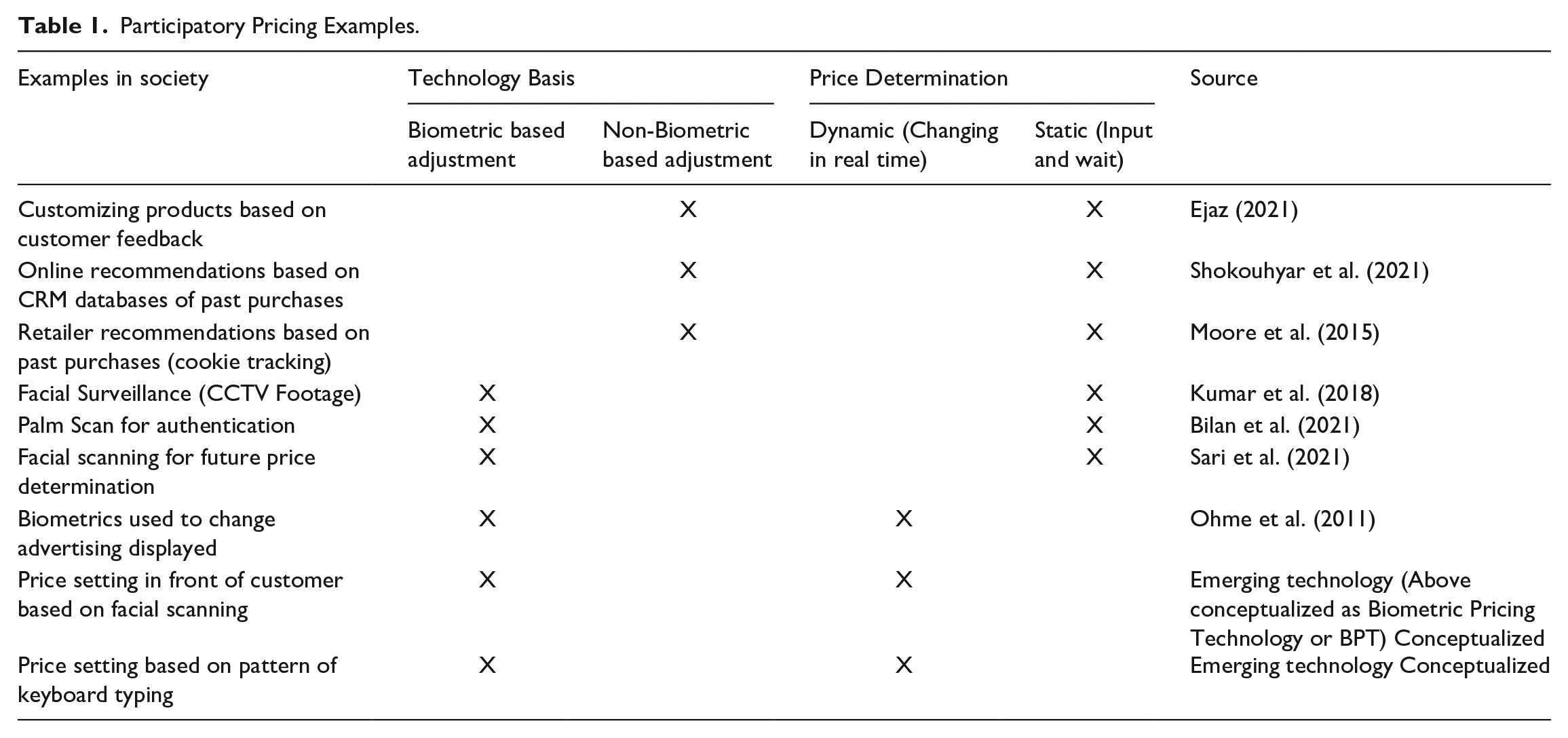
The ability to purchase in this manner could change consumption patterns over time resulting in consumers only purchasing what they want, rather than chasing sales leading to lower conspicuous consumption. However, such a new technology while potentially legal, also raises governance and regulation questions regarding whether such a technology is ethical. Dynamic pricing (changing prices) at farmers markets based on demand while questionably legal, often takes place and is socially acceptable. It is unknown how consumers will respond and perceive a technology changing the price based on who the consumer is and/or what their behaviours are (price discrimination). However, such a technology could emerge and with it raises questions over its governance, public policies and ethics. For example, consumers may want or need to understand how the price is changing before making an informed decision. Table 1 outlines different examples of dynamic versus static biometric technology situations.
Participatory Pricing Examples.
As outlined above there are great benefits to such technology advancements, however, biometric tracking can also trigger a sense of privacy invasion, overwhelm consumers and foster negative or helpless associations (Langenderfer & Linnhoff, 2005). Privacy invasion is the feeling of privacy information being taken from a person, over general privacy concerns, which is the idea of privacy mattering (Dolnicar & Jordaan, 2006; Nissenbaum, 2009). While previously the trade-off of privacy to benefits has been outlined through the privacy paradox (Barnes, 2006), consumers’ response to the potential privacy invasion through the advancements of biometric tracking technology has not yet been explored. It is unknown how the permanency and process of biometric tracking, such as with biometric pricing technology, affects the interaction between privacy and benefits.
This article responds by outlining a typology between the perceived benefits and perceived privacy to predict how in different configurations consumers may respond, and develops a research agenda based on these predicted reactions for future research to consider as the technology and different iterations emerge.
Biometrics and the privacy paradox
Privacy as a topic is hard to define for it is not an objective binary construct, varies from person to person and by the context of situations (Martin, 2019; Nissenbaum, 2009). Many contemporary academics (e.g. Martin, 2019; Massara et al., 2021) base their privacy definitions on the 1890 Warren and Brandeis premise that privacy is an ‘individual’s ability to withhold (or part) of thoughts, sentiments, emotions and expressive works’ (Warren & Brandeis, 1890).
A multitude of surveys show that privacy is a significant attitudinal concern for consumers in the digital age based on operationalizing privacy as a trait (Martin, 2019; Miltgen et al., 2013; Nissenbaum, 2009). Yet, behaviourally, individuals reveal personal information for relatively small rewards, such as to draw the attention of peers in an online social network (Hallam & Zanella, 2017), or to get slightly cheaper movie tickets (Jentzsch et al., 2012). This inconsistency of privacy attitudes and privacy behaviour is the ‘privacy paradox’ (Barnes, 2006). The paradox of revealing information through biometric tracking is beginning to be explored; in a privacy context (Miltgen et al., 2013), with virtual reality (Manis & Choi, 2019) and voice capturing (de Ruyter et al., 2020). However, BPT offers challenges that prior research has not addressed. Specifically, to date no studies address (1) the permanency of participation (e.g. it is hard to change one’s face and other biometrics compared to a password or ID badge) nor (2) the differences between dynamic interactions (real time price changes) and static attribute-based situations and (3) the impacts of these attributes on the privacy-benefits paradox for consumers. Therefore, drawing from the privacy calculation theory (Dinev et al., 2016), we next consider the privacy paradox between privacy and benefits when biometrics technology is introduced to predict behaviours. We will also outline new research considerations for before and after such a technology’s introduction.
Typology of consumer responses to perceived privacy concerns and benefits of biometric pricing technology
Perceived benefits of using online technology can motivate consumers to partake in online profiling systems despite privacy concerns (Campisi, 2013). It is unknown if the same is true with the usage of biometric tracking, where physical attributes are harder to change compared to digital attributes such as an address or citizenship. Privacy calculation theory outlines the consideration of adoption by consumers based on their perception of the benefits they would receive relative to the privacy they would sacrifice in each situation (Baruh & Cemalcılar, 2014. From this perspective, there is a relationship between the perceived benefits obtained and the privacy given up to obtain those benefits. Currently there is no understanding of how consumers feel if and how BPT impacts their privacy, whether there is a sense of privacy invasion, or whether the privacy calculation theory is applicable or not. Insight into how consumers may view biometric tracking as a privacy invasion can be found in the privacy hierarchy of Simmons (1968). This research shows how different types of information are viewed as greater or lesser privacy invasions. Being asked about moral and legal items in a judicial inquiry (e.g. opinions on abortion or amount spent in taxes) are considered a greater invasion of privacy than work items in a personnel inquiry (e.g. time spent at the office), which are perceived as a greater invasion of privacy than physical status items in a medical inquiry (e.g. status of cancer). As biometric tracking is observational, it could be perceived by consumers as a low privacy invasion. However, the implication of permanent biometric tracking is a greater societal issue and therefore might trigger a high level of perceived privacy invasion. As such implications are unknown, we propose a typology of potential outcomes (see Figure 1).
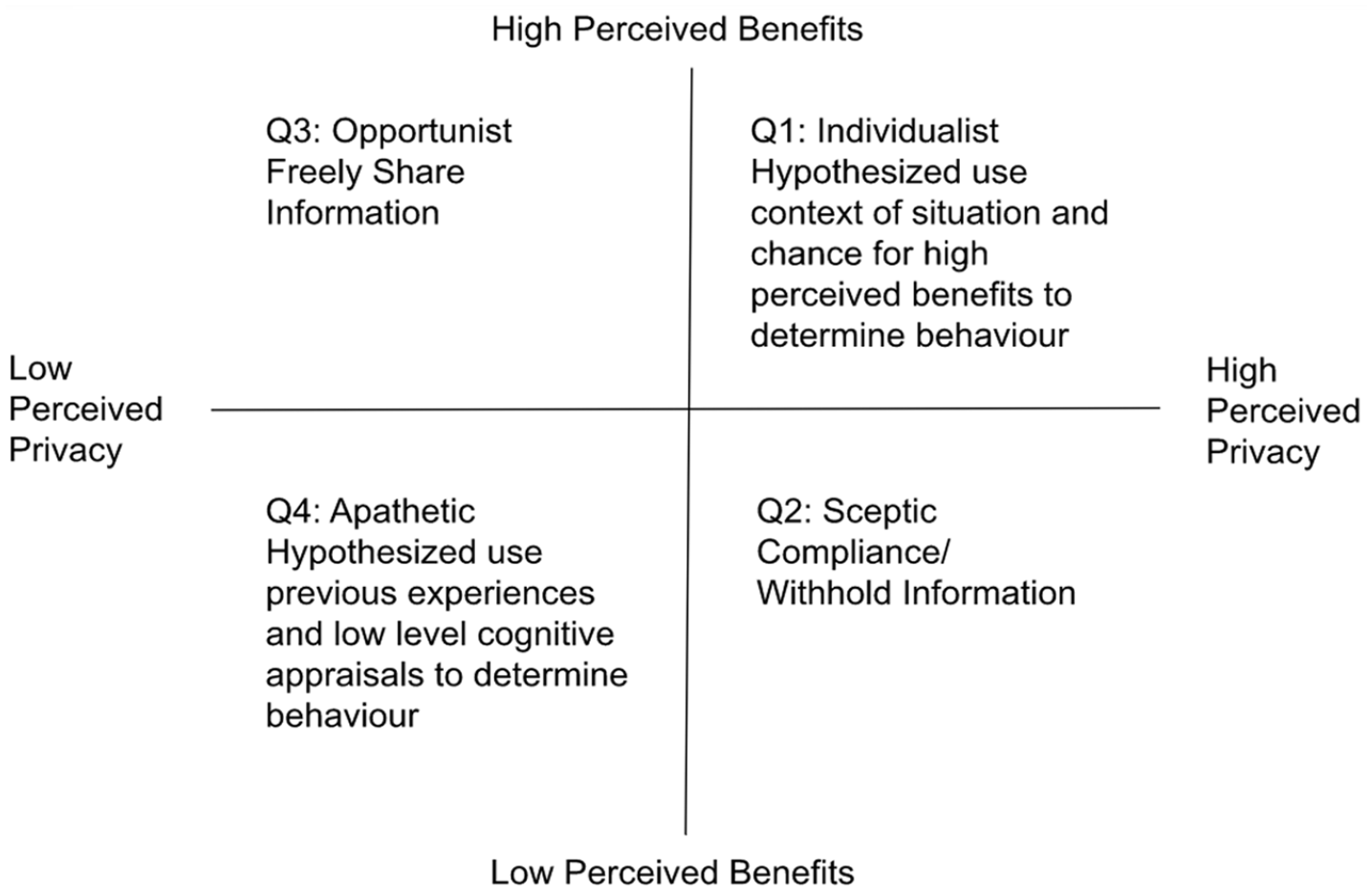
Typology of consumer responses to perceived privacy and benefits with biometric pricing technology.
We predict that consumers who perceive a low benefit from biometric pricing technology relative to a high privacy invasion will engage only as required or forced to. In other words, it is a minimal compliance-based behaviour, or as we term the Sceptic. This would result in withholding biometric information unless required. This contrasts with consumers who perceive a low privacy invasion and high benefit. They will exhibit a free sharing of information and welcome biometric pricing technology (Ayoubi & Thurm, 2020). We term this group the Opportunist, as they see the opportunity for a high level of benefit relative to a low perceived privacy invasion. It is recognized the usage of the word information is incomplete as human data such as pupil dilation or timing to type is also provided. However, in a general context this could all be classified as information. The privacy paradox however, to date, omits two conditions which are relevant for future research on biometric pricing technology: (1) when there is perceived low benefit and low invasion using a technology and (2) when there is perceived high benefit-perceived high privacy invasion. We term the former condition (low benefit-low privacy invasion) as the Apathetic, as the situation does not trigger consideration of either perceived benefits or perceived privacy invasion (Kahneman, 2011), however if better informed could trigger the moving to a different quadrant. Future researchers should address research questions around when the Apathetic condition results in other factors facilitating the sharing of information, such as prior firm experience as shown with offline behaviours (Culnan & Armstrong, 1999), or the conceptual fluency to what is being asked to what is given (Kahneman, 2011) as both have been previously shown to moderate the role of information sharing. In the second scenario (i.e. high benefit-high privacy invasion) we again suggest the same considerations on determining propensity to share information, while highlighting high perceived benefits would encourage ambitious risk-taking behaviour to obtain these perceived benefits. We term this group the Individualist, as they are willing to risk something, that may affect others, to personally gain something. In such circumstances, we expect that perceived benefits would show a stronger relationship to willingness to purchase than privacy concerns and that both moderators (prior experience, conceptual fluency) would just lower the thresholds for sharing information. The more experience with biometric tracking, the lower the threshold of benefits to share information, as no immediate consequences are apparent. Likewise, the higher the complexity in the request, the higher the likelihood to not mentally process the request and simply acquiesce to providing biometric data. Consequently, participation in all four quadrant situations would take place, similar to the original privacy paradox of having a privacy concern but still sharing personal information.
These different created personas and their reactions to privacy being infringed upon are based on the idea that while consumers value privacy in surveys, they will only pay a premium for protecting privacy when presented with an easy means of doing so (Egelman et al., 2013). Likewise, similar to cookie tracking consent, consumers rarely adjust their settings/sharing preferences to achieve privacy (Jentzsch et al., 2012). For example, when asked at the loading of a website to consent to cookie tracking, consumers have been shown to disclose more information before knowing the website’s implications than after (Knijnenburg & Kobsa, 2013), contradicting actions and governance structures to preserve privacy. Consumers interacting with biometric pricing technology then, in general, can be predicted to give up their biometric privacy before learning about the implications of doing so. However, as this technology is only emerging, it is unclear if traditional online tracking and the emerging biometric pricing technology produce the same responses in consumers. Therefore, further research is required for these propositions to be validated.
Development of a biometric research agenda
This typology, however, does not fully address the entire phenomenon of biometric technology usage and how its new introduction might be responded to by consumers. It does not address issues of technology acceptance, profiling consumers of changes to the consumer experience which are all known to influence engagement (Martin, 2019). Further, as Kosinski and Associates (2013) have outlined, discussing new technologies without governance, regulations and the ethics behind their usage is irresponsible. Therefore, we have developed a research agenda on these topics with biometric tracking including biometric pricing technology to stimulate the debate in the scientific field and in society in general.
Consumer technology acceptance of BPT
Our predictions may be limited to the specific biometric pricing technology (BPT) configuration we have imagined. However, the universal nature of the underlying decision-making theory suggests that these predictions could be extended to other kinds of personalization privacy preference interfaces involving biometric tracking. To understand how consumers may respond to biometric pricing technology, future research should first examine how consumers interact and accept biometric tracking technology in general. Are the perceived benefits and privacy implications of BPT recognized and understood?
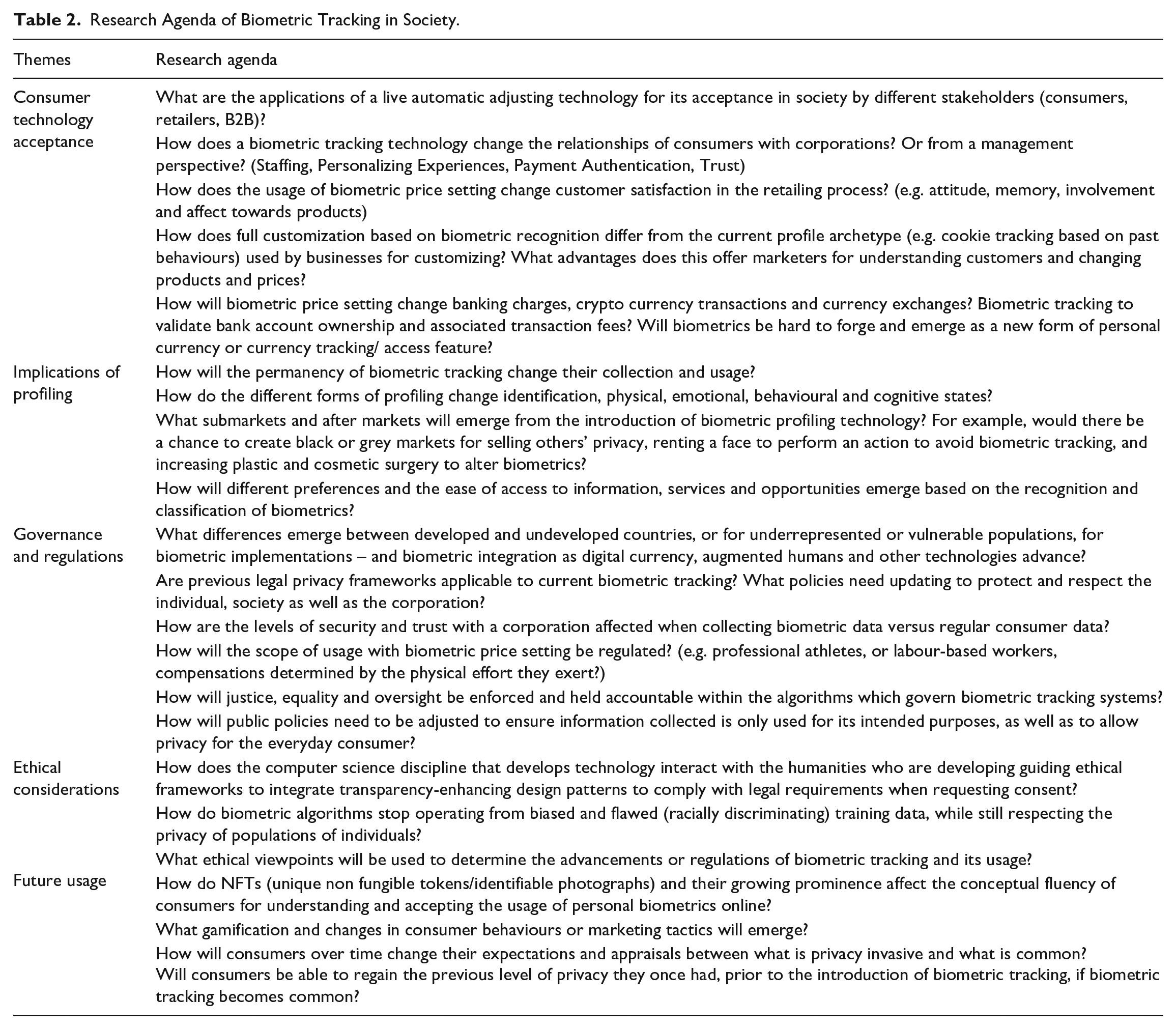
Regarding perceived benefits of technology, a large body of literature has examined the Technology Acceptance Model (TAM) which posits that perceived benefits and perceived ease of use are relevant variables in technology acceptance by users (F. D. Davis et al., 1989). However, restricting the study of BPT to perceived benefits and perceived ease of use of the biometric technology may not be the best determinants for technology acceptance as they miss not only personal privacy but also the privacy of others. Questions relating to technology acceptance as well as the consumer decision process interaction with biometrics are drafted below (see Table 2).
Research Agenda of Biometric Tracking in Society.
Implications of consumer profiling
Collectively grouping biometric data to create archetypes of behaviours that future ‘unknown individual’ consumers can be categorized as, can involve potential bias (training data or algorithms) and be flawed (Hooberman, 2021), which has many implications. These archetype classifications are a current legal work around existing identification legislation which aims to respect the privacy of individuals, such as the GDPR privacy legislation in Europe (Martin, 2019). Rather creating archetypes of consumers still profiles and targets consumers collectively on mass at a personal level. However, the level of profiling consumers and the deterministic nature of such profiling is not understood (Kosinski, 2017) and raises questions around its impact.
Governance and regulations
Biometric price setting has a strong privacy component which may not be understood by the everyday person (Martin, 2019). For consumers, either through passive surveillance from a far, or active interaction to learn about the technology (Zuboff, 2015), in either case it requires giving up one’s biometric privacy in the process (Nissenbaum, 2009), with each interaction providing data to train AI systems to recognize and categorize people better. Such tracking affects individuals’ collective privacy (giving up one’s privacy influences another’s personal privacy) and what legally is referred to as collective action (protecting people from other’s decisions) (H. Zhang & Pan, 2019). Similar to supportive safety measures or collective protective action (such as requiring vaccines), the actions of some influence all parties. No longer is personally unsubscribing enough to stop being biometrically profiled. Therefore, governance and regulations around such a technology’s usage should be considered at a larger scale level than individual organizations.
Ethical considerations
The examination of governance structures involves questions regarding what ethical structure, perspective or focus should be utilized (Foucault, 2019). Who and what should determine how we approach the evaluation and redrafting of such governance structures (Mittelstadt & Floridi, 2016)? We recommend that discussions of the ethical implications of BPT are presented in marketing journals. The introduction of ethical questions inside a marketing journal attempts to avoid the danger of business biometrics ethics as an academic discipline being leapfrogged not only by practice, as is currently taking place (Peters, 2020), but by other disciplines such as information management, computer science and online gaming (Gandomi & Haider, 2015). In other words, rather than publishing in academic outlets related to ethics and waiting for this research to permeate out to marketing journals, biometric ethics should be directly discussed in marketing outlets to ensure a timely discussion that can inform marketing thought and practice. Therefore, ethical questions around biometric tracking are also outlined in Table 2.
Future usage
Lastly, as biometric price setting is an emerging technology, it is unclear the repercussions to society over time. Based on the authors’ current understanding, expected future usage of biometrics, consideration-based questions have been added to the research agenda of how to explore this technology. Building on Fogg’s (2009) writing on persuasive system designing, over time biometric tracking could become normalized. For example, carrying a GPS emotional tracking device which reads your thumbprint and face sounds invasive. Yet, a mobile phone with these capabilities and many helpful applications has not only been welcomed, we pay to power and protect it. How biometric tracking, and specifically biometric pricing technology will be adapted and accepted by consumers, marketers and other stakeholders is unclear. Yet, it may be that the perceived benefits of BPT result in consumers valuing the benefits of BPT in a way where the use of the technology is normalized (see Table 2).
Conclusion
The aim of this paper is to present a research agenda that focuses on, and directs future considerations towards, intended and unintended usage of biometric tracking and specifically, the envisioned biometric pricing technology (BPT). We outline the importance of researching such a topic, providing numerous examples of how biometric tracking can have beneficial and negative consequences. The paper also sheds light on the permanence of biometric tracking, as once recorded, the information is digitally stored indefinitely, thus increasing the urgency of comprehending it before its mass harvesting deployment. This led into how the perceived benefits relative to the privacy invasion felt by consumers would guide their response to such a technology, with propositions presented regarding their different responses to high or low benefits and invasion. Finally, the paper outlines a comprehensive research agenda to guide empirical and theoretical investigations into the usage of biometric tracking from a marketing perspective, including its usage and acceptance, regulations, governance, and future utilization. As biometric technology continues to transverse the parapet and becomes an increasing feature in our lives, we hope the presented research offers scholars, managers and public policy makers new perspectives, considerations and insights for future research in this exciting area.
Footnotes
Declaration of conflicting interests
The author(s) declared no potential conflicts of interest with respect to the research, authorship, and/or publication of this article.
Funding
The author(s) disclosed receipt of the following financial support for the research, authorship, and/or publication of this article: The primary author holds an Australian Research and Training Scholarship for their doctoral thesis on biometric acceptance in consumer settings. Otherwise, the authors received no financial support for this specific research, authorship, and/or publication of this article.
