



Abstract
In recent decades, policymakers have advanced cultural policies aimed at spurring the economic value and employment growth of cultural and creative industries. The Australian government's 2023 cultural policy, Revive, refers to ‘artists as workers’ and champions the ‘centrality of the artist’ in Australian culture. But a closer examination of the conditions of cultural work yields a gloomy perspective on Australian cultural labour markets. This paper collates and analyses Australian Bureau of Statistics employment data to show that cultural work in Australia is poorly paid, unequal, insecure and precarious. Adopting a political economy analysis, we argue that social, cultural and industry policy settings favour large firms at the expense of artists and cultural workers. In response, we propose a number of policy interventions. It is possible to re-imagine a world of cultural work in which strong cultural, social and employment protections allow artists and cultural workers a dignified creative life.
Introduction
There are a range of ways in which artists and workers in culture can be conceptualised. Essayists and philosophers of art have been interested in artists as creators of symbolic material works (Kant et al., 2000; Rancière, 2004; Winckelmann, 2006), while historians and sociologists have recognised the importance of associated labour in the arts, such as gallery workers, stage crew, printers and printmakers, and film crew (Becker, 2008; Thornton, 2008; Wolff, 2021). In recent years, scholars have undertaken detailed studies of the labour conditions of cultural workforces such as performing arts crews (Kielich, 2021), television workers (Hesmondhalgh & Baker, 2008), sound engineers (Watson & Ward, 2013) and artists themselves (Luckman & Taylor, 2024).Workers in cultural industries, and their social scenes, have also frequently inspired the subject matter of art itself, from Balzac's exploration of the Parisian magazine scene in Lost Illusions, to the 2024 Hollywood comedy about stunt performers, The Fall Guy (Balzac, 2020; Leitch, 2024).
Policymakers have also paid increasing attention to cultural workers in recent years. In Australia, the federal government's 2023 national cultural policy, Revive, specifically refers to ‘artists as workers’, and the federal funding agency for the arts, Creative Australia, has recently set up a dedicated office for ‘Creative Workplaces’ (Australian Government, 2023).
This raises the problem of how to define what is and is not creative arts or cultural work, with scholars and policymakers drawing up lists of cultural and creative job titles and industries, in an attempt to quantify employment types and job numbers across a range of different artistic, cultural and creative industries (CCIs) and occupations. The Australian government, and its arms-length arts funding agency Creative Australia, have adopted McCutcheon and Cunningham's expansive definition of cultural and creative work, claiming that ‘in 2021, the creative economy provided employment to 714,632 people in Australia’ (McCutcheon & Cunningham, 2023). This is characteristic of a broader acceptance of ‘creative industries’ frameworks of culture by policymakers, which has been a key influence on the formulation of cultural policy in Australia since the late 1990s. The current Australian government definition of ‘cultural and creative activity’ (Bureau of Communications and Arts Research, 2018) relies on a classification that is contested by some artists and creative industries bodies, and includes software coders, web developers, advertising and marketing executives, town planners and architects. Conceptualising the creative workforce as large, growing and economically prosperous has skewed the cultural policy debate (O’Connor, 2024). It has led to a greater recognition of the economic value of the sector, influencing policymakers to invest more to support the development of the creative industries, but without asking too many questions about the quality of the work being measured (Carey et al., 2023; Virani, 2024).
A closer examination of the actual conditions of cultural work yields a gloomier perspective on the performance of the Australian cultural labour market. One of the key criticisms of the expansion of the popularisation of ‘the creative industries’ in policy narratives has been their contribution to ongoing insecurity and precarity of the cultural labour market (Brook et al., 2020; Comunian & England, 2020; Gross & Musgrave, 2020; Schlesinger, 2019). The International Labour Organization (ILO) has found that creative workers are most likely to experience precarious employment than those in other sectors (Galian et al., 2021). The ‘gig economy’ – famously named after the performing arts sector – has always been a chief mode of employment for many artists and creative workers, and the term has risen to prominence as the self-employment model of contracting labour has been exploited by platform firms in the transport, food and labour hire sectors (Fairwork, 2021; Stamford, 2017). Cultural workers are also subject to platformisation, whether it be graphic designers advertising for jobs on Upwork or Fiverr, or independent musicians and authors taking their chances on Spotify or Amazon.
As the rise of platform gig work attests, cultural labour market conditions are highly impacted by digitalisation, with tech platforms amassing considerable market power over cultural workers and artists (Doctorow & Giblin, 2022). The contractual imbalance between large technology corporations and individual artists makes it difficult for artists to monetise their intellectual property rights, which can lead to further precarious conditions for creative workers (Gu et al., 2022). The looming spectre of artificial intelligence models that can generate synthetic music, writing and art suggests a further wave of technology-driven disruption is underway (Bender, 2024). All of these trends have combined to disadvantage the conditions of artists and cultural workers. However, with the important exception of the long-running survey of Australian artists by Throsby and his collaborators (Throsby & Petetskaya, 2017, 2024; Throsby & Zednik, 2010), there has been relatively little quantitative research published on the scale and characteristics of insecure work in culture in Australia.
This paper asks how the neoliberalisation of cultural policy, with its predominant emphasis on the economic benefits of culture, diverts attention from cultural policy directed at cultural and social objectives. Using Australia as a case study, we examine available quantitative statistics on the Australian cultural labour market, as a way of describing and problematising the current policy landscape that cultural workers must navigate. Drawing on the political economy of the CCIs in Australia, in which any policy intervention must countervail against powerful structural forces stacked against the interests of individual artists and workers, we argue that current policy settings, while framed as offering positive economic impact and job creation, often ignore the industrial wages and conditions and social protections of artists and cultural workers. Instead of integrating cultural values into public services, policies based on the measurement of the economic value of culture can result in the undervaluing of the social and intrinsic benefits of cultural work, and the ongoing insecurity and precarity of artists and workers.
Precarity in cultural work in Australia
Precarious employment refers to work that is unstable, insecure and lacks employment benefits and protections, involving situations where individual workers have little job security, limited access to welfare benefits, and unpredictable working conditions (Kalleberg, 2009; Standing, 2011). Precarious employment may take various forms, such as temporary, part-time, freelance, casual or short-term contracts. According to Kreshpaj et al. (2020), key dimensions of precarious employment include employment insecurity, income inequality and lack of employment benefits. In Australia, the typical modes of precarious employment are ‘casual’ engagement, where workers are employed on an ‘as-needs’ or ‘hour to hour’ basis (Markey & McIvor, 2018), and ‘sole traders’, who are paid fees for services under Australian law as one-person microbusinesses with an Australian Business Number (McKeown, 2018). Freelancers are often legally considered to be contractors, not employees: in Australia, most of the so-called ‘National Employment Standards’ mandated by the 2009 Fair Work Act do not apply to independent contractors (Fair Work Ombudsman, 2024). Such workers are not protected by industrial regulations such as minimum wages or mandatory employment conditions.
While precarious employment is rife across the economy, there are specific manifestations of employment insecurity in the creative industries, due to industry dynamics and the nature of the work (Menger, 2001). Firstly, much of the work in the creative industries, such as film production, graphic design, media work and advertising, is temporary and project based (Gill, 2010). Cultural production is time-sensitive and firms must assemble complex, sequenced supply chains composed of many different types of labour (Caves, 2000). Many creatives in the sector, such as graphic designers, musicians, writers and photographers, work on a freelance or ‘gig work’ basis: they are paid a single fee for a single service, such as designing a graphic or writing an article. While this working model offers flexibility, it can lead to income instability, job insecurity and limited access to benefits (Comunian & England, 2020; Townley et al. 2009). Secondly, artists and cultural workers within the creative industries often embrace a freelance culture driven by creative freedom and passion (Abbing, 2008). This becomes amplified when artists and cultural workers are engaging with communities in practices where relationships and collaborative processes are key elements of production (Badham, 2019; Belfiore, 2022). Many artists and cultural workers are deeply committed to making art and culture as an aspect of their personal identity. This enthusiasm can be exploited by employers, leading to acceptance of precarious working conditions in the pursuit of fulfilling creative aspirations (Bille et al., 2017; Gu, 2023). Thirdly, creative work, especially in media and digital production, can be outsourced globally, resulting in higher competition in the local labour market, elevating job insecurity. With a large pool of talented individuals vying for limited opportunities, workers may accept precarious conditions in the hopes of establishing themselves or maintaining a foothold in the industry (Hesmondhalgh & Baker, 2013).
The insecurity that flows from these work patterns has negative impacts on artists and workers. As they bounce between short-term gigs, typically in project-based work, they experience repeated periods of unemployment between jobs, making financial planning challenging and reducing their ability to support themselves and their families. Precarity also has very real emotional and psychological psychological consequences (Alacovska, 2022; Standing, 2011).
The Australian cultural labour market is fragmented, insecure and precarious
Despite the Australian government's recent ambitions to treat ‘artists as workers’, surprisingly little quantitative research has been published into the nature and conditions of the Australian cultural labour market (McQuilten et al., 2025). In the following, we draw on public-source employment statistics to explore some of the evidence that points to the structural inequalities in the Australian creative economy; some of this data has been previously presented in a working paper by Eltham & OConnor (2024). We use Australian Bureau of Statistics Census and labour market data on employment patterns, wage levels and job security within the cultural sector, analysed from an adapted model of ‘precarious labour’ developed by Kreshpaj et al. (2020). This provides a descriptive foundation to help understand the scale of precarious cultural employment in Australia.
Firstly, it is important to note that existing policy definitions of the cultural labour market used by Australian policymakers are not fit for purpose. The figure of 714,632 workers used by Creative Australia, drawing on the work of McCutcheon and Cunningham, is implausibly large. It includes large numbers of workers in industries such as information technology, finance and construction, thus obscuring analysis of finer-grained and more variegated conditions for cultural workers in cultural industries.
Instead, and drawing on a previous working paper (Eltham & O’Connor, 2024), we have adopted the Australian Bureau of Statistics’ (ABS) definition of cultural work first analysed in 2011 (ABS, 2012). We built a dataset of cultural workers based on their participation in 34 industry sub-sectors categorised by the Australian and New Zealand Standard Industry Classifications (ABS, 2013), across three broad categories of ‘heritage’, ‘arts’ and ‘other culture’, grouped together to measure Australia's cultural industries. There were 367,335 workers in these ABS-defined cultural industries at the August 2021 Census. Using the same dataset, there were also 347,007 Australians working in occupations defined by the ABS as ‘cultural’. 1 Accordingly, when compared against other industrial sectors, culture is one of the smaller sectors of the labour force (see Figure 1). If we drill down to examine which individual industries cultural workers are employed in, the most important sub-sectors of cultural industries employment are ‘Architectural Services’ (47,100) and ‘Advertising’ (42,100), followed by ‘Religious Services’ (32,000), ‘Other Specialised Design Services’ (29,200) and ‘Creative Artists, Musicians, Writers and Performers’ (24,400). Many cultural industries are surprisingly small. Performing arts venue operation, book publishing, zoological and botanical gardens operation and internet publishing and broadcasting each employed fewer than 5000 workers in Australia in 2021.
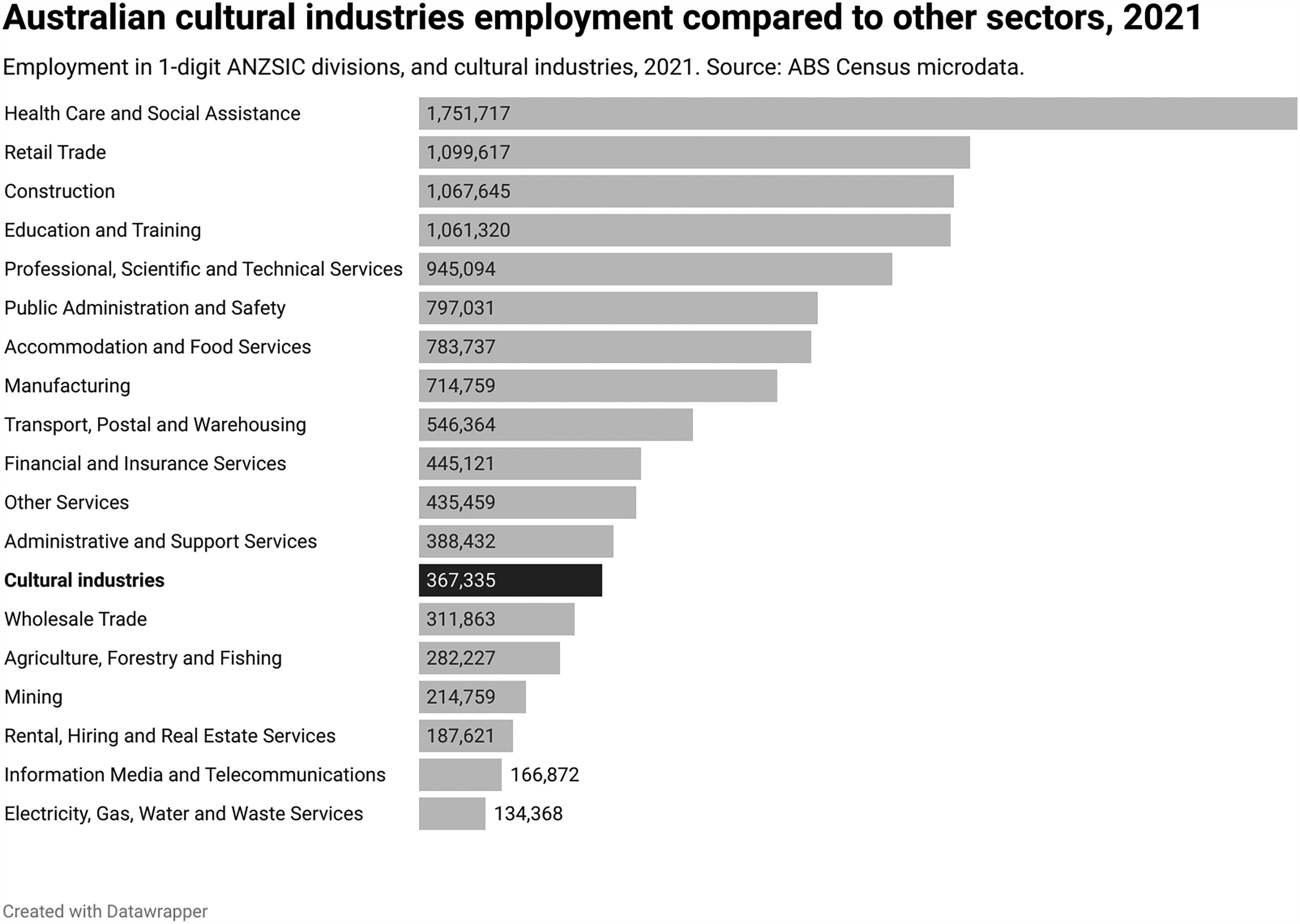
Employment in Australian cultural industries compared to employment in other top-level industry sectors of employment, 2021. Source: Australian Bureau of Statistics Census microdata.
The Census data shows that employment growth in the cultural industries in recent years has grown more slowly than both the Australian labour force and overall Australian employment. Overall, cultural industries employment added a modest 21,700 jobs in the period 2011–2021, a growth of just 6.5% over 10 years or 0.65% per annum. This was far below the growth in the overall Australian labour market, which added 2.7 million jobs in the decade, growing by 30.3%. As a result, cultural employment is declining as a percentage of all Australian jobs. Jobs growth is patchy or negative in some industries and occupations; there has been a substantial degree of deindustrialisation in sub-sectors such as print and video store retailing. Printing declined from 37,500 jobs in 2006 to 22,400 jobs in 2021, newspaper publishing declined from 26,600 to 9800 in the same period, and jobs in video stores almost disappeared.
Australian artists have below-median incomes on average. The median weekly income band for the ABS category of ‘Creative Artists, Writers, Musicians and Performers’ in 2021 was $800–999, while the median income band for the broader Australian labour force was $1000–1249. When we consider workers in the cultural industries and cultural occupations more broadly, median incomes are more closely aligned with the overall labour force medians, with some important variability within the cultural workforce between above-median wage sectors like architecture, advertising and design, and below-median wage sectors such as the performing arts and cultural retail.
The bubble chart presented in Figure 2 plots workers’ incomes in cultural industries according to median weekly income bands, against the size of each industry's workforce. The two large industries of advertising and architecture employ significant numbers of workers at above-median incomes. An important band of cultural workers in museums, printing and design are employed in industries in line with median employment income for the broader labour force. There is an identifiable group of cultural workers with low or very low incomes, especially in cultural retail categories such as entertainment media retailing, book retailing and cinema exhibition workers. Artists, writers and performers also have below-median weekly incomes (see Figure 2).
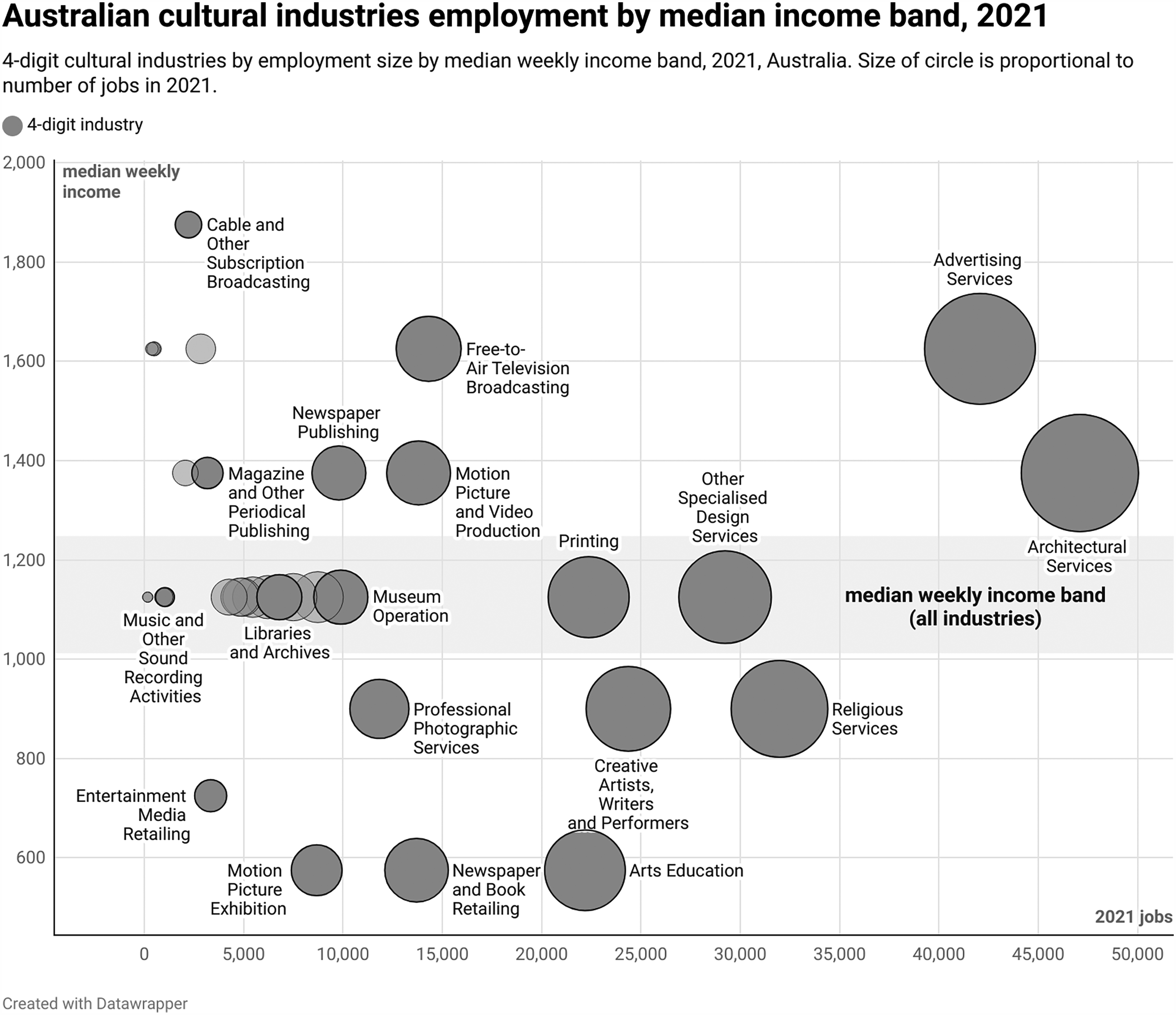
Median income bands of workers in cultural industries, by number of jobs in each industry, 2021. Source: Australian Bureau of Statistics Census microdata.
The ABS data also suggests that cultural workers suffer from considerable income inequality. One way of measuring income inequality is by comparing the incomes of top and bottom deciles, a so-called ‘P90/P10’ analysis (Burkhauser et al., 2009). Comparing P90 and P10 median incomes for Australian workers in a range of industry categories, workers in the cultural industries have relatively low incomes at the bottom of the distribution, with median incomes of $225 a week for the bottom 10% of workers (the P10) in 2021. In contrast, the median income in the bottom decile of workers across all industries in the Australian labour force was $345. The median income for workers in the top decile (the 90th percentile) of the cultural industries was $2495 a week, compared to $2825 for workers across all industries in the labour force. This suggests that employment incomes in the cultural industries are quite unequal, with a P90/P10 ratio of 11.1, compared to a ratio of 8.2 for the broader Australian labour force. Compared to other industry categories, and using the P90/P10 ratio, workers in the cultural industries are very income unequal: amongst comparable ‘1-digit’ industry divisions, only agriculture, accommodation and food services, and retail trade have higher P90/P10 ratios (Figure 3).
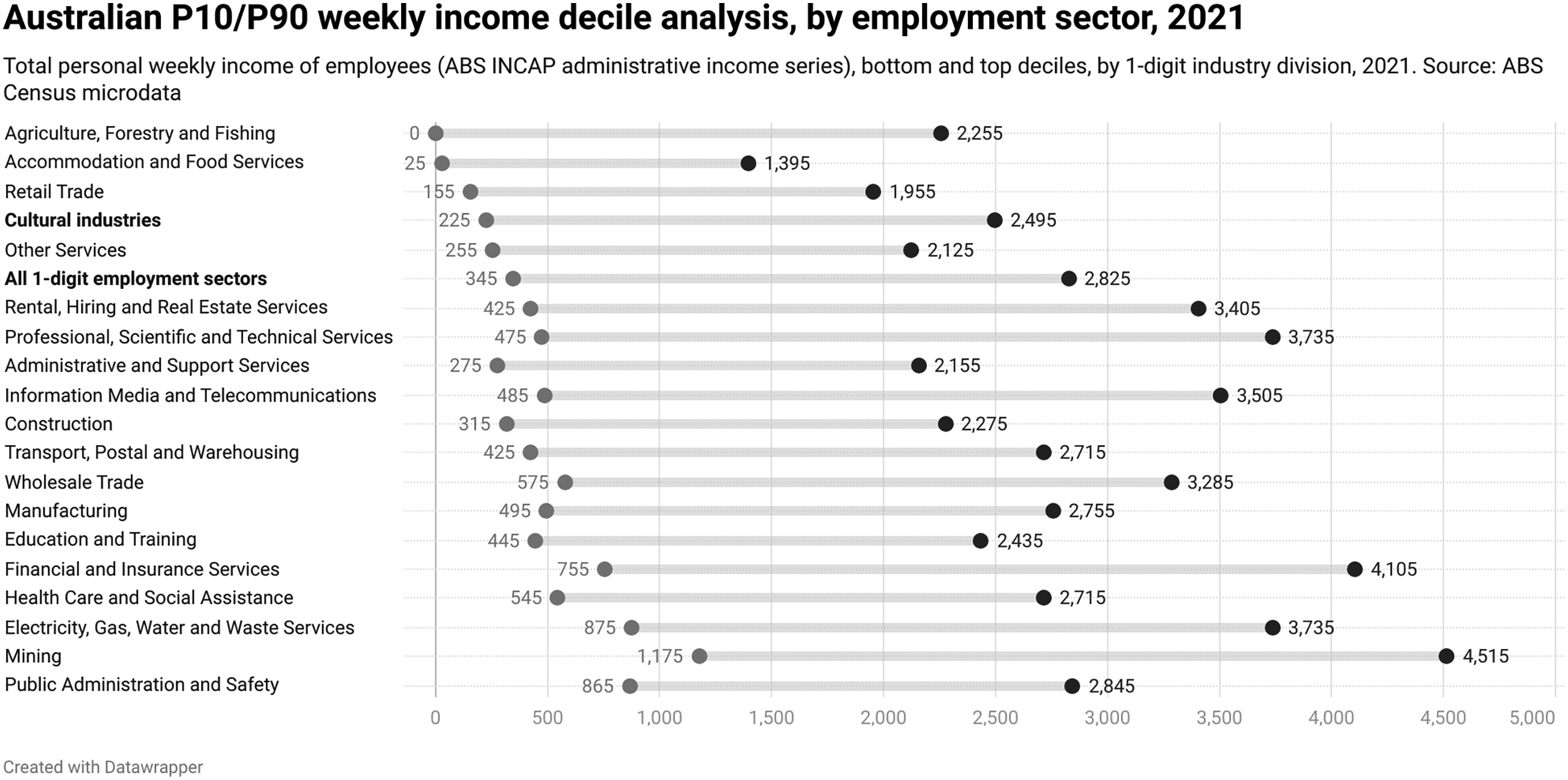
Australian P10/P90 weekly income decile analysis, by sector of employment, 2021. Source: Australian Bureau of Statistics Census microdata.
While there is no ‘accepted’ way of measuring insecure employment using Australian employment statistics, at least two useful proxies are available that measure access to social protections: receipt of leave entitlements, and type of employment contract. Figure 4 compares the percentage of workers receiving paid leave within a series of industry of employment categories. Fewer cultural workers and artists receive paid leave entitlements compared to the overall Australian labour force. The average for workers across all Australian industries is 64.4% entitled to paid leave, with 18.7% not entitled to paid leave and 17.0% classed as ‘not employees’ (in other words, contractors, sole-traders and gig workers). Workers in the broadest aggregate of cultural industries had 56.9% entitled to paid leave, with 19.3% not entitled to paid leave and 23.8% not employees. If we drill down to specific sub-sectors of the cultural industries, these figures for paid leave entitlements skew further negative: in the ‘Arts & Recreation Services’ industry sub-category, paid leave entitlements are in the minority at 45.2%, with 32.0% not entitled to paid leave and 22.7% not employees. In the ‘Creative & Performing Arts Activities’ industry sub-category, just 20.5% of workers are entitled to paid leave. Using this measure, cultural industries workers are more insecure than workers in most (but not all) Australian industries, and more insecure than the average across the Australian labour force.
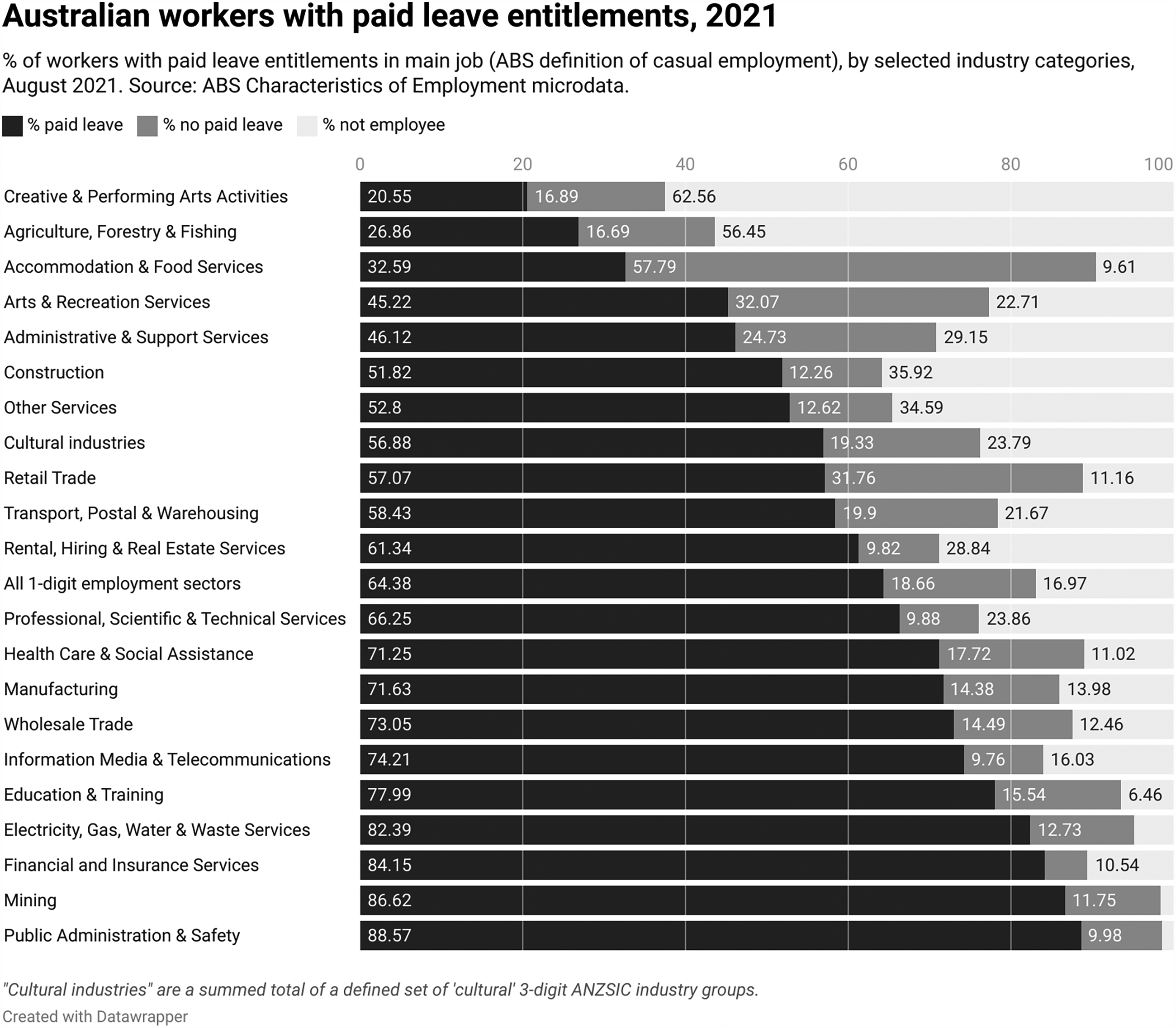
Comparing the proportion of workers with: paid leave entitlements; no paid leave entitlements; and who are not employees across different industry categories, Australia, 2021. Source: Australian Bureau of Statistics Census microdata.
As argued above, independent contracting is a typical working pattern, corresponding to gig work, for many workers in the Australian cultural sector. Figure 5 compares the percentage of independent contractors in a number of industry categories. Cultural industries workers have a higher rate of independent contracting than the border labour force: 12.1% of workers are independent contractors, with 12.3% classed as ‘other business operators’, compared with just 7.7% independent contractors for the labour force across all industries. In specific sub-categories of cultural work, this figure is much higher. The ‘Creative & Performing Arts Activities’ employment sub-category has very high levels of independent contractors, at 37.1%, with another 27.1% classed as other business operators. This points to the intense levels of freelance working arrangements in core cultural labour forces, such as the performing and visual arts.
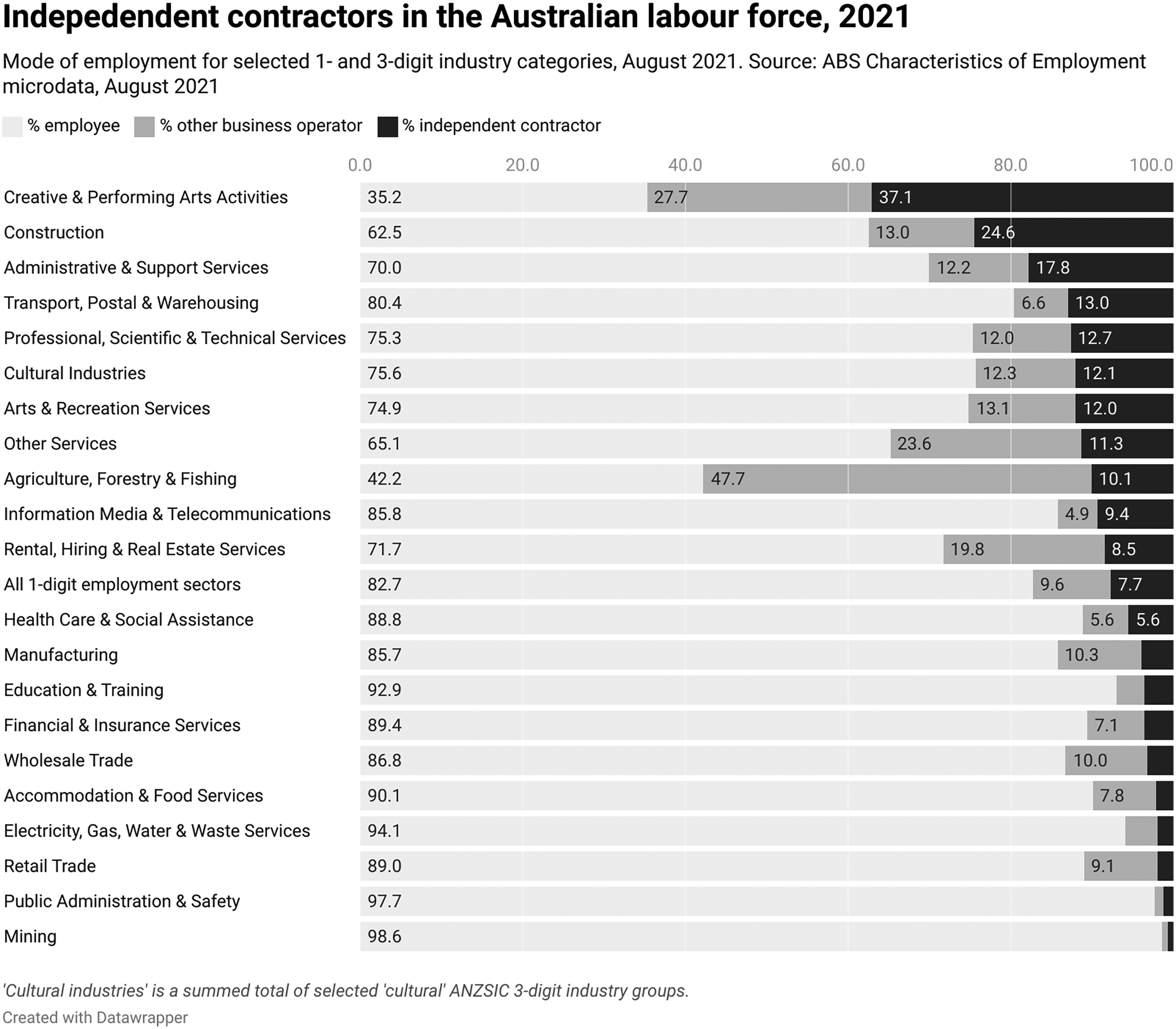
Comparing mode of employment for selected industry of employment categories, independent contracts, other business operators and traditional employees, 2021. Source: Australian Bureau of Statistics Characteristics of Employment microdata.
Another recognised characteristic of insecure work is low worker power, particularly where there is little union organisation (Vandaele, 2018). Available data for union density in Australia also shows low levels of worker organisation for the cultural labour force. Figure 6 expresses union density in various categories of industry of employment of workers. Notoriously, union density in the Australian workforce is low and declining (Bishop & Chan, 2019), with ABS data showing that only 11.7% of workers across all industries belonged to a union in August 2022. But union density is even lower for the cultural industries, with just 9.5% of workers belonging to a union. The industry sub-category of ‘Arts and Recreation Services’, a subset of the broader cultural industries labour force, is slightly higher at 12.3%; this likely reflects the relatively strong union density in the gaming and casinos sector. Low union densities make it difficult for unions to exert significant labour power when negotiating with business owners. Cultural unions also face the difficulty of reaching and recruiting a highly fragmented labour force.
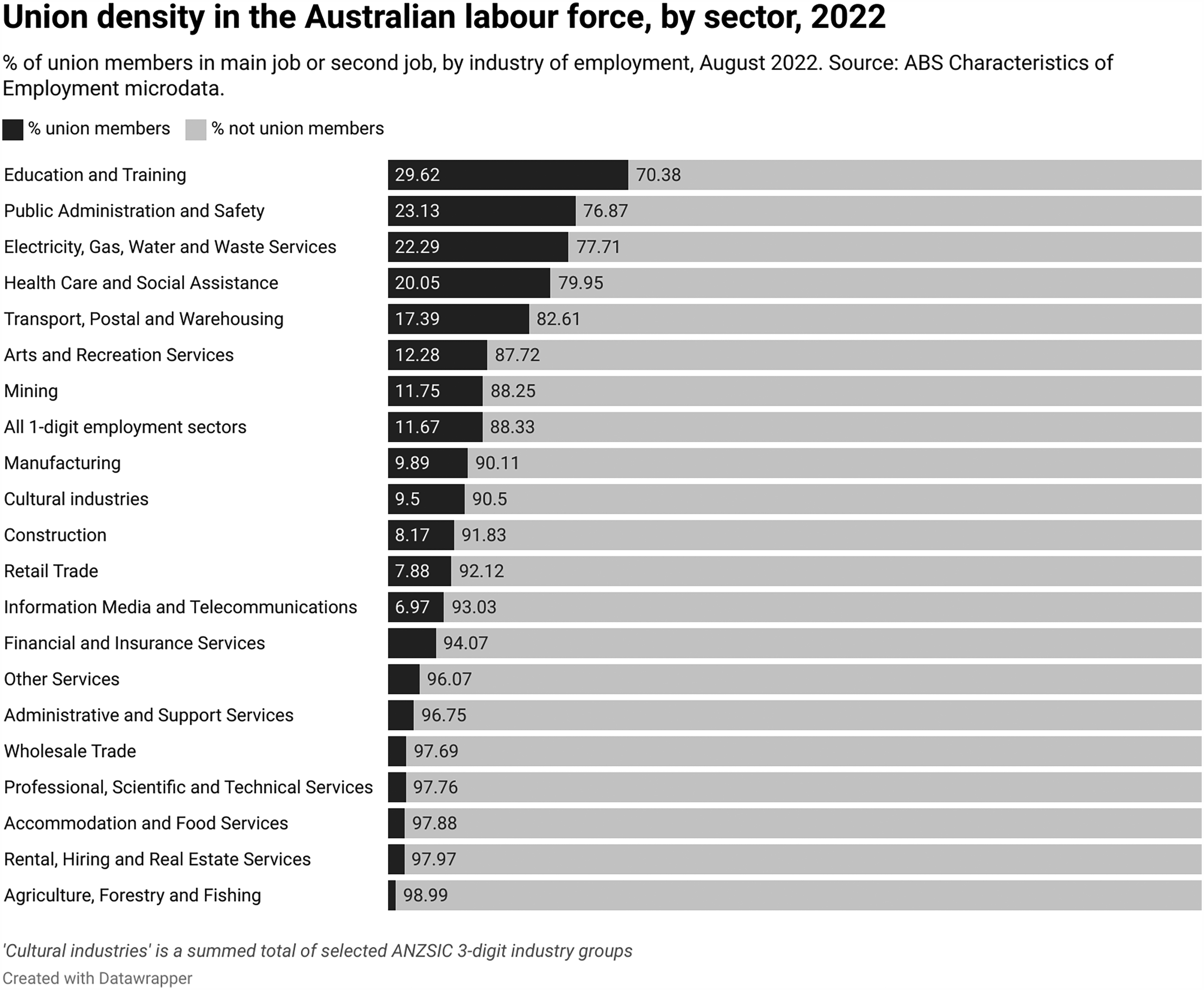
Union density in the Australian labour force, by sector of employment, 2022. Source: Australian Bureau of Statistics Characteristics of Employment microdata.
Analysing precarious cultural work in Australia: A political economy frame
The data we have presented suggest that workers in Australian culture show quite distinct socio-economic characteristics. Cultural work in Australia is insecure, fragmented and piecemeal. Cultural workers are considerably more insecure than the broader Australian labour force. Their wages are lower, and their income inequality is higher. They have higher proportions of independent contractors and lower proportions of workers with employment entitlements than the labour force as a whole. They have low union density, which suggests they have little labour power (consistent with their lower-than-median wages).
Applying a political economy frame helps us understand why precarious conditions of cultural work are a consequence of the structural disadvantages Australian cultural workers face. As noted, there is little worker organisation. As the ABS data examined above shows, the legal structure of much cultural work is freelance contracting, which puts workers at an intense personal disadvantage when negotiating pay and conditions. Outside the large public sector cultural organisations, there are few enterprise negotiations between workers and firms in the CCIs. This is likely to depress the wages and conditions of cultural workers, as enterprise bargaining is the primary legal means for collective bargaining under Australia's Fair Work Act (Pennington, 2018). Despite some small strikes at broadcasters Nine and the ABC, there has been little industrial action by cultural workers in recent years; unlike in the United States, the screen industry workforce in Australia is far less collectivised and there has been no equivalent to the long writers’ and actors’ strike in Hollywood in 2023.
Nor have Australian artists or cultural workers been able to marshal much political power. Australian artist lobbies are typically organised around particular artistic disciplines, sometimes also called ‘peak bodies’. They are important for networking and education, but are underfunded and relatively small in comparison to more muscular industry lobbies, such as those representing the tech sector. The most effective body in recent years has been the National Association for the Visual Arts, which has intervened in important ways in the policy discussion for visual artists through the introduction of a revised Code of Practice for the visual arts sector and collaboration on national scholarly research (McQuilten & Powell, 2025). Other artist lobbies, such as the Australian Society of Authors, the Australian Writers’ Guild, Theatre Network Australia and AusDance, are similarly hamstrung by limited resources allocated to support a large and diverse membership. These various artists lobbies have historically not coordinated their efforts particularly well, and there is still no unified artists’ lobby group with a permanent presence in Canberra. In contrast, large corporations in the tech and media sector have sophisticated and highly resourced lobbying outfits that are easily able to access and influence politicians and senior bureaucrats.
Cultural labour precarity as a reflection of a neoliberalised policy landscape
Australia has relatively neoliberalised social and economic policy settings, the result of a generation of liberalisation that began in the 1980s under the Labor governments of Bob Hawke and Paul Keating, which floated the Australian dollar, dramatically lowered tariffs and trade barriers, means-tested social benefits and imposed wage restraint on workers via a Wages and Prices Accord (Castles, 2001; Humphrys, 2019; Pusey, 1991; Quiggin, 1999). In the 1990s, the Liberal-National government of John Howard restructured labour laws and industrial relations regulations in favour of employers, penalising unions and making it legally difficult to take strike action (Forsyth & Stewart, 2009). Howard was a particular supporter of what came to be known as ‘independent contractors’ – small businesspeople operating in one-person firms who earned income via contracting fees for services (McKeown, 2016; Minter, 2017). By the early 2000s, the ‘sole trader’ had become a common legal structure of remuneration for many artists.
Australian cultural policy itself was also inevitably influenced by the prevailing neoliberalist policy climate. The Keating government's ‘Creative Nation’ policy stated that its goal was to ‘increase the comfort and enjoyment of Australian life’ (Australian Government, 1994), but also embraced the idea that culture was an important part of the economy. The rise of concepts like ‘the Creative Trident’ (Cunningham, 2014) and the increasingly sophisticated attempt by Australian policymakers to measure cultural and creative employment in the 2010s (Australian Bureau of Statistics, 2014) both reflect a focus on economic benefit that has come to dominate the Australian cultural policy framework. This neoliberal emphasis to cultural policy since the 1990s has meant that few policymakers have concerned themselves with addressing the prevalence of freelance and contract-based work – rather, such work patterns were championed as innovations and flexibilities that helped consumers and enabled workers to earn extra income (see Wells et al., 2023, for such justifications around Uber). Policymakers took little issue with cultural workers prioritising commercially viable projects over socially meaningful work, and were correspondingly little concerned with seeking to redistribute economic outcomes or promote diversity of cultural expression (Luckman, 2017; Virani, 2024). In the 2000s and 2010s, most of the Australian states and territories developed explicit creative industries policies with goals to promote the growth of the CCIs (Cunningham, 2014). Such initiatives made much of the economic growth opportunities supposedly promised by creative industries, but paid relatively little attention to the low pay, poor conditions and rampant insecurity of much of the work in culture (Queensland Government, 2004).
One way in which neoliberalising cultural policy made itself felt at street level was in the way that it encouraged – or even forced – arts organisations and artists to adopt an entrepreneurial mindset, diversifying revenue streams through sponsorship, ticket sales and merchandise (Meyrick et al., 2018). Cultural organisations were encouraged by funding agencies to develop business plans and appoint corporate executives to their boards (Glow et al., 2019). Funding bodies also gave less direct funding to artists as a proportion of total funding outlays, with grant pools for artists to make new work dwindling in comparison to funding to support larger cultural institutions (Eltham & Verhoeven, 2018). Many arts organisations also found their mission and values subtly diverted, as pro-business managers and board members strove to pay for the production of art with money-making exercises such as gift shops, venue bars and merchandising (Rentschler, 2014). Another consequence was the erosion of support for creative initiatives that provide intangible social benefits, such as programmes aimed at promoting participation, diversity and capacity building. As a result, neoliberalising policy settings have entrenched an economistic and growth-oriented logic of cultural policy making in Australia. We explore further dimensions of this paradigm below.
Global cultural corporations take advantage of neoliberal cultural policy settings
As described above, individual artists and cultural workers suffer from a relatively weak position in cultural labour markets. In contrast, the position of capital in terms of culture – such as the power of cultural corporations – is comparatively strong. The commanding heights of the Australian cultural economy are occupied mostly by foreign multinationals, particularly in the tech sector, who are only minimally regulated by Australian laws or policies. Attempts by successive national governments to regulate the US social media giants have largely ended in failure, with Facebook pulling out of the news media bargaining code and Twitter/X successfully challenging the Australian eSafety Commissioner's jurisdiction in the Federal Court (Dawkins, 2024; Leaver, 2021). Screen production subsidies in Australia are another example of cultural funding that is largely constructed around assistance to firms, rather than artists or workers. At roughly $AU672 million a year, the Australian Screen and Digital Game Production Incentive is more than twice the value of annual Creative Australia funding, but unlike Creative Australia funding, which reaches many individual artists and small cultural organisations, screen production subsidies flow overwhelmingly to companies such as domestic film producers and Hollywood studios, in the form of production offsets and location incentives for shooting productions in Australia (Lotz et al., 2024).
The neoliberal emphasis on market efficiency and the framing of competition policy around low prices for consumers have also led to the concentration of market power within a few major corporations in Australia. As Margaret Simons (2007) convincingly argued, Australia's ‘old media’ landscape has long been controlled by major commercial television broadcasting and print publishing companies like Nine Entertainment, Seven West Media and News Corporation. This concentration creates a chokehold on cultural production and distribution; it can also influence public opinion, aligning them with corporate interests rather than public voices (Carson, 2014; Simons, 2007). Meanwhile, in the digital economy, one of the most visible impacts of neoliberalist policy frameworks in Australia's creative economy is the regulatory comfort with – even the encouragement of – dominant digital platforms. Global giants like Netflix, Amazon, Disney and Spotify have become the primary distributors of cultural content to Australian audiences, with none of the content obligations that formerly applied to terrestrial broadcasters (Lobato et al., 2023). Australian creators often find themselves reliant on these giant platforms for distribution, forcing them to compete against a global creative labour pool, while grappling with platform practices such as geo-blocking and reach throttling.
The dominance of large multinationals in particular sub-sectors gives those firms the usual advantages enjoyed by monopolists and oligopolists, such as the ability to leverage their market power to price-gouge consumers and negotiate lopsided deals with suppliers. A good example is the Australian live performance sector, where US multinational Live Nation is a key player in the domestic touring circuit. Live Nation has taken advantage of its ownership of much-loved Australian music festivals such as Splendour in the Grass to extract lucrative production subsidies from state and federal governments (Burke, 2024); despite the funding, the 2024 Splendour in the Grass event was then cancelled.
To take perhaps the most glaring example, despite a long history of content obligations for domestic free-to-air broadcasters, no content quotas exist for the digital streaming platforms, and no legislative attempt has been made to intervene to prevent cultural monopsony or platform dominance. Spotify is reported by the business press at a 70% market share of the Australian streaming audio market (Buckley, 2023), but still has no local content requirements of any type, and there is little apparent interest from the competition regulator – the Australian Competition and Consumer Commission (ACCC) – to wind back the market power of Spotify's music streaming position. The introduction of local content obligations for the streaming platforms was an election promise of the incoming Albanese Labor government in 2022. But, perhaps due to lobbying of Australian trade officials by the US movie industry, the promise languished, and no streaming quota legislation was introduced during the 47th Parliament.
Ironically, the most consequential regulatory action in the Australian live performance sector may be the intervention of US competition regulators against Ticketmaster and Live Nation. It is too early to tell how and whether US competition litigation will affect Live Nation's dominant Australian operations (Quinn, 2024), but at the time of writing there was no investigation or intervention by the ACCC. It is telling that US regulators may end up playing a more significant role in pro-competitive regulatory action for Australian cultural consumers than their Australian counterparts.
The disconnection between cultural policy and cultural work
A cultural policy that takes ‘artists as workers’ seriously might conceivably have quite a lot to say about the inequality, insecurity and wage stagnation of cultural labour markets. Such a policy might seek to address broader labour market and social and welfare policy settings as they affect artists and cultural workers. Revive does not really do this, and neither do any of the provincial-level cultural policies of the Australian states and territories. As we have argued, the normalisation of ‘creative industries’ thinking in Australian cultural policy making has shifted state and federal arts funding models away from direct public subsidies and towards competitive grants and partnerships with private entities, framed according to their potential in generating employment and gross domestic product (GDP) growth. It has also encouraged, or at least emerged from a common ideological underpinning of, the deregulatory impulses of Australian media and technology policy, that have allowed the capture of the important parts of the Australian cultural sector by dominant technology platforms owned by large multinationals.
This shift towards market-driven principles and practices within the cultural policy design is coherent with the neoliberalisation of the cultural sector globally, but has specific national characteristics in Australia. For instance, the patchy and inchoate policy response to the shuttering of entire cultural sectors during COVID-19, despite some short-term emergency funding that varied widely across jurisdictions, shows how scattered and poorly directed pandemic stimulus measures failed to alleviate the devastating impacts of the pandemic on the cultural sector in a long-term context of austerity measures and shrinking public funding for culture at the federal level (Banks & O’Connor, 2020; Pennington & Eltham, 2021). As a result, and despite the limited but important new funding announced in Revive, Australian cultural policies continue to advantage commodification, globalisation and privatisation, at the expense of cultural diversity, accessibility, equality and public funding.
Social policy for artists and cultural workers
Social policy is another missing piece of the puzzle. Australia's welfare state is notoriously threadbare, often forcing job seekers and benefit recipients into onerous and self-defeating activity tests in order to qualify for benefits (Spies-Butcher, 2023). The precarious nature of cultural work makes artists and cultural workers especially vulnerable when it comes to welfare policies that impose strict welfare conditionality and mutual obligation requirements, even though their work patterns are piecemeal and freelance (Parsons, 2022). Welfare policies that aim to move Australian settings towards universalism and stronger social protection, and away from welfare conditionality and punishment, would particularly benefit cultural workers, precisely because they are so insecure. It is no coincidence that a number of artists in Australia are prominent campaigners for a basic income policy (Pledger, 2020), either specifically for artists or more generally as a universal basic income.
There are some clear opportunities for pro-cultural social policy. One is for cultural policies to recognise the importance of integrating social protection schemes (such as maternity leave) to support the wellbeing of workers (Gu et al., 2022). This approach advocates for the recognition of the intrinsic social values of cultural work, such as community engagement, cultural diversity and social cohesion. France's Intermittents du Spectacle (Benghalem et al., 2023) and Canada's Status of the Artist Act (Winters, 2012) are examples of how social protection schemes can be incorporated into cultural policy architecture, to ensure that marginalised groups are represented, and artists at different stages of their careers can have equal access to opportunities, reducing stress and financial insecurity.
Another approach would seek to better include artists and cultural workers within existing labour market protections. Such policies would address the precarious nature of cultural employment through conventional labour market interventions such as minimum wage regulations, legislated employment standards, collective bargaining and unionisation, and workplace safety, with the aim of improving job security, wages and working conditions for artists and cultural workers. The German Social Security Fund (Künstlersozialkasse) (Tobsch & Eichhorst, 2018) is one initiative advocating for fair pay and better working conditions through the state provision of care insurance to self-employed artists. Similarly, sole-trading artists now qualify for Australia's federally provided parental leave scheme. But, as with so much of Australia's social policy architecture, stern conditionality requirements make it difficult for artists and freelance workers to satisfy the paperwork needed to access the scheme.
Specific cultural labour market interventions
Dukes and Streeck (2023) point out the importance of contract status and labour law in structuring post-industrial political economies. ‘Occupational communities’ like print workers were once the social bedrock of strong craft unions such as the International Typographical Union, and there are latent solidaristic tendencies amongst many niches of cultural work, from librarians to musicians. What is missing are dedicated and properly resourced organising efforts, on a broad scale, that might rebuild the social and political power of the cultural working class. There are green shoots of unionisation in certain digital sectors, such as the games industry or amongst Australian freelance writers, but organising is made more difficult by Australia's very unbalanced industrial relations laws, which actively constrain union power, outlaw secondary corporate boycotts and heavily regulate strikes. Australia's main cultural union, the Media, Entertainment and Arts Alliance, is relatively small.
One of the most interesting aspects of Revive was its commitment to intervening in cultural labour regulation, through the creation of a dedicated cultural work office. The current Arts Minister in Australia, Tony Burke, was also the Employment Minister for the first two years of the Albanese government. Burke has taken a labourist approach to policymaking in the portfolio, attempting to better include artists and cultural workers where they have been ignored by the existing industrial relations policy framework under the Fair Work Act. Nonetheless, reform has been slow. The Fair Work Commission is currently rewriting the ‘Award’ regulations for artists, a key legislative instrument that sets minimum wages in important parts of the cultural sector (Fair Work Commission, 2024). This may have interesting effects at the margins of formal and informal work, as it becomes less legally expedient for cultural firms to source their labour through gig work models of freelance artist payments. If cultural labour market intervention is back in the policy toolkit, then specific policy interventions within cultural labour markets could also be considered. An obvious opportunity is better enforcement by the workplace regulator, the Fair Work Ombudsman, of laws against rampant underpayment and wage theft in the cultural sector. Other possibilities include a legislated minimum fee under the Fair Work Act for sole-trading Australian freelancers, expanded rights for freelance artists to collectively bargain, and even, as was suggested in 2025 by the Australian Greens party, an Australian trial of a basic income for artists and cultural workers.
Conclusion: A cultural policy that centres artists and workers?
Cultural research has had quite a lot to say about the insecurity and injustice of cultural work (Banks, 2017), but rather less to say about possible remedies. This paper has considered a broad range of policy interventions trying to address labour precarity in Australia through the integration of social protection schemes and labour market protections with cultural policy. We argue that a carefully balanced cultural policy must not just protect the livelihoods of artists and workers: it must also focus on how to make the invisible social and cultural values visible and accountable.
As illustrated by this Australian case study, the neoliberalisation of cultural policy, with its predominant emphasis on the economic benefits of culture, has weakened cultural policy's commitment to cultural and social values. This has resulted in a lack of integration between cultural funding and broader social policies that could support artists, including the provision of health care, pensions and unemployment insurance to individual cultural workers. This disconnect means that, even when funding is available, it does not translate into comprehensive support for the livelihoods of cultural workers. A holistic approach to cultural policy that balances economic, social and cultural values offers opportunities to re-imagine a more resilient and equitable cultural labour market. We must also address how best to evaluate the broader impact of cultural work on society, as well as a new collaborative model between government, industry and community stakeholders.
Work in culture does not have to be insecure. There are existing models of cultural provision, such as public libraries, that are perfectly capable of delivering valuable cultural services for citizens, but do not rely on a cut-throat competition between poorly paid cultural freelancers. Some types of culture, including many of the most important types of ‘everyday’ culture that ordinary citizens value (such as libraries and parks), require stable and long-term funding and infrastructure, and are (or should be) appropriately funded by governments in recognition of their essentially public nature and value (Gilmore, 2024). But even in highly competitive and dynamic industries, such as screen production or gaming, it is clear that there are ways in which artists and cultural workers can enjoy more stability, security and justice in their working lives. Similarly, even in the absence of a basic income, it is possible to imagine a greatly expanded system of publicly funded artists’ fellowships, in which large numbers of working Australian artists are given salaried full-time jobs, paid for by the federal government through Creative Australia. There is no reason why the contractual basis of cultural work in all cultural sectors should not be stable, long-term and secure. It is possible to re-imagine a world of cultural work, in which strong cultural, social and employment protections and rights allow artists and cultural workers a dignified creative life.
Footnotes
Acknowledgement
The authors would like to acknowledge the contribution of Dr Bronwyn Coate (School of Economics, Finance and Marketing, RMIT University) and Professor Justin O’Connor (UniSA Creative, University of South Australia) in the development of this manuscript.
Funding
The authors received no financial support for the research, authorship and/or publication of this article.
