



Abstract
Addressing public discourses that refugees are a burden, threat or cost, unable or unwilling to integrate into society, we argue in this article for a holistic reconceptualization of refugee integration. The article explores what we call ‘everyday refugee integration’ – that is, the ways in which refugee-background migrants participate in, contribute to and become a part of their local community socially, culturally and economically. We do so through a bottom-up approach that sharpens the lens of the ordinary to highlight the role that everyday practices of humanitarian-background migrants have in that process. This article draws on a qualitative case study of one group of humanitarian-background migrants, Hazaras from Afghanistan, across three sites: community and education centres, sports and business, in Adelaide, South Australia.
Introduction
There has been considerable debate regarding the role and place of refugees 1 in Australia at a political, media, academic and everyday social level (Department of Social Services, 2017; Shergold et al., 2019). Some public and media discourses suggest that refugees are a burden, cost, or threat to society, unable or unwilling to ‘integrate’ (Haw, 2022; Pederson & Hartley, 2017). An important response to these debates is to provide evidence-based insights into how humanitarian-background migrants live and become a part of their communities. We argue for a reconceptualization of ‘refugee integration’ through the lens of everyday living which takes a holistic approach that considers the social, cultural and economic aspects of community life. The research for this article sought to address this through a qualitative case study among one humanitarian-background community, Hazaras from Afghanistan, 2 settled in a culturally diverse local government council area of Adelaide, South Australia. This article first discusses humanitarian-background migrant ‘integration’, ‘settlement’ and the ‘everyday’ as concepts for understanding how humanitarian-background migrants participate in, contribute to and become a part of local communities. The article then outlines the research methods, followed by empirical findings of a case study of Hazaras through their holistic engagement in three community sites: community and education centres, sports, and the economic/business arena.
Refugee integration and settlement
Much current discussion on refugee settlement is focused on the challenges of the process of integration or what is considered successful integration for humanitarian-background migrants (Phillimore, 2021). For example, Ager and Strang's (2008) integration framework model is viewed through four domains: markers and means (housing, health, employment, education); social connections (social bonds, social bridges, social links); facilitators (language and cultural knowledge, safety, stability); and foundation (rights and citizenship). This is one of the most cited and used frameworks to understand and investigate humanitarian-migrant integration in a range of contexts across the world (Puma et al., 2020).
Despite the wide use of the term ‘integration’, it remains a contested concept (Gilmartin & Dagg, 2023; Phillimore, 2021). Kovacs’ (2015) critique of academic studies on refugee integration argues that these studies are hindered by several issues. These include potentially hidden assumptions of community homogeneity and identity that are likely not present in either humanitarian-background or ‘host’ communities, a lack of clarity around definitions or conceptualizations of terms such as ‘integration’ and ‘host community’ (see Marlowe, 2017, p. 1), and a tendency to make ‘weak claims’ about the nature of refugee integration.
Phillimore (2011) discusses the negative connotation of integration as it relates to ideas around assimilation where migrants need to give up their cultural ways and norms and embrace those of the dominant culture. On the other hand, Petsod et al. (2006, p. 25) suggest that integration is a positive ‘dynamic two-way process in which newcomers and the receiving society work together to build secure, vibrant, and cohesive societies … creating a new whole that is greater than the sum of its parts’ (cf. Glorius et al., 2021; Phillimore, 2021). Others, such as Hynie (2018, p. 267), focus instead on the ‘equitable access to opportunities and resources, participation in the community and society, and feelings of security and belonging in their new homes’.
Recent research on refugee ‘settlement’ has highlighted positive settlement outcomes and experiences (e.g, Collins et al., 2023), including the positive economic impact of refugees (AMES and Deloitte, 2015). A limitation of this focus is that it can sustain government and societal expectations that if ‘we’ as a society are going to accept refugees they need to be ‘giving back’ to society as ‘good refugees’ (Hetz, 2022). We acknowledge that conventional measures focused on structural dimensions such as discrimination, income disparities and English-language proficiency challenges as well as access to education, employment and housing (see Fix et al., 2017) serve as parsimonious, quantifiable indicators that help shape integration policies and programmes (Collins et al., 2023; Phillimore, 2012). However, as Bernstein and Dubois (2018, p. 10) put it: economics are not the entire story, nor should they be the only story that researchers explore or that policymakers consider. Indeed, given the humanitarian nature of their admission, it is inappropriate to judge refugees’ progress based solely on their economic outcomes. Refugees contribute to local economies … but they also contribute in other ways to the communities to which they belong.
Not only do we argue that such holistic frameworks should be cognizant of a range of contextual challenges, whether these be social, structural, cultural, experiential, or political (Marlowe et al., 2014; Puma et al., 2020), we also borrow from Phillimore (2021) and Hynie (2018) and call for multidimensional approaches to understanding these complex processes through the idea of ‘opportunity structures’ that focus on the role of receiving societies (see also Radford et al., 2023). We recognize that challenges and benefits are part of any settlement process – whether they reflect social, cultural, or economic capacities/inequalities/prejudices on the part of receiving communities and/or the (in)ability of new migrants to engage or interact with them (Radford, 2016, 2017; Marlowe, 2017; Strang & Quinn, 2021). Following on from this, we argue that a holistic view of integration should incorporate not only the agency of the humanitarian-background community, but also emphasize the multifaceted everyday ways that this takes place socially, culturally and economically. Leading integration academics Ndofor-Tah et al. (2019), who co-authored the UK Government's Integrated Communities Strategy, define integration as ‘communities where people, whatever their background, live, work, learn and socialise together, based on shared rights, responsibilities and opportunities’ (2019, p. 11, italics ours). Likewise, by moving away from the language of integration in terms of its controversies or debates, we shift towards language focused on how humanitarian-background migrants infiltrate local communities by conceptualizing the everyday ways that they participate in, contribute to and become a part of their local communities.
Becoming part of community in everyday ways
A key element to the analysis of this article is the concept of the ‘everyday’. Investigations into the everyday have increasingly become a focus of social science theory and empirical research (Gardiner, 2000; Lefebvre, 2008 [1991]); however, the ‘everyday’ has also been fraught with challenges of definition (Ebrey, 2016). The ambivalence of the everyday is complicated by the simultaneous ways we interchangeably use terms such as ‘everyday’, ‘banal’, ‘mundane’ and ‘quotidian’ (Brownlie, 2019; Ebrey, 2016; Highmore, 2001). Highmore helpfully suggests that one way of differentiating how we use these synonyms is to see how the everyday, on the one hand, refers to life's ‘most repeated actions’ that make up the day-to-day; and, on the other hand, the ‘everyday as value and quality – everydayness’ (2001, p. 1). The former suggests those aspects of quotidian life that we do repeatedly, routinely, ordinarily – those things in life that we do every day. The latter suggests that the everyday has particular qualities; it might be boring, monotonous, oppressive, or it may ‘bewilder or give pleasure … delight or depress … It might be, precisely, the unnoticed, the inconspicuous, the unobtrusive’ (2001, p. 1). Highmore also speaks of the everyday as ‘nonconscious life’ (2001, p. 13), which perhaps comes closer to how we use it in this article.
McLeod (2018) uses the term ‘everyday’ to speak of how ‘subjects’ become citizens through everyday practices. Whether official or unofficial citizens, we learn what it means to belong to a place through ‘repeated relational practices, regardless of whether we are official citizens, or strangers … outsiders or aliens’ (Isin & Nielsen, 2007, p. 37). The everyday has also been used to describe the lived experience of intercultural relations in diverse communities, from ‘everyday multiculturalism’ in urban contexts (Wise & Velayutham, 2014) to ‘everyday cosmopolitanism’ in rural communities (Woods, 2018).
In terms of humanitarian-background migrants’ experiences, Neal et al. (2018, p. 22) explore the ways in which ‘cultural difference and ethnic diversity are managed and experienced in quotidian life by urban populations … [a]s heterogeneity becomes the new ordinary’. For Neal et al., it is in the ‘micro and humdrum’ aspects of everyday life, where the social is made and unmade, that we can find the explanations of conviviality in building a sense of belonging and community in the midst of diversity (2018, p. 25). Rohde and d’Auria (2018, p. 36) draw on the everyday practices of ‘walking’ for humanitarian-background migrants in Germany to instil a sense of belonging and citizenship, not in terms of legal status, but as ‘identity and practice’.
Our study builds on Marlowe (2017, p. 34), who draws on the work of Bourdieu (1988) and speaks of ‘exoticizing the domestic’ – that is, elevating the everyday as a site for the ‘extra’-ordinary in refugee settlement. In this article, we use the term ‘everyday’ to refer to the everyday ways (practices/performances/activities/values) in which any person engages in community – in particular, how humanitarian-background migrants, largely unconsciously, go about living, experiencing, participating, imagining, engaging with and contributing to the communities they live amongst (see also Marlowe, 2017, p. 2).
Research design
Our research used a qualitative case study approach to investigate the question: how do humanitarian-background migrants live and become a part of the communities that they reside in? Research took place between 2019 and 2020 in a culturally diverse local government council area of Adelaide, South Australia, focused on the Hazara Afghan community. The interdisciplinary research team was from sociology, cultural studies, education, business and geography disciplines. An essential part of the research was the collaboration with community partner Multicultural Communities Council of South Australia (MCCSA), who provided advice throughout, from early research design through to research publications.
According to the 2016 Census data, there were 1484 Afghan-born persons living in the local area, and around 900 of those had arrived within less than five years, suggesting that this is a relatively new community. Within a decade (2006–16) the number of Afghan-born persons residing in this community had increased by more than four times (Australian Bureau of Statistics, 2018). Hazaras are the third largest ethnic group within Afghanistan, after the Pashtuns and the Tajiks. Most identify as Shi’ite Muslims, while a minority are Sunni (Saikal, 2012). With a history marked by suffering with limited access to political power or economic wealth, further persecution of Hazaras continued under the Taliban regime 1996–2001 (Saikal, 2012) and since the return of the Taliban in 2021 (RCOA, 2021). Afghans constitute a significant proportion of Australia's refugee intake over the last two decades, and one of the largest Hazara diaspora communities has settled in Australia (Department of Home Affairs, 2018).
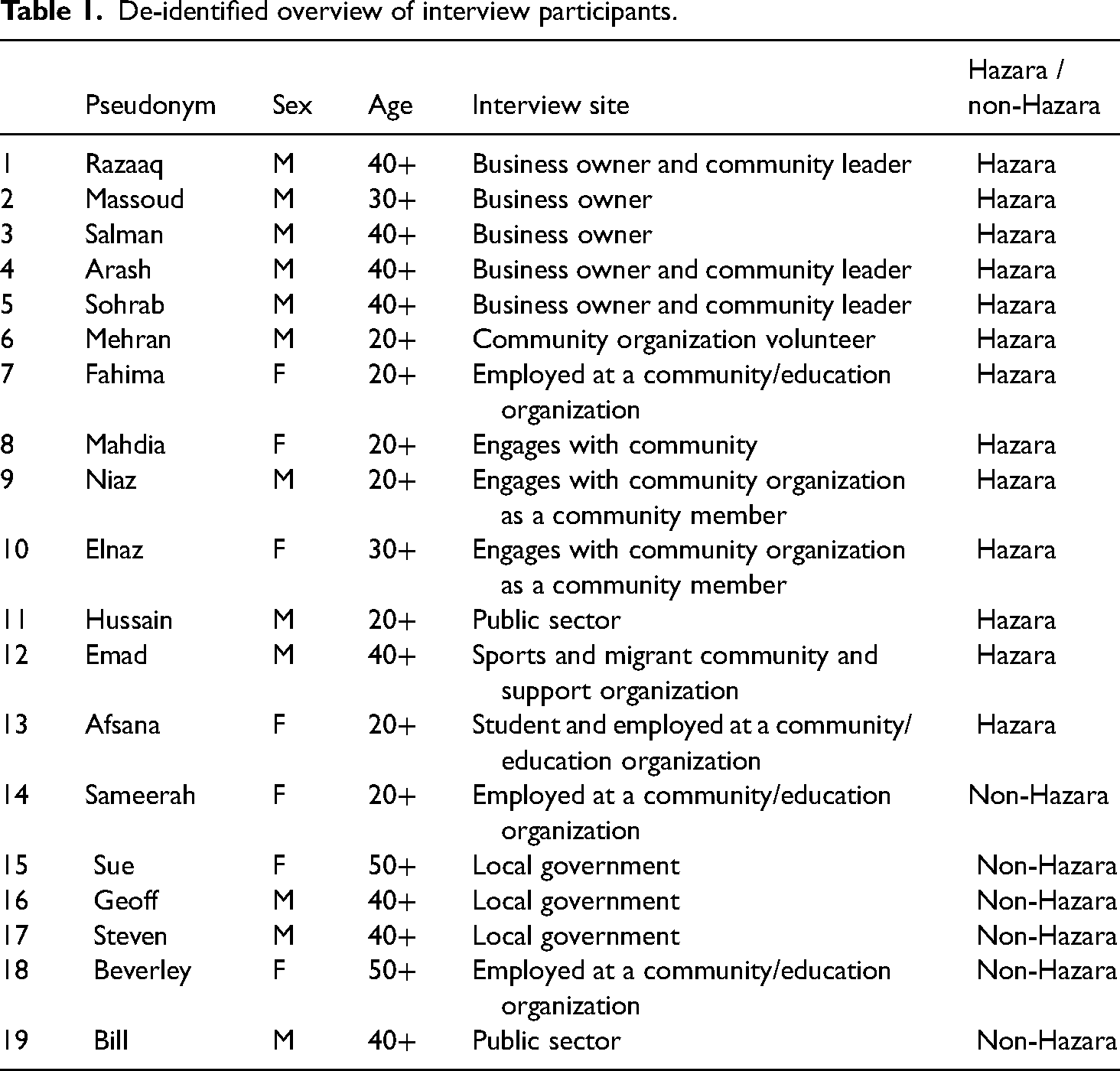
The research was approved by the Human Research Ethics Committee at the University of South Australia (protocol number 201600). A case study approach was used utilizing semi-structured biographical/life-history interviews with 13 Hazara humanitarian-background migrants and six non-Hazara participants in three primary social sites: community education centres, sports-related spaces and the business/economic arena, as well as local government. A biographical/life-history approach helped to provide a life-course context in which Hazara participants narrated and interpreted their experiences of settlement over time and space (Bornat, 2008). A combination of purposive and snowball sampling was used to recruit participants. Non-Hazara participants were selected due to their personal and structurally engaged involvement with the Hazaras (i.e. local government representative, community education provider). Interviews lasted between one and two hours, and were audio recorded and transcribed. Interviews explored the participants’ experiences of living in the community; of social change since arrival; of interactions with diverse others in formal/informal situations; the everyday strategies used to negotiate social, cultural and economic boundaries; participants’ role and understanding of the local area; the challenges, opportunities and acceptance of the Hazaras by the local community; and non-Hazara understanding of and engagement with the Hazaras. Transcripts were analysed using thematic analysis (Braun & Clarke, 2021), with the research team collaborating to manually code the interview material, identifying patterns in meaning across the data (see Table 1).
De-identified overview of interview participants.
Researchers were invited to attend various community events in the sites where most of the interviews took place. Interviews were undertaken in pairs, either one female and one male interviewer or two female interviewers. Consent forms and participation information sheets were available in both English and Dari (Hazara) languages. All participants were offered an interpreter for the interview, though not all requested to have one present. The purpose and ethical considerations of the project were explained to participants both verbally and in writing. If requested, use of an interpreter was also employed ahead of the interview to ensure participants understood the project, their role in it, issues of confidentiality and consent. All participants’ names are pseudonyms. The research drew upon principles of cultural safety (ANROWS, 2018) including engaging in dialogue and shaping ethical protocols with migrant and Hazara organizations and community members before the research began, ensuring participants were aware of their right to withdraw from the research at any point and had access to support services should they experience distress, and being sensitive to the impacts of gendered regulation on project participants (i.e. female interviewers interviewed female identifying interviewees).
The next section explores ‘everyday refugee integration’: the everyday practices of Hazara humanitarian-background migrants as they participate in, contribute to and become a part of three community sites: community and education centres, sport, and the business or economic arena.
Everyday refugee integration across three social sites
Community and education centres – empowering communities
Our research highlighted how everyday experiences such as volunteering, attending school and undertaking education and training courses provide important spaces for informal connections and belonging. Many Hazaras who initially benefited from community-run education and support programmes remained involved with the organization through regular volunteer and paid work roles (e.g. as translators, culturally appropriate knowledge providers or School Support Officers [SSO]). These community organizations fostered strong social relationships within the Hazara community and with other local residents, particularly through the networks of educators who facilitated the programmes.
Fahima, single parent of a young son, was working part-time as a SSO in a local public primary school and part-time in a community education centre as a translator. Fahima knew very little English when she first arrived in Australia at age 16. It was the regular weekly sessions at the community centre that were critical to developing her language skills and facilitating social connections within and beyond the local Hazara community. Because of Fahima's repeated relational participation in the community centre, she was able to find support from local community members to go through a difficult divorce and develop her independence. Fahima commented: I’m the only person for my son, single parent, I want to be very strong and do my parenting first, then my second goal is to get a job. because in our culture … if you divorce it's very not comfortable to share with everyone … it was my GP doctor that I told to get support because … I have already young baby and I wanted to help myself to help my baby. That was the first person and after two years I started telling my friends.
Both Mahdia's and Fahima's experiences are also examples of how their regular participation in the community sites have allowed them to develop the confidence to break away from the cultural expectations of being stay-at-home mothers. Instead of becoming insular in their social networks, they created their own networks with other Hazara women who are in need of support. They have shown how, through the regularity of ‘doing community life’ (Highmore, 2001), they have become women enablers who shared their knowledge, culturally appropriate information and networks across various groups of people.
The ‘everyday’ social and cultural community connections for these Hazara women are also intergenerational. Afsana, who was two years old when she arrived by boat in Australia from Afghanistan with her family, recalled how her mother, a full-time parent without formal education, regularly dropped her at a local childcare facility that had a community centre attached, where mothers were able to socialize and participate in language and well-being classes: There was a huge chunk of my childhood that we would go with mum to these [language] classes [at the community centre]. I think she would learn English or sewing – but then they also had an area for little kids to play just so the women didn’t have to stay home with the other kids … That sort of stuff is great, because that also allows the women to get away from just being a housewife as well and my mum loved sewing and when [she] was home with us she never got the chance to so it just gave her that opportunity.
Sport – connecting communities
Sport has supported the settlement of Hazaras in the local community and benefited the broader community through smaller and bigger everyday practices of engagement. A common refrain articulated by many Hazara participants was their desire to ‘give back’ to the community – a desire to be active, positive contributors to the local and wider Australian community.
Hussain's story is one example of benefiting from and contributing through sport. Hussain came to Australia in the early 2000s as a 14-year-old together with his mother and siblings. With only very basic English education, Hussain went directly into a local public school. He excelled academically and successfully completed a Bachelor of Business (Sport and Recreation Management).
Through participation in sport in high school, he was able to make friends with non-Hazara students. After high school Hussain and two Hazara friends went on to play cricket for a local and then a district cricket team. Hussain gained some initial employment with the South Australian Cricket Association (SACA) where he promoted cricket in primary schools. As a SACA multicultural ambassador Hussain developed a successful cricket tournament involving diverse community groups. When interviewed, he was working for a local politician – he described it as an opportunity to ‘give back to the community’.
As Spaaij et al. (2023, p. 4353) indicate, there is strong support in wider literature that sports (formal and informal) and leisure play an important role for new migrants in facilitating belonging. This can be seen through the role of the Afghan Football [Soccer] Club (AFC)
3
in the Hazara settlement experience and the way in which a social space represents a site of negotiated belonging and participation. The AFC was founded in the early 2000s by Arash, also the owner of an Afghan restaurant. The AFC now has several senior and junior teams including a female team.Arash commented that there have been tensions with some opposition players and clubs: Yes, in the games we’re fighting about winning but after the games we shake hands and forget any conflict. Yeah. 100 per cent to 90 per cent I know [everyone] here and they know me … and everyone I meet says: ‘Oh, how are you? Hi, how are you?’… There are multicultural people who come from everywhere … Now I [know] everyone, the coaches, community peoples … that's why I tell them sports is the thing [that brings] … people together.
A key element in the development of the AFC was the connection with the local Australian Football [‘Aussie Rules’] and Cricket Club (AFCC) and the shared use of the facilities. Both clubs were committed to supporting the disadvantaged and unemployed and the shared use of the sporting facilities maintained the financial viability of both clubs. Arash sees the shared sports facilities with the AFCC as a cultural hub that brings people together from various cultural and national backgrounds. While most of the players in AFC are Hazaras, they have had players from many cultural backgrounds across Asia, Africa, the Middle East, as well as from the Anglo-Saxon/European Australian community.
For Arash, sport and business go together. The restaurant Arash owns serves traditional Afghan and Central Asian food and has become a popular eating destination in Adelaide; it has also been a major sponsor of the AFC. When visiting teams come to AFC home games they now have the option to eat Afghan food or meat pies (a staple within the history of colonial Australian football matches). Local government representative Sue told us: I could tell you great stories … breaking down the barriers from people that are working there … [I see] Arash's wife and daughters … bringing the food that they have in their culture [but I also see] one of Arash's twins … eating a big meat pie. And they’ve got the donuts. And so they graduated into understanding that, yes, they’re playing there, but their opposition … require something different to eat as well.
Sport has been a family affair for Arash, with his wife and children supporting the business and his sporting ventures: My family supports my sports and my business too, and my wife and daughter do it now … they look after two younger teams. They start because they play younger under 12, under 13s … my wife, my daughters are all in … sports.
Children's sport, including female participation, is an essential aspect of community life (Appleby & Foster, 2013). It supports the development and well-being of children, but it is also an important way that families engage with and participate in community life (Lin et al., 2016). The story of Arash's own daughters’ participation in junior soccer reflects how Hazara families have begun to engage with sport in the local area.
Business – rejuvenating communities
The Hazara community has developed a well-diversified, compatible and self-supported business system serving its own ethnic market, with a substantial number of Hazara employees. Hazara businesses have built local social capital through the mutual provision of advice, acting as physical centres for the exchange of information, and relying on the support of other Hazaras, including for business partners and financial capital.
The initial Hazara settlement in the early 2000s revitalized the inner-city area and, according to a local council employee, Hazara settlement and enterprise creation led to ‘a place activation’. We focus on two Hazara men, Sohrab and Salman, whose stories illustrate the entrepreneurialism of Hazara migrants in general (Collins et al., 2017) and their impact as business owners in the local council area.
Sohrab and Salman described the area as previously unsafe, with many closed shops and frequent crime, including property damage and theft. According to Sohrab, the area was ‘terrible, [was] nightmare … it was Adelaide Texas’. Sohrab then commented: ‘so once … Hazara[s] start to settle in this area … [it became] slowly, slowly better and better and better’. Sohrab also explained: people involve in business they occupy the shops … they spend money [on] the shops … to make the security better, to make it looks better, they paint the walls and then it becomes more safer. when I go to any work, I try my best, I tried very deeply, I tried to make my boss happy. And after, if I work for myself, I even work harder because it was my own business, when I work in my grocery business, I deeply work that day, night, long hours every day. I work hard and I tried and tried. if you [are] deeply involved in something, you … educate yourself … on that business, on that field, and then you know what to do.
Salman, a carpet dealer in Afghanistan, initially worked in a factory, before establishing carpet shops in Adelaide, Melbourne and Sydney. However, during the global financial crisis, Salman's business collapsed, leaving him with significant debt. Instead of applying for bankruptcy, Salman decided to repay the money he owed to his Hazara business partners and community members. Salman rebuilt his local business where the rent for a new shop was cheaper and later joined Hazara business owners from across Australia in donating towards bushfire recovery, explaining that Hazaras are now members of the Australian community: we should share everything here, with the government, with the people … We cannot be separate.
Currently there is evidence of further growth of Hazara businesses, and diversification into other sectors such as real estate, building and tiling. While Hazara businesses initially clustered together, focusing exclusively on co-ethnic customers, they are now expanding either geographically or attracting more non-Hazara clientele.
This is evident in Sohrab's story. While he was running the Afghan supermarket, he made plans to lease a large independent grocery store located on a main road, with the goal of attracting both Afghan and non-Afghan customers: why not we invite Western community to understand Eastern community and also invite Eastern community, the refugees to understand Western culture … it will work. I am an Afghan man, I take risk. I didn’t bring money from Afghanistan. I took my family from there. I come empty hand, I work hard, I made money here, even if I lose money … that's fine, is a good lesson to me. Both of them are watching me suspicious[ly], this one was thinking I’m doing this side, this side was thinking I’m with this side, both of them are against me … slowly, slowly become a change and … become a normal, now it's fantastic, both come in … very happy, both of them.
Discussion
We recognize that the term ‘integration’ may have utilitarian merit and that it is still widely used in academic and public discourse, hence our preference to write ‘integration’ in inverted commas. Our research, however, was focused on understanding some of the ways that one humanitarian-background migrant community, Hazaras, participate in, contribute to and become a part of their local community in Adelaide. This approach suggests the need to move beyond ‘integration debates’ and to focus on the doing and becoming in community life. The aim of the research was to provide evidence-based insights into how that has occurred through a holistic approach that considered the social, cultural and economic aspects of community life through the lens of everyday living. Our argument here is, first, the inclusion of the social and cultural aspects of involvement in community are just as important as the economic. This holistic approach reminds us that humanitarian-background migrants, like other community members, provide more than economic benefit – they participate and contribute in the life of the community. Second, the emphasis on the everyday, what we might even call the banal or mundane activities of being in community, reminds us that this is exactly how most of us participate in community life. It is holistic because it recognizes that while some humanitarian-background migrants do excel, are more public or visible – with some examples noted – most participate in everyday, ‘invisible’ ways, just as we do as members of our local community. Marlowe et al. (2014, p. 63), in a New Zealand context, contend that humanitarian-background migrants need to be given ‘meaningful opportunities to fully participate as peers in civil society’. Our research shows that when participants have either taken up available opportunities or created their own, they demonstrate agency by claiming space for themselves through their everyday practices, and in the process strengthen their own and more established local communities.
In exploring the role of community and education centres we noted the importance of everyday participatory practices, formal and informal. Some practices are planned, resourced and structured (e.g. formal language classes), while other practices reveal everyday opportunities for giving that are private and personal (e.g. drawing on personal experiences to reshape community support programmes). In the study of community organizations, community members who benefitted and were empowered through these services often went on to support the work of the centre themselves (e.g. as translators, or culturally appropriate knowledge providers). These participatory practices emphasize the dynamic, engaged ways in which humanitarian-background migrants actively contribute to their local communities. Community centres were also spaces for intercultural and educative encounters and places for forming and building future educational/professional aspirations in spaces where they felt safe.
Sport has a vital role in the settlement of humanitarian-background migrants, facilitating policies of integration, social inclusion, social cohesion and acculturation (McDonald et al., 2019). Sport also helps humanitarian-background migrants to maintain and strengthen social bonds between members of the same or similar groups, to build bridges with mainstream community members, and to link them to structures that can support their long-term settlement and participation in mainstream society (Abur & Charles, 2020; Smith et al., 2019). Much of the literature has been deficit-based focusing on the loss, struggles and challenges associated with refugee/asylum seeker experiences in sport (Spaaij et al., 2019). While not downplaying these real challenges, this study has equally identified the strengths, agency and resources that humanitarian-background migrants bring to local communities, demonstrated through the everyday ways that they engage in formal and informal sporting participation (Aquino et al., 2020).
We also explored Hazara contributions through the framework of the entrepreneurial ecosystem. Since their initial settlement in the early 2000s, Hazara humanitarian-background migrants have been moving in and setting up businesses in their local area, contributing to the economic rejuvenation of a deprived suburban area. The local Hazara business community has acquired the resources, capacities and skills to effectively negotiate with relevant government and non-government agencies. This does not adhere to a common narrative of refugees being a burden to society and/or being passive recipients of government support (Haw, 2022). Instead, the story of the local Hazara business community is much more one of strength and community agency, and a strong and self-sustained ecosystem.
A key theme through the research was how Hazaras participate in, contribute to and have become a part of the local community in which they live. This has mostly taken place in everyday ways. Through this study we have sought to make visible the ‘hidden’ everyday ordinariness of community life participation and contribution of humanitarian-background migrants to highlight the various ways they have become part of the communities that they live amongst (Gardiner, 2000; Michael, 2016). These contributions to community life are what all members of local communities do through the practices of our daily living – that is, ‘we’ live, travel, shop, work (or don’t), study (or don’t), raise families (or don’t), eat at a local restaurant (or don’t), play sport (or don’t), volunteer (or don’t) in our neighbourhoods. Moran (2005, p. 169) comments: If we want to begin to transform our everyday lives for the better, perhaps we need to … see the everyday not as the eternally tedious or bathetically comic residue of contemporary life, or simply as a sphere of overlooked ordinariness, but as the real space in which we lead our actual lives.
Our focus has been on the everyday interactions of Hazaras in their local shopping areas and businesses, sports fields, schools and community groups. We have shown how humanitarian settlement involves a complex mixture of serendipitous friendships, connections with key community enablers, as well as support from one's co-ethnic or other migrant communities. Some scholars have moved away from discourses of integration to show how settlement instead involves ‘degrees of embeddedness’ and ‘sociabilities of emplacement’ across a range of areas (social, cultural, economic) and that this is a fluid and ongoing process (Wessendorf & Phillimore, 2019). For example, Fahima described her sense of belonging and embeddedness with the women with whom she had developed friendships through a language programme in her local community centre. However, she did not feel a strong sense of belonging in broader society, experiencing challenges finding work and navigating gendered and cultural expectations between her own professional and educational aspirations and that of her family. Our findings reinforce that settlement and belonging are ongoing processes involving everyday ‘relations of differing affective and functional depths with a variety of people’ (Wessendorf & Phillimore, 2019, p. 135) including co-ethnic, migrant and established communities, as well as in different contexts such as home, work, school, and informal spaces of community connection.
Conclusion
We have argued that participation and belonging for humanitarian-background migrants is a parallel process that builds up their co-ethnic community while simultaneously participating in, contributing to and becoming a part of their wider local community. The strength of their own identity and co-ethnic bonds provides the platform for the Hazaras’ increasing involvement, connections, contributions, belonging and identification with their local community, and ultimately with the broader Australian community. Our research challenges discourses that humanitarian-background migrants should be viewed as a burden, cost, or threat, unwilling or unable to integrate into the community. Further, the participants in this research indicate that they have moved beyond a refugee category or victim label (Marlowe, 2017; Radford & Hetz, 2021), demonstrating agency, a willingness and resilience in attitude and action to participate in, contribute to, become a part of and, indeed, enrich their local communities.
We recommend settlement policy makers and workers, drawing on evidence-based research such as this one, develop culturally appropriate policies around ensuring adequate support is provided for greater participation for informal practices such as sports participation or social support and services within community centres. In doing so, there will be more opportunities for members of local communities to listen to the everyday experiences of humanitarian-background migrants and understand the strengths they bring. We would also suggest that future research utilize the holistic framework used for this research (i.e through the lens of social, cultural and economic) when exploring how humanitarian-background refugees become a part of the communities in different contexts (see for example in rural communities, Radford et al., 2022). It offers the opportunity to provide nuanced and innovative ways that this occurs from the perspective of humanitarian-background migrants and the communities they live amongst.
We have also argued that a bottom-up approach that focuses on the everyday is an important lens to understand how humanitarian-background migrants ‘integrate’. Similar to this approach to integration, we emphasize how most people in a community, independently of their status as recent migrants, participate in, contribute to and become a part of their local communities – that is, in ordinary, everyday, even banal ways (Kovacs, 2015, p. 23). By teasing out the ‘ordinary’ ways that they have become a part of their local community through everyday practices, we bring into focus the contributions of the ordinary in providing a holistic reconceptualization of ‘refugee integration’.
Footnotes
Funding
The author(s) disclosed receipt of the following financial support for the research, authorship, and/or publication of this article: Authors received funding through the University of South Australia (UniSA) JUS URIPA Partnering Grant 'Exploring the positive impact of refugees in society: social, cultural and economic contributions of humanitarian migrants’ (#201600) in Partnership with the Multicultural Communities Council of South Australia - MCCSA.
