




Abstract
This article examines how (un-)certainty in settlement intentions affects the socio-economic integration of Ukrainian refugees in Germany, using longitudinal data from the IAB-BiB/FReDA-BAMF-SOEP survey. Applying an instrumental variable approach, we estimate the effects of permanent, temporary, and uncertain settlement intentions on employment, employment aspirations, and host-country language proficiency. Findings show that settlement intention uncertainty hinders integration outcomes – most notably German language acquisition – while temporary intentions are linked to lower language proficiency and reduced employment aspirations. Permanent intentions, in contrast, facilitate stronger integration across all outcomes. Refugees with uncertain plans exhibit intermediate results. Theoretically, the article contributes to migration literature by disentangling the effects of settlement intention certainty from anticipated duration of stay, and by demonstrating how subjective expectations shape forward-looking behaviour. Our results advance Goal-Setting and Rational Choice Theories, and the Immigrant Human Capital Investment model by integrating uncertainty as a key moderating factor in refugees’ integration trajectories.
Introduction
In recent decades, global forced displacement has surged, affecting over 100 million individuals who have been compelled to leave their homes due to military conflicts, persecution, and natural disasters (UNHCR, 2023). Russia’s full-scale invasion of Ukraine on 24 February 2022 has resulted in over six million Ukrainians seeking refuge in Europe, with over one million people currently receiving protection in Germany (UNHCR, 2025). The aftermath and duration of the conflict remain unpredictable, casting an essential veil of uncertainty over those who remained in Ukraine, the refugees who fled, and the host societies that now receive them.
Unlike labour migrants, who are typically driven by economic motives and often prepare for migration by acquiring destination-relevant skills, refugees are often compelled to move abroad to seek safety and asylum without such preparation (Kosyakova et al., 2022). As a result, refugees face distinct disadvantages upon arrival, including language barriers, limited knowledge about the host-country labour market, and a lack of relevant social networks essential for employment and social inclusion (Brücker et al., 2020; Fasani et al., 2022; Kosyakova and Kogan, 2022). Many suffer from trauma and health-related consequences, including elevated risks of mental health disorders (Buchcik et al., 2023; Walther et al., 2020). While Western asylum systems, including Germany’s, have historically required refugees to navigate protracted recognition procedures, including residency restrictions, and limited access to integration measures and employment (Fasani et al., 2022; Hainmueller et al., 2016; Kosyakova and Kogan, 2022), the implementation of the EU Temporary Protection Directive in March 2022 allowed Ukrainian refugees to bypass asylum processes and receive immediate legal protection initially for up to two years. In Germany, this entitles them to residence rights under Section 24 of the Residence Act (AufenthG), as well as direct access to the labour market and integration measures.
Despite this favourable legal environment, Ukrainian refugees still face significant barriers to socio-economic integration. One of the most consequential decisions they face is whether to remain in the host country or eventually return to Ukraine. Such settlement decisions are foundational: 1 they shape individual motivation, human capital investment, and long-term economic trajectories (Adda et al., 2022; de Vroome and van Tubergen, 2014; Wachter and Fleischmann, 2018). Yet many refugees are unable to make such decisions early after arrival due to structural uncertainty – such as unclear prospects of war termination, shifting legal frameworks, or ambivalent public sentiments in the host societies (Alrababah et al., 2023; Donadelli et al., 2020; Koenings et al., 2021; Schiltz et al., 2019; Williams and Baláž, 2012). This uncertainty can be viewed as a form of structural violence, constraining the ability to plan for the future and affecting migrants’ mental and physical well-being (Ager and Strang, 2008; Grace et al., 2018; Massazza et al., 2023; Perelli-Harris and Torrisi, 2025; Phillimore, 2011; Phillimore and Cheung, 2021).
While some studies have examined how legal insecurity affects integration outcomes (Adda et al., 2022; Damelang and Kosyakova, 2021; Kosyakova and Brenzel, 2020), we know comparatively little about how subjective uncertainty in settlement intentions – distinct from legal status – shapes refugees’ behaviour. In particular, it remains unclear whether those with evolving or ambiguous settlement plans integrate differently than those with clear, albeit temporary, intentions.
This article addresses that gap by arguing that uncertainty in settlement intentions is not merely a transitional state but a consequential orientation in its own right. Drawing on Goal-Setting Theory (Locke, 1968; Locke and Latham, 2006), Bounded Rationality (Simon, 1990), Rational Choice Theory (Coleman, 1994), and the post-migration Human Capital Investment model (Duleep and Regets, 1999), we conceptualize subjective intention certainty as a key determinant of forward-looking behaviour. Individuals with clear permanent intentions are likely to invest in language learning and labour market integration. Those with temporary plans may pursue short-term employment but underinvest in longer-term integration strategies. Meanwhile, individuals who are uncertain about their settlement plans may delay or reduce integration efforts altogether, hedging their options until external conditions become clearer.
Our main contribution is to theorize and empirically test this distinction between intention certainty and duration orientation. While previous studies often reduce intentions to a binary stay–return axis (e.g., Fokkema and de Haas, 2015; Geurts and Lubbers, 2017), we propose a threefold typology: (1) intentions to stay permanently, (2) intentions to stay temporarily, and (3) uncertainty about either path. This allows us to move beyond existing models that treat uncertainty as noise or residual category and instead conceptualize it as analytically meaningful. 2 We focus on the effect of initial settlement intentions on socio-economic integration outcomes to capture their formative role in shaping early integration-related decision-making. We assume that refugees’ anticipated length of stay in the host country – at early stages after arrival – guides their forward-looking strategies, particularly regarding labour market participation and human capital investment. Settlement intentions are understood as structuring dispositions that shape integration trajectories and exert lasting influences. Although intentions might evolve over time, initial orientations provide a crucial window into the early motivational and behavioural responses to displacement, which may translate into persistent integration disparities (Kosyakova et al., 2023).
Empirically, we use data from the 2022 and 2023 waves of the IAB-BiB/FReDA-BAMF-SOEP Survey of Ukrainian Refugees in Germany (Brücker et al., 2023) and apply an instrumental variable (IV) approach to estimate the causal effects of initial settlement intentions – permanent, temporary, or uncertain – on three key integration indicators: employment, employment aspirations among the non-working, and host-country language proficiency. To address endogeneity in intention formation, we use three instruments: (i) county-level (oblast in Ukrainian) 3 pre-war migration intentions to Germany; (ii) post-arrival conflict intensity in the region of origin; and (iii) perceived welcome upon arrival in Germany.
In doing so, we advance the sociology of uncertainty and refugee integration debates in three ways. First, we identify settlement intention certainty as a previously understudied mechanism shaping how refugees respond to host-country conditions. Second, we show that subjective expectations – regardless of legal status – are critical to integration behaviour. Third, we draw policy-relevant insights: promoting early clarity – not necessarily permanence – can facilitate more effective and sustainable integration for refugees and host societies alike.
Theoretical considerations and previous research
In the following section, we build theoretically informed expectations about refugees’ labour market integration under conditions of settlement uncertainty. Rather than testing one single theory, we draw on complementary insights from several theoretical approaches – including Rational Choice, Bounded Rationality, Goal-Setting Theory, and the Human Capital Investment model – to conceptualize the mechanisms linking settlement intentions to integration outcomes. Each of these perspectives emphasizes different but compatible aspects of decision-making under uncertainty, helping us to formulate expectations about how certainty, temporariness, or ambiguity in settlement plans may influence individual behaviour, motivation, and economic outcomes.
The role of settlement intentions in immigrants’ integration path
According to the Rational Choice Theory (Coleman, 1994), individuals act as purposeful and rational agents who strategically assess their options to maximize utility. This theoretical framework is particularly relevant in understanding immigrants’ decision-making processes regarding their integration into a host country. Immigrants’ intentions to settle can significantly influence their investments in host-country specific human, social, and cultural capital, as these investments are perceived to yield greater (economic) returns over a longer time period (Van Tubergen, 2022). Correspondingly, the anticipation of long-term residency alters immigrants’ cost-benefit calculations, encouraging investments that would be less attractive under temporary residency conditions. In other words, a longer expected stay increases the attractiveness of such investments, as the cumulative benefits of enhanced job prospects, social integration, and cultural adaptation can outweigh the initial costs. For immigrants anticipating a permanent stay, the integration process becomes not just a necessity but a rational investment in their future socio-economic stability within the host country.
These ideas resonate with the Immigrant Human Capital Investment model developed by Duleep and Regets (1999), which has become the dominant theoretical framework in the empirical literature on post-migration human capital investments (Adamuti-Trache et al., 2011; Damelang and Kosyakova, 2021; Van Tubergen, 2022). This model posits that the decision to invest in human capital post-migration involves cost-benefit calculations where a rational individual weighs expected returns against anticipated costs. An individual is likely to invest in destination-specific human capital (such as host-country language) only if the benefits outweigh the costs. According to this model, such calculations depend on three major elements: the transferability of skills, the opportunity cost of the investment, and the anticipated duration of stay in the host country – the latter being a key element in our analytical framework. 4
Empirical evidence consistently indicates that migrants with a permanent settlement intention in a host country are more likely to invest in host-country specific human capital, such as language skills (e.g., Geurts and Lubbers, 2017) and professional training and education (e.g., Van Tubergen, 2022). These investments boost job prospects (e.g., Auer, 2018) and increase earnings (e.g., Adda et al., 2022), often outperforming returns on skills acquired in their country of origin (e.g., Kanas and van Tubergen, 2009). Dustmann and Görlach (2016) also highlight that permanent migration influences immigrant behaviour across various dimensions, including human capital and labour supply.
Understanding the relationship between employment and settlement intentions requires a long-term perspective. Wachter and Fleischmann (2018) found that early after arrival, immigrants intending to return home tended to work more hours than those planning to stay permanently in the Netherlands. This is because those with temporary intentions prioritize short-term earnings over integration to maximize consumption back home, not seeing the benefit in acquiring host-country skills due to the short pay-off period (Adda et al., 2022). Conversely, immigrants with long-term intentions often delay entering the labour market to acquire local skills (Cortes, 2004), which positively impacts their long-term socio-economic status within the host society (Adda et al., 2022).
While these theoretical perspectives and empirical studies offer important insights into how settlement intentions influence migrants’ integration strategies, they primarily differentiate between permanent and temporary orientations and are largely derived from studies on economic migrants. A key limitation of this literature is its neglect of uncertainty as a distinct and theoretically relevant category – particularly in the context of forcibly displaced populations.
Unlike economic migrants, refugees differ markedly in both their migration goals and their capacity to return home (Cortes, 2004). Their relocation is typically unplanned, driven by the need for safety, and undertaken under traumatic circumstances with limited control over timing, destination, or duration of stay. Consequently, they often arrive without host-country language skills, social networks, or labour market knowledge. These structural disadvantages mean that refugees follow distinct integration paths, and the empirical findings relevant from economic migrants may not be directly transferable.
In this context, uncertainty about the future is not only common but structurally embedded. As Ager and Strang (2008) argue, access to safety, stability, and rights constitutes the foundational layer of refugee integration, without which long-term planning and investment become unlikely. Phillimore (2011) similarly highlights how insecurity related to legal status, housing, and service access constrains refugees’ capacity to formulate and pursue integration goals. These conditions foster persistent uncertainty, which cannot be dismissed as a transitional or residual phase. Yet the implications of such uncertainty for integration trajectories remain underexplored. In the following section, we argue that such uncertainty should not be treated as transitional or residual, but as a meaningful orientation that shapes refugees’ motivations, constraints, and behavioural responses in the host country.
Uncertainty of decision
An increasing number of economic sociologists have criticized Rational Choice Theory and neoclassical economics for assuming that individuals possess full knowledge and perfect information about complex social realities (Beckert, 1996; Boudon, 1998; Dequech, 2003). These assumptions are viewed as cognitively unrealistic, as they overlook the limits of human information-processing capacities and the true complexity of decision-making in dynamic and uncertain environments. To address this, sociologists have proposed uncertainty – especially that arising from complexity and limited foresight – as a foundational concept for a sociological approach to economic behaviour (Beckert, 1996).
Building on these critiques, the concept of ‘bounded rationality’ (Simon, 1990) offers a more realistic lens. It suggests that under most circumstances and especially in complex situations involving multiple factors – such as family, economic, and cultural influences, along with conditions in both home and host countries – it is neither feasible nor efficient to consider all possible alternatives when making decisions. The costs of gathering complete information can be too high, and the future too unpredictable. In such situations, maintaining a state of uncertainty may itself be a rational choice. This strategy allows individuals to postpone irreversible decisions, continue gathering relevant information, and adapt flexibly as circumstances evolve. In this view, choosing not to commit a fixed trajectory can be understood as a purposeful decision with an open-ended objective.
Goal-Setting Theory (Locke, 1968; Locke and Latham, 2006), developed within the psychological literature, further clarifies the behavioural implications of uncertainty. This theory postulates that specific and challenging goals lead to higher performance than vague or non-committal ones, because they direct attention, mobilize effort, encourage the development of strategies, and sustain motivation. In the context of refugee integration, clear settlement intentions – whether temporary or permanent – may facilitate proactive strategies aligned with longer-term long-term aspirations. For instance, those intending to remain permanently may be more willing to invest in language learning or professional training. In contrast, those with temporary intentions may prioritize short-term earnings but forgo longer-term investments that do not pay off before return.
Following this logic, uncertainty in settlement intentions can be viewed as the absence of a concrete integration goal. Individuals keep both staying and returning options open, which makes it difficult to commit to a specific strategy. From a Rational Choice perspective, this may reduce expected utility from long-term investments, leading to more cautious behaviour: individuals might fulfil only minimum integration requirements to maintain eligibility for benefits, while avoiding deeper investments that may prove unnecessary.
Empirical studies support this interpretation. Wachter and Fleischmann (2018) found that refugees uncertain about their settlement intentions exhibited intermediate levels of host-country language proficiency – higher than those with clear return intentions, but lower than those intending to stay. Other studies examining related forms of uncertainty, such as insecure protection status or extended asylum procedures, also report negative effects of prolonged uncertainty on human capital investments and economic integration (Hainmueller et al., 2016; Kosyakova and Brenzel, 2020).
From an analytical sociology perspective (e.g., Hedström, 2005), the mechanisms linking uncertainty to integration outcomes unfold across three stages. First, macro-level conditions, such as the ongoing war in Ukraine or temporary nature of legal protection, shape refugees’ settlement intentions, including widespread uncertainty (Kosyakova et al., 2026). Second, these settlement intentions influence integration-related goals and subsequent behaviours, such as the decision to invest in language acquisition or to enter the labour market – both of which are mandatory components of the integration pathway for recipients of social benefits in Germany. Third, these behaviours lead to differing levels of human capital and labour market success, thereby generating diverging integration trajectories. Our analysis focuses explicitly on the second stage: how divergent settlement intentions influence individual integration outcomes.
In sum, these theoretical perspectives suggest three analytically distinct settlement orientations – permanent, temporary, and uncertain – each associated with specific integration strategies. A clear intention to stay is expected to encourage long-term investment in host-country specific human capital (e.g., language acquisition) and improve employment outcomes. A temporary intention may prompt faster labour market entry but discourage long-term investment due to limited expected returns. Uncertainty, in contrast, represents a hedging strategy: individuals may comply with basic requirements (e.g., for legal status or benefits) while delaying major commitments. These orientations are not treated as competing hypotheses, but as theoretically grounded expectations about rational adaptation under different constraints. In the following empirical analysis, we test whether these distinct orientations are systematically associated with differential labour market participation, employment aspirations, and language acquisition in the medium term.
Empirical analyses
Data and sample
We used longitudinal representative data from the IAB-BiB/FReDA-BAMF-SOEP Survey of Ukrainian Refugees in Germany (Brücker et al., 2023), comprising two waves conducted in 2022 and 2023. The panel study targeted Ukrainian refugees aged 18 to 70 who fled to Germany after the Russian invasion on 24 February 2022, and arrived by mid-July 2022. The sample was drawn using a two-stage design from two administrative registers in Germany: the population register (EMR) and the Central Register of Foreigners (AZR). A total of 48,000 Ukrainian nationals registered in Germany after 24 February 2022, were initially sampled (for a detailed description of the survey design, see Brücker et al., 2023; Steinhauer et al., 2024).
The first survey wave took place between August and October 2022, followed by a second wave from January to March 2023. Wave 1 included 11,763 respondents; wave 2 included 6,786. The overall wave 1 response rate was about 25 percent (AAPOR Response Rate 1). The survey employed a push-to-web mixed-mode design, with respondents initially invited by postal mail to participate online. Approximately four-fifths of the participants completed the survey online (computer-assisted web interviewing, CAWI), while the remaining fifth responded by mail (paper-and-pencil interviewing, PAPI).
Owing to emigration restrictions on men of conscription age (18–60), the sample predominantly consisted of female refugees, many of whom arrived without partners but often with children. Conversely, men arrived predominantly with their families (Brücker et al., 2023).
Our empirical analyses focused primarily on data from wave 2, considering key predictors from wave 1 (see Section ‘Outcome variables’). We excluded respondents who left Ukraine before 2022 or arrived in Germany before 24 February 2022 (73 observations), those who left Germany between wave 1 and wave 2 (169 observations). We further excluded refugees aged over 55 at the time of the interview, since older refugees are less likely to be labour market-oriented (1,033 observations). Finally, we removed entries with missing data on dependent variables, settlement intentions in wave 1, instrumental variables, and gender (66 observations), yielding a final sample of 4,692 observations.
Outcome variables
We examined three indicators of refugee socio-economic integration: current employment status, future work aspirations, and German language proficiency.
Employment was based on self-reported status. Respondents were considered employed if they worked full-time, part-time, were marginally employed, in an internship, or were in vocational training. Those unemployed or inactive were coded as not employed. In 2023, about 19 percent of the Ukrainian refugees were employed (weighted results).
Given that many refugees had spent only a limited time in the host country, we also considered respondents’ employment intentions. All non-employed participants were asked whether they intended to work in the future. We defined individuals as having work aspirations if they responded ‘Definitely’. In contrast, those who answered ‘Probably’, ‘Rather unlikely’, or ‘Definitely not’ were categorized as having low aspirations. This binary classification was both conceptually meaningful and methodologically necessary. The number of respondents selecting the most negative categories was very small – only 30 (less than 1 percent) reported that they ‘definitely do not want to work’ and 98 (2 percent) reported being ‘rather unlikely’ to work – making it impractical to analyse these responses separately. Maintaining finer distinctions would introduce sparsity into the models, thereby reducing statistical power and increasing the risk of unstable estimates. By grouping responses in this way, we struck a balance between preserving the conceptual distinction between high and low work aspirations and ensuring that our estimates were based on sufficient variation. Weighted data show that 73 percent of non-employed refugees had definite work aspirations in 2023.
German language proficiency was measured through self-assessed reading, speaking, and writing skills, rated from 0 (‘not at all’) to 4 (‘very well’). We compiled an additive index of these three measures ranging from 0 to 12. Internal consistency was high (Cronbach’s alpha = 0.888). In 2023, the mean language proficiency index amounted to 4.2, reflecting ‘not very well’ to ‘average’ language skills (weighted results).
Settlement intentions
Our key independent variable was uncertainty in settlement intentions. 5 To assess refugees’ settlement intentions, we analysed responses to a survey question regarding the expected duration of their stay in Germany. The response options were: 1) until the end of the war, 2) up to another year at most, 3) for a few more years, 4) forever, and 5) don’t know. We grouped these into three categories: permanent settlement (option 4), temporary stay (options 1–3), and uncertainty (option 5). This classification allowed us to isolate the distinct role of uncertainty, apart from clearly temporary or permanent plans. In a robustness check (see Online Supplementary Appendix B), we explored an alternative coding scheme by recording ‘until the end of the war’ (option 5) as uncertain. This subgroup may have reflected a distinct motivational profile that did not align clearly with either temporary or permanent intentions, particularly given the unpredictable duration of the conflict.
Settlement intentions were not static. Over time, many who were initially uncertain developed more definitive intentions. Figure 1 (weighted results) shows transitions between categories across waves using a Sankey diagram.
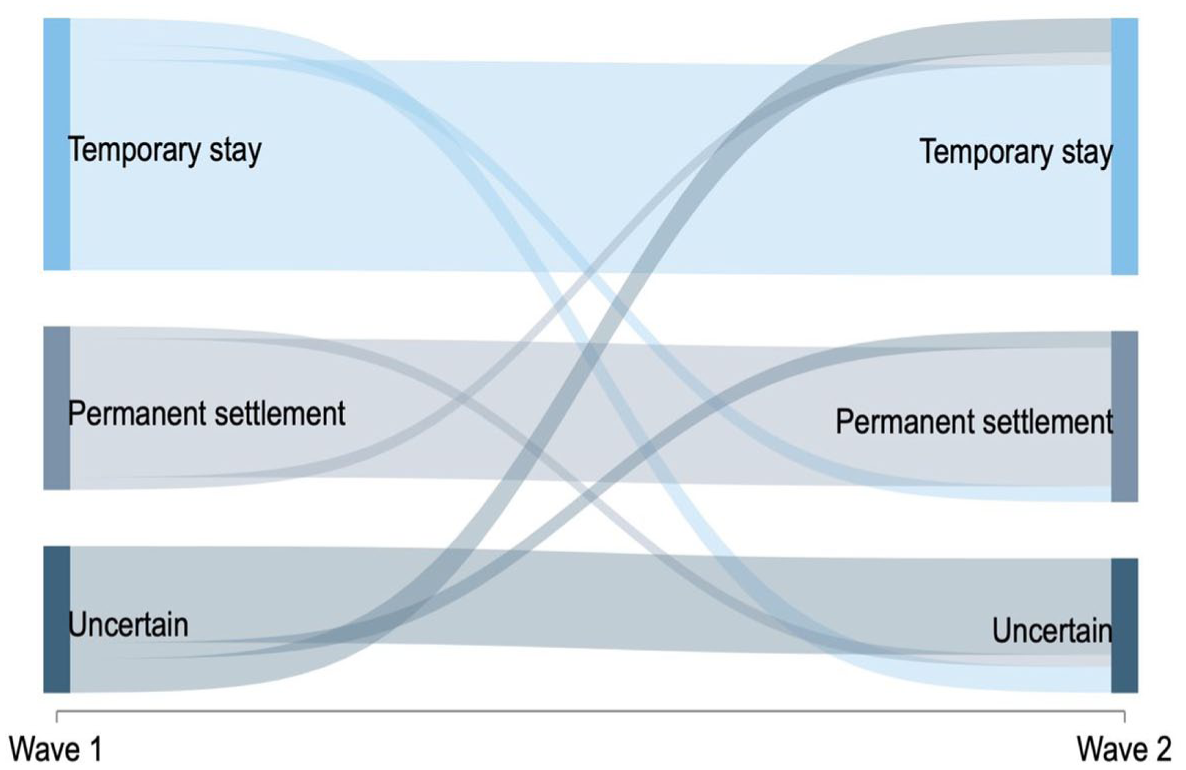
Comparison of refugees’ settlement intentions between wave 1 and wave 2, Sankey charts.
In the first survey wave, 29 percent reported permanent intentions, 45 percent temporary, and 26 percent were uncertain. By the second wave – about six months later – only 45 percent of initially uncertain remained so. Among the rest, 18 percent shifted to permanent and 37 percent to temporary intentions. Of those with initial temporary intentions, 17 percent became uncertain; and 12 percent of those initially permanent shifted to uncertainty. Correspondingly, settlement intentions are dynamic and subject to change, likely influenced by respondents’ individual and family circumstances, as well as the socio-economic conditions in Germany and the evolving economic and political landscape in Ukraine (Brücker et al., 2023; Van Tubergen et al., 2024). 6
Although the results in Figure 1 revealed individual-level updates in settlement intentions, our empirical strategy relied exclusively on settlement intentions expressed in wave 1. This decision was grounded in both conceptual and methodological considerations, consistent with our central research question: how does initial uncertainty in settlement plans affect subsequent labour market integration? By focusing on early intentions, we aimed to capture the effects of uncertainty from the onset of displacement, before substantial interaction with the host country’s labour market takes place. Conceptually, even if such uncertainty proved temporary, it could have lasting consequences. Early ambiguity about future residence may have delayed investments in host country-specific human capital, slowed labour market entry, intensified skill depreciation, and increased the risk of job mismatch over the medium to long term. Methodologically, wave 1 responses reflected intentions formed prior to significant labour market exposure, which was essential for our identification strategy. Using these pre-outcome measures helped avoid post-treatment bias that would have arisen if we had relied on intentions reported after employment trajectories had already begun. In contrast, settlement intentions measured in wave 2 were likely endogenous to prior labour market experiences – whether positive or negative. For transparency, we replicated our main analysis using wave 2 measures as a robustness check (see Online Supplementary Appendix B).
Estimation strategy
Probit and ordinary least squares (OLS) analyses
We estimated two binomial Probit models to analyse employment status and work aspirations, and one ordinary least squares (OLS) model to examine German language proficiency. Corresponding models were specified in equation:

where
Instrumental variable (IV) approach
A primary identification challenge in Equation 1 was the potential correlation between uncertain and temporary stay intentions in Germany and unobserved characteristics of the refugees, which might also influence the outcomes of interest. For example, refugees who were economically or socially well-off in Ukraine may be more reluctant to settle permanently in Germany due to potential losses in status or assets. Likewise, a preference to return could be more prevalent among older individuals with a shorter time horizon to benefit from integration, specialists whose human capital may be less transferable, and those with family or property ties in Ukraine. Moreover, post-war recovery is expected to generate considerable employment opportunities in Ukraine, particularly for high-skilled individuals (Shatz et al., 2023), potentially leading to positive selection into return. This might bias our estimates if individuals best positioned to reintegrate at home are less likely to stay in Germany. Recent empirical studies document negative selection among those remaining in host countries (Bijwaard and Wahba, 2019; Hannafi and Marouani, 2023).
To mitigate potential endogeneity concerns, we employed an instrumental variable (IV) approach based on three instruments. Online Supplementary Appendix A discusses the validity of instrumental variables and provides checks for plausibility of the identifying assumptions.
The first instrument captured the intention to migrate to Germany in 2018, measured at the county level in Ukraine, corresponding to the respondents’ location prior to relocation to Germany. This measure was derived from the Gallup World Poll dataset (Gallup, 2023), a nationally representative survey conducted among individuals over the age of 15 across nearly all countries worldwide. To gauge the intention to migrate to Germany, we considered Gallup (2023) survey questions on whether respondents would like to move permanently to another country, and the intended destination country in the case of an endorsement. This instrument assumed that individuals from regions with higher migration preferences towards Germany were more likely to plan permanent settlement there compared with those from regions with lower intention.
The second instrument was a compound index of conflict intensity in respondents’ home counties after their arrival in Germany. It combined data on explosions, battles, and instances of violence against civilians from the Armed Conflict Location and Event Data Project (ACLED) database (Raleigh et al., 2010) cumulated since arrival date in Germany until the wave 1 interview. Owing to high correlation of indicators, we applied principal component analysis (PCA) to reduce dimensionality, using the first principal component as a synthetic indicator of conflict intensity, which explained 72 percent of the total variability. This instrument assumed that more intense post-arrival conflict increases the perceived risks and costs of returning, thus making permanent settlement more attractive. Crucially, because this variation occurs after arrival, it is unlikely to influence pre-migration human capital or psychological health, which are potential confounders for integration outcomes. Online Supplementary Appendix A shows that this variable is not significantly correlated with proxies for self-rated health measures, or education (Online Supplementary Table A4), supporting the exclusion restriction.
The third instrument was a subjective measure, capturing the respondents’ perception of feeling welcomed upon their arrival in Germany, rated on a scale from 1 to 5. The underlying rationale was that refugees who perceived a sense of welcome in the host country may have faced lower subjective costs associated with remaining. As a result, they may have transitioned more quickly from uncertain or temporary intentions to permanent settlement, compared with those who felt less welcomed. This instrument assumed that the initial perception of being welcomed was shaped primarily by refugees’ first impressions of Germany and its society, rather than by unobserved skills, abilities, or personality traits that could have directly influenced employment outcomes or language acquisition.
All three instruments were tested for relevance and validity (see Online Supplementary Appendix A). We assessed potential violations of the exclusion restriction and checked for correlations with observable characteristics (e.g., age, gender, education, prior work experience). We failed to reject the hypothesis that these characteristics were jointly significant, as indicated by an F-test for joint significance that is below 3 in all specifications (see Online Supplementary Appendix A, Table A1). This test suggested that there is no evidence that the instruments were incorrectly excluded from the model. Ultimately, our findings provided no evidence that our instruments violated the exclusion restriction in ways that would skew our results. Finally, the instruments showed strong first-stage performance, with F-statistics above conventional thresholds (see Section ‘Causal examination of the settlement intentions impact on refugees’ integration outcomes’).
We applied a two-stage least squares (2SLS) and Instrumental Variable Probit (IVProbit) estimation to uncover the causal effect of the uncertainty of settlement intentions in Germany on Ukrainian refugees’ employment outcomes and German language scores:
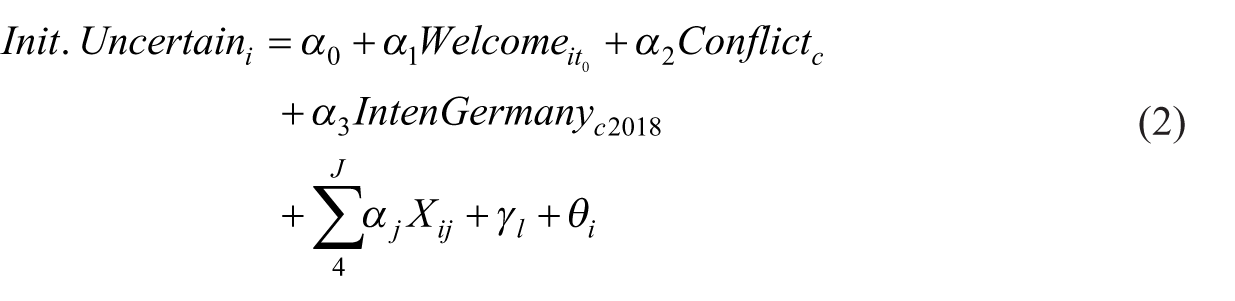

We followed a similar strategy to estimate the effect of temporary stay intentions in Germany on refugees’ employment outcomes and German language scores:
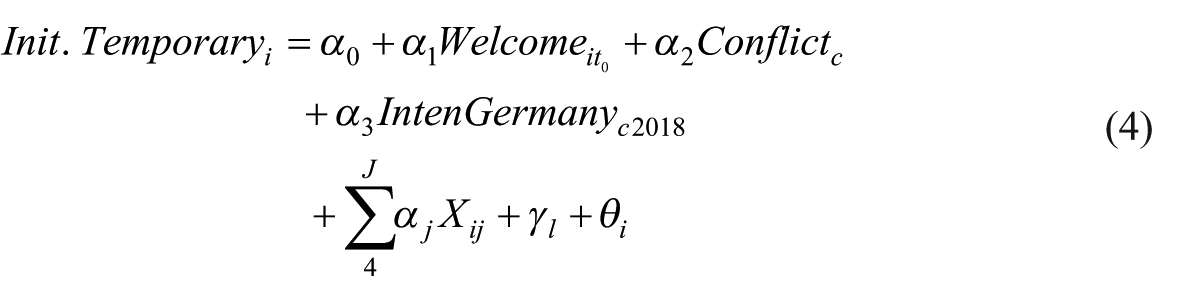

where
Kinky least-squares (KLS) approach
To further assess the robustness of our findings, we applied the kinky least-squares (KLS) approach (Kiviet, 2020). KLS analytically corrects for omitted variable bias in OLS regressions across a grid of assumed endogeneity correlations. When no endogeneity is present, KLS yields results equivalent to OLS; with endogeneity, it produces bounded estimates under varying assumptions about the correlation between the endogenous regressor and the structural error term.
Importantly, we used KLS not as a substitute for instrumental variable (IV) estimation, but as a diagnostic tool to evaluate the plausibility of the identifying assumptions underlying the IV approach. The method is especially useful when instrument validity is difficult to verify. In practice, it allowed us to ask: What level of endogeneity would be required to generate our IV estimates? If such levels are implausibly high, this would cast doubt on the IV findings; if they fall within theoretically or empirically plausible bounds, the credibility of the results is reinforced.
In our case, we restricted the analysis to a range of positive endogeneity correlations (ρ = 0.05 to 0.40), motivated by the expectation that refugees with stronger permanent intentions might be negatively self-selected with respect to labour market potential (for discussion, see Online Supplementary Appendix D). While evidence on negative post-arrival selection largely comes from studies of labour migrants (e.g., Bijwaard and Wahba, 2019), recent work suggests that similar selection mechanisms apply to refugees (Hannafi and Marouani, 2023; Ette et al. 2026). This supports the assumption of a positive correlation between settlement intentions and unobserved determinants of integration outcomes.
Results
Association between settlement intentions and refugees’ integration outcomes
We began by assessing the impact of settlement intentions in wave 1 on refugees’ integration outcomes in wave 2 using the Probit and OLS specifications of Equation (1), as presented in Table 1.
Average marginal effects of settlement intentions on the probability of employment, the probability of work aspirations, and German language proficiency: Binomial Probit and OLS estimates.
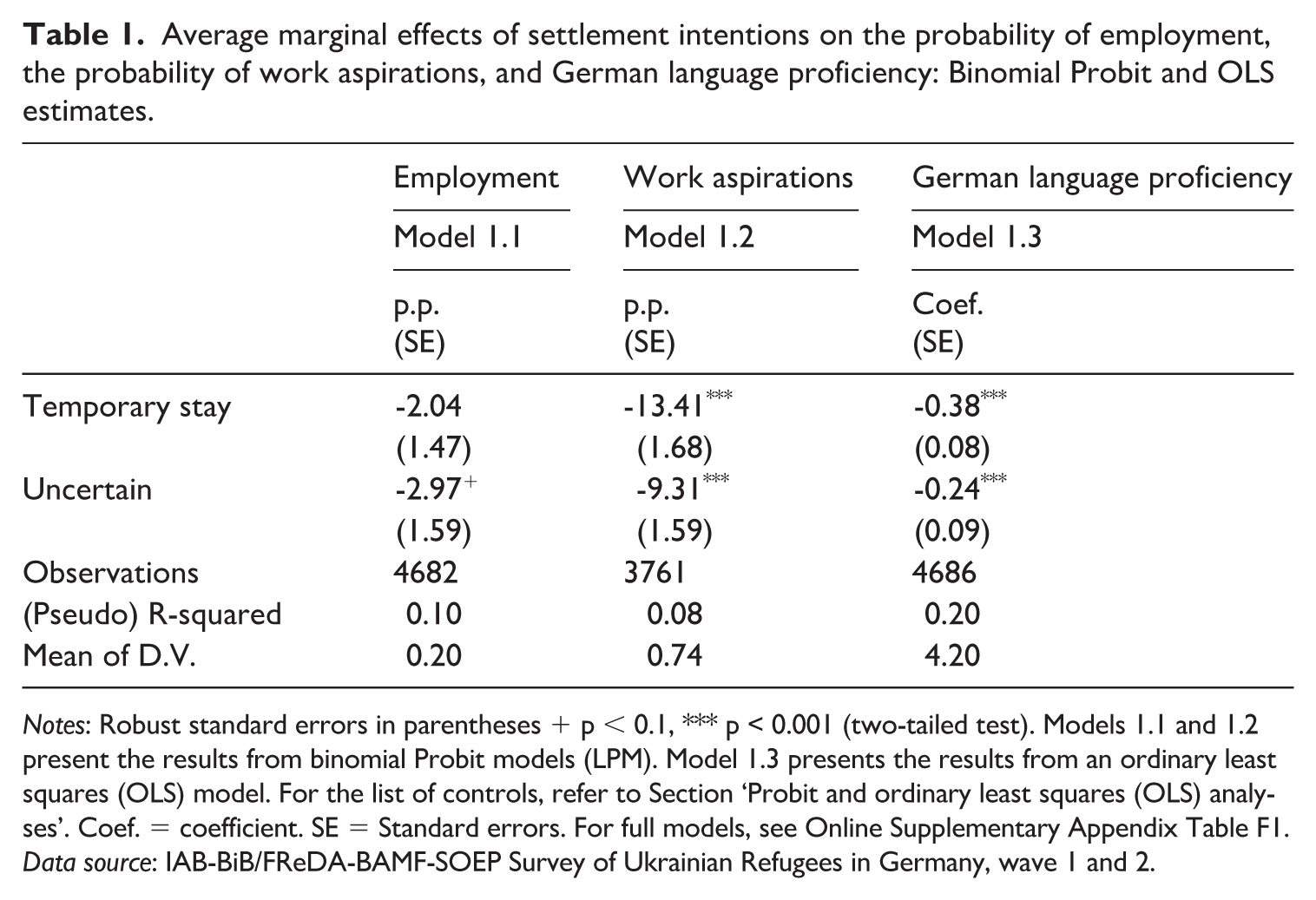
Notes: Robust standard errors in parentheses + p < 0.1, *** p < 0.001 (two-tailed test). Models 1.1 and 1.2 present the results from binomial Probit models (LPM). Model 1.3 presents the results from an ordinary least squares (OLS) model. For the list of controls, refer to Section ‘Probit and ordinary least squares (OLS) analyses’. Coef. = coefficient. SE = Standard errors. For full models, see Online Supplementary Appendix Table F1. Data source: IAB-BiB/FReDA-BAMF-SOEP Survey of Ukrainian Refugees in Germany, wave 1 and 2.
Model 1.1 showed that uncertain settlement intentions decreased the probability of employment by 2.97 percentage points compared with permanent settlement intentions. This association was statistically significant at the 10 percent level. Temporary settlement intentions were also negatively associated with employment probability, but this relationship was not statistically significant.
Model 1.2 indicated that refugees with uncertain settlement intentions were less likely to plan for future employment than those with permanent intentions, yet more likely than those with temporary settlement intentions. These results underscored the importance of settlement certainty in shaping refugees’ labour market aspirations. The degree of anticipated labour market attachment appeared to depend on the expected duration of stay in the host country. With regard to work aspirations, individuals with uncertain settlement intentions occupied an intermediate position between permanent and short-term stayers.
Turning to investment in host-country language skills, Model 1.3 showed a negative association between uncertain settlement intentions and German language proficiency, with uncertainty linked to a 0.24-point decrease on the 0–12 language proficiency scale. The negative association was even stronger for those with temporary intentions, amounting to a 0.38-point decline. These results suggested that stable settlement intentions were critical for successful language acquisition, as uncertainty appeared to hinder the development of the language skills necessary for integration in the German context.
Causal examination of settlement intentions impact on refugees’ integration outcomes
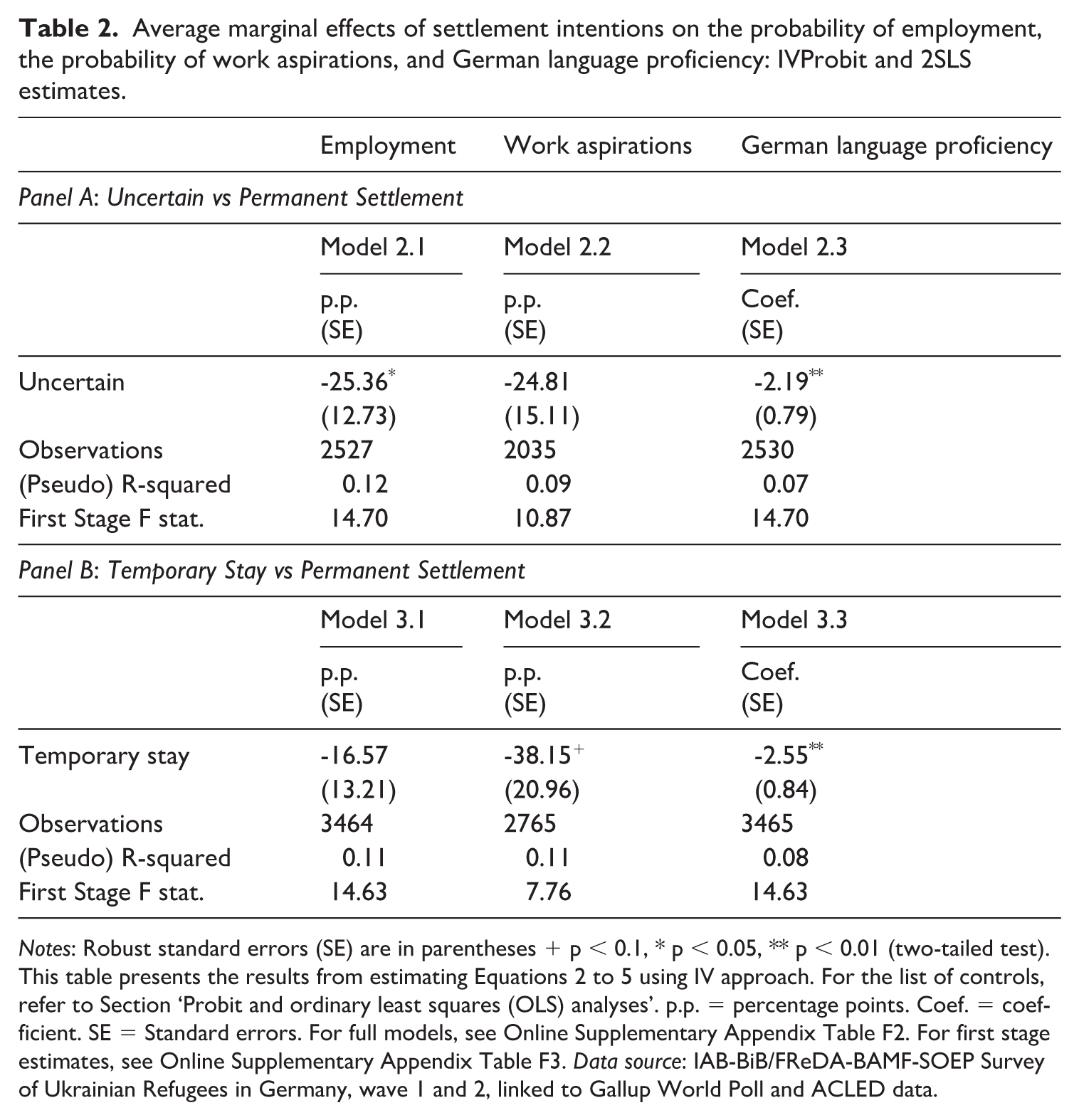
As discussed in the section ‘Estimation strategy’, the endogeneity of uncertainty and its interdependence with respondents’ family and socio-economic conditions prevented us from viewing the results in Table 1 as causal. Individuals characterized by uncertainty were likely positively selected; these were likely those who had the most to lose upon leaving Ukraine. To draw causal inferences on the effects of settlement intentions on integration outcomes, we employed the instrumental variable (IV) approach. The IV results are presented in Table 2, with Panel A comparing the integration outcomes between individuals with uncertain versus permanent settlement intentions, while Panel B contrasts those with temporary versus permanent settlement intentions.
Average marginal effects of settlement intentions on the probability of employment, the probability of work aspirations, and German language proficiency: IVProbit and 2SLS estimates.
Notes: Robust standard errors (SE) are in parentheses + p < 0.1, * p < 0.05, ** p < 0.01 (two-tailed test). This table presents the results from estimating Equations 2 to 5 using IV approach. For the list of controls, refer to Section ‘Probit and ordinary least squares (OLS) analyses’. p.p. = percentage points. Coef. = coefficient. SE = Standard errors. For full models, see Online Supplementary Appendix Table F2. For first stage estimates, see Online Supplementary Appendix Table F3. Data source: IAB-BiB/FReDA-BAMF-SOEP Survey of Ukrainian Refugees in Germany, wave 1 and 2, linked to Gallup World Poll and ACLED data.
Results in Model 2.1 indicated that uncertain settlement intentions in wave 1 had a negative effect on employment in wave 2, statistically significant at the 5 percent level. Quantitatively, settlement uncertainty decreased the employment probability by approximately 25 percentage points. Temporary settlement intentions showed a smaller and statistically insignificant effect (Model 3.1). In terms of employment aspirations (Models 2.2 and 3.2), both uncertain and temporary intentions led to significantly lower employment intentions. However, this negative effect was more pronounced for refugees with temporary intentions.
Regarding destination human capital, Models 2.3 and 3.3 indicated that uncertain settlement intentions were linked to lower German language proficiency. Specifically, refugees with uncertain intentions scored 2.19 points lower on German language assessments compared with those with permanent settlement intentions. Given the mean score of 4.20, this reflected a substantial gap, equivalent to approximately 18 percent of the full scale or 52 percent of the average level. This effect persisted even after accounting for language course participation and duration of stay in Germany, suggesting that individuals with uncertain settlement intentions acquired language skills more slowly over time. The negative impact was even more pronounced for individuals with temporary settlement intentions, who scored 2.55 points lower than those with permanent settlement intentions. This corresponded to approximately 21 percent of the full scale or 61 percent of the average language proficiency level among refugees, underscoring the role of settlement intentions in destination-language acquisition.
Robustness check: KLS estimation
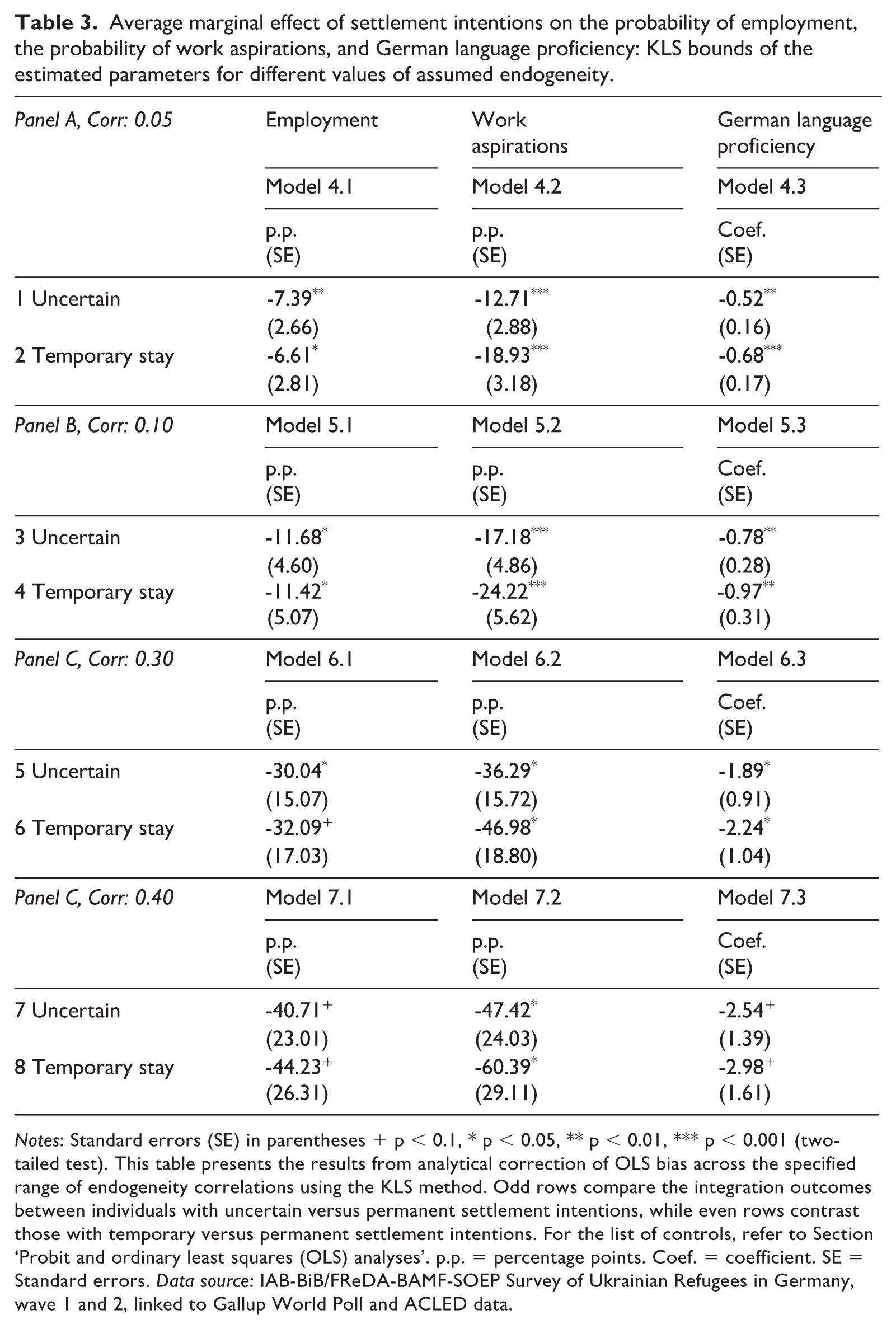
Given that the exclusion restriction underlying IV estimation is inherently untestable, we complemented our main analysis with the KLS approach (see section: Kinky least-squares (KLS) approach). KLS results are reported in Table 3 (see also Online Supplementary Appendix D). Across all three outcomes – employment, work aspirations, and German language proficiency – we find that even under moderate levels of endogeneity, the negative effects of uncertainty and temporary settlement intentions remain substantial.
Average marginal effect of settlement intentions on the probability of employment, the probability of work aspirations, and German language proficiency: KLS bounds of the estimated parameters for different values of assumed endogeneity.
Notes: Standard errors (SE) in parentheses + p < 0.1, * p < 0.05, ** p < 0.01, *** p < 0.001 (two-tailed test). This table presents the results from analytical correction of OLS bias across the specified range of endogeneity correlations using the KLS method. Odd rows compare the integration outcomes between individuals with uncertain versus permanent settlement intentions, while even rows contrast those with temporary versus permanent settlement intentions. For the list of controls, refer to Section ‘Probit and ordinary least squares (OLS) analyses’. p.p. = percentage points. Coef. = coefficient. SE = Standard errors. Data source: IAB-BiB/FReDA-BAMF-SOEP Survey of Ukrainian Refugees in Germany, wave 1 and 2, linked to Gallup World Poll and ACLED data.
For employment (Models 4.1 and 5.1), at endogeneity levels between 0.05 and 0.10, uncertainty reduces employment probability by 7.39 to 11.67 percentage points; the effect for temporary intentions ranges from 6.61 to 11.42 percentage points. Similar patterns emerge for work aspirations (Models 4.2 and 5.2), with uncertainty associated with a 12.71 to 17.18 point reduction, and temporary intentions showing even stronger effects (18.93 to 24.22 points). For German language proficiency (Models 4.3 and 5.3), uncertainty decreases scores by 0.52 to 0.78 points, while temporary intentions lead to even larger reductions (0.68 to 0.97 points).
At higher endogeneity levels (ρ ≈ 0.30–0.40), the KLS estimates converge with or slightly exceed the 2SLS estimates (Models 6.1 to 6.3), suggesting that 2SLS estimates may represent upper bounds of the true effects. Overall, the IV estimates fall within the range of effects generated by KLS under plausible assumptions, reinforcing their credibility.
The KLS framework thus enhanced transparency and sensitivity testing by replacing binary assumptions about instrument validity with a continuum of scenarios. These robustness checks support our main conclusion: uncertainty and temporary settlement intentions significantly hinder integration outcomes among Ukrainian refugees in Germany.
Additional analyses on job quality
While our results indicated that certainty in settlement intentions increases labour market integration among Ukrainian refugees, it remained possible that the jobs obtained were of lower quality. As explored in Online Supplementary Appendix C, both uncertain and temporary settlement intentions were significantly associated with a lower likelihood of skilled employment compared with non-employment. In contrast, neither type of intention significantly affected the probability of employment in unskilled or semi-skilled jobs relative to non-employment. These results suggest that unclear or short-term settlement plans primarily reduced access to higher-quality employment, shifting individuals toward non-employment or lower-tier jobs. Overall, early clarity in settlement intentions proved crucial not only for entering the labour market but also for securing higher-quality employment.
Discussion
This study analyses the effect of the (un)certain settlement intentions on socio-economic integration of Ukrainian refugees in Germany, including employment status, work aspirations, and German language proficiency. Our primary objective is to understand how uncertainty about settlement intentions shapes refugees’ integration paths.
Utilizing large-scale survey data representative of refugees who fled Ukraine to Germany following the Russian invasion in February 2022, and employing causal analyses techniques, our study shows that settlement intentions play a critical role in shaping integration outcomes. Compared with permanent settlement intentions, uncertainty has a negative impact on both employment and language proficiency. While temporary settlement intentions show a smaller and statistically insignificant effect on employment, they lead to notably lower German language scores. Furthermore, both uncertain and temporary intentions significantly reduce future employment plans, with the effect being more pronounced among those with temporary intentions. In sum, refugees with uncertain settlement plans seem to occupy an intermediary position between permanent settlers and temporary stayers concerning language proficiency and employment aspirations – factors that are crucial for long-term sustainable integration.
Our results resonate with theoretical frameworks such as Goal-Setting (Locke, 1968; Locke and Latham, 2006), Bounded Rationality (Simon, 1990) and Rational Choice (Coleman, 1994), as well as the post-migration Human Capital Investment model (Duleep and Regets, 1999), all of which suggest that a clear intent to settle fosters better integration outcomes. The underlying social mechanism suggests that individuals committed to living in a new country long-term are likely to align their goals accordingly. This alignment increases motivation and engagement in integration efforts, such as language learning or job search, which in turn improves socio-economic outcomes. Temporary intentions, by contrast, reflect a return- or onward-oriented outlook that discourages long-term investment. Our findings extend this logic by showing that even uncertainty about future settlement plans – often overlooked in the literature – constitutes a distinct behavioural orientation. Rather than merely representing an intermediate state, uncertainty generates a specific pattern of limited investment and strategic hedging, which may undermine integration outcomes over time.
From a sociological perspective, our findings contribute to understanding how personal agency and structural constraints interact to shape integration processes (Ager and Strang, 2008; Phillimore, 2011). They underscore the role of certainty and stability as enabling conditions for effective integration. Moreover, our findings speak to broader sociological debates on action under uncertainty and bounded rationality (Dequech, 2000, 2003). In contexts of high unpredictability and constrained foresight – typical for forcibly displaced populations – uncertainty itself may be a rational and adaptive strategy. However, our study results show that this adaptation may carry hidden costs: by reducing key integration efforts, refugees with uncertain intentions risk falling behind in labour market integration, compounding initial disadvantages. Moreover, our findings enrich migration sociology by highlighting how temporality and uncertainty shape refugee behaviour not only through structural constraints (e.g., legal status, institutional access), but also through subjective orientations (FitzGerald and Arar, 2018; Kogan and Kalter, 2020; Kosyakova and Kogan, 2022). The ambivalent logic of ‘staying with the option to leave’ emerges as a significant barrier to successful integration. In sum, our study adds nuance to existing theories of migrant incorporation, emphasizing the need for more dynamic models that account for the temporality of intentions and decision-making.
Our findings have several implications for policymakers. Individual-level uncertainty in settlement intentions is often shaped by broader institutional and legal contexts. In the case of Ukrainian refugees, temporary protection status grants immediate access to rights and services but also creates ambiguity regarding long-term residence. During our study period, the legal status was guaranteed only until March 2024, and its extension to March 2026 was uncertain at the time of data collection (Kosyakova and Brücker, 2024). Such institutional uncertainty can undermine future-oriented decision-making and discourage investments in integration. Integration policies that provide timely and transparent routes to permanence – where appropriate – can help counteract these effects. This includes streamlining legal processes, clarifying long-term prospects, and offering flexible support for both long-term settlers and those planning to return. Of course, limited integration among the latter may reflect strategic prioritization rather than failure. However, as the war continues and displacement becomes increasingly prolonged, many refugees have revised their initial intentions and now plan to stay in the host countries (Adema et al., 2024; Kosyakova et al., 2025). For them, delayed investment – especially in language skills – may lead to lasting disadvantages. A policy that naively treats all refugees as permanent stayers may misallocate resources, while one that neglects the prospect of long-term settlement may leave many ill-prepared. Integration measures must therefore address changing expectations to prevent costly integration gaps. 8
Future research has numerous pertinent avenues to explore. One such avenue is to disaggregate different dimensions of uncertainty (Dequech, 2003) and explore their respective impacts on integration. Our study focused on one key element – uncertainty in settlement intentions – but other types of uncertainty, such as institutional (e.g., legal precarity; Hainmueller et al., 2016; Kosyakova and Brenzel, 2020) or relational (e.g., social acceptance; Siebers, 2009) may have similarly strong effects on behaviour and wellbeing. Moreover, we focused on early-stage intentions; however, these may evolve over time due to life course developments, family reunification, or changes in war dynamics. Longitudinal data would allow researchers to trace how shifts in (un)certain intentions affect refugees’ integration strategies across different phases of the migration trajectory. Investigating these trajectories in diverse legal and policy contexts can enrich our understanding of the conditions under which uncertainty is either a short-term adaptation or a persistent barrier.
Supplemental Material
sj-docx-1-wes-10.1177_09500170261425857 – Supplemental material for The Role of Settlement Intentions (Un-)Certainty in the Labour Market Integration of Ukrainian Refugees in Germany
Supplemental material, sj-docx-1-wes-10.1177_09500170261425857 for The Role of Settlement Intentions (Un-)Certainty in the Labour Market Integration of Ukrainian Refugees in Germany by Davit Adunts, Kseniia Gatskova, Yuliya Kosyakova and Silvia Schwanhäuser in Work, Employment and Society
Footnotes
Acknowledgements
We would like to thank all those who commented on earlier presentations of this work at the INTER Lunch Seminar in Nuremberg (April 2024), the WeLar Workshop in Warsaw (April 2024), the international conference ‘Migration as a Multi-Sited Phenomenon: Migrant Selection and the Outcomes of Migration’ in Madrid (April 2024), the AISSEC XXIII Conference in Vincenza (June 2024), the BIBB-IAB-ROA Workshop 2024 in Nuremberg (July 2024), and the ISA RC28 Summer Meeting in Providence (August 2024), the virtual conference ‘The Past, Present, and Future of Human Migrations’ in the USA (September 2024), the ifo Workshop in Nuremberg (September 2024), and the international conference ‘Women in Times of Crisis: Rethinking the Extraordinary and the Everyday’ in Paris (October 2024). Replication codes for data preparation and analyses are available at https://doi.org/10.17605/OSF.IO/ZM7QA. Access to the data about the underlying IAB-BIB/FREDA-BAMF-SOEP Survey of Ukrainian Refugees in Germany data can be found at:  .
.
Funding
The authors disclosed receipt of the following financial support for the research, authorship, and/or publication of this article: We gratefully acknowledge support of the Deutsche Forschungsgemeinschaft (DFG — German Research Foundation) within the project ‘Longitudinal Study of Ukrainian Refugees (SUARE). Refugee Migration and Labor Market Integration’ (project number – 519020285).
Supplemental material
Supplemental material for this article is available online.
Notes
References
Supplementary Material
Please find the following supplemental material available below.
For Open Access articles published under a Creative Commons License, all supplemental material carries the same license as the article it is associated with.
For non-Open Access articles published, all supplemental material carries a non-exclusive license, and permission requests for re-use of supplemental material or any part of supplemental material shall be sent directly to the copyright owner as specified in the copyright notice associated with the article.
