




Abstract
Over recent decades, there have been increased public debates about rising level of ethnic and religious diversity and their implications for social cohesion and intercultural relations. These contestations are often situated within a diversity governance continuum with two opposing and often extreme poles both in the policy arena as well as the academic literature. The first pole sees diversity as potentially contributing to social fissures and intercultural discord. The second pole highlights the benefits of an acceptance of diversity for cross-cultural awareness and social peace. Using empirical evidence from a multi-year project, this article assesses the key assumptions underlying these oppositional approaches through a study of the provision of social services to multicultural communities and its association with civic engagement and national belonging. Study findings show that access to multicultural services is significantly associated with higher levels of civic engagement among migrants, rather than social exclusion and urban segregation.
Introduction
There is a growing debate in many multicultural societies about the optimal approaches to managing rising levels of ethnic and religious diversity (Barry, 2002; Fossum et al., 2020; Mansouri, 2015). These debates reflect a range of ideological and intellectual currents in the diversity governance literature especially as it pertains to multiculturalism and intercultural relations (Mansouri, 2017; Mansouri & Modood, 2020), which are organised along a continuum that presents two opposing poles. First, there is a long-standing ideological view that sees a possibility for social fissures, intercultural discord, and even outright conflict not only in relation to migration and diversity but also in any notions of difference (Hage, 2010; Yuval-Davis, 2007, 2011). This view emphasises the need to ensure that a form of commitment to and alignment with majoritarian, mainstream norms and practices is vital for sustaining community cohesion and social peace (Cantle, 2012, 2016; Putnam, 2009). We have seen this view manifest particularly in many assimilationist policies towards migration and diversity, as was the case with the White Australia policy. This policy endured into the early 1970s, since federation in 1901, when the Migration Restriction Act (the legislative genesis of the White Australia policy) was first introduced (Hage, 2008, 2010). In the Australian context, it is important to acknowledge that contemporary migration takes place in the shadow of 250 years of settler-colonialism that resulted in the oppression and dispossession of First Nations people (Butler & Ben, 2021; Povinelli, 2002). Indeed, this is important because ‘a focus on “everyday multiculturalism” and “convivialities” may also risk obscuring how colonial legacies have shaped and informed racialised and classed hierarchies of belonging in distinct context’ (Butler & Ben, 2021, p. 2179). The second, and almost oppositional view, is one that not only sees value in cultural diversity but also argues for state support for recognition of and support for cultural claims of migrants and other minority groups (Kymlicka, 1995, 2015). This is exemplified in the adoption of multiculturalism in the 1970s in the post-White Australia policy era. One of the key manifestations of the two oppositional ideological approaches to diversity governance is the extent to which migrants and ethno-cultural minorities are afforded not only cultural recognition but also material resources and support to articulate and sustain their ethno-cultural identities as individuals but, more critically, as groups. It is the latter collective claims that separate different diversity governance approaches most notably assimilationism and multiculturalism. And though classical assimilationism is no longer a prominent policy option across the world, its key arguments around adaptation to mainstream, majoritarian cultural and social norms still shape the policies of many countries particularly in the European context (Fossum et al., 2023) and beyond.
Against this migration and diversity historical background, both in Australia and internationally, this article aims to contribute to the ongoing discussion regarding assimilationist approaches and their efficacy in providing social services to multicultural communities. Through mixed-methods empirical investigation conducted in the Australian context, this article seeks to shed new light on the key assumptions underlying such approaches. In Australia as elsewhere, the delivery of migrant settlement services and other forms of social support in multicultural societies have been at the centre of a critical debate about the meaning of national citizenship and social inclusion of culturally and linguistically diverse communities. More than 20 years ago in the UK, Cantle (2001) introduced the notion of ‘parallel lives’, highlighting that ethnic groups tended to have little contact with the rest of society, which generated mutual fear and segregation. In the report, one of the recommendations to resolve social disintegration and thereby foster integration was the mainstreaming of services for ethnic communities. The assumption behind this view is that service provision tailored to multicultural communities (the so-called ‘ethno-specific’ or ‘multicultural’ services) is associated with weaker civic engagement (intended as the voluntary participation in groups and social activities with a positive impact on the community; Jones-Correa & Leal, 2001; Read, 2014; Vergani et al., 2017) and weaker national belonging. Concurrently, we also wanted to take the opportunity to interrogate the role that multicultural services play in facilitating social inclusion and the development of social capital, in light of Healy's research that supported ‘Putnam's finding regarding the negative impact of ethnic diversity on volunteering and, by implication, the formation of social capital’ (Healy, 2007, p. 63).
In this study, we investigated for the first time, with rigorous mixed methodologies in the Australian context, whether the provision of multicultural services is linked to weaker civic engagement and a weaker sense of national belonging, with the aim to interrogate the assumption, linked indirectly to Putnam's (2009) and Cantle's (2001) theses among others, that the use of ethno-specific and multicultural services by Australia's diverse communities is associated with weakened civic engagement and an enfeebled sense of belonging to national identity. Ethno-specific and multicultural services are viewed as social services designed to provide various forms of support for specific ethnic or diverse minority communities. In the subsequent sections, we will first present the intellectual discourse around multicultural services and their role in fostering social cohesion for diverse communities. Next, we will articulate the key hypotheses that we intend to test through our analysis of survey data collected in the Australian context. Finally, we will report the results of our quantitative analysis and supplement these with insights gathered from follow-up qualitative interviews with community members to help contextualise and interpret the findings.
The debate about multicultural services for diverse communities and social cohesion
The emergence of new waves of mass migration in Europe in the 1990s and the consequent religious and cultural diversity contributed at least partially to the ‘multiculturalism backlash’ debate. An abandonment of multiculturalism policies began to occur gradually in Europe, first in the Netherlands from the 2000s, while other European countries also started to shift towards muscular integration and, in some cases, assimilationist policies (Maan et al., 2014, p. 3; Scholten & van Breugel, 2018, p. 4). This shift towards less progressive policies towards migration and cultural diversity did not happen in a vacuum but rather in the context of the so-called ‘war on terror’ and the economic challenges that faced many European countries. This hard European response to migration and diversity also had its impact on Australian multicultural policies; government department mergers and restructuring began to take place with the political change brought about when the conservative John Howard government took office in 1996. In the same year, the Office of Multicultural Affairs was absorbed by the immigration portfolio and became the Department of Immigration and Multicultural Affairs (Australian Government, 2017; Koleth, 2010). In 2013, the Department of Immigration and Multicultural Affairs was re-assigned to the Department of Social Services, and ‘multiculturalism’ was institutionally erased.
The social complexity of increasing levels of diversity through migration – in culture, religion and linguistics – has contributed to questions on how best to manage superdiverse societies (Vertovec, 2023). Ted Cantle's 2001 Independent Review report, which investigated community conflict in numerous English towns and cities, led to his conclusion that migrants led ‘parallel lives’, where they could lead a majority of their everyday lives without interacting with communities outside of their own. This alleged that ‘parallel lives’ provide limited ‘opportunities for majority and minority groups to mingle and engage with each other’ (Peucker, 2017, pp. 38–9). This conclusion later contributed to Cantle's critique of multicultural policies, and his advocacy for interculturalism as an alternative diversity governance approach that prioritises interpersonal contact, interactions, and exchange across these intersectional differences (Cantle, 2016). It is in the face of these increasingly globalised, superdiverse societies that Robert Putnam posits that the challenge of social cohesion is ‘one of the pressure issues of our time’ (Putnam, 2009, p. 3), with particular concerns that, in the short term, ‘immigration and ethnic diversity tend to reduce social solidarity and social capital’ (Putnam, 2007, p. 137).
In response to this ‘multiculturalism backlash’ and ‘the complexification of migration and diversity’, several European countries have begun to adopt mainstreaming as a policy response to managing diversity in a sustainable and scalable way, often in an attempt to overcome integration measures that were de facto segregating newly arrived communities (Scholten, 2020, p. 117). Mainstreaming is an initiative of the European Union, and has been included in the Common Basic Principles for Immigrant Integration Policy and Common Agenda for Integration in 2004 and 2005 respectively (Collett & Petrovic, 2014, p. 4). It involves a move away from ‘target-group-specific policy measures … to coordinate integration measures as an integral part of generic policies’ (Scholten & van Breugel, 2018, p. 6), and requires ‘a whole-of-government response, including strong cooperation across policy portfolios and at the national and local level’ (Benton et al., 2015, p. 1). In Australia, multicultural policies from the 1970s have ensured the provision of welfare for migrant communities through the funding of ethno-specific welfare organisations (Jakubowicz, 1989). Yet, there is evidence Australia is similarly adopting a mainstream approach in managing its diverse communities that directs funding away from ethno-specific to mainstream organisations. While mainstreaming has benefits, such as its economic benefits, questions remains about how it will particularly benefit ‘newcomers, ethnic minorities, whole communities’ (Galandini et al., 2019, p. 698).
Methods
Our study seeks to add to the existing literature by employing a rigorous mixed-methods approach to examine a fundamental ideological assumption of assimilationist approaches regarding the provision of social services to multicultural communities. Specifically, we designed our empirical investigation to test one of the recommendations outlined in the Cantle report (2001), which suggests that services provided to ethnic communities should be integrated into mainstream service provision to promote social integration and combat social disintegration. The underlying assumption behind this recommendation is that the provision of multicultural services is linked to weaker civic engagement and a weaker sense of national belonging. If this assumption was valid, the provision of multicultural services tailored to specific ethnic and religious communities would lead to the creation of ‘parallel lives’, thereby fuelling fear and segregation.
Design and recruitment
Specifically, we formulate three hypotheses that will be tested in an empirical study initially with survey data:
Finally, we conducted follow-up qualitative interviews with a purposeful selection of Australian community members who have diverse experiences with multicultural services. These interviews aim to explore the nuanced relationship between the provision of multicultural services on one hand, and the prospects for migrants’ civic engagement and belonging on the other. The overarching research question the study aimed to examine was:
Together, the survey-based hypotheses and the interview-centred research question will allow us to examine the extent to which the particular mode of service provision to multicultural communities can be associated with specific outcomes in relation to civic engagement and local belonging. This question is at the heart of mainstreaming discourses in Europe and elsewhere where arguments are made about direct relationship, not correlation, between multicultural policy support in general and weakened outcomes for social cohesion (Cantle, 2016; Marc, 2010; Putnam, 2009).
Study participants and analytical measures
Our survey sample was collected between 21 April and 13 June 2022 by the data polling company YouGov from their well-established Australian demographic panel. The study sample is made of 1152 adult residents in Australia who were born overseas and who speak at least one language other than English at home. Although this is not a probabilistic sample, this is the first in the literature on multicultural service provision in Australia that attempts to provide a national snapshot of the attitudes and perceived impact of CALD 1 residents. According to the 2021 Australian Census, the overseas born population in Australia is composed of 48.5% males and 51.5%, females, and the median age is 45 years. Our sample is composed of 57.1% female and 42.9% male participants with a median age of 43 years (standard deviation = 16.92). This slight variation from the demographic characteristics of the wider population can be explained in relation to the survey company panel and the inclusion and exclusion criteria they employ. Nevertheless, the study sample exhibits similar overall characteristics to that of the wider population. Furthermore, the majority of the study participants (56.9%) settled in Australia more than 11 years ago, 14.3% settled between 6 and 10 years ago, and 18.4% 5 years ago or less. In terms of religious affiliation, only 28.7% of the sample identify as being non-religious, compared to 38.9% in the general Australian population. 40.2% of the sample are Christians (of which 20% Catholics), and 31% are of other religions (including 11.7% Hindu, 7.7% Muslim, 6.6% Buddhist, 0.7% Jewish, and 4.3% other religions). In terms of labour-force status, 40.5% of the participants were working full time, 25% were engaged in part-time work, 15.6% were retired, and 18.9% were not working. In terms of educational qualifications, 72.4% of our study participants had or were studying for a qualification including a certificate, diploma or degree, compared to 68% of Australians aged 15–74 (according to 2021 Census data). In relation to these characteristics, it is important to note that the geographical distribution of the sample is also very close to the distribution of the overseas-born population in Australia, according to the 2021 Census data (see Figure 1).
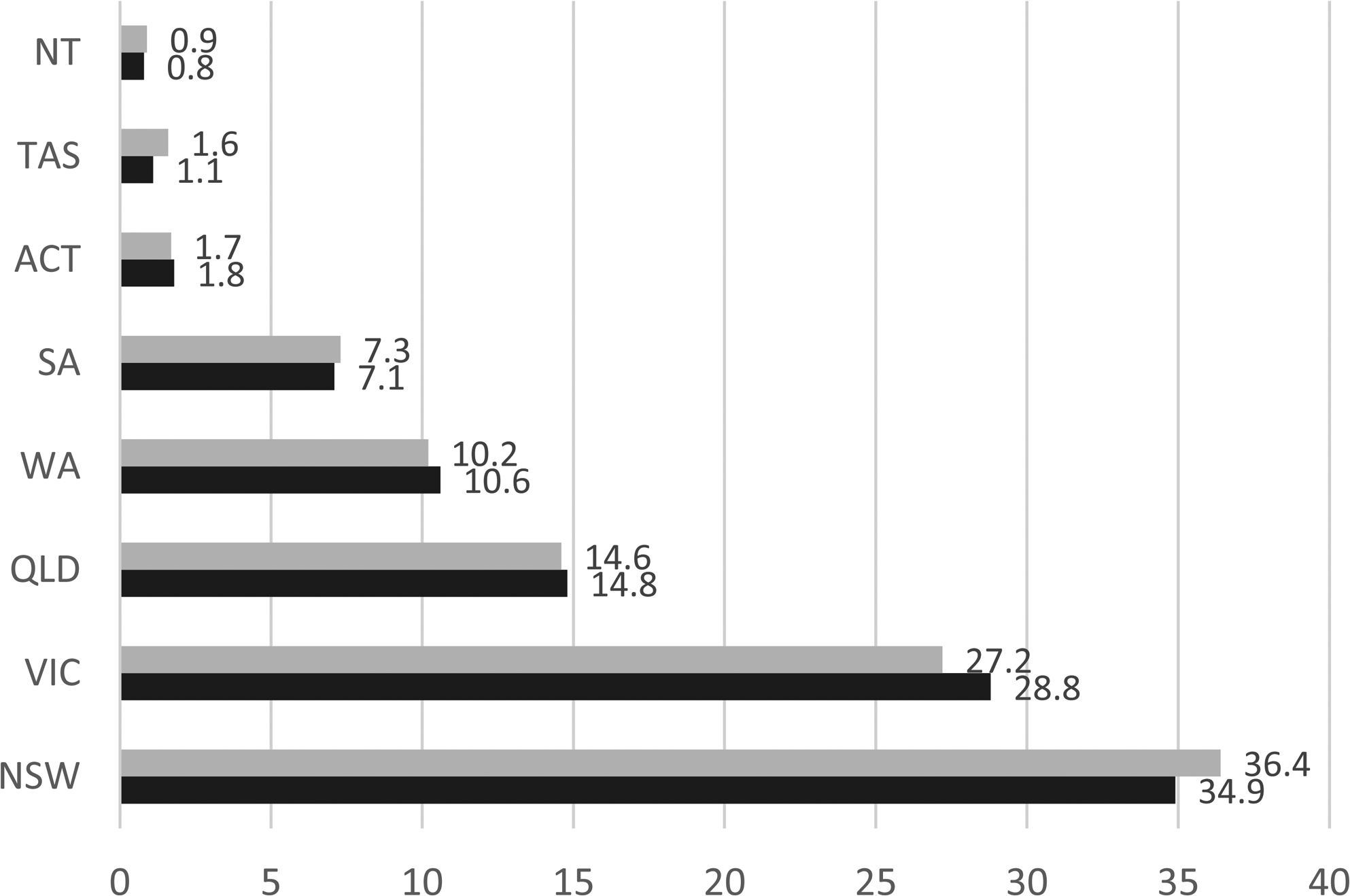
Geographical comparison of study participants and overseas born population by state. The darker line represents the percentage of the overseas born population in each state according to ABS data, while the lighter line indicates the percentage of study participants in our sample by state (percentages, N = 1152).
Among our participants, 69.1% identified as being migrant, 2.3% as being a refugee, 0.6% as asylum seekers, and the remaining 27.9% did not identify as belonging to any of these categories. The majority of our study participants (60%) are Australian citizens, 22.7% permanent residents, and the others are on various temporary visas. Importantly, 79.9% of our participants identify with a cultural and linguistic background other than English. More specifically, only 26.6% of the sample participants were born in Europe, North America and New Zealand. The next table provides an overview of the regions where our study participants were born (Figure 2).
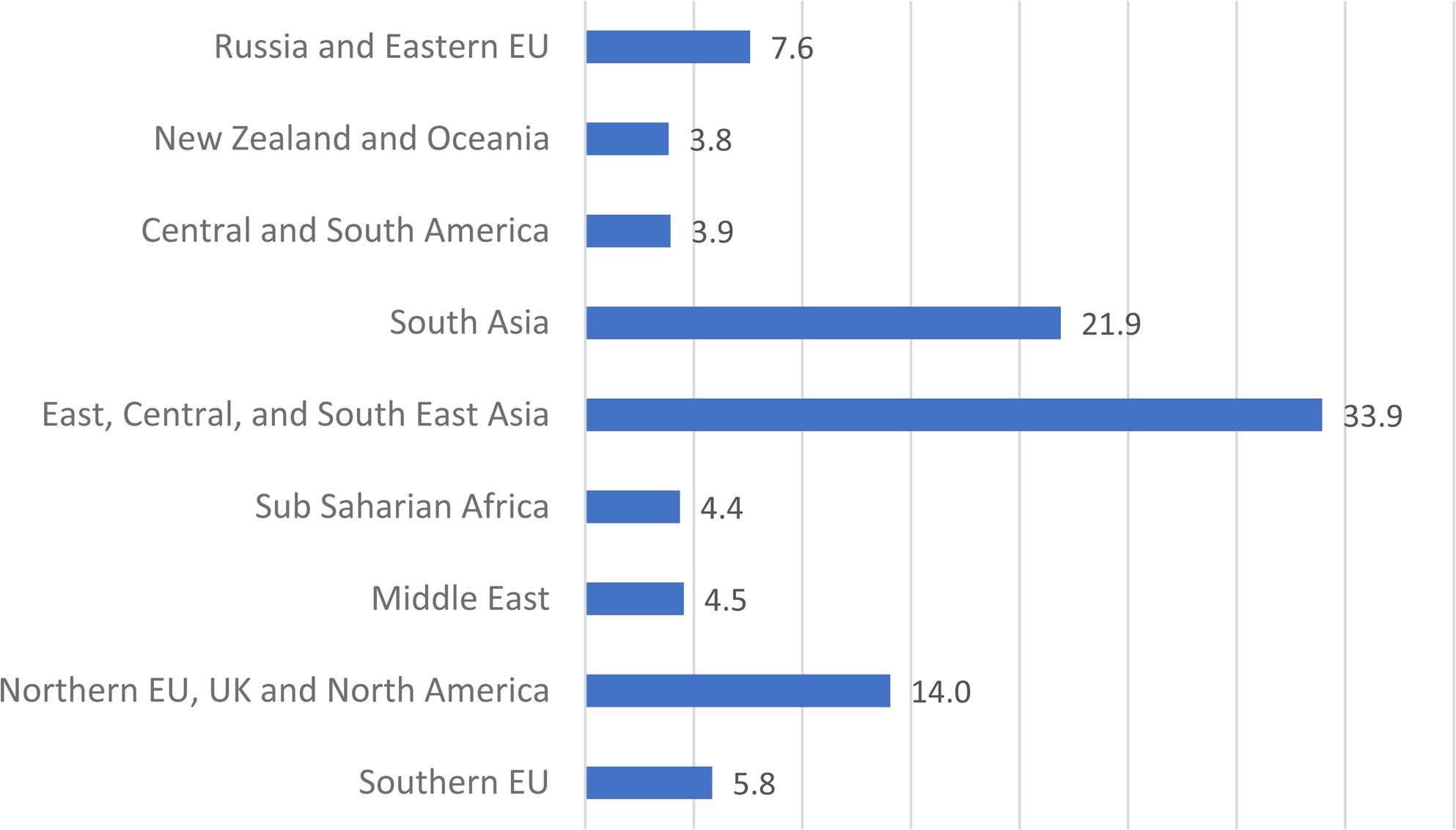
Country of birth of the study participants (percentages, N = 1152).
We measured the use of multicultural services by asking participants how often they used health, employment, or housing services from a ‘multicultural provider’ in the last five years. In the instructions, we described multicultural providers as ‘organisations offering services to specific ethnic or religious communities, and [that] cater to their specific cultural, religious, or linguistic needs’. Participants were asked to provide a response by selecting one of the following options: ‘Never, rarely, occasionally, frequently, very frequently’. We then dichotomised the variable by distinguishing between participants who never accessed any multicultural service in the last five years (71.4%) and the others (28.6%).
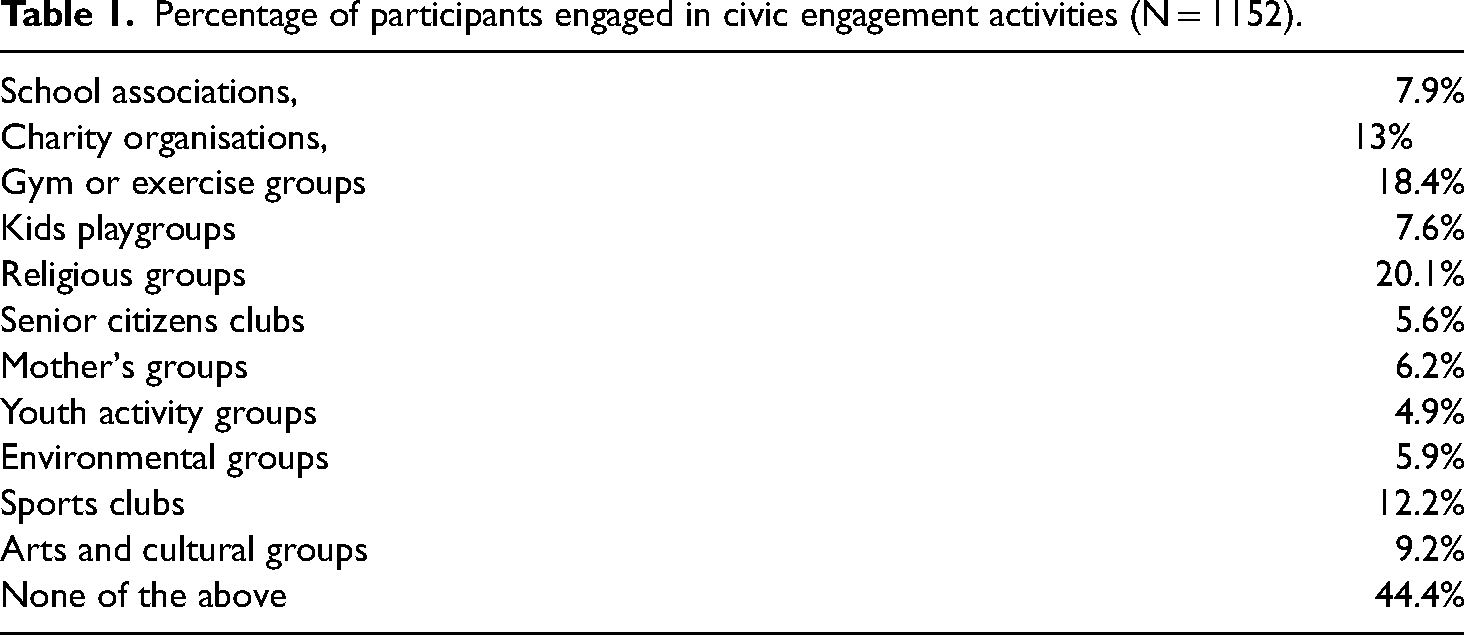
To measure civic engagement, we followed a procedure used in previous studies (Vergani et al., 2017) and created a scaled item by asking participants how many activities they were involved in, choosing all relevant options from the list displayed in Table 1. For each activity selected, participants were attributed one point. The mean number of activities selected by our respondent was 1.11 (standard deviation = 1.34).
Percentage of participants engaged in civic engagement activities (N = 1152).
To measure belonging, we asked two questions adapted from Wu and So (2020): ‘How would you describe your sense of belonging to Australia?’ and ‘How would you describe your sense of belonging to people with the same ethnic or cultural background as you?’ The responses were collected on a 5-point Likert scale from ‘Not strong at all’ to ‘Extremely strong’. The variable capturing belonging to Australia had mean 3.50 (standard deviation = 1.10) and belonging to the same ethnic or cultural group had mean 3.30 (standard deviation = 1.10).
In addition to the list of demographic variables presented at the beginning of this section, we collected other potential confounders (i.e. variables associated with access to multicultural services such as English proficiency, self-reported wellbeing and mental health, and perceptions of social exclusion). In terms of self-reported English proficiency, 59.9% indicated they had a ‘very good’ English proficiency level, and 40.2% a level of English ranging from ‘good’ (31.2%) to ‘acceptable’ (8.6%), ‘poor’ (0.3%) and ‘very poor’ (0.1%).To measure the wellbeing of participants we used an 8-item measure developed by Diener et al. (2009) with responses provided on a 7-point Likert scale (α = .92). In our sample, the mean wellbeing was 5.54 (standard deviation = 0.95). We measured mental health by asking ‘How would you rate your overall mental health?’. Responses were given on a 5-point Likert scale from 1 (Excellent) to 5 (Poor). The mean was 2.53 (standard deviation = 1.09). To measure perceptions of social exclusions, we adapted three items from Wu and So (2020) asking: ‘How would you describe the way in which the following groups are treated in Australia: people from an ethnic background other than Anglo-Australian; People who speak a language other than English; Migrants’ (α = .89). The mean was 2.75 (standard deviation = 0.87).
Qualitative interviews data
Research participants were recruited through mainstream, multicultural, and ethno-specific service providers. We focused on recruiting residents from the cities of Hume and Greater Dandenong in the state of Victoria. These are local government areas in Melbourne, Australia's largest city to date, and were selected as case study sites for this project based on their ethno-linguistic diversity and levels of socio-economic disadvantage. Our assumption is that based on these needs, these communities will likely require more support and access to services.
We interviewed 50 participants aged 24 to 81, who primarily reside in these selected cities. The gender distribution included 33 women and 17 men. Our sample represented a variety of countries of birth such as Middle Eastern nations like Afghanistan, Syria, Iran, Iraq and Lebanon; South, Southeast and East Asian countries including India, Pakistan, Singapore, Hong Kong and China; African countries like Zimbabwe, South Sudan, Egypt, Eritrea, Kenya and Uganda; European countries such as Bosnia, Malta, the UK and Italy; and from Oceania, Samoa. It is worth noting that some of them are not native to their country of birth. To ensure diverse perspectives on settlement experiences, we included participants who had settled within the last five years (n = 12), those who had been here between 6 to 10 years (n = 9), and those who had lived here for 11 years and over (n = 29). Eight of the more recently arrived research participants were not proficient in English and in such cases an interpreter was provided during the interview. These interpreters were recommended by the service providers as having prior working relationships with their service users. Most of these interviews were conducted via Zoom because of Covid-19 pandemic lockdown restrictions. All participants were provided with a plain language statement about the project with a consent form to record the interview for transcribing purposes. For non-English speakers, the interpreter communicated these details accordingly. During the interview, the researcher would establish the context of their migration journey to Australia before asking questions about their experiences with mainstream, multicultural and ethno-specific services. Finally, they were asked questions related to their social networks and participation within communities, their engagement with service providers, and how these participations shape their sense of belonging and citizenship in Australia. Some of them referred to their civic engagements in their responses.
Findings and discussion
Survey data: overview
Through the survey data, we tested the hypotheses of whether access to multicultural services influences levels of civic engagement and lower feelings of belonging to Australia. We also tested the hypothesis of whether the use of these services would result in increased levels of attachment to one's own ethnic and religious community, thereby creating parallel lives among migrant communities away from mainstream society.
Contrary to the ‘parallel lives’ hypothesis, findings revealed that engagement with multicultural services produces increased, rather than diminished, levels of civic engagement. There was also no significant correlation between accessing multicultural services and feelings of belonging either to Australia or a specific ethnic group. Additionally, the analysis identified factors, such as age, country of birth, and English proficiency, as variables associated with access to multicultural services.
Survey data findings
To test for H1, H2 and H3, we conducted independent samples t-tests. Additionally, to have a more robust test of the three hypotheses, we used a binary logistic regression model, and we controlled for covariates that are potentially significantly associated with access to multicultural services, including basic demographic factors and others (i.e. self-reported English proficiency, wellbeing, mental health and perceived exclusion of migrants and culturally diverse Australians).The binary variable measured whether participants accessed at least one multicultural service in the last five years was used as outcome variable. To test H1, we inserted as main independent variable our measure of civic engagement. To test H2 and H3, we added our items measuring belonging to Australia and belonging to the ethnic group. Additionally, we inserted a list of covariates for control. The results are reported in Table 2.
Binary logistic regression results. Outcome variable: used multicultural services at least once in the last 5 years (N = 1,152).
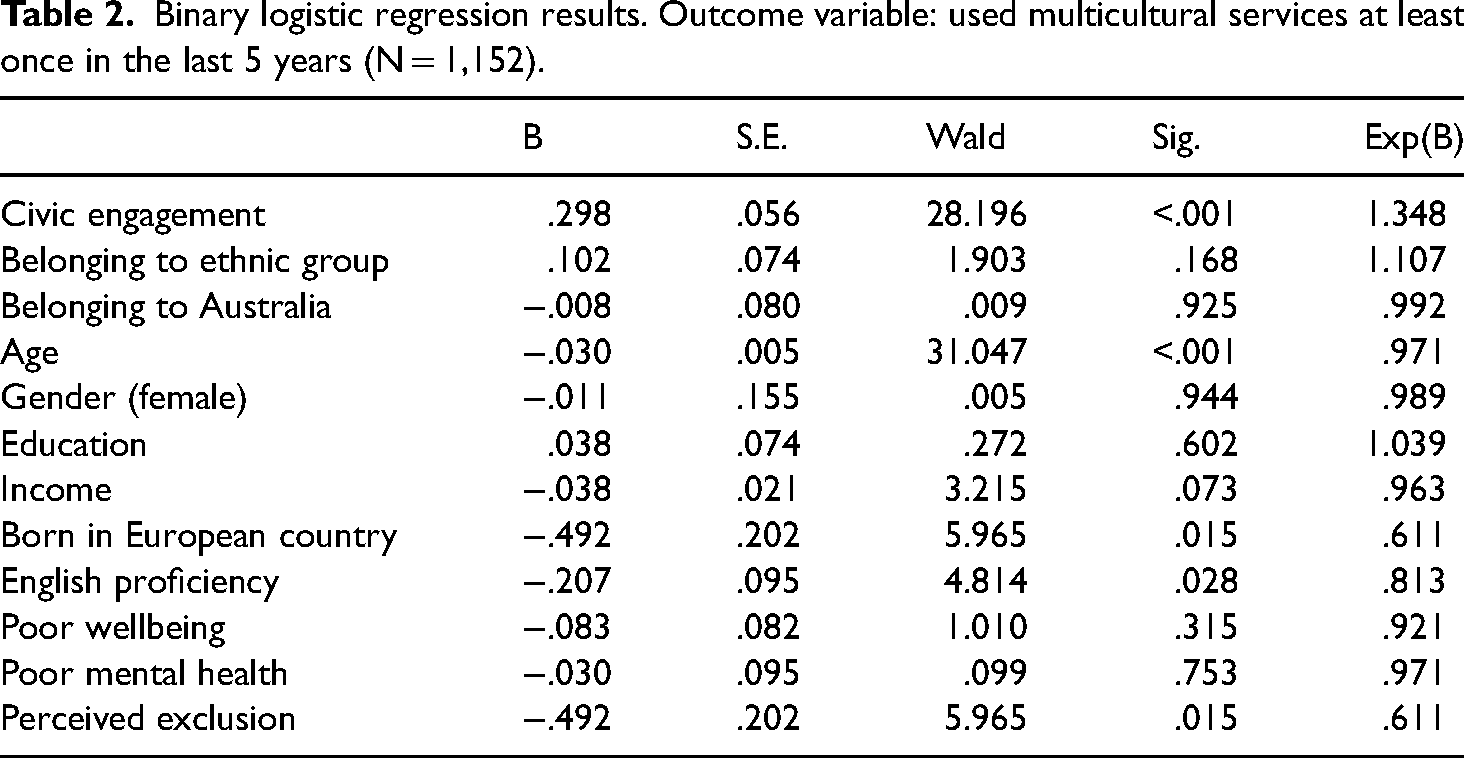
The results in Table 2 show that civic engagement has a significant positive effect on accessing multicultural services. For each civic engagement activity respondents are engaged in (see Table 1), the odds of accessing multicultural services increases by 34.8%, holding all other variables constant. In other words, individuals who are more civically engaged are 34.8% more likely to access multicultural services than those who are less civically engaged, all else being equal. Based on this result, H1 is not supported.
Belonging to Australia and to a specific ethnic group have a non-significant effect on accessing multicultural services. Therefore, there is no evidence to suggest that belonging to Australia or to a particular ethnic group increases or decreases the likelihood of accessing multicultural services. Based on this result, H2 and H3 are not supported.
Table 2 also shows that some of the co-variates have a significant effect on accessing multicultural services. Age has a significant negative effect on accessing multicultural services: for each one-year increase in age, the odds of accessing multicultural services decreased by 2.9%, holding all other variables constant. In other words, older individuals are 2.9% less likely to access multicultural services than younger individuals, all else being equal. Being born in the European Union has a significant negative effect on accessing multicultural services: compared to individuals not born in the European Union, those who were born in the European Union were 38.9% less likely to access multicultural services, holding all other variables constant. Finally, having high English proficiency has a significant negative effect on accessing multicultural services: individuals with high English proficiency are 27.5% less likely to access multicultural services compared to those with lower English proficiency, all else being equal.
Qualitative interviews: overview
The positive significant association between the use of multicultural services and civic engagement is reflected in our qualitative interviews. For many of the research participants, their involvement with multicultural services and their social networks encourage and facilitate civic engagement. It is within these social contexts that the research participants form bonds within their communities. It is through bonding formed within these multicultural services and social groups, through the staff and other service users who have informal connections with other community and religious organisations, that social bridging and linking occur. For other research participants, they proactively seek out social connections within and outside of their communities to combat loneliness, establish themselves in a new society, or to find employment. It is through such endeavours that they become aware of and connect with multicultural services.
Across the interviews, research participants often report that they lack awareness of the diverse range of services available to support them and their settlement needs. In such a context, multicultural services and community groups work collaboratively to expand their reach to communities in need. Participants’ proactive civic engagement has facilitated new connections with their ethnic communities and broader Australian society. They connect with and become part of community and religious groups through these social bridging activities. Multicultural services also promote civic participation as a means to support migrant integration with mainstream Australian society. Whether through access to multicultural services or their own civic engagement, these participants develop their social capital, connections with other communities and a stronger sense of belonging in Australian society.
Qualitative interviews findings
In this analytical section, we examine how involvement with multicultural and, in some cases, ethno-specific service provision has led to a more agentic, locally driven civic engagement (Giorgas, 2000). We chose to use biographic vignettes to highlight specific cases and provide more contexts where individual participants reflected on how access to culturally and linguistically appropriate support has played a significant role in engendering stronger notions of local attachment and community belonging. Collectively, these qualitative insights refute the notion that multicultural and ethno-specific modes for the provision of various social services to migrants necessarily lead to disconnection and disengagement from mainstream society.
I, kind of, gravitated towards more of people from my culture and, hence, I joined the youth team. I established the youth team in – at the church and we did a lot of youth events. That's how I started my community work at the time – because of my education I became quite a volunteer in the community. Did a lot of support applications, legal, everybody would take me with them to legal services … because I had the language.
So [AMES] welcome the people who want to do volunteer work. That's also a good thing which I like here in all professions, wherever you want to go. If you’re happy to do as a volunteer work, they will welcome you. That's a good opportunity for [people] like me, because I want to learn…. If I will give my time, I will get you know, in that case I will get, get information, knowledge. So volunteer work is very important which I like here in the Australia.
Most of the local organisations, I’m involved with them as an employee or a volunteer. I told you about the chippie skills I gained through pre-apprenticeship and apprenticeship…. So I was good with working with my hands. Then Dandenong Neighbourhood House offered me to work as a trainer for a Men's Shed program … So I was still desperate looking for work…. Then I saw an advertisement about a volunteer for L2P program in SMRC, Southern Migrant Resource Centre in Dandenong. I approached them and I said, ‘What's this?’ They said, ‘We established a program to teach new arrivals, migrants, to learn driving because they can’t really afford it.’ I said, ‘Okay. I remember I struggled a lot with that. This would be a way to help some people.’
My first job I was – when I came to Australia I was learning English class [at] Fitzroy Learning Network. They ask to do a volunteer. I said I can do. It was, like, in the corner of Napier Street, Fitzroy…. Then I was doing with them – once a week I was doing volunteering at that place. Yeah, we have – I have a lot of friends from our community; Eritrean women. We meet every Tuesday…. We have a place to meet there. We have a coffee ceremony, we chat, relaxing, enjoying, you know. We get sometimes the speakers from Co-Health from different places … they say, ‘Welcome everybody to come to have an educational thing’, you know, like, health, wellbeing and a lot of things … when we start we open to be, you know, the whole week have too much in your head and one day have relaxing day, you know, to meet friends, to have a chat and relax … happy day for us to see each other…. The group [is] called Eritrean Women's Group but we have friends around us, like Sudanese, you know, like, Yemeni and stuff…. Just the name is Eritrean Women's Group but everyone is welcome.
In sum, the qualitative findings suggest four main emerging patterns that shed empirical light on the link between using multicultural services and civic engagement. First, ethno-religious support structures can be instrumental in building social capital for migrants, which in turn facilitates their active participation in community life. This is exemplified by the stories of migrants who, through the support of their cultural and religious institutions, find avenues for volunteering and community work, thereby enhancing their civic engagement. Second, language services provided by multicultural agencies can help migrants to integrate into the community. Improved language skills are closely linked to increased confidence and participation in local activities, which strengthens migrants’ sense of belonging. Third, volunteering emerges as a potential pathway to civic involvement. Migrants engaging in volunteer work gain valuable knowledge and connections, which not only contribute to personal growth but also to the social fabric of the community. Lastly, community-led initiatives that are inclusive and culturally sensitive can promote a sense of belonging and engagement. These initiatives create spaces where migrants can connect with others, share experiences, and support each other, further embedding them within the social and civic life of their new environments. Together, these patterns underscore the importance of culturally attuned services in aiding migrants’ transition into active and engaged members of their communities.
Altogether, the quantitative and qualitative data above showed that exposure to and engagement with multicultural services is associated with higher levels of civic engagement, rather than the weakening of social cohesion and erosion of affective notions of local belonging. Furthermore, our analysis has shown that several key variables – most notably age, period of settlement and English proficiency – can be associated with changing patterns and intensity of access to multicultural services. Put differently, at a time when Australia has transitioned into a migrant-majority society (ABS, 2021), adopting an approach to service provision that caters to an increasingly superdiverse society (Vertovec, 2023) can be associated with positive outcomes in relation to local belonging, intercultural relations, and civic engagement.
Conclusion
The aim of this article was to provide new evidence to inform a key and decade-long debate about diversity governance in multicultural societies. The debate has broadly two ideological and intellectual poles: at one extremity, diversity is seen as potentially harmful to social cohesion. At the other extremity, diversity is seen as an opportunity for cultural awareness and openness. We used the example of multicultural service provision as a case study to test three hypotheses derived from the ‘parallel lives’ approach (Cantle, 2012, 2016), which assumes that the use of multicultural services would be associated with lower levels of civic engagement, lower levels of belonging to Australia, and higher levels of belonging to one's ethnic and religious communities. This assumption, though formulated twenty years ago, still plays an important role in the current intellectual and ideological debates about multiculturalism and the provision of social services for multicultural communities. In the last decade, governments in many European countries such as Germany, Sweden, and Denmark, have responded to the new demographic realities and social fissures by implementing a rebranded form of neo-assimilationism through mainstreaming of social services (Benton et al., 2015). Mainstreaming in this context carried within it an implicit belief that migrants needed to shed their heritage culture as they negotiate belonging in their new social milieus. This idea fundamentally entails that social services should be the same for everyone, regardless of ethnic, linguistic, or religious backgrounds. This is a departure from the multicultural ethos, which recognised that migrants, especially during the early phases of settlement, will require more culturally and linguistically appropriate support to navigate social integration successfully. The assumption that has been propagated implicitly or explicitly in policy circles and academic studies (Cantle, 2012; Putnam, 2007) was that rising levels of cultural diversity will weaken social cohesion if migrant groups are allowed and supported to retain aspects of their cultural and religious identities. Putnam's work in particular, and the ‘hunkering down’ hypothesis pertaining to the negative effect of ethnic and cultural diversity on trust and civic engagement, sustained much of the ongoing debate concerning the implications of ethno-cultural diversity for social cohesion.
Our research provided strong empirical evidence that the assumption about the relationship between the use of multicultural services and lower social cohesion outcomes is not informed by such evidence. On the contrary, we found that CALD Australians who were more civically engaged (i.e. those who participated in more associations, groups, volunteering organisations, community activities) were the ones who used multicultural services the most. We also found that higher levels of belonging to Australia were associated with greater perceived importance of multicultural services. Importantly, we found no association between ethnic belonging, and the use and perception of the importance of multicultural services. Our interpretation of these findings is that this positive association between provision of multicultural services and stronger notions of civic engagement and local belonging might indicate that the more the state itself functions in a multicultural capacity the more it will respond to the needs of all citizens and residents (Blair, 2015; Mansouri & Modood, 2020).
In terms of limitations, our survey questionnaire did not distinguish between participants accessing services tailored specifically for distinct ethnic or cultural groups and those spanning multiple communities. Future research should examine this differentiation, which could potentially play a role in exploring correlations between service access, civic engagement, and belonging. Furthermore, it should be noted that our sample provided a non-probabilistic representation of overseas-born Australian residents sourced via an online panel. This sampling methodology may have under-represented individuals with limited English proficiency and technological access, as they would not typically engage with online panels. However, it is important to observe that even within our sample, potentially skewed towards individuals with higher English and technological proficiency, English proficiency levels were significantly correlated with access to multicultural services. Such variations in proficiency levels within our dataset successfully highlight a significant association with our primary variable of interest. This suggests that the real-world correlation might be even more pronounced.
Our study supports previous research findings in the Australian context, which found that belonging to ethnic and religious minorities does not translate into weak social cohesion (Mansouri et al., 2015; Vergani et al., 2017). Rather, ethno-specific and multicultural organisations have ‘civic potentials and contributions to promoting social cohesion [that] have often remained unrecognised, underestimated and untapped’ (Peucker, 2017, p. 37). Earlier research in the US shows that voluntary organisations provide opportunities for training in various skills (Verba et al., 1995). Research in Australia shows that Muslim voluntary organisations in Australia contribute positively to social cohesion by bridging migrant communities with mainstream society, in spite of substantial negative perceptions subsequent to 9/11 (Peucker, 2016). In other words, new migrants may be better served by their own ethnic communities, through the development of their social capital, that in turn will better prepare them for integration into mainstream society. Our study is situated in broader global discourses on the failures of multicultural policies that have engulfed the UK and European countries over the last two decades. Australia was no exception with similarly critical discourses emerging around the crisis of multiculturalism (Ang & Stratton, 1998; Mansouri, 2015). Central to this rejection of pro-diversity policies, such as multiculturalism, was an assumption that such progressive policies have resulted in weakened civic engagement and feelings of national belonging among migrant groups. Numerous academic studies and policy reports (Cantle, 2012, 2016; Johnston et al., 2002; Putnam, 2009) have even suggested a direct correlation between pro-diversity multicultural policies on the one hand and community discord on the other. Our study refutes these claims and supports instead the value of a more inclusive approach to diversity governance, where equality of citizenship is not only articulated discursively at policy level but more critically performed through social service provisions programs that respond to the cultural, linguistic and religious specificities of individual migrants, their communities and the wider society at large (Barry, 2002; Beck, 2002; Thomas, 2011).
As societies become more ethno-culturally diverse, the recognition of cultural specificities and the impact they have on articulations of group belonging based on cultural identities is becoming more critical in our super-diverse societies, where increasing levels of migration are engendering new and more complex socio-cultural realities (Vertovec, 2023). As societies continue to diversify ever more profoundly, scholarly and policy debates about how best to manage this diversity have kept pace in most émigré milieus. At the heart of these debates are questions about identity and, in particular, the extent to which certain aspects of individual cultural identities can be supported by and adapted to mainstream values and norms without weakening overall social cohesion and intercultural connectedness (Mansouri, 2017). In this context, and particularly in liberal democratic societies, governments realised that cultural diversity needed to be recognised, though the dominant view is that defining and adopting universal human rights would adequately address the needs of culturally diverse minorities (Kymlicka, 1995). That is, rather than ‘protecting vulnerable cultural groups directly (by granting special rights for them), cultural minorities would be protected indirectly by guaranteeing basic civil and political rights to all individuals regardless of group membership’ (Marc, 2010, p. 15). It is these civil, social, and political rights for all individuals regardless of ethnic, cultural, or religious backgrounds that have informed the multicultural approach in Australia, where a whole infrastructure of service delivery was initiated in the 1970s following the 1978 Galbally Report for migrant settlement and to address their integration needs (Galbally, 1978). Among the first service provision priorities to emerge during this period were language services, with both interpreting and translating services, as well as ethnic media and community language programs. This multicultural support infrastructure ensured the smooth integration of new migrants as well as the successful handling of a growing level of ethnic and religious diversity of a scale not seen before in Australia (Jakubowicz, 1989, 2015; Mansouri, 2015). The evolving super-diversity in contemporary societies like Australia presents new challenges, necessitating a more comprehensive and robust approach to diversity management to effectively support an increasingly multicultural society.
Footnotes
Acknowledgements
We wish to thank Scheherazade Bloul for proofreading this article and the research participants who took part in this research. This research was conducted in accordance with the National Statement on Ethical Conduct in Human Research 2007 (Updated 2018). Higher-than-low risk ethics approval was granted by the Deakin University Human Research Ethics Committee (DUHREC) on 1 October 2020 for project number 2020-301.
Funding
The author(s) disclosed receipt of the following financial support for the research, authorship, and/or publication of this article: This work was supported by the Australian Research Council under the Linkage Grant LP190100459. The project is led by Deakin University, in partnership with the Australian Women's Centre for Human Rights, the Victorian Multicultural Council and the Ethnic Communities’ Council of Victoria.
