




Abstract
Existing quantitative research on sexual orientation and life satisfaction uses models with control variables that do not have a clear rationale. With a correct understanding of what control variables do, no controls are necessary to estimate the consequences of sexual orientation on life satisfaction. An analysis constructed from this perspective reveals gay and bisexual men in the UK and Australia are less satisfied with their lives (relative to heterosexual men). Bisexual women in both countries are less satisfied as well. Lesbians in Australia are less satisfied (relative to straight women) – but lesbians in the UK do not have lower satisfaction. These conclusions hold also in an analysis that considers the possibility that some non-heterosexual people might be unwilling to disclose their sexual orientation on surveys.
In societies where homosexuality and other forms of sexual difference are less than fully accepted (i.e. in most societies), it should surprise no-one that lesbians, gay men, bisexuals, and people with other non-straight sexual orientations sometimes do not achieve happiness/life satisfaction in the same measure as heterosexual people. All the same, instead of simply assuming that lesbian, gay and bisexual (LGB) people 1 are less satisfied with their lives than straight people, it is desirable to have research establishing whether gaps of that sort exist and in what measure. This question has been investigated only quite recently (e.g. Mann et al., 2019; Perales, 2016, 2019). The research presented in this article is motivated by concerns about the analytical methods used in existing contributions.
These concerns have to do with how control variables are selected for regression models estimating the well-being consequences of belonging to a sexual minority. As in research on other topics, this issue is often discussed in ways that do not show a clear rationale. A common view is that one should include controls for ‘other determinants’ of the dependent variable. This view neglects an important distinction (e.g. Elwert and Winship, 2014; Pearl and Mackenzie, 2018): other determinants of the outcome can be ‘confounders’ with respect to the main independent variable of interest (here, sexual orientation), or they can be ‘intervening variables’ in a path from the main independent variable to the outcome. The term ‘confounder’ is sometimes used more loosely, but strictly speaking it refers to other determinants of the outcome that are also determinants of the main independent variable whose effect we seek to identify. In other words, it is essential to ask about the nature of the relationship between the main independent variable and the (potential) controls; the rhetoric of ‘other determinants’ (vis-à-vis the dependent variable) is insufficient as a means of specifying our models and can easily result in significant bias in results (Bartram, 2021a).
To estimate the impact of sexual orientation on subjective well-being (henceforth SWB – whether in the form of happiness or life satisfaction), we must therefore ask: what determines sexual orientation? The current prevailing view is that sexual orientation (in the form of sexual/romantic attraction) is overwhelmingly a matter of brain development in the womb (e.g. LeVay, 2017; see also Bailey and Pillard, 1995). Thinking broadly, pre-birth brain development might also be a determinant of SWB – but it is not something that can be measured via the usual survey projects that give data used for investigation of happiness and life satisfaction. Nor is it obvious that the specific biological processes understood to determine an individual’s sexual orientation (e.g. brain exposure to testosterone at key developmental stages) are the same as the biological factors that might contribute to different SWB outcomes.
For research on sexual orientation using survey data, the important implication is that the usual ‘other determinants’ of SWB should not be included as control variables. Factors such as employment status, income, social connections, parenthood status, etc. do not determine sexual orientation; they are therefore not confounders in this context (even if they might well be confounders with regard to variables indicated by other research questions about SWB). Worse yet, they might be ‘intervening variables’: this pattern would obtain if someone’s sexual orientation becomes an object of discrimination, perhaps leading to greater risk of unemployment, lower income, etc. Including variables of that sort will likely introduce bias rather than mitigating it (see e.g. Rohrer, 2018 on ‘overcontrol bias’ – a contrast to ‘omitted variable bias’). At best, models including such variables might yield estimates of ‘direct effects’; if so, it is then important to interpret them as such, noting that they are net of the indirect effects of sexual orientation itself (so, not merely net of the effects of ‘other’ variables).
The analysis that follows, then, is specified via the perspective that no control variables are necessary. An additional consideration asks whether use of controls might address the possibility that people do not necessarily disclose their ‘true’ sexual orientation on surveys. The analysis uses data from the UK and Australia; the findings might not reflect the experience of people who live in places where sexuality is experienced and structured in ways that depart from this sort of ‘western’ context. Even in the UK and Australia, the available data regarding sexual orientation are limited, giving us only the categories of heterosexual, lesbian, gay, and bisexual; any other ways of experiencing sexual orientation (e.g. ‘heteroflexible’; see Cover, 2019) are indeed relegated to a survey category of ‘other’. Still, the core argument here is that we can do a better job with the data we have.
Previous research
A large research literature explores mental health/illness among the LGB population (e.g. Chakraborty et al., 2011) – but there are few research contributions exploring their SWB in other senses. To a certain extent, the lack of research exploring the SWB consequences of sexual orientation stems from the fact that many of the datasets used to investigate SWB have not included a question about respondents’ sexual orientation until quite recently (Schönpflug et al., 2018). Many studies of well-being among the LGB population also limit their scope to investigation of LGB people themselves (e.g. Lyons et al., 2013; Pachankis and Bränström, 2018; Sagie, 2015), instead of comparing to heterosexuals. Comparison to straight people is essential for considering how sexual orientation (in particular, having a non-heterosexual orientation) might result in different levels/patterns of life satisfaction.
The studies that use comparisons to heterosexuals generally find that belonging to a sexual minority is associated with lower life satisfaction. Perales (2016) analyses data from Australia and finds lower life satisfaction among lesbian and bisexual women; there are negative coefficients also for gay and bisexual men, but these are not significant at conventional thresholds. There are also no ‘significant’ differences for men and women choosing the ‘other’ response. In a later article (Perales, 2019), the pattern is different: here, bisexual men are less satisfied than straight men while gay men are not. Among women, lesbians are less satisfied than straight women, and bisexual women even more so. (So, the main difference is that in the earlier study bisexual men are not less satisfied, while in the later study bisexual men are less satisfied.)
The difference in findings might be related to the use of different sets of control variables in the two investigations. In his 2016 article, Perales included the following controls in his models: gender (sex), age (and age-squared), having a partner (or not), educational qualification, employment status, having a long-term health condition, religiosity, income, urban residence, and migrant/ethnic background. In the 2019 study, there was a more ‘parsimonious’ set of controls: sex, age, migrant/ethnic background, urban residence, and state/territory of residence. Variables were selected as controls on the basis that they are ‘known to influence subjective well-being’ (Perales, 2016: 833).
Another study (Mann et al., 2019) yields another set of patterns, pertaining to the UK (using data from the Understanding Society dataset [University of Essex, 2019]). Controlling for age, income, number of children, membership of societies, ill health, marriage, educational qualifications, personality type, employment status, and region of residence, the authors find that gays and bisexuals (male and female) are slightly less happy than heterosexuals, while lesbians are happier than heterosexuals. (The analysis explores impacts across a set of quantiles – an interesting angle; the findings related here in this paragraph pertain to outcomes for the 0.50 quantile, equivalent to a conventional OLS – ordinary least-squares – regression.) Control variables are selected on the basis that they are ‘commonly used’; it is true that they are commonly used, though this begs the question of why their list differs from what is used in other research on the same topic, especially the earlier work of Perales (2016).
A study exploring sexual orientation and ‘psychological well-being’ (Rieger and Savin-Williams, 2012) gave attention to life satisfaction among high-school seniors and found no negative association with belonging to a sexual minority. This analysis did not include control variables per se – perhaps in part because the analysis focused on prediction, not on causal effects. However, their models contained variables for gender non-conformity as well as sexual orientation. It is not obvious that gender non-conformity is a suitable control variable for estimating the effect of sexual orientation on life satisfaction (to be fair, the authors do not assert that it is suitable).
Other contributions focus on SWB in a different sense – the ‘eudaimonic’ notion of ‘life meaning’. Douglass et al. (2020) use structural equation modelling to explore the way experiences of discrimination might lead to a sense of rejection, concealment of sexual identity, and internalised homophobia; consistent with the ‘minority stressors model’ of Meyer (2003), these factors lead to a lower sense of meaning in one’s life. Here it appears that no controls were used in the analytical models. On the other hand, the purpose of the research is not to consider the effect of sexual orientation on SWB via comparison to heterosexual people – the sample consists entirely of LGB respondents.
Another study exploring eudaimonic well-being (Riggle et al., 2009) finds a negative impact of LGB identity/orientation (with data from the US in 1995, an earlier period where acceptance was lower than currently). This analysis starts with a model containing only the baseline controls (sex, race, and education). It then adds a variable indicating respondents’ experience with discrimination, and only at a third step do the researchers add a variable for belonging to a sexual minority. So, the coefficient for sexual minority status comes from a model controlling for experience of discrimination. In a model of that sort, the impact of sexual orientation is partly obscured by the fact that discrimination can only be an intervening variable in this context. The coefficient for orientation is then a ‘direct impact’; it gives the effect of belonging to a sexual minority that is net of the indirect impact that runs through the experience of discrimination. If the discrimination variable were omitted, the evident impact of sexual orientation would surely be larger – a result that would give us a better sense of the total impact of a minority sexual orientation.
A similar conclusion might pertain to the results of any other studies where the use of particular controls does not make sense. It is harder to form a view with the same degree of clarity; exploring the consequences of including controls would require a similar form of reasoning. For our purposes it is perhaps sufficient to observe that researchers should make their reasoning clear when they specify models and include particular controls. It ought to be possible to form a consensus about what controls are needed for identifying the impact of sexual orientation on SWB. What is required for this purpose is an explicit and coherent rationale. The current situation (where each study uses a different set of controls) is undesirable.
Data and analytical methods
To construct an effective analysis in these terms, data are drawn from Understanding Society, the UK household longitudinal study (University of Essex, 2019) and from the HILDA Survey (Household, Income, and Labour Dynamics in Australia). 2 For the UK, sexual orientation is asked in Wave 3 (with data drawn in 2011–13), so other variables (including life satisfaction) are drawn from that wave as well. (Some ‘initial conditions’ variables such as ‘race’ and immigration background are drawn from Wave 1.) Effective sample size is 28,755. In the HILDA Survey the sexual orientation question was asked in Wave 12 (2012); effective sample size is 15,175. The central variables here (life satisfaction and sexual orientation) are posed in a self-completion mode to reinforce a sense of privacy as people engage with those questions (Robertson et al., 2018).
The dependent variable is life satisfaction (‘satisfaction with your life overall’). In the UK responses are given on a 7-point scale where 1 is ‘completely dissatisfied’ and 7 is ‘completely satisfied’. In the Australian data the life satisfaction scale runs from 0 to 10.
The focal independent variable is sexual orientation. The question on Understanding Society asks ‘Which of the following options best describes how you think of yourself?’; the options are ‘heterosexual or straight’, ‘gay or lesbian’, ‘bisexual’, ‘other’, and ‘prefer not to say’. 3 The HILDA Survey question is identical (except for using the word ‘categories’ in place of ‘options’). This variable is again limited, failing to accommodate sexual fluidity and the nuances of self-definition that characterise many people’s experiences (Cover, 2019). (To some extent, that limitation is evident for all survey data where ‘closed’ responses are used.) The available array of categories might be considered to embody an ‘essentialised’ view of sexual orientation, where sexual identities, preferences and behaviours are held to be congruent (Cass, 1979; Korchmaros et al., 2013). Sexual orientation is stable and congruent for many people but certainly not for all. In key sections later in this article, the text refers to ‘true’ sexual orientation, in the sense that someone is willing to reveal their genuine feelings and preferences – but at best the meaning of that term can only be ‘true for now’, in light of the possibility that some people’s sense of their own feelings and preferences might change.
The survey questions (together with the response categories) do not define the terms/categories, a feature that might be considered ambiguous. But the ambiguity is useful in this context, at least from one angle. It enables capture of the two main components of sexual orientation as a broad concept: sexual/romantic attraction and one’s sense of identity as it corresponds to attraction (Stonewall, 2017). The analysis will focus first on the attraction component; a discussion of identity will follow.
To build regression models evaluating the impact of sexual orientation on life satisfaction, we must decide what variables to include as controls. As noted, a typical way to make decisions of that sort is to identify the ‘other determinants’ of the dependent variable (here, life satisfaction). Drawing on existing research about SWB (e.g. Dolan et al., 2008), we could select a broad range of variables, such as age, income, religiosity, social connections, (un)employment status and so on. An additional factor potentially deemed relevant in this context might be: experience of discrimination and harassment. But this ‘other determinants’ approach neglects the important distinction between confounders and intervening variables; it is likely to give results that are significantly biased.
Again, regression models evaluating an impact (a causal relationship) should include (as controls) only those variables that are (in addition to being determinants of the dependent variable) determinants of the independent variable whose impact we seek to identify (here, sexual orientation). So, we can ask: what are the determinants of sexual orientation (and are any of those factors also determinants of life satisfaction)? A recent summary of research addressing that question (LeVay, 2017) gives an answer whose implications need careful attention: sexual orientation in the sense of attraction is determined primarily via biological processes that happen in the womb, before birth (mainly, variations in brain exposure to testosterone at critical developmental stages). Another recent review (Bailey et al., 2016) considers a range of ‘social’ explanations of sexual orientation (including ‘recruitment’ by an older homosexual person and being raised by non-heterosexual parents) and finds no persuasive evidence to support them; in this study, as well, sexual orientation is understood as primarily ‘innate’, while any potentially influential ‘environmental’ factors are non-social.
The implication is: sexual orientation is not determined by the factors understood as determinants of life satisfaction. From that angle, none of the variables typically included in models of life satisfaction should be considered confounders with regard to the impact of sexual orientation on life satisfaction (a similar point holds for age: see Bartram, 2021b). There is of course a great deal of complexity (beyond ‘biological processes in the womb’) in the scientific literature about how sexual orientation is formed – but it is far from obvious that that complexity leads to a different conclusion here regarding control variables. We might therefore evaluate the impact via a regression model that included no control variables at all.
The situation is arguably not quite so clear-cut. The data available in Understanding Society and the HILDA Survey do not give us an individual’s sexual orientation directly; instead, that aspect of social/personal reality is mediated by respondents’ willingness to disclose their sexual orientation, for example, on a survey (Doan and Mize, 2020). In a society where prejudice remains significant, that willingness cannot be taken for granted, especially among sexual minorities – which means that willingness to disclose might also be related to one’s life satisfaction (as with being ‘out’ in a more general sense, see Kosciw et al., 2015). An additional angle is that some respondents might find it difficult to admit even to themselves that they are not heterosexual; that tendency might pertain especially to older people, and/or to people with particular religious backgrounds (e.g. Cahill et al., 2014; Fredriksen-Goldsen and Kim, 2015; Wilkerson et al., 2012). In other words, people who experience sexual attraction beyond the boundaries of conventional heterosexuality might be unwilling to embrace the identity aspect of a non-heterosexual orientation (not least on a survey). Respondents in situations of this sort have the option of selecting ‘prefer not to say’ – but someone who is already anxious about their sexuality (and the way others might see them on this basis) might be wary of selecting anything other than heterosexual. If they also have lower life satisfaction, an analysis that does not address these angles (for example because it excludes control variables entirely) might underestimate the gap in life satisfaction between straight people and others.
That possibility points to a rationale for exploring age and religiosity as potential confounders. Other factors potentially relevant in that sense include location (it is perhaps easier to be ‘out’ in an urban area – see e.g. Annes and Redlin, 2012 – and in certain regions of the country: see Rudder, 2014 and Wienke and Hill, 2013). Variables for immigration background and race/ethnicity can be used to facilitate controls pertaining to people’s background/identification in groups where sexual diversity might be less accepted (Kim and Fredriksen-Goldsen, 2013). Education likely matters as well, especially insofar as it increases acceptance of difference in general, perhaps including acceptance of oneself (Bernard et al., 2013). Sex might not be a confounder per se, but it is included in analyses below in part so that we can (via interaction terms) discern differences in the experiences of gays vs. lesbians, as well as men vs. women embracing bisexuality and ‘other’ orientations. 4
In treating these factors as confounders, we must also be confident that they are unlikely to be intervening variables in the relationship between sexual orientation and life satisfaction. In this respect sex and age are safe: sexual orientation cannot determine one’s sex, nor how old someone is. It seems unlikely to affect educational attainment. There is some (analytical) risk that sexual orientation could affect involvement in religion: people who belong to a religion that condemns homosexuality might abandon religion altogether, or move to a more accepting one (Mahaffy, 1996; Sherkat, 2018). A similar configuration might apply to migration (internal as well as international), though Rudder (2014) points to data indicating that people do not tend to move to more tolerant places – instead, they often stay put and stay in the closet (so, a control for region might do exactly the sort of work we want a confounder to do in this context).
Other candidates for controls (i.e. typical determinants of life satisfaction) can be dismissed more definitively as potential confounders; it is important to exclude them here because they are much more likely to act as intervening variables. Income is unlikely to affect willingness to disclose sexual orientation; sexual orientation could however affect someone’s income (e.g. Black et al., 2003), via discrimination and attempts to avoid it (Plug et al., 2014; Tilcsik, 2011). A similar conclusion might apply to unemployment. For discrimination/harassment, a more subtle view seems required: people belonging to sexual minorities who have experienced difficulties of that sort might be less willing to disclose their orientation on a survey, but by the same logic they would be less willing to disclose that they had experienced discrimination/harassment on the basis of sexual orientation. On the other hand, discrimination/harassment is surely an intervening variable here: if sexual minorities are less satisfied with their lives, it might well be in part because they have experienced more discrimination and harassment than heterosexual people (Meyer, 2003). It is therefore important not to ‘control away’ that causal path by including this variable as a control in the analysis below.
Control variables (for analysis pertaining to the ‘willingness to disclose’ scenario) are drawn from the datasets as follows. Age is given in years. Whether someone is an immigrant is determined by their answer to a question asking whether they were born in the UK and Australia respectively. A variable on ‘urban’ residence denotes a settlement with a population of more than 10,000. A similar derived variable gives geographical region (12 for the UK, 13 for Australia). Religiosity is given by answers to a question asking how much of a difference religion makes to their lives. Educational attainment is rooted in a question about ‘highest qualification’; the available responses are then aggregated to three values (none/primary, secondary, and university degree or equivalent). A similar aggregation is performed on Understanding Society’s variable for race/ethnicity, resulting in the categories White, South Asian, East Asian, Black, mixed, and ‘other’ (a race/ethnicity variable is not available in the HILDA Survey). 5
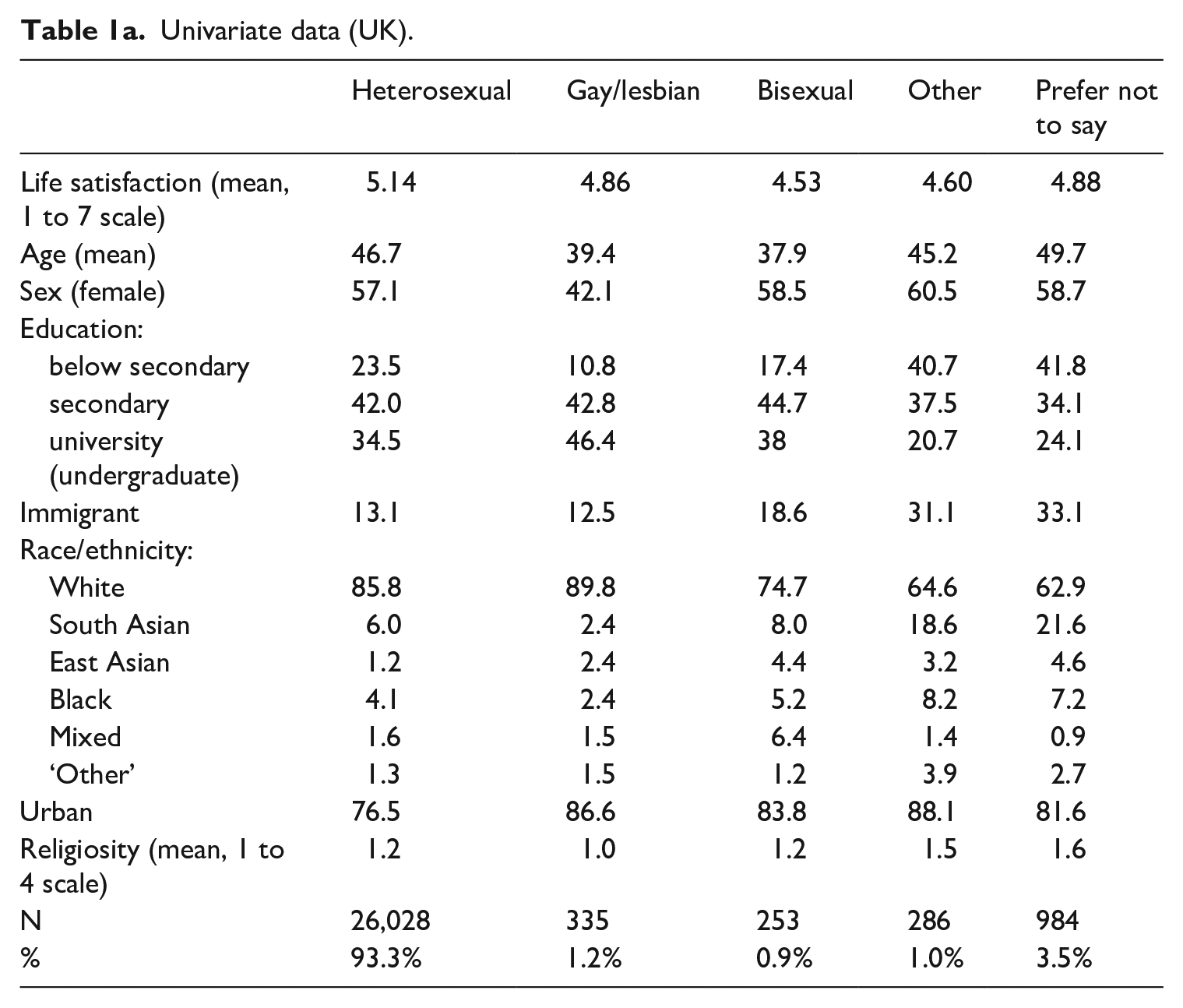
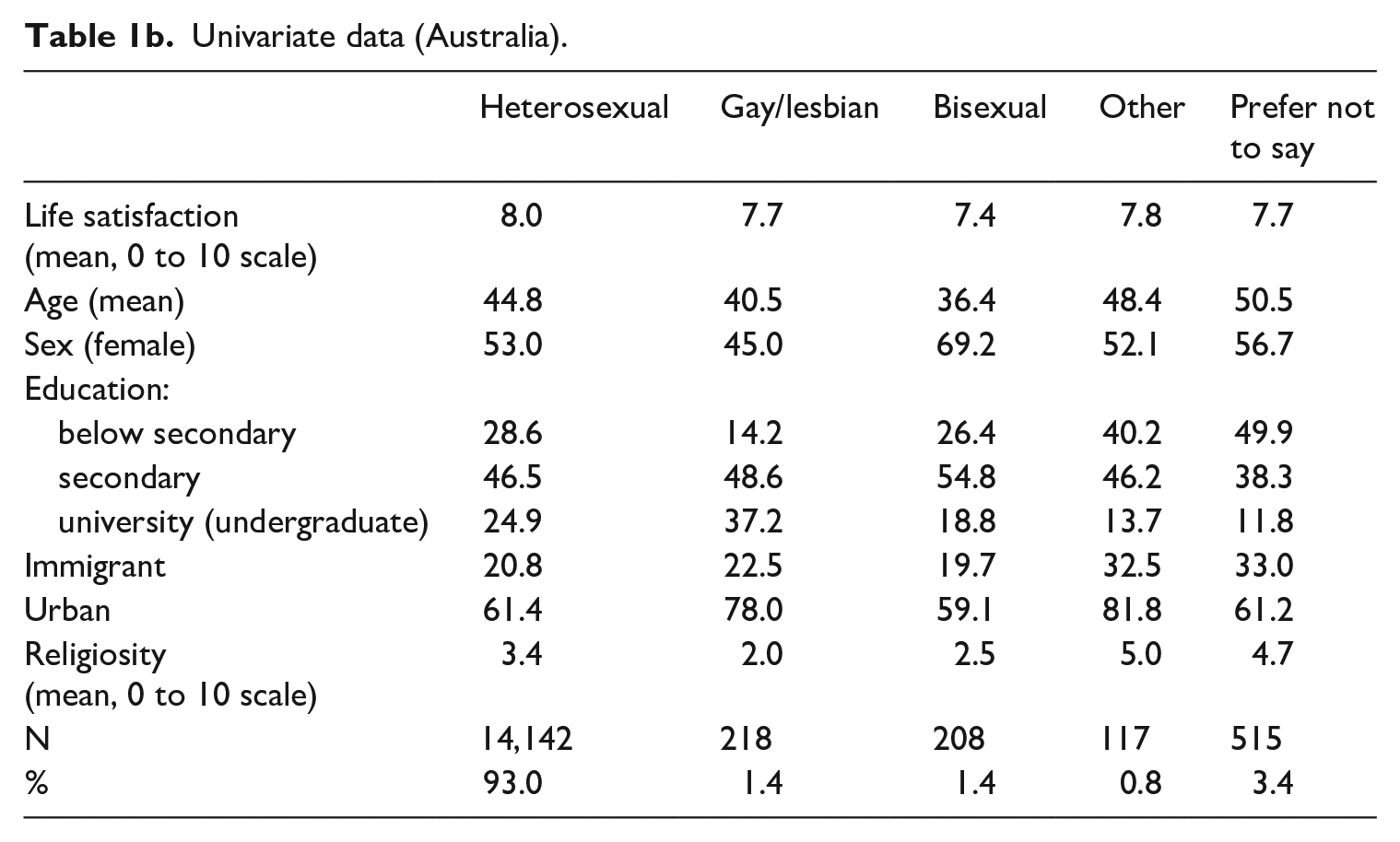
The analysis below uses OLS models, with sample weights (as provided with the datasets) to ensure representativeness. One could make a case that ordinal logistic models are more appropriate – but Ferrer-i-Carbonel and Frijters (2004) show that OLS analyses virtually always lead to the same substantive conclusions (and offer coefficients that can be interpreted more accessibly). Equivalent ordinal logistic results are available on request (they indeed give the same substantive conclusions). Table 1 gives univariate information for all variables included in the analysis (apart from region).
Univariate data (UK).
Univariate data (Australia).
Results
Table 2 provides the main results for UK respondents. Model 1 includes no control variables; the model gives differences in average life satisfaction across the non-heterosexual categories (with straight people as the reference category). The model includes an interaction term for sex – so, gay/bi/other/etc. men are compared to straight men, while lesbian/bi/other/etc. women are compared to straight women.
Regression models of life satisfaction (UK).
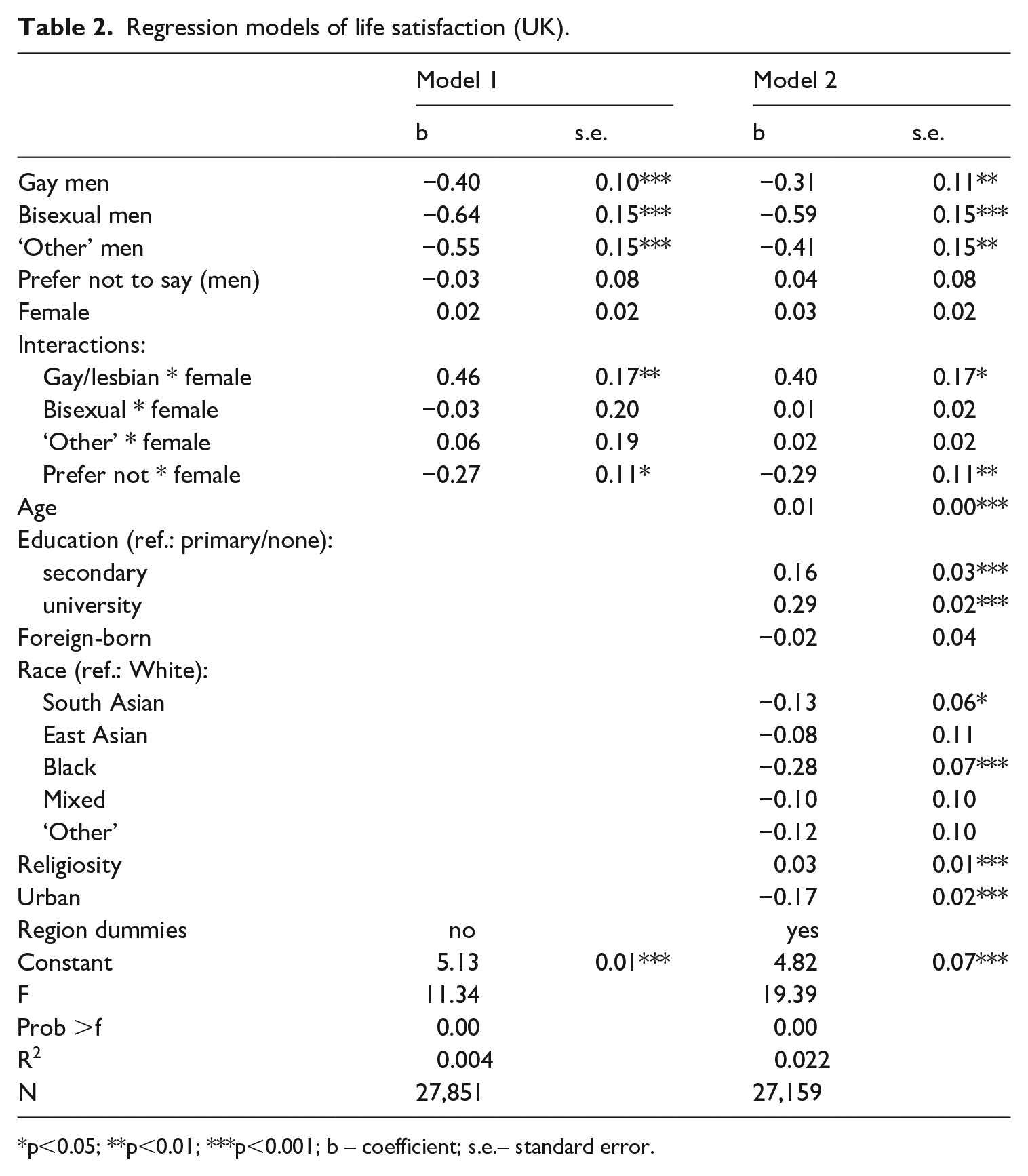
p<0.05; **p<0.01; ***p<0.001; b – coefficient; s.e.– standard error.
Given the coding of the sex variable, the first four rows (containing sexual-orientation variables) pertain to men. So, gay, bisexual, and ‘other’ men in the UK are less satisfied with their lives than straight men (while for those who ‘prefer not to say’ any differences are trivial). The life satisfaction deficits among bisexual and ‘other’ men are a bit larger than that for gay men (0.64 and 0.55, as against 0.40, on the 7-point life-satisfaction scale). For women, the picture is slightly more complex: the coefficient for the interaction term pertaining to lesbians cancels out the difference apparent for gay men – so, life satisfaction among lesbians is roughly on par with that of straight women. For bisexual and ‘other’ women, the interaction terms are small (in raw terms and relative to their standard errors) – so, their lower life satisfaction (relative to straight women) is equivalent to the gap among men with the same orientations. For women who ‘prefer not to say’, the interaction term indicates lower life satisfaction (of magnitude 0.27), in contrast to the outcome for men who respond similarly (where again there is no noteworthy difference).
If we were confident that respondents revealed their ‘true’ orientation in response to the relevant survey question, we could come to a straightforward conclusion that these results are an unbiased estimate of the life satisfaction consequences of belonging to the indicated sexual minorities. The omission of control variables would be entirely sensible: in line with the discussion earlier, these estimates would not be biased by virtue of not taking into account other determinants of life satisfaction, because those other determinants are not also determinants of sexual orientation. But in a heteronormative society, some non-straight people might be reluctant to answer truthfully; again, even choosing the option ‘prefer not to say’ might provoke anxiety, out of worry that not answering ‘heterosexual’ would be taken as an indication that one’s orientation is indeed something other than heterosexual. We can therefore consider sexual orientation as an identity, where what comes into play is whether someone is willing to disclose their orientation on a survey.
Model 2, then, adds control variables where it is possible to imagine that non-straight people with particular values on the indicated variables would be unwilling to disclose their orientation (so, selecting heterosexual and thus not giving their ‘true’ orientation). Again, the possibility to consider here is that such people might be less satisfied with their lives than those who feel able to reveal their sexual orientation (whether gay or straight), such that the results in Model 1 are biased with respect to the real impacts of belonging to a sexual minority.
The bottom line for Model 2 is that the inclusion of controls does not change the broad conclusions described above for Model 1. Gay men have lower life satisfaction than straight men, but lesbians are not less satisfied with their lives than straight women. People of both sexes who are bisexual or ‘other’ are even less satisfied (relative to heterosexuals); women who ‘prefer not to say’ are less satisfied than straight women (while men who prefer not to say are not less notably satisfied than straight men).
If people with non-straight orientations had chosen the heterosexual response and at the same time were less satisfied than people who felt more confident in revealing their orientation, the life satisfaction gaps between heterosexuals and sexual minorities would appear (in Model 1) to be smaller than they are in reality; satisfaction among heterosexuals would be lower by virtue of the fact that that group contained (via survey responses) a number of non-heterosexual people whose life satisfaction is perhaps impaired by their feeling that they cannot acknowledge being gay/lesbian/bi, etc. The inclusion of controls would then increase the gaps between heterosexuals and others by adjusting for the characteristics that might influence one’s willingness to disclose. But instead the gaps get smaller, not larger, when controls are added. This pattern undermines the case for presenting the figures from Model 2 as the preferred results in regard to the life satisfaction consequences of belonging to a sexual minority. The gaps evident in Model 1 are not a great deal larger than in Model 2, but we nonetheless have grounds to emphasise the results in Model 1 over those in Model 2.
Table 3 presents similar models of sexual orientation and life satisfaction in Australia. The main goal is to reconsider findings presented in earlier work by Perales (2016). Recalling his findings: while there were aspects of SWB where sexual minorities had lower levels (relative to heterosexuals), for life satisfaction specifically this pattern was evident in Perales’s analysis only for lesbian and bisexual women. Gay and bisexual men were not less satisfied with their lives (to an extent that met a conventional threshold for statistical significance). These findings were offered via regression models that controlled for a wide range of factors, including age, sex, having a partner, education, employment status, health, religiosity, income, urban residence, perceived social support, immigrant background, and region of residence. Some of these variables would clearly have potential to intervene in the effect of sexual orientation on life satisfaction (in particular: income, having a partner, and social support).
Regression models of life satisfaction (Australia).
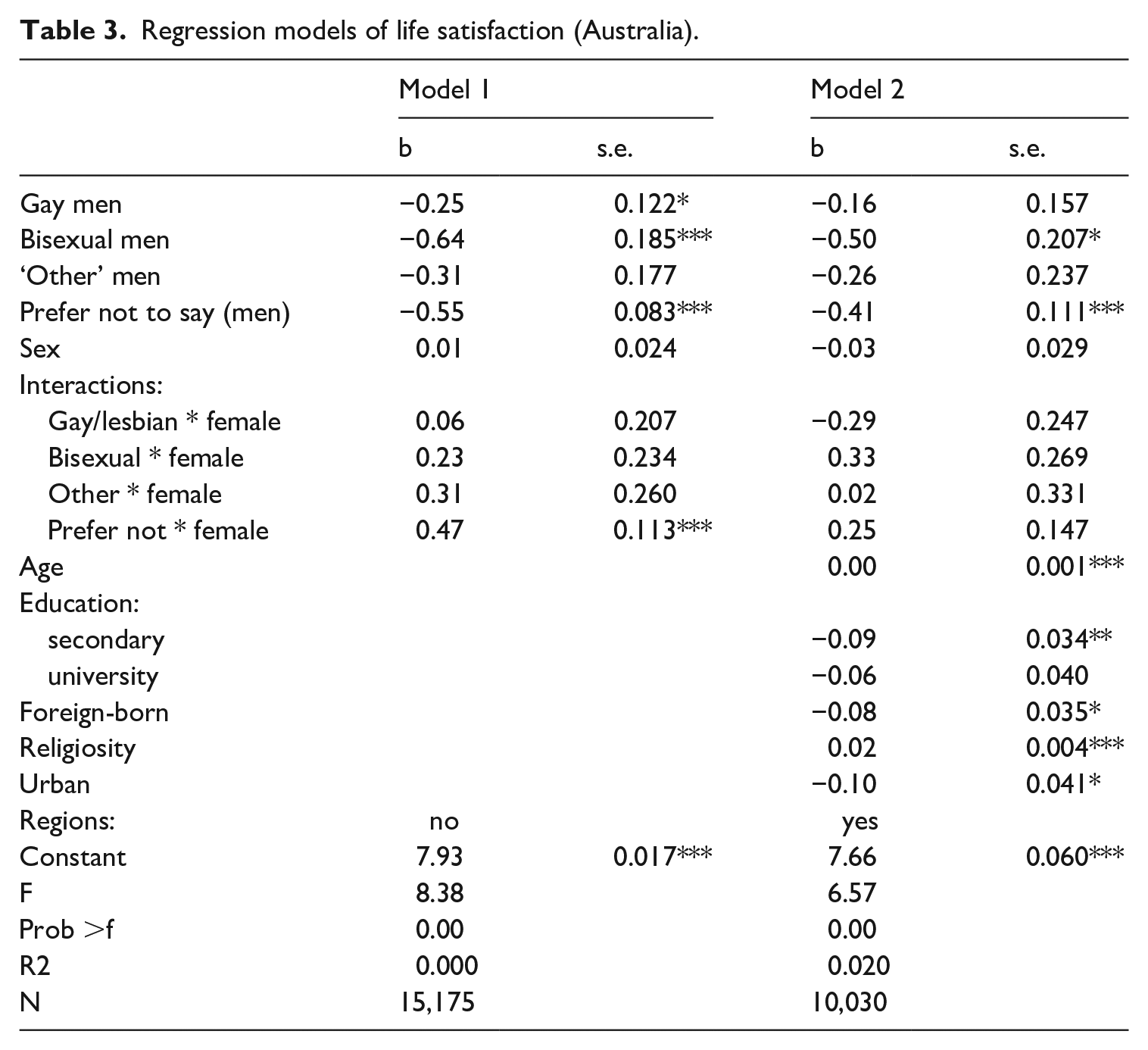
Model 1 in Table 3 presents an analysis where the only control variable is sex (to facilitate use of an interaction term). The conclusions of this analysis are different from those of Perales (2016) in important ways: here we see lower levels of life satisfaction among gay and bisexual men in Australia − 0.25 points and 0.64 points, respectively. (The interaction terms tell us that the lower life satisfaction evident among gay and bisexual men pertains also to women – that is, lesbian and bisexual women are also less satisfied, in line with Perales’s conclusions.) Male respondents who ‘prefer not to say’ what their sexual orientation is are also less satisfied; here the interaction term indicates that women selecting this response are not less satisfied.
Model 2 in Table 3 adds control variables to consider the possibility that some non-heterosexual respondents might be unwilling to disclose a non-heterosexual orientation/identity. The variables used for this purpose are the same as in the UK analysis above (except that a variable for race/ethnicity is not available in the HILDA Survey). Adding these variables to the model means that the coefficients pertaining to gay and bisexual men get smaller (while the standard errors get larger). As before, the expectation that leads to conducting the analysis this way is that some non-heterosexual people might be less willing to disclose their ‘true’ orientation – and such people might have lower satisfaction. If this pattern held, we would expect to find that the coefficients for sexual orientation would get larger, not smaller. So here, as well, we have grounds to prefer Model 1 as the better indication of the way a minority sexual orientation has consequences for life satisfaction.
Again, the key new finding of this analysis is that gay and bisexual men in Australia have lower life satisfaction than heterosexual men. This finding was not apparent in Perales’ (2016) study. (In his 2019 study, Perales found lower levels of SWB in other forms, such as mental health and psychological distress – but the results for life satisfaction specifically did not include ‘significantly’ lower levels of life satisfaction for gay men.) The apparent reason is that the inclusion of inappropriate control variables has ‘controlled away’ part of the true impact of being gay among Australian men.
Conclusion
Having a non-normative sexual orientation in the UK and Australia comes with consequences – including a lower level of life satisfaction. The only exception to that general pattern is lesbian women in the UK. The gap is especially large for bisexuals, of both sexes, and in both countries. There is also a striking negative coefficient for Australian men who ‘prefer not to say’. It is not hard to imagine that there must be a reason some Australian men prefer not to disclose their sexual orientation (especially if what they prefer not to disclose is: not being straight).
Researchers should be confident in perceiving that the right way to model the impact of sexual orientation on SWB is to exclude ‘other determinants’ as controls in this context – because the other determinants of SWB cannot also be determinants of sexual orientation. That assertion forms the key recommendation for future research on this topic. Building larger models with many control variables might appear desirable simply because a more parsimonious model (especially one containing no controls) might seem unpersuasive (e.g. to potential anonymous reviewers). But size on its own is hardly a coherent criterion for constructing an analytical model whose purpose is to gauge a causal impact (see e.g. Gangl, 2010).
The fact that lesbians in the UK report life satisfaction on a par with that of heterosexual women (in contrast with the life satisfaction deficit among gay men) is a striking finding, perhaps at odds with what one might expect, given the context of stigma and discrimination that commonly confronts people belonging to a sexual minority. Being gay in a heteronormative society sometimes goes with a perceived loss of masculinity and thus a reduction in status more generally (Connell, 1995); the lower life satisfaction among gay men is arguably understandable in these terms. A similar dynamic might not apply to the experience of lesbians to the same extent, perhaps in part because women in general already have lower social status in a patriarchal society such as the UK.
There is a genuine limitation of the analysis presented here: the findings describe average impacts pertaining to the categories available in the data and thus do not capture the diversity of experiences that go under the heading of being ‘gay’, ‘lesbian’, ‘bisexual’, etc. That point applies as well to the way people might choose from the available options on a survey question, at a single point in time. There are many ways to be non-heterosexual and indeed to be heterosexual, with imprecise and fluid boundaries for many (Cover, 2019). The fact that the available response categories inhibit a more fine-grained analysis does not mean this point is anything other than a limitation. The analysis in this article gives us average effects of belonging to an indicated category; for some individuals a negative impact will exceed that average, while for others the impact might be less negative or perhaps even null (cf. Feinstein et al., 2015). Even so, any attempt to gauge effects in a finer grain must ensure a correct use of control variables, along the lines developed in this article.
Footnotes
Acknowledgements

Funding
The author(s) received no financial support for the research, authorship, and/or publication of this article.