




Abstract
A central tenet of the New Economic Sociology is that trust is a central factor in the sound functioning of markets. Previous research has mainly used a national-scale network approach to argue that personal relations generate trust in market relations. In contrast, this article shows, from a comparative perspective, how political structures influence consumer trust. First, using aggregate data, it shows how consumer trust in markets varies across the 28 European Union (EU) member states. Second, it uses regression models to examine the effects of varying levels of political embeddedness on consumer trust, taking consumer policy as a proxy. The results support the view that it is not only personal relations that generate trust in market relations but also political structures. This argument echoes institutional economic sociological approaches, and it adds to them a trust dimension. It furthermore encourages a more finely grained comparative analysis to better account for the effects of social macrostructures on trust.
Keywords
A central tenet of the New Economic Sociology is that trust is a central factor in the sound functioning and reproduction of markets. This argument is delineated in two ways: trust reduces uncertainty about exchange partners (Granovetter, 1985, 2005; Uzzi, 1996, 1997) and about product quality (Karpik, 2010). Although trust does not entirely resolve the ‘problem of uncertainty’ characteristic of market exchange (Beckert, 2009), a minimum threshold of trust between exchange partners and in product quality is necessary for stable, functioning markets (Beckert, 2005; Granovetter, 2005; Karpik, 2010).
So far, most economic sociologists have relied on theoretical arguments (Beckert, 2005; Burt, 1995; Granovetter, 1985, 2005; Karpik, 2010) or on national-scale network analyses (Burt and Knez, 1995; Uzzi, 1996, 1997) to argue that trust is a central prerequisite of market exchange because it reduces uncertainty in exchange partners. Interestingly, though, consumer trust in sellers or products has never been studied on a larger scale, nor from a comparative point of view. Given that economic sociology, by and large, over-emphasises the supply side of markets (Fligstein and Dauter, 2007; Nessel, 2016a; Zelizer, 2005) and only rarely applies comparative accounts (Münnich, 2017), it is not these omissions that are surprising. What is surprising, rather, is that previous research has broadly neglected to analyse trust between the consumers and sellers of products and the factors which influence their ‘trust relations’ (but see Karpik, 2010). Moreover, and given that social structures differ between countries, it is surprising that a comparative analysis that examines nationally varying effects of social structures on trust has not yet been conducted. Only such a perspective may further shed light on a more general question: do varying degrees of social embeddedness make a difference in economic life, not only for firms but also for consumers, who have gained less attention in the economic sociological literature?
This article addresses some of these issues by comparatively analysing consumer trust in markets and the effect of social structures on trust in 28 1 EU member states. Its aim is twofold: to map levels of consumer trust in products, retailers and markets across Europe, and to examine the relationships between social structures and consumer trust. In doing the latter, this article limits its focus to the effect of political structures, a topic neglected in previous research. As consumer policy is the main political structure embedding consumer markets (Cafaggi and Micklitz, 2009; Nessel, 2019; Trumbull, 2006), consumer policy is used as a proxy for measuring and differentiating political structures across Europe. Consumer policy entails consumer law, legislative enforcement and associational aspects. The analysis of consumer policy hence allows for testing of the effects of several political (sub)structures on consumer trust, a research agenda which I suggest is useful for further analyses that incorporate additional social structures into comparative analysis of trust.
This article asks whether higher levels of embeddedness lead to more trust in markets, as suggested by previous research (Burt and Knez, 1995; Granovetter, 1985, 2005; Uzzi, 1996, 1997). More precisely, it asks whether higher levels of consumer protection influence consumer trust in retailers and products. After a brief discussion of the main arguments of economic sociological accounts of trust and markets in the second section, the third section introduces the methodological framework, data and methods. The fourth section presents empirical results for consumer trust in 28 EU member states and tests the effects of legal, enforcement, associational and institutional dimensions of consumer policy, as well as selected economic factors, on trust. The final section discusses the results against the backdrop of economic sociological accounts that find the establishment of trust by social structures to be a central factor in the sound functioning and reproduction of markets. In contrast to network analysts’ scepticism about the role of institutional or political macrostructures in generating trust, this article shows how political (sub)structures influence consumer trust. This argument partly follows comparative institutional approaches in economic sociology to the effects of social structures on markets, but it extends such approaches by introducing a trust dimension relevant to market functionality. I consequently argue that further and more finely grained comparative analysis is needed to better account for and distinguish the effects of different social structures on trust in markets.
Trust in markets: an economic sociological perspective
Trust is a mechanism to reduce the complexity of social life (Luhmann, 1979). More precisely, trust is important to reduce uncertainty about the behaviour and intentions of others. Uncertainty in social life stems from the observation that ‘social relations are risky’ because ‘people have ample cause to be uncertain of each other’s intentions and the probable outcomes of encounters’ (Heimer, 2001: 43). Uncertainty regarding others’ intentions exposes the individual to vulnerability, which is to say that ‘although some social interactions yield rewards for all participants, many involve rewards for some at the cost of others’. As modern societies are ‘characterised by increased contact with strangers’, uncertainty and vulnerability are widespread ‘problems’ that are reduced by trust (Heimer, 2001: 43–4). This is because trust ‘allows for specific (rather than arbitrary) assumptions about other social actors’ future behaviour’ (Bachmann, 2001: 342).
In economic sociology literature, such general conclusions about trust as a mechanism for reducing complexity, uncertainty and vulnerability form the basis of arguments on the relationship between trust and markets. Granovetter, in his canonical paper ‘Economic Action and Social Structure’ (1985), laid this foundation. He argues that explaining the establishment of trust is the starting point for a sociological analysis of markets because trust contributes to solving a central challenge in establishing constant market exchange: the ‘problem of cooperation’ (Beckert, 2009). In Granovetter’s view, trust is established through the embeddedness of actors in personal relations: the ‘embeddedness argument stresses [. . .] the role of concrete personal relations and structures (or “networks” of such relations in generating trust and discouraging malfeasance’ (Granovetter, 1985: 490). Granovetter is well aware that networks of personal relations may, in principle, enhance both trust and malfeasance (1985: 490–3). He asserts that ‘the details of social structure will determine which is found’ (1985: 493). Yet he mostly focuses on social networks as a trust-establishing device, and his work is mainly associated with this very perspective (e.g. Fligstein and Dauter, 2007: 114, 120; Shapiro, 1987: 624). This is because Granovetter (1985: 491) strongly questions the roles of social norms (called the ‘oversocialised’ conception of social life) and institutional arrangements such as contracts (called the ‘undersocialised’ conception of social life) in generating trust (Shapiro, 1987: 624). He says: ‘I have argued that social relations, rather than institutional arrangements or generalized morality, are mainly responsible for the production of trust in economic life’ (Granovetter, 1985: 491). Consequently, Granovetter is unequivocal on the point that trust is a prerequisite of market exchange and that it is personal networks which generate trust. Granovetter (2005: 33) is even more explicit on this matter in a more recent article: ‘Trust [. . .] emerges, if it does, in the context of a social network.’
Granovetter’s work laid the foundation for a New Economic Sociology interested in the effects of social structures on markets (Fligstein and Dauter, 2007). Of interest here is that Granovetter steered empirical work on the relationship between trust and markets, especially from a network perspective. Burt (1995), for example, refines Granovetter’s original argument, showing that it is not ‘only’ the strength of (‘weak’) network ties that enhances trust but particularly nodes with actors in a position to be able to bridge distances between several networks or nodes (the ‘structural holes argument’). In line with Granovetter, Burt is sceptical about the role of institutional arrangements in generating a threshold of trust: ‘The question is not whether to trust but whom to trust. [. . .] In the imperfectly competitive arena [not all-encompassed by institutional arrangements], you have only your personal contacts’ (Burt, 1995: 15). Uzzi (1996, 1997) further refined the arguments of both Granovetter and Burt. In his study of the New York apparel market, he distinguishes between impersonal ties kept at ‘arm’s length’, which have ‘low embeddedness’, and ‘embedded ties’ characterised by repeated interaction (‘high embeddedness’; Uzzi, 1996: 694). Uzzi found that ‘embedded’ ties lead to trust and that ‘trust acted as the governance mechanism of embedded relationships’. In his view, this is because ‘trust is personal and disposes one to interpret favourably another’s intentions and actions’ (Uzzi, 1996: 678). In sum, ‘network theorists have emphasized the role that social networks play in generating trust between [commercial] buyers and sellers that makes exchange possible’ (Fligstein and Dauter, 2007: 113). Such an approach is called the ‘structural embeddedness approach’ (DiMaggio and Zukin, 1990: 18–20).
Social network analysts are mainly interested in the establishment of trust between persons. In contrast, Karpik (2010) advances the idea that trust is also important in reducing uncertainty about the quality of a product. According to Karpik, the main problem consumers face in market relations consists not only in reducing uncertainty about the trustworthiness of a seller but also reducing uncertainty about the quality of a discrete offered product. He illustrates this argument by examining so-called ‘unique products’ such as wine, books, artwork, films and personal services. All these products are characterised by radical ‘quality uncertainty’ because their ‘qualities’ are considered ‘opaque’, ‘non-commensurable’ and ‘multidimensional’ (Karpik, 2010: 21–4). According to Karpik (2010: 55–6), the associated ‘singular markets’ are not coordinated by prices but by ‘judgement’ or ‘trust devices’). With the concept of a ‘trust device’, Karpik points to the importance of critics (book market), classifications (wine market) or rankings (music market) in reducing uncertainty about product qualities and in coordinating consumers and sellers. As regards markets for personal services, he further acknowledges the role of personal networks as a form of trust device.
Karpik restricts his analysis to cultural products and personal services. Yet his ideas can also be applied to ‘standard products’ or ‘standard markets’ such as consumer goods or their markets (Nessel, 2016a, 2016b), which are of interest in this article. In standard markets, it is particularly consumer associations, by means of comparative product testing, or public authorities, by means of guarantee rules or labelling schemes, that reduce uncertainty and establish a minimum threshold of trust in product qualities. These actors hence function as ‘trust devices’ in standard markets.
An examination of trust in products is absent in network analysis, as well as in other, more abstract examinations (Beckert, 2005). This may be because social network analysis implicitly assumes that trust in a seller is automatically associated with trust in his or her products. Karpik reminds us that in fact, trust in a seller may not necessarily reduce uncertainty in the qualities of a discrete product, even when a seller is trusted. In this article, I take up Karpik’s proposals to examine consumer trust in sellers as well as in products, and I examine the relationship between both dimensions.
Neither Karpik nor social network theorists devote much attention to the role of social macrostructures in generating trust (Nessel, 2016a). Instead, they restrict their analyses to the meso level of market relations. Both overlook that personal networks, as well as trust devices, are embedded in cultural and political macrostructures that influence their capacities to establish trust. However, at least occasionally, Karpik points to the importance of state agencies in establishing generalised rules that foster trust in products (Karpik, 2010: 241).
To downplay (Karpik) or refuse (social network theorists) the role of social macrostructures in establishing trust is notably against other well-acknowledged insights. In the economic sociological literature, it is a commonplace assumption that market relations are embedded in and influenced by political institutions (political embeddedness) or cultural norms (cultural embeddedness) (Fligstein and Dauter, 2007; Gershenson and Dobbin, 2015; DiMaggio and Zukin, 1990). These social structures have also been acknowledged as important in establishing trust in markets (Shapiro, 1987; Zucker, 1987) and between firms (Bachmann, 2001). Moreover, there exists a range of studies in historic economic analysis (Greif, 1993) or geography (Murphy, 2006) that demonstrate that cultural and/or political structures generate trust in economic relations. From a more general point of view, social theorists argue that trust in abstract institutions such as the legal or political system is a central characteristic of modern societies – ‘system trust’, in the conceptions of Luhmann (1979) and Giddens (1984). Interestingly, then, economic sociological network accounts that stress the importance of personal relations in establishing trust ignore such insights into the nature and sources of trust in modern societies. The same is true for Karpik’s analyses that focus solely on the meso level of markets.
In this article, I focus on the role of political embeddedness in trust generation. Political embeddedness refers to legal rules and political institutions which define the formal framework under which buyers and sellers (inter)act (DiMaggio and Zukin, 1990: 20–1). Legal rules and political institutions are suggested to be central in trust generation because they ‘motivate agents accordingly, while at the same time maintaining the capacity to enforce standards upon agents in cases where they are tempted to violate them’ (Offe, 1999: 75). As Akerlof (1970) has argued, without a minimum threshold of guarantee rights, quality uncertainty threatens consumer trust in products and fosters ineffective ‘lemon markets’.
Given that modern markets are complex and differentiated fields (Bourdieu, 2005), it is scarcely feasible to rely ‘only’ on personal networks in market relations. In many instances, to do so is also at odds with consumer experiences. Take the example of transactions carried out via the internet. To be sure, reputation systems, positive personal experiences with a trader, or the experiences of others may enhance trust in a seller and his or her offered products. However, systems such as internet auctions (e.g. eBay) or internet-mediated consumer-goods platforms (e.g. Amazon) are hardly likely to be built without being embedded in broader institutional structures. Consequently, Cheshire and Cook (2004: 4) state: ‘institutional backing, law and other devices for managing distrust or the breach of trust are crucial in the development of systems that manage trades, auctions and other forms of [consumer–seller] interaction involving the transfer of goods, services and money reliably’.
In summary, the named arguments point to the importance of institutional or political structures in influencing trust in market relations. Interestingly, however, existing economic sociological literature has broadly neglected to empirically and comparatively ask whether such structures influence consumer trust in markets. This is, above all, because most of the literature follows Granovetter’s seminal 1985 work and tends to restrict itself to meso-level analyses of national markets, implicitly assuming that consumers and sellers are equally embedded in social macrostructures. From a comparative point of view, however, it is well known that consumers and firms are embedded differently by these macrostructures according to their countries of origin (Koos and Sachweh, 2017) because, for example, legal and political systems provide more or less consumer rights or are more or less effective in their enforcement (Nessel, 2019). Consequently, I argue that varying levels of political embeddedness differently affect consumer trust in markets. In doing so, I partly follow institutional approaches in economic sociology (see Gershenson and Dobbin, 2015) but seek to add a trust dimension thus far absent in such approaches.
Methodology, data and methods
This article examines the effects of political structures on consumer trust in markets in 28 EU member states. I operationalised political structures using consumer policy as a proxy. This was done because consumer policy, or consumer protection, is the main political structure embedding consumer–firm relations and consumer markets (Cafaggi and Micklitz, 2009; Nessel, 2019; Trumbull, 2006). Consumer policy entails three main dimensions: a legal dimension, which grants consumers basic rights, such as guarantee or contract rights; an enforcement dimension which ensures that these rights are enforced and monitored either by public authorities (public enforcement) or by private actors such as the media, consumer associations or self-regulation bodies (private enforcement); and an associational dimension which considers the collective legal, political and economic representation of consumers by consumer associations. Moreover, consumer policy is addressed by consumer trust in national public authorities to protect consumer rights. I call this the ‘institutional dimension’ 2 of consumer policy.
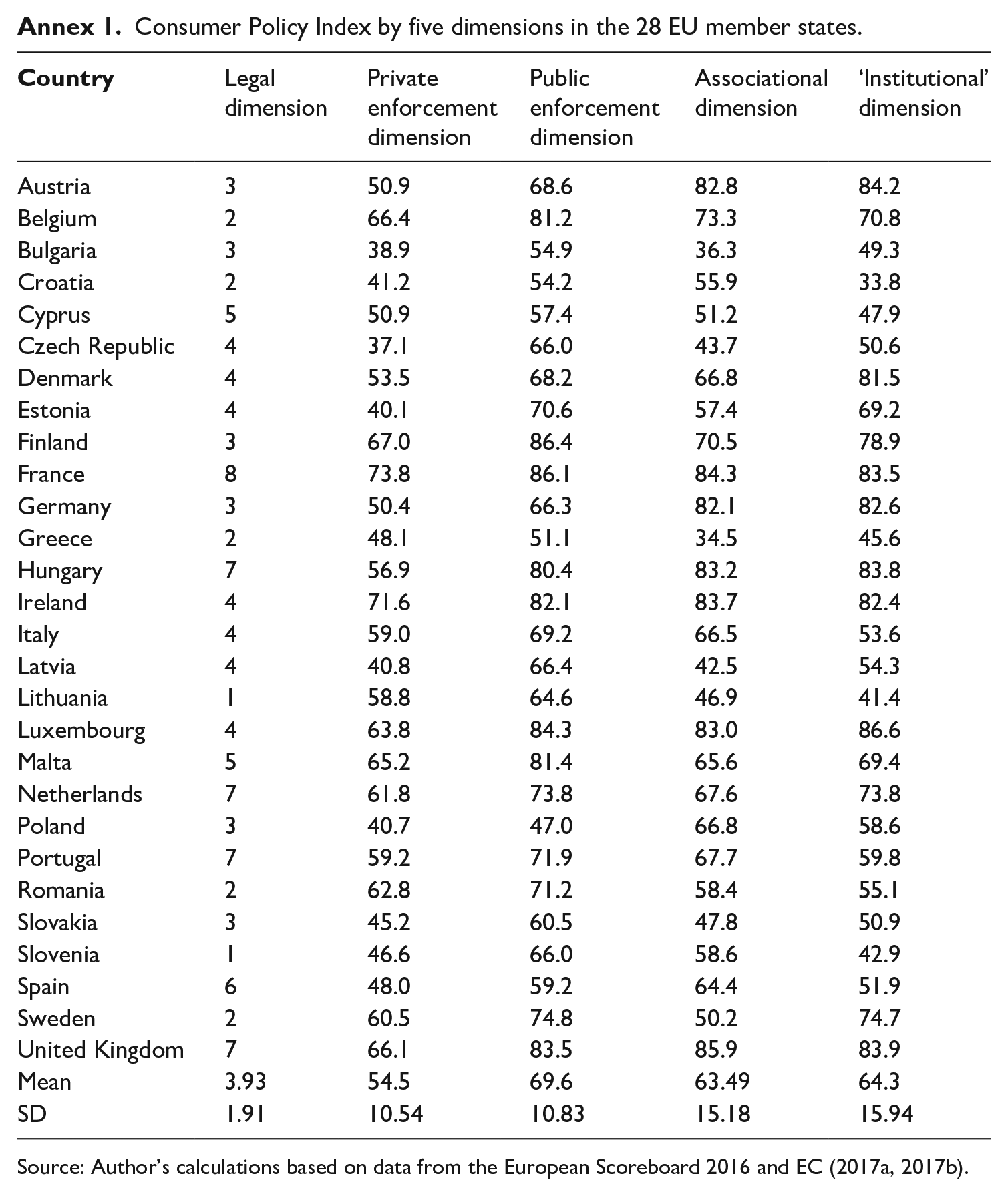
Consumer policy, as measured by these dimensions, strongly varies across Europe (see Annex I). Consequently, taking consumer policy as a proxy to measure political structures allows for testing the possible effects of varying levels of political embeddedness on consumer trust from a comparative point of view. Moreover, this methodology permits the examination of a more general question, which is whether different social structures exert varying effects on consumer trust. This question is further explored by including economic factors such as market concentration (Herfindahl–Hirschman Index, afterwards HH Index) and net household income (in US$) as control variables in the regression models used to examine the sources of consumer trust. 3
The data for measuring the relevant consumer policy dimensions and the methodological framework have been discussed in detail elsewhere (Nessel, 2019). The data for measuring enforcement, associational and ‘institutional’ dimensions of consumer policy was retrieved from the 2016 ‘Scoreboard of consumer and retailer attitudes towards cross-border trade and consumer protection’ (European Scoreboard, 2016). The ‘Scoreboard’ is a representative survey which relies on a standardised questionnaire asking about consumers’ and retailers’ perceptions of consumer protection. In sum, it represents 10,989 weighted retailer responses, and a total of 28,398 consumer responses across the European Union (EU). The relevant items used from these surveys are displayed in Table 1. The main data for measuring the legal subdimension of consumer policy was retrieved from the ‘Fitness check of consumer and marketing law’ (EC, 2017a, 2017b). The ‘fitness check’ analyses the legal consumer-protection environment of each member state. It examines the transposition and utilisation of options within five central European Consumer Directives, using a variety of data. 4 Altogether, these directives cover all stages of consumer–producer relations: the pre-contractual, contractual and post-contractual stages. This data was counterchecked and enriched with the author’s own desk research. More consumer-protection-index points were assigned to those countries that use relevant options within the EU basic framework than to those that do not. This procedure led to some refinements and to building the associated indices (see Nessel, 2019 for details). Table 1 summarises the methodology to operationalise the independent variables.
5 Methodology to measure the independent consumer policy variable.
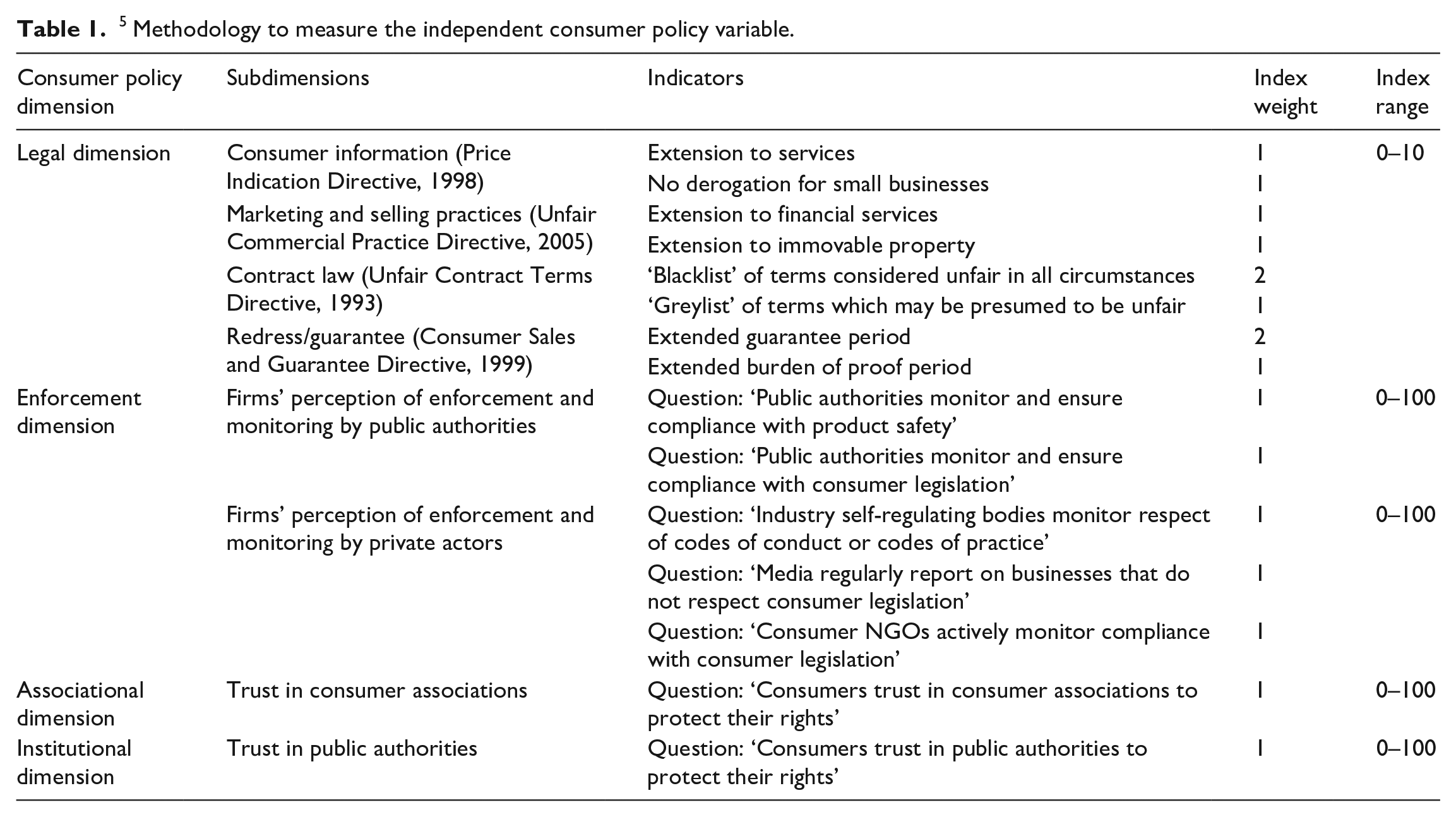
Following arguments discussed in section two (‘Trust in markets . . .’), I differentiate between consumer trust in persons and consumer trust in products as the two dependent variables used as proxies for measuring consumer trust in markets. Consumer trust in persons is measured by trust in the retailers of consumer goods. As retailers are the main actors with which consumers exchange goods, trust in retailers is an outstanding example of trust in persons from a consumer perspective. Consumer trust in products is operationalised by using consumer trust in product safety as a proxy. Of course, product safety is only one of many dimensions of product quality (Karpik, 2010), but it is a central, if not the most central, element of product quality as indicated by institutional economics (Akerlof, 1970), legal accounts (Micklitz, 2014) or the ‘economics of product safety’ (Oi, 1973). The data for measuring both dimensions was also retrieved from the 2016 ‘Scoreboard’, and further explored for the purpose of this article. The associated survey items were: How strongly do you agree that (a) ‘in general, retailers and service providers respect your rights as a consumer’ and (b) ‘essentially all non-food products are safe’. Respondents’ answers of ‘strongly agree’ or ‘agree’ on a four-point Likert scale were combined to measure trust in retailers and products, respectively. Respondents’ agreement with ‘strongly agree’ or ‘agree’ was used to build an index ranging from zero (no agreement; similar to all consumers responding ‘not agree’ or ‘not agree at all’) to 100 (full agreement) index points (Nessel, 2019). The same procedure was used to measure the above-named independent variables and to build the associated indices (see Annex 1).
The data and the associated indices were used to descriptively map variation of consumer trust across Europe. Linear regression models and bivariate correlations applying Pearson’s correlation coefficient were used to examine possible effects of the subdimensions of consumer policy on consumer trust. The unit of analysis was the 28 EU member states. The variance inflation factor (VIF) was used to test for multicollinearity and revealed no particularity. To enhance the robustness of the results, a bootstrap with 1000 iterations was computed. All cardinal variables were log-transformed.
Consumer trust in markets – results
Consumer trust in retailers, products and markets across Europe
Table 2 maps consumer trust in retailers, product safety and markets in the 28 EU member states. The results show that consumer trust in markets significantly differs. In the United Kingdom (90.2), consumer trust in markets is almost twice as high as it is in Cyprus (49.2). Moreover, for example, Ireland (89.1), Austria (88.7), Germany (88.7), France (88.2) or Luxembourg (86.5) strongly outperform Greece (56.4), Bulgaria (57.4), Malta (59.4) or Italy (59.8).
Index of consumer trust in products, retailers and markets in the 28 EU member states.
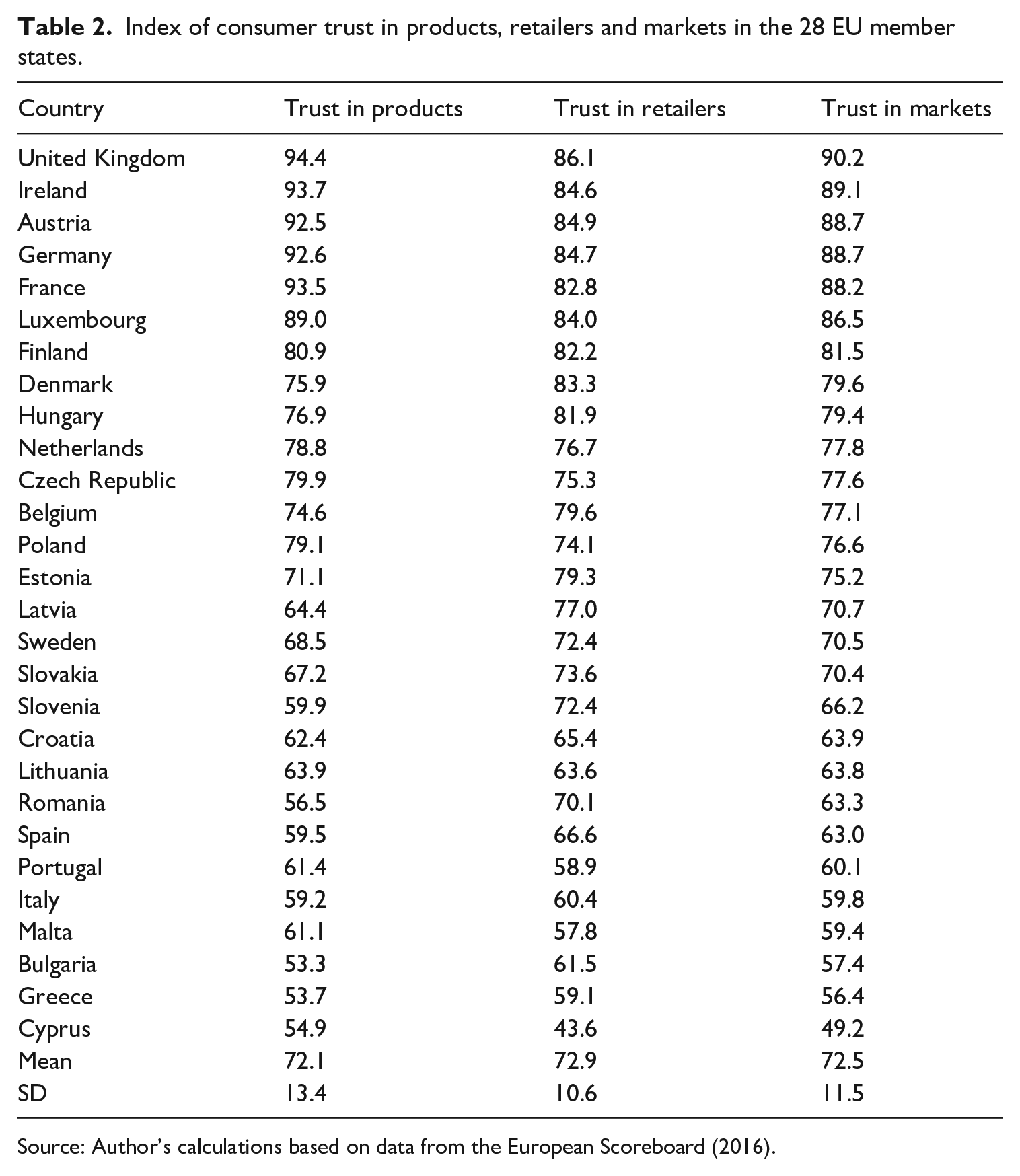
Source: Author’s calculations based on data from the European Scoreboard (2016).
As outlined in section two (‘Trust in markets . . .’), consumer trust in products and in retailers is analytically distinct. Yet, as implicitly assumed by social network theorists, both indicators may be closely associated. To assess their relationship, a Pearson’s correlation coefficient was computed. As the results show, consumer trust in products and consumer trust in retailers are indeed strongly associated (p<0.01; r = 0.812). Given their very strong correlation, I treat consumer trust in products and consumer trust in retailers as a single, additive variable called ‘consumer trust in markets’, representing the average of indices of consumer trust in products and retailers presented in columns one and two for each EU member state (Table 2).
Effect of political structures on consumer trust in markets – bivariate and multivariate findings
As the results presented in Table 3 indicate, there is a positive correlation between all independent variables and consumer trust in markets, meaning that higher political embeddedness positively influences consumer trust. However, the independent variables legal protection (r = 0.206; p>0.05) and private enforcement (r = 0.294; p>0.05) have a positive but non-significant effect. The public enforcement (r = 0.540; p<0.01), associational (r = 0.671; p<0.01) and ‘institutional’ (r = 0.756; p<0.01) dimensions have a strong, positive and significant effect.
Bivariate correlations between consumer policy dimensions and consumer trust in markets in 28 EU member states.
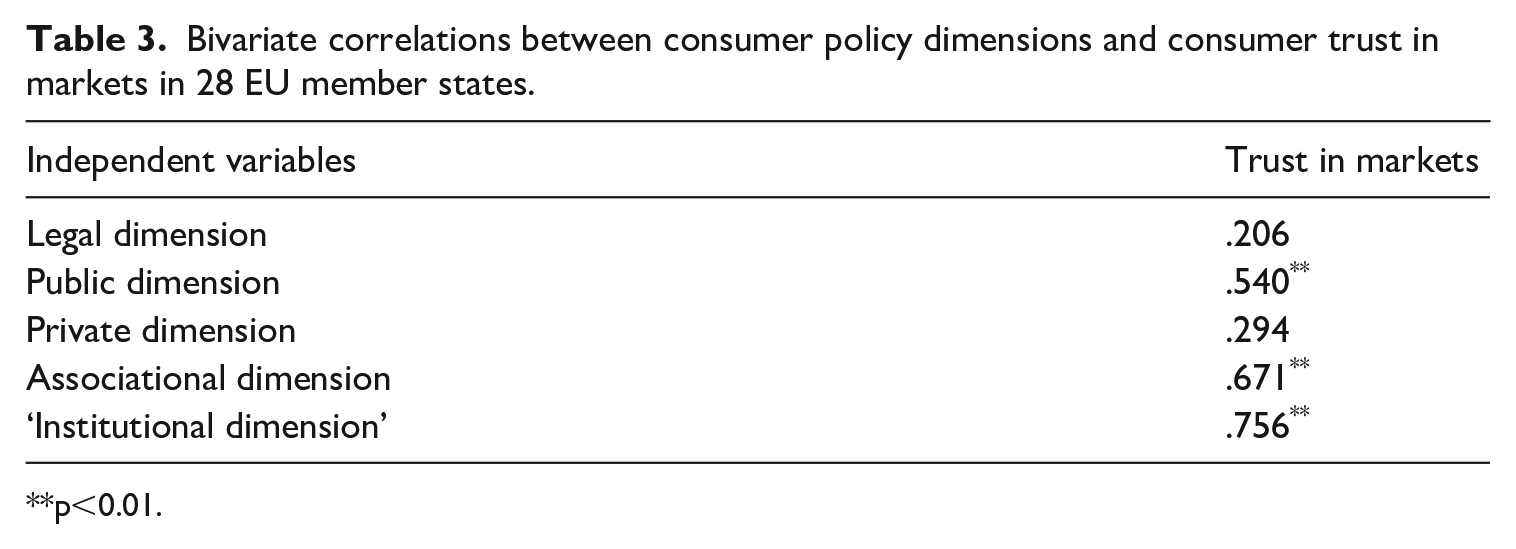
p<0.01.
To test the simultaneous effects of consumer policy subdimensions and consumer trust in markets, linear regression models are computed (Table 4). Models 1, 2 and 3 test the effects of the consumer policy variables. Note that private enforcement is not included in these models because it significantly confused initial models by introducing multicollinearity. Models 4 through 9 include economic control variables such as market concentration (HH Index) and household net income.
Multivariate findings.
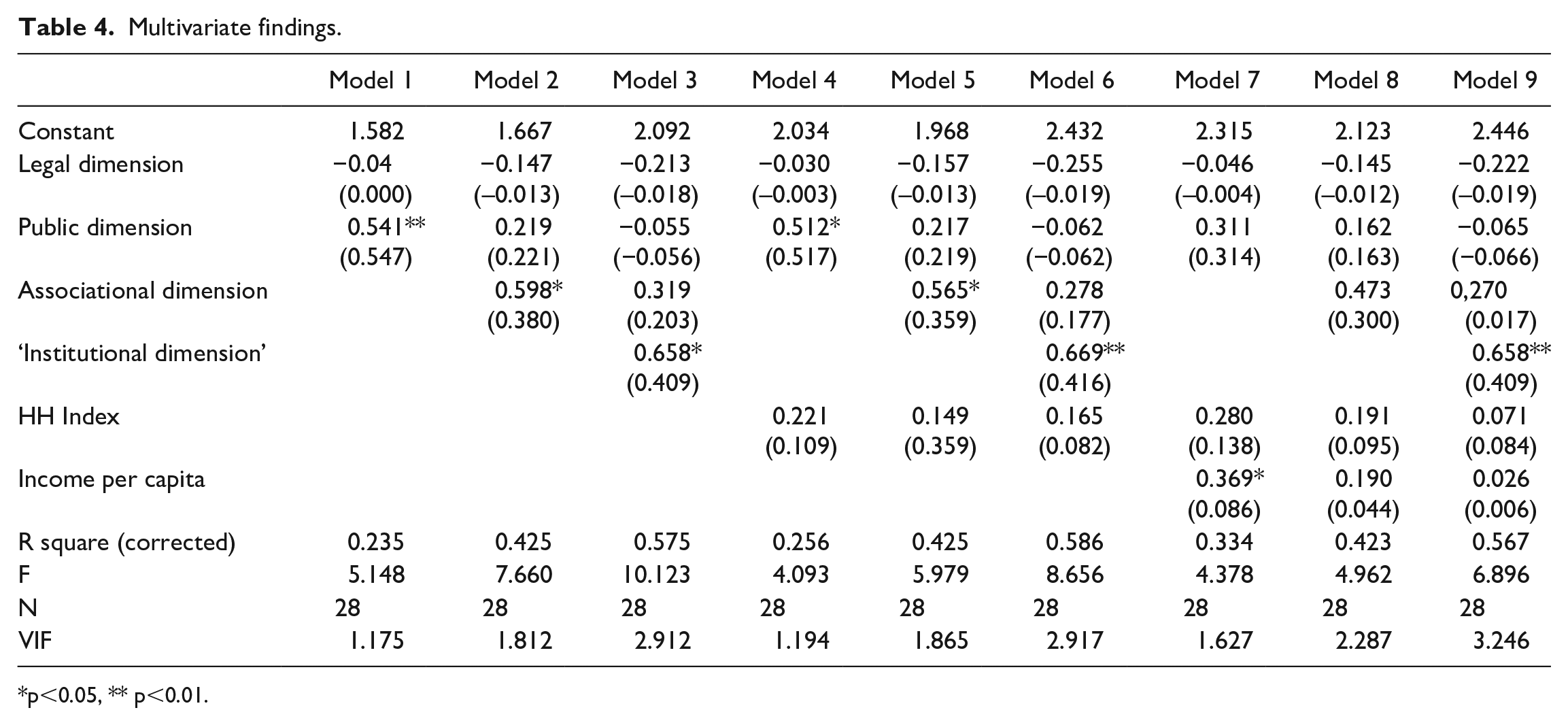
p<0.05, ** p<0.01.
The regressions confirm the bivariate analysis, showing that legal protection is a weak and non-significant predictor of consumer trust in markets. As regards the effects of other consumer policy dimensions, models 1 to 3 show that consumer trust in public authorities to protect their rights from sellers (‘institutional’ dimension) is the most stable predictor of consumer trust. Interestingly, when testing consumer policy dimensions against market competition (HH Index), the public enforcement (model 4), associational (model 5) and ‘institutional’ (model 6) dimensions of consumer policy remain significant predictors, having the same grading found before. However, when including net income per capita in the models, the significant effects of the public enforcement and associational dimensions vanish (models 7 and 8), whereas the ‘institutional’ dimension remains a significant predictor (model 9). Note that in model 6, net income per capita is itself a significant predictor of consumer trust in markets. Overall, the ‘institutional’ consumer policy dimension is found to be the most stable predictor of consumer trust.
Discussion and conclusion
This article sets out to examine trust in markets and the effects of social structures on consumer trust. It addresses a widely discussed issue in economic sociology, asking whether higher levels of market embeddedness positively influence trust between consumers and sellers. While the functions of trust are also critically discussed (Granovetter, 1985, 2005), there is widespread agreement that a minimum level of trust is a prerequisite for the sound functioning of markets (Fligstein and Dauter, 2007). This is because trust is described a main factor in addressing a central obstacle to market reproduction, the ‘problem of cooperation’ (Beckert, 2009).
Previous studies have mainly taken a network perspective (Burt, 1995; Granovetter, 1985, 2005; Uzzi, 1996, 1997), arguing that it is networks of personal relationships that influence trust between market participants, especially between manufacturers and retailers. Such findings contrast with social theorists’ arguments that modern societies are characterised by trust in macrolevel institutions such as the legal or the political system (‘system trust’) (Luhmann, 1979; see also Giddens, 1984). Applying this alternate perspective to the economic realm, sociologists (Shapiro, 1987; Zucker, 1987) and observers from other disciplines (Bachmann, 2001; Greif, 1993; Murphy, 2006) have argued that institutional trust is a primary factor explaining the reproduction of markets and their sound functioning. As consumer protection is an outstanding example of political structures embedding consumers, firms and their relations (Nessel, 2019), this article examines whether varying levels of consumer protection in the 28 EU member states explain varying consumer trust in markets, as measured by trust in retailers and products.
The first finding of this article is that consumer trust strongly varies between the 28 EU member states. Strikingly, in Anglo (UK, Ireland) and many Western European countries (Austria, Germany, France, Luxembourg), trust in markets is around 50% higher that it is in Southern European (Cyprus, Greece, Italy, Portugal, Spain) and some Eastern European countries (Bulgaria, Croatia, Lithuania, Romania). These results show that consumers experience market transactions quite differently throughout Europe. One explanation of the results revealed in this article is the level of political embeddedness. The named ‘high consumer trust countries’ all show significantly higher levels of public authorities’ effectiveness in the enforcement of consumer law and, consequently, high trust in such institutions, and they have strong consumer associations (see Table 4; similarly, Cafaggi and Micklitz, 2009; Trumbull, 2006). From a bird’s eye view, not surprisingly, the bivariate analysis discussed below sustains this explanation. These findings contribute first insights into consumer trust, an area that has gained little attention in economic sociology (but see Karpik, 2010) and none in cross-country analysis.
As Karpik (2010) reminds us, trust in a seller is analytically distinct from trust in the qualities of products. Considering that trust in markets entails trust not only in exchange partners (as suggested by social network theorists) but also in product qualities, this article’s methodological framework and the presented results allow for a more detailed picture of consumer trust and the effects of political structures on trust. Interestingly, however, trust in products seems strongly associated with trust in retailers. Yet because the data presented is on an aggregate country level, more research is necessary to further clarify the relationship between the trust in a seller and the trust in the qualities of his or her products.
The second finding is that higher levels of political embeddedness positively influence trust. Overall, the bivariate findings reveal a positive correlation between all dimensions of consumer policy and consumer trust. This positive correlation is strong and significant for the public enforcement, associational and ‘institutional’ dimensions but non-significant for the legal and the private enforcement dimensions, for reasons detailed later. This result echoes previous network accounts that argued that higher levels of network embeddedness result in higher levels of trust between exchange partners (Burt and Knez, 1995; Granovetter, 1985; Uzzi, 1996, 1997). Notably, however, it is at odds with their pessimistic view about the potential of political structures to generate trust. Indeed, these and the subsequent findings support arguments about the importance of political structures in generating trust (Bachmann, 2001; Shapiro, 1987; Zucker, 1987) and contribute a consumer perspective to such arguments.
The third finding sheds light on the effects of different social structures on consumer trust. This finding received closer scrutiny in the regression models. Initial models included only subdimensions of consumer protection. Subsequent models included control variables such as net household income and market concentration, which have been found to influence generalised trust (Algan and Cahuc, 2013; François and Ypersele, 2009). Overall, these models show that consumer trust in consumer associations (associational dimension) and in public authorities (‘institutional dimension’) to protect consumer rights from sellers are the most important consumer policy dimensions in predicting consumer trust. Interestingly, one model also indicates that higher net income may be a substitute for public enforcement to enhance trust. These findings are more closely explored below.
First, it is notable that the legal dimension of consumer policy is found to be a non-significant predictor of consumer trust. This finding opposes some economic sociological (Zucker, 1987; Shapiro, 1987) and legal standpoints (Caffagi and Micklitz, 2009) that argue that ‘higher’ levels of legal embeddedness positively influence trust. However, given that this study measured levels of legal embeddedness by taking European consumer law as a proxy, this finding should be interpreted carefully. To be precise, this finding suggests that European consumer law is not a central factor in generating consumer trust. It is important to note that while European consumer law defines a minimum threshold of consumer protection that member states can further enhance by using options granted to them under EU law, there still exists a range of specific national consumer-protection regulations (Tonner, 2014). Until now, however, no data has fully grasped the national consumer-protection environment in all member states. Only further and more refined studies may hence finally clarify the full range of consumers’ and sellers’ legal embeddedness in generating consumer trust.
Second, it is notable that public enforcement of consumer law by public authorities appears more important than market competition to trust generation. This finding opposes liberal economic conceptions, which argue that it is ‘the market’, rather than political structures, that generates ‘positive’ economic outcomes (‘invisible hands argument’; see Nessel, 2016a). In contrast, this finding underlines economic sociological arguments that see the state as an important factor influencing market relations (Dobbin, 1994; Fligstein, 2001) and adds the so-far missing (but see Zucker, 1987) dimension of trust to institutional approaches.
Third, it is notable that it is the ‘institutional’ dimension of consumer policy that is found to be the most important predictor of consumer trust. The institutional dimension is measured by consumers’ perceptions about the protection of their rights from sellers by public authorities. If certain well-acknowledged arguments in trust research are adopted, this finding can be interpreted in light of a relationship between a trustor and a third-party trustee (Six and Verhoest, 2017: 15–23). The associated argument is as follows: consumers (trustors) do not know a priori if a seller (trustee) is trustworthy before proved otherwise, for example, through repeated interaction. Even more precarious are a trustor’s expectations concerning the safety of products that usually cannot be personally examined. In such cases, it is beneficial and most likely to place trust in a third party (the regulator), which is expected to supervise the seller and diminish the vulnerability of the trustor that owes to informational or power asymmetries (Zucker, 1987). I hence suggest that the more strongly consumers believe that the ‘system’ associated with the regulator (public authority) will protect their rights from sellers and effectively enforce them (Offe, 1999), the more they expect that sellers will respect their rights and can consequentially be trusted.
Fourth, consumer trust in consumer associations – that is, the associational dimension of consumer policy – is also found to be an important predictor of consumer trust. I suggest two alternative explanations for this finding. The organisational explanation suggests that consumer associations’ role within the ‘public–private mix of enforcement’ is not that important in monitoring firms’ compliance as suggested by Cafaggi and Micklitz (2009). Instead, consumer associations’ role in generating trust may be better traced to their role in providing independent consumer information. This interpretation also indicates why the private enforcement dimension of consumer law is found to be a non-significant factor. Moreover, it suggests a reason why public enforcement lost its significance when included in the model incorporating net income whereas it did not change the significance of the associational dimension. I suggest that this is because greater affluence results in consumers buying higher quality products, and this may be a substitute for public enforcement or strong liability rules ensuring consumer satisfaction (Trumbull, 2006). As ‘high-quality products’ are more difficult to evaluate before purchase than ‘standard products’ (Nessel, 2016a), trust in consumer associations’ ‘judgements’ may enhance consumer awareness of product quality and trustworthy sellers and diminish ‘negative’ experiences, which reduce trust (Karpik, 2010). Moreover, because it is particularly ‘high-quality’ producers’ reputations that are at stake in independent product evaluations, such producers may be more sensitive to negative external judgements. Consequently, they orient their strategies more closely towards the expectations of consumer associations as collective consumer representatives than do ‘standard producers’ (see Nessel, 2016a). According to this reasoning, I suggest that it is less the monitoring of consumer law but rather the backing of legitimate consumer expectations that explains consumer associations’ role in trust-building, either by providing consumer information or by indirectly influencing firm strategies through product evaluations. The first, direct mechanism may be conceptualised as backing the exit strategy of consumers and the second as backing the voice strategy of consumers by enhancing their collective voice (Nessel, 2016b).
The second explanation is a rather systemic one, which echoes social theorists’ arguments on system trust (Giddens, 1984; Luhmann, 1979): the level of institutional trust is positively associated with trust in a field of society – in this case, the market. Consequently, I suggest that the greater the level of consumer trust in a market institution, for example, in consumer associations or public authorities, the more consumers trust in markets, products or retailers. Or, as Offe (1999: 75–6) puts it: ‘If institutional regimes are perceived to perform reasonably well [. . .] horizontal as well as vertical trust relations can flourish.’ As most consumers have no direct, personal encounters with public authorities or consumer associations, but instead a rather vague belief about the proper functioning of consumer policy institutions, they may expect to be protected if things go wrong in market exchange. It is exactly this abstract nature of institutional trust that I suggest explains institutional trust’s strong correlation with consumer trust in retailers and product safety.
The discussed effect can also, of course, have the opposite effect: if there is more distrust in the market as an institution, consumer experience with sellers, products, trust in consumer institutions or organisations embedding markets will also diminish. This process can often be observed after scandals or incidents (most recently after the financial crisis of 2008 or after ‘Dieselgate’). That said, it would be interesting not only to study further how consumer trust and trust in institutions embedding markets positively interrelate, but also to study chain reactions of evolving or sudden distrust in single institutions and its negative effect on other institutions.
In summary, this article shows that consumer trust in markets strongly varies across Europe. One explanation revealed in this article for such divergent levels of consumer trust is the level of political embeddedness. Taking consumer policy as a proxy for comparatively measuring levels of political embeddedness, this article shows that it is not, as suggested by social network analysts, trust in personal relations alone that is important for trust generation. I argue instead that institutional (or political) trust is another important factor influencing consumer trust in markets across Europe. These results contribute to a comparative economic sociology that is as-yet scarcely applied (Münnich, 2017) and to a perspective, understudied until now, that focuses on consumers as a unit of economic sociology. Yet the findings revealed in this article raise additional questions for subsequent research. Given the rarity of data on consumer trust in the 28 EU member states, this article measured consumer trust by taking non-food sellers and consumer safety in non-food products as a proxy. Subsequent research may more closely explore the identified effects in the food market, as well as in specific non-food submarkets. Moreover, more research is needed to consider the relationship between trust and its beneficial effect on the sound functioning of markets. In this vein, it would be interesting to ask whether trust in markets diminishes consumer problems in market encounters, a relevant function that trust should serve. Future research should also consider the negative consequences of ‘too much’ trust on consumer experiences and, ideally, identify thresholds of trust levels that explain positive or negative market experiences. Finally, there is good reason to believe that cultural structures, usually measured by generalised trust in others, may also influence varying levels of consumer trust in markets. Future research may hence consider the effects of political and cultural structures on consumer trust, their mediation through organisations, and their interplay in several markets to further the research agenda suggested in this article: analysing the effect of social macrostructures on consumer trust in markets from a comparative standpoint.
Footnotes
Appendix
Consumer Policy Index by five dimensions in the 28 EU member states.
|
|
Legal dimension | Private enforcement dimension | Public enforcement dimension | Associational dimension | ‘Institutional’ dimension |
|---|---|---|---|---|---|
| Austria | 3 | 50.9 | 68.6 | 82.8 | 84.2 |
| Belgium | 2 | 66.4 | 81.2 | 73.3 | 70.8 |
| Bulgaria | 3 | 38.9 | 54.9 | 36.3 | 49.3 |
| Croatia | 2 | 41.2 | 54.2 | 55.9 | 33.8 |
| Cyprus | 5 | 50.9 | 57.4 | 51.2 | 47.9 |
| Czech Republic | 4 | 37.1 | 66.0 | 43.7 | 50.6 |
| Denmark | 4 | 53.5 | 68.2 | 66.8 | 81.5 |
| Estonia | 4 | 40.1 | 70.6 | 57.4 | 69.2 |
| Finland | 3 | 67.0 | 86.4 | 70.5 | 78.9 |
| France | 8 | 73.8 | 86.1 | 84.3 | 83.5 |
| Germany | 3 | 50.4 | 66.3 | 82.1 | 82.6 |
| Greece | 2 | 48.1 | 51.1 | 34.5 | 45.6 |
| Hungary | 7 | 56.9 | 80.4 | 83.2 | 83.8 |
| Ireland | 4 | 71.6 | 82.1 | 83.7 | 82.4 |
| Italy | 4 | 59.0 | 69.2 | 66.5 | 53.6 |
| Latvia | 4 | 40.8 | 66.4 | 42.5 | 54.3 |
| Lithuania | 1 | 58.8 | 64.6 | 46.9 | 41.4 |
| Luxembourg | 4 | 63.8 | 84.3 | 83.0 | 86.6 |
| Malta | 5 | 65.2 | 81.4 | 65.6 | 69.4 |
| Netherlands | 7 | 61.8 | 73.8 | 67.6 | 73.8 |
| Poland | 3 | 40.7 | 47.0 | 66.8 | 58.6 |
| Portugal | 7 | 59.2 | 71.9 | 67.7 | 59.8 |
| Romania | 2 | 62.8 | 71.2 | 58.4 | 55.1 |
| Slovakia | 3 | 45.2 | 60.5 | 47.8 | 50.9 |
| Slovenia | 1 | 46.6 | 66.0 | 58.6 | 42.9 |
| Spain | 6 | 48.0 | 59.2 | 64.4 | 51.9 |
| Sweden | 2 | 60.5 | 74.8 | 50.2 | 74.7 |
| United Kingdom | 7 | 66.1 | 83.5 | 85.9 | 83.9 |
| Mean | 3.93 | 54.5 | 69.6 | 63.49 | 64.3 |
| SD | 1.91 | 10.54 | 10.83 | 15.18 | 15.94 |
Source: Author’s calculations based on data from the European Scoreboard 2016 and EC (2017a, 2017b).
Acknowledgements
Many thanks to Sacha Münnich for a first discussion of this article and his encouragements. I also appreciate the helpful comments of the two anonymous reviewers.
Funding
The author received no financial support for the research, authorship, and/or publication of this article.
