




Abstract
The guiding idea of this analysis concerns the development of social innovation theory on the paradigmatic basis of the social interaction concept. The aims of the discussion are three-fold. First, the central task is to elaborate on a multidimensional concept of social innovation, defined as organized social change. Second, the development of the social innovation concept is used to evaluate the heuristic potentials of the sociological paradigm of social interaction. Third, the paradigm of social interaction and its capacities to guide the structuration, functioning and development of knowledge about social innovations are put under close scrutiny. The conclusion is that the suggested disciplinary paradigm of sociology and the new concept of social innovation facilitate the explanatory approach to relevant social phenomena, the overcoming of theoretical and methodological dilemmas in sociology and the systematic building up of cumulative sociological knowledge.
‘Social innovation’ is a magical expression today. The topic attracts business managers who tend to stress the importance of advertisements, commercializing new products and changing organizational patterns of work. Politicians follow debates on the subject in the hopes that they might learn how to prevent or manage economic and political crises. Third sector activists see social innovations as the core of their work and legitimation. Experts with specific interests discuss strategies for social innovations in education, health care, mass media, religious institutions, the justice system, the military, etc. Practically oriented specialists prefer to focus on the efficiency and effectiveness of the projects for rationalizing social innovations (Ayob et al., 2016; Banerjee et al., 2020; Cheah, 2020; Howaldt et al., 2018; Murray et al., 2010).
The variety of interests in the study and management of social innovations unavoidably brings about numerous interpretations of this rather complex subject matter. A large collection of definitions and interpretations still occupies the place yet to be filled by a well-structured concept of social innovation. The situation is well grasped in sobering statements like ‘a proliferation of discourse and works on social innovation show the absence of an integrative framework’ (Klein, 2013: 9). A similar point is raised by those authoring recent overviews of the topic (Moulaert and MacCallum, 2019: 26f. 46f.).
Thus, the state of affairs regarding the conceptualization of such a central phenomenon in the social world is disappointing. Cycling through large-scale projects on social innovations has not brought about constructive agreements about the concept’s content. The editors of the respectable Atlas of Social Innovation introduce their readers to the problématique with the definition of social innovation as ‘a new combination or figuration of social practices’ (Howaldt et al., 2018: 6). The intentions of the authors might be different, but the formulation means that every change of structures and processes in social reality should be understood as social innovation. The association is unavoidable: in 1949 Kingsley Davis published his classical definition of social change as ‘only such alterations as occur in social organization, that is, structure and functions of society’ (Davis, 1949: 622). This definition appears everywhere in the books and teaching materials used by American students of sociology. The question immediately appears: are social change and social innovation identical phenomena? If so, is there any need to introduce a concept of social innovation if it would fully overlap with the well-established concept of social change?
Most recent publications explicitly focusing on the distinction between social change and social innovation (Domanski et al., 2020: 460–2) avoid giving a definite answer to such questions. The reference to the appearance of new practices is not the solution. New practices have appeared in the course of millennia in a spontaneous and evolutionary way. The vast majority of these practices have little to do with our present-day understanding of social innovation. Who invented the bow and introduced it into practice? The aim of the present article is to search for constructive responses to the above questions by avoiding simple answers to complex issues. The guiding assumption of the analysis and argumentation will be that the solution of the problem is an integrated conceptual model of social innovation. The development of this model is linked to current debates on the pressing paradigmatic issues of sociological studies on social innovations (Montgomery, 2016). The need to go in this direction finds implicit recognition in the strategic documents of the European Commission. According to its experts, the effort to develop social innovation theory ‘represents new responses to pressing social demands, which affect the process of social interactions’ (European Commission, 2013: 6).
The direct link between social innovation and social interaction in the quote signals the close relationship the two phenomena share. The guiding assumption in the following analysis and argumentation is that the best prospects for conceptualizing social innovation are linked to the paradigmatic framework of social interaction. The intended effect of the discussion is three-fold. First, the major task is to briefly elaborate on a multidimensional concept of social innovation. Second, the concept will be used as a tool for evaluation of the heuristic potential of the sociological paradigm of social interaction. Third, the capacities of the paradigm of social interaction to guide the structuration and functioning of knowledge about social innovations will be put under scrutiny.
How can the research programme thus outlined be implemented?
Variety and complexity of social innovations
The analysis and argumentation may start here with the same issue that was the starting point of Kingsley Davis’s elaboration on the concept of social change. He identified technological development as the major factor causing tensions and conflicts in social organization – and social change as the consequence. Other factors, like demography, economy, culture, etc., also play their role in the process. But what about social innovation? The content of the recent representative works in the field (Howaldt et al., 2018; Moulaert et al., 2013; Mulgan, 2019) deliver sobering news: our understanding of social innovation is nothing more than the combination of Davis’s knowledge about social change plus the large body of knowledge on the same topic obtained since his classical study. The evidence supporting this point of view (Vigezzi, 2020) raises the question: what more do we know about social change than Davis did?
The answer is basically known: we know much more about intended, planned, organized and controlled social change. For Davis, the modalities of spontaneous and organized social change were both included in the same genus proximum of social change. Today the advanced differentiation of social structures and processes, as well as the differentiation of social scientific knowledge, necessitate the identification of the ontological phenomenon of organized social change with a concept having differentia specifica ‘social innovation’. Another concept with the same logical characteristics is ‘social development’.
Currently, formal organizations heavily dominate social processes. The reason is the recognition that organized social change is more efficient and effective than spontaneous social change. In accordance with this historical trend and the advancement of social scientific knowledge, the following analysis and argumentation will focus on issues comprising and surrounding organized social change. This choice does not imply that the spontaneous change of social structures and functions could or should be neglected in social scientific theorizing and research. Natural calamities like volcanic eruptions or tsunamis, technological breakthroughs, economic, political and cultural tensions and conflicts usually trigger powerful spontaneous individual and collective reactions. A balanced point of view would respect the fact that social interactions include both spontaneous and organized components (Sunstein, 2019). For instance, social movements signal the possible emergence of new individual and collective needs and/or new options for need satisfaction. Movements might signal the reduction or closure of need satisfaction, as well. These mutually oriented actions and reactions trigger changes in economic, political and cultural structures and functions. These are accompanied by changes in the content and style of thinking and patterns of behaviour of individuals and groups. Thus, both spontaneous and organized social change might have constructive and destructive effects. Great uncertainty lies in the potential for controversial developments in this process (Pilati et al., 2019).
The uncertainties concerning the causes and effects of global environmental change, market volatility, unpredictable political confrontations and the spread of radical religious beliefs and practices cause some spontaneous change. Such change belongs to the very nature of contemporary societies. Yet, they are moving forward with increasingly intensive efforts to resolve social problems in an organized manner. The most relevant actors in this process are formal organizations. Some of them manage to take the initiative in the changes for their own economic, political, cultural, public or private advantage. For that purpose, they attempt and most often achieve partial or full command over the process of change. Change may have started spontaneously from the bottom up. Formal organizations take the initiative and the implementation of changes under their control (Stark et al., 2017).
The trend of accelerated organizational rationalization is manifest in the efforts to bring about organized change in action areas where it is existentially needed. This applies to the educational (Hung et al., 2019; Merdan et al., 2020) and health care (Ahn et al., 2015; Information Resources Management Association, 2020) system, for instance. The loss of control over ongoing innovations in most cases means a return to the millennia-long tradition of spontaneous actions and reactions in pre-modern societies. The current situation is different. The efforts of one city’s administration to integrate migrants into the local economic, political and cultural sphere might be rather successful. But it is often the case that insufficient financial resources, deficits of trained personnel or cultural tensions between migrants and locals cause conflicts whose intensity exceeds the administrative capacities to manage the crisis efficiently.
The conditions for destructive spontaneity in the interactions of city administration and immigrants is permanently present in the reforms of the health care and the educational system. The strong involvement of civil society organizations in the management of critical situations might be just the innovation needed for a smooth resolution of such conflicts. An adequate diagnosis of the above situation can facilitate decisions about the creation of work places and additional social housing, for instance. The implementation of both measures could be accompanied by programmes for introduction of a series of innovative arrangements. Typically, these would include organizational changes in the financing of housing construction, adjustments in the parameters of industrial zones and housing areas or efforts to educate and train migrants (Alexander, 2018).
The above interpretation of a problematic situation and the suggested solutions clearly supports trends in the debate on the specifics of social innovations. Instead of a simple equation between social change and social innovation, the conceptual differentiation presented above is at the core of the trend. The definition of social innovation as ‘a process of making changes to something established by introducing something new’ (O’Sullivan and Dooley, 2008: 1) is indicative of this shift. The ‘new’ entity introduced into social structures and processes via social innovation might be an idea, concept, method, organizational form, pattern of thinking and behaviour, specific practical activity or object. One or more of these might be introduced into existing social structures and processes as the result of the initiative and efforts of individuals, groups, movements, organizations, societies or supra-national organizations, each of them able to act as an innovator. In this way, the key parameters of the ‘social innovation’ phenomenon can be clearly and coherently formulated. First, the ‘new’ component of the efforts for solving social problems is assumed to be part of social reality. Second, what is ‘new’ is being introduced into existing social structures and processes in an organized manner. Third, what is ‘new’ is being introduced by changing structures and processes or by the appearance of new social structures and processes as an outcome of purposeful efforts. In contrast to the greater part of spontaneous social changes prior to industrialization, social innovations increasingly took the lead in social processes thereafter. Nowadays, this is predominantly the way in which active and reflexive individuals, groups and organizations construct their social environment in advanced societies. In other words, social innovation is organized social change for the purposeful construction of new social structures, processes and practices for meeting neglected, new or modified social needs. The causes, content, implementation, context and effects of social innovations are well illustrated in numerous studies on processes in various action spheres (Jarmai, 2020).
The suggested definition is neutral in value-normative terms and universal in relation to human history. But it might be easily transformed into a biased understanding of social innovations in the sense that they ‘are both good for society and enhance society’s capacity to act’ (Murray et al., 2010: 3). The same idea appears in the definition of social innovation as the ‘collective satisfaction of unsatisfied or insufficiently met human needs, building more cohesive social relations . . . [which . . .] through socio-political bottom-linked empowerment, work toward more democratic societies and communities . . .’ (Moulaert et al., 2017: 10). Both definitions are politically correct, but they neglect the need to define such a fundamental concept as social innovation in the most unbiased and socially universal manner possible. This implies recognition of the fact that controversial innovations are part of social life.
There are types of innovation strongly supporting this point. The industrial design and organization of the concentration camps during the Second World War was an impressive social innovation. Its purpose was intended to deviate from traditional morals from its very beginning. The introduction of composite shares in financial services was another innovation intended to support the rationalization of the financial system. But the intensive use of the new financial device had unintended destructive consequences, which contributed to the spread and the deepening of the financial and economic crisis of 2008–9. Still another type of controversy concerns the potentials of social innovations to support or reject the unity of research and production with civil and military purposes. The possibility for constructive and destructive, morally respectable and morally unacceptable social innovations questions definitions of social innovations as ‘good for society’ or developments which ‘work toward more democratic societies and communities’. The topic is bound to become the subject of intensive debates (Brandsen et al., 2016).
Against the background of controversial experience and uncertain future developments, the discussion is focused here on one of the central issues in the debates on social innovations. The issue concerns the cognitive reduction of the complexity of social innovations. The way this is done in this article is by placing the concept of social innovation under the guidance of the paradigm of social interaction. The results achieved so far can be briefly presented as follows.
Conceptual model of social innovation
Varieties of social innovations are manifest in all areas of human action (Rammert et al., 2018). They appear in different modalities, according to the aims, means and results of the activities of individuals and collectives involved in organized change. The structural characteristics of innovations are determined by the qualities of the individual and collective actors involved in the preparation and implementation of social innovations, as well as by the qualities of the innovation’s environment. The examples below show typical social innovations at diverse structural levels of social life:
- the organization of a microcredit lender primarily serving poor women (micro-social innovation in Bangladesh and later in other countries);
- the development of enterprises for temporary employment and vocational training of disadvantaged people (mezzo-social innovation in France);
- the Hermes Project for Conflict Management in Schools (macro-social innovation at a national level in Colombia);
- the introduction of the Bologna principles into the organization of higher education in European societies (supra-national innovation in Europe).
The discussion will be carried out at the level of general sociological theory. At this level of generalization, it is not particularly relevant whether the innovation concerns the organization of work, the system of education, health care or the activities of political parties. The relevant questions are formulated by using generalized concepts which can be applied in the study of all types of social structures and processes in problematic situations. The innovations include original alterations of social structures, functions or processes. The most relevant assumption is that the organized changes are designed and implemented as social interactions under various and changing conditions.
Social innovations are rather complex phenomena as a rule. This means that the innovation under scrutiny has to be ‘unpacked’ during the study. The analytical deconstruction of social innovations is an important task for social scientific studies but it presents some problems. One of them stems from the fact that the upgrading of sociological studies on social innovation guided by the social interaction concept is always in competition with other paradigmatic options. The idea that ‘there is no established paradigm of social innovation’ (Nicholls et al., 2015: 1) can be interpreted in different ways. One of them uses the argument that it is practically meaningless to develop a generalized analytical concept of social innovation since there are many varieties of social innovations. The most radical view on the issue comes from sociological historicism, arguing against the very building of generalized sociological concepts because of their supposed cognitive emptiness and methodological unproductiveness. Therefore, it is argued, generalized concepts should be regarded as quasi-concepts (Krlev et al., 2018: 15).
This author’s position is different. It is based on the understanding that generalized and universalized paradigmatic concepts, like that of social interaction, provide the platform for building up less general ones like the concept of social innovation. This is the logical way to build concepts with declining generalization and increasing options for operationalization by means of empirical indicators. This is the way to develop systematic descriptions of the achievements and failures of particular innovations, as well as explanatory models and ‘middle-range’ theories. These cognitive developments are the precondition for cumulative development of sociological knowledge about social innovations. In addition, this is the means of building adequate foresight which might support the orientation and regulation of practical activity.
When analysing the trajectory of social innovations, one may focus on the ways in which the search for testable regularities functions, as well as consider the causes and effects of deviations from such regularities. The usual outcome is the identification of rationally conceivable regularities plus a variety of spontaneities and irrationalities. Any deviations from the regularities typically stem from the initiative of an individual or collective actor (innovator) to define an existing, potential or imaginary social or cognitive problem whose resolution requires organized social change. The next steps in the process consist of the collection, comparison and evaluation of options for resolving the problem. They could possibly include the development of a strategy for the purpose. Once a preferred problem resolution strategy has been identified and elaborated, the interest would shift to the feasibility of its implementation. In the case of a positive outcome from the discussion, the implementation of the strategy will reach the point where an evaluation of the innovation and its outcomes rank high on the agenda (Pue et al., 2016: 13–27). These actions are usually guided by the assumption that there is no social innovation whose content is different from the exchange of matter, energy and information between individual and collective actors as well as between the actors and their environments. As seen from another vantage point, there is no social innovation without changes in social structures and action patterns, either. This process is schematically presented in Figure 1.
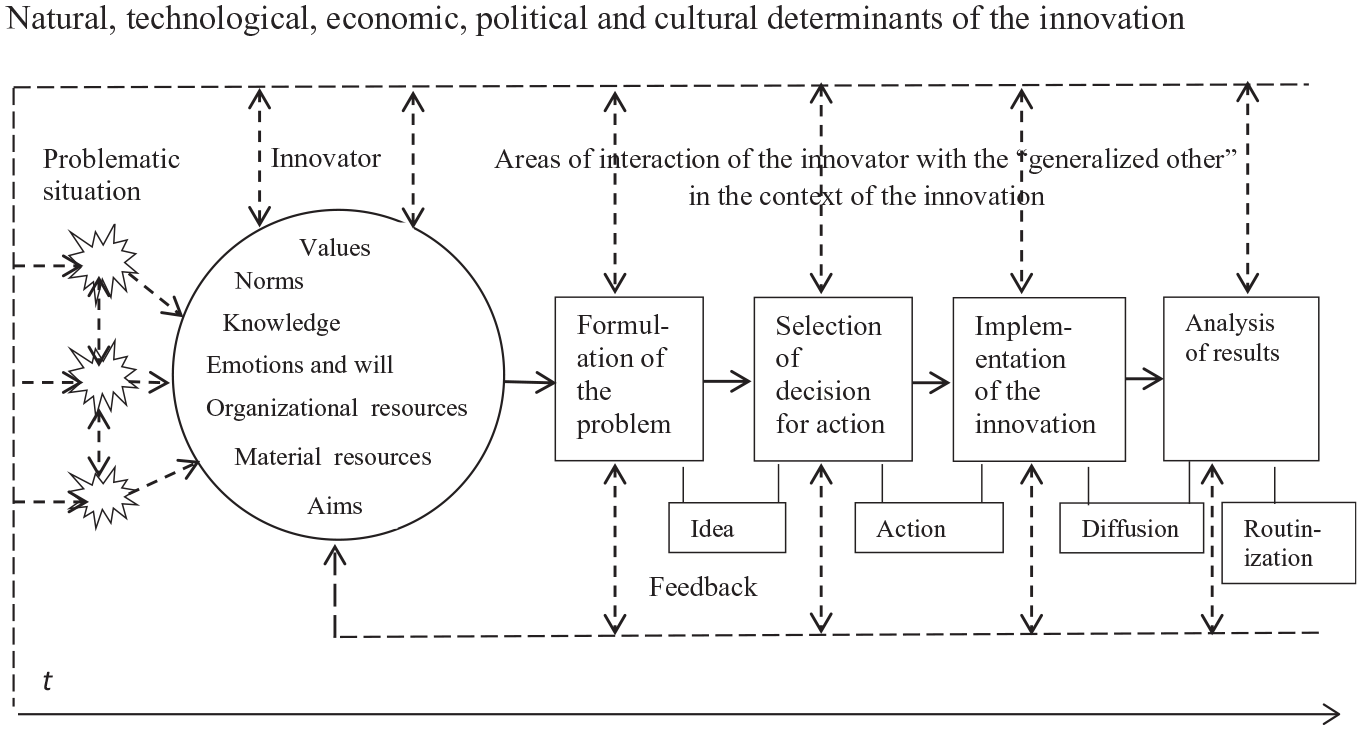
Social interactions in the innovation process.
The understanding of the social interaction concept as fundamental for the description and explanation of innovation processes precludes the possibility of interpreting social innovations as economic processes alone by following the spirit of Joseph Schumpeter’s pioneering works (Marie and Mertens, 2012). Neither can an approach to social innovations as technological innovations be persuasive. There are social innovations in propaganda and in fashion. The concept of social innovation can be very productive in the study of political structures and processes. This efficiency is not a signal that social innovations should be interpreted as political innovations only (Alexandre et al., 2020). An understanding of social innovation as a predominantly communicative process is even less persuasive. The productive alternative is to centre the exchange of matter, energy and information between individual and collective social actors (social interaction) in the interpretation of social innovations.
The innovator is the bearer of organizational initiative aimed at problem resolution in the context of innovation. Social innovations exhibit great variety due to the diversity of innovators and differences in contexts for each particular innovation. Innovators might be single individuals and small laboratories as well as multinational corporations and big universities (Fassi et al., 2020). The interpretations of micro-, mezzo- or macro-social level might change provided the activities are carried out by individual or collective innovators. The content, process and results of the transition from assembly-line organizational patterns to the organization of autonomous working groups came about as a reaction to a plethora of challenges like the new technological parameters of production, critical economic and political developments, demographic processes, educational and socio-psychological problems and changing values and norms (Broekstra, 2014).
In the sociological tradition, the best-known paradigms of studies on social innovations are typically focused on the aims, means, process and results of social action. This approach concentrates on the activities of separate participants in the innovation. The paradigm of social interaction requires paying attention to the mutual orientations and disorientations of various actors involved in the innovation, as well as the mutual facilitation or hindering of their activities (Genov, 2020).
Therefore, the first question which arises in the debate on completed, ongoing and forthcoming social innovations concerns the interaction of the innovator with other bearers of the exchange of matter, energy and information over the course of the innovation. There is a rare unanimity in the sociological community that human individuals are the major active component in the interactions bringing about and reproducing social innovations. Individuals act in the context of cooperation or confrontation with other individuals in small or larger groups. Provided that a group exhibits durability without legal regulation of its existence and activities, it might be regarded as an informal organization. Under present-day conditions, initiatives for social innovation and the implementation of such innovations are mainly the outcome of activities carried out by legally recognized formal organizations. Each real or potential, individual or collective participant in a social innovation is regarded as an actor in that innovation (Butzin and Terstriep, 2018).
The ability of an actor to influence the direction, course and results of social innovation vary, depending on the actors’ position in social structures, the material and symbolic resources at their disposal, and their skills to manage relevant situations. The performance of actors can vary greatly due to the impacting circumstances under which the innovation has been prepared and implemented. Such circumstances might include patterns of cooperation fostering the innovation. However, there are patterns of cooperation which hinder innovations because of the lack of motivation. Conflicts concerning the course of social innovations are typically regarded as hindrances to innovation activities. This view is widespread, although conflicts have the potential to foster constructive motivation and behaviour too. These similarities and differences determine the content and quality of the relationships of actors involved in this process. The analysis of social innovations may focus on the evolution of subjective visions about the aims and means of the innovation, or on the modalities of actors’ practical activities. The key analytical concept for dealing with the dynamics of these interactions is the concept of process in the social innovation (Santos et al., 2013).
This is the conceptual background of the research questions typically raised and answered during studies on organized social change: What are the objectively real and subjectively perceived needs and interests of the innovator and other participants in the social innovation? What is the innovator’s level of cognitive ability to properly identify the problematic situation requiring social innovation and to offer adequate ideas for its resolution? Is the innovator ready to take on the risks of implementing the social innovation? What is the cognitive capacity of participants in the innovative interactions for understanding the causes, course and effects of the innovation? What are the predominant attitudes in the social environment of the innovator – towards providing active support to the innovation, towards support to the initiatives of others, towards a passive ‘sit and wait’ policy during the preparation and implementation of the innovation or towards resistance to it?
The list of open questions is longer. The list of substantiated answers available in studies on the outcome of social innovation is shorter. They are entwined with the experiences of everyday life and only in rare cases oriented towards the formulation and testing of theoretical hypotheses. The major reason for this discrepancy is the complexity of social innovations. Various research approaches to every problem in the course of the innovations are possible. Diverse projects can be suggested for the preparation and implementation of organized social change. Consequently, careful selection of the approach which seems most appropriate for resolving the cognitive and practical problems under scrutiny is crucially important. If an innovator and the innovation’s supporters lack the desirable wide range of ideas, they may try to reduce the options for dealing with the innovation. The usual effect of deficiencies in action strategies would be the temporary or long-term blockage of objectively needed social innovations.
To select among strategies for studying social innovations, questions must be raised concerning the theoretical backgrounds, applicability and efficiency of the selection criteria. These might be guided by realistic or illusory visions about the needs and interests of the participants in the innovation. The selection and implementation of an inadequate research strategy might not reduce but rather increase the problematic situation’s complexity, with undesirable practical effects. Traditional criteria – simplicity, reliability and a high degree of correspondence to the social structures and processes – are no longer sufficient for coping with the methodological problems of innovation studies. Accelerated social dynamics determine the search for new flexibility requirements in the approach to social innovations (Leca et al., 2018: 202–5).
The conceptual framework of actors, relationships and processes in social interaction offers the main criteria for the efficient evaluation of an innovation’s preliminary and final results: What is the level of the new structures’ compatibility with former configurations of social structures? Do the new structures provide the conditions for achieving higher efficiency of individual and collective actions? Do the new structures offer promising conditions for efficient future innovations? The search for adequate answers guided by the paradigm of social interaction has a specific methodological advantage. The researcher might analyse important details by using a two-sided perspective of description and explanation of the innovation process. The first takes the points of view of participants in the innovation. The second comes from the point of view of the objective scientific observer.
Checking the viability of the conceptualization
The prospects for effectively developing a ‘middle-range theory’ of social innovations are encouraging. The reasons for this optimistic expectation relate to the conceptualization’s strong analytical background and the variety of available empirical evidence. Both information sources support the systematic and coherent paradigmatic guidance of sociological descriptions, explanations and forecasting of social innovations. The analytical concept of social interaction efficiently facilitates the reduction of complexity of innovation processes by integrating alternative views about social structure and social action, stability and change, differentiation and integration of social structures and processes, etc. A brief analysis of the aforementioned social innovations – at micro, mezzo, macro (national) and supra-national-macro level – strengthens this point. The analysis is structured according to the conceptual model of social interaction.
The organization of a system for offering microcredits started as a social innovation in Bangladesh during the 1970s. The background of the initiative was simple but existentially relevant. Poverty was the main social problem in the country. Some 80% of the rural population was living below the poverty line. Women were the major victims of widespread poverty. No established financial institution would give business loans to people belonging to the poorest segments of the country’s population (relations). The particularly problematic parameter of this situation was the reproduction of poverty. Muhammad Yunus and his Grameen Bank took the initiative (actor innovator) to break the vicious circle of poverty by offering small-size credits to mostly poor women from the countryside. The intention was to foster their entrepreneurship and thus their empowerment to escape from poverty. In a few years, the popularity of this successful system of microcredits spread throughout Bangladesh and encouraged followers from other less developed countries to repeat the project. Soon the microcredits movement became a global phenomenon, attracting the support of leading financial institutions and foundations worldwide (process). However, its functioning remained basically linked to micro-social interactions. Muhammad Yunus won the Nobel Peace Prize in 2006, though his social innovation project provoked strong counter-reactions. Some opponents still argue that microcredits are distorting the normal ways in which financial markets work. Nevertheless, the micro-social innovation initiated by Yunus is a telling example of the huge potential for change when people are empowered (Ashta et al., 2013; Mohanty and Faessel, 2018).
The integration (relations) of disadvantaged locals and immigrants into the workforce and social life is one of the most serious social problems facing Western European and other advanced societies. Most of the immigrants typically come to France from Africa, with low levels of education and without modern vocational training as a rule. Many are functionally illiterate and lack the habits for concentration and discipline needed in the workplace in modern and postmodern societies. The economic and social integration of this contingent has been attempted in France in the course of a bottom-up mezzo-social innovation. In its background lies the cross-sector partnership of French local civic administrations with local-level entrepreneurs and representatives of non-governmental organizations (actors innovators). The partnership was established for tackling the integration of disadvantaged natives and immigrants. The major part of the innovation was carried out by well-established enterprises in the construction, catering, gardening and recycling industries. Immigrants were offered work in enterprises for two years in order to learn the basic vocational knowledge, skills and habits necessary for regular working life. From the point of view of labour demand, the aim was to supply local enterprises with a trained labour force.
The social innovation of these local work-integration enterprises has become a well-known success story (process). The state adapted legislation to the new circumstances and offered support, covering about 20% of the business costs. The positive effects of this innovation are widely recognized and the public is largely in favour of such bottom-up initiatives. Nevertheless, there are also critical voices insisting that this innovation disturbs balances in the labour market too (Leca et al., 2018: 206–10).
In Colombia, the Hermes Project for Conflict Management in Schools started in 2001 as a macro-social innovation at the national level. The founding institutions were the Bogota Chamber of Commerce and the Inter-American Development Bank (actors innovators). The guiding intention of the project was, and remains, to change the attitudes of school children with poor backgrounds towards interpersonal conflicts (relations) and conflict resolution. Schoolboys with such backgrounds are known to be prone to deviations from publicly accepted behavioural norms. They are inclined to actively provoke conflicts in schools and take part in violent conflicts there. It is often the case that such conflicts in Colombian schools end up with human casualties. The state and local authorities provide teaching materials and trainers for courses on non-violent means of conflict resolution. The Hermes Project has established programmes (process) for conflict management in 360 schools nationwide, attended by students, parents, teachers and school staff (Bouvier, 2009: 164f.).
The Bologna reform process offers a telling example of the conditions, content, process and results of a supra-national social innovation. Numerous analyses of the state of higher education in Europe were carried out during the 1990s. They brought scholars to the conclusion that there is a burning need for strengthening the economic and cultural efficiency of higher education on the continent. One promising means for attaining that goal was the intensification of cross-border cooperation among national higher education institutions. It took time to understand that this result could be best achieved via a radical social innovation. It aimed at new structuring of university curricula in order to secure greater efficiency of university education and comparability between national educational systems (relations). The Bologna Declaration of 1999, signed by the European ministries of education, opened the way to a standardized introduction of Bachelor’s and Master’s curricula and degrees by using modules as curricula patterns. Some 48 countries (actors innovators) have put together tremendous efforts for substantial reforms in higher education by creating the European Higher Education Area and the European Credit Transfer and Accumulation System (ECTS). This innovation has been basically completed and routinized (process), although improvements are permanently on the agenda for discussions and reforms (European Commission, 2018). The prevailing opinion is that the innovation has been successful. Nevertheless, numerous criticisms focus on the false economic intentions of reforms, the replacement of traditional organizational patterns for universities with less effective new ones, or the supposed decline in educational effects under the new organizational patterns and educational contents (Mikelskis, 2018).
The structured narratives on social innovations at micro-, mezzo- and macro-societal levels, as well as at the supra-national level, precisely follow the major components of the innovation process as presented in Figure 1. The scheme is explicitly focused on explanations. The first step in this direction is the identification of the innovator in the specific context (relations). In the case of microcredits example, the initiation of an ambitious social innovation came from one person who became identified with the organized struggle against poverty. Three local organizations became innovators in the French case of establishing social enterprises for the socialization of disadvantaged people.
From the very beginning, the Hermes projects had a national innovator, while the Bologna process is a supra-national one established by the European Union (actors innovators). The life cycle of all four innovations under scrutiny started with the identification of a social problem to be resolved by a social innovation, with decisions for action, implementation of the decision and analysis of the results to follow (process). The dynamics of the innovation are fuelled by social interactions. The common pattern of the structure and moving forces among the four (rather different) social innovations vividly supports hypotheses about their common patterns regarding the explanation of innovations and the innovation management.
Conclusions
The intended effects of linking the paradigm of social interaction and the emerging ‘middle-range theory’ of social innovations have been achieved. The construction of the social innovation theory was carried out systematically by following the conceptual framework of actors, relations and processes as key parameters of the social interaction concept. The decomposition was achieved by simultaneously analysing typical social innovations and the emerging explanatory framework of the theory of social innovations. This result is confirmation of the heuristic potential of the social interaction paradigm. Its capacities for organizing the cognitive material obtained in the analysis and argumentation was confirmed throughout the exploration too.
The potential practical relevance of the new theoretical construct is guaranteed by keeping the sound distinction between the analysis of social innovations and the meta-theoretical discussion on the cognitive reproduction of social innovation processes. This ‘productive distance’ between the efforts towards systematic explanation of innovations and the elaborations of the conceptual schemes of the explanation allows for clear positions in the discussion on the mix of methods currently used or to be used in social innovation studies. For instance, contrary to widespread beliefs, only some of the studies can be designed and implemented as action research. In many cases, the most productive way to efficiently support practical activities is a supply of decision-makers with relevant descriptive, explanatory and predictive information (Kopf et al., 2014).
The testing of the paradigm of social interaction in the theorizing on social innovations leads to important conclusions. In contrast to the paradigms favouring the social and cognitive relevance of stability (order) or change (evolutionary or radical) in social reality, the social interaction concept offers the opportunity to balance out these and other theoretical and methodological alternatives. This advantage opens up prospects for objective multidimensional analysis of the rise and decline of social configurations, as well as the ‘sunny’ and ‘dark’ sides of social structures and processes (Alexander, 2013: 5–28). This applies to studies on spontaneous and organized change too.
The strategy for fostering the cumulative development of sociological knowledge about social innovations reduces tensions between the paradigms aspiring to a leading role in this research field and the overall development of the discipline. However, attempts at paradigmatic synthesis and its application for fostering the development of middle-range theories cannot alone overcome the deep divisions between sociological paradigms. The obstacles hindering paradigmatic synthesis are connected with the great complexity of social reality and differences in the philosophical foundations of sociological paradigms. Nevertheless, there are options for fostering the cumulative development of sociological knowledge. One of them is the increasing relevance of references to the emerging global society. Another factor is the ongoing universalization and integration of sociological concepts, methods and approaches to the study of social structures and social processes. This trend is accompanied by the progressing differentiation of sociological knowledge.
The ‘social interaction’ paradigm is deeply rooted in these social and cognitive processes. The rich cognitive background of its synthesis is the most general reason behind the paradigm’s heuristic and knowledge organizing potential. Against this rich background of the present analysis the radical generalization formulated by Niklas Luhmann that ‘since the classics, sociology has made no progress worth mentioning toward a theory of society in the course of the past 100 years or so’ (Luhmann, 2012 [1997]: 4) is obviously exaggerated. Together with rapid advancements in the field of empirical sociological studies, substantial achievements have also been registered in the areas of paradigmatic developments and the building of so-called ‘middle-range theories’. The theory of social innovations is an example of this type of advancement in sociological knowledge. The discussions on the paradigmatic foundations of sociology and the development of middle-range theory of social innovation provide enough evidence for the point. Nevertheless, there is an element of truth to Luhmann’s critical assessment of the situation of sociological knowledge. His criticism is focused on the meagre attempts at synergy in the laying of the foundations of sociological knowledge and in the development of general sociological theory.
The advancement of sociological knowledge is inspired by multiple factors in a variety of combinations and cannot be linear or free of controversies. The under- or over-estimation of any of these sources or tools for the constructive development of sociological theory might lend support to sociological explanations or hinder them. The variety of basic ingredients in sociological theorizing and research strengthens the point that sociology has been and remains a multi-paradigmatic scientific discipline.
If the above point were interpreted in the sense of multiculturalism, arguing that each paradigm has sufficient rights to be treated equally, then this would be likely to produce confusion. There are sociological paradigms in circulation which, though partly productive, suffer from theoretical and methodological one-sidedness. The paradigm of sociobiology is a good example. It has contributed to the creative inclusion of important biological and psychological topics within the sociological discourse. But it has failed in its ambition to reconstruct the foundations of modern sociology. Phenomenological sociology has its achievements in the decomposition of the foundations of everyday life. However, it has turned out to be incapable of guiding studies on macro-social changes. A large segment of sociological studies is still following the idea that the structure and functioning of society has to be the explanatory orientation in sociology.
The proposed paradigm of social interaction at the micro, mezzo and macro levels of social structures avoids such limitations on the acquisition, organization and use of systematic sociological knowledge. The suggested conceptual framework synthesizes alternative ideas from functionalism and evolutionism, micro-sociological and macro-sociological approaches, qualitative and quantitative studies. The application of the paradigm in the study of social innovations provides the evidence for the ensuing promising prospects for theoretical syntheses, theoretically guided empirical research and for practical relevance of sociological studies.
Footnotes
Funding
The author received no financial support for the research, authorship, and/or publication of this article.
