



Abstract
The term resilience is being more widely adopted in fire safety engineering, however, its comprehensive description is not clearly explained or correctly applied in practice. This study, therefore, defines the categories, dimensions, characteristics, capacities, objectives and missions possessed by resilience to provide a holistic understanding of the term. This is followed by an analysis and classification of the UK Standards and Codes addressing resilience considering their administrative and engineering features of resilience, and their resilience dimensions with definitions of fire resilience measures and approaches. A practical example of a fire resilience framework is applied in educational buildings considering internal resilience for a safe facility, risk reduction and disaster management, and external resilience involving redundancy of resources and community support. Finally, a fire resilience design framework is created in which structural and fire safety engineering are considered clarifying the steps to follow in a comprehensive design process based on a flow chart. This paper will contribute to the creation of a unified terminology and understanding of the concept linked to resilience to be adopted in various disciplines.
Keywords
Introduction
Currently, a common shared vision about risks and their mitigations does not exist and it is not clear how to increase the resilience of individuals, communities and the built environment. 1 Several resilience frameworks have been created in disciplines other than fire safety engineering but common aspects are present and similar purposes can be established in various contexts such as critical infrastructure and seismic engineering.
The Critical Infrastructure Resilience Framework defined by NIPP 2013 2 considers physical, cyber and human elements critical in infrastructure and the framework supports a decision-making process to inform risk-management actions. The National Institute of Standards and Technology (NIST) has created a community resilience plan for buildings and infrastructures 3 in which actions and activities are defined as planning steps involving a collaborative planning team, understanding of the social dimension and built environment, determining goals and objectives, planning developments, defining and implementing a plan. The UK Government 4 has defined the critical national infrastructure resilience and its components are resistance preventing damage and disruption and reducing vulnerability, reliability represented by the capacity to maintain operation, redundancy with the availability of backup installations, and response and recovery to rapidly respond to and recover from an incident. 4
The REDi (Resilience-based Earthquake Design Initiative for the Next Generation of Buildings) Rating System evaluates resilience in buildings subjected to earthquakes considering building resilience, organizational resilience and ambient resilience, and planning and evaluation representing the loss assessment. 5 Bruneau identifies system resilience in the scenario of earthquakes considering robustness and rapidity and showing how the resilience dimensions can be integrated into a method able to evaluate resilience for infrastructure systems and communities. 6 The analysis includes the possibility of having a fire following an earthquake scenario with cascading events causing social and economic losses. 7 Indeed, it is hypothesized that cities prepared for several hazards are more resilient than those for single hazard, 8 as responsibilities shift from individuals to communities. 9 Moreover, the evaluation of common indicators, quantified measures and structural effects of natural hazards will define the building response. 10
Within fire safety engineering literature, the term resilience is being used more and more often. Between 2000 and 2015, the term ‘resilience’ appears in papers with ‘fire engineering’ or ‘fire safety engineering’ just under 4% of the time on articles able to be found on Google Scholar. This increases to almost 7.5% between 2015 and 2019, up to 11.1% between 2019 and mid-2021.
It would, therefore, be useful to have a common definition and general resilience framework independently of the hazard analyzed. 11 In this paper, definitions, terminology, concepts and a framework related to resilience are applied to the fire safety problem to support their correct understanding and applications in practice.
A comprehensive understanding of resilience
A unique definition for resilience is difficult to find. The word comes from the Latin word resilio that means ‘jump back.’ 12 According to the United Nations, resilience is:
‘The ability of a system, community or society exposed to hazards to resist, absorb, accommodate, adapt to, transform and recover from the effects of a hazard in a timely and efficient manner, including through the preservation and restoration of its essential basic structures and functions through risk management’. 13
Linkov et al. 14 consider resilience as a complimentary attribute able to apply adaptation and mitigation strategies to improve risk management where risk is the loss in functionality and it depends on threats, vulnerabilities and consequences given by a specific risk. In seismic engineering, resilience is defined as ‘the ability of social units (e.g. organizations, communities) to mitigate hazards, contain the effects of disasters when they occur, and carry out recovery activities in ways that minimize social disruption and mitigate the effects of future earthquakes’. 6
The contemporary use of the term ‘resilience’ therefore implies a holistic view and covers societal risks as social stability and public health; organizational or geopolitical risk affecting political decisions, resolution of conflicts and disputes on resources; economical risk as to the failure of critical infrastructures on which economic activities are based; and technological risk involving, for example, infrastructure disruptions. 15
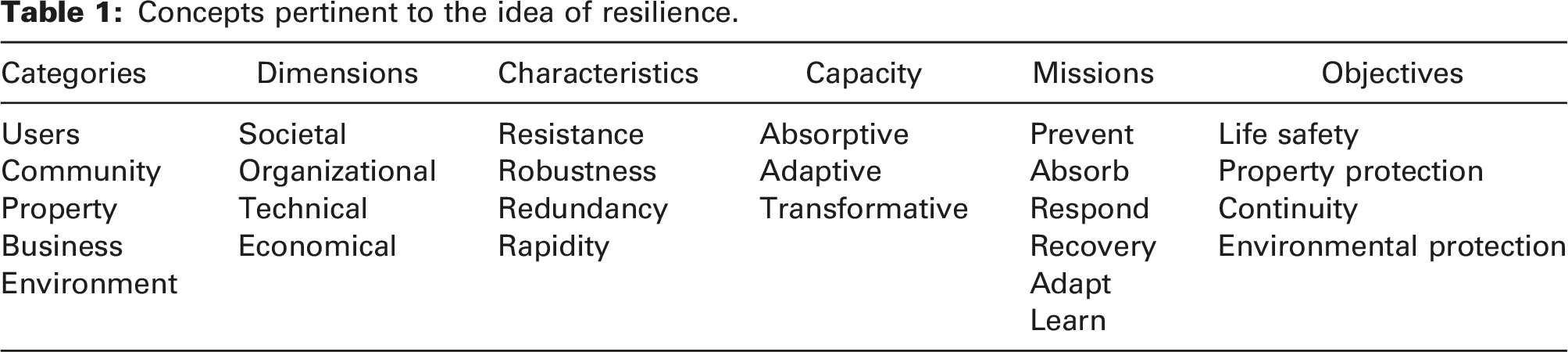
The above-mentioned risks also represent the resilience dimensions that can be classified in internal resilience (technological, organizational and economical dimensions) and external resilience (societal, technological, organizational and economic dimensions) .
16
It is clear then that resilience needs to be defined in multiple domains.
14
Despite the dimension considered, the following characteristics contribute to its resilience as stated by Bruneau et al.
6
: - Robustness: the ability of a system to withstand stress without loss in functionality, - Redundancy: the capacity of satisfying function in case of disruption, - Resourcefulness: the capacity to establish priorities and mobilize resources in the presence of disruption and - Rapidity: ability to meet priorities in a time-effective manner to contain losses.
Moreover, resilience systems possess three fundamental capacities
1
: - Absorptive capacity: ability to prepare for, mitigate and prevent negative impacts to prevent and restore basic functions, - Adaptive capacity: ability to modify or change to mitigate potential damage and guarantee the continuity of functions and - Transformative capacity: ability to create a new system to avoid the impact of disruption.
Resilience, therefore, is a network of capacities that respond to disruptions and results in a dynamic process that influences and is influenced by, private users such as individuals, families, businesses and organizations and public ones such as communities, 3 local and national governments. Norris et al. 17 affirm that community resilience is a process that links a network of adaptive capacities, based on resources with dynamic attributes, to adaptation after a disruption.
Resilience objectives and missions
The objective of life safety is usually considered as a necessary requirement to be incorporated with property protection 11 and continuity of function and business. In general, the objectives have the following hierarchy: life safety, environmental protection, property protection and continuity to families and business.
Consensus about the resilience objectives can be found in literature. In the field of seismic engineering, Bruneau defines the resilience objectives to minimize the impact in the reduction of life quality and economic losses due to an earthquake event. 6 The National Infrastructure Protection Plan (NIPP) 2013 2 for critical infrastructures in the United States establishes as objectives to assess and analyze hazards to inform risk management activities, secure against threats through actions to reduce risk, enhance resilience by minimizing the consequences of incidents based on planning and mitigation, and applying effective responses and ensure quick recovery, share action and vision, promote learning and adaptive capacity.
Similar goals and objectives are defined by the National Institute of Standards and Technology (NIST) 3 and involve the definition of community hazards and levels; prediction of performance to guarantee social functions; definition of desired recovery performance goals based on social needs and the identification of dependencies and cascading events. For building codes, the primary objective considering specific events is to guarantee life safety and prevent collapse defining an acceptable level of tolerable threat to a building; however, the objectives can also involve property protection and continuity providing a minimum level of functionality, quick recovery and improvement for future hazards. 18
Resilience is composed of engineered and administrative features where the former considers the technical aspects of disaster resilience while the latter includes elements such as preparing for, planning for, responding to and recovering from disasters, or in this case fires.
19
Therefore, resilience missions can be expressed as: - Prevention or Preparing to recover from potential hazards; - Mitigation/Absorption with the reduction of the impacts on lives and property; - Response to protect humans and the environment in the aftermath of the event; - Recovery through restoration and strengthening of communities and built environment;
20
- Adaption is also considered in the list of the resilience mission;
14
and - Learning after the incidents is necessary to increase preparedness for possible future events.
Measuring resilience
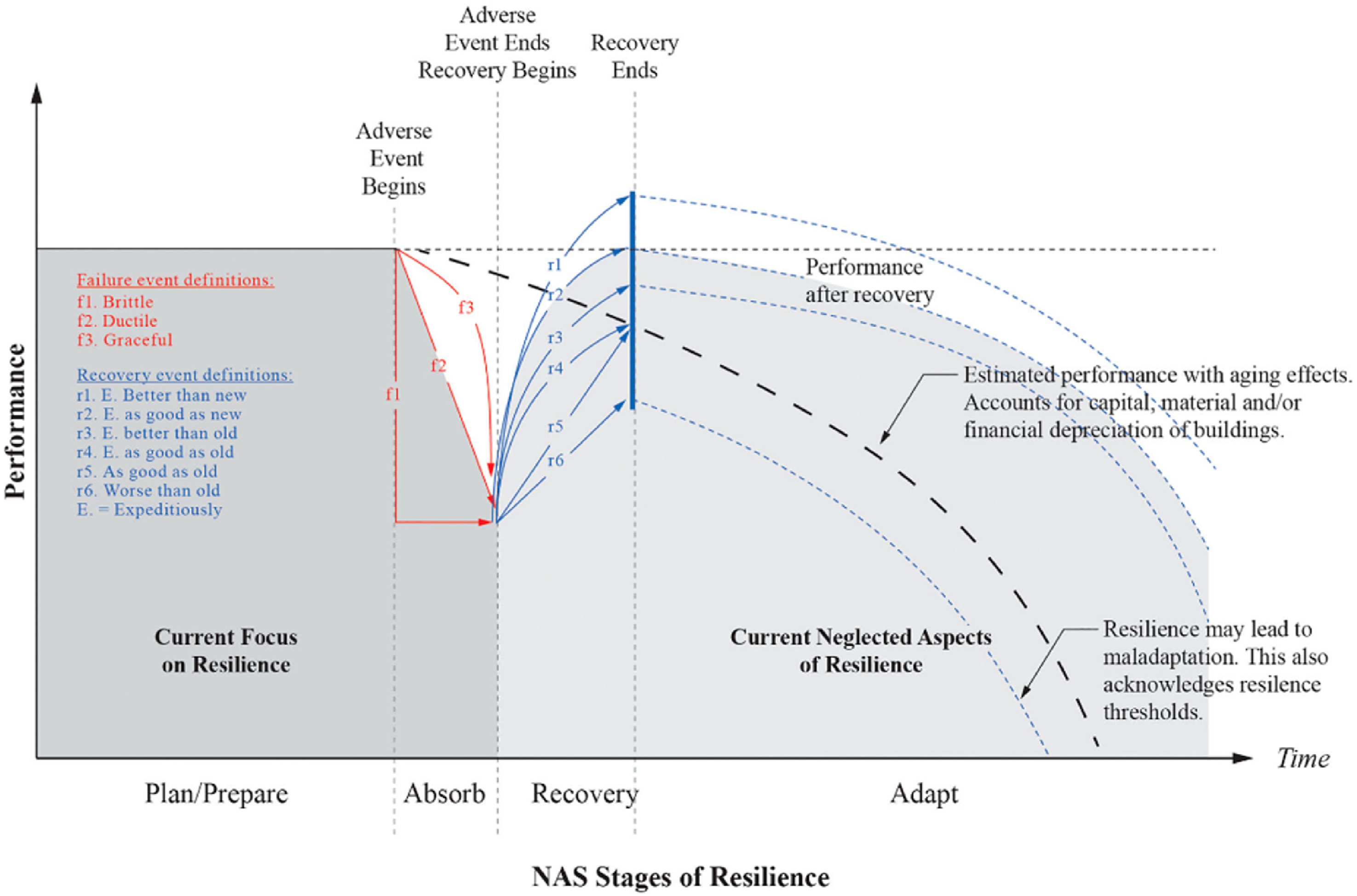
Resilience can be measured by the area generated by the incident to regain the normal functionality where the resilience triangle represents the loss of functionality due to the disruption and the possible restorations or recoveries over time. 21 For the resilience quantification, the process could be based on the evaluation of system performance and no-performance functions. 22 The National Institute of Standards and Technology (NIST) 3 quantifies resilience for a building or infrastructure (referred to the built environment) in terms of functionality against the time to recovery after a disruption based on an improved level of functionality or deterioration due to ageing and lack of appropriate maintenance.
Linkov et al. 14 state that resilience is related to a loss of functionality and recovery curve where the resilience missions of a system, to plan, absorb, recover and adapt, are now considered life-cycle stages and can be plotted in the graph of functionality against time. Another fundamental life-cycle stage is learning from the event and from the previous conditions that caused the disruption. Furthermore, resilience could be analyzed in different time horizons as immediate to guarantee life safety, intermediate for essential functions and long-term to establish normal functionality. 14 Indeed, risk composed of threat, vulnerability and consequences, is strictly connected to the concept of resilience where risk analysis and management have been widely used to predict the likelihood and consequences of potential hazards and quantify the complexity of uncertainties.
Kurth et al.
18
express the resilience life-cycle as a curve (Figure 1) with adapted resilience definitions from the National Academy of Science and include previous studies thinking, amongst which were Linkov
14
and Ayyub.
23
The three main concepts that are the basis of the graph are functionality, recovery and adaption. For the functionality linked to the performance in Figure 1, satisfying minimum code criteria may not guarantee functionality and inoperability could affect community resilience. Intrinsic and connected building functions need to be evaluated in terms of interdependencies and ability to function. Recovery (different recovery event definitions from r1 better than new to r6 worse than old in Figure 1) implies quick reparability from failure (brittle f1, ductile f2 and graceful failure f3 in Figure 1) and when system recovery is discussed, it is important to shift from the evaluation of failures to the understanding of the interdependencies and the ability to function. Adaption (after the recovery phase in Figure 1) represents the ability to accommodate unknown events and be more capable to recover.
18
Resilience function of Kurth et al.
18
If the evolution of performance in time can be evaluated with the resilience function, it is also important to quantify resilience and determine some resilience indicators. In earthquake engineering, the resilience concept has been quantified in three main reductions of failure (adverse event) probabilities, consequences and time to recovery. 6 There are also some resilience indicators or metrics that are defined to match the outcomes of the impact of social capital and wellbeing of a population or a system evaluated in different levels considering threat and consequences. 18 The indicators of the Organization for Economic Co-operation and Development, 1 investigated in the ‘Fire Resilience Measures’ section, are system resilience indicators, negative resilience indicators, process indicators, output indicators and proxy indicators.
Some examples of metrics for resilience are defined by Kurth et al. 18 such as the functionality of building after the incident, recovery time, operational and maintenance costs and likelihood of collapse. The aim is, therefore, to refine the social and economic measures of community resilience and translate them into technical and organizational system performance criteria. 6
Resilience frameworks in fire safety
Fire resilience frameworks are usually based on those developed for critical infrastructures or earthquake engineering. According to Gernay et al., 11 life safety and property protection need to be considered as fire safety requirements and the role of fire responders has to be investigated to improve safety and reduce fire damage allowing prompt recovery after a fire incident. Fire damage can range from destruction of belongings through to spread to other buildings and even structural damage and collapse. When considering the latter, three problems should be analyzed modelling fires: fire development, heat transfer model and thermomechanical response. Moreover, Ouyang et al. 24 affirmed that the infrastructure resilience subjected to fires needs to be based on three stages analysis: the resistant capacity that includes the limitation of fire load and effective use of the fire protection system; the absorptive capacity which reduces the impact of fire to maintain residual functionality while preventing disproportionate damage cascading effects, and also the restorative capacity linked to the recovery time after the disruption. The main difference between the three stages analysis and the classification of Table 1 is represented by the resistant and restorative capacities that in Table 1 are considered as characteristics rather than capacities.
Prescriptive fire codes often address life safety without explicitly considering financial losses and disruption due to fire incidents. Farsangi et al.
25
address the progress in fire engineering defining the steps to follow for a resilient and holistic approach where the following problems are evaluated: - Goal problem: Ensuring life protection and property protection given by direct losses; - Scale problem: Shifting the approach from individual components to the system; - Uncertainty problem: Accounting for uncertainties and evaluating probabilistic risk assessment to reduce risks; - Hazard scenario problem: Considering multi-hazards scenarios.
In the framework suggested by Farsangi et al. 25 the following steps need to be followed: the data collection, the characterization of design fire scenarios, the analysis of structural response, the assessment of damage and the calculation of the consequences.
NFPA 550 26 provides a systematic approach to evaluate a fire safety strategy where an initiating event creates a risk to exposed populations. This represents a tool to inform disaster resilience decisions 26 but in general fire resilience is evaluated in terms of performance of specific design subjected to fire and the related direct financial losses without considering the impact and downtime due to fire incidents on community and indirect financial losses, respectively. Fire resilience plans, then, are usually focused on the technical and economic dimensions neglecting those that are societal and organizational.
The UK Fire and Resilience Officer for construction, describes a range of fire engineering design, services, fire modelling and development of standards for construction materials. There is also a specific section for safety and resilience in which the aim is to deliver plans for services to secure, protect and guarantee the first response and sustain resilience for communities. 27
Having summarized relevant literature relating to resilience, in the following Section, an analysis of how resilience is considered within the UK Standards and Codes is examined.
Resilience in the UK Standards and Codes
Prescriptive Codes are intended to ensure that the performance objectives of life safety of occupants and some degree of property protection are achieved but this does not necessarily imply that the building would be functional or able to be re-occupied immediately after a fire. 5 Resilience is addressed in Codes and Standards where some policies require others to be implemented or need a longer time to have an effect. 16 Labaka et al. 16 developed research in which resilience policies for critical infrastructure are investigated, their influence on resilience analyzed in terms of prevention, absorption and recovery and a methodology defined for the best order in which they should be implemented. A similar investigation is now presented.
Investigation of resilience in UK Standards and Codes
UK standards addressing resilience aspects.
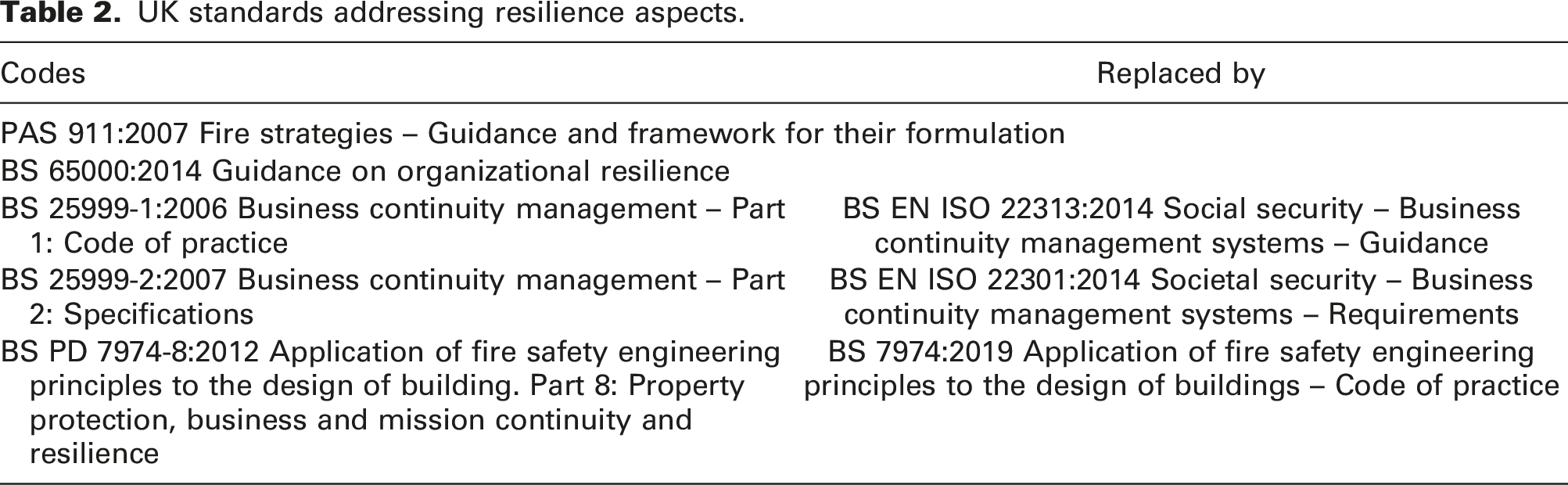
PAS 911:2007 28 is intended to provide guidance to create and review the fire safety strategy and does not give detailed recommendations or specifications for the applications of fire safety and protection which are usually covered in national Standards and Codes. It explains a methodology to integrate national Standards within a framework giving several tools and methodologies that can be adopted in the analytical phases of the preparation of the fire strategy.
Indeed, BS 25999-1:2006, 29 BS 7974-8:2012, 30 replaced by BS 7974:2019, 31 and BS 65000:2014, 32 take the form of guidance and recommendations and are not quoted as specifications or code of practice where qualified people can apply their provisions and need to justify any actions that deviate from the recommendations. BS EN ISO 22313:2014 33 which updated BS 25999-1:2006, 29 affirms that the Standard provides guidance on the requirements specified in BS EN ISO 22301:2014 34 which has replaced BS 25999-2:2007. 35
Administrative features
Resilience definitions
For the administrative features, the definition of resilience involves organizations and it is expressed by BS 65000:2014 32 as ‘a strategic objective to help an organization to survive and prosper’ and it involves characteristics such as being adaptive, competitive and robust. Moreover, organizational resilience involves the capacity to anticipate, respond and adapt from minor incidents to major shocks or constant changes. The BS 65000:2014 32 affirms that resilience deals with disruption, changes and uncertainties. It appears as a combination of continuity and long-term viability based on strategic changes. More generally, organizational resilience is defined by BS 25999-1:2006, 29 BS 25999-2:2007 35 and BS 7974-8:2012 30 as ‘the ability of an organization to resist being affected by an incident’.
Performance goals
The BS 65000:2014 32 provides guidance on building resilience clarifying the nature and scope for top management, identifying main components reviewing and implementing measures for improvements and recommending good practice building a culture of resilience. Resilience is, therefore, considered to be an outcome of effective governance that successfully evaluates opportunity, mitigates risks and appoints appropriate people and teams to make decisions.
BS 65000:2014 32 presents organizational resilience, while BS 25999-1:2006 29 introduces business continuity with code of practice and BS 25999-2:2007 35 defines specifications to assess the organization’s ability to meet regulatory, customer and the organization’s own requirements related to what is described in BS 25999-1:2006. 29 In BS 25999-1:2006, 29 business continuity management guarantees critical activities in various time steps establishing the maximum tolerable period of disruption and identifying inter-dependent activities.
BS 25999-1 and 2 have been replaced by BS EN ISO 22313:2014 33 and BS EN ISO 22301:2014, 34 respectively. They discuss social security and business continuity management systems. BS EN ISO 22313:2014 33 defines the importance of a business continuity management system to understand the organization’s necessity and to implement the capacity to deal with disruption monitoring performances, defining priorities, understanding threats and establishing arrangements to resume activities.
The PAS 911:2007 28 and BS PD 7974-8:2012, 30 are focused on fire safety strategies and fire safety engineering principles, respectively. In PAS 911:2007, 28 the benefits of the fire safety strategy imply an understanding of fire safety requirements for premises and occupants, considerations of fire precautions, including life safety, property protection, business continuity, and Environmental protection, review of design criteria and the creation of a framework to integrate protection measures with specific, measurable, achievable, realistic and time-related objectives.
BS PD 7974-8:2012 30 affirms that despite life safety being a mandated requirement by national building regulations, property protection and business continuity are fundamental to increase resilience to fire incidents and future use describing a business impact analysis process (BIA) to inform qualitative design review (QDR). This British Standard document has been replaced by BS 7974:2019 which affirms that fire safety engineering needs to reduce the damage of property, loss of productive capacity and reputation.
Suggested resilience framework
The frameworks suggested by the Standards of Table 2 are presented to critically evaluate how resilience could be addressed.
In BS 65000:2014,
32
building resilience is described according to six main steps as to: 1. Be informed to: a. Identify what has to be protected; b. Prepare resources to anticipate, identify, review and control problems and improvements; c. Optimize risk management framework(s); and d. Understand the lessons to be learnt. 2. Set directions, specifying clear roles and responsibilities. 3. Bring coherence; knowledge needs to be shared to coherently address risks and opportunities amongst all parts of organizations. 4. Develop an adaptive capacity to: a. Quickly respond to changes; b. Support innovations, flexibility and agility; and c. Promote activities and behaviours to facilitate new conditions 5. Strengthen the organizations to: a. Reduce the likelihood of disruptions; b. Improve adaptability increasing redundancy; and c. Predict and mitigate foreseen and unforeseen impacts. 6. Validate and critically review previous experiences creating appropriate training.
BS 25999-1:2006
29
presents a business continuity management program based on lifecycle in which four steps should be followed to: 1. Understand the organization, evaluate impacts and define a maximum period of disruption and a minimum level of functionality; 2. Determine business continuity management strategies considering people, premises, information, technology, supplies and stakeholders; 3. Develop and implement business continuity management response establishing incident response structure and actions to contain events; and 4. Exercise, maintain and review.
The overall recovery objective is composed of main time steps: incident response, business continuity and recovery highlighting the dependencies between business impact analysis, which manages the acute phase and business continuity. 29
In BS 25999-2:2007, 35 the Plan-Do-Check-Act cycle is composed of four steps to Plan (establish), Do (implement and operate), Check (monitor and review) and Act (maintain and improve). The cycle, included in the updated document of BS EN ISO 22313:2014, 33 explains how the business continuity requirements and expectations of interested parties are inputs to generate business continuity outcomes based on actions and processes. BS 7974-8:2012 30 is focused on fire safety engineering including property protection, business and mission continuity and resilience. It provides a fire safety engineering framework considering a qualitative design review to define objectives and identify hazards, a quantitative analysis to consider solutions and assessment against criteria in which the outcomes of quantitative analysis are compared against agreed criteria. In particular, qualitative design review is useful to examine evidence and fire statistics to establish scenarios for quantified evaluations and a business impact analysis is usually considered as input in every qualitative design review. According to BS PD 7974-8:2012, a business impact analysis is composed of the definition of scope, specific for fire disruptions; data collection, considering the maximum tolerable period and recovery time; and moderation process.
The updated version BS PD 7974:2019 31 considers an expanded fire safety engineering framework where it does not necessarily guarantee adequate design and approval bodies should be consulted. The framework is composed of the following main stages: qualitative design review, analysis, assessment against criteria, internal peer review and quality assurance, report and presentation of results and external peer review.
The qualitative design review includes the definition of objectives for fire (life safety, loss prevention and environment), identification of fire hazards and possible consequences, the setting of acceptable criteria, identification of method of analysis and establishment of fire scenarios. BS 7974:2019
31
presents an example of a timeline between fire development, evacuation and damage to property. While the timeline of BS 7974:2019
31
considers only the fire response of occupants, this paper also investigates the contribution of firefighters with the dispatch, preparation, travel time, set-up, occupant rescue and fire extinguishment highlighting the components of fire response and mitigation. Furthermore, BS 7974:2019
31
does not extend the timeline after the incident neglecting the recovery time and the possible implications on activity restoration and property repairs for a short or long disruption. Once the normal level of functionality is reached, performances could be implemented to achieve a higher level than the one before the incident (Figure 2). Improved example of the timeline provided by BS 7974:2019
31
(red additions are improvements).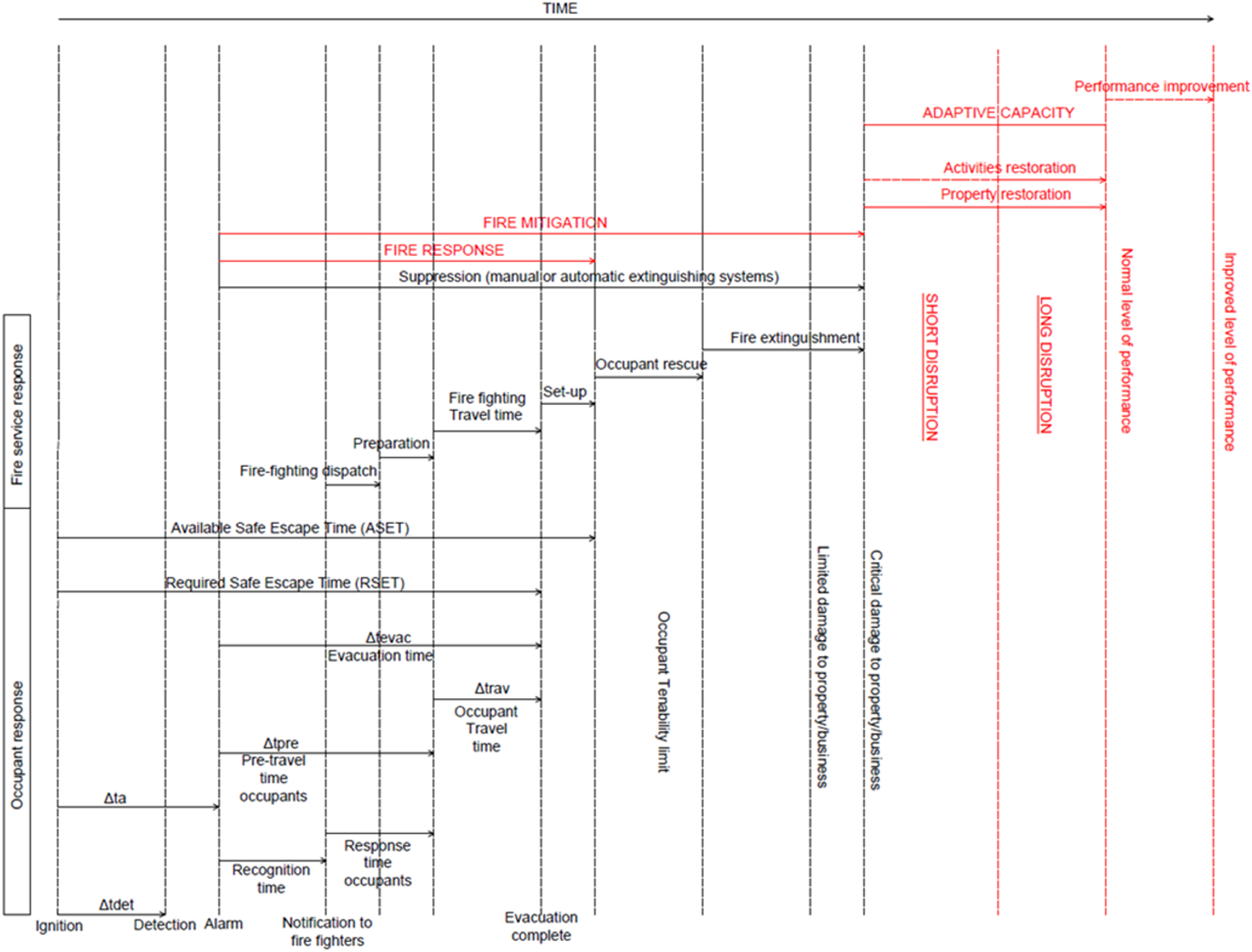
Administrative features and missions
The Standards of Table 2, are evaluated based on how they address the six resilience missions considering their administrative features.
To prevent: - PAS 911:2007, fire precautions with respect to broader objectives that may include life safety, property protection and environmental considerations. - BS 65000:2014, to predict and mitigate foreseen and unforeseen events. - BS 25999-1:2006, to identify what needs to be done before an accident occurs to protect people, premises, technology, information, supply chain, stakeholders and reputation. Replaced by: BS EN ISO 22313, to monitor and review the performances and effectiveness of business continuity management systems. - BS PD 7974-8:2012, to control fire to prevent the destruction of a building. Replaced by: BS 7974:2019, to identify fire hazards and potential consequences.
To respond: - PAS 911:2007, components of the fire strategy timeline. - BS 65000:2014, measures to develop and implement the business continuity management response and containing incident. - BS 25999-1:2006, methods of restoring an organization’s ability to supply products and services to an agreed level within an agreed time after the disruption. - BS 7974:2019, fire and human response translated into the building design process.
To absorb/mitigate: - PAS 911, to enhance business continuity. - BS 65000:2014, to establish a resilient organization. - BS 25999-1:2006, to improve the ability to achieve objectives against disruption. Replaced by: BS EN ISO 22313:2014, to implement and operate control measures for the overall capability to manage disruptive incidents. Mitigating, responding to and managing impacts. - BS PD 7974-8:2012, business impact analysis in combination with business continuity management to ensure adequate availability of critical activities. Replaced by: BS 7974:2019, fire safety measures to ensure that the functional objectives are met. Protect people and building structure.
To recover: - PAS 911, analysis of business interruption (short and long term). - BS 65000:2014, to strengthen the ability to address disruptive events, emergent risks and changes through recovery to an agreed state. - BS 25999-1:2006, to provide a method of restoring the ability to supply products and services to an agreed level within an agreed time after the disruption. Replaced by: BS EN ISO 22313, business continuity strategies – stabilizing, continuity, resuming and recovering prioritized activities. - BS PD 7974-8:2012, business impact analysis defines the timescale for the disruption. Replaced by: BS 7974:2019, maintain ongoing business viability.
To adapt: - BS 65000:2014, to develop adaptive capacity.
To learn: - PAS 911:2007, to investigate the existing management of fire safety systems. - BS 65000:2014, to identify and capture lessons to be learnt. - BS EN ISO 22313, to maintain and improve the business continuity management adopting corrective actions, based on the results of management review. Continuous management review and improvement.
Engineering features
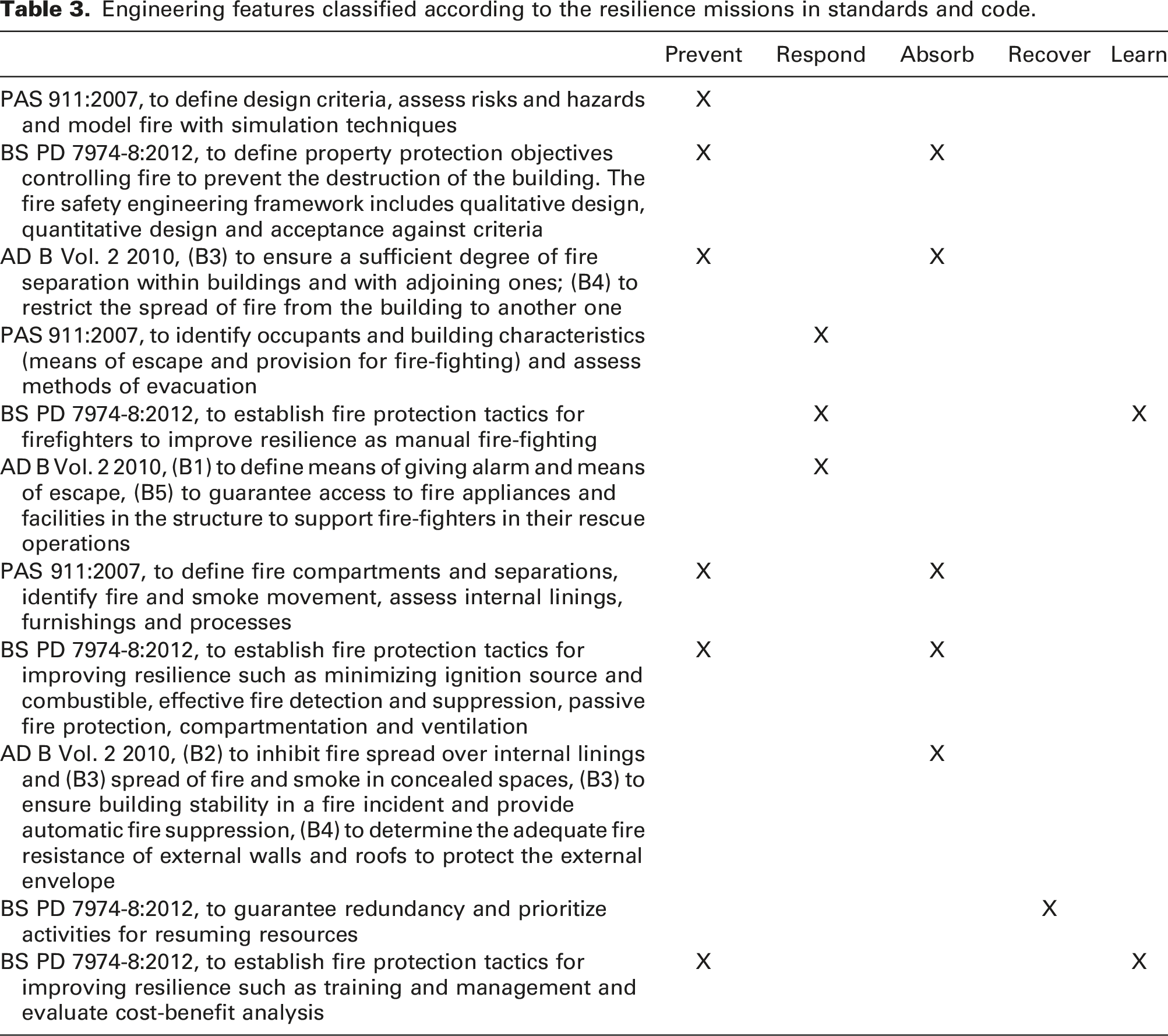
For the engineering features, PAS 911:2007 28 and BS PD 7974-8:2012 30 updated by BS 7974:2019 31 are mainly focused on the technical measures required to address fire safety issues while the others, listed in Table 2, mainly cover organizational and management issues. The Approved Document B –Volume 2 Buildings other than dwelling houses 2010 36 (named AD B Vol. 2 2010) is also considered which is composed of five chapters (B1–B5).
Engineering features classified according to the resilience missions in standards and code.
Standards and codes in the resilience function
It is important to understand how the Standards of Table 2, currently in place, and the AD B Vol. 2 2010
36
contribute to the resilience function considering the resilience missions. Based on Figure 3, the Standards and Code appear to be concentrated in the first part of the function and particularly in the sector of prevention, absorption and response. Their guidelines decrease moving towards the recovery and adaption phases. The AD B Vol. 2 provides guidance for prevention, absorption and response without considering the recovery and adaption phases. Standards and Codes and the resilience function.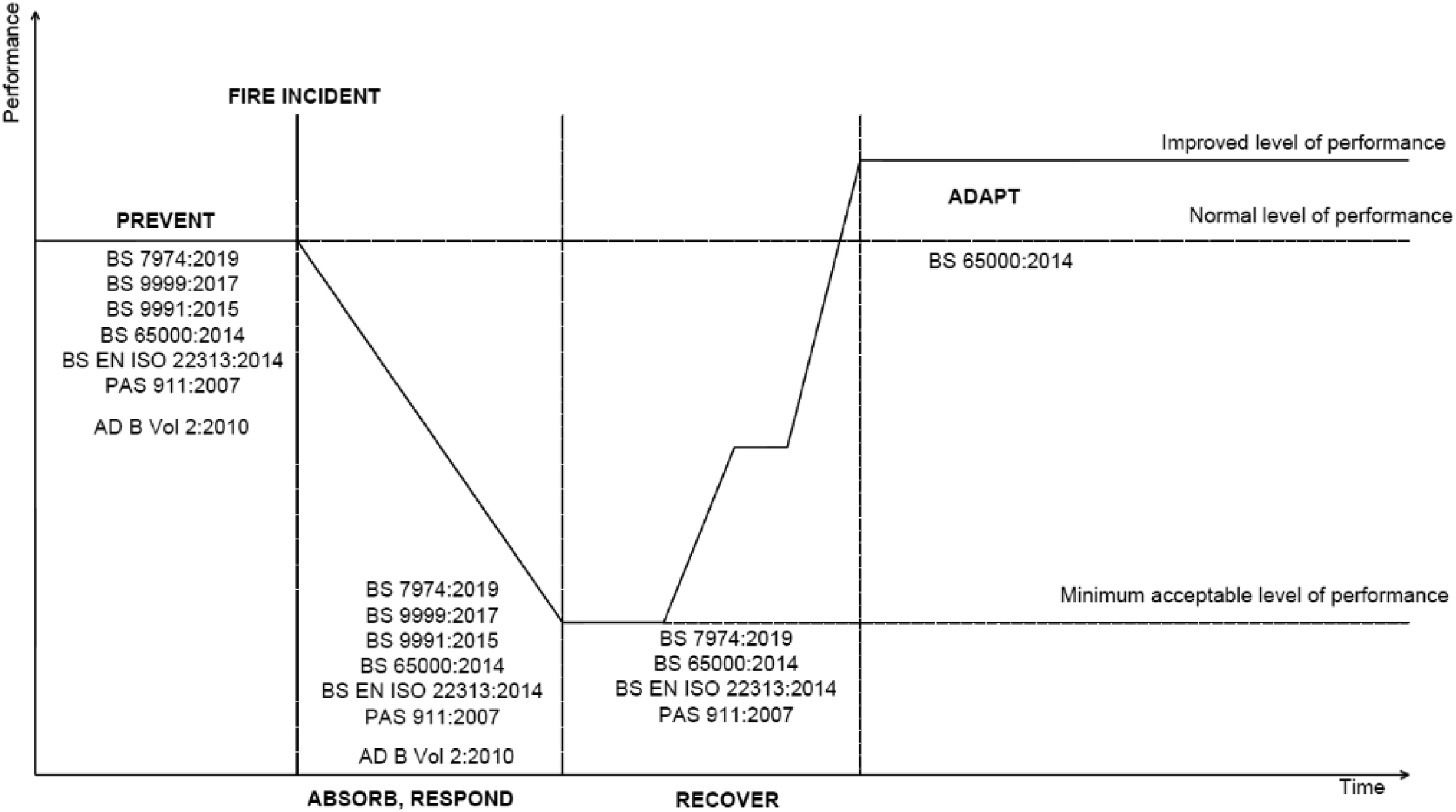
Therefore, due to the obtained distribution of the Standards and Codes, it is fundamental to integrate various guidelines to cover all the objectives and missions, investigate administrative and engineering features and apply a comprehensive resilience assessment in the case of fire incidents integrating the social, organizational, technical and economic dimensions.
After a literature review about the main concepts of resilience, its application in various disciplines and the related guidelines present in Standards and Codes, the paper is now focused on the applications of resilience in fire safety engineering.
Resilience applied to fire incidents
Fire resilience questions according to resilience categories.
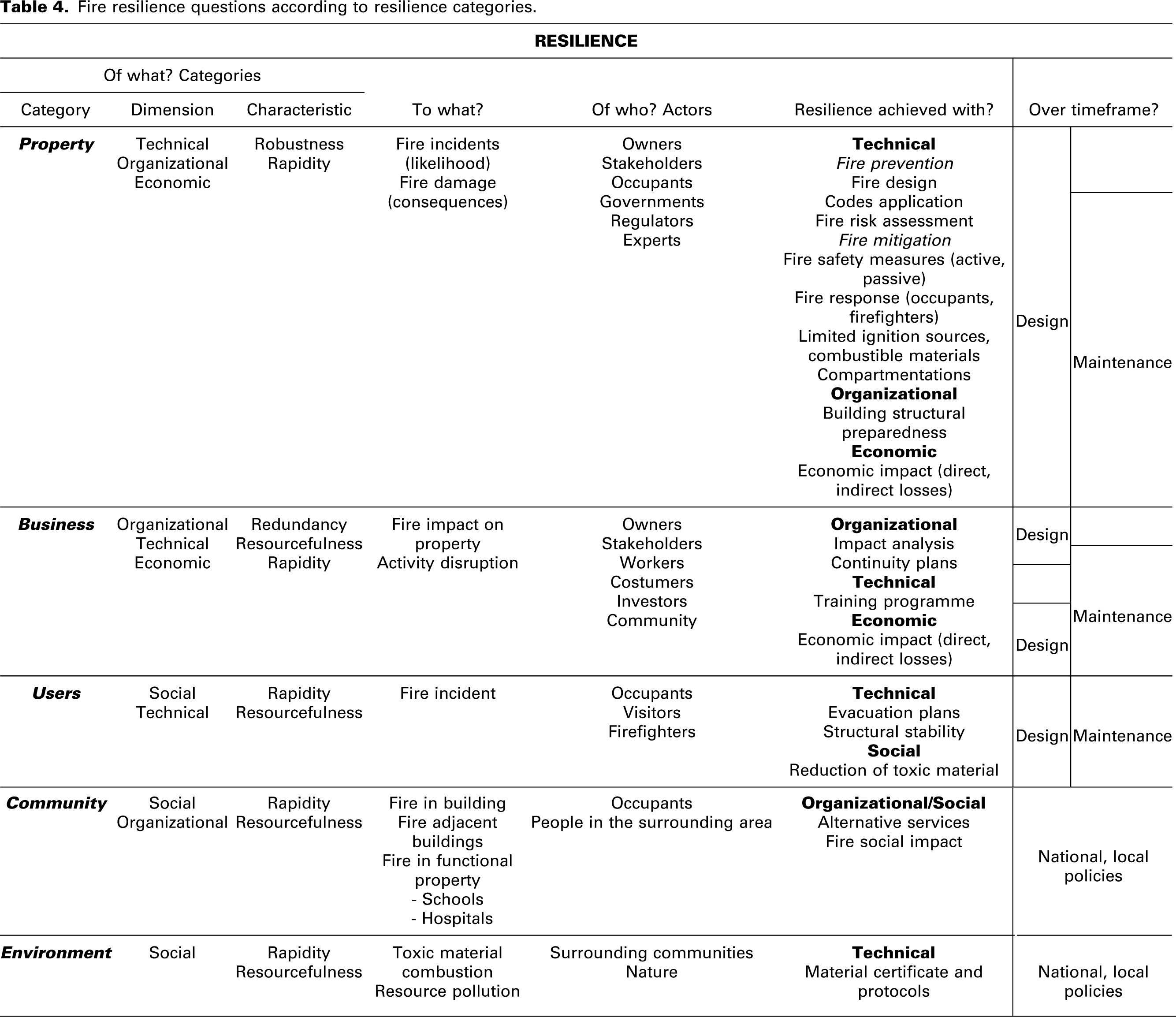
The category of property implies considerations related to the technical, organizational and economic dimensions where robustness and rapidity are required. The property needs to be prepared for fire incidents and damage, understanding their likelihood and potential consequences. In a fire, there are directly and indirectly affected actors as specified by Thomas et al. 37 where the direct losses involve deaths, injuries, health and psychological impacts while the indirect losses affect the economic and supply chain and accelerated economic decline of a community. Furthermore, the means of achieving resilience can be classified according to the resilience dimensions where technical aspects involve fire prevention, with fire design, code application and fire risk assessment, and fire mitigation including fire safety measures, fire response, limitation of ignition sources and combustible materials and effective compartmentation. The preparedness of building and the evaluation of the economic impact are fundamental to guarantee organizational and economic resilience. These aspects need to be continuously evaluated in the design, construction and maintenance phases.
Business comprehends organizational, technical and economic dimensions where the system should present redundancy of resources and rapidity of response. The impact on property and disruption of activity needs to be investigated pre- and post-fire. The negative consequences could highly affect the business continuity involving owners, stakeholders, workers, customers, investors, reputation and the community who benefit from the business activities. It is, therefore, important to establish impact and continuity plans in the design and maintenance phases, respectively. Managers and staff need to continuously attend training programmes to guarantee preparedness and effective response and review fire safety measures able to limit consequences of fire incidents and enhance continuity of business.
The category of users implies social and technical dimensions related to the fire incidents involving the potential harms to occupants and visitors, and fire-fighters during the rescue and fire-extinguishment operations. In this case, resilience is achieved with appropriate evacuations plans and ensuring the structural stability of the building during design, maintenance and clean-up after fires.
A fire incident could have implications also on the surrounding community, especially if a functional property is involved. The rapidity of response and resourcefulness are required and the impacts on the social and organizational dimensions could be reduced by arranging alternative services and applying prevention and mitigation measures. National and local policies should include these evaluations.
For the impact on the environment, the combustion of the material as well as the water damage and contamination during firefighting should be considered. The resilience of an ecosystem needs to be identified according to potential modification of natural resources, air, vegetation and animals. Therefore, it is important to establish appropriate protocols for materials, to guarantee sustainable engineering approaches supported by national and international policies.
Fire resilience measures
Fire resilience measures.
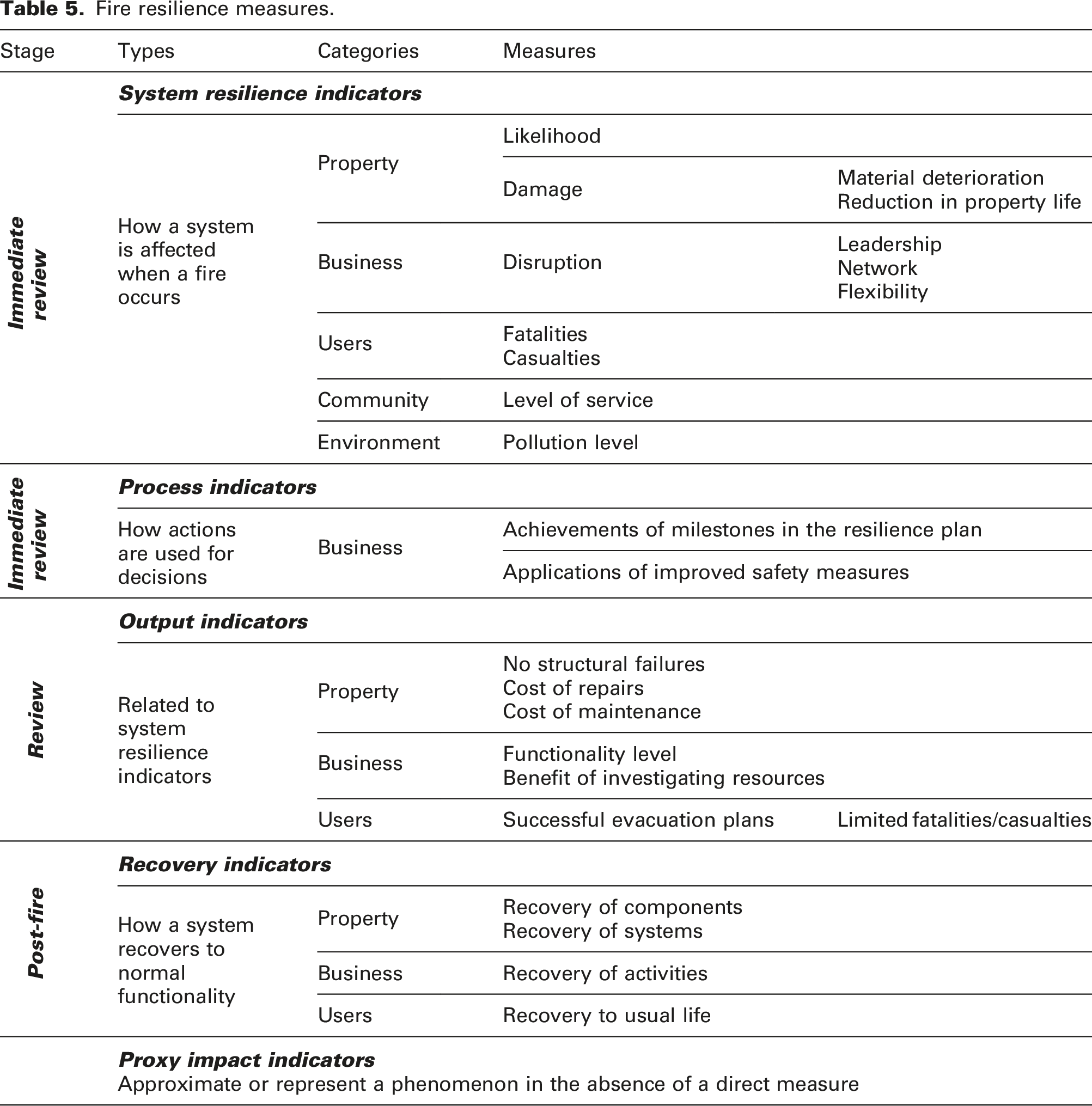
System resilience indicators describe how the system is affected when a fire occurs over time. For property, likelihood and damage considering for the latter, an analysis of material deterioration and reduction in property life. An indicator for business is the disruption time or maximum tolerable period of inactivity and this is highly dependent on leadership, level of flexibility and the ability to be supported by a good network of people and companies.
Process indicators describe how actions are used for decisions and a set of measures need to be defined in the resilience time frame or as milestones in fire resilience assessments to understand if the outcomes are generating the expected performances.
The output indicators are strictly related to the system resilience indicators and measure the results of activities or programmes in a system or building. Good output indicators are represented by the lack of structural failure and the limited or null cost of repairs and maintenance after fire incidents for property and by high functionality level after negative events and high achievements of benefits based on resource investments for business. A reduction of fatalities and casualties proves successful evacuation strategies in combination with appropriate alarm systems.
Recovery indicators determine how rapidly a system recover to normal functionality. Tolerable times of recovery should be established to guarantee continuity. Recovery time of system or component could be adopted for property and downtime period for activities. Finally, a proxy impact indicator approximates or represents a phenomenon in the absence of a direct measure, and this is very complex and highly dependent on the objectives of the plan.
If a strategy has a negative impact on other areas, this is represented as a negative resilience indicator. Negative indicators combined with positive ones become complex when the analysis is qualitative rather than quantitative. Over-protection for properties or over-allocation of resources for business could lead to severe economic impact without applying effective measures as well as lack of strategy optimization. However, negative indicators could be captured as the negative of one of the system resilience indicators. For example, over-protection could be referred to the absence of a positive indicator (economic or resource optimization) as opposed to the presence of a negative one. Therefore, it would be suggested to consider only system resilience indicators, process indicators, output indicators, recovery indicators and proxy impact indicators.
Fire resilience approach
Fire resilience approach.
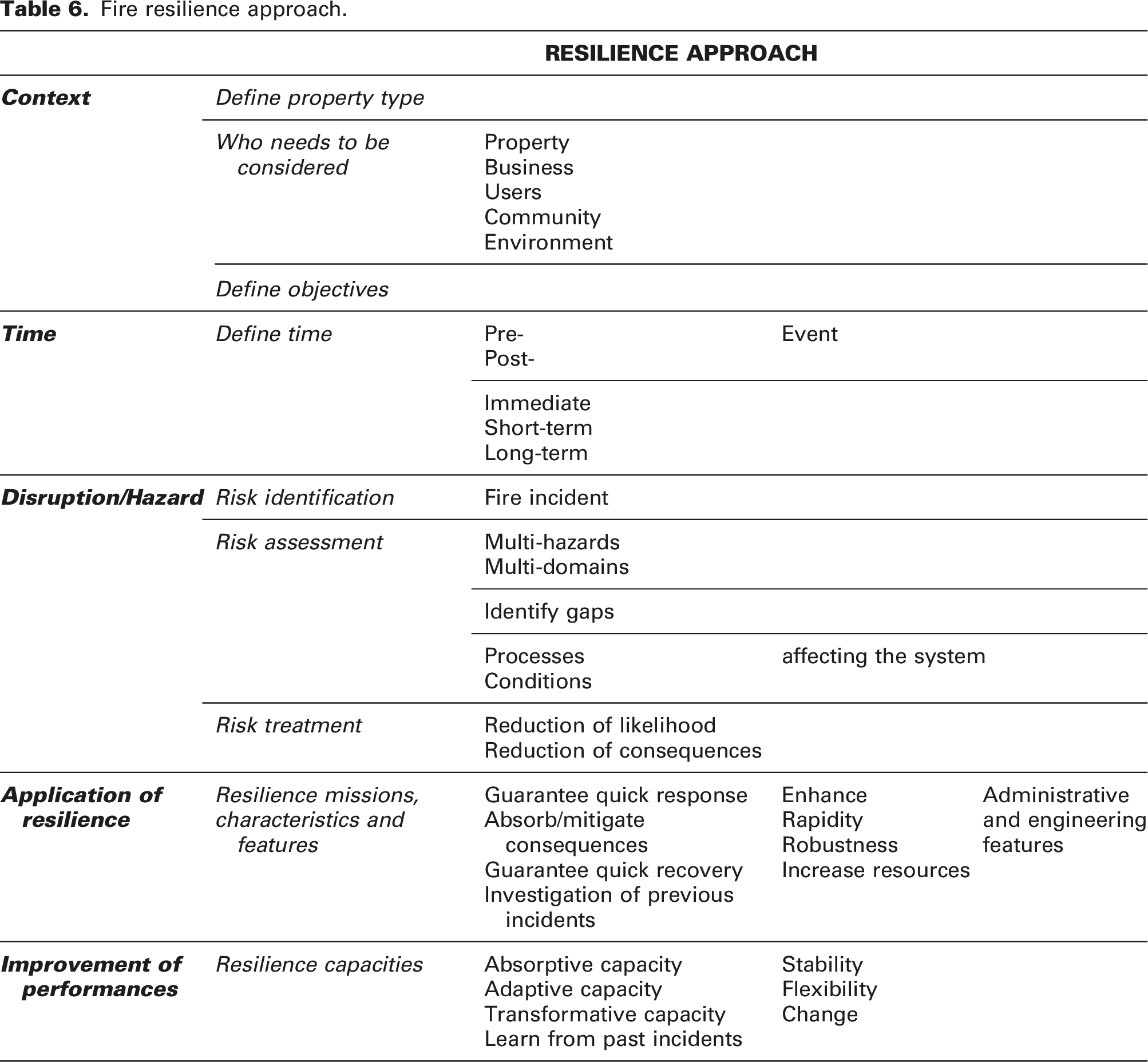
Fire risk assessments consider multi-hazards and multi-domains, identifying gaps and processes and conditions affecting the system to highlight interdependencies between several parts and ensure continuity. Risk treatment includes the components of risk such as reduction of likelihood and consequences. It is important to specify that resilience management and risk management are complementary techniques highlighting the broader perspective that resilience brings.
The resilience life-cycle stages should be applied to guarantee a quick response, effective mitigation strategies, prompt recovery after fires, based on administrative and engineering features as specified in ‘Resilience in the UK Standards and Codes’ section, and learning from the incident. Resistance, robustness, rapidity and resourcefulness are necessary characteristics to ensure the success of the fire resilience approach.
Finally, the analysis needs to improve the performances of the systems with a continual review of the process to ensure flexibility and applying changes to enhance absorptive capacity to limit damage, adaptive capacity to deal with unforeseen events, transformative capacity to learn from negative incidents and strengthen the system.
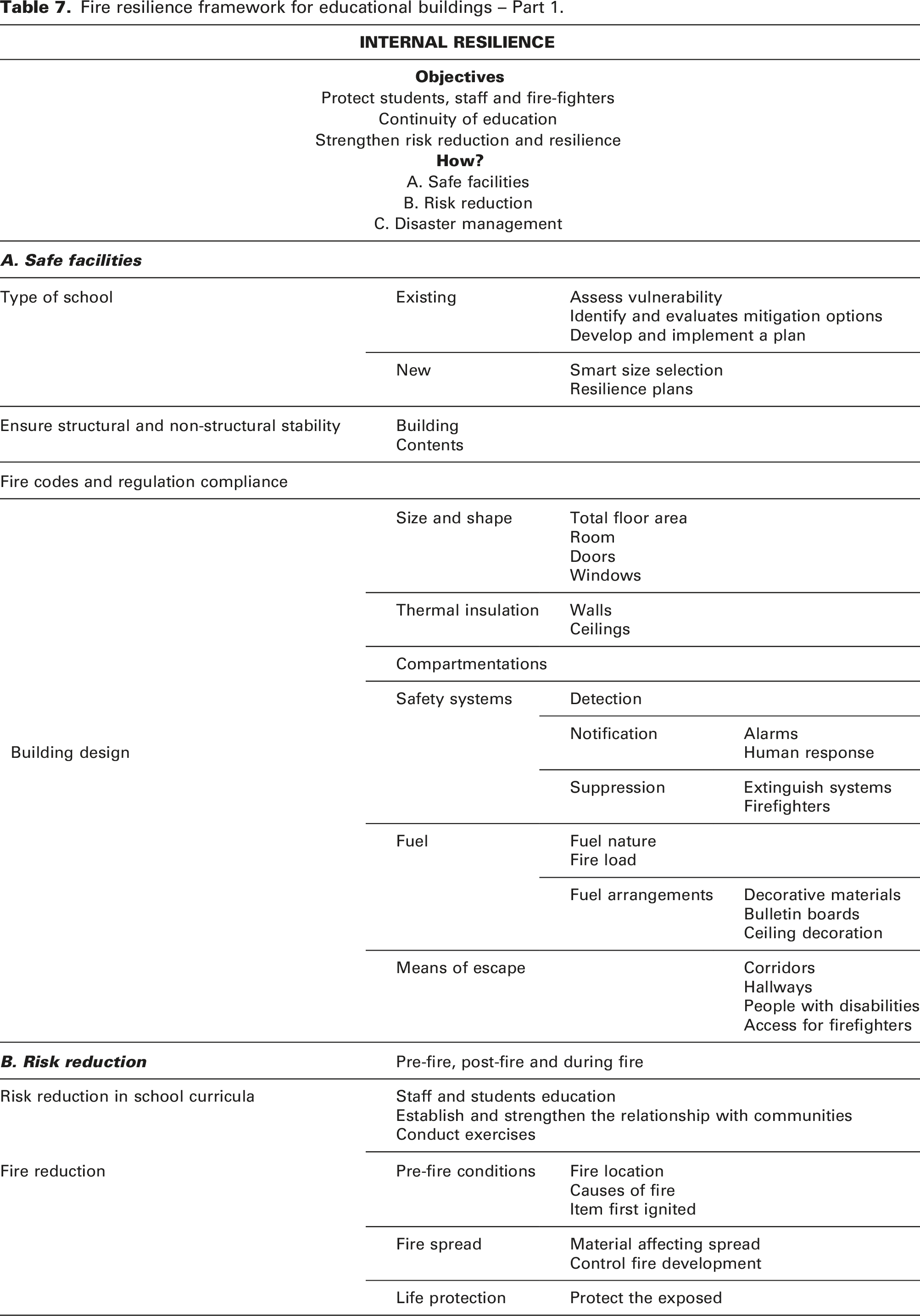
Fire resilience framework in educational buildings
Fire resilience framework for educational buildings – Part 1.
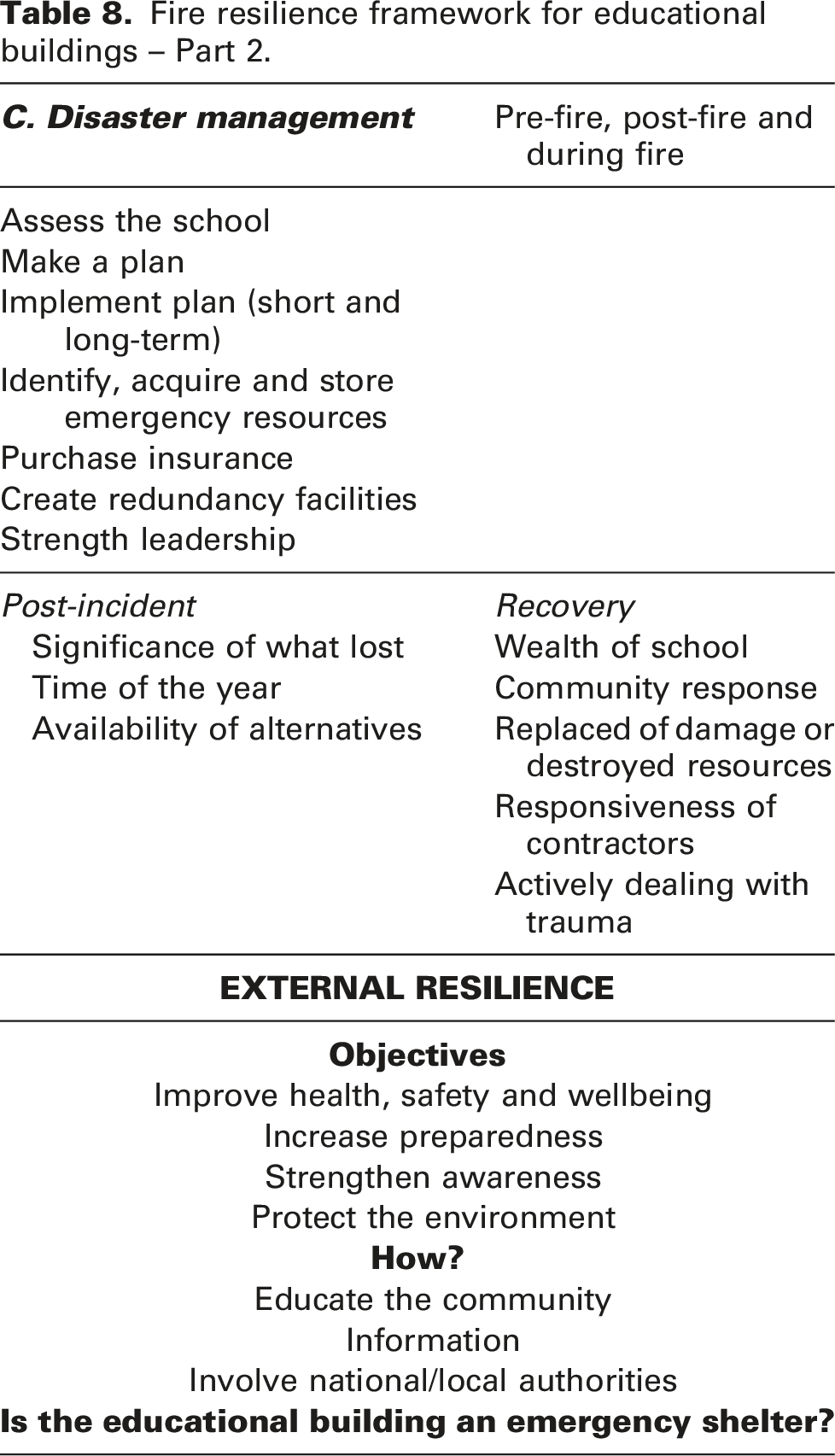
Fire resilience framework for educational buildings – Part 2.
Evaluating internal resilience, the United Nations Office for Disaster Risk Reduction
38
states that the objectives for comprehensive school safety are to protect students and staff during the fire incidents and firefighters in the rescue operations, guarantee continuity of education and strengthen risk reduction and resilience. It also defines three main phases of achieving these objectives represented by: A. Safe facilities, B. Risk reduction and C. Disaster management.
For a safe facility (Table 7), it is fundamental to define the type of school and building characteristics. In existing buildings, there is a need to assess vulnerability, identify and evaluate mitigation options and develop and implement plans while for a new school, a smart size selection and an optimized fire resilience plan need to be established. 39 Structural and non-structural stability is ensured 38 evaluating building and contents. 40 As for any other property type, educational buildings have to be compliant with fire codes and regulations. 41 The building design is subdivided into the evaluation of size and shape of the building, thermal insulation, 42 effective compartmentation and optimized fire safety systems including detection, notification and suppression. 43 The evaluation of fuel load is analyzed according to fuel nature, load and arrangements 42 and a contribution to the fire spread could be due to the presence of decorative materials on walls. 41 Means of escapes should consider the high number of people in the building. 41
Benefits have been seen in the integration of risk reduction in school curricula 44 involving the education of staff and students, 41 establishing strong relationships with the community and frequent training. 40 Analysis of pre-fire conditions, 41 and fire spread with appropriate control measures for fire development and life safety, 42 need to be determined. The disaster management is usually continuously implemented according to three actions of assessing the educational building, creating a fire strategy and implementing the fire resilience plan. 45
As shown in Table 8, for a successful disaster management plan, it is important to strengthen leadership, identify, acquire and store emergency resources and potentially purchase insurance. 40 A network of redundancy facilities could reduce disruption time and guarantee continuity of education. After an incident, fundamental is learning from past experiences and evaluate the significance of losses and the availability of alternatives. 46 Recovery is dependent on how wealthy is the school, the community response, the rapidity in replacing damaged and destroyed resources and how actively the school deals with the trauma. 46
The objectives of external resilience (Table 8) involve the improvement of health safety and wellbeing of people attending the school, protection of the environment from the combustion of toxic material, 47 an increase of preparedness and awareness. Community education is fundamental 47 and involves the creation of emergency plans at a national and local level. If the educational building assumes the role of an emergency shelter, a high level of functionality after a fire needs to be ensured.
Fire design for resilience
It is now important to define an approach able to integrate fire safety engineering in the design of structural systems. This goal supports the capacity to understand building performances subjected to fire rather than applying prescriptive codes. 48
Johann et al.
48
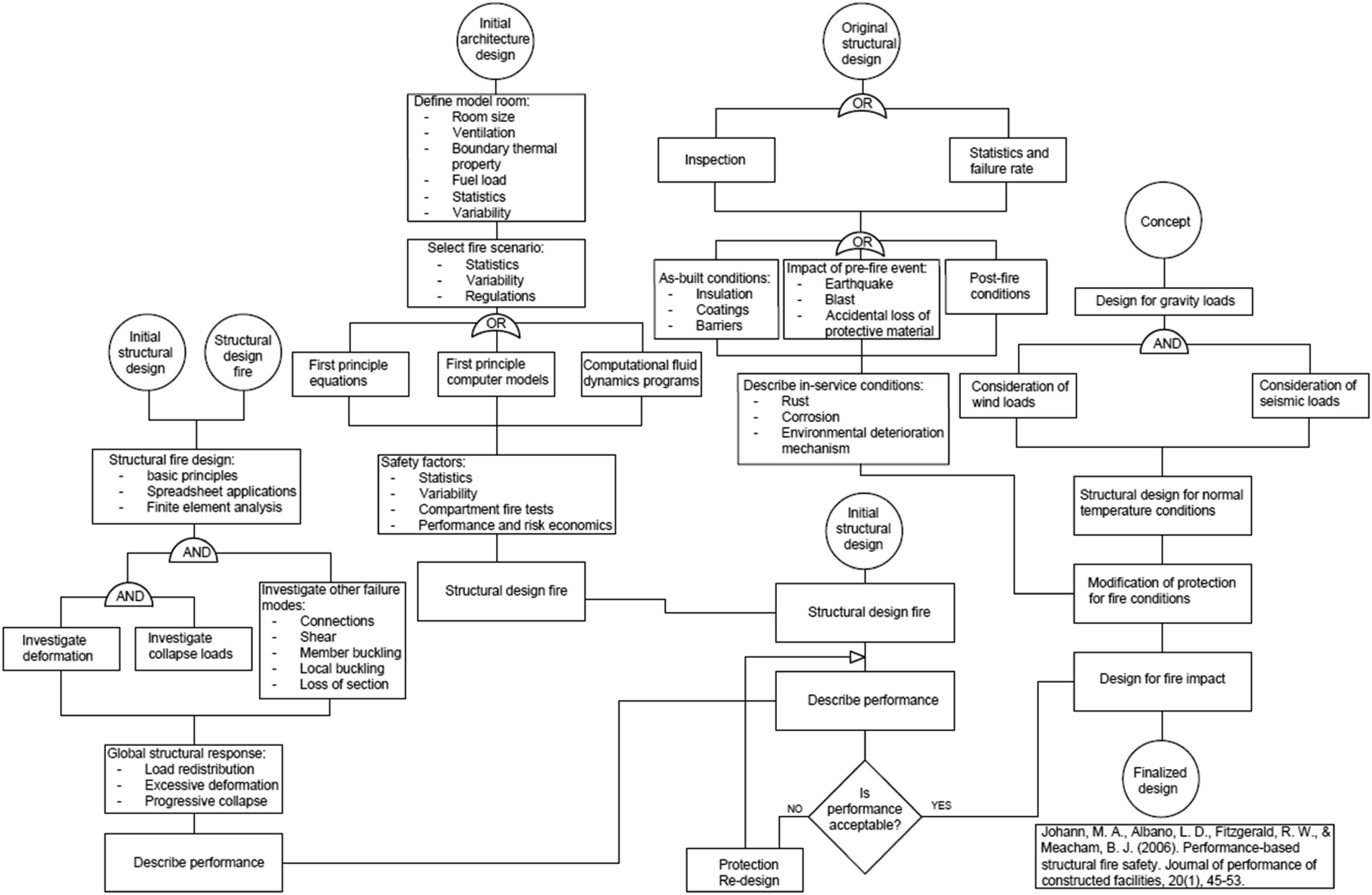
describe a flowchart subdivided in three main areas of interest that converged in the final design and have to be analyzed separately and in their combination: A. The design for gravity loads considering wind and seismic loads for the structural design in normal temperature conditions; B. The modification or protection for fire conditions; and C. The design for fire impact.
The modification or protection for fire conditions implies in-service building evaluations with the description of in-situ characteristics considering the original structural design based on inspection, statistics and failure rate according to built, pre and post-fire conditions. The design for fire impact is composed of structural design fire, description of performances and decision on acceptable performances. In Johann et al.’s flow-chart,
48
evaluations on sprinkler suppression are not included (Figure 4). Performance-based structural fire safety chart.
48
This paper considers the framework created by Johann et al.
48
rearranges and improves the information in a unique flowchart with new parts added to describe the steps to follow. The new framework created provides an engineering tool able to include fire safety approaches in structural design and is subdivided into: A. Inputs variables, B. Requirements and objectives, C. Structural design and D. Fire design.
In Figure 5, the description of the inputs is necessary for the structural and fire design and it involves the definition of the materials adopted and their characteristics in function of the temperature. Structural element dimensions, connections, coatings and barriers need to be established as well as gravity, wind and seismic loads. Moreover, the room needs to be modelled in terms of room size, ventilation, boundary thermal properties, fuel load, insulations and considering statistics and potential variability. Improved flow chart for fire design based on Johann et al.
48
– Part 1.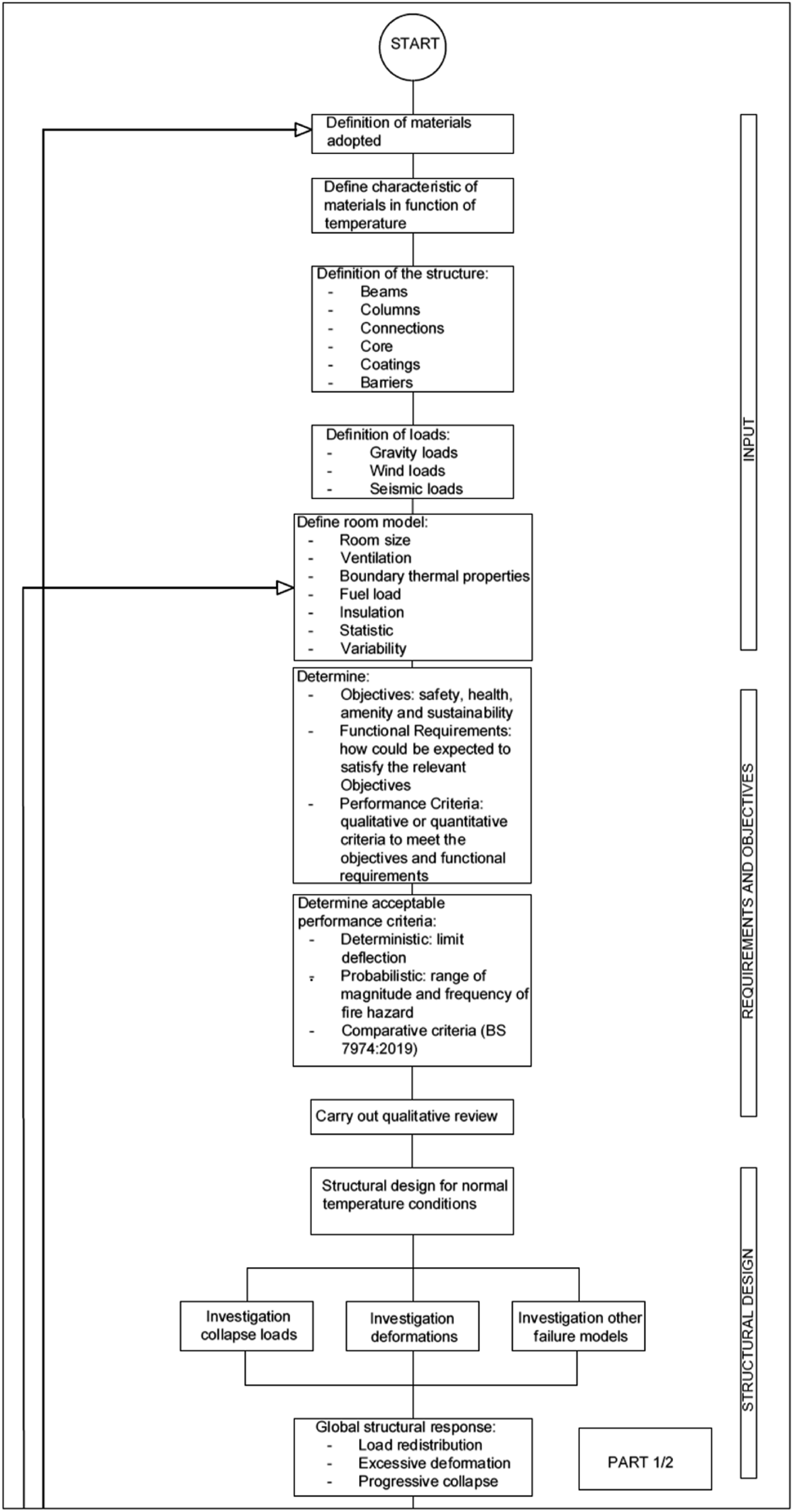
The requirements and objectives are based on acceptable criteria considering deterministic (e.g. deflection limit) and probabilistic (e.g. range of magnitude and frequency for fire hazards) criteria or applying a comparative approach based on performance-based approaches.
Designers could consider structural design for normal temperatures investigating collapse loads, deformations and failure modes. Completed the structural design, the diamond shape on top of the flow chart in Figure 6 requires if the conditions for stability are satisfied. With a negative answer, it is necessary to return to the definition of inputs while with a positive one, the fire design begins. Improved flow chart for fire design based on Johann et al.
48
– Part 2.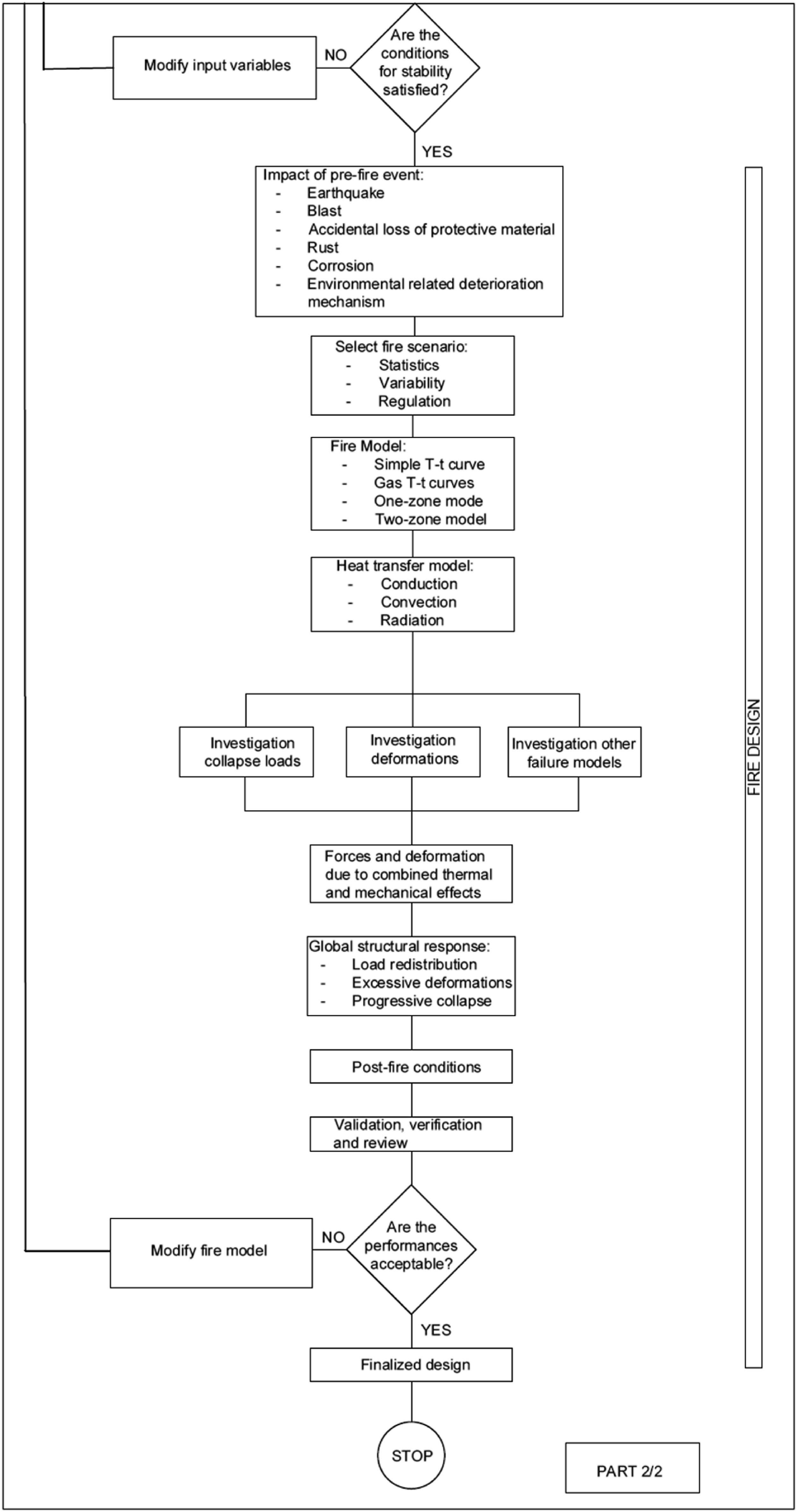
In fire design (Figure 6), pre-fire events could impact the structure as earthquakes, blast, accidental loss of protective materials, rust, corrosion or environmental related deterioration mechanisms. A fire scenario needs to be chosen based on statistics, variability and regulations. Several fire models could be adopted such as simple T-t curve, Gas T-t curves, One or two-zone models. Consequently, the evaluation of heat transfer models developed for conduction, convection and radiation and investigation of collapse loads, deformation and other failure models need to be examined. Considerations on forces and deformations due to combined thermal and mechanic effects need to be analyzed to provide a global structural response considering load redistribution, excessive deformation and progressive collapse. The fire design is also composed of post-fire conditions evaluation, validation, verification and review.
In the diamond shape at the bottom of Figure 6, if the performances are not acceptable, the fire design needs to be modified. Otherwise, the design is finalized. This fire design methodology presented could be applied to every property type equipped with different safety measures.
Discussion and conclusion
The concept of resilience includes specific characteristics, capacities, objectives and missions. Based on the assessment provided by various disciplines, resilience could be applied and measured in fire safety. Resilience in fire safety needs to be addressed considering the fire resilience questions related to actors, objectives, dimensions, characteristics and missions. Various resilience measures could determine the progress of the resilience approach such as system, process, output and recovery indicators defined in specific time over the process applied.
UK Standards and Codes guidelines have been investigated considering administrative and engineering features and the resilience missions. They appear to mainly cover the objectives of life safety and partially property protection. Specifications about business management and continuity are available; however, when the guidelines are plotted in the resilience function they are usually concentrated in the response and absorption phases and become scarce moving towards the adaptation and learning ones.
An educational building has been considered for the application of a fire resilience approach evaluating internal and external resilience. Considering the study developed by Johann et al., 48 a fire resilience design has been created based on the definition of inputs, requirements and objectives, structural design and fire design following a continuous flow of assumptions and validation based on deterministic and probabilistic variables and acceptable performances.
Footnotes
Acknowledgements
The authors would like to thank the Royal Society of Edinburgh for awarding Martina Manes with the Lessells Travel Scholarship and enabling the development of this research.
Author Contributions
MM: Conceptualization, Writing—original draft. DL: Conceptualization, Writing—review and editing. DR: Conceptualization, Writing—review and editing.
Declaration of Conflicting Interests
The authors declared no potential conflicts of interest with respect to the research, authorship, and/or publication of this article.
Funding
The authors disclosed receipt of the following financial support for the research, authorship, and/or publication of this article: This work was supported by the Royal Society of Edinburgh who awarded Martina Manes with the John Moyes Lessells Travel Scholarship.
