




Abstract
Background and aim:
In climates with wintry conditions, slip and fall injuries of pedestrians during wintertime can result in high healthcare and societal costs. The aim of this study was to evaluate the effectiveness of early warnings about slipperiness in preventing such injuries in Finland. Since 2004, the Finnish Meteorological Institute (FMI) has been providing a weather service for pedestrians, which has been developed continuously over time.
Data and methods:
Time series of pedestrian slip and fall injuries in commuting on foot in the 19 regions of Finland in 2005–2022 was obtained from the Finnish Workers’ Compensation Center and analysed for trends. We also analysed daily warnings about slippery sidewalks from the FMI archives for the period 2011–2022. To identify steps in the service chain that require improvement, we conducted a weather service chain analysis (WSCA) based on a slip and fall accident storyline.
Results:
There was no significant trend in the number of slipping injuries during the study period. The exposure of the Finnish population to slippery conditions varies according to the climate of the region and characteristics of the winters. We found that the responses of the users of the warning information may be inadequate.
Conclusions:
Introduction
Pedestrian slip and fall accidents during winter remain an underrated weather-related health hazard. In Finland, approximately 75,000 individuals suffer from slipping injuries during the winter season [1]. Sweden, Norway, and other parts of the world with wintry climate conditions face the same problem [2–8].
The injuries due to slip and fall events are typically bone fractures of the wrists and ankles, concussions, and other head injuries [9–12]. A study on the seasonality of distal radius fractures in Oulu showed that the number of fractures was 2.5 times higher on slippery winter days than on non-winter days [13]. Slip injuries are considered an issue of equality, as women slip more often than men [1]. Vulnerability also increases with age. Based on previous research, slip and fall injuries are most common among young adults, but women of the age group 50–64 years, who are still active in the workforce, are at the highest risk of injury [14,15].
Slipperiness is typically a consequence of precipitation or temperature variation around zero degrees [6]. On very slippery icy surfaces no footwear provides sufficient grip and, therefore, in such conditions anti-slip devices are needed [16]. In addition to weather, environmental and human factors affect the slip risk [17]. Sidewalk slipperiness is prevented by snow ploughing and gritting, whereas salt is not typically used on sidewalks in Finland. Winters are becoming milder because of ongoing climate change, and consequently very slippery sidewalk conditions are projected to become more frequent in mid-winter [18].
The Finnish Meteorological Institute (FMI) has developed a specific weather service for pedestrians and started to issue warnings on very slippery sidewalk conditions operationally already in 2004. The output of the RoadSurf-Pedestrians model is used as a tool in forecasting sidewalk conditions [14]. The modelled slipperiness has three categories: no slipperiness, slippery, or very slippery. Warnings are issued in the case of very slippery conditions, which are divided as follows: freezing of wet and slushy situation, hard-packed snow, and snow or water above the ice layer. The effectiveness of this service in prevention of pedestrian slip and fall accidents is difficult to define, as statistics on slipping injuries and their causes are not reliable enough for assessing long-term trends in slipping injuries. It has been identified that improving the value of weather warnings also requires more research on impacts, avoided losses, communication, citizen science, case studies, and accuracy of the forecasts [19].
An overview of the cost/benefit ratio of national meteorological services in several countries showed that the ratio ranges from 1:3 to 1:10, based on avoided costs or willingness to pay [20]. Slip and fall accidents lead to costs of about 1.42 billion euros annually, consisting of direct costs for healthcare, costs due to sickness absences and reduced wellbeing [1]. Preventing even one slip and fall injury each winter with the help of this warning service winter is cost-effective and can save individuals from suffering and a lowered quality of life. Leviäkangas and Hautala [21] estimated that in Finland the weather service for pedestrians could bring benefits of 100–300 million euros per year as avoided costs by reducing the number of slip and fall accidents.
The aim of this study was to assess the effectiveness of the early warning service in preventing pedestrian slip and fall injuries, and to identify potential segments in the service chain for improvement using both quantitative and qualitative research methods.
Data and methods
The health impact data used in this study were a time series of the daily number of pedestrian slip and fall injuries compensated by the Finnish Workers’ Compensation Center (TVK) in the 19 regions of Finland during the period 2005–2022. A total of 198,971 injuries occurred during the study period. The data included only injuries that occurred while commuting on foot and were classified as occupational health hazards. The information on causes of the injuries - slip and fall accidents because of slippery sidewalks - is temporally and spatially accurate, which is not the case in health care registers, where the background information of the incidents (such as location, time, indoor/outdoor) may be missing. However, the data include injuries only of individuals active in work life. Therefore, at weekends, the daily number of accidents may not reflect the sidewalk conditions well. TVK also provided the annual costs for compensations resulting from wintertime slip and fall injuries for the whole country for the period 2005–2022, altogether nearly 587 million euros.
Information about the employed labour force in the regions and the consumer price index (2005 = 100) was obtained from Statistics Finland [22, 23]. Incidences of slip and fall injuries for each region were calculated as the number of injuries per number of employed. Linear trends were fitted to the time series of the annual incidences of injuries. The time series of compensation costs were corrected by the consumer price index and the linear trends were fitted to both absolute and index corrected time series of costs. During the years of the COVID-19 pandemic (2020–2022) the share of remote work increased, which affected mobility and thus the numbers of accidents while commuting on foot as well. Therefore, the trend analysis was also conducted to the time series for the period 2005–2019 from which the years of the pandemic were excluded.
Daily warnings about slippery sidewalks were collected from the FMI archives for the period 2011–2022. The FMI started to issue warnings about slipperiness for pedestrians in 2004, but this warning type was given the same status as other weather warnings only gradually, and from 2011 it can be considered to have an established role among other weather warnings. The FMI issues the warnings regionally for 19 regions. The estimated cost of providing the pedestrian weather service is, on average, less than 10,000 euros per winter, based on the time allocated to this service in the FMI operational weather service.
We used the number of issued warnings per winter in each region to describe spatial and interannual variation in exposure of population to very slippery sidewalk conditions. The FMI climate service information was used to explain these variations.
For the qualitative study, we analysed the FMI warning service using a weather service chain analysis (WSCA) [24–26]. The WSCA is a stepwise approach to assess benefits of the service for end users and society by means of decomposition of the information flow from forecast generation via service delivery and user responses to benefit realisation. None of the steps are typically perfect. Figure 1 shows schematically the decay of information during the service chain.
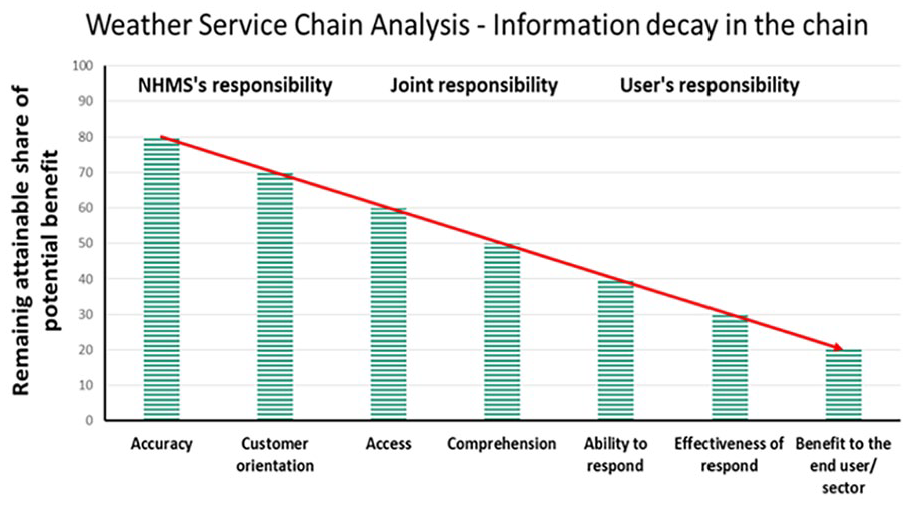
Schematic illustration of the WSCA based on [24]. The weather service (NHMS) is responsible for the first steps of the chain and users for the last steps, i.e. responses. NHMS, National Meteorological and Hydrological Services; WSCA, weather service chain analysis.
The WSCA can be used in identifying segments of the service chain that need improvement and would have the highest social-economic pay-off. The service provider is responsible for the accuracy and user orientation of the service, while the users of the service are responsible for the effectiveness of their responses. The WSCA can be conducted quantitatively or qualitatively. Here, we discuss the pedestrian weather service chain mainly qualitatively.
Physical climate storylines are increasingly used as a tool to produce and communicate decision-relevant climate risk information [27-29]. ‘Micro-stories’ use observations and witness testimonials, and they stimulate empathy, contribute to awareness rising and appreciation of multiple dimensions of climate risks [28]. For the qualitative study, we utilized a case study on a slip and fall injury and constructed a microstory to identify the segments of the warning service chain that need improvement.
Results
Pedestrian slip and fall injuries while commuting on foot
Figure 2a shows the annual number of injuries during commuting to or from work on foot in Finland in the period 2005–2022. On average, there were 11,054 injuries per year ranging from 7433 (in 2020) to 12,690 (in 2019). The majority of the accidents occurred in the winter months. Year to year variation can be attributed mainly to weather conditions, as studied by Hippi and Kangas [6]. There was no trend in the number of injuries during this study period. However, the COVID-19 pandemic led to a substantial increase in remote work and, thus, a reduction in commuting. This was reflected in the number of injuries, particularly in 2020 and 2021, but to some extent in 2022 as well.
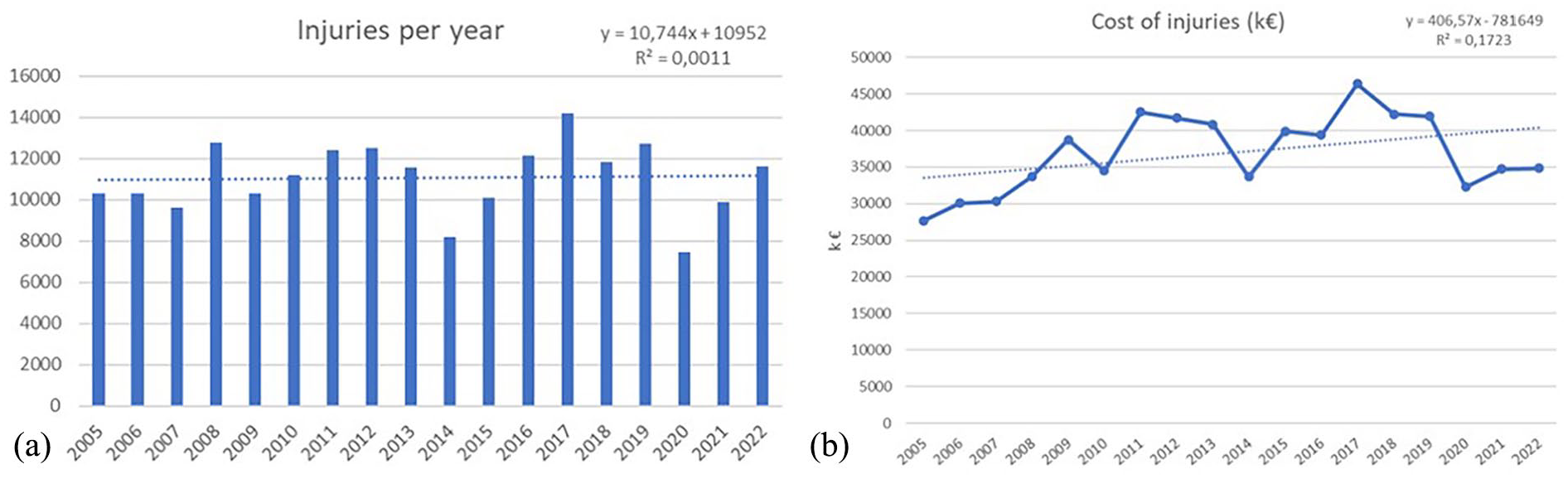
(a) Annual number of the injuries in commuting on foot and (b) cost of the injuries (index corrected) in Finland in 2005–2022 based on the compensations by the TVK. Dotted lines indicate linear trends fitted for the data. Data for the year 2022 are preliminary. TVK, Finnish Workers’ Compensation Center.
The TVK compensation costs resulting from wintertime slip and fall injuries while commuting on foot were nearly 587 million euros in 2005–2022. The annual cost of these injuries increased during the study period. The increase was partly due to inflation; however, the increasing trend in the costs remained even after index correction. Figure 2b shows the index corrected cost of injuries based on the consumer price index (2005 = 100). These costs rose from about 30 million euros per year to over 40 million euros per year during the study period. The linear trend was about +0.4 million euros per year. The amount of remote work during the pandemic was reflected as lower cost of injuries in 2020–2022. After excluding these years from the time series, the linear trend was higher, at about +1.0 million euros per year. The TVK compensation cost per injury was on average 4000 euros per injury, including costs related to healthcare and sick leaves.
The incidence of slip and fall injuries while commuting on foot per employed person varied by region in Finland (Figure 3). The highest incidence was in Uusimaa (623/100,000 employees) in southern Finland and the lowest in Ostrobothnia in western Finland (273/100,000 employees). Åland was excluded due to the low number of cases.
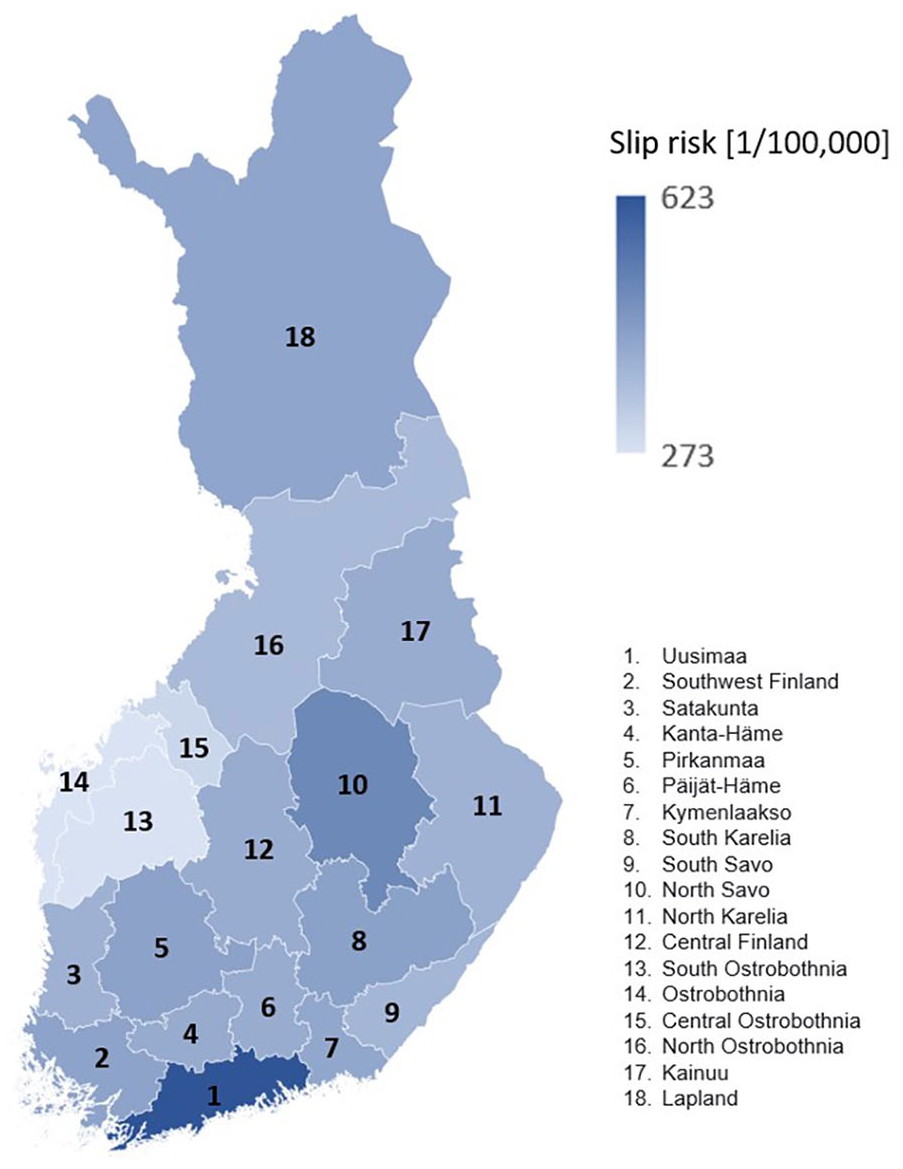
Yearly average number of commuting accidents (slipping injuries) per 100,000 employed in regions (Åland excluded), based on the data from the TVK covering winters from 2011–2012 to 2019–2020. Map colours represent incidences of the slipping injuries, and numbers represent Finnish regions. The map was generated using Microsoft Excel and Bing. TVK, Finnish Workers’ Compensation Center.
Warnings about slipperiness for pedestrians
Exposure of the population to hazardous sidewalk conditions varies by region and from year to year. Figure 4 shows the number of days per winter when warnings were issued for pedestrians in each region from winter 2011–2012 to winter 2022–2023, thus covering 12 winter seasons. The variation in the number of warning days can be explained by climatic differences within the country and varying weather conditions between the winters. Thermal winter determines the duration of the period when the risk of slip and fall injury is increased. The most slippery conditions in winter typically occur when the temperature fluctuates around 0 °C.
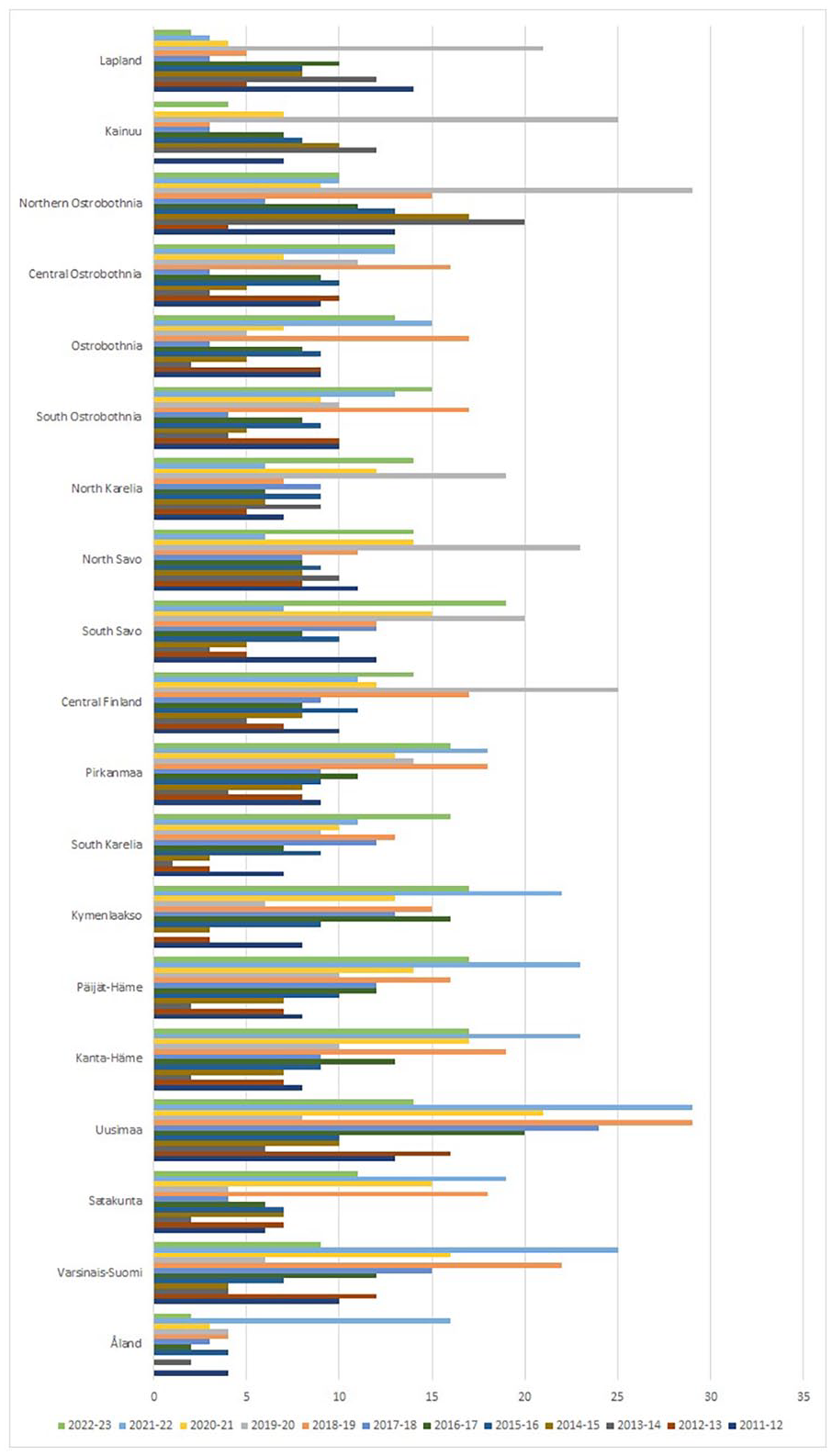
Number of the pedestrian warning days by 19 regions from winter 2011–2012 to winter 2022–2023. The regions are presented in the order from north to south (the regions are shown on the map in Figure 3).
In climatic normal winters, the population in the southern part of the country is more exposed to slippery conditions than the population in the north. In mild winters, the situation can be reversed, because in southern and western Finland temperature remains above freezing more than in a typical winter, and precipitation falls more often as rain. Consequently, fewer pedestrian warnings need to be issued. On the contrary, in eastern and northern Finland temperatures vary around 0 °C in mild winters more than in a typical winter, and more warnings need to be issued. Figure 5 presents three examples of how winter characteristics affect the number of warnings issued in different parts of the country.
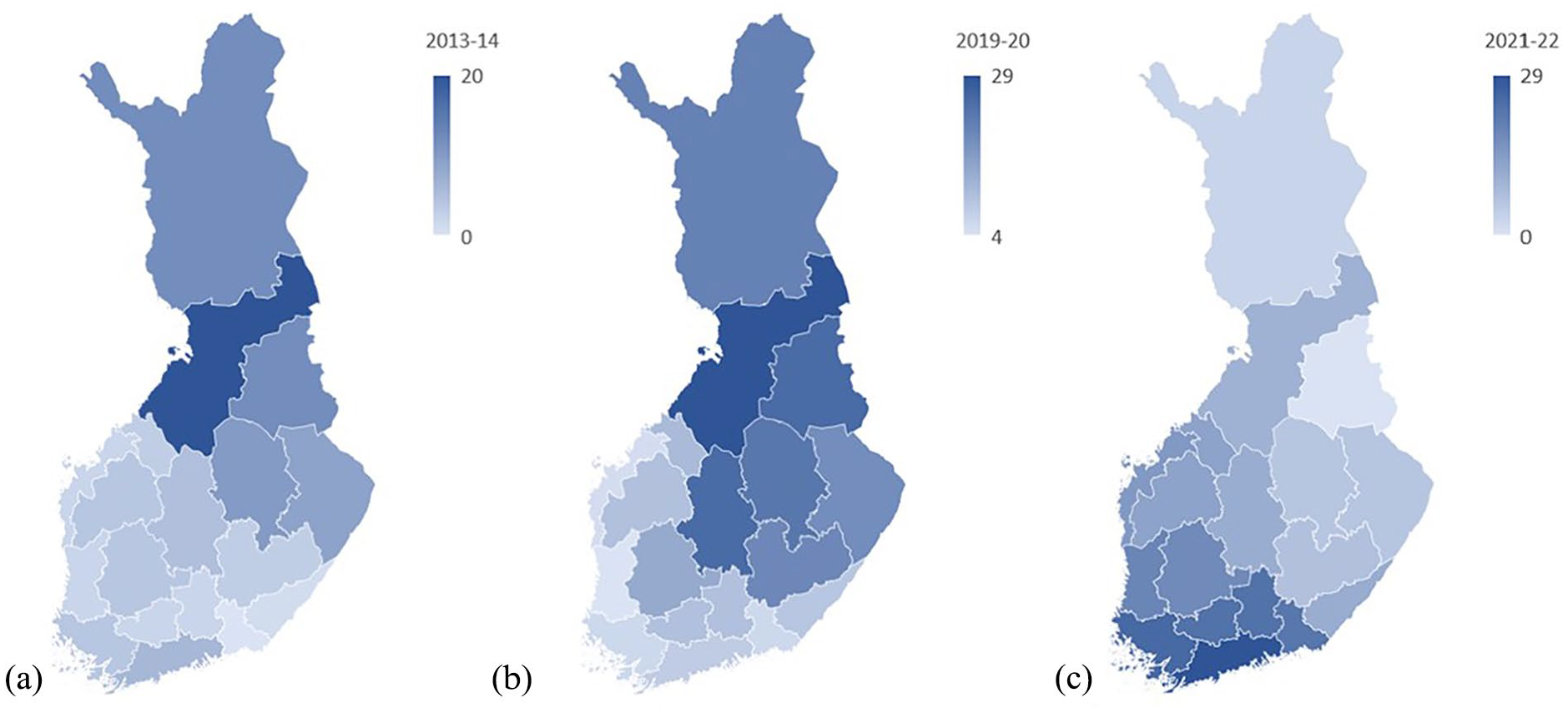
Number of warning days for pedestrians in (a) winter 2013–2014, with the lowest number of warning days, (b) winter 2019–2020, representing a mild winter and (c) winter 2021–2022, representing a climatic normal winter. Maps were generated using Microsoft Excel and Bing.
The winter 2021–2022 represents a typical winter in the current climate. The average temperature during the winter months (December–February) was normal compared with the climatic period 1991–2020. However, the precipitation was higher than average in the southern and eastern parts of the country. Warnings about slipperiness were issued more frequently in the southern and western regions than in eastern and northern regions (Figure 5c) reflecting the number of days when the temperature varied around 0 °C.
The winter 2019–2020 was exceptionally mild. The thermal winter on the southern and western coasts lasted only a few days. By the end of February, there was unusually little snow in the southern and western regions but plenty elsewhere. Consequently, more warnings about slippery conditions were issued in the north than in the south and west (Figure 5b).
In the winter 2013–2014 (Figure 5a) the number of issued warnings was the lowest with only about 100 warning days for all regions, compared with an average of almost 200. The thermal winter was shorter than usual in the southern and western regions. There was only a little snow, except in the north.
During the study period, there were no winters colder than the average winters in the climatic normal period of 1981–2010. On the contrary, in recent years mild winters have occurred frequently, indicating a warming trend.
Pedestrian WSCA based on the case study
For almost two decades, the FMI has been issuing warnings for pedestrians about slippery sidewalk conditions. However, no decreasing trend was found in the time series of slip and fall injuries (Figure 2). This raises the question of how the effectiveness of the warning service could be improved. To identify potential segments of the service chain for further development, we demonstrate the pedestrian weather service chain with the following case study.
On 12 January 2023, very slippery sidewalk conditions prevailed in wide areas of Finland, including Helsinki in Uusimaa. The RoadSurf-Pedestrian model predicted ‘water on ice’ type of very slippery conditions, and the FMI operational weather service issued warnings for pedestrians. Preliminary statistics of TVK indicate that there were 174 slip and fall injuries in Finland on that day, of which 54 occurred in the Uusimaa region. The qualitative storyline (Supplemental material) showed that, on that day, the FMI warnings for pedestrians were accurate and, thus, the high number of slip and fall injuries was related to poor responses to the issued warnings. Based on the micro-story, we can conclude that the winter maintenance failed adequately to reduce the slipperiness on the sidewalk. On an individual level, various psychosocial factors, such as a busy lifestyle, and overestimation of one’s ability to cope with hazardous sidewalk conditions, affected the responses. The resulting injury and related long sickness absence led to substantial costs for healthcare and society.
In this case, the weather service part of the weather service chain performed well, and we identified the quality of winter maintenance of sidewalks as an area that requires improvement. Additionally, on an individual level, behavioural changes, such as using slip-guards to prevent injuries, are needed.
Discussion
Wintertime slip and fall accidents pose a significant weather-related health risk in Finland. This study analysed data from compensations for injuries in commuting by foot, which accounts for only about 15 percent of the total number of slip and fall injuries. However, due to the high number of incidents, these data can be considered a representative subset of slip and fall injuries. The risk of injuries is particularly high among women of the age group 50–64 years [15]. The micro-story of the slip and fall accident used in the weather service chain analysis was an example representing this risk group.
The socio-demographic factors and traffic systems in Finnish regions vary greatly, which may impact the regional differences in the risks of slip and fall accidents as well. Factors such as the availability of public transport and the rules for winter maintenance of sidewalks can also affect travel modes of commuting and walking. For instance, there is relatively well functioning public transport in the most densely populated region of Uusimaa where the Helsinki metropolitan area is located. In the sparsely populated regions, the commuting distances may be long, and walking is not an option in practice. This may explain, at least partly, the regional differences in the incidences of the slipping injuries shown in Figure 3.
The assessment on slip and fall accidents from the perspective of equality and equity suggested that the municipalities do not adequately consider the safety of walking, and winter maintenance of sidewalks in their traffic system planning [1]. However, there are indications that the role of walking is increasing in planning [30].
Based on our study, it cannot be concluded that the early warning service would have led to a reduction in slip and fall injuries. On the other hand, it is also impossible to determine how many injuries have been prevented by this warning service.
In our case study, the warnings for pedestrian about the very slippery sidewalk conditions were accurate, which is not always the case, and improvements are needed in the weather prediction part of the service chain as well. However, there is potential to further improve the quality of the service, and to increase awareness of it. The service provided is unique worldwide. In Finland, slip and fall accidents are taken seriously and measures have been taken to prevent them.
The RoadSurf-Pedestrian model is developed continuously to improve the forecasters’ tools for issuing warnings. Predicting the road surface conditions from the pedestrian point of view can be challenging due to the complexity of slipperiness, which is affected by various factors beyond just weather. Furthermore, the lack of real slipperiness observations makes forecasting sidewalk conditions for pedestrians difficult.
Further research is needed on regional differences, as well as the sex and age distribution of wintertime slipping injuries. The types and severity of injuries affect the length and cost of sickness absences. Very slippery conditions may lead to an increased demand for healthcare services, and better understanding of the impact of slip and fall accidents on healthcare workload during such peak days is needed as well.
The cost of the pedestrian warning service is relatively low, at less than 10,000 euros per winter, considering the time allocated by the forecaster on duty. However, the societal impact and the benefits of the service can be significant. The compensation paid by TVK was about 4000 euros per injury. Thus, the service pays for itself if just two slip injuries are avoided.
For over 20 years, the Finnish Meteorological Institute has participated in the ‘Pysy Pystyssä’ (Stay on Your Feet) campaign, which aims to raise awareness of how to prevent slip and fall accidents. There are indications that for instance the use of anti-slip guards has increased over the years. Nowadays, 44% of Finns prepare for slippery conditions by wearing winter shoes with anti-slip guards [1]. The campaign promotes seven theses to enhance pedestrian safety. One of these is to check the weather warning for pedestrians on FMI’s webpages. Continuing such awareness-raising efforts is important to improve the effectiveness of the warning service.
Conclusions
Wintertime slip and fall injuries of pedestrians lead to high healthcare and societal costs. Preventing these accidents requires timely weather services and warnings. However, the effectiveness of these services also depends on the responses to the information, such as the changes in individual behaviour and efficient winter maintenance. Furthermore, it is important to promote the role and safety of walking in the planning of the traffic systems, and in urban planning.
Supplemental Material
sj-docx-1-sjp-10.1177_14034948241253673 – Supplemental material for Pedestrian wintertime slip and fall injuries—effectiveness of weather warning service in prevention
Supplemental material, sj-docx-1-sjp-10.1177_14034948241253673 for Pedestrian wintertime slip and fall injuries—effectiveness of weather warning service in prevention by Reija Ruuhela, Marjo Hippi and Sari Hartonen in Scandinavian Journal of Public Health
Footnotes
Acknowledgements
The authors would like to thank Janne Sysi-Aho from the Finnish Workers’ Compensation Center (TVK) for providing the injury statistics for this study.
Declaration of conflicting interests
The author(s) declared no potential conflicts of interest with respect to the research, authorship, and/or publication of this article.
Funding
The author(s) disclosed receipt of the following financial support for the research, authorship, and/or publication of this article: This work was supported by the Research Council Finland under the decision no 329225 (CHAMPS project) and 342561 (FINSCAPES-project), Belmont Forum, the Research Council Finland no 334798 (HEATCOST project) and the Strategic Research Council no 327803 (Smartland project).

Supplemental material
Supplemental material for this article is available online.
References
Supplementary Material
Please find the following supplemental material available below.
For Open Access articles published under a Creative Commons License, all supplemental material carries the same license as the article it is associated with.
For non-Open Access articles published, all supplemental material carries a non-exclusive license, and permission requests for re-use of supplemental material or any part of supplemental material shall be sent directly to the copyright owner as specified in the copyright notice associated with the article.
