




Abstract
Background:
In Nunavut, where 70% of children are food insecure, many households rely on school breakfast or community food programmes for nourishment. The COVID-19 pandemic and resulting policies to reduce the spread of the disease have the potential to exacerbate existing issues, including increasing food insecurity in households. Funding programmes were implemented to limit the impact of public-health measures on household and community food security. The overall effects of the actions are not yet understood.
Methods:
This project used a qualitative approach to examine the determinants of food security and sovereignty and the impact of the COVID-19 pandemic policy responses on these determinants in Arviat and Iqaluit. Narrative analysis applied within a relational epistemology was used to describe the experiences of community members in Iqaluit and Arviat during the COVID-19 pandemic.
Results:
Seven participants were interviewed in Iqaluit (n=3) and Arviat (n=4). Key themes included the importance of decolonisation for food sovereignty, the importance of food sharing to communities and the resilience of communities during COVID-19. Community members wished to see greater support and strengthening of the country (locally harvested) food economy to increase knowledge of food and harvesting skill, and for communities to find ways to reach residents who may fall through the cracks during times of need or crisis.
Conclusions:
Introduction
Food insecurity is characterised by a lack of secure access to sufficient safe and nutritious food [1]. Nunavut, a Canadian territory in the Eastern and Central Arctic, is the most impacted by food insecurity of any province or territory in the country. Inuit, which comprise 85% of the population in Nunavut, experience food insecurity at a rate far greater than any other Indigenous population living in a developed country [2]. Reported rates of household food insecurity in Nunavut range from 33.1% in 2010 to 57% in 2017 [3,4].
Food security and food sovereignty are two approaches to confronting food insecurity, with food security focused on market-based solutions and food sovereignty focused on local food-often referred to in Nunavut as “country food”-harvest and self-determination [5–7]. Though often framed as oppositional, both approaches are useful for assessing impacts of the wide variety of factors that influence food insecurity.
The COVID-19 pandemic resulted in large amounts of funding directed to Nunavut to mitigate the impacts of COVID-19 outbreaks and subsequent public-health measures on food insecurity in the territory. With food insecurity already significantly impacting the health of Nunavummiut, it is important to explore the effects of COVID-19 and resultant food security and food sovereignty funding in Nunavut. This study aimed to document the impacts of COVID-19 outbreaks and associated funding programmes, and to explore community perspectives on these impacts to provide insights into how food security and food sovereignty may be better supported in Nunavut in the future.
Methods
This research study utilised thematic narrative analysis. Participants were recruited through purposeful and snowball sampling. Narrative interviews were conducted over the phone between March and May 2021 with participants from Iqaluit and Arviat. Questions were designed to evoke stories from participants regarding their experiences during the COVID-19 pandemic and the impacts they observed in their communities of the pandemic and public-health measures on food security and food sovereignty. The conceptual model in Figure 1 created by the Canadian Council of Academies (2014) was utilised to ensure questions covered the broad range of factors that influence food security and food sovereignty. Ethics approval was attained from the University of Alberta Research Ethics Board. Interviews were conducted in an iterative process, with questions added as insights highlighted additional areas to explore [8].
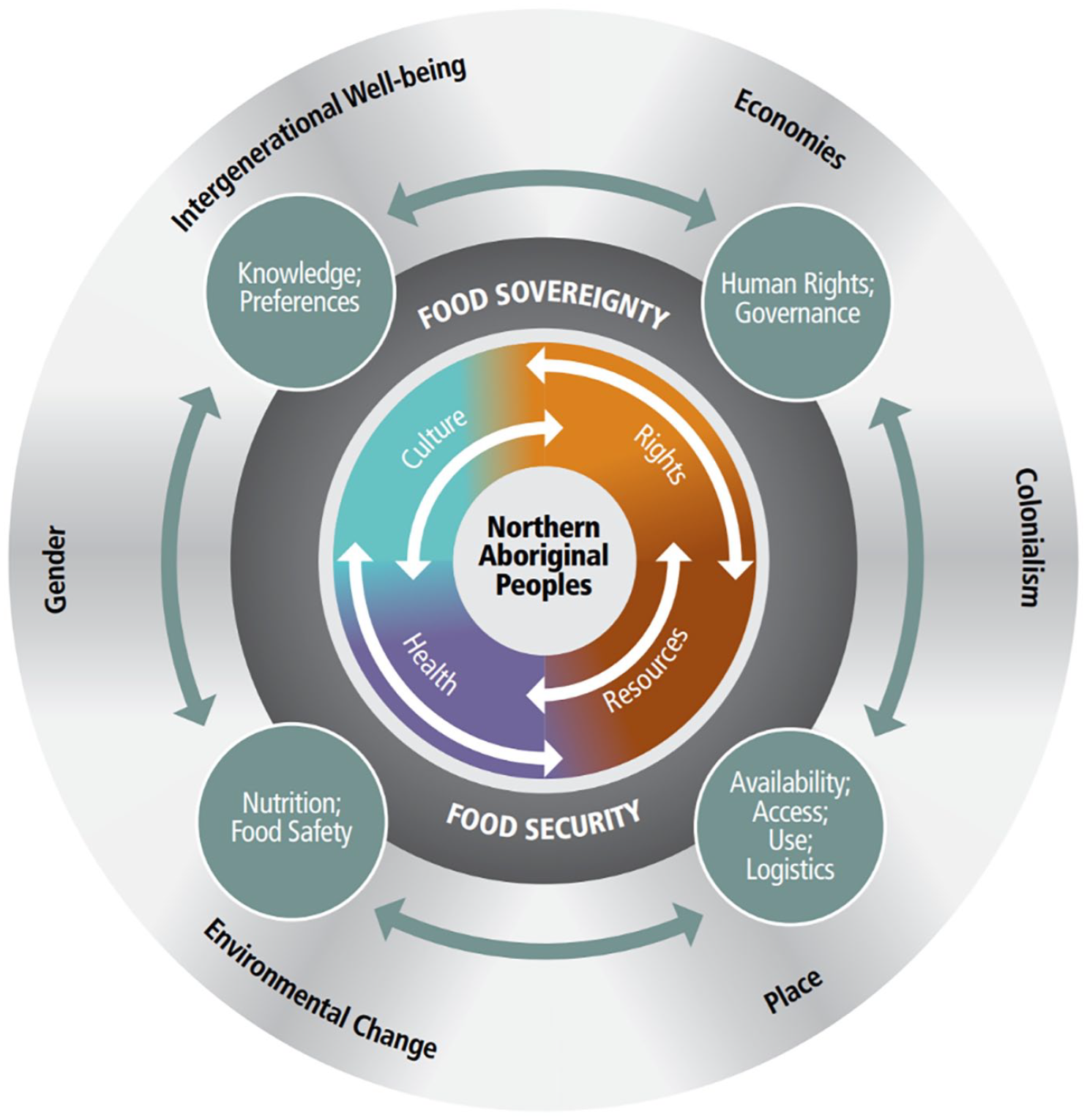
Conceptual model. From ‘Aboriginal Food Security in Northern Canada: An Assessment of the State of Knowledge’ by the Council of Canadian Academies, 2014, p. xviii Copyright Council of Canadian Academies.
Recruitment of those who have knowledge of or experience with the phenomenon is a critical aspect of reaching saturation [9]. Sampling was adjusted to include more individuals who had received on-the-land programme funding as interviews were conducted to ensure saturation [8]. After the initial three interviews were conducted, data analysis commenced and occurred concurrently with additional interviews [8]. The immersion/crystallisation (I/C) data analysis technique as pioneered by Borkan [10] was utilised to analyse data. The conceptual model in Figure 1 guided the analysis. Analyses were presented to and validated by community members in Iqaluit.
Results
Participant demographics
Seven interviews were conducted for this study. Three participants were from Iqaluit and four were from Arviat. Of these, four were women and three were men. Five received food assistance or support, two received COVID-19 on-the-land funding and two were involved in the administration of COVID-19 food assistance programmes or funding.
Sources of food support during COVID-19 and mitigation of impacts
The potential for COVID-19 pandemic community lockdowns to impact community members’ ability to get food for themselves and/or their families negatively was a key focus in Nunavut. Mitigation activities took place at all levels, from territory-wide funding programmes to community members checking in on each other and dropping off food on porches. Programmes to mitigate the impacts of lockdowns on food security were initiated at the territorial and community levels. With the federal funds made available, Inuit organisations distributed funds that directly enabled people to buy food for their households and supplies to get out on the land.
On-the-land funding
Participants overwhelmingly spoke of the positive impacts the on-the-land support had on their households and communities, as they enabled people to access country foods and the land more easily. People who did not necessarily have the means to get out on the land before the COVID-19 pandemic were able to use these funds to purchase equipment for harvesting.
So, [the funds I received] were for hunting, one was for food amounts, and I got a rifle and hunting gear, and I have been able to use that rifle, since. (B.U.)
Food basket/voucher programmes
Food vouchers and hampers were also provided to families in communities affected by COVID-19 lockdowns. This support was initiated to reduce the negative impacts that workplace shutdowns and mandatory isolation may have on the ability of people to feed their families. Food hamper distribution was initiated by the hamlet in Arviat and Nunavut Tunngavik Incorporated (NTI). In Iqaluit, NTI alone provided isolation baskets to families. Participants described these hampers as a welcome boost to food security during these periods.
On top of that, the federal government had kicked in all kinds of money, and so the hamlet was distributing food to families. (A.S.)
Canada Emergency Response Benefit
The introduction of the Canada Emergency Response Benefit (CERB) was noted to have a positive impact on community members. One programme facilitator noted that the introduction of the CERB directly coincided with significant reductions in the number of people coming to food programmes.
So the meal service definitely, there was a huge change we noticed. For the first couple of weeks, in late March, we had, equivalent numbers, if not higher numbers than what we normally had. We had a rush of services, and that all changed in early April . . . the only correlation I can make with that is . . . [it was] about a week after CERB was launched. And then it was essentially five business days that it took to process payment requests to be deposited into bank accounts. A week after that, we noticed that there was a very steep decline . . . saw a drop in demand. It was stark, and it lasted essentially until the fall. The numbers were a third . . . less than half of what we normally see. And I feel that that was attributable to the increased purchasing power that people had through CERB payments. (K.I.)
‘We’re just trying our best to help people who are in need of food’
During COVID-19 outbreaks, community members offered to shop for others. Instead of sharing a meal of country food or visiting to share food, community members also dropped food off on porches of those with whom they would normally share food.
Since more people were out hunting, they were sharing their food, even though we were in lockdown. And they were following the restrictions . . . they were following the safety protocols, and they dropped off the traditional food without contact, so that was really helpful. (R.M.)
During lockdowns, community members checked in on those who they knew might be struggling to obtain food. Some families do not have access to credit cards, which made ordering food to their homes difficult. However, this was also dependent on families identifying themselves as in need of help. Despite these challenges, community members provided assistance to those needing help to the best of their abilities. This included grocery shopping for those who did not have the ability to pay with a credit card.
The problem was you’re not allowed to know who those [COVID-19 positive] families are. So, unless they reached out individually, you couldn’t really help. But when we did know families like that, we tried to drop off food in their porches. The stores provided home delivery so you could phone in an order and as long as you had a credit card to prepay your order then they would deliver your order to you. Many people who didn’t have credit cards were running into problems. [But] you try to listen on Facebook to see who is in need. (A.S.)
Changes in support/resources/barriers to food programmes
Though a wide array of funding programmes were initiated during COVID-19 lockdowns to mitigate impacts on food security and sovereignty, there were some negative effects felt by food programmes in the territory. Lockdowns created barriers to the operation of certain programmes, thereby reducing the community’s access to these programmes or preventing access altogether.
A.S. spoke of how restrictions limited the number of people who could be served by the Meals on Wheels programme. Though there was interest from a large number of community members, only 50 meal deliveries could be accommodated due to limits on where the food could be prepared and the closure of alternate food preparation locations as a result of public-health measures.
We could increase the number of people who are doing Meals on Wheels too, although they have . . . We have to cook the meals in a household that has been COVID-19 free, i.e. mine. And, to prepare 50 hot meals. And for one kitchen, that’s about [all you can do]. The school kitchens are all closed. If we could access the school kitchen, we could do much more, but because of COVID-19, we’re not allowed to go. (A.S.)
K.I. spoke of the impacts of public-health restrictions on their organisation’s ability to provide in-person food programming.
We had to basically curtail all of our training programs or food skills programming when the pandemic began, and we focused exclusively on food access programmes . . . which was to pick up or delivery basis. And we’ve tried to bring back the in-person programmes over the past year, we started up with them back in September, but then had to quickly stop them again in late November because of the lockdown. (K.I.)
School breakfast programmes were also impacted by COVID-19 shutdowns, preventing the programmes from running and providing meals to children.
They’re [taxi companies] only doing our delivery so that’s worked for us, but, things like the breakfast programmes within the school just stopped. (A.S.)
Attention was paid to mitigate the impacts of COVID-19 on community food programmes. A.S. described their experience with seeking funding to shift to other services that would help their organisation to continue to feed people. Funds were made easily accessible to provide or shift programming to continue operations.
When our cooking programme had to shut down because we couldn’t meet, we applied to the Department of Family Services to redirect those funds to be used with the Meals on Wheels Program, and they were very open to accommodating that. (A.S.)
More people out on the land/more time for hunting and harvesting
All participants expressed that due to the shutdown or lockdown situations in their communities, they or their relatives were able to access the land and engage in hunting and harvesting activities. This increase was due to several factors, listed below as subthemes.
Encouragement
Hunting was encouraged by community leaders and Inuit organisations, as it was one of the safest activities possible during COVID-19 outbreaks. Many of the funding programmes initially introduced in March 2020 for on-the-land activities were to encourage people to self-isolate on the land.
Well, one of the things that we were told right from the beginning is that when you go out hunting, there’s only you and the land. So, it would be pretty hard to get COVID-19 from that, so they didn’t stop us from hunting. (A.S.)
Flexible and/or reduced working hours
Lockdowns, for many people, resulted in increased flexibility in working hours or, in some cases, reduced working hours. In turn, this enabled community members to go out on the land more frequently.
[My son] actually prefers hunting than working, so now that he’s not supposed to be at work, he’s definitely out hunting. (I.H.)
This increased free time coincided with the introduction of on-the-land funding programmes. These two factors combined greatly increased the time able to be spent on the land due to the subsidisation of associated costs. For those without equipment, the funding programmes facilitated their acquisition, increasing the number of people able to harvest. In addition to increases in their own abilities and their relatives’ abilities to go out on the land, participants also noted an increase in traffic on the land around their communities during lockdown periods. This was attributed to the increased time at home, allowing community members to get out on the land when the weather permitted.
You should have seen a couple weeks ago when this recent lockdown first started a lot of people were out and about on skidoos. It’s pretty cool to see, seeing that the lockdown has encouraged people to go out. And I’ve seen it. (B.U.)
Many participants felt that the increase in harvesting due to these factors had resulted in a net increase in the country food available in their communities.
In some situations, we were actually hunting even more, because we’re not supposed to be at work. So, in a way, we have more traditional food even, and are sharing it a lot. (A.S.)
More time at home for children
More time at home had other benefits to working towards food sovereignty. During lockdown periods, participants noted there were more people hunting with their children, as households were not allowed to mix. If COVID-19 was not identified in the community, on-the-land programmes could run, including those that teach children harvesting skills, such as the Young Hunters Program in Arviat. With schools not in session, this meant that such programmes could run throughout the day, not just in the late afternoons or weekends. These factors in combination meant that children were spending more time on the land.
As long as you don’t have active COVID-19 in your household, you can go out hunting. Of course, you can’t go out with anybody outside your household . . . because [of this], many of the youth within the family are going hunting with their dads, so that’s another positive that’s coming out of this . . . they’re out of school, so they’re available, and your regular hunting partner cannot go with you, so you take your son or your children. (A.S.)
More children spending time on the land is also related to hunting being one of the only permitted activities during COVID-19 lockdowns.
Social aspect of food
The social aspects and benefits of food, described by participants as very important to Inuit culture and values, were also impacted by COVID-19 public-health measures. Sharing is often done in these social settings.
Another part that is affected [is] not only in obtaining the food, it’s how you consume it. How you’re consuming it has been affected greatly. That’s a more negative effect [with] COVID-19 that comes to mind. (B.U.)
COVID-19 mitigation
Mitigating the spread of the virus was made difficult by issues with housing in the community. The stories told by two participants of their experiences with COVID-19 in their communities highlighted the impacts of housing on health.
I don’t think they can solve that problem [viruses spreading in the community] until they have more houses, so that it’s not so crowded. There are so many houses that have anywhere from 6 to 12 to 13 or more in two- to three-bedroom houses. Unless you were going to put them somewhere for a while, once one person got it, it pretty much just goes to the next person to the next person. So, it’s going to take a while to recover from that ’cause the problem exists because of poor housing not really for any other reason than that. (I.H.)
Housing is indirectly related to food security, with health as an intermediary. Housing impacts health as noted above; health in turn impacts food security and food sovereignty. This is discussed further in the previous section on the interconnectedness of health, food security and food sovereignty.
Discussion
The impacts of COVID-19 measures on food security and food sovereignty described by this study provide insights into how these determinants can be better supported in Nunavut. COVID-19 reduced a significant number of barriers to food security and sovereignty. The majority of these barriers involved the alleviation of the financial constraints of lack of purchasing power due to income support not meeting needs, the high costs of transportation and other needed equipment and goods for participation in harvesting and increases in the amount of time able to be spent on the land.
Participants felt that the food supports given to community members resulted in a significant boost to food security. It was recognised that unemployment due to COVID-19 public-health restrictions could impact individuals’ ability to feed themselves and their families; however, this same support is not given regularly, despite Nunavut having an unemployment rate of 13.4% – almost 2.5 times the Canadian average [11].
A significant finding of this study was the variety of ways in which COVID-19 facilitated multiple enablers of food sovereignty. It provided the funding, time and resources for communities to harvest. Continuing to promote and strengthen the country food economy is paramount to achieving food sovereignty in Nunavut. COVID-19 saw an increase in the ability of harvesters to get out on the land regularly due to the situational and financial changes ushered in by the pandemic. This was mainly due to two synergistic factors: an influx of funding initiatives for on-the-land programmes and increased flexibility of working and school hours. It is evident that in order to continue to support harvesters, communities and leaders must find ways to subsidise the associated costs, and expenses related to equipment and transport were a significant barrier to food sovereignty.
This study highlights the wide variety of impacts of the COVID-19 pandemic on food security and food sovereignty in two Nunavut communities. This may not be representative of other community perspectives. As contexts vary greatly between communities, further study is needed to understand the full scope of impact on this topic across Nunavut.
Footnotes
Acknowledgements
We would like to acknowledge the Nunavut community members who participated in the interviews and member checking of this study. Thank you to Aqqiumavvik Society in Arviat for your support of this project. This study would not have been possible without you all.
Declaration of conflicting interests
The authors declared no potential conflicts of interest with respect to the research, authorship and/or publication of this article.
Funding
The authors disclosed receipt of the following financial support for the research, authorship and/or publication of this article: This study was funded by the Canadian Institute of Health Research and POLAR Canada.
