



Abstract
The economic literature suggests that there is an inverted-U type of relationship between innovation and product market competition. Existing empirical studies assume a quadratic functional form while estimating the relationship between the two variables. Using data on the Indian manufacturing industry, this article contributes by using a semi-parametric approach to test the ‘Inverted-U’ hypothesis without assuming a priori functional form. The estimation results suggest that the functional form of the relationship is contingent upon the choice of product market competition indicator in the model. When product market competition is defined as overall price competition, the empirical evidence confirms the inverted-U hypothesis. This implies that both escape competition and the Schumpeterian effect are observed as price competition increases. However, when product market competition is defined as domestic competition, only the escape competition effect is observed.
Keywords
Introduction
The concept of growth is one of the central issues in the field of economics. Growth may depend upon several factors such as capital accumulation, technological progress, market structure, human capital, investment-saving behaviour of the people, population growth, geographical position, availability of natural resources, and so on (Aghion & Howitt, 1998; Barro, 2001; Becker et al., 1999; González-Val & Pueyo, 2019; Kaldor, 1961; Solow, 1962). Though all of these factors have their own significance, a few of them seem to have gained more attention in the literature. Earlier, it was capital accumulation that was conceived as the most important endogenous factor for growth, while technological improvement was treated as an exogenously determined process (Coe & Helpman, 1995; Kaldor, 1961). In recent literature, technological progress seems to have taken its place above capital accumulation and is treated as an endogenous process (Grossman & Helpman, 1991; Romer, 1990). Technological improvements generally occur due to product and process innovations and are commonly referred to as the ‘engine of growth’ (Milling & Stumpfe, 2000). It has become a common understanding that innovations increase output, bring efficiency to the production process, and help to introduce new products in the market.
Generally, industrial innovations are the result of costly R&D investments with a high degree of uncertainty involved. To make these investments feasible, it is argued that firms need to earn higher than normal profits (Schumpeter, 1942). Another stream of literature points out that incentives are a more important factor than the availability of finance (Arrow, 1962). It can be argued that both factors—the profit of the firms and the incentive to innovate—depend highly on the structure of the market (Aghion et al., 2005). In a monopoly, the firms enjoy high market power and earn supernormal profits, making them financially capable of investing in R&D. Nonetheless, firms may still be disinclined to invest in R&D due to a lack of incentives. Moreover, there may be a tendency to delay innovations to maximise the economic rent from existing innovations. Contrary to this, in perfect competition, firms may have a strong incentive to invest in R&D to survive against rivals. However, reduced market power due to intense competition adversely affects the firms’ profits, leaving them financially incapable of investing heavily in innovations.
Aghion et al. (2005) argue that firms’ decision to invest in R&D depends upon pre- and post-innovation rents. Investment in R&D is done when post-innovation rents are higher than pre-innovation rents. It is further argued that pre- and post-innovation incentives are contingent upon the market structure. Pre-innovation rents tend to be higher than post-innovation rents when the firm faces very high or low competition. This implies that extremely high and low competition is not conducive to innovation activities. An optimum market for innovation is characterized by neither very high nor very low competition, but moderately high competition. Based on these arguments, Aghion et al. (2005) suggest a non-linear inverted-U type of relationship between competition and innovations. The study points out that initially, an increase in product market competition increases the incentive to innovate. However, when the competition becomes too intense to generate enough profits, firms start investing less in innovations. Additionally, this type of ‘escape competition effect’ is stronger in neck-to-neck or levelled firms (firms technologically closer to the frontier) than the laggard firms (firms technologically farther from the frontiers). The levelled firms generally compete with each other to be technological leaders in their respective markets. The increasing competition encourages them to invest aggressively in R&D.
The present study attempts to test the arguments put forward by Aghion et al. (2005) in the case of the Indian manufacturing industry. India makes an interesting case for studying the relationship between competition and innovation activities 1 due to its recent shift towards the policy of liberalization, privatization, and globalization (famously known as LPG policy) in 1991. Before the reforms, the market structure was determined mainly by government policy, as the markets were operating under regulatory control (Athreye & Kapur, 2006). The 1991 reforms resulted in greater competitive pressure in the economy (Chakraborty, 2013). Among others, one of the major objectives of the reforms was to encourage investments in innovations through increased competition in the industrial sector. However, R&D investments remain significantly low after almost three decades of reforms (Dhar & Joseph, 2019). A recent study on the Indian industry by Dhanora et al. (2019) found little impact of competition on patents. We complement the findings of this study by using an alternative measure of innovation: R&D expenditure. R&D investments are generally very risky and uncertain (Gupta et al., 2000), and therefore a firm’s ‘intent to innovate’ may not always reflect in output-based measures such as patent counts. This observation is important in the context of this study since it is more concerned with how the firms behave regardless of how they perform.
As a major contribution to the literature, this study uses an alternative methodology to test the non-linearity of the model. Existing studies have used parametric regression methods with a priori assumption of the quadratic functional form of the relationship between innovation and competition. This study uses a semi-parametric approach that does not assume existing functional relationships (linear, quadratic, cubic, etc.) between the dependent and independent variables, thereby reducing the chances of biased estimation. Additionally, most existing studies use data on developed economies (see Aghion et al., 2005; Michiyuki & Shunsuke, 2013; Tingvall & Poldahl, 2006). It can be argued that developing economies are significantly different from developed countries due to a lack of complementary factors and weaker institutions. Therefore, another study on developing countries should be an important contribution. This article also suggests that the functional form of the relationship between innovation and competition may depend on how competition is defined in the model. The empirical results indicate that the inverted-U hypothesis is valid when competition is defined as price competition. This implies that both escape competition and the Schumpeterian effect are observed as price competition increases. However, when product market competition is defined as domestic competition, the inverted-U type of relationship is not observed. The subsequent section will review the relevant literature. The third section will present model specifications; the fourth section will discuss data and variable construction; the fifth section will present empirical results; and the final section will conclude.
Literature Review
Schumpeter (1942) argues that, unlike competitive markets, which are considered to be more efficient by the neo-classical school of thought, markets with a monopolistic market structure are more appropriate for innovations and new technology. The underlying argument is that the monopolistic structure helps firms to earn sufficient profits for their R&D investments. However, more competitive markets result in insufficient profits, further leading to reduced investments in R&D. In other words, Schumpeter argues that deadweight loss (which is zero in perfect competition and significantly high in monopolistic markets) is the price that has to be paid for a high level of innovative activities. Later, Arrow (1962) argues that the profits may be higher in a monopoly; however, the firms lack the incentive to innovate. Arrow argues that the pre-invention monopoly acts as a strong disincentive for further innovation. A higher degree of competition may provide the firms with a greater incentive to innovate. Geroski (1990) argues that among the two contradictory versions of the theory, Schumpeter’s version has not gained much empirical support. However, this cannot be claimed with confidence, as actual evidence of the impact of competition on R&D is mixed. Several empirical studies have shown that there is a linear positive relationship between competition and innovation (Geroski, 1990; Nickell, 1996), whereas others find that competition contracts innovation activities (see Horowitz, 1962; Kraft, 1989).
Recent literature has also argued in favour of product market competition as a determinant of innovation. For instance, Geroski (1990) suggests that a monopoly is bad for innovation as managers may become lazy because of a lack of competition. It argues that incumbent firms, whose monopoly position is due to past innovations, have a lesser incentive (or greater opportunity cost) to innovate than new entrants. Increased competition provides an incentive to innovate for such incumbent firms. Similarly, Gilbert (2006) argues that the incentive to invest in R&D may depend upon the profit that a firm can earn from innovation. Hence, incentives increase with the profits that a firm can earn from innovation and decrease with the profits a firm can earn if it does not innovate. The incentive to reduce marginal production costs through process innovations is also lower in the case of a monopoly, as it is protected from product competition. Blundell et al. (1999) find that highly concentrated industries have fewer aggregate innovations than industries with high competition. However, the study also suggests that innovations have a greater impact on the market value of firms with larger market shares. Therefore, firms with larger market shares are likely to benefit more from innovations. This implies that firms with greater market share have a greater incentive to pre-emptively innovate. The studies based on Schumpeter and Arrow’s arguments assume a linear relationship between competition and innovation. However, based on theoretical and empirical analysis, Aghion et al. (2005) have shown that the relationship between the two variables is non-linear and can be explained by the inverted-U curve. This implies that firms innovate more when monopolies start to disappear due to a rise in competition; however, when competition becomes very intense, innovations are negatively affected due to reduced profits. In Aghion et al.’s (2005) model, the incentive to innovate depends upon the difference between the pre-innovation and post-innovation rents of the existing firms. Competition is conducive to innovation when it reduces pre-innovation rents more than post-innovation rents. In this case, R&D expenditure aims at ‘escaping competition’, which is popularly referred to as the ‘escape competition effect’. Contrary to this, competition negatively affects innovation when post-innovation rents are reduced more than pre-innovation rents. This argument is in line with Schumpeter’s theory and is often described as the ‘Schumpeterian effect’.
Several empirical studies tested Aghion et al.’s (2005) inverted-U hypothesis. For instance, Tingvall and Poldahl (2006) find evidence that inverted-U type of relationship is present between innovation and competition when the Herfindahl index is used as an indicator of product market competition. The study argues that the positive ‘escape competition effect’ is stronger in the case of neck-to-neck or levelled firms. Further, it is observed that the results are contingent upon the choice of indicator used to measure product market competition. The results find support for only the Schumpeterian effect when the Price-Cost Margin (PCM) is used for empirical investigation. Similarly, Michiyuki and Shunsuke (2013) confirm the presence of the inverted-U relationship between innovation and competition using the constant slope model for all industries. However, when the fixed effects slope model is applied for each decade or industry, the inverted-U relationship is absent. In industries where the technological gap is narrow within firms (neck-and-neck industries), firms invest more in innovation as competition increases. Overall, the review of the literature suggests that there is mixed evidence on the type of relationship between innovation and competition. However, recent studies provide robust empirical evidence on the presence of an inverted-U curve type of relationship between the two variables.
The abovementioned empirical studies deal with data from developed countries. A recent study in India, a developing country, found little impact of competition on innovation outcomes (see Dhanora et al., 2019). It appears that another study on developing countries using alternative measures of innovation and competition will be an important addition. Moreover, existing studies used parametric techniques to test the inverted-U hypothesis and therefore assume a priori functional form of relationship between innovation and competition. Since econometric tools allow us to test the non-linear relationship without assuming functional form, the use of a semi-parametric approach may provide additional insights.
Methodology
In literature, most studies have used a parametric approach to find out the relationship between competition and innovation. Generally, the following type of parametric modelling is used:

Here,
Existing studies have introduced quadratic or cubic terms of
Here, semi-parametric estimation with fixed effects, as suggested by Baltagi and Li (2002), is used. If

Now, to remove the fixed effect, a first differencing method for linear panel data models has been applied as follows:

Baltagi and Li (2002) suggest approximating

Here,
Now, as a result, Equation (2) can be specified as the following:

The model as given in Equation (5) can be consistently estimated using the OLS method. After estimating ϴ and β in Equation (5), it is possible to fit the fixed effect

Equation (6) can be termed as a nonparametric panel data regression model. Here
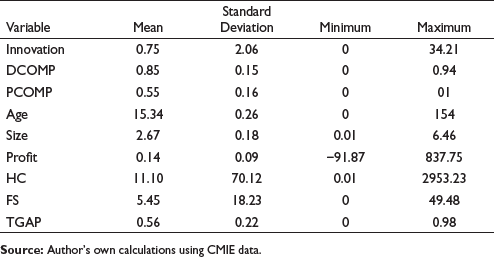
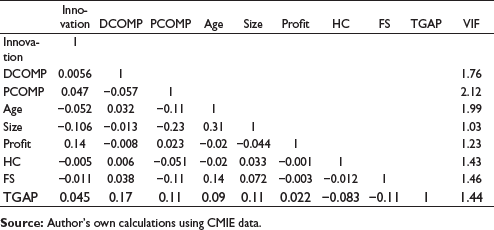
The descriptive statistics of the variables used in the model, the correlation matrix, and the variance inflation factor (VIF) are presented in the Appendices section. The analysis of the correlation matrix and VIF 2 suggests that there is no serious problem of multicollinearity.
Model Specification and Variable Construction
The study uses firm-level data provided by the Centre for Monitoring Indian Economy (CMIE) on the Indian manufacturing industry. An unbalanced panel of 2043 firms for the period 2001–2018 is used for estimation. As CMIE’s database provides us with the data at current prices, appropriate deflators are used to bring data at constant prices for 2004–2005. The following equation depicts the variables used in the model:

Here, the subscripts i and t denote the firm and time, respectively. As discussed earlier,
1. Lerner Index/PCM
Theoretically, the PCM or Lerner Index can be calculated as the difference between the price and marginal cost of the product (Elzinga & Mills, 2011). However, because it is difficult to calculate marginal cost, an alternative measure, defined as the difference between the value of total output and inputs, has been used. This version of the Lerner Index is an effective measure of monopoly power and is widely used in empirical studies (Singh, 2022).
2. HHI is calculated as the sum of the square of the market share of each firm at 3-digit National Industrial Classification (NIC)-2008. More specifically:

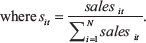
The PCM and HHI are indicators of market concentration, and their values lie between zero and one. The extreme values, zero and one, respectively, indicate perfect competition and monopoly. As discussed above, both indicators are calculated very differently. PCM, measured as the difference between price and marginal cost, represents the overall price competition faced by a firm. On the contrary, HHI measures domestic competition without taking into account competition from foreign firms. To transform the indicators of concentration into indicators of competition, the values of both indicators are subtracted from one. Subsequently, the indicators of competition derived using PCM and HHI are termed price competition (PCOMP) and domestic competition (DCOMP), respectively.

Here,
Empirical Results
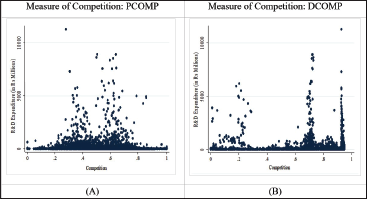
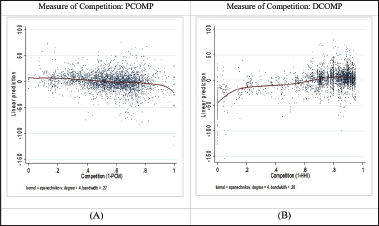
Figures 1(A) and 1(B) plot R&D expenditure against the degree of competition faced by firms in their respective industries. The x-axis and y-axis represent competition level and expenditure on R&D, respectively. The scatter plot in Figure 1(A) reveals that the R&D expenditure of several firms is significantly high when the price competition level is at a moderate level. At the extreme degree of price competition, where competition is very low or very high, the R&D expenditure of most firms is at low levels. Nonetheless, Figure 1(B) shows that the R&D expenditure of firms is higher at relatively high levels of domestic competition. The scatter plot in Figure 1(A) provides an analytical clue that an inverted-U kind of relationship may be present between innovation and price competition. On the other hand, Figure 1(B) suggests that greater R&D investments may occur even at a higher degree of domestic competition.
Econometric Results
The empirical investigation in this section attempts to test the relationship between innovation and competition without any prior assumption of the underlying functional form. The fitted curve shown in Figure 2(A) confirms Aghion et al.’s (2005) argument that there is an inverted-U type of relationship between innovation and PCOMP. However, the inverted-U curve appears to be somewhat flat, with the impact of competition on innovation more prominent at extreme levels. The findings suggest that the escape competition effect and the Schumpeterian effect are present, respectively, at very low and high levels of competition.
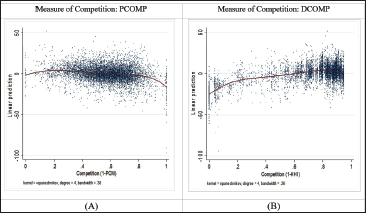
Table 1 provides the estimated coefficients of control variables used in the model. Model 1 lists the coefficients of all the control variables when price competition appears non-parametrically in the regression. The observations suggest that the age of the firm has a significantly negative yet comparatively weak relationship with innovation, indicating that younger firms are likely to invest more in innovations. The size of the firm and profit are found to be highly significant and positive factors influencing innovations. The observations are in line with the existing understanding that larger and more profitable firms are equipped with the required resources to invest heavily in R&D projects.
Semi-parametric Regression Coefficients: All Manufacturing Firms.
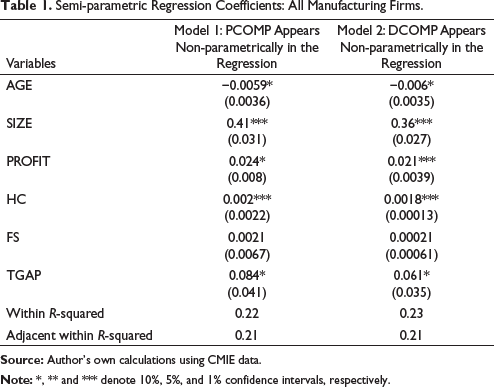
The semi-parametric estimation results are different when DCOMP appears non-parametrically in the regression equation. Figure 2(B) indicates that the inverted-U type of relationship between innovation and domestic competition does not exist. It appears that investments in innovations increase when monopolies break. Nonetheless, a very high level of competition has a negligible negative impact on innovations. The observation confirms the presence of the ‘escape competition effect’; however, the Schumpeterian effect is not observed at very high levels of domestic competition. The regression coefficients of control variables (see Model 2 in Table 1) are largely similar when domestic competition is introduced non-parametrically in regression equations instead of price competition.
Overall, the results suggest that price competition helps firms by providing an incentive to innovate only when monopolies start to disappear. When the price competition is very intense, it is not conducive to R&D investments. On the other hand, domestic competition substantially encourages firms to innovate as monopolies disappear. Moreover, no negative impact is witnessed even when domestic competition becomes very intense. The findings are important to understand the dynamics between product market competition and innovations in the Indian context. While an existing study by Dhanora et al. (2019) suggests no relationship between competition and output measures of innovations (patents), this paper finds a somewhat flat inverted-U type relationship exists between price competition and ‘intent to innovate’. Additionally, it is observed that the relationship between product market competition and innovations is dependent on the nature of competition faced by the firms. When competition is defined as domestic, only the positive effect of competition is noticed, with no negative effect at very high levels. Since R&D investments depend on the financial situation of the firms, the variation in results is probably due to the way price and domestic competition may affect the profitability of the firms. It can be argued that PCOMP, which is theoretically defined as the difference between marginal cost and price, may considerably reduce firms’ profits (Porter, 1980). On the other hand, DCOMP is measured in terms of the allocation of market share among participating firms. Based on this measure, higher competition does not explicitly imply that firms are not earning enough profits (Anderson et al., 1994; Cattó, 1980).
Levelled Versus Laggard Firms
The theory suggests that the relationship between innovations and product market competition may depend upon whether the firms are competing neck-to-neck (levelled firms) or are technologically distant from the frontier firm (laggard firms). In this study, levelled firms are defined as those with a technological gap from frontier firms less than the average technological distance at the 3-digit NIC-2008 level. Similarly, firms with a technological gap from frontier firms greater than the average technological distance at the 3-digit NIC-2008 level are laggard firms.
The empirical evidence in the literature suggests that levelled firms invest more aggressively in R&D to retain market share when competition increases. However, as shown in Figure 3(A), our semi-parametric estimation finds that increasing price competition has a negative effect on R&D investments by levelled firms. The escape competition effect is absent, as no incremental R&D investments are observed as the monopolies break. Due to the Schumpeter effect, R&D investments further decline as price competition becomes too intense. Contrary to this, Figure 3(B) suggests that an increase in domestic competition increases investments in innovation, although at a decreasing rate. In other words, R&D intensity increases significantly as the monopolies break; however, it becomes flatter at a very high domestic competition level. This implies that in levelled firms, the ‘escape competition effect’ is present only at a very low level of domestic competition, and the Schumpeterian effect is not witnessed even at a very high competition. Table 2 shows that among the control variables, the age of the firm remains either insignificant or significantly negative with a small coefficient. The size of the firms, profit, human capital, and technological gap are significantly positive determinants of innovations in Model 3 and Model 4.
Semi-parametric Regression Coefficients: Levelled Firms.
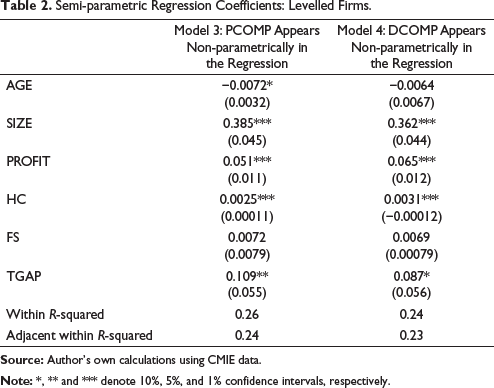
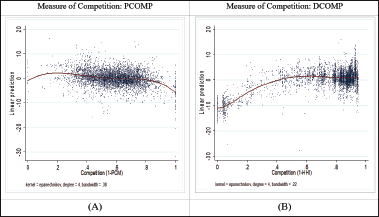
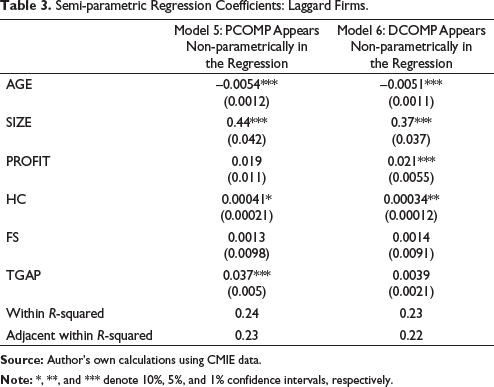
Figure 4 suggests that the estimation results in the sample of laggard firms are different from the results found in the case of levelled firms. While an inverted-U type of relationship is observed between innovation and price competition, only the escape competition effect is witnessed when the competition variable is defined as domestic competition. Table 3 shows the estimated coefficients of control variables in the sample of laggard firms. Model 5 and Model 6 provide estimates of the model using price competition and domestic competition, respectively, as measures of product market competition that appear non-parametrically. Largely, the control variables in the sample of laggard firms remain comparable to the coefficients estimated in the sample of levelled firms. Overall, the results suggest that as the monopolies break, both price and domestic competition provide more incentive to the laggard firms than the levelled firms. The findings are contrary to the existing understanding that levelled firms invest more aggressively than laggard firms when monopolies break. Additionally, the Schumpeterian effect dominates only when we consider price competition as a measure of product market competition in the model. Intense domestic competition does not affect the R&D investments of the firms.
Semi-parametric Regression Coefficients: Laggard Firms.
Conclusion and Policy Recommendations
The study attempts to find out the association between competition and investment in innovations using a semi-parametric regression approach to avoid misspecification of the functional form. In conformity with the recent empirical literature, the overall results find a somewhat flat inverted-U type of relationship between price competition and R&D investments. This implies that both scape competition and Schumpeterian effects are observed, respectively, at very low and high levels of competition. However, the results are contingent upon the choice of product market competition indicator. When domestic competition is used as an indicator of product market competition, only the ‘escape competition effect’ is observed. This suggests that the increase in domestic competition beyond moderate levels does not adversely affect R&D investments. Since this study uses an alternative methodology to test non-linearity and compares results using two different indicators of product market competition, it should be an important addition to the literature.
The results have important policy implications for India’s economic policies. The economic reforms of 1991 in India were intended to encourage overall competition in the economy. The reforms aimed to bring technological improvements and introduce efficiency in the production system by providing the private sector with incentives through increased competition. Even if competitive pressure has increased, its role in providing an incentive to improve innovativeness in the manufacturing sector is questionable. The R&D intensity remained largely stagnant in most manufacturing industries. Our findings suggest that instead of encouraging overall price competition, the promotion of domestic competition can be more conducive to innovations in the industry. It can be argued that price competition may considerably reduce firms’ profits and therefore adversely affect firms’ ability to invest in R&D. On the other hand, domestic competition is measured based on the relative market share of participating firms. A higher level of domestic competition does not explicitly imply that firms are not earning profits. Therefore, it may be argued that policies should aim to promote domestic product market competition and limit price competition. This objective may be achieved by imposing higher international trade barriers, especially for the industrial sectors which are underdeveloped and are unable to compete with the products in the international market. Simultaneous improvement in domestic competition through the reduction in unnecessary regulations, particularly for starting a new business, is also required. According to the Ease of Doing Business Index (EDBI), India’s rank improved from 142 to 63 during 2014–2020. However, an important component of EBDI, the Ease of Starting a New Business is still 136 (World Bank, 2020). Given the findings of this paper, a policy shift in favour of improving domestic competition through an emphasis on the ease of starting a new business could provide a boost to the stagnant R&D in India’s manufacturing sector.
Appendices
Appendix A. Summary Statistics.
Appendix B. Correlation Matrix.
Footnotes
Acknowledgement
The article has greatly benefited from the invaluable insights provided by Director and Professor Indrani Chakraborty, Professor Achin Chakraborty, and other esteemed faculty members of the Institute of Development Studies Kolkata (IDSK). I am also grateful to Prof. Lakhwinder Singh, Visiting Professor at the Institute for Human Development (IHD), New Delhi, Prof. Puluk Mishra from IIT Kharagpur, and Dr. Indervir Singh from the Central University of Himachal Pradesh (CUHP) for their insightful suggestions.
Declaration of Conflicting Interests
The author declared no potential conflicts of interest with respect to the research, authorship and/or publication of this article.
Funding
The author received no financial support for the research, authorship and/or publication of this article.
