



Abstract
Working time reduction (WTR) refers to an increasingly popular group of eco-social policies, with various potential implications for social security and sustainable welfare depending on the details of implementation. Despite the growing number of international examples, WTRs constitute a countertrend in Hungary where the government aims to create a ‘work-based society’. In this context, we investigate whether and how companies launch WTRs, and study their effects. Our approach is comparative and explorative. We draw on interviews with managers of 10 companies to understand the motivations behind WTRs. In addition, we use 34 interviews and two focus groups conducted at four companies, considering impacts on employees’ workload and working conditions. We show that the drivers, mechanisms and impacts of WTRs differ by company size. There is far more diversity among smaller companies, where the attitudes of managers and personal relationships are decisive. Larger companies either choose low-risk WTRs that offer low gains, or target further growth and potentially cause a reduction of sectoral output while maximising profit. The latter may be the first example of profit-driven degrowth in the literature. Insights generated here can be useful to understand the potential reasons for, and barriers to, a more widespread adoption of WTRs, as well as the role of positive and negative impacts on workers in this process. We argue that this is important not only for social and economic outcomes, but also for the environment, since WTRs are necessary for a precautionary approach to sustainability. We highlight the limitations of current WTRs, in order to catalyse thinking about more radical variants.
Keywords
Introduction
Changes in technologies, worldviews and the demographic composition of the workforce are widely expected to transform the world of work (Balliester and Elsheikhi, 2018; Berger and Frey, 2016; Messenger, 2018). Automation, digitalisation, post-Covid work attitudes and ageing populations may strongly affect how, where and how much people will work in the future. There are heated debates about future labour demand and supply: while some foresee mass unemployment due to the rise of artificial intelligence (Ford, 2016; Harari, 2017), others point to potential labour shortages due to falling shares of the economically active population (European Commission, 2023; OECD, 2019). Whichever effects will prevail in the long run, interest in significant reductions of paid working time (WT) has grown, due to short-term considerations.
Four-day workweeks – a diverse group of interventions reducing per capita WT – are frequently covered in the media in rich countries, appearing as a possible next step to improve the quality of life (e.g. Abend, 2023; Bateman, 2022; Dowd, 2022). In addition to benefits to work-life balance, these discussions often focus on potential environmental and economic advantages, ranging from reduced commuting to increased productivity and benefits for employment. The extent to which such positive impacts are achievable (Antal et al., 2021; Fagan et al., 2012; Zwickl et al., 2016), and whether reductions of WT are realistic in less favourable economic and policy contexts (Bick et al., 2018), are interesting questions. If there are real, visible benefits within organisations, then working time reductions (WTRs) may gain traction due to the broad support of employers and employees. However, it is also possible that some companies are better positioned than others to launch WTRs, and that differences between schemes in terms of eligibility, work schedules, changes in compensation and potential trade-offs have major impacts on workers, limiting the applicability or the benefits of specific WTRs.
This qualitative research paper studies three research questions: Why have companies launched WTR schemes in Hungary since 2020? How did the characteristics of these companies and their schemes affect the impacts on workers? What environmental consequences are likely in each case? The aim is to assess whether different types of WTRs can be effective eco-social policies, facilitating social and ecological goals in an integrated way (see the introduction to this special issue). We argue that certain WTRs meet these criteria more than others. A better understanding of the motivations of employers to launch specific schemes – which may range from easier recruitment and higher productivity to pure altruism (Lewis et al., 2023) – and the relationship between such motivations and WTR types could help to create conditions for a future upscaling of WTRs. This is especially relevant because WTRs may not only be socially desirable but are likely to be environmentally necessary to achieve sustainable welfare. From a social perspective, more time for regeneration, social connections and enjoyable activities could be an effective response to many problems associated with harried lifestyles (Han, 2015; Kamerāde et al., 2019; Linder, 1970; Wooden et al., 2009). From an environmental perspective, there are two combined issues behind the need for WTRs: first, it seems crucial to transcend the paradigm of economic growth if we are to achieve sustainability, and second, a post-growth transition is probably impossible without WTRs. Both parts of this statement are strongly supported by scientific evidence, as the next two paragraphs explain.
On a global scale, past decoupling of economic output from key climate, biodiversity and other environmental indicators was substantially slower than the decoupling rates currently required to achieve internationally agreed sustainability targets (Haberl et al., 2020; Vadén et al., 2020). As there are many reasons to be sceptical about sufficiently radical improvements in the future (Antal and Van den Bergh, 2016; Hickel and Kallis, 2020; Parrique et al., 2019), the pursuit of growth-based strategies in all countries is extremely risky from an environmental point of view (IPBES, 2019; IPCC, 2023). To mitigate these risks, the only option is to implement strategies that reduce our collective dependence on economic growth (Daly, 1996; Jackson, 2009; Victor, 2010).
However, post-growth scenarios are unlikely to be socially acceptable without reductions in paid WT (Kallis et al., 2012). Today, employers continuously seek to increase labour productivity, which reduces the need for labour input at any level of economic output. If aggregate output does not grow, this means falling demand for labour: either fewer workers or fewer hours per worker are needed (Antal, 2014; Jackson and Victor, 2011). Unless productivity growth stops (which we deem unlikely), or very radical strategies (e.g. a substantial universal basic income or a wide range of universal basic services) make workless lives socially viable, the number of paid working hours per person must fall. Note that the point here is not that basic income or service policies cannot be complementary with WTRs – in fact, voluntary WTRs may be enabled by such policies while involuntary WTRs may necessitate their use to preserve social stability. However, without very substantial basic incomes or services, which are difficult to implement, post-growth scenarios also require WTRs.
Nevertheless, the need to reduce the number of paid working hours does not mean that all types of WTRs are environmentally beneficial (Antal et al., 2021). The environmental impacts of WTRs are caused by changes in the scale and the composition of production and consumption, i.e. how much and what is produced and consumed (Knight et al., 2013). The ‘scale effect’ refers to the environmental impacts stemming from changes in output (e.g. lower production requiring fewer resources). The ‘composition effect’ depends on relative changes in different consumption categories because of changes in time use, pay, or work arrangements. The few available studies suggest that the scale effect tends to be more important than the composition effect from an environmental perspective (Nässén and Larsson, 2015; Neubert et al., 2022),
The number and distribution of working hours are also linked to social security outcomes in various ways, depending on how exactly WTRs are implemented. Beyond the indirect link through environmental sustainability, the most obvious connection is through wages (Pullinger, 2014; Spiegelaere and Piasna, 2017). If hourly wages are unchanged then incomes decrease, which can be a problem for many workers, leading to low participation rates or involuntary part-time employment if participation is mandatory. If hourly wages increase and incomes do not fall (proportionally), then questions about equality, work conditions and job security arise, all of which are relevant from a social security perspective.
Equality in terms of income and WT may be facilitated or hindered by WTRs with wage compensation. Perceptions of inequality can be severe if not all workers within the same company are eligible to participate, for instance because the management does not consider WT reductions or productivity increases feasible in certain types of jobs. Given that most WTR trials are conducted in white collar contexts (Lewis et al., 2023; Schor et al., 2022), there seems to be a real risk that WTRs may increase inequality. Workers who have more discretionary time can more easily avoid paying for various time-intensive services, such as childcare or maintenance work. At the same time, inequality between social classes may decrease if the benefits of productivity growth are received by workers in the form of free time, and not by company owners in the form of profits. Whether WTRs help gender equality depends on the gender composition of the participating workforce and the extent to which they spend the freed-up time doing unpaid work (Craig and Powell, 2012).
Changes in work conditions are linked to employer expectations (Hayden, 2006). If there is no (proportional) reduction in the expected output, then higher intensity and more exhausting work are likely (Delaney and Casey, 2021; Spencer, 2022). This may have health implications and potentially reduce the value of non-work time. Redistributing rest time from all workdays to a new day off may not deliver the benefits commonly associated with WTRs. The actual implications are strongly dependent on the type of work, because workloads may or may not be proportional to WT (Lukács and Antal, 2023). An issue closely connected to expected changes in productivity is whether workplace freedom, work schedules, the level of WT flexibility, or the opportunity to work from home are changed when a WTR scheme is introduced. Depending on the circumstances of workers (e.g. care responsibilities), there may also be social security implications.
WTRs may potentially impact job security for the workers involved as well as for others who are not participating. If the costs of employment per unit of output increase (Bosch and Lehndorff, 2001), then employers may respond by replacing labour with machines or by reducing output and hiring fewer workers (Hunt, 1999). What happens to employment opportunities can be mediated by collective agreements and government regulations. Research on the employment effects of various types of WTR programmes has produced mixed evidence (Askenazy, 2013; Kramarz et al., 2008; Zwickl et al., 2016), suggesting that the specific ways in which WTRs are implemented matter for employment impacts.
How far and how exactly WTRs are implemented depends on the country context. In Hungary, the average working hours are 38.2 h per week, as opposed to the EU average of 36.4 h (Eurostat, 2022a), while the purchasing power of the median salary is around 50% of the EU median (Eurostat, 2022b). This means that there is room for WTRs, but that wage compensation is necessary in most cases, especially because financial security is valued very highly in this risk-averse, post-socialist context (Kantar et al., 2021; Kapitány and Kapitány, 2012). However, government policies have generally tried to increase aggregate WT in an effort to create a ‘work-based society’, by, for example, reducing unemployment benefits, replacing direct welfare provisions by tax rebates and giving employers more control over the use of overtime hours (Karas, 2022; Scheiring and Szombati, 2020). As the government not only resists the idea of WTRs but has also shifted the power balance away from workers and unions towards employers, it is not surprising that all the existing WTR schemes are initiated at the company level.
We describe such initiatives using 10 post-Covid examples from Hungary. As most previous case studies were not comparative and did not focus on sustainable welfare (Hanbury et al., 2023), this allows for new types of conclusions, regarding, for example, the role of company characteristics. The focus on the post-Covid period is appropriate because four-day workweeks were not widely discussed or seriously considered before employers had first-hand experience showing that different ways of working were possible. Furthermore, Hungary is an interesting location to consider, since most previous case studies were conducted in a handful of rich countries (Joly, 2022; Lewis et al., 2023; Schor et al., 2022).
After a short section on methods, the descriptive part of the paper focuses on the motivations of employers and implications for workers, addressing the first and the second research question. Then the discussion interprets some of these results and addresses the third research question by speculating about environmental impacts, while also highlighting differences between WTRs based on company size. Finally, conclusions are drawn regarding the eco-social impacts: we suggest that the economic feasibility of WTRs often conflicts with their social and environmental desirability.
Methods
We study substantial WTRs, defined here as four-day workweeks, four-and-a-half-day workweeks, or leave programmes that offer more days off than these on an annual basis. We concentrate on these reductions because shortening standard working hours may have far-reaching consequences, as WT preferences concentrate around such standards (Drolet and Morissette, 1997; Reynolds, 2003; Tam, 2010). All the schemes studied here are collective schemes for specific groups of workers, as detailed below. Why workers individually choose part-time work is another interesting question, which is beyond the scope of this paper.
We rely on two main sources of information. On the one hand, we conducted interviews with managers of 10 companies that introduced substantial WTRs. Contact was established with these companies through various channels. In six cases, either we heard about their WTR schemes, or they heard about our research through the media or at public events, while four more companies were identified through personal networks. The semi-structured interviews with executive or human resource (HR) managers explored their work contexts, the motivations of those who initiated reductions and the experiences so far. Although we believe that most accounts were honest and realistic, we also indicate in the Results section when we perceived answers to be potentially biased. The interviews lasted 50–90 min. In addition, larger companies shared the results of various internal surveys they conducted to help us understand attitudes to and consequences of their WTR programme.
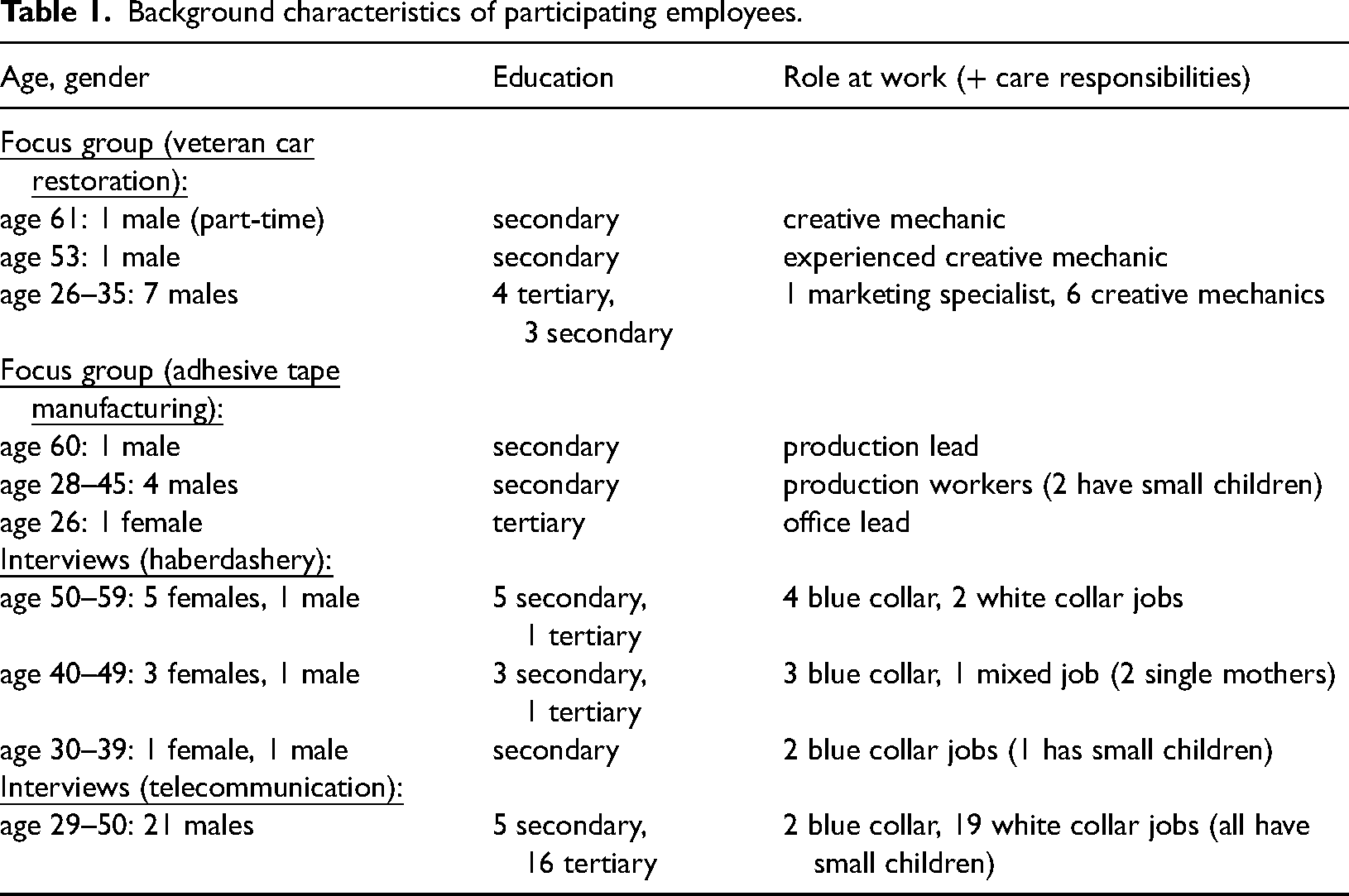
On the other hand, we used information from interviews and focus groups conducted with the workers of four of these companies. Two focus groups were conducted at smaller companies, while interviews were carried out with 12 employees of a smaller firm and 22 employees of a larger company (for background characteristics of these workers, see Table 1). Results from these were used to gain a deeper understanding of employees’ concerns. The focus was on impacts on time use, work processes and well-being. The interviews lasted 45–90 min and the focus groups lasted 70–90 min. All interviews and discussions were transcribed and qualitatively analysed.
Background characteristics of participating employees.
The approach of our research was explorative. We did not start from theoretically motivated hypotheses. Instead, we identified as many examples of WTRs as possible, in order to give an overview of recent developments in this context, and concentrated on themes that were important for our interviewees. While the presentation of the results largely reflects the conceptual categories used by our respondents, the discussion section focuses on questions previously asked in the literature regarding the feasibility, implementation and impacts of WTRs.
Given the approach and the methods of the paper, there are important limitations. First, the study is better suited to identifying causal mechanisms and tendencies than to generalizing findings for larger samples. Second, in several cases we could not triangulate the results as we have not (yet) talked to employees. Third, the complexity of the changes potentially triggered by WTRs prevents a full assessment of the eco-social impacts.
Results
Inventory of WTRs
We identified 10 companies that have permanently introduced or are currently experimenting with substantial working time reductions (Table 2). They operate in various sectors: most of them do office-based work, but the activities of three of the companies also involve manual labour. Only one company employs traditional blue-collar workers, while the others employ highly educated workers or require substantial internal training and creativity, even in the case of manual labour. All the WTRs started in or after 2020.
Examples of WTRs.
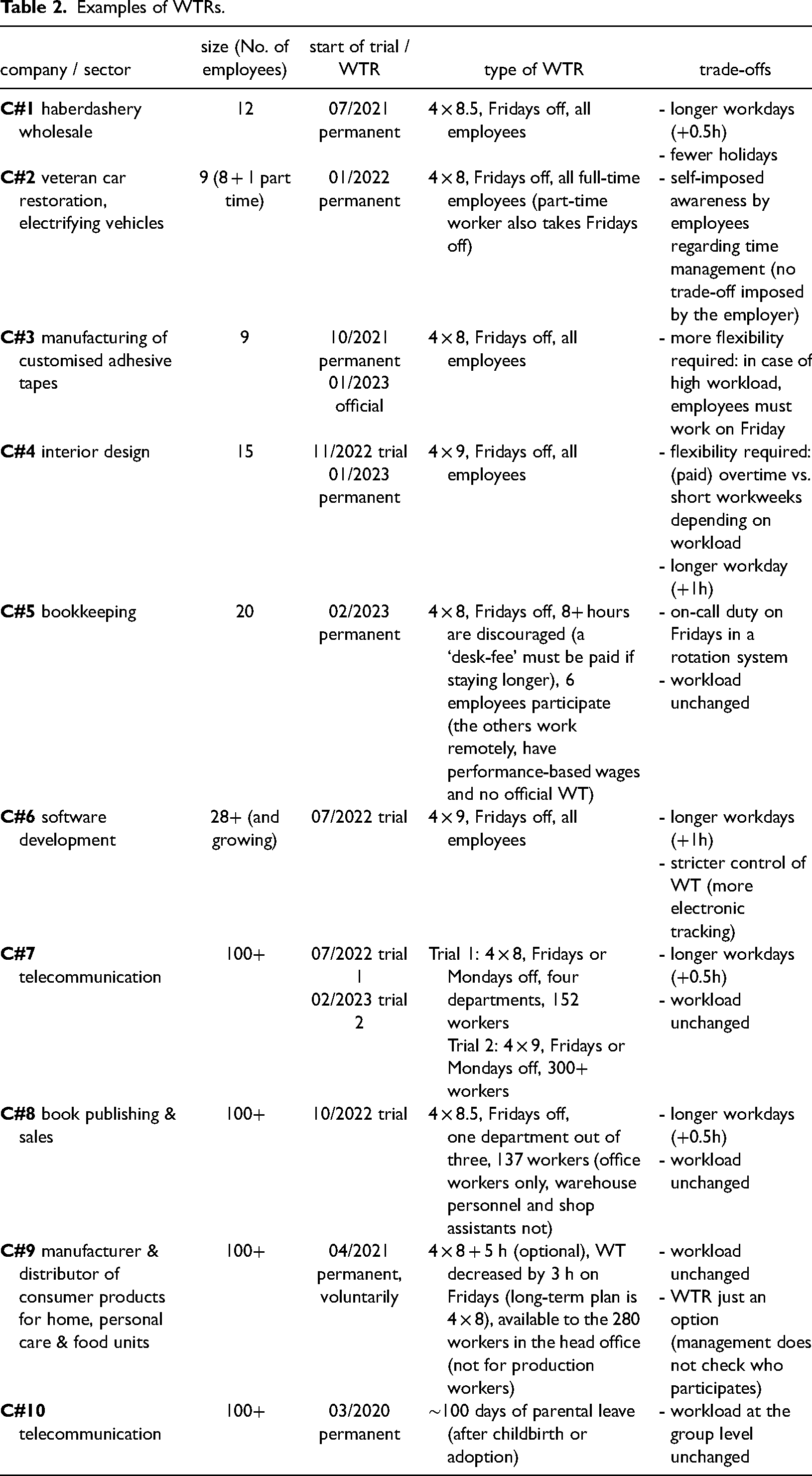
Five of the 10 companies are small businesses with fewer than 20 employees, characterised by a friendly atmosphere. The other half of the sample are categorised as large or growing. Four companies have 100+ employees, while the one with 28 employees has grown rapidly and aims to reach 100+ employees within five years. Size matters, because in companies with more than 20 employees it is more difficult for deeper personal connections to develop between the employer and the employees, impacting the implementation of WTRs.
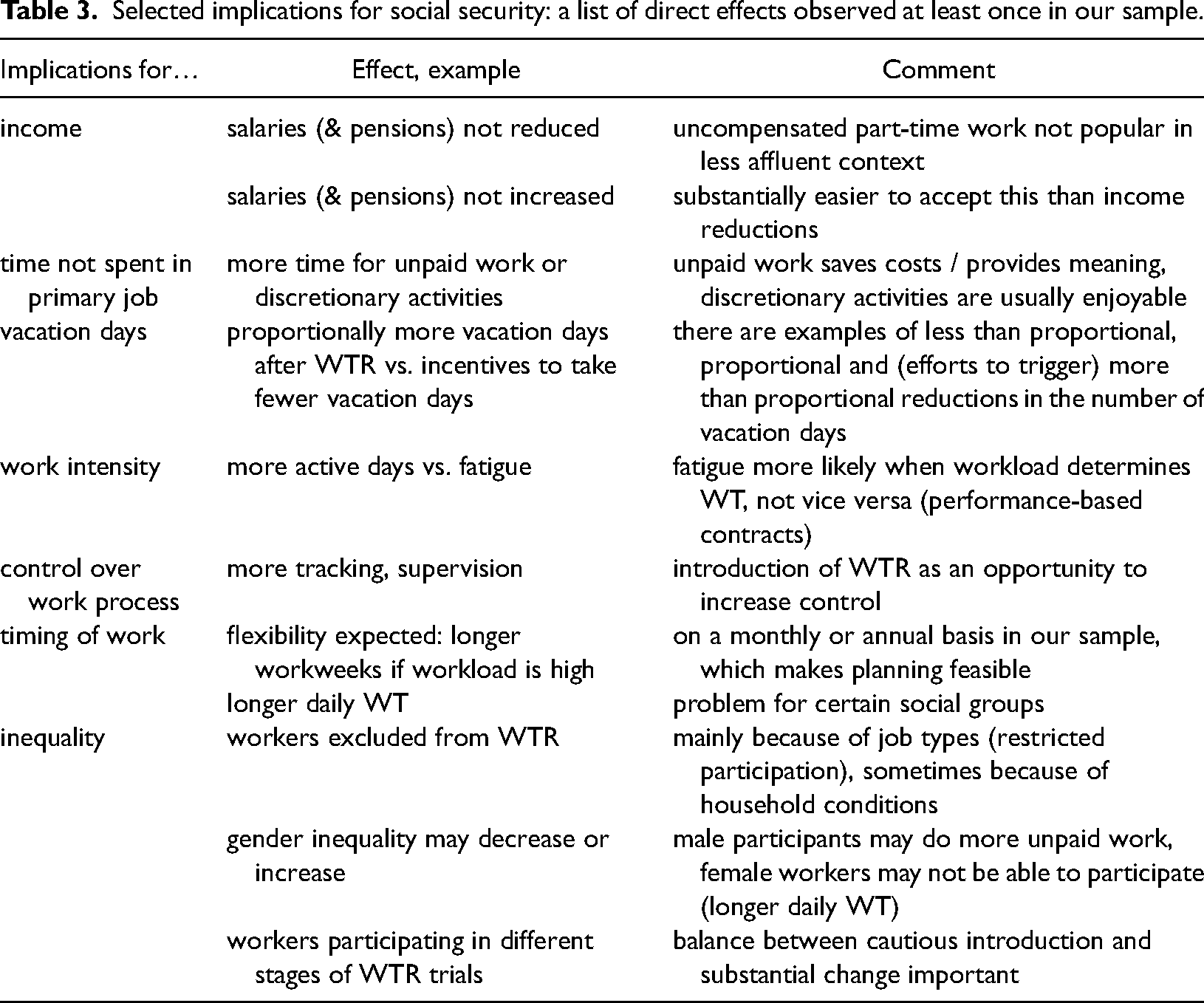
Salaries remained unchanged in all cases. Eight companies opted for a version of the four-day workweek, one allowed their staff to reduce WT by three hours per week as a first step towards free Fridays, and one company offered 16 weeks of paid parental leave plus half a year with four-day workweeks after the arrival of a child, in addition to the parental leave offered by the state. A pure four-day-week without any trade-offs for employees was rare. We identified the following compromises: increasing daily WT (by 0.5–1 h); stricter control of WT; stricter vacation rules; no change in workloads, implying a faster work pace with fewer breaks or other efforts to increase productivity; and on-call duty on Fridays for certain employees (in a rotation system). The social security implications are touched upon in the next subsections discussing the motivations of employers and impacts on workers – a summary of relevant results is given in Table 3.
Selected implications for social security: a list of direct effects observed at least once in our sample.
Motivations of employers
Significant differences were seen in the motivations of employers between smaller and larger companies. Among the group of smaller companies, we identified a range of motivations, strongly influenced by the attitudes of the CEO (who usually owns or co-owns the company). Managers’ genuine concerns about goals unrelated to profit mattered: the well-being of workers was mentioned in all five cases while the environment came up on three occasions. 1
The framing of altruistic concerns varied between the contexts, but always reflected a sufficiency mindset, i.e. no intentions to maximise profit at all cost. For example, shorter opening hours could somewhat reduce sales at the wholesale company (C#1). Keeping wages unchanged while expecting less work increased the costs per unit of production at the car refurbishment company (C#2). Similarly, the CEO of the company producing adhesive tapes rejected his co-owners’ suggestion to reduce salaries when employees were allowed to work fewer days (C#3).
The stated altruistic motivations were sometimes linked to non-altruistic motivations. In one case, the aim was to reduce overwork (C#4), but the manager also thought that overwork leads to more sick leave, badly timed vacation days and reduced effort. Furthermore, we saw examples in which WTR was partly motivated by expected reductions in non-personnel costs and associated environmental benefits. The managers of C#1, C#2, and C#4 thought that closing down the business on Fridays would also reduce utility costs. This prospect was exciting for them, partly because of their environmental awareness.
The interviews also revealed characteristic motivations that were not altruistic. First, the employers tried to reduce unplanned absences. These were problematic in the small companies because the absence of even just one or two workers could cause bottlenecks. One employer’s strategy was to introduce a bonus for those who take fewer than 12 days off per year (the bonus amounts to 10% of the annual salary and is reduced by 1% per vacation day above 12 days). Another question is whether the number of vacation days should decrease with a transition to a four-day working week, since keeping the same number of holidays would significantly increase the holiday-to-workday ratio. Requesting colleagues to use vacation days for Fridays if holidays span a whole week is an attempt to limit this.
Second, several employers expected more flexibility in terms of the timing of work. This usually meant that workers were expected to respond to fluctuations in the amount of work. Occasionally, five-day workweeks could be requested, if the formal WTR reflected a situation of lower WT amid weak demand (C#3). In certain cases, clients were not informed about the switch to a shorter workweek, to avoid perceptions of unavailability, so at least one person had to pick up the phone while the others took their days off (C#5). This could only work in cases when satisfying partners’ needs did not require significant work immediately.
Third, the employers often did not want output to drop substantially, expecting more efficient work. This suggests that the processes were not optimised for maximum efficiency before WTR. Nevertheless, limits to intensity partly explain why WT was often cut by less than a full day. In one case (C#5), the employers also started to monitor the workflow more closely, using a process management tool. C#2 stands out as an exception because the manager accepted the reduction in output. However, given the team spirit and positive attitudes towards the boss, some intensification still happened as employees voluntarily reduced slack time. As a result, output fell by around 10–15% instead of 20%, according to the perception of the manager.
In addition, WTR can be used to retain employees. The manager of C#5 saw its introduction as an alternative to significant salary increases. Such financial concerns were not separate from other goals but played a role in more complex decisions.
In the group of larger companies, the motivations to implement WTRs and the conditions under which this could be done were more uniform. Although the role of individuals – for example, committed HR managers – was crucial and some of them genuinely wanted to improve well-being, reduction programmes were not generally allowed to impact key performance indicators. The goal was to preserve or increase profits, mainly by increasing the attractiveness of the company and by increasing productivity.
The attractiveness of the company was most important when significant growth was targeted, or staff retention was problematic. This was most characteristic in the IT sector, where labour supply is scarce but a qualified workforce can create substantial value, resulting in intense competition for workers. This likely explains why our sample includes several software development and telecommunication firms. When the aim was to grow the company, the manager accepted a reduction in profits per employee, because the extra profit coming from the larger number of employees exceeded these losses. Workers benefitted from the shorter working week, while WTR was used as a marketing strategy in the labour market. This version of the four-day workweek also meant nine-hour workdays and more electronic tracking of WT than before (C#6).
The four large multinational companies tried to give something to their employees without sacrificing too much: if well-being could be increased without affecting production, then WTR was considered feasible. They therefore required increasing productivity from the workers who participated in WTRs – or their colleagues, in the case of the parental leave programme. An important difference between job types is how measurable the output of production is, as different departments of C#7 show. If output is easy to measure, then it is also easy to check whether productivity increased sufficiently to keep production constant. Poor measurability allows less stringent assessments, potentially facilitating WTRs.
Impacts on workers
Workers often categorised the effects of WTR programmes as positive, ambiguous and negative. Many primary effects fall into the first category. Workers have more time for recreational activities, hobbies, sports, self-development and learning (Balderson et al., 2022). Some of them visit their friends more, others meet with family over the weekend, play with their children and dedicate half a day or a whole day to their partner. They do yoga, go to the gym, spend long weekends hiking, cycling, skiing, or travelling (domestically or abroad). Some of them develop their skills in fields unrelated to work, for example, in a pottery or language course. Sometimes their hobbies intersect with professional work, so it is difficult to draw a clear boundary. For example, all employees in C#2 renovate classic cars as a hobby, so it is difficult to distinguish between paid work and their own projects (e.g. renovating cars for friends). More time for enjoyable activities and improvement of the work-life balance are the main benefits of WTRs for individuals.
Only in one case did we see evidence of a desire to become involved in voluntary activities or to participate in public affairs (C#2). This may be attributed to relatively low public engagement in Hungary (Mikecz, 2023), but it is also possible that fewer workers are motivated to spend time in ecologically beneficial ways through collective WTRs than through individual arrangements. After all, one potential reason to choose shorter hours is ecological (Hanbury et al., 2019), so people with such motivations are probably overrepresented among downshifters.
Another positive aspect for workers is that their pensions and social security status (health care rights) did not change. Pensions depend on salaries, so wage compensation is crucial here. As the legal environment has not adapted to the option of shorter workweeks, many employees still work full time on paper (40 h per week). In fact, the slow development of the legal framework creates a situation in which companies need to find their own solutions, none of which are perfect. As small companies often choose to do nothing and leave contracts unchanged, their workers may be at an advantage compared to workers in large companies which must formally change contracts in one way or another.
The impacts on gender equality are more ambiguous (Chung and van der Lippe, 2020; Langner, 2018). On the one hand, male employees of a multinational company (C#10) jokingly expressed self-pity that they had to do more household work such as childcare, shopping and housekeeping. On the other hand, longer workdays posed a problem to women who still did most household work. Doing 30–60 min more paid work per day was especially problematic for mothers. For instance, childcare became more complicated: they needed support from other family members (usually the grandparents) or had to hire babysitters at a non-negligible cost. In several cases, this resulted in increased stress when four-day trials were launched, but managers said that the stress eased when the new practices were established. However, for workers with weaker social networks and financial options, the problem could be unsolvable. One female employee left C#1 largely because she needed to stop work at 16:00 sharp to pick up her child. A single mother raising a child with special needs was the only person to not participate in the WTR trial at C#8, because she could not arrange care for her child and worried that she would spend more time commuting if travel shifted to the rush hour. In both cases, the timing of WT was the main problem, highlighting the importance of flexibility for people with special household situations. We also note that mothers are more affected than childless workers or men (Kurowska, 2020).
Another ambiguous issue is work intensity (Delaney and Casey, 2021). In trade jobs where daily WT cannot be substantially shorter or longer than the opening hours, several employees prefer more active workdays (up to a certain limit) to idle ones. In this case, condensing WT may be positive from a well-being and mental health perspective, especially if intensity before WTR was relatively low, leaving room for increases. In other jobs where daily WT is more flexible and depends on external factors (such as the volume of orders from clients or the amount of maintenance work that needs to be done), WTRs may have a smaller impact on WT or a greater impact on intensity. Employees in such jobs reported fatigue in four-day trials (C#7). When workloads and deadlines were unchanged and intensity was not low before WTR, the main effect of four-day schemes was a rearrangement of work, shifting most breaks to a certain day. For some workers, this day was needed for rest and to do the household work that was neglected during the week.
The main effects of WTRs in our sample were rarely perceived to be negative by large groups of workers, but some indirect effects tended to be described as negative. Two of these were psychological effects. In larger companies where not all workers could participate in WTR, those who were excluded felt bad even though their conditions had not changed. In one case, participants for the trial were chosen by a lottery. In another case, the excluded workers received some monetary compensation, but the amount was too low to ease tensions. In fact, this payment made some workers feel that their work was undervalued. Another large company modified how vacation days were counted between two stages of their WTR trial. During the first stage, Fridays or Mondays did not count as holidays even if participants took whole weeks off, which was changed for the second stage to reduce perceptions of inequality and unfairness.
While introducing stricter conditions for a second stage of a trial helped to deal with some psychological issues, it created other ones. In the case we observed, in addition to less advantageous holiday rules, daily WT was also supposed to be an hour longer in the second stage than in the first, because the production targets could not be met in 4 × 8 h. It is likely that some workers perceived this as a loss, especially because internal surveys showed that even longer workdays (4 × 10 h) are strongly rejected by the workers of this company. As the composition of the participating workforce also changed to let more people try the various WTR options and to offer more diverse lessons for the company, perceptions of inequality were unavoidable. Given that losses are generally perceived to be more painful than missing out on gains (Tversky and Kahneman, 1991), it is likely that starting with the less radical option and introducing further reductions in a second stage would not have created the same tensions. In fact, another company in our sample started with a 4 × 9 h option because the manager believed that trials create expectations that are difficult to scale back later on.
Discussion
Despite a policy environment that is increasingly hostile to workers (Scheiring and Szombati, 2020), there are several examples of fully compensated WTRs in Hungary. The fact that we found various examples through our personal networks suggests that the sample is likely incomplete. 2 Some managers do not want customers, journalists and researchers to know about their trials or practices, because that may harm their reputation or take up some of their time. On the basis of our sample, we can still find interesting patterns that are relevant to the scalability and the eco-social consequences of WTRs, which ultimately matter for the greening of employment (Bohnenberger, 2022).
The likelihood of WTRs
It seems that WTRs are more likely if a company is not under excessive competitive pressure in the market of its goods or services. Most firms in our sample are either active in niche or oligopolistic markets with few competitors (C#1, C#2, C#3, C#7, C#8, C#10), provide services for which demand exceeds supply (C#6), or dominate the market (C#8). Although there are exceptions (e.g. C#4 is in a competitive sector), WTRs that pose a risk to profits are likely to be more acceptable in less competitive circumstances.
WTRs are also more feasible if they do not overly threaten profits. This may result from characteristics of the sector or the types of WTRs chosen. Revenues are less directly affected by shorter WT in the wholesale trade and in businesses supplying goods to other businesses, where most buyers are longer-term partners. In this case, shorter opening hours can be communicated, and most buyers will not be lost because their occasional purchases can be shifted accordingly. The same is not true for the retail trade, where customer relations are less established and the timing of purchases is less flexible, making WTRs with shorter opening hours less feasible. There are similar barriers in all other professions where there is a close relationship between WT and the productive output. Many companies try to break this connection by introducing WTRs without changes in expected performance, which often entails more stringent performance measurement to minimise risks.
On the other hand, intense competition for workers in the labour market increases the likelihood that companies will try to offer something special. The same holds if losing workers is undesirable, for instance because of strong personal relationships or because of the costs related to company-specific knowledge that is difficult to acquire. The strength of such concerns depends on the stage of the economic cycle, the level of fluctuations, and whether the company wants to grow. Booming economies, large fluctuations and desires to grow all increase the likelihood of WTRs that genuinely benefit employees.
Decisions on WTRs
Decisions about WTRs and how to measure effectiveness tend to be made differently depending on the size of the company. In small companies, they are often rooted in personal connections. The idea may come from workers or the CEO, but in the end, managers think through how it could work well for them. They often do not conduct formal impact assessments because observed behaviours and informal feedback are sufficient. The fact that the human factor – and not various other conditions – is central to these WTRs is shown by the similarities between different cases in our sample. We highlight the examples of C#1 and C#4. The two companies have very different activities, employ people belonging to different social groups in terms of education and income, and occupy different places in their respective markets. However, the managers in both cases were personally committed to WTRs because of the well-being of workers, the reduction of absences, less energy use and lower environmental impacts.
In large companies, the decisions are usually more formalised (Mullens and Glorieux, 2023), top-down, and significant efforts are made to measure performance after the introduction of WTR schemes. Even though most large companies in our sample opted for low-risk WTRs, which essentially streamline and restructure work instead of meaningfully reducing workloads (Delaney and Casey, 2021), they run long trials and use lengthy introduction phases as they seek to strike a balance between offering attractive conditions to workers and preserving profit rates. The profit expectations of shareholders of publicly traded companies likely pose a barrier to more radical WTRs unless the company is able to grow significantly, highlighting the role of ownership structures.
Output and environmental consequences
Changes of output from the company and in the sector may differ from each other. In the case of small companies, there is no general pattern. Workloads are often dictated by factors that are largely external to the companies, such as demand for their products or services (C#1, C#3, C#4). Therefore, in jobs where intensity can fluctuate substantially, changes in per capita output as a result of WTRs are uncertain and cannot be separated from other effects. When intensity mainly depends on the workers, per capita output may or may not decrease depending on the efforts to increase productivity, which differ in our sample (C#2 vs. C#5).
The case of WTR-led growth is clearer. At the company level, production per capita falls and total production grows. At the sectoral level, total production likely falls because the workers who are attracted to the company by the WTR scheme probably leave full-time jobs. As a result, total productive WT in the sector falls, potentially leading to a contraction of total output. In fact, this may be the first observation of ‘profit-driven degrowth’. The fact that the strategy of one company increases labour shortages for others points to a social dilemma, in which labour market competition continuously increases.
In the case of the multinational companies, the aim is to keep output unchanged; WTRs therefore trigger productivity growth, but the benefits of this productivity growth are given to workers in the form of time. This is a substantial difference compared to a counterfactual scenario in which the same productivity growth could be used to increase production, and benefits would be collected as profits by the owners. Furthermore, in professions where output is less measurable, WTRs may actually result in output reductions without anyone noticing this.
Two more indirect effects are worth mentioning. On the one hand, some WTR participants may do paid work on their days off. For instance, passionate employees, mainly motivated by self-expression and to a lesser extent by financial gain, may renovate cars or work on private IT projects that are interesting and useful for self-development. It is very difficult to measure how the volume of such extra work changes with WTRs, because of its irregularity. On the other hand, companies other than those implementing WTRs may also change their WT and production: for example, competitors may increase production to fill the market gap, while partners supplied by the WTR-company may decrease it. Quantifying such changes is very difficult.
This leads to the last point: environmental impacts. When a company allows per capita output to fall, either because of a sufficiency mindset or as a strategy to attract workers, then there is a production-side scale effect for the WTR participants. However, there is no immediate change in the scale of consumption if wages remain the same, and there may be indirect impacts on production by others (within or beyond the company), so overall effects on the scale of production need to be analysed on a case-by-case basis. Moreover, the environmental impacts of production differ between and within sectors. As a result, it is difficult to tell whether electrifying fewer classic cars or doing less software development in given companies is good or bad for the environment.
There is no immediate scale effect when both salaries and output are unchanged. 3 Given the comparatively lower environmental relevance of the composition effect (Nässén and Larsson, 2015; Neubert et al., 2022), the main environmental benefit from WTRs in which performance and wages are unchanged is likely to be due to avoided production growth. Not firing the workforce when productivity grows is a temporary response to the employment dilemma caused by continuously increasing productivity, but not a solution to a scenario in which economy-wide output falls. Furthermore, it is uncertain whether this productivity growth would happen without WTR, so the environmental benefits are not likely to be significant compared to a baseline of doing nothing.
Regarding the composition effect, certain changes have been observed in the composition of consumption stemming from changes in company practices and the lifestyle changes of workers. There are occupations in which energy savings at company facilities are likely to be significant (e.g. when warehouses are not heated), while other cases are more comparable to energy use at home (e.g. not heating a smaller office). It is also possible that the expected reductions in energy use are not realised because some workers still turn up in the office (C#4), potentially increasing overall energy use. There is considerable variation in environmentally relevant behaviour. Some workers reported substantially increased travel, for example, because longer weekends tipped the balance from staying at home to meeting friends further away. For some workers, travelling is the main free time activity. Others have not changed their lifestyles significantly, or their new activities are not environmentally harmful. Substantial environmental improvements, such as travelling more slowly or buying fewer environmentally harmful products, were not observed in this sample.
While some positive environmental impacts are possible, it is unlikely that the overall environmental impacts of the observed WTRs were substantial and positive. Yet these reductions probably help to avoid some future negative impacts, making it more likely that future improvements in environmental efficiency will not be counterbalanced by growth in production and consumption. In addition, early WTRs catalyse a change towards shorter WT norms.
Conclusions
This article summarised experiences from 10 companies with substantial WTR programmes launched since 2020 in Hungary. It showed that small and large companies tend to reduce working hours in different ways. The motivations, conditions and consequences all depend on company size. Personal connections are key for small companies, which sometimes leads to WTRs that are very attractive to workers, while potentially resulting in reductions of output. Large companies tend to take smaller steps, in which workers must improve productivity to keep production unchanged. The only exception is when WTR is used to attract skilled workers to grow the company, which may result in profit-driven degrowth at the sectoral level.
There are various insights relevant to social security. First, WTR schemes exist even in a context where the balance of power has shifted towards employers. Second, none of the WTRs we identified reduced wages, and all of them were generally liked by the participants. Third, even if inequality between capital owners and workers likely decreased as a result of the WTRs we observed, problems also arose because not everybody could participate and sometimes whole departments were excluded because of their job types (e.g. blue collar workers). Fourth, the intensity of work increased in most cases, with large differences between contexts. Fifth, the impacts on employment either did not seem to be substantial or occurred indirectly at the sectoral level. Sixth, impacts on job security were either insignificant or positive (when applied as a response to low demand), but there are open questions about impacts on longer term wage trajectories.
From the perspective of sustainable welfare, an important insight refers to a dilemma between the feasibility and benefits of WTRs: with few exceptions, the more feasible the WTRs, the fewer benefits they offer for workers and the environment. Fully compensated WTRs are very popular with workers, but many employers only consider them feasible if production is unaffected. In this case, the environmental benefits are likely limited and may occur more through avoiding increased damage than through directly reducing harm. Such WTRs might be included in eco-social policy packages but require strong complementary measures to increase environmental benefits, such as policies that promote time-intensive but environmentally benign practices (e.g. slow travel). How more promising WTR variants that actually reduce workloads and production could be made more feasible, and what their indirect effects would be, are key questions for future research.
Footnotes
Acknowledgements
We thank our interviewees for their time and cooperation, Veronika Krámer for helpful input, as well as Benedikt Lehmann and Alexandra Halmos for useful comments. Funding for this research was provided through the Lendület grant (95245) from the Hungarian Academy of Sciences.
Author contributions
KH participated in the research design, collected most data and was involved in the analysis; TV participated in the research design, data collection and data analysis; MA participated in the research design, led the analysis and wrote the paper.
Declaration of conflicting interests
The authors declared no potential conflicts of interest with respect to the research, authorship and/or publication of this article.
Funding
The authors disclosed receipt of the following financial support for the research, authorship and/or publication of this article: This work was supported by the Magyar Tudományos Akadémia, (grant number Lendület 95245).
