




Abstract
Regulation 2.3 of the Maritime Labour Convention, 2006 (MLC, 2006) requires States to regulate ‘hours of work or hours of rest’. Listing three non-equivalent workweek standards (48-72-91), the regulation empowers Flag States to select the applicable norms. The study reviews the choices of Flag States when enacting working time standards applicable to their fleet under national law. In the overwhelming majority of cases, States adopt the working standard that is least favourable to workers. The general adoption of standards allowing up to a 91-hour workweek - the European Union Member States not being an exception - suggests a global alignment of regulators with the interests of capital and a disregard for the principles of labour law, which aim to protect the weaker party to the contract, in this case, the seafarer. Such a result indicates a governance imbalance at both international and national levels. Consequently, decent working time principles are disregarded, allowing unsafe and unhealthy working time conditions at sea to persist.
Introduction
The International Maritime Organization (IMO) and the International Labour Organization (ILO) are United Nations specialised agencies. The IMO has the responsibility for ensuring the safety and security of shipping and preventing marine and atmospheric pollution. 1 At the same time, the ILO focuses on the aspects of workers and promotes social justice, as well as internationally recognised human and labour rights. 2 While both are inter-governmental organisations, the ILO's decisions are made through tripartism, where representatives of governments, employers’ and workers’ associations jointly agree on labour matters. Furthermore, the IMO and ILO collaborate through Joint Tripartite Working Groups (JTWGs), as evidenced by the recent Resolution concerning the convening of a meeting of the Joint ILO-IMO Tripartite Working Group to Identify and Address Seafarers’ Issues and the Human Element on hours of work and hours of rest (STCMLC/2025/Resolution). 3
Within the ILO mandate, the institution has long struggled to regulate working time at sea. Since the 19th century, shipowners’ organisations have challenged labour law at sea, arguing that work at sea has a ‘special nature’. This argument presupposes the immutability of ship design and operations. Despite its success, this premise is objectively false because both shipbuilding and operational decisions are socially determined and potentially subject to regulation. Supported by the narrative of ‘maritime exceptionalism’, the coordinated action of the shipowners’ group and most ship-owning nations have hindered the entry into force of the instrument on working time established around the eight-hour reference system since 1920. 4
The 1920 ILO ‘Proposed Draft Convention limiting working hours on board ship’ and the 1936 Hours of Work and Manning (Sea) Convention (No. 57), respectively, failed to be adopted and to enter into force because both texts made the effectiveness of the eight-hour workday at sea conditional upon a restriction of shipowner freedom in determining crew size. After these initial attempts, no text has ever directly linked working time and stringent manpower requirements.
Consequently, the fictional normalisation of excessive working hours at sea made it necessary to adopt a different legal approach from other sectors. Additionally, the ILO introduced this maritime exceptionalism into its governance structures: first, the labour issues of those working at sea became debated in isolation from 1921 and, second, the introduction of the ‘tonnage lock’ in 1936, i.e., the requirement of reaching a specific world tonnage percentage for the convention to enter into force, tightened the grip of the industry over maritime labour law development. 5 Consequently, thus far, the development of working time standards for sea workers has focused on preserving sectoral interests and the status quo. 6
In the 1990s, serious marine casualties forced the IMO to regulate ‘the danger posed by [the] fatigue of seafarers’. The 1995 amendments to the International Convention on Standards of Training, Certification, and Watchkeeping 1978, as amended (STCW 1978 as amended), introduced minimum hours of rest requirements for seafarers. Created under Section A-VIII/1 – Fitness for duty, the IMO standards do not address hours of work, but minimum hours of rest.
In short, the IMO regulated where the ILO failed to do so. However, this IMO success is relative because it required notable deviations from the ILO working time standards, opening a wide gap between those applicable to sea workers and other workers. 7 Indeed, Section A-VIII/1 established a minimum of ten hours of rest in any 24-hour period, applicable only to watchkeepers, thereby shifting the reference system to a 14-hour workday. This initial version of Section A-VIII/1 even accommodated possible reductions to six hours of rest per day and did not prescribe weekly limitations. Furthermore, no verification mechanism, such as recordkeeping, was proposed. 8
In an attempt to integrate developments from the STCW 1978 as amended, the ILO responded by adopting the Seafarers' Hours of Work and the Manning of Ships Convention, 1996 (C180), altering its previous definition of what constituted the normal working hours’ standard. Indeed, the social partners’ acceptance required that the ILO standards assimilate the IMO principles. Undermining the universalism of the eight-hour working day, 9 the C180 amalgamated IMO and ILO standards, prompting its entry into force in 2002. Thereafter, the Maritime Labour Convention 2006 (MLC, 2006) absorbed the C180 substance in Regulation 2.3 - Hours of work and hours of rest, and Regulation 2.7 - Manning Levels.
Finally, in 2010, the IMO reviewed its standards to narrow the gap between the two instruments. Today, two badly-aligned standards coexist: Section A-VIII/1 of the STCW 78 as amended, and Regulation 2.3 of the MLC, 2006.
Furthermore, the implementation of the MLC, 2006 introduces an additional difficulty. The MLC, 2006, Regulation 2.3 mandates States to opt for two possible working time standards resulting from three different norms: (1) a strict 48-hour workweek (Standard A2.3, para. 3) and 2) a limit of either a maximum of 72 hours of work per week (Standard A2.3, para. 5a) or a minimum of 77 hours of rest per week (Standard A2.3, para. 5b). The three different workweek norms are 48, 72 and 91 hours in length, respectively. It is essential to note that 2.3, para. 5a and 2.3, para. 5b standards are not equivalent. When transformed into hours of work using the ILO definition of rest (Standard A2.3, para. 1), the minimum rest standard allows for up to 91 hours of work per week, while the maximum hours of work standard permits 72 hours. Each Member State shall consider the normal working hours’ standard for seafarers to be an eight-hour day with one day of rest per week and rest on public holidays, but choose between the abovementioned two non-equivalent standards based on ‘maximum hours of work’ or ‘minimum hours of rest’ to establish the limits of seafarers’ working time. This approach is to a certain extent replicated in C188-Work in Fishing Convention 2007.
For its part, the European Union (EU) first addressed minimum safety and health requirements for the organisation of working time in Directive 93/104/EC, 10 under the umbrella of Council Directive 89/391/EEC of 12 June 1989 on the introduction of measures to encourage improvements in the safety and health of workers at work. 11 It applied to all sectors, ‘with the exception of air, rail, road, sea, inland waterway and lake transport, sea fishing, other work at sea and the activities of doctors in training’ (Art. 1(3)). Directive 2003/88/EC 12 codifies the provisions of Directive 93/104/EC as amended by Directive 2000/34/EC, 13 including a provision on working time in fishing (Art. 21) and offshore workers as defined in Art. 2(8) (Art. 20), but excluding seafarers who are specifically covered by Council Directive 1999/63/EC of 21 June 1999 concerning the Agreement on the organisation of working time of seafarers concluded by the European Community Shipowners’ Association (ECSA) and the Federation of Transport Workers’ Unions in the European Union (FST). 14 Art. 11 of Council Directive (EU) 2017/159 of 19 December 2016 implementing the Agreement concerning the implementation of the Work in Fishing Convention, 2007 of the International Labour Organisation, concluded on 21 May 2012 between the General Confederation of Agricultural Cooperatives in the European Union (Cogeca), the European Transport Workers’ Federation (ETF) and the Association of National Organisations of Fishing Enterprises in the European Union (Europêche) 15 excludes fishers covered by the latter Agreement from Directive 2003/88. In this vein, all sea workers receive the same treatment under EU law as they do under international maritime labour law.
The purpose of this article is to analyse the regulatory choices Member States 16 have concerning seafarers’ working time.
Competing normativity in regulation 2.3
The misalignment between the ILO and IMO has allowed three different working time norms to coexist within the same regulation. Therefore, Flag States must incorporate normal working time standards (based on the ILO Hours of Work (Industry) Convention 1919, C001) as well as choose between the maritime standards presented in the MLC, 2006 regulation. The applicable standards comprise normal work hours plus limits (either based on hours of work or hours of rest).
The three bullets below shortly name (in bold) and describe the various standards available to States in Regulation 2.3:
The ‘normal working hours’ standard’ recalls that universal principles still exist (at least on paper). The ‘compromise standard’ confirms the possibility of negotiations between social partners. The ‘maximisation standard’ represents an industry-inspired option aimed at preserving the status quo by allowing very long working hours.
When enacting regulations, authorities must consider three standards, compelling them to tailor their rules to national interests and perspectives. Regulators are invited to ‘acknowledge’ (Standard A2.3, para. 3) the ‘normality standard’ while integrating ‘compromised’ or ‘maximised’ boundaries. These boundaries represent absolute limits to working time for sea workers.
Ignoring the normality
A first paradox emerges in the text. The IMO-inspired standards (A2.3, para. 5) undermine the ‘normality standard’, which is transformed into a mere intention. Only limits really matter, and the text confirms it. Indeed, Standard A2.3, para. 2 stresses that Member States shall ‘fix either a maximum number of hours of work […], or a minimum number of hours of rest […]’. The regulation only acknowledges the ‘normality standard’ without demanding it. As the ILO Handbook on MLC, 2006 implementation notes, the ‘normality standard’ relates to overtime more than protection against long hours of work.
Consequently, Member States can ignore the intention in terms of daily and weekly periods of work as long as they regulate either ‘maximum hours of work’ or ‘minimum hours of rest’.
Negotiated standards vs. industry practice
Regulation 2.3 contains another surprise. While daily maximum hours of work and minimum hours of rest standards converge, weekly standards notably diverge. While Standard A2.3, para. 5(a) allows for a maximum of 72 hours of work per week (equivalent to 96 hours of rest), Standard A2.3, para. 5(b) prescribes a minimum of 77 hours of rest, resulting in a maximum of 91 hours of work per week. It means that selecting the minimum hours of rest, Standard A2.3, para. 5(b) allows seafarers to work up to 19 hours more per week than the standards based on maximum hours of work.
In short, the minimum hours of rest standards represent a status quo standard fabricated to satisfy employers and officialise current working time practices in the shipping industry. In this respect, a recent study has confirmed that only 10.4% of seafarers benefit from having one day off per week, and 53.3% of them work, on average, more than 72 hours per week, including 11.7% who work more than 91 hours. 18 The data confirms previous research, which suggests that shipping practices ignore the universal right to decent working time (set at 48 hours per week by the ILO) 19 and the ‘compromise standard’ of 72 h of work per week. 20
Legalising the two-watch system
The shipping industry practices inform the design of regulations. The preservation of the status quo and established paradigms drive regulatory development as suggested by the ‘maximisation standard’. Indeed, this standard is the only pragmatic option that perpetuates the two-watch system and hinders modifications to crewing levels. The two-watch system divides the crew with watching duties into two groups, each taking turns standing watch, typically for six hours on and six hours off, although other schedules may be possible (e.g., 12 hours on, 12 hours off; eight hours on, eight hours off). The two-watch system is ‘inherently unsafe’ by highlighting that ‘[…] where a company applies for, and an Administration approves the implementation of a 6 h-on/6 h-off Master/Chief Mate watchkeeping system for a particular vessel, this generally compromises the requirements of resolution A.890(21) on Principles of safe manning and of clause 6.1.3 of the International Safety Management (ISM) Code. The effect of this is that the master of the vessel cannot stay within his/her hours of rest and work while safely carrying out his/her obligations in respect to keeping a proper watch (STCW Code, section A-II/I) and complying with all other administration and company-imposed duties.’ 21
Far from being benign, this point is essential to understanding working time standards in the shipping industry. Indeed, past regulatory attempts, based on an eight-hour workday, explicitly aimed to ban two-watch systems. 22 However, with the possibility of seafarers working 14-hour workdays, the two-watch system is officialised despite being frequently questioned for its impact on fatigue and safety. 23 The current legality of the two-watch system depends on the stability of IMO minimum hours of rest standards, vehemently defended by shipowner groups at IMO and ILO.
Regulation 2.3: Normativity models
The Table 1 summarises the working time normativity models permitted in Regulation 2.3. Their significance regarding labour/capital impacts, governance implications, alignment with current shipping industry practices and compatibility with the two-watch system is also detailed.
Summary of the three normativity models and impacts.
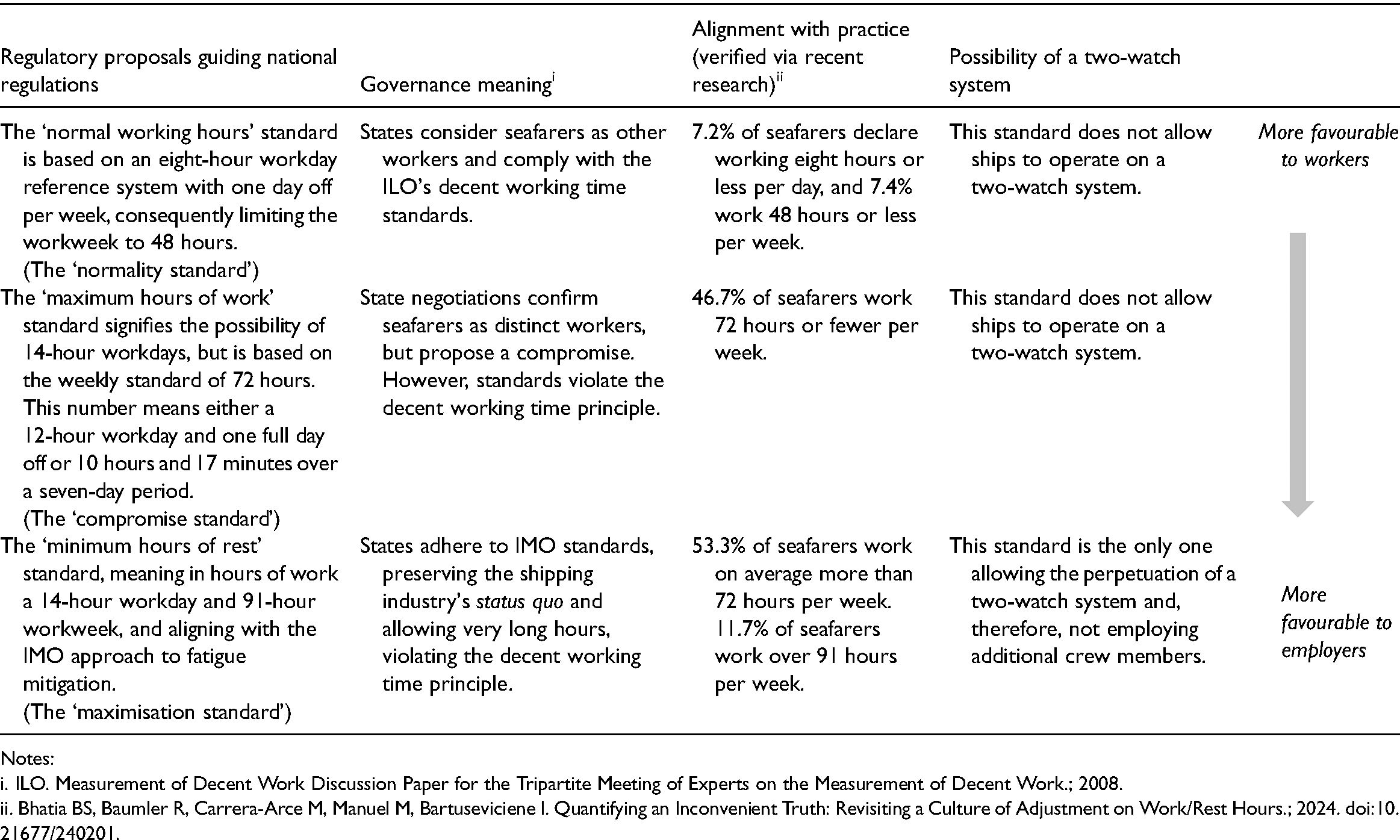
Summary of the three normativity models and impacts.
Researchers and non-governmental organisations (NGOs) have consistently highlighted the disproportionate influence of industry stakeholders within the IMO, suggesting a pattern of regulatory capture—a phenomenon also observed at the ILO. 24 The social dialogue instituted at the EU level shares this criticism by not questioning the status quo in the legislation created by both organisations. Neither Directive 1999/63 nor 2017/159 seeks to improve the minimum standards enshrined in the MLC, 2006 and C188. The same applies to other Directives introduced to implement both Conventions. 25 While the EU has been criticised in general for endangering the role of the IMO as a global standard-setting institution by introducing their own standards in maritime matters, 26 this has not occurred for labour matters, even though both, IMO and ILO Conventions set minimum standards with the aim of levelling the playing field and leaving room for the pursuit decent working and living conditions on board. More specifically, Standard A2.3, para. 4 of the MLC, 2006 indicates that: ‘In determining the national standards, each Member shall take account of the danger posed by the fatigue of seafarers, especially those whose duties involve navigational safety and the safe and secure operation of the ship’. Such consideration has not been undertaken by the EU social partners, who have only repeated the standards in the Convention and have left the decision up to EU Flag States.
Studying the Flag States’ regulatory choices when incorporating an international instrument that displays competing norms can reveal power balances and priorities. Do national regulators want to protect seafarers’ occupational health and safety by reducing their working time, or do they support labour intensification?
While some researchers argue that most Flag States tend to opt for provisions based on ‘hours of rest’, 27 a systematic analysis is lacking. The study intends to fill this gap through a review of Flag State preferences, along with a discussion of their implications.
Central to this research is the data collection, which focuses on the practical evidence contained in national laws or the Declaration of Maritime Labour Compliance (DMLC) Part I. This latter document is required by the MLC, 2006 to facilitate implementation and demonstrate compliance (Standard A5.1.3, para. 12). In the declaration, Flag States document ‘the national requirements embodying the relevant provisions of [the] Convention by providing a reference to the relevant national legal provisions […]’ (A.5.1.3, para. 10(a)). Additionally, shipowners must detail ‘the measures adopted to ensure ongoing compliance with the national requirements’ in DMLC Part II. 28
Methods
Finding objective evidence of Flag State decision-making when ‘effectively exerci[sing] its jurisdiction and control in administrative, technical and social matters over ships flying its flag’, as stated by the United Nations Convention on the Law of the Sea (UNCLOS Article 94), requires the collection of relevant data. For parties to the MLC, 2006, the DMLC Part I provides such evidence when available. When the DMLC Part I has not been obtained or has been deemed unclear, the national law has been explored instead or in addition to it. For non-parties to MLC, other sources of data have been used.
The study focuses on the top 35 Flag States identified by the United Nations Conference on Trade and Development (UNCTAD), because they account for 94.1% of the world's tonnage. 29 Additionally, the study includes the 27 EU Member States (14.2% of the world's tonnage) to complement the dataset. This inclusion is deemed justified because the EU region is recognised for its coordinated approach and progressive labour policies, especially on working time, as highlighted in the ILO General Survey on Working Time. 30
A sequential and systematic approach has been followed to gather national law or DMLC Part I (Figure 1).
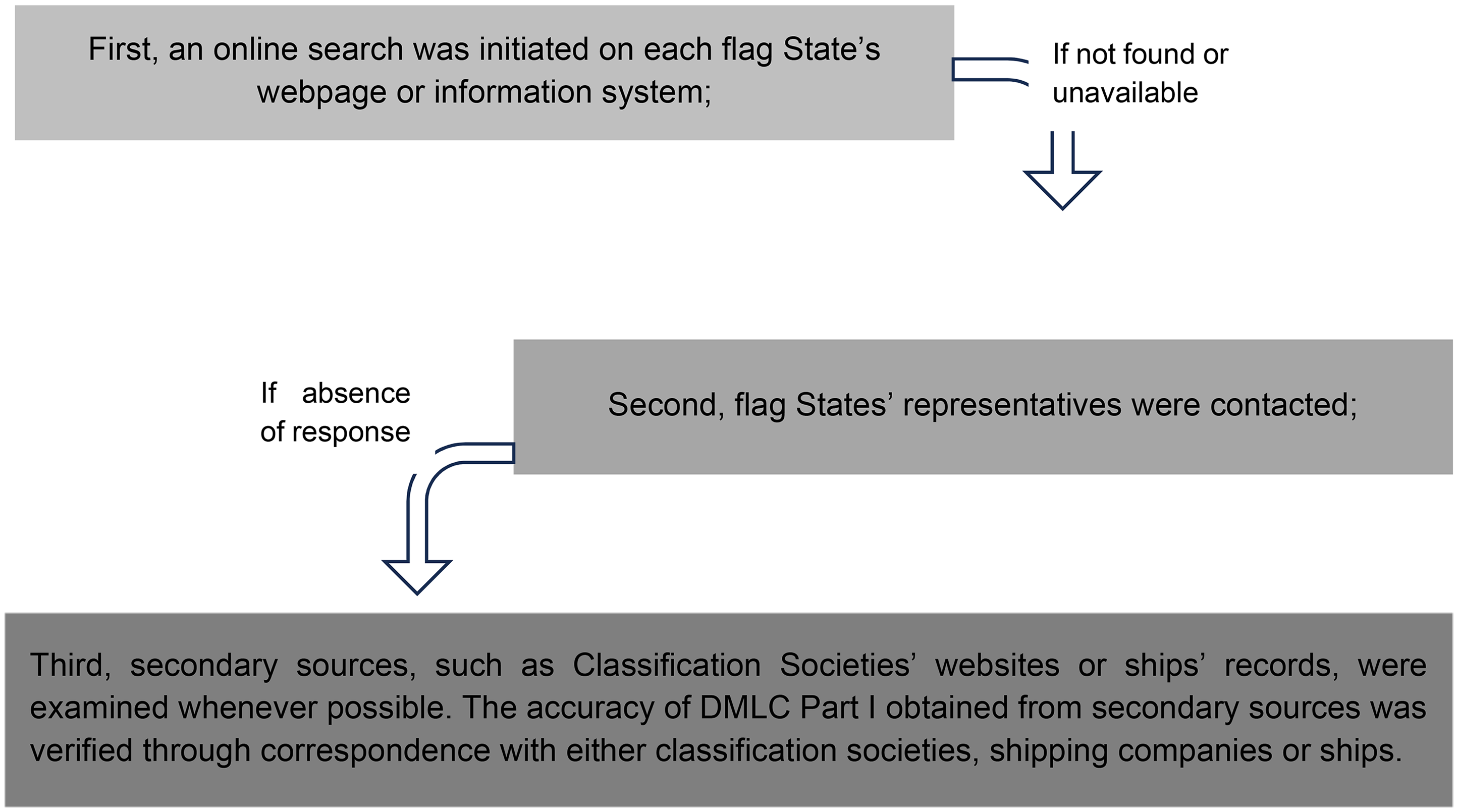
Research methodology.
Another approach to investigating Flag State preferences could involve directly examining the shipboard working arrangements, which detail the ‘maximum hours of work or the minimum hours of rest required by national laws or regulations or applicable collective agreements’ (Standard A2.3, para. 10[b]). However, such an examination would have to be carried out at individual ship level and would require data collection across multiple ships to be representative.
The tables (Table A1, Table A2) in the Appendix present the research outcomes for the 35 targeted countries and the 27 EU Member States that are parties (plus 3 European Economic Area [EEA] countries) 31 to the MLC, 2006. In total, the data covers 52 Member States.
The following findings are noteworthy:
The On ‘ On
Discussion
The unequivocal prevalence of the ‘maximisation standard’ reveals a striking alignment between Flag States and capital interests. Worldwide, countries have normalised profit-driven standards, even in the face of basic scientific evidence on working time and fatigue in transportation and the safety and health impacts. 35
Indeed, the proposals intended to mitigate or address the detrimental effects of very long hours on bodies and minds are either neglected or denied to seafarers. The data explicitly show that the sector disregards the possibility of introducing a 72-hour workweek and denies the possibility of a standard 48-hour workweek both in theory and practice. Supporting past research, a recent survey on seafarer working time confirms that, with a daily average of 11.5 hours and a weekly average of 74.9 hours, the persistence of very long working hours in the shipping industry remains. 36
Certain countries or regions, noting the contradiction between their commitment to labour protection and their actions, strive to reconcile both on paper. For example, Directive 1999/63/EC on the working time of seafarers mimics the C180, which was later integrated into the MLC, 2006. After recalling the normal working hours’ standard (eight hours of work per day and one day off), the Directive sets the genuine limits at 14 hours per day and 91 hours per week. The same applies to Art. 21 of Directive 2003/88 and Art.11 of Directive 2017/159 on working time in fishing. In addition to the particularities of work at sea, the choices made in the Directives prioritises the objective of ensuring fair competition among shipowners, i.e., assuming that reducing hours of work on board EU-flagged vessels will undermine their competitiveness and thus trigger re-flagging.
Such an approach also deprives sea workers on board EU vessels of the opportunity to discuss the quality of their rest periods on board. The distinction between working time and rest periods is common to all the aforementioned Directives, these definitions having been construed as autonomous concepts of EU law. In this vein, the EU characterisation of time as work depends on three conditions: (1) the worker must be ‘at work’, (2) he or she must be at the employer's disposal, and (3) he or she must be carrying out his or her activity or duties. 37 Time outside work as just defined is a rest period.
The Court of Justice has also had the opportunity to address the concept of rest periods in the context of stand-by duty, a period during which the worker is on-call either at the workplace or elsewhere, with specific obligations such as reporting to work within an established period of time - the question being whether such periods are to be considered working time or rest periods. Accordingly, while in the first case stand-by duty was classified as working time by the Court of Justice, 38 the second case gave rise to case law pointing towards a case-by-case examination of whether there are ‘constraints that objectively and very significantly limit the employee's right to control his/her own time’. 39 Should the answer be positive, stand-by time will be regarded as working time.
The background of these discussions is that the worker's safety and health should play a critical role in the organisation of working time, which should not be subordinated to purely economic considerations. 40 Interestingly, Advocate General Eleanor Sharpston went as far as to propose measuring rest periods in accordance with their quality, and thus considering all that do not meet a certain standard as working time. 41 While not accepted by the Court of Justice, the High Court nevertheless pointed out that stand-by duty might imply a work arrangement which ‘very significantly restricts worker's opportunities for other activities’, 42 and thus should be considered working time.
The latter is not the case for sea workers, taking into consideration the fact that the Court of Justice has also concluded that ‘where, due to the very nature of the workplace, the worker does not in practice have a realistic option of leaving that place after having completed his or her working hours, only those periods during which he or she remains subject to objective and very significant constraints, such as the obligation to be immediately available to his or her employer, must automatically be classified as ‘working time’ within the meaning of Directive 2003/88, to the exclusion of periods during which the impossibility of leaving his or her workplace is not the result of such an obligation but solely due to the particular nature of that place’. 43 However, the fact that they necessarily remain at the workplace, along with the seriously limited opportunities for other activities, should be compounded with the exceedingly high number of working hours to assess whether sea workers are effectively rested or not.
Enacting such regulations not only neglects science but also downgrades the humanity of sea workers, sending them the message that they do not deserve decent working conditions. In this respect, the 2008 ILO report on measurement of decent work underlines that decent working time indicators consider excessive working time to be above 48 hours and 60 hours. 44 The report also recalls that ‘[e]xcessive and atypical hours of work are a threat to physical and mental health, interfere with the balance between work and family life, and often signal an inadequate hourly pay’.
The permissive approach to seafarers’ working time inherently raises questions in respect of regulators’ objectives as it, in practice, exempts maritime employers from adhering to working time regulations that apply elsewhere. Worryingly, enabling excessively long working hours undermines the universality of working time.
When the ILO enacts a 14-hour workday for seafarers (and fishers), it violates its own reference standards with possible long-term consequences:
First, universal principles (such as the eight-hour workday and one-day-off reference system) and the commitment to providing ‘humane conditions of labour’ (as stated in the preamble of the ILO Convention) are distorted for sea workers. Is it a sign of crisis, ignorance or bureaucratic drift? Second, maritime governance proves ill-adapted to advance basic labour rights at sea. It appears that international structures, long-term sectoral isolationist politics, and tonnage lock have strengthened the structural power of shipowners, hindering the emergence of progressive labour regulations. Third, enacting downgraded labour standards targeting certain populations officialises discrimination. Allowing for standards that are beyond human capacity, such as 14-hour workdays and 91-hour workweeks, extracts seafarers from ‘normal’ humanity. Fourth, regulatory developments have proven to be scientifically ungrounded and have been unable to achieve their claimed objectives of mitigating fatigue.
45
Maritime regulations are often reactive and negotiated between peers to preserve capital interests.
Labour regulations are normally intended to protect the body and mind of workers from deleterious working conditions, including overwork. Today's maritime evidence shows that this is not the case for seafarers. Furthermore, labour law history indicates that improvements in working conditions require state arbitration and enforcement of regulations. When States align with the interests of capital and abandon essential principles, harmful regulations inevitably emerge.
In a capitalist society, where workers are subjugated to the decisions and organisations of employers, 46 the idea that shipowners will spontaneously choose to protect seafarers from the risks of long working hours seems both naïve and insincere, particuarly in a sector known for commodifying labour in a global market. 47
Conclusion
First, the study evidences a concerning trend: Flag States, both EU and non-EU, tend to adopt the lowest permissible regulatory standards for working time. The systemic prioritisation of lax standards, which legitimise working hours for seafarers that far exceed those deemed acceptable in shore-based industries, illustrates a serious power imbalance between social partners and the acceptance of regulations that are not scientifically grounded and claimed to mitigate fatigue.
Second, the normal working hours’ standard, unusually applied to seafarers (and fishers) at the international, EU and national levels, suggests that they belong to a distinct group, as they are expected to accept working conditions that are deemed harmful and dangerous for any other human being.
Finally, the existence of such ILO standards contradicts the core principles of the organisation, which calls into question its maritime machinery and capacity to protect workers at sea.
If progress is expected, the following points need to be addressed:
confirming and applying the universal social and human rights to sea workers; acknowledging sea workers’ humanity by preventing any discriminatory regulation and verifying the adequacy of current labour laws at international, regional and national levels; developing scientifically informed regulations and verifying the coherence of regulations in their capacity to achieve their objectives; reviewing ILO and IMO maritime governance to restrict excessive structural power and constructing a maritime sector as a public good.
Footnotes
CRediT roles
Raphaël Baumler: Supervision, Writing original draft. Bikram Singh Bhatia: Conceptualisation, Methodology, Investigation, Formal analysis, Writing original draft. Maria Carrera Arce: Supervision, Investigation, Formal analysis, Writing: review & editing. Laura Carballo Piñeiro: Writing: review & editing.
Declaration of conflicting interests
The authors declared no potential conflicts of interest with respect to the research, authorship, and/or publication of this article.
Funding
The authors disclosed receipt of the following financial support for the research, authorship, and/or publication of this article: This work was supported by ITF and ETF (Project ‘Social Rights of sea workers in EU waters’), and ITF Seafarers’ Trust (Project ‘Determination of Safe Manning Levels’).

Notes
Appendix
Hours of work and rest: Flag State preferences - EEA Flag States
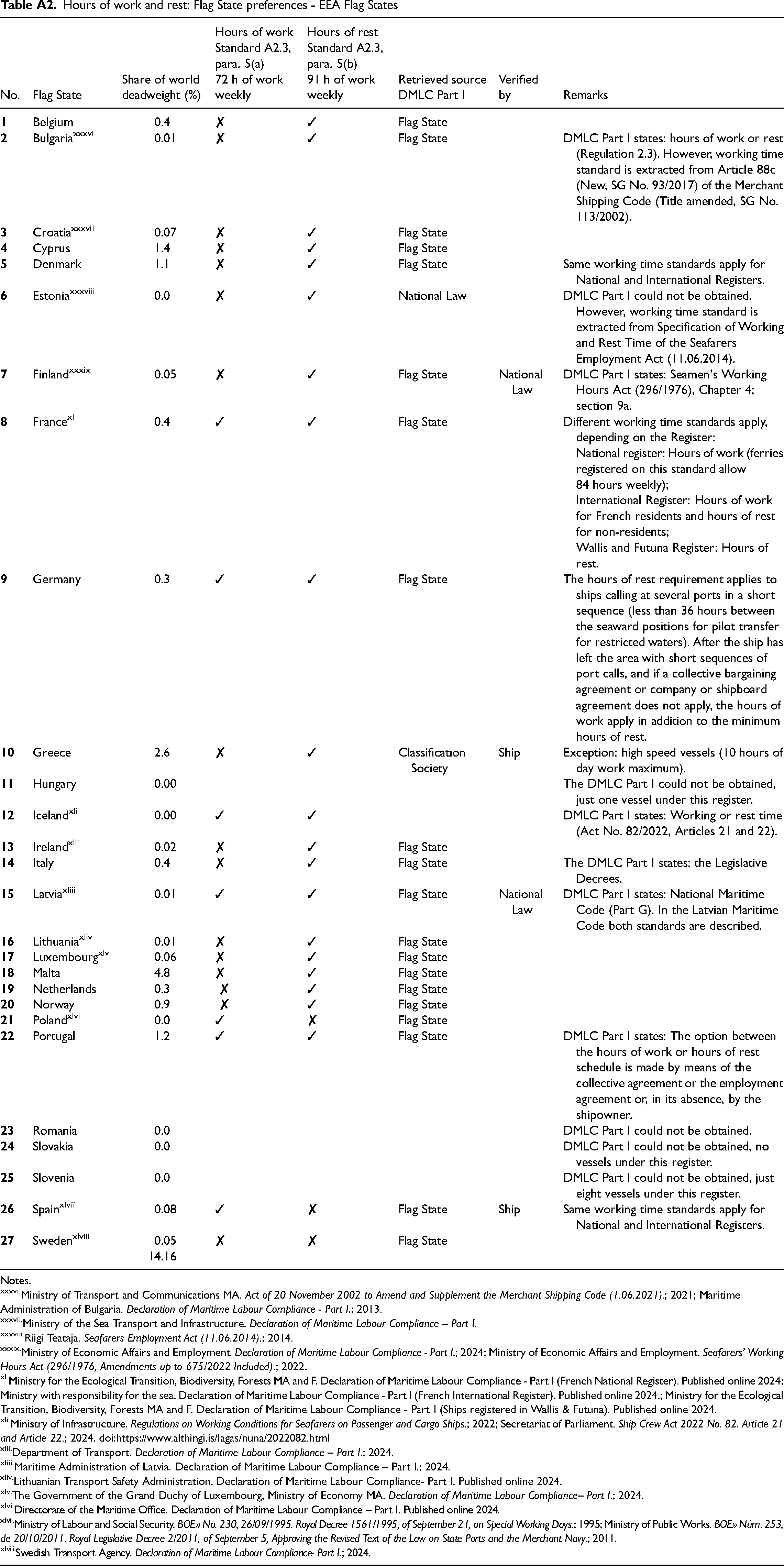
| No. | Flag State | Share of world deadweight (%) | Hours of work Standard A2.3, para. 5(a) |
Hours of rest Standard A2.3, para. 5(b) |
Retrieved source DMLC Part I | Verified by | Remarks |
|---|---|---|---|---|---|---|---|
|
|
Belgium | 0.4 | ✘ | ✓ | Flag State | ||
|
|
Bulgaria xxxvi | 0.01 | ✘ | ✓ | Flag State | DMLC Part I states: hours of work or rest (Regulation 2.3). However, working time standard is extracted from Article 88c (New, SG No. 93/2017) of the Merchant Shipping Code (Title amended, SG No. 113/2002). | |
|
|
Croatia xxxvii | 0.07 | ✘ | ✓ | Flag State | ||
|
|
Cyprus | 1.4 | ✘ | ✓ | Flag State | ||
|
|
Denmark | 1.1 | ✘ | ✓ | Flag State | Same working time standards apply for National and International Registers. | |
|
|
Estonia xxxviii | 0.0 | ✘ | ✓ | National Law | DMLC Part I could not be obtained. However, working time standard is extracted from Specification of Working and Rest Time of the Seafarers Employment Act (11.06.2014). | |
|
|
Finland xxxix | 0.05 | ✘ | ✓ | Flag State | National Law | DMLC Part I states: Seamen's Working Hours Act (296/1976), Chapter 4; section 9a. |
|
|
France xl | 0.4 | ✓ | ✓ | Flag State | Different working time standards apply, depending on the Register: |
|
|
|
Germany | 0.3 | ✓ | ✓ | Flag State | The hours of rest requirement applies to ships calling at several ports in a short sequence (less than 36 hours between the seaward positions for pilot transfer for restricted waters). After the ship has left the area with short sequences of port calls, and if a collective bargaining agreement or company or shipboard agreement does not apply, the hours of work apply in addition to the minimum hours of rest. | |
|
|
Greece | 2.6 | ✘ | ✓ | Classification Society | Ship | Exception: high speed vessels (10 hours of day work maximum). |
|
|
Hungary | 0.00 | The DMLC Part I could not be obtained, just one vessel under this register. | ||||
|
|
Iceland xli | 0.00 | ✓ | ✓ | DMLC Part I states: Working or rest time (Act No. 82/2022, Articles 21 and 22). | ||
|
|
Ireland xlii | 0.02 | ✘ | ✓ | Flag State | ||
|
|
Italy | 0.4 | ✘ | ✓ | Flag State | The DMLC Part I states: the Legislative Decrees. | |
|
|
Latvia xliii | 0.01 | ✓ | ✓ | Flag State | National Law | DMLC Part I states: National Maritime Code (Part G). In the Latvian Maritime Code both standards are described. |
|
|
Lithuania xliv | 0.01 | ✘ | ✓ | Flag State | ||
|
|
Luxembourg xlv | 0.06 | ✘ | ✓ | Flag State | ||
|
|
Malta | 4.8 | ✘ | ✓ | Flag State | ||
|
|
Netherlands | 0.3 | ✘ | ✓ | Flag State | ||
|
|
Norway | 0.9 | ✘ | ✓ | Flag State | ||
|
|
Poland xlvi | 0.0 | ✓ | ✘ | Flag State | ||
|
|
Portugal | 1.2 | ✓ | ✓ | Flag State | DMLC Part I states: The option between the hours of work or hours of rest schedule is made by means of the collective agreement or the employment agreement or, in its absence, by the shipowner. | |
|
|
Romania | 0.0 | DMLC Part I could not be obtained. | ||||
|
|
Slovakia | 0.0 | DMLC Part I could not be obtained, no vessels under this register. | ||||
|
|
Slovenia | 0.0 | DMLC Part I could not be obtained, just eight vessels under this register. | ||||
|
|
Spain xlvii | 0.08 | ✓ | ✘ | Flag State | Ship | Same working time standards apply for National and International Registers. |
|
|
Sweden xlviii | 0.05 | ✘ | ✘ | Flag State | ||
| 14.16 |
Ministry of Transport and Communications MA. Act of 20 November 2002 to Amend and Supplement the Merchant Shipping Code (1.06.2021).; 2021; Maritime Administration of Bulgaria. Declaration of Maritime Labour Compliance - Part I.; 2013.
Ministry of the Sea Transport and Infrastructure. Declaration of Maritime Labour Compliance – Part I.
Riigi Teataja. Seafarers Employment Act (11.06.2014).; 2014.
Ministry of Economic Affairs and Employment. Declaration of Maritime Labour Compliance - Part I.; 2024; Ministry of Economic Affairs and Employment. Seafarers’ Working Hours Act (296/1976, Amendments up to 675/2022 Included).; 2022.
Ministry for the Ecological Transition, Biodiversity, Forests MA and F. Declaration of Maritime Labour Compliance - Part I (French National Register). Published online 2024; Ministry with responsibility for the sea. Declaration of Maritime Labour Compliance - Part I (French International Register). Published online 2024.; Ministry for the Ecological Transition, Biodiversity, Forests MA and F. Declaration of Maritime Labour Compliance - Part I (Ships registered in Wallis & Futuna). Published online 2024.
Ministry of Infrastructure. Regulations on Working Conditions for Seafarers on Passenger and Cargo Ships.; 2022; Secretariat of Parliament. Ship Crew Act 2022 No. 82. Article 21 and Article 22.; 2024. doi:https://www.althingi.is/lagas/nuna/2022082.html
Department of Transport. Declaration of Maritime Labour Compliance – Part I.; 2024.
Maritime Administration of Latvia. Declaration of Maritime Labour Compliance – Part I.; 2024.
Lithuanian Transport Safety Administration. Declaration of Maritime Labour Compliance- Part I. Published online 2024.
The Government of the Grand Duchy of Luxembourg, Ministry of Economy MA. Declaration of Maritime Labour Compliance– Part I.; 2024.
Directorate of the Maritime Office. Declaration of Maritime Labour Compliance – Part I. Published online 2024.
Ministry of Labour and Social Security. BOE» No. 230, 26/09/1995. Royal Decree 1561/1995, of September 21, on Special Working Days.; 1995; Ministry of Public Works. BOE» Núm. 253, de 20/10/2011. Royal Legislative Decree 2/2011, of September 5, Approving the Revised Text of the Law on State Ports and the Merchant Navy.; 2011.
Swedish Transport Agency. Declaration of Maritime Labour Compliance- Part I.; 2024.