




Abstract
Finland conducted the first nationwide field experiment with partial basic income between 2017 and 2018. The experiment and its results were widely reported in international media and featured in political debates across the globe. Domestically, the experiment had an impact on social policy debates but no impact on social policy. For example, it did not feature in the Social Security 2030 project or in the work of the Social Security Reform Committee (2020–2027). The research setting for the experiment was compromised from the beginning due to political reasons; but the scientific power was further undermined by a new sanctioning model, which was implemented in 2018 at the beginning of the second year of the basic income experiment. The new Government taking office in 2019 promised to continue with a negative income tax experiment; however, no such experiment was conducted. The article will unpack these developments in Finland and discuss possible explanations for denouncing basic income as a policy idea.
Introduction
The Finnish basic income experiment started in 2017 evoked enthusiasm around the world. The fact that a country representing the Nordic welfare model, with top-ranking placement on almost all human development outcomes (Kenworthy, 2020), would experiment with basic income added undeniable credibility to the proposal. Additionally, Finland was the first country to conduct a field experiment on basic income at the national level. The experiment signalled both that Finland was interested in exploring basic income as a policy option for reforming the country’s social security system, and that the Government would base its decision on the evidence provided by a robust scientific experiment. This article takes these notions as hypotheses to be tested against subsequent developments in implementing the basic income experiment and utilising its results in policymaking. Was Finland genuinely interested in integrating basic income into its plans to develop social security? Was it ready to use evidence from the basic income experiment to guide its policy to develop social security? As the answers to both these research questions turned out to be negative, the article finally asks: why did the basic income experiment prove a missed opportunity for social security reform in Finland? This question will be answered by identifying moments of denial that prove cheap support for basic income.
Within the scope of this article, discussion of the basic income experiment took place during two consecutive government periods from 2015 to 2022. Historically, the Finnish parties have held very different attitudes on basic income. The Greens and the Left Alliance have been the most active proponents of basic income (e.g., Perkiö, 2020). Given that these parties have been both in opposition and in power, basic income has been a controversial issue both in Parliament and within the Governments. The Conservative Government of three parties – the Centre Party, the Finns Party, and the National Coalition Party – which was led by Prime Minister Juha Sipilä from the Centre Party, was in power between 2015 and 2019. Sipilä's Government was followed by the Social-Democrat-led Rinne/Marin Government, which included the Centre Party, the Greens, the Left Alliance, and the Swedish People's Party of Finland.
For Finland, persistently high long-term unemployment has been a particular problem since the deep depression in the early-1990s (Kiander and Vartia, 2011). In Finland as elsewhere, traditional activation policies had proven inadequate to employ long-term unemployed people and prevent them from social exclusion. These activation programmes have led to only a handful of long-term unemployed gaining consistent work.
The Finnish experiment led to unprecedented international interest, with hundreds of reports in foreign media outlets (Kangas et al., 2021). While basic income advocates had tried to revive interest in the policy idea through small pilots – for example, basic income lotteries, which mostly served as demonstration projects – the Finnish experiment was a large-scale project with a solid scientific ground. The expectation was that the results from Finland would bring clarity to the conflicting narratives of the negative tax experiments in the 1970s (e.g., Simpson, 2021). The international interest in the experiment was also a clear sign that despite its shortcomings, basic income addresses problems that many governments struggle to solve: how to find employment for those on the margins of the labour market and how to release even poor individuals’ energy and creativity to promote their own well-being and the well-being of their communities. However, as will be highlighted below, the experiment had a very different narrative in Finnish domestic policymaking (see also De Wispelaere et al., 2019; Halmetoja et al., 2019).
The analytical frame in the article is based on the idea of cheap political support developed by De Wispelaere (2016). De Wispelaere argues that much of the support for basic income by individual politicians, political parties, social movements, or interest groups is expressed as sincere preference in favour of basic income without true commitment (money, time, and, above all, political capital) to further the cause. De Wispelaere distinguishes two types of cheap support: a powerful agent speaking of basic income without true commitment, and a less powerful/marginal agent with true commitment but without the capacity to advance the policy. To study government-level political support for basic income in Finland during and after the experiment, it is necessary to identify key moments in governments’ efforts to reform social security. The following analysis will illustrate how the narrative of the political implication of the basic income experiment in Finland will bear resemblance with the story of apostle Peter in the Gospels and Acts, who denied Jesus three times during the events of the crucifixion. In the context of the basic income experiment, four denials are identified: (1) the Social Security 2030 Project; (2) the introduction of a new activation model; (3) the establishment of the Social Security Reform Committee; and (4) the fate of the negative income tax experiment, which was planned after the basic income experiment.
Goals and Implementation of the Experiment
In 2015, Juha Sipilä was nominated as Prime Minister of Finland. He was a graduate engineer and a successful tech-entrepreneur, who was a newly elected Chair of the Centre Party. In a country known for broad-based coalitions, Sipilä led a coalition of only three centre- and right-wing parties who agreed not only to put the Finnish economy on track after the Global Economic Crisis of 2008, but also to reform the government culture of policymaking. Evidence-based policy was to become a cornerstone of the new culture of decision-making. As part of that effort, the Sipilä Government decided to conduct a randomised control trial on basic income, a policy idea that had circulated in Finland within left-wing parties but also inside the Centre Party for a few decades (Koistinen and Perkiö, 2014; Perkiö, 2020).
The official goal of the basic income experiment was a policy measure designed to reform the Finnish social security system to better correspond to changes in working life and make it easier to take up part-time jobs that may lead to a more stable income. The experiment reflected a major shift in policy context. In the 1980s, basic income was discussed in Finland as a policy programme to reduce the supply of labour through sabbatical leave, job-sharing, and civil society activities (Perkiö, 2020). In the 1980s, related concepts, such as a citizen's wage or citizen's income, were used instead of basic income. During the 1980s, Finland had a young population with high labour force participation rates, while in later decades, Finland has been overshadowed by high unemployment and an ageing population. The social policy paradigm shifted in the mid-1990s towards an emphasis on work incentives and activation programmes. Since then, basic income has predominantly been understood in terms of activation policy as a tool to improve work incentives.
Before the early-1990s, all long-term unemployed people in Finland were entitled to a place in subsidised employment, through which they were able to renew their right to earnings-related unemployment benefits. That policy was gradually removed and replaced with sanctioning policies in the late-1990s. Since 2001, those who have been classified as “long-term unemployed” have been forced to participate in rehabilitative work programmes (Keskitalo, 2008). People who refuse to participate will lose their unemployment benefit for two months and may also face a reduction in their social assistance, which is the last tier of the income support system in Finland. As elsewhere, all minimum income benefits are means-tested in Finland, which means that extra income acquired from work is deducted from government-sponsored benefits. Combining small work incomes involved a lot of bureaucracy and repercussions, which could discourage jobless people from seeking the kinds of odd jobs and small jobs available to them. In 2015, the basic income experiment was presented as an innovation to incentivise young unemployed with no work history and the long-term unemployed to take up jobs.
The Social Insurance Institution of Finland (Kela) was responsible for the design of the basic income experiment (Kangas et al., 2021). The experiment was launched by passing a law that legislated the procedures and parameters of the experiment. 1 Kela also implemented the experiment.
The experiment was targeted at the young unemployed and the long-term unemployed. It replaced only non-contributory unemployment assistance benefit (Kangas et al., 2021). Those receiving basic income were entitled to housing allowance, social assistance, and other benefits. Therefore, it was an experiment with partial basic income. The experiment group consisted of 2,000 people who were randomly selected from a pool of individuals between the ages of 25 and 58, and who were receiving a flat rate non-contributory unemployment assistance benefit from Kela in November 2016 (about 130,000 individuals nationwide). According to the Law on Basic Income Experiment, 2 participation was mandatory. This was a unique feature compared with other experiments, where the samples are mainly based on voluntary self-enrolment.
The flat rate unemployment benefit programme is designed for young people who enter labour markets with no work history and for those long-term unemployed who have exhausted their right to higher earnings-related unemployment compensation. Clearly, the participants faced barriers to employment in the open labour market. The partial basic income payable during the experiment was called “perustulo”, which translates as “basic income”. In a nutshell, the aim of the Finnish basic income experiment was to test if the carrot works better than the stick in encouraging unemployed citizens to find new job offers and seek income from entrepreneurial activities (De Wispelaere et al., 2019). In essence, the experiment analysed three interlinked mechanisms:
Keeping extra income from work. Absence of sanctions. Reduced bureaucracy.
In the experiment, the sum of 560 euros per month was paid to basic income recipients (Kangas et al., 2021). This cash sum replaced the existing flat rate unemployment benefit and continued to be paid even if members of the experiment group took up jobs. The existing benefit was exactly the same amount as basic income; but the difference was that the basic income group was able to keep all extra money they earned above 300 euros per month (300 euros is the monthly amount of income disregard for unemployment benefits; after that, every extra euro from work results in a reduction of unemployment benefit by 50 cents).
Another important difference was the absence of sanctions. The basic income group did not risk losing their benefits if they refused to participate in active labour market policy programmes. An additional advantage for the participants was that they did not need to report their incomes to the employment office, which reduced bureaucracy and the insecurity caused by fluctuating benefit levels.
Income taxation also remained the same for those receiving the basic income. That is, the basic income was not “tapered” out by personal income taxation, even though it should be to be financeable at the population level. This means that the Finnish basic income experiment provided a stronger income incentive to work than a “real” basic income.
The control group comprised the rest of the unemployed in Finland, who received a flat-rate unemployment benefit at the end of 2016. Since the group getting the experiment “treatment” was similar to the control group in all relevant background characteristics, the experiment mimicked studies in natural sciences and medicine (Baron, 2018). The idea was that if there were any differences between the treatment and control groups after the experiment, that would establish a causal loop.
Policy Context
The basic income experiment needs to be understood in the specific Finnish policy context (see Halmetoja et al., 2019; Pulkka, 2019). The great majority of scholars and activists discussing the basic income experiment in Finland have failed to recognise the degree to which the existing legislation in Finland already resembles basic income. Section 19 “The Right to Social Security” in The Constitution of Finland, 3 which entered into force on 1 March 2000, states: “Those who cannot obtain the means necessary for a life of dignity have the right to receive indispensable subsistence and care.” In practice, this means that every legal resident in Finland is entitled to a basic amount of social assistance. On top of that comes assistance for housing and healthcare costs. If a non-disabled person refuses to participate in active labour market policy measures, the basic amount of social assistance can be temporarily reduced by 20 or 40 percent for a maximum duration of two months. In Finland, then, there already exists a non-conditional benefit scheme of 300-500 euros per month, with extra money for rent (up to 700 euros per month in Helsinki in 2021).
It is also important to emphasise that in Finland, social assistance is granted as a subjective right through a national agency, Kela (Social Insurance Institution of Finland), without any involvement of social work professionals (Varjonen, 2020). The mandate for granting basic social assistance was transferred from the municipalities to Kela at the time when the basic income experiment started (more exactly, since March 2017). Most of the applications are processed online. This means that all persons in the mentioned risk categories already have an unconditional basic benefit without means-test.
As argued by Simpson (2021:113), Finland and other Nordic countries could institute a basic income simply by dropping all work and other conditions associated with the receipt of social assistance. That would be, of course, very much against the current practice, where all claimants are obliged to register at the employment office unless they are exempted due to, for example, disability or illness. On the other hand, Finland is unique in the sense that social assistance is only partially conditional – it can be only reduced temporarily due to sanctioning.
First Denial: The Social Security 2030 Project
At the time of the basic income experiment, the Sipilä Government launched a project to prepare for a major social security reform (PMO, 2018). The aim of the “Social Security 2030” project (2017–2019) – known as “Toimi-project” in Finland – was to offer policymakers a comprehensive overview of the reform needs of, and different alternatives for, the Finnish system of social security and basic security. The explicit aim of the project was to seek new kinds of solutions to the social security of the future, for use by future governments.
In May 2018, the project presented three alternatives of how to arrange social security according to how three main value-decisions are weighted: individual versus family; universal versus targeted; and conditional versus unconditional (PMO, 2018). The third alternative - individual, universal, and unconditional - was essentially a basic income. However, the third option was not endorsed by the Social Security 2030 project; it was only presented as a theoretical option and not developed any further. This was surprising. In line with the basic income experiment, the starting point for the Social Security 2030 project were alleged labour market changes, including new forms of employment in the platform economy and ensuing insecurity, especially among low-educated workers (see e.g., Acemoglu and Restrepo, 2018).
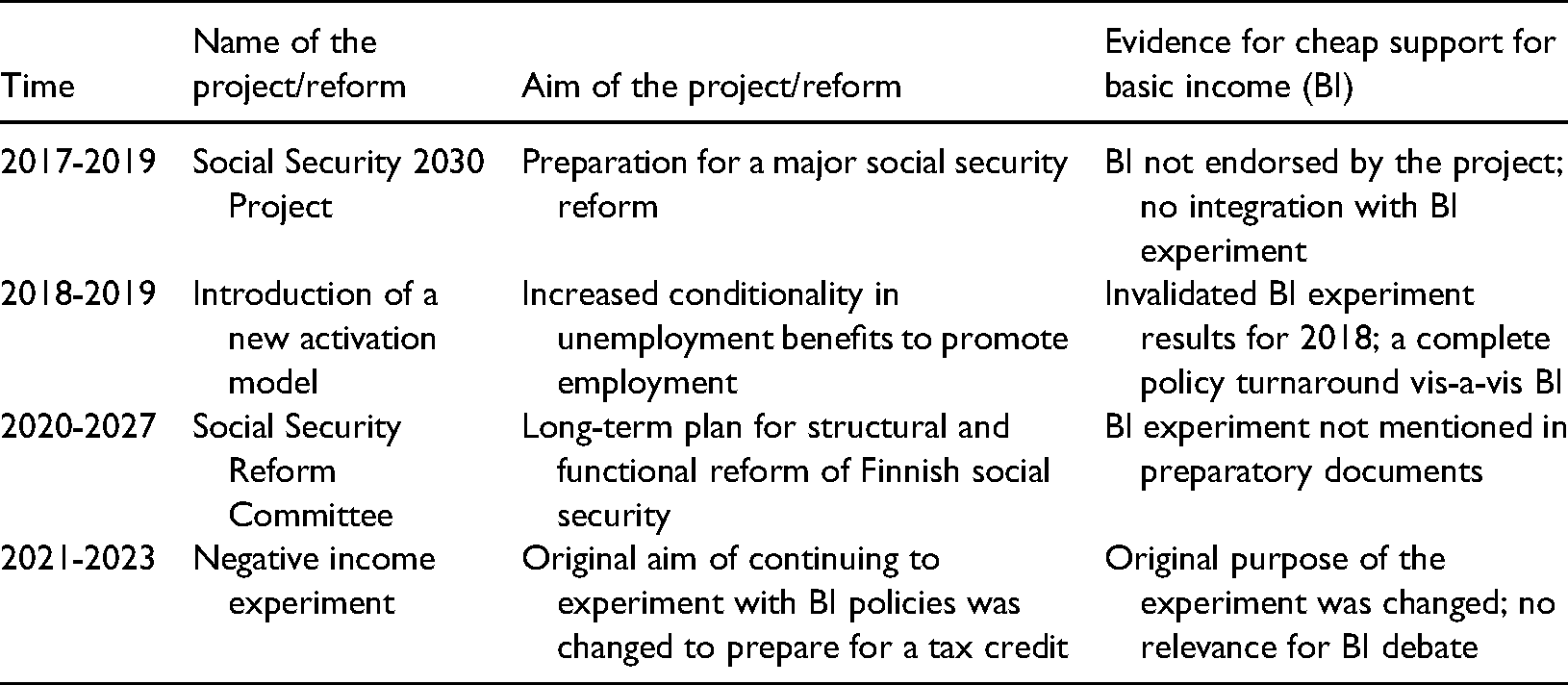
More conspicuously, there was no policy coordination with the basic income experiment and Social Security 2030 project. The thinking behind the experiment, its implementation, and preliminary results were not discussed in the context of the Social Security 2030 project. This prevented basic income from entering the major debate on reforming social security in Finland. Given that basic income experiments already had a high profile both in domestic and international debates, the decision not to integrate the Social Security 2030 project with the basic income experiment appears as a deliberate side-lining of the basic income experiment. This was the first time weak support for basic income became visible in reforming social security in Finland (Table 1).
Demonstration of cheap political support for basic income in reforming social security in Finland.
Difficulties in Implementing the Experiment
The implementation of the basic income experiment faced serious roadblocks (Kangas, 2021), which reflected animosity towards basic income among social security bureaucrats. The experiment budget to cover basic income payments was 20 million euros, but the benefit cost saved through the basic income payments was not considered. This means that net costs would increase only if there were more basic income payments than flat-rate unemployment benefit payments. With a view to expanding the experiment group, the Kela investigators tried to oppose the decision not to include the benefit cost savings, but were not successful.
The cameralistic interpretation of the experiment budget forced the research group to make do with only 2,000 people in the experiment group, whereby the ideas for oversampling of a particular region and including freelancers could not be realised. The aim of oversampling was to study the “spill-over” effects of basic income (Kangas and Pulkka, 2016; Kangas et al., 2016). For instance, basic income could increase consumption, which could add to the number of jobs available. This could in turn force employers to increase wages, which could then have unpredictable economic effects at the macro level. Planning of the Finnish basic income experiment was also delayed, so that when the actual work started, the research group had only six weeks to write the legislation and start implementing the experiment.
Another problem was that the research design did not allow for the study of the separate effects of the basic income’s different components (elimination of means testing, reduction in bureaucracy, and elimination of the obligation to participate in active labour market policies). An additional weakness of the research design was that child supplements were not incorporated into the design. In Finland, unemployment benefit comes with a supplement for each child, up to a maximum of three children (and a maximum amount of around 10 euros per day). This means that if recipients of unemployment benefit in the experiment group were eligible for the child supplement, they had to apply for the supplement from Kela and were partly returned to the old system, with its sanctions attached to participation in active labour market policies (ALMPs).
The limited scope of the Finnish basic income experiment was also reflected in the choice of outcome measures, which mostly relate to labour market outcomes (Kangas et al., 2020). The main outcome was the difference in employment rates (days worked and income from work) between the treatment (basic income) and control groups. Since Finland has extensive register data on health and well-being, it would have been possible also to study, for example, expenditure on medication, healthcare usage, and income variation. However, these outcomes were not discussed in the law detailing the experiment or in the official policy documents. Kela, the organisation designing and implementing the experiment, did not approach the study participants before the experiment to conduct surveys or qualitative interviews. To avoid observer effects, Kela announced that it was not conducting interviews or questionnaires during the experiment.
Second Denial: The Activation Model
By far, the biggest drawback of the Finnish basic income experiment was that a new sanction regime (“activation model”) was implemented in 2018, which was the second year of the basic income experiment (Kangas and Kalliomaa-Puha, 2019). The aim of the activation model was to tighten the conditions for benefit eligibility, encourage activation of the unemployed, reduce the duration of unemployment, and increase the employment rate. The unemployed were required to meet an “activity condition” to avoid curtailment of their benefits.
The activation model basically invalidated the basic income experiment results for the second year (Kangas et al., 2020), which was a major setback for an experiment with already a tight time frame. Due to the activation model, the effects of the second year of the experiment cannot be separated from the effects of the activation model (Verho et al., 2022). This was not only a technical failure in a research experiment, but it also reflected major change in the Government’s policy to promote evidence-based decision-making. Despite the roadblocks described above, basic income was being experimented with a solid scientific approach. However, the activation model was introduced without a plan to study its effects. In its final assessment of the effects of the activation model, the Government Economic Institution had to acknowledge that, in the absence of a preconceived plan to study the reform's effects, no firm conclusions could be drawn (Kyyrä et al., 2019).
The Government's decision to implement the new sanction regime stood in absolute conflict with basic income (Halmetoja et al., 2019). Basic income recipients were given the freedom to decide themselves on how to contribute to society and benefit both themselves and their community, while the activation model was based on a sanctioning ideology, whereby the state bureaucracy defined the approved activities. The first approach represented unconditionality, while the second approach introduced more conditionality.
The decision to implement the activation model cannot be interpreted in any other way than reflecting the Government's lack of true commitment to the basic income experiment. The decision to implement the activation model was in clear conflict with a genuine interest in basic income as a policy option. Had the Government been open to the possibility of pursuing basic income as a policy option, it would not have implemented a model representing a completely different philosophy in the middle of the experiment with basic income. Additionally, the Government clearly denounced its own intention to gain robust scientific evidence from the basic income experiment.
This was the second time that policy indicated that the original support for basic income, as shown in the Government’s Programme, was no more than cheap support and lacked true commitment to pursue the policy (Table 1). The decision to contaminate the basic income experiment also reflected the power of the conservative National Coalition Party in the Sipilä Government. The activation model was strongly supported by the National Coalition Party, which had very little understanding of the basic income experiment.
Interpretation of the Experiment Results
When the long-awaited results from the two-year Finnish basic income experiment were finally released in May 2019, almost 18 months after the experiment had been concluded, the verdict was that there was very little difference in employment or earned income between the experiment and control groups (Kangas et al., 2020). The average number of days of employment between November 2017 and October 2018 was 78 for the basic income group, while the corresponding figure for the control group was 73 (Verho et al., 2022). Over the first year of the experiment, there was no difference between the groups. In the second year, the basic income group worked five days more, but the difference cannot be attributed to basic income alone. Due to the activation model, the effects of the second year of the experiment cannot be separated from the effects of the activation model.
The research group concluded that the basic income model - together with the additional “exemption from income taxes” carrot included in the experimented basic income - did not actually work in increasing employment (Verho et al., 2022). The final report of the Finnish basic income experiment also discussed survey results that showed the basic income group had clearly higher subjective wellbeing across a large variety of measures (Kangas et al., 2020). According to subjective evaluations, basic income recipients experienced significantly fewer problems relating to health and stress. The average scores for life satisfaction, from 0 (lowest) to 10 (highest), were 7.3 for the basic income group and 6.8 for the control group.
Due to the problems with the survey, the research group concluded it is not possible to determine if the positive results can be attributed to the basic income (Kangas et al., 2020). The primary aim of the experiment was not to study the effects on well-being beyond employment. This explains the absence of a baseline survey. This is a major weakness, since wellbeing effects are at the core of the global basic income debate. However, the survey results were interesting enough to keep up interest in basic income, especially among those who see basic income more as a social justice issue and less as an instrument for activating the unemployed.
More surprisingly, the results from the final Finnish basic income experiment report revealed that many members of the basic income group did not want to abandon employment services and active labour market policy measures (Verho et al., 2022). They were in no way obliged to register with the employment office, but a great majority of them still decided to do so. 4 The share of the basic income group who registered with the employment office was - at most - only 17 percent lower than the corresponding share of the control group. The research group concluded that most of the basic income group did not have a problem with the conditionality of employment services, which is a conclusion that has major relevance for reforming social security in Finland and elsewhere (Kangas et al., 2020).
Third Denial: The Social Security Reform Committee
The incoming Rinne/Marin 5 Government, led by the Social Democrats, decided to scrap the activation model in 2019 but did not act upon reforming social security towards basic income. The decision demonstrates that cheap support for basic income came not only from the Sipilä Government, but is a broader attitude in Finnish politics. The new Coalition included both the Green Party and the Left Alliance, which have traditionally supported basic income (Perkiö, 2020). However, besides negotiating a statement on the negative income tax experiment in the Government’s Programme, these parties did not insist on reforming social security towards basic income.
Cheap support for basic income was again reflected in 2020 when Sanna Marin's Government appointed a Parliamentary Social Security Reform Committee with a mandate period until 2027. The Committee consists of nine full members representing each party in the Finnish Parliament, as well as 24 experts, a chair and secretariat, and five sub-committees. The task of the Committee is to draft a long-term plan for structural and functional reform of Finnish social security. The mandate covers basic social security, social assistance, and earnings-based benefits, as well as their integration with employment, health, and social services.
The mandate letter mentioned preparatory work conducted during the Sipilä Government under the Social Security 2030 project. However, basic income was not mentioned in the Social Security 2030 project. Consequently, basic income and the results of the experiment were also not mentioned anywhere in the preparatory documents or in the official decisions to appoint the Social Security Reform Committee (MSAH, 2022). The preliminary conclusions of the Committee do not discuss basic income; rather, they indicate strengthening conditionality in social security (MSAH, 2022). This was the third time a major decision was taken not to pursue basic income policy in Finland (Table 1). Considering the Social Security Reform Committee’s preliminary conclusions, the basic income experiment appeared as a completely separated process from reforming social security in Finland. This was yet more evidence of cheap political support for basic income in Finland.
Fourth Denial: The Negative Income Tax Experiment
Acknowledging the limitations of the original experiment, the basic income research team recommended expanding the experiment in future years (Kangas, 2017). According to the expert group that designed the initial experiment, producing more reliable and generally applicable information required a series of experiments to study the preconditions for the reform from a variety of perspectives and for various population groups. There were plans to introduce a new experiment in 2018 with a wider treatment group consisting of self-employed persons, freelancers, small-scale entrepreneurs, and other small-income receivers. The research team also proposed a future experiment with negative income tax, which could have been built on the comprehensive national income register introduced in 2020. 6 In August 2017, the Sipilä Government decided not to invest in any new basic income experiments.
Basic income rebounded in the new Left-Centre Rinne/Marin Government, which took over in 2019. Its programme included a negative income tax experiment (although the English version of the Government’s Programme spoke about a basic income experiment). A major shortcoming of the basic income experiment was that it targeted unemployed recipients of basic security only. For example, low-paid employees were not included in the experiment. It was expected that the negative income tax experiment would include these groups. A negative income tax could replace, for example, flat-rate unemployment compensation and minimum sickness benefits with a single benefit paid through taxation. This would simplify the social security system, reduce bureaucracy, and also encourage low-paid work.
The two first years of the Left-Centre Rinne/Marin Government were overshadowed by the COVID-19 pandemic, and nothing happened around the negative income tax experiment. Finally, in August 2021, the Ministry of Finance said that it had set up a working group to investigate the introduction of a negative income tax in Finland (Ministry of Finance, 2021). However, the Ministry of Finance's mandate limited the examination of a “negative income tax” to the earned income tax credit, which is a form of wage subsidy for low-income workers. The limitation truncated the idea of a negative income tax into small-scale tax support.
Surprisingly, the decision to scrap the negative income tax experiment did not arouse objections or criticism from either the opposition or coalition parties. No vocal opposition was heard even from the Green Party and the Left Alliance, which had pushed the initiative into the Government’s Programme and had cherished the negative income tax trial as a political victory and a step towards implementing basic income in Finland. It is remarkable that the announcement to abandon a genuine negative income tax experiment came from the Chair of the Centre Party, who was the Minister of Finance at the time. This demonstrated the Centre Party's cheap political support for basic income. This was the fourth time when political support for basic income evaporated without any political ramifications in Finland. The pandemic contributed to the watering down of the negative income tax experiment. However, crises can also consolidate support for unconditional and flexible forms of social security. The incidence demonstrates cheap political support for basic income in Finland (Table 1).
Summary and Conclusions
The Finnish basic income experiment was intensively discussed outside Finland; but within the country, it had little effect on reforming social security. Following the evidence-based policy approach adopted by the Sipilä Government and followed up by the Rinne/Marin Government, it would have been logical to bring the basic income experiment's results into the centre of social security reform. However, it seems there was no genuine interest in Finland in implementing basic income or learning from the basic income experiment results. The developments during and after the experiment demonstrate that the experiment did not consolidate support either for basic income as a policy idea, or for using the results from the basic income experiment to help reform social security in Finland. The experiment remained a truly missed opportunity for reform. The domestic narrative of the experiment in Finland clearly demonstrates cheap support (De Wispelaere, 2016) for the basic income throughout the preparation, implementation, and analysis of the experiment results (Table 1).
Why did this happen? Firstly, it might be that large coalition governments, like in Finland, tend to have initiatives in their governmental programmes that are not expected to be accomplished, but have only a signalling function to supporters. Secondly, including the basic income experiment in the Sipilä Government's programme could have merely been a manoeuvre to please certain progressive voices inside the Centre Party (Prime Minister Juha Sipilä not being one of them). The Centre Party (formerly the Agrarian Party) has long favoured flat-rate benefits over earnings-related benefits, since the party is representing farmers and agricultural workers who do not have regular earned income. This standpoint has lost meaning since the party has gained more support among wage-earners. By De Wispelaere's (2016) two categories of cheap support, the Centre Party's position reflects a powerful agent speaking of basic income without true commitment. Previous studies have shown that the Greens have been rather committed to basic income in their political actions (e.g., Perkiö, 2020). The Green Party is certainly not a marginal actor, but is less powerful compared with the Centre Party and not powerful enough to build a coalition. The last two denials demonstrate that the Greens have not been willing to compromise on other political goals for promoting basic income in the cabined negotiations leading up to the nomination of the Social Security Reform Committee and in the follow-up to the negative income tax experiment.
Thirdly, it is also important to acknowledge that the Finnish basic social security system does not deviate from the basic income model as much as in many other countries. Additionally, Finland applies more lenient social assistance sanctions than other European countries (Eleveld, 2016). The remaining conditionality in the Finnish social security system is strongly supported by social partners and the largest political parties. In the larger frame of social policy reforms, the Finnish basic income experiment appears as a side stream, which did not in any event manage to undermine support for the existing institutionalised social security system.
Despite the lack of immediate impact, the Finnish basic income experiment has important take-home messages which could be utilised in reforming social security in Finland and elsewhere. Firstly, as expected among basic-income scholars, the results aligned with what was earlier known about the labour supply effects of basic income. Substitution effects are moderate and income effects are small. There were positive effects on subjective well-being (Gibson et al., 2020; Simpson, 2021:167) and social trust (Kangas et al., 2021). The experiments also show that at least some target groups benefitted from participating in the activation measures. This finding emphasises the role of personalised services for the long-term unemployed. The main conclusion points to the motto: “letting go and learning to trust” (Muffels, 2021).
Secondly, the Finnish experiment demonstrated that the problems experienced by young and long-term unemployed individuals in finding work may not relate to bureaucratic obstacles to benefits or financial incentives. Similarly, the results showed that financial incentives for employment and a reduction in benevolent bureaucracy may not be used as selling points for basic income. The results also called into question punitive workfare policies based on the deterrent effect of unemployment services. During the first phase of the COVID-19 pandemic, activity requirements for unemployed persons were abandoned (Mäntyneva et al., 2021). When the pandemic situation temporarily improved, the requirements were reinstituted.
Thirdly, the Finnish results showed that young unemployed and long-term unemployed individuals were willing to participate in ALMPs, even if participation was not mandatory (however, it is not clear whether all recipients of basic income were aware that they were not required to participate in ALMPs). This notion gives room to develop employment services and cash benefits based on mutual trust between claimants and policymakers. Similar results are emerging from elsewhere. The Dutch “trust experiments” (Muffels, 2021) and Barcelona experiment align with the results from the Finnish basic income study (Lain, 2019; Rincon in this volume; Riutort et al., 2021). The employment effects were either insignificant or negative, indicating that financial incentives matter less than expected.
Towards the end of the experiment, public interest in basic income faded. Many parties and stakeholder groups began to emphasise the importance of benefit conditionality. However, basic income will be discussed again in Finland when the Social Security Committee publishes its report on alternative models for social security in 2023 (MSAH, 2022). During the first year of deliberations, the Committee adopted a two-tier process: a plan for incremental reform is prepared first, followed by a report on the principles for long-term reform. The latter part includes a study on alternative models for social security, where a basic income is also analysed and compared with the existing social security system. The interim report of the Committee is expected to be released by early 2023. This means the results from the Finnish basic income experiment may find new relevance in the near future. However, the preparatory documents of the committee indicate support for strengthening rather than relaxing conditionality (MSAH, 2022). The basic income experiment data were finally released for other scholars outside the original research group in early 2022. New results from the experiment will facilitate academic discussion, but their impact on social security politics remains unknown.
Footnotes
Acknowledgements
The author expresses his gratitude to Pasi Moisio, Jürgen de Wispelaere, and two anonymous referees for comments and suggestions.
Declaration of conflicting interests
The author(s) declared no potential conflicts of interest with respect to the research, authorship, and/or publication of this article.
Funding
The author(s) disclosed receipt of the following financial support for the research, authorship, and/or publication of this article: This work was supported by the Strategic Research Council (Academy of Finland) Project “Manufacturing 4.0 – Reshaping social policies” (WP5) and the European Union’s Horizon 2020 research and innovation programme under grant agreement No. 822296.
