



Abstract
The latest UK and Norwegian state pension reforms have reflected contrasting policy design in the balance of private pensions, savings and state provision. Nevertheless, we argue that both governments have in many ways adopted strikingly similar approaches in seeking public acceptance of these potentially controversial reforms, employing a similar repertoire of discursive elements to persuade populations about their logic and rationality. Based on critical analysis of government policy papers, speeches and parliamentary debates, we find that both countries emphasise ‘sustainability’ and ‘fairness’ within an increasingly individualised context where both systems are characterized as facilitating individuals’ efforts to attain security in retirement through ‘choice’ or ‘flexibility’. Significantly, contrasting symbolic metaphors are adopted to situate these reforms, and their proponents, within the heritage and traditions of their different welfare systems, which we find is a key element in successfully implementing the reforms. We note the implications of this research for the analysis of European state pension reform.
1. Introduction
In the past decade, the adequacy and sustainability of public and private pension provision has been a key issue for nation states across Europe (European Commission, 2018; HLG, 2019). The fiscal demands of the coronavirus pandemic (Di Feliciantonio, 2020) have only compounded the budgetary challenges of population ageing and shrinking workforces. As a result, governments have faced, and will continue to face, the dilemma of seeking retrenchment in state-sponsored pension spending whilst avoiding claims of intergenerational unfairness. In most cases to date, the result has been incremental, parametric reductions in levels of pension provision (European Commission, 2018).
So how have governments justified these reforms so far? In seeking to address this question we examine the importance of discursive regimes, following the influential work of Schmidt, who argues that an important element in reforming welfare states is the “ability to legitimate the economic adjustments and institutional adaptations by way of public discourse” (2000: 278). This discourse, according to Schmidt, should differ across countries due to different contexts, pressures and differences in the relevant actors that must be convinced. We therefore adopt a comparative case study examining how the UK and Norway have addressed the challenges of state pension reform. These countries have been selected because of their contrasting institutional pension structures and different welfare state typologies as defined by Esping-Andersen (1990). Norway represents the social-democratic welfare system and the United Kingdom the liberal welfare system.
Comparing Norway and the UK implies contrasting two different pension systems. The public British system was and is directed towards protecting against poverty in old age (basic security, the Beveridge model) rather than securing income standard security as in continental Europe (e.g. the Bismarckian model of Germany) (Hinrich & Lynch, 2010). The public pension system in Norway, Folketrygden (National insurance) has in contrast, since the introduction of income related pensions in 1967, aimed at combining basic and standard security, or in other words combining Bismarck and Beveridge. The contained public responsibility in the British system, has strengthened the role of occupational pensions and private market-based arrangements for income security in the British pension system (Bridgen & Meyer, 2011). The strong dominance of public pensions in Norway has reduced the scope for occupational and private pension schemes.
A simple way to illustrate this is to have a look at replacement rates, which tells us the share of previous earnings that an individual receives as pension in retirement. The figures in Table 1 indicate some important aspects of the functioning of the two pension systems previous to the pension reforms. This composition of different pension institutions expresses in historical context different policy ideas and broader welfare state philosophies of the two countries. In the British and liberal welfare state tradition limited public resources should be targeted at those most in need to reduce poverty, and additional income needs ought to be left to the individual and his/her own decision on saving and choice of a suitable level of living in old age. Thus, voluntarism is key in the British pension system (Bridgen & Mayer, 2011). The Norwegian tradition expresses a wider state responsibility for welfare in line with what is known as the social democratic, Scandinavian or encompassing welfare model (Esping-Andersen, 1990). Here, public resources are used to reach beyond fighting poverty to ensure income inequalities in old age are lower than in working life (Pedersen, 1999).
Net replacement rates of public pensions at various lifetime earnings levels in 2004.
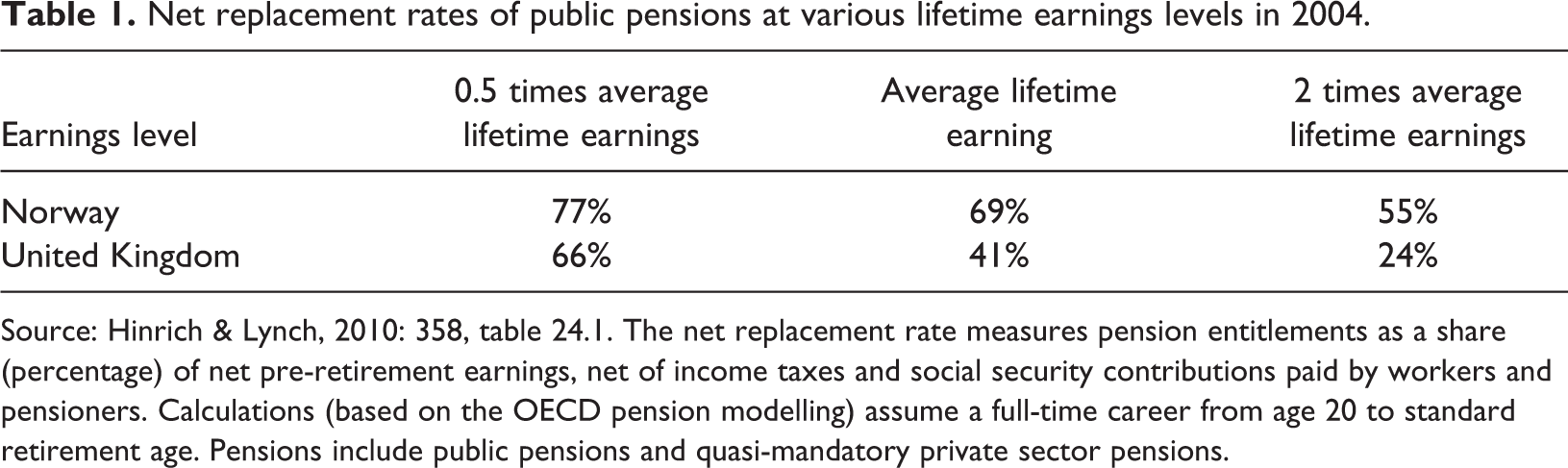
Source: Hinrich & Lynch, 2010: 358, table 24.1. The net replacement rate measures pension entitlements as a share (percentage) of net pre-retirement earnings, net of income taxes and social security contributions paid by workers and pensioners. Calculations (based on the OECD pension modelling) assume a full-time career from age 20 to standard retirement age. Pensions include public pensions and quasi-mandatory private sector pensions.
We conduct a critical investigation of government policy papers, speeches and parliamentary debates over the periods 2001-2009 (Norway) and 2004-2013 (UK). By undertaking a form of directed content analysis of policy documents (see Hsieh and Shannon 2005), identifying the key concepts forming the basis of our discursive analysis, we are able to derive intensity scores for those concepts. The scores indicate the number of times each concept is used in a document as a percentage of the number of pages in that document. We treat this as a proxy of the importance of a concept in the discursive narrative of that document. This enables us to characterise and compare the discursive narratives employed in each country in attempting to implement state pension reform.
Despite their differences, we find similarities between the two countries in what Schmidt refers to as the ideational dimensions of discourse. Specifically, the reforms in both countries harness elements of discourse embedded in attempts to address demographic and economic structural stresses, as well as increasingly influential privatising and individualising pressures, experienced by states across Europe (European Commission, 2012). However, as Schmidt points out: “Good ideas alone…. are not enough. They must be translated into a common language accessible to the larger public that can serve as the basis for a discourse capable of convincing citizens of the appropriateness and legitimacy of change” (2000: 285). We find that there are both differences and similarities in what Schmidt refers to as the interactive dimension of discourse. Both countries emphasise ‘sustainability’ and ‘fairness’ within an increasingly individualised context where both systems are characterized as facilitating individuals’ efforts to attain security in retirement through ‘choice’ or ‘flexibility’. Significantly, contrasting symbolic metaphors are adopted to situate these reforms, and their proponents, within the heritage and traditions of their different welfare systems, which we find is a key element in successfully implementing the reforms. We thus add to literature on pension reform and security as well as the important question about how governments try to gain public acceptance of potentially controversial reforms to pension systems (see, for example, Belfrage, 2015 and Bridgen and Meyer, 2018).
The next section contextualises, and further justifies, our comparison of Norway and the UK. Thereafter, section three outlines Schmidt’s theoretical perspective and its relevance for our work. Section four briefly outlines data and sources. The main analysis of the pension reform discourses of the two countries is provided in section five. Section six provides a discussion and conclusion.
2. Case selection
Whilst there are similarities in the issues Norway and the UK were attempting to address, their pension systems rested on very different degrees of state responsibility.
As illustrated in Table 1, prior to the reforms examined, the two countries revealed fundamentally different approaches. Norway, combined a fairly generous minimum pension with an earnings-related element aimed at securing moderate living standards (within an income ceiling) in old age through a PAYG system (cf. Pedersen, 2011 for an elaboration). In the UK a below subsistence level, flat rate pension was supplemented by some additional earnings-related second state pension (cf. Seeleib-Kaiser, 2013) and means tested benefits. Unsurprisingly, this resulted in very different outcomes for the then current, and predicted future, public spending on state pensions.
In Table 2 1 , we see that in 2000, prior to reforms in either country, relative spending was higher for Norway than for the UK, and was predicted to increase significantly, putting Norway above the OECD spending average (NOU 2004: 1, p. 52). For the UK, public spending was also expected to increase but predicted to be at a substantially lower level than for Norway. Post- reform spending predicted for 2050 would reduce Norwegian public spending figures by around 3 percentage points. As regards the UK, it was expected that, despite anticipated demographic pressures, state pension spending as at 2050 would be broadly similar pre- and post- 2016 reform (although it was argued that taking into account increased National Insurance contribution receipts resulting from the abolition of the contracting out element of the State Second Pension would mean that the reforms generated substantial savings) (Pensions Policy Institute, 2014).
Current and future direct public old age pension spending pre and post reform: Share of GDP, 2000, 2050.
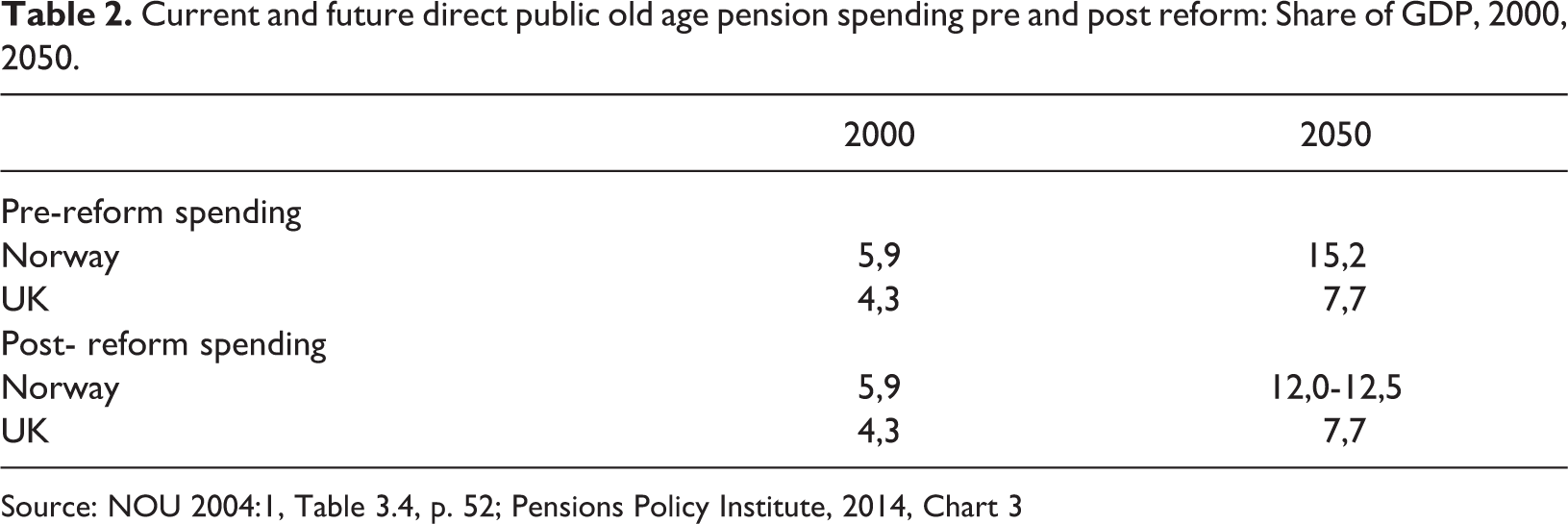
Source: NOU 2004:1, Table 3.4, p. 52; Pensions Policy Institute, 2014, Chart 3
Norway and the UK are therefore good cases to compare. Both pension systems have faced demographic and economic cost pressures. However, their welfare state typologies, institutional structures and levels of provision, differ significantly. Thus, we might expect differences in the discourse used in each country to successfully introduce reforms that would otherwise be controversial to voters and interest organizations (cf. Immergut and Abou-Chadi, 2014). Considering their approaches to gaining acceptance of state pension reforms, and in particular seeking reduction in state pension expenditures, this allows us to assess the possible implications for other governments implementing similar reforms.
3. Theoretical perspective: the need for convincing discourse
The importance of pensions in the welfare state edifices of both Norway and the UK is well documented (Bjørnson, 2001: 212; Barr, 2001). Pension institutions are not simply technical vehicles providing income streams; they encapsulate notions of fairness and distributive justice. Consequently, successful reform requires influential interest groups and the general public to be convinced of both the justification for, and effectiveness of, any proposed reforms. These concerns tap into the central dimensions and functions of discourse discussed in Schmidt’s account of the nature of discourse (2000: 277-290). According to Schmidt, public discourse is defined as: the sum of political actors’ public accounts of the polity’s purposes, goals and ideals which serve to explain political events, to justify political actions, to develop political identities, to reshape and/or reinterpret political history, and, all in all, to frame the national political discussion (2000: 279).
Schmidt distinguishes between two central dimensions of discourse: the ideational and the interactive. Table 3 summarises these discursive dimensions and their functions in Schmidt’s analytic account. The ideational dimension of discourse requires a policy programme providing good reasons for its implementation and that is appropriate, in as much as it aligns with national values. Its cognitive function demonstrates why the proposed policy programme is superior to the present one; correctly identifying the problem at hand, providing the goals to be achieved, and pinpointing the means and instruments to be deployed. Its normative function legitimates the policy programme by attempting to connect it to entrenched values and national identity, demonstrating how the new ideas of the proposed policy programme are in keeping with those values and identity.
The dimensions and functions of discourse.
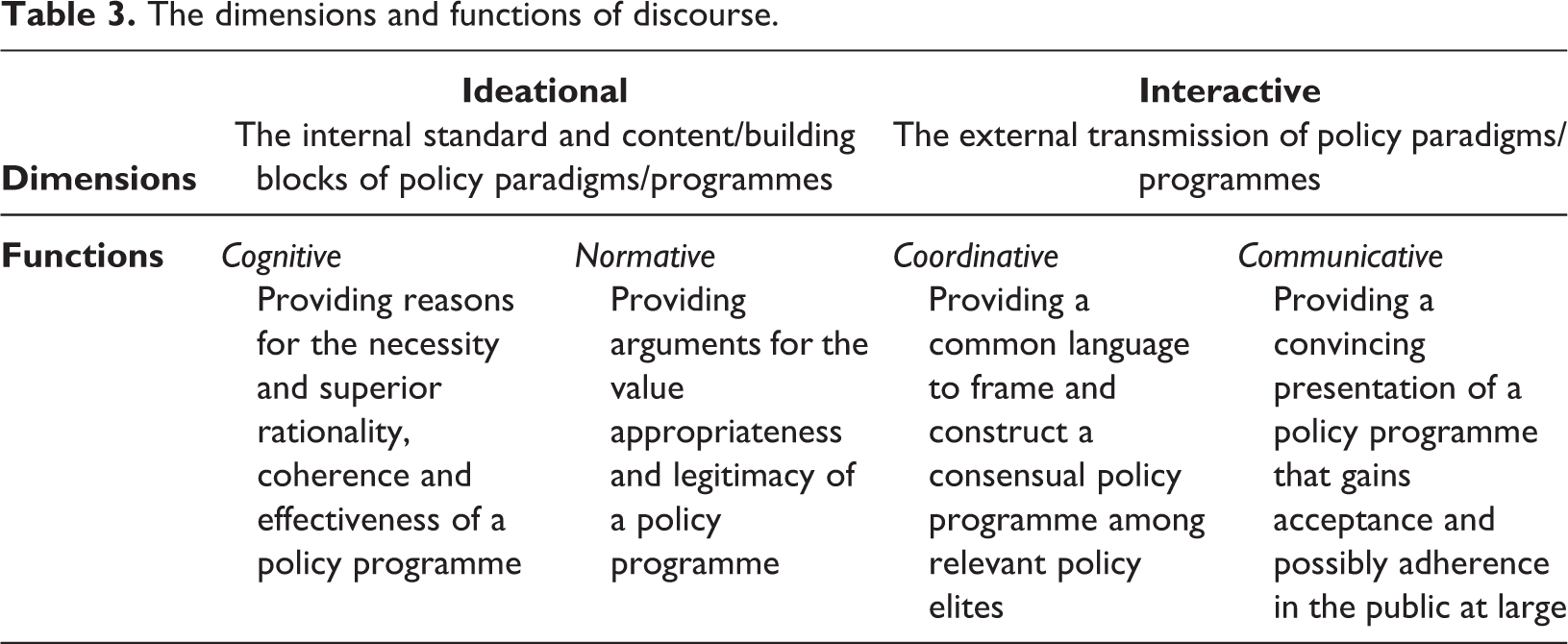
Through its interactive dimension, discourse facilitates consensus for a policy programme among policy elites, whilst reaching out more broadly to convince the larger public. Its coordinative function employs “a common language and ideational framework through which key policy groups seek to come to agreement about a policy paradigm” (Schmidt, 2000: 285). Its communicative function is the means by which policy elites convincingly convey the ideational framework, through that common language.
Schmidt (2000: 286) argues that the need for a broadly convincing ideational framework is more important in ‘consensual’ countries where power is dispersed amongst governmental elites, political opposition and interest groups – a characteristic displayed in Norway, as opposed to countries where a ‘majoritarian’ “government-centred policy elite” dominates with high power concentration (e.g. the UK). As a result, and following Schmidt’s analysis (2000: 293), we would expect a need for the ideational framework to draw more upon traditionally accepted notions of social justice and solidarity in Norwegian pension reform discourse and for the co-ordinative element of discourse to be key in seeking to successfully enlist a dispersed range of interests. By contrast, in the case of the UK, one might expect that systemic reforms would more easily be adopted by a narrower policy elite, with the greater challenge for the communicative aspect of discourse as a narrower policy elite seeks to convince the wider general public of the merits of its reforms. Moreover, we should expect a different reform discourse in countries where public responsibility for social justice is institutionalized, as in Norway, compared to countries where individual responsibility is more firmly established, as in the UK. In sum, this implies that we should see different discursive constructs of pension reform.
4. Data and methods
Our approach to the choice of documentation and its analysis reflects the two different forms of democratic approach examined in this paper, i.e. the consensual model for Norway, and the majoritarian approach in the UK (Schmidt, 2011: 59). In both cases, we undertake documentary analysis of the key documents setting out their cognitive and normative approaches to reform. In the case of Norway, taking account of the significance of the co-ordinative dimension of discourse arising from Norway’s consensual model of politics, we also examine parliamentary debates. We thus focus on the period 2001-2009 as this includes preparatory work by the government and the commission it appointed, as well as main parliamentary debates leading to the reform in 2009. In the case of the UK, after briefly outlining the reasons for the failure of the UK’s 1998 pension reforms, we use Schmidt’s framework to examine policy documents in the two episodes of pension reform in 2004-6 and 2010-13 that ultimately led to the reformed state pension now in place in the UK.
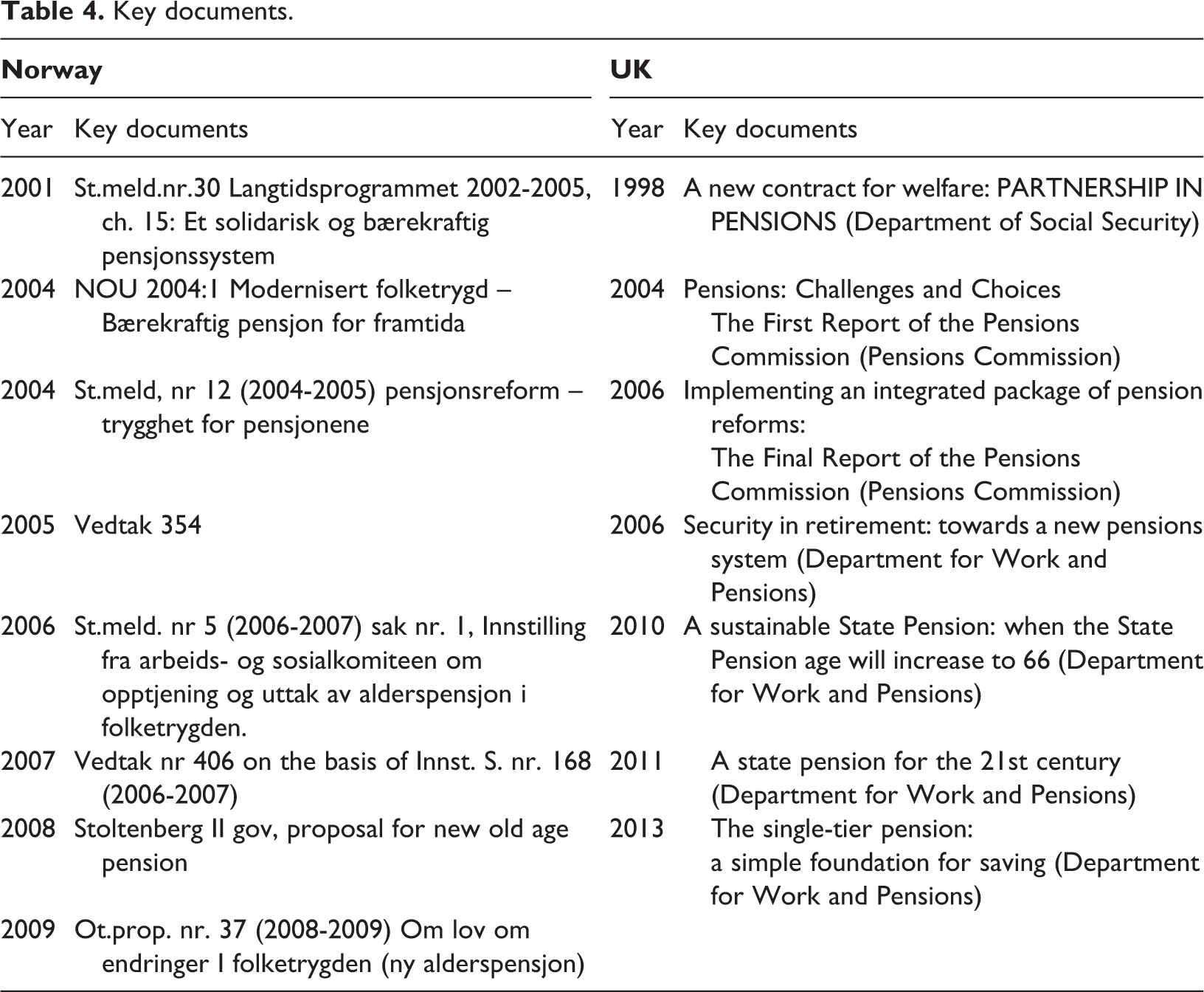
Table 4 sets out the key documents analysed. The sample of Norwegian documents is based on the website www.pensjonsreform.no (Ministry of Labour and Social Affairs), which lists all public documents concerning pension reform. In addition, we have included a White Paper from 2001 (St.meld 2001) not mentioned on the website. Translations from Norwegian into English are made by the authors of this article. As regards the UK, the relevant Government white and green pension reform papers, which proposed and then set out in detail the UK coalition’s state pension reforms in 2010-13, are analysed. In the earlier period of 2004-2006, the Pensions Commission publications establishing the analysis and framework upon which those subsequent reforms rest are included in the analysis alongside the subsequent White paper of 2006 setting out Labour’s reforms. Whilst these documents do not encapsulate every pronouncement of the respective governments on state pension issues, they include all of the main policy documents upon which the reforms are based.
Key documents.
As noted above, we conduct a form of directed content analysis by using intensity scores for key words identified in the two reform processes. The returns of these key word searches are presented in Figures 1 -5. This approach provides a measure of the importance of these elements of discourse, and can be contrasted with other approaches to discourse analysis which emphasise the role of interpretation (see Glynos et al., 2009). To enhance the validity of the content analysis, and to address any criticism that the intensity scores are an artefact of the documents themselves, the key words are identified based on a careful reading and re-reading of the documents in the context of Schmidt’s analytical framework, and agreed by the researchers. To ensure that occurrences are not underreported we recognise that words may be written differently and so we search for the stem of words. On the other hand, we avoid over-reporting by omitting returns due to key words appearing in tables of content, lists of references, notes or headers of documents; words being similar, but with totally different meanings (e.g. utvalg [commission] when searching for valg [choice]); or selected words being used in a context which does not specifically refer to the pensions issues under analysis (Weber, 1990). Interviews with key actors on how governments justify reforms could have further strengthened the validity of our analysis but was not possible in this project. Norway and the UK were examined to contrast differing welfare regimes, although we recognise that the generalisability of our results might be improved by applying our approach to other countries.
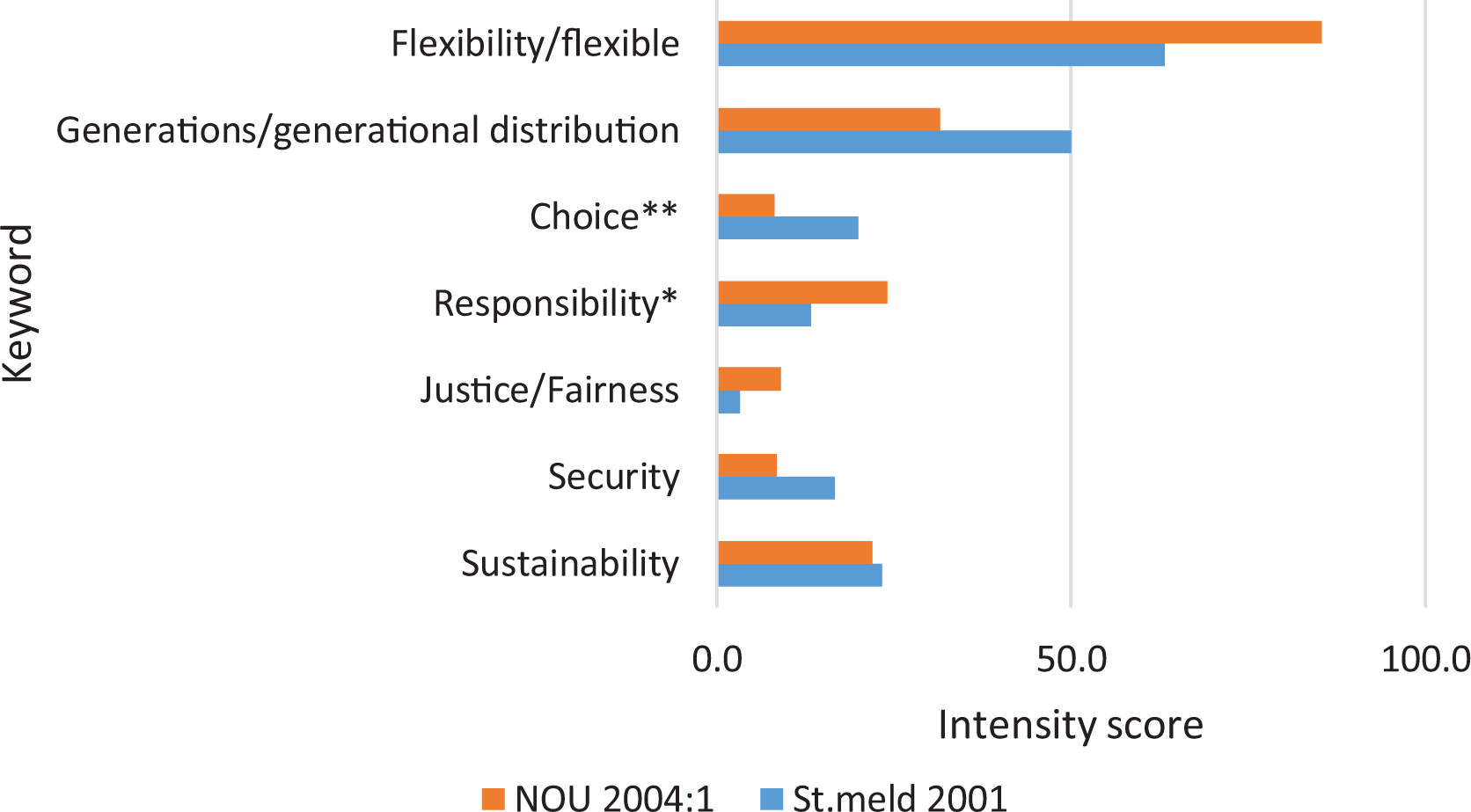
Intensity scores for keywords, documents 2001-2004.
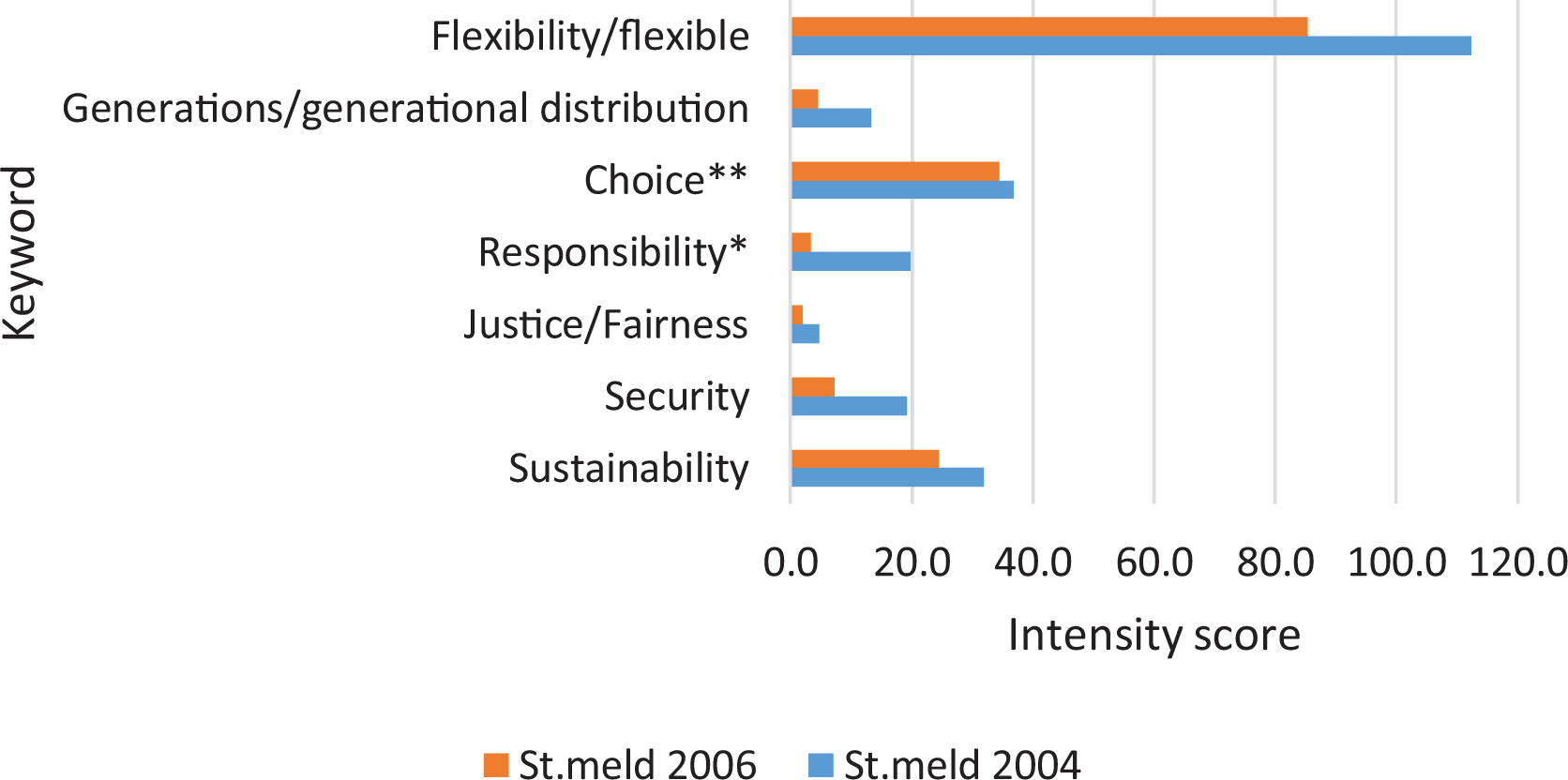
Intensity scores for keywords, documents 2004-2006.
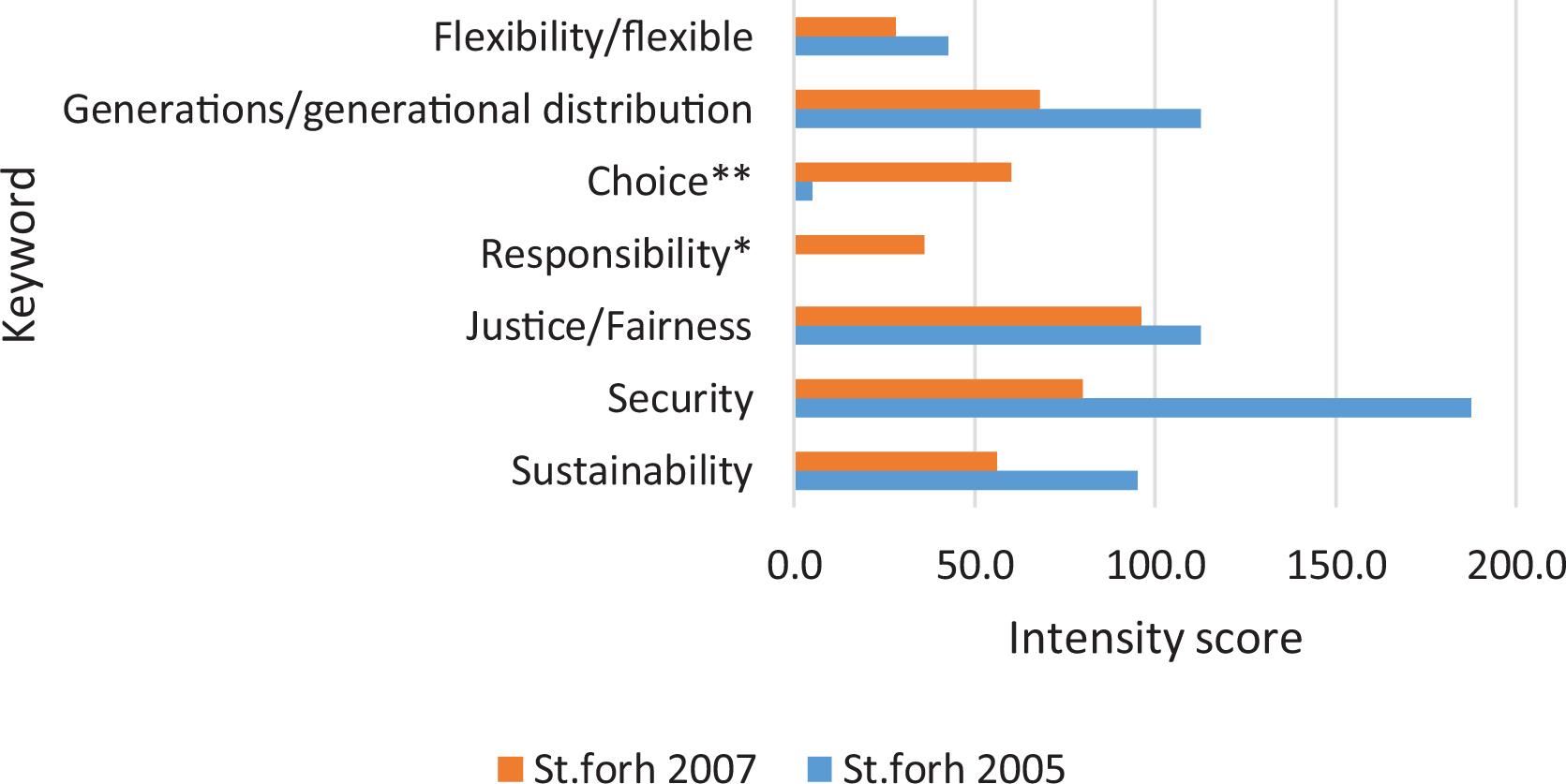
Intensity scores for keywords, documents 2005-2007.
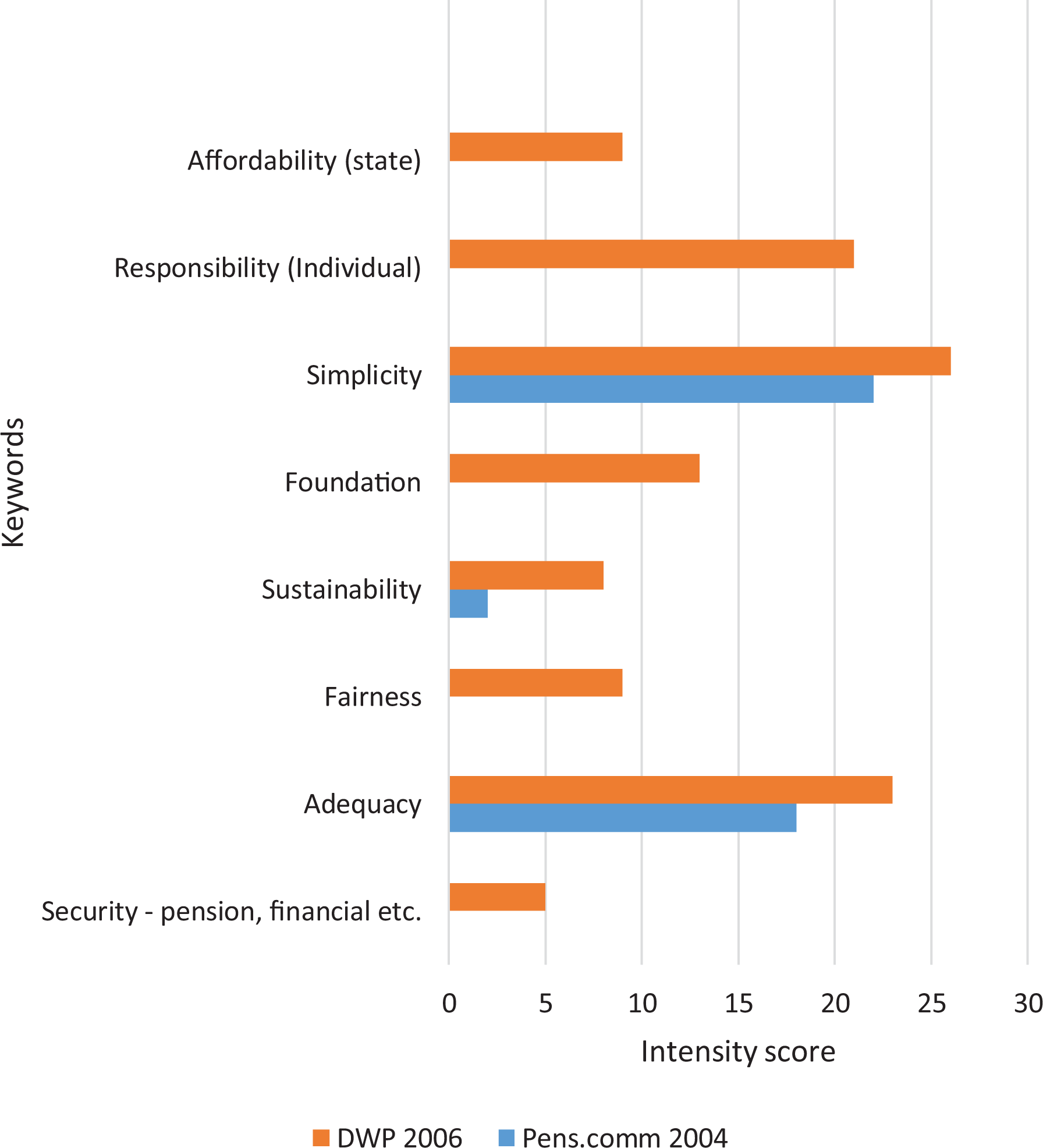
Intensity scores for keywords, documents 2004-2006.
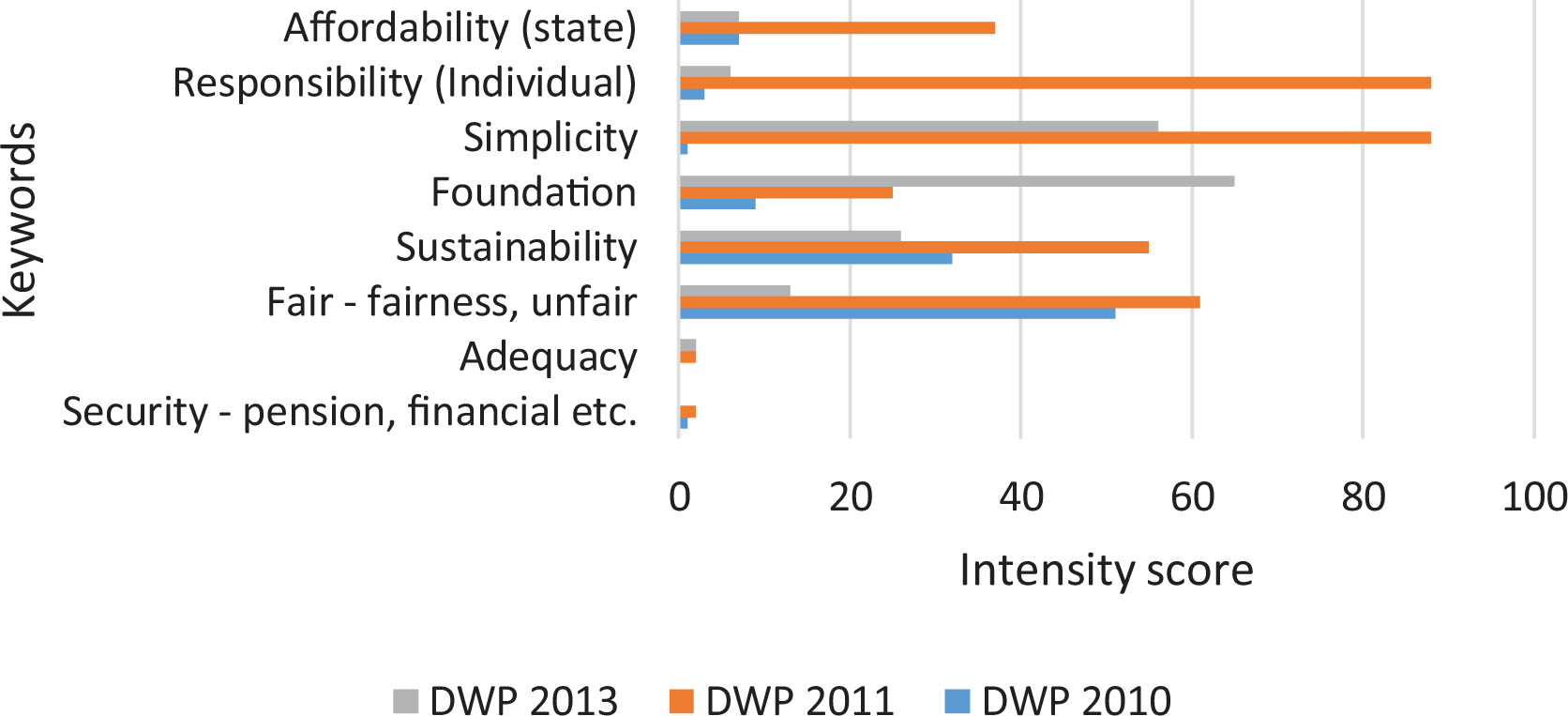
Intensity scores for keywords, documents 2010-2013.
5. Pension reform discourses
Norway – the ideational dimension
Applying our analysis to the Norwegian pension reform process, we start with the cognitive and normative functions of discourse as expressed in two central documents establishing the key principles of Norwegian reforms: the White Paper (long term programme) presenting pension challenges and mandating a pension commission be appointed (St. meld. nr. 30, 2001); and the Green Paper (official Norwegian report) on a modernised national insurance scheme developed by the independent commission (NOU, 2004: 1). Sustainability was a key concept in explaining the problems of the system and establishing a goal for reform (see Figures 1 and 2). It was understood, first and foremost, as economic sustainability; that financial demands do not overburden the economy or taxpayers now or in the future: “a system with a close to equal distribution of benefits and burdens between generations over time” (NOU, 2004: 1: 92).
Cognitively, increasing longevity and a worsening old age dependency ratio were identified as challenges concerning generational distribution (see Figures 1 and 2) (NOU, 2004: 1: 10, 45-65 and 103-107). The traditional way of meeting these financial challenges in Norway has been increasing taxes. However, the Commission set out why such a policy path was problematic and was to be avoided (NOU, 2004: 1: 104-107). It argued that a good pension system is not judged on the ‘headline’ pension figure but upon having secure financing over time, which it argued required limiting expenditure in the context of substantial long-term austerity needed for the economy as a whole. This is reflected in the intensity of the use of the concept of ‘sustainability’ and ‘generational distribution’ in the policy documents (see Figures 1 and 2). It was argued that in a PAYG system tax increases may reduce the support among the working age population and the intergenerational understanding upon which the system rests. This argument served an important normative function (cf. Schmidt, 2000: 281) and is reflected in the intensity scores for both generational distribution and justice/fairness in Figures 1 and 2.
The Commission also stressed that no other countries had relied on tax increases as a reform strategy; instead they increased state pension age, reduced pension expenditures, and reduced public responsibility. Thus, the choices made by other countries framed reform options for Norway: There are limits to how much higher tax levels in Norway may be compared to other countries, if serious consequences for Norwegian business life are to be avoided. The Pension Commission has therefore decided to disregard a general tax increase as a main strategy to solve the pension challenge (NOU, 2004: 1: 106).
As noted by Schmidt (2000: 281), discursive transformation may take place by invoking the past and building on long established values. In Norway, the reforms were portrayed as a form of ‘restoration’ of the original distributive idea of national insurance. In the two parliamentary debates following the Green Paper, the intensity of the use of the concepts of justice/fairness and security was ramped up (contrast Figures 1 and 2 with Figure 3) as advocates of the reforms characterised them as being in the spirit and tradition of the ground-breaking establishment of national insurance (St.forh. 2005: 2349-2350, 2007: 2657-2658).
The normative idea of individual responsibility, through a stronger proportional link between contributions and benefits, also emphasised the connection between labour market success and pension outcomes and underpinned parliamentary debates concerning increasing longevity and building security, sustainability and generational fairness (see Figure 3). Individuals had a choice: extend their working life and delay retirement, or disregard increased longevity and face a permanently lower replacement level.
The solution was to replace a fixed retirement age (67) with a flexible one (62-75), strengthening the link between contributions and pension benefits, and to introduce the main retrenchment element of the reform: life expectancy divisors. At the time of retirement, the annual pension would be calculated by dividing accumulated pension entitlement by a life expectancy divisor based on cohort life expectancy (OECD, 2015: 316). A flexible pension age allowed individuals to work longer to compensate for increased life expectancy, or to take (lower) pension benefits from an earlier date. The solution was presented as allowing individuals to make decisions - choices - in accordance with their personal circumstances. Flexibility and choice were therefore key themes in both the White and Green Papers on pension reform (see Figures 1 and 2), as well as forming a key element in building a consensus in parliamentary debates (see Figure 3).
In sum, cognitive ideas focusing on longevity, economic sustainability and generational distribution formed the salient aspects of the problem. Normatively, the existing system was deemed unfair. Policy solutions addressed longevity and sustainability and emphasised flexibility, choice, and individual responsibility, which were framed as being within the long-standing traditions of the pension system.
Norway - the interactive dimension
A broad consensus emerged quite rapidly among major interest groups such as employer and employee organizations, the financial industry and pensioner organizations, on both the problem description and the central policy measures. Although the major employee organization, the Norwegian Confederation of Trade Unions (LO), at first was quite critical, it faced a solid majority consensus and therefore changed its focus towards trying to influence specific reform elements to improve distributive outcomes.
In subsequent parliamentary debates, political parties presented themselves to the general public as responsible guardians of their voters´ interests, justifying why they supported (or not) reform. It is thus fair to say that, in line with Schmidt’s approach, white papers contributed more to “building agreement on a policy programme among policy actors central to the policy process” (Schmidt 2000: 288) while parliamentary debates represented an effort to ‘frame’ a consensual co-ordinative approach and “communicate it successfully to the public at large” (Schmidt, 2000: 288).
The importance of achieving consensus in the face of potential controversy is perhaps best illustrated by MP Jensen (Progress Party) in her critical statement during the first parliamentary debate: “But I think this so-called robust system will be put to the test in the years to come, not least when the pensioners become aware of what the majority has supported” (St.forh., 2005: 2356). The detailed and comprehensive nature of the white paper, presenting a thorough review of the work of the pension commission, supported by the views expressed by different stakeholders, meant that there was an ‘epistemic community’ (Schmidt, 2000: 286) the effect of which was to overcome dissent and help convince the general public of the benefits of the reforms. The effect of this epistemic community belied the fact that the implications of the proposals were less evident to non-experts, and specifically to those negatively affected by the reforms in the longer term.
Thus, it was that a main theme of ‘security’ in the 2004 white paper (St.meld. nr 12, 2004-2005) was closely linked to sustainability in documents and subsequent debates (see Figures 2 and 3), suggesting a secure and sustainable pension system would provide future pensioners with solid and reliable pensions. MP Duesund (Christian Democrats) stated that: “We establish security in executing a pension reform. (…) My point of departure is that we must establish a system that is stable over time” (St. forh., 2005: 2386). Parliamentary debate (St. forh., 2005) went so far as to suggest the white paper reforms were an improvement, adding to the notion of security in retirement (see Figure 3). Some MPs referred to specific improvements in the system, while others to how the reforms in general represented improvement and not severe cutbacks. An illustration of this last point is the statement by Frøiland (Labour): “You cannot say that pension benefits are cut, but that there is less growth in some pension benefits” (St.forh., 2005: 2354). Likewise, the idea of a “little less more” was emphasised by several MPs (e.g. St. forh., 2005: 2367, 2370, 2379, 2383, 2387) who argued that people should not think of the reform as reducing pension benefits. In other fora, the former Prime Minister Stoltenberg portrayed state pensions as an elevator which, even though it does not necessarily take you to the top floor, brings you a good retirement income that should not be considered any less valuable than today’s pension benefits.
Several MPs also argued the reforms increased fairness (see Figure 3) by correcting existing injustices, e.g. how people with long working careers in the old system ended up with a very limited pension (St. forh., 2005: 2366). Intergenerational fairness was also highlighted by the then finance minister Foss: “Today’s winners are those with no right to vote” (St. forhandl. 2005: 2364). Høybråten (Christian Democrats) exemplified the flexibility and freedom of choice argument, suggesting that: “More individual flexibility to choose the timing and degree of retirement is a large welfare improvement” (St. forh., 2005: 2382).
The second white paper (St.meld. nr 5, 2006-2007), on which the second parliamentary debate was based, was similar in tone to the first. As highlighted by Figure 3, the arguments in the second parliamentary debate were also similar to the ones in 2005 (St.forh., 2007), although the importance of choice (seen as improvement) is more apparent in the second parliamentary debate compared to the second white paper.
UK - the ideational and interactive dimensions
Background Context
At a time of gradually declining occupational pension scheme membership (Pensions Commission, 2004: 81), the (then) new Labour government moved away from Conservative policies of the early- to mid-1990s and attempted to create a ‘Partnership in Pensions’ (Department for Social Security, 1998). For those with no pension provision above the basic state pension, the state would provide a means-tested minimum income guarantee (1998: 3). A new, simplified and easily accessible private ‘stakeholder’ pension would encourage individuals to supplement the state pension by making greater private saving, thereby ensuring fewer had to rely on means-tested benefits.
Yet, that ‘partnership’ failed to achieve its objectives (Association of British Insurers, 2003; Barr & Diamond, 2010: 163). Cognitively, the benefit of saving using stakeholder pensions was difficult to assess for low income individuals due to the complex interaction of state pension and means-tested benefits with private savings (Rake et al. 1999) (thus, also hampering the communicative element of the discourse). The lack of employer contribution to the stakeholder pension also made it unattractive, and the financial services sector remained unconvinced about its viability (Association of British Insurers, 2003). In Schmidt’s terms, the ideational and interactive dimensions of discourse were deficient, resulting in the failure to create an ‘epistemic community’ (Schmidt, 2000: 286) that might frame and construct a consensus (the co-ordinative element of discourse) to successfully implement these reforms.
The 2004 pensions commission and 2006 white paper
In the wake of this failure, and with further significant declines in occupational pension scheme membership (Maer and Thurley, 2009) creating increased pressure on the provision of means-tested benefits, the subsequent creation of a high-profile independent Pensions Commission was seen as a means of ‘re-booting’ attempts to create a broad consensus on pension reform (Department for Work and Pensions, 2002: 30-31). Made up of three key members - a business, a union and an academic representative - and supported by government, it brought together the key interests in UK policy-making. Producing three reports (Pensions Commission, 2004, 2005, 2006), it undertook widespread consultation on its ideas by instigating a ‘National Pensions Debate’ which ‘toured’ the country. This was characterised as a “dialogue with the public” (Department for Work and Pensions, 2005a, 2005b), a recognition of the importance of the interactive element of discourse.
The Commission’s remit considered state pension issues insofar as they impacted on private savings (Institute for Government, 2010: 3). Early on, there appears to have been an acceptance of the inevitability of a reduced/limited role for state provision (Pensions Commission, 2004: x, xii, 57, 58, 74) in the face of issues of sustainability (see Figure 4). This facilitated the ‘settling’ of a policy framing the adequacy of both state and private provision, as well as the affordability of state provision. Whilst subsequent feedback from the ‘national debate’ did not always align with the Commission’s suggestions, there was sufficient public and industry support to enable the implementation of the government’s subsequent proposals (Bridgen and Meyer, 2018). The Commission provided government with a clearly argued policy framework (Schmidt’s ideational function); and, the representation of key interests on the Commission, supported by a national pensions debate, was an effective approach to convince the public at large of the merits of the policy (Schmidt’s interactive dimension). The government had learned lessons from its previous attempt at pensions reform.
Drawing upon the Commission’s report (see Figure 4), the result was the 2006 White Paper ‘Security in retirement: towards a new pension system’ (Department for Work and Pensions, 2006). The White Paper set out a number of principles or ‘tests’ for any new reforms – explicitly addressing the normative element in Schmidt’s ideational dimension of discourse. The first principle, personal responsibility, was, following Schmidt, cognitively supported by evidence in the findings of the first report of the Pensions Commission of failing pension schemes and a lack of private saving.
The White Paper also included ‘sustainability’ as a principle of reform, and the affordability of state provision was clearly embedded in the notion of fiscal sustainability. Cognitive arguments drawing upon ‘sustainability’ and ‘affordability’ supported calls for greater personal responsibility (see Figure 4) creating a more integrated ideational discursive framework. These normative appeals were cognitively supported by evidence and argument aimed at increasing the state pension age.
The principles in the White Paper also incorporated simplicity and fairness (see Figure 4). The government wanted to remove the complexity of means-testing to make clear to individuals the benefits to be derived from saving, as well as increasing the basic state pension to reduce reliance of the poorest on means-tested benefits. Ideationally, it addressed the cognitive element of discourse whilst appealing to the norms of simplicity and fairness.
Significantly, the White Paper introduced the metaphor of the state pension as a ‘foundation’ for retirement (again, see Figure 4). The commitment to increase the basic state pension in line with earnings and alter the earnings-related second state pension to a flat rate benefit over a long transition period was portrayed as providing “a foundation for all upon which to plan for their retirement” (Department for Work and Pensions, 2006: 103). As Berry points out (2016: 16): …by redefining the purpose of the state pension as enabling private retirement saving by individuals, the reform represents a subtle form of welfare retrenchment through which the state withdraws from any attempt to provide a genuine income-replacement benefit for pensioners.
Cognitively, a flat rate of state provision (albeit made of separate basic state and additional second pension, both based on National Insurance contribution record) could be presented as underpinning the reforms’ normative notion of simplicity, whilst its lack of generosity drew attention to the importance of individual responsibility for private pensions. Individual responsibility would be ‘facilitated’ by the automatic enrolment of employees, in turn becoming contributing members of a pension scheme without the need to take any positive action. At the same time, these reforms provided employers with the opportunity to move from more expensive benefit provision to making lower levels of benefit provision which, nevertheless, met the minimum employer contributions required under automatic enrolment (Johnson et al., 2010). It has been argued that this is the context within which employers and industry were able to support such reforms (Bridgen and Meyer, 2018).
In Schmidt’s terms, a core set of (normative) principles aligned with consistent (cognitive) arguments were employed in a “recasting of the discourse and its policy paradigm” (Schmidt, 2000: 282) to convince the public of the soundness of these reforms.
The 2010 coalition government
In 2011, in the aftermath of the financial crisis, and before these reforms could be fully implemented, a new coalition government consulted on further changes to state pension provision (Department for Work and Pensions, 2011: 7-8), setting out principles of reform almost identical to those the Labour Government had set out in 2006, except that affordability and sustainability were merged in a single principle. This was no random conjuncture; framing affordability in the context of sustainability alluded to the broader fiscal prudence and ‘austerity’ agenda of the Coalition. Likewise, (re-)adopting these principles enabled the coalition to draw upon the discursive repertoire of the previous government’s reforms, including that of the state pension as a ‘foundation’ for private provision (see also Berry, 2016). The significance of this approach is apparent in the textual analysis of the Coalition’s subsequent Green and White Papers (see Figure 5).
Firstly, it proposed speeding up the move to a flat rate of state provision, but this time as a single state pension set just above the level of means-tested benefits. The Coalition emphasised simplicity in provision, enabling individuals to take greater responsibility for their retirement, and the importance of providing “a firmer foundation for saving” (Department for Work and Pensions, 2011: 37). Communicatively, the idea of a simplified structure could be conveyed easily and clearly. In addition, the reforms were convincingly portrayed as an improvement, in so far as they increased the level of the basic rate pension, reduced means-testing, and resulted in higher state pensions for those about to retire than they would have received under the system being replaced. Nevertheless, this belied a significant decrease in overall state pension entitlement for younger generations as a result of removing the opportunity to accrue state second pension (Pensions Policy Institute, 2014).
Secondly, again incorporating already established discursive elements, the notion of fairness signalled the needs of the vulnerable would be addressed (Department for Work and Pensions, 2011: 8 and 33), but in a way that also addressed the unfairness of intergenerational transfers (Department for Work and Pensions, 2011: 8, 11, 41, 45; and see Figure 5). By retaining (and increasing) the contributory requirement to qualify for state pension as of right, and by incorporating the notion of ‘contribution’ within a discourse that also emphasised the costs of state benefits, the notion of fairness thus included the need to address sustainability through enhanced personal responsibility.
The state now positioned itself as the facilitator, or enabler - a significantly different obligation to that of ‘partner’ contained in the 1998 ‘Contract for Welfare’. There was much less emphasis on adequacy even compared to the 2006 proposals, and a much greater emphasis on personal responsibility (contrast Figures 4 and 5). As the Coalition pointed out: Pension Credit is an effective safety net in helping to keep today’s pensioners out of poverty. However, we are interested in views as to whether a continuation of the current system of Pension Credit for future pensioners would help achieve the Government’s principles of a state pensions system that is simple, fair, promotes personal responsibility, and is affordable and sustainable. Any reforms would need to be delivered without increasing public spending in any year (Department for Work and Pensions, 2011: 40).
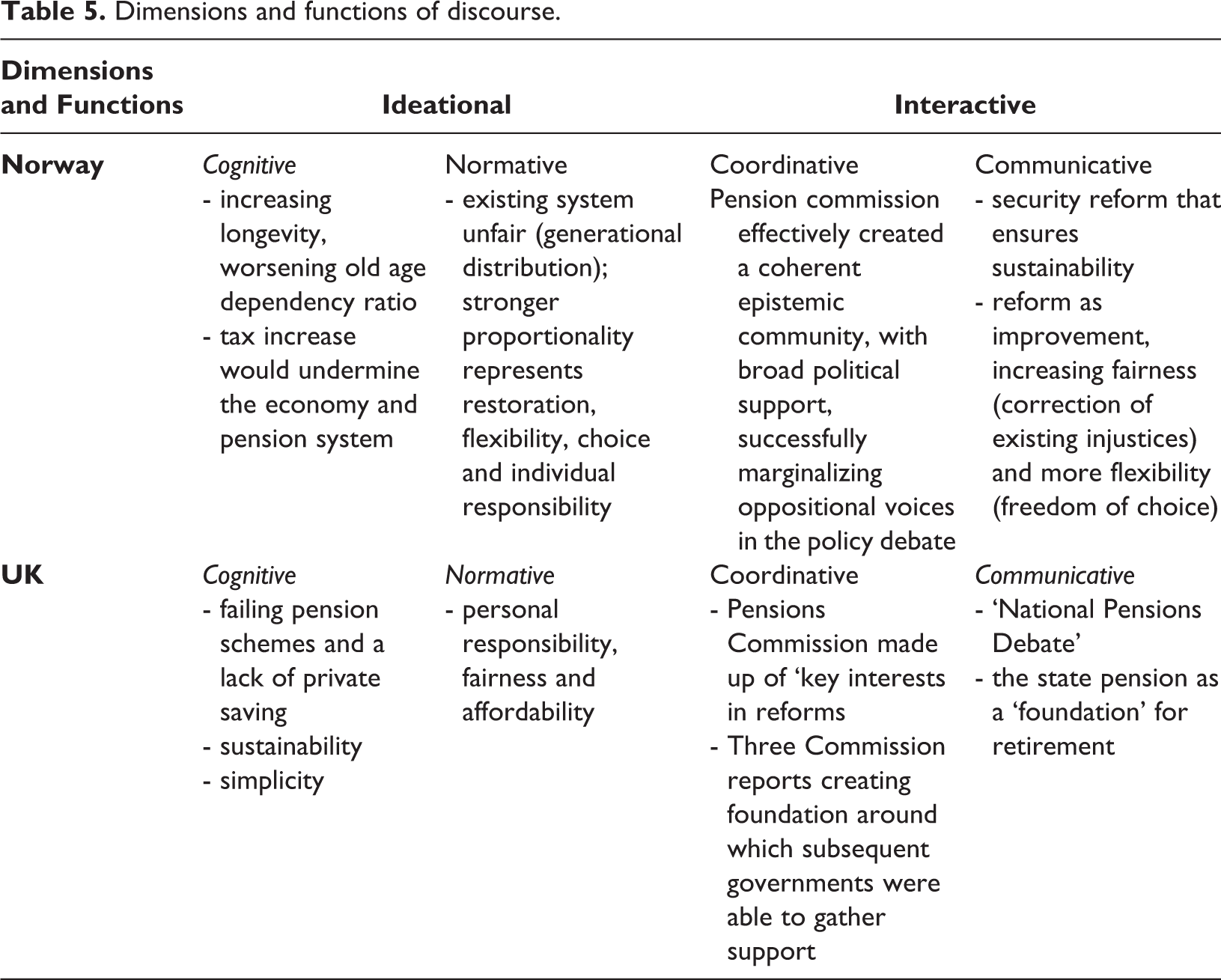
Table 5 summarizes the Norwegian and UK pensions reform discourse.
Dimensions and functions of discourse.
6. Discussion and conclusion
Whilst Norway and the UK embarked upon reforms from very different positions (European Commission, 2012; OECD, 2012), they have both attempted to limit the role of the state in pension provision. Using the framework provided by Schmidt, our study illustrates the importance of discourse to both the depiction, and implementation, of such reforms.
Firstly, we find that both countries adopted a very similar approach in implementing reform, specifically using similar ‘building blocks’ (following Schmidt’s ideational dimension of discourse) in addressing the reasons for, and legitimacy of, their respective policy programmes. Firstly, sustainability (of national finances) is a key cognitive motif in both sets of reforms. In the UK, this is further underpinned by emphasising affordability (for government).
Secondly, the notions of fairness (UK) and generational distribution (Norway) are both used to establish (cognitively) a particular understanding of the implications of longevity for benefit costs, as well as to more explicitly link contributions and benefits. Normatively, fairness demands less redistribution, both intragenerationally and intergenerationally, of the cost of state pensions. This enabled both governments to emphasise individual effort in making retirement provision. In the UK, this has been an integral part of pensions discourse for a significant time, and the emphasis upon issues of choice and flexibility in Norwegian reforms suggests the increased significance of a similar narrative, placing greater emphasis on the ‘choice’ of individuals to continue in work or not.
Notwithstanding very different welfare traditions, Norway and the UK have imbued the notions of fairness and responsibility with very specific implications for the state’s, and individuals’, choices and responsibilities. The fall out of the great financial crisis has only served to reinforce this logic (Goul Andersen, Schoyen and Hvinden 2017), and it is reflected in discussion concerning reform across Europe (see, for example, European Commission, 2012). Thus, pension discourse in the two countries are more similar in this respect than should be expected based on the approach of Schmidt (2000).
As regards the interactive dimension of discourse there are perhaps more differences, although again parallels can be drawn. In Norway, appeals for consensus on the reforms amongst the general public were, most visible in our data through the medium of the two key parliamentary debates on the reforms. In terms of the ideational dimension of the reform discourse, politicians appealed to notions of justice and security. These are notions which would traditionally be taken to be at the heart of a welfare state regime. Such parliamentary appeals may have been more significant given that these notions are much less evident in the reform documents themselves.
In the UK, having failed to achieve ‘buy in’ for the successful implementation of the 1998 reforms, the government thereafter appears to have been much more attuned to importance of both the ideational and interactive functions of discourse. At an interactive level, it sought support from the financial services sector, unions and employers co-ordinatively through the composition and work of the Pensions Commission, whose three reports established the basis for an epistemic community to coalesce around reforms. Equally, the ‘National Pensions Debate’ provided a vehicle by which it could, with more or less justification, point to public support for the general thrust of its reforms – addressing both the co-ordinative and communicative elements of discourse. The lesson for Norway may be that in seeking further individualisation in pension provision, in future it may need to do much more in terms of the external transmission of its policy paradigm and programme.
This last point draws attention to one further parallel between the UK and Norway that arises from this discussion. If, paradigmatically, both sets of recent reforms can be said to be concerned with re-aligning the role of the state and the individual, then it is interesting to note the metaphors used by the respective governments to characterise state pension reform. In Norway, it was the use of the metaphor of an elevator; taking someone up (as opposed to down) is both positive and enabling. In the UK, by contrast, the use of the term ‘foundation’ in relation to the unified state pension suggests something enabling, but at the time aligned with the more basic aspirations for state pension in the UK and marks the demarcation of responsibilities for retirement between the state and its citizens. In both cases, savers/retirees are supported and helped by the state, but each metaphor portrays a different degree of assistance more attuned to the welfare traditions of each country drawn upon in arguing for these reforms. Nevertheless, both are underpinned by a similar repertoire of discursive elements to create, in each case, a coordinative common language that is able to convincingly present each government’s policy programme as an ‘improvement’ in state provision in the face of reduced spending.
The use of metaphors may have an added significance. In both countries, they appear to have enabled reformers, in engaging with the ideational element of discourse, to provide a convincing narrative for the public which was founded in the country’s welfare traditions, without necessarily requiring public engagement with the corpus of technical and complex detail also necessary to form an epistemic community for the reforms.
In conclusion, our analysis suggests that, no matter their domestic welfare and democratic traditions, nation states addressing issues of state pension spending are likely to employ similar discursive elements in persuading their population about the logic and rationality of their reforms. These discursive elements are also likely to be imbued with a financialised and individualising logic. The analysis also indicates the importance of the discourse being supported by a significant body of research that is capable of enlisting the ‘epistemic community’ needed to drive through the reforms in the face of any criticism.
That said, our analysis also draws attention to the importance of communicative aspects of discourse in the success of any reforms. It suggests that in communicating reforms, successful governments weave ‘shards of the [national and collective] past’ in their narrative. At the same time, in the face of inevitable complexity, they may adopt metaphors to ‘make sense’ of the reforms in the context of collective welfare traditions and to galvanise support for acceptance of reforms.
Our analysis provides lessons for both governments and policy reform groups. In the face of national differences, it points to commonalities of approach in implementing welfare policy reform across nation states in the context of increased financial pressures. It also highlights how this approach needs to reflect the particular characteristics of that nation and its welfare traditions. In addition, the analysis provides a potential template for analysing further welfare policy changes that may occur in the context of addressing government debt in the aftermath of the coronavirus pandemic.
Footnotes
Declaration of conflicting interests
The author(s) declared no potential conflicts of interest with respect to the research, authorship, and/or publication of this article.
Funding
The author(s) received no financial support for the research, authorship, and/or publication of this article.
