




Abstract
Background
Alzheimer's disease is the leading cause of dementia and constitutes a major public health problem. Recent research suggests that certain chronic infections, particularly periodontal infections, may play a role in the development or progression of this disease. Among the bacteria involved in periodontal disease, Porphyromonas gingivalis has attracted particular attention from researchers.
Objective
In this way, the aim of this thesis, conducted in the form of a scoping review, was to analyze existing scientific data on the relationship between Porphyromonas gingivalis infection and Alzheimer's disease.
Methods
To achieve this, a literature search was conducted in several scientific databases leading to the selection of fourteen studies that met the inclusion criteria.
Results
Some of the selected studies have shown the presence of Porphyromonas gingivalis or its virulence factors in the brain tissues of patients with Alzheimer's disease. Experimental studies also indicate that this bacterium can promote certain mechanisms involved in neurodegeneration, namely inflammation and accumulation of amyloid-β.
Conclusions
Selected studies point to the existence of an association between exposure to periodontal bacteria and an increased risk of developing Alzheimer's disease.
Introduction
Alzheimer's disease (AD) is the leading cause of dementia, manifesting as progressive impairments in memory, language and executive function, associated with amyloid deposits, tau protein abnormalities and chronic inflammation of the brain. 1
In addition to known genetic factors, a growing body of research suggests that modifiable factors, including chronic infections and systemic inflammation, may play an important role in the development and progression of AD. 2
In this context, oral health, and periodontitis in particular, has attracted considerable attention. Periodontitis is a chronic infection of the gums and periodontal tissues, common in adulthood, which repeatedly exposes the body to bacteria and their toxins. 3 Among these bacteria, Porphyromonas gingivalis (P. gingivalis or Pg) is considered a key pathogen as it is capable of disrupting the local immune response, destroying periodontal tissues and spreading beyond the oral cavity. 3 Epidemiological studies have shown that the presence of antibodies against periodontal bacteria, including P. gingivalis, is associated with a higher risk of developing dementia, including AD, particularly in individuals who also have other chronic infections such as hepatitis C and herpes simplex virus type 2 (HSV-2). 2
More recent studies have focused on what occurs in the brain itself. P. gingivalis and its toxic proteins, gingipains, have been detected in the brains of patients with AD, and an association has been identified between their presence and the severity of amyloid lesions and tau protein. 1 In vitro experiments show that the bacterium P. gingivalis can infect human neurons derived from induced pluripotent stem cells (iPSCs), persist within these cells and induce changes similar to those observed in AD, such as tau protein degradation, increased phosphorylation of tau and the loss of synapses. 4 In experiments using rats as models for the induction of experimental periodontitis or oral infection with P. gingivalis, researchers suggest a link between periodontal inflammation, increased amyloid deposits in the brain, changes in microglia and worsening of markers of neurodegeneration.1,3
In light of the above, this thesis, in the form of a systematic review, forms part of this rapidly expanding field of research. The aim is to provide a structured overview of the relationship between P. gingivalis and AD, focusing on clinical and epidemiological data, postmortem study results, cellular and animal models, as well as the first therapeutic leads targeting gingipains.1–4 By searching and organizing the data available in the literature, this study aims to clarify the extent to which P. gingivalis might contribute to the development or progression of AD, addressing the main limitations of current studies and how this evidence can inform preventive strategies focused on periodontitis control and oral health.1,2
Methods
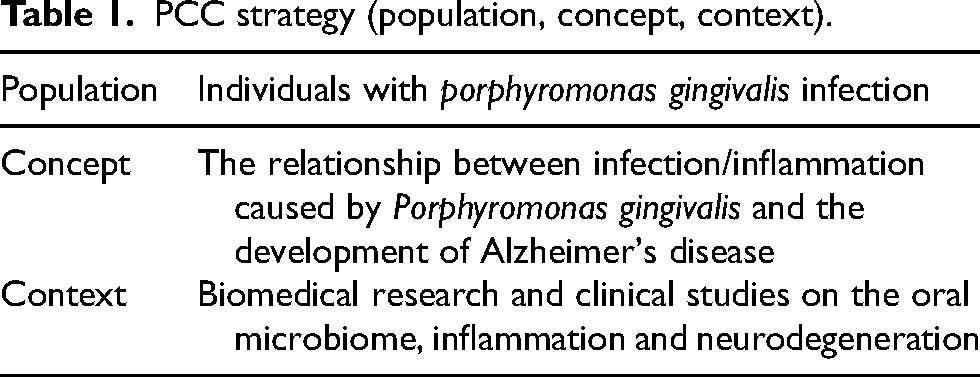
A research protocol was developed based on the Joanna Briggs Institute (JBI) model,5–7 which led to the formulation of the following research question: What is the relationship between P. gingivalis infection and the development of AD? Thus, the acronym PCC used was that presented in Table 1.
PCC strategy (population, concept, context).
For the final review, the items identified in the reports prepared to guide systematic reviews and meta-analysis extensions (PRISMA-ScR) were used. This protocol was registered on the OSF platform (https://osf.io/z6wc4/overview (accessed on 5 January 2026)).
Inclusion and exclusion criteria
Inclusion criteria
Original studies published in peer-reviewed scientific journals that examine the relationship between P. gingivalis and AD; articles written in English, Portuguese, French or Spanish; studies involving human or animal models.
Exclusion criteria
Articles for which the full text is not available; publications in languages other than those specified in the inclusion criteria; studies not related to P. gingivalis or AD; editorials, letters, conference abstracts or commentaries without primary data; review articles; studies focusing exclusively on other bacteria or other neurodegenerative diseases, surveys, and studies on systemic diseases or treatments.
Search strategy
The search strategy was designed by two reviewers and reviewed by a third specialist reviewer, using the Peer Review of Electronic Search Strategies (PRESS) checklist. 8
For this scoping review, a search was conducted in the following databases: PubMed, ScienceDirect, Web of Science, CINAHL Plus with Full text and MEDLINE with Full text. The search strategy recommended by the JBI was implemented.
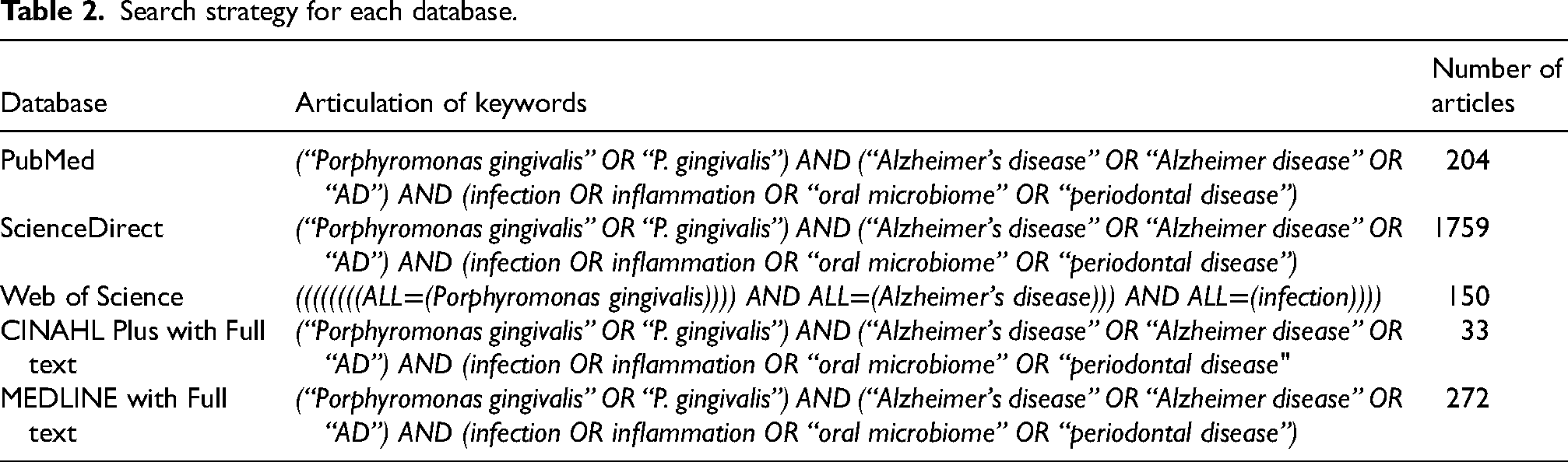
A preliminary search of the databases was carried out to identify the keywords and index terms used in publications relating to the topic. This enabled the development of the search strategy for each database, as presented in Table 2. This search was conducted on 23 March 2025.
Search strategy for each database.
A review of the reference lists of all included articles was carried out to assess the possibility of including additional articles. The results of the electronic search were exported to Rayyan®. 9 The software was developed by Rayyan Systems Inc. of Cambridge, MA, USA. The AI-driven software was not used to select the articles; it was used solely as a support tool to gather all the articles found in the various databases used, identify duplicates and select the articles to be included. The identified duplicates were removed.
Selection, analysis, and studies presentation
After removing duplicates, two reviewers independently screened the titles and abstracts against the inclusion and exclusion criteria to decide whether to include the articles in the scoping review. During this first screening stage, titles and abstracts were assessed to determine their relevance to both P. gingivalis and AD. Studies were considered potentially eligible if the title or abstract explicitly mentioned: a) P. gingivalis or clearly referred to this pathogen as a periodontal keystone bacterium; b) AD, cognitive impairment, dementia, or key pathological features of this disorder. Abstracts were judged as relevant if they suggested a direct or indirect association between P. gingivalis infection and AD-related outcomes.
The full-text articles from studies with potential for inclusion in this review were assessed independently by the same two reviewers. Any uncertainties or disagreements encountered were discussed with a third reviewer, in accordance with the Peer Review of Electronic Search Strategies (PRESS) checklist. 8
The assessment and selection of articles was carried out in two stages: firstly by reading the title and abstract, and secondly by reading the full text. This methodological strategy is illustrated in the PRISMA flowchart (Figure 1).
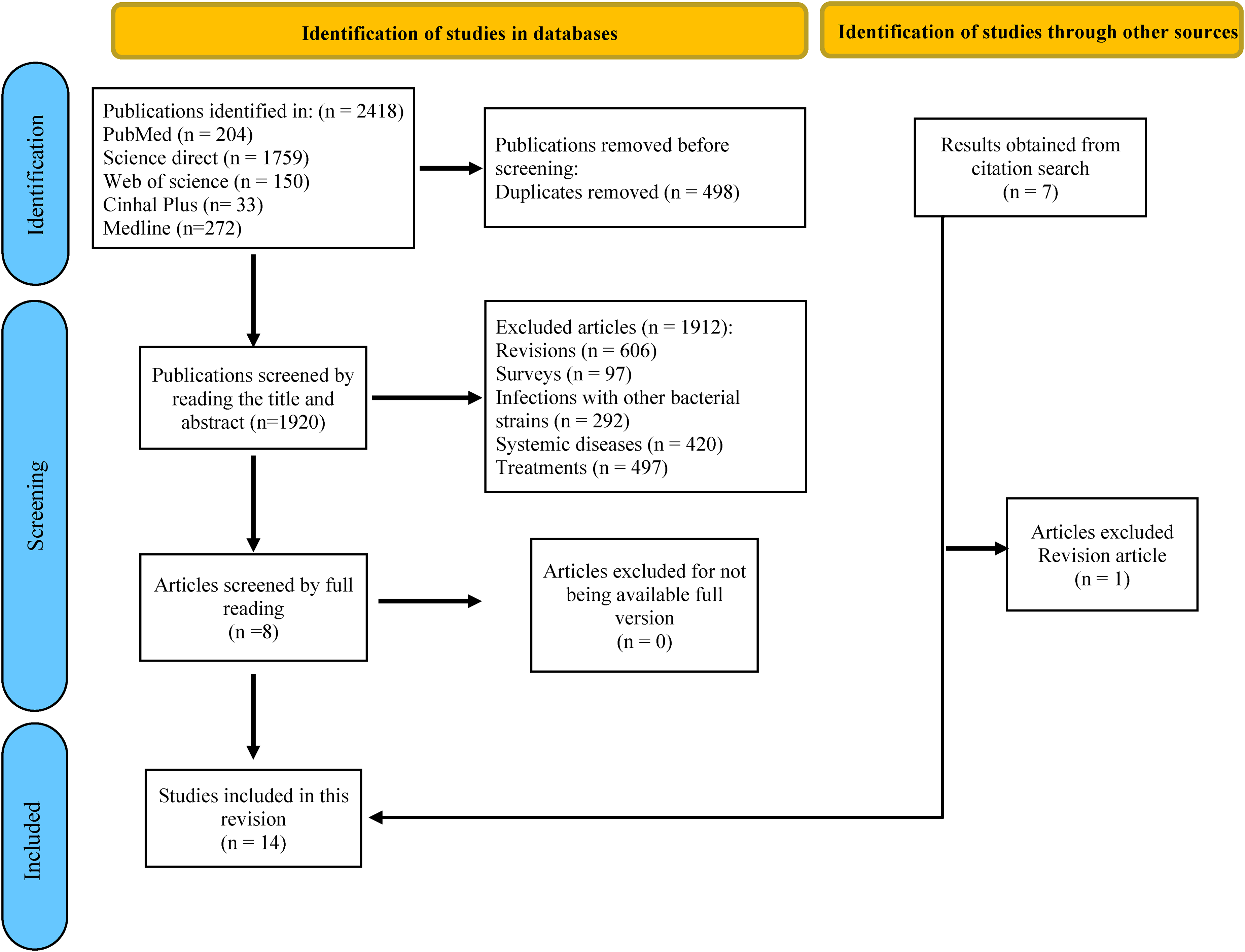
Fluxogram of the paper selection process, adapted from the PRISMA 2000 flow diagram. 10
After reading the full-text articles included in this scoping review, data were extracted in accordance with the objectives and research questions of this review, using the tool proposed by the Joanna Briggs Institute,5–7 covering the following relevant information: title, author(s), year of publication, country of origin, study type, objective(s) and main results.
In the first phase of the search, filters were applied, resulting in 2418 articles, of which 498 duplicates were identified and removed. Of the remaining 1920 articles, the initial screening by title and abstract excluded 1912 for the reasons presented in Figure 1. Eight articles were selected for full-text review. A manual search of the reference lists identified 7 additional articles, of which 1 was rejected. Ultimately, 14 articles were included in this scoping review (Figure 1).
Results
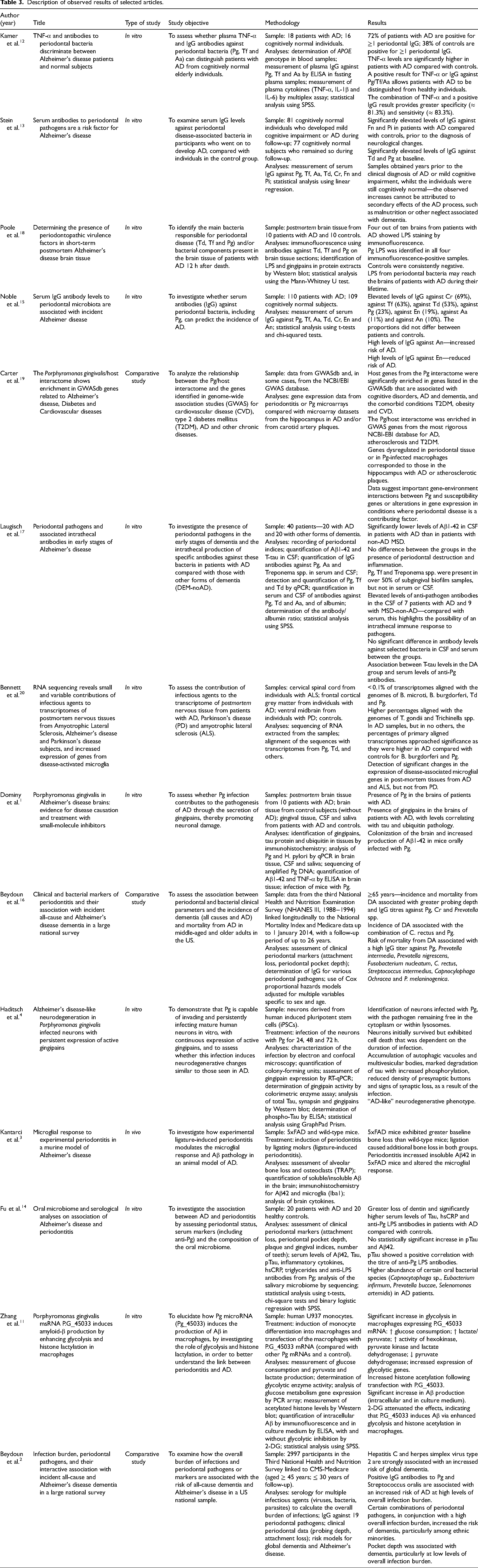
Most of the selected publications are in vitro studies, with one in vivo study and three comparative studies. Table 3 provides details of the articles included in this review, as well as results of those studies.
Description of observed results of selected articles.
The presence of P. gingivalis and its virulence enzymes (gingipains) has been observed in the brains of patients with AD. 1 This study demonstrated that infecting mice with this bacterium leads to increased amyloid-β (Aβ) production. Furthermore, the use of gingipain inhibitors reduces inflammation and neurodegeneration in these patients. In line with these results, Haditsch et al. 4 demonstrated the ability of P. gingivalis to infect neurons in vitro, leading to the death of these cells. The infected neurons exhibited a neurodegenerative phenotype similar to that seen in AD.
In another in vitro study, P. gingivalis led to significant alterations in various enzymes involved in glucose metabolism in transfected macrophages, resulting in increased Aβ production. 11
These findings are supported by the study by Kantarci et al. 3 who, using an animal model of AD, demonstrated that experimental induction of periodontitis leads to an increase in insoluble Aβ and alters microglial activation, suggesting a link between periodontal inflammation and neuroinflammation in AD.
Kamer et al. 12 observed that patients with AD had higher levels of TNF-α and IgG antibodies against certain periodontal bacteria. The combination of these markers made it possible to distinguish patients with AD from cognitively healthy individuals. Indeed, elevated levels of antibodies against various periodontal pathogens were observed in some individuals several years prior to the diagnosis of AD.13,14 Similarly, Noble et al. 15 and Beydoun et al. 16 demonstrated that elevated serum levels of IgG against certain periodontal bacteria are associated with a higher risk of developing AD. Antibodies against periodontal bacteria were detected by Laugisch et al. 17 in the cerebrospinal fluid of patients with AD, suggesting an intrathecal immune response associated with periodontal infections.
In addition to antibodies, lipopolysaccharides (LPS) from P. gingivalis were detected in the postmortem brain tissue of patients with AD. 18 These LPS were absent in individuals in the control group, suggesting that bacterial virulence factors may reach the brain and contribute to the inflammatory processes associated with AD. Patients with AD also had higher levels of Tau and high-sensitivity C-reactive protein (hs-CRP) in serum. 14 This study observed a positive correlation between the presence of anti-P. gingivalis antibodies and the biomarker phosphorylated Tau protein (pTau), suggesting a link between periodontal infection and the mechanisms underlying the development of AD.
Some studies suggest that infection with P. gingivalis may influence genetic mechanisms involved in the pathophysiology of AD 19 and may contribute to the expression of genes related to microglial activation in the postmortem brain tissues of patients with neurodegenerative diseases. 20
Beydoun et al. 2 demonstrated that IgG antibodies against P. gingivalis and Streptococcus oralis bacteria are associated with an increased risk of AD in individuals with a high bacterial load.
Discussion
The studies analyzed in this scoping review employ different methodological approaches, including epidemiological studies, analyses of postmortem brain tissue, and in vitro and in vivo experimental models.
Overall, these studies show that chronic exposure to periodontal bacteria may contribute to certain mechanisms involved in neurodegeneration. Indeed, several of the epidemiological studies analyzed demonstrated that individuals with high levels of antibodies against periodontal bacteria had a higher risk of developing AD. This was observed by Kamer et al. 12 in patients with this disease, who had higher concentrations of TNF-α and antibodies against certain periodontal bacteria than cognitively healthy individuals. These results suggest that systemic inflammation associated with periodontal disease may play a role in the pathological processes of AD.
Other studies also suggest that exposure to periodontal bacteria may precede the onset of neurological symptoms. Stein et al. 13 demonstrated that high levels of antibodies against various periodontal pathogens were already present in individuals several years prior to the clinical diagnosis of AD. This suggests that periodontal infection may represent a potential risk factor, rather than a consequence of the disease.
Similar findings were also reported by Noble et al., 15 who observed that elevated levels of IgG antibodies against periodontal bacteria were associated with an increased risk of developing AD over time.
Some studies have also attempted to directly identify the presence of periodontal bacteria or their components in the brain. Poole et al. 18 detected bacterial lipopolysaccharides in postmortem brain tissue from patients with AD. Similarly, Dominy et al. 1 identified the presence of P. gingivalis and its virulence proteins, gingipains, in the brains of patients with AD. These authors also observed that these proteins were associated with alterations in tau protein, which could indicate a role for the bacterium in neurodegenerative mechanisms. 1
These results suggest that P. gingivalis may contribute to AD by interacting with certain susceptibility genes identified in genetic studies. As suggested by Carter et al., 19 periodontal infection may influence the expression of various genes involved in immune and inflammatory responses, which may promote the neurodegenerative processes observed in AD.
Similar findings were reported by Beydoun et al., 16 who investigated the association between periodontal pathogens and the risk of dementia in a large cohort from the NHANES study. The authors demonstrated that higher levels of IgG antibodies directed against P. gingivalis were associated with an increased risk of AD, as well as mortality related to this condition in older adults. These observations reinforce the hypothesis that periodontal infections may contribute to the processes involved in neurodegeneration.
Findings were reported by Fu et al., 14 who investigated the association between AD, the oral microbiome and certain serum biomarkers. The authors demonstrated that patients with AD had higher serum levels of Tau, hs-CRP and antibodies directed against P. gingivalis LPS. Furthermore, certain bacterial species, such as Eubacterium infirmum and Prevotella buccae, were more abundant in patients with AD, suggesting that alterations in the oral microbiome and systemic inflammation could contribute to the pathophysiological mechanisms of the disease.
Beydoun et al. 2 investigated the association between overall infectious burden and periodontal pathogens in the NHANES III cohort. The authors demonstrate that certain infections, notably hepatitis C and HSV-2, are associated with an increased risk of dementia. Furthermore, high levels of antibodies against P. gingivalis and Streptococcus oralis are associated with an increased risk of AD in individuals with a high infectious burden. These results suggest that the interaction between systemic infections and periodontal pathogens may contribute to the mechanisms of neurodegeneration.
Other studies have also examined the immune response associated with these pathogens. For example, Laugisch et al. 17 observed the presence of antibodies against periodontal bacteria in the cerebrospinal fluid of patients with dementia, suggesting a possible intrathecal immune response to these microorganisms.
Furthermore, studies on the oral microbiome have demonstrated that changes in oral bacterial composition may be associated with AD. For example, analyses of the oral microbiome and serological markers have shown differences in the presence of periodontal bacteria between individuals with AD and healthy individuals. 20
Experimental studies also provide important insights into the possible mechanisms underlying this relationship. Haditsch et al. 4 demonstrated that P. gingivalis was capable of infecting human neurons in culture and inducing changes similar to those observed in AD, including tau protein degradation and synaptic loss. Furthermore, animal models have suggested that periodontal inflammation could promote increased Aβ deposits in the brain, which is a key feature of the disease. 3
Similarly, Zhang et al. 11 demonstrated that small RNA molecules produced by P. gingivalis can stimulate the production of Aβ in immune system cells, suggesting a possible molecular mechanism linking bacterial infection to AD pathology.
A study conducted in a murine model of AD 3 demonstrated that experimental periodontitis can alter the inflammatory response in the brain. In this study, the induction of periodontitis led to changes in microglial cell activation and an increase in levels of insoluble Aβ42 in the brains of mice with AD-like pathology, suggesting that periodontal inflammation may influence neuroinflammatory processes and contribute to disease progression.
Several reviews have previously examined the association between periodontal disease and AD, including the putative role of P. gingivalis. Overall, these studies report convergent evidence suggesting a link between chronic periodontal infection, systemic inflammatory responses, and neurodegenerative processes. The originality of the present scoping review resides in both its methodological framework and its thematic focus. By adhering to the JBI and PRISMA-ScR recommendations, this review systematically maps the available evidence across epidemiological and clinical studies, as well as postmortem investigations and experimental models (in vitro and in vivo), with a specific emphasis on P. gingivalis rather than periodontal disease as a whole. Moreover, this study integrates more recent findings and provides an updated synthesis of the proposed mechanistic pathways, while explicitly identifying current knowledge gaps and methodological limitations, particularly regarding causal inference.
Despite these results, several limitations must be taken into account. Firstly, most of the available studies are observational or experimental and do not allow a direct causal link to be established between periodontal disease and AD.
Furthermore, these two conditions share several common risk factors, such as advanced age, diabetes smoking, systemic inflammation, comorbidities, or lifestyle factors, which may complicate the interpretation of the observed associations. Finally, findings regarding the direct presence of bacteria in the brain continue to vary across studies.
Although the present scoping review included a limited number of in vivo studies, this reflects the current state of research in this field, where much of the available evidence derives from in vitro experiments, postmortem analyses, and epidemiological or observational studies. This imbalance should be acknowledged when interpreting the findings. While experimental and observational data consistently suggest an association between P. gingivalis infection and mechanisms implicated in AD, such as neuroinflammation, Aβ accumulation, and tau pathology, these study designs do not allow firm conclusions regarding causality. In particular, as mentioned above, most human studies are associative in nature and may be influenced by shared risk factors. Therefore, the findings should be interpreted as supportive of a potential contributory role of P. gingivalis in AD pathophysiology rather than definitive evidence of a direct causal relationship.
Thus, although current evidence suggests that chronic infection with P. gingivalis may contribute to mechanisms involved in AD, further well-designed longitudinal studies and in vivo experimental models are required to clarify the temporal sequence and underlying mechanistic pathways, as well as to help define the potential impact of oral health on the risk of neurodegenerative diseases.
Conclusion
The findings of this review suggest that there may be a link between infection with P. gingivalis and the development of AD. Several studies have shown that exposure to the bacteria responsible for periodontal disease, as well as the presence of antibodies against these bacteria, may be associated with a higher risk of developing cognitive impairment.
Some research has also identified the presence of bacterial components or virulence factors of P. gingivalis in the brains of patients with AD. Furthermore, experimental studies suggest that this bacterium may be involved in certain mechanisms observed in the disease, such as brain inflammation, alterations in tau protein, or increased production of Aβ.
However, the current findings do not yet allow us to conclude that there is a direct cause-and-effect relationship between periodontal disease and AD. In fact, AD is a complex condition that depends on many factors, including genetic, environmental and lifestyle-related factors.
Therefore, further research is needed to better understand the exact role of P. gingivalis in this disease. However, these findings highlight the importance of oral health and suggest that the prevention and treatment of periodontal disease may also have an impact on general health.
Footnotes
Acknowledgements
The authors want to thank University Fernando Pessoa for making this work possible.

Author contribution(s)
Funding
The authors received no financial support for the research, authorship, and/or publication of this article.
Declaration of conflicting interests
The authors declared no potential conflicts of interest with respect to the research, authorship, and/or publication of this article.