




Abstract
Background
Curiosity and decentering are two constructs that represent momentary mindfulness. Dance is an art and complex physical activity mode, which may serve as a behavioral correlate of mindfulness.
Objective
To characterize momentary mindfulness in relation to a novel, accelerometer-derived measure for characterizing human movement quality (i.e. “dance-like state” DLS scores).
Methods
Adults (N = 41), ages 18–83 years old, engaged in the following conditions in a lab and completed questionnaires on mindfulness after each: (1) clipping their fingernails; (2) sitting, standing, and walking on a treadmill; and (3) dancing at self-determined reference intensities with and without music. Conditions 2–3 were monitored with accelerometers. DLS score summary statistics (i.e. median and median amplitude deviation [MAD]) were used in linear mixed effects models.
Results
On average, curiosity [13.7(1.02)] was significantly associated with median DLS scores (β = 1.79, p = 0.007) over time; adults with a lower median DLS score reported higher levels of curiosity [16.2; 95%C.I. 13.3–19.0], on average, when compared [12.6; 95%C.I., 10.3–14.9] to adults with a higher median DLS score. On average, decentering [14.9(1.01)] was significantly associated with the DLS score MAD (β = 1.28, p = 0.035) over time; adults who had less variability in DLS scores across conditions reported greater experiences of decentering [15.9; 95%C.I. 13.7–18.1], on average, when compared [13.3; 95%C.I. 10.7–15.9] to adults with more variability in DLS scores across conditions.
Conclusions
Among ostensibly healthy adults, movement quality was correlated with momentary mindfulness. Additional research is needed to understand if DLS scores are differentially associated with momentary mindfulness among adults with Alzheimer's disease.
Introduction
Mindfulness has been conceptualized as the experience, process, or practice of bringing a nonjudgmental quality of attention to stimuli in the present moment in tandem with an attitude of acceptance. 1 The practice of mindfulness has been associated with positive psychological health status throughout adulthood,1,2 and mindfulness has been reported to confer health benefits throughout the ageing process.1,3,4 Greater momentary cognitive control may also be positively associated with mindfulness in older individuals, 5 and momentary mindfulness appears to share a positive relationship with mood.2,6,7 Prior studies have focused on curiosity and decentering to track moment-to-moment changes in mindfulness. 8 Curiosity refers to cognitive engagement—with internal or external stimuli—that manifests with a purpose to close some gap in knowledge with information or understanding.9,10 Decentering is a metacognitive process of noticing psychological stimuli, like thoughts or memories, as transient events that are separate from any absolute truth about self-identity—toward reducing negative emotional reactions to psychological stimuli.11,12 While studies show that self-reported measures of momentary mindfulness offer a unique and important window into the interplay between mindfulness and affective states at discrete time scales, 2 the need for further research on observable correlates of curiosity and decentering dually remains. 13
A critical analysis of methods for measuring mindfulness highlighted the crucial need to quantify changes in state mindfulness, 14 and a recent review posited that research on mindfulness will be advanced through repeated, intensive assessments of momentary mindfulness that better capture fluctuations in mindfulness over time. 2 Further research that characterizes observable behavioral correlates of curiosity and decentering using sensors may facilitate the study of modulations in momentary mindfulness at increasingly granular time scales. Curiosity has been associated with exploratory behaviors 15 ; curiosity is predictive of a broader focus of attention as measured by eye movement,15,16 and studies of physical activity have used direct observation measures in children or physical activity questionnaires in adults to identify gross motor behavior correlates of curiosity.17,18 Though eye tracking technologies for detecting curiosity have been utilized to identify relationships between specific oculomotor activity patterns and curiosity.16,19,20 available research that points toward positive associations between curiosity and self-reported total daily time spent in physical activity reveals the need to identify specific modes of physical activity behavior that may offer salient features for detecting changes in curiosity among adults. 17 With respect to studies on movement and decentering, reports have largely focused on the beneficial role that decentering plays in promoting psychological well-being within studies of sports performance and psychological health among athletes.21–23 None of these studies, however, have sought to quantify motor activity patterns using accelerometers with an interest in characterizing associations between momentary mindfulness and movement quality. Thus, the application of wearable technology to the study decentering may help to determine the extent to which decentering may be monitored using sensors within studies of state mindfulness. 14 Given that studies on mindfulness substrates of curiosity and decentering have respectively reported that each dimension of state mindfulness is positively associated with health and longevity,8,24 further investigation of behavioral correlates of curiosity and decentering among young to older adults is warranted.
Dance behavior refers to the wide range of spontaneous or planned oculomotor, facial, fine and gross motor behaviors that may be employed to express meaning, sensory experience, imagination, or creative intent. 25 When wholistically conceived, dance may include behaviors such as sitting, standing, walking, and any series of codified or idiosyncratic motor behaviors. Though context specific, the integration of mind and body practices such as deep breathing, body scan exercises, or mindful walking, 26 may be an intrinsic component of dance behavior, and studies have shown that participation in various respective styles of dance may be associated with mindfulness.27,28 Participating in free-form, spontaneous, or creative dance activity affords opportunities for engagement in exploratory behavior at the individual-level,25,29,30 and free-form dance requires neither specific rehearsal nor prior dance training experience. As such, the study of free-form dance behavior may offer a unique paradigm in which to observe self-directed motor behavior in a largely unconstrained fashion while within a controlled laboratory setting. Furthermore, by using wearable sensors to quantify gross motor behavior, and by simultaneously implementing repeated assessments of state mindfulness, 14 applications of kinematic data may be further optimized to augment research on specific gross motor behaviors that could serve as correlates of momentary changes in mindfulness.
Taken together, while some studies have used direct observation methods or eye tracking technologies to determine specific behavioral correlates of curiosity,16,18 there is a paucity of research on curiosity and motor behavior that has used wearable sensors to continuously characterize motor behavior patterns while simultaneously tracking acute changes in momentary mindfulness. 14 Additional research on curiosity that specifically uses accelerometry to qualitatively characterize motor behavior within a laboratory-based setting may help to extend existing data that show a positive relationship between self-reported free-living physical activity and curiosity in adults. 17 Moreover, in view of its exploratory nature, free-form dance may offer researchers a promising means for studying self-directed, observable behaviors in relation to momentary mindfulness within laboratory conditions. Little is known about whether momentary shifts in metacognitive processes, such as decentering, covary with any specific motor behavior characteristics that are related to dance behavior, and additional data are needed to understand how dance-related movement qualities observed across modes of behavior may relate to curiosity. Movement quality has been defined as “a qualitative rating of functional compensation, asymmetry, impairment, or efficiency of movement control either with individual movement tasks or a composite battery of movement tasks” 31 —it offers a description about how someone moves,31,32 and research on movement quality has shown that motor behavior characteristics may be related to psychological and cognitive health outcomes.33,34 Thus, in this pilot study we sought to continuously surveil movement qualities within a laboratory setting using accelerometry with an aim to (1) identify relationships between curiosity and dance-related movement qualities, and (2) characterize decentering in relation to dance-related movement qualities among young to older adults with a range of prior dance training experiences.
Methods
Participants
Community-dwelling adults ages 18–85 years old were recruited in western Massachusetts via word of mouth, flyers, email, and social media. 35 Prior to being invited to join the study, all prospective participants were screened using the following screening criteria: Inclusion criteria included that adults were physically active (i.e. self-reported 36 that they participated in ≥90 min of moderate-to-vigorous intensity physical activity per week, on average, over the past 3 months), able to walk safely on a treadmill, and able to engage in moderate-to-vigorous intensity dancing. Adults who were pregnant, who used corticosteroid medications topically, orally or by injection; who habitually bit their fingernails; who took a medication that would affect cardiovascular responses to exercise; who experienced a blackout, fainted, or lost consciousness as a result of a head injury, or had a diagnosed concussion within the last 12 months; those with stage 2 hypertension, arthritis, osteoporosis, back problems, diabetes, chronic kidney disease, a heart condition, respiratory disease, or liver problems; those who reported the presence of any contraindications to exercise, as defined by the Physical Activity Readiness Questionnaire for Everyone, 37 were not invited to participate in this study. All participants (N = 66) provided informed consent, and the study protocol was approved by the University of Massachusetts Amherst Institutional Review Board.
Procedures
Participants completed a sociodemographic questionnaire, and each participant self-reported how many years they had previously engaged in professionally led dance classes. On a separate day, participants returned to the laboratory to have their height and weight measured. Participants were then instructed to choose, from their own personal library, two to three pieces of music to accompany them as they danced before returning to the lab on a separate day; they were also asked to complete a self-report questionnaire on their own perceived resilience. Finally, each participant returned to the laboratory for a final visit during which they were invited to complete three different laboratory conditions: (1) clipping their own fingernails; 5-min bouts of (2) sitting, standing, and walking on the treadmill at three self-selected speeds, with a 3-min interval between bouts; 5-min bouts of (3) dancing solo at two to three self-determined physical activity intensities (light, moderate, and vigorous) both with and without music, with 3-min intervals between bouts. Across conditions 2–3, participants wore five triaxial accelerometers, a portable indirect calorimeter, and a wireless heart rate monitor. Study staff monitored participants’ heart rate (HR) throughout conditions 2–3, and asked participants to reduce the intensity of their dancing if their HR exceeded 84% of their age-predicted maximal HR. After each condition, participants were asked to report their level of mindfulness and mood.
Sociodemographic information
A brief sociodemographic questionnaire was used to collect information on participants’ age, sex, race, ethnicity, and education. Professional dance training experience was assessed by asking participants to report the total number of years in which they had engaged in professionally led dance classes.
Anthropometric data
Body mass index (BMI) was measured twice with a calibrated scale and stadiometer (seca 286; Hamburg, Germany) to the nearest 0.1 kg/m2, and the average of the two measurements was used.
State mindfulness
The Toronto Mindfulness Scale (TMS) was used to measure two mindfulness constructs—curiosity and decentering—using a 5-point Likert scale. The TMS is a 13-item questionnaire that has been validated for measuring state mindfulness in adults. 8 Cronbach's alpha for curiosity was α = 0.73 and α = 0.84 for decentering, respectively, in our study.
Affect
The Positive and Negative Affective Schedule (PANAS) is a 20-item scale that was used to assess changes in positive and negative affect using a 5-point Likert scale across each of the study conditions. The PANAS has been previously validated among adults for measuring mood. 38 In the current study, Cronbach's alpha for positive affect was α = 0.83 and α = 0.66 for negative affect, respectively.
Heart rate (HR)
Wireless Polar HR monitors (H10, Polar Electro; Kemeple, Finland) were worn on the chest with a cloth strap. Age-predicted maximal HR was calculated as 207-(0.7 × age) for each participant. 39
Total energy expenditure
A portable indirect calorimeter (MetaMax 3B-R2, Cortex, Leipzig, Germany) was used to quantify oxygen uptake during the warm-up (sitting, standing, walking) and free-form dance conditions. The laboratory temperature was set to 21.1 °C at least two hours prior to oxygen uptake (
Music information retrieval
MIRToolbox 42 was used to determine the tempo of each piece of music that participants selected in bpm.
Resilience
Broadly defined as the process of positively adapting to, and recovering from, significant adversity or stressors, 43 prior research has shown that resilience is positively associated with dispositional mindfulness and affect.43,44 Though we assessed momentary mindfulness in our study of artful movement and mindfulness, we dually assessed resilience to characterize potential correlations with curiosity or decentering. The Brief Resilient Coping Scale 43 was used to assess the degree to which participants positively coped with significant negative or stressful stimuli by implementing adaptive coping strategies. The BRCS is a 4-item, Likert scale questionnaire, and respondents may receive a total score of 4 (low level of resilient coping) to 20 (high level of resilient coping).
“Dance-like state” (DLS) scores
“Dance-like state” (DLS) scores are a novel, accelerometer-based method for quantifying the degree to which a given motor behavior episode qualitatively resembles free-form dancing. Prior analyses of DLS scores demonstrated that they are a valid and reliable metric for quantitatively characterizing motor behavior in reference to free-form dancing among young to older adults with and without prior dance training experience. 45 This pilot study on mindfulness and movement quality used DLS score summary statistics to characterize associations between momentary qualities detected in movement, as was measured using accelerometry, and momentary mindfulness. Specifically, this study investigated a measure of DLS score central tendency (median DLS score) and dispersion (DLS median amplitude deviation) in relation to curiosity and decentering, respectively. Overall DLS scores may range from 0 to 1.0, and the DLS score range reflects the probability that the motor behavior quality is, respectively, less like free-form dance (0) or more like free-from dancing (1.0). DLS score summary statistics (i.e. median and median amplitude deviation) for each participant were calculated using the mean overall DLS score that was generated across each respective condition. For example, after generating the mean DLS score for each condition from quiet sitting to free-form dancing, the median overall DLS score for a participant would be the median DLS score observed across all conditions. DLS score summary statistics were then dichotomized, and the 50th percentile was respectively used as the cut point for each DLS score summary statistic.
Statistical analyses
Data were analyzed in MATLAB R2024a. Given that DLS scores were the signal of interest, only participants with available data from the GT9X accelerometers were included in further analyses. Of those who provided informed consent, n = 43 participants returned to the lab and completed the dancing activities while wearing the GT9X accelerometers. Data recorded during the dance condition for n = 2 participants were excluded from analyses due to technical issues with equipment.
Descriptive statistics were reported as mean (standard deviations), median (interquartile range) and percentages (frequencies). Linear mixed effects (LME) models were used to test associations between state mindfulness and overall DLS score summary statistics, controlling for age, resilience, sex, years of dance training, positive and negative affect, with random intercepts to adjust for the random effects of subject and time. Sex, the median DLS score, and the DLS median amplitude deviation were effect coded in all LME models. All LME models were run using a residual maximum likelihood estimator, with degrees of freedom calculated using Satterwhite approximations to account for small sample sizes (n ≤ 50)46,47; the assumptions of normality and homogeneity of variances were found to be tenable for all LME models. Two-tailed Wilcoxon rank sum tests 48 were used to explore differences in participant characteristics (i.e. total kcal, MET-minutes, and music preference information) in relation to DLS score summary statistics. The significance level was established a priori with α = 0.05.
Supplemental File 1 contains reports on LME models that tested associations between state mindfulness and overall DLS score summary statistics, controlling for age, resilience, sex, dance experience, total energy expenditure, BMI, positive and negative affect, with random intercepts to adjust for the random effects of subject and time.
Results
Adult participants [n = 41; female: 81%(33)] were 45(18) years old, with a range 0–56 years of dance training experience. Participants self-identified their race as White 68%(28), Asian 10%(4), mixed race 10%(4), Black/African American 7%(3), or as other/did not specify 5%(2); 15%(6) self-identified as Latino/a/x. Participants self-identified their gender as woman [73%(30)], man [20%(8)], or “other” gender identity [7%(3)] and 0%(0) as transgender. Participants reported their highest level of formal education to be some primary or secondary school experience [2%(1)], a high school diploma/GED [10%(4)], an associate's degree/some college [12%(5)], bachelor's degree [15%(6)], or a graduate degree [61%(25)].
Table 1 shows momentary curiosity and decentering, on average, in addition to self-reported positive and negative affect across each measurement time point. Across all conditions observed in the laboratory, total energy expenditure was 246(54) kcal, on average. The median score on the resilience scale within the cohort (n = 40) was 16(4). The average BMI was 24.8(4.5) kg/m2, and resting HR was 57(7) bpm, on average. The median preferred music tempo during self-determined vigorous intensity dancing was 123(41) bpm. When averaged over all 5-min activity periods, the overall mean DLS score observed in the sample was 0.45(0.42).
State mindfulness and affect across three time points.
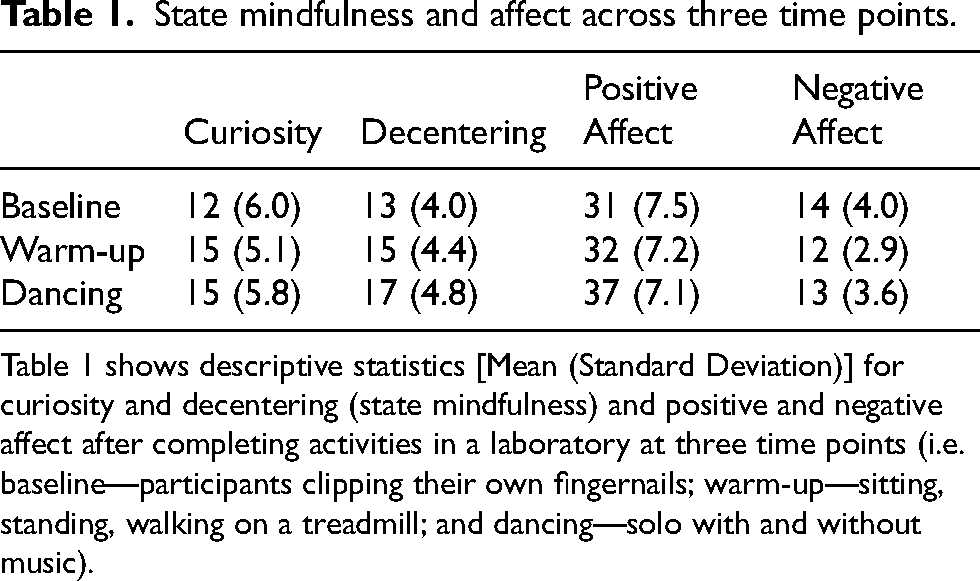
Table 1 shows descriptive statistics [Mean (Standard Deviation)] for curiosity and decentering (state mindfulness) and positive and negative affect after completing activities in a laboratory at three time points (i.e. baseline—participants clipping their own fingernails; warm-up—sitting, standing, walking on a treadmill; and dancing—solo with and without music).
Curiosity and DLS scores
Table 2 shows that curiosity was significantly associated with median overall DLS scores (effect coded), after adjusting for age, resilience, sex, years of dance training, affect, and the overall DLS score median amplitude deviation. As shown in Figure 1(a), participants with a relatively lower median overall DLS score (i.e. below the 50th percentile) reported significantly higher curiosity [16.2; 95% C.I., 13.3 to 19.0] on average, when compared [12.6; 95% C.I., 10.3 to 14.9] to those with a relatively higher median overall DLS score.
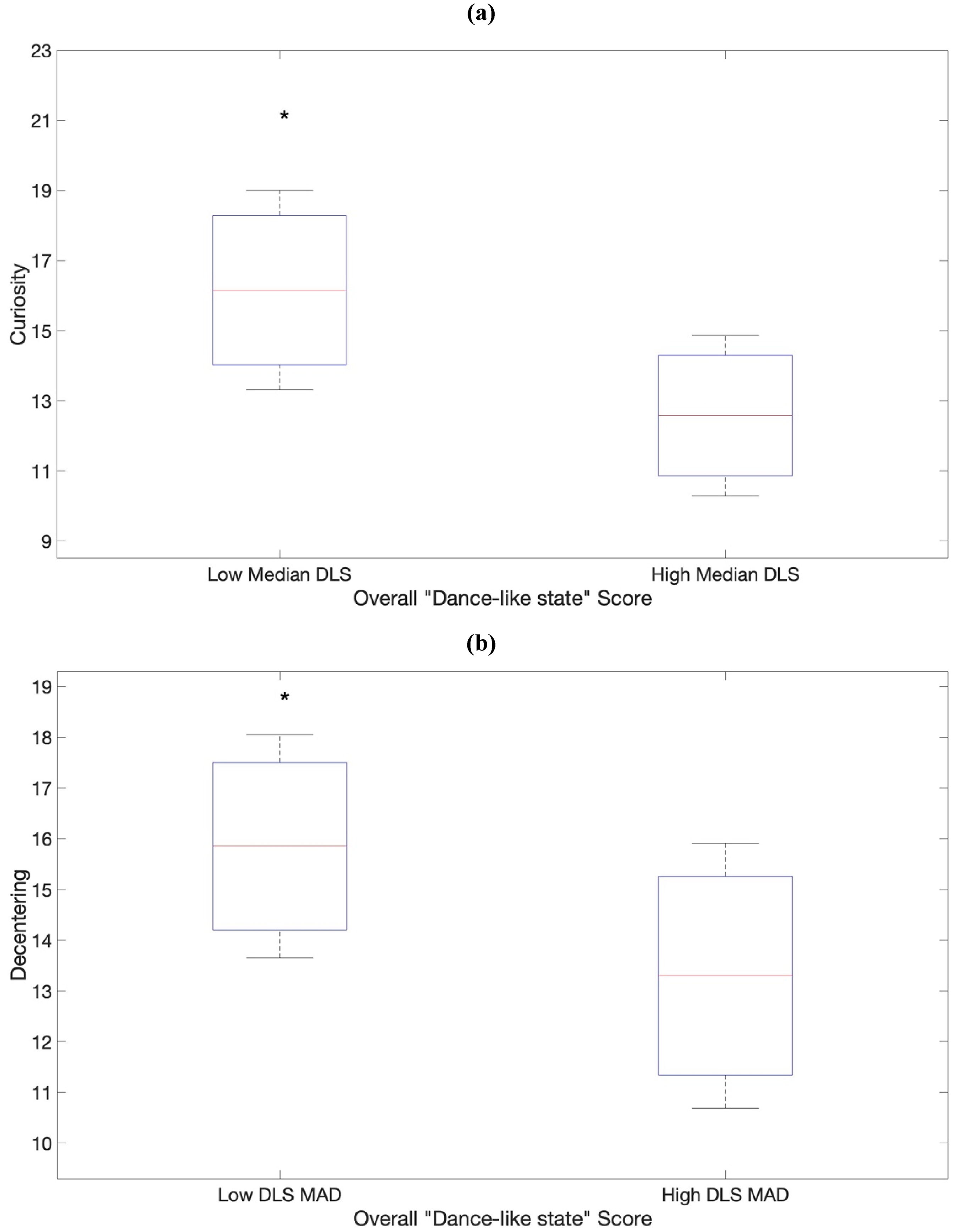
“Dance-like state” score summary statistics and differences in covariate-adjusted curiosity and decentering among 18- to 83-year-old adults with 0 to 56 years of prior dance training. Panels a and b show significant differences (*p < 0.05) in self-reported curiosity (a) and decentering (b) on the Toronto Mindfulness Scale, after controlling respective linear mixed effects models for participant characteristics and overall “dance-like state” (DLS) score summary statistics. Panel a shows curiosity was significantly higher among participants with a lower median overall DLS score. Panel b shows decentering was significantly higher among participants with a lower overall DLS score median amplitude deviation (MAD). For each DLS score summary statistic, low and high were respectively defined for each DLS score summary statistics as ≤50th percentile (low) and >50th percentile (high).
Curiosity over time in relation to overall “dance-like state” score summary statistics.
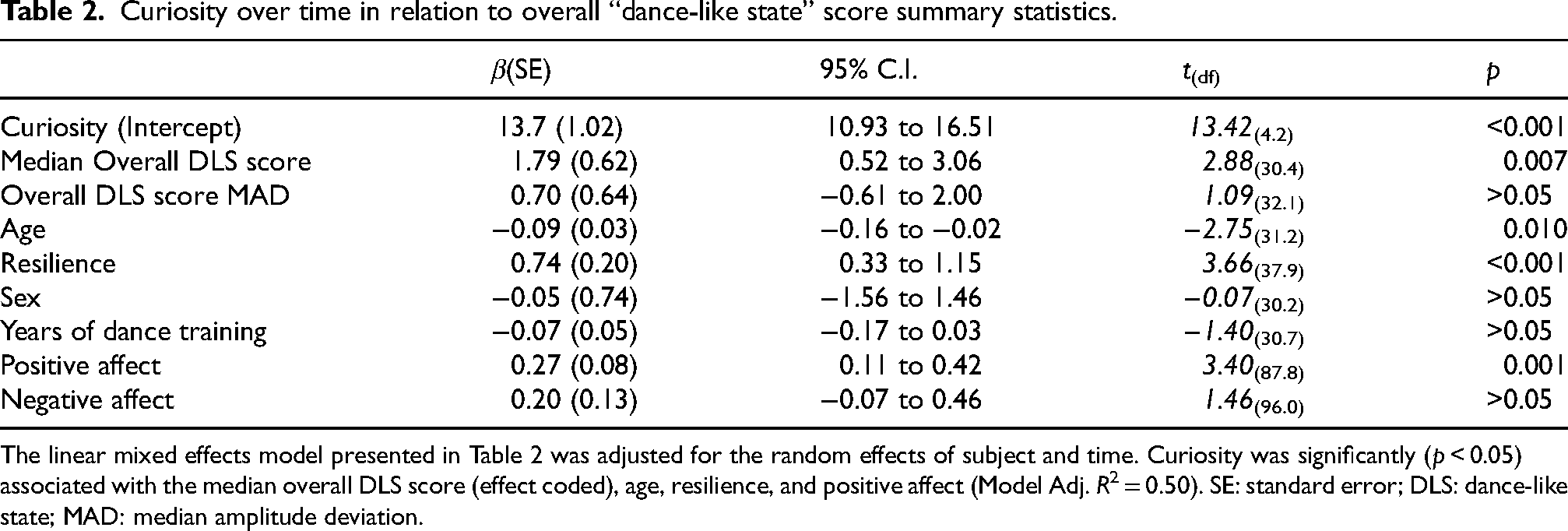
The linear mixed effects model presented in Table 2 was adjusted for the random effects of subject and time. Curiosity was significantly (p < 0.05) associated with the median overall DLS score (effect coded), age, resilience, and positive affect (Model Adj. R2 = 0.50). SE: standard error; DLS: dance-like state; MAD: median amplitude deviation.
Rank sum analyses of total energy expenditure showed energy expenditure recorded among participants with a relatively lower median overall DLS score (i.e. below the 50th percentile) was significantly lower [217.9(50.9) kcal], when compared [264.3(85.8) kcal] to those with a relatively higher median overall DLS score (U = 305, Z = −2.99, p = 0.003). After converting total kcal to MET-minutes, rank sum analyses showed MET-minutes among participants with a relatively lower median overall DLS score were significantly lower [196.1(64.2) MET-minutes], when compared [226.9(56.8) MET-minutes] to those with a relatively higher median DLS score (U = 339, Z = −2.10, p = 0.036).
In a separate model without DLS scores, LME results showed that self-reported curiosity [13.9(1.02)] over time was significantly inversely associated with total energy expenditure [ß = −0.04(0.02); 95% C.I., −0.07 to −0.006; t31.2 = −2.43; p = 0.021], controlling for age [ß = −0.13(0.04); 95% C.I., −0.21 to −0.05; t32.9 = −3.33; p = 0.002], resilience [ß = 0.65(0.20); 95% C.I., 0.25 to 1.05; t38.8 = −3.29; p = 0.021], sex [ß = −0.81(0.84); 95% C.I., −2.52 to 0.90; t31.4 = −0.96; p > 0.05], years of dance training [ß = −0.03(0.05); 95% C.I., −0.13 to 0.08; t32.1 = −0.52; p > 0.05], positive affect [ß = 0.29(0.08); 95% C.I., 0.14 to 0.44; t84.6 = 3.77; p < 0.001], negative affect [ß = 0.15(0.13); 95% C.I., −0.12 to 0.42; t98.0 = 1.12; p > 0.05], and BMI [ß = 0.15(0.15); 95% C.I., −0.15 to 0.46; t30.9 = 1.03; p > 0.05], with a model Adj. R2 = 0.51.
Decentering and DLS scores
Table 3 shows that decentering was significantly associated with the overall DLS score median amplitude deviation (effect coded), after adjusting for age, sex, resilience, years of dance training, affect, and median overall DLS scores. As presented in Figure 1(b), participants with a relatively lower overall DLS score median amplitude deviation (i.e. below the 50th percentile) reported significantly higher levels of decentering [15.9; 95% C.I., 13.7 to 18.1] on average, when compared [13.3; 95% C.I., 10.7 to 15.9] to those with a relatively higher overall DLS score median amplitude deviation.
Decentering over time in relation to overall “dance-like state” score summary statistics.
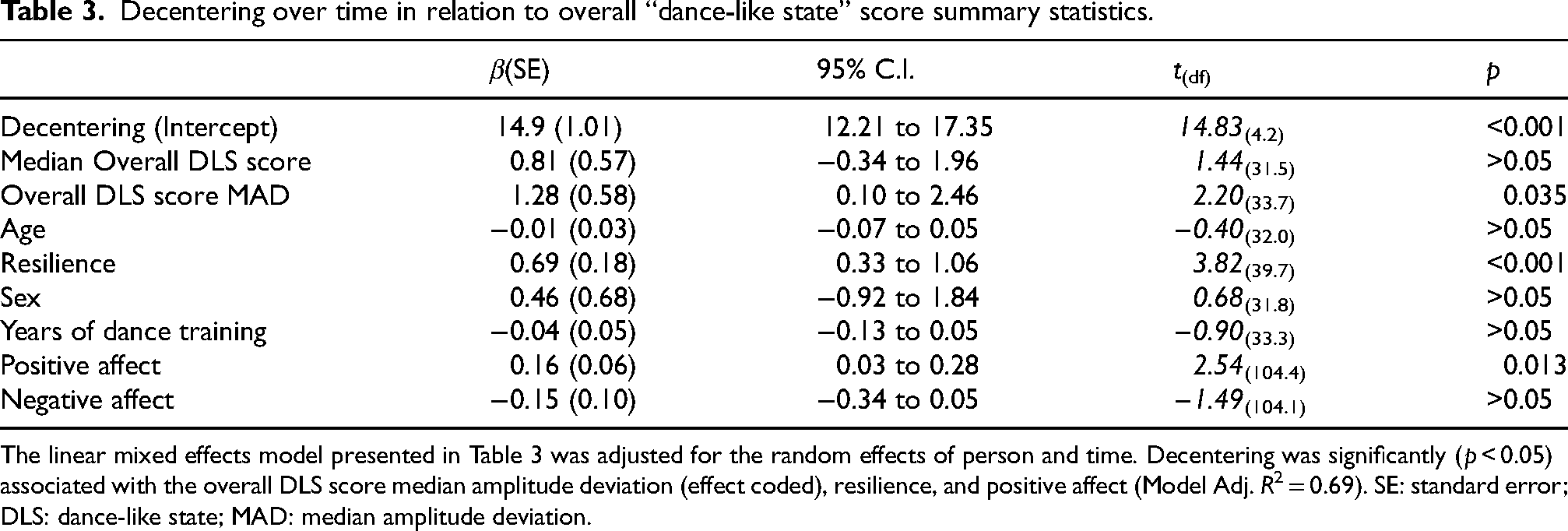
The linear mixed effects model presented in Table 3 was adjusted for the random effects of person and time. Decentering was significantly (p < 0.05) associated with the overall DLS score median amplitude deviation (effect coded), resilience, and positive affect (Model Adj. R2 = 0.69). SE: standard error; DLS: dance-like state; MAD: median amplitude deviation.
Rank sum analyses of preferred music tempo during self-determined vigorous intensity dancing showed that the preferred music tempo among those with a relatively lower overall DLS score median amplitude deviation (i.e. below the 50th percentile) was significantly higher [128(44) bpm], when compared [109(25) bpm] to participants with a relatively higher overall DLS score median amplitude deviation (U = 517, Z = 2.52, p = 0.012).
In a separate model without DLS scores, LME results showed that self-reported decentering was not significantly associated with total energy expenditure [ß = −0.003(0.01); 95% C.I., −0.03 to 0.03; t31.0 = −0.19; p > 0.05], controlling for age, resilience, sex, years of dance training, positive affect, negative affect, and BMI, with a model Adj. R2 = 0.69.
Discussion
This pilot study assessed the degree to which human movement qualities, as observed across a range of motor behaviors, were associated with experiences of curiosity and decentering in a sample of 18- to 83-year-old adults. Movement quality was analyzed using a novel, accelerometer-based measure (i.e. DLS scores) that quantifies the probability that a given motor behavior is an expression of free-form dancing. Study results showed DLS scores were related to curiosity and decentering, respectively, when robust summary statistics (i.e. the median and median absolute deviation) were applied to DLS scores and used to characterize overall movement quality across conditions. For curiosity, a higher median DLS score across conditions was associated with lower curiosity. Lower reports of decentering among young to older adults were associated with having a higher median amplitude deviation in DLS scores across conditions. Median DLS scores were associated with energy expenditure across conditions among young to older adults, and the DLS score median amplitude deviation was associated with music preferences during free-form dancing. These results collectively point toward meaningful relationships between movement quality, music preference and energy expenditure, and suggest that further analysis of human movement quality in relation to cognitive and metacognitive phenomena may advance what is known about the relationship between dance behavior and these state mindfulness substrates.
Participants with a lower median probability of being engaged in free-form dance across conditions (i.e. those with a lower median DLS score) self-reported being more curious than those with a higher median probability of being engaged in free-form dance across conditions. Relatedly, adults with a lower median probability of being engaged in free-form dance across conditions were found to have lower energy expenditure across conditions when compared to adults with a higher median probability of being engaged in free-form dance. In a model without DLS scores, we also detected an inverse relationship between energy expenditure and curiosity. Curiosity is a cognitive phenomenon,9,10 and prior research showing an inverted-U relationship between acute changes in cognitive performance and central nervous system arousal suggests that engaging in moderate intensity physical activity may be optimal for narrowing attention to focus on task-relevant cues and improving cognitive performance; however, exposures to higher intensity physical activity may lead to acute decreases in cognitive performance and an overly narrowed field of attention that may lead to missing relevant cues. 49 Cognitive performance may also be dependent upon the complexity of the task, whereby performance on simple perceptual tasks, for example, has been inversely associated with energy expenditure and performance on more complex, decisional tasks has been positively associated with energy expenditure. 49 After using the average physical activity intensity observed across conditions to compute MET-minutes, to better account for time and body weight, we saw that physical activity intensity over time (i.e. its dose—the physical activity frequency × intensity × duration) was lower among adults with a lower median DLS score when compared to those with a higher median DLS score. Thus, across activity bouts that were performed at self-selected intensities, adults with a lower median DLS score tended to be those who accumulated lower doses of physical activity and had higher curiosity when compared to those with a higher median DLS score. Given that research shows that task duration and complexity are associated with cognitive performance, 49 additional study of movement complexity in relation to curiosity may help to reveal whether those with higher energy expenditure and lower curiosity may be those who tended to engage in more complex dance behaviors. Consistent with the original DLS score calibration study, 45 the median DLS scores observed within the study cohort were dichotomized using the 50th percentile as the cut point. Because prior studies have shown that physical activity intensity may be associated with cognitive performance, 49 and in view of the observed relationship between energy expenditure and curiosity in our cohort of young to older adults, future studies on curiosity should be conducted in larger cohorts of adults to better understand changes in state curiosity in relation to physical activity intensity, task complexity, and task duration during dance.
Previous reports on associations between curiosity and movement have shown that oculomotor activity during sitting can be monitored as a correlate of curiosity.16,19,20 For example, a study of twenty adults found that oculomotor activity could be used to predict curiosity using a machine learning approach. 16 At the level of gross motor activity, a prior study by Lydon-Staley and colleagues that used questionnaires to study free-living physical activity in adults reported that self-reported total daily physical activity volumes were also positively associated with daily self-reports of curiosity. 17 With specific reference to the findings presented by Lydon-Staley and colleagues, 17 we found in our study that greater energy expenditure was inversely associated with self-reported curiosity when energy expenditure was measured using indirect calorimetry; however, it is important to note that self-reported measures of physical activity may not directly correlate with device-measured estimates of physical activity, 50 which precludes direct comparisons between our results and the findings reported by Lydon-Staley and colleagues who used a self-reported measure of physical activity. Nevertheless, these studies and ours show both that motor activity is associated with experiences of curiosity and that further investigation of this cognitive dimension of state mindfulness in relation to motor activity and its physiological correlates among adults is warranted. We found that self-reported experiences of curiosity while in the laboratory decreased with age among young to older adults ages 18 to 83 years old. Prior studies that have quantified saccadic eye movement as a motor correlate of curiosity in typically ageing populations and those with cognitive impairments have also respectively reported decreases in curiosity with increasing age or the presence of cognitive impairment.19,20 Though we used the Toronto Mindfulness Scale to measure curiosity, and prior studies of curiosity have respectively used other measures of the construct, the instrument that we used to assess curiosity within our cohort of community dwelling, ostensibly healthy young to older adults further confirms an inverse relationship between curiosity and age. These consistent results, though obtained using different instruments for measuring curiosity, may suggest that curiosity shares a robust inverse relationship with age among adults; however, additional research using a wider panel of curiosity measures within a larger cohort of young to older adults is needed to further characterize the relationship between chronological age and curiosity. Given the approach implemented in our study, we also suggest that future designs consider further study of free-form dance as a mode of exploratory behavior in relation to curiosity among adults, especially in tandem with the use of wearable technologies for quantifying physical activity dose and motor behavior complexity.
Adults among whom the probability of being engaged in dance was less variable across conditions (i.e. those with a lower DLS score median amplitude deviation) reported greater experiences of decentering when compared to adults among whom the probability of being engaged in dance was more variable across conditions. Notably, adults among whom the probability of being engaged in dance was less variable across conditions were also those who selected faster music during self-determined vigorous intensity dancing when compared to those for whom the probability of being engaged in dance across conditions was more variable. Decentering is a metacognitive process largely concerned with attention to psychological stimuli.11,12 Prior studies have shown that exposures to self-selected, familiar music may be associated with psychological factors such as enjoyment and reductions in experiences of tension or anxiety; 51 changes in motor performance 52 and improved task efficiency; 51 fMRI data have shown engaging with self-selected music led to greater activation of auditory areas (superior temporal gyrus, superior temporal sulcus, and middle temporal gyrus), the dopaminergic reward system, and the default mode network (medial prefrontal cortex, posterior singular cortex, temporoparietal junction/inferior parietal lobule, and parahippocampal gyrus) when compared to other-selected music, 53 and the default mode network has been associated with internally-directed mentation and may be implicated in the development of mindfulness. 54 Though the literature shows mixed results regarding which musical parameters may be most associated with experiences of mindfulness,55–58 the overlapping findings across prior reports and the present study that indicate exposures to self-selected music may be associated with both motor activity and psychological phenomena may mean that musical features are an important factor to consider in the study of decentering and dance behavior. Decentering predicts changes in psychological health outcomes, such as psychological distress, psychiatric disorders, and perceived stress. 8 Thus, the significant finding in the present study that human movement quality was associated with decentering importantly points toward the potential use of quantifiable motor behavior characteristics in future studies that aim to monitor decentering over time.
A delimitation of this study is that movement quality and state mindfulness were assessed among community dwelling adults ages 18–83 years old; however, physical activity behavior patterns are known to differ between adults and children. 59 Therefore, the findings presented in this study on the relationship between state mindfulness and movement quality may be limited to adults. Additional studies that use accelerometry are needed to advance prior observational research that shows motor activity may serve as correlate of curiosity among children. 18 Our study used a single, self-reported measure of momentary mindfulness to explore associations between movement patterns, curiosity, and decentering; however, future studies should use a battery of curiosity assessments 60 to conduct domain-specific assessments of curiosity in relation to movement across the lifespan. Furthermore, this study was conducted in among a small sample of young to older adults within a laboratory setting; as such, these results should be replicated and extended in a larger, diverse sample of adults. State mindfulness in this study was measured before and after participants engaged in all dance bouts; thus, the study design limited further analysis of the influence of music on mindfulness and movement quality during free-form dancing. Additional studies are therefore needed to understand how exposures to self-selected music may relate to momentary mindfulness and movement qualities during free-form dance. A major strength of this study is that we used accelerometry data to characterize human movement quality in reference to free-form dance. Thus, our study extends prior reports that have used direct observation methods to quantify changes in curiosity among children, 18 and oculomotor activity among adults,16,19,20 by demonstrating that gross motor correlates of curiosity may be assessed using accelerometer data among adults. To our knowledge, this present study is the first to provide evidence of a relationship between movement quality and decentering within dance contexts among a cohort of adults with and without prior dance training, thus this study importantly adds to the literature further evidence that movement quality among adults is associated with cognitive and metacognitive phenomena. Additionally, this study appropriately adjusted models that assessed respective relationships between curiosity, decentering, and motor activity for trait resilience and self-reported changes in positive and negative affect over time, in view of prior research showing that mindfulness, mood, and one's disposition toward being resilient may be correlated.2,6,7,43,44 Finally, rather than using qualitative descriptors and evaluations from coders to characterize gross motor activities, 61 we used an accelerometer-based method to characterize human movement quality in reference to free-form dancing.
The results of this pilot study provide a foundation for continued research on free-form dance as an intervention in studies that aim to identify motor correlates of curiosity and decentering. In future studies that aim to further investigate curiosity in relation to human movement quality, we suggest that researchers continue to measure energy expenditure as a correlate of interest. In our study, though we found that both energy expenditure and DLS scores were associated with self-reported curiosity, results showed that DLS scores explained a significant degree of the variability in self-reported curiosity even after adjusting for energy expenditure. Unlike for curiosity, we observed no significant relationship between decentering and energy expenditure, which could reveal that energy expenditure may only be an important factor to consider when measuring curiosity. Because DLS scores and energy expenditure similarly explained an inverse relationship between physical activity dose and curiosity, these pilot results provide preliminary evidence that DLS scores could be used as a proxy for other measures of energy expenditure in the context of studying curiosity and dance behavior. Moreover, our use of a parsimonious set of signal features to characterize movement quality across a range of motor behaviors offers further evidence for the use of DLS scores as a quantitative metric for characterizing qualitative features of human movement. Taken together, our findings provide further evidence that kinematic features of human activity may serve as a distinguishable correlate of curiosity and decentering in adults. Future research on movement quality in relationship to momentary mindfulness should further characterize the influences of physical activity dose and motor complexity on acute changes in mindfulness in a larger sample of adults. Additionally, future studies on mindfulness and kinematic features of human movement may also benefit from investigating physical activity modes that will provide meaningful information for quantifying changes in curiosity and decentering using accelerometry data, and the range of warm-up and free-form dance behaviors observed in our study provided sufficient stimuli to detect significant motor correlates of mindfulness using accelerometry among adults with and without prior dance training.
Curiosity and decentering were each found to be associated with movement qualities that were detected among adults ages 18 to 83 years old when a novel, accelerometer-based method was used to characterize the quality of motor behavior in reference to dancing (i.e. “dance-like state” scores). This study found that adults who reported feeling less curious across conditions had lower median “dance-like state” scores, and that having lower median “dance-like state” scores was associated with accumulating a lower dose of physical activity across conditions. Decentering was inversely associated with the magnitude of variability that was observed in “dance-like state” scores across conditions, and adults among whom less variability was observed in “dance-like state” scores were also those who preferred listening to faster music while engaged in free-form dancing at a self-determined vigorous intensity. Further investigation on the respective influences of task complexity and musical preference on curiosity and decentering are required to better understand their roles in shaping experiences of state mindfulness. Additional research using multiple assessments of curiosity and decentering are also needed to confirm respective associations between curiosity, decentering, and dance-related movement qualities within a larger sample.
Supplemental Material
sj-docx-1-alz-10.1177_13872877251315054 - Supplemental material for Dance-like state detection, curiosity, and decentering: A pilot study on artful movement and mindfulness
Supplemental material, sj-docx-1-alz-10.1177_13872877251315054 for Dance-like state detection, curiosity, and decentering: A pilot study on artful movement and mindfulness by Aston K. McCullough, Siobhan Lawless and Bruna Martins-Klein in Journal of Alzheimer's Disease
Footnotes
Acknowledgments
We are grateful to all participants who volunteered their time in the study.

Author contributions
Aston McCullough (Conceptualization; Data curation; Formal analysis; Funding acquisition; Investigation; Methodology; Project administration; Resources; Software; Supervision; Validation; Visualization; Writing – original draft; Writing – review & editing); Siobhan Lawless (Writing – original draft; Writing – review & editing); Bruna Martins-Klein (Methodology; Validation; Writing – review & editing).
Funding
The study was funded in part by an award from the National Endowment for the Arts (Award #: 1879058-38-C-21).
Declaration of conflicting interests
The authors declared no potential conflicts of interest with respect to the research, authorship, and/or publication of this article. The opinions expressed are those of the authors and do not represent the views of the National Endowment for the Arts (NEA) Office of Research & Analysis or the National Endowment for the Arts. The NEA does not guarantee the accuracy or completeness of the information included in this material and is not responsible for any consequences of its use.
Data availability
Study data presented in this article may be obtained upon submitting a request to the corresponding author.
Supplemental material
Supplemental material for this article is available online.
References
Supplementary Material
Please find the following supplemental material available below.
For Open Access articles published under a Creative Commons License, all supplemental material carries the same license as the article it is associated with.
For non-Open Access articles published, all supplemental material carries a non-exclusive license, and permission requests for re-use of supplemental material or any part of supplemental material shall be sent directly to the copyright owner as specified in the copyright notice associated with the article.
