




Abstract
Rooted in the rational choice theory, high stake elections are considered to attract more voters than elections where the outcome is a foregone conclusion. In single member plurality systems, local and national competitiveness are both thought to be part of a voter’s consideration when deciding whether or not to turn out to vote. However, we know little about how these two levels of competitiveness interact. This article aims to shed light on the nature of the relationship – whether competing or complementary – of local and national competitiveness on voter turnout in single member plurality systems. We develop expectations, particularly zooming in on the role of party contention, and verify their validity based on the combined British Elections Studies from 1964 to 2019 to which information on the level of electoral saliency at the constituency and national level have been added. We find that the effect of competitiveness on individual-level turnout depends on its operationalisation. This is in line with the literature, which reports conflicting evidence about its impact on turnout. When one’s preferred party is in contention at both the local and the national level, there is a consistent positive effect on turnout. Out of the two, the local level seems to have slightly more weight.
Introduction
The degree of closeness of an election is linked to the likelihood of voters affecting an election’s outcome. The closer the race, the higher the probability that a single vote will make the difference. Rooted in the rational choice literature (Downs, 1957; Riker and Ordeshook, 1968), the idea that one’s vote counts increases potential personal benefits and therefore also the probability of turnout. Moreover, when the outcome of an election is unsure political parties and candidates will increase voter mobilisation efforts. The probability of being a decisive voter is not directly observable. Parties and candidates are, however, considered to have an increased awareness for the degree of closeness of an election. Therefore, parties and candidates mobilise their supporters in high stake elections since mobilisation efforts are more likely to be decisive.
While measures of the closeness of the race at the national level are traditionally part of voter turnout research, constituency conditions have historically also garnered attention (see, for example, Bealey et al., 1965; Blais and Lago, 2009; Denver et al., 2003; Endersby et al., 2002; Fauvelle-Aymar and François, 2006; Johnston et al., 2007; Selb, 2009; Vowles et al., 2017). Especially in single member plurality (SMP) systems, measures of national competitiveness do not suffice to explain levels of voter turnout. Measures of local competitiveness are modelled alongside national-level measures, since voters not only take into account the closeness of the race at the national level but are driven by local levels of electoral saliency as well. That is, the race for their constituency representative. What is unclear is how local and national competitiveness together influence a voter’s decision to the polls. This article aims to shed light on the nature of the relationship between local and national competitiveness as explanatory factors of turnout in national elections. More specifically, it asks whether the two measures are competing or complementary. That is, do they work together in their effect on turnout, or do they conflict?
A key contribution of this article is accounting for party preference in theorising and operationalising how local and national competitiveness can impact turnout. Importantly, the salience of the election should matter most for those whose party is in contention. Elections should first and foremost mobilise those whose preferred party has a chance of winning. Those who are indifferent to the front runners should be less motivated to turn out to vote. That said, campaign intensity may still have some effect on turnout, even in the absence of partisan motivations. A voter’s preferred party could be in contention locally, nationally, both or neither. We provide and test expectations for how each of these conditions can explain turnout.
In empirical research, the impact of electoral competition on voter turnout finds mixed evidence in meta-analyses (Cancela and Geys, 2016; Frank and Martínez i Coma, 2023; Geys, 2006; Smets and van Ham, 2013; Stockemer, 2017). The level at which the closeness of the race and electoral turnout are measured plays a role in this. For instance, Cancela and Geys (2016) find only 46% of tests show a positive relationship between district closeness and turnout, compared to 70% of national-level tests; however, this is over five different measures of competitiveness. Similarly, Stockemer (2017: 698) finds ‘electoral closeness is inconclusive at best’ but does not report the measurements of this concept. Therefore, a second contribution of this article lies in the fact that it looks at the impact of electoral saliency at the local and national level on individual-level turnout, while testing for differences in measurement. Disagreement on the operationalisation of electoral competition plays a role in the mixed findings (Endersby et al., 2002). While many measures of competitiveness are applicable in two-party systems, they do not make theoretical sense once more than two parties compete in the race (Blais, 2006). This is the case in virtually all proportional electoral systems and even in some majoritarian ones. The United Kingdom, for example, has long been known as a 2.5 party system (Blondel, 1968). Indeed, with the exception of 1966 and 1970, every UK election since 1964 has had an effective number of parties of 2.5 or over, with 2024 topping the charts at 4.76 (Laakso and Taagepera, 1979). In assessing the competing or complementary nature of local and national competitiveness as explanatory factors of turnout, taking into account various operationalisations of electoral competitiveness that fit the character of both the electoral system and the party system is therefore indispensable.
We address the questions outlined above based on the British Election Studies (BES) from 1964 to 2019. Great Britain is a good case to study the effect of local and national competitiveness in SMP systems as it is a classic example of a first-past-the-post system, a well-documented case, has data that cover the longest available time span, and speaks directly and indirectly to the literature under scrutiny. Since the BES keep a record of the constituency a respondent lives in and their party preference, the impact of competitiveness at the constituency-level on individual-level voter turnout can be modelled alongside measures of national electoral saliency. In order to be able to do so, information on the level of electoral competition in the respondent’s constituency was added to the combined BES 1964−2019 dataset alongside measures at the national level for all respondents in all election years. This combination of data not only allows addressing the extent to which local and national competitiveness influence individual-level and constituency-level turnout in national elections, but also to assess which measures and elements of competitiveness matter most and how this is impacted by which party is in contention.
The next section presents a theoretical framework that incorporates party preference into a grid of expectations for how differing levels of competitiveness could impact turnout. After this, we address the measurement of electoral competitiveness in SMP systems like Great Britain. Next, we discuss the dataset constructed for this article and present the results of the analyses with which we test our hypotheses. In line with the literature, we find that competitiveness matters for turnout, but that there is no systematic competing or complementing pattern between local and national competitiveness. Taking into account the role of contention, we find that one’s preferred party being in contention at both the local and the national level positively impacts turnout. Out of the two, the local level seems most important for turnout. While our article confirms that the impact of competitiveness is not uniform, it makes a contribution by shedding light on the mechanisms behind the inconclusive findings in the literature.
Theorising levels of competitiveness with party preference
The central research question of this article is whether levels of competitiveness are competing or complementary in their effects on turnout. We therefore ask two questions: (1) do local and national competitiveness work together? That is, they both increase turnout, and when interacted they work in the same direction; or (2) do they work against each other? That is, only one increases turnout, and/or when interacted they cancel each other out (showing no effect on turnout) or turnout decreases. To do so, we must consider why each level of competitiveness matters and how these levels may have a distinct impact on the decision to vote.
The mechanism by which competitiveness encourages turnout is through increased probability of holding the decisive vote (Downs, 1957; Riker and Ordeshook, 1968). When your vote matters more, you are more likely to cast it. At the constituency level in Britain this is theorised as explaining why marginal seats enjoy higher turnout (Denver and Hands, 1974; Denver et al., 2003; Vowles et al., 2017). Greater competitiveness at the local level means an increased chance of your vote mattering when electing a representative. Yet citizens in Britain do not vote directly for a government. As a consequence, at the national level there is no increase in the probability of a vote mattering. There is, however, an increase in the chance that certain seats will decide the election, making them more important (Denver et al., 2003; Milazzo, 2015). A voter can therefore reside in a seat where their vote is important (local competitiveness) during a general election where their constituency could be important (national competitiveness). They could also experience high local competitiveness in an uncompetitive national election, and the reverse of this. It is also possible that neither conditions apply, meaning neither their seat nor their vote is important for an electoral outcome.
It is also true that party mobilisation efforts change in competitive elections, as those fighting for office are aware of this increased importance at both levels. Parties are rational in how they allocate funds (Pattie et al. 1995), targeting the constituencies they are most likely to win. This is not so easy for parties to determine when spending nationally, again because of a system whereby there is no direct vote for a government, and so parties see much less of a return in terms of support when increasing national campaign spend (Fisher, 1999, 2018; Trumm and Sudulich, 2018). Instead, the tone of the national campaign intensifies as electoral competition increases nationally. The media in particular focus on the ‘horse race’ element of uncertain elections, bringing this competitiveness to the forefront of citizens’ awareness. When voters are conscious of this increased competition, they are more knowledgeable and seek out more information about the election (Milazzo, 2015).
The factors are, of course, not independent. Voters reside in constituencies, these constituencies are housed in the nation; they are different levels of aggregation. For a salient general election when the governing national party is difficult to predict, there are more voters in more seats that matter. In turn, there are a greater number and higher magnitude of intense campaigns experienced by more citizens. We can therefore construct a typology of competitiveness conditions where a range of voters experience a range of competitiveness depending on the electoral context.
Our expectation is that competitiveness (whether at the constituency or the national level), generally speaking, has a positive effect on turnout (H1a and H1b). Since the literature does not indicate what to expect when competitiveness is high at both levels, we develop two competing hypotheses. On the one hand, we can expect high levels of competitiveness to be complementary and to boost individual-level turnout (H2a), on the other hand it may be that local and national competitiveness compete with each other and/or cancel each other out (H2b). This could be because voters are receiving conflicting messages from national and local campaigns. Or, in the case that we find opposing evidence for H1a and H1b at one of the levels, because the two competitiveness effects nullify each other.
However, there is an additional crucial step: these conditions should matter mostly (or even only) when your party is in contention. Competitiveness itself is a function of the likelihood a particular party will win, therefore voters should only care about the competition as a mobiliser when theirs is the preference that could be realised – if you are indifferent between the frontrunners, then there is no explanation from a rational choice perspective as to why would you be motivated to vote as their race gets closer. Yet it is likely that campaign intensity will serve to have some positive effect on turnout, even in the absence of partisan motivations.
We therefore have two hypotheses relating to party contention. First, we expect that the likelihood of voting increases when a person’s party is in contention to win and that these conditions are true both nationally and locally (H3). That is, a Conservative supporter is most likely to vote when a Conservative candidate may narrowly win in their constituency and a Conservative government may be elected to Parliament with a small majority of seats. We also theorise that turnout should be lowest when the opposite is true: neither the national or constituency race is close, and a citizen’s preferred party is not in contention to win at either level. This is because the two levels are complementary and both work to increase turnout. We also test the degree to which this is the case. We expect that as competitiveness rises at both levels, this should positively impact turnout most for those whose party is in contention at both levels, more so than voters whose partisan identity only matches the potential winner at one level (H4a).
In the same way, voters experience competing effects when conditions differ between the national and local context. This could be because the constituency race is not close, while the national context is, or it is clear who will form the national government but uncertain who will win the voters’ seat. Alternatively, it could be that either (or both) levels are competitive but a voters’ party is not in contention. Therefore, we test whether this is the case (H4b). At all times, we consider this from the individual voters’ perspective but expect that these effects are uniform and therefore can be aggregated.
We will consider that our evidence supports H1a and H1b when national and local competitiveness each have a positive relationship with individual turnout. For H3, this will be the case when there is a positive relationship between party contention and turnout. H2a is supported when the interaction term between national and local elections is positive and statistically significant, and H4a if this relationship is strongest when voters’ preferred parties are in contention at both levels. For H2b, we will find evidence in support when any positive effects of one level of competitiveness on turnout is dampened by the absence of competitiveness at another level such that they appear to cancel each other out by showing no effect on turnout (i.e. the base terms have different signs). H4a is also supported if the interaction term between local and national competitiveness is negative and significant. H4b is supported when this relationship is strongest when voters’ preferred parties are not in contention at both levels at the same time or if one level of competitiveness and party contention is significant while another is not.
One caveat to our theoretical expectations is that it is of course very possible that a voter’s main preferred party is not in contention to win in their constituency/at the national level, but that they still care deeply about the election outcome. In cases where an election is particularly close, voters with a strong dislike for one party would have a greater incentive to vote against that party, even if their main preferred party isn’t in the running. The role of negative partisanship is not one we can study in this work, but we will return to its implications later in this article.
Measuring electoral competition between political parties
Research regarding the impact of competitiveness on turnout provides mixed results. While Geys (2006) in his review of the literature concludes that empirical evidence points to a link between the level of competition between political parties and aggregate level turnout, Smets and van Ham (2013) find the same not to be true in their meta-analysis of research on individual voter turnout. In an update to their paper, Cancela and Geys (2016) find closeness important for national but not local aggregate turnout. Yet there is a long tradition in the British voting behaviour literature evidencing that constituency competitiveness consistently incentivises voting (for instance, Bealey et al., 1965; Denver and Halfacree, 1992; Denver et al., 2003; Pattie and Johnston, 1998; Pattie et al., 1995; Vowles et al., 2017). Stockemer (2017) shows that over half of the coefficients in the 89 models they analysed in their meta-analysis fail to find a relationship between participation and competitiveness. Two explanations for these mixed results are mentioned in the literature. The first concerns the type of data used to measure electoral competition. The second regards the measurement of the closeness of the race.
Since the impact of electoral competition is theoretically based on perceptions of the closeness of the race before the election, the use of ex-ante measures would be preferable. Pre-election opinion and exit polls provide a precise measure of the degree of closeness of the upcoming ballot. Such polls are usually only available at the national level, though. Moreover, while polling data are available in relation to recent elections they are harder to find going back in time. Such forecast data, therefore, do not allow us to measure perception of the closeness of the race at the constituency level and would not permit us to measure the impact of competitiveness over a long period of time (Fauvelle-Aymar and François, 2006: 473).
For all these reasons, most studies rely on ex-post measures of closeness. In other words, they take into account the actual closeness rather than the perceived closeness. Such actual election results may not accurately reflect pre-election expectations. Ex-post measures of competitiveness are, moreover, a function of the dependent variable turnout and therefore can potentially lead to biased results. That said, there are virtually no alternatives to using ex-post data when researching the impact of electoral competition at the constituency level over a considerable period of time (Selb, 2009: 537).
Turning to the second problem, there is little agreement on and consistency in the operationalisation of the electoral closeness (see Endersby et al., 2002 and Fauvelle-Aymar and François, 2006 for overviews). The decisiveness of the vote depends on two elements: the closeness of the electoral race and the size of the electorate. The smaller the district, the higher the probability that a single vote will be decisive. Despite the seeming logic, size of the electorate hardly ever has the expected negative effect on voter turnout (Fauvelle-Aymar and François, 2006: 472). 1 Moreover, as it is not a measure of competition between parties, we will not take it into account in this study.
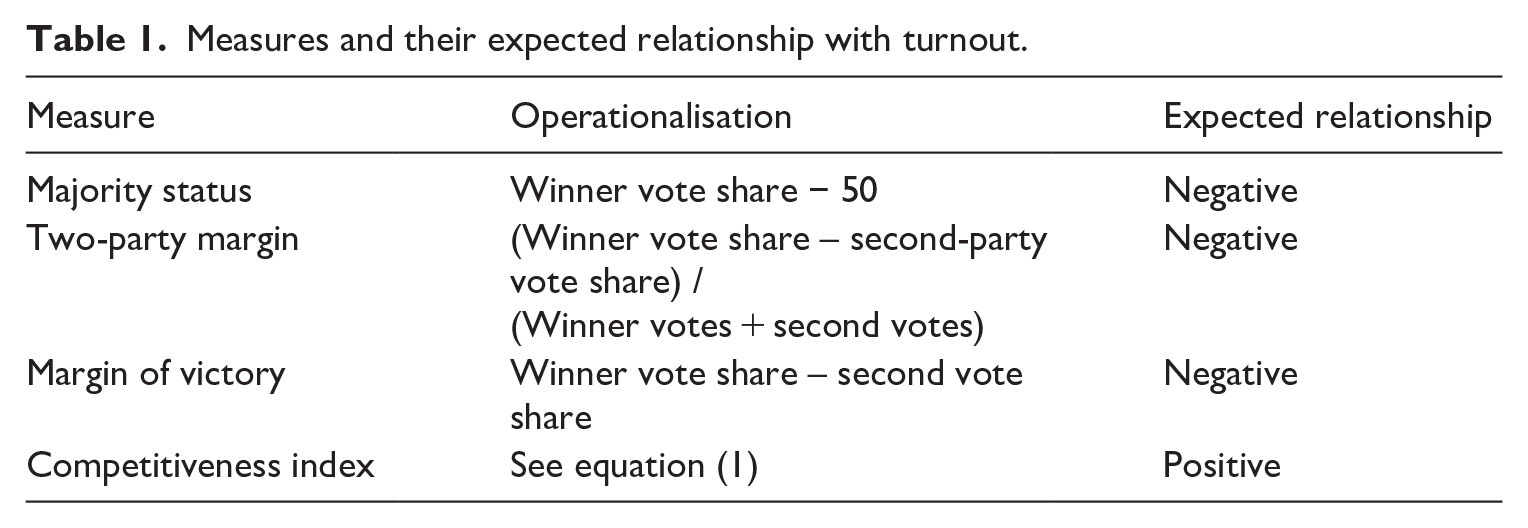
The closeness of the race between parties is measured in various ways in the literature. The majority status measures the distance between the vote share of the first placed party and fifty % (v1 −50). 2 Negative values indicate that the largest party did not manage to obtain 50% of the popular vote, whereas positive values point to the largest party winning a majority of the popular vote. The more positive the majority status, the larger the victory of the first placed party and the less close the electoral race. Majority status is therefore expected to negatively affect turnout levels.
The two-party margin is calculated as the difference between the votes for the first placed and second placed party divided by the total number of votes for these two parties ((v1 − v2)/(v1 + v2)). As pointed out by Cox (1988), the problem is that in a truly bipartisan system the sum of the vote shares between the first two parties is equivalent to the total votes cast. Hence, the denominator overlaps with the dependent variable. We will return to this point in relation to the nature of the UK party system below. Since low values point to more competitive elections, we expect a negative relation between the two-party margin and voter turnout.
Another commonly used measure of competitiveness is the margin of the victory also known as the raw vote margin. This measure was proposed by Cox (1988) 3 to solve the problem of the overlap between the dependent and independent variable and is measured as the simple difference between the first placed and the second placed party (v1 − v2). The larger the difference between the vote shares of the first two parties, the less competitive an election is.
Both the two-party margin and the margin of the victory assume the existence of a two-party system. Members of the UK Parliament are elected by plurality vote within single member districts, or constituencies. In some of these consistencies, the race is indeed effectively between two candidates. In others, however, more than two candidates are serious contenders for a seat in parliament. To this effect, Endersby et al. (2002: 738) developed the competitiveness index, which is defined as

where ckj is the level of competitiveness among the k parties in constituency j and vij is the proportion of votes cast for the ith party in the jth constituency. The number of parties to be taken into account is at the discretion of the researcher and is allowed to vary from constituency to constituency so as to perceive the different party dynamics in the districts. Following Endersby et al. (2002), k is set to the number of effective electoral parties within each constituency. The number of effective parties is the inverse of the sum of the squared vote shares for all parties (i) in a constituency (1/Σp2 i) (see Laakso and Taagepera, 1979). This result is then rounded to the nearest integer (see also Johnston et al., 2007). The competitiveness index ranges between 0 and 1, where higher values indicate closer elections. In their work, Endersby, Galatas, and Rackaway (2002: 628) show based on Canadian data that the competitiveness works well in two-party systems and performs better than two-party margins in multiparty systems. Table 1 provides an overview of the competitiveness measures included in this article and their expected association with voter turnout.
Measures and their expected relationship with turnout.
In the quest for measures of electoral competitiveness that can be applied to both majoritarian and proportional systems a number of alternative measures has been proposed. Blais and Lago (2009: 94) define competitiveness ’as the degree of uncertainty in the outcome of an election’ and propose a measure that equals the minimal number of additional votes required for any party to win one additional seat. The minimal number of required votes depends heavily on rules for translating votes into seats, which differ from country to country. In SMP systems, however, the minimal number of additional votes corresponds to the margin of the victory.
Grofman and Selb (2009: 2) propose yet again a slightly different measure of competitiveness that allows for the fact that voters of different parties have different incentives to turn out to vote and that these incentives are sensitive to the voting rule used. Their measure too reduces to the difference in the vote share between the first two parties for two-candidate plurality elections. Hence, it seems that from the various measures discussed the margin of the victory and the competitiveness index by Endersby et al. are the better candidates when it comes to operationalising competitiveness in SMP systems.
Our choice to focus on four different measures of competitiveness rather than one is not only justified because of a lack of consensus in the scholarly community on how to operationalise the concept. Because our analysis covers six decades, changes in the party system also mean different measures may have captured competitiveness better at different times. For example, when Britain was still a two-party system measures derived from the two best-placed parties in an election would likely have captured competitiveness well. Now that multiple parties are electorally effective, a measure such as the competitiveness index that accounts for this multipartism (see Bunting, 2024) may be a more accurate measure.
Constituency-level and national-level competitiveness data
The analyses presented in this article are based on data from the combined BES from 1964 to 2019, containing data on the electoral behaviour and characteristics of respondents in 16 national elections. Since the BES contain information on the constituency in which a respondent resides, it is possible to link measures of competitiveness at the constituency level to the electoral behaviour of the respondent. In order to do so, in a first step data on the vote shares of parties at the constituency level were gathered for each election since 1964. From these vote shares – available from Crewe and Fox (1984); Caramani (2000); Morgan (2001), and the Electoral Commission (2006) – the various indicators of electoral competition can be constructed. The BES of 2010 onwards already included all necessary information to construct the relevant indicators at the constituency level. Each cross-sectional survey includes respondents from 200 to 250 constituencies in most election years. There are a few exceptions to this rule: 1964 (respondents from 80 constituencies), 1966 (82), 1970 (81), 2001 (128), 2005 (127), 2015 (304) and 2019 (341). Since we are interested in the nature of the relationship – whether competing or complementary – between constituency-level and national-level measures of competitiveness, the latter had to be added to the dataset as well. Data on which measures at the national level are based come from the Institute for Democracy and Electoral Assistance (IDEA) (n.d.) and the UK Electoral Commission.
Table 2 gives an overview of the pairwise correlations between the different measures of competitiveness and individual-level turnout. 4 Each operationalisation of the level of competition between political parties is measured at the constituency level (c) and the national level (n). With few exceptions, all measures have a statistically significant correlation with turnout. Only the correlation coefficient between margin of the victory at the national-level and individual-level turnout does not reach statistical significance. The signs of the correlation coefficients are in line with expectations, with the exception of majority status at the national level which has an unexpected positive (and significant) sign. Negative partisanship may be able to explain this theoretically inconsistent finding. We return to this in the conclusion. It is worth nothing that the correlation coefficients are generally small in size. This may – in part – explain why competitiveness is found to have opposing or no effect at all on turnout in meta-analyses.
Bivariate correlations of competitiveness measures and individual-level turnout.
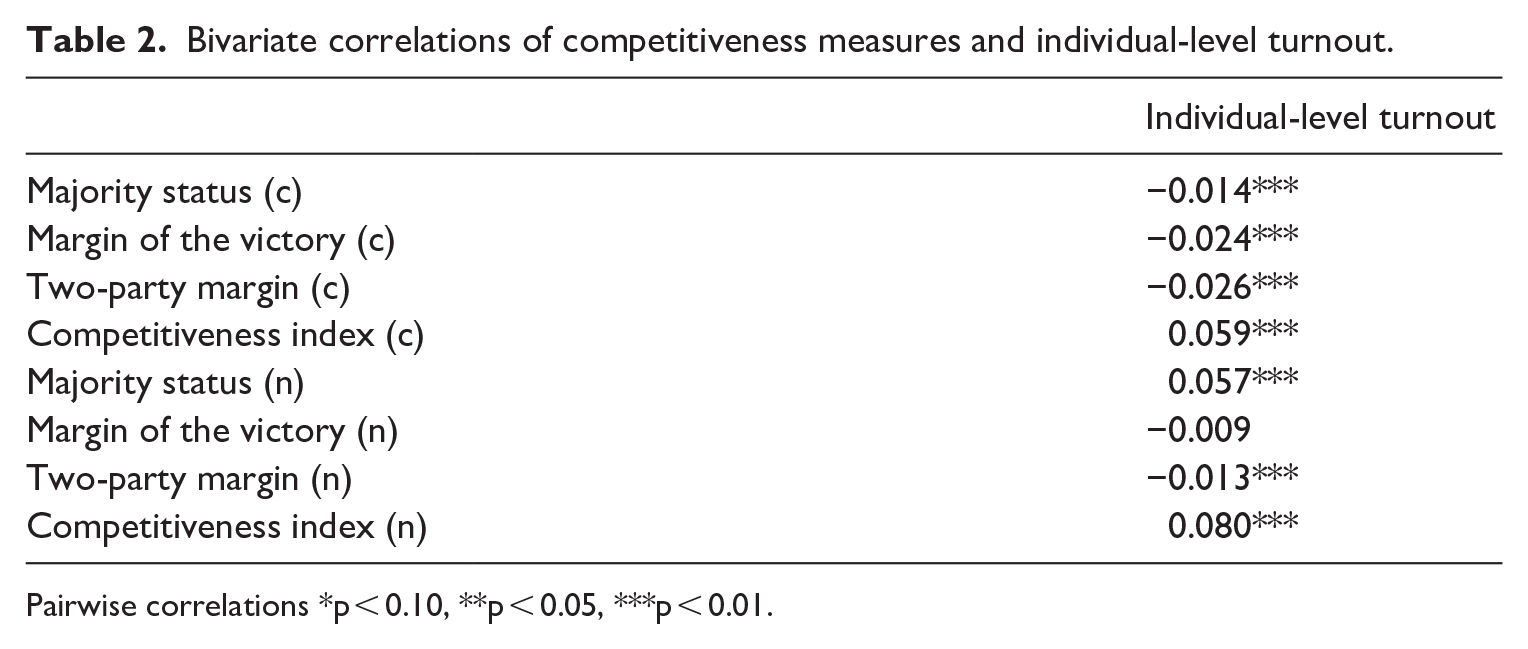
Pairwise correlations *p < 0.10, **p < 0.05, ***p < 0.01.
In the next section, we present sets of logistic regression models that test each of the four hypotheses in turn. We have opted for the simplest model specification; however, multilevel models with fixed effects are presented in Appendix E with consistent results. The dependent variable throughout is self-reported individual-level turnout, that is whether the respondent voted or not (1 = voted). Because self-reported turnout is inflated (see, for example, Dahlgaard et al., 2019), we weigh for over-reporting. These weights were calculated using officially reported turnout as reported in the IDEA Voter Turnout database. Socio-demographic weights are also applied. Here we used the standard socio-demographic weights already included in the BES surveys. The four competitiveness measures are independent variables, however as they measure the same concept these cannot be modelled simultaneously. We specify one model per measure. For models other than the first presented, we do include both levels (constituency and national) of each measure within the same regression. Due to the nature of these data, we cluster standard errors for individual and constituency, which accounts for respondents’ previous voting behaviour and constituency-specific effects. From the variables that Smets and van Ham (2013) find to be consistently linked to individual voter turnout in their meta-analysis, we control for age (rescaled to 0−1), gender (male = 1), education (ranging from 1 = low to 3 = high), whether a respondent works or not (1 = works), and strength of party identification (rescaled to 0−1 where a zero indicates a respondent does not identify with a party and higher values indicate higher levels of party identification strength). These are the only control variables available for all election years. In Appendix F, we provide robustness models that include a standardised measure of political interest as a proxy for a respondents’ awareness of the level of competitiveness of a given election. However, political interest is not available in the same format for the first 2 years of the BES data and therefore is not included in the tables presented in the main text. The results in Appendix F do not substantively differ from those presented here. 5 The final models include measures of party contention. Respondents are allocated a binary indicator for whether their preferred party, as signified by their partisan identity, is in contention to win at the national level, and/or the constituency level. This is the case when their preferred party was in the top two best placed in their constituency, and if their party could have been in government at the national level. For most years, this is only Conservative, Labour or both parties; however, 2010 also includes the Liberal Democrats. Full details are in Appendix C. We also create a categorical measure that groups respondents by their party being in contention at both levels, one level (constituency only, national only) or at neither level.
Results
After scrutinising the bivariate correlations between different measures of electoral competitiveness and turnout, we now turn to looking at how the measures fare in a multivariate environment. We begin testing the direct association between competitiveness and turnout, as well as the way in which local and national measures combined impact a voter’s decision to turn out to vote. In this way, we build our analysis around specific tests of our four hypotheses.
Competitiveness and individual-level turnout
In this subsection, we look at the impact of local and national competitiveness on individual turnout. Table 3 summarises the results from eight logistic models, which measure the impact of competitiveness on turnout in a multivariate setting. Models 1−4 show the impact of constituency-level measures of competitiveness on individual turnout, models 5−8 show the same measures but now measured at the national level. Controls were included in each of the models, but are not reported for space reasons. 6 We expect negative signs for majority status, margin of the victory and two-party margin, and a positive sign for the competitiveness index (see Table 1 and the preceding discussion.
Levels of competitiveness on turnout.
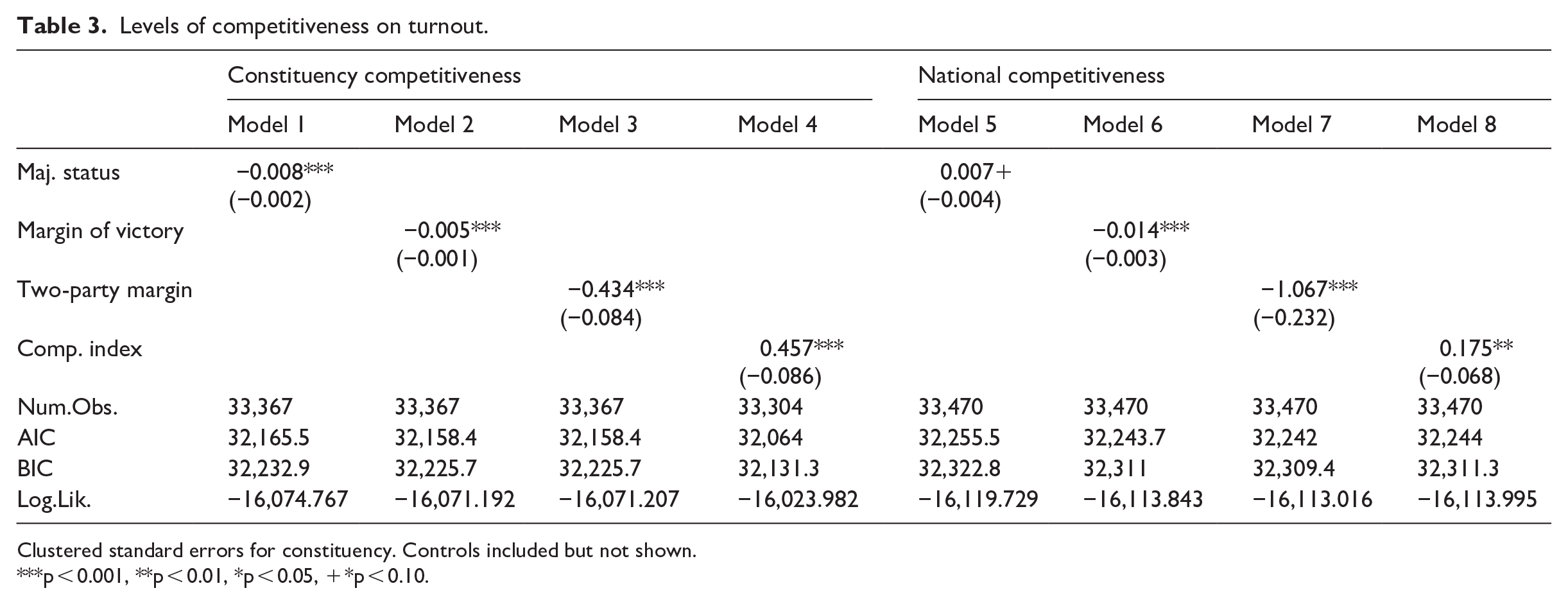
Clustered standard errors for constituency. Controls included but not shown.
p < 0.001, **p < 0.01, *p < 0.05, + *p < 0.10.
All competitiveness measures have a statistically significant association with individual turnout (p < 0.05) They do so in the expected way: negative signs for majority status, margin of the victory and two-party-margin; positive signs for the competitiveness index. 7 The only exception is majority status at the national level, which has an unexpected positive sign and also does not reach statistical significance. This means that in a multivariate setting we can no longer speak of an effect of majority status at the national-level on individual-level voter turnout. By and large, however, the models confirm our first hypotheses (H1a and H1b). The higher the level of competitiveness (at the constituency/national level), the higher the probability of a voter turning out.
Table 4 allows us to investigate the complementary or competing nature of local and national competitiveness as set out in hypotheses 2a and 2b. The four models presented in the table feature different measures of competitiveness. Each measure is included at the constituency level (c), the national level (n) and includes an interaction term of the local and national level (c*n). Comparing Table 3 and Table 4, we see that the signs of the coefficients for the single local and national competitiveness measures remain stable. They all have the expected effect on turnout, with the exception of majority status at the national level which again has a positive sign. The single term for the competitiveness index at the national level is positive, but is not statistically significant when we include the interaction term.
Interacted levels of competitiveness on turnout.
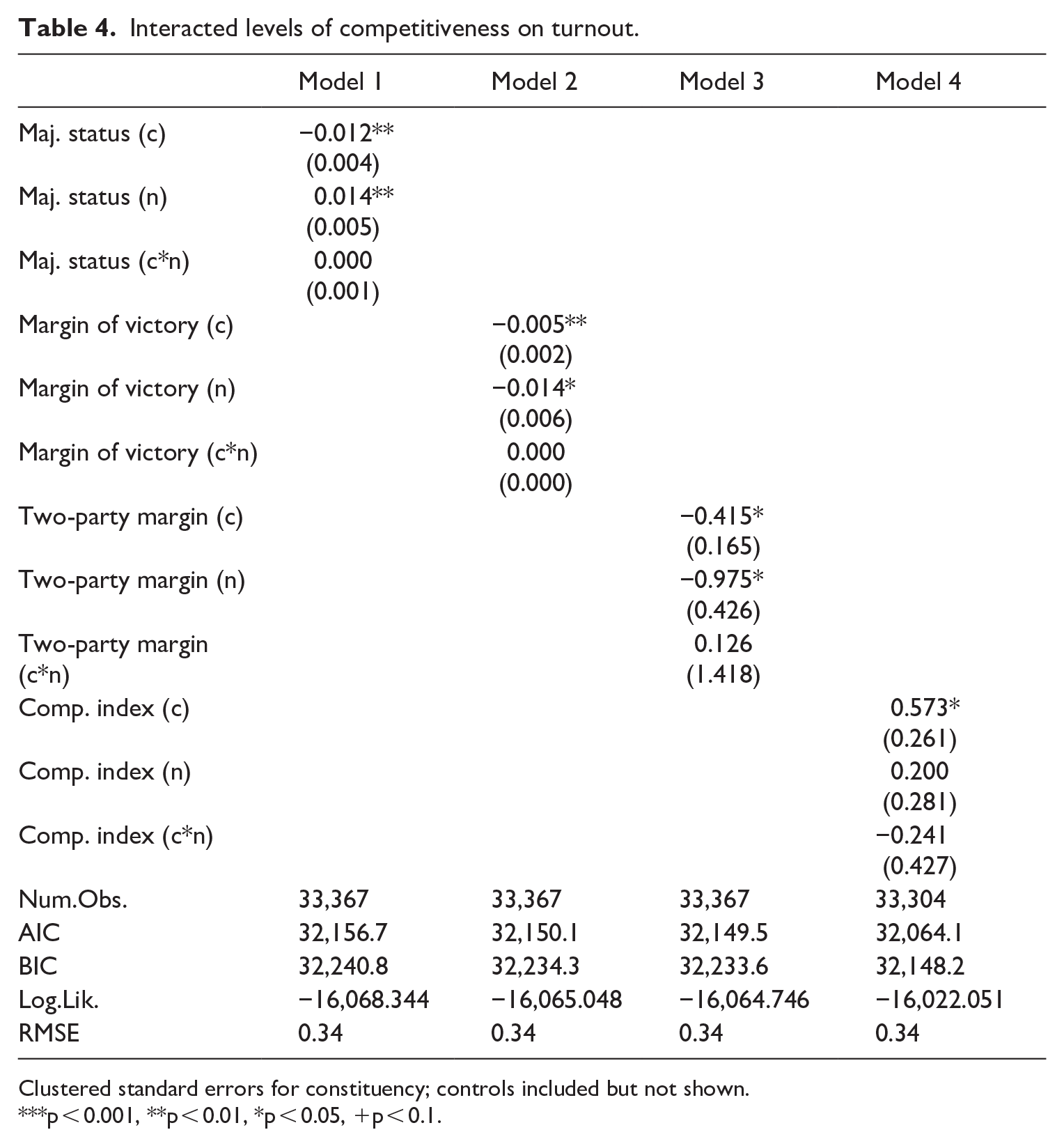
Clustered standard errors for constituency; controls included but not shown.
p < 0.001, **p < 0.01, *p < 0.05, +p < 0.1.
More importantly, and perhaps surprisingly, none of the interactions between local and national competitiveness reach statistical significance. In the models with national- and constituency-level majority status, we do see that the sign for constituency-level competitiveness is negative (b = −.012; p < 0.01) and the sign for national-level competitiveness is positive (b = .014; p < 0.01). The effect sizes are so similar that the two coefficients cancel each other out. This means that we are unable to distinguish whether local and national competitiveness are competing or complementary and that our findings are inconclusive with regard to H2a and H2b. One of the reasons for these inclusive findings may be related to the fact that competitiveness should matter most for those whose party is in contention. Therefore, we turn to the role of contention in the next section.
Models of party contention
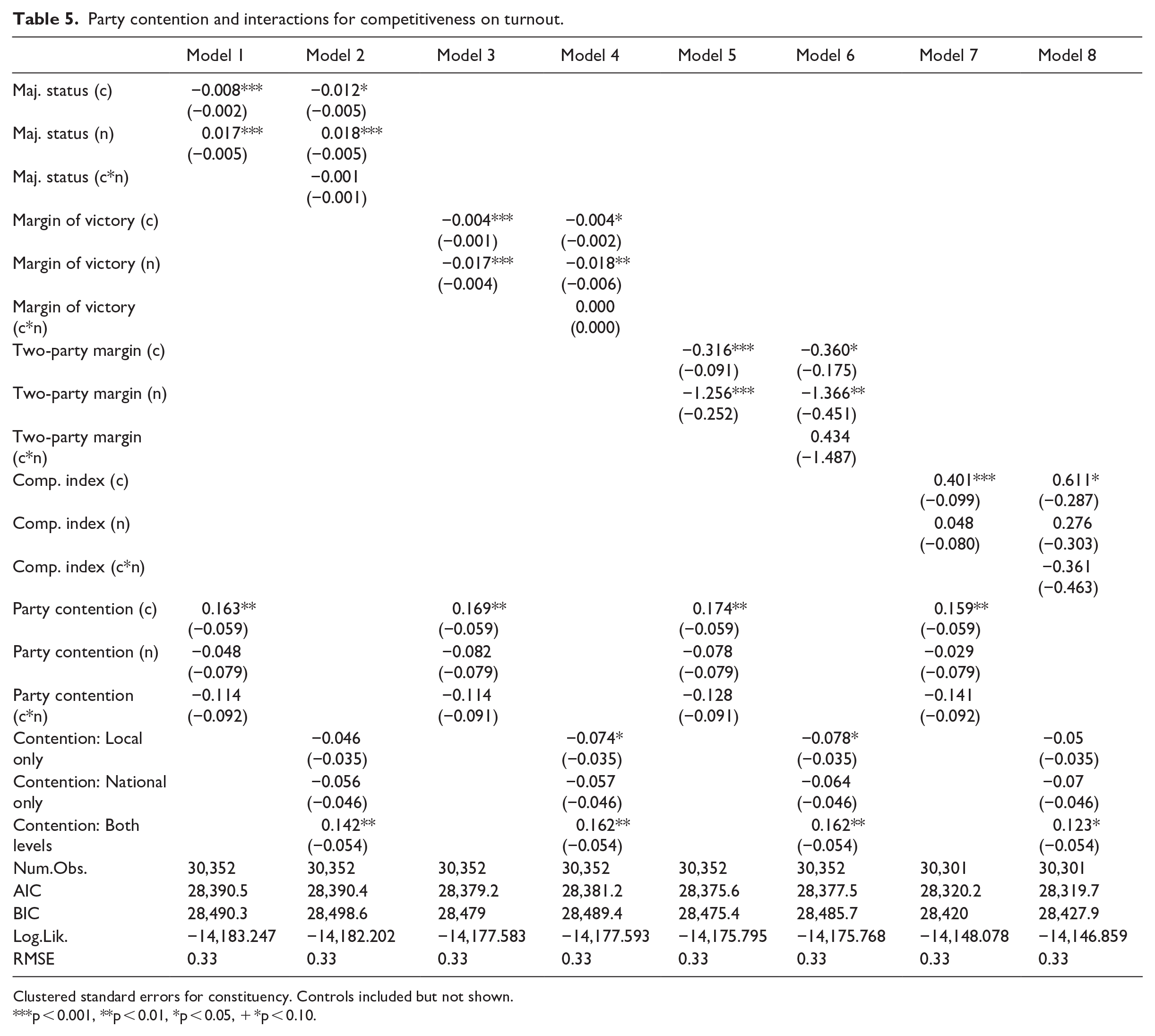
We now turn to tests of H3 and H4, which focus on the role of contention. Table 5 shows two sets of models: the first where party contention is interacted between constituency and national level, and the second with a categorical measure of party contention where competitiveness levels are again interacted. The effect size and direction for each of the competitiveness measures are consistent with the previous models, along with their interactions. At the constituency level, there is an increased likelihood of voting when a respondents’ party is in contention to win. However, this is not the case for the national level, nor do we find a significant interaction effect.
Party contention and interactions for competitiveness on turnout.
Clustered standard errors for constituency. Controls included but not shown.
p < 0.001, **p < 0.01, *p < 0.05, + *p < 0.10.
Yet when contention is operationalised as a categorical variable, the models predict a significant difference between voters whose party is in contention at both levels, compared to the reference category of contention at neither level. For the models including the margin of the victory and the two-party margin, there is a negative effect of constituency-level contention. However, the effect size is smaller than for the variable measuring contention at both levels. In sum, though there appears to be little to no effect where preferred parties are only viable in either the national or constituency race, there is an increased likelihood of voting if both your seat and government could return your preferred party.
These findings can probably best be illustrated with an example. Suppose a Conservative voter in Brent, the constituency held by Labour MP Dawn Butler since 2015. Also, suppose that the Conservative Party is predicted to be defeated at the national level in the next election. Clearly, with the voter’s preferred party not being in contention at either level, this candidate is not very likely to turn out to vote. If the Conservatives had a chance of winning Brent in the next election, then this voter would be more likely to turn out to vote despite the fact that the Conservatives are not predicted to win nationally. If the Conservatives were predicted to win both at the constituency and at the national level, then they would be even more likely to turn out to vote.
We visualise the probabilities from two of the competitiveness measures in Figure 1, representing the model coefficients as transformed into the probability scale so that each model can be directly compared. A probability of 0.5 means it is equally likely (50/50) that the respondent voted if the variable makes a one-unit change, meaning probabilities above 0.5 represent an increased likelihood of voting and those below 0.5 mean a respondent is less likely to vote as the variable increases. In both models, there is a small significant increase in the probability of voting when the respondent’s party is in contention at both levels. However, the difference comes in the predictive power of each of the competitiveness measures. Figure 1(a) shows that respondents in the least competitive constituencies, where the MP was elected with a large majority, have a 42% probability of voting. The result is less pronounced when the national level is uncompetitive, as this results in a 48% probability of voting. Yet the predictive power of the competitiveness index is larger. Figure 1(b) shows the most competitive constituencies expect a 65% probability of the respondent voting, but there is no significant difference in probability for elections fiercely contested at the national level. Taken together, we can say that the more complex measure of competitiveness is more strongly related to voting, but a respondent’s party being in contention to win at both levels has the most consistent result.
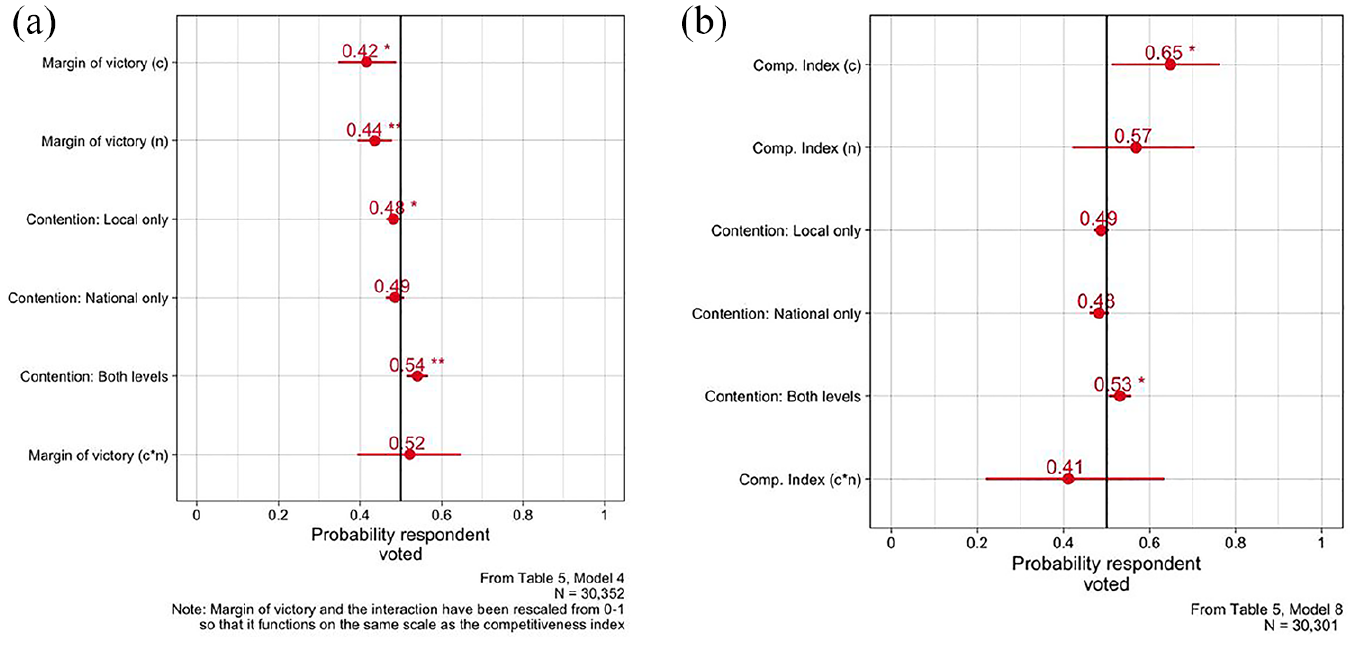
Probabilities of respondent having voted, two measures of competitiveness compared.(a) Margin of victory. (b) Competitiveness index.
Conclusion and discussion
The aim of this article was to research the relationship between local and national-level competitiveness as explanatory factors of voter turnout. It is a generally accepted hypothesis that high stake elections attract more voters than elections where the outcome is a foregone conclusion. Empirical evidence is less conclusive, however. Two problems are thought to be at the root of this ambiguity. The first relates to the level of measurement, where the question is whether citizens take into account the electoral race at the national level or rather take notice of the closeness of the race at the local level, that is, in their districts or constituencies. This question is especially pertinent in SMP systems where the winner takes all in a given district. A second source of inconclusive evidence is the operationalisation of electoral competitiveness. The various measures proposed have problems related to collinearity with the dependent variable, and are often not applicable in races where more than two parties are in the race for a seat.
Our findings show that it is difficult to determine a best performing measure of competitiveness using statistics alone. The metrics of model fit, such as RMSE and log-likelihood, do not substantively change with the different competitiveness measure. However, there are theoretical distinctions between measures of competitiveness. Three of the measures (majority status, margin of victory and two-party margin) are derived only from the two best-placed parties in an election. When Britain’s elections were dominated by two parties, this made sense and held conceptual validity. Yet now that multiple parties are electorally effective, measures of competitiveness should account for this multipartism (Bunting, 2024). Therefore, we conclude that the competitiveness index (Endersby et al., 2002) is the most consistent with statistical and theoretical motivations for the construct of electoral competitiveness in contemporary Britain at both the constituency and national levels.
In addition to investigating the competing or complementing nature of local and national competitiveness, this article theorised and operationalised how one’s party preference shapes the role of competitiveness on turnout. The salience of the election should matter most for those whose party is in contention and elections should first and foremost mobilise those whose preferred party has a chance of winning. Those who are indifferent to the front runners should be less motivated to turn out to vote.
Based on the BES from 1964 to 2019, our findings show that constituency-level and national-level competitiveness each has a direct impact on turnout. However, interactions between local and national competitiveness do not yield statistically significant findings. This means that, based on these models, we cannot really tell whether local and national competitiveness are competing or complementary. This may be due to factors beyond the scope of our study, such as respondents’ main source of news about the election (either local or national focused), or differences in the strength of feeling between their local candidate and the candidates for Prime Minister. Future studies could interrogate the question of whether local and national contexts are competing or complementary by using other explanatory factors.
Turning to the role of contention, we found that turnout is marginally higher for those whose preferred party has a chance of winning at the constituency level but did not find such effects when the preferred party was in contention at the national level. We then looked into the role of party contention in scenarios where one’s preferred party was in contention at one level (local or national), at both levels, or neither. We found a small positive difference between one’s party being in contention at both levels compared to at neither level. People are more likely to turn out to vote when their party is in contention at both the national and the local level. However, when one’s preferred party is only in contention at one level, the local level seems the more important one.
Overall, like much of the literature, this article confirms that the impact of competitiveness on voter turnout is elusive and inconclusive. Competitiveness matters, but only under certain conditions and using certain measures. Exploring the causal mechanism underlying the association between competitiveness and turnout, this article contributes to the literature by showing that competitiveness only matters when one’s party is in contention. In our case, we find that the local level matters as do both the national and the constituency level simultaneously.
Future research should continue to explore the mechanisms behind the impact of competitiveness on turnout. In this sense, the fact that the last available waves of the British Elections Studies (2010 onwards) already included all of the necessary data to construct the relevant measures is a positive development. The inclusion of contextual information regarding the constituency in which a respondent resides facilitates researchers as it takes a large data collection effort out of their hands.
Future research should also explore the role of negative partisanship. 8 It is also entirely possible that a voter’s main preferred party is not in contention to win in their constituency, or at the national level, but that doesn’t necessarily mean they will also be indifferent to the front runners. In cases where an election is particularly close, voters with a strong dislike for one party would have a greater incentive to vote against that party, even if their main preferred party isn’t in the running (e.g. A traditional Labour voter switching to the Liberal Democrats to try and keep the Conservative party from winning that seat).
Supplemental Material
sj-pdf-1-bpi-10.1177_13691481251331498 – Supplemental material for Competing or complementary? Local and national competitiveness as explanatory factors of turnout in SMP systems
Supplemental material, sj-pdf-1-bpi-10.1177_13691481251331498 for Competing or complementary? Local and national competitiveness as explanatory factors of turnout in SMP systems by Kaat Smets and Hannah Bunting in The British Journal of Politics and International Relations
Footnotes
Funding
The author(s) received no financial support for the research, authorship and/or publication of this article.

Supplemental material
Additional supplementary information may be found with the online version of this article.
Appendix A. Descriptive statistics of the measures of competitiveness
Appendix B. Pearson’s correlations between the different measures of competitiveness
Appendix C. National Contention Measure
Table C1. Years in National Contention by Party.
Appendix D. Full models with control variables
Table D1. Constituency level competitiveness on turnout.
Table D2. National level competitiveness on turnout.
Table D3. Interacted levels of competitiveness on turnout.
Table D4. Party in contention for competitiveness on turnout.
Table D5. Party in contention (categorical measure) for competitiveness on turnout.
Appendix E. Robustness tests: Multilevel model specification
Table E1. Levels of competitiveness on turnout MLM.
Table E2. Interacted levels of competitiveness on turnout MLM.
Table E3. Party contention and interactions for competitiveness on turnout MLM.
Appendix F. Robustness tests: Models including political interests as a control variable
Table F1. Constituency level competitiveness on turnout.
Table F2. National competitiveness on turnout.
Table F3. Interacted levels of competitiveness on turnout.
Table F4. Party contention and interactions for competitiveness on turnout.
Notes
References
Supplementary Material
Please find the following supplemental material available below.
For Open Access articles published under a Creative Commons License, all supplemental material carries the same license as the article it is associated with.
For non-Open Access articles published, all supplemental material carries a non-exclusive license, and permission requests for re-use of supplemental material or any part of supplemental material shall be sent directly to the copyright owner as specified in the copyright notice associated with the article.
