




Abstract
Earth System Science has fundamentally transformed our understanding of the planet as a single, complex-adaptive system, integrating natural and social dynamics. This paradigm shift challenges some of the foundational concepts and assumptions in political science, including state sovereignty and institutional effectiveness. This article examines to what extent Earth System Science has influenced environmental governance and international relations scholarship. Theoretical innovations, publication trends, and a dedicated Earth System Governance research community signal progress, but the broader political science discourse remains disengaged from Earth system thinking. There is limited examination of whether the current international system is capable of effectively responding to Earth system dynamics. I scope future research trajectories in a context of accelerating Earth system change that undermines human well-being. Pursuing these research programmes would foster knowledge that reflects the planet’s condition and can support the development of effective governance solutions in the Anthropocene.
Introduction
Over the past half-century, a fundamental transformation has occurred in our collective understanding of the Earth’s functioning and the complex interdependencies between natural systems and human societies. The field of Earth System Science (ESS) fostered an understanding of the Earth as a single, complex-adaptive system, challenging conventional ontologies across the social sciences and humanities, including the idea of knowledge production in disciplinary silos.
The concept of an integrated Earth system has profound implications for politics and, by extension, the discipline of political science. However, while it has begun to catalyse new theories, methods, and institutions across the social sciences (Biermann et al., 2020; Brondizio et al., 2016), the ESS paradigm has made limited inroads into mainstream political science discourse, including journals such as BJPIR. Since Hugh Dyer raised the question whether the environment is merely an additional or transformational issue for international relations in 2001 (Dyer, 2001), little attention has been paid to the discipline-altering potential of global environmental issues. The dominant political theories tend to mirror the blind spots of economics, treating the environment not as an integral component of the system in question – for example, an active political agent, causal force, or structural context – but as an object of politics and policy usually categorised as ‘low politics’.
Political science overlooks ESS at its peril. The failure to incorporate Earth system dynamics risks producing theories and models that are not only analytically deficient but also normatively inadequate for addressing the governance challenges of the Anthropocene. Without conceptual tools attuned to or even aware of the complexities of Earth system processes, political analysis and decision-making will fall short in explaining contemporary realities and guiding effective governance.
Focusing on the cross-disciplinary impact of ESS on political science, I explore the extent to which ESS has influenced political science, with a particular focus on the sub-field of environmental governance. Through a review of existing scholarship and a cursory bibliometric analysis of key ESS-related terms in political science, I seek to evaluate the progress towards a necessary paradigm shift in political theorising. While I find plenty of evidence for the influence of ESS on the scholarship on environmental governance, research on Earth system politics and governance has not found its way into central theoretical debates and journals of political science. Based on my observations, I sketch a path forward, highlighting critical research questions and challenges for the discipline in the coming years.
Earth System Science
The history of Earth System Science can be traced back almost 100 years (Lövbrand et al., 2009; Steffen et al., 2020), with important markers in the 1950s (the International Geophysical Year), during the Cold War (e.g. the creation of international research programmes on the functioning of the Earth), in the 1990s (e.g. the International Human Dimensions Program on Global Environmental Change, IHDP), and the early 2000s with the establishment of the Earth System Science Partnership and the Amsterdam Declaration (Pronk, 2002).
At the core of ESS is the idea of the Earth as a complex-adaptive system, comprising multiple sub-components, including eco- and social systems, connected through multiple feedback dynamics. Importantly, ESS rests on the observation that human societies are an integral part of the Earth system, exerting a surprising amount of influence over the planet’s physical, chemical, biological, and even geological conditions. Schellnhuber and Wenzel (1998); Schellnhuber (1999) argued that nature and humanity co-evolve in a dynamic, global-scale relationship, and that human pressures on the Earth system could trigger rapid shifts (tipping processes) that could be catastrophic for human well-being.
The concept of the Anthropocene grew out of ESS in the first decade of the 21st century (Steffen et al., 2020), accompanied by an increasingly public and global understanding of the human role in shaping planetary conditions. The Anthropocene and two additional concepts – tipping points (Lenton et al., 2008) and planetary boundaries (Rockström et al., 2009) – anchor ESS today (Steffen et al., 2020). The authors of ‘Tipping elements in the climate system’ (Lenton et al., 2008) made the case that major components of the Earth system could pass tipping points and undergo non-linear and hard-to-reverse transitions to fundamentally different states. This potential for rapid system transformation challenges the dominant human experience and basic assumptions of stability and linearity of change. The planetary boundaries framework suggests that not just the climate, but many Earth systems may exhibit dangerous thresholds (Rockström et al., 2009). The nine proposed planetary boundaries offered indicators for the borders between safe and unsafe Earth system conditions for humankind. The concept implied that staying within the planetary boundaries (‘safe operating space for humanity’) should become the new rationale and objective of global governance. In 2023, Earth system scholars published major advances regarding these two concepts, synthesising growing research endeavours over the last 15 years: the first Global Tipping Points Report (Lenton et al., 2023), a comprehensive assessment of Earth system tipping risks, and the first full quantification of all nine planetary boundaries (Richardson et al., 2023). Each concept is the subject of a recent or ongoing special issue in the journal Earth System Dynamics.
These three concepts – the Anthropocene, Earth system tipping points, and planetary boundaries – have raised new questions and fundamental challenges for environmental governance scholarship and practice. What are the implications of Earth system dynamics for the existing architecture and patterns of global governance, especially for environmental governance? Is it possible to effectively govern and steer societies in complex-adaptive Earth systems that display multi-stability, non-linearity, limited predictability, and limited reversibility at global scales? Even more broadly, what should be governed when the human environment is no longer conceived as external to society – an object of governance – but humans and Earth systems interact and co-create social-environmental realities (Biermann, 2021)?
From environmental to Earth System Governance?
The social sciences and humanities have taken up Earth system thinking in rich and expanding debates, including contestations over the meaning, risks, and utility of the concept of the Anthropocene (e.g. Belli, 2017; Bennett et al., 2016; Malm and Hornborg, 2014). Here I am most interested in its effects on political science, especially the sub-fields of international relations and global environmental governance.
Tracing and measuring the intellectual influence of ESS on political science is a challenging task. Given the nature of this article, a comprehensive quantitative bibliometric analysis is neither feasible nor the most suitable approach. Instead, I focus on identifying key developments in the discipline, including innovation in knowledge production, scholarly output, and developments in knowledge institutions. To do so, I examine the emergence of new concepts and the revision of central theories, take a cursory look at the growth of relevant scholarship, and analyse the development of Earth System Governance (ESG) as a dedicated sub-field. I rely on existing literature, particularly review articles, while acknowledging their limitations in scope and timeframe; conduct simple bibliometric searches on Web of Science; and analyse relevant documents and websites related to the ESG project to provide an assessment of ESS’s impact on political science.
My assumption is that the primary domains of change should be the sub-field of global environmental governance, including (domestic) environmental policy and politics, but also general theories of IR regarding international cooperation, conflict, and security and IPE, as well as general debates about political institutions, the role of science and expertise in public decision making, and political theory.
New concepts and theory revisions
Within the field of global environmental governance, the growing understanding of the tight coupling between Earth systems and societies generated a new body of scholarship rooted in complex-systems thinking, which emphasised uncertainty, non-linearity, and limited predictability and control as central governance challenges (Duit and Galaz, 2008; Galaz et al., 2017; Loorbach, 2010; Young, 2017). This systems perspective forced a reconceptualisation of basic governance logics, including multi- and cross-scale dynamics (Galaz et al., 2016), connectivity and globally networked risks (Homer-Dixon et al., 2015; Lawrence et al., 2024), and the potential for non-linear change (surprises). Corresponding with this new perspective were principles like polycentricity (Ostrom, 2010), and adaptive and anticipatory governance modes (Boyd et al., 2015; Duit and Galaz, 2008; Galaz et al., 2016; Muiderman et al., 2020).
Related to the scholarship based on complex-systems thinking, a broader interdisciplinary body of work on ESG has emerged over the last 15 years. (Biermann, 2014; Biermann et al., 2010; Burch et al., 2018), which has elaborated the multiple ways in which currently dominant modes of policymaking, institutions and governance approaches (the environmental policy paradigm) fail to address the reality of Earth system dynamics and the corresponding risks to humanity (Biermann, 2021; Young, 2021). ESG refers to
the interrelated and increasingly integrated system of formal and informal rules, rule-making systems, and actor-networks at all levels of human society (from local to global) that are set up to steer societies towards preventing, mitigating, and adapting to global and local environmental change and, in particular, earth system transformation, within the normative context of sustainable development. (Biermann et al., 2010)
It expands on the notion of environmental governance ‘to focus on broader planetary transformation processes, novel global interdependencies, new understandings of nature-society relations, and multiple and expanding spatial teleconnections’ (Biermann et al., 2019: 17).
Numerous conceptual innovations emerging from these two bodies of scholarship suggest that ESS has had a productive influence on global environmental governance, including neighbouring disciplines like law and economics. Some of these innovations are listed in Table 1.
Conceptual Innovations related to Earth System Governance and Planetary Boundaries, 2010–2024.
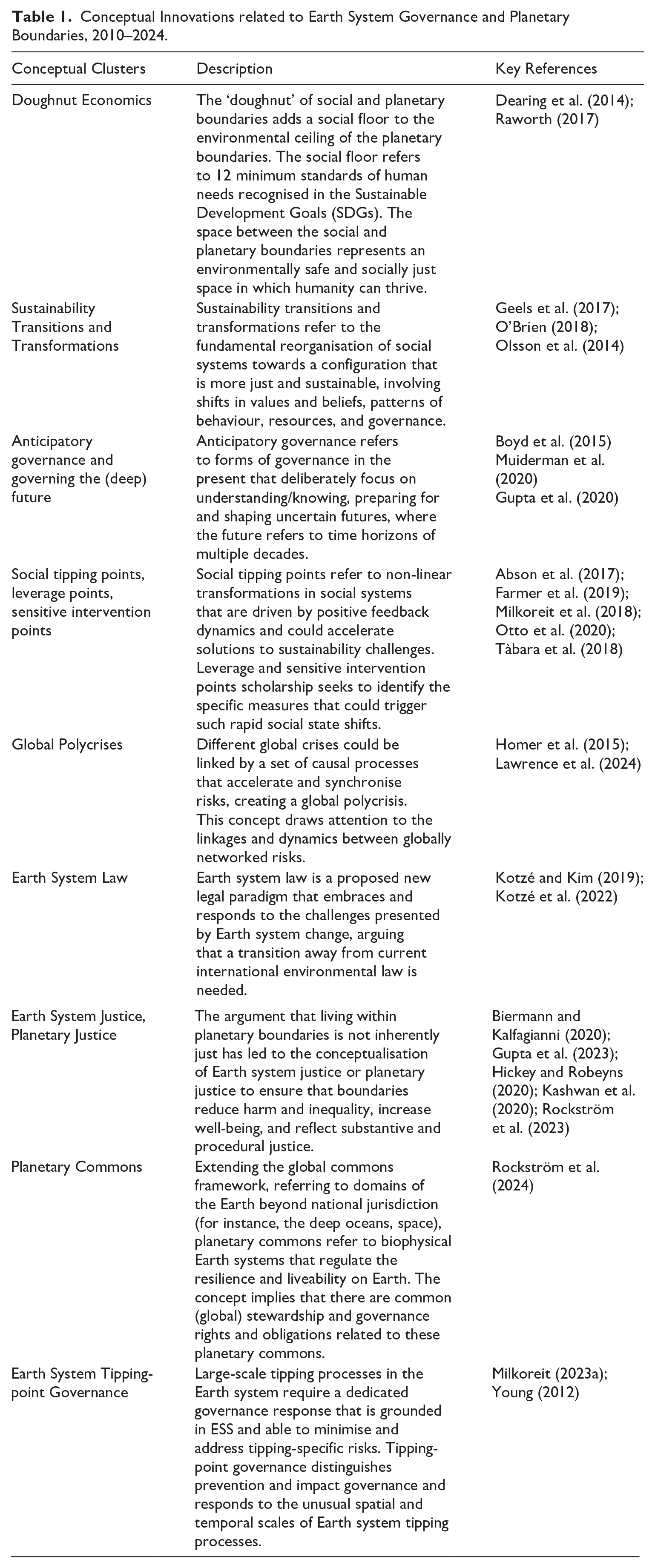
Four clusters of proposals are consistently put forward regarding the changes needed to move towards an Earth system paradigm (Biermann, 2021). Each of these clusters corresponds to a core feature of governance, understood as ‘the rules, regulations, norms and institutions that structure and guide collective behaviour and actions’ (Milkoreit, 2023a: 8). Correspondingly, the proposals for ESG focus on (1) principles and normative foundations, (2) institutions and organisations of governance, (3) science-policy interactions as an essential feature of environmental governance, and (4) the distinct challenge of interaction management in a multi-scale, multi-site governance system for interconnected Earth systems (Biermann, 2014; Galaz, 2014; Galaz et al., 2012, 2016):
First, scholars argue that there is a need for new overarching principles and norms that reflect the new understanding of Earth systems (Baber and Bartlett, 2021; Galaz et al., 2012; Milkoreit, 2023a: 3.1), especially the tight connections between human and natural systems, the potential for non-linearity, cross-scale and cross-system linkages that facilitate risk cascades, and the expansion and diversification of relevant time horizons for decision-making (Galaz, 2019; Hanusch and Biermann, 2020). Proposed norms and principles include biosphere stewardship (Folke et al., 2019), precaution, and planetary justice (Biermann and Kalfagianni, 2020). The Anthropocene also requires new ways of thinking about the allocation of responsibility, corresponding democratic processes and ethical principles (Pattberg and Zelli, 2016; Pickering, 2019).
Adjusting existing or creating new international and national institutions, including global democratic and legal institutions, is the subject of the second cluster of ideas (Dryzek, 2014; Kotzé, 2014). Proposals include upgrading the United Nations Environment Programme (Biermann, 2014), creating a framework convention on planetary boundaries (Fernández and Malwé, 2019), or the creation of global institutions for nitrogen and phosphorous use (Ahlström and Cornell, 2018; Sutton et al., 2021). Global and national citizen assemblies (e.g. on climate change, genome editing) are increasingly adopted as a new form of democratic governance (Dryzek and Niemeyer, 2024).
A third set of proposals concerns the need for changes in science-policy interactions that foster effective, relevant and responsible (Beck and Mahony, 2018) knowledge co-production, for example, more frequent intergovernmental scientific assessments related to the planetary boundaries (Galaz et al., 2012), assessment structures and topics (e.g. nexus assessments) that better reflect the integration between natural and human systems. Proposals for increased reflexivity and anticipatory knowledge production increasingly point to the need for ‘transformative science’ or knowledge that can support sustainability transformations (Fazey et al., 2020).
Fourth, recognising the importance of interactions between different Earth systems and different scales, there is a need for strategic and careful interaction management in polycentric governance systems (Galaz et al., 2012). This requires purposeful integration and information flows between distinct international regimes (‘nexus governance’ (Kotzé and Kim, 2022)), for instance, climate change and biodiversity, and attending to cross-scale linkages and cascading patterns within and across systems (Galaz et al., 2011; Homer-Dixon et al., 2015; Klose et al., 2021).
There is no doubt that ESS has shaped the field of Global Environmental Governance and scholarly debates on core concepts, such as the global commons, sustainable development, geopolitics, and polycentric governance. For example, Kim and Kotzé assessed the state of scholarship related to the planetary boundaries in 2021, stating, ‘There is some agreement that the planetary boundaries framework has proven useful and influential in driving academic debate and, at the very least, in initiating policy change discussions that could benefit ESG for planetary integrity and justice’ (Kim and Kotzé, 2021: 14). However, these ideas have yet to become influential in the discipline of political science and its established sub-fields, especially international relations. Dominant assumptions and theories about the nature of politics, the role of nature in politics, and the laws that govern political behaviour remain largely untouched. The Earth system paradigm continues to evolve largely in parallel to mainstream debates in political science and international relations.
Knowledge production and publication trends
ESG scholarship has expanded significantly over the last 25 years but might still be marginal relative to general knowledge production in key disciplines like political science and international relations. It is challenging to quantify this growth, given the diversity of relevant concepts and the interdisciplinary nature of the field, leading to publications in different disciplines but also in interdisciplinary journals, not always associated with political science. Further relevant work includes topics such as sustainable development, climate change governance, biodiversity, resource use, and water and oceans, without necessarily mentioning the terms Earth system, Anthropocene, or planetary boundaries.
Despite these limitations, the results of a simple Web-of-Science search for key terms is indicative of the field’s growth since 2007 with ‘bumper years’ in 2020 and 2021. A search for the terms ‘planetary boundaries’ AND governance in title or abstract yielded 110 results, ‘Anthropocene’ AND governance 358, and ‘Earth system’ AND governance 234 results with a maximum of 39 publications in 2020. A search for ‘Earth system governance’ across all search categories generated 3132 results. Of these, about 25% fell into the most relevant disciplinary Web of Science categories: 307 in political science, 272 in international relations, and 209 in public administration.
Other quantitative indicators can be derived from reviews in the literature, and from the ESG Project website and its annual reports. In 2020, Kim and Kotzé identified 250 articles that addressed the ‘institutional dimensions of the planetary boundaries’. In 2016, the ESG Project launched a ‘harvesting initiative’ to assess the work produced by its members over the first decade of the project’s life (ESG Project, 2018). The initiative identified several thousand papers published by the ESG community between 2008 and 2016, and generated multiple edited volumes based on this body of work (e.g. Betsill et al., 2020). ESG project annual reports indicate that the production of articles by its affiliates has now reached over 1000 (e.g. 1505 in 2021).
ESG is the top journal for publications on ESG, followed by International Environmental Agreements: Politics, Law and Economics. But the highest-ranking journals in political science, including American Political Science Review, International Organization, or Journal of Politics, are notably absent from the list of publications. As scholars have repeatedly argued over the last decade, political science and international relations journals have given very limited space to climate change and related issues (Bernauer, 2013; Javeline, 2014; Sending et al., 2019), and this pattern holds for ESG.
Even if this account greatly underestimates the relevant body of work, which likely consists of several thousand rather than several hundred papers since 2007, this is still a small volume of research compared to the publication numbers in the relevant disciplines – tens of thousands each year.
The ESG project and community
The ESG Project has played a pivotal role in fostering scholarship on governance responses to global environmental change. Established in 2009, the ESG Project emerged in response to the growing recognition of humanity’s profound impact on planetary systems. Its original science plan (Biermann et al., 2009) was structured around five key analytical themes – agency, architecture, allocation, access, and adaptiveness – which provided a foundational framework for interdisciplinary research. While the initial plan did not explicitly incorporate concepts such as the Anthropocene, tipping points, or planetary boundaries, these themes became more central in the Project’s 2018 science plan (Burch et al., 2018), reflecting the evolving scientific discourse on Earth System Science.
Beyond fostering research and conceptual innovation, the ESG Project has been a key institutional force in creating and supporting a scholarly community dedicated to ESG. The network of affiliated scholars has expanded significantly, surpassing 550 members from over 50 countries in 2023. Annual conferences have served as vital platforms for advancing research, while topical task forces, working groups, and affiliated research centres worldwide further strengthen academic collaboration. The Project also launched its own journal, which achieved a strong first impact factor, along with now three dedicated book series published with top-tier academic presses. This institutional infrastructure has helped consolidate ESG as a maturing and increasingly influential field, interdisciplinary yet with a strong foundation in political science.
Despite all these observed impacts of ESS on the scholarship on environmental governance, a significant gap remains between the core ontological assumptions (Pan, 2024), theorising, and knowledge development in political science and the reality of the planet as a complex-adaptive Earth-society system. This gap raises serious concerns about the adequacy of the discipline in responding to the challenges posed by large-scale, non-linear environmental change and the Anthropocene.
Following Burke et al. (2016), Young (2021, 2023), and Kotzé and Kim (2022), I argue that much of environmental governance scholarship remains constrained by state-centred assumptions and the Westphalian system of sovereign states, which are fundamentally misaligned with the realities of Earth system dynamics. While researchers have extensively critiqued existing governance structures as inadequate for addressing complex, global-scale changes, including tipping processes, scholarship tends to develop ‘within-system’ reform proposals but has yet to meaningfully engage with alternatives beyond the nation-state model. This limitation reflects a deeper intellectual inertia in the field – one that prioritises incremental institutional adaptation over fundamental reimagination of governance paradigms.
The dominance of state sovereignty has constrained the discipline’s ability to conceptualise governance at appropriate scales (Bosselmann, 2021; Rockström et al., 2024), such as tipping elements or social-ecological systems. The key characteristics of the international system are poorly suited to address complex Earth systems dynamics (Orsini et al., 2020), which require risk assessment and interest formation at larger than national scales (Milkoreit et al., 2024), a more-than-human perspective, systems thinking, and the capacity to take into account a variety of time horizons, including the distant future.
Sovereignty, national identities, and the concept of inter-nation relations impose a territorial logic of decision making that misaligns with global change processes. National governments often overlook Earth systems since their dynamics transcend borders. Legal frameworks further reinforce this disconnect by viewing nature as property and economic resource rather than interdependent systems (eco- or Earth systems).
Within this system of sovereign states, where each actor is concerned exclusively with the security and prosperity of people in its own territory, dominant worldviews and ideologies prioritise national security and prosperity, ignoring the role of Earth systems in sustaining human well-being. Complex systems thinking – essential for understanding causation, unpredictability, and uncertainty across scales – is lacking (Duit and Galaz, 2008; Homer-Dixon, 1996; Orsini et al., 2020). Particularly challenging are the temporal characteristics of Earth system change, including non-linearity (changes in the rate of change) and the duration (length) of change processes (Lyon et al., 2022; Underdal, 2010). Decision makers, institutions, and publics are unable to imagine, value, and address risks to the future beyond a 15-year time horizon – the temporal scope of the SDGs, which is starkly out of sync with the time horizons of Earth system dynamics and the factual causal reach of present generations’ actions into the distant future.
One could argue that the primary obstacle is not the Westphalian state system itself but the neoliberal capitalist order, which prioritises short-term gains over long-term sustainability. Even within transnational efforts, powerful corporate interests often steer environmental policies towards market-friendly solutions rather than systemic change. In this view, reforming capitalism – through degrowth, redistribution, or post-capitalist economic structures – may be more critical than restructuring the state system. However, changing the economic system would also be a task of national governments, tying this explanation to the Westphalian state system.
The existing political-economic institutions and decision-making paradigms also tend to be resistant to reform and transformation: ‘Path dependency in institutions complicit in destabilizing the Earth system constrains response to this emerging epoch’ (Dryzek, 2014: 937). Given this context, it seems inevitable to question the most foundational ideas that have structured international life for the last 300 years and taking seriously the idea that a change of the global order is a possible and necessary response to the Anthropocene.
The way ahead
Environmental governance and international relations scholarship must confront its own disciplinary constraints and actively engage in theorising transformative, post-Westphalian governance futures. Scholars face profound questions regarding the ability of today’s political global order to address Earth system change, and whether their disciplines can generate the necessary knowledge to support effective governance. To advance this agenda, I identify three key research directions, distinguished by the scale of governance change they address.
Incremental reforms within the existing system
A crucial research avenue concerns the extent to which governance institutions can be adapted within the current international system to better address Earth system dynamics. Given the inherent limitations of state sovereignty and international cooperation mechanisms, how far can existing structures be pushed to enhance systemic risk management, biosphere protection, and principles of intra-generational, intergenerational, and inter-species justice? Key questions include the following: What can be done to prevent the passage of Earth system tipping points, prepare for, and adapt to their potential impacts within the current framework for climate change governance? What governance capacities, such as complex systems thinking, anticipation, reflexivity, and transformational policy design, are needed to operate effectively under an ‘Earth system paradigm’ (Biermann, 2021)? This research direction focuses on pragmatic and near-term governance improvements that do not require a fundamental reconfiguration of the global order but seek to maximise the effectiveness of existing institutions.
Transformative shifts in global governance
examines whether deeper systemic change in global governance is necessary to address the challenges posed by Earth system change. This avenue questions whether the Westphalian system of sovereign states and international law remains fit for purpose in the Anthropocene or whether alternative governance models are needed. Key questions include: What conditions could enable a transformation in the global order? What forces or actors might drive such systemic change? What characteristics would alternative governance systems need to effectively govern planetary processes? And what are the time horizons for a large-scale shift in global governance? Recent work suggests that the international system itself may function as a social tipping element, capable of undergoing rapid transformation under the right conditions (Young, 2023). This raises important questions about what constitutes a tipping point in global governance (Milkoreit, 2023b) and how it might be triggered.
Governing on an unsafe planet
°Third, future research should focus on governance on an unsafe planet. As Earth System Science continues to demonstrate, humanity has already breached six of the nine planetary boundaries (Richardson et al., 2023), and continues to push further away from the ‘safe operating space’ indicated by this framework. Furthermore, global warming is edging closer to the 1.5°C threshold (WMO, 2024) and appears to be accelerating (Hansen et al., 2025), making it increasingly likely that a handful of Earth system tipping points will be crossed in the coming years. In fact, some might have been crossed already (Goreau and Hayes, 2021; Naughten et al., 2023; Pearce-Kelly et al., 2024). Key questions include: How can policymakers recognise tipping dynamics and deal with the uncertainty regarding the state of a large-scale tipping process? What governance principles should guide decision-making after a tipping point has been crossed? How should governance systems adapt to long-term planetary destabilisation, including rising loss and damage, ecological collapse, and humanitarian crises? This research agenda recognises that governance will need to operate under conditions of profound uncertainty and transition, as systems move towards new, potentially unstable states. The challenge is no longer just about preventing Earth system change but about governing within a fundamentally altered planetary reality.
These observations underscore a further crucial challenge: how can academic work on ESG meaningfully influence governance practice? While concepts like planetary boundaries and Earth system tipping points have gained traction in scientific discourse, their integration into policymaking remains limited. Biermann (2021) highlights that ESG scholarship has yet to leave a significant imprint on institutional reforms, global agreements, or political discourse. This raises fundamental questions about the pathways through which scientific and normative ideas travel into governance systems – whether through shifts in terminology, the framing of international agreements, or the design of new governance mechanisms such as global citizens’ assemblies. Key examples of such influence might include the rise of anti-fossil fuel norms, the establishment of climate disclosure mechanisms, and divestment movements. Studying these pathways, especially the various forms of resistance against them, can offer insights into the conditions under which academic concepts shape governance innovation. If sovereignty continues to dominate governance logics in an era of resurgent nationalism and geopolitical conflict, ESG research must critically engage with the political conditions that enable or obstruct transformative governance shifts. This presents an urgent agenda for political scientists: to move beyond diagnosing governance failures and to systematically explore when, where, and how governance paradigms evolve and what role scholarship can play in that process.
Footnotes
Acknowledgements
The arguments presented here grew out of the drafting process of the Global Tipping Points Report 2023 and draw on the many contributions of the report’s co-authors, especially those working on the governance section. I want to thank the Earth Resilience in the Anthropocene project for the opportunity to present these ideas at a symposium in 2024 and the valuable feedback provided by the reviewers.
Funding
The author(s) received no financial support for the research, authorship, and/or publication of this article.
