



Abstract
Hegemonic green philosophies have historically been dominated by accounts centring the views and experiences of (well to do) white people in the Global. This article partly addresses this by examining both the politics and language of intersectionality in environmentalism. In doing so, it speaks to debates about intersectionality as marrying theory and practice – to form praxis – in social movements by providing an analysis of ‘intersectional absences’ in modern British environmentalism. It asks: Where does intersectionality not speak in the context of British environmentalism? How can we characterise and explain these absences? What effects might these absences have on the ways that British environmentalist discourses are formed and put into practice? What do they say about the relevance of intersectionality to British environmentalism? Proposing a typology of intersectional absences (ignorance, strategic, and strategic), it argues that intersectionality – as a framework and vocabulary – can help us to understand and deepen environmentalist discourse, strategy, and praxis in Britain today.
Keywords
Introduction
Once a fringe issue in British politics, the environment consistently features in lists of the public’s priorities in national opinion polls today (Ipsos MORI, 2021, 2022; Office for National Statistics, 2021). ‘Green’ issues are firmly on the agenda – and not just for green parties. This success of climate and environmental issues can be at least partly attributed to the work of the modern environmentalist movement which reached its zenith in the late twentieth century (Rüdig, 2019). But the environmentalist movement did not ‘complete’ its work and disappear from the European political landscape. In recent years, people organising around the climate and environment have received a renewed wave of attention. This is particularly true from the period since 2019, when British environmentalism was revitalised with the direct action of the then nascent grassroots organisation, Extinction Rebellion (XR). Since 2019, then, environmentalism has penetrated public consciousness in Britain and beyond. But not without contention.
Some environmentalist organisations, including XR, have come under fire for the ways in which their discourses and strategies reproduce patterns of social marginalisation, silencing groups who are often already minoritised along the axes of race, gender, dis/ability, age, nationality, and among other social lines (Bell, 2021). The exclusions at play here are problematic given the disproportionate climate and environmental burdens that these marginalised groups face, despite the fact that they have often contributed the least to the causes of climate and environmental breakdown (Bell, 2020). Karen Bell (2020) notes, for example, that ‘when working-class groups approach mainstream organisations for support with their issues, for example the location of incinerators in their communities, the mainstream organisations can deem such issues to be outside the scope of ‘environmental’’ (p. 13). Hence, debates about the exclusions that characterise some forms of environmentalism are embedded even in how environmentalists define the very scope of their organising.
Hegemonic green philosophies have historically been dominated by accounts centring the views and experiences of (well to do) white people in the Global North (Ducre, 2018; Sultana, 2022; Whyte, 2018). With this in mind, this study partly addresses this by examining both the politics and language of intersectionality in environmentalism. In doing so, it speaks to debates about intersectionality as marrying theory and practice – to form praxis – in social movements (Collins and Bilge, 2016; Evans and Lépinard, 2019) by providing an analysis of what I term intersectional absences in modern British environmentalism.
As noted above, scholars and activists from across the world have called for a more explicit reckoning with the relevance of intersecting social inequalities, injustices, and marginalisation as forces which shape and are shaped by a rapidly changing biosphere (Sultana, 2022; Mikulewicz et al., 2023). I think about the ways in which, as environmentalists, we enact and talk about intersectionality (or not) to ask how the absence of intersectionality shapes environmentalist praxis. This line of inquiry sheds light on the tensions emerging from the gaps between how we do politics and how we talk about it – especially in the recent context of Britain’s ‘culture wars’, in which conservative forces have sought to suppress marginalised perspectives and efforts to redress historic inequities (Satia, 2022).
While, indeed, there are intersectional presences which are important to recognise for their prefigurative potency, this article focuses on absences. It asks: Where does intersectionality not speak in the context of British environmentalism? How can we characterise and explain these absences? What effects might these absences have on the ways that British environmentalist discourses are formed and put into practice? What do they say about the relevance of intersectionality to British environmentalism? My reasoning for focusing on absences to a greater extent than presences here is to bring attention to issues relating to the current state of environmentalist discourse and practice in Britain today. It is to think about the politics of knowledge and citation in movement building, as well as to contribute to discussions around the organising labour and its effects on minoritised groups who are working to embed intersectionality deeper into environmentalist praxis.
Environmentalist praxis is not necessarily intersectional or radical by mere virtue of being green (Beuret, 2023). When environmentalist action does not account for social inequalities, the types of initiatives that spring from their demands can feed into policies which reinscribe unequal relations of power (Newman, 2011). Hence, it is important to give due critical consideration to the types of demands that environmentalists make, how they make them, and the ways in which they speak to existing power relations. In many ways, it could be argued that social movement actors should not be expected to engage with the ‘discourse’ of intersectionality, sometimes presented as being too academic or simply as jargon (Gordon, 2016). Indeed, it may be true that intersectionality would not be a familiar term to some without a college or university education, and by extension, people who might often be excluded from mainstream environmentalism. As I show in this article, however, an absence of the term intersectionality in environmentalist organising does not signal it a hostility towards intersectional politics. Indeed, the presence of the word itself cannot be taken as a proxy for the politics it encapsulates. To recognise this is also to affirm that choosing the right language that environmentalists – and crucially, potential environmentalists – can relate to and understand is a boon to fuller and more expansive social and political participation (Henn and Foard, 2014).
At the same time, intersectionality originates from concrete practices of community organising for social justice. That is, taking action to animate the material, social, and cultural redistributions necessary to combat structural inequalities. Indeed, Collins (2015) emphasises the real-world implications of intersectionality for undertaking social justice work (p. 16). And so, this piece argues that environmentalists – who are oftentimes already working with academic ideas (e.g. ecology, carbon emissions, biodiversity) can and should engage with intersectionality – first and foremost as a politics (crucial for the demands they articulate and strategies they use to do so) and secondarily, as a vocabulary (which helps us to bridge histories of intersectionality as developed in struggles for social justice to a contemporary political approach to ecology).
This article draws on the research I undertook as a doctoral student completing a PhD. It speaks to what I would argue are some of the most important questions of our time – about how we organise collectively on a warming planet, how we care for each other and the life that we share the biosphere with in doing so, and how we resist violence, domination, and oppression. It argues that intersectionality – as a framework and vocabulary – can help us to understand and deepen environmentalist discourse, strategy, and praxis in Britain – and in doing so, interrogates the junctures at which the politics of the ‘natural’ and ‘social’ meet (Alaimo, 2008).
The discussion proceeds as following: The first part provides a brief literature overview on intersectionality and its relevance to environmentalism. The second part details the political ethnographic methods employed to undertake this study. The third part presents some of the findings, providing a brief sketch and analysis of what it means to talk about intersectional absences in environmentalism across Britain today. The final section develops some further reflections on the empirical material, reflecting on what its key implications are for social movement organising that prefigures and builds alternative futures that nourish the more equitable and reciprocal forms of relationality that Indigenous and Black feminist scholarship/activism centre.
Intersectionality
Intersectionality, formally conceptualised by Kimberlé Crenshaw, analyses the structural relationships between what we often conceive as discrete structures of oppression, such as racism, sexism, and classism. This has become a critical, though not uncontested, framework for Black feminists to examine and respond to how unequal expressions of power materialise in the ways that legal systems operate, wealth is distributed, and ideas produced and spread (Crenshaw, 1989). Intersectionality situates marginality in webs of power that operate across several domains – a phenomenon which can often go unacknowledged by those for whom these intersections do not produce a marginalising and/or silencing effect. This is captured in the title of the key landmark anthology, All the Women Are White, All the Blacks Are Men, But Some of Us Are Brave (Hull et al., 1982) which illuminates the silences faced by groups caught at the intersections of injustices which are too often conceived as disparate.
Over the past half century, intersectionality has emerged as a key site of discussion and organising in various countries, such as in the Americas and in Europe (Evans, 2016; Evans and Lépinard, 2019; Perry, 2016; Weber, 2015). This has been the case particularly for feminists, as Black feminists have used intersectionality to disrupt the dominance of white, middle-class women’s concerns within feminist spaces, and Black men’s voices within the civil rights and anti-racist movements, especially but not exclusively in the United States/Turtle Island (Collins and Bilge, 2016). Given the complex, unique insights intersectionality proposes into how multiple forces and modes of power collude to produce marginality, the framework has been recognised as one of the most transformative concepts for feminist scholarship and has even been described as ‘the most important theoretical contribution that women’s studies, in conjunction with related fields, has made so far’ (McCall, 2005: 1771). The number of studies on intersectionality, and its general usage, is increasing at a fast pace. This article contributes to these expanding conversations about intersectionality with a specific attention to how intersectional absences figure in the specific context of environmentalism in Britain.
There has been lively and, at times, strained debate among scholars concerning the meaning and utility of intersectionality as an intellectual framework. It is important to acknowledge and recognise these ongoing conversations, appreciating intersectional studies as a field of research which is very much alive and growing. As it has become more popular in some places, intersectionality has undergone transformation and rescripting in its travels across different contexts (Salem, 2018). If it can travel, so too can it unravel. Both within and outside of academia, its meaning and focus is shaped differently in different contexts – sometimes in ways that actually reinforce and reinscribe the marginalisation of Black women(Jordan-Zachery, 2012; May, 2015) At the same time, the growth of awareness about intersectionality within some parts of academia and elsewhere has also provided social movements with opportunities for internal reflection on how to practise forms of intersectional praxis and intersectional solidarity that supports the practice of liberatory, coalitional, social movement building (Tormos, 2017). Indeed, thinking about how intersectionality moves in different ways in different spaces is central to this study which focuses on the journeys taken and bridges built by intersectionality, specifically in the context of environmentalism in Britain.
There are critiques of intersectionality which propose an inspection and revision of how intersectionality has and might be operationalised: critiques of its use and journeys rather than the intellectual basis upon which it is built. Sara Salem (2018) argues that in its current usage, intersectionality is insufficiently radical and should be more explicitly tied to Marxist feminist analysis coming out of the Global South. Salem writes against the co-optation rather than the idea of intersectionality, warning against is use by (neo)liberal feminists as a catch-all stand-in for an ahistorical ‘diversity’ which is divorced from a critique of capitalism.
Other scholars of intersectionality have also raised urgent concerns about the exclusion of Black women from the academic spaces in which Black feminist thought is talked about, often by non-Black scholars. These critiques rarely emerge out of a rejection of or hostility towards the idea of intersectionality itself. Rather, they object to how intersectionality has been taken up in ways that are incompatible with commitments to social justice, and therefore anti-capitalism, that are at the heart of Black feminist normativity. In effect, intersectionality has been repurposed, repackaged, and appropriated to the needs and desires of non-Black people, both white and Global Majority, despite the Black feminist roots of the framework. Much work has emphatically noted the problematic stretching and reconfiguring of intersectionality as a catch-all stand-in for neoliberal forms of corporate ‘diversity’ (Christoffersen, 2021; Ferree, 2018). In this context, it can be challenging to imagine what it means to ‘do’ intersectionality in environmentalism in ways that remains true to its original Black feminist normative commitments to redressing social, material, and cultural domination and exploitation.
The roots of intersectionality are intimately linked to the lived experiences and standpoints of Black women, thus contributing to the development of feminist standpoint theory more broadly (Yuval-Davis, 2015). This is not to imply, however, that intersectional research can or should be conducted only by or about Black, Indigenous, or other racially minoritised women. Rather, given the importance of Black women’s standpoints in the development of the framework, intersectional scholarship should invite continued reflection on how structures of oppression intersect to marginalise Black, Indigenous, and other racially minoritised women (Jordan-Zachery, 2012). This study strives to include some such perspectives, appreciating the power of understanding marginality as a generative space from which to build theory and knowledge (hooks, 2014).
As noted above, the body of thought where intersectionality is used as a primary lens to explore issues relating to the climate and environment is growing. Still, there have been few attempts yet to use it to explore environmentalism as a social movement. This becomes even more true when thinking beyond case studies in North America/Turtle Island. Hence, this study seeks to place intersectionality in conversation with environmentalism in a specifically British context – a space which has hitherto received little attention at the intersections of Black feminist and environmentalist literatures. Given the dynamism of the environmentalist movement across Britain, I stress the importance of having these conversations in this context, speaking to the gaps in our knowledges about the potential and actual convergences between Black feminist frameworks and ecological praxis. I thus situate this study between ‘American domination and European silence about Black feminism’ (Emejulu and Sobande, 2019: 6) and environmentalism.
Political ethnography: Methodological approach
A substantial part of the data collection for this project makes use of semi-structured interviews, with many of this project’s insights being drawn from semi-structured interviews which I conducted with grassroots activists, Green Party activists, politicians, youth climate strikers, faith leaders, and individuals working in environmental NGOs. Many of the interviewees were recruited from my existing networks while I recruited others by emailing them or speaking to them at events. As part of my doctoral research programme, I undertook 37 semi-structured interviews across Britain. I devised an interview schedule with a selection of questions to initiate the recorded conversations for this work. I made participants aware that this was the case, though I also explicitly invited them to take the conversation into new directions which they might find interesting or useful.
The interviews were mostly conducted online, with each interview lasting on average between 30 and 45 minutes, though there were two interviews which lasted much longer (> 2 hours). A majority of the interviews were conducted on a one-to-one basis, though there were two interviews which included young people under the age of 18, where the respondents were interviewed in pairs. Every interview but two was audio recorded and manually transcribed afterwards. Each participant completed an informed consent form and before participating were fully informed of the project’s working title, main themes, and my background as both researcher and environmental campaigner in London. The interview data is stored securely on an encrypted USB pen drive.
This research project employed methods drawn from political ethnography and literary studies. Political ethnography includes a wide array of qualitative tools including in-depth interviews, focus groups, and various forms of observation which may include direct participation or not (Rhodes, 2016; Schatz, 2021; Tilly, 2007). Since this study is interested in how claims are constructed, communicated, and developed, it draws on a political ethnography repertoire, using semi-structured interviews and participant observation. In addition, I drew on my literary training in order to think about the importance of language in environmentalist discourse. This takes the form of a textual approach to content and interview data analysis. Mirroring a commitment to resist extractivism in the broader, ecological sense, my approach is framed by feminist and Indigenous decolonising approaches to research methods that seek to resist extractive research practices (Tuhiwai Smith, 1999). More concretely, I emphasise reciprocity as a key commitment that has framed the undertaking of this research, which has sought to contribute both materially and intellectually to the building of more equitable and just forms of green organising.
In addition to the semi-structured interviews conducted, this study also draws on participant observational data which I collected while attending Green Party of England and Wales (GPEW) conferences between 2021 and 2022 and various protest events organised by groups including but not limited to XR. I attended the GPEW conferences in my capacity as a member of the party, participating in internal processes and interacting with other conference attendees, and wrote ethnographic fieldnotes at the end of each day. Participant observation is a political ethnographic tool wherein the researcher is ‘immersed’ in the ‘field’, simultaneously directly engaging in and observing day to day activities of the political actors or groups of interest (Gillespie and Michelson, 2011; Schatz, 2021). Both participating and observing can also be understood within the context of my commitment to reciprocal research which seeks to build rather than extract from the movement spaces which produce the insights presented here.
This project passed the university’s ethics approval process at which I undertook my doctoral programme. In order to ensure the safe participation for all those involved in this research, as part of the ethical approval process, I reflected on the necessity for informed consent, anonymisation, secure data storage, and COVID related adjustments. I took the necessary steps to ensure that the appropriate and relevant measures have been in place to ensure the safety and legality of this project at every stage. In practical terms, this means that before participating in this project, I provided each participant with a cover sheet detailing the project title and its broad contours as well as an informed consent form that confirmed that they were happy to participate in this project without any pressure.
All participants agreed to take part in this research on an anonymous basis. Any information which could be used to identify participants in any quotes has been removed. Certainly, questions arise about the politics of knowledge production, authorship, and attribution, and even the possibility of anonymous research especially in the new digital era (Godfrey-Faussett, 2022). But anonymisation of research participants remains a strong ethical norm within social research; namely because it protects the privacy of the participant and supports a relationship of trust between researcher and participant.
In addition, this research was conducted within the context of the COVID-19 pandemic. This meant that, at times, meeting physically in person was illegal. Even when meeting in person was legal, the threat of viral infection remained a live one. Certainly, this threat was, and continues to be, even more pronounced for those who either have underlying health conditions themselves or live with people who do, and/or those in precarious work who cannot afford to take time off to quarantine or are not able to work from home. In this context, the majority of my interviews were conducted online and the conversations which did take place in person were conducted outdoors.
Intersectional absences in environmentalist organising
As a normative framework, not only does the analytical strength of intersectionality reveal the lumpy, uneven, and imbricated nature of power and inequality, it resists it (Cho et al., 2013; Collins and Bilge, 2016). In a similar vein, parts of the large field of environmental studies – such as environmental justice (EJ) scholarship – seek not only to describe racialised inequalities and exploitation in lived environments, but also to resist them (Schlosberg, 2013). From this perspective, this project follows in the footsteps of its intellectual and activist forbears and seeks to contribute to theory and movement building. As someone who has been involved in environmentalist organising in various organisational settings over the past few years, much of this work is informed by the experience of studying a movement that I identify as part of. I have tried to approach this research and the environmentalists I encountered as part of this research as a ‘critical friend’ (Earl, 2018). As a critical friend, I have sought to make this research to speak to and with other environmentalists as a way of encouraging a critical but constructive reflection on how we can discuss and disrupt inequality, power, and marginality on a warming planet. This article thus seeks to contribute to a conversation which, though already existing, needs to expand – a conversation which centres environmental imaginaries that are alternative to hegemonic forms of environmentalism that fail to account for the lumpy and uneven nature of climate change and environmental breakdown (Sultana, 2022).
This section will present and critically comment on part of the data which I collected during the fieldwork stage of this research project. Based on the semi-structured in-depth interviews conducted for this research project, extended ethnographic participant observation, and textual analysis of various documents including websites and Green Party manifestoes, the key themes relating to intersectionality which emerged from the wider research project that this article grows out of can be loosely organised into two categories: absences and presences. But this article focuses very specifically on the types of intersectional absence which emerged from this research to better understand the political and practical implications of these silences.
Nonetheless, I want to resist an authoritative binary representation of absences as existing in distinct contrast and opposition to intersectional presences. There can be present absences and absent presences. Presences and absences stand in relation to each other and can also be understood as co-constitutive (Derrida, 1967). So, as we will see in the discussion of the findings, there are forms of absence and presence which overlap (i.e. constitute both presence and absence simultaneously).
In addition, we need to stay conscious of the specific context of British environmentalisms and the historical trajectories of the key ideas, concepts, and terms that shape the dominant green discourses. For this project, this means recognising that Black feminisms of different kinds have not been at the heart of the historical development of British environmentalism – which has sometimes been driven instead by antithetical projects like imperialism and colonialism (Grove, 2010). Indeed, part of the aim of this research is to understand and imagine the places in which the two converge and diverge historically, presently, and potentially. But this also means addressing the questions that some may raise around the extent to which British environmentalists can actually be expected to engage with the ‘discourse’ of intersectionality, which is sometimes presented as either deeply tied to a very academic form of feminism or simply jargon (Gordon, 2016). If we take this into consideration, we should stay sensitive to the complex simultaneous absences and presences that intersectionality might be subject to in environmentalist spaces. As we will see, sometimes actors seek to operationalise intersectionality as a politics without using the word ‘intersectionality’ or vice versa – whether intentionally or not.
I introduce a fluid typology of multiple types of intersectional absences below (Figure 1). The fluid typology illustrates the diversity of approaches to organising that environmentalists can and do take in relation to intersectional absences specifically. I emphasise the fluid nature of the typology which proves useful for understanding the varied nuances which characterise how environmentalists do or do not engage with intersectionality. Indeed, environmentalists may demonstrate one or more types of absence or presence at different times and in different spaces. The findings of this research indicate several shades of absence (which can overlap with presence), that are shaped by a multitude of factors, including the biographies of environmentalists, the spatial and temporal contexts in which they are operating, and the concrete issues which call their environmentalism into being.
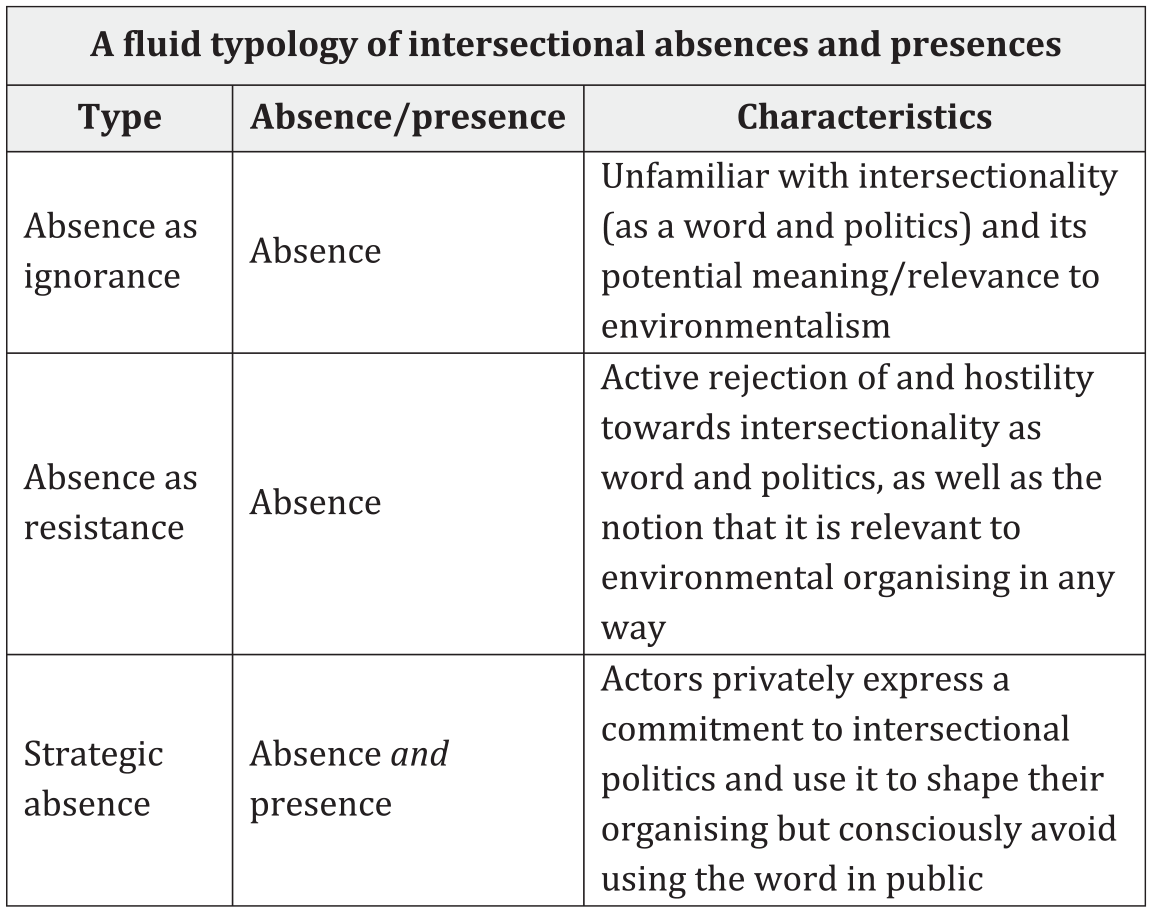
A fluid typology of intersectional absences and presences.
Let us now turn to some of the data to flesh out the character of these different types of absence.
Absence as ignorance
Absence as ignorance describes when environmentalists are either totally or partially unaware of intersectionality as both a politics and a terminology. This ignorance can be partial (e.g. ‘I’ve heard of it before but I’m not sure what it means’) or total (e.g. ‘I don’t know what that means and I have never come across it before’).
While most of my interview participants were familiar with the term intersectionality and had at least some idea about what it meant, about a third expressed a total or partial lack of familiarity with it, both as a word and a politics. One participant, a parent organising with climate strikers in a core city 1 in the North of England, explained to me that among ‘the sort of people that I’m talking to regularly, [intersectionality is] not a word that people use’ (P023). Interestingly, however, throughout the broader conversations, these above interviewees frequently used other terms and concepts such as ‘sustainability’ and ‘justice’ more broadly with great fluency – intellectual ideas which have seen greater usage in dominant environmentalist discourses at the British and global level in the past three decades. Indeed, discussions around equity and justice are taking place within some environmentalist spaces but often using different discursive contexts and frames which are not necessarily informed by intersectionality (such as ‘just transition’, ‘sustainable development’, or even ‘diversity’). This suggests that intersectionality, as a whole, has not yet penetrated the dominant environmentalist discourses in Britain. While intersectionality, both politically and linguistically, represents a live node of contention within some organising spaces in Britain, particularly those organising more explicitly around feminist and queer politics (Evans and Lépinard, 2019), it remains less familiar within the context of environmentalism. This is a finding that is supported by research that I have conducted elsewhere on the websites of key environmental organisations in Britain and their discourses (Hiraide and Evans, 2023).
Absence as resistance
Absence as resistance refers to an active rejection of intersectional politics and therefore, its language. This resistance can be expressed in ways that are either explicitly or implicitly hostile – either way, this resistance shuts down any further discussion or dialogue around intersectionality as a useful or relevant instrument within the context of environmentalist organising.
Interestingly, I did not encounter firsthand hostility towards intersectionality, neither as a politics nor as a word, in the interviews I conducted for this study. Still, this is not proof that such hostility does not exist anywhere among environmentalists in Britain. Participants, especially those who identified as women and/or negatively racialised, talked about experiences of encountering pushback and hostility when trying to advance intersectional agendas in their organising settings. These environmentalists reflected on their experiences of pushback from other environmentalists when they tried to introduce intersectional politics or talk about intersectionality in settings which were dominated by white, often middle-class, environmentalists. Such experiences are important testimonies which help us to better understand and explore the barriers and potential for environmentalist organising rooted in a firmly intersectional politics. They have significant meaning, too, for reflections on the burdens of intersectional organising labour, a point to which I return shortly.
One environmentalist, a queer Black woman of mixed heritage organising in Wales, noted that, It is a problem that environmentalism is too white, too middle class, too academic. But when you go into that space where they’ve had the room all this time and you’re saying, ‘This needs to be more intersectional’, they feel like you’re accusing them of being something wrong. And you’re not. You’re just saying that more people need to have space in this room. And, um, it’s almost worse with men. (Laughs) Sometimes. (P009)
She is conscious of and sensitive to the criticisms that environmentalists have been subject to in Britain, regarding exclusionary organising practices and the movement’s diversity (‘environmentalism is too white, too middle class, too academic’). Indeed, these are issues that many of my research participants raised – whether thinking about intersectionality specifically or not. Transforming intersectionality into a focus on diversity in some professionalised organisations is not tantamount to advancing intersectional politics. The repetition of EDI turns ‘equalitydiversityinclusion’ into a mantra that risks making intersectionality ‘an empty gesture that reaffirms white supremacy’ (Christoffersen and Emejulu, 2023: 632) within social movement organisations – an outcome which is contrary to the stated desires to do better on these issues. Intersectionality, when understood as diversity, falls short of the structural analysis and interventions necessary to transform existing relations of power more concretely. We see, then, that how intersectionality is conceptualised matters. That it is mentioned as a word does not necessarily make it present in a substantive way.
At the same time, we should note that my interlocutor’s efforts to even mention the word intersectionality in her organising is met with defensiveness. Defensive mechanisms uphold and reinforce racism (DiAngelo, 2018)) – an insight which is true of other interlocking systems of oppression too. Since ‘the benefits afforded to privileged groups typically go unnoticed by those who are privileged’ (Evans and Lépinard, 2019: 13), defence mechanisms are used to respond to (often marginalised) actors who raise issues of power and inequity to those who may have little or no experience being confronted with such issues previously. This experience of hostility and pushback against even the word intersectionality recounted above was a recurring theme among environmentalists that I interviewed, especially those from minoritised groups. And it speaks to a broader context of hostility and resistance to articulations of environmentalism rooted in marginality and a politics of social justice both within and beyond the movement itself.
This hostility is also articulated among environmentalists articulating a more deeply structural, material intersectional agenda within their environmentalism – even when they are not using the word intersectionality. One environmentalist, a disabled woman of colour who organises with her local XR group in a small town on the southern coast of England, described feeling extremely ‘disappointed’ and ‘let down’ as the group failed to grapple sufficiently with issues relating to intersectionality, in particular around race and colonial legacies. I quote her here: [My local XR group] asked me to prepare-, They said to me . . . Can you draw us something? Of what you think-, what it would be like if [our local] XR was committed to social justice. You know, I sat down and made a whole list of things. And then I thought you will probably be accused of being an idealist! Because that’s what-, because one of the things that I said in that document is that every action there should be certain questions in the preparation of the action. How will this be impacting on certain communities? How will these communities feel about it? And how will they-, How can you make it so that people feel that they can take part in it? The use of language, the design of them, so that probably, I could have saw individuals in front of me and they are very committed and enthusiastic people in [my local] XR. And I could see them visually-, them kind of physically looking at me and thinking, she’s too much of an idealist, we don’t-, you’re just bothering us. Go away. (P025, emphasis added)
Rather than aggressive hostility or pushback, she described the resistance she faced as dismissive, with fellow group members ‘sweeping [the issue] under the carpet’. Dismissal has the power to undermine the significance of the oppression that marginalised actors are drawing attention to (Cabrera, 2014). By refusing to acknowledge and address the social issues that an intersectional politics asks us to attend to, those with dismissive attitudes effectively will the continuation of the status quo. Moreover, the experience of facing dismissive attitudes when talking about social justice issues in an environmentalist setting can affect an individual’s ability to influence change in the group they are organising in, as my interlocutor recounted.
The affective quality of my above interlocutor’s recounting of her experience was particularly compelling. The way she conjured up the image of her peers telling her to go away, to stop bothering them was moving, and she was visibly upset recounting this experience in the interview. Past experiences of encountering actual resistance strengthen the perception that resistance is the likely reaction that this actor’s actions will inspire. We can see how this makes doing the labour to advance intersectional agendas in such spaces difficult, and, as a few of my interlocutors expressed to me, can raise questions about whether individuals feel able or willing to continue organising with the groups that they are part of (Figure 2).
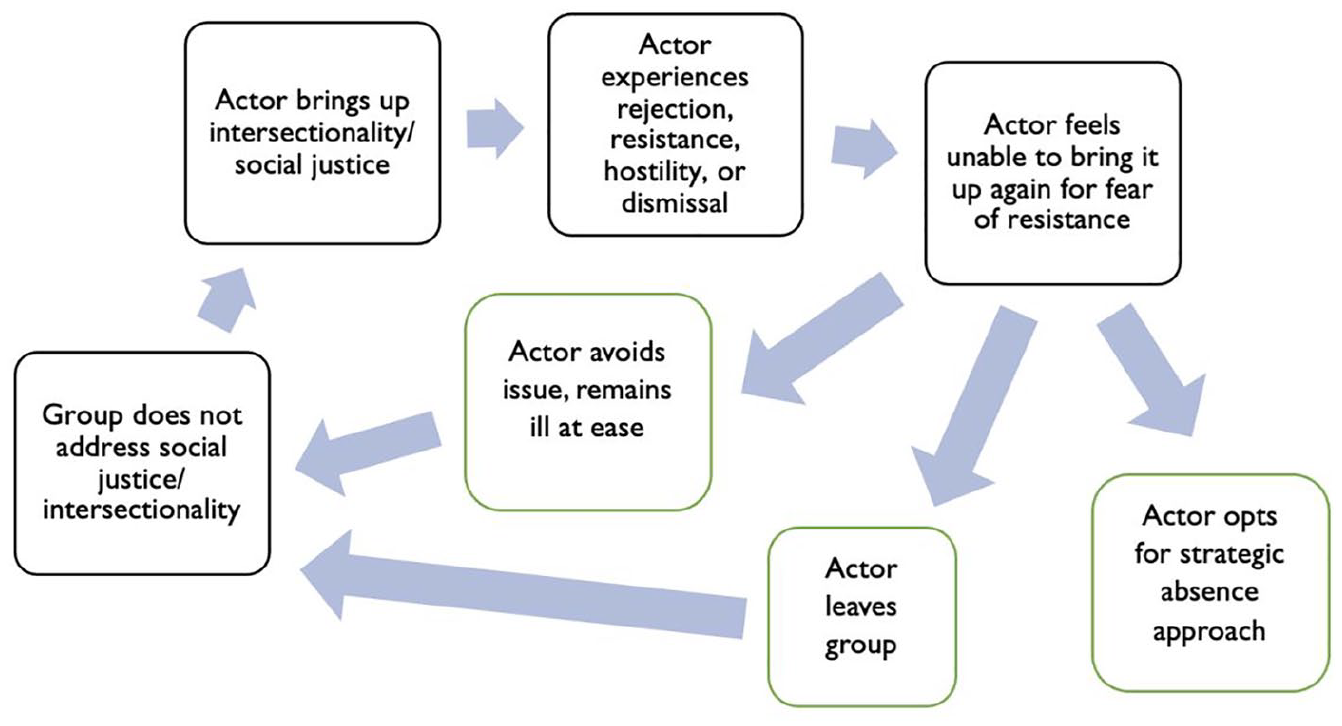
Cycles of intersectional absence.
We know, then, that some environmentalists continue to resist the kinds of changes invited by intersectionality – no matter whether this is articulated in a lighter touch, oft-critiqued, ‘diversity’ form or the deeper, structural and material analyses that we have seen respectively above. In this resistance, environmentalists perform a reactionary movement in which environmentalism opens itself to alignment with the resurgence of reactionary politics we have seen across Europe in recent years (Capelos et al., 2021). These positions ultimately work to refuse the redistribution of power within movements, but also the redistribution of power and resources in their externally oriented political demands and solutions too. Organising in a context where individuals are repeatedly exposed to hostility and resistance to addressing issues around power and social inequities, can lead to burnout – an issue which the Black women I spoke to raised in particular.
The experience of encountering specific pushback against both discussing and addressing issues relating to race and the legacies of colonialism specifically was also a recurring theme among the racialised environmentalists that I interviewed for this research. And indeed, experiences of racism within grassroots environmentalist groups such as Extinction Rebellion UK have been well documented (Yassin, 2020). Such findings resonate with the legacies and histories of mainstream environmentalism in Britain as being rooted in politics and projects (read: imperialism) which are antithetical to intersectional politics (Grove, 2010). This is an issue which XR, specifically, has explicitly tried to navigate, running training events such as ‘Working to eliminate effects of racism in environmental activism’ (Extinction Rebellion, 2019) and talks such as ‘Racial Justice is Climate Justice’ (Extinction Rebellion, 2020). More recently, XR UK shifted their strategy away from disruption and arrest as a commitment to ‘to including everyone in this work and leaving no one behind, because everyone has a role to play’, and ‘prioritis[ing] attendance over arrest and relationships over roadblocks’ (Extinction Rebellion, 2022). But studies have shown that a failure to take on an intersectional and anti-racist approach to environmental organising is not only important for those operating within these groups; for the types of organising tactics and discourses employed by groups like XR have also produced feelings of alienation and disconnect among racially minoritised communities as audiences and potential recruitees for such groups (Bell and Bevan, 2021). Concerns about how environmentalists manage and respond to anti-racism in particular was also present in other aspects of the primary research conducted for this study. In particular, this was the case during my ethnographic fieldwork which included attendance at Green Party conferences and XR protests.
Strategic absence
The strategic absence of intersectionality refers to where actors privately express a commitment to intersectional politics but turn away from its language in public. Choosing not to use the term ‘intersectionality’ is a deliberate move, largely designed to avoid alienating the actor’s actual and potential peers and audiences. This strategic absence is a conscious effort to either: make intersectionality legible to those who would not otherwise understand its meaning, and/or to make it palatable and appealing to those who, upon hearing its vocabulary pronounced, and perhaps recognising its origins, may reject the speaker’s claims.
Strategic absence is distinct from the previous types of absence explored above. It is primarily a linguistic absence. Even when environmentalists are keen to embrace an intersectional politics, they are strategically monitoring and shaping their own vocabularies in ways that move to obscure the Black feminist imaginaries which make intersectional environmental organising possible. Broadly speaking, my interlocutors explicitly pointed to one or two of three key driving factors that to explain the choice to opt for strategic absence: the will to avoid language considered ‘too academic’, jargonistic, or difficult to understand; the extant challenge they were experiencing around making the marriage between social and environmental issues legible to audiences; a desire not to alienate potentially more socially conservative audiences who might be hostile upon hearing the word ‘intersectionality’.
In particular, I found a recurring theme around perceptions of the language of intersectionality being, as some of my interlocutors put it, ‘too academic’ to be used in a widespread way. Some of the interviewees in this research cited this as a reason to opt for the strategic use of intersectionality as informing their politics, without ever publicly using the language of intersectionality. To some extent, they enact a form of linguistic erasure of intersectionality while actively drawing on an intersectional politics to inform their organising and/or activism. This is a curious tension – demonstrating the kinds of paradoxical gaps that can and sometimes must be opened up between the foundations of the politics environmentalists advance and the language that they use to articulate it.
The characterisation of intersectionality as either ‘too academic’ or too difficult to understand among many was particularly, but not exclusively, noticeable among environmentalists either already in or seeking elected office. One such participant in the GPEW reflected that Interviewer And what about the-, this notion of intersectionality? Is that something that you think is a useful vocabulary? Respondent So, I’m very passionate about the concept . . . I think there’s a lot of work to get it broadly understood. And I think, you know, if you did a poll of 100 people, unfortunately, a quite small minority of people would, would understand it. Now, you know, whether that’s about using our platforms to get the word out there and get more people understood, or it’s about breaking down what we mean by intersectionality down to its components. And you know, when I think about my day-to-day group campaigning, you know, I write newsletters, talk about issues and I try and break down the language that we use. So that like, an 11- or 12-year-old can understand it. (P005)
Indeed, the relationship or perceived gap between academia and environmental organising is pertinent for many reasons. In some countries, such as the United States, the intersection of the two spheres has produced fruitful alliances whereby engaged scholars produce credible, scientific data which supports legal environmental justice claims against local and national governments made by aggrieved communities (Ergas et al., 2021).
Another interviewee, also an elected environmentalist from the Scottish Green Party (SGP), reflected, I spent 10-, more than 10 years as an academic, so I probably get sucked into theoretical language probably too quickly. But I like it. I like language, and I like what it can do. But I think there’s something about recognising difference and recognising where other people are. So, you know, I might not say I’m an intersectional feminist when I’m speaking to people at the food bank or when I’m meeting a[nother politician from a different party], for instance. But I’ll talk about, you know, whether they can access the shops that they need to-, . . . I talk about class all the time, even if I didn’t use the word class. (P014)
Here, the interviewees raise concerns which can be understood as problems related to issue framing through choice of language. Both of my interlocutors here are elected environmentalists, and thus face the particular challenges that come with seeking and holding elected office. Issue framing is extremely important (Rhee, 1997) and, in particular, the language used to form these frames (Brewer, 2002; Cameron and Shaw, 2016). This is true not only for those operating within electoral politics, but for actors seeking social and systemic change more broadly (Johnston and Noakes, 2005). By using the word ‘intersectionality’ – which the interviewees above describe as being perceived as an academic/theoretical word with which many will be unfamiliar – there is a perception that this word produces a risk of alienating potential sympathisers and/or voters who might identify with environmentalist causes. We should note the specificities that come with seeking and holding elected office (e.g. representing a diverse range of constituents and trying to win over new, potentially very conservative, voters). But as we know from the current political climate, comprehension is not the only barrier to openly drawing on intersectionality. A political climate in which ‘culture wars’ (Curran et al., 2018; Donington, 2019) are being stoked means that hostility to the politics that this word represents is a real obstacle too – an observation that environmentalists operating within faith groups made particularly apparent to me, as we will see in greater detail below.
The above interviewees, seeking or situated in elected office, employed the strategic absence of intersectionality because of concerns about legibility and comprehension. Others expressed concerns about being met by hostility. As such, they reflected on their efforts to incorporate intersectionality into their work without using the term at all as a way of avoiding alienating other environmentalists operating in the same space. Ultimately, these interviewees strategically operationalise intersectionality in ways that intentionally obscure its Black feminist origins – and, as far as possible, its politics. This raises many challenging questions. What does it mean to draw on Black feminist ideas while actively deciding not to cite them or talk about their origins? What kind of politics does strategic absence lead to in the face of hostility towards Black feminism? And how useful is strategic absence in environmentalist contexts specifically? These are questions which many Black feminists have already been discussing extensively, especially in the context of political organising and theorising around racial capitalism and heteropatriarchy (Alexander-Floyd, 2012; Gines, 2011; Carbado et al., 2013; Collins, 2015; Hall, 2016).
As one environmentalist organising among faith groups told me: [intersectionality is] probably something that some people [I organise with who] would not be comfortable with because they would say that they see-, they see-, they see it as part of a-, kind of, like, a progressive kind of agenda. That kind of thing. They get very worried about it. And because of that, it’s seen as something kind of political, that you shouldn’t, kind of, engage with. Which is ironic because you know, the-, you can’t really, like, remove yourself from politics, whatever you’re doing, you know. (P007)
Another environmentalist organising among faith groups shared similar reflections: I think it’s always like, have-, have the three things working as a trinity: race, class, gender, race, class, gender. . . . I try not to use the word intersectionality though. I just try and do it. When I’m writing newsletters, or when I’m organising events or whatever, I try never to use that word. But again, those three interacting factors I always think about them. [An ex-colleague] was telling me, ‘Look, if you say the word intersectionality, you’re going to turn a lot of people off’. (P006)
In these reflections, the interviewees are not questioning whether people would understand what intersectionality means. The issue is not comprehension, although both interviewees raise this at other points in the discussions that I had with them. But here, they raise concerns about active hostility. In pronouncing the word ‘intersectionality’, they are sensitive to ‘turning people off’, triggering hostility and opposition to the kinds of politics that the word has come to symbolise among those who are familiar with it.
Key implications
Even when environmentalists are keen to embrace an intersectional politics, they can still be strategically monitoring, shaping, and constraining their own language in ways that move to obscure the Black feminist locales from which this politics arises. In particular, strategic absence as a form of intersectional absence throws up many questions about a number of live debates among (Black) feminists, especially about the politics of citation (Ahmed, 2017) as well as the buzzword-ification (Davis, 2008), co-optation (Salem, 2018), and whitewashing (Christoffersen, 2019, 2021; Collins and Bilge, 2016) of intersectionality – which work to invisibilise Black women.
We should stay conscious of the specific context of British environmentalisms and the historical trajectories of the key ideas, concepts, and terms that shape the dominant green discourses. Black feminisms of different kinds have not been at the heart of the historical development of British environmentalism – which has sometimes been driven instead by antithetical projects like imperialism and colonialism (Grove, 2010). Indeed, part of the aim of this research is to understand and imagine the places in which the two converge and diverge historically, presently, and potentially. But this also means addressing the questions that some may raise around the extent to which British environmentalists can actually be expected to engage with the ‘discourse’ of intersectionality, which is sometimes presented as either deeply tied to a very academic form of feminism or simply jargon (Gordon, 2016).
While some scholars and activists/organisers have found ample opportunity for collaboration with each other, there has also long been a historically troubled relationship between political organising and universities/university research; a perceived gap between the two spheres (Flood et al., 2013; Martin, 2010 Kelley, 2018). Scholars in the Black Radical Tradition have even argued that the two are antithetical to each other, stressing that the intellectual, social, and material foundations upon which modern universities function are already always reliant upon the logics of racial capitalism (Harney and Moten, 2013; Kelley, 2018). I recognise that those who hold the view that universities are antithetical to the interests of Black politics likely would not have engaged with/answered the call to be interviewed for this research. But it is interesting to note that a couple of my interlocutors saw the problem of the ‘ivory tower’ as one which creates problems for using the language associated with it. But is intersectionality too academic? Yes, intersectionality, as a word, is one which is born in the university. But is it fundamentally of the university? Such questions, I think, remain open.
Yet, we might want to question what it means to talk about intersectionality as being ‘too academic’ since, unlike many theories about change and action, intersectionality’s origins lie within Black women’s community organising for social justice (Bilge, 2020; Collins, 1989). It thus emerges out of taking tangible action to animate the material, social, and cultural redistributions necessary to combat structural inequalities. Indeed, since its inception, intersectionality has been robustly theorised in the academy – hence the existence of the vocabulary to express it today. But Collins (2015) emphasises the real-world implications of intersectionality, arguing that intersectionality is principally about political organising and concrete social justice work (p. 16).
Finally, it is important to note that the findings of this research speak to material concerns about the labour that goes into organising. That the labour of leading action on the concerns of intersectionality, and encountering resistance to when doing so, often falls to already minoritised actors forces us to reflect on the very concrete consequences for the wellbeing of these environmentalists. These individuals are exposed to the threat of activist burnout, which can take a serious physical and mental toll and cause people to disengage from or decrease their organising (Vaccaro and Mena, 2011; Gorski, 2018, 2019; Gorski et al., 2019). This is even more significant in the case of marginalised actors, since ‘[s]ystemic oppression is itself [already] traumatizing’ (Wineman, 2003: 42). Looking back to the cycles of intersectional absence that can take place (Figure 2), reflection about movement exit becomes necessary.
Concluding remarks
As mentioned earlier, environmentalists in Britain and other parts of the Global North have been subject to critique by various groups for a failure to platform the concerns of marginalised communities or to include marginalised groups within its organising spaces. The findings and discussion presented in this study are important for thinking about whether and how contemporary environmentalists speak to the issues of power, inequity, and domination that intersectionality centres. By examining some of the discursive and tactical choices that environmentalists are making, this article has sought to contribute to our understanding of the generative connections that can be and currently are being made between a Black feminist politics of intersectional justice and Northern environmentalism (Ducre, 2018) in a British context. It showed how an intersectional politics in environmentalist contexts thus informs how certain issues come to be part of a group’s agenda (Crenshaw, 1991), and the discourses/strategies which activists and political actors make use of to serve the political ends they are seeking (Evans and Lépinard, 2019).
This article proposed a typology of intersectional absences within environmental organising which illustrates the ways that intersectionality can show up in its absence in environmentalist discursive practices across Britain today. It articulated some of the political and intellectual implications that the empirical articulations of these absences produce in Britain. In particular, we saw the different ways in which intersectional absences have material implications for minoritised environmentalists who are working to embed intersectional politics within the movement, as well as for the state of environmentalist discourse/praxis more broadly. Cycles of absence push environmentalists working from an intersectional politics, often themselves people who have experienced intersectional oppression, to either exit the movement or strategically censor themselves such that they may be perceived as palatable by wider audiences. If environmentalists exit the movement or turn away from environmentalist organising because of burnout – and if those people are in large part from minoritised groups in Britain – this has important implications for how green discourses and action continues to evolve in Britain (Bell and Bevan, 2021). As my interlocutors and the existing scholarship affirm, green discourses and action in Britain benefit greatly from being shaped by various social vantage points; for our experiences of race, colonisation, class, gender, dis/ability, and other axes of power contribute to a fuller understanding and response to tackling relations of domination, extractivism, and ecological breakdown.
Footnotes
Acknowledgements
I would like to give my heartfelt thanks to Professor Elizabeth Evans and Professor Sanjay Seth who supervised the doctoral research on which this paper is based. I am grateful too, for the support this paper has received from Council for European Studies Gender and Sexuality Research Network.
Funding
The author disclosed receipt of the following financial support for the research, authorship, and/or publication of this article: Thank you to the Arts and Humanities Research Council for funding this research through the CHASE Doctoral Training Partnership.
