



Abstract
Personal stories are a strategic tool often used by advocacy movements to pursue claims for equality. In the 2023 Voice referendum campaign in Australia, personal storytelling was used by the conservative No campaign to argue against the constitutional recognition of Aboriginal and Torres Strait Islander peoples. Through narrative analysis of the Yes and No campaigns, we highlight two storytelling dynamics. First, the autobiographical hero narrative, fused with the Australian ‘fair go’, to de-historicise inequality and de-emphasise experiences of colonisation and systemic racism. Second, personal storytelling’s strength in emphasising shared identity between storytellers and the public helped the No campaign’s defence of the status quo and their claims that constitutional recognition would be divisive. These narratives set the agenda for the campaign, making it difficult for the Yes campaign’s use of community strengths-based stories to convince the public that recognition of difference was key to achieving greater equality.
Introduction: The Voice referendum
In October 2023, Australia held its first national referendum in nearly 25 years. The so-called ‘Voice referendum’ proposed the formal recognition of Aboriginal and Torres Strait Islander peoples within the Constitution, through the creation of a national consultative body that would be called the ‘Voice to Parliament’. The Prime Minister, Anthony Albanese, had made an election commitment to hold the referendum, following the recommendations of the Uluru Statement from the Heart, a document first shared in 2017 at a national constitutional convention of 250 Aboriginal and Torres Strait Islander people (Albanese, 2022). The Uluru Statement’s intention was to ensure that constitutional recognition was not merely symbolic but created an enduring legacy of material and institutional recognition for Aboriginal and Torres Strait Islander peoples, through the creation of the Voice to Parliament. Despite active support by the new Labor Government, public opinion in support of voting Yes shifted dramatically from two-thirds support in late 2022 to 40% by October 2023 (Evershed and Nicholas, 2023). This underscores the importance of the campaign itself in understanding the referendum’s failure, as argued by Biddle et al. (2023). In this article, we focus on a particular aspect of these campaign dynamics: the role of storytelling.
In an era of data-driven campaigning and crowdsourced politics, story-based campaigning has become a central part of persuasion. That is, many campaigns use personal stories to generate an affective response to campaign messages and mobilise support. Referendums for constitutional change are a distinct political scenario to examine the use of storytelling as they display hybrid logics of electoral and direct democracy. Voters and campaigners participate in these events not in routinised partisan ways but as decision-makers for a simple and direct yes/no binary. Twenty-first century referendums are also shaped by the logic of connective advocacy, as campaigns use a digital-first strategy, predicated on rapid sharing of campaign content via an assortment of social media platforms.
Through an analysis of prominent stories used in each of the campaigns, this article asks: How did the Yes and No campaigns for the 2023 Voice referendum use personalised storytelling to promote ideas of equality and social change? In doing so, the article examines how historically contextualised conservative narratives on equality and unity were successfully used by the No campaign in the 2023 Voice referendum to oppose the introduction of a constitutionally entrenched consultative body of Aboriginal and Torres Strait Islander Australians. After a close reading of the use of personal stories in both the Yes and No campaigns, the article suggests that the inability of the Labor Government and the Yes campaign to create change underpins broader issues in the crisis of equality politics for social democratic parties. This includes the challenges of creating a persuasive narrative with broad appeal that celebrates reconciliation and recognises race-based differences. Extending dignity and respect towards the identities of others is not the zero-sum game that conservatives portray it is in order to sideline calls for recognition. As Michele Lamont (2023: 69) argues: ‘identity and material resources are both important factors, therefore, and both are needed to properly understand inequality. For one thing, economic inequality is often deeply rooted in identity-based discrimination and injustice’.
Researching narratives and storytelling for political and social change
In this section, we show how our analysis of narratives and storytelling used in the Australian Voice referendum campaign contributes to two fields of existing scholarship. First, we survey existing research on the use of narratives in recent referendum campaigns, particularly Brexit. Second, we introduce recent research on the use of personal storytelling for advocacy and social change campaigns, with a specific focus on the dilemmas of Aboriginal and Torres Strait Islander storytelling.
On referendums and the use of narrative
In the 21st century, there has been an increasing call from scholars and practitioners alike to amplify the voices of citizens and to innovate practices to promote engagement, beyond the electoral cycles of representative democracies. Innovations take a myriad of forms, but arguably the most prominent are underpinned by the principles of direct democracy on the one hand (such as the use of referendums) and deliberative democracy on the other (including the use of mini-publics, such as citizen assemblies). Referendums are a direct public vote on a proposal, law or policy concern and occur at national or subnational levels; they are not a vote to choose democratic representatives to make decisions on behalf of citizens, as in a more routine election (Dekavalla, 2016). Constitutional reform referendums are of a particular type: their decisions are binding on government, they alter the text of a constitution or nation-forming document, and in most countries they are a rare or ad hoc enough occurrence that citizens tend not to see them as a routine way of engaging with politics.[1] Some contemporary referendums combine both innovative approaches to democracy, such as the hosting of a deliberative Constitutional Convention prior to an electorate-wide direct vote in a referendum. Contemporary manifestations of referendums are now hybrid events combining the logics of voting and deliberation, beyond the party-political focus of elections, and are shaped by a horizontally networked digital/social media context (Langer et al., 2019). An important factor here is that referendum voters may not have pre-conditioned views of their choice – as opposed to elections where most voters already know which political party they will vote for.
The role of the media in communicating debates over constitutional reform is also key. Stefan Rummens writes of how the personalisation and mediatisation of representative politics has led to the foregrounding of a dramaturgical logic where the focus is on conflict, not consensus, and the ‘media want a story or an argument to be presented by a recognisable person; it means that messages have to be short, to the point and preferably presented by means of a captivating metaphor and some humour’ (Rummens, 2016: 137). This turn towards referendums staged as digitally mediated narratives fosters the use of personalised storytelling that brings citizens along as active participants in the storyline.
The production of both heroes and villains within storylines becomes important to referendum campaign success. We have seen this use of digitally mediated storytelling in other 21st century constitutional reform referendum campaigns, for example on the UK leaving the EU in Brexit in (2016), in Ireland on abortion (2018) and marriage equality (2015), and in the Scottish Independence referendum (2014). During Brexit the Leave campaign’s success was driven by a persistent narrative of the failure or crisis of the EU (Bennett, 2019), coupled with the promise of success for Britain once it was outside of the EU. Prominent Leave campaigners, such as Boris Johnson and Nigel Farage, portrayed themselves as key storytellers, and heroic figures opposing the dominant force of the EU. Similarly, the Alex Salmond-led Yes campaign used heroic motifs in the 2014 Scottish Independence referendum to promote a storyline of Scottish civic nationalism reliant on the distinctive qualities of its society and politics, in contrast to England- and Westminster-dominant governance (McAnulla and Crines, 2017).
Narrative genres, such as comedy, satire, tragedy, and romance, also matter for persuading the audience (i.e. voters in referendums). Spencer and Oppermann (2020: 678) argue that in the lead-up to the Brexit referendum, the Remain campaign used a mix of genres, which served to confuse the audience about their core messages. By contrast, the Leave campaign consistently and successfully engaged with the romance genre. Romance narratives have a storyline that relies on a strong and honourable hero winning an asymmetrical conflict. As mentioned above, stories about heroic moral figures winning against the odds were important for the successful Leave campaign in Brexit. In a romance narrative, ‘the hero is fighting for some kind of ideal or sacred value such as liberation, justice, freedom, democracy or love’ (Spencer and Oppermann, 2020: 671). By invoking traditional myths of what it means to be British, the Leave campaign therefore pitted the United Kingdom as a ‘romantic hero’, that needed to be liberated from the might of an expansionist European Union. The use of romance narratives and heroes can be utilised by either side of a referendum debate. The successful 2017 ‘Yes to marriage equality’ plebiscite campaign in Australia also used romance narratives – in this case, quite explicitly, through positioning love stories of same-sex couples as equivalent to more familiar straight romance tropes (Trevisan et al., 2025). A similar storytelling strategy was employed by the successful earlier campaign for marriage equality in Ireland in 2015 (Healy et al., 2016; Murphy, 2016).
Brexit’s ideological narrative also highlighted problematic, nostalgic beliefs in white English racial dominance, cultivated during Britain’s pursuit of its empire (Melhuish, 2024). In her book Destructive Storytelling (2022), Imke Henkel (2022) suggests that accounts of the success of the Leave campaign need to focus on how these narratives were formulated and resonated, to move beyond analysis of disinformation or misinformation in the campaigns’ core messages. She writes: ‘it would be a distraction to focus on the content of the lies rather than their narrative structure and strategy, which served their ideological purpose’ (p. 165).
Brexit was also a notable digitally mediated event with both sides making extensive use of social media to propel their campaigns and distribute core storylines. Platforms were used by campaigns in a hybrid way through sharing and recirculating the messages of mainstream journalism and the core leaders in the debate. This was not a grassroots campaign, despite the traces of collective action and protests from the Remain side after the referendum result (Brändle et al., 2022). Other recent referendum campaigns have been less top-down in narrative construction than Brexit was and more reliant on crowdsourced citizen stories to propel the case for institutionalising social change. In these cases individuals, rather than recognisable political leaders, share stories of their everyday personal experiences to propel campaigns. It is important not to assume, however, that crowdsourced narratives necessarily involve a more radical or egalitarian perspective: O’Shaughnessy (2022) describes the ‘Together for Yes’ campaign as a conservative take on abortion rights, while Trevisan et al. (2025) describe how the crowdsourced stories in the Australian marriage equality campaign necessarily directed themselves towards the median Australian voter, rather than the expressive needs of diverse queer communities.
In summary, referendums on constitutional reform are a rare occurrence in many advanced democracies, and rarely have a commonly accepted script for voters or citizens to follow in the way that regular elections do. Specific campaigns for or against a referendum proposal present formal and technical arguments in their cases for or against change. At the same time, they also establish campaign-specific, digitally mediated narratives that reflect traditions of discourse and political ideologies based on national stories and myths. Referendums are important to understand for their influence on and reflection of dominant political cultures. We will demonstrate below that national myths of equality and egalitarianism in Australia were used in narratives and stories during the Voice referendum campaign to prevent constitutional change.
On storytelling and advocacy
In this article, we define personal stories as those that have an individual talking about their lived experience to relay a story or narrative that contributes to a larger argument. Personal stories are used to instil a sense of shared values, challenge dominant narratives, as well as focus on future social change. Stories are used in campaigns to create an affective or cognitive response in the listener, and to inspire them to act. They are often counterposed with depersonalised, fact-driven campaigns that are less persuasive or motivating (Dillon and Craig, 2021).
Polletta and Callahan (2017: 394) point out that campaign stories are ‘allusive’ in that the moral point is rarely overt but gleaned from ‘reference to stories we have heard before’. Thus, the romantic hero – David triumphing over Goliath – motif is a well-understood reference point for the story listener. In contemporary advocacy campaigns stories are rarely unresolved traumatic stories of victimhood, instead foregrounding heroic triumph over adversity to build a narrative of hope and possible solutions.
In their research, Polletta and Callahan suggest that Donald Trump won the American Presidency in 2016, not primarily by telling a personal story, but by building an inclusive ‘we’ narrative that reinforced an existing shared story line of cultural loss and that encouraged listeners (potential voters) to adopt the narrative as their own (Polletta and Callahan, 2017). They also point out that storytelling is not based on the story text alone but is also performative – who tells the story and how matters for the story’s authenticity and shareability (Polletta and Callahan, 2017: 395). Both conservative and progressive advocacy campaigns use individuals who share their personal stories as the face of their campaign to persuade those not already on their side through empathy or relatability to the storyteller (Gupta-Carlson, 2016; Polletta, 2008). Some advocacy campaigns crowdsource stories – as opposed to curating them – for several reasons, including diversifying the stories of the campaign, and creating critical mass and collective identity based on shared experiences (e.g. Trevisan, 2017).
Particularly given the nature of the Voice referendum, and the prominence of Aboriginal and Torres Strait Islander storytellers in both the Yes and No campaigns, it is also vital to acknowledge the storytelling tradition of First Nations peoples of Australia. Aboriginal and Torres Strait Islander people use storytelling processes to share traditions and preserve cultural knowledges. Dadirri, for example, is an epistemological and ethical framework of the Ngan’gikurunggkurr people of the Daly River (Northern Territory) which can be used to scaffold respectful storytelling, as it guides people towards ‘cyclical, deep listening, and reflection’, and encourages ‘being present, being still, connecting with yourself and the environment in such a profound way that it creates space for deep relationships’ (Ungunmerr-Baumann et al., 2022: 96). A related process is yarning (Barlo et al., 2021); as Australian Indigenous academic and author Tyson Yunkaporta (2019) explains, ‘yarns are like conversations but take a traditional form we have always used to create and transmit knowledge’. These story-driven and conversational processes, such as yarning, are used to collectively understand familial interconnections, history, and underscore the unfairness of shared inequities (Povey et al., 2023).
Contemporary Aboriginal and Torres Strait Islander storytellers recognise how negative stereotypes and dominant narratives are frequently used against them, and to police their everyday lives and access to health, justice, social support, and housing. For example, Larissa Behrendt (2019) uses harrowing individual stories of state child removal to argue that the only way in which someone with preconceived ideas will let go of them is if those views are challenged by powerful narratives. The telling of a personal story can humanise an issue – put a face to the statistics – and can increase empathy in the person who gets to listen to the story. In her research, Behrendt (2019) has used stories that have a successful resolution: ‘Stories of overcoming disadvantage and of resisting injustice highlight the strength and agency of Aboriginal people’ (p. 201). However, Behrendt also acknowledges the impediments to changing dominant narratives, including the great myths of egalitarianism in Australia’s historical trajectory, to respectfully recognise Indigenous experience: ‘‘Not making people feel guilty’ was one of the key arguments put forward as to why Australia’s national narrative should continue to exclude this important aspect of Indigenous experience and of the colonial story’ (Behrendt, 2019: 202).
Oral or written testimonies based on personal stories also have a long history in commissions of inquiry, such as the Bringing them Home Report on the Stolen Generations, and truth telling commissions that have been used in several national contexts to achieve healing and reconciliation. Through people sharing their testimonies, they can also be transformed from victims into strong survivors of structural and systematic forms of discrimination, disadvantage, and abuse (Schaffer and Smith, 2004). Yet there is also inherent risk here with storytellers being vulnerable to challenge, rebuttals, and increased scrutiny. Not all audiences are compelled to listen to or empathise with personal stories. As Schaffer and Smith (2004: 15) note in Australia, the sharing of Aboriginal and Torres Strait Islander peoples’ lived experiences and stories over decades has been politicised and led to ‘contentious national debates, denials of redress, and forums of blame and suspicion’. In both research and advocacy campaigns alike, once Aboriginal and Torres Strait Islander peoples’ stories become public property, the ‘stories are too often reinterpreted from a colonial perspective that fits with dominant ideology, or decontextualized and positioned to be vulnerable to breaches of privacy and custodianship’ (Povey et al., 2023: 241).
This complexity in telling and sharing Aboriginal and Torres Strait Islander peoples’ stories necessitates exploration of how personal stories embody truth-telling, and are a space for the recognition needed to create social and political change. These questions are particularly pressing in the context of a nation-wide campaign such as the Australian Voice referendum, where both Yes and No campaign narratives were publicly led by Aboriginal and Torres Strait Islander advocates. As this article demonstrates, dominant, bipartisan ideologies and myths of Australian politics and national identity – liberal individualism and material egalitarianism driven by a meritocratic belief in the ‘fair go’ – shaped how personal stories were mobilised and recieved during the Voice referendum campaign.
In the next section, we explain our methodological use of narrative analysis to study the Voice referendum, the key actors in the campaign, and their stories that were included in our analysis.
Methodology
Narrative analysis
At its most basic, a story is ‘a description of events involving characters (human and non-human) who are placed in a temporal and spatial setting’ (van Hulst et al., 2024: 8). ‘Story’ and ‘narrative’ are related, and have been described in terms of the difference between a set of events and a particular representation of that set of events, respectively (Abbott, 2008: 14). As Feldman et al. (2004: 148) suggest, a narrative can be understood as: a sequence of events, experiences, or actions with a plot that ties together different parts into a meaningful whole . . . Through the events the narrative includes, excludes, and emphasizes, the storyteller not only illustrates his or her version of the action but also provides an interpretation or evaluative commentary on the subject.
While we acknowledge the importance in making a distinction between the ‘story’ and the ‘narrative’ in certain spheres, here we use the two terms synonymously. In the context of political communication, the telling of particular events and experiences will often necessarily take the form of politically motivated representations of those events and experiences for persuasive purposes: the ‘story’, as such, cannot be separated from the ‘narrative’. A narrative or story, for our purposes, then, not only offers a picture of how the world is but also how the world could or should be, through the eyes and sensemaking of the storyteller. As Bonansinga (2022: 514) suggests, they are ‘sense-making and sense-giving devices that structure information, establishing cognitive and normative maps to understand the political world’. The narrative analysis, then, is an attempt to understand how certain story elements (i.e. events, actors, and settings) are woven together – and to identify which elements or interpretations might have been left out – in order to make sense of what has happened, and to offer a vision of how we might affect change in the future.
We used a narrative approach to analyse the Voice referendum campaign for two main reasons. First, narrative analysis is an effective lens through which to understand the interplay between individual experience and wider cultural scripts (for a discussion of the political significance of these scripts, see Lamont et al., 2014). Stories provide a scaffold for individuals to make sense of their own life, and in their retelling a way to energise and legitimise those scripts for others. As discussed above, storytelling also strengthens the potential for those scripts to be mobilised for specific political ends. To take a concrete example of a cultural script (one to which we return in our empirical analysis), consider the idea of meritocracy. This is a widely available script that helps individuals to make sense of their lives, whether advantaged individuals justifying their deservingness (Friedman et al., 2024), or the more disadvantaged fostering a sense of an agentic and upwardly mobile self (Ho, 2024). Moving beyond an individual biography, meritocratic scripts also provide a way of understanding and explaining the formation of social structures in a given country (Heuer et al., 2020). Narrative analysis is the most effective way to understand how these kinds of commonsense cultural scripts are evoked and reinscribed in public debate through the telling of personal stories.
Second, narrative analysis is particularly suited to understanding the political dynamics of the 2023 Voice referendum, as a case combining a high degree of political uncertainty with resonant pre-existing narratives on Australian national identity and history. In part, this is because the referendum campaign involved sense-making about a proposal and political format (a referendum for constitutional change) that was largely unfamiliar to the Australian public. Our approach mirrors the work of scholars using narrative analysis in other areas of high uncertainty such as the COVID-19 pandemic (Biswas Mellamphy et al., 2023; Mintrom and O’Connor, 2020), where the more allusive and associative argumentation characteristic of political narratives has particular power. The case of the Voice referendum also invoked questions of national identity, history and origin – elements which Patterson and Munroe (1998: 322) argue are particularly highly charged sites for cultural contestation in political narratives. For these reasons, narrative analysis of personal stories used during the Voice referendum allowed us to be attuned to sensemaking processes both regarding the specific policy proposal (see Bonansinga, 2022: 514) but also the underlying questions of collective national identity and history.
In analysing the campaign storytelling videos that we collected (see the next section for more information on our dataset), we noted down each idea and concept introduced by the storyteller which related to the concept of equality. Similar ideas and concepts were then grouped together to determine the key themes that characterised the narratives. Further, as noted above, narratives consist of actors, events and settings and in narrative analysis ‘actors, events and setting are the anchor points’ (van Hulst et al., 2024: 17). While analysing the videos in our dataset, we also considered how concepts and ideas were visually presented: who were the storytellers? Which events and experiences drove the narrative? How did the video’s setting, and the places referred to in the story, propel the story being told? Through paying attention to these elements of storytelling, we gained a fuller understanding of the normative themes (or meaning-making) within the videos themselves, and how they differed across the videos in the dataset.
We acknowledge that there are problems and limitations of undertaking political analysis of Aboriginal and Torres Strait Islander peoples’ referendum campaign stories as non-Indigenous white researchers (see Raciti, 2023). We, as the three authors of this article, are all non-Indigenous Australians. In writing this article, we do not seek to speak on behalf of Aboriginal and Torres Strait Islander peoples’ experiences, or their own analysis of the Voice referendum (see: Davis, 2023). Instead, we analyse the Yes and No referendum campaigns’ use of storytelling to promote particular narratives of social and political equality in Australia. We all see ourselves as allies to the cause of achieving constitutional recognition, and acknowledge that this inevitably shapes the way we reflect on the selection and promotion of narratives and stories in the campaign. We are also reflexively interested in showing how the No campaign’s key narrative and storytellers became dominant, and were able to win over a clear majority of the Australian voting public.
Key actors and data sources
We analysed personal stories used in the campaigns of four organisations: two established, but ideologically opposed digital campaigning ‘third party’ organisations (GetUp and Advance) and two new, referendum-specific digital organisations (Yes23 and Fair Australia). Beyond the overt partisan debate, these four organisations became the de facto or dominant voices for the opposing Yes and No campaigns. To an extent, they overlap explicitly, as Fair Australia was funded and launched by Advance, and implicitly, through existing solidarity networks among both progressive digital campaigning organisations and Aboriginal and Torres Strait Islander constitutional recognition groups. For example, Yes23 was launched and supported by Australians for Indigenous Constitutional Recognition, a registered charity established in 2019.[2] Advance was established during the 2019 Australian federal election to explicitly counter the influence of progressive organisations like GetUp (which has been prominent in Australian politics since 2006). Advance is overtly right-wing and until the 2023 Referendum campaign had mainly courted controversy and media attention by pulling stunts during election campaigns in 2019 and 2022 (Vromen and Rutledge-Prior, 2023). The 2023 referendum campaign heralds the mainstreaming of Advance as an influential non-party campaigner in Australian politics, especially due to the sophistication of its digital campaign management and targeted social media messaging (Albrechtsen, 2023).
Larissa Baldwin-Roberts, a Bundjalung Nations woman, became CEO of GetUp in late 2022. Importantly, Baldwin-Roberts had a long-standing commitment to the use of storytelling for advocacy and was a lead on a research project Passing the Messaging Stick, under the auspices of Progress Australia, which became an important guidebook for the Yes campaign. For example, the Passing the Messaging Stick report argued that ‘because the referendum is ultimately a vote about how people perceive us – we need to flood the airwaves and conversations with stories of our strength, leadership and solutions’ (Passing the Message Stick, 2023: 3). While it is beyond the scope of this article to systematically trace the influence of the Pass the Messaging Stick report’s foundational principles for effective storytelling on the narratives of the Yes campaign, it clearly influenced the Yes campaign’s focus on strengths-based storytelling. GetUp (2023) did not launch its own Yes campaign until the end of June 2023 with a video statement from Baldwin-Roberts arguing that: ‘we need to drown out the noise and redirect the public conversation towards what really matters: hearing from our communities about the political moment we’re in and what it’s going to take to win a resounding YES’.
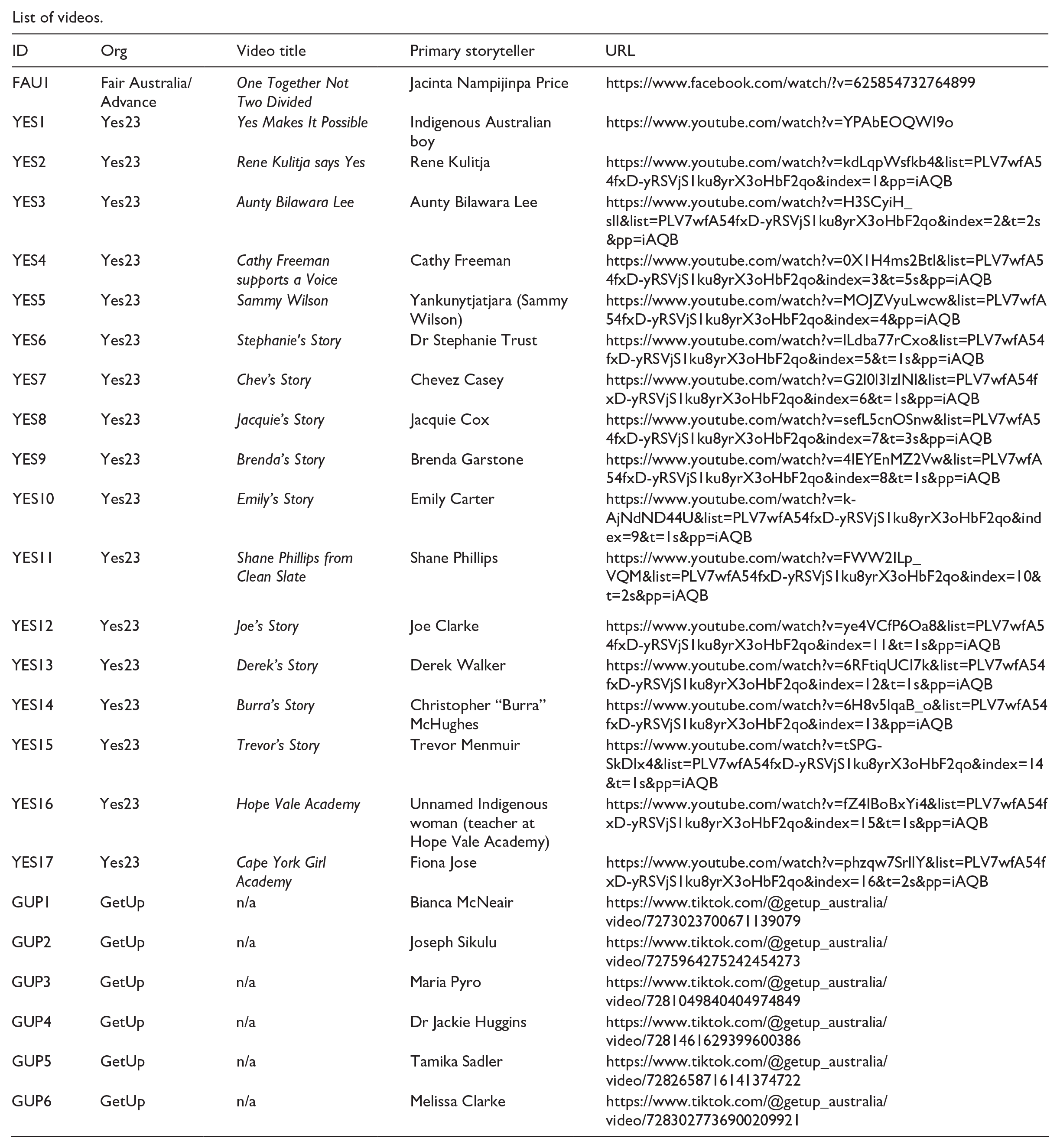
We used a targeted approach to identify prominent equality narratives using personal storytelling that emerged throughout the course of the Voice campaigning period. We selected the most salient personal stories presented by the campaign organisations, determined by: their prevalence across digital platforms, the extent to which they were foregrounded by the organisations themselves, and their impact in public debate. To identify these stories, we searched for instances of personal stories used in campaign emails and key social media accounts (e.g. Facebook, Instagram, YouTube and TikTok). This was done to ensure we captured stories targeting as broad a demographic spread as possible (Facebook, for example, skews older while TikTok skews younger (Carson et al., 2024)). This brought us to four main examples: two videos featuring individuals (one each from the No and Yes campaigns), and two collections of videos (both from the Yes campaign).
The first example is a 9-minute documentary produced by Advance/Fair Australia: One Together, Not Two Divided (henceforth: One Together). Advance had started promoting their core message that the Voice would be divisive as early as February 2022, with the hope that the then Coalition government would openly take this position to the May 2022 Australian election. Advance and Fair Australia announced via email on February 15, 2023, that Jacinta Nampijinpa Price, a Warlpiri woman, was formally joining their campaign, and was to be the key spokesperson for the No campaign. They subsequently released the One Together documentary on April 19, 2023, just after Price–a Senator for the conservative NT Country Liberal Party–became Shadow Minister for Indigenous affairs.
The second example is the Yes Makes it Possible video, released by Yes23 on social media platforms (e.g. Facebook, YouTube, Instagram, TikTok) on September 15/16, 2023, 1 month before the referendum. The video, which runs for 30 seconds, features an Indigenous boy as narrator. It had 3.7 million views on YouTube alone.[3] The boy is an ordinary boy, posing a series of experiential questions about his future options in Australia. Through this storytelling technique, the video emphasises shared universal values, challenges dominant narratives, and focuses on future social change. It promotes a universalising message about recognition and equal opportunity as the rationale for voting Yes.
The third example is the Local Voices for Yes videos, which were produced by Yes23’s director, the famous filmmaker, and Arrente and Kalkadoon woman, Rachel Perkins. These 16 videos are included in a collection on Yes23’s YouTube page,[4] with a subset of six featured on a page on the Yes23 website. The videos in the YouTube collection were posted over 2 months, from August 3 to September 23, 2023, and run from 28 seconds to 2:08 minutes (average: 1:23 minutes). They are each focused on a primary storyteller; however, several feature other individuals who supplement the primary storyteller’s narrative.
The final example is a collection of six videos shared by GetUp (henceforth, the ‘GetUp Local Voices’ videos). Unlike the previous example, this is a collection of videos that we assembled by searching through GetUp’s social media pages for all the examples of videos featuring storytelling that we could find during the campaign period. The collection is GetUp’s equivalent to the Yes23 Local Voices videos, as the former is also centred around Aboriginal and Torres Strait Islander people telling their stories and explaining why they are voting ‘Yes’. These videos were posted to TikTok (and other social media platforms) from 30 August to 26 September 2023, and run from 30 seconds to 1:35 minutes (average: 1:20 minutes).
For the purposes of the analysis, rather than simply comparing the narratives presented by the Yes campaign’s stories by contrast with those of the No campaign, we decided to analyse the more popular Yes Makes it Possible video separately from the ‘local voices’ videos produced by Yes23 and GetUp. With the narratives in the latter group analysed together, this left three sites of analysis–one from the No campaign and two from the Yes campaign. Merging the local voices videos into a single collection was done because the stories were relatively structurally similar: they all presented a personal narrator who drew on their lived experience to develop a narrative. By contrast, the Yes Makes it Possible video of an ordinary boy built his narrative by weaving together personal experiences and realities salient to Aboriginal and Torres Strait Islander people, and likely to appeal to the non-Indigenous population more generally.
Storytelling and equality in the referendum campaigns
In this section, we analyse three distinct uses of storytelling. First, Jacinta Price’s story in Advance’s No campaign video, One Together; second, the Yes23 campaign’s Yes Makes it Possible video; and, third, the Local Voices videos produced by both GetUp and Yes23.
The ‘romantic hero’: Jacinta Nampijinpa Price
The One Together documentary[5] setting is Alice Springs in the Northern Territory (Arrente/Walpiri Country). Throughout the video, the natural beauty of this region is emphasised with scenic shots of the land. The Northern Territory, which has the highest proportion of Aboriginal and Torres Strait Islander peoples of any state or territory in Australia, is also most associated with the Australian ‘Outback’: it therefore represents the ‘real’ Australia. This setting subtly suggests the storyteller’s legitimacy in speaking not only for Australians in general, but also for Australia’s Aboriginal and Torres Strait Islander population.
The storyteller, Jacinta Price, is the daughter of former Member of the Northern Territory Legislative Assembly Bess Price and lives in Alice Springs with her musician husband, Colin, and their sons (their ‘blended family’). While Price is presented as the main storyteller, Colin also shares elements of his story, as a (white) Scots-Australian, and provides support for Price’s personal narrative of triumph over adversity: ‘I will not argue and debate her lived experience, which she has seen and heard with her own ears and eyes’.
The video centres around three core themes of equality, the first is that shared humanity and love are the cornerstones of a united family – the suggestion being that shared humanity and love are the cornerstones of a united country. The theme of the united country is expressed through Price’s sharing of her story as the mother of a successful blended Indigenous and non-Indigenous family, which represents the united nation and foregrounds the notion, repeated throughout the video, that ‘we are all human beings’. For example, as Price explains: I might be growing up with Walpiri culture and modern Australian culture [but] I belong to this world just like all other human beings belong to this world, like all other Australians belong to Australia. They’re the values that I was brought up with.
Similarly, Colin, referring to their sons, notes: Their family is a blended thing. Their family is what Australia is. Australia is that thing where it doesn’t matter where you’re from in this planet, you can stand at any country in the world and you can say ‘you could be Aussie, mate. You could be Aussie’.
The video’s second key theme is that social, political and economic standing are meritocratically earned, based on individual hard work to overcome disadvantage–or to ‘become something new’. Anyone can be a hero and triumph over adversity. Reflecting on her childhood growing up in Alice Springs, in a community where ‘violence was very much accepted’, Price explains that her driving motivator has been to protect and empower vulnerable and marginalised communities. At the same time, she stresses that one’s background circumstances need not determine one’s fate: I might be a survivor of domestic violence myself–I might have experienced adversity at some point in my life–that’s not entirely who I am. I am who I am because of things that I’ve achieved in my life. . . . And that is all that I want to aim for in supporting others to feel that way: to be confident human beings who can stand on their own two feet and create their own destiny.
Both Price and Colin emphasise the importance of people having the opportunity to pursue their goals, with each reflecting on their own backgrounds: the former with Aboriginal heritage and the latter as a migrant. For Price: It doesn’t matter what background you come from as a human being, if you have the drive and the passion you can become what it is that you want to become. And this country certainly provides that opportunity for you. My mother could be born under a tree, her first language is not English, and she can grow up to become a minister of the Crown.
With Price emphasising the power of opportunity in Australia, Colin’s reflections express his fear that Australia’s values are being ‘chipped away at’ and that ‘anybody else coming to Australia will feel that they are not as equal and will not have the same opportunities that I had’.
Having built the narratives of the united family/country and the importance of equal opportunity, the third theme is that constitutional recognition of difference is inherently unfair. In the final minute of the video, Price introduces us to the upcoming referendum which, if the Yes campaign is successful, ‘will mean that some Australians are treated differently based on the colour of their skin’. Seeing race and legislating on those grounds – or in this case giving Aboriginal and Torres Strait Islander people both constitutional recognition and self-determination through a Voice to Parliament–is, for Price, divisive: What’s important to me is that we don’t divide ourselves along the lines of race in this country. I don’t want to see my family divided along the lines of race because we are a family of human beings, and that’s the bottom line.
Yes makes it possible
By contrast with the No campaign’s consistent foregrounding of Jacinta Price and her story, the Yes campaign was not driven by a single prominent spokesperson. Instead, arguably the Yes campaign’s most important and popular storyteller was an ordinary unnamed boy in the Yes Makes It Possible video. The boy, standing as a representative for all Aboriginal and Torres Strait Islander children, and by extension all future generations, represented the idea of opportunity and a better future.
The video consists of voiceovers of the boy asking six questions: ‘Will I grow up in a country that hears my voice?’, ‘Will I live as long as other Australians?’, ‘Will I get to go to a good school?’, ‘Will I be able to learn my people’s language?’, ‘Will I be seen beyond the sports field?’ and will I be ‘recognised by the decision makers of our country?’. The narration is accompanied by settings of Australian nature scenes (e.g. a forested region, a starry night sky) and other images that correspond to the questions being posed (e.g. a school library, various sports fields, Parliament House). Images of the boy are interspersed throughout the video, however the boy is never shown voicing the questions. The final footage included in the video shows the boy’s face, front on with the words ‘Yes makes it possible’ superimposed in the middle.
The video did not directly use evidence of the lived reality of the discrimination experienced and the gap between Aboriginal and Torres Strait Islander people and non-Indigenous Australians. Instead, it focused on creating an aspirational shared story of possible futures if the gap is closed. Its use of a personal story tried to unify the audience in solidarity with the boy, via extending meritocratic possibility for all Australian society, and its ‘appeal to the shared imagination and common memories of a people’ (Bonnet, 2024: 1256). This simple message of the possibility of fairness and equality was narratively important for the Yes campaign, but as it was only released in the last month of the campaign, it was probably too late to shift the vote.
Local voices and recognition messaging
The ‘local voices’ videos produced by Yes23 and GetUp share similar narrative features. They foreground one main storyteller, who is personally identifiable and who is often engaged in important community work. The videos are consistently set within the community of the storytellers, including at their homes and workplaces – settings that emphasise that the storyteller is a regular member of the community, rather than a well-known leader or politician.
The first key theme in the local voices videos is that the Voice will ensure greater empowerment for Indigenous communities by providing a better platform to have their voices heard by government. The Passing the Message Stick (2023) report was explicit about the importance of avoiding deficit narratives, and instead focused on shared values of listening and respect, and a shared vision of transformational change via the Voice. The report cautioned against emphasising ‘long lists of negative statistics’ and proposes that advocates instead acknowledge ‘Australia’s ugly history regarding Aboriginal people’ while offering solutions on how community members can and have acted (Passing the Message Stick, 2023: 80). The report also recommended that messages in support of the Referendum ‘move the hero of the story from the government to the general public’ by emphasising how important change can be made when communities work together (Passing the Message Stick, 2023: 62).
Many of the recommendations from Passing the Message Stick can be seen in the local voices videos from both Yes23 and GetUp. The need for greater empowerment in the face of socio-economic difference is supported in several of the Yes23 videos through the use of statistics that compare key social and health indicators of Aboriginal and Torres Strait Islander peoples with the Australian community more generally: in ‘Derek’s Story’, for example, we are told that ‘Unemployment is three times higher in Indigenous communities’,[6] while in ‘Chev’s Story’,[7] we see that ‘Kidney failure is twenty times higher in remote Aboriginal communities’. Importantly, these statistics are introduced to then highlight how the storyteller’s personal actions are positively impacting their community. In other videos, storytellers share their experiences of working with Indigenous communities, noting that new approaches are needed to long-standing challenges and that better outcomes are likely when Aboriginal and Torres Strait Islander peoples’ solutions are implemented.[8] Thus, the use of statistical data suggests what needs to change, and the personal stories offer practical solutions on how change is to be achieved.
An implication drawn from this theme of the Voice empowering local communities to be able to make their own decisions, is that these are decisions that local communities – particularly Aboriginal and Torres Strait Islander peoples’ communities – are uniquely placed to make. The suggestion is that politicians and the government do not understand Aboriginal and Torres Strait Islander people, and that the latter need members of their community speaking for them. As GetUp storyteller Maria Pyro, a Garrawa Yanyuwa woman, says, ‘You need to be able to trust First Nations people, because we understand our people more than you do. We have the solution. Just give us a chance to lead’.[9]
Many storytellers emphasised how the Voice would make substantial positive changes in their communities–arguably its function as a consultative body. One storyteller suggested that ‘We really need the Voice to work for us (we don’t want to wait around another 200 years like we have) and live a normal, functioning life equal to our non-Indigenous counterparts’,[10] while another explained, ‘I don’t want my children to continually fight for their basic human rights. I’m writing Yes because I want my children to thrive, to have joy, and to have every opportunity to have every opportunity like everybody else’.[11]
The Voice was also suggested as a pathway to a treaty between the government and Aboriginal and Torres Strait Islander peoples in several of the GetUp videos. For example, Jackie Huggins, an academic historian and Bidjara and Birri Gubba Juru woman, featured by GetUp stated: I would say to people who are fence-sitting that this is a very simple proposition. When you write ‘yes’, you’ll be writing for treaties, social justice, and a better future for all of us who call this country home, who love it dearly.[12]
Other GetUp storytellers also mentioned Treaty, including Malgana woman Bianca McNeair, who affirmed that ‘I’m writing yes to a treaty and the future for Aboriginal and Torres Strait Islander people in Australia’,[13] and Joseph Sikulu, from Tongatapu, who explained, I’m voting yes, but it’s not just a yes: it’s a yes and. A yes and a commitment to see this through all the way to treaty, to see Indigenous and First Nations people get everything they want out of this process.[14]
There were also several instances in which local voices storytellers challenge popular misconceptions about the scope of the Voice, namely, that it would give Aboriginal and Torres Strait Islander people the ability to take land and/or property from non-Indigenous Australians (see Davidson, 2023; Galloway, 2023). For example, Huggins said: ‘we’re not asking for money. We’re not asking for your backyards, we’re not. We just want recognition, acknowledgement and the respect to be included in the national debate’.[15] Similarly, Yes23 storyteller Rene Kulitja affirmed that, ‘We’re not going to take anything away. We don’t want to take anything belonging to anyone else’.[16]
The second central theme presented by the local voices videos is that Aboriginal and Torres Strait Islander people have the knowledge to best address challenges facing their own communities. Many of the Local Voices for Yes videos, for example, feature Aboriginal and Torres Strait Islander people who have emerged as community leaders, creating positive change throughout their communities. For example, Chevez Casey, who works at an Indigenous-run renal facility in the Northern Territory, which has–as one of Casey’s coworkers notes–ensured that the community has ‘gone from the worst survival rates on dialysis to the best, so [their] patients are actually living longer than non-Aboriginal people in capital cities’.[17] Also, Shane Phillips, who works for Clean Slate, an organisation that runs engagement programmes for at-risk Aboriginal and Torres Strait Islander young people; and Fiona Jose, the CEO of Cape York Partnership, which established the Cape York Girl Academy which provides training to young women to help them enter the workforce.[18] These and other storytellers assert that Aboriginal and Torres Strait Islander peoples need to be involved in political decision-making and that government alone should not and cannot to come up with solutions to complex challenges facing Aboriginal and Torres Strait Islander peoples’ communities. As Trevor Menmuir, who is involved in a programme targeting children with low school attendance, says: ‘Those solutions need to come from the community. We see, we feel these things on a daily basis and the solutions are going to come within. It’s going to come from us. And that’s why we need that representation. We need that support. That’s why we need that Voice’.[19]
Competing Australian stories and historicising inequality
The campaigning during the Australian Voice referendum demonstrated the ongoing strategic importance of personal storytelling. Through the personal stories employed in support of each side of the campaign, there were traces of a larger narrative debate about the existence and effects of inequality in Australian society. The stories analysed in this article show that the two campaigns did not compete ‘for’ and ‘against’ equality for Aboriginal and Torres Strait Islander peoples, instead, the competition was over how to understand conflicting conceptions of equality, and how we should respond to it. In this section we summarise and contrast these two versions of equality, before discussing our major finding: that storytelling mechanisms served the No campaign’s strategic needs and ultimate success by de-historicising inequality, and emphasising sameness between the storyteller and their audience.
The interpretation of inequality and its effects presented by Jacinta Price for the No campaign spoke directly to meritocratic belief systems, often expressed in a national context through the Australian myth of the ‘fair go’. Price’s claim that ‘I am who I am because of things that I’ve achieved in my life’ is typical of the arguments used to promote ideals of equality-as-equal-opportunity. In particular, it can be seen as a representative expression of the–albeit contested (see: Howard, 2023)–ideal of the ‘fair go’. Here, fairness is understood in distributive terms and as arising via access to equality-of-opportunity and the perceived solutions of establishing meritocratic processes.
In contrast, the Yes campaign mobilised a claim for equality closer to that presented by Michele Lamont (2023): an equality based on recognition of difference, to achieve fairness. In the Yes Makes It Possible video, the underlying premise is that Aboriginal and Torres Strait Islander peoples are not yet the equals of other Australians in relation to key socio-economic measures–but that they deserve to now have a voice and to be recognised as equally worthy. This is reinforced in the Local Voices videos produced by Yes23 and GetUp, many of which provided evidence of the social, political and economic challenges faced by Indigenous communities that have not been addressed, despite years of policymaking via the National Agreement on Closing the Gap. Across the Yes campaign’s videos, the message is that the Voice will help to address these disparities by giving Aboriginal and Torres Strait Islander communities a constitutionally entrenched mechanism for having their voices and knowledges heard, and to implement community-based solutions on a national scale.
The meritocratic, ‘fair go’ narrative on equality was successfully harnessed in the referendum for two main reasons. First, the genre of biographical narrative emphasises the individual life story in a way that aligns with meritocratic explanations by de-historicising inequality. Price’s video directly addressed the issue of her lived experience of racism and violence but suggested that she individually overcame these experiences and they were not an impediment to her eventual success. With Price’s personal story being used to sideline the role of historical processes ( ‘I am who I am because of things I’ve achieved in my life’), her personal relationship also dramatises the threat that the Voice would be divisive and treat people ‘differently based on the colour of their skin’. Rather than the Voice being, as intended, a needed corrective to centuries of discrimination and mistreatment. The use of personal storytelling to invoke individualised meritocratic narratives resonates with Sujatha Fernandes’ (2017) critique that contemporary storytelling practices represent ‘neoliberal self-making’ by upwardly mobile individuals. In the case of the Voice referendum campaign, this meritocratic promise also serves as a refusal of reparatory justice arising from the wrongs of the past.
Second, storytelling in the No campaign was successfully used to convey claims of shared ambitions and sameness between the storyteller and their audience, which in this case worked against an equality built on the recognition of difference. As Francesca Polletta (2015: 35) has argued, ‘we adopt the views of the characters with whom we identify’. The No campaign’s version of equality asserted the sameness of all Australians and a shared imagined future, leveraging this power of identification. This was clear, for example, as we see Price – the protagonist of her story and therefore the ‘character’ with whom the audience is invited to identify – assert that ‘I belong to this world just like all other human beings belong to this world, like all other Australians belong to Australia’. This message evidently made an impact with No voters: one poll which asked No voters about their three most important reasons for voting no found that ‘It will divide Australia’ was both the most commonly listed reason, and the one most often listed as the foremost important reason (Accent Research, 2023: 5).
The Yes campaign’s storytelling faced a different and more challenging task: on the one hand, historicising the inequality that needed redress, and on the other, simultaneously asserting sameness and difference with white Australians (see: Jenson et al. (2019) for an analogous discussion of this ‘sameness/difference dilemma’). Yes23 storytellers did show that Aboriginal and Torres Strait Islander people in Australia have a history of fighting against colonialism, and that the Voice is the next step in this story; as Aunty Bilawara Lee reflected, ‘at 73, I lived history. I’ve gone through the referendum to become a citizen of Australia’ and ‘now is the next sensible step in the recovery and, you know, recompense to Aboriginal people for all that was done to them’.[20] Yet a history of discrimination and racism was barely mentioned in the Yes23 campaign’s use of personal stories. Bearing in mind Larissa Behrendt’s (2019) comments about the pressure to ‘not make people feel guilty’, we interpret this lack of attention to racism as not only a function of the complexity of this kind of storytelling but also the constraints placed on the Yes campaign by the public audience’s prior beliefs and expectations.
For example, one poll found nearly half (47%) of Australians believed that White Australians face as much or more discrimination as Aboriginal and Torres Strait Islanders (Accent Research, 2023: 7), while another study found a belief that Aboriginal and Torres Strait Islander people are already treated equally to other Australians was significantly associated with a No vote (Biddle et al., 2023: 74). As such, righting the wrongs of racism may not have resonated with many Australians as a sufficient reason for enshrining a Voice within the Constitution. In contrast, a majority of Australians suggest that they would have voted Yes if the proposal were merely to recognise Aboriginal and Torres Strait Islanders within the Constitution (Biddle et al., 2023: 75). Even though stories often present themselves as arising organically to express an authentic truth, in modern campaigning they are often curated to navigate well-researched community prejudices. In a sense, the meritocratic story was the one the public audience already believed (for Australians’ comparatively high and rising belief in meritocracy, see Mijs, 2021). The narrative about Australia’s violent past and racist present was still a story this audience was much less willing to hear.
Concluding thoughts: the romantic hero in storytelling and unrewarded arguments for recognition
Constitutional recognition of Aboriginal and Torres Strait Islander peoples in Australia was carefully prepared and asked for, for over 25 years. National bodies, culminating in the Uluru Statement from the Heart, had formulated a self-determined position that truth-telling take place, and a representative Voice to Parliament be enshrined in the Constitution. It could have been the moment for Australians to reckon with their colonialist past and come together to vote in favour of constitutional change to hear the voices of Aboriginal and Torres Strait Islander peoples. This would have built on the legacy of the 91% of Australians who voted ‘Yes’ to constitutional change in the 1967 Referendum (Stanford and Evans, 2024). As the results came in on the evening of October 14, 2023, it became clear that that moment had not yet arrived.
As we have argued in this article, the One Together video is key to understanding how a personal storytelling narrative was used to propel the No campaign and its success. Indeed, Steve Doyle, the Advance/Fair Australia campaign Director, ascribed the main reason for the No Campaign’s success to Jacinta Price’s advocacy using her personal story: [Advance’s] research showed that ‘If you hadn’t encountered Price and her personal story, and you hadn’t encountered our campaign message you were a default Yes voter. If you knew who she was, and knew her story, you were likely to be a No voter’ (Albrechtsen, 2023).
The power of Jacinta Price’s use of the romantic hero genre is that she speaks as a successful and powerful Australian Aboriginal woman, while also propelling a conservative vision of the politics of equality. Her story negates the social democratic version of equality based on intervention to achieve greater recognition, as well as social and economic equality, for traditionally marginalised social groups. She used her story of triumph-despite-adversity to argue against constitutional recognition being necessary and, in doing so, suggested that race does not matter in the future Australian story of unity. This is despite ample evidence from years of Closing the Gap reports and policymaking suggesting otherwise – that is, that economic inequality and racism are intertwined and remain a significant part of the lived experience of Aboriginal and Torres Strait Islander people in Australia (see: Lowitja Institute, 2023).
Unlike the No campaign’s strategy, the Yes campaign’s approach was in line with what they had prepared for: in important respects, it followed the suggestions in the Passing the Message Stick (2023) report by drawing on positive stories from a range of grassroots Aboriginal and Torres Strait Islander representatives, rather than focusing on nationally identifiable leaders or celebrities. This amplified the voices of local Aboriginal and Torres Strait Islander elders, leaders and community members, and presented a diversity of opinion in support of a Yes vote. These features of the campaign aligned with Indigenous knowledges and processes such as dadirri and yarning, as well as a vision of equality based on recognising difference. The late campaign message of Yes Makes it Possible, and its appeal for the need for change, was too late to regain majority support among the Australian voting public.
The No campaign did not win simply because Jacinta Price told a compelling story about her lived experience as an Aboriginal woman and how she had achieved success despite the obstacles. Rather, we suggest that a key factor in the No campaign’s success was Price’s use of her ‘allusive’ and de-historicised story to reinforce existing narratives in Australian political culture of the importance of sameness of treatment for meritocratic egalitarianism. This story appealed to the core group who voted No–men, older people, conservatives, and those living outside metropolitan cities (Biddle et al., 2023)–as it maintains an antiquated or nostalgic version of the Australian ‘fair go’ (see Stanford and Evans, 2024). This is key to the current crisis of equality politics that Carol Johnson (2019) draws our attention to. The main challenges for the politics of equality are ongoing, propelled by both increasing economic inequality as well as the substantial expansion of equality issues into demands for gender, racial, ethnic and sexual equality. Further, as Johnson puts it, ‘the crisis of social democracy is not just economic and social – it is also an affective one, and those affective aspects have major implications for issues of equality’ (Johnson, 2019: 221). Future research could examine in detail how and when social democrats successfully use narratives to move beyond arguing against material inequality and include more affective and unifying perceptions of fairness that win campaigns. This could be applied in both the rare and unique examples of national referendums, as well as in the more routine and partisan context of elections.
Progressives face an ironically uneven playing field in storytelling, when competing with the meritocratic or ‘fair go’ story. Inclusion, fairness, and recognition based on essentially different lived experiences and identities are a second-order issue, and many contemporary social democrats do not have narratives ready to coherently discuss these differences. This is part of the reason why conservative actors have been able to successfully harness emotion-laden storylines of the unifying romantic hero and win campaigns. They present the act of recognition of difference itself as divisive and contrary to politics of equality. They rarely argue against social change on economic grounds as too expensive to implement, even when they are criticising initiatives such as the Voice as ‘just’ symbolic. Instead, they argue that ordinary people, the heroes of the storyline, will lose if anyone else receives unfair ‘special treatment’ (e.g. Haigron, 2012; Johnson, 2005). In a political context, when such beliefs are widespread and rising, personal storytelling offers a powerful mechanism to shape social processes and assert the sameness between narrators and audiences. The progressive side of politics needs instead to explain how institutionalised recognition of systemic discrimination and disadvantage can strengthen the community and be more than a zero-sum game: that you do not lose when we right the wrongs of the past.
Footnotes
Appendix 1
List of videos.
Funding
The author(s) received no financial support for the research, authorship, and/or publication of this article.
