



Abstract
This article shows how Australian politics played an under-researched part in the development of the Anglosphere idea. By examining the contestation of nationhood in Australia from the republic referendum of the 1990s until the mid-2000s, this article offers a new interpretation of the genesis of the Anglosphere idea. The article suggests that debates about national identity in Australia and the Anglosphere idea are co-constitutive. These co-constitutive relationships are with the United Kingdom (via the republic debate, the process of reconciliation between settlers and Indigenous peoples and civics and citizenship education), New Zealand (via ‘Anzac’ war commemoration) and the United States of America (via defence and security). The Anglosphere idea remains important to debates about national identity and public policy in Australia and provides context for decisions about how Australia positions itself in the world at a time of significant transnational challenges and threats.
Introduction
This article makes a novel contribution to understandings of the Anglosphere, and the genealogy of the Anglosphere idea in particular. In doing so it builds upon, but extends, previous research on the origins of the Anglosphere that focused on the 19th and 20th centuries (Bell, 2007; Vucetic, 2011). Understanding the Anglosphere is an important endeavour given the strategic and political reorientations of the 2020s. These reorientations bear close resemblance to the publicly-stated desires of advocates of the Anglosphere idea advanced in the past two decades. In the strategic context, intensifying Sino-US competition and the United Kingdom’s (UK’s) post-Brexit ‘Indo-Pacific tilt’ have led to a ‘New Atlantic Charter’ and the AUKUS security pact of 2021. Politically, there has been a post-Brexit reinvigoration of Anglo-Australian relations, most importantly through the UK-Australia free trade agreement signed in 2021, but also symbolised by former Australian Prime Minister, Tony Abbott, who is now an advisor to the UK’s Board of Trade, an institution revivified in 2018.
AUKUS is only the most salient and visible example of this recent development. In Australia, under the centre-right Coalition government from 2013 to 2022, advocacy of the Anglosphere idea was increasingly pronounced. As Tim Legrand notes, Australia’s membership of formal and informal ‘Anglosphere’ policy networks and assemblages during that period produced new federal criminal and civil laws, policing agreements, immigration practices, data-sharing, social programmes, market regulation, partnership initiatives in global security and collaboration in international organisations (Legrand, 2016, 2021).
Understanding the Anglosphere can help us comprehend these reorientations and assemblages in ways that materially-based explanations of foreign policy choices struggle to explain. As such, this article is positioned at the intersection of domestic politics and foreign policy, seeing the two as mutually reinforcing in the process of national identity formation (Vucetic, 2021: 13; Wellings, 2019: 168). Such identity politics can, in the words of Alder-Nissen, Galpin and Rosamond, ‘create that which it purports to describe’, thereby amplifying and sustaining ‘identities that lend support for particular political projects’ (Alder-Nissen et al., 2017: 574). This is what Srdjan Vucetic calls the ‘discursive fit’ between national identity and foreign policy. According to Vucetic, ‘discursive fit can help us grasp the political dynamic between national identity contestation on the one hand and foreign policy on the other’ (Vucetic, 2021: 18). This focuses the analysis on the ‘mutual constitution of national identity and international order’ (Vucetic, 2021: 201). In this way, analysing the politics of contestation over Australian national identity in the 1990s and 2000s helps us deepen our understanding of the emergence of the Anglosphere idea as a guiding ideology of the right wing of politics in English-speaking liberal democracies in the 21st century.
This article identifies a gap in our understanding of the origins of the Anglosphere idea and the role of what we might call the ‘junior partners’ (Canada, Australia and New Zealand) in the gestation of this influential, if understated, political idea. Notwithstanding important research on the link between national identity contestation and foreign and security policies in Australia (Beeson, 2007; Holland, 2010, 2020), this gap has come about because the established origin narrative of the Anglosphere sees this development as a trans-Atlantic, Anglo-US initiative. This is understandable given the importance and scale of transnational conservative networks between the United States of America (USA) and the UK, but the role of Australian politics in shaping the Anglosphere idea in practice, this article argues, has been overlooked. As Stefano Gulmanelli notes, the Anglosphere offers a new lens to understand the political projects of the Howard governments of 1996–2007 (Gulmanelli, 2014). This is correct, but it also allows for a fuller account of the emergence of the Anglosphere idea beyond the Anglo-US conservatism and one that examines the role of the ‘junior partners’ in the Anglosphere project and the role of national identity contestation in shaping the Anglosphere idea itself.
This article will draw on evidence from two prominent supporters of the Anglosphere idea in Australia: John Howard and Tony Abbott. Both men were leaders of the Liberal Party, the major centre-right party in Australia, which was in a formal coalition with the National Party that represents rural and regional constituencies throughout the time period under analysis, 1991–2007. This timeframe covers the formal start of the movement to make Australia a republic in 1991 and ends with John Howard’s election loss in 2007. During this period, Howard was the leader of the opposition from 1995 to 1996, and then Prime Minister from 1996 to 2007. Abbott was the Executive Director of Australians for Constitutional Monarchy (ACM) between 1993 and 1994 and then a federal member of the parliament (MP) for Warringah, holding ministerial positions from 1998 to 2007. Subsequently, he was the leader of the opposition from 2009 to 2013 and Prime Minister from 2013 to 2015.
These two figures did much to shape the emerging contours of the Anglosphere idea as it was articulated at the turn of the 21st century. In particular, this was done by forming arguments to publicly justify the continuance of constitutional monarchy in Australia, nurture a militarised narrative of Australian national identity – including through civics education – and downplaying the worst effects of settler colonialism on Indigenous people. This article will focus primarily on arguments made in favour of retaining the Crown at the core of Australia’s representative democracy, and the politics of civics education that followed the rejection of an Australian republic in 1999, to support its claim that it is important to consider the role of ‘junior partners’ in the origins of the Anglosphere idea at the turn of the 21st century.
Rethinking the origins of the Anglosphere idea
This section traces the academic explanation of the emergence of the Anglosphere that has evolved as a result of a decade of research on this topic (see Mycock and Wellings, 2019 for an overview of this research). It adds a new element by looking at the Anglosphere’s origins from the perspective of one of the ‘junior partners’ in the Anglosphere, but one that played an important role in the formulation and articulation of the Anglosphere idea. Published in the year of the invasion of Iraq and coinciding with Niall Ferguson’s Empire (Ferguson, 2003), David Malouf’s Quarterly Essay Made in England (2003) looked like a coda to the republic debate of the 1990s. However, in seeking the origins of Australian national identity and traditions of political language in transnational Britishness (the title of the work notwithstanding), it was actually one of the first articulations of a recognisably Anglosphere idea in Australia (Malouf, 2003). The timing and content of this publication alert us to the fact that the origins of the Anglosphere were more than just a trans-Atlantic phenomenon.
As Duncan Bell notes, the term ‘Anglosphere’ is used to cover two distinct, but related, elements: its geographical scope, and degree of institutionalisation (Bell, 2019: 40). The Anglosphere is a contested idea that refers to an amorphous list of English-speaking countries that varies according to the observer. It most commonly refers to five English-speaking countries (including two that are formally bilingual) that are, according to the idea’s advocates, bound by language, common histories and values. The Anglosphere states are commonly understood as the USA, the UK, Canada, Australia and New Zealand. Other countries beyond the five ‘core’ states often include Singapore (an especially attractive model for British Brexiteers seeking to remake London as ‘Singapore-on-Thames’); sometimes includes India (for those seeking to balance China in the Indo-Pacific); focuses far less on South Africa than it used to and rarely incorporates Ireland, where interpretations of the past have a negative view of the British Empire, which serves to reveal that a positive view of British imperialism is as very important element of Anglosphere thought. As an idea, the Anglosphere is now most commonly encountered on the right wing of politics in English-speaking liberal democracies although its forebears had wide political purchase in the pre-1945 era on the left wing of politics too (Kenny and Pearce, 2018: 177).
The degree of institutionalisation of the Anglosphere covers extant security and intelligence relationships between English-speaking liberal democracies, most notably the Five Eyes intelligence-sharing alliance between the USA, the UK, Canada, Australia and New Zealand. However, this dimension is perhaps less apparent from the writings of Anglosphere advocates which tend to stress the – in their view – beneficial effects of this concept of English-speaking powers on the global order (Gamble, 2019: 182–188). In this view, the Anglosphere is an ideal of (international) political community whose commonality, according to its advocates, stems from shared histories and values. These shared histories and values are centred on positive understandings of the benefits of economic liberalism, with empire and great power politics as the vehicles for spreading such benefits to humanity. The confluence of the geographical scope and degree of institutionalisation of this security community of like-minded states was most evident – and most successful – during the conflict and confrontation with authoritarian and totalitarian states and ideologies during the 20th century. It was this success that gave what was labelled in the 21st century as ‘the Anglosphere’ its unique and exemplary character. For Jack Holland, the Anglosphere ‘was and remains far more than an alliance: it is a security community bound by a shared identity forged through racialized conflicts and their subsequent retelling in national mythology’ (Holland, 2020: 60). These two elements – the geographical scope and degree of institutionalisation – of the term ‘Anglosphere’, as a post facto rationalisation of existing trade, military and diplomatic alliances, ties and networks that exist as an ideal of the optimal international and domestic order, are closely interrelated. National identities, international relations and domestic politics are all tightly linked in the Anglosphere worldview.
Academic research into the Anglosphere has developed since 2011. Reflecting the two main understandings of the Anglosphere noted above, this research has followed two broad directions. The first considers the Anglosphere as an actor in international relations. Srdjan Vucetic’s (2011) The Anglosphere, Alex Davis’ India and the Anglosphere (Davis, 2018) and Jack Holland’s (2020) Selling War and Peace fit into this category. The second examines the place of the Anglosphere idea in domestic politics, most notably that of the UK. Articles, monographs and edited volumes by Wellings and Baxendale (2015), Kenny and Pearce (2018) and Wellings and Mycock (2019) fit into this category. The article by Stefano Gulmanelli stands out as the sole publication on the effects of the Anglosphere in Australian politics (Gulmanelli, 2014) although the idea is touched upon in the article of Jim Berryman in 2015 (Berryman, 2015).
Although the word Anglosphere is a neologism, critics and advocates alike focus on the continuity of the idea under different names and in different guises. For its advocates, the expansion of the English and, later, British empires and the traditions of political liberty that developed in those polities (seen as a legacy of English political culture that developed in the USA) are a key element of commonality. This commonality is presented as stretching back to Magna Carta, and the constitutional wars of the 17th–18th centuries in the three kingdoms and the American colonies, abolitionism and campaigns for male and female suffrage are folded into a conservative transnational narrative that is supportive of the liberal international order. In this narrative, this version of liberty and order was defended against autocratic and totalitarian regimes during the 20th century. From a British perspective, this 20th century alliance was given ideological expression in Churchill’s ‘English-speaking peoples’ (Churchill, 1956) and his ‘three circles’ of foreign policy, encompassing the trans-Atlantic ‘Special Relationship’, the British Commonwealth and – in last place – Europe (Kenny and Pearce, 2019: 192–193).
Critics of the Anglosphere idea examine similar historical periods but reach very different conclusions. They also point to the expansion of the English and British empires but with an emphasis on the unfreedoms and exploitation that went with the empire, rather than the political liberties accorded to small minorities within settler societies (Ward and Rasch, 2019) and the value of Indigenous peoples’ experiences in illuminating different and critical perspectives on claims made by the Anglosphere’s supporters (Smits, 2019: 172). With an analytical point of departure in anti-empire traditions in the UK and anti-slavery and civil rights traditions in USA, these critics see the ‘Atlantic world’ from subaltern perspectives and point to the ongoing legacies of slavery and imperialism in the maintenance of contemporary inequalities within and between states (Hannah-Jones et al., 2021; Sen, 2021). Others point to the racisms associated with the ‘Leave’ campaigns during the Brexit referendum (Namusoke, 2019: 237), which were the obverse of pro-Anglosphere views on the UK’s strategic reorientation and the language of freedom that accompanied those ideas. Although proponents assert a centuries-old continuity to the Anglosphere, with some analysts going beyond the dominant focus on the period of high imperialism by pointing to its origins in Enlightenment political language (Gardiner, 2019: 21), most proponents and critics alike place the origins of the Anglosphere in the political evolution of the English and British empires and the settler societies that emerged from them, including the USA, and the important transition from British to US hegemony during the 20th century (Bridge and Zielinski, 2019: 121–127; Tooze, 2014: 13–14).
Despite some research on the related ‘CANZUK’ idea that advocates closer cooperation for Canada, Australia, New Zealand and the UK as an international actor and zone of free movement of labour (Bell and Vucetic, 2019; CANZUK International, 2022; Mycock, 2019), the overall debate on the origins of the Anglosphere tends to be an Anglo-US discussion about the historical continuity of the idea, and hence its legitimacy or otherwise. This is also true with more analytical attempts to identify the (re-)emergence of the Anglosphere as a reformulation of an older political idea in the 21st century at a moment when ‘Third Way’ politics was in its ascendancy in the US, the UK and Europe. The usual points of departure are the Hudson Institute conferences of 1999 and 2000 that took place in Washington DC and Berkshire, respectively. It was at these conferences that the vague notion of closer cooperation between English-speaking conservatives was given some significant political support (Lloyd, 2000). Many of the attendees – who included important conservative figures notably Margaret Thatcher, David Davis, Conrad Black, Francis Fukuyama, Robert Conquest, Kenneth Minogue, James C. Bennett and John O’Sullivan – subsequently published articles and books advocating the Anglosphere idea in its ideational or institutional forms, or both (see Bennett, 2004; Conquest, 2000). Such ideas were in turn promoted in Conrad Black’s and Rupert Murdoch’s stable of Anglophone newspapers (Baxendale and Wellings, 2019: 208–213).
The reworked and revived idea of the ‘English-speaking people’ that emerged from these efforts in opposition was both a historical description and intended as a place of political destination. The aim was not merely to describe the past and lament its passing; it was to inspire a new generation of actors to redefine domestic politics and international relations in the Anglosphere’s image. This worldview was outlined at an ideological level by supporters such as Conquest, Bennett and later Daniel Hannan (Hannan, 2013). It had important continuities with the security arrangements and intelligence-sharing of the post-Second World War era (Vucetic, 2019: 80–86) but found renewed momentum and novel expressions after the invasion of Iraq and into the second decade of the 21st century (Legrand, 2019: 57).
There were three pillars of this revived political tradition: veneration of representative democracy that coexisted with an ability to operationalise mechanisms of direct democracy as an expression of the ‘will of the people’; rehabilitation of empire as a force for good in alignment with a muscular liberalism in foreign and domestic policies; and, relatedly, war memory that supported a narrative of liberal democratic just wars against totalitarian and authoritarian regimes (not including imperial regimes of which Anglosphere states were a part). In this regard, the Anglosphere idea can be considered as a ‘strategic narrative’ (Miskimmon et al., 2013); one that positions Anglosphere states against non-Anglosphere states in the global order and imparts value judgements about the desirability of such an order and hierarchy. However, it is not a narrative that should be confined to the realm of international relations but can and should be considered as part of domestic political projects too.
In this account, the Anglosphere idea emerged during the late 1990s when the (US) Republican and (British) Conservative parties were in a period of opposition to ‘Third Way’ parties of the centre-left. The Anglosphere idea matured during the 2000s and 2010s among think tanks and policy networks and – in the case of the UK – played an important part in elite arguments to reposition the UK in relation to the European Union (EU) and, hence, foster new or renewed diplomatic and trading relationships beyond the EU. This was notable even before the 2016 EU referendum in speeches made by William Hague as the Foreign Secretary in 2013 (Hague, 2013) and David Cameron’s address to the Australian Parliament in 2014 (Cameron, 2014). The Anglosphere idea was used by the ‘Leave’ campaign during the Brexit referendum (Gove, 2016) and was visible in the subsequent emergence of a post-Brexit ‘Global Britain’ foreign policy. Prefiguring the announcement of AUKUS in September 2021, the most self-conscious linkage between Global Britain and Anglosphere notions of liberal order came after the G7 summit at Carbis Bay in Cornwall during June 2021. At this summit, a ‘New Atlantic Charter’ was announced by the UK Prime Minister Boris Johnson and US President Joe Biden. As Johnson subsequently explained to the House of Commons: Together with the G7, the countries represented at Carbis Bay comprise a ‘Democratic XI’ – free nations living on five continents, spanning different faiths and cultures, but united by a shared belief in liberty, democracy and human rights. Those ideals were encapsulated in the Atlantic Charter agreed by Winston Churchill and President Roosevelt in 1941, when Britain was the only surviving democracy in Europe and the very existence of our freedom was in peril. The courage and valour of millions of people ensured that our ideals survived and flourished, and 80 years on, President Biden and I met within sight of HMS Prince of Wales, the Royal Navy’s newest aircraft carrier and the linear successor and we agreed a New Atlantic Charter, encompassing the full breadth of British and American cooperation in science and technology, trade and global security. (Johnson, 2021)
However, this account of the emergence of the Anglosphere as another reiteration of the Anglo-US Special Relationship is incomplete. This article adds an Australian dimension to explanations of the emergence of the Anglosphere idea in the 21st century by looking at the contestation of Australian national identity during the late 1990s when conservatives were having to respond to Third Way politics across the Anglophone liberal democracies. It argues that two prominent supporters of the Anglosphere – John Howard and Tony Abbott – helped shape the emergence of the Anglosphere idea in the crucible of Australian politics: Howard as the Prime Minister of Australia from 1996 to 2007 and Abbott as the leader of the ACM from 1993 to 1994 and a federal MP and cabinet member up to 2007.
Both men had close personal ties to Britain. John Howard’s middle name – Winston – was taken from Churchill, and he campaigned for the Conservative party at the UK’s 1964 General Election (National Archives of Australia [NAA], 2022a). Furthermore, Howard was heavily influenced by Robert Menzies, who was central to the creation of the Liberal Party in the 1940s and was Australia’s longest serving prime minister (1939–1940 and 1949–1966). Menzies was unambiguous in his support for the idea that Australia was closely aligned with Britain. He had declared that he was ‘British to the bootstraps’ and proposed (unsuccessfully) that Australia’s new decimal currency – eventually launched in 1966 as the ‘dollar’ – be called the ‘Royal’ (NAA, 2022c). Menzies also forged closer ties between Australia and other nations in the Anglosphere. As prime minister, for example, Menzies signed the ANZUS Treaty, a moment which he listed as his ‘greatest achievement’ (Downer 2021).
One peculiarity of the Anglosphere idea in Australia is that it is heavily inflected towards a veneration of the British legacy, more than a promotion of all other four Anglosphere states equally. Howard continued the pro-British lineage of Menzies during his time as the leader of the Liberal Party and as prime minister. He consistently supported Menzies’ position that Australia-UK relations were ‘well-grounded in history and culture and respect for the rule of law and Parliamentary democracy’ (Howard, 2001). Howard also highlighted the importance of strong relations with Anglosphere countries by describing the maintenance of ANZUS as ‘the outward manifestation of a very deep and abiding relationship between our two societies . . . kept together by the common sense of values and the common traditions that our two societies have’ (Howard, 2001).
John Howard also continued to venerate the contribution of Menzies to Australian and international politics through his work after leaving office. Howard was the guest curator at the Museum of Australian Democracy on the occasion of the 75th anniversary of Menzies’ election victory in 2014, and he published The Menzies Era, an exploration of the Menzies prime ministership, in the same year (Howard, 2014). In 2016, Howard hosted a television programme named Howard on Menzies: Building Modern Australia on the Australian Broadcasting Corporation (ABC), and in 2022, Howard hosted another television programme that presented home movies that Menzies had recorded.
Tony Abbott was born in London in 1957 and migrated to Australia in 1960. He won a Rhodes Scholarship to Oxford University in 1981 (NAA, 2022b). This is not to say that being born in the UK automatically inclines an individual towards a pro-Anglosphere view (former Prime Minister Julia Gillard was born in Wales but showed no such interest in the Anglosphere), but both Abbott and Howard aligned these international connections with matters of political principle and expanded them to the Anglosphere idea. Cohering the idea in 2009, in a period of the opposition, Abbott argued that ‘The bonds between the countries of the anglosphere arise from patterns of thinking originally shaped by Shakespeare and the King James Bible, constantly reinforced by reading each other’s books, watching the same movies and consuming the same international magazines’ (Abbott, 2009: 159). Similarly, when giving the Margaret Thatcher Freedom Lecture at the Heritage Foundation in the US two years later, Howard asserted that ‘there is nothing, in my view, which is more important than to reassert our cultural self-belief . . . to reassert our cultural self-belief is an important armor [sic] plate in the battle of ideologies that is being waged at the present time’ (Howard, 2011). The Howard Government also implemented a new national civics and citizenship curriculum partly because the prime minister believed that there was ‘thin knowledge of the triumphs of democracy in Australia’ (cited in Ghazarian and Laughland-Booÿ, 2020).
Monarchy and the Anglosphere
Many of the ideas that became subsumed under the heading of ‘the Anglosphere’ in the 2010s played out in the contestation of Australian nationhood during the late 1990s and the place of the British legacy in that nationality. The modern Australian state and attendant sense of nationhood is the product of the 18th- and 19th-century expansion of the British Empire and the processes of decolonisation and ‘de-dominionisation’ that reshaped former colonies in the 20th century. It is also a product of settler colonialism that dispossessed Indigenous people and asserted a racial chauvinism and exclusiveness through its ‘White Australia Policy’ (Lake and Reynolds, 2008; Wolfe, 2006). The Immigration Restriction Act 1901, which was more commonly known as the White Australia Policy, was one of the earliest laws passed by the new national government after federation in 1901 and sought to stop migrants from all countries other than Britain (Moran, 2005: 169).
Australian historiography has emphasised either the 1940s (Waters, 1995) or, more commonly in recent scholarship, the 1960s (Benvenuti, 2008; Curran and Ward, 2010) as the critical juncture in the emergence of a post-imperial Australia. It was during this period that momentum grew to dismantle the White Australia Policy. The impact of global population movements after the end of World War II played a role in easing migration restrictions, while Menzies’ successor, Prime Minister Harold Holt, moved to end discriminatory policy measures (National Museum of Australia [NMA], 2022). In 1973, the Gough Whitlam–led Labor Government formally dismantled the White Australia Policy
However, the rupture with Australia’s British past was only ever partial. In this way, political contestation over national identity in Australia was a crucible for the emergent Anglosphere idea. Unlike the UK and US, the late 1990s was not a period of opposition for the right wing, but a time in which the right of politics in Australia was in government at the federal level, establishing its agenda against the legacy of a reformist Australian Labor Party (ALP) that had been in power from 1983 to 1996. One of the three key areas of national politics in which Anglosphere ideas gestated was the place and role of the monarchy in Australian representative democracy and Australia’s symbolic and political links with the UK.
Given its complex relationship to political traditions within English-speaking countries, the place of monarchy in Anglosphere thought is perhaps understandable. A consideration of the British monarchy – and its ‘repatriated’ existence in Australia, Canada and New Zealand – is usually absent from existing analyses and explanations of the Anglosphere. This might be understandable from a US perspective where, for reasons to do with the foundational mythologies of the USA, Magna Carta is revered more than the British Crown. However, it was the successful campaign to retain the Crown at the centre of the Australian constitutional settlement (to prevent Australia becoming a republic) that provided for the first and deepest rearticulation of the Anglosphere attitude towards representative democracy and hence the value of the British legacy more broadly.
As Stefano Gulmanelli has shown, the ‘Anglospherist reshaping of Australia’ was advanced in two main areas during John Howard’s time as prime minister: The first was a challenge to existing understandings of multiculturalism; the second was an ostensible and rhetorical emphasis in foreign policy towards those states with ‘shared values’ that implicitly aligned Australia’s foreign relations with a ‘transnational cultural space’ (Gulmanelli, 2014: 593); it should be noted that although security was focused on the USA and New Zealand, trade was deepened with regional economies, particularly in Asia (Ravenhill and Heubner, 2019: 118). These specific areas of activity were bolstered by wider discourses on the right wing about the enduring value of Judeo-Christian legacies, the Enlightenment and the enduring worth of British and Western civilisation(s) during the years 1996–2007 (Berryman, 2015: 591).
Advocates of the Anglosphere laud the Westminster model of representative democracy (and with some contortion, US democracy too) as Britain’s historical ‘gift to the world’ (Fox, 2016). However, these advocates have sought recourse via plebiscitary means to defend it on two important occasions. The second occasion, the 2016 referendum on the UK’s membership of the EU, is well documented. The first, Australia’s 1999 referendum on whether to become a republic, has received less attention from those interested in the Anglosphere and its origins.
By the early 1990s, Britain’s gift to Australia of its system of representative democracy was receiving criticism for being unrepresentative in one key element: the Crown and the figure of monarch at the centre of the political system. This rejection of the monarchy as a British (and hence foreign) institution was the core element of the case for abolishing the Crown in Australian politics and establishing an Australian republic. This is what we might call the ALP interpretation of the monarchy in Australia that had its roots in the radicalism of the 1890s (McKenna, 1996) and gained salience a century later during the prime ministership of Paul Keating (1993–1996). In 1995, Keating stated that it was the ‘view of the Government that Australia’s head of state should be an Australian and that Australia should be a republic by the year 2001’ and that this would be ‘the final step to becoming a fully independent nation’ (Keating, 1995).
Advocates of an Australian republic bolstered the argument that becoming a republic was the logical culmination of a nationalist teleology, with three supporting claims about the development of Australia: that Australia’s new-found multiculturalism rendered the British monarchy incompatible with modern Australia; that Australia had reoriented its economy away from Britain and an integrating Europe towards Asia and that the principle of a hereditary monarchy was contrary to Australia’s tradition of egalitarianism. In a speech to parliament in 1995, Prime Minister Keating detailed such reasons for supporting a republic. For Keating, the switch from monarchy to republic presented an opportunity for change and a chance to ally the republic with a wide variety of progressive issues (notwithstanding some support for a republic on the centre-right of Australian politics). He told the parliament that: An Australian Head of State can embody our modern aspirations – our cultural diversity, our evolving partnership with Asia and the Pacific, our quest for reconciliation with Aboriginal Australians, our ambition to create a society in which women have an equal opportunity, equal representation and equal rights. In this decade we have a chance few other countries have; in declaring ourselves for an Australian republic, we can give expression to both our best traditions and our current sensibilities and ambitions. (Keating, 1995: 3–4)
Counterarguments for Australia’s ‘minimal monarchy’ soon emerged in the face of this challenge to constitutional monarchy in Australia. Like Brexiteers to come, defenders of constitutional monarchy were portrayed as nostalgic conservatives. However, it is better to see the defence of monarchy in Australia as the veneration of a form of representative democracy that, in its supporters’ view, stood the test of time and hence ought not to be consigned to the dustbin of history. Arguments for a constitutional monarchy focused on older ideas of the Crown above party and faction that were then deemed to be applicable to multicultural Australia; the stability and continuity provided by the Crown and monarchy in what was portrayed as an age of change and the font of liberty and democracy against totalitarian regimes (although this 20th century confrontation had receded with the end of the Cold War).
Particularly important in the early articulation of these ideas early in the decade-long campaign to retain the Crown in Australia’s so-called ‘Wash-minster’ form of representative government was Tony Abbott, both in his role as executive director of ACM and his election to federal parliament in 1994 (Abbott, 1995). For Abbott, Australian nationality and monarchy were entirely compatible, even if Australian and British nationality were distinct, because of the ties between what was not yet called ‘the Anglosphere’ that bound Australia and Britain: For Australians, ‘Britishness’ did not mean wearing bowler hats to work or speaking with fruity accents. It meant belonging to a mutual self-help society bound together by ties of trade and defence in the strongest alliance of different nations the world had ever seen. It meant participation in a supra-national association with common bonds, a common language and the common law system – the finest and fairest yet evolved. (Abbott, 1997: 101)
At the domestic level, the monarchy was equated with continuity and stability in times of social change. Abbott argued that the monarch’s continuing position as the head of the Church of England in Australia was ‘a powerful reminder of enduring values which should transcend the “them and us”, “what’s in it for me?”, “nothing counts except the bottom line” approach that often threatens to dominate government and degrade contemporary society’ (Abbott, 1997: 124). Although the defenders of the role of the Crown in Australian politics were labelled ‘monarchists’ during the debate, few in the pro-monarchy campaign argued in support of the monarchy as a British institution as such but instead developed ideas that anticipated the Anglosphere idea of the 21st century. The constitutional history of the Anglosphere was presented as an essential component of the current Australian political system (and hence democracy more generally) that would be foolhardy and detrimental to jettison. In an address to the Australian Constitutional Foundation in 1996, High Court Justice Michael Kirby argued that ‘So far as the government is concerned, many of the blessings we enjoy derive not from the written text of the [Australian] Constitution, as such, but from centuries of heroic struggles in England which preceded Federation’. He continued that: Our Constitution is part of this lineage of the constitutional struggles of the people of England . . . The political conventions by which we live are part of our heritage as an English-speaking nation. The text of the Commonwealth Constitution Act may be uninspiring and austere for some readers . . . [However,] its forebears include the Magna Carta, the English Bill of Rights of 1689, the Act of Settlement of 1701, the American Declaration of Independence of 1776 and the United States Constitution. (Australians for Constitutional Monarchy (ACM), 1996: 33)
Most importantly, for the subsequent idea of the Anglosphere, Abbott’s political mentor, Prime Minister John Howard, endorsed and promoted these proto-Anglosphere ideas during the referendum campaign. On the issue of the republic, John Howard declared himself to be a ‘Burkean conservative – if you have a system or an institution that works, then there’s no need to examine changing it’ (quoted in the book of Rundle, 2001: 14). So rather than a defence of the person of the Queen and her role in Australia, what emerged during the debate was a defence of the role of the Crown in politics along the lines of Edmund Burke and Walter Bagehot, preserving the ‘efficient’ part of government from ‘extreme’ political doctrines. Crucially, Australians voted to retain the monarch as the head of state in the 1999 referendum by a nationwide vote of 55%–45%, a position supported in all six states of the federation.
The successful defence of the monarch’s position in Australia’s political system cannot be seen simply as a victory for pro-British nostalgia. Prefiguring sociopolitical divisions of the 2010s, support for an Australian republic was concentrated among the inner metropolitan areas and among those with higher levels of education. Nevertheless, the successful defence of Australia’s constitutional monarchy ultimately fed into the Anglosphere idea as it emerged on the right wing of politics throughout the English-speaking democracies in the following decade. It did so by reasserting the idea that Anglophone political systems (including the US republican system) represented the best of all possible worlds because they were inherently better than any possible alternative; an idea that recurred in Brexiteer arguments against the UK’s membership of the EU.
The referendum on the republic also coincided with the rise of a new political force in Australia from the right wing. Pauline Hanson, who had been disendorsed by the Liberal Party before the 1996 election because of comments made about First Nations Australians, created the One Nation party which was deeply sceptical of immigration, multiculturalism and globalisation (see Ghazarian, 2015). As Kathy Smits has pointed out, the presence of dispossessed Indigenous peoples in four of the five ‘core’ Anglosphere states has a disconcerting effect on claims about progress, freedom and liberty (Smits, 2019: 156). Hence, Indigenous politics becomes an important site of contestation over national – and Anglosphere – values. Hanson was highly critical of programmes tailored for First Nations Australians, arguing that she was ‘fed up to the back teeth with the inequalities that are being promoted by the government and paid for by the taxpayer under the assumption that Aboriginals are the most disadvantaged people in Australia’ (Hanson, 1997). Furthermore, Hanson advocated abolishing the Aboriginal and Torres Strait Islander Commission (ATSIC), which was a representative body for First Nations Australians that had been established in 1990.
Hanson’s message resonated with many voters and, at its first election in the state of Queensland in 1998, her One Nation party won a higher primary vote than the Liberal and National parties and succeeded in winning 11 seats in the state’s parliament. These results caused concern for the Howard Government as it would potentially lose power if they were replicated at a national election. The major parties ultimately used their capacity to divert votes away from One Nation thanks to the preferential voting system which meant that Hanson could not win additional seats in parliament to extend her influence following the 1998 election.
In response to the rise of Hanson and One Nation, Howard avoided demonising her views or those voters who supported her (see Wark, 2016). Howard, however, did appear to implement policies that would align with the interests of One Nation voters, especially through his Government’s refusal to allow hundreds of asylum seekers who had been rescued by a Norwegian Freighter, the MV Tampa to enter Australia in August 2001. Arguing that his government was taking a strong stand against an ‘uncontrollable number of illegal arrivals’, John Howard positioned himself as a ‘strong leader’ who was focused on national security and maintaining the integrity of national borders (NMA, 2022). Howard consolidated this position when, following the September 2001 terrorist attacks in the USA, he stated that ‘we will decide who comes to this country and the circumstances in which they come’ (NMA, 2022). The Howard Government went on to retain power in the 2001 election, while the One Nation party’s primary vote declined.
While the Howard Government did not explicitly adopt the policies of One Nation, it did put into practice ideas that may have appealed to One Nation voters. In 2004, for example, the Howard Government abolished ATSIC. Hanson argued that such actions were due to her advocacy and believed that ‘John Howard sailed home on One Nation policies . . . in short, if we were not around, John Howard would not have made the decisions he did’ (Hanson cited in Wark, 2016). The emphasis that the Howard Government placed on national identity, and the significance of the Anglosphere, grew following the 2001 election and began to have greater impact on other policy areas, including civics and education.
Civics, citizenship and the Anglosphere
The Anglosphere was also playing a role in shaping Australian government priorities, especially in education policy, at this time. Teaching students about Australia’s democratic institutions and values has been a part of civics and citizenship education in Australian schools since Federation. In the 1990s, however, civics and citizenship became an area of significant interest for national governments. The Keating Government, for example, prioritised boosting civic knowledge among young people in the early 1990s by allocating funding to implement a new national civics and citizenship education programme (Ghazarian and Laughland-Booÿ 2020).
When Keating lost the 1996 election, the incoming Howard Government continued to advance the agenda to enhance civics and citizenship education. In 1997, the government introduced a new national education programme which was known as Discovering Democracy. This project ostensibly sought to provide teachers and students with resources and materials required to learn about Australia’s political system, and focused on the institutions of government, law and Australian democracy. It ran from 1998 to 2004, cost over $30 million, and was made available to all school students and teachers across the country (also see Ghazarian and Laughland-Booÿ, 2020).
This project coincided with the nation marking 100 years since Federation, when previously autonomous colonies across Australia decided to form a new federal system of government. The Centenary of Federation in 2001 provided further opportunities to shape public perceptions of Australia’s legitimacy in ways that were recognisable as the emerging Anglosphere idea. In one radio interview at the start of 2001, for example, Howard highlighted the importance of the Anglosphere to Australia by arguing that ‘Australia is uniquely placed by history as a country in the Asia-Pacific region yet a nation which has very special links with Europe and North America’ (Howard, 2001).
This aligned with a key feature of the Discovering Democracy project in which students explored democratic values. These included ‘popular sovereignty’, as well as ‘the value of individual and collective initiative and effort’ (Education Services Australia, n.d.). These values, however, were a source of discomfort for some Australian teachers, especially for those who were concerned that teaching values could be seen as ‘indoctrination’ (Roh, 2004: 173). While Discovering Democracy was designed for a national rollout, the uptake of the programme was inconsistent. This was primarily because education was a responsibility of state governments, and schools could choose to implement parts, or all, of the programme.
The Howard Government’s attempts to advance Anglosphere values through education policy grew following the September 11 attacks in the USA in 2001. The change in the government’s approach also coincided with Howard appointing a new Education Minister following the terrorist attacks. David Kemp, a political scientist who had been the education minister since 1996, was replaced by Brendan Nelson in 2001. Nelson, who later became the Minster for Defence (2006–2007) and director of the Australian War Memorial (2012–2019), sought to place greater emphasis on values linked to Australia’s military history, especially the ‘Anzac legend’. Hence, the Anzac also became a critically important platform for advancing Anglosphere ideas during the last term of the Howard Government between 2004 and 2007.
It was during this time that the Australian government implemented the ‘Values for Australian Schooling’ programme which outlined nine core values that were presented as ‘shared values’ and formed a ‘part of Australia’s common democratic way of life, which includes equality, freedom and the rule of law’ (Department of Education, Employment and Workplace Relations [DEEWR], 2005).
These values were presented on a poster for schools that featured an important symbol in the Anzac legend, Simpson and his donkey (Figure 1). John Simpson Kirkpatrick was a British national making his way back to England by enlisting in the Australian Imperial Force at the outbreak of World War I. Diverted to the Dardanelles, he was killed at Gallipoli, but not before assisting wounded comrades to get to the medical stations with the aid of a donkey. This act became a symbol of ‘mateship’ as the Anzac legend developed, diverting the original impetus for this concept from camaraderie in the face of adversity associated with convicts and gold diggers to being heavily inflected with military-civic virtues (Dyrenfurth, 2015). Illustrative of the muscular liberalism that linked rehabilitated empire with the politics of transnational Anglosphere values, Brendan Nelson, at the launch of the national values to be taught at schools, explained that: We don’t care where people come from, we don’t mind what religion they’ve got but what we want them to do is to commit to the Australian Constitution, Australian rule of law and basically, if people don’t want to be Australians and they don’t want to live by Australian values and understand them, well then, they can basically clear off. (ABC, 2005)
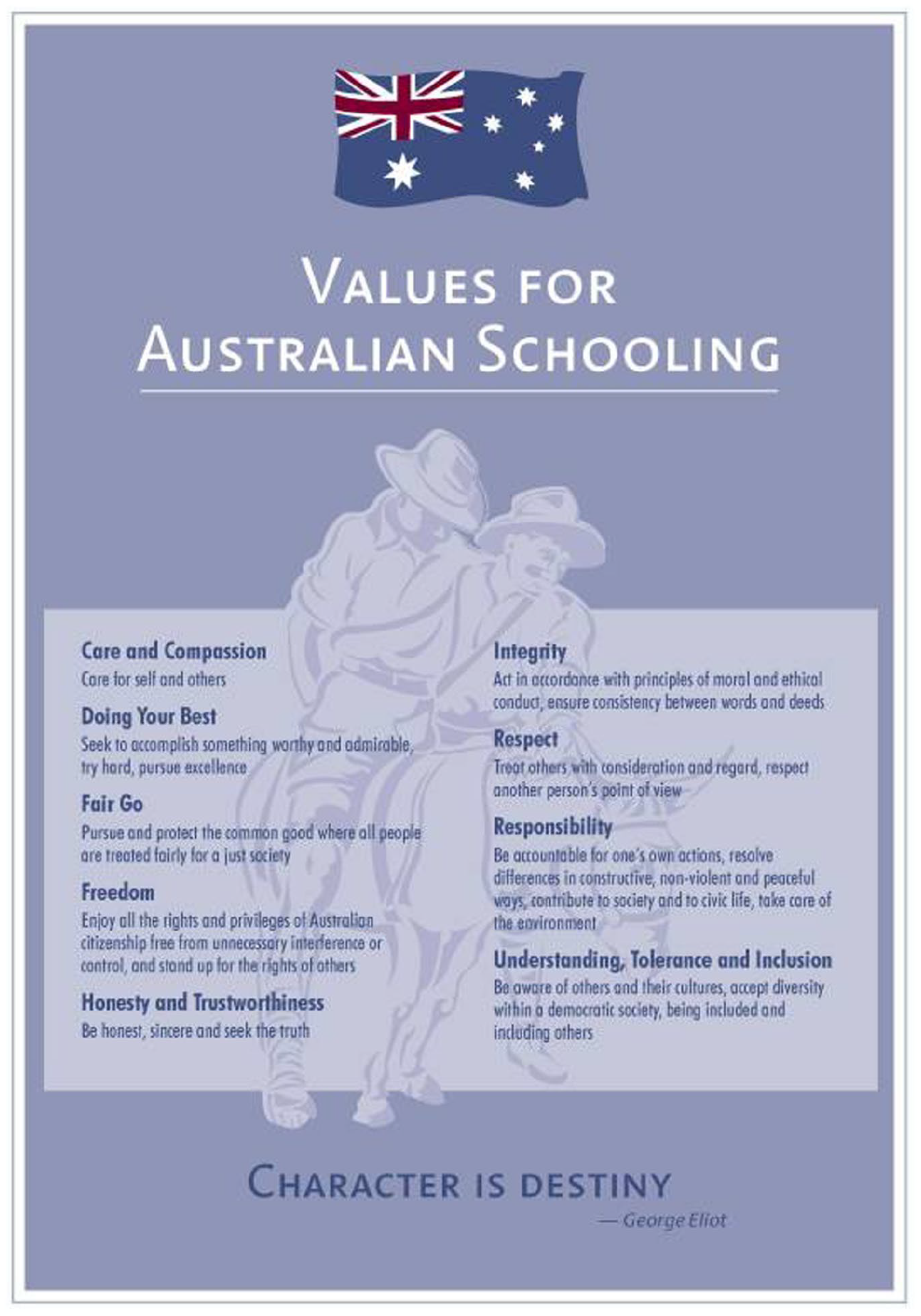
National framework: nine values for Australian schooling. Department of Education, Employment and Workplace Relations, Australian Government.
The Values for Australian Schooling attracted criticism from a range of actors. Some were dismissive of the attempts by the national government to teach values to students, while others argued that the ‘90-year-old imperialist tale of Simpson and his donkey is arguably of marginal relevance in 21st-century Australia, a society that reflects a range of social, political and religious values that inform the sum of its parts’ (The Age, 2005).
Shifting efforts into the terrain of ‘culture wars’, the Howard Government continued to advance its agenda of delivering values that aligned with the Anglosphere in schools. As part of the Values for Australian Schooling programme, the Howard Government provided grants to instal new flagpoles on school grounds to display the Australian flag. This followed a decision of the government to make flying the national flag a condition of federal funding (The Age, 2004). This was in the dual context of the challenge to the global order posed by Al Qaeda and other forms of Islamic fundamentalisms, but also a concurrent sense that the centre-left in the English-speaking world was too sympathetic towards diversity at the expense of values-based unity in each of the Anglosphere countries. The Howard Government maintained its values framework in education until it lost office in 2007.
Conclusion
Contestation over Australian nationhood during the 1990s and 2000s has played an under-researched part in the development of the Anglosphere idea since it (re)emerged on the right wing of politics in the English-speaking democracies during the 2000s. Rather than existing in the realm of think tanks or on the pages of works of political imagination developed in periods of opposition, the practicalities of Australian politics sharpened existing themes and tested them amid the pressures and possibilities of a sustained period of government. Three ‘pillars’ of the Anglosphere imagination can be discerned from this formative period: veneration and defence of forms of representative democracy; the rehabilitation of empire, and war memory advancing and legitimatising the post-Cold War liberal order (inclusive of free markets and free trade). The peculiarity of Australian politics in this sense was the defence of the monarchy as the crucible for arguments about the superiority of Westminster-style democracies. However, with its hybrid Washington-Westminster system, these arguments could be bent to include US forms of government without too much imagination.
Yet the idea is not something that one likes to proclaim openly in public debate. One reason for this is that although supporters claim that the Anglosphere is about language and values that can be shared by anyone and everyone and hence is applicable to societies with citizens from diverse national backgrounds, its historical connections to ideas of empire and the racisms that supported them make it an easy target for opponents. In Australian politics, the relationship between the mainstream centre-right and those from the further right of the spectrum was highlighted when the Liberal-National Coalition government seemingly implemented key One Nation ideas, especially in areas concerning First Nations Australians and border control. The announcement of the AUKUS pact in 2021 underscored the strength of self-perceptions of identity and the Anglosphere lineages that underpin and shape the intersections between foreign and security policies and the contestation of national identity in domestic politics.
It is quite easy to dismiss the Anglosphere as a political fantasy or post facto ordering of the messy reality of overlapping and extant relationships that even involve non-Anglophone partners. The idea of the Anglosphere, however, has impacted Australian politics, especially the way in which Australian conservatives sought to fashion political narratives to advance policy outcomes, not least the Howard Government’s emphasis on the Anzac legend and national values through its civics and citizenship programmes. Debates about national identity and public policy in Australia continue to be intertwined with the importance of the Anglosphere. But beyond this, an examination of the genealogy of the Anglosphere idea in Australian politics shows how the contestation over Australian nationhood helped to shape the Anglosphere idea as it emerged at the turn of the 21st century.
