




Abstract
This article examines governing tactics which, prima facie, seek to remove issues from political contestation, yet utilise democracy in doing so. It explores this tension through the case of the 1973 Northern Ireland border poll. In the context of escalating violence and entrenched political conflict, the Heath government announced the poll alongside direct rule to ‘take the border out of politics’. Although the poll was consistently framed in terms of depoliticisation, it was increasingly viewed by both the government and the public as a means to reassure the unionist community of Northern Ireland’s status in the United Kingdom. This attempt to reassure the unionists exposed the political character of the strategy, strengthening the nationalist boycott campaign. However, this article argues that in reconfiguring legitimacy for the United Kingdom, the poll temporarily defused unionist concerns and allowed the UK government to claim Northern Irish citizens had a democratic right to self-determination.
The 1998 Belfast Good Friday Agreement (GFA) sought to ‘take the border out of politics’ (Gormley-Heenan and Aughey, 2017: 501), crafting political institutions to thaw the constitutional question that had frozen Northern Irish politics for decades. Though the success of the GFA was always contested (Nagle, 2018), the agreement quelled significant dispute around the border until the 2016 EU referendum. Divergent referendum results, between Northern Ireland (NI) and the United Kingdom, and between unionist and nationalist communities, re-politicised the border in multiple and complex ways (Gormley-Heenan and Aughey, 2017). While the 2017 collapse of Stormont arose primarily from the so-called ‘cash-for-ash’ scandal, unresolved disputes over post-Brexit trade reignited entrenched divisions to produce two further years of stalemate from 2020. Alongside demographic shifts and the electoral success of Sinn Féin, in this context, the discretion granted to the UK Secretary of State to call a future border poll has attracted attention, with several studies seriously contemplating the mechanics of reunification referendums (O’Leary, 2022; Renwick and Kelly, 2021). While ratification of the GFA through concurrent votes North and South of the border in May 1998 illustrated the potential of a referendum to facilitate containment of political conflict, the aftermath of 2016 revealed the politicising potential of the device when implemented in different circumstances.
The GFA was the latest in a long line of attempts to depoliticise the border question, with successive UK governments experimenting with constitutional reforms in search of a political solution to conflict in the territory (Bogdanor, 2009; Cochrane, 2021). It was in these terms that Edward Heath first announced the border poll, declaring that a plebiscitary system might serve to take ‘the border out of the day-to-day political scene’. This proposal was couched in terms of the principle of consent, a provision of the 1949 Ireland Act which sought to secure the status of the territory by declaring that no part of NI could be removed from the United Kingdom ‘without the consent’ of the Stormont Parliament. Though this principle ultimately underpinned the path to democratic change, when the border was drawn in 1921, such consent seemed predetermined given the demographic dominance of unionism and unionist parties it enshrined. Held in March 1973, the poll asked voters registered in NI whether they preferred to remain within the United Kingdom or to form a united Ireland. On a turnout of 58.7%, 98.9% of voters backed remaining within the United Kingdom and 1.1% joining with the Republic (Independent Commission on Referendums (ICR), 2018). Given the likelihood of a unionist victory, the nationalists organised a successful boycott campaign to undermine the poll’s legitimacy (Torrance, 2019).
The poll was announced a year prior, in March 1972, two months after Bloody Sunday, 1 as part of a wider political initiative which included prorogation of Stormont, imposition of direct rule and a gradual phasing out of internment. 2 Given that it was the first time in over 50 years the UK government had assumed full legislative responsibility for the territory, that 1972 turned out to be the bloodiest year of the conflict and that the poll was deemed a foregone conclusion, it is perhaps understandable that the literature tends to view it as an historical footnote. 3 In both scholarship and contemporaneous press reports, it has been branded an ‘artificial’ and ‘futile’ exercise (Lawrence and Elliott, 1975; Rose, 1976; Tonge, 2000: 45), even a ‘fiasco’ (Qvortrup, 2006: 69). Other accounts – some of which highlight its significance as the first government-initiated referendum in the United Kingdom – explore why the poll was held. The consensus suggests instigation of regular referendums provided an alternative means for the UK government to enact the principle of consent following the suspension of Stormont, assuring the unionists and protecting the status quo (Balsom, 1996; Bogdanor, 1981: 62–64; Lawrence and Elliott, 1975: 1–3). In his memoir, Heath (1999: 543) echoed these sentiments, suggesting a direct vote was used ‘only because’ Stormont had been suspended.
This article does not contest that some combination of these factors influenced the decision to hold the poll. However, it analyses the interplay – and resulting tensions – of the pledge to remove the border from ‘the day-to-day political scene’ and the role of the vote in reassuring the unionist community. In taking the former motivation seriously, it explores the depoliticising potential of the border poll as a part of the Heath government’s thinking. Cognisant of the unique context of NI, it reveals how UK government actors utilised contestation around different conceptions of democracy to frame the border poll as depoliticising tactic, despite growing claims of illegitimacy from the nationalists. Drawing on extensive archival research, the article thus offers the first detailed empirical account of the 1973 border poll, an episode often omitted from the study of NI politics.
Section 1 situates the analysis within the (de)politicisation literature, focusing on scholarship which emphasises the inherently political character of depoliticisation and the relationship between (de)politicisation and democracy. It then addresses how these conceptual dynamics apply to the political context of NI. Section 2 constitutes the empirical analysis, composed of three arguments. First, the article argues that depoliticisation was a consistent motivation behind the poll. Initially it was conceived as a means of outsourcing the constitutional question to the electorate to ‘normalise’ Stormont elections. As the second argument outlines, however, in the context of direct rule the UK government shifted the depoliticising remit of the poll to defusing unionist pressures, exposing the political character of the strategy and strengthening the nationalist boycott campaign. The final argument contests characterisations of the poll as ‘futile’, identifying how it temporarily defused unionist concerns and allowed the UK government to propagate the claim that NI citizens had the democratic right to self-determination. The article concludes by reflecting on some implications of this analysis for future constitutional referendums on the island of Ireland.
(De)politicisation and democracy
The political character of (de)politicisation
In a standout contribution to the literature on depoliticisation as a mode of governance, Peter Burnham (2001: 131) defines it as a strategy which seeks to ‘place at one remove the political character of decision-making’. Building on Jim Bulpitt’s (1996) concept of ‘Court statecraft’ – the notion that rational politicians prioritise ‘crude, subsistence-level objectives’ to maintain office – Burnham (2001, 2014) produced a body of work analysing how the politics of depoliticisation provide an effective toolkit for meeting such objectives, whether in terms of enhancing economic credibility, policymaking autonomy and/or electoral standing. Subsequent scholarship in this vein delineated the variety of techniques politicians might employ in this pursuit. Based on the identification of institutional, rule-based and preference-shaping tactics (Flinders and Buller, 2006), empirical work has traced deployment of depoliticised governing across multi-level structures and through the concept of meta-governance (e.g. Fawcett et al., 2017; Reardon and Marsden, 2020).
Following Burnham’s initial contribution, however, extensive debate emerged around the conceptualisation of the political behind this definition. As noted by Flinders and Buller (2006: 296), for Burnham, depoliticisation is a ‘misnomer’ in that ‘the politics remains but the arena or process through which decisions are taken is altered’. Burnham’s (2001: 136) framework is thus predicated on the inherently political character of the process. This observation sparked exploration of the paradoxical politics of depoliticisation as well as counter-processes of politicisation in the literature. Hay’s Why We Hate Politics provided one of the first sustained analyses. Grounded in an ostensibly ‘inclusive’ definition of politics as ‘the realm of contingency and deliberation’, this account set out a broader conceptualisation of depoliticisation which sought to move beyond the ‘governmental’ sphere, towards the societal and discursive (Beveridge, 2017; Hay, 2007: Ch. 2; Jenkins, 2011). This debate produced many insightful contributions, providing the foundations for more recent accounts which move beyond the characterisation of politicisation and depoliticisation as binary processes and instead foreground their interconnection (hence (de)politicisation) (Bates et al., 2014; Buller et al., 2019; Burnham, 2006).
As Diamond (2015) and others have noted, an awareness of the interconnected nature of (de)politicisation is particularly pertinent to the UK context where ideas of ‘strong, decisive government’ associated with the political constitution and Westminster Model (WM) dominate. Strategies seeking to ‘offload responsibility’ seem incongruous in this context, leading to the emergence of ‘hybrid’ forms of statecraft, in which depoliticised and politicised elements coexist as a ‘duality’ which can either be complimentary or conflictual (Diamond, 2015: 430; on the former, see Sandford, 2024). This observation links back to Burnham’s (2006: 305) emphasis on the political character of depoliticisation, which notes that while one mode may dominate in a particular governing paradigm, 4 to analyse (de)politicisation is to analyse the ‘contradictions and tensions’ arising from the interplay between politicised and depoliticised elements ‘within a governing regime’. This dynamic is critical in empirical studies which attempt to evaluate the complexities and ‘unpredictability of the politicisation-depoliticisation dynamic in practice’ (Warner and Luke, 2023: 368).
Dedemocratisation, deliberation and the depoliticising referendum
Alongside the expansion of depoliticisation scholarship, many authors heralded the arrival of a ‘post-political’ or ‘post-democratic’ era in the context of growing political disaffection and the ‘end of history’ (Crouch, 2004; Mouffe, 2005; Rancière, 1999). A further contribution of Hay’s work was to bring the emerging literature on depoliticisation into conversation with this scholarship on ‘anti-politics’. Hay argued that, particularly due to the influence of Burnham’s (2014: 196) conception of the political associated with the state, depoliticisation as statecraft came to be viewed in ‘normatively dubious’ terms in scholarly accounts as it entailed the denial of democracy and/or politics by those in power, embedding a sense of inevitability and furthering disaffection among citizens (Hay, 2007: 92, 2014: 303; Mair, 2013). This assessment of depoliticisation as an anti-democratic phenomenon seemingly lay at the heart of the critical academic disposition. Hay (2007: 92 italics added) thus characterised the critique: ‘Depoliticization . . . serves to insulate politicians and their choices, immunizing them from responsibility [and] accountability . . . It is a disavowal of the democratic obligations of a government to its citizens in a democratic polity’.
Here we encounter another paradox of the politics of depoliticisation. While the academic literature largely views such governing tactics as anti-democratic, both in how policy areas are insulated from contestation and how politicians’ disavowal of responsibility feeds anti-political sentiment, politicians themselves have often framed depoliticising measures in terms of enhancing democracy and participation (see Hay, 2007: 90–95; also, Wood and Flinders, 2014: 135). Independent of context, this tension seems particularly pertinent to the case of the border poll, as it raises the question of how the decision to implement a direct democratic vote, which ostensibly politicises a particular question through democratisation, can have depoliticising effects? The poll was explicitly couched in these terms, with Heath suggesting that removing the border issue from day-to-day politics would bring ‘stability’ and create a more ‘flexible’ political structure.
Three reasons why politicians might present measures which ostensibly deny their democratic responsibility in ‘the language of inclusiveness, democratisation and empowerment’ can be gleaned from the literature (Burnham, 2001: 129; also see Jenkins, 2011: 156). The first and most straightforward relates to Hay’s (2014: 299) point that ‘there is a discursive component to all depoliticisations’. New Labour Minister Charlie Falconer’s claim that depoliticisation is ‘a vital element in bringing power closer to the people’ as it ‘place[s] power not with politicians, but with those best fitted in different ways to deploy it’ (Falconer, cited in Flinders and Buller, 2006: 312) encapsulates how discursive tactics operate alongside institutional reforms to legitimise depoliticisation strategies. To take the example of Bank of England independence, the decision is presented as democratising even though it places responsibility for monetary policy at one remove from the democratically accountable.
The second stems from contributions to the (de)politicisation literature from deliberative democratic theory, especially Pettit (2004) and Landwehr (2017). To prevent decisions deemed inconsistent with the principles of epistemic democracy, such as impartiality and sound reasoning, Pettit (2004: 62–63) argues that depoliticisation via ‘constitutional constraints, consultative procedures and arm’s length appointments’, including deliberative forums, reduce the ‘contestatory burden’ on public deliberation and facilitate realisation of the common good. As noted by Landwehr (2017: 53–55), this account not only advocates various tools of governmental depoliticisation to enhance deliberation but also implies a wider depoliticising logic through the notion that ‘good’ decisions are more likely when decision-making is separated from the inherent conflicts which characterise majoritarian institutions and the electorate. The elitist and quasi-technocratic rationale of deliberation – that such decisions are free from sectional interests and popular passions – thus aligns with endorsements of depoliticising reforms by politicians claiming to seek better decision-making (Urbinati, 2014: 118). 5 Contrasts might be drawn here between recent deployment of deliberative assemblies in the Republic of Ireland (RoI), largely viewed as meaningful participatory exercises (Courant, 2021), and those in Macron’s France, perceived as a mechanism to depoliticise protest movements (Ehs and Mokre, 2021).
Finally, and most pertinently in relation to the border poll, other scholarship on the New Labour era has viewed the use of referendums as consistent with depoliticised statecraft. Specifically, Gifford and Wellings (2018: 275) note how Labour’s deployment of direct democracy was ‘far from politicising’ in that it sought to eschew left–right party divides and ‘remove partisan politics from the decision-making process’, developing ‘stable governing positions’ upon which popular consent could be built. Similarly, in a comparative study of discretionary commitments to EU referendums, Oppermann (2013) identifies the ‘ideal type’ of the ‘depoliticising referendum’. From a sample of five UK pledges, Oppermann (2013: 689) suggests all fit the ‘depoliticising’ type, motivated by ‘domestic’ and ‘defensive’ reasons in seeking to ‘unburden governments from the making and defending of contentious decisions and to shield them from the eventual political fallout from such decisions’ (also see Qvortrup, 2006). While Oppermann (2013: 686) notes depoliticising effects are likely strongest in cases where votes are not held due to the risk of defeat, introduction of the concept of the ‘depoliticising referendum’ allows for more detailed analysis of how direct democracy might be deployed in a depoliticising manner, from the initial announcement or pledge through to implementation and outcome.
In this light, a more nuanced conceptualisation of the relationship between (de)politicisation and democracy emerges. Discursively, different conceptions of democracy can be framed and utilised by politicians to legitimise certain decisions and foreclose debate around contentious issues. Where deliberative theory circumvents political conflict through democratic innovations and institutional reforms, direct democracy similarly bypasses the partisanship associated with traditional institutions of party democracy. Focusing specifically on the referendum, this (re)conceptualisation facilitates a perspective whereby deployment enables the depoliticisation of decision-making itself, reframing and outsourcing a decision from the majoritarian institutions of parliament or the executive to the public (see Trueblood, 2022). Importantly, this outsourcing involves only temporary displacement of the political character of the decision and the attendant politicisation of the public realm to some degree, creating opportunities for popular resistance (Hay, 2007: 84). This reconceptualisation allows for more detailed empirical exploration of the paradoxes of (de)politicisation and how interconnected processes of depoliticisation and politicisation transpire temporally throughout implementation (Warner and Luke, 2023; Wolf and Dooren, 2018).
(De)politicisation and the Northern Ireland border poll
Given the unique circumstances of Northern Ireland, it is essential to consider whether and how the conceptual dynamics of (de)politicisation apply to the case. As summarised by Cochrane (2021: 1–6; also, Finn, 2021: 3), the ‘centuries of division’ which characterise NI’s history have contributed to a broad and more ‘fluid’ understanding of politics in the territory, shaped by a distinctive combination of informal community relations and formal institutions. Examining how these historical forces have influenced the political context, Richard Bourke (2012: 18) argues the conflict might be understood as an outgrowth of competing definitions of democracy and how the ‘democratic expectation of political equality was thwarted by the mechanisms of democratic government’. The deliberate entrenchment of a unionist majority in the drawing of the border, institutionalised via Stormont in the 1949 Ireland Act, ensured the protection of ‘a sectional interest in what might be called a ‘majority state’’ (Bourke, 2012: 20). This conflation of majoritarianism and democracy triggered successive majoritarian claims to democratic legitimacy, with nationalists countering the unionist dominance of the ‘six counties’ by claiming the island of Ireland as their legitimate demos (Wellings and Vines, 2016: 313).
The implications of this context and the border poll within it in terms of the politics of (de)politicisation are twofold. First, it is important to note that regardless of whether the UK government presented the poll as depoliticising, such a claim would always be viewed with scepticism by the nationalist community given the in-built unionist majority. The intensely politicised context and the spiral of conflict in the early 1970s ensured that even if the UK government genuinely viewed the device as a means to defuse tensions, the political character of the strategy was acutely vulnerable to exposure. The specifics of the case therefore speak to the difficulties any government might face in controlling the political agenda and the success of depoliticised tactics (Daly, 2020; Hay, 2007: 74), but also to how the nationalist community capitalised on the poll to resist the status quo, politicising the poll through the boycott campaign. In this sense, the example speaks to recent developments in the (de)politicisation literature regarding examples of politicisation as resistance, in the realm of industrial relations and elsewhere (Buller et al., 2019; Warner, 2019).
Second, while introduction of a direct vote provided nationalists with the opportunity to politicise the poll through the boycott, it simultaneously allowed the UK government to propagate the claim that NI citizens had the democratic right to self-determination. As the motivation to reassure the unionist community under direct rule became more prominent in the UK government’s thinking, this aim was integrated into the prior depoliticising rationale for the poll. This was evident from how the government: (1) emphasised how the border poll could provide an assurance to unionists that appeared more effective than the 1949 Ireland Act and (2) utilised contestation around different conceptions of democracy to frame the border poll as enabling direct expression of NI’s democratic will (Bourke, 2012: 206). In this sense, the poll constituted an attempt by the British state to maintain an arm’s length relationship with the territory despite instigation of direct rule (Bew and Patterson, 1985: 20; Rose, 1982: 122). Although neutrality on the constitutional position of NI was impossible for the UK government (O’Leary, 2019: 43), use of a direct vote allowed it to renew its claim to be a ‘neutral actor’ facilitating ‘local wishes rather than as a participant in the conflict’ (Mac Ginty et al., 2001: 478). Indeed, it was along these lines that Social Democratic and Labour Party (SDLP) politician, John Hume, first articulated the case for a direct vote in the late 1960s (McLoughlin, 2006). The British state thus reframed the discourse of legitimacy for the United Kingdom in Britain and internationally, while also paving the way to the nascent power-sharing proposals of the Sunningdale Agreement. 6
The Heath government, the border poll and the ‘post-political’ initiative
The empirical analysis is guided by two questions: (1) why did the Heath government decide to hold a border poll? (2) how can the decision to implement a direct democratic vote have depoliticising effects? Three arguments are outlined below in response to these questions, corroborated by analysis of an extensive sample of primary documents from The National Archives (UK). Primary documents were scanned with mobile application Adobe Scan which is equipped with optical character recognition to facilitate more efficient storage and analysis in NVivo (12-14). Informed by Franzosi’s (2006: 444) approach to archival research as ‘detective work’, certain themes were deduced from theoretical and secondary literature to produce leads to guide data collection, while others emerged inductively during the process. An iterative thematic coding approach was used for analysis, with codes revised, refined and sidelined as I became familiar with the data and clarified central themes and attendant sub-themes. Data were then triangulated with secondary material from memoirs, contemporaneous newspaper reports and the extant literature (Robson and McCartan, 2016: 474–476).
Depoliticisation as an objective
It was in the final throes of the first Wilson administration (1964–70) that the possibility of a referendum on the Irish border was first considered by the British state. These discussions were influenced by two sources. One was a House of Lords debate, in which Lord John Monson suggested modifying the 1949 Act to include a referendum before any constitutional change were to happen. Given disparities between Catholic and Protestant birth rates, Monson suggested that any such vote should stipulate a majority threshold for change of ‘two . . . or three to one’ to assure unionists ‘that their future and . . . way of life was not preserved for a mere decade but for generations to come’. 7 Another was the independent nationalist and later SDLP politician, John Hume. As opposed to nationalist orthodoxy, which saw the British imperialist presence in NI as the greatest barrier to reunification, Hume suggested that the nationalist cause should refocus its attention onto the people of NI (Murray, 2021; White, 1984: 74). This pledge was translated into a more concrete proposal in a November 1969 speech in Derry, in which Hume noted a nascent consensus around the need for consent for any change in the constitutional status and suggested ‘the constitutional question should be taken out of politics by having a periodic referendum on it, so that elections could be real elections based on real political issues’ (McLoughlin, 2006: 164–165). From an early stage, therefore, the case for a border poll to reassure the unionist community and to depoliticise the constitutional question had both been made separately. 8
Hume’s framing of the proposal as a means to ‘take the border out of politics’ made an impression on Home Office thinking, with the NI diplomatic representative writing to the department to record the novelty of this rationale. 9 While an official report provided a favourable assessment of Hume’s proposal on the grounds that a direct vote ‘might lift the question out of the realm of Parliamentary dispute’ which had long-mired NI politics, 10 fears that a referendum would fail to achieve its stated objective and precipitate pressures for votes on other constitutional matters across the United Kingdom weighed against it. The report voiced scepticism about amending the parliamentary principle of consent contained in the 1949 Ireland Act due to the ‘mystical aura’ with which unionists viewed the provision. Another assessment suggested that while constitutional objections to the referendum were surmountable, the prospects of such a mechanism ‘remov[ing] partition from day-to-day politics were unsatisfactory’. 11 Despite the ‘conclusive arguments against’, therefore, the potential for a border poll to defuse political tensions and facilitate a more functional political context was viewed as a clear merit of the strategy from these first internal discussions.
From the outset of the Heath administration, a more concerted effort was made to consider constitutional proposals on the grounds that anything other than a ‘fresh political initiative’ would have ‘grave’ consequences for NI. 12 Though such an initiative was deemed ‘almost impossible’ to imagine, a study group on longer-term prospects concluded this work should be developed under the rubric of contingency planning, particularly in circumstances where ‘HMG . . . were compelled to introduce direct rule’. 13 The prospect of direct rule, which was an IRA objective and thus anathema to unionists, underpinned the political upheaval of early 1971. Seeking to bolster ‘Stormont’s role in security policy’ (Patterson, 2007: 220), new PM Brian Faulkner pressed the UK government to introduce internment without trial that August, 14 which exacerbated community tensions and produced a surge in violence. Internment renewed the urgency for political alternatives which might rebuild trust with the nationalists. 15 In this context, Home Secretary Maudling sought to negotiate with all NI political parties on an ‘active, permanent and guaranteed’ role for the Catholic minority (Baston, 2004: 378). While Faulkner initially objected on the grounds that any such proposal threatened the ‘democratic principle of majority rule’ – the unionist orthodoxy at the time – the UK government pressed the need for such measures if direct rule or tripartite solutions with the Republic were to be avoided. 16
The referendum idea had remained in the policymaking ether through the work of the Royal Commission on the Constitution. 17 While reservations were expressed about Hume’s idea for periodic votes, deemed to imply a ‘more positive instrument for change’ than the purely ‘defensive’ mechanism of the 1949 Act, substitution of the 1949 Act for a referendum was deemed to merit ‘serious consideration’ given its potential to defuse the border issue. 18 In the post-internment context, several sources reached for the idea on some combination of these grounds. With wider constitutional proposals being drawn up in both Stormont and Whitehall, Cabinet Secretary Burke Trend considered whether a border poll alongside the 1949 Act could make incorporation of non-militant republicans into the NI government ‘more palatable’ to the unionists by assuring them there would be ‘no change in the border without a referendum’. 19 Bew (2007: 504–505) notes how, as part of wider government thinking in rebuilding trust with the nationalists, the device also kept open the possibility of a united Ireland ‘some time in the future’.
Similarly, Maudling’s negotiations on an ‘active, permanent and guaranteed’ minority role produced a new team of officials dedicated to long-term political planning.
20
Maudling’s request for ‘ideas on how to get “the Border into Baulk”’ produced the first comprehensive official assessment of how a referendum might help to ‘insulate the Border problem and at the same time erode the rigid party structure’.
21
Assuming direct rule would disable operation of the principle of consent via Stormont, official Kelvin White noted that the ‘obligation to consult the wishes of the majority . . . will presumably remain’. He went on to suggest: Assuming . . . we judge the imposition of Direct Rule to be all that the Protestant majority could possibly swallow, and that to couple it with any avowed move towards a united Ireland would increase the risk of a Protestant backlash, some method of isolating ‘the Border’ from the political situation would have to be found.
In conjunction with the announcement of alternative administrative arrangements, White suggested that ‘HMG should announce that the constitutional status of NI as part of the UK should be the subject of a 5-yearly (or 10-yearly) referendum, open to all the electorate of NI’ which ‘should
This assessment was instrumental in precipitating inclusion of a referendum within the wider initiative, with officials becoming increasingly interested in the idea. 23 In the week that followed, the relevant official and ministerial committees both featured discussion of the referendum as a serious option, 24 with official Philip Allen endorsing the device as a means to remove the ‘question of unification from day-to-day politics’. 25 The prospect of direct rule was thus a crucial factor in the government’s thinking that an additional mechanism would be required to reassure the unionist community. As the above evidence suggests, however, this objective was integrated into the initial depoliticising rationale – that the poll might outsource the decision on the border question from NI representatives to voters and refocus Stormont elections onto other issues. 26 Though entanglement of these objectives would expose the political character of the strategy, strengthening the nationalist boycott campaign, it also modified the depoliticising remit of the device in that it now sought to defuse unionist concerns.
In a subsequent memorandum setting out NI policy for 1972, Maudling identified three objectives: (1) reassurance about the border; (2) a change in the composition of government; and (3) a redefinition of the powers of government. 27 On the first of these, he conceded that the Protestant community could not have an assurance more effective than the 1949 Act. However, his belief that unionists were ‘pathologically afraid’ of the border’s disappearance led him to see the merits of an ‘an assurance that looks more effective’. To place the border in ‘baulk for a generation’, therefore, he agreed the government should legislate such that no change in the border take place ‘unless authorised by a simple majority in a general plebiscite, that the first such plebiscite should be held after 15 or 20 years, and further plebiscites at 10-year intervals’. 28 In this context, depoliticisation and unionist reassurance were seen as one and the same. The outcome of a border poll was so clearly predetermined as to provide additional reassurance to the unionist community. In framing this reassurance as cosmetic, however, Maudling also endorsed the device in discursively depoliticising terms: as a mechanism which appeared more effective to alter public expectations.
The events of Bloody Sunday both pressed the need for alternative constitutional arrangements and narrowed ‘the range of political possibilities’.
29
Despite ‘major political risks’, in early February 1972, Cabinet agreed the plan with Heath endorsing the border poll on the grounds that it ‘might remove the emotive subject of the border from the centre of Northern Ireland politics’.
30
During the ultimately futile attempts to bring the NI government on side, the government acceded to Faulkner’s request that the first vote ‘not be indefinitely delayed’, but resisted demands for thresholds to further skew the outcome in favour of the status quo.
31
The depoliticising dimension remained a consistent and critical driver of the decision, with Maudling insisting the ‘referendum system’ itself would place the ‘problem of the Border in cold storage’.
32
Following the resignation of Faulkner’s Cabinet, however, the need to defuse unionist concerns was reconciled with the wider rationale for the poll, and thoughts turned to how the Foreign Office might capitalise on the initiative. It was noted that the ‘post-political’ framing should be emphasised in future Anglo-Irish relations, with the referendum providing a ‘safeguard’ for co-operation and ‘legitimate political aspirations’ regarding the border question.
33
Over a year later, after the poll had been held, Heath restated this post-political framing in negotiations with the incoming Taoiseach (Prime Minister) Liam Cosgrave: ‘. . . if the border could be taken out of politics, a more normal political structure could evolve, in which the parties would argue about everyday issues, for example, education or industrial policy. Although some claimed that the result of the border poll was a foregone conclusion, this did not invalidate its purpose’.
34
Mitigating the boycott and reassuring the unionists
On 24 March 1972, Edward Heath announced that a series of radical measures had been put the NI government to break the ‘deadlock’ of Northern Irish politics. The initiative comprised the gradual phasing out of internment, the transfer of law and order to Westminster and a plan for ‘periodic plebiscites’. The latter was framed in terms of two key objectives: In the hope of taking the border out of the day-to-day political scene, and as a reassurance that there would be no change in the border without the consent of a majority of the people of Northern Ireland, we proposed periodic plebiscites on this issue.
35
As the NI Cabinet had unanimously resigned in objection to the proposals, especially the transfer of law and order (Faulkner, 1978: 154–155), Heath said that the government had ‘no alternative’ but to assume ‘full and direct responsibility for the administration of Northern Ireland’. He recalled the commitment of successive administrations not to change the position of NI ‘without the consent of the people’ and presented the ‘system of regular plebiscites’ as consistent with this commitment.
36
Although in practice the Stormont Parliament would never reconvene, Heath stressed that the votes would be ‘in addition’ to the 1949 Ireland Act, implying that the suspension of Stormont was ‘temporary’ and the requirement for parliamentary consent for constitutional change would remain: This position is not prejudiced by the temporary prorogation of that Parliament . . . this arrangement, while leaving open the possibility of a change in the status of the province if the majority so wish, will both confirm that no such change will be made without their consent and provide, in the intervals between plebiscites, a greater measure of stability in the political life of Northern Ireland’.
37
Though the assurance to the unionists was cloaked in the language of the principle of consent, the rationale to defuse the border issue in day-to-day politics remained central to government framing of the policy, alongside the hope that periodic votes would stabilise politics in NI.
The initial response of the nationalist community to Heath’s proposals was mixed, with the more moderate elements – including the RoI government – more receptive.
38
However, entanglement of the government’s aims for the poll to remove the border issue from day-to-day politics and reassure the unionist community raised questions from officials, not least regarding the possibility of a nationalist boycott. Trend voiced scepticism as to whether the government should proceed with the plebiscites as they might be deemed a ‘“bonus” for the Protestants’
39
given the conflation of majoritarianism and democracy inherent in NI’s conception. Indeed, it was based on the latter point that Maudling viewed the poll as an assurance that might appear more effective to the unionists. Moreover, the impression that NI Secretary Willie Whitelaw consistently yielded to pressure from Faulkner for a quick poll undermined the potential of the device to seriously defuse the border question. As one official noted: The aim of the plebiscite, as I understand it, is to offer the Protestants some reassurance, to offer Roman Catholics some ‘light at the end of the tunnel’, and with luck to take the Border issue out of party politics. These aims will not be served if the date of our first plebiscite is fixed to meet the demands of the Protestant community only.
40
Navigating implementation of the poll in this contradictory context, therefore, involved balancing unionist reassurance while attempting to ensure the nationalists remained engaged with the prospect of a peaceful, democratic path to reunification. 41
As complications grew around timing and implementation, it became clear that maintaining the nationalist participation required to fulfil the aim of removing the border from NI politics was irreconcilable with prioritising unionist reassurance. Early official discussions stipulated any measures in the initiative should be ‘hardly possible for the minority . . . to boycott’. 42 Given the haste with which the final measures were decided, however, it was only after Heath’s announcement that draftsmen noted how important it was for the vote to engage with, and be accepted by, both communities to achieve its aims. 43 In a context where boycotting was long established as a form of nationalist protest (Cooley, 2024) and prominent southern politicians increasingly stressed reservations about a binary poll, 44 support for a boycott grew. Across the spectrum of nationalism, from armed resistance to constitutionalist advocates, contestation over the constituency for the vote lay at the heart of this campaign (see Figure 1). 45 Underpinned by the view that the vote was a foregone conclusion and might exacerbate sectarianism, Taoiseach Jack Lynch argued the measure was not ‘realistic politics in terms of Anglo-Irish relations’. As pressure built for a concurrent vote in the RoI, officials questioned whether a referendum restricted to the NI electorate would be deemed legitimate. 46 Heath was perceived to have built good faith with the nationalist community ‘for the first time in history’, and it was feared the border poll might jeopardise this work. 47

Official republican movement campaign literature (https://irishelectionliterature.com/?s=border+poll). Reproduced with permission.
The UK government’s response to controversy over the question illustrates both the politicisation of border poll implementation and efforts to mitigate it. Officials concluded early on that for a referendum to have any chance of defusing the border question, then it should be ‘formulated as to present clear and comprehensive alternatives’, meaning ‘the status quo on one hand or a specified change on the other’. This raised a further problem as negotiations with the Irish government were necessary to develop an alternative, which alongside a guarantee of implementation, might be viewed as ‘improper’ by the unionists. 48 The government’s prioritisation of the Darlington Conference was partly an attempt to address this dilemma, in the hope it would facilitate constructive discussions and underpin Green and White Paper(s) to act as a ‘blueprint’ for a new model of governance in advance of the border poll. 49 However, the souring of UK government–nationalist relations since internment led the SDLP and John Hume – a pioneer of the border poll idea – to, somewhat portentously, boycott the conference (cain.ulster.ac.uk, 2023). The subsequent Green Paper conceded that no concrete proposals had been developed, confirming that the poll would merely decide on the principle of union and if the result was a vote for Irish unification, then there was a recognition that ‘a lengthy process of discussion and negotiation would inevitably follow’ (NIO, 1972).
In lieu of such proposals, officials looked to the example of the 1967 Gibraltar referendum 50 in drafting the question. The ‘either-or’ model required the electorate to affirmatively choose either a UK or united Ireland option, meaning that any determination to boycott among the nationalists would simply reduce the ‘percentage of votes cast for the Republicans’, 51 weakening their case and potentially reducing its likelihood and effectiveness. 52 In this sense, management of the question to neutralise nationalist resistance and reassert the depoliticising potential of the poll was in accordance with the earliest official assessments of a boycott, that such a measure that would only ‘damage . . . instigators and bring advantage(s) . . . to their opponents’. 53
Though contestation around the question illustrates how implementation of the poll was politicised as a form of resistance by the nationalist community, it also speaks to the government’s determination to reorient its depoliticising potential. In the context of direct rule, this priority shifted to provide unionist reassurance. Though the UK government instigated the referendum to ostensibly outsource the decision regarding the Irish border from Stormont to the electorate, any potential to depoliticise the border question was hamstrung by the conflation of majoritarianism and democracy inherent in the creation of NI. In this vein, the UK government refused requests from both Lynch’s government and Fine Gael leader Liam Cosgrave – as well as the SDLP in the north (White, 1984: 138) – to include a more constructive ballot option based on the Green Paper on the grounds that it would ‘water down’ the outcome and ‘lessen the reassurance’ provided to ‘the Protestants’. 54 To successfully defuse the border issue, it was now argued, the result had to be ‘clear beyond all doubt’. 55
Reconfiguring legitimacy: Direct expression of NI’s ‘democratic will’
As legislation was drafted and the Border Poll Bill introduced to Parliament, several final decisions were made on logistics and organisation. Ministers ultimately retreated from including provision for votes at ‘regular intervals’, deterred by the contention surrounding periodic votes in the parliamentary debate, 56 as well as the prospect of (self)imposing a legislative obligation ‘which ten or fifteen years hence they may regret’. 57 Though a provision for 10-year intervals was added to the subsequent Northern Ireland Constitution Act (NICA), the reluctance of ministers to tie their hands on future polls arguably foretold the ‘unrestricted discretion’ which the GFA and Northern Ireland Act 1998 granted to the Secretary of State to determine the date of any future poll (Murray, 2021: 117). The proposal for periodic plebiscites to provide an interim ’moratorium’ on the border question had been central to the depoliticising potential of the strategy since Hume’s initial formulation. 58 However, different intervals – of 5, 10, 15, or 20 years – were mooted by officials and ministers all the way up to the drafting of the NICA, indicating the lack of a clear rationale for the time frame. 59
The Bill received Royal Assent and passed onto the statute book on 7 December 1972, a week before Whitelaw announced the polling date of 8 March. Whitelaw had consistently pushed for a poll at ‘the earliest practicable moment’. 60 This became a source of internal consternation, as although a bespoke Electoral Commission had been appointed to organise and expedite the vote, officials worried delays would expose them to unionist accusations that the poll had been ‘suborned by some Popish plot’ rather than in accordance with independent advice. 61 These tensions were bound up with ambiguity over the sequencing of the border poll and the White Paper which presaged the power-sharing measures in the NICA and the Sunningdale Agreement (UK Government, 1973). Whitelaw’s announcement neglected to mention whether the White Paper – crucial to maintaining nationalist engagement – would precede or follow the poll, not only increasing tension between the UK government and nationalists but also between the government and opposition at Westminster (Torrance, 2019). This tied into security concerns, which noted that as the unionists would discover they ‘have to swallow a lot’ following publication of the White Paper, greater military reinforcements would likely be required to counter the unionist response than to deal with nationalist mobilisations around the border poll. 62 In scheduling the border poll before the White Paper, therefore, the UK government again tacitly acknowledged the collateral of prioritising unionist reassurance – and not provoking further unionist unrest (see Bennett, 2023) – was nationalist engagement, initially identified as necessary to any prospect of the poll defusing the border in NI politics.
The NI (Border Poll) Order, made on 24 January 1973, confirmed the date and the two options on the ballot (see Figure 2). The nationalist boycott campaign was effective, with a subsequent parliamentary paper noting ‘throughout the day there were consistent reports of heavy polling in Protestant areas and virtual inactivity in Roman Catholic areas’ (Lawrence and Elliott, 1975: 24). This resulted in less than 1% turnout in the nationalist population, with the results skewed in the unionists’ favour: 591,280 votes for the United Kingdom (98.9%); 6423 votes for the Republic of Ireland (1.1%). 63 The result created a lasting impression of the futility of the poll in that ‘pro-unionists were pleased with their turnout (57%) and . . . anti-partitionists were equally pleased with their boycott’ (Lawrence and Elliott, 1975: 29). Indeed, despite Faulkner’s initial ambivalence towards the poll following Stormont’s suspension, which he thought could ‘only be unsatisfactory’, 64 unionists organised to maximise turnout and attain a conclusive result, demonstrating their ongoing anxiety around reunification (see Figure 3).
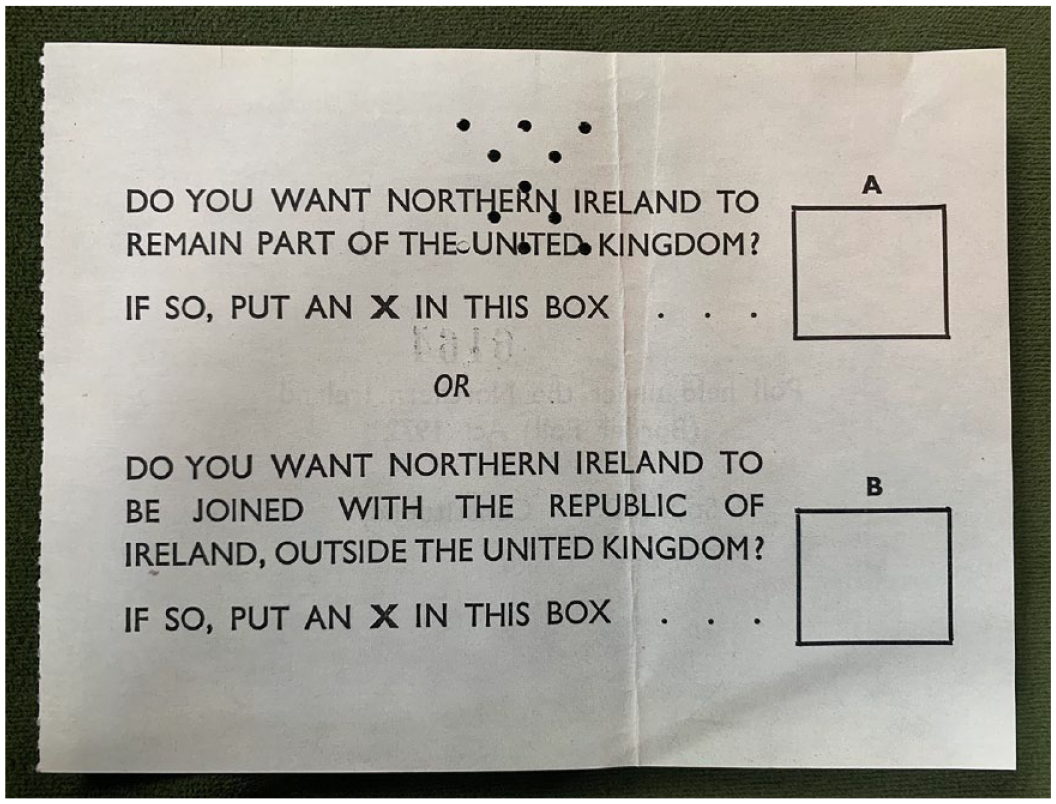
Postal ballot paper. Reproduced with permission.
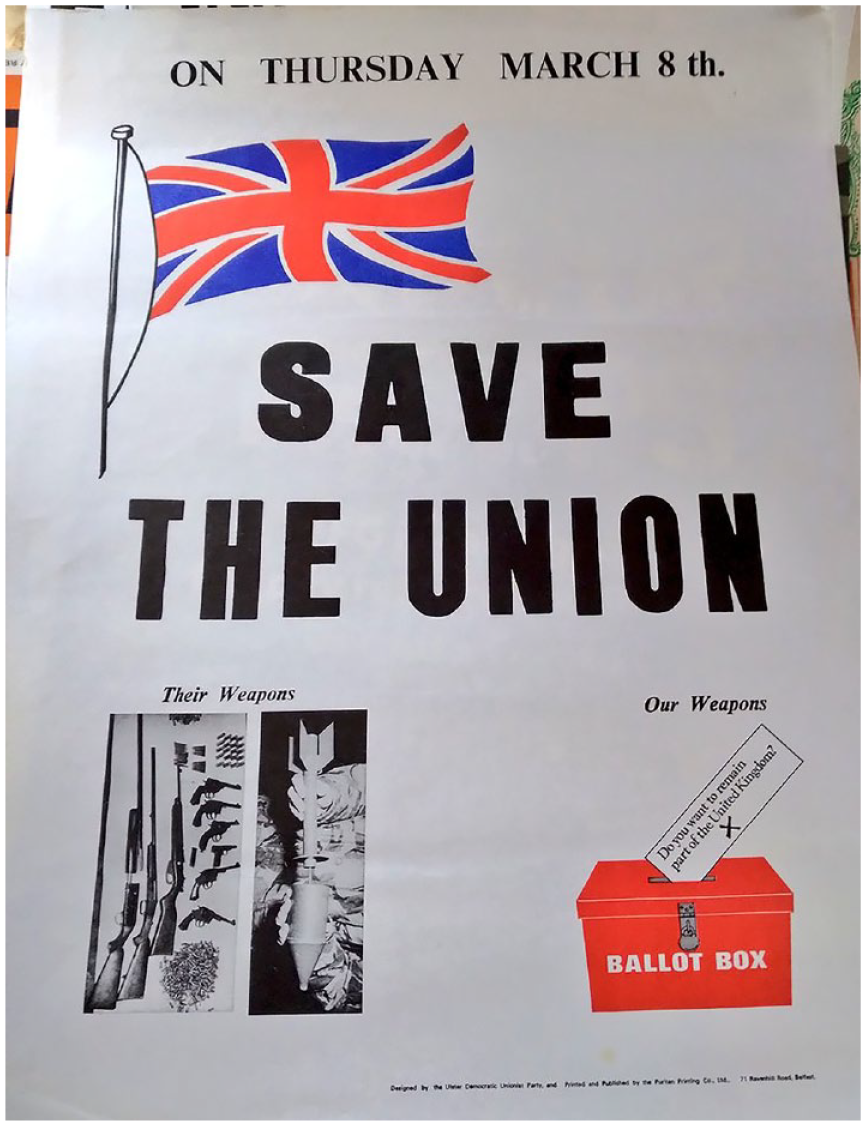
Ulster democratic unionist party campaign literature (https://irishelectionliterature.com/). Reproduced with permission.
The precedent that any future change in the status of NI had to be passed by a majority of the people rather than a majority in Stormont was formalised in the NICA, which confirmed the abolition of the Stormont Parliament and creation of a new NI Assembly in its stead. This legislation echoed the wording of the 1949 Act, replacing ‘the majority of Parliament’ with ‘the majority of people’ as the source of democratic legitimacy (NICA, 1973: Ch. 36 S1(1)). As Bourke (2012: 203–204) suggests, such a provision would never be returned to the devolved institutions and remained ‘the exclusive decision of a majority of the Province’s population’. As the UK government had gone to great lengths to assure the unionists the border poll would be in addition to the 1949 Act, this contributed to subsequent conflict around the Sunningdale Agreement, which introduced a new power-sharing executive and the Council of Ireland alongside the new assembly. As Bew and Patterson (1985: 65) noted, opposition to Sunningdale allowed those elements of the unionist community that had splintered following direct rule to reunite, culminating in the Ulster Worker’s Council strikes of May 1974 and the collapse of the new institutions. 65
The transience of the Sunningdale institutions underpins the orthodoxy in the literature that the border poll was a largely futile exercise. However, viewed in the shorter-term context of immediate concerns around the border question following direct rule, the poll was arguably successful in depoliticising the issue. Moreover, it provided means for the unionists and the UK government to reconfigure legitimacy for the United Kingdom on the grounds that it facilitated direct expression of NI’s democratic will. This is evident from both the public pronouncements of key unionists as well as subsequent internal discussions with NI political parties and in the context of foreign policy. Newspaper editorials echoed the assessment that both sides got what they wanted. The Irish Times led with the headline ‘No Surprise in Border Poll Result’, reporting the ‘delight’ of unionist politicians at Protestant turnout. 66 The Times (of London) noted how the boycott added ‘artificiality’ to ‘the whole exercise’, and that nothing could be taken from the poll except ‘whatever could be extracted for propaganda purposes’. 67 The Guardian reported that the attainment of an absolute majority allowed the unionists to ‘claim with considerable justification that Ulster wants to stay British’. 68
Yet with the addition of the motivation to provide a reassurance to the unionists following direct rule, part of the purpose of the poll was to provide such a propaganda mechanism. Though this increased exposure of the political character of the strategy, strengthening the nationalist boycott and further limiting the (already limited) potential to remove the border issue from day-to-day politics, the poll did provide a clear mandate which defused unionist concerns and allowed them to claim, as Faulkner did in the aftermath, that ‘The people of Ulster have spoken through the ballot box, not with bullets and bombs’. 69 That this assurance was sufficient to secure the participation of amenable unionists in the Sunningdale institutions, however briefly, is arguably further evidence of its success, given the strength of opposition. In negotiations, Whitelaw repeatedly emphasised how the White Paper would ‘endorse the results of the border poll’ and that the holding of the poll, its form and timing, showed that ‘the British Government kept their word’ and ‘should go some way to reassuring those who still had doubts about the Government’s determination to preserve the integrity of NI’. 70 Similarly, in communications regarding the White Paper with both President Nixon and the Vatican, Heath pointedly emphasised how ‘The wish of the majority within NI to remain part of the United Kingdom as demonstrated beyond doubt by the Border Poll on 8 March. Our proposals offer firm assurances that this view will be respected’. 71
Conclusion
This article has provided a detailed empirical assessment of why the decision was made to hold the NI border poll, as well as how implementation of the poll played out in terms of the politics of (de)politicisation. Three arguments were advanced. First, the article argued that depoliticisation was a consistent motivation behind the poll. Initially it was conceived as a means of outsourcing the decision on the constitutional question to the electorate to refocus and ‘normalise’ Stormont elections. As the second argument noted, however, prioritisation of the objective to provide the unionists with an assurance that ‘looked’ more effective than the 1949 Act starkly exposed the political character of this strategy. This resulted in the politicisation of implementation in the form of the nationalist boycott campaign. In response, the UK government sought to adapt the depoliticising rationale to allay unionist concerns following introduction of direct rule. The third argument contested accounts which view the poll as ‘futile’, suggesting that it temporarily reassured the unionists and allowed the UK government to reconfigure legitimacy for the United Kingdom around the claim that NI citizens had the democratic right to self-determination.
In keeping with the methodological implications of archival work, this interpretation is based on a particular reading of primary material and of course remains ‘open to contestation’ (Warner and Luke, 2023: 367). However, given that the literature has tended to treat the border poll as marginal to NI’s history, the empirical material analysed in this article and the arguments therein represent a significant contribution to understanding of the past, present and future role of direct democracy in NI and the wider United Kingdom. Beyond its empirical contributions, the article has also sought to provide in-depth exploration of the inherently political character of depoliticisation, as well as the complex relationship between (de)politicisation and democracy. While the unique circumstances of NI potentially limit applicability of any theoretical conclusions, the conflation of majoritarianism with democracy in NI also revealed how politicians might utilise contestation around different conceptions of democracy to depoliticise certain issues. In this sense, a referendum might be utilised by governments to outsource a decision from representatives to the electorate, with the subsequent mandate used to discursively depoliticise a particular problem (see Trueblood, 2022). David Cameron’s repeated deployment of the referendum as a ‘bluff-call’ mechanism, seeking remove contentious issues from the political agenda, is largely consistent with this account (ICR, 2018: 41). The analysis contributes to both the investigation of the interconnection between politicised and depoliticised processes and identification of ‘depoliticising content’ within politicised governing contexts (Bates et al., 2014: 246), as well as revealing the complexities of empirical examples of (de)politicisation.
The significance of the border poll and subsequent NICA in relocating the principle of consent with the people directly, rather than with Stormont, perhaps provides the most enduring legacy of the case in contemporary NI politics. Though the violence and chaos of the period disrupted the consistency of government motivations for the poll, when viewed in light of the subsequent GFA institutions it is noteworthy how elements of UK government thinking at this time realised that removing the ‘Stormont veto’ was key to resolving the ‘democratic contradictions’ of ‘majority rule and minority rights’ embedded within the 1949 Ireland Act (Bourke, 2012: 200–206; Murray, 2021). 72
It has been suggested the prospects for a future poll, which increased so markedly post-2016, have diminished once again following the 2024 UK general election (Carroll, 2024). Yet as O’Leary (2022: Ch. 2) has recently indicated, demographic shifts in favour of nationalism as well as an emphasis on pragmatism in the politics of reunification – particularly pronounced in the context of Brexit – are likely to sustain pressure on the Secretary of State for a poll in the near future. Given the possibility of a repeat nationalist boycott or, perhaps more likely in the current context, a unionist one, O’Leary (2022: 21) notes the importance of timing the call and providing ‘power-sharing ‘securities’’ to ensure a legitimate vote. Renwick and Kelly (2021: 687) similarly highlight trade-offs in different referendum configurations, between informed choice and inclusivity and majoritarian decisions and consensus building. While the authors identify important mitigation measures, principally ensuring agreement on the referendum process, they also note the inescapably majoritarian or binary nature of sovereignty decisions ‘if both options are to be treated equally’ (Renwick and Kelly, 2021: 689). In this vein, one of the lessons of the 1973 poll is arguably the inherently political nature of any such decision, even if it is framed as depoliticising. In this sense, clarifying measures for any future poll should aim to facilitate and contain disagreement as openly and democratically as possible, rather than (falsely) hoping to remove political conflict through codification of various aspects of the process (Daly, 2020).
Footnotes
Acknowledgements
The author would like to thank Prof. Feargal Cochrane, Dr Nathan Critch and participants of the 2024 PSA Annual Conference for their contributions which substantially sharpened the arguments of the article. He would also like to thank David Torrance for permission to use the ballot paper featured in Figure 2, as well as Alan Kinsella at the Irish Election literature website ( ) for permission to use the boycott literature in Figures 1 and 3.
Funding
The author(s) disclosed receipt of the following financial support for the research, authorship and/or publication of this article: J. Ward gratefully acknowledges funding from the Economic and Social Research Council (ESRC), Grant No. R/181442-11-1. For the purpose of open access, the author has applied a ‘Creative Commons Attribution (CC BY)’ licence to any Author Accepted Manuscript version arising.