




Abstract
While ethno-national demography has featured significantly in political and scholarly debates about Northern Ireland, little attention has been paid to the politics of the Northern Ireland census itself. This article addresses this gap by exploring census politics since the 1998 Good Friday Agreement. It demonstrates that the border poll provision of the Good Friday Agreement and Brexit have increased the political salience of census results, with the 2021 census now being anticipated by many as a potential referendum trigger. Against this background, I argue that new census questions – on religious background and national identity – have had significant consequences for debates about the constitutional future. Introduced in order to satisfy requirements stemming partly from equalities legislation, an unintended consequence of the religious background question has been to reinforce ‘two communities’ narratives in constitutional debates, whereas the national identity question has served to problematise assumptions about relationships between identity and constitutional preferences.
Keywords
Introduction
Censuses in Northern Ireland have long attracted political interest and debate because of what they reveal about the territory’s changing ethno-national demography (Anderson and Shuttleworth, 1998). Census results inform debates about the gradually narrowing gap between the size of the Protestant and Catholic populations and speculation about its implications for the constitutional future. Demographic statistics have also been employed in scholarly analysis of Northern Ireland’s conflict and its settlement, with political scientists, for instance, highlighting the contribution of the erosion of the Protestant majority to the republican movement’s abandonment of violence in favour of electoral politics (e.g. Kaufmann, 2011: 373).
These accounts share an implicit assumption that demographic statistics unproblematically reflect an underlying social reality – an empiricist approach that overlooks acts of political and administrative decision-making in their production (Jenkins, 2019). By contrast, a broader literature documents the inherently political nature of statistics, including the census, focusing largely on the role that practices of classification and enumeration play in constructing and reifying group identities (Anderson, 1991; Kertzer and Arel, 2002; Scott, 1998). This article builds on this literature by examining census politics in post-Good Friday Agreement (GFA) Northern Ireland. It demonstrates the unintended but highly political consequences of administrative decisions made about census design, especially when combined with changes in the context in which its results are understood, even where group identities pre-exist enumeration. Specifically, I show how the introduction of new questions on ‘religion brought up in’ as a supplement to the long-standing religion question in 2001 and on national identity in 2011 has established new statistical outputs, which, in the context of renewed focus on demography resulting from the provision in the GFA for the holding of a ‘border poll’ and from Brexit, have had significant consequences for debates about Northern Ireland’s constitutional future.
This argument draws on multiple sources of evidence. I make use of documents relating to the organisation and design of the census, including consultation papers, explanatory notes and minutes of advisory committee meetings; Northern Ireland Assembly debate and committee transcripts; and official government papers from the Public Record Office of Northern Ireland (PRONI) archives. 1 I also use media coverage, gathered from an online search, the Nexis and ProQuest newspaper databases and the Belfast Newspaper Library collection, focusing on UK and Irish national newspapers and the three major Northern Irish titles, the Belfast Telegraph, the Irish News and the News Letter, as well as interviews conducted with policy-makers and politicians between April 2017 and September 2018.
The article proceeds in four sections. In the first, I outline debate about demographic change in Northern Ireland, highlighting the use of census statistics in public discourse and in academic analysis. Next, I draw on the literature on the politics of statistics to argue that these demographic accounts treat census statistics as self-evident measures of an objective reality, and thus fail to pay sufficient attention to the political and administrative processes involved in their construction. In the third section, I outline two developments exogenous to the census process, but which have raised the prospect of a border poll, increasing the salience of census results: the adoption of the GFA in 1998 and the outcome of the UK’s 2016 European Union (EU) membership referendum. The fourth section then explores two developments in the administration of the census: the addition of questions on ‘religion brought up in’ in 2001 and national identity in 2011. I demonstrate that these additions were driven by administrative rationales but have had profound consequences for constitutional debates. The religious background question has resulted in more people being classified as Protestant or Catholic than would be the case using the religion question alone, strengthening ‘two communities’ interpretations of census results and serving to delay the apparent disappearance of the Protestant majority. The national identity question, by contrast, has problematised assumptions about identity and constitutional preference by demonstrating the complexity of national affiliation in Northern Ireland at a juncture where such preferences are highly salient.
Debating demographic change in Northern Ireland
Demography has been central to Northern Ireland’s politics since its creation following the partition of Ireland in 1921. The line of partition was determined partly using data from the 1911 census, which showed that in the nine-county province of Ulster, Protestants (who were presumed to support the union with Great Britain) accounted for 56% of the population and Catholics (presumed to be Irish nationalists) 44%. This majority was deemed too slim to sustain British rule, and hence Northern Ireland was created as a polity of just six counties, with an engineered and supposedly ‘safe’ Protestant majority of roughly two-to-one (McEldowney et al., 2011: 162; Morland, 2014: 94–98). As a result, ‘sectarian head-counting has been a built-in feature of popular politics in Northern Ireland’ since partition (McEldowney et al., 2011: 161).
Intensity of interest in the census increased during the late twentieth century, as the Protestant majority shrunk to the point where speculation about its imminent disappearance became possible. The 1991 census was the subject of considerable debate – partly because of the uncertainty resulting from many Catholics boycotting the religion question in 1971 and 1981. Its results were anticipated with concern by many unionists and hope by nationalists, who expected that they might herald an imminent Catholic majority and speculated about what this might mean for the prospects of Irish unification (Anderson and Shuttleworth, 1998). The published results did not reveal a Catholic majority, but the apparent narrowing of the gap reinforced perceptions about its inevitability. Similar anticipation accompanied the build-up to the 2001 census, but it appeared to show that demographic change was slowing and that a Protestant majority – and by implication the constitutional status quo – might be sustained for some time.
Recent analysis suggests that it might be productive not to think about a Catholic majority replacing a Protestant one, but instead to see the immediate future as being one in which neither Protestants nor Catholics form a majority. O’Leary (2019: 332), for instance, argues that ‘Northern Ireland no longer has an ethnic, religious, or political majority. It has two and a fraction major blocs that are each minorities: unionists, nationalists, and others, which partly reflects transformations of its demography of Protestants, Catholics, and Others’. He argues that while the Catholic population will likely soon overtake the Protestant one, it might take two decades for there to be a Catholic majority (O’Leary, 2019: 335). Nolan (2018), meanwhile, argues that ‘Northern Ireland is on its way to a situation where Catholics will outnumber Protestants’, perhaps by the 2021 census, but that ‘[w]hile the issue is usually presented as an arm wrestle between unionism and nationalism, this completely neglects the growing importance of those who do not identify with either of the two blocs’. In this view, Irish unification will come about not through the emergence of a Catholic majority, but by nationalists convincing ‘others’ and moderate unionists of its benefits (Carroll, 2019; Mallon, 2019; Nolan, 2018).
Beyond discussion about its constitutional implications, analysis of the role of demography in the conflict has focused on several themes. Prominent among these is an argument that the growing Catholic share of the population played a role in the republican movement’s abandonment of violence in favour of electoral politics. Kaufmann, for instance, argues that ‘[f]avourable demographic trends . . . formed the linchpin of the emerging strategy of the Provisional IRA . . . and Sinn Féin leader Gerry Adams’. According to Kaufmann (2011: 373), ‘Adams used the demographic argument to convince the IRA’s Army Council to back his tactic of shifting from “the Armalite [i.e. armed struggle] to the ballot box”’. Others offer further evidence for this interpretation (Bean, 2007; McAllister, 2004: 207–210; Whiting, 2018: 55–56), with McDonald (2002) arguing that ‘[f]or almost a decade, the organisation’s leadership sold the idea to their base that babies would replace bombs in delivering the year of victory; the “Long War” would be replaced by the “Long Lay”’. 2
Understanding census politics
As the sketch above demonstrates, political and scholarly discussion of the consequences of demographic change in Northern Ireland abounds. Regardless of what claims are being made in these debates, the various perspectives share an assumption that statistics represent an objective demographic ‘reality’. This is characteristic of the common understanding of statistics as empirical truths, rather than as ‘made objects which serve particular purposes and are designed in particular ways’ (Jenkins, 2019: 882). The literature on the main source of demographic statistics – censuses – challenges this understanding, as Lieberman and Singh (2017: 1) summarise: By now, it is widely recognized among scholars that the administration of the census is not simply a neutral, scientific-bureaucratic procedure. That is, official statistics do not simply mirror, but help produce social realities. In particular, census makers have always had some latitude in the inclusion and content of questions that could serve to distinguish the relevant social groups within society.
A strong variant of this argument suggests that censuses ‘provide resources that sustain or run counter to political projects’, and that rather than being ‘“taken,” they are made. They are made through practices that do not simply reflect but that also discipline and organize social relations’ (Curtis, 2001: 28, 34, emphasis in original). Curtis gives several examples, but most research focuses on one of these in particular: the census as ‘an instrument for forging ethnic, religious, and national identities’ (Curtis, 2001: 28). Authors such as Scott (1998: 83), Anderson (1991: 165–166) and Hirschman (1986, 1987) have demonstrated the power of colonial states to impose and reify social categories. Other authors, meanwhile, highlight the ability of populations to resist and shape official practices of classification (Kertzer and Arel, 2002: 27–31; Urla, 1993: 837), demonstrating, to pick one example from many, the role played by interaction between bureaucratic practices and the actions of ethnic entrepreneurs in the emergence of a pan-ethnic ‘Hispanic’ identity in the United States (Mora, 2014; Starr, 1992: 277–278).
In Northern Ireland, however, the census has not significantly contributed to the construction or reification of ethno-national identities; the two main communal identities pre-date British census-taking in Ireland (McEldowney et al., 2011: 161).
3
This does not imply that census statistics unproblematically mirror a prior-existing social reality, though. Returning momentarily to Curtis, we are reminded that ‘[t]he practical work of making a census involves attempts to translate prior conceptual postulates about the organization of social relations into a body of empirical knowledge’. These attempts reveal their own political dynamics. As Curtis (2001: 28) argues, the ways in which ‘population’ is imagined or postulated tends to change from one census to the next, both as a practical consequence of past attempts to observe it and, to the continuing chagrin of social scientists, as a consequence of changing political and administrative interests.
Examining statistical production as a process can thus demonstrate how statistics and the uses to which they are put are shaped by actors pursuing multiple goals (Jenkins, 2019). While some critical attention has been paid to the politics of the census in Northern Ireland, it limits itself largely to the use of census results in political discourse (see Anderson and Shuttleworth, 1998; McEldowney et al., 2011). Research on censuses in other deeply divided societies, meanwhile, has mainly been concerned with contestation of the census and ethnic mobilisation around categories (see, for example, Cooley, 2019; Visoka and Gjevori, 2013), rather than the political and administrative processes involved in the census’s organisation or their constitutional implications.
Adopting an institutionalist perspective can help us understand these processes. As Thompson (2016: 32) notes, census questions are ‘innately predisposed toward the status quo’, due to the need for comparable data from one census to the next. Like other institutions, once established, census questions and categories display path dependency. However, change can result from institutional incentives both within and outside the immediate realm of census policy-making. The content of the census is determined by interactions between statisticians, politicians and civil society actors at the national level, but is also shaped and constrained by international and regional policies and guidelines (Thompson, 2016: 41). The census also exists in a broader network of institutions. Thompson (2016: 34) highlights, for instance, how specific ‘racial projects’ – motivated alternatively by repressive or egalitarian motives – ‘provide the institutional incentives for including or avoiding racial questions and/or specific categories on the census’. Arguments about the role of equalities legislation and the framework of multiculturalism in incentivising racial or ethnic enumeration can, I argue, be extended to decisions to count other contextually relevant identities, such as religion, language and nationality. Importantly, the relationship between the census and other, adjacent institutions operates bidirectionally, with the decision to enumerate identities having potentially far-reaching consequences, through codifying and consolidating those identities (Starr, 1992; Thompson, 2016: 35). These consequences may well be unintended, in the sense that they lie beyond the policy rationales driving a decision to enumerate, but this does not necessarily mean that they are unanticipated (De Zwart, 2015). In the analysis that follows, I demonstrate how, in Northern Ireland, these consequences have been felt not in the reification of identities, as documented in other cases, but in debates about the polity’s constitutional future.
The changing context of the census: Good Friday, ‘border polls’ and Brexit
The first two developments I analyse have not changed the content of the census, but rather the political context in which its results are understood and interpreted, by providing further impetus to debates about their implications for the constitutional future of Northern Ireland. The first of these is the GFA of April 1998. While the main element of the GFA was the establishment of power-sharing institutions for devolved government, it also included provision for the holding of a referendum on Irish unification, known colloquially as a ‘border poll’. If held, this poll would require the support of a simple majority for a change in Northern Ireland’s constitutional status – a starkly majoritarian feature in contrast to the consociational nature of power-sharing (Mac Ginty, 2003: 1).
As the 2001 census approached, media coverage started to make connections between it and the GFA’s border poll provision. In July 1999, for example, a Belfast Telegraph article referred to the census as ‘Northern Ireland’s date with destiny’. It noted: In the Agreement there is a hitherto unremarked upon clause allowing for a ‘border poll’ but with a twist. Contrary to previous practice, the facility can only be put into use if it appears likely to the Secretary of State that a majority of those voting would express a wish that Northern Ireland should form part of a united Ireland. Presumably, with national allegiances following the trends they do, if the census suggests a significant narrowing of the gap between Catholics and Protestants so that it is all but invisible, the Secretary of State might decide to call such a poll. (King, 1999)
Other coverage, reporting republican expectations that the census would reveal a Catholic majority, noted that Sinn Féin would subsequently call for a poll. The Guardian reported shortly before the census date that Sinn Féin’s general secretary Mitchel McLaughlin ‘knows his side will lose [a border poll], but it will show their strength. Then, in the next 10 years, he wants another one. Eventually, his side will have the numbers and it will win’ (The Guardian, 2001). Awaiting publication of the results, journalist Liam Clarke (2002) wrote: Some commentators predict that Northern Ireland census results, to be released in the autumn, will show rough parity between the two communities, with up to 46% Catholic. Sinn Fein has predicted that a united Ireland will be a reality by 2016, the centenary of the Easter Rising.
Expectations that the census would demonstrate that Protestant demographic dominance was coming to an end pervaded newspaper coverage in the lead up to the release of the results, feeding a discourse about ‘implications for the very existence of Northern Ireland’ (McEldowney et al., 2011: 164–165). While nationalists were keen to talk up these implications, many unionists were clearly concerned. Then Ulster Unionist Party MP Jeffrey Donaldson argued in light of speculation about the status of the Protestant majority that any border poll should require a concurrent majority of nationalists and unionists (Walsh, 2002). When the results were released, however, expectations that they might reveal a Catholic majority proved to have been premature, prompting The Observer’s Ireland correspondent Henry McDonald (2002) to comment that ‘[p]redicting a united Ireland by 2016 is like believing in Santa Claus’. This experience likely muted speculation in the run-up to the 2011 census (O’Connor, 2012), but the implications of the results for the holding and likely outcome of a border poll remained a theme of press coverage (see, for example, Kane, 2012; Sanderson, 2012).
As McEldowney et al. (2011: 166) argue in relation to the 2001 census, nationalists and unionists were united in making highly questionable (indeed improbable) assumptions, translating demography all too directly into political outcomes: all Catholics were nationalists, all would actually come out to vote, and all in a nationalist majority would vote Northern Ireland out of existence.
These assumptions are challenged by surveys demonstrating that Protestant attachment to the union is stronger than Catholic support for the cause of a united Ireland (Coakley, 2018). Despite this evidence, interest in the ‘sectarian headcount’ is sustained – in part because of the ambiguity that exists regarding the triggering of a border poll.
Ahead of the 2011 census, Mitchel McLaughlin suggested that the census could be used to address the question of constitutional preference more directly. Questioning Northern Ireland Statistics and Research Agency (NISRA) officials who were briefing the Assembly’s Finance and Personnel Committee on preparations for the census, McLaughlin argued: When the previous census was published, there was a debate about changing public attitudes to the constitutional future . . . The questioning of people about their religion is generally assumed also to indicate their political affiliation, but, as I am sure you would agree, that is hardly a scientific or robust approach. Why not simply ask the question? Given that the issue has been divisive up to now, there is potential for it to continue to be so. However, the question will not go away, and, in fact, it might become increasingly relevant . . . [I]n the period between the next census and the one following that, change of some kind will happen. To take the heat out of the situation and avoid any misrepresentation of the facts, why do we not quantify that change?
The NISRA chief executive’s response was that ‘[t]here is a predilection for censuses to avoid attitudinal questions and to record matters of fact’, and that surveys were better suited to judging constitutional preferences (Hansard, 2010a). The suggestion was repeated in 2012, however, in Gerry Adams’s response to claims made by the Secretary of State that only a minority supported Irish unification and that a border poll would be premature (McAdam, 2012), and again by a now-retired McLaughlin, who argued in June 2018: Perhaps the most constructive contribution that a restored Executive, or in their absence, a Secretary of State could make, would be to arrange for an appropriate question to be formulated for inclusion in the 2021 census that would permit citizens to declare their support for either of the two constitutional options described in the Good Friday Agreement . . . The inclusion of such a question would have no constitutional effect. However, the objectivity of the process and collation of responses would be essential to a decision on a referendum on Irish unity and in itself an encouragement for developing rational and thoughtful debate. (McHugh, 2018)
McLaughlin argues that this is desirable because the GFA specifies that a border poll should be held ‘if at any time it appears likely to [the Secretary of State] that a majority of those voting would express a wish that Northern Ireland should cease to be part of the United Kingdom and form part of a united Ireland’, but that the mechanism for judging this likelihood is unclear. A census question on constitutional preference would, he argues, be best, since ‘you may well get 100% response to the census and I would say you’ll get a very, very high degree of accuracy in terms of the result and there’d be little or no need for anybody to extrapolate’. 4
Since the 2011 census, a second exogenous event has heightened speculation about a border poll and interest in demographic statistics. In the June 2016 referendum on EU membership, a majority of those voting across the UK as a whole voted to leave, but in Northern Ireland (and in Scotland), there were remain majorities. Nonetheless, the Westminster government has insisted that ‘Brexit means Brexit’, and that the UK must leave the bloc as one. Given that ‘in 1998 all Northern Irish futures had presupposed a European roof’ (O’Leary, 2018: 29), and a stark division between overwhelming support for remain among nationalists and overall support for leave among unionists, this has resulted in renewed speculation about Irish unification. As Gormley-Heenan and Aughey (2017: 507) note, ‘Brexit has heightened northern nationalist expectation that the combination of identity and political effects indicates a “tipping point” for Irish unity’, with the expectation not only that it reinforces nationalist support for unification but also that some moderate unionists might be willing to countenance it in order to retain the benefits of EU membership. Even prior to the referendum, Adams argued that a ‘leave’ vote should trigger a border poll; media coverage of this referenced census data as indicating that such a poll would be unlikely to result in a nationalist victory (see, for example, Emerson, 2016b). After the referendum, coverage turned to whether the census might indeed be a trigger: The trigger for a border poll under the Agreement is for a nationalist victory to appear ‘likely’ to the secretary of state. Likelihood is not defined but has been assumed to mean a census or election result showing a Catholic or nationalist majority, or perhaps plurality. Even before Brexit, these supposedly conjoined indicators were diverging – the Catholic population rising to 45 per cent, the nationalist vote falling to 36 per cent. So which should the secretary of state use? (Emerson, 2016a; see also Kearney, 2016)
Discussing possible triggers, Whysall (2019: 6) notes the suggestion of a Catholic census majority, even though ‘that is clearly not determinative’ of political attitudes. Asked about the issue in a radio interview in July 2019, Sinn Féin leader Mary Lou McDonald argued that British government ministers needed to make clear what the trigger was. Asked for her view, McDonald noted that unionists had failed to secure majorities in three successive elections and that ‘the demographic patterns have been well discussed and well aired and they’re moving in one direction’. She stated that the latter ‘is not for me the most compelling of arguments, but it is a reality’ (Today Programme, 31 July 2019). Media coverage, meanwhile, frequently discusses Brexit, a border poll and the 2021 census as intimately related. For instance, a June 2019 Irish Times article argued: It is premature to open a substantial debate about Irish unity. The issue should certainly not become bound up in the immediate Brexit controversies. Nevertheless, several developments could bring the issue to a head, including the shifting mood of nationalists in Northern Ireland, the impact of a hard Brexit and the possible findings of the 2021 census. (McDonagh, 2019)
The GFA and Brexit are exogenous to the census process but have served to increase the constitutional salience of census results. The border poll provision of the GFA did not establish the perceived link between population shares and constitutional status – that link was arguably created in 1921 – but has strengthened it by offering a potential pathway to Irish unification. The outcome of the referendum of 2016 has subsequently heightened debate about the possible trigger for a border poll, strengthening interest in demographic statistics as the 2021 census approaches.
The changing content of the census: New questions
While the GFA and Brexit have altered the context in which census results are anticipated and interpreted, other developments have come in the form of administrative decisions altering the content of the census in ways that have shaped perceptions of demographic change. These are the addition of questions on ‘religion brought up in’ as a supplement to the religion question in 2001 and on national identity in 2011. Neither decision was driven by a deliberate attempt to shape the constitutional discourse – though that was an outcome. Rather, the rationales for the questions were bureaucratic and, in the case of national identity, largely originated outside Northern Ireland.
Organisation of the census is governed by the Census Act (Northern Ireland) 1969. This allows for the holding of a census subject to the passing of secondary legislation by the Northern Ireland Assembly or by Westminster. Delivery of the census is devolved, with NISRA having responsibility for its design and conduct, but in order to ensure UK-wide comparability of data, it does so in close co-operation with the Office for National Statistics (ONS), which runs the England and Wales census, and National Records of Scotland. The census is also subject to international and European guidelines, and the ONS has responsibility for reporting statistics to Eurostat for the United Kingdom as a whole (Compton et al., 2018: 33).
NISRA added the ‘religion brought up in’ question to the 2001 census as a supplement to the religion question, which has been included in censuses of Ireland and then Northern Ireland since 1861. Response to the latter is optional, and non-response has become more frequent in recent decades. A consequence of the 1971 and 1981 boycotts was that religious affiliation was missing for a large percentage of the population. Even leaving aside those who failed to return census forms, the religion non-response rate was 9.4% in 1971 and 18.5% in 1981, compared with only 1.9% in 1961. In the absence of any nationalist boycott campaign in 1991, non-response fell, but it remained significant at 7.3% (with an additional 3.8% specifying that they had no religion) (Doherty and Poole, 2002: 77). The question added in 2001 was designed to address this. The religion question would remain optional, but those not specifying an affiliation would now be asked a second, compulsory question asking what religion they were brought up in, presenting the same options as the religion question (including a ‘none’ tick-box). 5
Similar to the incentives for counting identified by Thompson (2016), the institutional imperative for this change came from equalities monitoring requirements. Fair Employment legislation requires employers to monitor workforce composition and to take affirmative action if this shows that Protestants and Catholics are not being afforded equal opportunities. Workforce data therefore need to be compared with population data, and the Equality Commission for Northern Ireland (2011) considers the census ‘the only available data source in Northern Ireland which provides such data at the local area level’. A significant proportion of people not specifying their religion was regarded as undermining this system,
6
and so the White Paper on the 2001 census proposed: A question on religion has traditionally been included in the census in Northern Ireland, where the information is used to help in the monitoring of policies on equality issues. The question will be similar to that asked in the 1991 Census, but in addition, respondents who indicate ‘no religion’ will be asked to record the religion in which they were brought up (if any). (Cm4253: 18)
Following enumeration, to deal with ‘secondary secularisation’, whereby some people failed to answer either question, 7 NISRA applied a procedure to impute a response by matching an individual to a ‘donor’ respondent with a similar profile (NISRA, 2001: 15–21). 8 Responses to the two religion questions were then combined into a new output, labelled ‘community background’, to be used in equalities monitoring (ONS, General Register Office for Scotland and NISRA, 2004: 21–22).
The imputation process was subsequently criticised by those who argued that it breached respondents’ right to self-identify (Shuttleworth and Lloyd, 2009: 216). Tom Hadden, writing in the Belfast periodical Fortnight, questioned the right of the census authorities to ‘[put] as many people as possible into sectarian boxes’ and suggested that the government should instead be incentivising non-communal identities (Hadden, 2003: 3). Then leader of the Alliance Party, David Ford, described the practice as ‘a sad example of how public agencies can inadvertently promote sectarianism’ (Alliance Party, 2003) and highlighted it in his 2003 party conference speech (Ford, 2003). However, when NISRA consulted on the content of the 2011 census, none of the respondents expressed a view that the religious background question should be removed or mentioned imputation (NISRA, 2005: 28). Ford, meanwhile, had been appointed Justice Minister by the time of the 2011 census, and while this did not constrain him from expressing his view, the demands of the role took his attention away from the issue. 9 The imputation procedure was applied again in 2011 (NISRA, 2012a: 2).
Critics claim that the original rationale for recording or imputing community background no longer applies. Robin Wilson, for example, argues: ‘There is no good public-policy reason for this. The existing declarations required of job applicants have brought employment discrimination almost to vanishing point’ (Wilson, 2012; see also Fisher, 2019). 10 Ford takes a similar view and queries ‘whether that level of monitoring is now appropriate if we’re seeking to build a liberal society in which we don’t simply regard people as belonging to a tribe but as individuals with rights as individuals’. 11 Reflecting the party’s broader difference-blind policy orientation (Tonge, 2020), Alliance MLA Chris Lyttle has questioned whether imputation and the construction of a community background statistical output are compatible with the Council of Europe’s Framework Convention on the Protection of National Minorities (FCNM) (AQW 52331/11-16; AQW 52332/11-16). The Advisory Committee on the FCNM (2017: 12) has expressed concern about the subjective determination of workforce composition and has called for careful monitoring of the mechanism against its original purpose, but continued reliance on ‘perceived community background’ has been defended by nationalist politicians (Sinn Féin, 2007) and some academics (Ringelheim, 2011). The census imputation procedure, meanwhile, is considered less legally problematic. 12 The government’s response to Lyttle’s questions was that because census statistics are published only for population groups and areas, data on individuals – imputed or otherwise – ‘has no direct effect upon their self-identification nor upon how they are treated’. Nonetheless, another Alliance MLA, Kellie Armstrong, has reiterated the party’s opposition (Alliance Party, 2019) and, during a debate about the 2021 census legislation, criticised the inclusion of the ‘religion brought up in’ question. Responding for the Executive Office, Sinn Féin’s Declan Kearney argued that the Fair Employment and Treatment Order 1998 ‘requires employers to establish the community background of their employees and, in turn, for that to be compared with the eligible population’. The ‘community background’ output is, he argued, ‘essential for those purposes’ (Hansard, 2020).
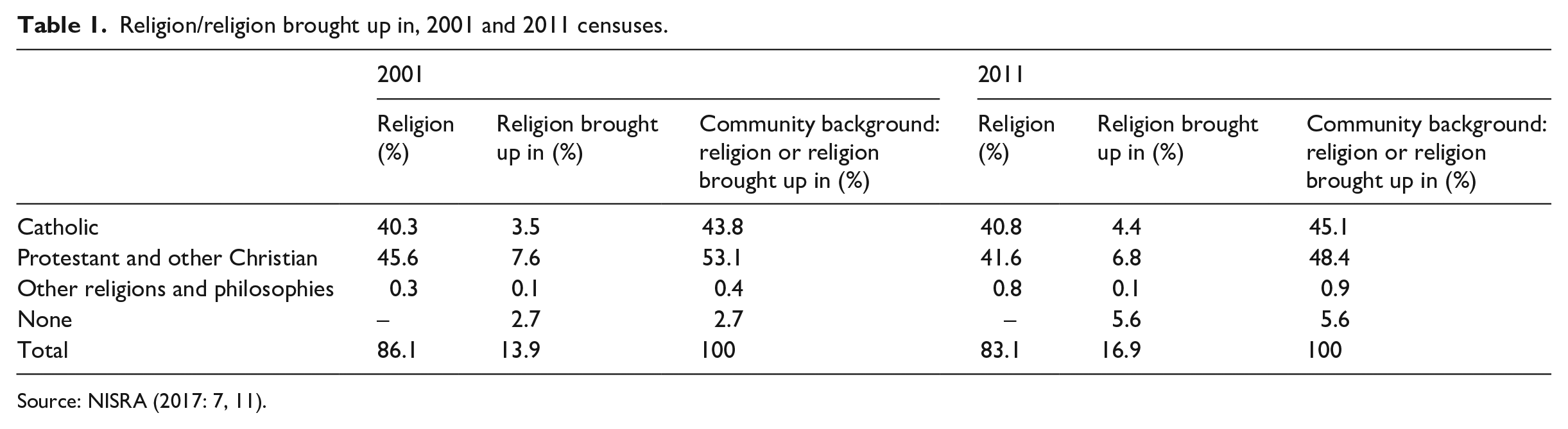
The effects of the addition of the new question on the census outputs are shown in Table 1. Effectively, its introduction delayed the point at which the recorded Protestant population dipped below 50% from 2001 to 2011. As noted above, the 2001 census had been widely anticipated as likely to show that Protestants were no longer in the majority. When judged by the religion question alone, this came to pass – although there was still a Protestant plurality. 13 However, using the new community background output, Protestants made up 53.1% of the population – more than 9 percentage points higher than the Catholic share. 14 This combined output featured most prominently in media coverage, with the Belfast Telegraph (2002) reporting the results in the style of a rugby score: ‘Protestants 53% Catholics 44%’. A Daily Telegraph article argued that ‘republican hopes of achieving a united Ireland by Roman Catholics outnumbering Protestants [had] suffered a setback’ (Harding, 2002). The Irish News, meanwhile, explained the computation of the figures, but nonetheless summarised that ‘the Protestant population still stands at over 50 per cent and a Catholic majority still appears some way off’ (Bonner, 2002). A similar pattern followed the release of the 2011 results, with the proportions reported as 48%–45% (see, for example, Belfast Telegraph, 2012; Connolly, 2012b; News Letter, 2012).
Religion/religion brought up in, 2001 and 2011 censuses.
Source: NISRA (2017: 7, 11).
The 2011 census brought a second significant content development. NISRA had added an ethnic group question to the census in 2001, largely based on the version introduced in Great Britain in 1991, with categories such as ‘White’, ‘Indian’ and ‘Black Caribbean’. The question added in 2011, by contrast, asked respondents how they would describe their national identity, offering British, Irish, Northern Irish, English, Scottish and Welsh tick-boxes and an ‘other’ write-in option. Unlike the ethnic group question, then, this question appeared to be relevant to constitutional debates. The decision to introduce it, however, was a bureaucratic one with roots in London, Cardiff and Brussels as much as in Belfast. There were three main reasons for adding the question.
First, the ethnic group question used in England and Wales in 2001 employed headings such as ‘Asian or Asian British’ and ‘Black or Black British’, with ‘Indian’, ‘Pakistani’, ‘Bangladeshi’, ‘Caribbean’ and ‘African’ tick-boxes offered under these headings, but a ‘British’ tick-box only under the ‘White’ heading. Critics argued that only white respondents were thus able to identify as British. There was also criticism that it was not possible to identify as Welsh under the ‘White’ heading, whereas in Scotland, a ‘Scottish’ tick-box was available (Thompson, 2016: 249–250). Introducing a separate national identity question addressed these criticisms, since it would allow all respondents to identity as English, Welsh or British, regardless of their response to the ethnic group question (ONS, 2013: 3). 15 To take advantage of economies of scale, census forms for Northern Ireland are processed together with those for England and Wales, incentivising the minimisation of differences in their questionnaires. NISRA hence followed the ONS in adding a national identity question. 16 Published census proposals echoed the ONS’s rationale for the question, explaining that it was ‘to make provision for those people, regardless of their broad ethnic group, to indicate their identity as being British, Irish, Northern Irish, English, Scottish, Welsh or “other”’ (Department of Finance and Personnel, 2010: 42). To make the question consistent with the GFA’s provision that people should be free to identify as British, Irish or both, multiple response was permitted (ONS, 2011: 28).
The question also satisfied a second requirement. In 2009, the ONS noted that the government had been subject to ‘years of pressure from Eurostat and the [United Nations Economic Commission for Europe] to collect information on citizenship’, but that ‘the problem . . . remains that the concept of “citizenship” is not generally well understood by the British public’. Testing showed that the best solution was to ask what passport(s) people held, and so this question was added (ONS, 2009: 5–6). Where respondents reported not holding a passport, the ONS decided to use country of birth to estimate citizenship (ONS, 2013: 4–5). In Northern Ireland, the national identity question is also used to make this determination for people holding both British and Irish passports (ONS, no date: 12).
The third reason had to do with user demand. NISRA’s consultation exercise, undertaken in 2005, did not propose specific new questions but asked respondents for suggested new topics. Only three out of a total of 50 respondents suggested the addition of a nationality or citizenship question (NISRA, 2005: 73). However, there was broader demand for better data about migrants following EU enlargement in 2004. Sinn Féin, for instance, highlighted in 2007 that migrant workers from Catholic-majority countries were being categorised in workforce equality monitoring as having a Catholic community background, and argued that this was distorting efforts to address historical discrimination against the Catholic minority (Sinn Féin, 2007). Introducing national identity questions, including in the census, could help to distinguish Catholic immigrants from Northern Irish Catholics. 17
The addition of this question might have been expected to be of political interest given that it would generate data on national allegiance in an ethno-nationally divided society. Indeed, this was anticipated by NISRA officials and by members of its Census Advisory Group (CAG). Some CAG members expressed concern that the question might prove divisive. 18 One highlighted that enumeration would happen shortly before the May 2011 Assembly election, but the NISRA official chairing the group pointed out that the results wouldn’t be published until ‘quite some time after the election’ (NISRA, 2009: 1). The inclusion of a Northern Irish option offered, in the words of a NISRA official, ‘a structure to rejection’ of binary identity categories. On the one hand, the official noted, this might have placated those objecting to the religious background question, but on the other hand, the national identity question risked further politicising the census. 19 However, if politicians had challenged the addition of the question, then officials, who ultimately supported its inclusion, could credibly have claimed that they might be fined for not complying with Eurostat requirements. Furthermore, the fact that officials were following the ONS’s lead ‘helped, by showing that it wasn’t solely a NISRA decision’. 20
During census planning, there was in fact very little broader interest in the addition of the national identity question. 21 It received some attention at the Assembly Finance and Personnel Committee briefing in April 2010, when Progressive Unionist Party MLA Dawn Purvis asked whether the format would allow for open response and whether it would be used to count migrants, and also suggested that it might provide the information that Mitchel McLaughlin was looking for from his proposed constitutional preference question. McLaughlin dismissed the latter point, arguing that ‘there are many nationalities here, and we would end up extrapolating what they might do’. Alliance MLA Stephen Farry asked whether people would be able to specify more than one national identity (Hansard, 2010a). After the briefing, the Committee agreed that it was content with the Census Order (Hansard, 2010b).
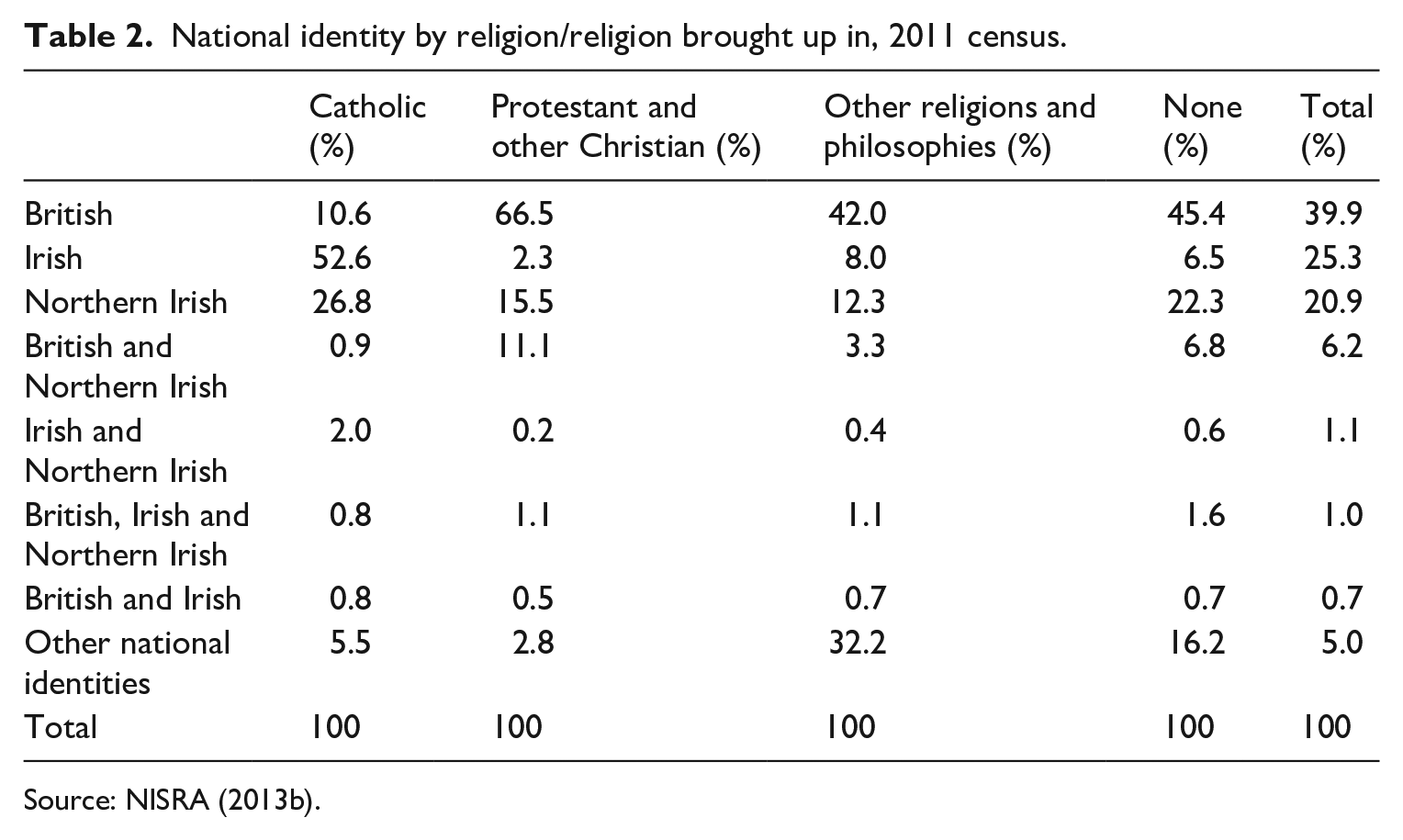
Interest increased significantly when the national identity results were published. While results cross-tabulated with community background (Table 2) were not released until later, NISRA published headline results alongside other key statistics, including those for religion and community background, in December 2012. CAG members subsequently noted that there was ‘arguably more interest in national identity than religion’ (NISRA, 2013a: 3). The press release highlighted that 40% of Northern Ireland’s resident population had a British-only national identity, 25% considered themselves Irish only and 21% Northern Irish only. It also noted that 48% of people included British among their answers, 29% included Northern Irish and 28% included Irish (NISRA, 2012b: 2). Coverage of the results gave prominence to these figures (McNicholl, 2019: 30), with BBC Northern Ireland’s political editor, Mark Devenport, arguing that the question’s inclusion made the census ‘a mini border poll’ (Devenport, 2012). Liam Clarke noted in the Belfast Telegraph:
National identity by religion/religion brought up in, 2011 census.
Source: NISRA (2013b).
The most eagerly awaited statistic is always the overall balance of Catholics and Protestants – the so-called sectarian headcount. But the latest figures . . . challenge conventional wisdom that national identity and religion are directly linked. Catholics now make up 41% of the population, or 45% if you count people brought up Catholics but who have abandoned the religion. That is up slightly from 40% and 43.8% in 2001, and is the highest proportion in our history. However, this high Catholic figure isn’t reflected in an Irish national identity . . . While nearly half the population has a Catholic background, just 25% think of themselves as solely Irish, while around 28% declare some sense of Irish identity. By contrast, the Protestant population has fallen since 2001. Last year 48% of people said they either belonged to or were brought up in Protestant denominations – down from 53.1% in 2001. But only a minority of 40% of the total population considered themselves exclusively British. This rose to 48%, still a minority, when multiple identities such as British and Northern Irish (6.2%) were included in the count. (Clarke, 2012a)
The addition of the national identity question has served to problematise the two-communities narrative that had been strengthened by the ‘religion brought up in’ question. Reacting to the results, journalist Newton Emerson described the 21% identifying as exclusively Northern Irish as ‘intriguing’ and ‘remarkable, given the binary state of identity politics here since time immemorial’ (Emerson, 2012). Liam Clarke (2012b) similarly claimed that ‘[t]he census results suggest that the political playbook should be rewritten in Northern Ireland. The logic of the blocks, of two distinct communities who have to be managed and led separately is starting to break down’. Maeve Connolly argued that the results showed that ‘religious background is not as clear a guide to national identity as had previously been thought’. Politicians, meanwhile, made competing claims about the constitutional implications. Sinn Féin MP Conor Murphy stated that ‘claims and counter-claims’ would be made about the meaning of the results, but that ‘[t]he way to have a definitive result for that question is to hold a border poll’. Democratic Unionist Party deputy leader Nigel Dodds, meanwhile, was quoted as saying, ‘[t]he lazy assumption that demographics equates to either national identity or political choice should now be laid to rest forever’ (Connolly, 2012a).
Conclusion
This article has made two main contributions to our understanding of the census in Northern Ireland. First, it has foregrounded the importance of the political context in which the census exists, demonstrating how two key events have heightened political interest in demographic statistics. While ‘sectarian head-counting’ has been a feature of Northern Irish politics since partition in 1921, by providing for a referendum on Irish unification, the 1998 GFA introduced a mechanism for constitutional change to follow demographic change. The outcome of the 2016 Brexit referendum has subsequently led to heightened debate about the possibility of such a ‘border poll’ being held. The GFA did not specify which indicators would be used to judge when a referendum should be held, but given assumptions made about the relationship between ethno-national identity and constitutional preference, census results have featured prominently in discussion of possible triggers and speculation now abounds about whether the next census – due to take place in Northern Ireland’s centenary year – might be this trigger.
Second, the article has demonstrated how the administrative rationales that underpin decisions about the inclusion and design of census questions have had important consequences for these constitutional debates. The combining of the religion and a new ‘religion brought up in’ question into a community background output since 2001 has changed the distribution of individuals across categories, boosting the proportion of the population represented in statistics as either Protestant or Catholic. The need for this output came from the requirements of equalities legislation. However, in the first census after the GFA provided a mechanism for a border poll to be held once it appears likely that a majority might support Irish unification, the new output combining religious background with religious affiliation demonstrated a Protestant majority where the latter alone did not, with unintended but significant impacts on constitutional discourse. The addition of the national identity question in 2011, meanwhile, was driven largely by attempts to address perceived deficiencies with the ethnicity question asked across the United Kingdom and to satisfy a Eurostat citizenship data requirement. Despite this administrative rationale, the statistics resulting from the question have proved to be highly politically significant, prompting reconsideration of assumptions about the relationship between religious background and national affiliation and challenging the binary ‘sectarian headcount’.
Whereas most research on census politics in deeply divided societies has focused on societal contestation and mobilisation around the census and its role in identity construction (Bieber, 2015; Visoka and Gjevori, 2013), the analysis here demonstrates the value of applying insights from the broader literature in order to investigate the often unintended consequences of bureaucratic decisions about census design in these contexts. In Northern Ireland, these consequences have played out in debates about the constitutional implications of demographic change, but in other cases, the consequences might be for the power-sharing institutions linking population shares with political power, which are frequently employed in deeply divided societies (Visoka and Gjevori, 2013: 484). More broadly, the analysis here alerts us to the value in uncovering the politics that lies beneath narratives of demographic change in deeply divided societies.
Footnotes
Acknowledgements
I am grateful to my interviewees for their time and insights, and to Ian Shuttleworth for numerous helpful discussions about the Northern Ireland census.
Funding
The author disclosed receipt of the following financial support for the research, authorship and/or publication of this article: This work was supported by the Economic and Social Research Council grant ES/N01684X/1.
