




Abstract
Women are historically under-represented amongst government ministers. While most research on gender and executives concentrates on who gets to (and stays at) the top, we examine the executive as a gendered institution, investigating how ministers experience the ‘heart of the machine’ once they get there. Using documentary sources and interviews with former ministers, we explore these dynamics through a case study of the early years of the (then) Scottish Executive (1999-2007), examining how men and women ministers navigated the complex rules and relationships of government in a new institution, and moving the research agenda on gender and the executive in the UK beyond Westminster and Whitehall. While we find evidence of both nominal and substantive change – in terms of ministerial recruitment, portfolio allocation and different ways of working – our findings highlight the continuing drag of the Westminster model on the ‘making’ of the Scottish Executive, limiting possibilities for innovation.
Access to ministerial office is gendered. Historically, most of the occupants appointed to these positions have been men from majority groups, alongside the prime ministers and presidents appointing them. In seeking to explain these continuing inequalities, an expanding field of research has sought to look more closely at the relationship between gender and executives, seeking to explain variations in women’s access to ministerial and executive power. While this work provides important insights into when, where and how women become government ministers, few studies have directly examined the everyday politics and power-dependent relationships within the ‘heart’ of the government ‘machine’ – that is, the complex web of institutions, networks, rules and practices that constitute executive government (cf. Rhodes, 1995a, 2011). Even fewer scholars have examined ministerial careers and experiences at the sub-national level, and its additional complexities and inter-dependencies.
This article moves beyond a focus on how women ministers get to the top to explore the executive itself as a gendered institution. Drawing on insights from feminist institutionalism, we explore the interplay between actors and institutions, asking how ministers navigate the rules and relationships of government, and with what general and gendered effects. In doing so, we contribute to a small but growing body of research on gender and the inner life of the executive (see, for example, Annesley and Gains, 2010; Mackay and Rhodes, 2013) and on post-devolution government in the United Kingdom (see, for example, Andrews, 2022; Cairney, 2011; Keating, 2005).
We investigate these dynamics through a case study of the early years of the executive in post-devolution Scotland (1999–2007). 1 Institutions are difficult to change, but periods of institutional design and restructuring can open up opportunities for (bounded) innovation within wider institutional contexts. Timing, then, is crucial, as once new institutions are created, they tend towards path dependency, limiting what change can be achieved and when. In particular, new institutions can offer opportunities for gender equality concerns to be incorporated more easily at the outset of an institution’s ‘life’, as opposed to ‘adding them in’ at a later stage (Waylen, 2008: 273; see also Mackay, 2014). Focusing on the early years of executive government in Scotland therefore allows us to examine an institution in flux within a wider context of constitutional and institutional restructuring, in which many of the blueprints and rules of government were still being bedded in. Gender equality concerns were closely intertwined with these processes, with the high levels of women’s representation achieved in the first Scottish Parliament seen to be emblematic of a more inclusive and modern ‘new politics’ (Mackay, 2014). In focusing on the ‘permissive’ stage of institutional design and creation, we are therefore able to further investigate the ways in which new (and gendered) institutions are enacted through everyday practices by new actors using formal and informal rules in a crucial (and under-researched) institutional arena, contributing to wider understandings of the general and gendered challenges of institutional change and innovation.
Drawing on original data, including documentary sources and elite interviews with former government ministers, we evaluate the early years of the Scottish Executive through a feminist institutionalist lens. We map the formal and informal rules that shape power and opportunities in the executive; the representation of women in ministerial ranks in terms of roles and resources; and the formal and informal relationships and networks that lie at the heart of government (cf. Annesley and Gains, 2010). Focusing on men and women ministers’ everyday experiences navigating the ‘rules of the game’, we find some evidence of the ‘re-gendering’ of this new institution – particularly in terms of ministerial recruitment, portfolio allocation, and ways of working. But we also point to the interplay of the old and new, formal and informal – highlighting the persistence of gendered inequalities, as well the powerful drag of the Westminster model on the ‘making’ of the executive in Scotland over this period. We conclude by reflecting on progress since these early days and outline the wider implications of our findings for the study of gender, executives, institutional continuity and change.
Gender, institutions and executives
Studies of the executive in the Westminster world have long argued for a broader and more complex conceptualisation of central government, one that incorporates the full range of actors, organisations and structures involved in policy decisions (Dunleavy and Rhodes, 1990). At the heart of this ‘machine’ is the core executive, constituting ‘the complex web of institutions, networks and practices surrounding the prime minister, cabinet, cabinet committees and their official counterparts, less formalised ministerial “clubs” or meetings, bilateral negotiations and inter-departmental committees’ (Rhodes, 1995b: 12). In focusing on key questions of ‘who does what?’ and ‘with what resources?’ in central government, studies of the core executive shift the emphasis away from a sole focus on formal institutional structures towards the study of what executive actors actually do (Kolltveit and Shaw, 2022; Rhodes, 2007). However, despite a central focus on power-dependent relations at the top (Elgie, 2011), there has been little systematic consideration in these studies of how these dynamics might be gendered (for a notable recent exception, see Andrews, 2024). As Marsh et al. (2003: 308) argue, British governance is characterised by ‘exchange relations’ between different actors within a wider context of ‘structured inequality’, including in relation to class, gender and race (see also Burch and Holliday, 1996; Richards and Smith, 2000, 2004). Yet mainstream accounts have largely failed to explore the ways in which gender might shape the formal and informal rules, representational dynamics and resource-dependent relationships of executive government.
For feminist political scientists, in contrast, questions of the ‘who’ and the ‘what’ of executive power cannot be fully answered without the incorporation of a gender perspective. While historically executives have been highly masculinised, significant changes have occurred globally in recent years, with growing numbers of women prime ministers and presidents around the world (though they are still a relatively small club at the top), as well as increasing political pressure to appoint parity cabinets. These trends are paralleled by a rapidly growing body of research on gender and the executive more generally, as well as gender and cabinet ministers specifically. Studies find that access to positions of power in the executive is gendered, identifying the conditions under which women are appointed to cabinets (Claveria, 2014; Escobar-Lemmon and Taylor-Robinson, 2005; Field, 2021; Goddard, 2021; Reyes-Housholder, 2016) and comparing men’s and women’s differing ministerial career paths (Escobar-Lemmon and Taylor-Robinson, 2009; Kroeber and Hüffelman, 2022), including after they leave office (Claveria and Verge, 2015). Once women reach the top rungs of political power, they face inequalities in resources and power, with male ministers tending to be allocated the most influential and high-prestige portfolios (Escobar-Lemmon and Taylor-Robinson, 2009; Kroeber and Hüffelman, 2022; Krook and O’Brien, 2012), particularly when the remits of these positions reinforce traditional expectations about gender roles (Barnes and O’Brien, 2018). The ability of executive actors to get things done further depends on formal and informal networks and relationships, which women are generally less likely than men to have access to, and benefit from (Verge and Astudillo, 2019; Verge and Claveria, 2017). Yet while this (largely quantitative) body of research yields important insights into when, where and how women get to the top (and whether they stay there), it often stops short of directly examining the internal dynamics and everyday ‘doing’ of executive government.
This article addresses these gaps, drawing on insights from feminist institutionalism (FI) to explore the executive as a gendered institution in formal and informal terms. FI integrates new institutionalist insights with gender politics research to investigate the interplay between gender and the operation and effect of political institutions; answer real-world questions about power inequalities in public and political life; and identify institutional mechanisms of continuity and change (Kenny, 2013; Krook and Mackay, 2011; Mackay et al., 2010). FI and mainstream approaches to researching the executive share several central concerns, opening up possibilities for fruitful exchange (see Annesley and Gains, 2010; Chappell and Waylen, 2013; Mackay and Rhodes, 2013). Studies of the core executive – whether adopting a view of power as relational (Bevir and Rhodes, 2008) or structural (Marsh et al., 2003; Smith, 1999) – emphasise the importance of situating actors within their wider institutional and organisational contexts (Elgie, 2011), and of moving beyond the formal to also investigate the informal dimensions and everyday enactment of power and influence within the executive ‘court’ (Kolltveit and Shaw, 2022; Rhodes, 2011). FI scholars similarly point to how the behaviour of actors both shapes and is shaped by the wider institutional environment in which they find themselves, but crucially highlight the ways in which institutional rules (both formal and informal) reflect and distribute power along gendered lines (Krook and Mackay, 2011; Mackay et al., 2010). This includes rules that are gendered in themselves – for example, the historic ‘marriage bar’ which prevented married women from joining and remaining in the UK civil service – as well as seemingly neutral rules that may, in interaction with other institutions, produce gendered effects (Gains and Lowndes, 2014; Lowndes, 2020). Even when institutions are formally codified, they are continually subject to contestation – with the ‘gaps’ and ‘soft spots’ that exist between institutional rules and their enactment opening spaces for actors to re-interpret and redirect institutions in new directions (Kenny, 2013).
There are few studies of gender and the inner life of the executive. Notably, Annesley and Gains (2010) identify a ‘gendered disposition’ of the UK core executive, demonstrating how rules, resources and relationships structured the capacities of women ministers to achieve substantive policy change promoting gender equality. More recent work on gender and ministerial recruitment, meanwhile, provides an in-depth examination of the process of cabinet appointment itself, assessing the formal and informal rules that shape who is eligible to be a minister, how they qualify and who selects them (Annesley et al., 2019; see also Annesley, 2015; Franceschet and Thomas, 2015). But, as Chappell and Waylen (2013: 610) argue, there is a need to build further on these studies and to move beyond the predominant focus on how women get to the top, or on feminist ministers and gender equality policies, to ‘systematically examine the gendered nature of the core executive’. This, in turn, requires researchers to identify the rules that shape the day-to-day work of the executive, to investigate the ways in which power and resource within the executive is allocated and to map interactions and networks between actors (Annesley and Gains, 2010; Chappell and Waylen, 2013). Establishing whether and to what extent the executive is a gendered institution is therefore an empirical question, requiring a fine-grained investigation of the interplay between actors and rules in specific political contexts, and their connections to other institutions both within and outwith the political arena (Grahn, 2024; Kenny, 2013; Lowndes, 2020).
The Scottish executive: Case study and methods
We explore the internal and gendered dynamics of executive government through a case study of the early years of ministerial life in post-devolution Scotland (1999–2007). This encompasses the full period of Labour-Liberal Democrat coalition government in Scotland (1999–2000, 2000–2001, 2001–2003, 2003–2007). In focusing on the ministerial, rather than the official side, of government, we make an important contribution to the wider literature on post-devolution governance in the United Kingdom (see, for example, Cairney, 2011; Keating, 2005; Lynch, 2006) – an under-researched area where ministers have often been left to the ‘margins’ (Andrews, 2022: 124) and where there has been little attention to the gendered dimensions of the executive (for partial exceptions, see Andrews, 2024; Morrison and Gibbs, 2023). 2 This gap in the field includes not only academic studies but also firsthand accounts – while work on executive government at UK level can draw on a wide range of ministerial biographies, autobiographies and diaries, there are few published insider accounts of executive government in the devolved nations (see Andrews, 2022; Lynch, 2006, on this point). Research interviews with former ministers are available through non-partisan think tank the Institute for Government’s Ministers Reflect series – however, these include only eight interviews with Scottish government ministers, just three of whom were in power in the period 1999–2007 (all men; Institute for Government, 2024). While some research studies that draw on the Institute’s data do include analysis of the devolved governments (see, for example, Andrews, 2024), others continue to focus exclusively on ministers at Westminster on the grounds of ‘comparability’ (see, for example, Boswell et al., 2024).
Focusing on the early years of executive government in Scotland also allows us to evaluate the design and active creation of a ‘new’ institution and its rules, practices and power structures (cf. Andrews, 2022; Mackay, 2014). Permissive stages of institutional design can provide openings for change, as old settlements are destabilised and new rules and ways of working are institutionalised (Goodin, 1996). ‘New’ institutions, however, are never really new; they are ‘nested spatially and structurally’ in terms of their interactions with other institutions, and temporally, in relation to historical legacies and path dependencies (Mackay, 2014: 557). Scotland sits within a multi-level system of governance, and executive government has therefore taken its shape within a wider framework of Westminster and Whitehall traditions, and (gendered) institutional and party-political cultures, among other legacies (Mackay, 2014; see also A Brown, 2000; Mitchell, 2000). Studying how new actors enact new institutions can therefore offer insights into the complex and gendered interplay between the old and new, formal and informal – with case study analysis well suited to the fine-grained investigation of the day-to-day interpretation and enactment of institutions on the ground (Kenny, 2013).
Our empirical analysis focuses on men and women ministers’ everyday experiences navigating the ‘rules of the game’ in the early years of executive government in Scotland (1999–2007). As Smith et al. (2000) note, analyses of British political elites often focus on agency-oriented accounts, while underplaying the structural constraints that shape behaviour. Multiple methods, then, are usually required to capture the dynamic relationship between institutions and actors (Grahn, 2024). We began by mapping the formal ‘rules of the game’ – that is, rules that are consciously designed and specified in writing. We collected and analysed a range of documents, drawing largely on the founding documents of devolution – including relevant legislation, the Standing Orders of the Scottish Parliament, ministerial codes and official reports covering the period 1999–2007 – as well as the historical records of the Scottish Cabinet which are publicly available through National Records of Scotland after 15 years. These latter sources provided further insights into the inner workings of government, and the design of ‘new’ rules on the ground – for example, through memos, emails, briefings and other papers relating to the drafting and implementation of key documents. We supplement these, where possible, with secondary literature and additional documentary sources – including media coverage of government formation and reshuffles, and the existing small number of Scottish ministerial interviews gathered by the Institute for Government.
Informal dynamics within the executive are more difficult to capture, partly because of the often-hidden character of these practices (Bjarnegård and Kenny, 2015; Chappell and Waylen, 2013). Quantitative studies have the potential to identify whether there are similarities or differences in particular behaviours or practices (Bjarnegård, 2013; Grahn, 2024); however, uncovering the informal often requires in-depth and detailed qualitative work. Some scholars have been able to employ more time-consuming and field-intensive qualitative methods to identify the ‘rules-in-use’ in executive government, including ethnographic approaches (see, notably, Rhodes, 2011) – but issues of access, time and resource mean that these kinds of methods are not always feasible for many researchers. Interviews are often the most effective method for understanding ‘how things are done around here’ and ‘why do you do X but not Y?’ particularly in a context where the rules of the game had yet to be fully clarified (Lowndes, 2014; see also Evans and Kenny, 2020). In our study, we supplemented the above documentary sources with an original set of semi-structured interviews conducted with former Scottish ministers undertaken between 2015 and 2017, eight of whom served between 1999 and 2007, and a third of whom were women. 3 Annesley et al. (2019) note the value of interviewing former ministers, rather than those currently in office, as they are freer to offer frank and reflective views. While elite interviews may be affected by gaps in memory, elusiveness or misrepresentations, triangulation through multiple methodological resources can provide additional information and/or corroborate initial findings (Natow, 2020). Interviews followed a common question schedule (focusing on appointment, everyday life, parliament and civil service), while allowing space for open-ended reflection. Our participants included both women and men, allowing us to explore some potential similarities and differences in experiences, while also reflecting that gender remains a relevant analytical category even in institutional contexts where women themselves are absent (Mackay, 2011). While men are seldom asked to reflect on their gendered experiences in politics, researching both men and women can enrich our understanding of the relational and gendered dynamics of political institutions (Murray and Bjarnegård, 2023). Interviews are identified by number to preserve anonymity.
In the following sections, we organise our analysis around key themes identified through the interviews, documents and secondary literature, focusing on: first, the formal and informal rules that shape power and behaviour in the executive in Scotland; second, the representation of women in terms of roles and resources; and third, the power-dependent relationships and networks that underpin the formal structures of executive government (cf. Annesley and Gains, 2010). Across all these thematic areas, we focus on the interplay between actors and institutions, asking whether and how the formal and informal rules of the game constrain and empower actors, and with what general and gendered effects.
New institutions, new rules?
Hopes for a ‘new’, modern and democratic Scottish politics were based on a range of critiques of the Westminster model, including not only its unrepresentativeness, but also a winner-takes-all electoral system that excluded small parties; executive dominance, with power concentrated within government rather than Parliament and its committees; and adversarialism between government and opposition (McGarvey and Cairney, 2008). Feminist critiques of the Westminster model draw attention to both its gendered character and gendering effects – arguing that hierarchical and adversarial Westminster-style practices privilege certain types of traditional masculinity and in doing so, reinforce the continuing political dominance of some men (Lovenduski, 2005; Mackay, 2014; Sanders and Flavell, 2023). These critiques were central to the devolution debate in Scotland, where feminist campaigners used Westminster as a ‘negative template’ (cf. Mitchell, 2000) of a masculinised political culture hostile to women and other under-represented groups (see, for example, Woman’s Claim of Right Group, 1991). They argued that ‘new politics’ would disrupt this gendered political model of ‘centralised authority and uncompromised sovereignty’, envisioning a parliament that would look more like the people it represented and work in more collaborative and participatory ways (Mackay, 2014: 559; see also Morrison and Gibbs, 2023).
To prepare the groundwork for the new institution, a Consultative Steering Group (CSG) of political party and civic representatives was set up by the Secretary of State for Scotland in 1997 to develop proposals for the rules of procedure, Standing Orders and working methods of the Scottish Parliament. However, it largely steered clear of questions around the structure of the executive branch, and the relationship between ministers, civil servants and Members of the Scottish Parliament (MSPs; Parry and Jones, 2000). The CSG emphasised in their 1998 report that ‘the Scottish Executive should be accountable to the Scottish Parliament and the Parliament and Executive should be accountable to the people of Scotland’ (Consultative Steering Group on the Scottish Parliament, 1998: 6). The relationship between the executive and the legislature in Scotland therefore ultimately followed a modified Westminster model, with St Andrew’s House and Holyrood paralleling Whitehall and Westminster (Parry and Jones, 2000: 53; see also Birrell, 2012).
At the same time, while the CSG ‘recognised the need for the Executive to govern’, it also envisaged a stronger parliamentary role, advanced by comparatively powerful Scottish parliamentary committees that would scrutinise the work of the Executive (Consultative Steering Group on the Scottish Parliament, 1998: 7). Yet the CSG did not fully account for or acknowledge the impact of party politics and party whipping, with Labour and the Liberal Democrats forming a governing majority after the first election to the Scottish Parliament and numerically dominating committees (Cairney, 2011: 41–42; see also Arter, 2004; Parry, 2020). There was also little political appetite for taking up the CSG agenda in relation to the executive, including from the media or from opposition parties who wanted to be able to oppose (Parry and Jones, 2000). For Cairney (2011: 41), the ultimate result was a rather ‘curious mix’ of a set of ‘consensus’ institutions operated by politicians with majoritarian attitudes derived from the Westminster tradition.
The structure of government was also heavily influenced by the fact that the old Whitehall department of the Scottish Office and most of its staff transferred into the new institutions. The UK Government saw the civil service as a key link between it and the new devolved governments, and were intent on keeping a unified civil service, retaining civil service policy as a function of the UK Government (Cairney, 2011). Given the lack of a steering group on the Scottish Executive to match the one on Parliament, and the very short timeframe between the first election in May 1999 and the official transfer of powers to the new parliament in July, officials largely ‘replicated and perpetuated what they knew’ (Parry, 2020: 390). This included expectations that new ministers would learn ‘our ways’ and pick up a ‘model pattern of minister-civil servant relations on the job’ (Parry and Jones, 2000: 60).
Rhodes (2011: 140) famously conceptualises the relationships inside and outside British government departments as the ‘departmental court’, drawing attention to their complex organisation and hierarchical and monarchical traditions. Everyday practices concern the deference due to the minister at the centre of the hierarchy and success is measured in part in loyalty to the minister and in guiding and defending him or her as necessary in the battles of bureaucratic politics. Ministers are waited upon by drivers, diary secretaries, private secretaries, ministerial or special advisers, and other civil servants who control access to the minister and may fall in and out of favour with their political boss. This stratified structure, and its lines of reporting and command, again privilege hierarchical relationships, gendered divisions of labour and masculinised modes of working and leadership – an argument we return to in subsequent sections (Mackay and Rhodes, 2013).
The assumption that new ministers would be easily socialised into these Whitehall ways of working created tensions in Scotland, particularly in the new context of Labour-Liberal Democrat coalition government after the 1999 election, where there was no accompanying rulebook. Lord Wallace, the then-leader of the Scottish Liberal Democrats and Deputy First Minister, reflected on the ways in which civil service actors fell back on traditional practices of ‘deference’ to their Labour partners during coalition discussions, which included the former Secretary of State for Scotland and newly elected First Minister Donald Dewar: . . . in 1999, the civil service mindset when we went into the coalition talks before we went into government, was that they were dealing with the Secretary of State for Scotland [Donald Dewar] and two or three ministers: Sam Galbraith, Henry [McLeish]. We were like the supplicants . . . everything was deference to the secretary of state. (Lord Wallace, 2015)
The formal rules of the game – outlined in legislation and in aspects of the Scottish Ministerial Code 4 and related guidance – were also largely adapted from the Whitehall model (Birrell, 2012). The Scottish Office’s process of drafting of the Scottish Ministerial Code in 1999 used the UK Ministerial Code as a starting point – altering it to reflect the ‘terms and nomenclature’ of the devolution settlement, while leaving largely undisturbed the provisions on propriety, conduct and the relationship between ministers and civil servants. Indeed, internal correspondence during the creation of the code included instructions to ‘trawl through the text in search of . . . unfortunate hangovers from the UK code, and consider whether any future “Scottification” would be appropriate’. 5
Scottish ministers are MSPs and their roles follow the general principles of ministerial responsibility as they operate in Westminster, in that they are accountable to Parliament for decisions within their areas of responsibilities and perform parliamentary duties (introducing legislation, answering questions and so on). They also observe collective ministerial responsibility for government policy, which is outlined in the Scottish Ministerial Code – and from 1999 to 2007 was accompanied by additional guidance on collective decision-making in coalition (Scottish Executive, 1999).
The most senior ministers form the Scottish Cabinet, chaired by the First Minister (FM) who is the head of government. It is worth noting here that early editions of the Scottish Ministerial Code used the pronoun ‘he’ when referring to the FM (the current code simply refers to the FM by title). The FM has discretion to alter the shape (through merging and abolishing roles or departments) and personnel (through the hiring and dismissal of ministers) of the government – although coalition arrangements allowed the partner party to select their own ministers (Keating, 2005). While there are generally few formal rules about cabinet appointments (Blick and Jones, 2010), the Scottish ministerial appointment process is more formalised than some other Westminster systems, as ministers must also be confirmed by the Scottish Parliament (and are ultimately approved by the sovereign). Eligibility for ministerial posts is also restricted to MSPs, which means that the FM has a smaller eligibility pool to choose from than their counterpart at Westminster (Lynch, 2006).
While coalition resulted in the creation of a new Cabinet post – the role of Deputy First Minister (DFM), occupied in 1999–2007 by the leader of the junior party – roles in the new Scottish Executive largely followed Westminster norms, with Ministers (‘Cabinet Secretaries’ in the post-2007 Scottish Government terminology) assisted by deputy (junior) ministers (now referred to simply as ‘ministers’ post-2007). Deputy ministers are not members of the Cabinet but may be invited to attend. Ministers are served by a private office of civil servants (sometimes with special advisers); but unlike in Whitehall, ministerial responsibilities and departments do not align precisely. Rather than reflecting a new approach to government, Parry and Jones (2000) argue that this is an inherited administrative legacy of the old Scottish Office, where there were fewer ministers than departments (see also Cairney, 2011). The most senior civil servant is the Permanent Secretary (Scotland’s ‘Cabinet Secretary’) – the first of whom, Muir Russell, transferred over from the Scottish Office – followed by department heads (reconfigured as ‘Directors-General’ post-2007).
Representation and resources
The aims of gender balance and fair representation of other under-represented groups were closely intertwined with the ‘building’ of the new parliament (see, for example, Breitenbach and Mackay, 2001; Brown, 1996; Morrison and Gibbs, 2023). The equal representation of men and women was a key rallying cry for a broad-based and pluralist coalition of women’s organisations and activists, but it was also part of a broader set of claims and expectations around more accessible and inclusive politics and policymaking, and improvements in women’s substantive representation (Kenny and Mackay, 2020: 61). However, demands for 50:50 representation largely focused on mechanisms for ensuring women’s parliamentary presence, rather than on the executive per se.
There are no formal rules about gender and ministerial recruitment in Scotland. This does not, however, imply that gender is absent in formation of cabinets – the interplay between actors and rules can create opportunities for women, or can work to reinforce gender inequalities in political power (Annesley et al., 2019). However, many of the gendered obstacles present in legislative recruitment are absent in the process of appointing cabinet ministers (Annesley et al., 2019). For example, a strong informal rule for ministerial selection is that aspirants do not publicly self-nominate or lobby for a spot in cabinet, which in theory, may create a more even playing field between men and women. In Scotland, women also have more access to the ministerial eligibility pool at Holyrood, with, a higher proportion of women elected to the Scottish Parliament than Westminster over time. However, levels of women’s representation in Scotland have fluctuated significantly over time and across parties, due to the variable implementation of equality measures like party gender quotas (Belknap and Kenny, 2024; Kenny and Mackay, 2020).
Other gendered barriers, however, are magnified in ministerial recruitment compared with legislative recruitment (Annesley et al., 2019: 208) – namely that rules are largely informal rather than formal. While informal rules are not necessarily ‘bad’ for women (see, for example, Kenny and Verge, 2016), in the executive, the rules of the game put considerable power in a small (and usually single) set of hands. Selectors can therefore use their agency to advance women’s political presence, or to choose not to do so (Annesley et al., 2019). In Scotland, the relative stability of women’s inclusion among ministers (see Figure 1) – at around 30% from 1999 to 2007 – potentially points to an agreed inclusionary norm around women’s representation, or what Annesley et al. (2019: 252) identify as a ‘concrete floor’, a ‘minimum number or proportion of women in cabinet for that ministerial team to be perceived as legitimate’. At the same time, there have been consistently fewer women than men on the Scottish government benches until recently, despite their increased presence in the ministerial eligibility pool from the beginning. Scottish Labour, for example, had 50% women in its parliamentary party in 1999, rising to 56% in 2003, yet women’s numbers stagnated at under a third of ministers for most of the 1999–2007 coalition period (see Figure 1). All Scottish Liberal Democrat ministers from 1999-2007 were men.
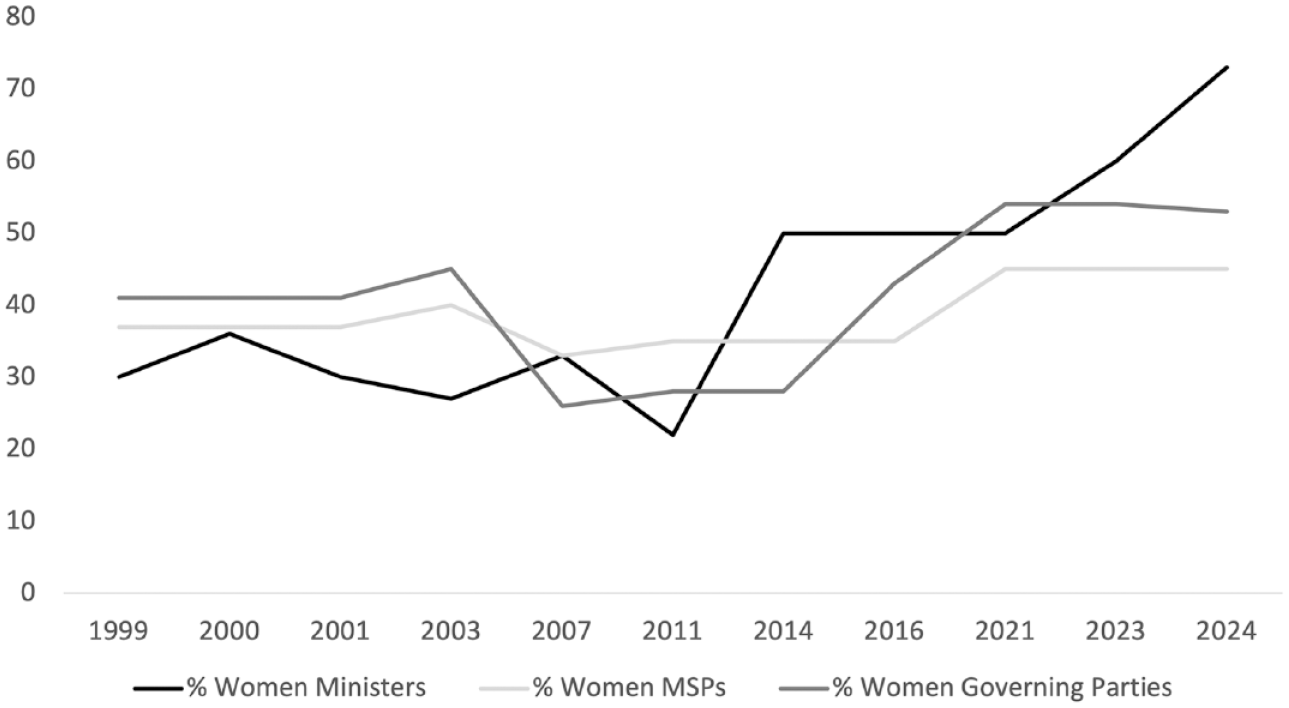
Proportion of women among ministers, MSPs and governing parties, 1999–2024.
Notwithstanding the centrality of equal representation to wider devolution debates, and some high-profile individual ministerial appointments, there is little sign in the early years of the Scottish Executive that First Ministers were prioritising gender as a central representational criterion in ministerial selection; nor was gender a significant talking point in wider media coverage of cabinet selection. Donald Dewar (1999–2000), for example, announced his cabinet as representing the ‘talent, experience and people who have the commitment and enthusiasm to deliver the agenda’ (Swanson, 1999), with The Herald describing his new team as ‘young and able’ (Ritchie and Dinwoodie, 1999). After Dewar’s untimely death, his successor Henry McLeish (2000–2001) similarly claimed that his cabinet team was more representative of experience and age but did not explicitly mention gender (with the number of women in his cabinet rising from three to four) (see, for example, Ritchie and Dinwoodie, 2000). The subsequent drop in women ministers – from four back down to three, including the high-profile departure of Health and Community Care Minister Susan Deacon – in First Minister Jack McConnell’s (2001–2003, 2003–2007) first cabinet also attracted little explicitly gendered media attention or comment, with the focus instead on McConnell’s sacking of a large number of ministers and appointment of his supporters (see, for example, BBC News, 2001a; Sinclair, 2001).
Gendered power dynamics also play out in the departmental court in the allocation of ministerial responsibilities and resources. For example, Escobar-Lemmon and Taylor-Robinson’s (2005, 2009) work on Latin American cabinets finds that women are often over-represented in ‘feminine’, low-prestige cabinet portfolios (e.g. family, culture, education, social services), while men are over-represented in ‘masculine’, high-prestige cabinet portfolios (e.g. defence, economics, finance, security; see also Krook and O’Brien, 2012). Informal networks and relationships of trust are particularly important for the high-value and influential ‘core’ ministries of state, which are crucial to leaders seeking to hold onto political power (Huber and Martinez-Gallardo, 2008); with men more likely to have access to the political resources and ‘homosocial capital’ needed to build networks and gain political power (Bjarnegård, 2013; Goddard, 2019). This further constrains women’s access to the ‘inner cabinet’ and to the head of government, as well as potentially excluding them from the executive’s primary policy priorities (Escobar-Lemmon and Taylor-Robinson, 2016). At Westminster, for example, only 10 women have held any of the Great Offices of State, with Rachel Reeves appointed as the first ever female Chancellor of the Exchequer in 2024. In some respects, the early years of the Scottish Executive follow these familiar gendered patterns – for example, all First Ministers, Deputy First Ministers, and Finance Ministers between 1999 and 2007 were men.
‘Core’ portfolios, however, are not the only ones important to leaders, with some portfolios gaining higher salience than others depending on party policy priorities (Warwick and Druckman, 2006) and the distribution of competences between different political levels (Barnes et al., 2019; Höhmann, 2023). The question of power in the executive is therefore a relative matter, rather than absolute, involving not only the mapping of numbers, but also the gathering of evidence on the resources and more informal ‘status and expectations’ associated with particular tasks and positions to establish where power really lies (Erikson and Josefsson, 2022: 29). Indeed, in seeking to identify the locus of power within the Scottish Executive, Cairney (2011) asks whether a ‘core executive’ could be identified at all, given the lack of clarity in the early years of devolution as to the relationship between the Scottish Executive and the UK Government, a dearth of central leadership and coordination, and ongoing confusion over Cabinet roles – what Parry and Jones (2000: 54) dub a system of ‘ministers without ministries’ (see also Keating, 2005). This was further complicated in the early years by the sheer number of ministers appointed (22 ministers and deputies in the Dewar government), which disrupted plans for offices and private secretaries, and led to wider questions about who was meant to be doing what (Parry and Jones, 2000). Scottish ministers are responsible for portfolios that often cut across multiple policy areas, and portfolios and titles can change easily. In some cases, the restructuring and renaming of portfolios has also been less about ‘joined-up government’, than it has been about cabinet power politics (Cairney, 2011). For example, when Jack McConnell became First Minister after Henry McLeish’s resignation in 2001, he added transport into rival Wendy Alexander’s enterprise and lifelong portfolio, leading her to be popularly dubbed ‘Minister for Everything’. Rather than boost Alexander’s ministerial portfolio, there was speculation that this was an attempt by McConnell to overburden her and keep her side-lined from inner circles (Winetrobe, 2002: 7).
The small body of literature that does exist on gender and sub-national cabinets suggests, on one hand, that the sub-national level may be potentially favourable to women’s ministerial representation, particularly in contexts with strong gender equality norms, given the fact that many conventionally ‘masculine’ ministries do not exist at this level (Höhmann, 2023). In Scotland, for example, Health, which is typically seen as a medium-prestige ministry in the ‘feminine domain’ (Escobar-Lemmon and Taylor-Robinson, 2009), has one of the largest spending portfolios in the Scottish system, as well as a stronger institutional base, given the fusion of the policy side with the central management of NHS (National Health Service) Scotland. In contrast, Finance, a typically high-prestige ministry in the ‘masculine domain’ (Escobar-Lemmon and Taylor-Robinson, 2009), was responsible for the Scottish Executive’s spending plans, but, in the early years, did not have significant powers over the economy, taxation or public spending, and was not equivalent to its UK counterpart by any means (Cairney, 2011; Lynch, 2006). Other traditional ‘masculine’ policy competences like defence, foreign policy, immigration, trade and industry are reserved to Westminster – although the boundaries of devolved competence are sometimes blurred (see Keating, 2005). As Lord McConnell, the first Minister for Finance in Scotland reflected: Undoubtedly, there had been a view in the civil service that there had to be a minister who was responsible for finance and budgeting, but I don’t think anybody had planned what the remit of that job would be, and nobody had restructured the civil servants to create a cohesive unit that would work with the minister. (Lord McConnell, 2018)
However, studies of women’s representation at the sub-national level suggest women may be more likely to be excluded from executive positions with significant control over resources, particularly in more politically powerful regions (Barnes et al., 2019; see also Gushchina and Kaiser, 2021). In the period of Labour-Liberal Democrat government from 1999 to 2007, women did occupy several prominent portfolios, including Health (Susan Deacon, Labour, 1999–2001) and Justice (Cathy Jamieson, Labour, 2003–2007) among others – perhaps pointing to a partial (re)gendering of political power (cf. Barnes and O’Brien, 2018). In other respects, however, women continued to be under-represented both overall in the executive (Figure 1) and relative to where power lies, with women ministers in general allocated to traditionally ‘softer’ and less-prestigious portfolios, including communities, culture and sport, and social justice.
Navigating relationships and rules
Power in the executive derives from ‘command over and exchange of resources’, and the resulting dependency that this builds between actors (Annesley and Gains, 2010: 916). Within the executive, actors navigate formal and informal networks and relationships, exchanging resources with other policy actors and with outside organisations (Bevir and Rhodes, 2006; Burch and Holliday, 1996). These networks are also gendered, with important discussions often taking place in ‘back rooms’ or locations that women do not have access to, where they are largely absent, or where caring responsibilities may prevent them from taking part (Watson, 1994). Annesley and Gains (2010), for example, highlight the ‘blokey’ and ‘laddish’ culture of UK Labour Governments at Westminster under Tony Blair and Gordon Brown, which made it more difficult for women to access the high-trust networks needed to make ministerial careers. Notably, former Europe minister Caroline Flint quit Brown’s government after accusing him of using her as ‘female window dressing’, while a Foreign Office official reported that Brown’s ‘advisers have to be male because sometimes the only way to get a decision is to follow him into the loo’ (Day, 2009).
In the Scottish Executive, these dynamics were easier for insiders with political experience to navigate. In the first Labour–Liberal Democrat executive, for example, all the male MSPs in the Cabinet had previous experience of holding elected office, either at Westminster or in local government, while none of the women had previously held political office. As one woman minister reflected: There were things called green folders and orange folders. Green folders were invitations and orange folders were correspondence. Knowledge is power. I can remember having to ask things like ‘what’s a green folder?’ Now that’s the kind of thing that Sam [Galbraith], Donald [Dewar], Henry [McLeish], they would have known that because they had come from government in Westminster before. (Minister 5)
It takes time to learn how to navigate this system and work out how much individual ministers can push their influence: ‘It takes you a while to build up sufficient confidence to say: I don’t like this. Let’s do something different about that’ (Minister 6).
The first Scottish ministers had to deal with the fact that they were creating new institutions as well as running them: ‘what was different about the class of 1999 was that everything and everybody was new’ (Minister 5) which meant that you ‘had lots of learner drivers in ministerial roles’ (Minister 7). Once ministers were appointed, there was no process of induction, and the learning curve was steep, described by one minister as a ‘learning perpendicular’ (Minister 3). One minister cited that their only sources of information were watching Yes, Minister and reading Kaufman. 6 An induction process was subsequently introduced after the 2003 Scottish Parliament election, including the circulation of a ‘Key Information for Ministers’ document and welcome pack, as well as a ministerial induction session held in May 2003 (focused on ‘priorities’, ‘working together’, ‘diaries and time’ and ‘private offices’; Scottish Executive, 2003).
Overall, the process was daunting, and appeared to some to be designed to ‘tame’ the new ministers into civil service practices of working (Minister 2). And while several members of the first Scottish Executive had Westminster experience, this was still limited, given that Labour had been in opposition at Westminster from 1979-1997. Moreover: Because it was new, there was no route map in a way, so even the so-called ‘experienced’ ministers that were coming in who had been in Westminster before, they had a different type of experience that didn’t necessarily just slot into what the new processes and structure of Scottish politics and the Scottish Parliament were . . . so, no, virtually [no guidance], given a private secretary and shown to the office and told to get on with it. (Minister 5)
The key day-to-day relationship for any minister in a Westminster system is the private office. This is the site of everyday interaction and decision-making and centre of the ministerial court. It plugs the minister into the rest of the system and acts as the conduit for papers and decisions (Rhodes, 2011: 140). As several ministers reflected: You get allocated a private secretary, and a car appears. Suddenly, your life is in practical terms transformed. Because being used to, particularly as a woman, doing things for myself, everything was done for me. And I resisted that for a bit because I didn’t want to lose control, but actually once you realise that that’s to help you and you let go of the stuff that isn’t really important, it becomes very liberating in terms of time to do other things. (Minister 4) See, you go into it naively thinking I don’t need a car. Why would I need a car? You go to your private office. I’ve got a diary secretary? What’s that about? That’s just ridiculous. And I’ve got two private secretaries? One assistant and one private secretary. And then you realise what a massive undertaking this is logistically. (Minister 2)
A minister’s relationship with the First Minister can be a key constraint or resource, particularly if they are in a senior position. For some ministers, the turnover of three successive Labour First Ministers during the Parliament’s initial years signalled a change in approach to policy, which gradually became more closed and hierarchical: I always remember [another minister] saying to me, ‘Remember when Donald [Dewar] was doing a big speech that was covering all the main work of government, he would circulate it round all of us and we would get a chance to input to our section? Donald would circulate it in advance, and we would get the chance to input to our section. And then Henry [McLeish] came in and we’d get circulated an advance copy of his speech just before he gave it for information. And then when Jack [McConnell] came in, we’d get circulated the speech after he delivered it. (Minister 5)
One of the founding principles of the Scottish Parliament is openness – that the parliament ‘should be accessible, open, responsive and develop procedures which make possible a participative approach to the development, consideration and scrutiny of policy’ (Consultative Steering Group on the Scottish Parliament, 1998: 6) and that this commitment to openness and accessibility should be ‘reflected in the working of the Scottish Executive’ (Consultative Steering Group on the Scottish Parliament, 1998: 10). As First Minister Jack McConnell notably exhorted ministers in his first cabinet meeting: ‘go out there and talk to people in the front line, the public service leaders and the public, and listen to them’ (BBC News, 2001b). In considering issues of power-sharing, access and participation, the CSG’s consultation explicitly included questions about involving and building relationships with women’s groups and other actors beyond the ‘usual suspects’ in the political process (Consultative Steering Group on the Scottish Parliament, 1998, Annex C), reflecting wider demands from organised women during the devolution campaign to institutionalise women’s policy concerns through new access channels and policy machinery (Mackay, 2006: 176; see also Mackay, 2010). This ‘new politics’ is argued to have encouraged the development of a more consultative ‘Scottish policy style’ (Cairney, 2011; Keating, 2005; Keating et al., 2009), set in opposition to more traditional and hierarchical ‘command-and-control’ models, and with gender equality seen to be an important part of a ‘distinctive’ Scottish policy narrative (Cairney and Rummery, 2018; see also Mackay, 2010). In the executive, however, ‘new’ styles of policymaking created some uneasy tensions over ways of working: We worked slightly different from Westminster, although I personally have nothing to compare it to. We were very interested in doing things and talking to people. A very senior civil servant said to me: ‘it is very difficult to provide you with policy advice because you speak to people outside the civil service’. Well, I almost fell out my chair because the wonderful thing about Scotland being a small place is that we all kind of know each other and I would think nothing of phoning somebody without the civil servant making the call for me, to say: ‘what do you think?’ So, they hated that because I got policy advice from outside. (Minister 4)
Similarly, another minister recalls that: I was keen to get outside sources of information, so I tried to do a number of visits to the third sector, and meet professors of this or that, and just to make sure I wasn’t just solely dependent on civil service advice. They didn’t always like that too much. They liked you to go through their channels. So, they weren’t awfully keen on you meeting people like that. (Minister 6)
Tensions between the old and the new also emerged in other areas. Rhodes (2011) contends that one of the key daily tasks of the departmental court is ‘coping’ – ‘managing’ problems and conflicts with detachment and the ritualised practices of politeness and civility. These practices are also gendered, in that the highly valued norm of ‘bureaucratic neutrality’ and ‘dispassionate objectivity’ in Westminster systems favours traditionally masculine traits, while expressions of emotion have been associated with femininity and regarded as weak or biased (Chappell, 2002; Mackay and Rhodes, 2013; Stivers, 2002 [1993]). Within this context, the idea of the ‘good’ minister is imbued with gendered assumptions (see Andrews, 2024; Boswell et al., 2022), notably summarised by former UK junior minister Kitty Ussher as a kind of stiff upper lip middle aged gentleman who would have Sunday lunch with his family and then his wife would take the children off to something or whatever and the minister would sit at their large oak panelled desk and their ministerial box. (Ussher, 2016)
In the Scottish case, ministers highlighted that the idea of ‘doing’ the papers in your ministerial box on time became a badge of pride and something that impressed the civil servants. However, for some, these practices of churning through the papers overnight and dispatching quick and actionable decisions jarred again with their desire to practice ‘different ways of working’ in the new executive: You would end up starting scribbling on the top right-hand corner of the paper and then onto the back of the page and right the way down, saying: I am generally happy with the direction of travel but what I am not sure about is why is ‘x’ being proposed and why is it ‘y’ and I would like to speak to somebody about ‘z’. And all of that started to drive the civil servants nuts because they were used to greater distance and greater detachment from ministers who would just sort of give the nod. (Minister 5)
Some ministers felt it wise to pick their battles in terms of procedural change, retaining some old Westminster traditions. For instance, it was considered a serious breach of procedure for a minister to travel to a civil servant’s office for a meeting. Protocol dictated that civil servants attend the minister, not the other way round. One minister’s decision to disrupt this protocol caused such a ‘stushie’ with the private office that from then on, she decided to receive civil servants in her office: ‘give them heart attacks over things that matter’ (Minister 4). Similarly, another felt that ‘you simply didn’t have time to get into arguments about process . . . You had practical issues to deal with’ (Minister 3).
Others highlighted their frustration with ongoing Westminster-style practices, including the competitive dynamics in the chamber and the daily grind of ‘febrile’ media firefighting. This was compounded by the male-dominated press lobby, which some female ministers felt focused more on public spectacle than the hard work behind the scenes (see Dalgety and Phillips, 2013). Labour ministers Wendy Alexander and Susan Deacon, for example, were held up as evidence of women lacking ‘bottle’ by the Sunday Times when they chose not to enter the contest for First Minister after Henry McLeish’s resignation and accused of putting their personal lives ahead of ‘civic duty or personal ambition’ (Bowditch, 2001). Deacon was regularly described as ‘Nanny Deacon’ in the press and by opposition party spokespeople, while Sarah Boyack was dubbed ‘Little Miss Cock-up’ by the Daily Record after a long-running saga over a super-quarry (T Brown, 2000).
Nowhere were these dynamics more apparent than in the weekly ritual of First Minister’s Questions, which, like Prime Minister’s Questions (PMQs) at Westminster, require repetitive performances of adversarial confrontation. In designing the new institution, the CSG had emphasised that the time provided in Plenary for Parliamentary Questions (PQs) should be used for ‘eliciting information’, not for ‘political points scoring’ (Consultative Steering Group on the Scottish Parliament, 1998: 49). The CSG proposed that all PQs be addressed in the first instance to the Scottish Ministers, and that it would be for the First Minister to allocate particular ministers for reply. However, while the initial Standing Orders followed the CSG’s preferred model (‘Question Time’ and ‘Open Question Time’), Open Question Time was subsequently renamed and restructured as First Minister’s Questions (FMQs), with the expectation that the First Minister would now normally answer questions. The underlying impetus was the perceived need to inject some political theatre in the chamber, with the government anxious that it would be perceived as having ‘no appetite for the fight’ (Winetrobe, 2001: 157).
The ’invention’ of FMQs therefore provides a key instance of institutional actors filling institutional gaps with elements of the old, a shift that had both general and gendered outcomes. Mackay (2014) argues that this decision reasserted a more confrontational and masculine-coded style of politics and performance at the expense of more innovative practices of holding the executive to account (see also Winetrobe, 2001). As one woman minister reflected, speaking in the chamber was a ritualised performance of being ‘in charge’ and ‘in command’ of your brief: I learnt very, very early that people don’t listen very carefully to what you say, but they judge the character of the answer by your body language. Are you smiling? Do you make a joke? Are you in command of your brief? So, you need to just appear confident. (Minister 4)
There is also mixed evidence of a wider rethinking of ministerial ‘work’ and how it is done. Communications to new ministers emphasised the importance of work–life balance, while still highlighting the 24/7 nature of a ministerial role: As you know, Parliament aims to work family-friendly hours – we hope Ministers will do the same. Other than at times of crisis, we encourage officials to work hard and smart, but not to be at their desks all the hours of the day and night. If you can help Private Offices and Departments use their time effectively as well as yours, it will make their lives easier and help them support you better. Crises, however, don’t observe family-friendly hours, and you will be on call 24 hours a day, 365 days a year. (Scottish Executive, 2003: 4)
In practice, however, and as at Westminster, interviewees suggested that the executive in Scotland is still a ‘greedy employer’ (Mackay and Rhodes, 2013: 584; see also Stivers, 2002 [1993]), with conventions of long hours, loyalty and prioritisation of work over other commitments. As the former DFM Lord Wallace reflected on his different ministerial experiences: ‘It’s really all a feature of time, the diary . . . you could be run ragged by the end of the day . . . when every Sunday afternoon was being taken, as well as the other time’ (Lord Wallace, 2015).
‘Greedy institutions’ can be understood as gendered because the commitment required of the job comprises a form of ‘heroic masculinity’ based on the underlying assumption that others are taking care of care (Mackay and Rhodes, 2013: 585). While this greediness ‘consumes’ both women and men, it can create additional obstacles and costs for women (especially mothers), who may be less likely to be perceived as high performers, or to be able to live up to the expectations of being a ‘good worker’ (Stivers, 2002 [1993]). In 2001, for example, the then Health and Community Care Minister Susan Deacon, who was pregnant with her second child, resigned from the Scottish Cabinet rather than accept the social justice brief offered to her by First Minister Jack McConnell in a reshuffle. While Deacon felt retaining her existing role was ‘do-able’, she did not feel able to take on an entirely new brief, reflecting on her experiences in an interview with The Herald at the time: The whole thing about ‘mum as a minister’ quickly disappeared and the next thing I was getting criticisms that I wasn’t circulating or networking with back benchers. The truth is that the way you cope is by being brutal about your time, about making calculations about your life. (Susan Deacon, cited in Dinwoodie, 2001)
Nevertheless, we see some evidence of new and potentially re-gendered pathways, with men and women ministers in the Scottish Executive reporting that they were able to carve out informal working arrangements to balance family commitments, for example, laying down ground rules that their working day would not start until the school run was over, or starting early so that they could get away before evening functions: I said to them I’ll give you me from half six and I’ll give you to 7 o’clock. I had young kids at the time. I said: ‘Don’t put me on for evening dinners with boring people and organisations. I’ll meet them for breakfast, and I’ll give you one night a week for an event that you think is absolutely critical but after that you’re not on. Saturday and Sunday mornings I’m yours because the kids can sleep long and so did my [partner] and I don’t really’. So, I just set out my parameters with them and we understood each other. (Minister 2)
The government car service became particularly important in this regard, with one woman minister reporting that she found it a useful resource to make sure that she could spend as much time at home as possible: There were a lot of my colleagues, mostly men, who judge the amount of work they do by how long they sit at a desk. We [women] don’t do that. We are much cleverer. We work on the move. We used every minute. So, I would use car journeys backwards and forwards to make phone calls, to clear work, to do all of that kind of stuff. (Minister 4)
Conclusion
The growing body of work on gender and executives provides essential insights into women’s access to, and careers within cabinet. Our analysis has sought to move beyond a focus on how women get to the top, or whether feminist ministers make a difference, to investigate the inner life of the executive as a gendered institution. Focusing on the early years of the Scottish Executive (1999–2007) and the making of executive government in a new institution, we explored what it is like when ministers get there, investigating the formal and informal rules, representational dynamics and resource-dependent relationships of executive government. In doing so, we move the research agenda on gender and the executive in the United Kingdom beyond Westminster and Whitehall and add an important new case study to the wider literature on executive government, highlighting the ways in which ‘new’ institutions are enacted and institutionalised by actors and providing a gendered analysis of the power-dependent relationships at the heart of government. Here, we argue, there is considerable potential for dialogue between institutionally focused feminist political scientists and mainstream executive scholars.
Mitchell (2010) argues that despite efforts to be different, the Scottish Parliament is ultimately the child of Westminster. We find it hard to disagree with this assessment – our findings suggest that while the Westminster model operated as the ‘negative template’ of the devolution campaign, actors largely reverted to Westminster and Whitehall modes in the design and institutionalisation phases of executive government. With the balance between ‘innovation and replication’ largely tilted towards the latter (Parry and Jones, 2000: 62), early Scottish ministers navigated formal and informal rules and expectations that did not always align comfortably with wider hopes for a ‘new’ Scottish politics, with a tendency for some actors to fall back on ‘authoritative modes’ and hegemonically masculinised rules, institutional logics, and ways of doing things (cf. Mackay, 2014: 556). The day-to-day practices of the Scottish Executive continued in many respects to reinforce gender inequalities, through hierarchical relationships, gendered divisions of roles and responsibilities, and masculinised expectations around commitment and long hours working, as well as the churn of quick decisions.
Nevertheless, the Scottish case also demonstrates possibilities for change – both nominally, in terms of the composition of the executive, and substantively, in terms of ways of working and the rules of the game. Women have occupied positional power from the beginning of the parliament, including in some high-prestige portfolios – albeit more limited in the early days of the Scottish Executive than expected, given party performance on women’s representation and the engendering of wider constitutional and institutional debates by feminist reformers. While there are no formal ‘rules about gender’ in the Scottish Executive, our findings suggest that from the early days gender has been at least an informal representational criterion for ministerial recruitment, though not necessarily a highly political salient one. Interviews with former Ministers also point to possibilities for the re-gendering of ministerial work and relationships, including with regard to care responsibilities.
Post-2007, there has been significant change in both the structure of the (now) Scottish Government and its composition. Informal rules and expectations around women’s inclusion in Cabinet have been strengthened, with SNP First Ministers Nicola Sturgeon (2014–2023), Humza Yousaf (2023–2024), and John Swinney (2024 to present) appointing parity cabinets or better. 7 There have also been some noticeable representative ‘firsts’. Kaukab Stewart became the first woman of colour to hold a ministerial post in the Scottish Government in February 2024 when she was appointed by Yousaf as Minister for Culture, Europe and International Development (equivalent to a deputy minister in post-2007 terminology). Kate Forbes, meanwhile, became the first female Cabinet Secretary for Finance in 2020, followed by Shona Robison from 2023. Forbes also became the first Cabinet Secretary to take maternity leave, 8 a contrast from the treatment of Susan Deacon in the early years. At the same time, however, some women ministers have continued to highlight the pressures of balancing ministerial and care responsibilities – with, for example, SNP Cabinet Secretary for Communities and Local Government Aileen Campbell standing down before the 2021 Scottish Parliament election citing the need for a better ‘work-life balance’ and to spend more time with her small children (BBC News, 2020). While we focus in this article on the post-design institutionalisation phase, further research is needed to examine the development of the executive over the longer haul and to investigate the question of whether subsequent changes in positional power have also shifted the day-to-day-practices of the ministerial court and made a difference in terms of agenda setting and issue prioritisation.
Investigating the inner life and gendered dynamics of the executive presents challenges for researchers. Nevertheless, within-case analysis can help to develop at least limited generalisations which may travel well across different settings (cf. Pierson, 2004). Untangling the interplay between institutions and actors in the executive will require more comparative research across space and time (including across Westminster systems, in particular), as well as more in-depth case studies that situate their findings in relation to other cases. In doing so, we will be able to improve our understanding of power dynamics within this important institutional arena, while also contributing to our knowledge of the general and gendered mechanisms of institutional continuity and change.
Footnotes
Acknowledgements
The authors thank Sarah Childs, Josefina Erikson, Marc Geddes, Cecilia Josefsson, and Richard Parry for their detailed comments on earlier drafts – as well as the editors and anonymous reviewers. They have also benefitted from helpful feedback received at the APSA Annual Conference, European Conference of Politics and Gender, and University of East Anglia’s POW and Uppsala University’s Department of Government seminar series.
Funding
The author(s) disclosed receipt of the following financial support for the research, authorship, and/or publication of this article: Research for this article was supported by a British Academy/Leverhulme Small Research Grant [SRG2223\230763]. Meryl Kenny’s contribution was aided by a University of Edinburgh IASH Sabbatical Fellowship (2022) and an Uppsala Forum Fellowship (2024). For the purpose of open access, the authors have applied a Creative Commons Attribution (CC BY) licence to any Author Accepted Manuscript version arising from this submission.
