




Abstract
Character assassination, a specific type of negative campaigning, has been intensely investigated through the lenses of the circumstances and content of attacks. However, we know little about why some politicians survive and others do not. The present article addresses this gap in the literature and identifies the reasons for political survival following character assassination attempts. It compares 20 cases from the last two decades and uses qualitative comparative analysis to test the effect of five potential causes: power relations, gender, response, media coverage and the complexity of the attack. The results indicate that male politicians who face attacks from the same level of power, those who adjust their response to the attack’s complexity, and cases where the media do not extensively cover the attack all have higher chances of survival. The findings broaden the understanding of the character assassination dynamics and ways of protection against it.
Introduction
‘Donald thinks belittling women makes him bigger’ or ‘[Hillary] does not have the stamina [to be president]’. Among others, this is what the candidates of the 2016 US presidential elections said about each other during the debates. Both accusations were part of a broader assassination campaign aiming to destroy the credibility of the opponent. The two assassination campaigns ended differently for them: Trump survived and got elected as president, while Clinton lost the elections and disappeared from the front lines of US politics. Examples of character assassination can be found in antiquity despite the emergence of the term in the 20th century in the United States. Over time, Roman emperors, Catholic popes, French royals, Soviet politicians, British prime ministers, and American Supreme Court judges and businessmen have been subject to, and in some cases, victims of, character assassination attempts (Icks and Shiraev, 2014). Character assassination is a deliberate attempt to seriously damage the public reputation of another person, so that their chances of success become minimal (Samoilenko, 2021; Shiraev et al., 2022). It applies to individuals, not to groups. This very specific type of negative campaigning has been applied to eliminate competition in politics. There is extensive research about the character assassination of politicians, the characteristics and processes of character assassination, and the messages used in attempts (Berti and Loner, 2023; Johnson, 2021; Shiraev et al., 2022). Studies also refer broadly to political scandals associated with character assassinations (Herrick, 2000; Newmark et al., 2019) and explore the effects of character assassination on audiences or on the attackers (Schultz and Pancer, 1997; Schumacher-Rutherford and Muddiman, 2021; Skaperdas and Grofman, 1995). Despite this burgeoning literature, the survival of targets has rarely been investigated.
This article seeks to fill this gap in the literature and to identify why some politicians survive character assassination attempts while others do not. To this end, it focuses on 20 cases of individual politicians subjected to character assassination, which were selected from the Character Assassination and Reputation Politics Research Lab (CARP). The character assassination attempts occurred between 2000 and 2023 and include those against national presidents, prime ministers, presidential nominees, parliamentarians, state governors, and mayors. Our analysis covers politicians who were candidates in an election at least once. When a politician overcomes the effects of a character assassination attempt, we consider this to represent survival. For example, if the character assassination was directed against a politician in office, political survival means their ability to stay in office (Rottinghaus, 2014). If it was directed against a politician not holding an elected office, political survival may be measured by approval ratings (Bueno de Mesquita et al., 2005) and whether they managed to keep their party positions or were fired or forced to resign (Rottinghaus, 2014). We test the effects of politicians’ power relations, gender, response, media coverage, and the complexity of the attack on politicians’ survival. We use qualitative comparative analysis (QCA), which is appropriate for a medium-N research design (Ragin, 2008).
The contributions of our work are twofold. At a scientific level, understanding these effects is important because it informs us about the limitations of negative campaigning and allows prediction of what happens in political careers. We show that character assassination attempts produced the intended outcome in half of the past instances. As such, this specific type of negative campaigning resulted in political survival under specific circumstances related to the nature of the attack, the target’s characteristics, and media reactions to the attack. At a societal level, the study identifies the ways in which politicians can counteract attacks. In a context in which the number of character assassination attempts per election campaign has gradually increased over the past two decades (Shiraev et al., 2022), these results indicate the conditions that make politicians vulnerable to attacks. Political parties, campaign managers, and communication specialists will gain knowledge that could equip them to ensure the political survival of the targets.
The next section reviews the literature and formulates several testable hypotheses. Then, we present the research design with an emphasis on the case selection, variable measurement, and the methods of data collection and analysis. The fourth section includes the main findings with insights about the analysed cases. The conclusion discusses the main implications of the results for the broader field of study and suggests avenues for future research.
Character assassination and political survival
Character assassination is a public attempt to destroy the personal traits of a politician in the eyes of voters (Johnson, 2021). To effectively do so, it must stem from an understanding of what the public wants (Botan, 2017), and it relies on perceptions. Unlike media scandals that are often the results of a political figure having allegedly committed immoral acts, character attacks may be based on truths just as much as on lies. The reputation of the subject is destroyed if the audience sees the allegation as a problem and does not necessarily depend on whether the allegations are true (Icks and Shiraev, 2014). Continuity is an important feature of character assassination and distinguishes it from ad hominem attacks (Wodak, 2015). While both aim to destroy the opponent’s credibility, character assassination is a long-term process that does not happen spontaneously on the spot in the context of a debate, but is, instead, recurring (Icks and Shiraev, 2014). To achieve reputational damage, it seeks to prompt a negative emotional response from the public towards the target and thus to eliminate the opposition from the competition.
As such, character assassination focuses on the long-term characteristics of individuals rather than on short-term events or their public record (Berti and Loner, 2023; Shiraev et al., 2022). These characteristics may include the private lives, behaviour, past actions, personality traits, values, aspirations, identity, family, sexual orientation, health, mental abilities, age, gender, and ethnicity of the targets (Icks and Shiraev, 2014). For example, US senator John Kerry was labelled a ‘flip-flopper’ for his inconsistent voting, which is a behavioural pattern; presidential candidate Hillary Clinton was often referred to as an old woman, which are age and gender characteristics; president Barack Obama’s family was accused of being hippies and Marxists, which are family-related elements (Smart and Shiraev, 2014). The targets must be in an important social position, successful in their respective field, part of a competition that seeks public approval, and representing a certain ideology, opinion, cause, or movement (Shiraev et al., 2022). Once the target is selected, the character assassination takes place through both verbal and non-verbal communication (Jasper et al., 2020). Quite often, character assassination is a communication strategy. For example, an analysis of cartoons on George W. Bush successfully identifies themes of character assassination such as his incompetence or limited intelligence and integrity (Kelley-Romano and Westgate, 2007). A textual analysis of the transcript of US Supreme Court judge-nominee Brett Kavanaugh’s sexual assault trial finds that the attacks on him were classic examples of character assassination: They focused on negative and offensive traits (Benoit and Stein, 2021).
The survival of a character assassination means that the politician who had been targeted is ‘unharmed’ in their reputation. In other words, they are able to remain part of the political arena. In case of a target who bears a position of responsibility, this may also mean their ability to stay in office or keep their party position (Rottinghaus, 2014). Political survival can also be measured by approval ratings (Bueno de Mesquita et al., 2005) and election outcomes. In our study, we label a case as ‘no survival’ or successful character assassination if the target resigned or lost an election during or shortly following the character assassination attempt. If the target managed to maintain their position or win an election following the attack, the case is considered as ‘survival’.
There are five components of character assassination: the attacker, the target, the medium, the audience, and the context (e.g. the political culture and the economic or technological circumstances; Shiraev et al., 2022). We build on these to identify potential drivers for the survival of character assassination, to formulate theoretical expectations, and to select our control variables. To begin with the attacker, this term refers to the initiator of the character assassination attempt and can be an individual, an opposition party, or even an allied group seeking specific political gains such as more public attention, shrinking the support and confidence of the opponent, or changing the narrative of an election campaign (Shiraev et al., 2022). Some politicians have greater power and more resources (knowledge, influence, and money) than others at their disposal, which they can use to attack the character of a rival. Under these circumstances, there are horizontal assassination attempts in which the attacker and the target possess similar power and resources, and vertical assassination attempts in which the attacker possesses more or less power than the target.
Earlier evidence shows that vertical character assassination does not lead to the expected results. This may be due to several reasons including higher empathy of the audience with the target in the face of disproportionate power when the attacker has the upper hand or the attackers with limited power and resources having lower credibility among the audience. Also, targets may fight harder when attacked by powerful opponents. An empathic audience, for example, was key in the survival of various gay and lesbian activists subject to character assassination attempts made by the FBI (Leighton, 2016) or that of Václav Havel (Klicperová-Baker, 2014). Both the FBI and the Czechoslovakian state possessed more power and the targets survived. In the case of Havel, his survival was equivalent to a major electoral performance when becoming the president of the Czech Republic after the disintegration of the communist state.
Similar conclusions have been reached in cases when the attacker possessed less power than the target. Lower credibility often led to less successful character assassination attempts. For example, Anita Hill was a university professor with no political power who accused judge-nominee Clarence Thomas of sexual harassment, but the latter was still confirmed to the Supreme Court (Shiraev et al., 2022), similar to the case of Brett Kavanaugh (Benoit and Stein, 2021). In line with these conclusions, we expect more survival in character assassination attempts in which the power relations between the attacker and the target are unbalanced. Following these arguments, we expect that:
Hypothesis 1 (H1). Politicians subject to vertical character attacks will survive more often than politicians subject to horizontal character attacks.
The target is the individual who is subject to the act of character assassination. If the character assassination is successful, they become the victims. Becoming a victim depends on a series of factors that include personality traits (likeability); personal characteristics such as competence, charisma, assertiveness, and toughness; and support in their constituency (Newmark et al., 2019; Samoilenko, 2019; Seiffert-Brockmann et al., 2018; Yu and Jong-A-Pin, 2016). However, these factors are all subject to the audience’s perceptions and are difficult to objectively measure. This is why many studies focus on a measurable characteristic of the target, such as gender (Newmark et al., 2019; Schultz and Pancer, 1997). A politician’s gender is relevant because the electorate uses it to form expectations about their competency, and it thus becomes a heuristic in voting (Mo, 2015).
Evidence indicates the existence of gender stereotypes within the electorate. Male voters are less likely to support female candidates, and voters often assign certain traits and competencies to candidates according to their gender: Firm leadership and military and economy policies are seen as the domains of male candidates, and compassion and healthcare or education policies are associated with female candidates (Huddy and Terkildsen, 1993; Rosenwasser et al., 1987; Sigelman and Sigelman, 1982). It is also often believed that men are better at handling certain issues than women and that, in general, politics is perceived to be more masculine than feminine (Huddy and Terkildsen, 1993; Leeper, 1991). Female candidates are more susceptible to certain issue attacks and are particularly vulnerable to trait attacks. When the latter are carried out along gender issues, traits, and stereotypes, they can reduce the electoral support for female candidates (Cassese and Holman, 2018). Since character assassination is mainly about the target’s traits, it is more likely that women will be viewed more unfavourably.
The survival of a character assassination attempt may also depend on how the targets defend themselves. Image repair campaigns consist of messages that attempt to restore the target’s reputation and credibility (Benoit, 2015). To formulate an adequate defence, the target must consider both the content and the means of the response (Smart and Shiraev, 2014). Image repair theory suggests that since the character attacks have two components, blame and offensiveness, a target can limit their potential effects by altering the beliefs about the attack (by reducing responsibility or provocation), altering the values of the attack (by reducing offensiveness, bolstering, comparing, or compensating), or altering the response to the attack (by denying or admitting and apologising; Benoit, 2015). There is mixed evidence about the effectiveness of denial and bolstering response strategies. In some instances, these have led to the survival of targets, as was the case in the sex scandal implicating Judge Clarence Thomas (Benoit and Nill, 1998) or in the character attacks against the US president George W. Bush for invading Iraq despite the country possessing no weapons of mass destruction (Benoit, 2015). The same approach made victims of the targets, as was the case with Kenneth Starr, who faced a character assassination attempt accusing him of pursuing a vendetta against Bill Clinton during the Monica Lewinsky scandal (Benoit, 2015). All these indicate that the image repair responses have limits depending on the truth of the character assassination messages and the power of the attackers (Samoilenko, 2019).
Instead, not responding or engaging in corrective action and mortification was effective in several cases. For example, the US Senator David Vitter was attacked in a prostitute scandal, and several Democratic candidates were attacked for their alleged insufficient concern about religion (Benoit, 2015; Kaylor, 2011). These politicians did not engage in a debate with the attackers and survived the character assassination attempts. Ignoring the attacks could enhance survival for at least two reasons. First, a response provides the attackers further opportunities to develop the topic, to engage the audience, and to augment the discussion. The absence of an answer may reduce the presence of the topic on the public agenda and steer the voters away from it. Second, by being silent about attacks against them, the politicians may convey the idea that the attacks are of low importance, and they prefer to focus on something that makes a difference in politics and for voters. Politicians are also less consumed by attacks if they do not speak about them and can focus on other topics, which can be reflected in their communication with audiences. Following these arguments, we expect that:
Hypothesis 2 (H2). Male politicians will survive character assassination attempts more often than female politicians.
Hypothesis 3 (H3). Those who do not respond to character assassination attempts will survive politically more often than those who do.
The medium as a component of character assassination refers to both the media environment and the message content and methods. The media environment is important because it can cover, interpret, and shape public opinion on character attacks (Seiffert-Brockmann et al., 2018). The gatekeeping media theory can explain the relationship between the media and character assassination: In their roles as gatekeepers, journalists may choose to open or close ‘news gates’ to certain political actors and their activities (Wettstein et al., 2018). Character assassination is likely to be covered to a great extent because of its negative, dramatic, sensationalist, and scandalous nature, to which the public is receptive (Samoilenko and Laruelle, 2020). The differences between the topics and methods of character assassination often lead to some attacks being covered far more than others. Ultimately, the media has the power to give visibility to, and frame the issues of, different politicians and to highlight (or not report on) their character assassination (Berti and Loner, 2023); this means that the amount of media coverage could affect the political survival of politicians. High media coverage of an allegation is likely to result in a politician’s removal from office (Herrick, 2000; Newmark et al., 2019).
The messages used for character assassination differ in terms of content, methods, scope, and size (Newmark et al., 2019). This variation positions the messages on a ‘complexity continuum’: simple attacks that require no additional information to be understood, medium-level attacks that need some information to be understood, and complex attacks that cannot be interpreted without extra information (Shiraev et al., 2022). Simpler messages are easier to detect, interpret, and process than complex ones. As a result, political actors have an interest in simplifying their messages instead of using a more comprehensive style (Bischof and Senninger, 2018) to reach and appeal to more people. For example, this has been a successful approach in UK elections (Spirling, 2016). Character assassinations in the form of simpler messages are easier for the audience to understand and can damage the target more. Consequently, we expect that:
Hypothesis 4 (H4). Character assassinations receiving limited media coverage are more likely to end up with the politicians’ survival.
Hypothesis 5 (H5). Character assassination attempts using complex messages are more likely to lead to a politicians’ survival.
Controls
Character assassinations produce victims when the character attacks are perceived negatively by the audience and the accusations appear to be justified, that is, the target is deemed ‘guilty’ (Benoit and Dorries, 1996). Nonetheless, audiences are diverse, and certain messages resonate with some audiences more than others. For instance, people in the United States are often uncomfortable with divorced political candidates, but Europeans generally do not have an issue with this (Shiraev et al., 2022). In addition, the public may respond more negatively to character attacks based on financial topics than character attacks based on moral scandals and accusations (Doherty et al., 2011). We therefore control for several variables related to the audience, for which we did not have sufficient arguments to formulate theoretical expectations, which may influence politicians’ survival. First, we look at the support that politicians enjoy within the electorate (C1) and within their party (C2) because ‘politicians in safe seats will more likely survive [character attacks] than those in competitive races’ (Newmark et al., 2019: 1271), and political survival may depend on maintaining a large support base (Yu and Jong-A-Pin, 2016).
The targets’ incumbency (C3) could also matter for survival because those with a popular record on policy issues may receive leniency from the audience (Newmark et al., 2019). The target’s age (C4) could also influence their chances of survival, especially given that during elections, a candidate’s age has a greater impact on voting behaviour than gender or race (Sigelman and Sigelman, 1982). We also considered controlling for target’s race and their country’s economic situation since many studies indicate that these shape people’s opinions about candidates. However, there is limited diversity in our dataset – only one politician had a different racial background than the others, and only two cases have a timeline with a growing economy; thus, we could not include these among the controls.
Research design
In this study, we considered a character assassination to be an attack that meets the following four criteria: It is deliberate, reoccurring, public, and targets the personal characteristics of an individual (Shiraev et al., 2022). We selected our cases from the character assassination database of the CARP which includes approximately 1000 examples of character attacks against individuals in several domains (politics, religion, science, etc.) ranging from ancient to current times. Our criteria for selection were a living politician (to exclude posthumous character attacks) facing a character assassination attack meeting the four criteria outlined earlier, running in free and fair elections (excluding authoritarian regimes), and excluding attacks based on unrealistic rumours (e.g. Hillary Clinton being linked to a prostitution ring). This selection resulted in 20 cases of character assassination attempts (see Table 1) on politicians between 2000 and 2020. Most come from the United States, except for Silvio Berlusconi, Tony Blair, Rob Ford, and Maia Sandu. There was an almost equal distribution in terms of political survival in our universe of cases: The politicians in nine cases survived the character assassination attempts, while 11 did not survive.
Cases included in the analysis in chronological order.
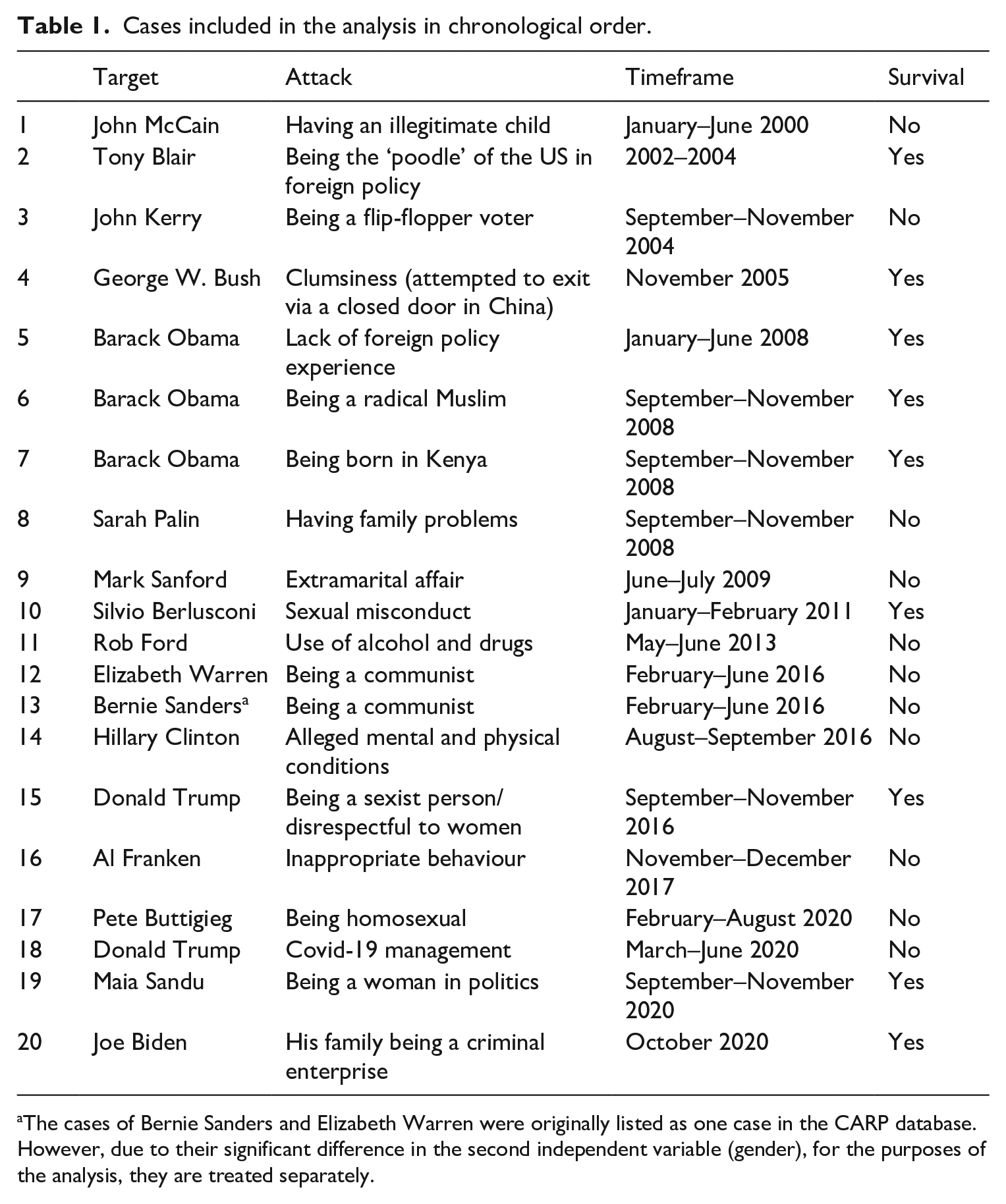
The cases of Bernie Sanders and Elizabeth Warren were originally listed as one case in the CARP database. However, due to their significant difference in the second independent variable (gender), for the purposes of the analysis, they are treated separately.
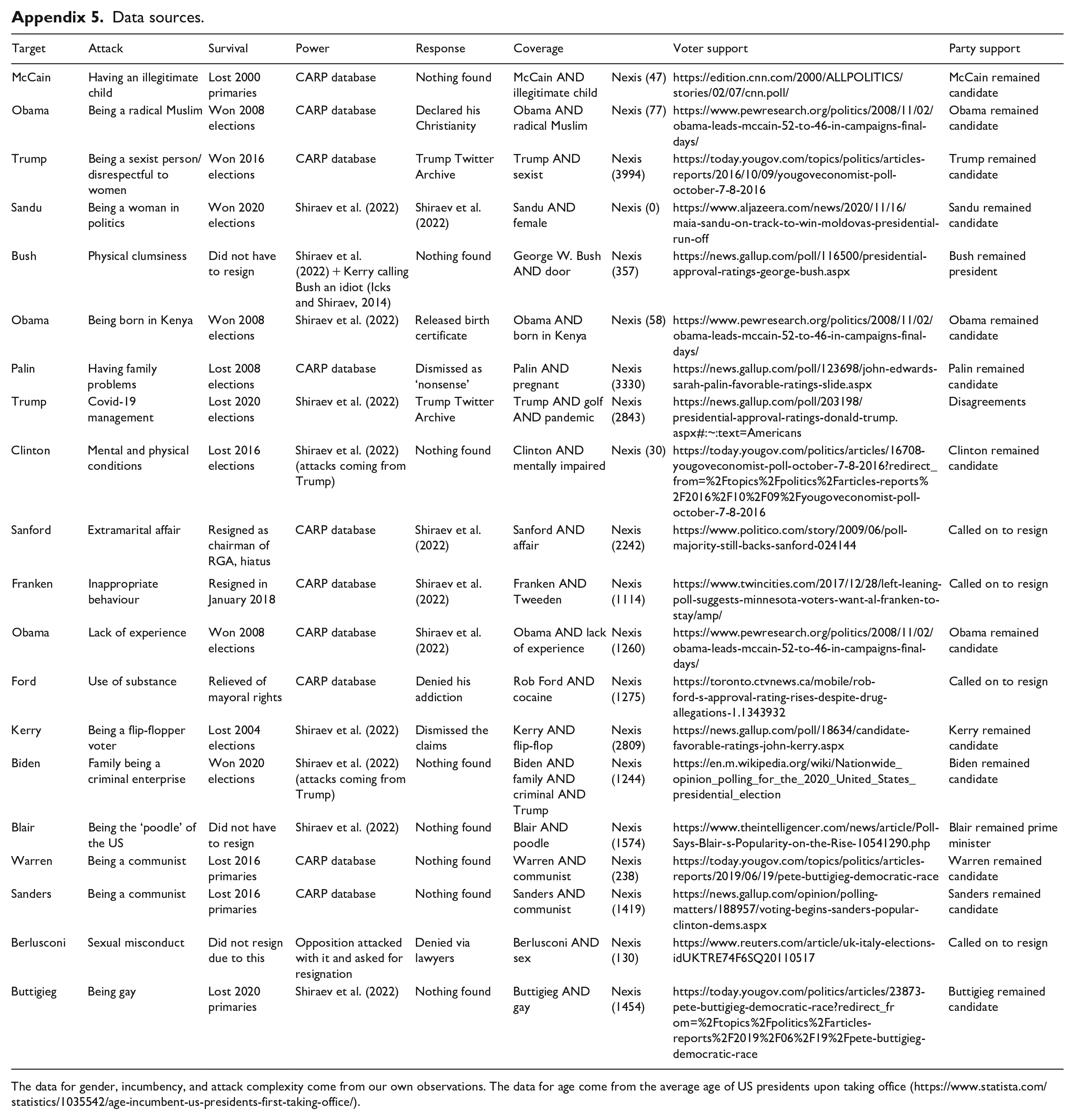
The variable measurement and coding are summarised in Appendix 1. Survival was measured based on the observation of the target and their political environment. If the target resigned or lost an election during or shortly following the character assassination attempt, then the case was categorised as a successful character assassination (no survival). If the target stayed in their position or won an election closely following the attack, then the case outcome was marked as survival. The data for gender, media coverage, voter support, age, and incumbency were drawn from secondary sources. For example, popular support was based on public opinion polls in each country before the assassination attack. Data for power relations, response to the attack, message complexity, and party support came from both primary and secondary sources. Besides consulting with Shiraev et al. (2022), for example, we assessed how politicians responded and whether their party supported them by looking at media reports about politicians’ actions, public speeches, and social media posts and their parties’ social media (Facebook and Twitter). This information was triangulated with the data available in the CARP database. Details on the sources of the data are set out in Appendix 5.
The content of the attacks in Table 1 is different. One might argue that character assassination cases based on sexual misconduct or criminal allegations are more impactful and memorable than attacks based on clumsiness. However, previous research argues that character assassination stems from the understanding of what the public wants to hear (Botan, 2017). The allegations must be credible, and thus the content is often irrelevant. It is difficult to know how people rank allegations and what is more important to them when assessing a politician’s performance. For example, we cannot infer whether George W. Bush’s attempt to go through a closed door could be judged harsher by the public than the allegation against Barack Obama lacking foreign policy experience. As such, we use a common model to explain the variation in the outcome of these cases because we cannot know what people want to hear and whether they perceive attacks as being different.
Once collected and coded, the data were analysed using QCA that combines techniques from qualitative and quantitative approaches, analyses a medium set of cases, and is case oriented (Ragin, 2008). It aims to identify causal explanations of an outcome – in this case, political survival – through the Boolean method of logical comparison (Halperin and Heath, 2020; Ragin, 2008). QCA, in this case, was carried out with the fsQCA software. The causal conditions, for which we formulated hypotheses to make them understandable by a broader audience, and the outcomes are presented in the ‘truth tables’. The presence of conditions is marked with capitals, and their absence with lower letters. For example, if a message is complex, then it is noted in the table and analysis as ‘COMPLEX’, while if it is simple (lacks complexity), we label it as ‘complex’. For details regarding the coding, see Appendix 1.
The truth tables include all the possible combinations of political survival for all cases (Ragin, 1987): Each row stands for one of the possible combinations of all conditions and outcomes (Schneider and Wagemann, 2012). In the minimised version of the truth table 1 for this study (Appendix 2), the outcome(s) can either be 1 = survival or 0 = no survival, which must be explained with reference to the causal conditions. For example, hypothetically, if we have three suspected conditions – A, B, and C – in a truth table, we can see how many different combinations of their presence (1) or absence (0) led to political survival if we look at all the cases where the target survived (S = 1). The conditions and the outcome then can be written down in a mathematical formula, such as S = A + B or S = A + C. Then, the redundant conditions (conditions that differ in each case with successful outcome) can be eliminated, which results in a solution of S = A. This means that political survival is in all cases dependent on the presence of condition A.
We tested for necessity before the analysis of sufficiency (Schneider, 2018; Schneider and Wagemann, 2010). A condition is considered necessary if both its consistency and coverage scores are above 0.75 (Ragin, 2017). The consistency score shows the strength of the relationship between the condition and the outcome (Ragin, 2006; Pappas et al., 2020). A high consistency score means that the condition is present in most cases. The coverage score shows the extent to which the condition explains the occurrence of the outcome. In our analysis of sufficiency, we used the parsimonious solution – which is a combination of conditions – that delivered the essential configurations (Ragin, 2008).
Analysis
The minimised truth table (see Appendix 2) allows several general observations that can help in answering the research question. In total, five combinations across six cases (rows 1–5) can be seen to lead to survival with 100% consistency. In all these combinations, ‘power’ was horizontal, that is, the attack came from a politically equal opponent. Another combination led to survival in two cases (Obama twice) but non-survival in one case (Al Franken) (row 6). Another combination led to survival in one case (Blair) but non-survival in another case (Sanders). The strongest combination of survival seems to be when the target is male and responds to the attack, as happened with Berlusconi’s sex scandal and Obama’s lack of foreign policy experience (row 1). There are 10 combinations that explain the 11 cases of non-survival, the strongest being when all the conditions apart from message complexity are present (see row 8 of Appendix 2). Only two of these combinations included horizontal power attacks; all the others were characterised by vertical power attacks. As such, horizontal power appears to make a difference with respect to survival. Out of the four selected cases involving female politicians, three resulted in non-survival. As for the conditions of ‘response’, ‘coverage’, and ‘complexity’, no obvious conclusions can be drawn based on the truth table alone. As such, a necessity and sufficiency analysis will be presented in the following lines.
Table 2 includes the necessity analysis for both survival and non-survival. With respect to survival, the analysis returned high consistency values for male targets (0.88), minor media coverage of the attack (0.77), and simple character attacks (0.77). The highest coverage score was that of ‘power’ (0.75), meaning that in 75% of the cases where the target survived, the attacker and the target were at the same level. Only Blair and Obama survived attacks from below. When explaining non-survival, the analysis returned high consistency values for vertical power attacks (0.81) and female targets (0.72). High coverage was observed for vertical power attacks (Al Franken, Mark Sanford, Rob Ford, Sarah Palin, Elizabeth Warren, John McCain, Bernie Sanders, and Donald Trump), female targets (Hillary Clinton, Sarah Palin, and Elizabeth Warren), and major media coverage (Mark Sanford, Rob Ford, Pete Buttigieg, Sarah Palin, John Kerry, Bernie Sanders, and Donald Trump).
Analysis of necessity for survival and non-survival.
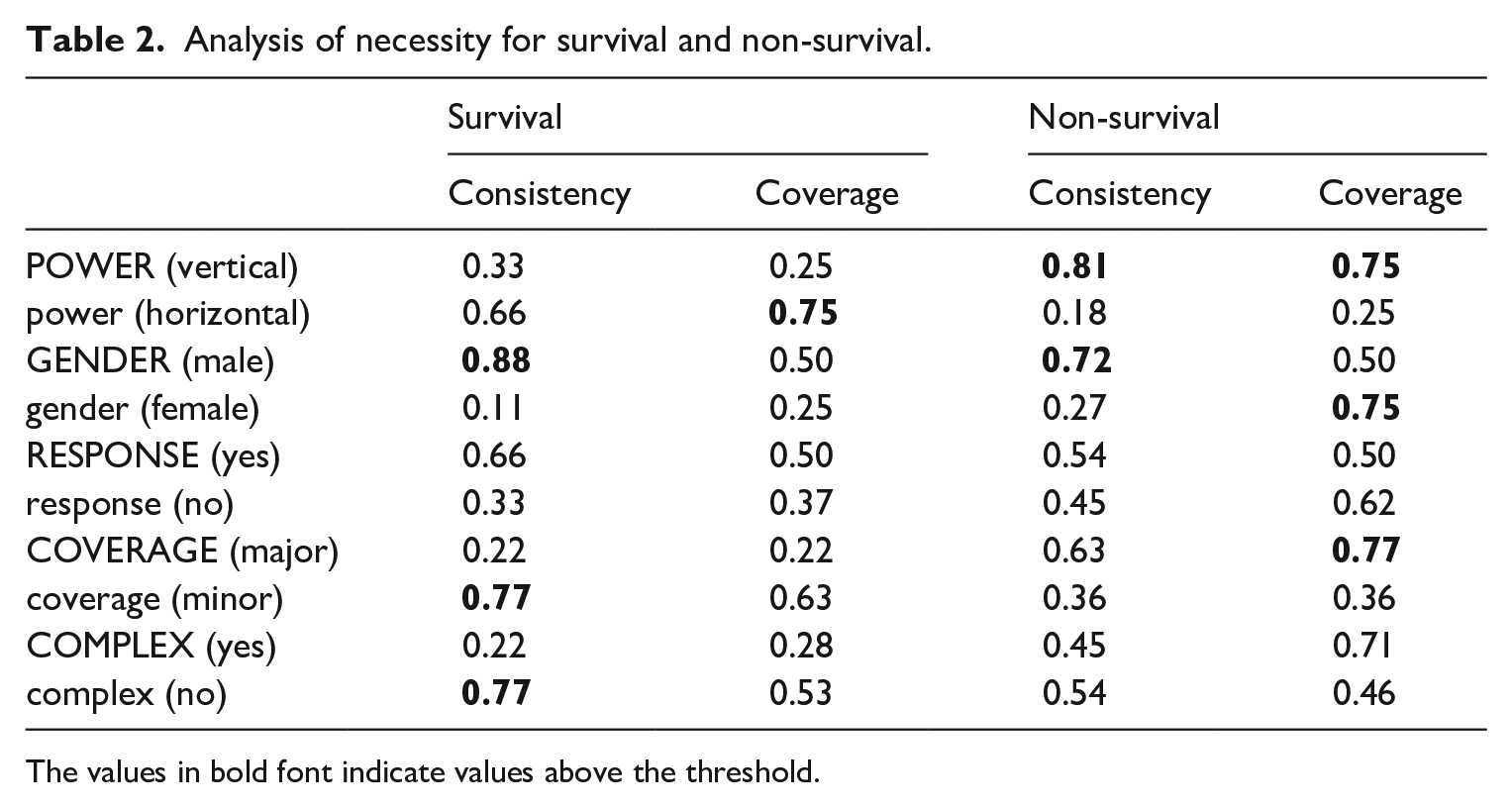
The values in bold font indicate values above the threshold.
These results indicate partial empirical support for two of our theoretical expectations. The following conditions are sufficient for the political survival of the targets: when the attack is directed at male politicians (H2), and it is simple and does not enjoy high media coverage (H4). There are four cases of character assassination with these characteristics: Berlusconi’s sex scandal, Bush’s door incident, Clinton’s mental health smear, and Obama’s lack of foreign policy experience. These all represent ‘cheap shots’ (Shiraev et al., 2022) that stem from the personal characteristics of the target or are sometimes displayed by accident, such as Bush’s door incident. Despite their entertainment value, they did not attract much media attention. None of the examined conditions is necessary for survival, but the presence of vertical power is necessary for non-survival. Accordingly, character assassinations are more likely to be successful if they come from anyone but a fellow politician. This goes against our first theoretical expectation (H1).
Next, we proceed to the analysis of sufficiency. The parsimonious solution (see Table 3) includes two combinations for political survival. Most conditions occurred in the analysis of necessity except for response to attack, which appears to matter in the first combination. Regarding this combination, political survival is possible if the target is on the same political level as the attacker, responds to the attack, and the attack is simple. Contrary to the theoretical expectations, many targets who respond to attacks survive the character assassination attempts. This combination explains 44% of political survival and includes the cases of Berlusconi, Obama (foreign policy), Sandu, and Trump (2016). Its consistency is perfect, which means that all cases which featured this combination resulted in survival. For example, Obama specifically responded to the attack that he lacked foreign policy experience by ‘suggesting that the best person to be answering an alarming phone call [. . .] was the one who had taken the ‘correct’ positions on Iraq, al-Qaeda, and nuclear disarmament – [. . .] Senator Obama’ (Shiraev et al., 2022: 138). In the second combination, survival is possible if the target is on the same political level as the attacker, the target is male, and there is limited media coverage of the attack. This solution also explains 44% of the cases, of which three overlap with the first solution: Berlusconi, Obama (foreign policy), and Trump (2016). Overall, these two combinations explain two thirds of the instances of political survival – some cases are explained by both.
The parsimonious solutions for survival.
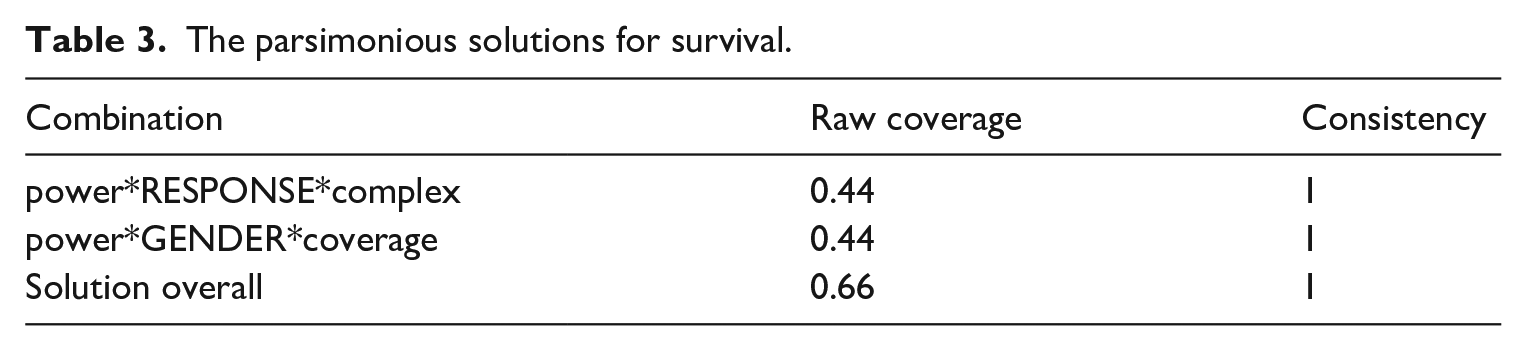
Both parsimonious solutions include ‘power’ (horizontal), which interacts with the presence of a response and the absence of complexity (solution 1), or male gender and minor media coverage (solution 2). Equation (1) explains 88% of the cases in our sample. This can be linked with the truth table (see Appendix 2) in which all political survival cases (‘SURVIVAL’) include ‘power’ as one of their conditions. Berlusconi, Bush, Obama (three times), Sandu, and Trump (2016) all survived character attacks by a politically equal opponent. The only ones who did not survive attacks coming from such opponents were Clinton and Kerry. In addition, almost half of the non-survival cases (coded ‘survival’) had vertical power (coded ‘POWER’). This is supplementary evidence confirming that politicians subjected to horizontal character attacks are more likely to survive character assassination than politicians subject to vertical character attacks. In contrast to previous conclusions (Benoit and Stein, 2021; Leighton, 2016; Shiraev et al., 2022), we find that it is more difficult to survive character assassination attempts when the attacker is a non-politician or if the attack comes from someone with greater political resources at their disposal.
The equation also indicates that simple attacks require quick responses for survival. In half of the examined cases, the attack was simple, and the target responded. Of these, 60% survived. For example, Obama faced two simple character assassination attempts during his 2008 presidential election campaign: He was accused of being a radical Muslim and of having been born in Kenya. He was quick to respond to each accusation, with the release of his birth certificate and the declaration of his Christian faith in a speech, respectively. Similarly, Trump responded via several tweets very soon after being accused of sexism. At the same time, Biden or Blair did not provide quick responses to their character assassination attempts based on complex stories. Biden’s foreign relations in Ukraine and Blair’s relationship with the United States are topics that require considerable knowledge and background information among the audience if they are to understand the attack. In their communication, Biden and Blair did not make this easier and avoided failure by ignoring complex attacks. In brief, the equation suggests that answering simple attacks and ignoring complex ones increases the chance of political survival. This evidence provides partial empirical support for H3 and H5.

The equation also provides empirical support for H2: Male politicians survive character assassination attempts more than female politicians. This is in line with previous findings suggesting that female candidates are susceptible to certain issue attacks and are particularly vulnerable to trait attacks (Cassese and Holman, 2018). Apart from Warren, the other female politicians covered by our analysis were attacked based on their personality and the fact that they are women. In many countries, the public continues to maintain stereotypes about male and female politicians having different issue competencies and priorities (O’Brien, 2019). Only one female politician (Sandu) survived her character assassination attempt. There is also empirical support for H4, according to which an assassination attempt with limited media coverage results in political survival. This is in line with previous findings explaining that attacks amplified by the media produce stronger effects on politicians (Herrick, 2000).
Controls
We ran similar analyses separately for the controls. The truth table is presented in Appendix 3, and the following lines describe the necessity analysis (shown in Table 4). Its results indicate that strong support from the target’s political party can ensure political survival (0.88). Among those who survived, Berlusconi is the only politician whose party withdrew its support. The necessity analysis shows that voter support, incumbency, and age have no effect on political survival or the success of a character assassination attempt (consistency and coverage scores well below 0.75).
Analysis of the necessity of the control variables.
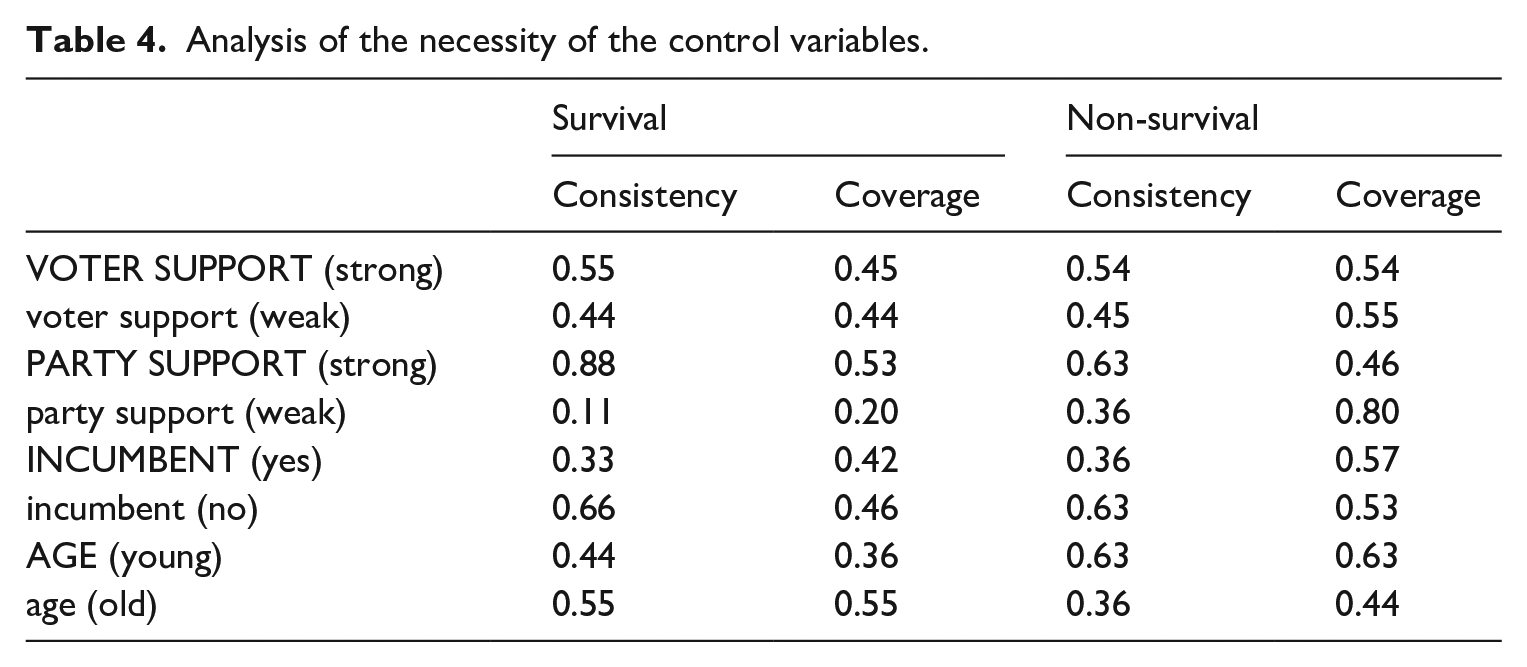
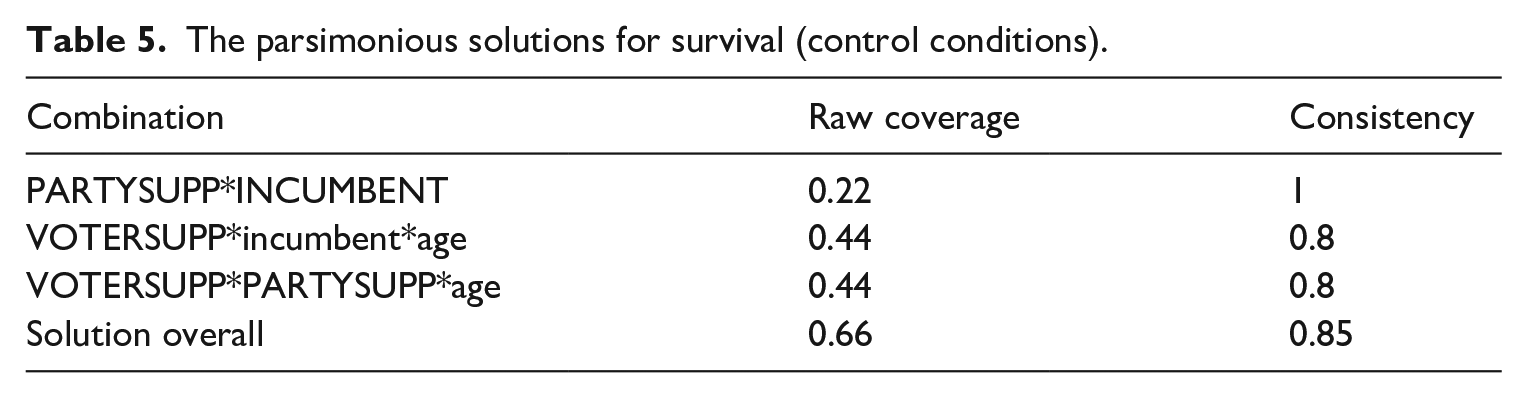
The parsimonious solution for the controls (see Table 5) shows that party support and voter support are present in two combinations each. Targets’ incumbency has a different effect on political survival depending on the interaction with two other variables: Some incumbents who have party support survive, while politicians in opposition who have voter support also survive. In addition, older politicians are more likely to survive. However, these variables had low scores in the necessity analysis, and as such, their overall effect on survival might be considered weak.
The parsimonious solutions for survival (control conditions).
We ran a final analysis with all the conditions (those from the hypotheses plus the controls) in the same truth table with all the prime implicants retained. This is presented in Appendix 4. The parsimonious solution of this analysis is presented in Table 6, and it confirms the previous findings: Horizontal attacks (‘power’) are included in four solutions, while vertical power (‘POWER’) is not included in any. The male target (‘GENDER’) is included in five solutions, while the female target (‘gender’) is included in none. The combination between response to attack and simple attack (‘RESPONSE*complex’) appears three times too. From among the control variables, the existence of party support appears to be conducive to survival in five combinations, and the support of voters in three.
The parsimonious solutions for survival (hypotheses plus control conditions).
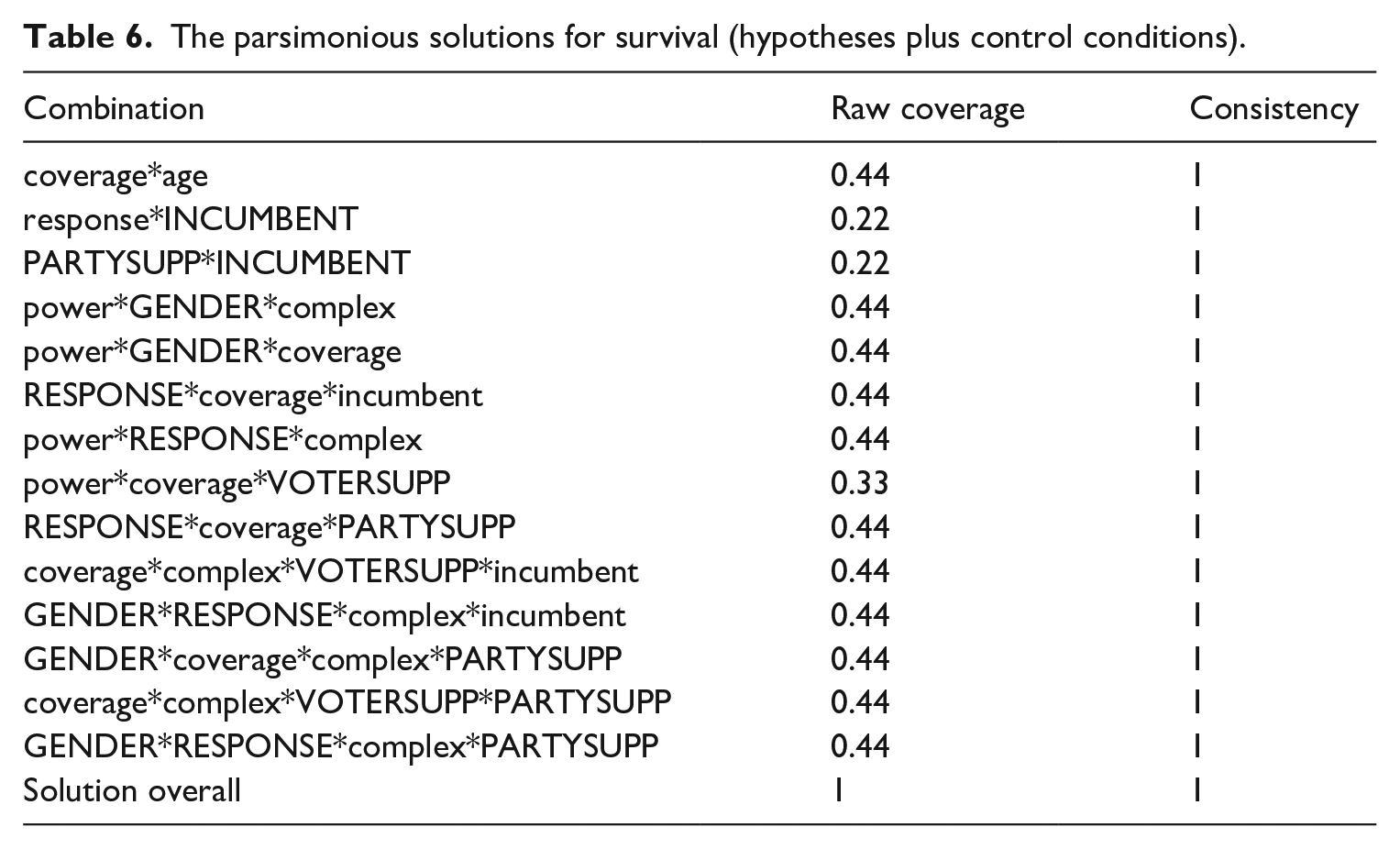
The following equation can be established based on the parsimonious solution of the truth table that includes both the actual and control conditions. The importance of the equal political power of the attacker and the target, being male, and responding to a simple attack while either being a challenger or being an incumbent with party support all stand out here too.

Conclusion
This article has aimed to identify the factors contributing to the political survival of the target after a character assassination attempt. The analysis covered 20 cases between 2000 and 2023, and the findings indicate that survival is more likely when the attacker is at the same level of power as the target, when the target is male and adjusts their responses to the attack, and when the media do not provide significant coverage to attacks. All these conclusions hold true when controlling for supplementary variables and checking for instances of non-survival. The findings about gender and media coverage are in line with previous conclusions (Cassese and Holman, 2018; Herrick, 2000), but we complement the literature by showing that complex attacks require no responses, and simple attacks require quick responses for survival.
We also contradict earlier findings that showed chances of survival to be higher if the attack comes from above or below (Klicperová-Baker, 2014; Leighton, 2016; Shiraev et al., 2022), and we illustrate that political survival is more possible in horizontal character attacks.
These findings have several broader implications for the field of study. First, at a theoretical level, this article enriches the analytical tools available to understand negative campaigning and survival. It provides a framework that brings together the characteristics of the attacker, the characteristics of the target, the characteristics of the message, and the context around the message. We illustrate its explanatory power, and we test its robustness against alternative explanations. This study can therefore be used a point of departure by future researchers, who can either apply it to a larger universe of cases or complement it with additional variables. Empirically, we illustrate the importance of power dynamics and responses to attacks for political survival. We show that survival depends on the nature of the attack and what the targets do rather than to personal characteristics (e.g. gender) or external factors over which the targets have no control. The ability to distinguish between simple and complex attacks and their differentiated treatment can lead to survival.
Beyond the usual criticism levelled at QCA about simplifying reality through its binary data and its crisp set analysis, the study has two important limitations. One of them is the inability to treat all the contextual information that could have contributed to the (non-)survival of politicians. There is a trade-off between the comparability of the data and the case-specific information that could have been included. For example, the influence of Berlusconi in the Italian public media could have also played a role in his survival. Similarly, Trump framing himself as a victim might have influenced the outcome of his case. Further research can account for the control over the media and content of response to the attack in order to cover a wider range of potential explanations.
Second, the analysis included many cases from established democracies, and its findings are relevant for this set of countries. Nevertheless, the number of democracies around the world is gradually shrinking – as Freedom House and V-Dem reports illustrate – and more cases from transition countries or hybrid regimes with a component of free and fair elections may be more generalizable. Also, the sample covered by our analysis includes few cases of women politicians. Although this matches well the share of female politicians in many established democracies, further research could expand the sample to include cases of more female politicians being under attack. Another potential avenue for further research could combine QCA with another qualitative form of analysis, as suggested in the literature (Halperin and Heath, 2020), to identify contextual elements of the character assassination cases. For example, the type of office, its importance in the political system or from people’s perspective, or a categorization of the content of attack could reveal important insights into the matter.
Footnotes
Appendix
Data sources.
| Target | Attack | Survival | Power | Response | Coverage | Voter support | Party support | |
|---|---|---|---|---|---|---|---|---|
| McCain | Having an illegitimate child | Lost 2000 primaries | CARP database | Nothing found | McCain AND illegitimate child | Nexis (47) | https://edition.cnn.com/2000/ALLPOLITICS/stories/02/07/cnn.poll/ | McCain remained candidate |
| Obama | Being a radical Muslim | Won 2008 elections | CARP database | Declared his Christianity | Obama AND radical Muslim | Nexis (77) | https://www.pewresearch.org/politics/2008/11/02/obama-leads-mccain-52-to-46-in-campaigns-final-days/ | Obama remained candidate |
| Trump | Being a sexist person/disrespectful to women | Won 2016 elections | CARP database | Trump Twitter Archive | Trump AND sexist | Nexis (3994) | https://today.yougov.com/topics/politics/articles-reports/2016/10/09/yougoveconomist-poll-october-7-8-2016 | Trump remained candidate |
| Sandu | Being a woman in politics | Won 2020 elections | Shiraev et al. (2022) | Shiraev et al. (2022) | Sandu AND female | Nexis (0) | https://www.aljazeera.com/news/2020/11/16/maia-sandu-on-track-to-win-moldovas-presidential-run-off | Sandu remained candidate |
| Bush | Physical clumsiness | Did not have to resign | Shiraev et al. (2022) + Kerry calling Bush an idiot (Icks and Shiraev, 2014) | Nothing found | George W. Bush AND door | Nexis (357) | https://news.gallup.com/poll/116500/presidential-approval-ratings-george-bush.aspx | Bush remained president |
| Obama | Being born in Kenya | Won 2008 elections | Shiraev et al. (2022) | Released birth certificate | Obama AND born in Kenya | Nexis (58) | https://www.pewresearch.org/politics/2008/11/02/obama-leads-mccain-52-to-46-in-campaigns-final-days/ | Obama remained candidate |
| Palin | Having family problems | Lost 2008 elections | CARP database | Dismissed as ‘nonsense’ | Palin AND pregnant | Nexis (3330) | https://news.gallup.com/poll/123698/john-edwards-sarah-palin-favorable-ratings-slide.aspx | Palin remained candidate |
| Trump | Covid-19 management | Lost 2020 elections | Shiraev et al. (2022) | Trump Twitter Archive | Trump AND golf AND pandemic | Nexis (2843) | https://news.gallup.com/poll/203198/presidential-approval-ratings-donald-trump.aspx#:~:text=Americans | Disagreements |
| Clinton | Mental and physical conditions | Lost 2016 elections | Shiraev et al. (2022) (attacks coming from Trump) | Nothing found | Clinton AND mentally impaired | Nexis (30) | https://today.yougov.com/politics/articles/16708-yougoveconomist-poll-october-7-8-2016?redirect_from=%2Ftopics%2Fpolitics%2Farticles-reports%2F2016%2F10%2F09%2Fyougoveconomist-poll-october-7-8-2016 | Clinton remained candidate |
| Sanford | Extramarital affair | Resigned as chairman of RGA, hiatus | CARP database | Shiraev et al. (2022) | Sanford AND affair | Nexis (2242) | https://www.politico.com/story/2009/06/poll-majority-still-backs-sanford-024144 | Called on to resign |
| Franken | Inappropriate behaviour | Resigned in January 2018 | CARP database | Shiraev et al. (2022) | Franken AND Tweeden | Nexis (1114) | https://www.twincities.com/2017/12/28/left-leaning-poll-suggests-minnesota-voters-want-al-franken-to-stay/amp/ | Called on to resign |
| Obama | Lack of experience | Won 2008 elections | CARP database | Shiraev et al. (2022) | Obama AND lack of experience | Nexis (1260) | https://www.pewresearch.org/politics/2008/11/02/obama-leads-mccain-52-to-46-in-campaigns-final-days/ | Obama remained candidate |
| Ford | Use of substance | Relieved of mayoral rights | CARP database | Denied his addiction | Rob Ford AND cocaine | Nexis (1275) | https://toronto.ctvnews.ca/mobile/rob-ford-s-approval-rating-rises-despite-drug-allegations-1.1343932 | Called on to resign |
| Kerry | Being a flip-flopper voter | Lost 2004 elections | Shiraev et al. (2022) | Dismissed the claims | Kerry AND flip-flop | Nexis (2809) | https://news.gallup.com/poll/18634/candidate-favorable-ratings-john-kerry.aspx | Kerry remained candidate |
| Biden | Family being a criminal enterprise | Won 2020 elections | Shiraev et al. (2022) (attacks coming from Trump) | Nothing found | Biden AND family AND criminal AND Trump | Nexis (1244) | https://en.m.wikipedia.org/wiki/Nationwide_opinion_polling_for_the_2020_United_States_presidential_election | Biden remained candidate |
| Blair | Being the ‘poodle’ of the US | Did not have to resign | Shiraev et al. (2022) | Nothing found | Blair AND poodle | Nexis (1574) | https://www.theintelligencer.com/news/article/Poll-Says-Blair-s-Popularity-on-the-Rise-10541290.php | Blair remained prime minister |
| Warren | Being a communist | Lost 2016 primaries | CARP database | Nothing found | Warren AND communist | Nexis (238) | https://today.yougov.com/topics/politics/articles-reports/2019/06/19/pete-buttigieg-democratic-race | Warren remained candidate |
| Sanders | Being a communist | Lost 2016 primaries | CARP database | Nothing found | Sanders AND communist | Nexis (1419) | https://news.gallup.com/opinion/polling-matters/188957/voting-begins-sanders-popular-clinton-dems.aspx | Sanders remained candidate |
| Berlusconi | Sexual misconduct | Did not resign due to this | Opposition attacked with it and asked for resignation | Denied via lawyers | Berlusconi AND sex | Nexis (130) | https://www.reuters.com/article/uk-italy-elections-idUKTRE74F6SQ20110517 | Called on to resign |
| Buttigieg | Being gay | Lost 2020 primaries | Shiraev et al. (2022) | Nothing found | Buttigieg AND gay | Nexis (1454) | https://today.yougov.com/politics/articles/23873-pete-buttigieg-democratic-race?redirect_from=%2Ftopics%2Fpolitics%2Farticles-reports%2F2019%2F06%2F19%2Fpete-buttigieg-democratic-race | Buttigieg remained candidate |
The data for gender, incumbency, and attack complexity come from our own observations. The data for age come from the average age of US presidents upon taking office (https://www.statista.com/statistics/1035542/age-incumbent-us-presidents-first-taking-office/).
Funding
The author(s) received no financial support for the research, authorship, and/or publication of this article.
