



Abstract
The Plymouth shooting in August 2021 attracted worldwide attention after media outlets reported on it as ‘incel violence’. By examining misogynist incels’ discussions of the shooting, the perpetrator’s YouTube videos, and media reportage by five UK newspapers, this article takes a critical look at newspapers’ representations of the shooting. While the perpetrator did not unambiguously self-describe to the incel identity, and misogynist incels were divided on the perpetrator’s incel status, the newspapers saw the attack as the spread of ‘incel culture’. This indicates that the media plays a role in the public imagination of misogynist incels. The article argues that the concept of incel violence risks overshadowing other forms of misogynistic violence in society through how the misogynist incel is imagined in public discourse which, consequently, impacts our understanding of misogyny. This article contributes to our understanding of how public discourse forms representations of gender-based violence in Britain.
Introduction
On 12 August 2021, a 22-year-old man in Plymouth, UK, 1 shot his mother in their home and then went on to shoot another six people, including himself. The shooting spree resulted in the deaths of Maxine Davison (51), Sophie Martyn (3), Lee Martyn (43), Stephen Washington (59), and Kate Shephard (66) (BBC, 2021). News reports suggested that the shooting demonstrated that ‘incel culture’ was spreading (Topping, 2021), a concern raised in the media both prior to (Beckett, 2021; Tobin, 2021) and following the shooting (ITV News, 2022). However, when, whether, and why the label ‘incel’ is used is far from straightforward. Especially, since it is usually a form of self-identification. Thus, there is a tension between the ‘self-’ and ‘identification’ in how we approach the incel community, and understand its reach. Indeed, how the term is understood in public discourse has implications for how we treat and understand the politics of misogyny and gender-based violence – two important areas for political actors and scholars of politics. And yet, despite its importance, the topic of incels has hitherto received little attention from politics scholars. Following political theorist Judith Squires’ (2000: 1) assertion that it is the work of gender theory to ‘unsettle established conventions about the nature and boundaries of the political’, this article stresses the importance of examining the political dimensions of how misogynistic violence is understood and interpreted in contemporary society.
This article builds on the growing feminist and gender scholarship examining misogynistic violence and the misogynist incel (MI) community (Bratich and Banet-Weiser, 2019; DeCook and Kelly, 2022; Ging, 2017; Kelly et al., 2022; Manne, 2018; Tranchese and Sugiura, 2021) by exploring how mainstream media outlets (here, five British newspapers), MI forums, and individual perpetrators contribute to the (re)making of the MI identity. Specifically, the article takes as its focus the shooting in Plymouth in order to address three inter-related questions that can better help us understand the idea of ‘the incel’ and ultimately gender-based violence: (1) How did MIs respond to the shooting and the perpetrator? (2) how did the shooter describe his own identity? and (3) how did five major British newspapers report on the Plymouth shooting? The research finds that the newspapers assigned the Plymouth shooter an incel identity, while the views of the MI community were mixed and the perpetrator did not unambiguously self-identify as an incel, thus raising further questions about the use of the term and the role of the media in constructing ‘the incel’ in the public imagination. This article does not provide an exhaustive perspective of all news coverage of the Plymouth shooting or incels; nevertheless, the analysis presented is indicative of reporting trends on incels. I conclude this article by stressing the risk in assigning the perpetrator of the Plymouth shooting an incel identity, as it has potential implications for future misogynistic attacks.
This article emphasises the importance of analysing different media outlets’ coverage of ‘incel violence’ and the danger of such violence being ‘elevated’ in public consciousness as the ‘paramount expression’ of misogynistic violence. This framing may serve as a recruitment drive to the MI community for like-minded people and reinforce a hierarchy of perpetrators and victims of misogyny. Indeed, socially gendered violence is crucial to investigate to understand how institutional and systematic political processes are reinforced through the constraints or malleability of identities (Squires and Weldes, 2007: 195–196, 198). As such, the exploration of how media outlets shape our perception of the Plymouth shooting and MIs is vital for understanding contemporary politics of gender in the United Kingdom. The article is structured as follows: first, I give an overview of the extant literature on the MI community; second, I set out the methods adopted for this study; third, I analyse MIs’ discussion of the Plymouth shooting, the Plymouth shooter’s YouTube videos, and the news coverage of the shooting. Finally, I consider the implications of the news reporting and its effect on the incel identity and our understanding of misogynistic violence.
Incels: What’s in a name?
Since the 2018 Toronto Van Attack, the term ‘incel’ has been in regular media circulation. However, it is worth stressing that there are several different interpretations of ‘incel’. For example, the MI community is a cis-gender, heterosexual, men-only community or movement that shares and advocates male supremacist ideology (Kelly et al., 2021). Meanwhile, the concept of identifying as an incel has a queer, and non-extremist, beginning, coined by a bisexual woman (Love, Not Anger, 2019) and has been used in sexuality studies to understand the differences in perceived involuntary celibacy (Donnelly et al., 2001). However, media outlets such as newspapers and TV broadcasts, which seldom specify which incels they are discussing, tend to focus on MIs (Byerly, 2020: 298; Kelly et al., 2021). Even within the MI community, opinions differ over who is considered an incel. The misogynist, or Blackpill, incel is commonly described as a man who blames his involuntary celibacy on his rejection by women due to feminism and the creation of a ‘gynocentric society’ – a society in which women control the ‘sexual market’ and wield disproportionate power over men (Bates, 2020: 19). In this article, I understand misogyny as a concept that ‘. . . ought to be understood as the system that operates within a patriarchal social order to police and enforce women’s subordination and to uphold male dominance’ (Manne, 2018: 33), a system that
. . . always entails some form of harm; either directly in the form of psychological, professional, reputational, or, in some cases, physical harm; or indirectly, in the sense that it makes the internet a less equal, less safe, or less inclusive space for women and girls’ (Ging and Siapera, 2018).
Within scholarly studies of MIs, there are four main dimensions: gender and masculinity, technology, identity, and violence. The research on incels, gender, and masculinity has discussed MIs’ language, masculine norms, and fantasies of committing gender-based violence (Scaptura and Boyle, 2020). Studies have highlighted the reinforcement of Western hegemonic masculinity (Daly and Reed, 2021; Myketiak, 2016) – a type of masculinity which serves as a culturally specific normative framework exhibited and inhibited by a minority of men (Connell and Messerschmidt, 2005: 832). There have also been studies examining how incels are engaged in media and technology. For example, Horta Ribeiro et al. (2021) analyse moderation practices in MI online communities, while Preston et al. (2021) look at MIs’ relationship with modern technology, such as dating apps. Research has also found that social media algorithms facilitate accessibility to MI content (Papadamou et al., 2021). At the broader level, the making of incel identity has been studied (Hintz and Baker, 2021), such as how the emergence of the MI community is due to neoliberalism’s failure to deliver the promised trope of individual ‘self-confidence’ (Bratich and Banet-Weiser, 2019). In addition, there have been efforts to psychoanalyse parts of the MI community (DeCook, 2021; Johanssen, 2022), and incels’ mental health and risk of self-harm have been of increasing interest (Shrestha et al., 2021). Yet, the topic that has attracted the most attention concerns evaluating MIs’ potential for violence and acts of terrorism (DeCook and Kelly, 2022; Gentry, 2022; Hoffman et al., 2020; O’Donnell and Shor, 2022; O’Malley et al., 2022).
Less attention has been paid to how different media outlets narrate the stories of incels and the violence committed by MIs. Indeed, only a few academic works have discussed this. For instance, Byerly (2020) has examined news media’s language around incels’ behaviour online finding that social media is influencing the promotion of MI violence. Indeed, Solea and Sugiura (2023: 313) contend that the hybridisation of misogynistic ‘new’ incel ideas and ‘old’ sexist tropes are popularised and normalised via the social media platform TikTok. Manne (2018: 37) mentions the trend in news reporting on the mass murder by an MI in Isla Vista in 2014, 2 stating that some news outlets (there among The Guardian) framed the attack as committed by a ‘madman’ or a man who suffered from social isolation, sexual frustration, and mental illness. This trend has also been identified by Pruden (2021: 190–195) in her study of US news dailies’ coverage of other American MI mass killers, where the news dailies facilitated MIs’ view of their violence as ‘retributive violence’. Indeed, Bates (2020: 11) states that when MIs pop up in news reporting, they are commonly dismissed as ‘a tiny fringe group of online weirdos’, a dismissal which Doyle (2018) means originates from pop cultural representations of ‘Pick-Up Artists’ 3 that have been mainstreamed through TV shows such as ‘The Pickup Artist’ on VH1 in the late-2000s and How I Met Your Mother, and coverage in magazines framing them as peculiar seductors rather than men who manipulate women (and male wannabes) to take part in sexual acts or to mimic their ‘success’.
Jasser et al. (2020) have found that some media outlets tend to be quick to call the assailants of right-wing extremist attacks incels, which, in turn, serves to trivialise the complex relationship between white supremacy, male entitlement, and misogyny, as well as to portray MIs as something out of the ordinary. Moreover, a study by Kelly (2021) illustrates recent attempts by MIs to eradicate the misogynistic and violent label of MIs and their online community by engaging with mainstream and social media outlets. Pruden (2021: 193) cautions us about MIs’ tactical engagement with the media, such as through interviews with newspapers and podcasts, to create a culture of notoriety for (MI) mass killers. Indeed, the media 4 plays an important role in shaping public perception and imagination (David, 2022: 334–335, 337; Hoffman, 2013; Iyengar and Kinder, 2010; Miller et al., 1979). Furthermore, scholars emphasise the important role of the media in shaping the public’s interest and perception of political violence (Ajakaiye et al., 2021; Nacos, 2002; West and Lloyd, 2017). Conway and Scrivens (2019), for example, note that the more publicity a terrorist campaign attracts in news coverage, the greater its chances for longevity (Conway and Scrivens, 2019: 305). Thus, the question of how MIs and their violence are talked about in news coverage is an important issue to explore to understand contemporary gender politics. Indeed, the few studies on MIs and their relation to different media platforms point to the increasingly important role of investigating newspapers’ relationship to maintaining MI identity and violence – and how this may affect policy-making on gender-based violence.
This article adds to the growing research on MIs and their identity, the politics of misogyny, as well as to our knowledge of the media’s framing of incels. Similar to Kelly’s (2021) research, I find that news coverage portrays MIs as failing to love and be loved, which subsequently trivialises their violence as symptoms of mental ill-health and validates their state of ‘involuntary celibacy’. I also argue, in line with Jasser et al. (2020), that media reporting on MIs shows tendencies to equate extreme acts of misogynistic violence to ‘incel violence’ which, in turn, risks obscuring forms of misogynistic violence by perpetrators that do not neatly align with a perceived incel identity. As such, I argue that misogynists, including MIs, benefit from these framings because they both legitimise the MI community and obscure some misogynistic violence. Being ‘an incel’ may thus become a way to instrumentalise or denounce one’s involvement in misogyny. Before providing the empirical analysis, I now set out the methods used to undertake this study.
Methods
I have adopted a multi-methods approach: analysing an online MI forum, the YouTube videos produced by the Plymouth shooter, and newspaper coverage of the shooting. The first stage of the research involved analysing 13 threads on the largest MI-only forum 5 that discussed the Plymouth shooting, 9 of these contained sufficient comments and information to be considered for analysis. 6 This forum was chosen not only for its open access, but also because it has proven to be resilient in terms of potential shutdowns: since it is administrated and owned by MIs rather than hosted on another social media platform with externally governed community guidelines (such as Reddit), MIs do not need to worry about complying with rules that they do not support and thus have greater control on the survival of the forum. The open-access forum comprises of, at the time of data collection, three different sub-forums (members-only access to the website includes more features and places to communicate). The thread with the latest activity (e.g. a new comment has been made) appears at the top of the subforum. There is also a section of each subforum with ‘pinned’ threads that the moderators and administrators decide to add or remove. Pinned threads tend to garner more engagement due to their visibility. More ‘popular’ MIs on the forum tend to get their threads pinned more often, such as the content produced by the moderators.
The data from the online forum were gathered through systematic digital ethnographic observations which I had started in September 2021, with an intentional back-track to the 12th of August 2021. For this article, I also did an active search through different search engines (Google and DuckDuckGo) on the 2nd of March 2022. Collating data from the MI forum in this way enabled me to ensure that all threads dedicated to discussing the Plymouth shooting were found since the forum is very active with several new threads and comments added every hour. I also used further search words, such as ‘Plymouth’, ‘Plymouth Shooting’, ‘[Full name of the perpetrator]’, ‘[Surname of the perpetrator]’, ‘[Common misspelling of the surname of the perpetrator]’, and ‘UK Shooting’. I chose to not use any digital scraping tools for this part of the analysis as the data gathered from the MI forum build on a qualitative digital ethnographic method for capturing data that is part of a broader ongoing project. However, people interested in further analysis of the impact the perpetrator has had on this particular MI community may find it useful to use scraping tools to find potential mentions of the Plymouth shooting and the perpetrator in passing-by comments on threads that do not solely discuss the attack, as well as discussions that have taken place after the time of my data collection. Important to note is that the number of discrete users on this forum is currently impossible to ascertain due to security measures taken by both the administrators of the forum and users themselves (such as altering IP addresses by using VPNs). As a result, MIs’ nationalities are unknown.
The second element of the research involved analysis of the perpetrator’s YouTube videos. The videos, eight in total, are a mix of four training videos where the perpetrator is lifting weights, a video where he is uploading a storyline from a computer game, and three monologues. These were analysed to assess the perpetrator’s political ideology and see whether any beliefs or comments were similar, or outright in line with, the ideology expressed in MI communities.
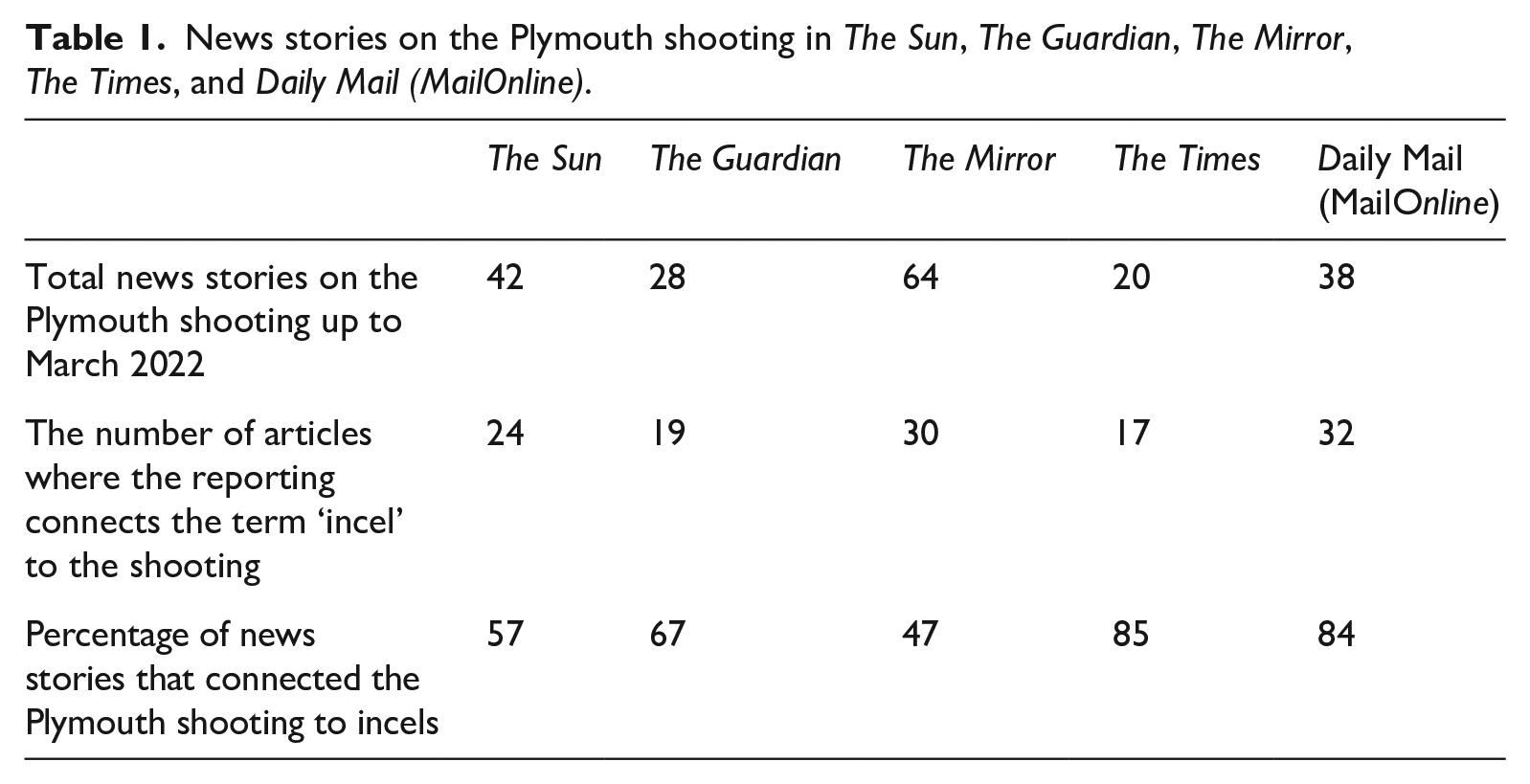
Finally, the third element of the research involved analysis of five daily newspapers, The Sun, The Guardian, The Mirror, The Times, and Daily Mail (Mail Online) chosen for a number of reasons. All of these newspapers are well-established with significant political power: The Sun was launched in 1969 (The Sun, 2019), The Guardian has been in the press since the 1820s (The Guardian, 2022), The Mirror has been in press since 1903 (The Mirror, 2023), The Times was established in 1785 (The Times, 2019), and Daily Mail was launched in 1896 (Encyclopedia Britannica, 2024). All have a wide readership, The Sun reaches over 28 million readers monthly, The Guardian reaches over 19 million readers monthly, The Mirror reaches over 32 million readers monthly, The Times reaches around 15 million readers monthly, and Daily Mail reaches over 36 million readers monthly (Newsworks, 2022a, 2022b; Statista, 2022a, 2022b, 2022c). Importantly, the papers reach different audiences. For example, The Sun has a wider readership among the older generations, particularly Baby Boomers, while The Guardian has a wider readership among Millennials and Generation X (YouGov, 2021). Finally, they all have different political leanings: two are right-leaning tabloid newspaper (The Sun and Daily Mail) with a history of sexist media reporting, one is a left-leaning tabloid newspaper (The Mirror), while the other two are broadsheets, one left-leaning (The Guardian) and one right-leaning (The Times) which enables analysis of how different political news outlets engage with stories on (misogynist) incels (Smith, 2017). To understand how the newspapers covered the shooting, I used the software tool LexisNexis to search for all articles from the date of the Plymouth shooting (12 August 2021) to the time of data collection (15 March 2022), with the search words ‘Plymouth shooting’. This search resulted in 42 relevant articles from The Sun, 28 relevant articles from The Guardian, 64 relevant articles from The Mirror, 20 relevant articles from The Times, and 38 relevant articles from Daily Mail. 7
I then read all the articles and coded them using a number of themes which emerged from the data (discussed below), paying extra attention to the articles where ‘incel’ was mentioned and discussed, but also looked at the terms applied to the perpetrator and the content covered on the perpetrator that did not discuss the shooting in relation to incels. The objective was to see how they talked about incels and the perpetrator: what words were used in addition to incel and the perpetrator, as well as whether and how they related incels to the shooting. I then synthesised my findings from the reporting into three main themes based on the terms used in association with the shooting. The main themes identified were ‘incel violence’, ‘deviancy’, and ‘loneliness & lovelessness’. Incel violence applied to all articles labelling any violence in relation to the shooting as ‘incel’, or which connected the perpetrator to incels and therefore assumed a connection to the violence. Deviance applied to articles that noted some sort of particularity of the violence committed by the perpetrator, such as that the violence occurred because he had mental health issues or previous history with the police, and descriptive terms of the perpetrator that implied an abnormality to social norms, like ‘crazy’ and ‘monster’. The theme loneliness & lovelessness applied to articles that explained, or emphasised, the (incel) violence as the result of loneliness or lovelessness. Of course all these themes could be found in one individual article; conversely, there were a very small number of in which none of these themes were identified. For example, a breaking news article about the shooting was not categorised into these themes since it only reported that a shooting had happened. The great majority of the articles were coded into the main three themes as context and information about the shooter surfaced quickly. In the following sections, I go through these three sources of data. First, I provide information from the discussions on the MI forum, followed by the content of the perpetrator’s YouTube videos, and then conclude with analysis of the newspapers’ reporting and its implications.
How did MIs perceive the Plymouth shooting?
MIs discussed the Plymouth shooting and perpetrator in two ways, which both concerned the political and aesthetic character of the perpetrator. In their discussions, they used reports by different news media outlets, the perpetrator’s YouTube videos, and their own opinions to justify their judgements. First, they dismissed that the attack was an MI attack as the perpetrator did not directly state that he did it in the name of an MI ideology; moreover, the perpetrator was considered by some to be too good-looking to be an incel. Second, and conversely, some MIs celebrated the attack and thought the perpetrator looked ‘incel adjacent’. In other words, MIs differed in their perceptions of the perpetrator’s incel identity. However, previous research has found that the MI community uses ambivalence as an instrumental strategy to denounce potential violence that can be connected to the community, such as celebrating cases of shootings linked and unlinked to the MI community. As such, the celebration of violence is portrayed as a general, rather than targeted, practice in the community. This serves to remove their responsibility for the violence but also as a recruitment drive to attract attention to the community (Kelly, 2021; O’Donnell and Shor, 2022: 337; Pruden, 2021).
Analysing MIs’ engagement with news media sources illustrate how MIs are interested in reading the news published on their community and that they want to ‘correct’ the way news coverage portrays them (Pruden, 2021). Most of the threads commenting on the Plymouth shooting were made the day after the shooting. In one thread, a popular moderator on the forum commented on how media outlets, referencing the BBC and some Reddit threads, were classifying the Plymouth shooting as terrorism: the MI disagreed with this classification. In turn, several MIs expressed resentment for ‘the media’s’ (specifically, sharing articles by Sky News and Vice) and ‘Redditors’ (a name for people using Reddit) inclination to blame violence on MIs. Although the moderator tried to deflect the violence from MIs, three members praised both the perpetrator and the shooting, which also happened in other threads (13 August 2021d); including the sharing of the perpetrator’s YouTube videos (13 August 2021a), and comparing his act of violence to that of another idolised MI attacker (the Isla Vista attacker) (13 August 2021b). As such, there was an ambivalence to the assailant as an MI. Indeed, in another thread, three MIs sympathised with the assailant’s struggle to find a girlfriend. But some also dismissed his struggle since they judged him to be too attractive to be an incel. Further concerns were raised about how the community was described in the media which shows an awareness by the community of their mainstream reach. One of the threads, for example, also engaged directly with articles by The Sun and Metro (13 August 2021c). Other MIs raised questions regarding the victims of the Plymouth attack (13 August 2021e), expressing sympathy for the child that was murdered (12 February 2022) and wondering why he did not target attractive women (14 August 2021a; 14 August 2021b). There was also discussion that the United Kingdom is a bad place for an MI to live due to the public engagement in the news about inceldom being terrorism (25 January 2022).
The observation of MIs’ discussions on the perpetrator yielded a contradictory response, an ambivalence, to whether the MIs thought the perpetrator belonged in the community. In comparison with the discussions and praise given to the Isla Vista attacker, the Plymouth attack has not gathered the same attention (as of yet). Indeed, feelings of rejection have been used by non-incel men in the past as reasons for mass shootings, so it is possible that the perpetrator was not an MI (Scaptura and Boyle, 2020: 282). Nevertheless, the perpetrator and his violence were raised on the forum several times in relation to inceldom which reflects common practice in the MI community – to equate unattractive virgin men to ‘incels’, thus assigning the incel identity onto some men involuntarily through memefication (Brooke, 2022: 10–11). This process serves to trivialise their misogyny and political identity (Lagerwey and Nygaard, 2020), but also to maximise their reach. Thus, ‘the incel identity’ appears malleable in the MI community. To further explore the political identity of the perpetrator, the article now examines the content of his YouTube videos.
Before the Plymouth shooting: The perpetrator’s YouTube videos
The assailant’s videos show that he was aware of MIs and their grievances, as well as their discourse and related violence, and that he wanted to share his physical prowess and/or progress. Of the eight videos found on the perpetrator’s YouTube channel, three of these were videos of him working out, one was of a computer game, and in three of the videos he expressed that he was upset about not having a girlfriend. Nevertheless, when he mentioned (misogynist) incels, he distanced himself from them. As such, if we follow the idea that MIs, as well as other incels, need to commit to the identity and ideology through self-identification, the Plymouth shooter may not have been an MI. Nevertheless, we are yet to see what police investigations have to say on the matter and whether the shared narratives the perpetrator had with MI communities are enough to call it ‘incel violence’. In the next paragraphs, I illustrate and analyse briefly how the perpetrator talked about his situation, identity, and politics.
In three of the videos, he recorded himself doing bench presses (2021d), deadlifts (2021e), and shoulder presses (2021f). In another video, we see a first-person shooter video game that storylines vengeance and uses terms such as ‘Alpha’ 8 and ‘subhuman’ 9 (2021g), terms found in the MI community (Daly and Reed, 2022: 22; Ging, 2017: 640), but not exclusively. In two of the video-monographs, he discussed how he feels financially disadvantaged, finds it hard to socialise, and to find romantic love (2021a, 2021b). These videos align with expressions in MI communities, as well as mainstream idealisations of masculinity, that endorse a masculine body that is physically strong and sexually active (Vito et al., 2018: 93–94). The videos also endorse MIs’ tendency to self-victimise, a process also seen in the Isla Vista 2014 shooter’s ‘manifesto’ (Witt, 2020: 679), where they centre the role of the romantic partner as the solution to ‘becoming a man’ – and therefore assign the romantic partner as the main problem and thus obstacle to ending their involuntary state of being ‘loveless’ (O’Malley and Helm, 2023: 1038). 10
The partner as the solution and problem is found in one of the perpetrator’s other videos. In this video, he said that it would be difficult to find love as an adult because of what she will be (in)capable of feeling. He expressed that women are less capable to feel due to being ‘broken down’ by previous partners, ‘Chads’ (2021b). In addition, we observe some MI terms being used such as ‘Chad’ 11 and the Blackpill 12 (2021c), and direct references to MIs: The perpetrator talked about incels as dealing with unfulfilled sexual and romantic desires, particularly how their way of ‘coping and deluding themselves’, made sense to him. However, he only talked about MIs as ‘them’. He also said that the ‘black pill doesn’t just apply to incels’. Hence, while he shared many similarities with MIs, he distanced himself from the community. The distancing indicates that he did not, at least publicly, identify as an incel. Since the perpetrator did not directly self-identify as an incel, the analysis of the videos leaves us with two possible conclusions: first, the ideology of MIs is not necessarily distinct from general misogyny, and/or finally, MI’s ideology is in the process of mainstreaming (Czerwinsky, 2023; Solea and Sugiura, 2023).
So far, considering the discussions on the MI forum and the content of the perpetrator’s YouTube videos, we find a mixed picture. The perpetrator did not self-identify as an incel yet espoused views commonly found in MI forums; meanwhile, some MIs would recognise him as an MI while others would not. In other words, it is not axiomatic that the perpetrator would or should be considered an MI. However, when it came to the news reporting in The Sun, The Guardian, The Mirror, The Times, and Daily Mail, there was no ambiguity.
An overview of British newspaper reporting on the Plymouth shooting
The Sun, The Guardian, The Times, The Mirror, and Daily Mail all labelled the Plymouth shooting an example of ‘incel violence’. Furthermore, they also emphasised the perpetrator’s perceived state of being lonely and loveless – and his deviance from British society. As more information was revealed by the newspapers or other news sources, the more they stayed with the Plymouth shooting as an atrocity committed by a lonely and loveless MI.
As the data in Table 1 indicate, the majority of pieces on the Plymouth shooting did mention the term incel at least one time per article, except for the reporting by The Mirror where the percentage was slightly lower. The reporting on the shooting and the inclusion of ‘incel’ and accompanying information around the incel community suggests that the perpetrator is connected to incels. Furthermore, the connection between the perpetrator and incels suggests that these newspapers framed the Plymouth shooting as an attack made by an incel. Nevertheless, the content published along with the designation of the attack as ‘incel’ is important to investigate to better understand how the violence is portrayed in public discourse. Most articles by The Sun, The Guardian, and Daily Mail about the Plymouth shooting were published in the week that the shooting took place, 12 August 2021. Almost all the articles published by The Mirror and The Times were published that week too. Indeed, of the 192 articles published by these five major British newspapers, 159 were published between 12 and 19 August 2021. Considering the sheer amount of articles published on the atrocity, it suggests that the interest taken by news editors and the reach of news to the public were extensive. As such, I now outline the main themes of the reporting to deepen our understanding of how the Plymouth shooting was portrayed by these newspapers. The themes I have identified are ‘incel violence’, deviance, and loneliness & lovelessness. 13 The synthesisation of the reporting is followed by an analysis of how the foci of the reporting affect our perception of misogyny and the incel identity.
News stories on the Plymouth shooting in The Sun, The Guardian, The Mirror, The Times, and Daily Mail (MailOnline).
‘Incel violence’
The first theme identified in the reporting by the newspapers is the tendency to describe the perpetrator and his actions as simultaneously violent and incel. All newspapers reported that the perpetrator likened himself to a ‘Terminator’ (Brown et al., 2021; Christodoulou et al., 2021; Ungoed-Thomas, 2022). Furthermore, other labels connected to violence described the perpetrator as a ‘killing machine’ (Christodoulou et al., 2021), ‘incel shooter’ (Gant, 2021a), and ‘misogynist gunman’ (Humphries and Hamilton, 2021a, 2021b). All newspapers also came to identify the perpetrator as incel (e.g. Coles, 2021; Fielding, 2021b; Hern, 2021; Shadwell, 2021; Wearmouth, 2021) and connected to ‘incel culture’ (e.g. Duell, 2021; Feehan, 2021; Fuller, 2021; Gant, 2021b).
The violence discussed extended to the online and offline realms. The Guardian reported that the assailant had been glorified by incels on their forums and that his attack could serve as a ‘recruitment drive’ (Quinn, 2022). Daily Mail stated that ‘[t]here has been a six-fold rise in UK web traffic to websites promoting “incel” culture’ (Gant, 2022). The perpetrator’s link to the incel community was clear to the newspapers. The Mirror and The Guardian reported that the perpetrator had discussed or been part of the incel movement (Penketh-King and Merrifield, 2021; Weaver and Morris, 2021). The newspapers also emphasised the ‘terroristic’ aspect of the shooting (Smith, 2021). Although, The Times reported that the ‘deputy senior national co-ordinator for UK counterterrorism policing, said that . . . [the perpetrator] was not motivated by the misogynistic incel online movement’ (Hamilton, 2021b), they also raised concern about the networked potentials of incels (The Times, 2021). Hence, the reporting linked the shooting to a particular kind of violence that was extreme, misogynistic, and ‘incel’.
Deviancy
The second theme identified was that the violence, and thus the MI, is a deviant. This theme was identified in how the newspapers described the supposed behaviour of the perpetrator leading up to the violence and how the reporting deflected the issue of ‘incel violence’ onto, particularly, the United States or non-socially anchored individual behaviour (Christodoulou and Mansfield, 2021; Feehan, 2021; Hern, 2021; Hoffman, 2019; Purves, 2021; Voice of the Mirror, 2021). The majority of The Sun’s articles that mentioned incels described the assailant as ‘warped’ and ‘twisted’ (Cavanagh, 2021; Christodoulou, 2021b; Fuller et al., 2021; James et al., 2021b), descriptions The Mirror also used (O’Leary, 2021; Timms, 2021). Daily Mail described the perpetrator as a ‘maniac’ (Thorburn et al., 2021a & 2021b).
All newspapers addressed previous in-person violence committed by MIs, particularly cases in the United States and Canada, but also a couple of potential MI cases in the United Kingdom. The attack that was referred to most frequently in the reporting, except for the Plymouth shooting itself, was the Isla Vista killings in 2014. The Sun, for example, reported that the perpetrator had done ‘creepy incel ramblings’ (Hill, 2021). The Guardian reported on CCTV footage that showed a man who was not ‘in his right mind’ (Dodd and Weaver, 2021; The Guardian, 2021). Indeed, The Times reported that the locals knew who the perpetrator ‘had to be’ before his identity was confirmed (Bannerman et al., 2021). Furthermore, the Daily Mail centred ‘expert views’ on the shooting wherein the violent act of the perpetrator was described as ‘mysterious’ and that the perpetrator was ‘predisposed’ to his behaviour (Cole et al., 2021). The deviance was thus pathologised and individualised as ‘incel’.
Loneliness & lovelessness
The third theme identified reflects the tendency in the reporting to emphasise that the perpetrator, and therefore also the MI, was lonely and loveless. This meant that loneliness and lovelessness were portrayed in addition to the deviance and violence of the perpetrator, and as such, insinuated that loneliness and lovelessness were parts of the reason why the violence happened. For example, The Mirror referred to the perpetrator as ‘painfully lonely’ (Merrifield, 2021; Saunders, 2021). Several of Daily Mail’s and The Times’ articles focused on the perpetrator’s mental health (Fielding, 2021a; Gant, 2021b; Hamilton, 2021a; Robinson et al., 2021). Daily Mail reported that the perpetrator self-identified as a ‘fat ugly virgin’ (Cole, 2021). In addition, Daily Mail called the perpetrator ‘lonely and bored’ (Gant and Fielding, 2021), while The Sun called the perpetrator an ‘incel loner’ (James et al, 2021a; Razavi and Atherley, 2021). The Guardian reported that the perpetrator ‘had recently posted videos expressing despair about the future and frustrations about failing to . . . find a girlfriend’ (Weaver et al., 2021). Overall, the newspapers had striking similarities in how they reported on the perpetrator’s presumed state of loneliness and lovelessness.
While not all articles discussed incels in relation to the Plymouth shooting, The Sun, The Guardian, The Times, The Mirror, and Daily Mail all came to identify the perpetrator as a (misogynist) incel, already the day after the shooting. A possible explanation to the similarity may be found in that they tended to reference each other, as well as the same police and expert statements, and the perpetrator’s social media. In the next section, I further analyse and discuss the implications of this reporting, while taking into account the analyses of the forum and video data, and illustrate how the reporting affects how we view the ‘incel identity’ and misogynistic violence.
The (re)making of the incel identity
Triangulating my data shows that designating an ‘incel identity’, directly and/or indirectly, involves several actors such as newspapers, MIs themselves, and ‘potential MIs’/other misogynists (e.g. the Plymouth perpetrator). As a result, identifying an ‘incel identity’ is not straightforward. What does this mean for our perceptions of ‘the incel’, as well as accompanying concepts reported in the news alongside ‘the incel’, such as misogynistic violence? I suggest that the co-construction and (re)making of ‘the incel’ should urge us to further analyse the way we ‘identify’ (misogynist) incels. In this section, I focus on how newspapers, themselves influenced by MIs, play a role in shaping ‘the incel’ in the public imagination through the mainstreaming of MIs. I discuss how misogynistic violence and ‘incel violence’ are entangled and understood as the same thing in the reporting. Finally, I illustrate the implications this has on our perception of misogynistic violence which I argue takes the form of obscuring some perpetrators and victims of misogyny by (re)enforcing a hierarchy of misogynistic perpetrators and victims.
The newspapers’ engagement in a particular identity, here ‘the incel’, means that its ‘visibility becomes an end in itself, what is visible becomes what is’ (Banet-Weiser, 2018: 22). Stereotypes may thus be reaffirmed when highlighting particular characteristics of the identity. For example, we often see ‘high-classed, white (or whitened), and healthy’ as the default in news reporting because these characteristics are seldom specified, thus reinforcing colonial perceptions of the universal (Kil, 2020; Vergès, 2022: 92), which translates to less coverage of and complexity given to victims of colour (White et al., 2021). To not reinforce structural inequalities, we therefore must be critically examining our assumptions about, and coverage of, perpetrators committing gendered violence. Indeed, the news stories that emphasise the misogyny of the Plymouth perpetrator do not equal that ‘this new mediated visibility . . . is somehow becoming feminist’ or that the reporting is countering misogyny (Gill and Toms, 2019: 97). We still need to account for the societal structures wherein the violence is taking place, to see whether we are opposing its source. Put simply, we may still be complicit in structures of misogyny even when we are reacting to, and opposing, expressions of misogyny (Banet-Weiser, 2018: 2–3). Particularly, this may happen when our spotlight is directed at a form of misogyny – a hyperfocus that may cast other everyday forms of misogyny in the shadows (McRobbie, 2015: 6). I contend that this happened in the news reporting on the Plymouth shooting where the hyperfocus of MIs’ misogyny works to individualise misogynistic violence (Tranchese and Sugiura, 2021: 4, 20), a process I now set to explain further.
The individualisation of misogyny is a common process wherein media reporting uses carceral logic to assign an act to be criminal rather than systematic (Sullivan, 2022: 79). The process of individualising misogynistic violence is illustrated in how the reporting claims particular ways to identify MIs and their violence: The descriptions of the perpetrator’s behaviour before the shooting – that he engaged in ‘incel ramblings’ and was ‘mad’ and lonely – suggest that the reporting believes that there is a way of acting, of performing, an MI identity. The behaviour thus suggested as being ‘incel’ equals expressing misogynistic views, pseudoscientific theories, and being mentally ill from a lack of love. This view confirms MIs’ belief in being deterministically involuntary celibate, individualises acts of misogyny by assigning it as an MI trait, and marginalise people with mental ill-health. Thus, the newspapers are playing an active part in reinforcing the cultural and political forces that (re)make ‘the incel’ (Bratich and Banet-Weiser, 2019; Butler, 2007: 4–5), which through the process of individualising their expression of misogyny designates it a crime rather than systematic. Indeed, the frequent reference to ‘incel violence’ rather than the structures that enabled the violence carries the danger to replace ‘misogynistic violence’ with ‘incel violence’ in the public imagination. As such, ‘incel violence’ becomes the ‘paramount expression’ of misogyny.
The making of MIs violence as the paramount expression of misogyny becomes a double-edged sword. We both denounce the systematic nature of misogynistic violence and perform a favour to MIs: the individualisation of misogynistic violence as MI violence actually benefits the MI community because this confirms their misogyny as impactful and can help like-minded people find the community – without MIs having to make the effort to recruit themselves. Furthermore, the making of MI violence as the paramount expression of misogyny, and in turn the MI as The Misogynist, reaffirms their self-victimisation as society’s ‘scapegoats’ (Jasser et al., 2020). While MIs do not necessarily mind being seen as misogynists (because they are), they are, nevertheless, worried that the in-person violence connected to the community will force the community to be taken down by legal means. As such, unless there are any legal actions accompanied by the naming, uncritically identifying any misogynists as ‘incels’ serve to further the impact of the MI community. Currently, no impactful legal actions have been actioned against the MI community (BBC, 2023; Bengtsson Meuller and Evans, 2023). With current reporting trends, we are thus facilitating the mainstreaming of MIs’ ideology instead (Solea and Sugiura, 2023).
The individualisation of misogynistic violence by The Sun, The Guardian, The Mirror, The Times, and Daily Mail thus illustrated the Plymouth shooting as an atrocity committed by a misogynistic, lonely, and loveless incel – but I also found that the perpetrator’s misogynistic views were portrayed as an anomaly of British society. In the case of these British newspapers’ reporting, they took a step further from seeing misogyny as systematic: they individualised the misogynistic violence to the extent that they displaced it from British culture. The newspapers insinuate the importance of the topic of MIs and their violence by continuously warning that ‘incel culture’ is, and has been for a while, spreading to/in British society. When doing so, they also insinuate that it did not start in the United Kingdom. In this particular case, they displace it to the United States; they reported that the 2014 Isla Vista killer was British(-born) but grew up in the United States (Christodoulou, 2021a; Hern, 2021), and that the Plymouth perpetrator was ‘obsessed’ with American culture (Purves, 2021). Taking these two together sends the message that American culture is partly responsible for the violence we saw in Plymouth. In turn, the displacement of misogynistic violence creates the idea of MI’s violence as something new in the United Kingdom and in desperate need to be confronted. Misogynistic violence is as such pathologised and portrayed as only exhibited in certain individuals (here, MIs, as also observed by Pruden (2021)) – a logic in line with how some structural racism-deniers view racism and white supremacism in the United Kingdom (Eddo-Lodge, 2018: 2–4; Mondon and Winter, 2020: 2, 5). Subsequently, when ignoring British society’s patriarchal (and white supremacist) structures that breed misogyny (Jones, 2019; Mason-Bish and Zempi 2018), the individualisation of misogynistic violence as ‘incel violence’ becomes the ultimate threat to women. Consequently, ‘incel violence’ is instrumentalised as the most important form of misogynistic violence to tackle (Shepherd, 2022: 728), and thus further reinforcing its status as the ‘paramount expression’ of misogyny.
The combination of associating MIs with the United States and disconnecting systematic misogyny in British society paints the picture that the United Kingdom is not responsible for the growth of the MI community. As such, I argue that the designation of the Plymouth shooting as ‘incel violence’ carries the risk of derailing our understanding of misogyny, since it assigns both validity and monopoly of misogynistic violence to the MI movement and ignores its systematic function. Indeed, MIs’ ideological misogyny is reinforced by both being assigned The Misogynists by default, but also via the other characteristics of the community the reporting assigns to them, such as being lonely and loveless – exactly what MIs state as reasons for their misogynistic beliefs. In turn, as Pruden (2021) and Kelly (2021) have warned us, due to the simultaneous connection between MIs to loneliness and subsequently mental illness, the response to MIs risk turning overly empathetic, rather than confronting these men who are engaging in strategic violence. The emphasis on MIs being The Misogynists thus have implications on whom we deem to be misogynist in society; what happens when someone who does not espouse ‘incel characteristics’ is involved in expressions of misogyny?
By predominantly emphasising misogyny as of the MI community, the reporting creates (or reinforces) a hierarchy of both perpetrators and victims of misogyny (Gilchrist, 2010: 385). For example, in the reporting, ‘incel violence’ overshadowed other acts of misogyny that the perpetrator had engaged in before the shooting – such as domestic violence and online harassment (Byerly, 2020; Lumsden and Morgan, 2017: 936). As a result, the mother of the perpetrator became a victim of MI violence rather than domestic violence. At the same time, the perpetrator became a (misogynist) incel instead of a domestic abuser. The ‘incel violence’, therefore, retells the story of the Plymouth attack as an exceptional case of violence – rather than a culmination of the systematic engagement in violence against women by the perpetrator, enabled by mainstream misogyny and patriarchal structures. Similar observations, in a US context, have been noted by Pruden (2021); news reporting on MIs obscured the heterogeneity of race and ethnicity of the community by assuming whiteness which mobilises white supremacist societal and structural support. Subsequently, when considering the tendency to report on MIs as ‘crazy’ and ‘odd’, she argues that this
leads folks to make assumptions that incels are white and, in the end, mobilizes the hegemonic power of straight male whiteness to normalize gendered violence as the individual act of the mentally ill . . . rather than as connected to structural and systemic white male supremacism (Pruden, 2021: 191).
Hence, uncritical reporting on MIs makes us complicit in creating a hierarchy of misogynistic perpetrators where misogynistic people who do not fulfil the criteria of ‘the incel’ are measured against the MI. As such, an expression of misogyny may be deemed as less severe, or illogical, in relation to the ‘paramount expression’ of misogyny – and consequently shield privileged people from being seen as misogynists. A hierarchy of misogyny thus leads to the categorisation of misogyny into less or more extreme misogynies 14 which carries the risk of shifting focus from fighting systematic misogyny.
A hierarchy of perpetrators of misogyny also means that we enforce a hierarchy of victims that reinforces privilege and inequality; certain types of violence will be deemed as less important and can lead to increased violence towards the victims at the bottom of the hierarchy since this violence will be less scrutinised (Gilchrist, 2010: 385). A hierarchy of victims is visible in society already. For example, white cis-women tend to receive greater attention in missing-person media coverage which can lead to severe, and life-depending, consequences for victims of colour, vulnerable men (Jeanis and Powers, 2017: 681), and for transgender people (Wood et al., 2022). Indeed, structures of power are reinforced whenever we are not resisting this hierarchy, which is intimately linked to how we approach a hierarchy of perpetrators. In a society that wants to upkeep its imperial, white supremacist, ableist, capitalist, and cis-heteropatriarchal functions (hooks, 2010: 1), we see less (re)actions to eliminate misogynistic violence that goes beyond that of incarcerating individual ‘bad men’ (Olufemi, 2020: 62–63; Phipps, 2020: 46–47). Hence, it is concerning how media reporting practices, such as that of The Sun, The Guardian, The Mirror, The Times, and Daily Mail, sensationalise one type of misogynistic actor’s violence over another’s. If we are serious about eliminating misogynistic violence, we need to reassess how we talk about, and act on, misogyny.
Conclusion
In this article, I have demonstrated how The Sun, The Guardian, The Mirror, The Times, and Daily Mail reported on the Plymouth shooting; how MIs discussed the violence; and what the perpetrator expressed in his videos before he committed the shooting. I answered the questions of how The Guardian, The Sun, The Mirror, The Times, and Daily Mail reported on the Plymouth shooting and the way they looked at the Plymouth shooting as ‘incel violence’. Consequently, I also looked to answer how MIs responded to the shooting and the perpetrator by examining their discussions on the atrocity, as well as how the shooter framed his own political identity by analysing his YouTube videos. I aimed to examine whether the Plymouth attack was incel violence and whether the perpetrator was an MI. This article has contributed to our understanding of the interplay of male supremacist (online) actors and media actors, such as the political role newspapers have in reshaping and reinforcing MIs’ beliefs and identity. The gender analysis of this article has thus emphasised how the politics of misogyny in everyday media narratives (such as in newspapers and on social media) matters in the study of Politics and IR. Furthermore, this article adds to the sparse literature on ‘misogynistic extremism’ and MIs in Politics and IR.
Was the perpetrator of the Plymouth shooting an MI? While current evidence points to the perpetrator exposing misogynistic views, adherence to pseudoscientific takes on dating, and that he had expressed sympathy for MIs’ perceived rejection and need for love, he distanced himself from the incel identity. Hence, in this article, I suggested that current evidence indicates that the Plymouth shooter was not a self-identified (misogynist) incel, but that the ‘incel identity’ in itself is mediated and negotiated via different actors and thus not straightforward. For example, the newspapers covered in this analysis came to solidify the identity of the perpetrator as an incel and reinforce MIs’ perceived rejection by society and women due to feminism and progressive gender politics. Consequently, I aimed to investigate what this adds to our understanding of ‘the incel identity’ as well as its implications.
I argued that the ways in which The Sun, The Guardian, The Mirror, The Times, and Daily Mail reported on the Plymouth shooting, and in turn ‘incel violence’, impact our understanding of misogyny in society; I found that they individualised the misogyny to the perpetrator, and in turn to MIs, due to that an extreme act of misogyny came to be equalled to incel violence – with little consideration to the self-description aspect of the incel identity nor the debates among MIs about the perpetrator’s identity. In turn, I flagged that ‘incel violence’ may come to overshadow other forms of misogyny in the public consciousness and that the MI may come to overshadow other perpetrators of misogynistic violence. Hence, in the newspapers’ reporting, the MI is portrayed as the most legitimate perpetrator of illegitimate misogyny (the actor of ‘the paramount form of misogynistic expression’) which may benefit, and shield, other perpetrators of misogynistic violence. Hence, the reporting reinforces a hierarchy of perpetrators and victims of misogyny that is influenced by intersecting forms of oppression. Consequently, I propose that our current framework of looking at MIs and their violence does not align with current demonstrations of misogyny.
The findings I have presented in this article should be seen as a stepping stone into further research on misogynist and antifeminist (online) communities and media representation, but also how our perception of misogyny can be malleable by different actors. We must ask ourselves how we might reinforce MIs’ perceived rejection by society and the harm this might inflict. As such, future research should look further into the ways news outlets, social media outlets, and tech- and state policies look at and frame gender-based violence and the MI community.
