




Abstract
The article analyses the renewed importance of bilateralism for the UK’s engagement with individual EU member states in relation to security and defence policy. By systematically scrutinising the bilateral agreements with 18 EU countries concluded between the EU membership referendum in 2016 and the end of Boris Johnson’s premiership in 2022, we argue that the United Kingdom currently finds itself in the process of transitioning from one policy regime (multilateralism) to another (bilateralism); we try to make sense of this strategy by looking at it through the lens of four key aspects stemming from regime theory, namely (1) triggering factors; (2) institutional design and adaptation; (3) path dependency; and (4) regime sustainability. The analysis shows how the sustainability of a purely bilateral regime, with its high degree of customisation and intrinsic reliance on specific reciprocity, is precarious, albeit while leaving open the possibility to incorporate a future multilateral component.
Introduction
Outside of the EU club, the way the United Kingdom engages with European countries is necessarily very different from before Brexit. Formerly, the United Kingdom practised a ‘multipronged European diplomatic strategy’ that consisted of treating EU relations as a subset of its broader international diplomatic strategy for promoting free trade, human rights, and a rules-based order (Whitman, 2016, 2020b). Although there is continuity in certain multilateral settings – notably the North Atlantic Treaty Organization (NATO) and the United Nations (UN) – the UK’s approach to dialogue and policy coordination with EU member states after Brexit can no longer take place within, or at the margins, of the EU institutions (Ewers-Peters, 2021; Martill and Sus, 2018; Rees, 2017). This explains why, since 2016, UK foreign policy towards EU countries has taken the form of enhanced bilateralism and, on occasion, minilateralism, 1 both of which are complicated endeavours, notably because of the transaction costs involved in coordinating political engagement and civil service capacity across multiple agreements (O’Brennan, 2019). However, the intricacies and results of this novel bilateral engagement have been relatively neglected amid the more intense focus on the overarching EU–UK relationship.
Hence, this article seeks to analyse the renewed importance of bilateralism 2 for the UK’s engagement with individual EU member states, particularly in relation to security and defence policy, areas not covered by the 2020 Trade and Cooperation Agreement (TCA) (Hill, 2019; Major and Von Ondarza, 2018; Ricketts, 2018). The first objective is to highlight the significance of the UK’s security bilateralism with EU27 countries in a strictly European context, that is, outside the transatlantic security relationship institutionally structured by NATO. By systematically scrutinising the bilateral agreements with 18 EU countries 3 made between the EU membership referendum in 2016 and the end of Boris Johnson’s premiership in 2022, we map the diversity of the UK’s approaches to reinvigorating bilateral relations and identify emerging patterns and trends. More fundamentally, the article also sets out to explain both the choice to upgrade bilateral ties and the implications of shifting from a multilateral regime (the European Union) to a bilateral one when it comes to specific areas of European security policy not covered by NATO or the TCA.
To achieve this aim, the analysis compares post-Brexit bilateral agreements with the UK’s previous objective of a security treaty with the European Union – a goal dropped by Boris Johnson after he became Prime Minister in 2019 (Whitman, 2020a). Johnson’s government was at pains to distance itself from May’s proposal for formal, treaty-based security policy coordination, instead preferring to promote flexibility as a core feature of post-Brexit diplomacy. The UK’s post-2016 bilateral engagement with Europe bears the hallmarks of this flexibility, but it is important to examine the spider’s web of bilateral agreements to determine whether this ultimately amounts to creating the same kind of commitments as envisaged in the abandoned 2018 Framework for the UK–EU Security Partnership. That is, despite Johnson’s bluster, has the United Kingdom simply tried to re-create a framework for committing to European security via bilateralism rather than multilateralism?
An alternative way to interpret the UK turn to bilateralism is as an extension of the Brexit negotiation approach that adopted a differential treatment of individual EU countries to find allies that could provide support for UK positions during EU–UK wrangles (Martill and Staiger, 2021). This reading of the UK’s bilateralism as a new diplomatic lever rather than a substitute for an overarching EU–UK agreement was offered by the former UK Brexit negotiator, Lord Frost, in light of UK coordination with Poland and the Baltic states to support Ukraine after the Russian invasion in February 2022. He argued that countries ‘who in the past would have been content to tuck in behind a Commission-France-Germany axis in imposing trade sanctions on the UK, would now no longer be ready to do so’ (Frost, 2020). Assessing this claim that bilateralism is designed with a view to promoting UK interests vis-à-vis the European Union is thus a secondary goal of the analysis.
The article is structured as follows. After introducing our theoretical framework, the next section deals with the triggering factors behind the regime change. Afterwards, we turn our attention to the issue of institutional adaptation and design in responding to the regime change. The subsequent part investigates the role played by path dependence in the establishment of the emerging regime. In the penultimate section, we address the issue of regime sustainability, exploring the unique features of the new regime that either strengthen or potentially jeopardise it. The concluding section sums up our main arguments and offers final reflections.
Theoretical framework
Theoretically, our article is grounded in regime theory which provides a framework to interpret state behaviour and decision-making in the international system (Krasner, 1982; Rittberger and Mayer, 1995; Ruggie, 1992, 1994; Wilson, 2000). While the term ‘regime’ eludes an easy characterisation, we understand the term ‘regime’ in the sense of Ruggie’s (1992: 573) definition as ‘common, deliberative, though often highly asymmetrical means of conducting interstate relations’. Helping states to ‘cooperate with a view to reaping joint gains in the form of additional welfare or security’ (Hasenclever et al., 2000: 4), the purpose and function of a regime is to facilitate agreements (Krasner, 1982: 187). The agreements that are reached in the form of a regime then ‘constitute rules and norms that regulate specific activities or domains of activities’ (Bohman, 1999: 500).
As we are specifically interested in the aspect of regime change as the United Kingdom made the transition from multilateralism to bilateralism, we find the application of regime theory a particularly useful lens through which to look at the shift in UK’s approach and analyse the structure, mechanisms, and dynamics of the emerging regime. There are four concepts stemming from the theory that are especially useful in this context. First, triggering factors (often referred to as ‘stressors’) play a crucial role in initiating a regime change. These stressors can be varied and multifaceted, encompassing events, processes, or shifts that disrupt the status quo and create pressures for change (Krasner, 1982; Wilson, 2000). Second, regime theory emphasises the importance of institutional adaptation and design in responding to regime changes and underscores the dynamic nature of institutions in a changing environment (Ruggie, 1992; Wilson, 2000). Third, the concept of path dependency suggests that initial/previous policy or institutional choices can shape the trajectory of the regimes and exert a significant influence on subsequent developments (Kuipers, 2009; Marx, 2010). Fourth, regime theory also addresses sustainability of the regimes in a sense of their ability to endure and maintain its core features over time. The enduring nature of regimes is often attributed to the institutional arrangements and norms that they embody, the structures they create to manage and reduce uncertainty, and learning processes and broader societal and power dynamics (Goodin, 1998; Ruggie, 1992). It is through the lens of these four aspects that we seek to make sense of the UK’s bilateralism in security and defence in the 2016–2022 period.
By providing an in-depth study of the renewed importance of bilateralism for the UK’s engagement in security and defence policy, the article speaks to the literature on the more general trend towards institutional diversity and overlaps in states’ security and defence policies. These consist of the co-existence of bilateral, minilateral, and multilateral cooperation arrangements as well as informal, formal, and ad hoc formats (Ewers-Peters, 2023; Hofmann, 2011, 2019; Karlsrud and Reykers, 2020). With this institutional diversity reflecting the multifaceted challenges of today’s interconnected international landscape, states find it increasingly beneficial to engage in a variety of formats to fulfil their interests, address multifaceted global issues effectively, cater to evolving international power dynamics, and sometimes circumvent the limitations of existing institutional arrangements (Hofmann, 2011, 2019; Karlsrud and Reykers, 2020). The end result is a rich tapestry of diverse cooperation frameworks, with the UK’s case, although distinct in terms of the triggering factors, notably populist hostility to multilateralism, resonating with this wider shift towards institutionally diverse and overlapping constellations in security and defence.
The analysis also takes account of the intersection between populism and foreign policy. The ‘thin-centred ideology’ (Mudde, 2004: 544) of populism is fundamentally hostile to elites as well as anti-pluralist, placing it at odds with a liberal international order that relies on governance via expertise and a complex patchwork of institutional actors. Consequently, the rise of populism within nation-states, of which Brexit is one manifestation (Agnew and Shin, 2019), has important foreign policy implications, notably concerning the risk of greater international confrontation, the weakening of international institutions, and the personalisation of foreign policy that in turn can make alliance politics more fickle (Destradi and Plagemann, 2019). Hence, the focus on the UK’s Brexit-induced shift in security architecture, especially as represented by the contrast between the populist-inclined Johnson and his more sobre predecessor May, is designed to contribute to expanding knowledge of managing the stresses populist parties and leaders place on foreign policy (cf. Mead, 2011).
Triggering factors: Reasons behind the UK’s shift to a bilateral strategy after 2016
The shift from a multilateral European security regime to a bilateral one was the product of choices made in the United Kingdom, but which took account of a changing international context, both within and outside Europe. By heralding a break with EU multilateralism, the 2016 referendum gave a new impetus to bilateralism by creating functional pressure to use bilateral diplomacy to reduce the inevitable transaction costs of Brexit (O’Brennan, 2019). Bilateralism also appealed from the perspective of political interest as it tapped into the logic of the Brexit campaign, which rested ultimately on the populist-pleasing argument that a more successful United Kingdom would emerge once freed from the multilateral constraints of the European Union (Glencross, 2023). At the same time, the attempt to switch to a new type of security regime coincided with policy-makers’ growing awareness of a power shift to Asia, meaning that a bilateral approach could also be considered a more appropriate method of negotiating a changing international order (Patalano, 2021). Consequently, this section will explore three triggers behind bilateralism: a functional logic, power shifts, and cognitive frameworks.
The break with the European Union, although it was not the only multilateral security institution the United Kingdom participated in, triggered a functional need for bilateral engagement with European countries. This was because the European Union had provided a formal and efficient mechanism for inter alia: coordinating foreign policy (notably in the field of sanctions), judicial and police cooperation (including data sharing), border control, as well as trade and development policy. Rather than abandoning cooperation or coordination in these security-related domains, the UK’s overriding interest was to find a way to replicate these arrangements, albeit with the lowest possible level of political and legal constraints. This functional need pushed Theresa May, who succeeded David Cameron as Prime Minister in summer 2016, to pursue a dual strategy of initialising bilateral engagement with EU capitals and seeking to secure a treaty-based security partnership with the European Union as part of the Brexit process. The latter aim was clearly captured in the Political Declaration that accompanied the final text of the EU–UK Withdrawal Agreement adopted by the European Council in November 2018 which contained specific provisions for ‘a broad, comprehensive and balanced security partnership’. However, the hedging approach of consolidating bilateralism while negotiating a UK–EU security treaty also corresponded with UK policy-makers’ understanding of the evolving European and international order and the shift in policy preferences, especially concerning trade, ushered in by Brexit.
May’s (2016) first major speech as Prime Minister sketched out a vision for the UK’s engagement that was couched in terms of a ‘Global Britain’ agenda anchored in the promotion of free trade, power projection capabilities, as well as partnerships and alliances spanning the globe. The supposed global reach of this new foreign policy posture went hand in glove with a new bilateral approach to security for two reasons. On one hand, the Global Britain ambition overlapped squarely with the rhetoric of the Brexit campaign which suggested that a more successful United Kingdom would emerge once freed from the constraints of EU supranationalism. May, who had not supported the campaign to leave the European Union, was thus able to demonstrate her acceptance and indeed championing of a change of paradigm away from EU-centred multilateralism. The rationale for unleashing a new era of bilateralism was to take advantage of leaving the European Union to be more nimble in the pursuit of UK interests by virtue of finding like-minded partners on issues covering the gamut from trade and defence, to climate change and development, without being tied to binding commitments from a one-size-fits-all political union.
On the other hand, this trigger for replacing EU multilateralism with a bilateral approach overlapped with two power shifts that were taken into consideration by UK policy-makers: one explicit and one far more implicit. The explicit power consideration was the fact that Europe’s position in global trade and clout more generally was declining, as recognised by the US pivot to Asia announced by President Obama (Shambaugh, 2013). This notion of being freer to opportunities to develop new partnerships in the Indo-Pacific region was again in keeping with the spirit of the Brexit campaign. The culmination of the Asia-turn in the United Kingdom was the Integrated Review of UK foreign policy initiated by May’s successor, Boris Johnson, which emphasised renewed engagement with the Indo-Pacific (HM Government, 2021).
Yet the implicit power shift that required a new Europe-centred bilateral approach was the fact that as part of the Article 50 negotiations for an orderly departure from the European Union, the United Kingdom suddenly found itself in the position of having to find allies among EU capitals to support its negotiating stance. The UK’s overall Brexit negotiation strategy rested on an ‘adversarial bargaining approach’ towards the European Union (Martill and Staiger, 2021). This strategy sought to leverage existing and new bilateral ties among the EU27 to probe areas where the United Kingdom could obtain concessions. Hence, the United Kingdom increased its diplomatic efforts in countries such as Czechia and Slovakia – countries benignly neglected prior to 2016 – in the hope of creating wiggle room on sensitive topics during the Article 50 phase of Brexit (Brusenbauch Meislová, 2019; Brusenbauch Meislová and Glencross, 2022).
When the United Kingdom and European Union finally concluded, under May’s successor Boris Johnson, a formal divorce settlement known as the Withdrawal Agreement, it seemed as if the United Kingdom would continue to hedge. The Political Declaration that accompanied to 2019 treaty retained the same provision and wording that declared both parties would seek to negotiate a ‘flexible and scalable cooperation’ as well as structured coordination and mechanisms for cooperating and sharing information in the field of foreign policy broadly conceived (EU-UK Withdrawal Agreement, 2020). Hence, it was a surprise when, a few months later, the UK negotiating team set out to conclude a free trade agreement with the European Union without any accompanying treaty covering the UK–EU foreign policy, security, and defence relationship (Whitman, 2020a). However, what might have appeared as a major break with May’s strategy for creating a new UK approach to security in Europe actually masked a continuing form of institutional adaptation as the UK’s bilateral diplomacy responded to the same triggers that had existed in 2016.
Institutional design and adaptation: An overview of post-2016 bilateral partnership agreements
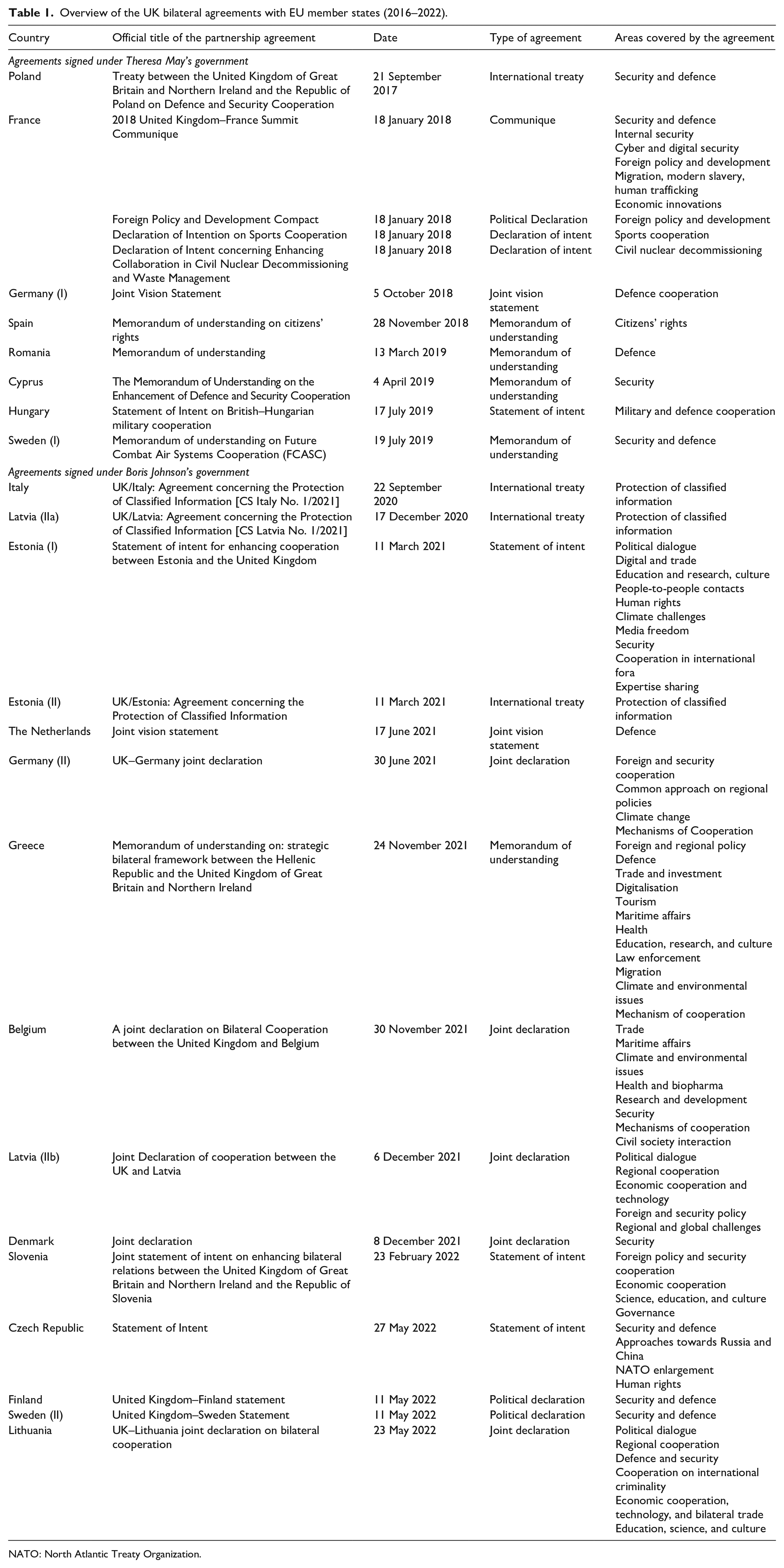
In the 6 years between 2016 and 2022, the UK government entered into security-related partnerships with more than two-thirds of the EU27 (see Table 1 for the full list). It signed five joint declarations (Belgium, Denmark, Germany, Latvia, and Lithuania), five memoranda of understanding (Cyprus, Greece, Romania, Spain, and Sweden), four statements of intent (Czechia, Estonia, Hungary, and Slovenia), one letter of intent for a memorandum of understanding (France), two joint vision statements (Germany and the Netherlands), two political declarations (Finland and Sweden), and one treaty under international law (Poland). 4 France represents an exceptional case in this respect, with a variety of partnership agreements having been agreed with it (letter of intent for a memorandum of understanding; two declarations of intention; summit communique; and a new treaty for managing the shared border created by the 2003 Le Touquet treaty, which attest to the robustness of the mutual bilateral relationship). In the case of Germany, both joint vision statements and then joint declarations were adopted. Based on the date of signing, most bilateral agreements were signed in 2021 (7); in both 2019 and 2022, five were signed, and two were signed in 2020 which can be attributed to the outbreak of Covid-19 pandemic and the demands of TCA negotiations. In most cases, the exact text of the agreements is available in the public domain. 5
Overview of the UK bilateral agreements with EU member states (2016–2022).
NATO: North Atlantic Treaty Organization.
These bilateral agreements demonstrate the UK’s approach to institutional design and adaptation during this regime change. Following the referendum, the United Kingdom adapted its institutional relationships with EU27 in the area of security, opting for selective, flexible bilateralism which does not follow a uniform policy. Despite all these agreements being designed to upgrade bilateral relations with the United Kingdom, they display a high degree of variance in terms of design, differing notably in their level of comprehensiveness, scope, and function. The UK’s preference for institutional flexibility is prominently manifest in four key dimensions. First of all, it is the contractual basis of the bilateral relationships that varies. Some (typically, joint declarations or international treaties) are legally complex and go far by virtue of identifying concrete objectives and scope of the cooperation and specifying mechanisms for achieving them. Other are little more than declarations of intent to cooperate and are couched as statements of intent or memoranda of understanding. Yet, we assert that it is important to consider also these agreements for analysis, as they often constitute the first formal step in establishing more substantial agreements, providing a structure for dialogue, setting out initial terms of understanding, and indicating a willingness to work together towards a common goal (Garriga, 2009: 699–700). Overall, with the partnership agreements codified mostly in non-binding soft law instruments, the UK government shows a clear preference for soft law instruments with no binding rules, no legal codes, no compliance mechanisms, and minimal or no supporting institutions. Second, there are marked differences in terms of the specificity of the partnership agreements. In some cases, the objectives listed in the given agreement are rather minimalist and quite general, whereas sometimes, they include detailed commitments. Third, some establish institutional apparatuses in the form of bilateral coordination structures (Germany (II), France, Poland, Latvia (IIb) Greece, and Belgium), while others do not. Fourth, they exhibit variation in the degree of their comprehensiveness and detail. There are some bilateral agreements covering broader aspects of foreign policy, the most detailed of which is the partnership with France. Some of the bilateral declarations, however, also contain objectives beyond foreign, security and defence policy, albeit often in a perfunctory fashion, such as the ones with Greece, Latvia, Belgium, Estonia.
Path dependence: A comparison of post-2016 bilateral agreements with the proposed UK–EU Security Partnership
This section explores the role played by path dependence in the establishment of the UK’s bilateral security and defence regime in Europe after 2016. To demonstrate continuity with a multilateral approach – the product of choices embedded in institutional and policy frameworks we argue – the analysis focuses on the overlap between the post-2016 bilateral agreements and May’s original 2018 vision for an UK–EU security treaty, which Johnson abandoned. The original post-Brexit security partnership was envisioned as dynamic, flexible, and containing ‘a mix of legal and political agreements’ (HM Government, 2018; also Haves, 2018: 6). The intended multilateral nature of this regime was clear in that the partnership was designed to allow for new tools and measures to be incorporated into the EU–UK treaty in the future. We show that despite Johnson’s government ditching this multilateral approach, his government sought de facto to replicate many of the provisions of the 2018 Framework for the UK–EU Security Partnership using bilateralism.
The Framework for the UK–EU Security Partnership identified five key thematic cooperation areas within the realm of external security which could be included in a future security cooperation agreement: (1) cyber security; (2) health security and protection and civil protection; (3) asylum and illegal migration; (4) sensitive information and intelligence; and (5) counterterrorism and countering violent extremism. These five themes reprise areas of security cooperation previously undertaken multilaterally during the UK’s time as an EU member state (Martill and Sus, 2023). The May government’s aim, as with the rest of the Brexit negotiations, was essentially to opt back in (or ‘cherry pick’ as EU leaders called it) to EU policy coordination in areas of UK national interest (Martill and Sus, 2023), which would be akin to external differentiated integration (Schimmelfennig et al., 2015). Even if most of these policy areas were of low political salience, Johnson refused to continue negotiating a security partnership at the EU level and forged ahead purely with bilateral engagement on security in Europe. However, the web of bilateral deals between the UK and EU member states after 2016 show a clear overlap between the Johnson government and the priorities set by May for her UK–EU Security Partnership as summarised in Table 2.
Overlap between UK bilateral agreements (2016–2022) with the proposed 2018 Framework for the UK–EU Security Partnership in thematic areas of external security.
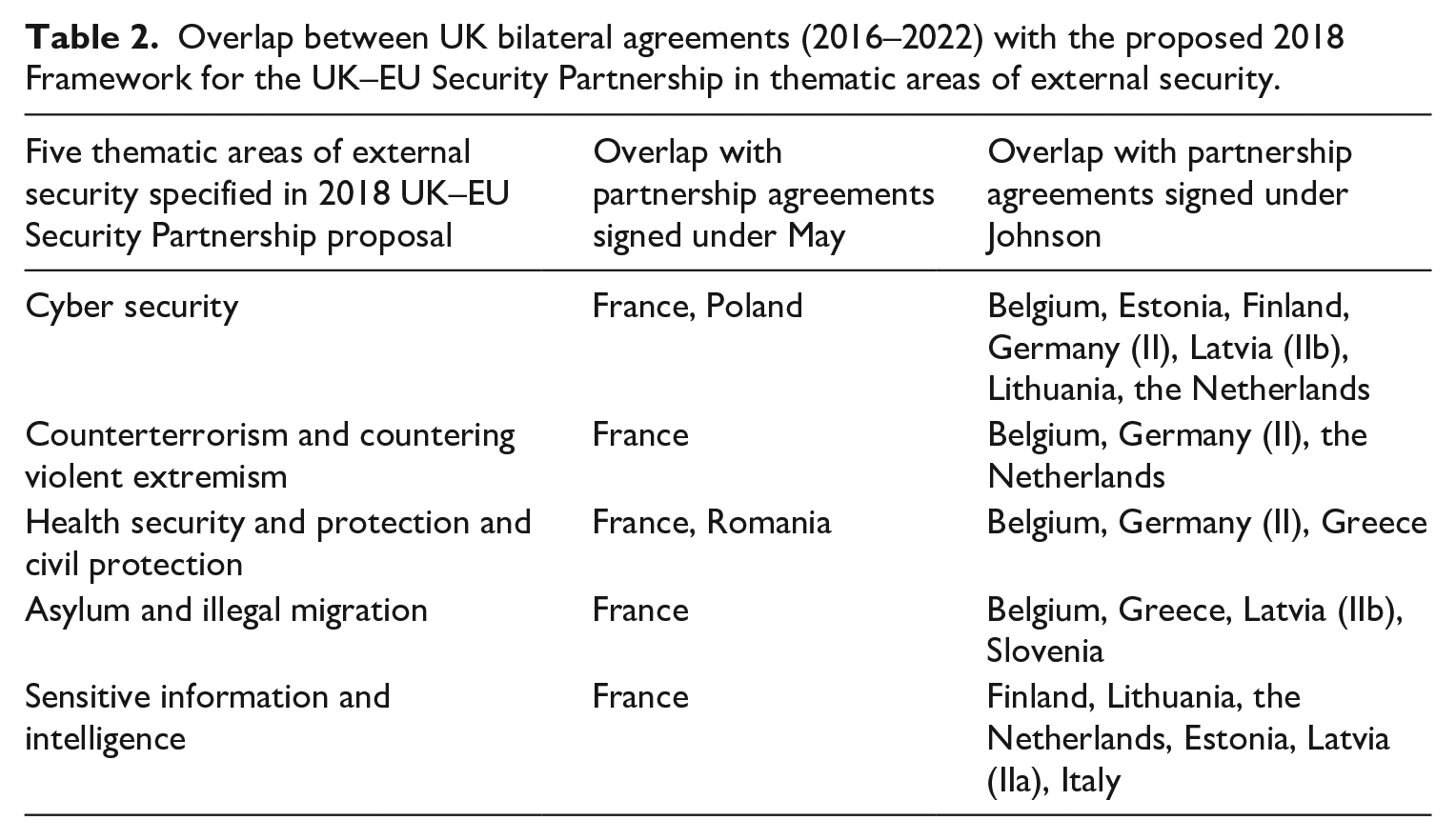
Table 2 also illustrates the limited degree to which Theresa May was able to hedge, in the limited time of her premiership, by pursuing a bilateral approach alongside negotiating a multilateral security partnership. The fact that the major bilateral deal signed during her tenure was with France reflects the way some in the European Union considered that deals with important member states acted as a disincentive for Johnson to negotiate a multilateral agreement upon entering number 10 (Martill and Sus, 2023: 1298). This notion of bilateralism as a disincentive for multilateralism, because the former reduces the need for a latter, is precisely a sign of how the UK approach followed a logic of path dependence when conceiving its bilateral engagement with EU countries. Further evidence of the overlap between the bilateral approach and what would have been covered by a multilateral EU–UK treaty is available by examining the way cooperation on external security is structured. According to the 2018 Framework document, UK–EU cooperation on external security was to be based on three dimensions, all underpinned by information and secondment of personnel. These included (1) consultations (institutional and structured dialogue on shared global challenges); (2) coordination (working together using diplomatic, defence, and development resources where this delivers the best effect, further subdivided into (a) restrictive measures, (b) development and external programmes, and (c) defence); and (3) capabilities. The extent of the overlap in these dimensions is depicted in Table 3.
Overlap between UK bilateral agreements (2016–2022) with the proposed 2018 Framework for the UK–EU Security Partnership in three dimensions of external security.
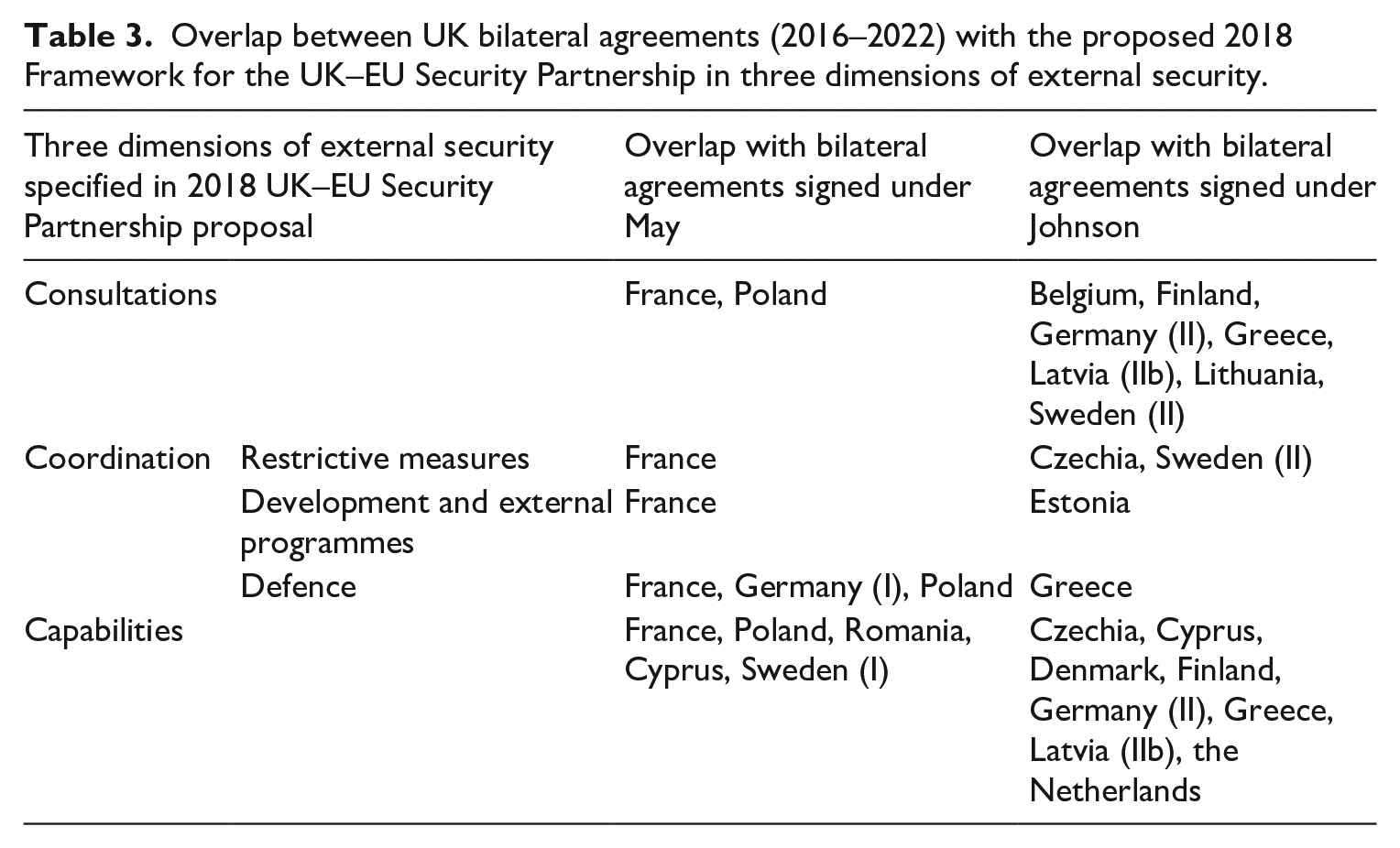
A particularly telling element of continuity between May’s objective of securing a multilateral treaty and Johnson’s purely bilateral approach concerns cooperation on capabilities, also illustrated in Table 2. According to the Framework for the UK–EU Security Partnership, this type of cooperation was intended to ensure a coordinated approach to European capability development and planning. In the envisaged multilateral regime, this was to have taken shape via potential participation in EU capacity-building programmes. In the bilateral regime developed between 2016 and 2022, capabilities are an explicit part of partnership agreements with Czechia, Cyprus, Denmark, Finland, France, Germany (II), Greece, Latvia (IIb), the Netherlands, Poland, Romania, and Sweden (I). Five of these were signed while May was in power, the other seven while Johnson was in number 10.
The clearest area of divergence between the scope of bilateral agreements and the security partnership plan for developing EU–UK capabilities concerns collaboration on the Galileo GPS system. In 2018, the United Kingdom anticipated collaboration on both the open signal and access to the military-grade encrypted Public Regulated Service (PRS) signal (continued UK access to PRS information and the right for UK entities to compete fairly for PRS-related contracts). Yet by the end of May’s time in office, this goal had to be jettisoned as EU countries refused to accept PRS participation by a third country. Space collaboration is nonetheless addressed in three bilateral relationships: in those with France (commitment to work together on norms of responsible behaviour in space; deepening of cooperation in space activities, including cooperation to build Exomars, Europe’s first Mars Rover), Germany (II), and Latvia (IIb) (in both cases in terms of strengthening cooperation in the area of security in space). The latter two were signed during Johnson’s tenure.
How then to explain this type of fine-grained continuity? A path-dependent understanding of this overlap requires first an examination of the principal actors involved in the relevant decision-making processes. In the case of Theresa May, her approach to security cooperation with EU partners can be said to have been fundamentally shaped by her experience as Home Secretary (2010–2016), where she was able to opt out and opt in to EU measures concerning the area of freedom, security, and justice (Green, 2017). This cherry-picking approach of seeking to preserve the best elements of EU membership was also shared by the person she picked as foreign secretary after becoming Prime Minister: Boris Johnson (Martill and Sus, 2022; Wolff and Piquet, 2022). During the referendum campaign, the latter consistently sought to reassure voters that aspects of European integration that were central to UK interests could be retained despite not being a member of the European Union (Glencross, 2023). As a result, both leaders were minded to prioritise the same areas for policy cooperation and coordination after 2016.
More fundamentally, neither leader envisaged a paradigm shift in security policy in Europe. To use the idiom of the literature on policy change (Hall, 1993), when it came to security policy, May and Johnson sought only second-order change in the wake of Brexit. That is, the two governments might have privileged two different means for achieving their security objectives – a multilateral treaty vs a bilateral regime – yet they shared the same overarching goal of achieving European security via policy cooperation and coordination. Their preferred tools were different, but remained intra-paradigmatic as they each wanted a United Kingdom firmly anchored in the European security architecture. They had overlapping preferences for second-order change relating to a reconfiguration of the institutional arrangements and instruments used to achieve security policy in Europe. Even if Johnson’s foreign policy rhetoric suggested a desire to shift the UK’s focus to the Indo-Pacific to match a recalibration of trading priorities outside Europe, the 2021 Integrated Review was by no means a call for paradigmatic change. It stated (HM Government, 2021: 13) that the UK’s ‘commitment to European security is unequivocal, through NATO, the Joint Expeditionary Force and strong bilateral relations’.
In other words, despite Brexit, the cognitive frameworks for understanding UK security interests and their dependence on European-wide coordination to mitigate for inefficiencies and vulnerabilities – the key rationale for establishing a regime (Krasner, 1991) – did not change. Rather, after 2016, it was the choice of instruments that differed, which in turn entails potential material differences in the process of policy coordination and cooperation. Whereas the proposed UK–EU Security Partnership was to have been anchored in a treaty creating binding legal commitments, post-2016 bilateral engagement is mostly a question of soft law as discussed in the previous section. Consequently, it is important to reflect on what this change of instrument means for coordination and capacity-building challenges.
Sustainability: Factors increasing and decreasing resilience of the emerging bilateral regime
The sustainability of the UK’s emerging bilateral regime is contingent upon a variety of factors, some of which can contribute to its resilience, while others can potentially weaken it. Let us highlight the strengths and weaknesses of the emerging bilateral regime adopted by the United Kingdom and consider on each side of the balance sheet five key factors, the summary of which is depicted in Table 4.
Resilience of the UK’s emerging bilateral regime: summary of factors.
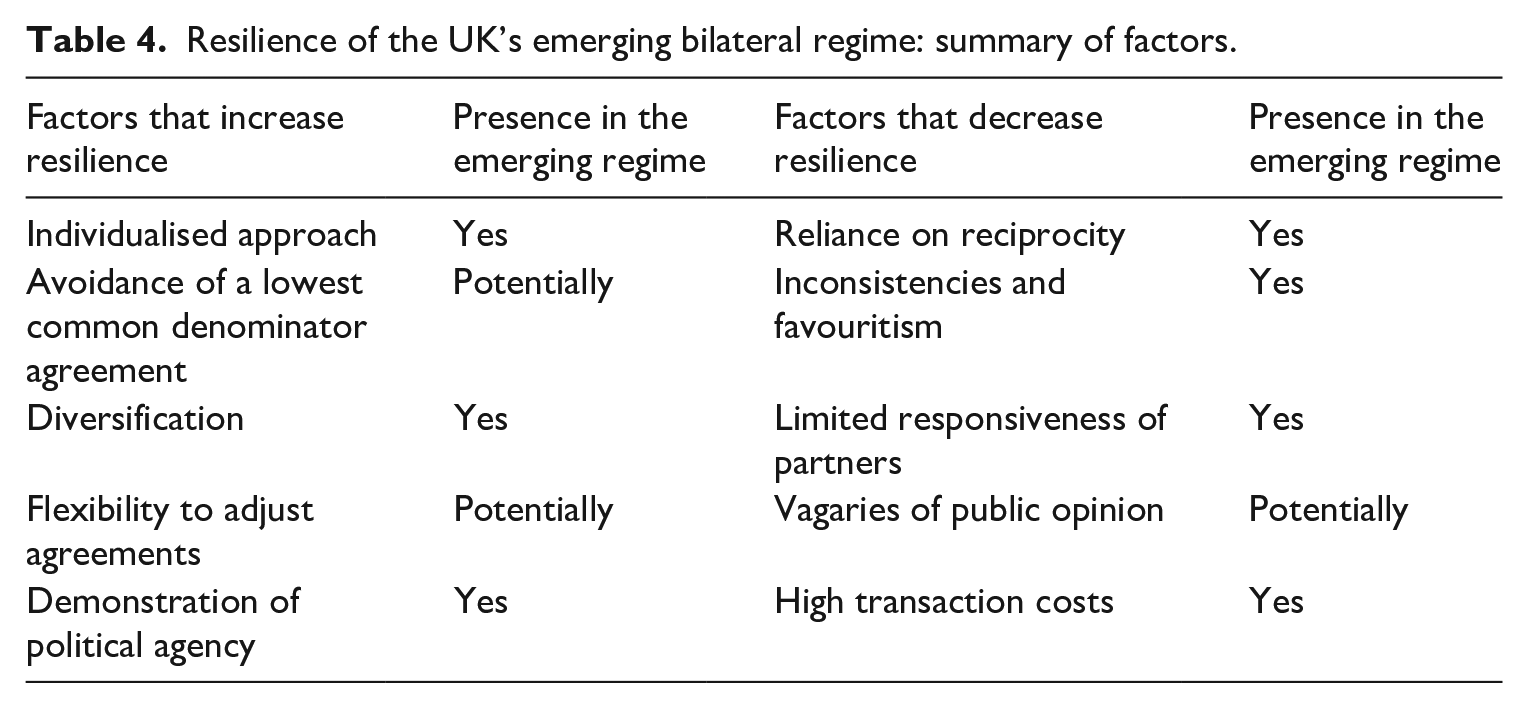
Starting with the elements that contribute to the regime sustainability, with bilateralism differentiating ‘relations case-by-case based principally on a priori particularistic grounds or situational exigencies’ (Ruggie, 1992: 571), this type of regime creates the potential to engage individual countries along various different lines/topics which is a suitable approach in the case of preference heterogeneity (Reich, 2010: 276; Thompson and Verdier, 2014: 16; Verdier, 2008: 440).
Second, fostering individualised bilateral agreements gives the United Kingdom greater latitude to negotiate terms that are most beneficial to its own interests, without the need for compromise typically required in multilateral agreements to accommodate the diverse interests of multiple parties (cf. Reich, 2010: 273–274; Zawahri and Mitchell, 2011: 838). As such, this can potentially overcome the risk of a multilateral UK–EU security deal resting on a lowest common denominator agreement. Finely tuned agreements might also increase the likelihood of each partnership being viewed as (mutually) beneficial and thus upheld over the long term, making the regime better prepared to withstand disruptions.
Third, bilateral agreements can be an effective tool for diversification, helping the United Kingdom spread risk across multiple partners. Having a diversified portfolio of bilateral agreements can provide the United Kingdom with greater manoeuvrability in its security policy. If one partnership encounters difficulties or becomes less advantageous due to changing circumstances, the country can adjust its focus to other relationship (cf. Thompson and Verdier, 2014). Diversification through multiple bilateral agreements also provides an opportunity to explore varied approaches to common issues and learn from different experiences and solutions. In this sense, it can lead to innovation and development of more effective policies.
Fourth, the high degree of flexibility which characterises the new regime can potentially help absorb shocks by allowing for adjustments over time and adaptability to changing circumstances or shifts in partner states’ attitudes and policies. Indeed, the degree of flexibility within the new regime is so high that in the future, it might allow for the combination and co-existence of bilateralism and multilateralism (Verdier, 2008; Zawahri and Mitchell, 2011), creating a space for initiatives such as the European Political Community.
Fifth and finally, the new regime allows the UK government to demonstrate success in its foreign policy engagement without creating binding commitments. Indeed, bilateral agreements are much easier to conclude than the multilateral ones (Reich, 2010: 277; Verdier, 2008: 441). This demonstration of agency can reinforce the UK’s reputation as a competent actor (or the perception thereof), which can in turn strengthen its relationships with other countries. What is more, the absence of compliance mechanisms which characterises the agreements signed between 2016 and 2022 – with priorities and commitments usually too broad to serve as benchmarks against which to evaluate implementation – reduces the potential for conflicts and disagreements.
At the same time, however, fragmented governance – to borrow the term from Zawahri and Mitchell (2011) – in the form of bilateralisation of mutual relations with EU27 countries is vulnerable to a number of risks and limitations that threaten its stability. Here, let us outline five key ones. First, in theoretical terms, resorting to bilateralism can be viewed as a regression (De Bièvre and Van Ommeren, 2021; Thompson and Verdier, 2014) because, unlike multilateralism, bilateralism ‘segments relations into multiples of dyads and compartmentalizes them’ (Ruggie, 1992: 571). The end result is that specific agreements are ‘premised on specific reciprocity, the simultaneous balancing of specific quid-pro-quos by each party with every other at all times’ (Ruggie, 1992: 571–572). This potentially weakens the resilience of the new regime as it makes the agreements heavily dependent on specific quid pro quos. What is more, in practice, reliance on a quid pro quo in a specific policy area is no guarantee of leverage to gain concessions in other policy areas as the United Kingdom discovered when it came to trying to renegotiate the Northern Ireland Protocol that was agreed as part of the 2019 EU–UK Withdrawal Agreement.
Second, the article has demonstrated that the terms and conditions of partnership arrangements vary greatly between countries. Inconsistencies inherent in this ‘spaghetti bowl’ of bilateral agreements might lead to divisions and (both perceived and actual) inequalities and strain relations, if the terms agreed with one country are perceived as better or more favourable than those agreed with another (Reich, 2010: 266), thereby possibly undermining the resilience of the bilateral regime.
Third, the inability to use bilateral security agreements as a form of insurance policy to achieve other policy objectives after Brexit demonstrates the challenge of limited responsiveness on the part of EU member states. Although the transition to bilateralism is far from complete, it is evident that some EU27 states embark on closer bilateral agreements with the United Kingdom more slowly and less enthusiastically than others and some not at all. Hence, the current bilateral regime is far less comprehensive in scope than the security partnership envisaged by May precisely because it does not cover all EU countries, differs in scope according to the member state in question, and cannot cover areas of defence or security coming under EU competence such as the European Defence Agency. The different degree of depth and breadth of the partnership declarations is a factor of many forces, including certain self-restraint on the part of EU member states. That is, some are reluctant to forge close(r) relationships with the United Kingdom out of concern that this may damage the European Union as a whole even if legally ‘member states are free to fill in unused mixed competences themselves’ (Mintel and Von Ondarza, 2022: 5). The need to respect EU commitments as a higher order preference is in fact enshrined in a number of partnership agreements. As many as six of them explicitly make specific references to the country’s membership in the European Union and/or TCA, anchoring the bilateral dealings firmly within the multilateral EU system (Belgium, Germany (II) Greece, Latvia (IIb) Lithuania, and Slovenia). These constitutional commitments to the European Union thus limit the UK’s ability to conclude bilateral deals with member states, thus potentially decreasing the resilience of the new regime.
Fourth, bilateral partnerships are often more susceptible to political changes within the countries involved. For instance, a significant shift in government, policy, or public opinion within a country might lead to a re-evaluation, or possibly even termination, of the bilateral agreement. Such instability decreases predictability and hence also the sustainability of the regime (Reich, 2010: 266).
Fifth and finally, unlike the multilateral solutions when ‘there is only one deal and it is the same for everyone’ (Verdier, 2008: 440), the transaction costs of bilateralism are very high, with bilateralism multiplying them, because it requires many such agreements (Garriga, 2009: 700; Reich, 2010: 283–284; Zawahri and Mitchell, 2011: 840–841). Each of these relationships requires ongoing attention, with the United Kingdom having to negotiate, implement, and safeguard a new partnership declaration with each member state, and simultaneously at that. The increased complexity of dealing with each country’s unique set of interests, priorities, and constraints puts a strain on the UK’s diplomatic resources, which may limit the country’s ability to effectively manage all these relationships (Mintel and Von Ondarza, 2022: 6).
Conclusion
The evidence from the UK’s post-Brexit security engagement with the EU27 analysed in this article points to the way that the United Kingdom is currently in the process of transitioning from one policy regime to another. Consequently, it is imperative to understand how far the turn to bilateralism can function as a replacement for treaty-based, multilateral coordination upon which the United Kingdom used to rely in a European context. This is particularly true in the context of the war in Ukraine, which has demonstrated the importance of coordinating security policy between the European Union and the United Kingdom in a crisis, as well as the gaps that currently exist on this front (Magill and Rees, 2022).
More specifically, the article shows that since 2016, UK governments have opted for selective engagement with the EU27 aimed at establishing mutually beneficial partnerships with each country. The defining features of this new regime include highly differential treatment vis-à-vis individual EU member states, the pursuit of particularistic interests with each country, customisation of conditions to each individual member state, and flexible political commitments and institutional arrangements. As a result, one might even talk about a post-Brexit ‘renaissance of bilateralism’ for the United Kingdom (cf. Klemenčič, 2011), with a large spider’s web of bilateral agreements radiating now out from London. Our evidence further shows that the United Kingdom can be considered the founder/organiser of this regime as it has taken the initiative to establish a plethora of agreements (cf. Thompson and Verdier, 2014: 15–16). The article has also demonstrated that although Theresa May sought to maintain a multilateral component to European security, the three policy objectives she set in terms of consultation, coordination, and capabilities and the five thematic areas could also be pursued via bilateral means. A close examination of post-2016 bilateralism showcases continuity in these objectives between Boris Johnson’s government and May’s, even though the former officially repudiated the goal of securing a multilateral UK–EU arrangement. The tension between bilateralism and multilateralism looks set to continue, however: in the run-up to the 2024 UK General Election, the Labour Party has announced its intention both to sign a Lancaster House-style treaty (POLITICO, 2023) and to negotiate a security treaty with the EU (BBC, 2023).
Nevertheless, while the emerging regime offers the advantage of tailored agreements, it is not without its vulnerabilities. The sustainability of a purely bilateral regime, with its high degree of customisation and intrinsic reliance on specific reciprocity, is precarious. It is, in essence, a very delicate balancing act, with each bilateral agreement standing on its own, isolated from the others, and dependent on the mutual fulfilment of specific quid pro quos. When scaled up to a network of numerous countries, each with its own unique interests and political contexts, its institutional fragility, not just the volatility stemming from reliance on personal ties between leaders (Destradi and Plagemann, 2019), can destabilise the whole regime. What is more, managing such a complex network of individual agreements places a significant burden on the UK’s diplomatic resources, further threatening the regime’s sustainability.
However, its intrinsic flexibility leaves room for incorporation of multilateral initiatives, an aspect that might alleviate some of the pressure and provide a more robust and resilient type of a regime (Verdier, 2008; Zawahri and Mitchell, 2011). Thus, instead of being constrained to a purely bilateral approach, the United Kingdom can leverage this flexibility to leave the door open for re-engaging with multilateralism – for instance, via the newly established European Political Community or a European Security Council (Kaim and Ronjin, 2019). This ‘hybrid’ approach might provide the best of both worlds, going back to the earlier discussion on the general trend towards institutional diversity in states’ security and defence policies (Ewers-Peters, 2023; Hofmann, 2011, 2019; Karlsrud and Reykers, 2020). On one hand, the United Kingdom can continue to negotiate and implement individualised bilateral agreements, fine-tuning each one to cater to its specific interests and those of its counterpart. At the same time, incorporation of multilateral initiatives may allow for a collective approach to common issues, fostering collaboration and mutual support among a broader set of countries. Since multilateral initiatives, by virtue of their collective nature, are more resilient to changes than the bilateral ones (De Bièvre and Van Ommeren, 2021), such a combined approach might bring a level of stability that is hard to achieve with a purely bilateral regime.
Footnotes
Acknowledgements
Our heartfelt thanks go to editors of the British Journal of Politics and International Relations and the anonymous reviewers for their thoughtful comments and constructive feedback on earlier versions of the manuscript.
Funding
The author(s) disclosed receipt of the following financial support for the research, authorship, and/or publication of this article: In Monika’s case, writing of this article was supported by Masaryk University (project MUNI/A/1196/2022).
