



Abstract
Much contemporary economic policy analysis deploys demographic projections. To explore their macroeconomic significance, this article draws on documentary evidence from two case studies: (1) the World Bank’s Human Capital Index and (2) European Union models of population ageing within debt sustainability analysis. Combining constructivist and Foucauldian insights, we develop a threefold argument about the constitutive effects of quantified demographic futures on macroeconomic policy analysis. First, the World Bank’s and the European Union’s respective demographic futures mobilise urgency for contingent policy choices with reference to expected future ‘gaps’. Second, they build credibility for contested bodies of expertise on the basis of long-term population forecasts. Third, they delineate agency such that the effects of structural inter-dependencies between economies are rendered as national-level policy risks. These findings demonstrate how quantified demographic futures circumscribe national policy space, mediate the politics of macroeconomic ideas and contribute to the depoliticisation of economic policymaking.
Keywords
Introduction
Demographic projections – forecasts about the future state of human populations – occupy an increasingly central place in institutionalised macroeconomic policy analysis. Combining demographic data with macroeconomic models, these quantified futures commonly extend to both ends of the ‘life course’. While human capital indicators quantify the likely productive potential of the future workforce, often seeking to capture the contribution of even unborn people, population ageing projections quantify the future impact of demographic change on government spending, fiscal sustainability and public debt. Neither demographic nor economic forecasts are novel techniques. For example, demographic projections inform the direction of national immigration policy (Schultz, 2019), while growth and debt forecasts have been shown in recent political economy scholarship to play a key role in delimiting the parameters of national fiscal policy (Clift, 2023; Stanley, 2016). However, the explicit integration of demographic projections into macroeconomic policy analysis, at various levels of governance, represents an understudied phenomenon in the International Political Economy (IPE) and International Relations (IR) literatures, including on international organisations (IOs).
The growing prominence of quantified demographic futures in macroeconomic analysis raises questions that sit at the intersection of two previously largely disconnected literatures, as suggested by the guest editors (Berten and Kranke, 2024). A first, now fairly extensive body of research on the politics of measurement in contemporary global governance has analysed the distinctive role of quantification, metrics and accounting technologies in world politics (Broome and Quirk, 2015; Hansen and Mühlen-Schulte, 2012; Kelley and Simmons, 2019). Most global benchmarks take the past as their temporal reference point – that is, they assess how countries have performed. Quantified futures, however, represent a distinct category of metrics because their reference point is the future – that is, they evaluate how countries may perform. A second, more recent literature on anticipatory governance, meanwhile, has sought to understand how political institutions render the future governable through various expert practices of forward-looking knowledge production. Indeed, this literature shows how many transnational actors ground their claims to expert authority specifically in the inherent uncertainty of the future (Berten and Kranke, 2022; Best, 2014). Yet such scholarship has until now rarely scrutinised the distinctive role played by quantified knowledge about the future in global politics.
In line with the special issue theme, this article thus connects research on quantification and anticipatory governance practices in the specific context of macroeconomic governance and expertise. Our contribution integrates insights from constructivist and Foucauldian perspectives to investigate how demographic forecasts and projections intervene in the governance of development and fiscal policy challenges. Drawing on publicly available documents, we conduct two qualitative case studies of the use of quantified futures in macroeconomic analysis at both ends of the life course. First, the World Bank’s recently launched Human Capital Index (HCI) quantifies the extent to which nations fall short of realising their future ‘human capital’ potential when they underinvest in the health and skills of young people. Second, the Economic Policy Committee (EPC) of the European Union (EU) uses demographic projections to quantify the impact of ageing populations on debt sustainability and fiscal policy. Taken together, the two cases illustrate the political implications of demographic projections, which make the challenge of governing future populations for macroeconomic ends an urgent matter of present policymaking.
Specifically, through these two case studies, we show how quantified demographic futures construct national policy space in three interrelated ways. First, both the World Bank and the EU mobilise urgency for broadly neoliberal reform trajectories by constructing future macroeconomic ‘gaps’ – that is, productivity shortfalls (based on human capital ‘gaps’) and debt sustainability issues (based on fiscal ‘gaps’), respectively. Second, quantified demographic futures serve to normalise and depoliticise assumptions underpinning mainstream macroeconomic modelling and expertise. They build credibility for increasingly contested bodies of development and macroeconomic expertise, as well as associated policy agendas, by incorporating widely accepted long-term trends of demographic change identified through population forecasting. The associated policy agendas are thus presented as inescapable responses to demographic ‘destiny’, rather than political choices. Third and finally, these projections delineate agency along highly selective lines, thereby obscuring the embeddedness of nations in the global political economy. Through this form of methodological nationalism (see Beck, 2007), structural inter-dependencies are converted into national-level policy risks while the overarching dynamics of power in the global political economy become largely invisible.
These empirical findings, in turn, contribute to two broader debates in constructivist IPE. First, there continues to be a lively debate about the nature of ideational change since the global financial crisis. While some authors point to the resilience of neoliberal ideas despite widespread evidence of their apparent limitations (Crouch, 2011; Gamble, 2019; Helleiner, 2014; Kaya and Herrera, 2015; Schmidt and Thatcher, 2013), others see evidence of significant incremental change (Baker, 2013; Clift, 2018) or even a nascent, if contradictory, paradigm shift (Schneider, 2023; van ’t Klooster, 2022). Against this background, our argument adds to constructivist IPE work that stresses the stickiness and resilience of neoliberal ideas in the post-crisis era, in particular as a result of how the underlying assumptions and bodies of expertise are sustained and normalised by their integration into routines of quantified modelling, accounting and measurement (Baumann, 2020; Fougner, 2008; Schueth, 2011). The embeddedness of demographic projections in mainstream economic analysis thus represents a distinctive, albeit understudied, channel through which contestable (and increasingly contested) neoliberal ideas are reinforced, reproduced and legitimised. Apparently objective measurement processes endow these quantified futures with a semblance of certainty associated with the science of demographic forecasting, thereby making them more immune to political contestation.
Second and relatedly, there is an extensive debate about technocratic depoliticisation within neoliberal institutional configurations and governance projects, such as independent central banking (Watson, 2002), external audits (Power, 1997) or fiscal rules (Clift and Tomlinson, 2012). In this context, we can situate the turn to quantified demographic futures as another means to re-assert depoliticised forms of governance in response to a quickly evolving global economic and geopolitical landscape (see Radaelli, 1999: 763). Some key developments, including post-crisis monetary policy, renewed geopolitical rivalry and the COVID-19 pandemic, have threatened to re-politicise macroeconomic and development policy (Best, 2022; Schneider, 2023). In this regard, the distinctiveness of demographic projections lies in their ability to legitimise broadly neoliberal development or macroeconomic policies designed to counter long-term demographic trends. This blending with demographic forecasting as a more widely accepted body of expertise shields macroeconomic expertise from stronger contestation attempts. As we document in the two case studies, the construction of a seemingly precise quantified gap operates through this kind of blended expertise: demographic forecasts feed calls for immediate government measures to invest in the skills of the next generation of workers, or to extend the working life of older people through cuts to pension and benefit entitlements while mitigating ‘dependency ratios’ through labour market activation policies.
The article proceeds as follows. In the first section, we situate our argument within research on the role of expertise, the politics of numbers and anticipatory practices in global governance. We relate these literatures to the construction of future ‘gaps’ analysed in the next two sections: the World Bank’s HCI as a metric of estimated productivity shortfalls of future workforces and the projections of the macroeconomic impacts of population ageing within EU fiscal policy. In the fourth section, we discuss the main insights from the case studies. To conclude, we reflect on the wider implications of the use of demographic projections for global and national economic governance, and outline avenues of future research on quantified futures in the form of gaps.
Quantified futures as macroeconomic gaps
Both quantification and futurisation can be important sources of expert authority for governance actors. Quantitative outputs – from simple numbers to more sophisticated composite indicators – commonly count as objective, albeit simplified, representations of reality. As a large body of constructivist scholarship demonstrates, numbers shape collective understandings of the wider social world (Hansen and Porter, 2012: 413) while operationalising specific concepts (e.g., Honig and Weaver, 2019; Speich, 2011). The issues that these concepts represent thus become ‘knowable and governable’ through quantification (Robinson, 2018).
Because of their perceived objectivity and neutrality, quantified indicators legitimise certain bodies of expertise and policy agendas (Hansen and Porter, 2012; Mügge, 2016). The producers of global indicators, ratings and rankings base their claims to expert authority on the provision of such seemingly objective evidence even if the underlying practices are anything but value-free (Broome et al., 2018; Erkkilä and Piironen, 2014; Rocha de Siqueira, 2017). In this sense, quantification has been deeply implicated in neoliberal reform agendas – manifest in conceptualisations of states as competing against each other as destinations for global resource flows (Elias, 2013; Linsi, 2020), and operationalised through rankings that encourage deregulation and business-friendly policymaking (Doshi et al., 2019; Fougner, 2008). In short, the use of quantified governance instruments through which transnational actors validate their epistemic authority can significantly narrow national policy space.
While the link between governing by numbers and expert authority is well established, the role of imagined futures in the making of governance expertise has received less attention. However, recent work in a broadly constructivist tradition has begun to address this topic. This research shows how the uncertain future, which may never occur, can also be rendered ‘knowable and governable through anticipation’ (Berten and Kranke, 2022: 157; see also Heath-Kelly, 2013). Anticipatory practices underpin expert authority when relevant audiences believe actors’ claims about how the future will unfold, or which scenarios are more or less likely to materialise (Aykut et al., 2019; Mahajan, 2008). Experts can only be proven wrong about any such projections after the fact as the future can materialise in countless different ways. At the same time, this fundamental uncertainty makes it extremely difficult, if not impossible, for anyone to provide incontrovertible evidence for the plausibility of their projections (Beckert, 2013; Evans, 2010). Actors who engage in anticipatory practices therefore need to bolster forward-looking claims with precision and certainty to exude confidence in their own predictions.
Linking insights from these two literatures, we suggest that references to ‘gaps’ lend precision, urgency and credibility to statements about potential future states of the economy. A gap delineates the scope of an estimated shortfall in seemingly exact quantitative terms, translating complex assumptions about how much is already or may be missing at a future point in time into an easily communicable headline figure. The quantification of such a gap particularly mitigates the problem that the future is a space of uncertain and often even yet unknown possibilities. Governors can express in a single number that something important will be undersupplied, and also detail how severe the anticipated undersupply will be. If a gap is widely perceived as too large and the time horizon available to ‘close’ it as relatively short, calls for urgent preventive action are likely to follow. Otherwise, the gap cannot realistically be narrowed or even closed during the time frame over which it is projected to emerge. The discursive construction of a macroeconomic gap moves a future problem onto the agenda of the present, making it susceptible to immediate intervention. The macroeconomic gap thus makes the future economy more knowable and governable, lending credibility to suggested policy responses to avert it.
Urgency can also be the result of perceptions of risk. In the security realm, for example, the need for urgent action frequently emerges from attempts to model the risk of a terrorist attack and identify likely perpetrators (Aradau and Van Munster, 2007). Even mundane securitisation practices always factor in the need for immediate responses: ‘Constant drama does not have to be present, because it is implicitly assumed that when we talk of this (typically, but not necessarily, defense issues), we are by definition in the area of urgency’ (Buzan et al., 1998: 27, original emphasis). Concerns over impending threats have underlined the value of ‘preparedness’ for broad classes of negative events, such as security, economic or environmental ones (Adey and Anderson, 2012; Braun, 2015; Oels, 2013). Invoking a gap clarifies what to avoid or, at least, prepare for in the face of certain risks. Quantifying its size further removes uncertainty about options and outcomes, introduces new categories of risk, and details the costs of not overcoming the shortfall within a given time frame.
Depending on their focus, gap-centric discourses can enable new rationalities of control, or modes of ‘governmentality’ as prominently analysed by Michel Foucault. In The Birth of Biopolitics, Foucault (2008: 230) observes that a core objective of the modern state is ‘first, to improve human capital, and second, to preserve and employ it for as long as possible’. In other words, biopolitical measures focus on the prevention of diseases to keep populations healthy, and on the promotion of skills to keep them productive. The concept of biopolitics highlights how human populations have been routinely subjected to various forms of (quasi-)governmental surveillance across a wide range of domains, including development (Li, 2007), health (Kenny, 2015), immigration (Schultz, 2019) and security (Da Silva et al., 2022). With the rise of Chicago School neoliberalism in the 20th century, the development of human capital became even more central: And as soon as a society poses itself the problem of the improvement of its human capital in general, it is inevitable that the problem of the control, screening, and improvement of the human capital of individuals, as a function of unions and consequent reproduction, will become actual, or at any rate, called for. So, the political problem of the use of genetics arises in terms of the formation, growth, accumulation, and improvement of human capital (Foucault, 2008: 228).
Beyond these ‘innate and hereditary elements’ (Foucault, 2008: 228), biopolitics in the name of human capital improvement aims to constantly enhance the level of ‘acquired human capital’ (Foucault, 2008: 229). Thus, ‘the formation of an abilities-machine’ essentially begins right after birth with a vital dose of parental attention and subsequently requires ‘educational investments’ (Foucault, 2008: 229). Yet society as a whole has come to be considered in need of interventions designed to raise the aggregate level of human capital, rather than seeking to enhance the quality of health and education services for their own sake. Historically speaking, the statistical apparatuses of states were central to making populations governable and economically productive (Miller and Rose, 1990). More recently, IOs have harnessed quantitative governing practices to make states themselves pursue predefined biopolitical ends (Kenny, 2015; Yarrow, 2022).
While most literature on biopolitics has focused on current populations, we present two case studies on the quantification and surveillance of future populations as central to the reproduction of existing political economies. This analytical shift extends Foucault-inspired work showing how economic considerations motivate many political measures (Best, 2007) and how organisations seek to ‘colonise’ the future with their own priorities (Chamlian, 2016). Notably, the two case studies do not follow a comparative logic but rather help us to highlight how quantified demographic futures discursively circumscribe national policy space in two different institutional settings – namely one IO (the World Bank) and one supranational organisation (the EU). Our empirical analysis reveals a roughly parallel pattern of three interrelated themes: mobilising urgency, building credibility and delineating agency. The mobilisation of urgency via a macroeconomic gap or shortfall helps to build credibility for market-oriented reforms (in the World Bank’s case) and for fiscal conservatism (in the EU’s case), which, in turn, delineates a particular version of national policy agency. We begin our analysis with the World Bank’s HCI, a novel metric designed to gauge the productivity of future workers.
Future productivity gaps and the World Bank’s HCI
The HCI is a recent addition to the World Bank’s sizable portfolio of benchmarks. Launched as part of the Bank’s wider Human Capital Project (HCP), the HCI was officially released in the 2018 The Human Capital Project report (World Bank, 2018); one part of it subsequently appeared as a chapter in the 2019 World Development Report (World Bank, 2019c: 49–67). The second edition of the HCI was published in 2021 as The Human Capital Index 2020 Update (World Bank, 2021c). Given the novelty of the HCP/HCI, the immediately relevant literature is still small. To our knowledge, only two pertinent analyses have been published so far: Benjamin M. Hunter and Jonathan D. Shaffer (2022) see the HCP as driving the Bank’s wider risk-oriented strategy to regain lost authority in the realm of global development; and David Yarrow (2022) finds a strong pro-market logic at its heart similar to many other transnational human capital accounting initiatives. Building on these early contributions, we examine the HCI as a source of quantified demographic futures, which the World Bank links not only to labour market dynamics but also to broader questions of national welfare. In fact, human capital issues have featured prominently in the organisation’s The Changing Wealth of Nations series, which was launched as early as 2006. The fourth and latest report, from 2021, states the following: ‘Human capital is a critical component of a nation’s wealth, accounting for the largest share of wealth for most countries. On average, human capital constitutes about two-thirds of total wealth at the global level . . .’ (World Bank, 2021b: 149).
Mobilising urgency
One of the very few genuinely prospective benchmarks in contemporary global governance, the HCI is a prime example of the ‘quantification of the future’ described in the special issue introduction (Berten and Kranke, 2024, original emphasis). Central to the HCI is the notion of the ‘human capital gap’, which is operationalised as the distance from the ideal state on a 0–1 range, with ‘1’ representing what is termed ‘the benchmark of complete education and full health’. The gap thus denotes a relative lack of investment in the health and education of today’s children, who will be the next generation of workers. As Aart Kraay (2019: 4, original emphasis), one of the architects of the HCI, explains in an article published in the in-house The World Bank Research Observer: ‘. . . the HCI measures the expected future human capital of a child born today, given current education and health outcomes for the young.’ In this sense, current underinvestment in human capital is taken as a risk of future productivity shortfalls (Hunter and Shaffer, 2022: 46–47).
The temporal connection between the present and the future cuts both ways in the HCI. A country that invests too little in its children’s human capital now is predicted to suffer later from this unrealised potential compared to the ideal state of no human capital gap. Present efforts shape future opportunities, much in the same way as ‘. . . the educational attainment of the current workforce primarily reflects the educational opportunities that were available to current workers in the past when they were school-aged children . . .’ (Kraay, 2019: 4). This rationale embraces a modern chronological understanding of time, whereby humans can secure a good fate through choices made in the present (Adam, 2010: 365). Conversely, a projected future shortfall calls for preventive action in the present, rendering a persistently large human capital gap an unacceptable policy failure. Thus, ‘[t]his forward-looking emphasis’, as Kraay (2019: 4) calls it, puts public pressure particularly on countries with large gaps.
Accordingly, The Human Capital Project strives ‘to understand what policies can help countries rapidly increase their human capital’ (World Bank, 2018: 5, emphasis added). The 2020 Update reinforces this message when generally invoking ‘the urgency of improving human capital outcomes for children today’ (World Bank, 2021c: 15). A notable focus rests on children facing adverse living conditions, such as poverty, that may turn them into less productive future workers (World Bank, 2021c: 1). For the World Bank (2021c: esp. 82–107), human capital investments have become even more urgent in the wake of the COVID-19 pandemic – a recurring theme at the (typically) biannual Human Capital Ministerial Conclaves since 2020 (e.g., World Bank, 2020). It is then not surprising that, during the current International Development Association replenishment round (IDA20), human capital is one of the five ‘Special Themes’ (World Bank, n.d.), thus constituting a funding priority.
The regular release of countries’ evolving human capital situations further intensifies pressure. The World Bank runs its own ‘Investing in Human Capital’ YouTube channel, which featured 58 videos as of 11 May 2023. 1 For example, a recent video 2 introduces three – arguably fictional – examples of children from Brazil to illustrate regional differences in the country’s human capital track record. The video also discusses the adverse effects that the COVID-19 pandemic has had on Brazil’s overall human capital gap, which widened by six percentage points within just 2 years – from an HCI score of 0.6 in 2019 to 0.54 in 2021. Even though the pandemic constitutes an external shock beyond the control of the Brazilian government, the Bank urges it to act immediately: ‘Therefore, there is no time to lose’ (from 2:41). The video ends on the following call to action: ‘The future starts now’ (from 2:56). The urgency thus constructed justifies governmental measures to nurture the human capital of the nation’s underage population.
The perceived need for swift action, however, is unevenly distributed through the HCI, as is often the case with benchmarking exercises. Although the World Bank (2018: 24, 41, 2021c: 23) admits that it ‘should be interpreted with caution’, the exaggeration of performance differences is a well-known problem of country rankings (Høyland et al., 2012). To clarify, the distance between any two adjacent ranks is nominally the same, but the underlying ratings may vary considerably. For instance, the difference between ranks 9 and 10 could, in some circumstances, be larger than that between 20 and 25 (see World Bank, 2021c: 39). Because the HCI takes the form of a ranking – explicitly so in 2018 with stated ranks and implicitly so in 2020 with countries ordered by their scores – performance is relative. As a consequence, the results of the index can foster considerable urgency for a country with even a good or improving overall score if countries with slightly lower scores manage to outperform it next time (see Espeland and Sauder, 2007: 19–20). It is a problem of achieving ‘less more’ compared to others who accomplish ‘more more’ (Ringel et al., 2021: 2, original emphasis).
In any case, the pressure to take preventive action arguably increases for vulnerable countries with limited capacity. According to the World Bank (2021c: 6), ‘the urgency of addressing human capital gaps’ is most pronounced for ‘the seven economies with the lowest HCI 2020 scores’, which suffer from state fragility or the prevalence of conflict. HCI-based knowledge that calls for urgent action to promote the development of human capital of young people through investments in education and health thus does not target all countries in the same manner. Given their international standing, relatively poor and powerless countries can the least afford to evade the expectations of improved performance imposed on them through global systems of evaluation (Löwenheim, 2008: 261–262).
Building credibility
It is important to acknowledge that the creators of the HCI go to great lengths to outline and justify their methodological choices. The article by Kraay (2019) is replete with information on data sources, measurement choices and alternative human capital metrics. Similar reflections can be found in the methodological appendix of the initial report on the HCP (World Bank, 2018: 33–50). However, the focus on the size of human capital gaps overshadows contested theoretical priors and methodological choices on which the expert knowledge surrounding the HCI rests. To begin with, the idea of human capital accounting has a distinct neoliberal lineage, which treats skills primarily as marketable commodities (Yarrow, 2022). Within this thinking, it is seen as the exclusive responsibility of national governments to develop and maintain a sufficient human capital stock. This rendering ignores the differential embeddedness of countries in the global political economy, as emphasised in recent research (Blackmon, 2014; Bonizzi et al., 2019; Dorninger et al., 2021). Therefore, the Bank needs to build credibility for its expertise on human capital in two main ways: first, to demonstrate that investments in human capital eventually ‘pay off’ in the form of productivity gains; and second, to identify public finance as the decisive instrument available to states with sharply varying economic capacities and vulnerabilities.
The World Bank has been anything but shy about its intention to push countries towards higher human capital investments. Already in 2015, then-Bank President Jim Yong Kim (2015) declared the following in a public speech: ‘Our strategy to end extreme poverty, based on the best global knowledge now available, can be summed up in just three words: Grow. Invest. And insure’. And as if to foreshadow the two HCI core components, Kim (2015) subsequently emphasised the strategy’s second prong as ‘investing in people, especially through education and health’. As summaries of the Ministerial Conclaves suggest, many countries readily buy into the Bank’s human capital agenda and even language. Virtually echoing the official framing, the Ukrainian finance minister is reported to have remarked during the first Ministerial Conclave at the 2019 World Bank/International Monetary Fund (IMF) Spring Meetings: ‘Developing human capital is not an expenditure in our budget. It’s an investment’ (World Bank, 2019a). To provide but one more example, the finance minister of Bhutan – a country known less for its neoliberal credentials than its heretical interest in ‘gross national happiness’ – stated the following during the 2021 Spring Meetings Conclave: ‘Bhutan will soon be instituting a conditional cash transfer mechanism to ensure a better outcome of healthy citizens in generations to come’ (World Bank, 2021a).
The Bank presents human capital gaps and the ensuing future productivity shortfalls as resulting solely from a lack of government investment. The upshot of this view is that it only requires enough political will by those in power to close these gaps comprehensively and swiftly. By using the HCI, the World Bank pushes national governments to develop a lasting architecture for what Foucault (2008: 228) refers to as ‘the control, screening, and improvement of the human capital of individuals’ in modern society. Although the Bank sees itself as a partner in this respect, providing both funding and advice to its members, it is ultimately national governments who have to enact this demanding agenda. The exclusive focus on the national level of human capital provision forecloses attention to how a country’s position in the global political economy mediates its ability to invest in human capital (Hunter and Shaffer, 2022: 43).
This bias is baked into the very design of the HCI, as well as that of many other benchmarks that evaluate national performance. As a consequence, ‘. . . high scores are widely presumed to be the result of individual efforts and achievements . . .’, while ‘. . . low scores are widely presumed to be the result of internal failings and shortcomings . . .’ (Broome and Quirk, 2015: 831). The diverse online HCP materials – including the major reports, case studies and regional human capital ‘plans’ (for Africa and the MENA region), summaries of Ministerial Conclaves and explanatory videos – are part of a public relations strategy to disseminate this thinking. These calls to action cloak the prevalent power structures of the global political economy, which are founded upon legacies of historical injustice at the expense of today’s poor countries (Broome and Quirk, 2015: 831). Many countries in the Global South occupy structurally disadvantageous positions that curtail their policy space and squeeze their capacity to invest large sums into the provision of education and health. Not every country faces a favourable opportunity structure for the prioritisation of education and health expenditures required for better HCI scores.
Even a cursory look at the two HCI editions in 2018 and 2020 corroborates this concern. Table 1 reveals a remarkable clustering of rich countries at the top and poor countries at the bottom of the ranking, coupled with limited mobility at both ends. Only one out of the (mostly Asian and European) countries that were ranked among the ‘top ten’ in 2018 had dropped from this elite group by 2020. Similarly, only 2 out of the 10 lowest ranked countries from the first HCI were no longer in this group 2 years later; most notably, all the 12 countries that found themselves among the ‘bottom ten’ over these two editions were from sub-Saharan Africa. While this stability is at least partly owed to ‘outcomes that typically change slowly’ (World Bank, 2021c: 6, 47), there is evidence of similar patterns in other high-profile global benchmarks (Broome et al., 2018: 521, 527).
Top 10 and bottom 10 countries in the HCI (World Bank, 2018: 32, 2021c: 41).
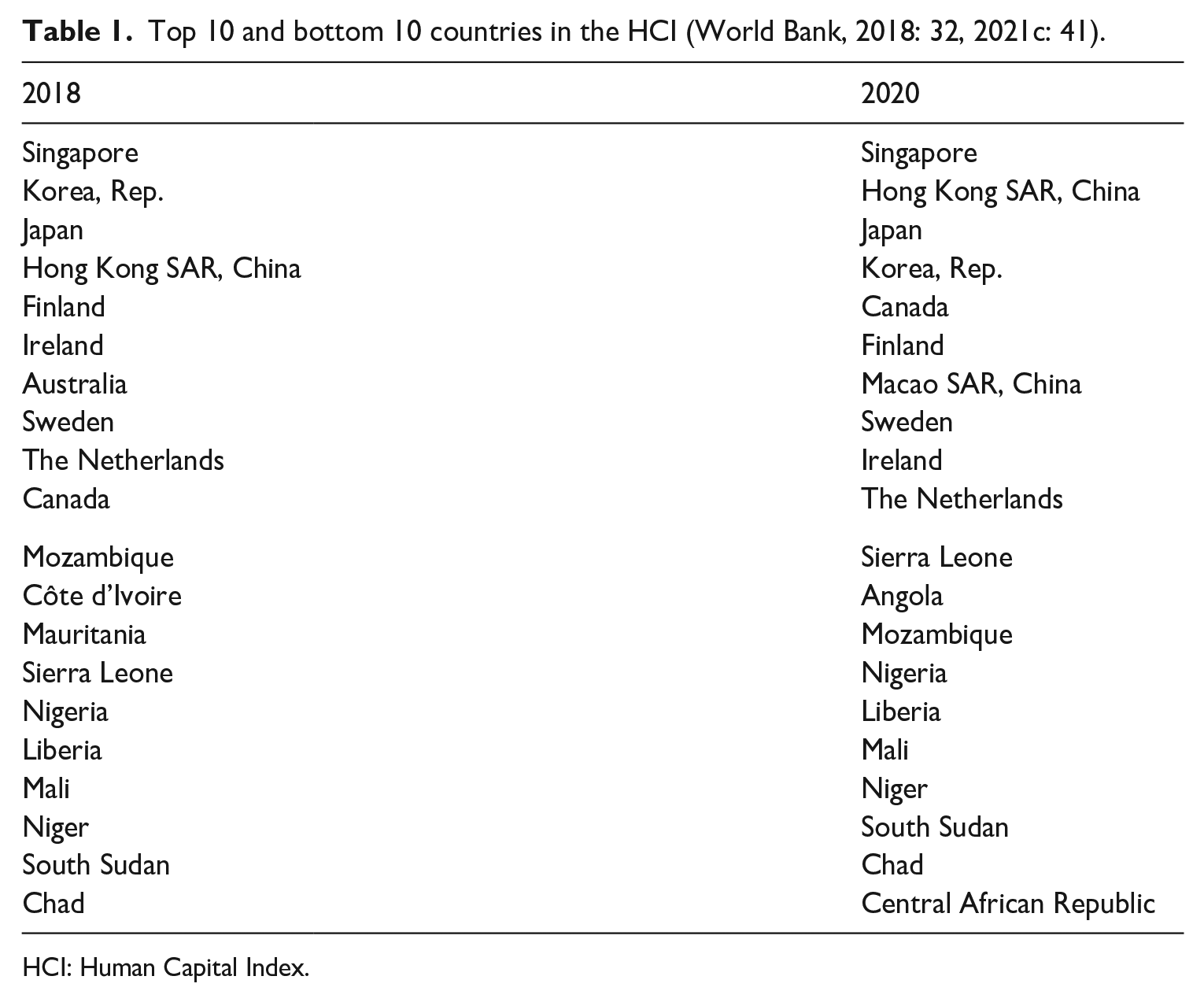
HCI: Human Capital Index.
Seen in this light, quantified futures that provide evidence about the lack of investment in human capital by poor countries become more questionable than the neutral language of the benchmarking exercise may at first glance suggest. Even though the World Bank (2018: 35) stresses the positive correlation between income levels, measured in gross domestic product (GDP) per capita, and education and health outcomes (see also Kraay, 2019: 7, 14), the HCI shies away from addressing the implications. One obvious inference to be drawn here is that low-income levels are not only the result of incomplete education and poor health but also a fundamental cause of these problems. Yet the latest HCI edition observes the following: Importantly, the HCI is lower in low-income economies than in high-income economies by a substantial margin. In the poorest economies in the world, a child born today will grow up to be only 30 percent as productive as she could be; in the richest economies, the corresponding figure is 80 percent or more . . . Compared to a child in Europe and Central Asia, a child born in Sub-Saharan Africa can expect to be only 58 percent as productive . . . (World Bank, 2021c: 18).
Such blanket statements risk hiding the structural disadvantages experienced by low-income economies, especially those that obtain lower HCI scores, such as sub-Saharan countries. Although governments assume a central role in guaranteeing the existence of, or directly funding, education and health institutions, the environment in which they go about these tasks affects their capacities even if there is plenty of political will. Whether a country constantly hones the human capital of its population for the sake of the economy therefore depends on the contingent interplay of political choices and structural conditions. The expectation that all countries do so, however, has been normalised through the World Bank’s long-standing engagement with human capital questions and their latest culmination in the HCI, which embodies and quantitatively validates the underlying market-oriented development expertise. Blended with more robust evidence from demographic data, this body of expertise appears less controversial than it actually is.
Delineating agency
As explained above, the HCI assesses the human capital performance of national governments. This methodological nationalism implies that the ranking assigns responsibility for observed outcomes to governments without factoring in the impact of their structural embeddedness in the global political economy. In other words, the HCI delineates national policy agency within an international economic system that is taken as given. Three interrelated aspects of agency thus conceived stand out.
First, the HCI documentation consistently emphasises the value of comprehensive data coverage over time and space. Lacking data are not merely a matter of insufficient knowledge to target human capital investments; the HCI itself regularly requires fresh data for updates. Conventionally, the collection and administering of population data through instruments such as registries or surveys lies in the hands of national governments (see World Bank, 2021c: 23). The World Bank (2021c: 130–136) outlines in great detail what data are needed for what purpose. This stance maintains that the quantification of countries’ human capital track records is without alternative: ‘Measuring how well children are growing, whether they are learning, and how financial stress and insecurity are affecting their development is a necessity, not a luxury’ (World Bank, 2021c: 129). Countries can hardly – or only at great reputational cost – opt out of the provision of relevant data. They must participate in rendering their population governable on terms set by the World Bank’s HCI.
Second, national authorities face strong expectations, conveyed through a benchmark released by a powerful IO, to invest in the human capital of their future workforce for the benefit of the domestic economy. The extensive methodological apparatus behind the HCI commodifies the provision of health and education services as investments in the future of the national economy, thus downplaying an ‘intrinsic value’ that even the World Bank (2018: 22, 2021c: 1, 5, 16) does not deny. Present children, or future workers, are cast as ‘abilities-machines’ (Foucault, 2008: 229), which limits the legitimate range of political agency: governmental actions have to concentrate on boosting human capital – commodifiable skills that improve national accounts (today typically by contributing positively to GDP) – through investments in health and education. This expectation also applies to structurally disadvantaged countries for which the availability of funds to undertake human capital investments is largely dependent on external factors, such as world market prices for export goods. Relatedly, some sectors in an economy may thrive on the employment of a high portion of unskilled low-wage workers. The commodification of skills for the labour market that is normalised through the HCI does not align well with the universal – and principally laudable – aspiration for better health and education.
Third, the improvement of human capital serves the overarching objective of fostering economic growth. Following a neoclassical model, as Kraay (2019: 23) acknowledges, the Bank links individual human capital to national economic growth via the HCI (Kraay, 2019: 23–24; World Bank, 2018: 23–24). The underlying assumption is that there is ‘a virtuous cycle between physical and human capital and growth and poverty reduction’ (World Bank, 2018: 2). Governments receive the message that by not investing enough in education and health, they jeopardise growth prospects and ultimately harm national welfare. In fact, ministers representing countries as diverse as Guyana (World Bank, 2021a) and Ireland (World Bank, 2019b) have reiterated this reasoning at Human Capital Ministerial Conclaves. Through the HCI, the Bank reproduces the long-established prioritisation of aggregate growth rates, as well as of governing populations in the name of national welfare reduced to headline GDP figures. This fixation on growth has attracted criticism for exacerbating multiple global ecological crises and, hence, deepening existing social inequalities (Asara et al., 2015; Hickel and Kallis, 2020). Contrary to the World Bank’s (2021c: 34) own hope for ‘inclusive and sustainable’ growth through human capital improvements, economic growth may have the opposite effect in the long term (Kallis, 2015).
Population ageing and future fiscal gaps in the EU
While human capital metrics quantify shortfalls in the productive potential of future workers, projections of fiscal gaps and shortfalls produced by an ageing population play an increasingly prominent role in macroeconomic policy analysis by IOs and national governments (IMF and G20, 2019; Office for Budget Responsibility (OBR), 2018). In the EU, these projections are deeply embedded in the governance of fiscal policy within the Stability and Growth Pact (SGP) (European Commission (EC), 2016). Specifically, regular ‘ageing reports’ are produced by the Ageing Working Group (AWG) of the EPC (EC, 2018, 2021b). By quantifying the long-term fiscal impact demographic change and a growing ‘dependency ratio’ (the ratio of the employed population relative to the economically inactive or retired), AWG projections play a key role in the assessment of member state’s macroeconomic policy by the Commission. They directly inform Medium-Term Budgetary Objectives under the SGP (EC, 2016). They are also a core component of the methodology used to calculate indicators of long-term fiscal and debt sustainability ‘risks’ within the Commission’s Debt Sustainability Monitor (EC, 2021a) and Fiscal Sustainability Reports (EC, 2022).
Mobilising urgency
Figure 1 shows a visualisation from the AWG’s 2021 Ageing Report. Here, countries are ranked according to the projected increase in public expenditure due to demographics ageing by 2070, as a percentage of GDP. Figure 2 shows how these calculations in turn impact the debt sustainability risk category assigned to member state governments in the Commission’s Fiscal Sustainability Report. This categorises a country’s long-term debt sustainability risk as ‘low’, ‘medium’ or ‘high’, based on their scores on the S2 indicator: a measure of the fiscal consolidation needed to ensure public debt remains stable over the long term (EC, 2022). 3 All seven countries classified ‘high’ risk were taken into this category by the projected increases in government spending due to population ageing. Moreover, of the 11 countries classified ‘medium’ risk, 7 would have been categorised as low risk without projected ageing-related fiscal gaps.
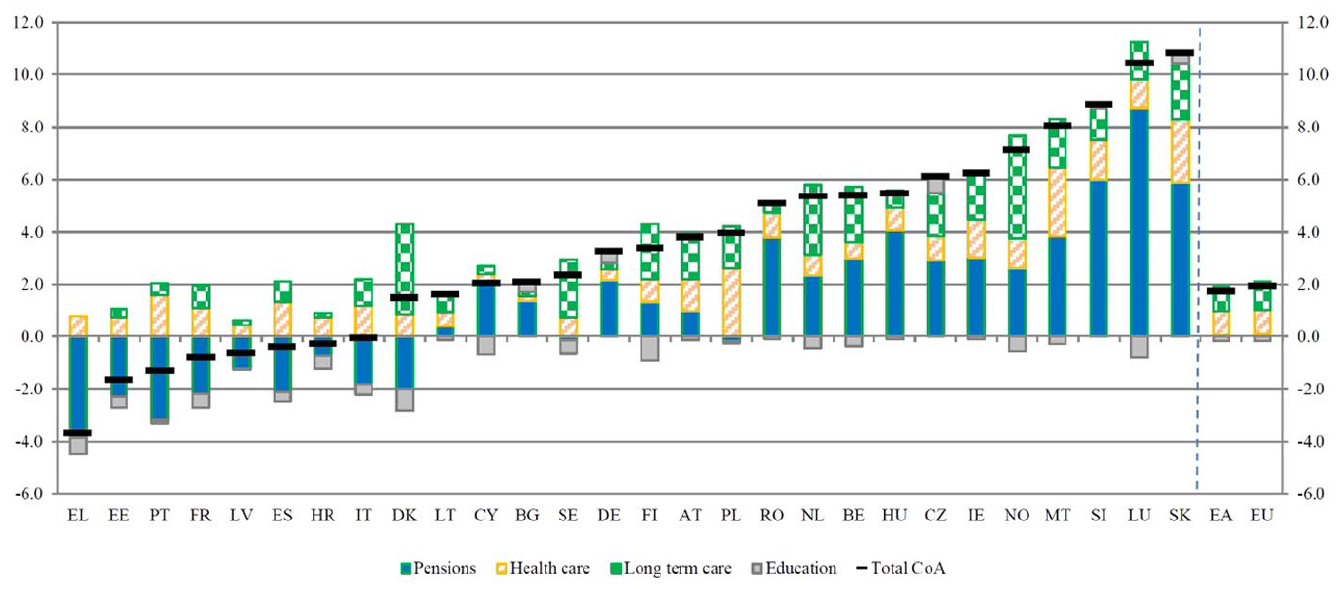
Projected change in age-related expenditure, 2019–2070 (EC, 2021b: 8).
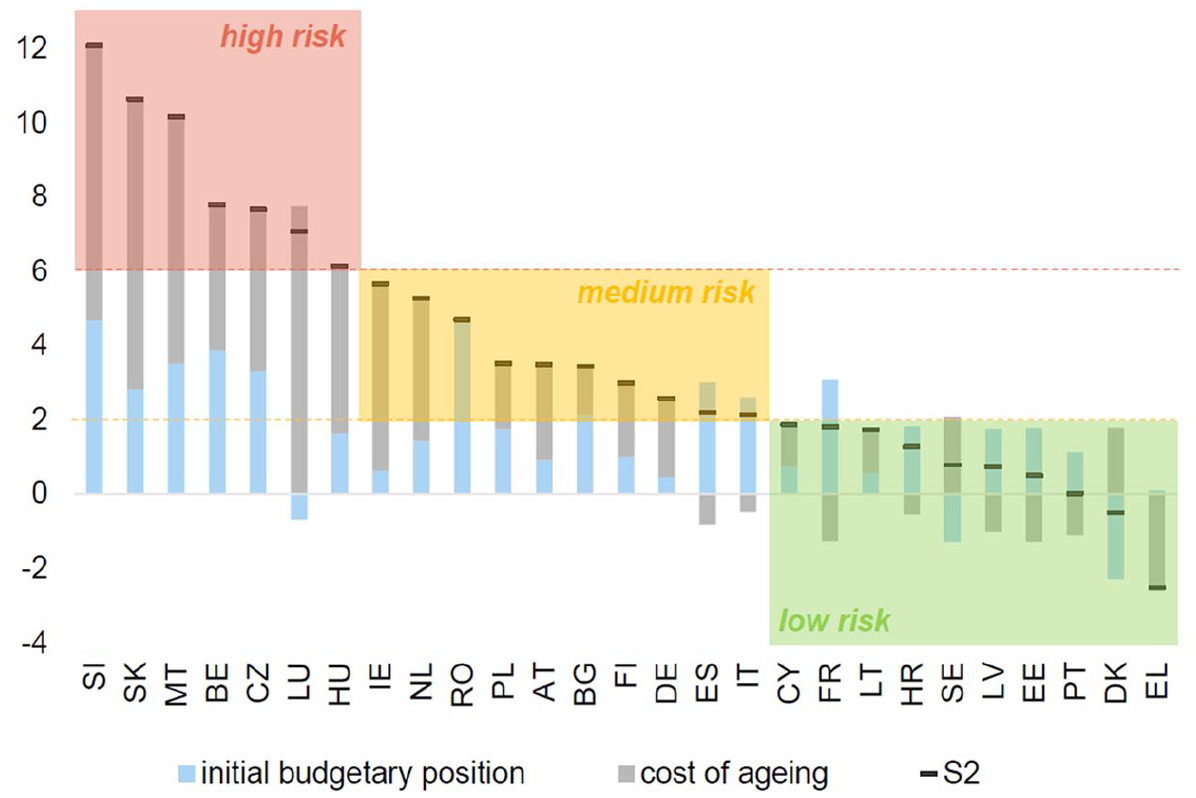
How ageing cost projections shape fiscal risk classifications (EC, 2022: 90).
These debt sustainability scores are politically consequential in several ways. First, they play a vital role in shaping perceptions of the fiscal policy ‘space’ available to EU member states (EC, 2021a). Figure 3 shows the implied fiscal adjustment needed to reach long-term debt sustainability, according to the S2 indicator. For Slovakia, for instance, this implies a required fiscal contraction of 10.5% of GDP. Within EU economic governance discourse, these long-term projections support and legitimise calls for urgent short- and medium-term fiscal contraction by the Commission. For instance, the 2021 Ageing Report suggested the following: The long-term projections show where (in which countries), when, and to what extent ageing pressures will accelerate . . . Hence, the projections are helpful in highlighting the immediate and future policy challenges for governments posed by projected demographic trends (EC, 2021b: 1).
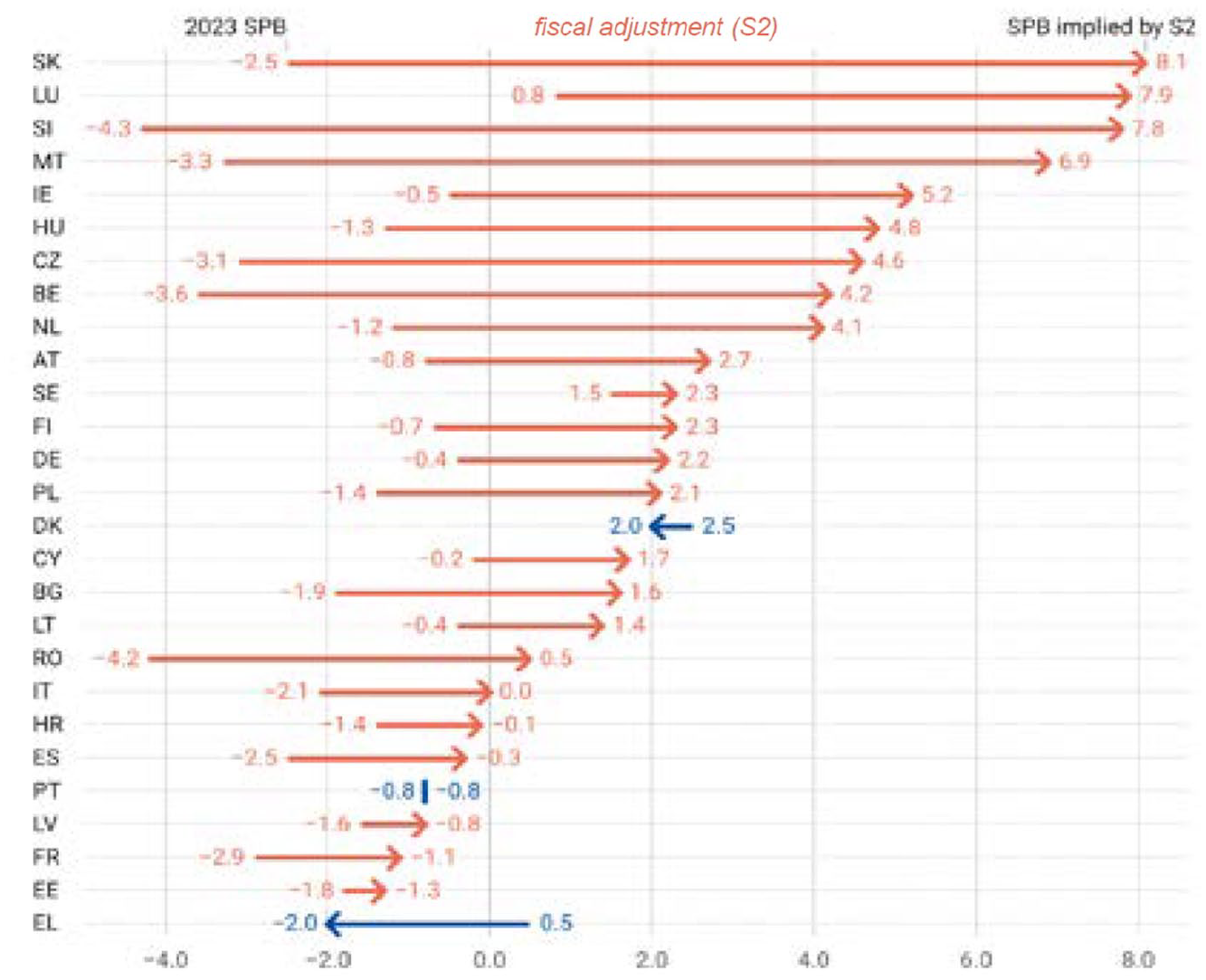
Fiscal consolidation required to close projected ageing costs (EC, 2022: 92).
AWG projections are also used by major IOs in country-level assessments – again, to support fiscally contractionary policy recommendations. Drawing directly on AWG projections, the Organisation for Economic Co-operation and Development (OECD) stated the following: Ageing puts long-term fiscal sustainability at risk ... Official projections [by the European Union] suggest that ageing-related spending ... could increase by more than 10 percentage points of GDP by 2070, one of the largest increases among OECD countries . . . Unless policies are put in place to mitigate these adverse effects, ageing will jeopardise fiscal sustainability . . . (OECD, 2022: 69).
This illustrates how, by assigning a precise figure to the fiscal gaps created by long-term demographic change, urgency is added to calls to reduce fiscal deficits in the immediate future.
Second, member states governments internalise these projections as hard constraints on their fiscal policy space. This is evidenced by the prominent role they play informing country-level Stability Programmes – and policy commitments made therein – submitted annually by Eurozone member states. Slovakia’s 2022 Stability Programme outlined how After meeting the targets under the public expenditure limit, the gross debt will fall below 55% of GDP by 2025. However, the long-term sustainability indicator S2 will remain in the high-risk zone at over 8% of GDP, reflecting in particular the strong adverse impact of the Slovak population ageing . . . This means that stabilisation or debt reduction beyond the budget horizon will only be possible through further revenue increases or expenditure cuts . . . (Ministry of Finance of the Slovak Republic, 2022: 3).
Indeed, so urgent was the perceived need for fiscal consolidation due to age-related pressures that it led to a revision of Slovakia’s constitution in December 2020, to add ‘a commitment to protect the long-term sustainability of the Slovak Republic’s economy based on transparency and efficiency in the use of public funds’ (Ministry of Finance of the Slovak Republic, 2022: 36). Slovakia also changed its fiscal rules – from targeting a 0.5% structural deficit to a 0.5% structural surplus – to contain ‘the sustainability risks associated with the costs of an ageing population’ (Ministry of Finance of the Slovak Republic, 2022: 48). Meanwhile, in response to its high S2 indicator score, Slovenia’s 2021 Stability Programme outlined a series of fiscally contractionary structural reforms, on the grounds that ‘. . . otherwise the age related expenditures will increasingly quickly [crowd] out expenditures for other purposes in the future’ (Government of the Republic of Slovenia, 2021: 50).
Finally, these projections matter in direct material terms. Access to key ECB funds such as the European Stability Mechanism (EC, 2019) – including its Pandemic Crisis Support Facility (EC, 2021a: 8–9) – depends on favourable assessments of debt sustainability, that draw on AWG age-related expenditure projections. They are also used by private Credit Rating Agencies in assessments of sovereign debt risk. In a 2022 assessment of Slovakia, Fitch (2022a) listed the ‘failure to adopt reforms that contain long-term fiscal pressures tied to ageing’ as among the ‘[f]actors that could lead . . . to negative rating action’ in the future. Likewise, a Moody’s (2021) report on Slovenia highlighted how ‘[f]iscal challenges related to Slovenia’s ageing population continue to pose risks to long-term fiscal sustainability’, while Fitch (2022b) highlighted the need for ‘[i]mplementation of structural reforms . . . to reduce longer-term public debt sustainability pressures associated with an ageing population’. Thus, access to EU support funds and the terms on which governments borrow in bond markets are influenced by AWG ageing projections.
This illustrates the political significance of age-related fiscal projections. By quantifying budgetary shortfalls due to long-term demographic change, they act to highlight anticipated pressure on national debt sustainability. They thereby support and legitimise calls for urgent fiscal consolidation measures – by EU authorities, IOs and private rating agencies – while directly influencing the trajectory of national macroeconomic policy.
Building credibility
Projected fiscal gaps are presented as the inevitable result of demographic trends, albeit ‘subject to considerable uncertainty’ (EC, 2020: 2). However, despite the framing of these projections as neutral and technocratic risk forecasts, analysing the underlying methodology reveals how they rely on a series of contested concepts. The very concept of ‘debt sustainability’ has a contested history (Kranke, 2022). Prominent heterodox theories of monetary policy – including modern monetary theory and post-Keynesian thought – challenge the notion that sovereign currency issuers face hard budgetary constraints (Kelton, 2020), suggesting capacity limits and inflation are the true constraints on activist fiscal policy. The main threat to debt sustainability in the Eurozone would thus be the ordoliberal design of the ECB, whose mandate forbids monetary funding of national debt. Even leaving aside these broader debates, the modelling of age-related fiscal risks relies on mobilising a series of debated or largely arbitrary assumptions, without which it would be impossible to convert the inherent uncertainty of the long-term future into tractable, quantified risks.
One of these is the time horizon over which projections are made. In the 2021 Ageing Report, the projection horizon is 2070 (50 years). This choice is arbitrary, but nevertheless has important implications for which countries are assigned high debt sustainability risk scores. This is because states have different projected ageing profiles, which interact with different pension and health policies. Figure 4 illustrates this point. Malta’s expenditure on public pensions, for example, is projected to decline over the medium term, so that by 2050, it will remain under the EU average. However, it then rises significantly to 2070, so that, at the end of the chosen projection period, it is above the EU average. Conversely, Romania’s forecasted pension costs rise steeply until 2050, at which point, they decline relative to the EU average. Setting the projection horizon at 2050, rather than 2070, would thus have resulted in Romania being assigned a higher, and Malta a significantly lower, risk score – impacting the fiscal space available to their respective governments.
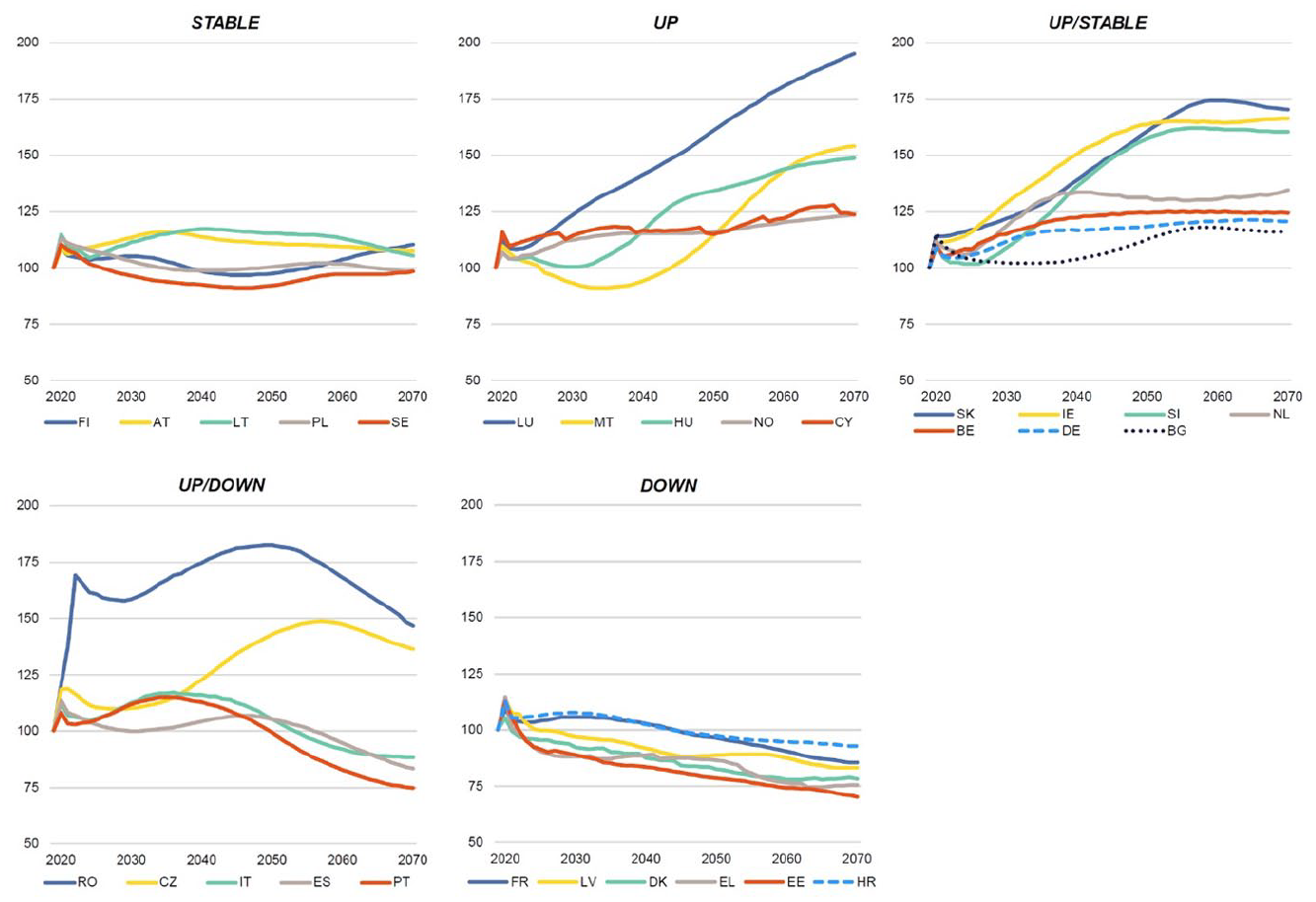
Evolution of ageing costs over projection period (EC, 2021b: 73).
Another key assumption on which AWG ageing projections depend is the ‘Non-Accelerating Wage Rate of Unemployment’ (NAWRU) – an assumed natural ‘equilibrium’ rate of unemployment for an economy, at which inflationary pressures due to wage bargaining will be contained. This is an essential underpinning of the model, allowing for an estimation of the unemployment rate far into the future (EC, 2020: 54–55). Without the concept of a NAWRU, and the further assumption of long-term convergence upon it, there would be no basis on which to make assumptions about the labour market dynamics of EU countries 50 years into the future, and so forecast the dependency ratios that inform AWG ageing projections. However, NAWRU is a deeply contested concept (see Kelton, 2020); there remains no theoretical consensus, or empirical validation, of its existence.
An important political consequence of using NAWRU as a core assumption in ageing projections is that it ignores the possibility that active public policy measures might bring unemployment down below this ‘natural’ rate in response to population ageing. For instance, the 2021 Ageing Report forecasts Eurozone unemployment to decline only marginally from a rate of 7.7% in 2019 to an average rate of 6% in 2070 – reflecting long-term convergence on NAWRU estimates (EC, 2020: 4). Thus, NAWRU assumes away any possibility of using radical labour market policies – such as a job guarantee – or public-led investment to achieve genuine full employment as a response to population ageing. By assuming a floor of 6% for unemployment 50 years into the future, present-day fiscal policy space is a priori constrained, by methodological design.
Calculation of age-related fiscal gaps is also highly sensitive to assumptions made about long-term interest rates (EC, 2021a: 74–77). This is important to assessments of long-term fiscal sustainability for two reasons that pull in opposite directions. First, a higher assumed long-term interest rate increases the future costs of servicing government debt. Conversely, a higher long-term interest rate results in lower discounted pension liabilities, decreasing their future cost to governments. Changing the assumed long-term interest rates used in ageing projections therefore has differential effects on the projected fiscal sustainability of different member states. States with high levels of accumulated public debt but low pension-related ageing costs will benefit from lower assumed future interest rates, and vice versa (EC, 2021a).
Significantly, in 2020, the AWG decided to revise the assumed nominal long-term interest rate downwards, from 5% to 4% (EC, 2021a). This methodological change had a divergent impact on the risk scores of different countries (see Figure 5). For example, Italy – which has high debt but lower pension liabilities – saw its risk score decrease, indicating greater fiscal space and greater access to funding sources, whereas for other countries (Malta, Luxembourg and Slovakia), this change led to increased risk scores. This highlights how an apparently technical change in assumed long-term interest rates has important impacts on projections of population ageing costs, and consequently the fiscal room available to governments today.
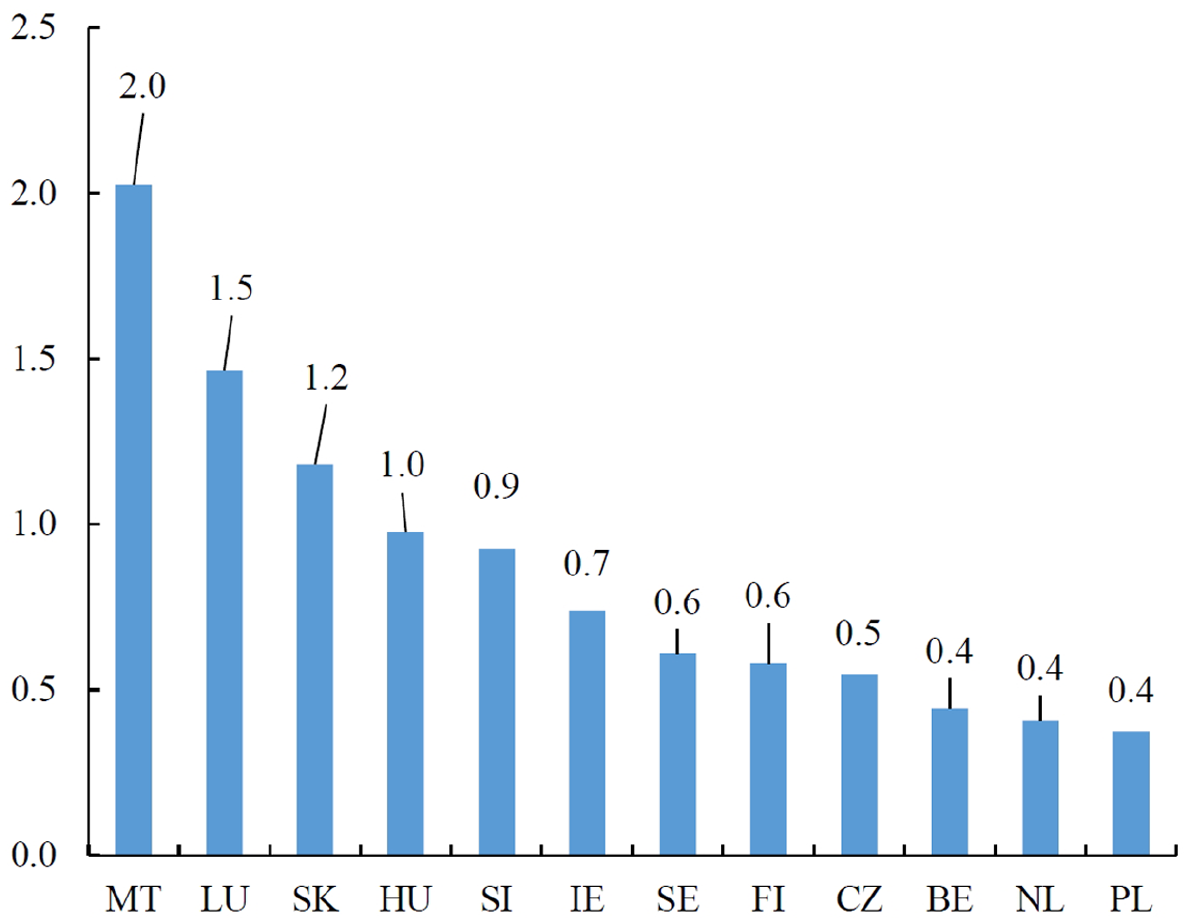
Impact of changing assumed long-term IR on ageing cost (EC, 2022: 175).
Finally, AWG ageing projections rely on assumptions about long-term total factor productivity (TFP) growth, which inform assumptions regarding potential GDP growth. Extrapolating from the recent secular downwards trend in TFP, the baseline scenario assumed convergence of EU countries on 1% TFP growth by 2070 (EC, 2020: 74–75). However, a ‘TFP risk scenario’ was also modelled, which assumed TFP growth slowing still further, to only 0.8% – generating even greater need for fiscal contraction. Two points about this assumption merit attention. First, the decision not to symmetrically model higher TFP growth scenarios narrows the perceived fiscal room available to governments. Second, it again precludes the possibility that significant public investment could raise long-term TFP growth rates. As such, TFP projections have a pro-cyclical, performative dimension (Heimberger and Kapeller, 2017). By assuming low future TFP growth based on the recent depressed trends – caused partly by low levels of investment – the policy space available for government-led stimulus and investment, which might in turn raise long-term TFP growth, is narrowed.
As we see, AWG ageing projections blend a series of contestable (and increasingly contested) macroeconomic assumptions with demographic forecasting techniques. In this way, importantly, the body of expertise from which these assumptions draw is lent credibility and objectivity. Rather than appear as the product of a particular body of politicised expertise, the policy prescriptions that flow from these models are normalised as the inevitable response to inexorable (and apolitical) demographic trends.
Delineating agency
The methodology underpinning the AWG’s ageing projections also constructs national policy agency in highly selective ways. As with the HCI, a methodological nationalism prevails, which fails to account for the structural (inter-)dependencies between economies identified in much comparative political economy (CPE) literature (Hall, 2018), the path-dependent trajectories of national economic institutions and the ways in which these condition the ability of national policymaking elites to respond to future fiscal challenges in isolation.
A central underpinning of the AWG’s ageing projections is assumed long-term ‘convergence’ of European economies (EC, 2020). In particular, the projections are based on assuming a common European demographic future by 2070, involving long-term convergence towards (1) the highest current national life expectancy; (2) the highest current national fertility rate; and (3) a common rate of inwards migration, based on the current short-term average (EC, 2020: 14–29). These are complemented by assumptions of long-term macroeconomic convergence towards (1) a common level of TFP growth; (2) a common nominal interest rate (4%); and (3) a common structural unemployment rate (EC, 2020: 66–80). These convergence assumptions appear heroic, based on the historical record of the Eurozone. Set against persistent predictions from its founders that monetary union would drive convergence, divergence in the macroeconomic profile of Eurozone members played an extensively documented role in the Eurozone crisis itself (Clift and Ryner, 2014; Copelovitch et al., 2016; Stockhammer, 2016). Since many of the underlying institutional features that drove pre-crisis divergence are still in existence (Schmidt and Thatcher, 2013), the assumption of smooth convergence towards a common European average by 2070 appears Panglossian.
More than a technical simplification for the purposes of modelling, these convergence assumptions serve to analytically bracket the multiple ways Eurozone membership itself drives macroeconomic imbalances that bear on the fiscal profile of member states. Assumptions of long-term convergence transform collective distributive questions (concerning fiscal transfer and burden-sharing between member states) into unit-level national fiscal ‘risks’. Through this, deeply political questions surrounding the institutional design of Eurozone governance or fiscal union – central to the long-term politics of ‘debt sustainability’ in the EU – are sidestepped, with age projections instead used to reinforce calls for fiscal discipline at the national level.
Finally, the design of the AWG’s ‘sensitivity tests’ also construct perceived national policy agency in highly selective ways. Significantly, almost every alternative scenario is designed to highlight how the fiscal consequences of ageing would be even worse if broadly fiscally conservative policy responses were not adhered to (EC, 2022: 81–90). Notably, they are used to admonish countries for any perceived backsliding on commitments to reduce the generosity of public pension and childcare schemes, or for failing to increase the statutory retirement age (EC, 2021b: 9). For instance, AWG projections were used by the OECD survey of Slovakia in 2022 to justify recommending even faster cuts to pensions and childcare provision, since while Under current policies, expenditure is projected to surge by 6 percentage points of GDP between 2019 and 2050 . . . The public pension reforms recently proposed by the Ministry of Labour are expected to narrow the financing gap only by around 1/3 of the projected gap in 2060 . . . (OECD, 2022: 70).
By modelling how projected ageing costs would be even larger if faster cuts in pensions and other benefits were not implemented, AWG sensitivity tests serve to mobilise urgency for punitive welfare and benefit reforms – presenting these, not as contingent political choices, but rather as structurally inevitable responses to population ageing.
Likewise, the negative macroeconomic impacts of reducing pension entitlements and other benefits, and the potential benefits of alternative policy responses, are excluded from the AWG model. For instance, a prominent literature highlights the channels through which rising inequality serves to slow growth and investment, by reducing demand (Stockhammer, 2015). If a greater share of national income goes to those higher up the income distribution, the saving rate increases, while demand is suppressed. But as the OECD Survey on Slovakia notes, while calling for reductions to pension entitlements to anticipate the costs of population ageing, The pension system contributes to low old-age poverty and inequality . . . Moreover, income inequality among the population aged 65 and above is among the lowest in the OECD . . . (OECD, 2022: 70).
An obvious implication is that widespread cuts to benefit and welfare systems will increase inequality. Yet, the growth-suppressing impact of this and the potential growth-enhancing effects of more redistributive policy scenarios that boost demand and investment are not included in the model used to forecast ageing costs or their sensitivity to policy change. Thus, alternative policy scenarios are a priori de-legitimised because the causal channels that would support them are excluded from the model. Consequently, cuts to public pension and welfare schemes appear as an inevitable and inescapable consequence of demographic change.
This section has shown how ageing projections play an important role in EU fiscal governance. By quantifying the long-term fiscal shortfalls created by ageing populations, they legitimise calls for urgent fiscal consolidation, conditioning perceptions of the fiscal space available to EU governments and supporting rapid cuts to pensions, childcare and welfare entitlements to increase labour market participation. As with the Bank’s HCI, however, we have seen how these projections are premised on contested macroeconomic assumptions. Moreover, through methodological design, national policy agency is constructed in ways that reduce scope for alternative agendas and downplay the need for collective European responses.
Discussion: Why and how quantified demographic futures matter
These two empirical case studies have illuminated the growing interactions between demographic projections, macroeconomic analysis and economic governance discourses. Reflecting on the broader implications of the foregoing analysis, we briefly highlight two themes: first, the different dynamics of governing through these quantified demographic futures across sites of economic governance; and second, the normative and political implications of the use of demographic forecasts in macroeconomic analysis, especially vis-à-vis other forms of quantified futures.
First, while the cases display similar dynamics surrounding the use of quantified futures, their respective institutional function and potential impact differ. Demographic projections at the World Bank play a predominantly discursive role. In giving precise quantified form to an otherwise vague concept, the HCI allows the Bank to bolster its calls for sustained investments into health and education. While the HCI serves to expose human capital trends among countries, it is best seen as informing a wider policy discourse that legitimises market-oriented goals and measures promoted by the Bank. By contrast, demographic models in the EU enter long-established and routinised processes of macroeconomic policy review and surveillance as part of the European Semester. Thus, their impact takes a more direct and instrumental form, in addition to generating discursive pressures to adopt the associated wider policy agenda of anticipatory fiscal restraint. An interesting, additional insight from the first case is that, with the Bank’s turn to ‘beyond GDP’ indicators, GDP has forcefully come in again through the backdoor via demographic projections that connect human capital investments to the prospect of economic growth. This dynamic provides evidence for the view that alternative indicators may ultimately not deviate much from the operating logics of mainstream indicators as long as powerful actors launch them (Malay, 2019).
Second, the integration of demographic projections into macroeconomic expertise and analysis raises important normative and political issues. All modelling and forecasting necessarily involves, as practitioners themselves concede, making simplified assumptions about a complex and ultimately unknowable reality (DeRock, 2021; Millo and MacKenzie, 2009). Moreover, these models are designed and used to provide information that can guide present policy action – in this sense, one might contend that a flawed or crude forecast is better than no forecast at all. Yet we have shown that, as quantified futures, demographic projections mediate economic knowledge in distinctive ways. Primarily, they do so by embedding the contested macroeconomic assumptions that inform these indicators and models with the less easily politicised and seemingly more objective science of demographic forecasting. In other words, the neoliberal policy agendas that they generally support – market-driven development policies in the case of the World Bank, and fiscally conservative macroeconomic policy in the case of the EU – can be abstracted from the particular bodies of economic knowledge that legitimise them; they are then rendered less contested and more credible with reference to long-term demographic trends that do not have an obvious association with any political ideology. Thus, market-based reforms and fiscal conservatism can be presented not as prescriptions of a particular form of contested economic knowledge, but as inevitable consequences of demographic change.
A key factor here is the status of expert knowledge that is entwined with certain forms of modelling, particularly the blending of different bodies of expertise to mediate internal disagreement or a lack of scientific consensus. The contemporary field of macroeconomics has witnessed growing internal contestation and professional fragmentation, both in academic and in practitioner circles (Ban, 2015; Dobusch and Kapeller, 2012; Meckling and Allan, 2020). In this regard, the blending of demographic projections with mainstream macroeconomic models downplays or even hides the contestedness of the underlying assumptions. As we have seen in the EU case, the urgency of fiscal consolidation can be framed as deriving secondhand legitimacy from the more settled and consensual field of demography, rather than as emanating from any particular school of macroeconomic thought. Indeed, as Steve Keen (2021) has pointed out, similar dynamics are at play in neoclassical approaches to modelling the economic damages of climate change. In this sense, researchers and democratic publics should be watchful of attempts to mask expert disagreement by coupling contested ideas to more settled and consensual fields of expertise, rather than explicitly confronting these problems through deliberative means (see, for example, Fischer, 2009).
Conclusion
In this article, we have analysed the consequences of the growing use of demographic projections in the realms of development and fiscal policy. To explore their impact empirically, we have used two case studies that span the life course: (1) the World Bank’s HCI, which forecasts long-term shortfalls in the future productive potential of national workforces; and (2) the EU’s Ageing Reports, which project the long-term costs of an ageing population. Both cases demonstrate how the routine creation of urgency via macroeconomic gaps, the building of credibility for contested bodies of development and economic expertise on the back of established demographic forecasting techniques, and the methodologically nationalist delineation of political agency combine to narrow countries’ policy space. Despite idiosyncratic dynamics and divergence in terms of direct policy impact, there are thus striking commonalities in how quantified demographic futures orient macroeconomic practice across different institutional sites.
More generally, the empirical material foregrounds the workings of quantified futures. The ability to mobilise urgency for policy action with reference to the threat of widening ‘gaps’ distinguishes these futures from more traditional, backward-looking quantitative indicators. Existing analyses tend to stress reputational dynamics that induce actors subjected to measurement to fear unfavourable scores and ranks because they are taken by others as evidence of poor past performance (Broome, 2022; Kelley and Simmons, 2015; Schueth, 2011). Our account complements such findings by directing attention to how benchmarking practices can activate concerns about potential future consequences of policy inaction or ‘wrong’ policy choices in the present. Here, reputational considerations are likely to be less pronounced because benchmarked actors could simply reject quantified futures as highly contingent or even not based on ‘facts’ as long as these futures do not form part of a larger governance architecture. However, even then considerable discursive pressure is generated by those who invoke ‘gaps’ as warnings of the dire things to materialise unless urgent action is taken.
Our study points to the need for more research on how quantified futures animate discourses of urgency, mainstream contested assumptions and (mis)represent structural constraints. While the macroeconomic gaps analysed here trigger calls for their urgent closing, other quantified futures may follow different logics and pre-structure the discursive space in different but no less consequential ways. For example, discourses organised around ‘thresholds’ lead actors to worry about crossing an imagined line beyond which heightened danger lurks (see Rodehau-Noack, 2023). Yet gaps and thresholds are more than just signposts towards an imagined future; they are markers of particular, often heavily contested, future-oriented concerns that are negotiated in the present – be it a perceived lack of human capital among young people or fiscal pressures resulting from societal ageing. The politics that lie behind these quantified futures therefore deserve to be taken more seriously.
Footnotes
Acknowledgements
The authors contributed equally to this article. They wish to thank the participants at two virtual workshops (in April and June 2022), including but not limited to the contributors to this special issue, and two anonymous reviewers for their constructive comments on earlier drafts. For the purpose of open access, the authors have applied a Creative Commons Attribution (CC BY) licence to any Author Accepted Manuscript version arising from this submission.
Funding
The author(s) received no financial support for the research, authorship, and/or publication of this article.
