



Abstract
Consociationalism’s uneven performance has focussed attention on the (possible) end stage of power-sharing systems. Northern Ireland, once lauded a consociational success, is now discussed among consociational failures. We use new public opinion data to assess consociationalism in Northern Ireland from a citizen’s perspective, exploring support for, trust in, and knowledge of power-sharing. We show that public attachment to the principles of power-sharing is higher than might be expected, despite dissatisfaction with the practical operation of the institutions. Whilst trust in the Assembly is low, trust in some Executive ministers is higher. The results from a political knowledge test are suggestive of healthy (if critical) political engagement. Support for power-sharing is, however, lopsided vis-à-vis the region’s two ethnonational communities. Citizens therefore offer a mixed verdict which, while not a ringing endorsement of the status quo, does not suggest the end of power-sharing. Assessments of power-sharing elsewhere could make similar use of public opinion.
Keywords
Introduction
Interest in consociational power-sharing is at an all-time high (Bogaards et al., 2019). However, even proponents of this leading institutional strategy for managing ethnically divided societies concede its performance has been ‘uneven’ across the globe (McCulloch and McEvoy, 2020: 109). On the one hand, power-sharing settlements can result in a peace dividend. Indeed, as one Large-N study has recently concluded, power-sharing systems perform relatively well in terms of reducing ethnic violence and preventing its reoccurrence (Cederman et al., 2022). On the other hand, a proneness to gridlock and institutional instability has meant that the governance and efficiency record of power-sharing systems has been less impressive (Fakhoury, 2019; Le Van, 2011; Younis, 2011). The trade-off between peace and governing efficiency that can arise in power-sharing contexts has been borne out in Northern Ireland’s (NI) experience of consociationalism. Whilst the 1998 Good Friday Agreement (GFA) has delivered a significant reduction in ethnonational violence (Gormley-Heenan, 2019), the consociational institutions it created have not functioned for over 40% of their existence. 1 As such, NI finds itself cited as one of several prominent examples of ‘zombie power-sharing’ (Nagle, 2020) and serious doubts have emerged about the survival of the region’s consociation.
Pessimistic assessments of power-sharing in NI suggest the region may be approaching what McCulloch and McEvoy (2020: 110) dub the ‘(possible) end’ stage of the power-sharing lifecycle. This arises when, after the adoption and tricky implementation stages of power-sharing (circa 1999–2017 in NI’s case), the regime arrives at a critical juncture at which a decision may be taken to abandon power-sharing altogether. Some commentary would suggest the fate of power-sharing in NI has already been sealed. At least three of the five largest political parties in the region, for example, have called for an end to so-called ‘mandatory coalition’, which is a central pillar of the consociational architecture enshrined in the GFA. 2 Media commentators, some of whom are long-time supporters of the GFA, now ask if power-sharing has outlived its purpose (Kane, 2022). But what of the views of the NI public? We know that, faced with the choice of British direct rule or power-sharing devolution, citizens in NI prefer the latter (Tonge, 2019). We also know – although the data are now somewhat dated – that citizens in NI were once fairly trusting of the devolved institutions (Gormley-Heenan and Devine, 2010: 159–160). There is much more to learn, however, about what citizens have to say about the state of power-sharing and the performance of the devolved institutions.
This article presents original survey data (N = 840) exploring levels of public support for, trust in, and knowledge about the power-sharing institutions. Our findings show that, despite recent problems, public support for the principles of power-sharing is higher than might otherwise be expected. At the same time, we evidence widespread dissatisfaction with the practicalities of power-sharing, by which is meant the day-to-day performance of the Assembly and Executive. We also show that support for power-sharing is lopsided: the region’s (British) unionist community is both less supportive and less trusting of the institutions compared with their counterparts in the (Irish) nationalist community. In terms of political trust, a varied picture emerges. Whilst trust in the power-sharing Assembly is low, moderate-to-high levels of trust are placed in (some) ministers of the power-sharing Executive. And, moreover, some ministers are shown to have earned the trust of citizens beyond their own ethnonational community. Using a political knowledge test, our findings also reveal a citizenry, which is knowledgeable about (and therefore clearly pays attention to) how power-sharing operates. This is worth noting, given that critics of consociation argue it can create a disengaged and passive citizenry (Dixon, 2005). In sum, therefore, the public offers a mixed verdict on the state of power-sharing which, whilst far from a ringing endorsement of the status quo, suggests that consociationalism in the region is not yet spent.
The remainder of this article is organised as follows. Using McCulloch and McEvoy’s (2020: 110) concept of the power-sharing lifecycle, in the next section we review the evolution of NI’s consociation and argue that it has indeed arrived at a ‘critical juncture’. We then describe our research methodology and the operationalisation of our variables in the survey before proceeding to analyse our main findings on citizens’ support for, trust in, and knowledge about power-sharing. We conclude by discussing the potential implications of the research.
The power-sharing lifecycle in NI
McCulloch and McEvoy (2020) posit three stages in the power-sharing lifecycle: adoption, tricky implementation, and (possible) end. Reviewing the evolution of the power-sharing system in NI would suggest it has moved towards its (possible) end stage.
The power-sharing arrangements set out in the 1998 GFA place NI in the category of a consociational democracy. Consociations are defined by four institutional features – Executive power-sharing, proportionality, mutual veto, and community autonomy (Lijphart, 1977) – all of which find some expression in the GFA (O’Leary, 1999). Additional provisions in the GFA, to do with demilitarisation, prisoner releases, and police reform, ensured its successful adoption in May 1998 via referendums in the north and south of Ireland. To say that the early implementation stage of power-sharing in NI was ‘tricky’, however, would be to understate the scale of the problems. Bitter disputes between unionists and nationalists over issues such as the pace of paramilitary decommissioning hobbled the power-sharing administration to the extent it was suspended three times between 1999 and 2001 (see Tonge, 2005). Then, after a total breakdown in the unionist-nationalist relationship in late 2002, the British government suspended power-sharing on a longer-term basis, placing the devolved institutions into cold storage until 2007.
The implementation and embedding of power-sharing in NI became less tricky after 2007. In 2006, the Democratic Unionist Party (DUP) and Sinn Féin, having electorally eclipsed their more moderate unionist and nationalist rivals after the 2002 suspension, agreed to resurrect power-sharing via the St Andrews Agreement. The re-devolving of powers to Belfast in May 2007 marked the beginning of a decade of devolved government during which the most unlikely of partners, ethnonational hardliners the DUP and Sinn Féin, jointly led a multiparty power-sharing administration without need for any suspensions. This decade marked the highpoint of power-sharing in NI, even if it did not always appear so at the time. Poor cooperation within the multiparty Executive (Wilford, 2010), subpar policymaking (Birrell and Heenan, 2013), and recurring stalemates arising from abuse of the ‘Petition of Concern’ veto (McCulloch, 2018) earned the institutions a reputation for dysfunction. Nonetheless, power-sharing endured and some aspects of the devolved institutions, for example the Assembly’s committee system, began to function reasonably well (Haughey, 2019).
The devolved elections of May 2016 indicated a further bedding in of power-sharing in NI. Taking advantage of institutional reforms agreed in March, the Ulster Unionist Party (UUP) and Social Democratic and Labour Party (SDLP) declined the Executive seats to which they were entitled and instead opted to form an official, cross-community, opposition. This was a first for devolved power-sharing, resulting in the formation of a two-party Executive led by the dominant unionist (DUP) and nationalist (Sinn Féin) parties. NI therefore transitioned from a ‘unanimous consociation’ (i.e. a grand coalition) to a ‘concurrent consociation’ in which the Executive had majority support in both ethnonational communities (see McGarry and O’Leary, 2006). This was heralded as marking ‘a new era in consociational power-sharing’ (Matthews and Pow, 2017: 311), which initially fostered a closer and more productive working relationship between the DUP and Sinn Féin.
3
This new era bore the hallmarks of a transition in the power-sharing lifecycle: Having bedded down for a period, the lifecycle then moves to a future destination with several possible scenarios . . . [1] the stable (or unstable) operation of the original agreement or [2] a process of evolution with intermittent episodes of institutional (re)design, or [3] . . . a shift away from power-sharing (McCulloch and McEvoy, 2020: 110).
By 2016 it appeared that NI had come to the ‘future destination’ point of the power-sharing lifecycle, settling into a process of evolution with intermittent episodes of institutional (re)design. 4 In early 2017, however, the region’s power-sharing lifecycle was dramatically reset when Sinn Féin withdrew from (and therefore collapsed) the Executive, 5 citing allegations of DUP malfeasance in an energy scheme (see McBride, 2019) and a pattern of disrespect towards Irish nationalism (BBC News, 2017). It would take 3 years before the institutions were restored (see Haughey, 2020). In the interim, the fallout from the United Kingdom’s 2016 decision to leave the European Union (EU) caused significant damage to the relationships (inter-party, inter-communal, and British-Irish) upon which the power-sharing settlement was built. The prospect of a UK–EU post-Brexit trade frontier was particularly destabilising as it re-invigorated the vexed Irish border question in British and Irish politics (Gormley-Heenan and Aughey, 2017). In the eyes of some (particularly nationalists), the spirit, if not the letter, of the GFA was further undermined by the actions of the British government. In an effort to strengthen her hand in negotiations with the EU, then UK Prime Minister called a snap General Election in 2017 only to lose her parliamentary majority. May then struck a ‘confidence and supply’ agreement with DUP MPs to remain in power, an arrangement which raised questions about the UK government’s commitment, as set forth in the GFA, to exercise ‘rigorous impartiality’ on behalf of all of the people in NI.
Power-sharing was restored in January 2020, shortly after the Conservative Party’s victory in the 2019 UK General Election ended the DUP’s kingmaker role at Westminster. The arrival of the Covid-19 pandemic a few months into the new administration initially fostered a spirit of cooperation within the multiparty Executive, 6 however there was a sense by the summer of that year that relationships, particularly between the DUP and Sinn Fein, had only partially recovered. By the autumn of 2020 disagreements within the Executive began to cause delays in the administration’s Covid-19 response (Moriarty, 2020) and, by 2021, coalition parties were openly accusing one another of undermining the Executive’s handling of the pandemic. The DUP, in particular, attracted criticism in this regard (e.g. Ulster Unionist Party, 2021). In the face of a public health crisis, the re-emergence of institutional dysfunction was interpreted in some quarters as proof positive that the power-sharing system was in need of a serious rethink.
In their power-sharing lifecycle, McCulloch and McEvoy (2020: 10) posit that ‘a critical juncture or exogenous shock’ is what triggers the transition towards the (possible) end stage of power-sharing. In NI’s case, it was the occurrence of both – a critical juncture (occasioned by Brexit) and an exogenous shock (in the form of a public health emergency) – which created widespread doubts, among politicians and media commentators alike, 7 about the survivability and suitability of power-sharing in NI. Brexit unsettled the political and economic status quo upon which the power-sharing settlement rested, and an unprecedented public health emergency tested Executive cohesion to its limits. It was in this context that we conducted our public opinion survey to learn of the extent to which citizens in NI shared these sentiments.
Survey methodology
An original representative survey was conducted to explore public support for, trust in, and knowledge about power-sharing. The survey was carried out by Ipsos MORI and fielded between 30 September and 6 October 2021. 8 The 840 respondents were drawn from the NI sample of Ipsos MORI’s ‘UK Knowledge Panel’ with respondents recruited to the panel via random probability address based sampling. The survey was administered online. Standard design weights have been assigned to adjust for sampling differences in selection procedures, probabilities, and response rates between key subgroups within the NI Population. Table 1 displays the demographic distribution of the survey according to key social divisions in the NI electorate.
Demographic distribution of survey sample.
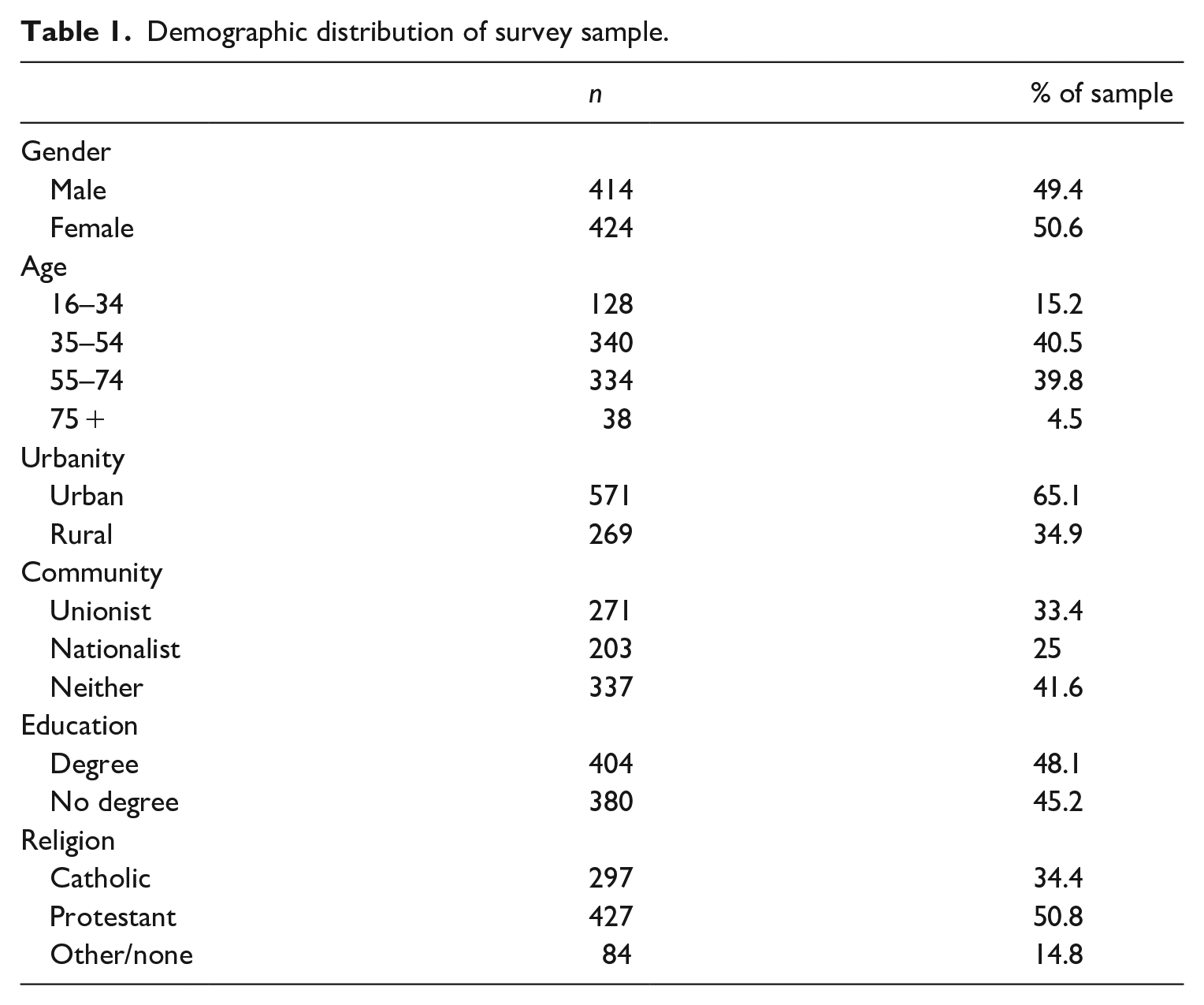
As would be expected, there is an underrepresentation of over 75 in the survey. This is an established drawback of using online surveys due to lower levels of Internet use among older cohorts (Blasius and Brandt, 2010). However, the age distribution beyond the over 75 is broadly representative. Other demographic indicators are also representative and consistent with recent surveys of the NI electorate (Northern Ireland Life and Times Survey, 2019, 2020, 2021; Shirlow and Tonge, 2019). In line with the growing number of citizens in NI who are eschewing ethnonational identity politics (Tonge, 2022), a plurality of respondents identified as neither nationalist nor unionist (which below we refer to as ‘Other’). Likewise the breakdown of self-reported nationalists and unionists is consistent with these recent survey results. 9 However, there on one notable demographic anomaly in the survey data: a small but significant under sampling of cultural Catholic identifiers (relative to Protestant identifiers) within the sample. The most likely explanation for this is survey companies using panel recruitment strategies based on out-of-date demographic data. We have controlled for this in the analysis by applying an additional survey weighting in our analysis based on the Catholic-Protestant demographic ratio reported in the 2021 census results as this represents the most accurate and up to date benchmark available (Northern Ireland Statistics and Research Agency, 2022). 10
The survey contains four question modules focussing on: actual levels of political knowledge among respondents; levels of trust in ministers of the NI Executive; levels of trust in political institutions (including those beyond NI); and attitudes towards power-sharing.
For the power-sharing module, respondents were presented with a series of statements related to their preferences regarding the region’s consociation and asked to place their attitudes towards each statement on a standard 5-point Likert-type scale from 1 (strongly agree) to 5 (strongly disagree). The statements captured general approval of power-sharing – for instance whether power-sharing is the most appropriate form of government for NI – and views on the performance of specific aspects of the power-sharing Assembly and Executive. Respondents were also asked if they believed power-sharing could be improved with further institutional reforms. Trust questions were captured on standard 10-point scales from 1 (no trust) to 10 (complete trust). The institutional trust question relates to the NI Assembly, although trust was also gauged with respect to other institutions such as the UK Parliament, Dáil Eireann (the lower house of the Irish parliament), the EU, and local councils. Our analysis includes a political knowledge variable, which relates to each respondent’s score from the survey’s political knowledge test. Respondents were presented with 10 statements about power-sharing, mostly pertaining to the Assembly and Executive, and asked to state whether these were true or false without looking them up. 11 We then created a simple additive index variable of actual knowledge for each respondent based on these responses. The mean number of correct answers was 5.97 (SD = 2.54) with a negative skew to the distribution, suggesting that citizens in NI are relatively knowledgeable about the power-sharing institutions.
The analysis will proceed by presenting an overview of the key descriptive findings before proceeding to the multivariate models of attitudes to power-sharing.
Results and analysis
Attitudes towards power-sharing
Figure 1 reports net agreement scores for the statements pertaining to power-sharing. The power-sharing attitude variables were recoded into three categories from the original 5-point Likert-type scales: the ‘Agree’ and ‘Strongly Agree’ options were combined into a single ‘Agree’ category and the two disagree options were combined into a single ‘Disagree’ category. The remaining responses were combined into a ‘neither’ category and are not reported in the table for reasons of clarity. Each net agreement score is calculated by subtracting the percentage of respondents who disagreed with the statement from the percentage of respondents who agreed with the statement.
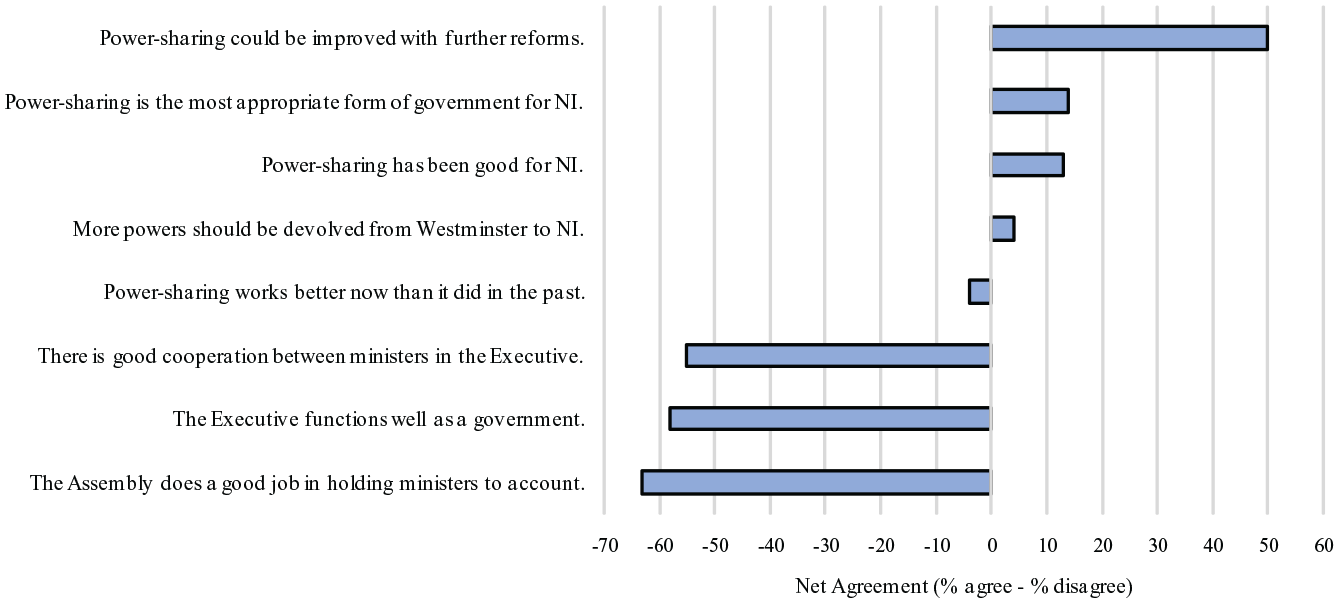
Attitudes to power-sharing (net agreement).
The above-mentioned results suggest that the principles of power-sharing continue to resonate with the NI public. There is net public agreement that power-sharing is the most appropriate form of government for NI, with citizens more likely to agree (42%) than disagree (28%) with this statement. Similarly, a plurality of citizens (41%) agree that, overall, power-sharing has been good for NI. Nationalists are noticeably more positive about power-sharing relative to their unionist counterparts. For example, whereas the majority of nationalists (56%) believe that power-sharing is the most appropriate form of government for NI, only a plurality of unionists (39%) take the same view. Moreover, more unionists disagree (42%) than agree (37%) that power-sharing has been good for NI. As with unionists, it is a plurality (38%) rather than a majority of ‘Other’ respondents who agree that power-sharing is the most appropriate form of government for NI. Other respondents are somewhat more upbeat than unionist respondents on whether power-sharing has been good for NI, with 40% agreeing and 26% disagreeing with this contention.
Lopsided support for power-sharing, vis-à-vis the two ethnonational communities, is not too surprising. The arrival of power-sharing in 1998 significantly improved the political fortunes of the nationalist community, which had been marginalised under unionist majority-rule from the 1920s until the 1970s (see O’Leary, 2020). For political unionism, however, power-sharing entailed a transition from ascendency to mandatory compromise. It is not uncommon for majority communities to have some resentment towards power-sharing (Horowitz, 2014: 12), although in NI’s case it would be more accurate to describe unionism as a former-majority community given recent demographic and electoral developments. Unionist parties lost their Assembly majority in the 2017 election and the steady decline in the Protestant population (Cooley, 2021), the natural support base of political unionism, makes the recovery of a unionist majority unlikely.
The discrete challenges facing ‘Others’ – those who do not align with the dominant cleavage that the power-sharing system is designed to accommodate – are well known (Agarin and McCulloch, 2020). In NI’s case, the votes of MLAs designating as Other count for less than the votes of unionist and nationalist MLAs in ‘key’ decisions, such as the election of Speaker or the passing of budget allocations (Schwartz, 2010). These key decisions can only pass having demonstrated a requisite level of unionist and nationalist support – usually a majority of MLAs in each bloc – thus granting ethnonational MLAs a veto. 12 Several scholars have railed against this as undemocratic and patently unfair to those in the Other community (O’Flynn, 2003; Wilford, 2010). In that regard, it might elicit surprise that we do not see more overtly negative views towards power-sharing emanating from the Other community. For example, Other respondents are just about as supportive of power-sharing as the most appropriate form of government for NI as unionist respondents are, even though the former’s MLAs are disadvantaged by consociational voting rules whereas the latter’s are not. This could suggest that Others are not as exercised by consociational voting rules as some might think, or, perhaps, that Others balance the unfairness of cross-community voting against the gains they have reaped elsewhere in the Stormont system. The Alliance Party, for example, has previously benefitted from an extra portfolio allocation in the Executive by virtue of its Other status, which, in the eyes of the DUP and Sinn Féin, have rendered it a more impartial candidate for administering the Department of Justice (Mitchell, 2018). 13
Modest levels of support for the principles of power-sharing contrast sharply with near universal dissatisfaction with the practical operation of the power-sharing institutions. Two-thirds of respondents disagree that the Assembly does a good job in holding ministers to account while 70% disagree that the Executive functions well as a government, resulting in net agreement scores of −58% and −63% for these questions respectively. These questions elicit strong cross-community consensus, with the majority of unionist respondents, the majority of nationalist respondents, and the majority of Other respondents taking a negative view of how the region’s legislature and government function. A perception that the performance of power-sharing has deteriorated over time is reflected in a negative net agreement score for whether power-sharing ‘works better now than it did in the past’.
Importantly, however, the public do not regard the problems affecting the institutions to be insurmountable: majorities in all three designation groups agree that power-sharing could be improved with further institutional reforms. And, despite the public’s verdict on the day-to-day performance of the institutions, there is still net public agreement that more powers should be devolved from Westminster to the power-sharing administration in Belfast. This finding should be of interest to both the London and Belfast governments given recent scoping exercises on the further devolution of fiscal powers, including the income tax rate, to NI (Independent Fiscal Commission, 2022). Nationalist respondents, who place low levels of trust in Westminster (see below), are unsurprisingly the most supportive of devolving further powers to Belfast, however there is also net agreement among Other respondents that further powers should be devolved. Unionists, who place more trust in Westminster than they do in the power-sharing Assembly, are more likely to oppose (53%) than support (28%) the devolution of further powers to Belfast.
Trust in politicians and political institutions
Respondents were asked to rate the trustworthiness of (1) a selection of unionist, nationalist, and Other ministers in the power-sharing Executive (one minister per party), and of (2) a range of political institutions within and beyond the United Kingdom. Respondents rated trustworthiness using a 10-point scale, where 1 = ‘no trust at all’ and 10 = ‘trust completely’. Figure 2 presents a percentage breakdown of these findings recoded so that a response of 1–4 = ‘low trust’, 5–6 = ‘Medium Trust’ and 7–10 = ‘High Trust’.
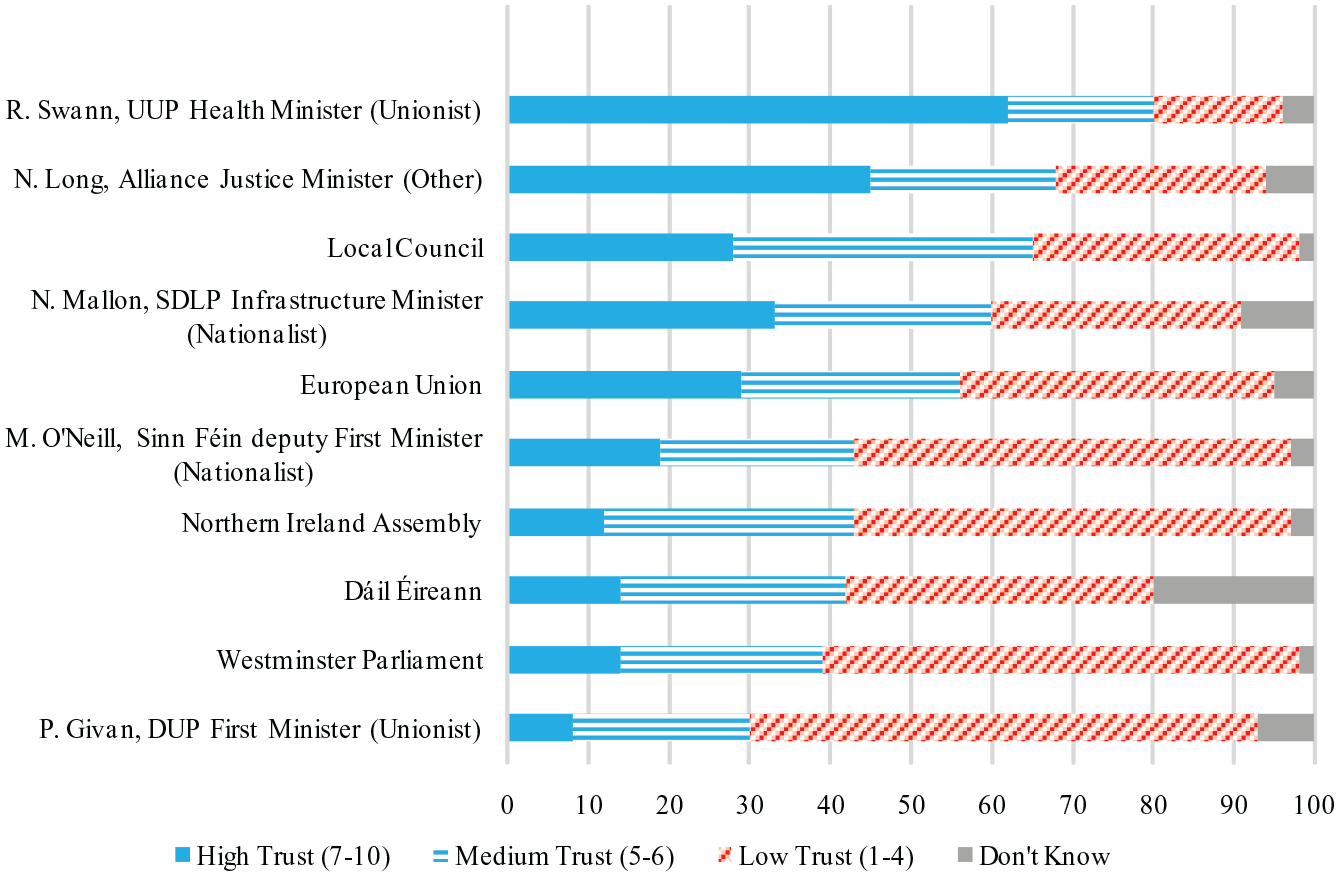
Levels of trust in institutions and representatives.
Figure 2 demonstrates a varied and nuanced picture regarding levels of political trust in NI. Three ministers in the power-sharing Executive emerge as some of the most trusted in our sample of representatives and institutions. The UUP Health Minister elicits an impressive level of political trust, with 62% of respondents placing high trust and a further 18% placing medium trust in this minister. As the minister overseeing the public health response to the Covid-19 pandemic at the time of our survey, such a favourable rating is probably to be expected. It is notable, however, that ministers with less prominent portfolios are also fairly well trusted by the public. Both the Alliance Party Justice Minister and the SDLP Infrastructure Minister have a plurality of respondents expressing high trust in them and both emerge as more trusted than distrusted by the public when their medium and high trust scores are combined. The same cannot be said for the leaders of the power-sharing Executive: 63% of respondents indicate having low trust in the DUP First Minister and 54% of respondents indicate having low trust in the Sinn Féin deputy First Minister. A similar level of pessimism exists regarding political institutions within the United Kingdom, with the majority of respondents expressing low trust in the Assembly (54%) and in the Westminster Parliament (59%). Interestingly, political institutions outside the UK fare somewhat better: a plurality of respondents place medium-high trust in the Irish Parliament (Dáil Éireann) and a majority of respondents place medium-high trust in the EU.
In some respects, ethnonational identity and levels of political trust align as we would expect. That is to say, for example, that trust in unionist ministers is highest among unionist respondents while trust in nationalist ministers is highest among nationalist respondents. Similarly, nationalists are more trusting of Dáil Eireann than of the British Parliament whereas the reverse is true for unionists. There are, however, some surprising results. Over 60% of nationalists place a high level of trust in the unionist Health Minister, illustrating that politicians in NI can win respect and earn trust beyond their traditional ethnonational support base (albeit in unusual circumstances). Furthermore, inter-ethnic comparisons reveal ethnonational identity to be a poor proxy for levels of political trust. Unionist respondents, for example, place similar levels of high trust in the nationalist Infrastructure minister (21% indicate high trust) as they do in the unionist First Minister (19% high trust). 14 Likewise, nationalist respondents are more trusting of the Justice Minister (68% indicate high trust), who designates as Other, than they are of the nationalist First Minister (49% high trust). If ever in doubt, there are clear limitations to using ethnonational identity as a proxy for political opinion in NI. 15
A final point worth noting is that, irrespective of trust score, ministers in NI possess good name recognition among the general public. An indication of this is the low number of respondents answering ‘don’t know’ when asked about the trustworthiness of different ministers (ranging from 9% for the Infrastructure minister to 3% for the deputy First Minister). This, added to our findings below on political knowledge, is suggestive of a politically engaged citizenry in NI.
Political knowledge
We use actual political knowledge as a proxy for political engagement in NI. In Figure 3, we report the mean of correct responses to 10 factual true or false questions about the power-sharing institutions. These questions tested knowledge about the Assembly (e.g. the number of signatures required to activate a Petition of Concern), the Executive (e.g. whether it has the power to raise income tax), and about devolved politics in general (e.g. the date of the next Assembly election).
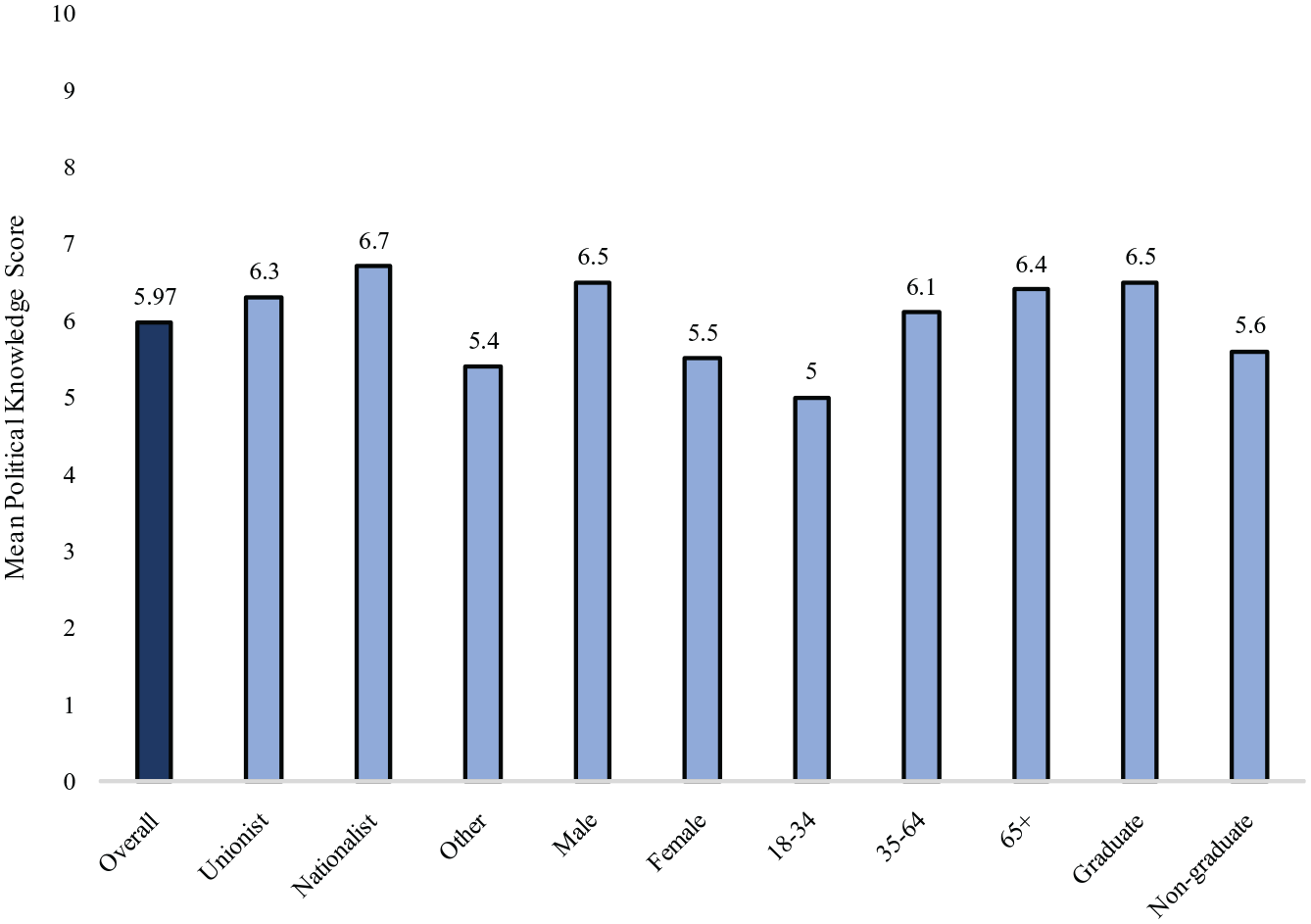
Mean levels of political knowledge.
The elitist tendencies of consociational power-sharing may well run the risk of disengaging citizens from the polity; however, this risk appears not to have materialised in NI. With respondents answering an average of nearly six out of 10 questions correctly, these results are suggestive of a citizenry which is fairly knowledgeable about how the power-sharing institutions operate. Some statistically significant (p < .05) knowledge gaps between demographic sub-groups are notable. As would be expected, older respondents and those with a degree are more likely to have higher levels of political knowledge than younger respondents without a degree. Consistent with trends observed elsewhere (Fortin- Rittberger, 2016), there is also a significant gender gap in political knowledge, with male respondents averaging a whole point (6.5–5.5) higher than female respondents.
In terms of ethnonational designations, nationalist respondents emerge as the most knowledgeable about power-sharing (answering an average of 6.7 questions correctly). Political knowledge within the unionist community, however, is also quite high, with respondents averaging a knowledge score of 6.4. With a noticeably lower political knowledge score of 5.4, Other respondents emerge as the least knowledgeable about the institutions. Given the literature shows a consistent relationship between education levels and political knowledge (Grönlund and Milner, 2006) it seems likely this pattern is explained by higher education levels among the Catholic nationalist community. However, analysis that controlled for the effect of education was inconclusive.
Drivers of support for power-sharing
Model specification
For the final stage of our analysis, we designed a logistic regression analysis to explore potential drivers of support for power-sharing. We focussed the multivariate analysis on four of the variables related to power-sharing preferences 16 :
Power-sharing is the most appropriate form of government for NI.
More powers should be devolved from Westminster to NI.
Power-sharing works better now than it did in the past.
Power-sharing could be improved with further reforms.
Respondents generally agreed with these statements (see Figure 1), with plurality agreement for Statements 1 and 2 and a large majority agreeing with Statement 4. Only Statement 3 has a narrow plurality disagreeing with the statement. As we have demonstrated above, there is some variation by community allegiance. We use a logistic regression approach to test if this division holds and to see if other variances emerge in a multivariate analysis.
To create our dependent variables, the responses to the above statements were recoded into a binary format with 1 = ‘agree’ and 0 = ‘all other responses’. We chose to keep responses of ‘don’t know’ and ‘neither’ within the analysis to set a more conservative predictive threshold for power-sharing attitudes which reflects the distribution of views within the electorate. This also improved the statistical power of the models given our relatively modest sample size. After the recoding, the distribution within the dependent variables is relatively even; 47.4% (388 respondents) agreed with Statement 1, 36.4% (304) agreed with Statement 2, 28.6% (240 respondents) agreed with Statement 3, and 65.4% (549) agreed with Statement 4. Bi-variate analysis demonstrating substantively relevant differences in the relationship between the statements and the predictors in our model suggests that we are justified treating these attitudes towards power-sharing as substantively and analytically distinct rather than creating a single indexed measures or factor score.
We used a block building approach to modelling the attitudes towards power-sharing with predictors entered in three stages to identify any possible interaction or confounding effects in the model. The first stage introduced the key demographic variables which were selected based on previous research on predictors of attitudes within the NI electorate added to standard controls. Age is included as a three-category variable; 18–34, 35–64, and 65 + with the latter included as the reference category. This is a slightly non-standard approach to measuring the effects of age but was based on the age distribution within the sample and a desire to identify cohorts that would have a distinctive relationship with power-sharing arrangements. The 18–34 cohort would all have come of age after power-sharing came into operation, 35–64 captures the transition generation and 65 + older groups. Gender is included as a Standard 2 category dummy variable with Female = 1, Education is entered as a binary variable where Degree = 1 and Urbanity is entered as a binary variable where Rural = 1. 17
Stage two introduced the political attitudinal variables into the analysis. These include prospective vote choice (for upcoming NI Assembly elections in May 2022) with non-voters set as the reference category to measure variance between unionist and nationalist voters. We are limited here by the survey company only capturing vote choice for DUP, Sinn Féin and ‘smaller parties’ in its questionnaire. The ‘smaller parties’ category includes all parties other than the DUP and Sinn Féin. This limitation in the data means that party choice (particularly the ‘smaller parties’ category) offers limited insight as a predictor in the models but needs to be included as a control. Also included in Stage 2 were actual levels of political knowledge which is an ordinal index of the number of correct answers respondents scored on 10 political knowledge questions about power-sharing (see the methodology section) and levels of trust in the NI Assembly – a 10-point ordinal variable running from 0 (no trust) to 10 (complete trust).
At Stage 3, the community variable was introduced to discover how it disrupted the model and to test if community allegiance continues to override other considerations as a driver of attitudes towards power-sharing. It is entered as a three-category binary variable (Nationalist, Unionist, and Other) with the Unionist identity held as a control. We considered including religion and ethnicity in the model. However, these were too strongly correlated with community identity to disaggregate their effects and avoid issues of multi-collinearity.
Model results
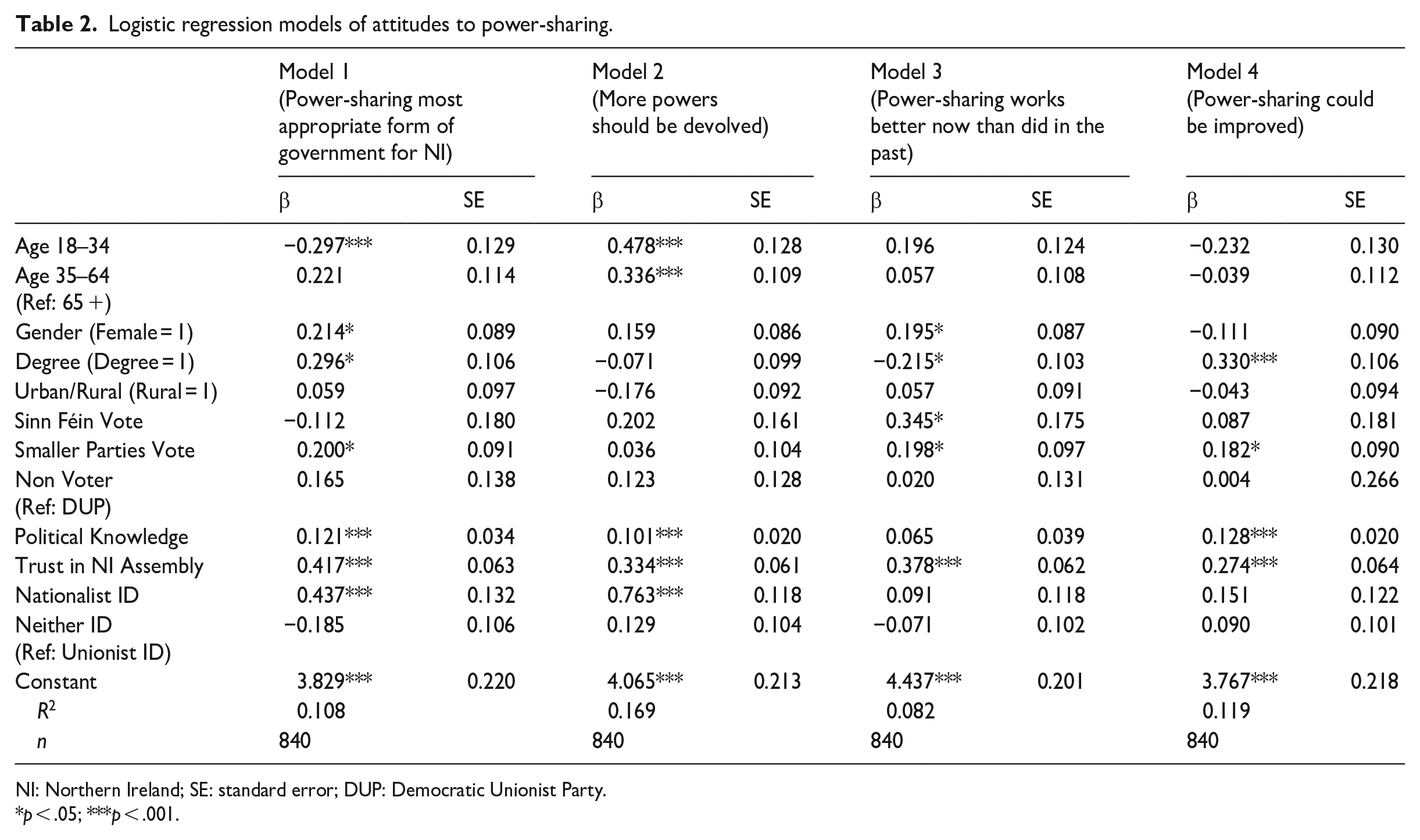
Table 2 presents the results from the logistic regression analysis. The same model was applied to predict attitudes on each of the dependent variable power-sharing indicators. Table 2 shows the final model.
Logistic regression models of attitudes to power-sharing.
NI: Northern Ireland; SE: standard error; DUP: Democratic Unionist Party.
p < .05; ***p < .001.
Model 1 reveals several statistically significant predictors of support for the power-sharing model of government. Unsurprisingly, given what we note above, there is a strong positive relationship between the nationalist identity and support for power-sharing. There is also a positive relationship between having trust in the Assembly and support for power-sharing, and between political knowledge and support for power-sharing. Simply put, those who trust the institutions and have some knowledge of how they work are more supportive of them. Similarly, education level has a positive effect: those with a degree are more likely to view power-sharing as the appropriate model of government for NI compared with those without a degree. Interestingly, youth (18–34) negatively predict support for power-sharing, which is to say that younger respondents (compared with older respondents) are not as convinced that power-sharing is the most appropriate model of government for NI.
One of the most interesting findings to emerge from Model 1 is the positive gender effect. Compared with their male counterparts, women are more likely to think that power-sharing is the most appropriate form of government for NI. Moreover, as revealed in Model 3, women are also more likely to think that power-sharing works better now than it did in the past. These findings are worth noting. Research from a decade ago found women in NI to be less supportive of power-sharing than men and pointed to lingering gender inequalities, such as barriers to reproductive healthcare, as a potential contributor to this effect (Hayes and McAllister, 2013; see also Kennedy et al., 2016). Since then, there have been strides towards gender equality in NI, not least the decriminalisation of abortion in 2019. 18 Added to this, the number of female MLAs is increasing (30% at the time of our survey, compared with 7.7% in 1998) and significant advancements have been made within political parties in terms of female political leadership (Matthews and Whiting, 2022). Our results suggest the devolved administration may be reaping some credit for improvements to gender equality in NI, even if the most important of these was legislated for by Westminster (see Pierson, 2021).
Despite younger citizens taking a more negative view of power-sharing as a model of government, Model 2 shows that they still favour strengthening devolved government by transferring further powers from London to Belfast. With the 65 + age cohort as the reference category, both the 18–34 and 35–64 cohorts correlate positively with support for further devolution. As with Model 1, political trust and political knowledge are shown to be statistically significant predictors in Model 2: those who trust and are knowledgeable about the institutions are supportive of strengthening their policy remit. The nationalist identity is a strong positive predictor of support for devolving more powers from London to Belfast, which is unsurprising given nationalism’s separatist tendencies.
It is notable that there are no effects for the community variable in Model 3 on whether power-sharing works better now than in the past. As there are strong positive significant effects of both Sinn Féin and the ‘smaller parties’ vote in this model (compared with DUP vote), the null finding for community allegiance suggests that the unionist community may be significantly divided on this question although the limitations of the vote-choice variable restrict our capacity to explore this further. It is also interesting that while the trust variable remains a strong predictor, knowledge of the Assembly is not having an impact in this model, suggesting those with knowledge may have strong opinions in both directions on whether power-sharing works better now than in the past. Education has a negative effect in this model, which is to say that degree holders tend to disagree that power-sharing is working better now than it did in the past.
Model 4, on predictors of attitudes to whether power-sharing could be improved with reforms, is the least well performing of our models. Given the relatively high level of consensus on the question of reform, discussed above, the lack of variance in this model is not too surprising. Trust and knowledge are, again, significant positive predictors in this model, further underlining the importance of political trust and political knowledge to perceptions of power-sharing. Education is having a positive significant effect, and, interestingly, it runs counter to the negative effect in Model 3. This makes sense: degree holders tend to disagree that power-sharing works better now than before and are more supportive of reforms to improve it.
Conclusions and implications
The increasing dominance of consociational power-sharing as a model for divided societies has been welcomed by some (Bogaards et al., 2019) and is lamented by others (Dixon, 2020). Whatever the merits of the model, however, advocates and critics will likely concur with Nagle (2020: 140), who argues that all forms of hegemony, including ‘the hegemony of consociationalism’, are contingent upon public consent. Having explored public opinion on the subject, this article’s findings do not suggest a withdrawal of consent for the use of power-sharing in NI. Citizens are more likely to agree than disagree that power-sharing is the most appropriate form of government for NI, that power-sharing has been good for NI, and that more policy responsibilities should be brought under the control of the power-sharing administration. These are not exactly the findings we would expect of a power-sharing system at the end of its lifecycle.
It is important to note, however, that the public attachment to power-sharing we illustrate, first, is modest and, second, cannot be taken for granted. Our findings point to a number of issues which, if left unaddressed, will likely chip away at public confidence in the region’s institutions if and when they are fully restored. First, there are those issues on which all three communities agree. There is cross-community consensus (1) that the Assembly does not perform well in holding ministers to account, and (2) that the Executive does not function well as a government. These criticisms cannot be dismissed as generic political cynicism. As we show above, citizens in NI are fairly knowledgeable about power-sharing and, as such, we would characterise these complaints as informed criticisms which warrant attention. For the Assembly, some of the issues affecting its scrutiny capacity are already known. Behavioural issues, such as the tendency for MLAs to prioritise party loyalty above their scrutiny obligations (Wilford, 2015) and structural issues, such as the presentation-style format of committee scrutiny sessions (Cole, 2015), are both thought to work against rigorous accountability. For the Executive, lack of cooperation between ministers is likely contributing to its poor reputation. Moves to address these issues would likely meet strong public approval given the level of support for institutional reform we note above. Some remedies for these problems have already been offered – see Coglin et al. (2020), for example – however, institutional instability has likely frustrated their implementation.
Intra-communal issues, particularly lower levels of institutional trust and support for power-sharing within the unionist community, pose greater difficulty. In defence of the region’s consociation, it is probable that issues beyond the control of the Assembly and Executive bear some responsibility for these findings. Unionists have recently experienced the psychological shock of losing their parliamentary majority at Stormont (Cheung, 2017) and shortly thereafter witnessed the British government implement the ‘Northern Ireland Protocol’. 19 This latter development has been particularly unsettling for unionists, many of whom regard it as a betrayal which imperils the union (McBride, 2021). The sense of unionist isolation which emerges from our findings is unsurprising against this backdrop. Whatever the cause, however, unionism’s political isolation poses a challenge to the power-sharing institutions, whose long-term survival will depend on retaining a level of support and trust across the ethnonational spectrum.
Low levels of institutional trust in general need not spell a democratic crisis for NI. Scholars have observed low levels of institutional trust across the democratic world for some time (Arpino and Obydenkova, 2020; Dalton, 2004), thus there is nothing particular to NI about these findings. Moreover, despite low levels of trust, there is little to suggest that citizens in NI are politically disengaged. We observe respectable levels of actual political knowledge which would place citizens more in the category of engaged sceptics – or perhaps ‘critical citizens’ (see Norris, 2011) – than in the category of the disengaged. Advocates of consociationalism will find further encouraging signs in levels of trust placed in (some) individual ministers, particularly where ministers have earned the trust of citizens from across the ethnonational spectrum. The favourable ratings of the unionist Health Minister among nationalist respondents are especially interesting in this regard. Studies of performance-based electoral behaviour in NI have found evidence of responsibility attribution among unionist electors but not among nationalist electors (Garry, 2016), however the high level of trust nationalists place in the Health Minister might suggest a change in this regard – albeit in the temporary context of a public health emergency. Given that we did not ask questions specific to the minister’s handling of Covid-19, further and more bespoke research to explore this would be welcome.
The limitations of our study beckon further research. Our survey took place not long after a period of institutional collapse and amid increasingly negative media coverage of the Executive – hardly an auspicious context within which to survey public opinion about the institutions. However, it should be noted that the institutions have experienced a further setback since we undertook our survey. DUP First Minister Paul Givan resigned in February 2022 (McCormack, 2022) and, following the elections in May, the Assembly has yet to elect a Speaker to commence full parliamentary business. These subsequent developments may have affected public opinion on power-sharing, although it is difficult to anticipate how. Furthermore, instability may have lessened support for power-sharing, although we would note that institutional reforms agreed in January 2020 enabled Executive ministers to remain in post for a considerable period (see Haughey, 2020), lessening the severity of this episode of institutional instability compared with its predecessor in 2017–2020. Nonetheless, further research on public attitudes to power-sharing would be welcome.
Further research on the role of public opinion in consociations, specifically vis-à-vis its relation to the power-sharing life cycle, would also be welcome. The elitist tendencies of consociational power-sharing – it is, after all, a system of government by ‘elite cartel’ (Lijphart, 1969: 216) – has led some to argue that it undermines the role of citizens in the polity (Deschouwer, 2006). At the same time, however, we know that elites have turned to public opinion during power-sharing negotiations (Irwin, 2001) and that elites have attached much importance to putting power-sharing agreements to the people, via referenda, before they are adopted (McEvoy, 2018). But what of the role of public opinion further along the power-sharing lifecycle? If the mark of a successful consociation is that it builds good community relations and renders itself superfluous (Lijphart, 1977), the role of public opinion towards the (possible) end of the lifecycle is surely a crucial one. McCulloch and McEvoy (2020) call for further study of the conditions under which political actors might decide to depart from power-sharing. A related and equally important question concerns the extent to which – if at all – public opinion feeds into these deliberations. Elite opinion may well suggest that the end of power-sharing has arrived, but the NI case study illustrates that citizens may not necessarily agree.
Footnotes
Acknowledgements
The authors thank two anonymous reviewers for constructive feedback on an earlier draft of this paper.
Funding
The author(s) disclosed receipt of the following financial support for the research, authorship, and/or publication of this article: The authors gratefully acknowledge funding from the Early Career Researchers and Returners Fund, University of Liverpool.
