




Abstract
Political parties are afforded a key role in making consociational democracy work; however, parties that dis-identify with salient identities and appeal to voters across the ethno-political divide face barriers when interacting with voters and with other, segmental parties. Nevertheless, such cross-segmental parties often thrive and even ascend to power. Northern Ireland’s cross-segmental parties – the Alliance Party, the Green Party, and People before Profit – have sought to traverse group-specific voter interests and set their agenda apart from that of segmental parties. For such parties to be considered ‘coalitionable’, they should outline their (potential) governing contribution to complement other political parties’ agendas. Cross-segmental parties’ participation in government makes them appear electable, but it is the focus on bipartisan concerns that consolidates their electoral success and ensures their political relevance. We focus on the evolution of Alliance’s political agenda and fill a gap in the literature on the relevance of cross-segmental parties in consociations.
Keywords
Introduction
Observers of representation in divided societies anticipate that parties are likely to reflect the vision of ethno-political stewardship resulting from dominant cleavages. Their role, however, is judged to be ambiguous. Some scholars, following Nordlinger (1972: 82), reaffirm that leaders lead and voters follow, assigning a stabilising role to political parties in divided places. Segmental parties underpin the mode of voter representation in formal institutional settings (Luther, 1999: 8) and, over time, allow for violence to be translated into political conflict (Reilly, 2006). If political party platforms reflect social divisions, and political preferences appear seamlessly coherent with the social characteristics of those casting ballots, electoral success – and thus, political stability in post-conflict divided societies – will be guaranteed (Lipset and Rokkan, 1967).
Scholars from Lijphart to Nordlinger, Reilly to O’Leary suggest that in divided places political elites need to signal – but not assert – identity connections between themselves and their voters. This link is already presumed by parties representing politically relevant groups, since, as Diamond and Gunther (2001: 23) suggest, ‘the electoral logic of the ethnic party is to harden and mobilize its ethnic base with exclusive, often polarizing appeals to ethnic group opportunity and threat’. Even though reaching out across the divide is acknowledged to contribute more substantively to the stability of consociational places, mobilising voter support for non-binary politics in a polity operating under consociational arrangements is considerably more difficult (Tonge, 2020). The central challenge for cross-segmental parties in consociations is to develop strategies that yield electoral success and ensure their political relevance. Our research offers the first attempt to assess whether they can be successful in doing so.
If segmental parties can translate votes into political influence through a guaranteed seat in government, cross-segmental parties’ electoral success situates them and their voters in opposition to the political agendas of parties of the consociation’s majority, raising concerns about the representativeness of politics and the democraticness of consociational policy-making. We analyse the most resilient cross-segmental party in Northern Ireland, the Alliance Party (APNI), and suggest that focusing their political agenda ensured their ability to attain what most parties in all political systems aspire to continuous participation in executives, which contributes to greater representation and democracy in this regional consociation.
The article proceeds as follows. First, it considers the theory and practice of political parties in consociational societies, before focusing on cross-segmental parties in Northern Ireland and then the specific case of APNI. We conduct a review of the party’s manifestos, election campaign material, and policy reports from its foundation to the present day. To complement this focus, we also utilise data from APNI’s public statements and from interviews with the party leadership conducted by the authors between 2013 and 2019.
Over the past decade, repeated stalemates in the Northern Ireland Assembly have galvanised voters around three issues – government transparency, Europe and Brexit, and public services. We find that over time the party’s agenda became more specialised to reflect this limited set which concerns all voters in Northern Ireland. In the process of focusing on the core concerns of the entire electorate, APNI has consolidated its profile as the party that stands above the sectarian division and is able to most effectively appeal to all voters by addressing these issues in its campaigns. These focal issues reflect concerns over policy efficiency, economic sustainability, and the local impact of dynamic regional, interstate relations, allowing the party to downplay its prowess as a member of government and to exercise power. We define prowess as the ability of cross-segmental parties to realise the full potential of their unique position within consociations by outlining their (prospective) governing contribution to complement the agendas of other political parties and thus be considered ‘coalitionable’. Our overall conclusion is that the case of APNI demonstrates that when segmental parties in consociations fail to ensure substantive representation of their voters interests, a cross-segmental political party stands some chance of success despite disincentives for voters to choose ‘middle of the road’ political representatives.
Political parties in consociations
Despite the evolution of consociational scholarship from descriptive to prescriptive evaluations of divided societies, focusing on cross-segmental elite cooperation retains its appeal. Lijphart’s (1977) characterisation of consociational democracy as a political regime in which cooperation takes place between the leaders of parties representing distinct socio-cultural segments of divided societies stands its ground.
Because consociational regimes are poised to encourage parties’ ethno-political appeal – or at the very least, encourage moves towards the ethnic tribune (Mitchell et al., 2009) – some scholars view the existence of parties with a cross-segmental voter base as evidence of the ‘normalisation’ of political participation of citizens (Reilly, 2012). They argue that once citizens articulate their political interests through cross-segmental political parties in a system that encourages the salience of group identities, representation will become more stable because it is more accountable to the median voter (Horowitz, 2000 (1985)). Others disagree that the long-term political reward for moderation exhorts a stabilising effect on politics in deeply divided societies (McCulloch, 2013).
Instead, inter-party competition within an electoral segment, and particularly ‘ethnic outbidding’ as the dominant strategy of parties’ relationships within the respective politically relevant segment, has so far overshadowed another component determining parties’ electoral success: their relations with voters (Mitchell et al., 2009). Regarding factors to explain party success in divided societies, Bogaards (2014: 7) notes that ‘segmental parties have two dimensions: an internal dimension, pertaining to the relationship between party and segment; and an external dimension, pointing at the relationship among the (segmental) parties in the party system’. The external dimension is often uncritically believed to determine a party’s relationship with its voters, rather than the internal, party-voter relationship defining a party’s chances of joining governing coalitions. However, a credible link between the party and the voter is central to its electoral success, as accumulating sufficient electoral weight to be considered seriously as potential coalition partner is a key for any party in any electoral system.
Political regimes where access to public office is stipulated to ensure equitable representation of all significant societal groups are not the exception to this rule. Since consociational rules usually prescribe cross-segmental cooperation in government, only parties that stand to represent politically relevant segments can be considered ‘coalitionable’ (meaning that they can participate in government formation). To ensure that the consociational veto mechanism works in practice, all consociations make it a requirement for politically relevant segments to be represented in the executive, making bare provisions for the eventual expansion of participation to representatives of other groups (Stojanović, 2017). Executives must, at least in theory, fulfil the consociational requirements of the particular society in that it is socially relevant groups that elect the representatives to systemically relevant positions in the legislature, while voters from ‘other’ groups elect representatives to be chosen as partners for the consociational executive by the segmental party.
Reconciling the internal and external dimensions of parties in consociations has proven considerably difficult both in practice and in scholarly analyses. The extensive literature on the capacity of parties to bridge the gap between communities in divided places acknowledges that all parties need to navigate institutional settings (see, for example, for Northern Ireland: Wilford, 2010; North Macedonia: Stewart, 2019; South Tyrol: Utz, 2019; see also, Deschouwer, 2006). While rules of electoral and government formation vary across the ‘consociational universe’, parties that mobilise their voters on the basis of identities that have not been accounted for in the institutional architecture of consociations ‘remain markedly under-theorised’ (Murtagh, 2020). We believe that this is in part due to an overt focus on parties in consociations being dissimilar to parties in majoritarian systems.
Political organisation in consociations is assumed to be different because it offers a predefined set of identity preferences to voters, dividing the electorate into parallel constituencies within which voters express their preferences. Since information costs are high in all political systems, voters inside the ethno-political blocs will consider the segmental background of a party’s leadership first, before judging the details of party policy to make their choices (Downs, 1957: 98–100). The result is the success of ‘broad church’ identity-based parties coalesced around the core identities of their voters. In this view, therefore, parties in consociations respond to the demands of their ethnic voters by adopting their ideology and supplying a default electoral choice within the ethnic bloc. This logic also explains ethno-political polarisation, when major political parties of dominant groups need to perpetually defend their position from intra-ethnic rivals.
On one hand, consociational rules prescribing coalitions between representatives of the politically relevant societal segments relieve political parties elected to represent these from justifying to their voters how they plan to cooperate with political adversaries once in government. This does not neglect the (potential) changes in a society’s politically salient identities, but primarily affects the dynamics of party-based representation of divided communities (Cox, 1999). At a minimum, a party’s continuous electoral success discourages political moderation (Fraenkel and Grofman, 2006) and, at most, encourages citizen disengagement from politics (Hayward and McManus, 2019), as well as the erosion of trust in (consociational) democracy at large (Agarin and Nakai, 2021). On the other hand, political parties that seek to appeal across the politically relevant divide and engage socially salient identities, rather than ones that are relevant due to the political system, face two hurdles. First, they need to define their relationship with voters from the groups seeking representation (internal dimension), and second, they should outline the mode of cooperation with parties representing identity-based voter choices after their seat in the legislature is guaranteed (external dimension).
The limited attention paid to the distinction between the internal and external dimensions of parties helps us understand why scholarship on parties in consociations has failed to appreciate the role cross-segmental parties play in such systems. The assumption of party stability in consociational ‘stabilitocracies’ underpins the growing interest in wholesale reform of consociational arrangements (McGarry and O’Leary, 2013), as well as their parts, for example, participation in executives (McGarry and O’Leary, 2017), vetoes (McCulloch and Zdeb, 2020) and the extent of segmental autonomy (Coakley and Fraenkel, 2017). Cross-segmental parties are most often viewed at best as facilitators of ‘cross-community’ relations, not as key contributors to the overall stability of consociational politics, since their voice can be easily marginalised in the political system serving a divided society. It is therefore unsurprising that many seem to outright reject the salience of ethnicity as an identity to be represented in political institutions in consociations.
The structural advantages for segmental parties enshrined in the consociational institutional framework – by means of veto mechanism, segmental autonomy, proportional representation and guaranteed involvement in government – create barriers for the inclusion of ‘other’, cross-segmental parties in government after elections. As a result, there are comparatively few cross-segmental parties, their electoral success is persistent but limited, and their participation in power-sharing executives has been irregular, discouraging scholarship from assessing their role in – and relevance to – consociational politics. But in spite of the difficulties in doing so, parties such as Naša Stranka (NS) and Socijaldemokratska Partija (SDP; Bosnia-Herzegovina), Socijaldemokratski Sojuz na Makedonija (SDSM; North Macedonia) and, historically, Neue Linke/Nuova Sinistra (South Tyrol) and Abahuza (Burundi) have gained some electoral success. This is largely due to them deliberately distancing themselves from appealing to any one specific group, treating all segments of the electorate equally, and seeking to reach out to all voters on an equal footing. Despite the increasing numbers of citizens who anticipate substantive representation of their interests while dissociating from binary group identities in divided societies, the electoral success of cross-segmental parties tends to plateau with minor fluctuations across all cases. Our discussion highlights why.
As we discuss in this article, the lacklustre electoral performance of (at least some) cross-segmental parties is a result of them copying the behaviour of other parties in consociations; they focus on supplying electorates with agendas, rather than building on voters’ demands. Furthermore, dis-identifying from issues that segmental parties ‘own’ in the zero-sum politics of post-conflict consociational societies has been helpful for achieving regular breakthroughs for cross-segmental parties. It has also aided the consolidation of their position as a mediator between the major ethno-political blocs at times when voters are frustrated with the political alternatives available. It is, however, only when the ‘other’ parties convince their political competitors that their policy agenda has a narrow focus with a potential to appeal to voters of all politically relevant segments that cross-segmental parties are seriously considered as potential participants in consociational governments.
Cross-segmental parties in Northern Ireland
Cross-segmental parties would appear to offer an alternative to ethno-national parties for voters, and since the Good Friday (Belfast) Agreement of 1998, Northern Ireland has seen the repeated rise (and fall) of these political organisations. Unlike parties representing politically salient societal segments of divided societies, those mobilising around ideologically consistent appeals are similar to parties in majoritarian democracies in so far as they do not supply but reflect the demand side of the electorate. As a result, they are easily perceived to organise on an entirely different footing from parties seeking to serve only one societal segment; the existence of cross-segmental parties is not justified by the need of the system for group representation but by the need of people to have their interests represented (Murtagh, 2020). To do so, however, cross-segmental parties need to combine their clear appeal to voters (internal dimension) with moderation towards their rivals (external dimension) to operate successfully within a consociational system.
Pundits of electoral politics in consociations repeatedly point to cross-segmental parties’ comparative – and persistent – electoral weakness as a result of several environmental factors. However, the long-term effects of past inter-group societal violence which underpins both the segmental political organisation for distinct sections of society and voters’ preference for ‘politics of the likes by the likes’ (Rabushka and Shepsle, 1972: 21) weigh heavy on the internal dimension. Comparative analyses of electoral behaviour across consociations (Bogaards, 2019; Fraenkel, 2020) point out that community affiliations inform political preferences, including attitudes towards political representatives of the competing community (Coakley, 2020). On the external dimension, the consociational rules of executive formation disadvantage cross-segmental parties from developing an image as a credible partner in government with other parties (McEvoy, 2006). While parties of dominant ethno-political segments increasingly tap into new and emerging constituencies in divided places to retain a stable presence in legislatures (McCulloch and Murtagh, 2021), the ability of cross-segmental parties to gauge and represent the diversity of relevant preferences by voters remains limited. We explore how Northern Ireland’s cross-segmental parties fare on this account.
Under Northern Ireland’s consociational arrangements, Members of the Legislative Assembly (MLAs) designating as ‘Other’ cannot exercise the community-specific veto right and while all MLAs may vote on these issues, only those self-designating as ‘Unionist’ or ‘Nationalist’ count when it comes to ascertaining cross-community support (including the election of the speaker, standing orders and budget ratification; McGarry and O’Leary, 2009). The impact of this arrangement on cross-segmental parties’ appeal, and ultimately their electoral success, is usually projected on the electorate’s appetite to elect representatives positioning themselves outside of the sectarian divide. Since representatives designating as ‘Other’ do not have the same political weight in decision-making once elected, some observers of Northern Ireland infer that the electorate believes that a vote for a cross-segmental party will be ‘wasted’ (e.g. Murtagh, 2015).
In practice, however, APNI was able to repeatedly secure the supernumerary and communally sensitive Minister of Justice post (2010–2016, 2020 to present), which is not allocated using the d’hondt formula to determine executive positions; and the Minister for Employment and Learning position (2011–2016), which is allocated using the d’hondt formula. Following the same rule, if representatives of ‘others’ gain the largest number of MLAs, they might eventually be allocated the position of First Minister. This opportunity did not go unnoticed by NI21. This short-lived cross-segmental party was founded in 2013 by two former Ulster Unionist Party (UUP) MLAs who at first continued to designate as ‘Unionist’ in the Northern Ireland Assembly. As our interviewee asserted, ‘if I wasn’t designated a unionist my vote wouldn’t count . . . So we’re locked in this due to the system and therefore keeping our designation is probably the best option. And it’s because we are a pro-UK party’ (author interview, 23 November 2013).
The link between voters’ understanding of the workings of consociational politics and their voting preference, however, is difficult to conclusively prove (Coakley, 2020). This is in part because over the past 25 years, numerous parties such as the Northern Ireland Labour Party (NILP), the Northern Ireland Conservatives and the UK Independence Party (UKIP) have stood in Northern Ireland Assembly elections. These, and ‘other’ parties with a clear cross-segmental appeal, including the Northern Ireland Women’s Coalition (NIWC), the Workers’ Party, the Socialist Party and Cannabis Is Safer Than Alcohol (CISTA) have enjoyed only modest success and, when achieved, this success was often short-lived. It is predictable to find environmentalists voting for single issue cross-segmental parties such as the Green Party in Northern Ireland and those seeking greater state involvement in the economy’s regulation voting for People before Profit (PBP). However, it is less clear who votes for ‘catch-all’ cross-segmental parties such as APNI, which has seen persistent electoral returns since 1998.
Observers of electoral politics in Northern Ireland aptly state that it is exceedingly rare to find a unionist voting for a nationalist party and vice versa because most voters opt for political parties that are more likely to represent their societal segment (see, for example, Mitchell et al., 2009). Since 1998, when the electorate was called upon to elect the newly devolved Northern Ireland Assembly that would be mandated with the implementation of the Good Friday Agreement, ethno-national parties have won more than 80% of the share of the vote in Northern Ireland and elections are thus primarily contested within blocs rather than between them. However, if elections in Northern Ireland were to be considered an ethnic headcount, the parties designating as ‘Other’ in the Assembly would have had much greater electoral success during the past 25 years, as increasing numbers of the population are identifying as neither unionist nor nationalist (see Table 1).
Percentage of first preference votes received by ‘Other’ (non-‘Unionist’ and non-‘Nationalist’) parties at Northern Ireland Assembly elections.
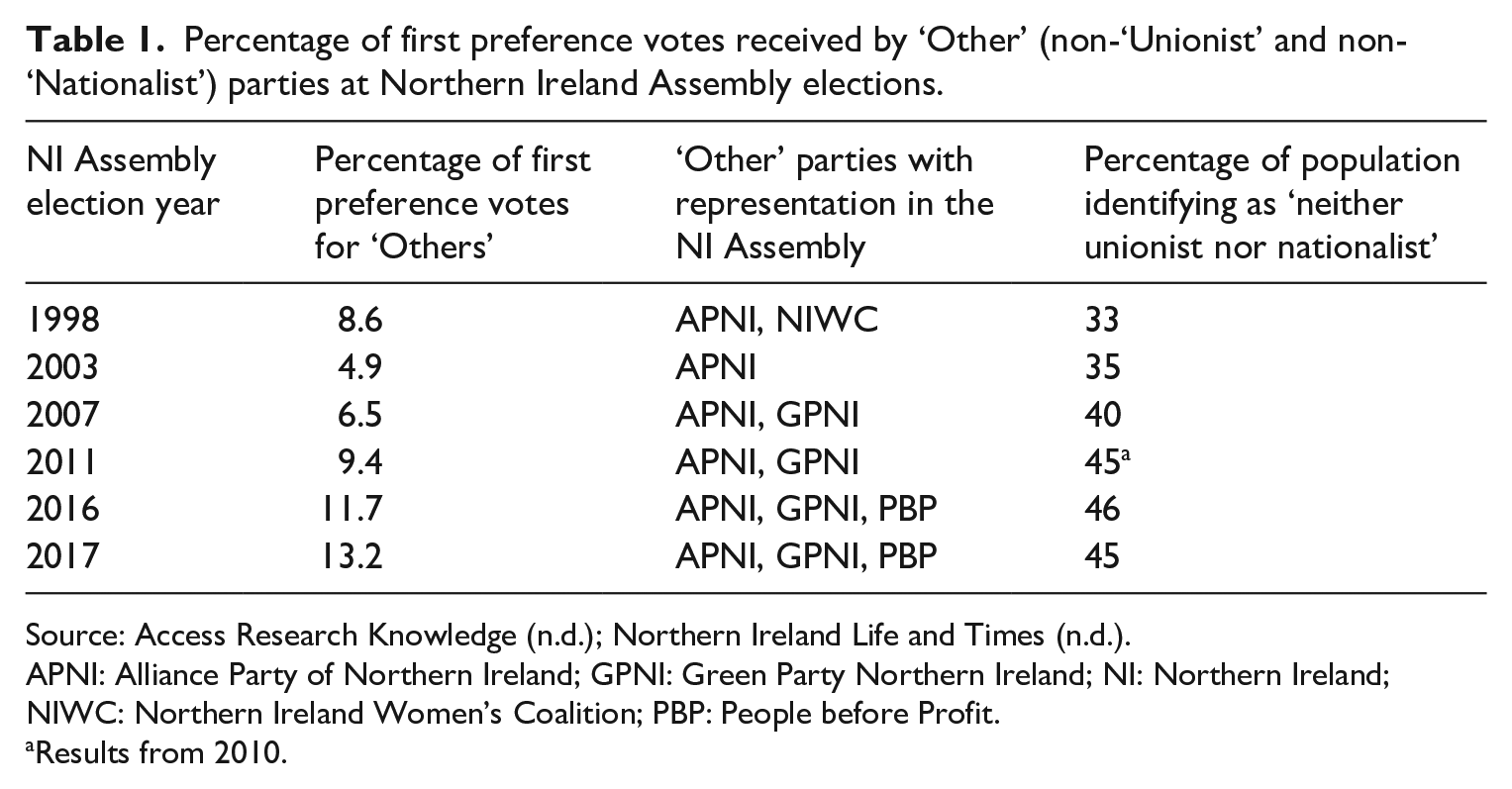
APNI: Alliance Party of Northern Ireland; GPNI: Green Party Northern Ireland; NI: Northern Ireland; NIWC: Northern Ireland Women’s Coalition; PBP: People before Profit.
Results from 2010.
Individually and jointly, all cross-segmental parties have not reached the electoral weight one would expect from the size of the ‘neither unionist nor nationalist’ demographic. Much of this can be explained by the continued salience of unionist and nationalist politics in Northern Ireland (Tonge and Gomez, 2015: 294–95), general dissatisfaction with the cross-segmental parties on offer – including APNI (Todd, 2009) – and the fact that non-aligned voters are less likely to vote altogether (Hayward and McManus, 2019: 151). These scholarly views, as well as an assessment of its membership base (Evans and Tonge, 2001), largely reflect the limited voter buy-in of cross-segmental parties’ appeal and, in our terminology, deficiencies in the internal party political dimension.
However, some attention has been paid to effects of system specific factors on the external dimension of cross-segmental parties in Northern Ireland. Existing literature has covered APNI’s position on the Good Friday Agreement (Farry and Neeson, 1998), institutional barriers affecting the party (Murtagh, 2015), the impact of the Single Transferable Vote (STV) electoral system on the party (Jarrett, 2016) and an assessment of its ability to operate within the constraints of a power-sharing framework (Mitchell, 2018).
We acknowledge that the context of a post-conflict society and the constraints of operating under consociational rules matter for the electoral behaviour of citizens. However, in divided societies and in consociations – as elsewhere – any party rejecting existing electorally relevant agendas must, at the very least, be viewed as a credible voice of those whose vote it seeks to attract. In addition, parties in consociations need to demonstrate a strong relationship with a societal segment that is discrete enough to un-follow the established segmental parties. In this view, engaging socially salient categories over politically relevant ones should add, rather than diminish, the attractiveness of any party to voters concerned with political outputs rather than with political representation per se (see, for example, McCulloch and Murtagh, 2021).
The limited attention afforded to cross-segmental parties in Northern Ireland is often justified by the fact that their inter-bloc appeal does not focus on relevant enough issues. Most observers suggest that cross-segmental parties exploit the flexibility of the consociational system while reflecting on the discrete ideological, issue-based and communal polarisation of society. Since the Good Friday Agreement, APNI is often assumed to be the political voice of this emergent non-aligned community and is at least partly appealing to the burgeoning political allegiances of Northern Ireland’s communities (Access Research Knowledge (ARK), 2018). But the party’s appeal to groups dis-identifying from the core ethno-political blocs, and as a result implicitly excluded from a guaranteed seat at the ministerial table, explains – at least in part – why ‘Alliance [has been] campaigning on detribalisation’ and reaching out to those ‘completely detached from Northern Ireland politics, [who] think “it’s a load of crap” that has no relevance to their lives’ (author interview, 4 November 2013). We now consider if such a party appeal has been relevant for APNI in achieving meaningful electoral representation after the Good Friday Agreement.
The case of the Alliance Party of Northern Ireland
In this section, we examine whether the pragmatism of party leadership in the absence of prowess to steer political discourse and lead on political change has aided APNI’s gradual establishment as one of the main political forces in Northern Ireland. APNI was founded in 1970 with the intention of offering a cross-segmental alternative to Northern Ireland’s traditional ethno-national political parties, to break down sectarianism, and promote a shared and integrated society. Similarly to NILP, it sought to transcend divisions between unionists and nationalists (Jarrett, 2016: 311). From its first electoral contest in 1973 until the 1996 elections to the Northern Ireland Forum, APNI has continuously offered a regional non-sectarian alternative to ethno-political representation by including candidates from both communities.
In the elections to the Northern Ireland Assembly immediately after the signing of the ill-fated Sunningdale Agreement in 1973, the party received 9.2% of the share of the vote and won eight seats, entering into the power-sharing executive (ARK, 1973). APNI continued to attract a similar level of support both before and after the Good Friday Agreement. Its position on the Agreement is that while the party broadly supports it as a foundation from which to build a non-sectarian Northern Ireland, it will not produce long-term peace and stability (Farry and Neeson, 1998: 1249). Nevertheless, APNI has been willing to fully engage in the region’s consociational politics, including participating in its power-sharing executive, as we discuss.
From its inception, APNI has sought to become the main electoral home for voters dejected by sectarian politics. The criteria for elections to the Assembly established under the Good Friday Agreement has allowed APNI to receive considerable support from voters in some traditionally Protestant and affluent electoral wards. Elections to the Northern Ireland Assembly are contested using the STV electoral system in multi-member constituencies. The proportional and preferential character of this system has allowed APNI to forego direct competition with segmental parties for nomination as voters’ first choice while pooling lower order preference votes across the electorate. APNI has thus enjoyed success in making considerable repeated electoral progress in Assembly elections, particularly in more affluent constituencies such as Belfast South and North Down (Jarrett, 2016).
APNI declared its support for the ‘constitutional position of Northern Ireland as an integral part of the United Kingdom’ at the time of its foundation and its 1975 Constitutional Convention election manifesto argued that ‘the link is in the best economic and social interests of all the people of Northern Ireland, and we will maintain that only the people of Northern Ireland have the right to decide any change by voting in a referendum’ (Alliance Party, 1975). The focus of APNI has consistently been on economic and social issues regardless of the ethno-national preferences upon which segmental parties focus their campaigns. Whereas Northern Ireland’s segmental parties’ policies have been strongly influenced by references to the constitutional status of the region when formulating policies that reflect the future relationships of Northern Ireland with both the United Kingdom and the Republic of Ireland – as well as with the European Union (EU) – until relatively recently APNI has been silent on this subject in its election manifestos (Alliance Party, 1998). In its 1997 manifesto, APNI moderates its view that Northern Ireland is better off in the United Kingdom towards an open position that ‘the people of Northern Ireland [are] to decide their own future, with no change in the constitutional position without their consent’ (Alliance Party, 1997).
Following the economic downturn from 2008, APNI has taken a moderately conciliatory line on austerity politics, invoking (inter-) communal solidarity (Alliance Party, 2010). Similarly, by focusing on infrastructure investment, APNI has positioned itself as a staunch advocate of regional development in the wider European context, including cooperation with the Republic of Ireland where necessary (Alliance Party, 1998). APNI’s successive leadership has emphasised the need for a regional approach to ‘bread and butter’ and ‘legacy’ issues to boost the domestic economy.
Despite common perceptions of APNI’s implicit support for Northern Ireland to remain part of the United Kingdom and its traditionally rather reserved criticism of the British government, the party has advocated policies to benefit regional economic development and has called for pragmatic relations between Northern Ireland and the Republic of Ireland within the wider context of EU integration (Alliance Party, 2017b). By avoiding explicit reference to Northern Ireland’s constitutional status as part of the United Kingdom, APNI has merely advocated ‘what is best for development’ in the region (Alliance Party, 2017a).
Foregrounding the rejection of cleavages that dominate political behaviour has increased party appeals across the segmented political spectrum as a potential broker in the negotiations of segmental parties. APNI’s successive leaders have been drawn into the spotlight of Northern Ireland Assembly politics as Speaker of Assembly (John Alderdice, 1998–2004) and Ministers of Justice (David Ford, 2010–2016 and Naomi Long, 2020—present). As such, the party has benefitted from its appeal to cross-segmental electorates when invited to break the deadlock between competing ethno-political parties (first the UUP and Social Democratic and Labour Party (SDLP) and, from the early 2000s, the Democratic Unionist Party (DUP) and Sinn Fein), despite not being granted an executive post under Northern Ireland’s d’hondt procedure to determine ministerial positions (The Guardian, 2010). Similarly, following the reestablishment of power-sharing in 2020 Naomi Long joined the executive as Minister of Justice, capitalising on the party’s non-communal appeal, rather than as a reflection of the Office’s mandate to serve all politically salient segments.
APNI’s politically versed leadership has thus played a crucial role in reconciling the party’s external and internal dimensions; its pragmatism and transparency when in government has been repeatedly rewarded by electoral returns in local and regional elections. In effect, the party could gain experience of government and contribute to more accountable politics when focusing on the three areas of concern to all Northern Ireland voters: efficiency of policymaking, economic sustainability and regional power dynamics as a result of changing relationships with the EU. We now discuss how APNI has consolidated its role as a cross-segmental representative of these concerns affecting all voters by examining three key areas: government transparency, Europe and Brexit, and public services.
Government transparency
Over the past decade, APNI has increasingly emphasised the pertinence of political corruption, first by expressing support for the British government’s new expenses regime after the 2009 parliamentary scandal (Alliance Party, 2010), and then by focusing on several local corruption scandals throughout the 2010s. This is particularly relevant as APNI sought to persuasively shift from being solely concerned with Northern Ireland to engaging constructively with the wider framework of politics and policymaking as part of the United Kingdom.
The revelations of serious incompetence behind the Renewable Heat Incentive (RHI) scheme, which was overseen by (the later First Minister) Arlene Foster of the DUP when she was Minister for the Department of Enterprise, Trade and Investment (DETI), provided APNI with an opportunity to score points with the electorate. The suspension of the Assembly in 2017 allowed the party to simultaneously oppose the DUP and encourage a move towards a ‘new’ (non-sectarian) politics in the region in protest against a system prone to clientelism (Derry Now, 2017). APNI (alongside PBP) has been crucial to publicising the costs to be borne by the region as a result of the DUP sponsored scheme that offered incentives to businesses and saw spiking application numbers at a time when the Executive Office was pressured to close the scheme (BBC News, 2016; The Irish News, 2016). In response to the RHI scandal, APNI leader Naomi Long accused the DUP of having ‘recklessly endangered’ Northern Ireland’s political institutions, calling for inquiries into previous scandals and pivoting APNI as a party seeking government transparency (Derry Now, 2017).
In light of this position, the party emphasised its commitment to transparent government in the Assembly by supporting and developing a system of independent investigations into alleged breaches of the Ministerial Code, subjecting Special Advisers to the Civil Service disciplinary procedure, introducing a lobbying register in Northern Ireland, opening ministerial diaries to the public and developing an Open Data Strategy for all Executive departments (Alliance Party, 2017c). The framing of this pledge is strongly anti-sectarian in stating that ‘yet again, a Stormont government has collapsed. It happened under the UUP and SDLP, and now it’s happening under the DUP and Sinn Fein’ (Alliance Party, 2017c). APNI clearly seeks to offer an anti-corruption, transparent alternative to political parties associated with the scandals that have in the past plagued segmental parties.
This approach has been evident in APNI’s repeated emphasis on the DUP’s (assumed) links to paramilitary organisations, stating that ‘in sharp contrast to the DUP, who appear content to accept the endorsement of paramilitaries, APNI is satisfied to accept their rejection of our principled and consistent stand for the rule of law and against all terrorism’ (BBC News, 2017). In response to the Loyalist Communities Council’s call for unionists to boycott APNI at the 2017 UK general election, Stephen Farry (then a party MLA; later Westminster MP for North Down) stated that ‘it is sad and sickening the DUP still meet with unrepentant terror organisations’ to discuss Brexit (Belfast Telegraph, 2019). Highlighting possible links to paramilitarism is thus a further way in which the party seeks to draw attention to the political corruption of Northern Ireland’s mainstream parties. It also provides an opportunity for APNI to align its political transparency agenda with its opposition to segmental parties and further boost its credentials as an untainted alternative.
The moderate success of APNI in pioneering the cause for government transparency showcases tensions in the inclusive, cross-segmental cooperation necessary for policies addressing societal cohesion and economic development. At the same time, electoral returns on APNI’s transparency agenda reflects the local population’s awareness of dominant parties’ limited commitment to reform. APNI’s pledge to transparent government has been embedded in the discourse of economic development, inter-communal peace and political cooperation, all of which are partially served by parties foregrounding identity politics. On this basis, APNI has been repeatedly successful not because of its own merit (though not for the lack of effort), but rather as a result of the failure of major political parties to deliver on their promise to core segments of their constituency.
Europe and Brexit
APNI’s engagement with the EU in 1998 demonstrates a focus on ways in which European policies impact Northern Ireland, while recognising its geographical position as part of the island of Ireland and calling for stronger international cooperation by and through the British government. In its 1998 Assembly election manifesto, at a time when the United Kingdom’s EU membership was not seriously questioned, APNI looked to the EU for specific policies for conducting business, ensuring infrastructural development and for government transparency (Alliance Party, 1998). A key issue at the time concerned the European Monetary Union (EMU) and APNI asserted that the United Kingdom ‘needs to clarify its position on membership’ and ‘join at the earliest opportunity’, as ‘Northern Ireland may lose out if the Republic of Ireland joins the EMU and the United Kingdom does not’. The party emphasised the business case for EU membership to gloss over issues contested by the segments of Northern Ireland’s deeply divided society.
Given APNI’s long-term priority of ensuring the economic prosperity of Northern Ireland regardless of its constitutional status, the party’s focus on and rhetorical references to the EU since January 2013, when the then Prime Minister, David Cameron, promised to hold a referendum on the United Kingdom’s membership, are unsurprising. Identifying Brexit as the most severe threat to socioeconomic development and political stability in Northern Ireland, APNI argued for the region to be afforded ‘special status’ (Alliance Party, 2017d). This position was later reflected in the party’s manifesto for the 2017 Assembly election, focusing on ‘mitigating the impact of Brexit upon Northern Ireland’ and identifying key areas, such as finance, economics, borders, political implications, and policing and security (Alliance Party, 2017c). As ‘the effects of Brexit would be more severe upon Northern Ireland than any other region of the UK’, APNI argued that the region should continue to participate in the Single Market and Customs Union and maintain the ‘four freedoms’ of the EU and EU citizenship for those born in the region. In effect, the challenge for the party was: to try and persuade [other parties] that going down the Brexit route is going to be incredibly bad, and . . . is more likely to lead to the breakup of the Union than defending the Union. The Alliance Party thought Brexit through. We always have been and remain a pro-European party. (Author interview, 6 March 2018)
It is tempting to conclude that APNI’s approach to Brexit has been driven purely by considerations of economic stability in the region. Indeed, during the 2019 European and Westminster elections, which took place in the context of Brexit preparations, APNI performed comparatively well. Initial analysis, however, has attributed this success to the dissatisfaction of voters in Northern Ireland with the DUP and Sinn Fein, as these parties were unable to resolve the 3-year impasse at Stormont until early 2020 (Jarrett, 2020). There is some indication that APNI may have been an obvious choice for the 34% of unionists who voted Remain, as suggested by a party official (authors’ interview, 4 December 2019). However, a more accurate explanation for APNI’s rise in support at this time may be the party’s attempts to deploy its pro-EU agenda to mobilise support among voters in Northern Ireland who are likely to be dissatisfied by the British government’s neglect of the consequences of Brexit for the region (Alliance Party, 2017a). APNI’s policy built upon this position and spoke directly to voter interests, rather than to those of political competitors, marking a shifting preference from privileging the party’s external dimension to its interactions with the electorate.
Public services
The focus on ‘coalitionability’ over responsiveness to their voters dominated APNI’s original policy agenda. This perspective has progressively changed since the Good Friday Agreement. As the parameters of institutional politics in Northern Ireland have not changed for the past two decades – but the voter base has – we have seen that initially APNI sought to lead their followers, as would be expected of a party in a consociational society. However, it has achieved limited electoral success in doing so, resulting in the party gradually granting more attention to the preferences of their voters in formulating tangible policy alternatives that are in the public interest. Concerns over the availability of public services rank highly on the priority list of Northern Ireland’s electorate and APNI has successfully translated this concern into a poignant party agenda. Reflecting on this point, a member of the APNI leadership claimed that the party’s active members are ‘people who have come from working-class backgrounds, have made a reasonable life for themselves, but have a desire for social justice, so they want to give something back’ (authors’ interview, 4 May 2018).
APNI’s policy positions on public services as set out in its 1998 Assembly manifesto cannot be separated from the party’s assessment of its position in a future government. As such, APNI was unlikely to secure enough legislative seats to obtain an executive post in the aftermath of this election. This indicates that at this time APNI prepared to be in opposition to the region’s major segmental parties providing voters with a non-ethno-political alternative but offering little beyond this position. Its stance on public health, for example, which is broad and general, offered few actual policy positions.
APNI’s manifesto for the 1998 Assembly election set out its agenda for health in Northern Ireland (Alliance Party, 1998). It states the party’s commitment to a National Health Service (NHS) that is free at the point of use and funded from taxation. It also asserts that a ‘coherent regional health strategy’ is needed to ensure ‘a high quality, accessible service for all’. Furthermore, the manifesto stresses the need for cooperation between Northern Ireland and the Republic of Ireland on health, which would be of particular benefit to those in the border regions. Finally, it emphasises the party’s commitment to reinstating free eye and dental checks and supports a ban on advertising, and a tax rise on, tobacco products. Although these single issue proposals have reflected the needs of Northern Ireland’s society, the manifesto offers scant further information on the nature of its proposed ‘coherent regional health strategy’. Crucially, there is a little mention of how this strategy would be implemented.
APNI’s manifesto for the 2017 Assembly election showcases the party’s shift from focusing on inter-party competition towards greater voter orientation and, specifically, its disengagement from pro-business rhetoric to addressing the needs of the entire electorate. In focusing on ‘maximising the resources directed towards the health sector from within the Northern Ireland budget’ and supporting ‘the re-introduction of a small charge for those able to pay for their prescriptions’ (Alliance Party, 2017b), it sought to appeal to people, rather than businesses, and criticises the policy positions and decisions of other parties. Since the party had participated in the executive and therefore had government experience at this time, this light touch on the issue of public health could reflect the growing specialisation of the party in facilitating inter-communal dialogue and holding the governing parties to account.
This approach has been played out since the return of the Assembly in 2020, when APNI leader Naomi Long assumed the post of Minister of Justice. Soon after, the COVID-19 pandemic struck, requiring the Northern Ireland government to introduce measures to restrict public freedom to stem the spread of the virus. In response, APNI presented itself as a scrutiniser of the response of relevant government ministries (Belfast Telegraph, 2020). Focusing on coordinating the response of businesses to the challenges of the pandemic has been centre of attention for APNI throughout 2020–2021 (Alliance Party, 2020a). For example, party councillor Amanda Grehan voiced concerns that the economic impact of a grant delay to assist small businesses could force some into liquidation (Alliance Party, 2020b). Similarly, APNI’s MP, Stephen Farry, called for the Northern Ireland Business Minister to extend the deferral of rates for businesses beyond June (Alliance Party, 2020c). These examples are evidence that APNI is engaging in some specific policy issues related to businesses in response to COVID-19 but also demonstrate the party’s continued commitment to scrutinising and criticising an executive that it participates in to assure voters that it can hold the government to account. Underpinning this voter appeal remains central to APNI’s aspiration of political decision-making to benefit Northern Ireland, as either a part of the United Kingdom or through all-Ireland cooperation within a wider European policy space despite the anticipated negative impact of Brexit.
Conclusion
Cross-segmental political parties face multiple challenges when competing in consociational political systems. In comparison to other parties in consociations, their positions often appear ‘muddied’: their appeal to voters is defined by their desire to participate in the political process despite their determined opposition to the divisive nature of power-sharing politics. Both of these are intuitively appealing to voters, yet discourage the continuous allegiance of the electorate in the absence of realistic chances to change the system. The limited electoral returns they gain often reflects the cross-segmental parties’ commitment to following the same pattern of representing the identity or interest nexus as that of the consociation’s segmental parties. Yet, to develop and maintain the relationship with their voters, cross-segmental parties can cautiously but consciously identify their central policy profile to access political office, emphasising their prowess as the ‘go-between’ of major political forces.
The most resilient of these parties in Northern Ireland, APNI, has moved beyond a loose relationship with the cross-segmental voter base by prioritising its focus on public services, opportunities for economic development and government transparency as its core political preferences. Thus, far from being a case of a party struggling to operate in a consociational system and failing to mobilise a divided electorate, APNI performs as well as could be expected. It speaks to all societal segments of the population while offering a narrower set of policy issues to its core electorate. However, APNI could have achieved wider success much earlier.
On the one hand, the party’s original appeal to affluent, better educated, and more independently minded voters overrepresented in one societal segment (Protestant) encouraged the other politically salient segment (Catholic) to support APNI in late 1970s and again over the last decade. This has particularly been the case among Catholic voters in Protestant majority areas where Sinn Fein or SDLP candidates are unlikely to be elected (Jarrett, 2016: 313). The party’s political success became more tangible once the position of Northern Ireland in the United Kingdom was reaffirmed with the Good Friday Agreement, and the practical implications of the disruptive effects of Brexit on local economic prospects only further mobilised the cross-segmental electorate around the need for regional political, economic and social development unmet by major parties.
On the other hand, APNI’s long-term ambivalence towards the ‘constitutional question’, coupled with strong links to Britain in the party leadership, was not sufficiently exploited outside of the framework of economic opportunities for the region due to its political geography. In a UK context, APNI’s EU-orientation could have underlined regional self-interest and distancing from the British electorate’s scepticism of ‘Europe’. Emphasising the socially redistributive dimension of EU membership has indeed been one of the elements that has reflected APNI’s long-standing focus on an inclusive, civic identity.
From our analysis, we conclude that even while criticising the system of representation of the regional consociational government, APNI has for too long foregrounded the constraints on the party’s relationships with other political competitors, specifically its ‘coalitionability’ under consociational rules. In the words of a party insider, the APNI leadership has been of the assumption that once its electoral support increases, the party’s aspiration to participate in government will facilitate further support over time (author interview, 25 November 2013). We believe the party could do more to appease its potential electorate and possible defectors from the main segmental parties earlier. Not until after Naomi Long assumed the party leadership in 2016 did APNI unequivocally commit to nurturing relationships with voters rather than with other parties. The combination of government experience, strong personal leadership in the context of the recent Northern Ireland Assembly suspension, and growing uncertainty over the impact of Brexit on the region has aided the party’s rise. Whether APNI’s inability to engage more closely with voter preferences is due to under-appreciation of the political salience of identities in Northern Ireland by its leadership or due to systemic constrains should be the subject of future analysis of APNI and other cross-segmental parties.
Our review of three policy areas of APNI’s agenda – government transparency, Europe and Brexit, and public services – finds that once the party focused on ‘bread and butter’ issues in its election manifestos, it was able to play a not insignificant role at the council level and mediate the bifurcated politics of the Northern Ireland Assembly. However, for a party with roots in the region and considerable experience of electoral politics, APNI has underperformed at elections. As 50% of NI’s population do not identify politically as unionist or nationalist (ARK, 2018), APNI could claim a potentially powerful electoral base to draw from during election campaigns and counter the ramifications of ‘exclusion amid inclusion’ (Agarin and McCulloch, 2020). However, despite considerable electoral gains since 2010, APNI has struggled to achieve the level of support that matches the potential number of voters who prefer to identify as neither unionist nor nationalist in public surveys (Coakley, 2020; Tonge and Evans, 2015).
In reviewing APNI’s manifestos and policy proposals, we conclude that for too long the party operated by playing by the rules expected of a major party in the divided political spectrum of Northern Ireland’s consociational system; it focused on developing its ‘coalitionability’ (external dimension) over appeasing a particular segment of the electorate (internal dimension). This is the main reason for the party’s earlier failure to convert its attractive policy appeal into widespread electoral support over the past five decades, and increasingly so under changing societal conditions since the Good Friday Agreement of 1998.
Lijphart’s (1968: 21) claim that ‘the essential characteristic of consociational democracy is not so much any particular institutional arrangement as overarching cooperation at the elite level’ suggests that political parties are afforded a key role in making consociational democracy work. However, while segmental parties are endowed with structural resources to maintain their leverage over consociational political mechanisms, cross-segmental parties need to negotiate access to the political process, in addition to outlining their (potential) governing contribution to both voters and other political parties. Luther (1999: 6) notes how ‘consociational theory and party theory have not yet been brought together in a truly comparative perspective’, inviting analyses that distinguish between the role of parties within and among segments, as well as between one another. In this article, we linked these two scholarships by assessing how a party that navigates the consociational political system has sought to traverse segmental interests and the agendas of segmental parties by downplaying its prowess as an intermediary of competing social and political interests to access power.
Footnotes
Funding
The author(s) disclosed receipt of the following financial support for the research, authorship and/or publication of this article: This research was carried out as part of the Exclusion amid Inclusion: Power-Sharing and Non-Dominant Minorities’ project at Queen’s University Belfast, funded by the Economic and Social Research Council (ES/P003036/1).
