



Abstract
This article introduces an analytical framework to trace and compare leaders’ different types of behaviours to the health crisis posed by COVID-19, following the analytical benefits of Leadership Trait Analysis. It examines Boris Johnson’s and Nicola Sturgeon’s diverging initial responses to the pandemic’s onset. We employ the Leadership Trait Analysis to shed light on three main differences in their respective leadership styles: risk-proneness versus risk-aversion; flexibility versus rigidity and rule advocacy versus rule ambivalence. Crises are one of the more fruitful situations in which to study leaders as their personal characteristics become central to the decision-making process. Thus, we employ an agent-centred and political psychology approach to analyse leaders’ behaviour and make sense of their divergent management styles. The results show that the differences between these leaders’ approaches to handling this global health crisis can be partly explained by their level of openness to information and their task versus relationship focus.
Keywords
Introduction
The COVID-19 pandemic affected all countries of the world and became one of the most significant crises ever for national leaders. While the risks coming with the pandemic are similar in nature for different countries, the ways in which leaders have confronted such challenges have varied significantly. Some played down the threat, while others reacted promptly to impose costly lockdowns. Some leaders tended to neglect the value of scientific judgements, while others followed scientific evidence from the very beginning of the SARS-CoV-2 virus’ outbreak.
This pandemic has shown that leaders matter. However, the fast-growing literature on political institutions and public policy regarding COVID-19 has focussed on the policy capacity, institutional trust, historical legacy and cultural aspects, as well as different national policy styles, and not much on the role of leaders as key drivers to explain the variation in responses to the pandemic (Capano et al., 2020; Jennings et al., 2021; Toshkov et al., 2021; Yan et al., 2021; Zahariadis et al., 2021). Studies that have engaged with leaders focus on their educational backgrounds, communication styles and gender (Forster and Heinzel, 2021; Green et al., 2020; Piscopo, 2020). In these different studies, leaders’ personal characteristics are not systematically explored as possible causes for this puzzling variation in national responses to the pandemic. This work is an initial step in that direction by offering a complementary approach and perspective to the growing comparative studies on diverging responses of governments to the COVID-19 crisis from the angles of institutions, public policy and policy styles. Thus, this article offers a framework to analyse leaders’ different types of behaviours and reactions to COVID-19, following the analytical benefits of Leadership Trait Analysis (LTA) (Hermann, 2009).
The United Kingdom offers an ideal political context in which to carry out this study under a most-similar system design. We focussed on two of the four UK nations to conduct the analysis, namely Scotland and England. This comparison has particular value due to the potential effects that the different approaches to handling the health crisis can have in paving the way for a second independence referendum in Scotland and, therefore, the future of the union. These countries’ leaderships have markedly differed in their managing of the COVID-19 crisis, despite very similar presenting circumstances. While Prime Minister of the UK Boris Johnson initially downplayed the severity of the crisis, First Minister of Scotland Nicola Sturgeon adopted a more cautious approach upon SARS-CoV-2’s outbreak. Sturgeon made quicker decisions and put in place stricter measures to stop the spread of the virus compared with Johnson. In addition, Sturgeon reacted strongly when her own advisors broke COVID-19 rules, whereas Johnson was more hesitant to do the same with his own cabinet or advisors (Allegretti, 2020; Carrell, 2020). As we will explain in-depth in the following sections, this speaks to three main differences in these leaders’ styles: (1) risk-proneness versus risk-aversion; (2) flexibility and pragmatism versus rigidity and hesitancy and (3) rule advocacy versus rule ambivalence. Thus, this article aims at capturing the factors behind such a divergent set of responses from these two leaders: Why, under similar circumstances, did leaders such as Sturgeon and Johnson respond differently to the COVID-19 pandemic? What are the drivers of their differing crisis-management styles?
Following the premises of LTA, we argue that the way Sturgeon and Johnson process and respond to incoming information about the pandemic and their tendency to prioritise tasks over relationships (or vice versa) can shed light on the diverging behaviours of these two leaders. In other words, personality traits and the styles of leadership of both Sturgeon and Johnson are expected to have shaped their respective governments’ responses to the COVID-19 crisis. Our research covers the initial response to the crisis: that is, the time period between the World Health Organization’s (WHO) declaration of the SARS-CoV-2 outbreak now being a pandemic in March 2020 to the announcement of the approval for the Pfizer–BioNTech vaccine in the United Kingdom in December of the same year. Within this timeframe, we focus on three phases of the Covid-19 crisis in the United Kingdom: the lockdown, exit strategy and second wave.
The following section provides an overview of the political situation in the United Kingdom, pointing out the differences observed in the handling of the crisis by Scotland and England from a leadership vantage point. Then, we introduce the LTA framework to compare the two leaders’ behaviour during the COVID-19 crisis. Thereafter, we discuss the method and data used in our assessment of both leaders, followed by an empirical analysis of the traits and leadership styles results that help explain these leaders’ diverging means of managing the COVID-19 crisis. Finally, the conclusion discusses the main findings and proposes avenues for further research.
Political background in the United Kingdom
Sturgeon has been in power as First Minister since 2014, while Johnson was a Prime Minister from 2019 to 2022. However, for both leaderships, Brexit would dominate their political agendas. During the process of negotiating a withdrawal agreement (WA) and subsequent free trade agreement (FTA) with the European Union, the United Kingdom would experience a series of political events. Sturgeon expressed her dissatisfaction with both the Brexit referendum result of 2016 and with the outcomes of the WA and the FTA alike. For Sturgeon, Scotland did not support Brexit, and the conditions achieved in the FTA undermined the Scottish economy. These moments in casting a post-Brexit strategy in the United Kingdom would become the cornerstone of Sturgeon’s project of a new independence referendum for Scotland even in pandemic times (McEwen and Murphy, 2021).
Likewise, Brexit was also key to Johnson achieving political power as prime minister. Johnson seized on these events to his own favour, as he was able to articulate opposition to May’s premiership from within the Conservative Party. As party fragmentation increased, a ratifiable WA became costly to May’s government as parliament refused to ratify the WA she had negotiated. Once May stepped down as prime minister, Johnson became the leader and presented himself as the figure who would be able to get a better deal vis-à-vis the EU (Haughton, 2021). Although the concluded WA was ultimately no different from the one negotiated by his predecessor, Johnson achieved what May could not: ratifying the deal in parliament. This event was key to increasing his popular and electoral support and that of the Tories in the election of December 2019.
After the favourable general election, Johnson was on track to ‘get Brexit done’. However, the COVID-19 outbreak changed the political dynamics in the United Kingdom. At the end of 2019, China reported a cluster of cases of a pneumonia-like disease in Wuhan. By 11 March 2020, the WHO had declared this outbreak a pandemic. In this context, the UK Government published an action plan to contain the spread of COVID-19 the same month. Both Sturgeon and Johnson were part of the coordinating team of the four Home Nations, who adopted a common set of policies to contain the virus (House of Commons Scottish Affairs Committee, 2020: 8). However, from this moment onwards, both leaders started to demonstrate differences in terms of the implementation of policies and their communication strategies to manage the pandemic (see next section).
As cases increased, the United Kingdom went into its first national lockdown on 23 March 2020. Both leaders called on people to stay at home and held regular briefings with the press to keep the public informed about the situation. A few days later, the United Kingdom passed the Coronavirus Act, which gave the four Home Nations room to adopt their own measures to tackle the pandemic. Scotland adopted further measures to the rest by passing the Scottish Coronavirus Act. While the concrete means of handling the pandemic across the United Kingdom’s four constitutive nations during its initial stages were relatively similar, at least in substance rather than form, more differences emerged as Scotland and England came out of their first lockdowns (Sargeant, 2020). England lifted restrictions at a faster pace than Scotland, which opted for a more cautious approach to reopening shops, bars and other non-essential services (Paun et al., 2020). The differences in their leadership choices impacted more positively on Sturgeon’s popularity due to her chosen measures and her management style compared with Johnson (Financial Times, 2020; Swindon, 2021).
Facing the COVID-19 health crisis: Sturgeon and Johnson
After SARS-CoV-2 hit the United Kingdom and the WHO and health experts called for the swift implementation of measures to stop the spread of the virus, both leaders reacted differently, especially in their approach to containment. While Johnson adopted a more risk-prone approach, characterised by the reluctance and delay in imposing restrictions as well as the rush to lift them, Sturgeon adopted a more risk-averse position. She pushed for the United Kingdom’s implementation of stricter restrictions and oversaw them in Scotland itself; she was also more cautious in lifting certain measures, such as the use of facemasks and the opening of shops and hospitality venues (House of Commons Scottish Affairs Committee, 2020; Sargeant, 2020; Smith, 2021). In fact, the report issued by the House of Commons Health and Social Care Committee and Science and Technology Committee (2021) recognised that the different leadership approaches to managing the pandemic eroded public trust in information affecting compliance with the rules.
Both leaders also evidenced important differences in how they adjusted to the changing nature of the pandemic and its repercussions on the contemporary political context and their respective governments. Johnson showed less flexibility and pragmatism than Sturgeon when faced with a political conundrum. Sturgeon showed a willingness to accept mistakes, remove people from her team when they broke COVID-19-related restrictions and take responsibility for her government’s actions. Unlike Sturgeon, Johnson was reluctant to accept his and his team’s errors and continued to support key members even when they broke such restrictions (e.g. Allegretti, 2020; Carrell, 2020).
This willingness or not to be held accountable for their actions was also observed in their handling of the press: Sturgeon adopted an open approach to the latter (Kwan et al., 2020). She held over 140 meetings with the press in the time between the beginning of the pandemic and the announcement of the vaccine rollout in December 2020. 1 She acknowledged her mistakes and stressed that, ultimately, she was the one making the decisions (Sturgeon, 2020a, 2020b, 2020c). However, Johnson would be less proactive and more evasive when it came to dealing with the press. At the end of June 2020, he announced the winding down of the rhythm of press conferences and stopped appearing publicly as often as he used to. Moreover, journalists questioned him on his delivery of mixed messages to the people, not taking the pandemic seriously and boycotting certain media outlets (BBC, 2020; Good Morning Britain, 2020; MacDonald, 2020). He attempted, contrariwise, to draw attention away from the government’s mistakes and failures of responsibility in the crisis.
These leaders’ behaviours also diverged in the way they approached compliance with the restrictions imposed as well as in their related communication strategies (Garland, 2021). From the beginning of the pandemic, Sturgeon would stress the gravity of the situation and adopt a ‘we are in this together’ stance, showing that she was also personally affected by the stringency of the rules. Contrariwise, Johnson demonstrated a tendency to undermine the seriousness of the crisis. He showed a greater hesitancy to change his own behaviour in line with the rules imposed by his government on the rest of the population (Stern, 2020). From his initial approach to the pandemic, when he affirmed that he had shaken hands with everyone, to his firm support of team members – most prominently, Dominic Cummings – who broke the rules, his behaviour suggested that the restrictions and the effects of the pandemic did not apply to him or his close circle. 2
Thus, while both leaders operated within somewhat different contexts and constraints, we argue that the different paths they took during the highly uncertain first months of the pandemic can be partly understood as a result of their respective personality characteristics.
Leadership in times of crisis and the LTA approach
Previous scholarly work suggests that when crises hit, leaders play a central role in a network of interrelated decision-making processes (Boin et al., 2005; Hudson, 2013; Kahn, 2009). Crises are transitional phases which occur when the central values or life-sustaining systems of a given community come under threat, therewith inducing a sense of urgency (Boin et al., 2005). Understanding what factors help explain leaders’ decision-making during the COVID-19 crisis is of key relevance, as policy choices made in these critical situations have profound effects on the population at large. How crisis management is conducted directly influences citizens’ lives, as the way leaders assess and address these threats can have potentially devastating results when they get it wrong (Kahn, 2009).
The literature on leaders in the context of COVID-19 is still relatively thin. Existing works have analysed the effects of their communication styles during the pandemic (see Green et al., 2020; Hatcher, 2020; McGuire et al., 2020; Sobral et al., 2020). Some have explored the potential difference gender has made in the management of these events: so far, research shows that there is no clear evidence that it explains the variation seen in leaders’ responses to COVID-19 (Aldrich and Lotito, 2020; Piscopo, 2020; Purkayastha et al., 2020). An exception is a study by Waylen (2021), who shows how the hypermasculine leadership style of Johnson can account for some of the Government’s poor decisions during COVID-19. While this study opens new venues on masculinity and leadership during COVID-19, it does not include comparisons with female and feminine leadership styles and attributes. There have also been scholarly works examining the role of populist leaders in shaping the response to this global health crisis (Lasco, 2020; McKee et al., 2020). There are also studies scrutinising the instrumentalisation of the crisis and how so doing undermines democracy (see Guasti, 2020); the role of ‘strong leadership’ in managing the pandemic (see Barnard, 2020); and how confidence in political leaders can influence public risk perceptions vis-à-vis COVID-19 (Shao and Hao, 2020).
While these studies have stressed the role of leaders during the pandemic, there is no theory-driven analysis of how their personality traits have shaped the responses to COVID-19 and the variations in policymaking witnessed across different countries. Previous research has shown that characteristics such as personality traits, political values, worldviews and beliefs are central to understanding leaders’ political behaviour (Hermann, 2003; Kaarbo, 2018; Schafer and Walker, 2006a). In this specific crisis, scholarly work has stressed the relevance of sense-making by policymakers, which relates to the way they analyse cues, signals and data about the threat (Boin et al., 2021). These observations raise the question of what specific elements are relevant to help us understand political leaders’ behaviours and predispositions regarding the pandemic. The LTA framework pioneered by Hermann (1980, 2003) allows for the at-a-distance assessment of leaders’ personality profiles. The LTA has produced robust and reliable results in the study both of leaders’ traits and the influence thereof on decision-making processes, especially in foreign policy (Cuhadar et al., 2017; Kaarbo, 2018; Van Esch and Swinkels, 2015).
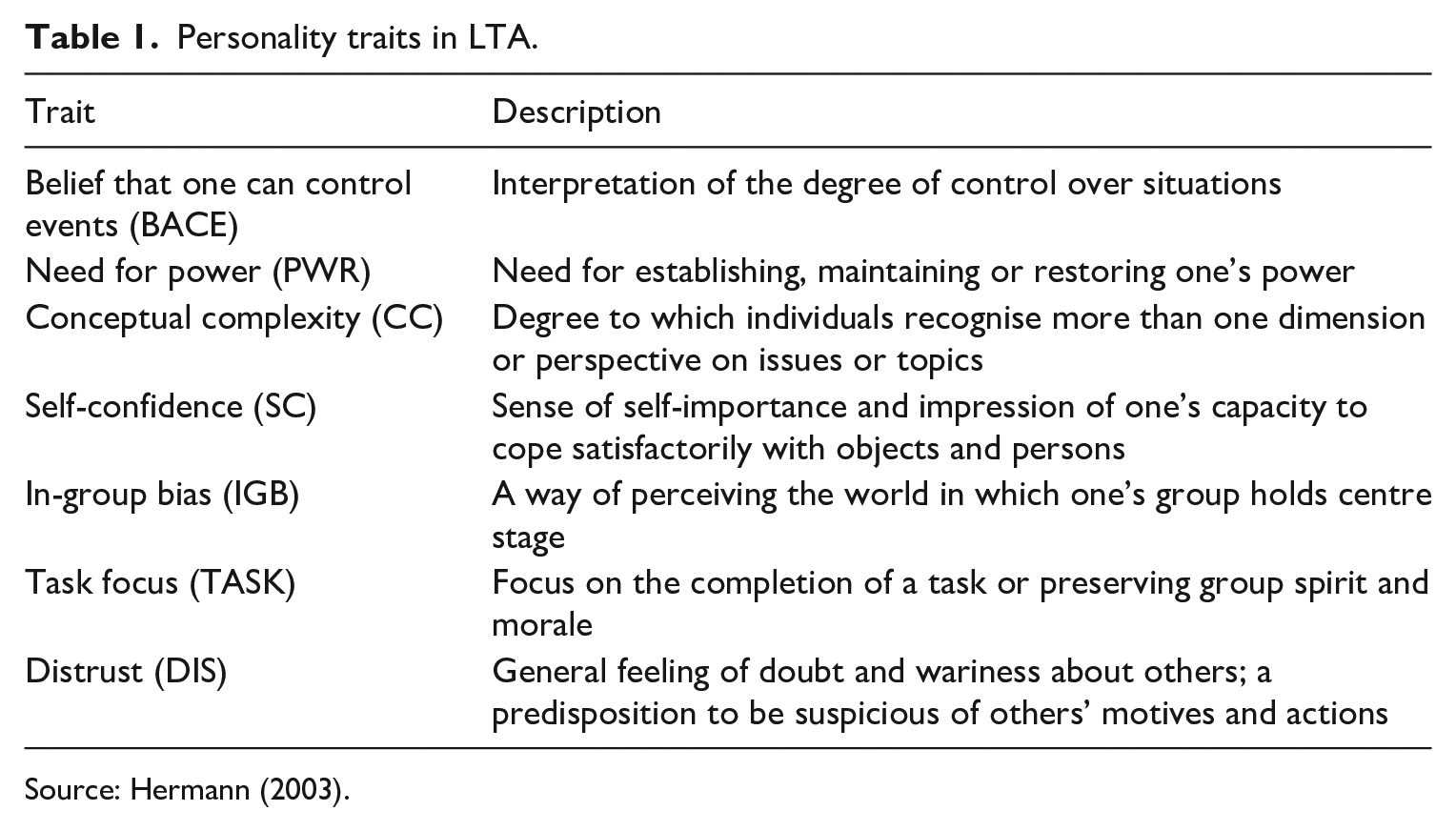
Per LTA, a leader’s personal profile is composed of seven traits: belief in their ability to control events (BACE), conceptual complexity (CC), the need for power (PWR), distrust of others (DIS), in-group bias (IGB), self-confidence (SC) and task orientation (TASK) (see Table 1). LTA provides numerical scores which allow for comparison with a norming group. Moreover, when these individual traits are combined in pairs or triplets, they can provide essential information on: how leaders react to constraints; how open they are to incoming information and whether their actions and decisions to seek political power are driven by a focus on delivering on the task at hand (e.g. policy design and implementation) or by putting relationships with people, followers or a particular group first over dealing with the task itself per se (see Table 2). The combination of these traits in play is key to determining the leadership style of a given policymaker.
Personality traits in LTA.
Source: Hermann (2003).
Questions for identifying personality traits.
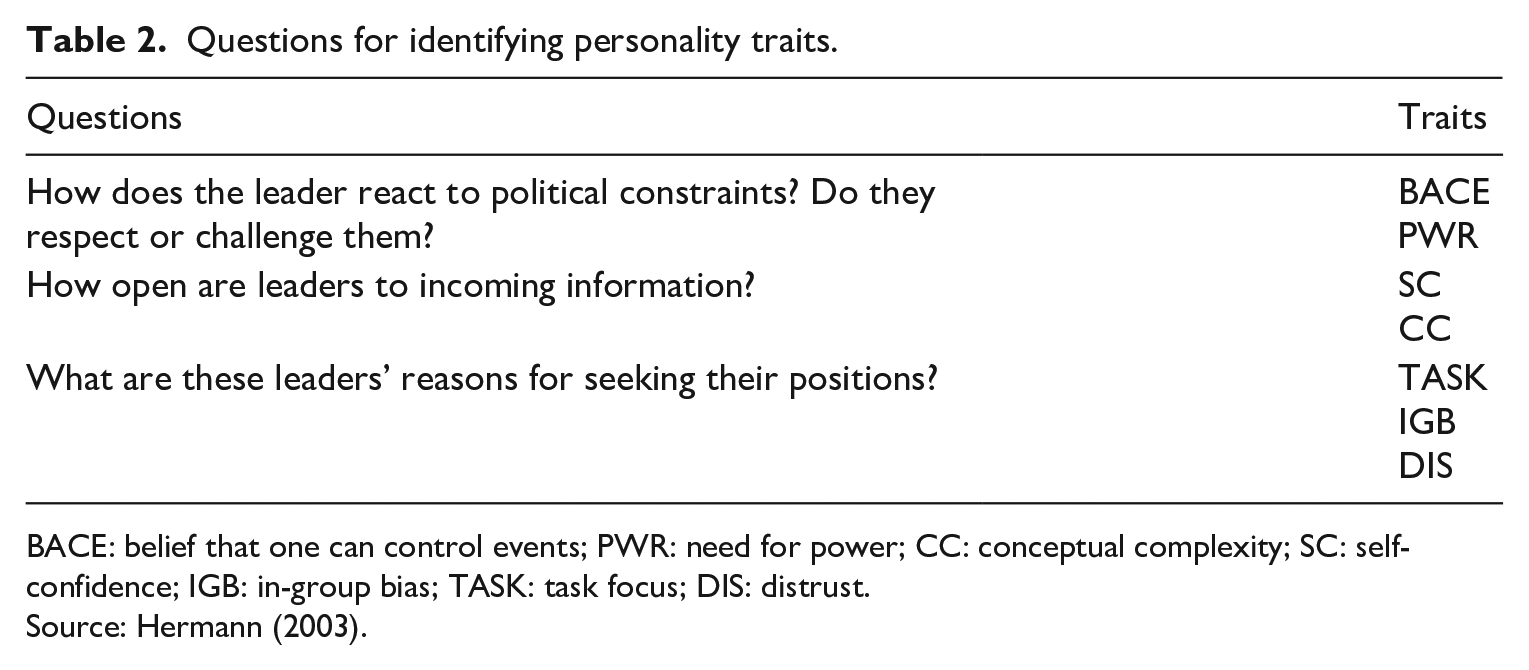
BACE: belief that one can control events; PWR: need for power; CC: conceptual complexity; SC: self-confidence; IGB: in-group bias; TASK: task focus; DIS: distrust.
Source: Hermann (2003).
Below, we outline a proposal of how the combination of traits advanced by Hermann (2003, 2008) works to capture the variation witnessed in different leaders’ responses to the global health crisis during its initial stages:
Constraint challenger or constraint respecter
This is composed of the traits PWR and BACE. Political leaders face both international and domestic structures, institutions and bureaucratic practices which may limit their behaviours and choices. Leaders vary in how they respond to such imposed constraints (Cuhadar et al., 2017; Keller, 2005a). During the COVID-19 crisis, leaders had to defy constraints and put in place exceptional measures to be able to manage the pandemic. Leaders made tough calls and introduced measures which severely restricted individual freedoms and daily life. Differences in this dimension can account for whether the leader adopts cooperative or non-cooperative behaviour, how active or passive they are in policymaking, how much they delegate responsibility to others, and the speed with which strict measures are put in place.
Leaders who score high on both traits are considered constraints challengers and tend to be skilful at achieving what they want (Hermann, 2003). In a crisis, we expect that leaders with a high perception of control will tend to adopt active measures and a tougher stance to reduce risk, as the presenting circumstances give them a window of opportunity to increase their level of influence. Those leaders who score low on both traits are considered constraints respecters meanwhile, and they tend to accept the restrictions they perceive in their environment. They focus on building consensus and achieving compromise (Hermann, 2003). During a crisis, we expect that leaders who score low on both traits will be more inclined to delegate decision-making and share responsibility with others. They will also adopt a more passive ‘wait-and-see’ stance towards the situation. Finally, leaders who present moderate scores on both traits have the skills to move from challenging to respecting constraints and vice versa, depending on the context (Hermann, 2003). This dimension could explain the behaviour of a group of leaders who have displayed a more balanced response to the crisis.
Openness to contextual information
This measure comprises the traits CC and SC. The combination of these traits indicates how open leaders are to input from the surrounding environment in their decision-making (Hermann, 2003). In the context of the COVID-19 crisis, this dimension helps explain the variation seen in leaders’ openness to expert advice from the national (scientific advisors) or international level (WHO). Leaders who score higher on CC than SC tend to be more pragmatic and responsive to others’ demands; they also deal with problems on a case-by-case basis (Hermann, 2003). In periods of crisis, we expect that leaders who are open to information will be more prone to policies based on the assessment of the specific situation and following expert advice, displaying a collegial and inclusive approach. Conversely, leaders with a higher SC level vis-à-vis CC tend to be closed to new information. They tend to reinterpret circumstances to fit their views of the world, and they are inclined to be ideologues, hierarchical, and unresponsive to external cues (Hermann, 2003). Hence, during crises, we expect these leaders to be less flexible and adopt an ‘I know what it is right’ approach, struggling with the changing nature of the situation and cherry-picking the information they deem correct rather than adopting an integrative and open approach to gathering further relevant information.
Motivations for seeking office
Leaders may be driven by an internal focus (task) or the desire to obtain a certain type of feedback from the environment (relationship). They can also be motivated by the need to protect their own group (Hermann, 2003). Leaders’ rationales are measured by three traits: IGB, TASK and DIS. These motivations can be situated on a continuum. On one extreme, we find leaders who are mainly interested in the completion of a task (the problem); on the other, one sees those seeking to maintain group spirit and morale (building relationships) (Hermann, 2003). Leaders who have a direct management style have been linked to high TASK (Keller, 2005a, 2005b). In a context of crisis, we expect that leaders who are highly focussed on achieving a given task (e.g. containing and reducing the effect of a virus) will push the group towards the achievement of that specific goal and will be willing to sacrifice a high level of morale and sense of belonging among the group to deliver (Hermann, 2003). These leaders will be more willing to adopt unpopular measures to solve the crisis and pay less attention to pressures from the environment and their followers. However, we expect relationship-oriented leaders to be more sensitive to what people want, emphasise group maintenance, retain constituents’ loyalty and keep morale high (Hermann, 2003). These leaders could be more prone to disregarding expert advice if the policies proposed by them jeopardise their relationship with their followers, despite the associated risks. They might also engage in less cooperative and more antagonistic behaviour if they deem it necessary to maintain constituents’ support.
Leaders can be driven by threats or problems they perceive in the world or by the chance to establish cooperative relationships. Leaders who are more focussed on protecting their own group tend to perceive the environment as more threatening and are more willing to confront these threats (Hermann, 2003). However, leaders who are less focussed on their own group are able to see the benefits of reaching agreements and building relationships (Hermann, 2003). Therefore, in times of crisis, we expect that leaders who score high on IGB will be less prone to engage in cooperative behaviour in the international arena. This element could explain the variation witnessed in leaders’ behaviour regarding, for example, the acquisition of medical supplies and the roll-out of vaccines. Moreover, we expect distrustful leaders to be more prone to be suspicious of others’ behaviours and more reluctant to cooperate with fellow international actors.
The analytical framework presented above can, then, help us shed light on the psychological drivers of the three main differences observed in Sturgeon’s and Johnson’s behaviour regarding the management of the COVID-19 pandemic: (1) risk-proneness versus risk-aversion, (2) flexibility and pragmatism versus rigidity and hesitancy and (3) rule advocacy versus rule ambivalence. We expect to find two key differences in these leaders’ personality traits. These can help advance our understanding of their respective decision-making styles and the different paths they took during the initial stages of this global health crisis:
Proposition 1. Sturgeon will be more open to incoming information than Johnson, which could help explain their differences in their treatment of expert advice and their capacity to modify their behaviour and policy decisions in such a way as to take into account the evolving nature of the pandemic.
Proposition 2. Sturgeon will be more task-oriented and Johnson more focussed on the preservation of the group and relationships. This element could help shed light on Sturgeon’s pragmatic and problem-solving approach to the pandemic and Johnson’s reactive attitude and tendency to delay important decisions. Johnson’s focus on relationships could also help explain his more lenient approach to rule-breaking when the culprit is part of his team.
Research design
At-a-distance method
LTA is an at-a-distance content-analysis method which allows researchers to take advantage of the fact that communication is an integral part of what political leaders do (Hermann, 2008). It provides a useful tool for collecting information about their beliefs, motives and relationships with equals, subordinates and constituents (Hermann, 2008). The central premise is that psychological characteristics can be evaluated through a systematic analysis of what leaders say (Hermann, 2003; Weintraub, 2003). The more often leaders use certain words and phrases, the more significant such content is to them, and the more representative it is of who they are (Hermann, 2003, 2008). The at-a-distance technique to assess political leaders has been widely used to evaluate the role of their beliefs, personality traits and motivations in shaping foreign policy (Cuhadar et al., 2017; Dyson, 2018; Hermann, 2003; Schafer and Walker, 2006b).
Data collection and analysis
The data used for the analysis were retrieved from press conferences, briefings and interviews given by Sturgeon and Johnson during the period between 11 March and 2 December 2020. Two bookends define this period: the day when the WHO first labelled the SARS-CoV-2 outbreak a pandemic and the day when the United Kingdom’s Medicines and Healthcare products Regulatory Agency gave temporary approval for the Pfizer–BioNTech vaccine, respectively. The reasons for choosing this time frame are twofold: first, we wish to reduce the potential effects of leaders’ learning during the almost 2 years of the global health crisis to date and focus instead on their initial reactions to it, which could provide a better account of their personality traits. Second, ending our analysis with the day of the approval of that vaccine is due to it marking a certain cut-off point from the great levels of uncertainty which leaders had to face previous to this development. This decision is in line with the literature on leadership assessment, which suggests that it is more advantageous to evaluate leaders’ personal attributes in non-routine, ambiguous and uncertain situations (Holsti, 1976; Hudson, 2013). In a context of uncertainty and urgency, leaders have to make decisions based on their own ‘gut feeling’ or political judgement (Boin et al., 2021).
We divided the data into three phases to capture the nuances of Sturgeon’s and Johnson’s leadership styles (Sargeant, 2020). Phase 1 ‘lockdown’ corresponds to the early phase of the crisis from March to the end of April 2020. Phase 2, ‘exit strategy’, encompasses the period between May and August when the United Kingdom began looking towards lifting lockdown restrictions. Finally, Phase 3, ‘facing the second wave’, corresponds to the period from September to December, in which the United Kingdom was confronted with a rise in coronavirus cases leading to the implementation of new measures.
Following Hermann’s (2003) proposed methodological steps, to minimise the ‘speech writer effect’, our assessment is based on spontaneous verbal material. The advantage of employing such material is that leaders tend to be less in control of what they say and therefore are more likely to show themselves as they really are. In the case of Sturgeon, we analysed 99,777 words retrieved from her COVID-19 updates (see footnote 2) as well as from interviews given to media outlets (e.g. The Telegraph and BBC). In the case of Johnson, we analysed 170,155 words retrieved from his COVID-19 briefings (which can be found on the YouTube accounts of media outlets like The Telegraph, The Guardian and the BBC), his interventions in the House of Commons and other interviews conducted by media outlets. The analysis was conducted employing the recently published Psychological Characteristics of Leaders (PsyCL) data set, 3 which contains updated scores per LTA (Schafer et al., 2021; Schafer and Lambert, 2022).
The data was analysed using Profiler Plus (version 7.3.19), a software tool developed by Social Science Automation, Inc. This software automates the assessment of the seven traits posited by the LTA model. Among the advantages of such automation are the possibility to manage large amounts of data in a short period of time, increased reliability and a decrease in researcher bias. The assumptions behind the use of at-a-distance techniques may raise some enquiries about validity. One contention is that leaders’ psychological traits cannot be accurately assessed by employing verbal material. However, the linguistic is another form of behaviour that is also employed in regular psychological analyses (Schafer, 2014). Considering that these techniques have been widely used to carry out research in this field, they count with broad-based validity, particularly construct validity (Schafer, 2014). Moreover, to address leaders’ potential attempts to deceive the public, this study employs a large number of words covering different contexts and dates. Statistical analyses were performed with IBM SPSS Version 25.
Results and discussion
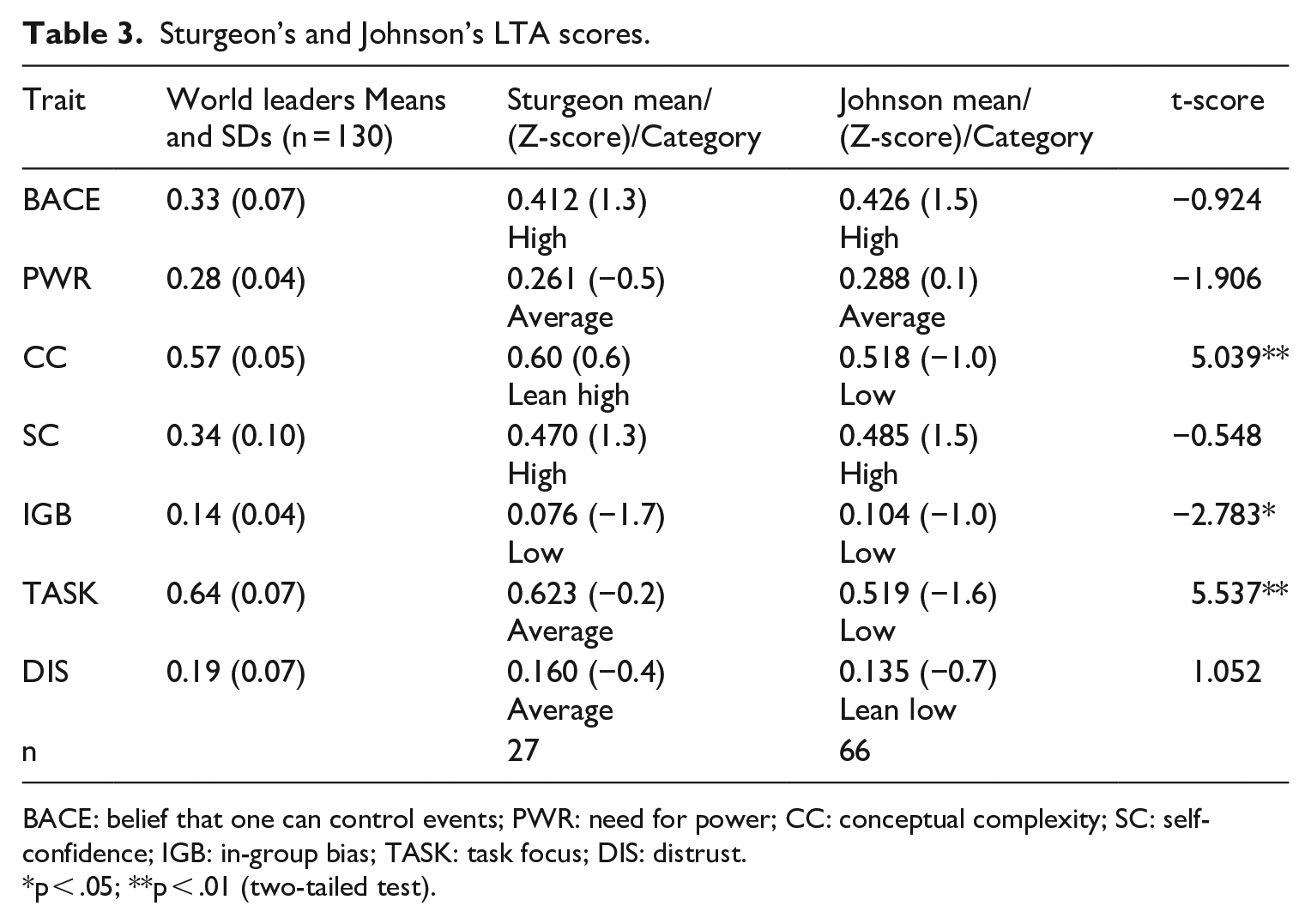
Table 3 displays Sturgeon’s and Johnson’s scores on each of the seven personality traits plus their Z-scores compared with the means for a norming group of 130 world political leaders so as to establish comparisons between them and other decision-makers (PsyCL). The low, high and moderate categories are based on the standard deviation (SD) from the mean score. If the score obtained is 1 SD above the mean for the sample of the norming group, the leader is considered high on the trait in question (Hermann, 2003). If the score is 1 SD below the norming group, the leader is considered low on the trait at hand (Hermann, 2003). The lean-high or lean-low categories were employed when the scores were more than 0.5 SD above or below the mean. The final column reports a measure of the difference of means between the LTA scores for both leaders (t-test), with a positive (or negative) score indicating that Sturgeon was statistically significantly higher (or lower) than Johnson on that trait.
Sturgeon’s and Johnson’s LTA scores.
BACE: belief that one can control events; PWR: need for power; CC: conceptual complexity; SC: self-confidence; IGB: in-group bias; TASK: task focus; DIS: distrust.
p < .05; **p < .01 (two-tailed test).
Overall, the scores show that Johnson displays a more unusual profile compared with other world leaders than Sturgeon does, as most of his scores are above or below the mean. The results speak to a leader whose BACE and SC are above those of other world leaders. His profile also shows low CC, IGB and TASK compared with the norming group. However, while Sturgeon’s profile also displays some important differences compared with other world leaders, as four out of the seven traits are either average or leaning high, her scores are closer to the norming-group average than Johnson’s are. She differs from other world leaders on BACE and SC, which are higher than the mean, as well as on IGB, in which she shows a score lower than the overall average. Her PWR, TASK and DIS scores do not stand out compared with those of other world leaders.
When comparing these two leaders, the results show statistically significant differences between them. The main differences can be observed between the traits CC and TASK, followed by IGB, meaning that Sturgeon is more conceptually complex and task-oriented than Johnson. However, Johnson shows a stronger attachment to his in-group than Sturgeon.
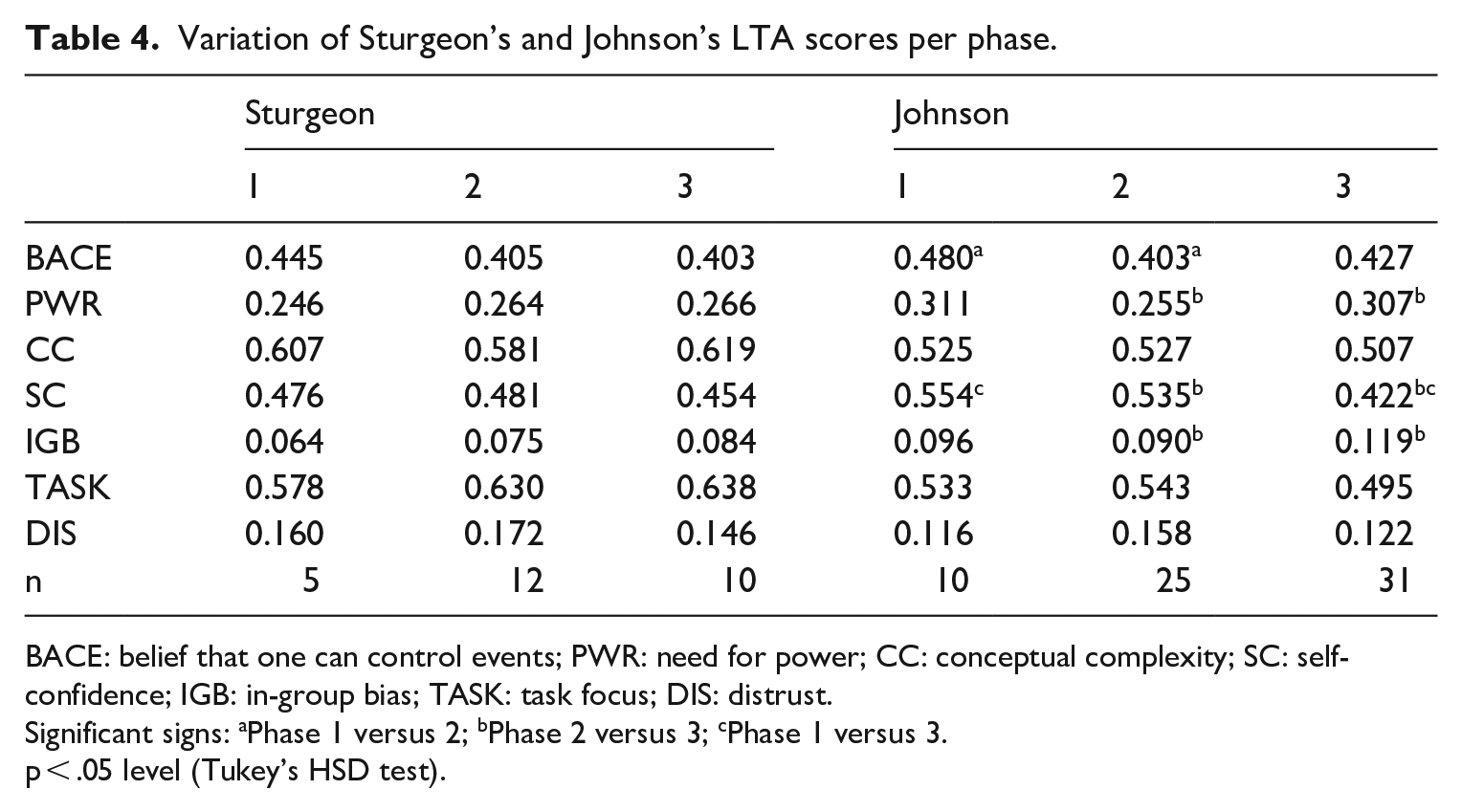
Table 4 displays Sturgeon’s and Johnson’s LTA scores in the three initial phases of the pandemic to determine whether the variation in the context influenced their leadership style. A one-way analysis of variance found no statistically significant differences in Sturgeon’s LTA scores, which suggests that she maintained a steady profile throughout the selected time frame. However, Johnson’s scores showed statistically significant differences between the traits BACE, PWR, SC and IGB. The results indicate that his BACE and SC were significantly higher during the initial lockdown phase. Moreover, the results suggest that his PWR and IGB increased significantly from the ‘exit strategy’ to the ‘facing the second wave’ stage.
Variation of Sturgeon’s and Johnson’s LTA scores per phase.
BACE: belief that one can control events; PWR: need for power; CC: conceptual complexity; SC: self-confidence; IGB: in-group bias; TASK: task focus; DIS: distrust.
Significant signs: aPhase 1 versus 2; bPhase 2 versus 3; cPhase 1 versus 3.
p < .05 level (Tukey’s HSD test).
We ran two-tailed t-tests with independent samples to test whether Johnson’s and Sturgeon’s LTA scores differed significantly during the initial three phases of the pandemic. Table 5 shows that during the lockdown phase, Johnson was more concerned with establishing and maintaining his power than Sturgeon. In line with the findings presented above, both leaders differed consistently in the traits CC and TASK during the second and third phases. They also showed differences in the trait IGB during the last phase of the selected time frame. These results also suggest that during the first year of the pandemic, both leaders increasingly showed more differences in their leadership styles. However, these differences were mainly the result of Johnson’s changes in his approach to handling the pandemic as Sturgeon maintained a stable profile throughout.
Comparison of Sturgeon’s and Johnson’s LTA scores per phase.
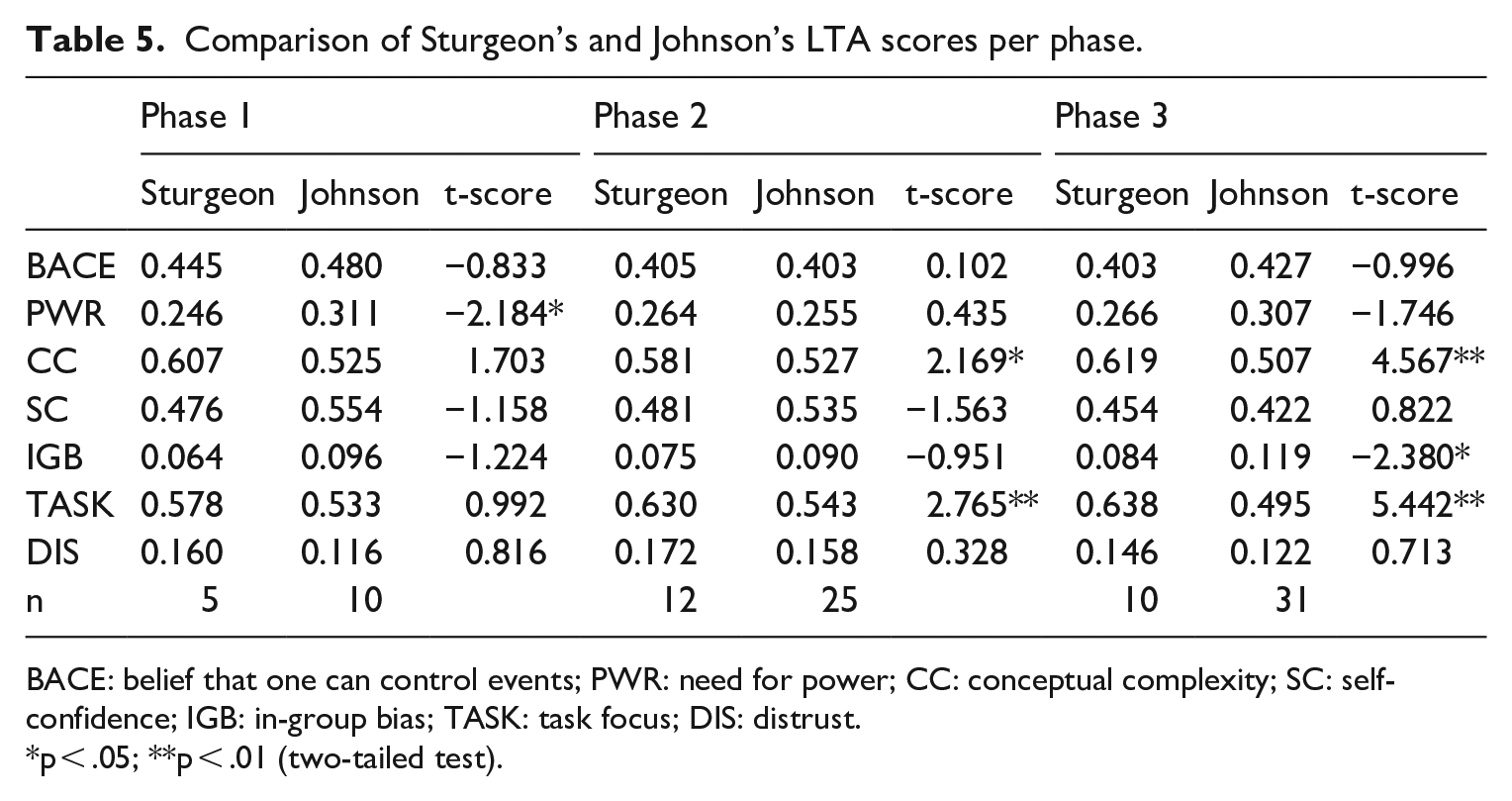
BACE: belief that one can control events; PWR: need for power; CC: conceptual complexity; SC: self-confidence; IGB: in-group bias; TASK: task focus; DIS: distrust.
p < .05; **p < .01 (two-tailed test).
We draw on the scores exhibited in Tables 3 to 5 to answer our initial research questions and determine the potential effects of personality traits in explaining the variation in Sturgeon’s and Johnson’s behaviour during the first stages of the pandemic. The results show that Sturgeon and Johnson diverge in their openness to incoming information, which supports one of our initial expectations. Johnson’s higher scores on SC compared with CC during the first two phases of the pandemic speak to a politician who is mostly close to incoming information. Overall, compared with other world leaders, Johnson’s scores high on SC also indicate that he is more immune to contextual cues and reinterprets new information based on his high sense of self-worth (Hermann, 2003). Furthermore, Johnson’s scores low on CC speak to a leader who tends to trust his intuition and classify the contextual information according to a set of pre-established stereotypes (Hermann, 2003). It is relevant to point out that Johnson appeared more open to information during the third phase of the pandemic compared with previous stages. This change is a reflection of the significant decrease in his scores on SC. However, Sturgeon’s profile remained stable, showing openness to information throughout. Similar to Johnson, Sturgeon also displays a high SC score compared with other world leaders. However, her overall leaning-high score on CC suggests that she can embrace a wide range of environmental stimuli and stay highly attuned to contextual information (Hermann, 2003). The combination of high CC and SC scores makes Sturgeon more likely to be more pragmatic and responsive to the interests, needs and ideas of others (Hermann, 2003).
In sum, the differences found between the two leaders’ openness to incoming information can help explain their capacity to modify their ideas and behaviours or not when faced with the emerging challenges and constant changes induced by the pandemic. The fact that leaders who are high in CC tend to take the time to evaluate different information and consider their options can also help explain Sturgeon’s tendency to be more risk-averse and her capacity to recognise and accept her mistakes more easily than Johnson does. Conversely, Johnson’s low CC could have made him more prone to make risky decisions which only deferred to his own previous ideas on how to manage crises in general and did not take into account the nuances and particularities of the situation he now found himself in. Moreover, the results can also shed light on Johnson’s difficulty in accepting the mistakes made in handling the pandemic, as he struggled with the management of new information which did not match his previously held beliefs. These characteristics, along with Johnson’s priority for keeping relationships over focussing on the task, can help explain why he was more prone to engage in groupthink behaviour, as described in the report issued by the House of Commons Health and Social Care Committee and Science and Technology Committee (2021).
In terms of Sturgeon’s and Johnson’s task versus relationship orientations, we also found important differences between both leaders, which support our initial expectations. Johnson displays a low focus on the problem or task at hand compared to both Sturgeon and world leaders in general. His scores speak to a leader who emphasises relationships over tasks. His decisions are driven by camaraderie, loyalty and commitment to the group (Hermann, 2003). In other words, the group and retaining the support of people come before delivering on the task. Such a focus can help explain Johnson’s more lenient approach when enforcing the rules, especially when they were broken by his close collaborators. At the same time, such scores also reflect a tendency to keep his decisions in line with expectations from a group of supporters who are mainly concerned with the economic repercussions of the restrictions imposed. However, Sturgeon shows moderate scores on this trait, meaning that she can focus on both the task in front of her and on relationships – as the context demands (Hermann, 2003). This characteristic can help explain her more balanced response to the implementation of new rules: she showed determination when the management of the pandemic required the implementation of more stringent measures and was also attuned to people’s needs. This trait can also shed light on her response to situations where people from her team did not comply with the measures the government had imposed to stop the spread of the SARS-CoV-2 virus.
While this work focusses on assessing the differences between both leaders and shedding light on the reasons for the variation seen in their respective behaviours during the pandemic, the results also show important similarities. In terms of these leaders’ BACE scores, Sturgeon’s and Johnson’s are above the average for other world leaders. This means that they share the strong perception that they are in control of events and that their decisions have a tangible impact on outcomes, making them more active in the policymaking process. Leaders with high scores on this trait are more inclined to carry out active policy agendas and less prone to delegate to others (Shannon and Keller, 2007). Previous research has also shown that in the context of crises, the higher the score on this trait, the lower a leader’s sense of uncertainty and threat perceptions; the greater likelihood of them envisaging a role for themselves in the management of the crisis therewith ensues (Van Esch and Swinkels, 2015). Regarding the trait PWR, in both cases, their overall scores are average compared with other world leaders, meaning that they do not stand out in their desire to control or influence other people or groups.
The analysis of both of these traits, BACE and PWR, in combination, reveals leaders’ positions regarding political constraints. In this context, Sturgeon’s and Johnson’s scores speak to leaders who tend to challenge constraints but who, due to the too-direct and open use of power, are less successful at reading how to manipulate and influence people (Hermann, 2003). Thus, while both perceive themselves as crucial to managing the pandemic, they may experience difficulties convincing other people of their policies and ideas. Their profile could help shed light on some of the problems these leaders encountered in their attempts to maintain a high level of consensus vis-à-vis the government and the opposition.
Concerning the trait DIS, while the results suggest no statistically significant difference between them, their overall scores show some variation compared with world leaders. Johnson leans low on DIS, while Sturgeon’s score hereon is average compared with other world leaders. Johnson’s score speaks to a leader who is less inclined to suspect the actions and motives of others (Hermann, 2003). Regarding IGB, Sturgeon and Johnson display low scores compared with other world leaders. These scores show that while they are still interested in maintaining their in-group, they are less prone to categorise people in us-versus-them terms. Herewith, they are more willing to label people according to the nature of the situation rather than their belonging to a specific group (Hermann, 2003).
Following Hermann’s model (2003), the combined traits IGB and DIS speak to leaders’ motivations in how they choose to act towards the world and whether they are more or less prone to perceive the environment as conflictual or cooperative. For Johnson, the combination of low IGB and leaning-low DIS scores denote a leader whose focus is on taking advantage of external opportunities and the relationships provided by the environment, which makes him more inclined to see possibilities for win-win agreements. The case of Sturgeon is less clear, as her scores do not fully fit into Hermann’s categories. However, it can be argued that she is more capable of seeing possible conflicts in the environment and remains reasonably vigilant against them.
Conclusion
The COVID-19 pandemic has made it evident that political leaders’ reactions and decisions are central to managing this global health crisis. Periods of crisis, when the information available is limited and quick decisions are required, constitute a prime empirical scenario to assess and compare leaders’ personal characteristics and their impact on steering the way governments, institutions, and bureaucratic apparatus manage the situation at hand. This article introduced the LTA framework to compare leaders’ different types of behaviours to the health crisis induced by COVID-19. Our study concentrated on two relevant cases: Boris Johnson and Nicola Sturgeon. These cases allowed us to compare two different leaders faced with similar contextual backgrounds but who oversaw divergent policy outcomes. We argued that in the context of crises, how such situations are managed is in part determined by leaders’ personality traits. In line with our initial expectations, the analysis of the data shows that their divergent behaviours in handling the crisis can be associated with two personality characteristics: that is, the degree of openness to incoming information about the pandemic and a focus on the tasks required by the crisis or conversely the prioritisation of relationships respectively.
While the limited number of cases examined does not allow for conclusive evidence, this study suggests that the LTA approach can help shed light on the divergent reactions leaders have shown in confronting the challenges faced. Thus, this study is a starting point to show the value of our approach to understanding how personality traits and leadership styles affect the pathways governments took to manage the COVID-19 crisis. Further theorisation is important to fully unpack the reasons for these different reactions and responses to the pandemic. Future research on the topic should continue with this task and expand the analysis to the other leaderships of the nations of the United Kingdom as well as to other state leaders. It would be interesting to increase the number of cases analysed using LTA to have degrees of comparability across different regions of the world. Doing so would help establish a more comprehensive understanding of the role political leaders play in shaping the directions taken by the institutional and bureaucratic apparatus of the state during crises. Thus, we hope to have laid the foundations for a future research agenda working to that end.
Footnotes
Acknowledgements
The authors thank the University of Edinburgh Foreign Policy Research Group, Bariş Kesgin and the anonymous reviewers for helpful comments.
Funding
The author(s) received no financial support for the research, authorship, and/or publication of this article.
