




Abstract
The New Far-Right is often equated with fascism within mainstream political discourse. Although there are fascistic elements of the far-right generally, the New Far-Right is typified by its adoption of liberal values and support of democracy. Some argue that this adoption of liberal values is a strategy to distance themselves from fascism, while others argue that their pro-liberal position is semi-liberal. This article aims to understand whether individuals within the British New Far-Right are strategically liberal or semi-liberal. Fifteen semi-structured interviews were conducted with three British New Far-Right groups. Using reflexive thematic analysis, three grievance-based themes were developed: Islam, COVID-19, and liberal values. While some narratives were nationalistic using liberal values to oppose Islam, others discussed liberal rights topics that were not related to nationalism. Supporting previous research, previously left-wing individuals were more likely to hold semi-liberal arguments, whereas previously right-wing individuals were more likely to be strategically liberal.
Keywords
Introduction
The term far-right is normally equated with fascism (Ringrose, 2022). However, this term may not apply to all far-right groups. After World War II, fascistic movements split into three strands: (1) revolutionary ultranationalists (fascists), (2) ethnopluralists, and (3) groups that were more compatible with liberal democracy through their adoption of less extreme rhetoric (Griffin, 2003; Taguieff, 1993; Traverso, 2019). Three master frames complement these three strands: the fascist, ethno-pluralist, and anti-Islam master frame (Berntzen, 2019). The anti-Islam master frame links with the fascist master frame through its focus on hierarchy. It also links to the ethno-pluralist master frame through its acceptance of democracy, in opposition to the fascist master frame. However, the anti-Islam master frame breaks with both other master frames by adopting more liberal, progressive perspectives (Berntzen, 2019).
Within the far-right literature, different concepts are used to describe similar groups, and distinctions between groups can be fuzzy. According to Bobbio, the distinction between the left and right political spectrums lies in an emphasis on either equality or hierarchy (Bobbio, 1996). The left is concerned with equality, whereas the right is concerned with hierarchy. However, the distinction between the left and right has become less clear as groups have adopted policies of the opposing side (Mosca and Tronconi, 2019). According to Griffin, within the far-right literature, the term ‘far’ symbolises ideological groups that position themselves outside the political establishment (Griffin, 2008). However, the term far-right is an umbrella term, often encompassing groups with different views, values, and motives (Allen, 2014) specifically concerning immigration, identity, and race (Lowles et al., 2019). The far-right can comprise both democratic and anti-democratic extremists. Both accept nativism (prioritising the protection of British-born inhabitants over immigrants), inequality, and authoritarianism (the strict enforcement of authority over personal freedoms) (Ravndal and Bjørgo, 2018).
Within this far-right umbrella, the terms counter-jihad and anti-Islam are synonymous and describe the three groups focused on in this research: The For Britain Movement (TFBM), the Democratic Football Lads Alliance (DFLA), and Patriotic Europeans against Islamisation of the Occident UK (PEGIDA UK). The most important factor in counter-jihad activism is the opposition to Islam and Muslims (Lee, 2015), which is one of the main distinctions between the traditional, fascistic far-right and the New Far-Right. Although some academics use other terms, such as the ‘Radical Right’, ‘counter-jihad’, ‘anti-Islam’, ‘right-wing extremists’, or ‘far-right’ generally, in this article, the term New Far-Right will be used. The term New Far-Right focuses on a specific sub-category of the far-right and is defined by an aggressive opposition to Islam, support of democracy, use of social media, ultra-patriotism, critique of mainstream politics, and the adoption of some liberal values (defined as the consent of the governed, liberty, a fair legal system, and individual rights) (Berntzen, 2019; Jackson and Feldman, 2014). This represents a new type of far-right politics, based on the anti-Islam master frame, which actively opposes fascism, thereby distancing itself from the traditional right (Berntzen, 2019; Jackson and Feldman, 2014). Consequently, groups that adopt this third master frame are often less extreme than their fascistic and ethno-plural counterparts.
Although New Far-Right groups have adopted some liberal arguments, academics are sceptical of their liberal position. Some argue that the adoption of liberal arguments is a strategy to appear more moderate and distance themselves from the fascistic, far-right stereotype (Copsey, 2010; Garland and Treadwell, 2011; Griffin, 2000; Robinson, 2017). While others argue that the New Far-Right holds a counterintuitive position; they position themselves as the defenders and protectors of Western and liberal culture arguing that immigrants must integrate. However, this is an anti-liberal position as they do not recognise certain cultural sub-groups (Betz and Johnson, 2004) which links to strategic liberalism. While other academics argue that many supporters and leaders of the New Far-Right moved over from the left-wing political spectrum in response to a moral shock, such as Islamist terrorism. Therefore, by moving from the left to the right, some New Far-Right individuals have retained some of their liberal values making them semi-liberal (Berntzen, 2019). Consequently, New Far-Right groups like the DFLA may be less discriminatory than previous related groups (Allchorn and Feldman, 2019). There are, therefore, two opposing arguments relating to the adoption of liberal values within the New Far-Right: strategic liberalism and semi-liberalism.
Strategic liberalism – Femonationalism, animal nationalism, and homonationalism
One of the main differences between the New Far-Right and the traditional fascistic far-right is the focus on Muslim immigration (Zúquete, 2008). This anti-Islam stance was largely inspired by the ‘The Clash of Civilizations’ thesis (Huntington, 2002) where Islam is argued to be incompatible with Western values (Froio, 2018). It has also been inspired by terrorist attacks, the refugee crisis (Pew Research Centre, 2016), anti-Islam rhetoric used by mainstream politicians (Allen, 2004), and the media (Ansari and Hafez, 2012). In addition to the perceived incompatibility between Islam and the West, some more extremist interpretations of current events (normally accompanied by conspiracy theories), see Muslim migrants, immigrants, and refugees as the fifth column of a supposed Islamic empire wherein Muslims conquer Christian Europe (Froio, 2018).
Resulting from World War II, certain ethnic-based prejudices such as biological racism were deemed unacceptable (Kallis, 2013). Far-Right parties that use an ethnic national identity narrative, therefore, are often categorised as racist and xenophobic. By focusing on the perceived values of Islam rather than Muslims, individuals avoid convictions for hate speech. By focusing on Islam and not restricting an individual’s ability to practice Islam, freedom of religion laws are not violated (Howard, 2017). New Far-Right groups, therefore, have attempted to distance themselves from race-based arguments circumventing the stigma and sanctions that are usually imposed on far-right groups (Jackson and Feldman, 2011), thereby gaining an element of respectability (Kallis, 2013).
However, these ethnic-based prejudices did not disappear. Consequently, the Radical Right emerged recalibrating and reabsorbing traditional ethnic-based prejudice instead focusing on perceived cultural incompatibility and adopting mainstream narratives of human rights, equality, social contract, identity, and well-being. A new zero-sum competition approach was adopted where immigrants are positioned not only as a threat to economic resources but also to national identity, Western lifestyle, and culture. This positioned not only the economy as a finite resource but also national identity and culture. Any concession to an immigrant population risked diminishing the culture and identity of the majority group (Kallis, 2013). Therefore, the Radical Right adopted both an ethno-pluralist and nativist approach while democratising some of their narratives. This reimagines the taboo argument of biological racism as a cultural incompatibility where certain others represent a ‘legitimate’ threat to Western liberal democratic values (Kallis, 2013: 233). Consequently, New Far-Right groups and parties have adopted a civic national identity that is more inclusive than an exclusionary, ethnic identity. Some groups, therefore, use the civic values of democracy, tolerance, and inclusiveness to position certain immigrant communities as anti-democratic, intolerant, and non-inclusive (Halikiopoulou et al., 2013). Some of the liberal values of society are adopted while certain out-groups are not tolerated creating a type of ‘ethnocratic liberalism’ or liberal illiberalism (Griffin, 2000: 174; Pilkington, 2016). These groups have adopted cultural racism, the new racism which dispenses with biological markers and shifts to markers of inclusion and exclusion positioning fears about immigration as a threat to our way of life or culture (Allen, 2010). Therefore, to legitimately oppose Islam, the New Far-Right has annexed certain civil, liberal rights (Akkerman, 2015; Halikiopoulou et al., 2013) which are argued to conceal more extreme backstage narratives (Jackson and Feldman, 2014).
To describe this strategic adoption of liberal values different terms have been used in the literature, including ethnocratic liberalism, liberal illiberalism, instrumental liberalism, and alter-progressivism (Berntzen, 2019; Foster and Kirke, 2022; Griffin, 2000; Margulies, 2018; Moffitt, 2017). However, in this article, the term strategic liberalism will be used (Berntzen, 2019). Previous research suggests that the New Far-Right has specifically adopted four aspects of liberalism, focusing on defending gender and sexual minorities, secularism, individual freedom, and free speech (Gustavsson, 2014). This article will focus on the first liberal values of gender and sexual minority rights. In addition, due to the growing concern in the New Far-Right for animal rights, this will also be a focus.
To appear more moderate, a series of three strategies have been adopted by some New Far-Right parties and groups: femonationalism, animal nationalism, and homonationalism. In New Far-Right discourse, these concepts position women’s rights, lesbian, gay, and bisexual (LGB) rights, and animal rights as core values of the nation which are threatened by immigrants and outsiders deemed unwilling or unable to hold these liberal values (Halikiopoulou et al., 2013).
In contrast to historical fascistic groups, most New Far-Right groups advocate for women’s rights. Far-right parties often support traditional gender roles reducing women to the role of mother or spouse. For women that support feminist arguments, these traditional roles are unlikely to appeal. This is particularly true of younger women (Inglehart et al., 2003). To address this, some New Far-Right groups have adopted femonationalism, which combines feminist themes and nationalism to oppose Islam (Farris, 2017; Pilkington, 2017). Larzillière and Sal (2011) argue that this adoption of women’s rights is pseudo-feminist and, therefore, inauthentic.
Besides femonationalism, concern for animal rights may also be strategically adopted by the New Far-Right. Animal nationalism is the adoption of animal rights with nationalism in an attempt to appear more liberal and civilised compared with other cultures (Miller, 2021). Within animal nationalism, cultural claims of national belonging and responsibilities of citizenship are attached to the treatment of animals (Davis, 2013). Therefore, by specifically focusing on unstunned halal ritualised slaughter, the New Far-Right can position British law, as superior to Islamic law, due to its enforcement of more ethical stunned slaughter practices.
Some European New Far-Right groups also use homonationalism; adopting LGB rights to oppose Islam (Meret and Siim, 2013; Puar, 2018). Homonationalism is the combination of tolerant views towards members of the LGB community, nationalism, and racism (Freude and Vergés Bosch, 2020). Previous research by Foster and Kirke (2022) developed four main themes within the Radical Right relating to alter-progressivism (strategic liberalism) that use homonationalist narratives: (1) cisnormativity, (2) a clear perceived incompatibility between illiberal Islam and the liberal West, (3) a perceived threat posed by Islam towards members of the LGB community, (4) and that the Radical Right were the sole protectors of LGB community against this threat.
Semi-liberalism – The political move from left to right
Although some argue that this adoption of liberal rights is strategic, others argue that because many supporters of the New Far-Right were originally on the left-side of politics, they are semi-liberal (Berntzen, 2019). Berntzen (2019) argues that there are two main pathways into the anti-Islam movement. The first pathway, the nativist outlook, is a strategic calculation pathway wherein individuals support a New Far-Right group because of their anti-Islam position, but then strategically adopt some liberal views (femonationalism, homonationalism, and animal nationalism) to appear more moderate and progressive. The second liberal, progressive pathway into the New Far-Right is through moral shocks, such as Islamist terrorist attacks, which trigger an emotional response, leading some to see Islam as a totalitarian, existential threat to British equality. Therefore, for those that were previously left-wing, the liberal views they hold now are likely to be semi-liberal. The term semi-liberal is used as the New Far-Right only adopts certain liberal values (Berntzen, 2019). This article adds to this discussion on the anti-Islam movement. Using interview evidence, I discuss whether some within the British New Far-Right adopt liberal values to appear more moderate or whether these concerns are semi-liberal.
Methodology
In this research, I interviewed 15 supporters and leaders of 3 British New Far-Right groups, including Anne Marie Waters (AMW), the leader and creator of TFBM and PEGIDA UK, and Tommy Robinson 1 (TR), the previous leader and creator of the English Defence League and PEGIDA UK. The three groups focused on were TFBM, the DFLA, and PEGIDA UK. Further details can be found in Table 1. Ethical approval for this study was granted on 15 March 2022 (no.2022/73) by the Schools of Business, Law, and Social Sciences Research ethics committee at the unnamed university. Informed consent was also obtained in written form from all 15 interviewees. All interviews were anonymised except for AMW and TR who gave their verbal or written consent to be identified. Most interviewees were contacted via Facebook messenger. Each of the three New Far-Right groups has an official Facebook page which I used to contact individuals who had reacted to a post on the page. In total, over 1000 messages were sent. Nine people were recruited via the Facebook messaging platform and five were recruited through snowball sampling where a Regional Organiser acted as a gatekeeper leading to the recruitment of five other individuals, including AMW. I contacted TR through a historical personal website and not through Facebook, as he has been banned from this platform (Hern and Waterson, 2019).
The demographic breakdown of each interviewee.
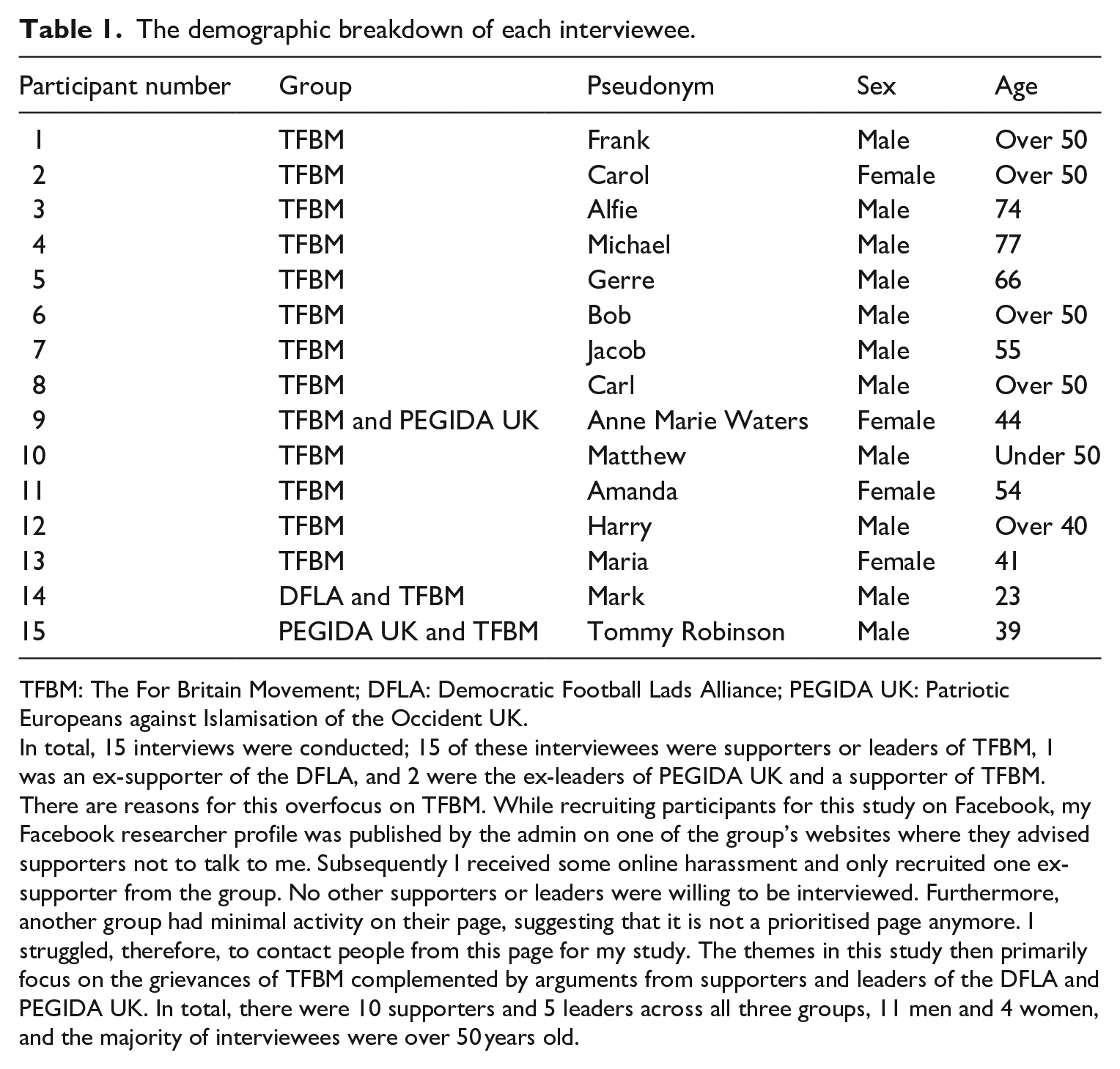
TFBM: The For Britain Movement; DFLA: Democratic Football Lads Alliance; PEGIDA UK: Patriotic Europeans against Islamisation of the Occident UK.
In total, 15 interviews were conducted; 15 of these interviewees were supporters or leaders of TFBM, 1 was an ex-supporter of the DFLA, and 2 were the ex-leaders of PEGIDA UK and a supporter of TFBM. There are reasons for this overfocus on TFBM. While recruiting participants for this study on Facebook, my Facebook researcher profile was published by the admin on one of the group’s websites where they advised supporters not to talk to me. Subsequently I received some online harassment and only recruited one ex-supporter from the group. No other supporters or leaders were willing to be interviewed. Furthermore, another group had minimal activity on their page, suggesting that it is not a prioritised page anymore. I struggled, therefore, to contact people from this page for my study. The themes in this study then primarily focus on the grievances of TFBM complemented by arguments from supporters and leaders of the DFLA and PEGIDA UK. In total, there were 10 supporters and 5 leaders across all three groups, 11 men and 4 women, and the majority of interviewees were over 50 years old.
The interviews conducted were semi-structured and aimed to understand grievance-based motivations for supporting these New Far-Right groups. Using reflexive thematic analysis (Braun and Clarke, 2019), a total of 27 grievance-based nodes and 3 main themes were developed. The first main theme was concern about Islam, with Islam is not a religion of peace and Islam is anti-liberal values being the two main sub-themes. The second main theme was concern about COVID-19. The third most common theme was concern about the erosion of liberal values, especially women’s rights, LGB rights, and animal rights. This article will focus on two main themes: concern about Islam, specifically the Islam is anti-liberal rights sub-theme, and concern about the erosion of liberal rights theme. These two themes will be used to assess whether liberal views expressed in these three New British Far-Right groups are strategically liberal or semi-liberal.
As discussed above, some individuals moved from the left to the right within politics. Out of the 15 interviews conducted, 7 people explicitly stated their previous political allegiance. Therefore, in the discussion on the transition into the New Far-Right, I will reference arguments made by Alfie, Bob, and TR who were previously right-wing, and AMW, Gerre, and Maria who were previously left-wing. Maria had previously voted for both left and right-wing political parties. Therefore, this transition from left to right might not be clear-cut. However, previous research found that activists who are attracted to the far-right are primarily motivated by non-ideological or apolitical reasons (e.g. Busher, 2015; Goodwin, 2011; Pilkington, 2016). Therefore, different trajectories and motivations for supporting the present three groups will also be discussed to highlight the multifaceted nature of supporter motivation. In addition, it is important to note that the interview quotes used in this article represent the individual’s frontstage persona and are, therefore, likely to be more moderate than any backstage narratives (Jackson and Feldman, 2014). Finally, due to the qualitative nature of this research, the quotes used are also not representative of the group.
Self-reflexivity is integral in this study (Salter and Mutlu, 2013). Being a young, White, British, female, it is likely that I was trusted by the individuals in these groups, and this may have assisted in snowball sampling. It is also possible that the interviewees, especially the leaders, were using me to present a more moderate frontstage persona while concealing a more extreme backstage. Furthermore, as an educated liberal, I position these groups as ideologically opposed to my political position. Nevertheless, because of my background in psychology, I was able to empathise with individual stories and perceived relative deprivation. This potential danger of empathising with the far-right is one of the main reasons interviews are rarely conducted with far-right actors (Ashe et al., 2020). However, although I was aware of this potential danger, I believe it is imperative to talk to those with opposing views to my own, especially within the university community where liberalism is the norm and far-right individuals may be ostracised (Gross and Fosse, 2012). By not talking to those on the right, far-right and extreme right, we risk reinforcing the echo chamber which ignores grievances on the right-side of the political spectrum (Ross Arguedas et al., 2022). If individuals feel disillusioned and voiceless, this may push them further towards the fringes of politics (Maher et al., 2018). Finally, because of the lack of interview-based research within the far-right and because of my left-leaning political positioning, I attempted to be open-minded during the interviews, neither agreeing nor disagreeing but acknowledging that I understood positions and arguments.
Are individuals within the New Far-Right strategically liberal or semi-liberal?
I’d say, my opposition to Islam comes from my liberal views. I am a liberal. (Interview 15 – Tommy Robinson)
Within the first main theme developed, Islam, there were two sub-themes: Islam is not a religion of peace and Islam is anti-liberal rights. Therefore, femonationalism, homonationalism, and animal nationalism have all been adopted within this theme to oppose Islam. The main framing of these arguments was that Islam is anti-liberal rights and threatens Britain’s pro-liberal rights. Interviewees were primarily concerned about women’s rights, animal rights, and LGB rights. These, it was argued, are in danger of being eroded by Islam. The third main theme discussed later, was concern about the erosion of liberal values generally, specifically related to women’s rights, animal rights, and LGB rights (Table 2).
Each interviewee’s position on women’s rights, animal rights, and LGB rights.
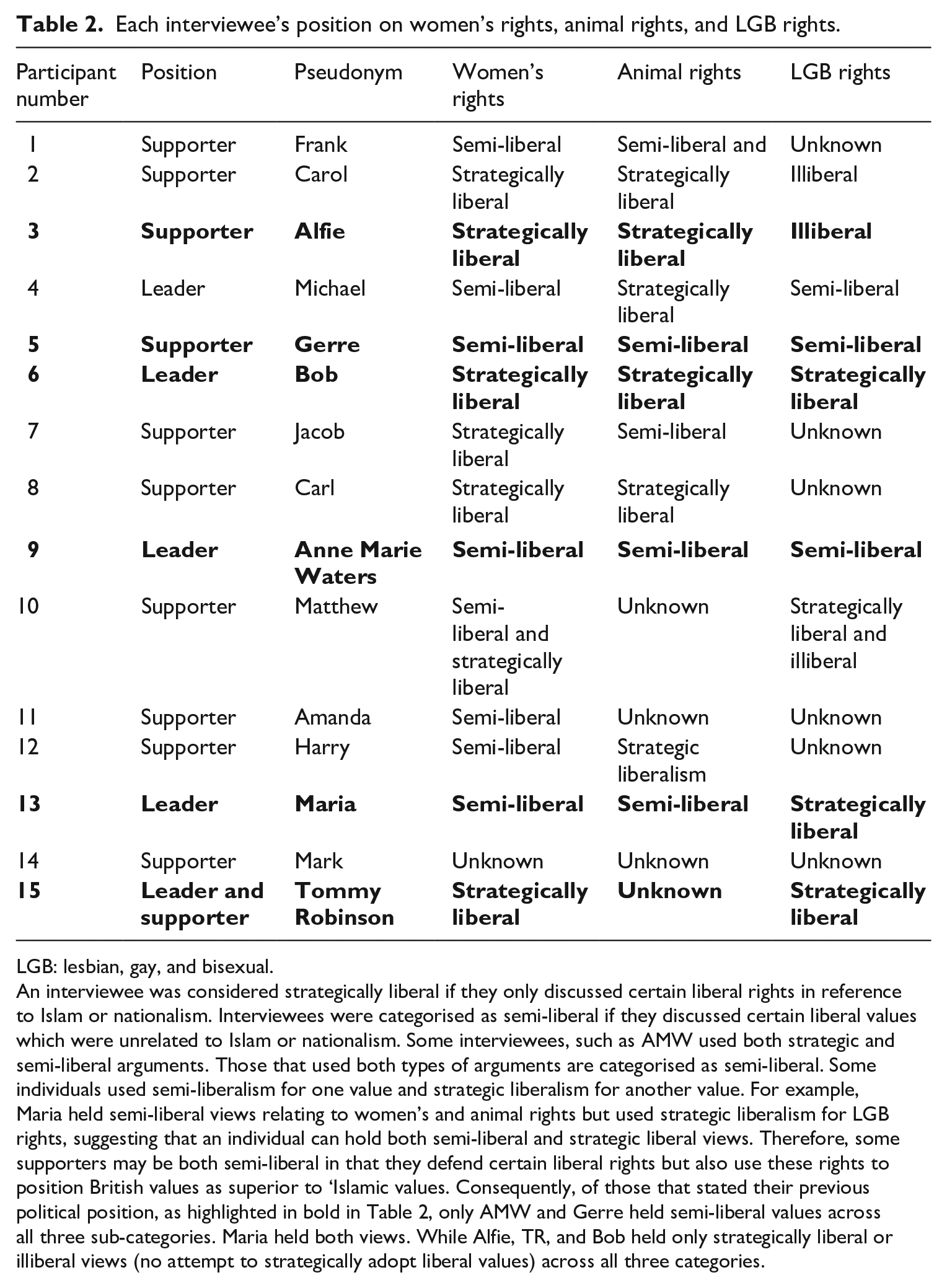
LGB: lesbian, gay, and bisexual.
An interviewee was considered strategically liberal if they only discussed certain liberal rights in reference to Islam or nationalism. Interviewees were categorised as semi-liberal if they discussed certain liberal values which were unrelated to Islam or nationalism. Some interviewees, such as AMW used both strategic and semi-liberal arguments. Those that used both types of arguments are categorised as semi-liberal. Some individuals used semi-liberalism for one value and strategic liberalism for another value. For example, Maria held semi-liberal views relating to women’s and animal rights but used strategic liberalism for LGB rights, suggesting that an individual can hold both semi-liberal and strategic liberal views. Therefore, some supporters may be both semi-liberal in that they defend certain liberal rights but also use these rights to position British values as superior to ‘Islamic values. Consequently, of those that stated their previous political position, as highlighted in bold in Table 2, only AMW and Gerre held semi-liberal values across all three sub-categories. Maria held both views. While Alfie, TR, and Bob held only strategically liberal or illiberal views (no attempt to strategically adopt liberal values) across all three categories.
Women’s rights
Alfie and TR were only concerned about women’s rights when discussing Islam, suggesting that femonationalism was important in their narratives. Alfie believed that under Islamic law, women are not treated equally to men. TR specifically commented on the grooming gang cases,
2
arguing that young British girls were being exploited by Muslim men following the teachings of Mohammed. He also commented on the perceived oppressive nature of Islam generally, arguing that Islam opposes women’s rights as shown in the quote below. This position highlights a femonationalist, strategic adoption of feminist positions to oppose Islam: People say, you are against immigration. Nope, I would open the British embassy tomorrow and get every woman out of Saudi Arabia. Every single one of them. And just leave loads of cavemen scratching their heads going, what the fuck is going on, all the women have gone. (Interview 15 – Tommy Robinson)
3
The narratives used by supporters and leaders of the present three New Far-Right groups use both the protector frame and the equality frame, as highlighted by Berntzen, to justify their anti-Islam stance regarding women’s rights (Berntzen, 2019). In the protector frame, Muslim men are positioned as a threat to non-Muslim women, for example, in the grooming gang cases. The equality frame is also used, where Muslim women are seen as vulnerable within patriarchal Islam, positioning Muslim men as a threat to British, liberal values leading to gender inequality. Muslim men, therefore, are perceived as a threat in both the protector frame and the equality frame (Berntzen, 2019). As the New Far-Right often positions women’s rights as a cornerstone of Western, progressive democracy, this inequality is seen as an assault on democratic liberal values. This argument is rooted in femonationalism where individuals only adopt feminist arguments to oppose Islam.
It is argued, therefore, that any liberal narratives are a masquerade for more extreme illiberal backstage narratives (Berntzen, 2019; Mayer et al., 2014). However, in comparison, some of the arguments made by AMW and other interviewees in this study were not only due to the adoption of femonationalism. AMW’s position on women’s rights is not only explained through femonationalism as she is concerned about a range of feminist issues that are unrelated to Islam or nationalism. This notion is likely due to her shift from a left-wing, Labour supporter to a right-wing, TFBM leader. In his research, Berntzen found that out of 30 main leaders of the anti-Islam movement an equal number were from both left-wing and right-wing backgrounds. Only a minority had a history in the radical or extreme right (Berntzen, 2019). Therefore, in AMW’s transition from the left to the right side of politics, some of her liberal values have remained and she can be positioned as both semi-liberal and strategically liberal (Berntzen, 2019). Semi-liberal, as she argues that we still need to strive for gender equality in the United Kingdom. Strategically liberal, because she also argues that certain outsiders do pose a threat to some liberal rights (Moffitt, 2017). It is, therefore, likely that femonationalism does not fully explain AMW’s arguments (and the views of other interviewees in this research), but that the label of femonationalism may allow the left to dismiss legitimate women’s rights arguments made by the New Far-Right. AMW’s arguments then can be categorised as both strategically liberal and semi-liberal.
Animal rights
The second main sub-theme within the Islam and Liberal rights themes is concern about animal rights. As with femonationalism, some individuals were only concerned about animal rights in opposition to the Islamic treatment of animals and halal slaughter. Alfie, who ate meat, was staunchly against halal unstunned slaughter. However, he did not mention any other form of animal cruelty outside of Islam, suggesting that his concern related to Islam rather than animal welfare. Bob also focused his attention on halal practices arguing that Kosher slaughter, although unstunned, was not an issue because the practice was minimal compared with halal slaughter which, he argued is widespread: Definitely against halal and I’ve actively campaigned against that myself. (Interview 6 – Bob)
The anti-halal arguments made in these interviews reflect animal nationalism. By specifically focusing only on unstunned halal ritualised slaughter, certain individuals can position British law, which enforces stunned slaughter, as superior to Islamic law. However, some of the narratives in these interviews were different from these purely nationalistic arguments. Other interviewees were concerned about a range of issues related to animal rights. Within the 15 interviews conducted, 2 individuals were vegan, and 2 were vegetarian. Jacob spoke about how we have been indoctrinated to eat dead bodies and to drink the milk of other species, while Gerre spoke about the plight of animals in factory farms and Frank said he ‘watched slaughterhouse videos and I can’t even walk down the meat aisle’. Maria argued that the dairy industry was horrific as highlighted in the quote below: I didn’t realise how horrific the dairy industry was . . . it was just from finding out about things that I didn’t know that went on . . . in the farming industry . . . we lived in a very rural area . . . There’s a field over there and it had cows in it and then one day we just heard the cows making the most horrific, groaning noise and it wouldn’t stop and they went on for days and I spoke to the neighbour, and he said it was the day they took their calves away. It was haunting. (Interview 13 – Maria)
Although surprising to some, the fascistic and New Far-Right often hold pro-animal welfare arguments which are not only restricted to halal slaughter. Eco-fascism implemented by the German National Socialist party used animal rights and environmental rights to justify their pro-eugenics and anti-Jew stance, arguing that environmental damage was caused by overpopulation and population density (Zimmerman, 2004). According to Forchtner and Tominc (2017), veganism is also becoming more visible in far-right groups. Some White supremacist, alt-right, and far-right groups identify veganism as being pure, elitist, and heroic, following the diet of Adolf Hitler and the Aryan way of life (Taylor, 2019). Vegan fascists, such as Jayme Louis Liardi, identify veganism as the natural, European way in opposition to capitalist consumerism, which he argues is driven by Jewish forces. His interpretation of veganism is rooted in fascistic, antisemitic narratives (Coning, 2017). The term for this type of veganism is vegan nationalism which ‘is a hegemonic discourse that posits vegans (and by extension their respect and support of animal rights) as another example of the ethical superiority of nations that welcome vegans as members of an exceptional ‘minority’ group (Yasui, 2022: 9). Vegan nationalism suggests that pro-animal rights arguments are no longer positioned exclusively on the left (Yasui, 2022).
However, these animal nationalist, eco-fascist, and vegan nationalist narratives are different narratives to the views expressed by some interviewees in the present research concerning animal rights. Apart from halal, there was no mention of any connection to country, identity, or superiority which would link arguments to animal nationalism. Instead, as shown above, arguments were focused on the abuse of animals generally rather than the superiority of the interviewees. Therefore, although animal nationalism can explain these narratives to a degree, some of the arguments made can be described as semi-liberal. This may be due to the liberal background of some of the interviewees who have adopted authoritarian values and solutions but still hold some of their liberal values (Berntzen, 2019). Gerre, Maria, and AMW all stated that they moved from the left-side of the political spectrum to the right after certain moral shocks. An example of moral shock given was the identification of Islam as authoritarian after an Islamist terrorist attack. Therefore, again, semi-liberalism may explain why some individuals in the New Far-Right are genuinely concerned about animal rights.
LGB rights
For some interviewees, concern about the erosion of LGB rights by Islam was the main grievance. As discussed above, previous research by Foster and Kirke highlighted the combination of LGB rights, nationalism, and racism within the Radical Right (the New Far-Right). The arguments put forward by interviewees in this study, support the findings of Foster and Kirke (2022): The Guardian carried out a survey . . . of British Muslims and asking them whether or not they found homosexuality acceptable and 100% said no, 100%. And then more recently you’ve had, should homosexuality be criminalised? 52% of British Muslims said yes . . . they weren’t asked about the death penalty. Did you know that in many Muslim societies, homosexuality carries the death penalty, they weren’t asked that question and I would like to know what the answer to that question would have been. (Interview 9 – Anne Marie Waters)
Homonationalism might explain this relationship between the New Far-Right and gay rights. The adoption of homonationalist narratives attracts more gay and lesbian supporters of nationalist parties or groups as it allows LGB rights to be positioned as a cornerstone of Western, liberal democracies while claiming Islam threatens these liberal values. Interviewees referenced how, ‘If that was Islam, they would throw him off a building, they would hang him, they would beat him’ (Interview 5 – Gerre), Muslims ‘throw gays off roofs’ (Interview 6 – Bob) and ‘hang you [gay people]’ (Interview – 10 Matthew), clearly highlighting the perceived illiberal and violent nature of Islam concerning homosexuality. This opposition is deemed to be incompatible with British values and some interviewees expressed how they want to fight to protect these liberal rights, as seen in the quotation below: I support gay people’s rights. If someone was to come in and start on a homosexual, I’d beat them up. I have done growing up because I do not care. You want to do what you want to do; you go and do it. But then, when you start talking about Islam because of these views, you’re a fucking extremist, you’re far-right. (Interview 15 – Tommy Robinson)
Some individuals, such as Matthew who was a devout Christian, claimed that Islam’s treatment of homosexuals was barbaric compared with the Christian response to homosexuality. This is an example of homonationalism, where certain pro-gay narratives have been adopted to present a positive, progressive image of British liberal values, compared with the perceived backward, negative image of Islam which is anti-gay rights, anti-progressive, and anti-freedom of choice. This narrative supports the dichotomy of the ‘gay-friendly West and the homophobic Middle East’ (Yasui, 2022: 9). However, homonationalism may not explain the views of other interviewees. Although Gerre and AMW held some homonationalist views, they also shared semi-liberal arguments relating to LGB rights. Both Gerre and AMW self-identified as gay or lesbian. For example, Gerre has been an active pro-gay rights activist for most of his adult life: I was always involved in as a gay man, I was, you know, thrust into the left because the left was campaigning for civil rights, where the Conservatives were, you know, hiding and using rent boys and getting married and lying basically. (Interview 5 – Gerre)
Gerre’s stance as a gay man is uncommon in the New Far-Right but not unique. Previous research found that individuals that were anti-immigration but members of the LGB community were more likely to support the Populist Radical Right than individuals that were only anti-immigration (Spierings et al., 2017). As discussed, although homonationalism is likely to have been adopted by certain individuals, especially heterosexual supporters of the New Far-Right, others, such as Gerre and AMW have a liberal background in politics and moved over to the right later in their life. It is likely, therefore, that certain individuals of the New Far-Right have retained their pro-liberal values rather than adopting homonationalism (Berntzen, 2019). Therefore, for some, semi-liberalism is more likely to explain support for LGB rights within the New Far-Right (Berntzen, 2019). However, this liberalism only extends so far. Foster and Kirke highlight a new tactic used by the Radical Right (New Far-Right), which argues that some British Radical Right groups deploy alter-progressive narratives to attract a cisgender LGB supporter but also, oppose trans rights. The alter-progressive supporter is not progressive, concerning mainstream liberalism, but they are also not anti-progressive as seen in fascistic, neo-Nazism, they are between these two spectrums (Foster and Kirke, 2022). Therefore, LGB supporters of the New Far-Right may hold some liberal values, but other liberal values, such as trans rights, might be deemed too liberal and not part of the heteronormative mainstream in which some gay men specifically strive for acceptance (Foster and Kirke, 2022).
Although certain individuals in this article held some semi-liberal values this does not make them liberal. Liberalism relies on a full range of principles including equality, anti-racism, and universal rights. As these groups hold nativist arguments positioning Muslims as the outside other, they cannot be considered liberal but may hold some liberal arguments. They are, therefore, nativists with some semi-liberal arguments rather than liberals (Margulies, 2018). Furthermore, although both strategically liberal and semi-liberal arguments were present in this research, it is also important to note that homophobia is still present within the New Far-Right. In this study, Alfie and Matthew openly displayed illiberal anti-LGB narratives ‘it is wrong to be homosexual’ (Alfie, interview 3). Both Alfie and Matthew were Christian, believing strongly in family values, which may explain their illiberal anti-LGB attitudes, as Christianity is correlated with authoritarianism (Berntzen, 2019).
Diverse narratives within the New Far-Right
As discussed, there are two pathways into the New Far-Right: from authoritarianism or liberalism (Berntzen, 2019). In the present research, individuals that stated they were historically on the right-side of the political spectrum or held authoritarian values, such as Alfie, Bob, and TR, used arguments that adopted liberal values but only as a façade to oppose Islam through their adoption of femonationalism, animal nationalism, and homonationalism. These strategic narratives were used to moderate their arguments appealing to a wider range of people, potentially circumventing stigma, avoiding deplatforming (Sibley, 2023), and avoiding convictions under hate speech laws (Howard, 2017). In contrast, individuals that stated they had historically been liberal and moved to the right-side of the political spectrum, such as Gerre, AMW, and Maria, were semi-liberal and discussed a range of concerns about the rights of women, animals, and the LGB community. This argument supports Berntzen’s research and suggests that although many of the narratives within the anti-Islam New Far-Right can be perceived as prejudiced, xenophobic, and offensive, other arguments may be rooted in semi-liberal concern about the erosion of liberal rights within the United Kingdom (Berntzen, 2019).
However, it is important to note that there were other non-ideological or apolitical trajectories into these groups including through emotions, social ties and football hooliganism (e.g. Busher, 2015; Goodwin, 2011; Pilkington, 2016). Alan spoke about his loneliness, confusion, and isolation in an ever-changing world. Jacob said that he didn’t have any friends and he didn’t talk to anyone leaving him socially isolated. Harry was a working-class, self-employed technician who suffered from depression causing him to become socially isolated. Both Gerre and Amanda had friends that supported Donald Trump which encouraged them to become involved with the pro-Trump movement. While both Maria and Mark had family and friends in the anti-Islam movement (Busher, 2015) who encouraged them to join. In Mark’s case, he had also previously been homeless and unemployed. He spoke about how marching with members of the DFLA made him feel protected. Tommy Robinson is well known for being a football hooligan and later became involved in the anti-Islam movement through his hooliganism (Busher, 2015). These non-ideological trajectories highlight the importance of loneliness and isolation, family/friendship connections to the anti-Islam movement, and football hooliganism involvement, suggesting that political ideology is not the only route into these three groups.
As highlighted, Islam and Muslims are singled out as the main issue for the British far-right. Therefore, there were other racialised arguments against Islam and Muslims that were not related to liberal values. In the Islamic ideology theme, Islam is not a religion of peace was the main sub-theme. Islam is anti-liberal values was the second main sub-theme. Consequently, those that held semi-liberal arguments also used other arguments to oppose Islam. For example, the so-called ‘grooming gang’ cases gained attention from the British far-right. Although the religion of the perpetrators was not identified by the police (Crowther, 2022), AMW identified the perpetrators as Muslim because they were identified as Asian and Pakistani. ‘I spent about a year and a half researching the grooming gangs. The way that these girls were treated . . . not only by the rape gangs but by the system afterward, because of the Muslim element of it’ (Interview 9 – Anne Marie Waters). Although she then continues to talk about the negative influence of the Islamic culture on the perpetrators and states that ‘I know it has nothing to do with race, it’s religion’ (Interview 9 – Anne Marie Waters), she still associates the ‘grooming gang’ cases with Muslims based on the identification of the perpetrators being Pakistani and on their physical appearance adding a racialised element. Muslims are positioned as the outsider (Betz and Johnson, 2004). Therefore, there is a diverse range of arguments in the British New Far-right including semi-liberal, strategic liberal, and ethnic or racial-based. It is worth mentioning that the focus on religion instead of race is likely a strategy as minority groups such as Muslims, LGBT members, Jews, and so on, have minority protection in the United Kingdom (Allchorn and Feldman, 2019).
It is also important to note the ideological connection between liberalism and multiculturalism. It is assumed those who are liberal are likely to support multiculturalism (Kymlicka, 1999). Therefore, this assumption positions any group critiquing multiculturalism as opposing liberalism. However, the link between liberalism and multiculturalism is complicated. Many liberals have criticised multiculturalism. For example, Sartori (2000) argued that there is a demand for the state and majority society to ‘recognise’ the minority group. However, there is less demand for the minority group to ‘recognise’ the cultural values of the majority group. Parekh (2000) argues that when there is a clash between the minority and majority groups based on controversial public values, the controversial public values must retreat to allow for the majority public values. Despite these liberal critiques of multiculturalism, the theory of multiculturalism does not explicitly highlight the importance of the minority group ‘recognising’ the values of the majority group. This then critiques the notion of tolerance within multiculturalism and argues that the tolerance shown to minority groups must be reciprocal (Sartori, 2000) moving from multiculturalism to civic integration (Joppke, 2004). It could, therefore, be argued that this furthers the link between certain supporters/leaders of these groups and semi-liberal values. Their criticism of multiculturalism, specifically Muslim-related multiculturalism may be based on liberal critiques of tolerance and reciprocity leading to the idea that Islam, and therefore Muslims, are not tolerant of women, members of the LGB community, and animals which are fundamental British values.
The New Far-Right: Both strategic and semi-liberal
This research suggests two things. First, some individuals within the New Far-Right do have semi-liberal arguments. Second, other individuals use liberal arguments to distance themselves from fascism, using a liberal veil as a façade. This semi-liberal or strategic liberal position, according to Berntzen, depends on the pathway individuals have taken to align with the New Far-Right. The present research supports Bentzen’s findings (Berntzen, 2019). Individuals that moved from the left appeared to hold semi-liberal views covering a range of issues, not only in opposition to Islam. Those that held more authoritarian views only used liberal arguments combined with nationalism to oppose and criticise Islam. It also suggests that although the arguments of the far-right can be extreme, unfounded, and strategic, the semi-liberal arguments within New Far-Right narratives may be legitimate and need to be listened to. Therefore, using terms of nationalism, such as femontionalism, animal nationalism, and homonationalism, along with more extremist terms, such as fascism, to define all supporters or groups of the New Far-Right, may obscure some genuine semi-liberal concerns individuals may have. Using these terms may also be a strategy used by the left to dismiss all concerns of the New Far-Right, despite the liberal origins of some individuals. It is necessary, therefore, to identify which arguments within the New Far-Right are semi-liberal and work to appeal to individuals that hold these views. The shared liberal values between mainstream politics and semi-liberal supporters of the New Far-Right may act as a bridge to encourage disillusioned individuals on the right-wing fringes to reconnect with mainstream politics.
For individuals that hold authoritarian views and adopt liberal values to distance themselves from traditional fascism, researchers need to be aware of the backstage that these individuals may be concealing to appeal to a wider population. Statistics and discourse analysis need to be conducted to understand the makeup of the New Far-Right, how many people are strategically liberal, how many are semi-liberal, and how strategically liberal individuals conceal their extreme backstage narratives. This research suggests that the New Far-Right is not homogeneous, and there are significant differences within New Far-Right groups, not only between. To understand the New Far-Right fully, research needs to be conducted to identify why people choose to move from the left-political spectrum to the right, why authoritarian individuals choose to become involved in the New Far-Right rather than the fascistic far-right, and how we bring individuals with semi-liberal views back into mainstream politics. Finally, academics, governments, and the media need to be careful to appropriately categorise different groups within the far-right. Previous research suggests that using extreme terms such as fascistic, to describe New Far-Right groups, may push supporters further to the extremes. Using less extreme language and understanding the semi-liberal nuances within the New Far-Right may reduce the number of individuals that become extreme or violent as a result of being pushed further to the fringes of the political spectrum.
Footnotes
Acknowledgements
I would like to acknowledge my gratitude to Nottingham Trent University, my supervisors and other academics that have been kind enough to review my work and help me grow as a researcher.
Declaration of conflicting interests
The author(s) declared the following potential conflicts of interest with respect to the research, authorship, and/or publication of this article: The author received a scholarship from Nottingham Trent University and has no personal, financial, professional, or contractual competing interests.
Funding
The author(s) disclosed receipt of the following financial support for the research, authorship, and/or publication of this article: This research was funded by the VC bursary at Nottingham Trent University.
