




Abstract
The antagonism between far right and new left parties has transformed West European politics through increasing sociocultural conflict. We ask what this new cleavage implies for the politicization of inequalities. We contrast two diverging theoretical expectations. The first expects a tradeoff between sociocultural and socioeconomic inequalities, with new left voters emphasizing the former over the latter, and vice versa for far right voters. The second predicts a single dimension of inequality attitudes, from new left “universalists” being inequality averse to far right “particularists” being more inequality tolerant. Evidence based on survey data from Germany supports the second perspective. Even new left voters in the educated middle classes are more averse to all dimensions of inequality than (far) right voters. This implies that a successful new left agenda can simultaneously target various inequalities. However, in contexts of polarized party competition, divisive sociocultural conflicts may crowd out attention to traditional, less divisive socioeconomic inequalities.
Opposition between the traditionalist far right and the progressive new left—primarily over sociocultural conflicts, matters of identity, and the boundaries of community—has transformed the politics of advanced democracies. The divide is often viewed as having displaced conflicts more narrowly centered on economic inequality. Yet, the electoral success of the far right and its antagonism with the new left are intrinsically linked to inequalities in advanced knowledge societies, both in terms of electoral sociology and voter concerns. There is ample and growing evidence that the rise of this political divide is linked to sociostructural electoral constituencies that mirror the development of opportunities and threats in the knowledge society; in particular, education, occupational class, and relative deprivation are among the strongest predictors of new left versus radical right voting. 1 Individual perceptions of economic prospects and opportunities relate directly to support for these two party families, 2 and the voters of new left and radical right parties even self-identify with terms associated with the increasing redistribution and reevaluation of both economic and cultural sources of status and capital. 3
This article asks how the new cleavage articulated by the far right versus the new left relates to the contested importance and legitimacy of inequality on various dimensions, as perceived by voters. (Recent) “identity politics” are sometimes seen to have displaced (former) “class politics,” but the key question is whether and how a new cleavage inflects or incorporates the politicization of different types of inequalities, both economic and sociocultural. Which inequalities are relevant in the eyes of far right versus new left voters? Does the universalism-particularism cleavage also entail conflict over the types of inequalities societies should address, or does it encompass a more fundamental divide over accepting versus rejecting social hierarchies and stratification?
These questions are all the more important as inequalities and their politicization have increased tremendously along several dimensions in many advanced democracies. Knowledge societies are characterized by increasing demand for a highly skilled workforce in the growing service sector. 4 Skill- and task-biased technological change as well as liberalizing reforms have led to a massive increase in income and wealth inequality, especially at the top end of the distribution. 5 Economic inequality has become a megatopic in both scholarly and political debate, and many suggested the emergence of the far right might be interpreted as a backlash against the formation of economic, social, and cultural elites in a context of increasing inequality. 6 However, inequalities have also become politicized along other dimensions than income and wealth, particularly in far right versus new left opposition: inequalities based on gender, sexual orientation, ethnicity, race, or migration status have become important topics of electoral contention, both in parties’ discourse and in voters’ concerns. 7
Against this backdrop, we contrast two perspectives on what the rise of a new cleavage implies for the politicization of inequality, focusing on different segments of the electorate. On the one hand, some claims in the literature and public debate suggest that the emerging cleavage may coincide with a divide over the perception of relevant inequalities: The constituencies of new left parties (on average more highly educated voters, “new” middle class, professionals, etc.) supposedly emphasize the political relevance of sociocultural inequalities (gender, migration, sexual orientation) more strongly, while the constituencies of the far right (on average lower-educated voters, “old” middle and working class, etc.) discount social inequalities and care relatively more about economic ones. 8 By new left, we mean green parties that spearheaded a progressive transformation of the left field, but also other left parties to the extent that they have embraced socioculturally progressive programmatic positions and thereby diametrically oppose the far right and increasingly cater to educated middle-class voters. Hence, we refer as “new left” to the voters of both green and such progressive left-wing parties. This first perspective implies a largely rational-choice-based view on inequality concerns, as the expected relative importance attributed to sociocultural versus economic inequalities is derived straightforwardly from voters’ own socioeconomic position.
However, we so far have no empirical evidence on whether there is such a tradeoff in the relative importance attributed to different types of inequalities by far right and new left voters. In fact, there is a competing theoretical view on how a new cleavage relates to inequality perceptions. This alternative, more political-sociological approach suggests that the politicization of inequalities relates to a single ideological dimension between universalistic values on the one hand, reflecting a generalized inequality aversion, as opposed to more particularistic values, which are more accepting of stratification and inequalities along communitarian lines. 9 In this alternative scenario, we would expect voters of the new left to hold more inequality-averse attitudes on every dimension of stratification, whereas voters of the far right would be more accepting of inequalities and hierarchies, be they regarding economic or sociocultural aspects. In other words, we would not observe a tradeoff between different types of inequalities, but rather alignment of voters’ perceptions across distinct types of inequality. This expectation roots in a structuralist perspective that considers the values prevalent in different milieus, but also the economic risks and forms of discrimination that segments of the new middle classes face as compared with the old middle and working classes.
In this article, we contrast these hypotheses theoretically and put them to an empirical test, using original survey data collected in Germany in 2022. We measure the extent to which respondents perceive both economic (income, education, class background) and sociocultural (sexual orientation, gender, and migration background) inequalities as problematic. Our results show that (new) left voters think of sociocultural and economic factors as more problematic than their far right-party leaning counterparts. This is especially true of green voters, but in fact also of voters supporting the radical and mainstream left—parties which in Germany have in the past been more internally divided over sociocultural issues. These findings are in line with the expectations of the universalist-particularist framework suggesting the alignment of both economic and sociocultural inequality concerns: Progressive left voters are more concerned about all types of inequality than conservative center right and especially far right constituencies. Studying the structural foundations of these inequality perceptions highlights that even a transformed, realigned—that is, more highly educated, middle class, professional, etc.—left electorate is still most sensitive to inequality, also with regard to more classic economic divides, than any right-wing electorate. 10 In other words, even if the social groups known to support a transforming left increasingly belong to the relative “winners” of socioeconomic change, they are still averse to inequality across the board.
This structure of inequality perceptions has several important implications. For the progressive left, this article confirms previous findings that there does not seem to be an electoral tradeoff between adopting economically redistributive and culturally progressive positions—quite the contrary. 11 To appeal to these voters, left parties must tackle economic and sociocultural inequalities through effective strategies addressing both forms of stratification. We also find no evidence that far right voters care strongly about economic inequalities, despite this party family's disproportionate success among lower-educated workers who tend to be relatively disadvantaged by structural change. On economic issues narrowly defined, far right parties and party elites have certainly not emerged as champions for equality of the lower classes so far; our evidence further suggests that far right voters, too, are by no means advocates of combating economic inequality. These voters’ “particularist,” relatively high tolerance for sociocultural stratification rather seems to extend to economic dimensions of stratification. Even in realigning party systems, the left remains best-placed to successfully and comprehensively politicize inequalities and social hierarchies, mobilizing an electorate that is “universalist” in its broad rejection of inequality.
This said, at the party system level, the lower divisiveness of socioeconomic inequalities among voters may reduce incentives for parties to mobilize on these as opposed to sociocultural issues, potentially fostering a crowding out of traditional socioeconomic inequalities by sociocultural conflicts. In fact, we might already observe such systemic crowding out, with public debates focusing on polarized issues of gender or sexuality, expressed in discussions surrounding “woke” culture and heated debates over migration policies, both of which seem to divert public attention from socioeconomic inequalities traditionally defined.
The Politicization of Inequalities in the Knowledge Economy
The last decades have seen the simultaneous rise of economic inequalities between relative “winners” and “losers” of the knowledge economy, on the one hand, and of so-called culture wars over sociocultural inequalities, on the other. However, the theorization and study of different types of inequalities have remained surprisingly separate in different strands of literature. In this section, we discuss both the literature on politics and increasing economic inequality, as well as the literature on the sociocultural political conflicts of the knowledge society. Drawing on these different strands, we derive two competing hypotheses about the relationship between political divides and inequality politicization that we can test against each other: The first hypothesis suggests a tradeoff between the types of inequalities considered to be problematic by different parts of the electorate; the other suggests that inequalities are politicized along a single dimension of inequality aversion versus tolerance.
A Tradeoff Perspective on the Politicization of Inequalities
Political-economic studies of the “great U-turn” in the development of inequalities, that is, the reversal of the declining trend to growth of inequality after the 1970s—have launched a massive research agenda on the reemergence of income, wealth, occupational, educational, and risk inequalities in Western economies since the 1990s. 12 Inequality research has come to worldwide prominence not least with the publications by Piketty and his coauthors. 13 The data produced show how changing demand for skilled labor, economic-financial liberalization, globalization, and political reforms has fueled the increasingly unequal distribution of material resources and economic opportunities in societies. 14
One manifestation of this trend is the decoupling in terms of wealth and resources of the “top 1 percent” from the broader public. However—and more relevant for the politicization of inequality in mass politics—in the knowledge society, economic, social, and cultural resources generally seem to increasingly bundle in the hands of an expanding educated middle class. 15 Conversely, citizens with lower levels of human capital, with obsolete skills in a deindustrializing economy, in more remote places, and without access to institutions of higher education seem to fall behind in the distribution of material security and opportunities. 16 In some countries, political reforms have even fueled the increase of inequality “at the bottom” of the income distribution by deliberately creating a low-wage employment sector and deregulating labor markets. 17
Given such deepening economic inequalities between groups who benefit from a shift toward a knowledge-based economy and those who are relatively disadvantaged by it, the weakness of politicized class conflict is a source of puzzlement from a rational-choice-based perspective on electoral politics. A straightforward translation of shifting economic trends into the politicization of inequality would have us expect knowledge economy “winners” to defend liberal markets, legitimize the unequal distribution of income and opportunities, and oppose redistribution—certainly if we think of these groups as new educational elites. On the other hand, one might expect knowledge economy “losers” to fight for protection and redistribution. In short, one might expect a reemergence of a relatively blunt left-right class conflict. This is not what we have seen over the past years, of course.
The absence of renewed, large-scale left-right class conflict at the level of partisan politics has been explained mainly with elite-driven factors. 18 These authors argue that parts of the left have become distracted from the fight against economic inequality. This argument particularly concerns the “new left,” that is, left-wing parties and their voters who defend culturally progressive stances on inequalities beyond primarily economic ones (such as gender, migration, or sexual orientation). Green parties represent the “avant-garde” on this development, but to varying degrees, many other left parties have also become more socially progressive. The increasing emphasis placed on sociocultural inequalities by such left parties is supposed to have relegated lower-educated voters to parties contesting this focus, in particular the far right. Electoral realignment, from this perspective, is largely a consequence of left parties increasingly catering to highly educated middle classes with culturally liberal appeals, thereby making the far right an attractive harbor for a more conservative working class. In short, the literature on rising economic inequality tends to suggest that the politicization of “alternative” sociocultural inequalities has come at the expense of attention to material-economic inequality, obfuscating underlying class conflict between lower and higher social strata over economic-material resources.
Heightened concern with sociocultural inequalities at the expense of socioeconomic ones may, in principle, be collateral or intentional. Either way, as voters of the new left on average belong to the relative beneficiaries of the knowledge society, they are seen as having an explicit or implicit interest in politically downplaying matters of economic distribution. From this perspective, middle-class new left voters can “afford” to care about sociocultural inequalities and disregard or underestimate economic inequalities, while (relatively) economically deprived far right voters discount the importance of these same sociocultural inequalities. Accordingly, far right voters are viewed as being concerned first and foremost with “hard” material inequalities that become manifest, for instance, in self-interested welfare chauvinist positions.
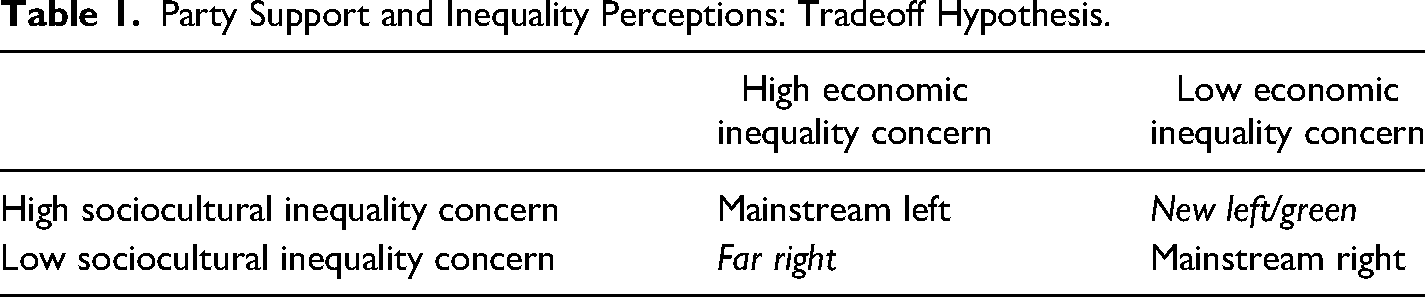
Table 1 summarizes this tradeoff hypothesis. From this theoretical perspective, supporters of new left (especially green) parties are expected to perceive sociocultural inequalities as more problematic than socioeconomic ones, and vice versa for far right voters. The rise of sociocultural issues is viewed as having intensified a difference in emphasis on economics versus culture among voters on the left and right, compared to traditional disagreement between mainstream left and mainstream right voters over economic inequality and redistribution. Under traditional forms of class conflict (arguably still mainly represented today by mainstream parties), the divergence in the types of inequalities considered problematic by the left and the right is not a central feature of political contestation. This is why we place mainstream right and mainstream left electorates in the off-diagonal compared to new left and far right voters in Table 1. We refrain from explicitly placing radical left parties with the new or mainstream (old, “materialist”) left, as radical left parties and their constituencies vary across countries regarding their orientations on culturally progressive stances. 19
Party Support and Inequality Perceptions: Tradeoff Hypothesis.
A Universalist-Particularist Perspective on the Politicization of Inequalities
The rival theoretical approach takes a more historical-sociological perspective on how the sociostructural transformation of the knowledge society relates to the politicization of different types of inequality. This literature also starts from structural changes in the economy but theorizes the implications of these changes more broadly, beyond increasing income and wealth inequality. In part, it conceptualizes the beneficiaries of the knowledge economy not as a narrow educational elite, but as an emerging broad class of professionals with a particular set of characteristics, values, and experiences. 20 The expansion of this educated middle class, predominantly via job growth in the skilled service sector and in occupations with strong female labor market participation, has contributed to the transformation of a new core electorate of left-wing parties since the 1980s. 21 In the wake of new social movements fighting for gender equality, international peace, environmental protection, and minority rights, these new groups of voters joined and transformed parts of the left across Western European democracies early on. 22 By doing so, they not only expanded the programmatic agenda and priorities of the left from a focus on economic redistribution to sociocultural policies, but they broadened the notion of equality and universalism in the entire “left field” of partisan politics. 23 Again, green parties and other early-moving left parties are considered to have spearheaded this development—but this literature emphasizes how the new left started to mobilize around sociocultural issues in addition to supporting state intervention and redistribution.
In such a perspective, the emergence of sociocultural dimensions of inequality on the political agenda has not led to a tradeoff with economic inequality, but has merely extended the “egalitarian” program of the new left to novel constituencies and beneficiaries. At the same time, a new national-conservative pole of far right parties has emerged across Western Europe as a counterreaction to this new left program, defending existing social hierarchies, stratification, and norms of social dominance in the realms of family, social order, nationality, the labor market, and even the welfare state. 24 Over time, these far right parties managed to win ever larger shares of (predominantly male) voters among the lower-educated and working class, who take issue with the broadened understanding of egalitarian universalism advocated by the new left. 25 And while, on aggregate, they may be cross-pressured by left-wing appeals to economic redistribution and far right appeals to sociocultural particularism, working-class voters over time seem to have sorted into these two political camps, with left-voting working-class members sharing the universalistic-egalitarian agenda of the new left and right-voting working-class members sharing the particularistic criticism of egalitarian policies. 26
Adding to this, in times of greater economic and fiscal constraints, supposedly cultural conflicts (e.g., related to gender or immigration) have become more openly charged in distributive economic terms. Inversely, fundamentally distributive questions (e.g., over providing access to the welfare state or where to channel public spending) are increasingly viewed through a lens of sociocultural conflicts. This means that the main “economic” and “cultural” dimensions of political conflict in Western politics have become blurred. 27 The terms “universalism” versus “particularism” (as opposed to other labels such as liberal-authoritarian, GAL-TAN, etc.) take this amalgamation into account. 28 So do conceptualizations of a new sociocultural divide as a fully fledged “cleavage” with roots in socioeconomic change. 29 In contrast to the tradeoff hypothesis, this strand of theory and research suggests that solidarity with lower social strata is actually part and parcel of new left voters’ social identities.
In terms of individual-level mechanisms, explanations for why new left voters might be generally inequality averse and receptive to universalist political appeals lie largely in their socialization experiences, especially through education and at the workplace. Higher education, especially in cultural and communicative fields, is typically associated with more universalist values, openness to diversity, experience with flat hierarchies, and sensitivity to various dimensions of inequality. 30 Employment in the social or education sectors and working in client-interactive settings (i.e., “sociocultural” occupations in teaching, care, etc.) further expose individuals to less privileged groups, which tends to instill empathy. 31 Research suggests that these educational and occupational experiences reinforce selection effects and socializing experiences in the parental home.
What is more, although the language of “knowledge economy winners” evokes elites, a large body of literature on new and changing social risks highlights that highly skilled middle-class workers should also be sensitive to inequality because they themselves experience vulnerability. Besides potentially facing discrimination based on gender or minority status, economic risks and disadvantages stemming from irregular, part-time, or fixed-term employment often affect even the highly educated (especially women). 32 By contrast, far right voters on average belong to historically relatively advantaged groups, clearly so in terms of gender or ethnicity, but as “typical workers” also in terms of labor market protection. 33 This literature often identifies conservative-authoritarian voters as in fact being “a few rungs up” from the bottom of the social ladder, prone to emphasizing and legitimizing hierarchies of various types toward the lowest-placed (income, ethnic, etc.) groups in society. 34 This runs counter to a tradeoff hypothesis and points toward mechanisms that might make the typical far right voter rather inequality tolerant, and generally accepting of social stratification.
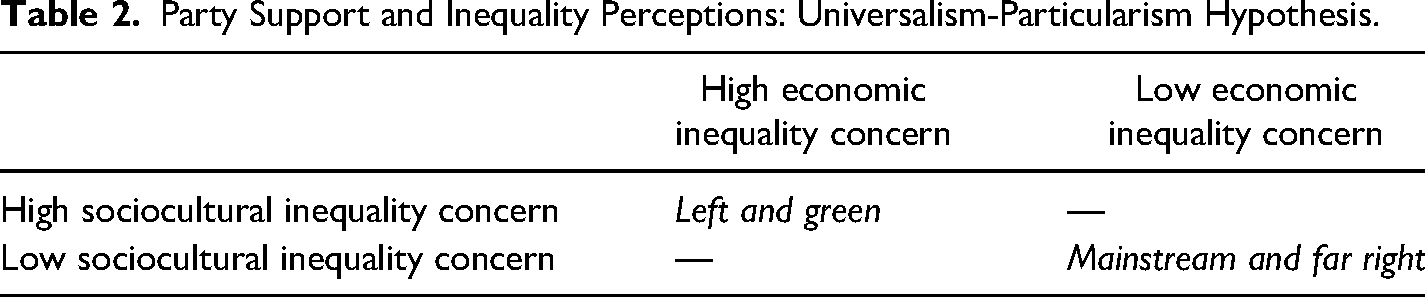
Table 2 summarizes our universalism-particularism hypothesis. It posits that inequalities are politicized along a single dimension, with (new) left voters being more inequality averse and (far) right voters being more inequality tolerant. We would expect especially green voters but generally a transforming left electorate—despite on average relatively advantaged sociodemographic background (higher education, etc.)—to share heightened perceptions of both socioeconomic and sociocultural inequalities as problematic. By contrast, we would expect voters of mainstream and far right parties to share a more particularistic vision of society, defending existing patterns of social stratification. The contrast regarding sociocultural inequalities should be particularly pronounced for green/left-libertarian as opposed to far right parties, but stretch to more traditionally defined socioeconomic inequalities.
Party Support and Inequality Perceptions: Universalism-Particularism Hypothesis.
Research Design
Case Selection and Survey
To assess how different party electorates perceive and evaluate inequalities, we fielded an original survey with new questions regarding six different dimensions of inequality between May and July 2022 in Germany. At a general level, Germany has witnessed the same broad transformations of the left and right as have other West European countries, with new left and, more recently, far right parties putting new issues and inequalities firmly on the agenda, thus exerting pressure on and increasingly fragmenting mainstream party competition. Within this broad comparative lens, we consider the German context a least likely case for our universalism-particularism hypothesis and a most likely case for a tradeoff between economic and cultural inequalities.
Working against a universalist-particularist structure of inequality perceptions, political narratives around sociocultural conflicts have been slow to gain traction in Germany compared to other contexts, such as neighboring France, the Netherlands, or Switzerland. 35 While Germany is undoubtedly witnessing all the social and political transformations typical of advanced democracies (e.g., decline of industry, the growth of a skilled middle class, the consolidation of the greens, the establishment of a far right party), from a historical and comparative perspective, the emergence of a fully fledged new cleavage over sociocultural conflicts has been slow. This has to do with the late rise of the AfD, 36 but also, for instance, with the SPD's long-term avoidance of sociocultural issues. 37 While the country hence saw the early emergence of a Green movement and party (the paradigmatic “new” left actor), electorally successful far right countermobilization has only more recently led to the full articulation of this antagonism, in a way that also led established mainstream actors to take a clearer stand on sociocultural issues.
At the same time, specific features of the German case make a tradeoff in inequality perceptions particularly likely: Income inequality has increased significantly and saliently, particularly as Germany has experienced an expansion of the low-wage sector. 38 On top of that, the left SPD/Greens government coalition and their “Agenda 2010” policy reforms have often been criticized for facilitating the growth of low-wage employment and the subsequent increase in lower-end income inequality. A potential tradeoff between addressing socioeconomic versus sociocultural inequalities has also been made more explicit by political actors in Germany than elsewhere, particularly in the wake of internal debates within the radical left party Die Linke between a more progressive faction and a more conservative one. These internal divisions led to a split from the party by the more conservative faction led by political entrepreneur Sahra Wagenknecht who in 2024 founded a new, social-conservative party. Hence, while a political offer combining economically left-wing positions with social conservatism is notoriously weak in most West European countries, it is rather more strongly mobilized in Germany. The presence of these competitors has contributed to the SPD's hesitance about combining economically left-wing positions with a clearly progressive stance on sociocultural conflicts. 39 All of this means that if evidence points toward a universalism-particularism divide rather than an inequality tradeoff in the German case (e.g., if even voters of Die Linke and the SPD—and not just the Greens—display broad intolerance for inequality that sets them apart from the [far] right), we interpret this as evidence that we are likely to observe similar trends in other countries where electoral realignments of the political space are more advanced.
A total of 5,108 respondents answered our online survey. We implemented representative quotas for region, gender, and age, but restrict the age range to between eighteen and fifty-seven years. By limiting the age range we can observe the perceptions of three generations (Generation X, Millennials, and Generation Z) that are and will be decisive for politics. We oversample high- and lower-educated respondents, since we are particularly interested in the inequality perceptions of (highly educated) winners and (less educated) losers of the knowledge economy. The lower-educated group includes all respondents without any formal education, those with primary education, and unfinished high school degrees, as well as respondents with a high school diploma. The highly educated category includes everyone with a bachelor's or any other higher university degree. Table A1 in the Appendix shows the characteristics of our sample. A relatively large share of respondents live in urban areas and the overwhelming majority have no migration background.
Inequality Perceptions
Our approach to measuring inequality perceptions focuses on the extent to which voters view the unequal distribution of resources as problematic. This is, arguably, a necessary condition to demand change and support government interventions to curb economic and social (dis)advantages. We ask respondents about inequalities due to income, education, social origin, gender, sexual orientation, and migration background. Note that while income and educational attainment are less ascriptive traits and might also be considered outcomes of inequality, we consider them as key dimensions of inequality themselves, since they shape life chances and are at the heart of many key (political) debates about inequality. We further ask about “social origin” to get at perceptions of inequalities by class background.
We categorize these first three inequality dimensions as “socioceonomic” (income, education, social origin) and the last three as “sociocultural” (gender, sexual orientation, migration background). However, it is important to acknowledge that sociocultural inequalities have material aspects, and socioeconomic inequalities are influenced by cultural resources. Therefore, these two overarching categories provide a broad analytical framework. Empirically, we look at dimensions of inequality individually.
We ask respondents to indicate whether they think having (dis)advantages due to income, education, social origin, gender, sexual orientation, and migration background are acceptable or not. The scale for this item ranges from 0 (“perfectly fine”) to 4 (“not at all OK”). We chose the wording “having advantages or disadvantages in society” to make the abstract concept of “inequality” accessible. In addition, mentioning advantages and disadvantages in the item should allow respondents to not only express their perception of the more often discussed downsides of these inequalities. In phrasing the question, we were purposefully agnostic about the underlying criteria for the evaluation. Lastly, we chose to avoid the term “inequality” itself, to not convey any preconceived notions of moral judgment. Overall, (dis)advantages due to social origin, gender, and sexual orientation are perceived as most problematic (see Figure 1). Among the different types of inequalities, respondents are most accepting of differences due to education (average 2.36). While our main analyses rely on this measure, we also considered whether citizens think that resources and (dis)advantages related to these six factors matter for shaping people's well-being. In Appendix section A.2.2, we discuss and show that our main conclusions hold when considering this additional measure.
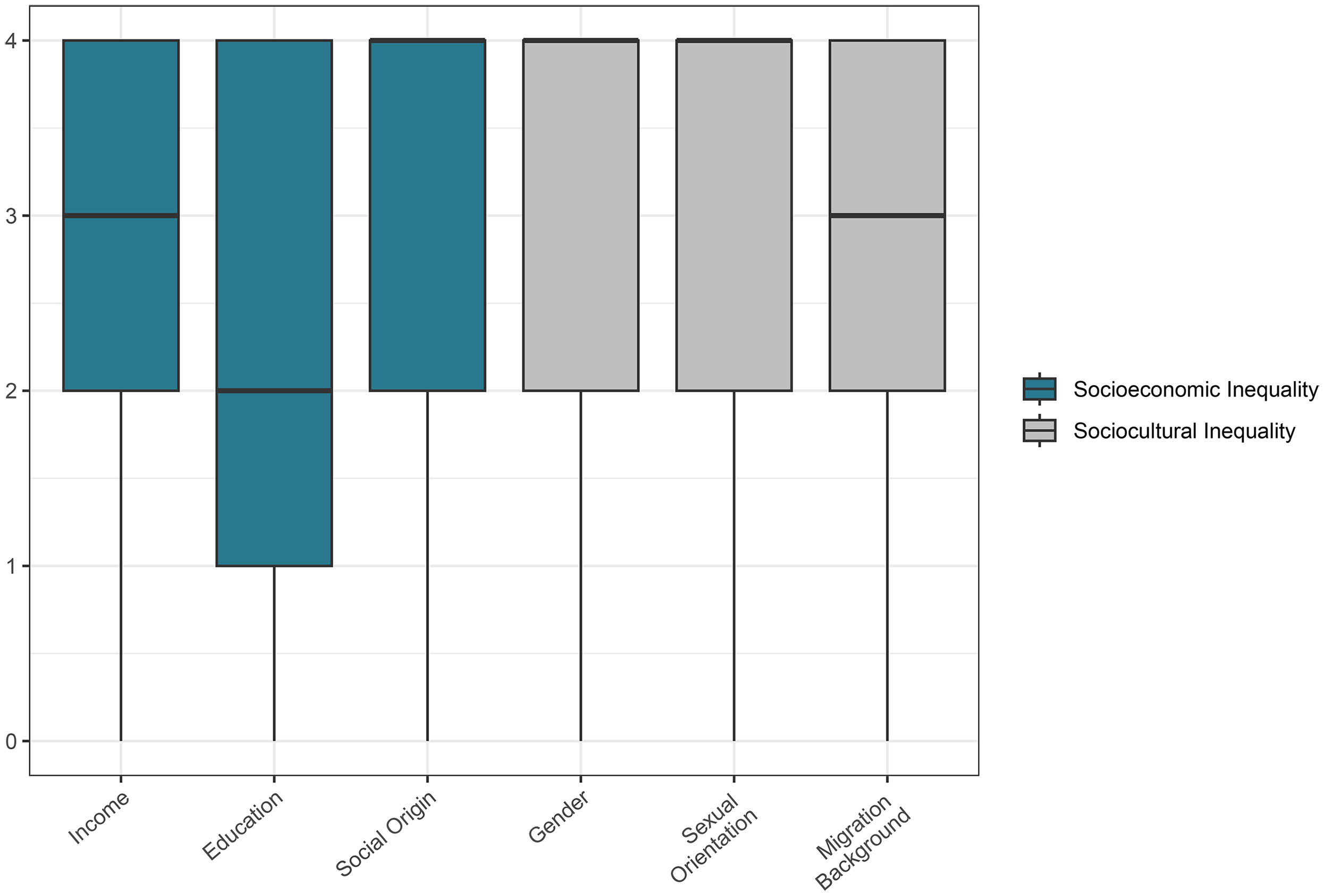
Problematization of inequalities.
Electoral and Sociostructural Groups
To construct electoral groups, we use a question about individual vote choice in the previous federal elections. We consider support for all parties represented in the German parliament, that is, the SPD (social democrats), CDU/CSU (Christian democrats), Bündnis90/Die Grünen (greens), FDP (liberals), AfD (far right), and Die Linke (radical left). Our primary interest is in the electorates of the Greens versus the AfD as clear representatives of the new left and far right. However, in line with the hypotheses summarized in Tables 1 and 2, we also discuss results for the SPD, as representatives of the mainstream left, and CDU/CSU as well as FDP, as those of the mainstream right respectively. We also consider the radical left Die Linke, although the party has experienced strong internal programmatic divides and cannot easily be categorized ex ante regarding its expected position within the left field.
We explore the structural foundations of inequality perceptions from multiple angles, based on existing literature. We first focus on how perceptions of inequalities differ by level of education. This has been the primary lens through which relative knowledge economy “winners” and “losers” typically associated with the new left and far right have been discussed in extant research. With knowledge economies reliant on skilled and educated labor to sustain growth, the importance of education for economic success in the labor market has increased. 40 Higher education has emerged as the main indicator of coveted skills, resulting in a growing tertiary wage premium. Educational attainment is also increasingly considered the new master variable underpinning emerging forms of sociocultural conflict. 41 We use individuals’ level of education to classify respondents into a broad category of winners, namely, everyone who has completed tertiary education. Respondents without a tertiary degree are classified as relatively disadvantaged in the knowledge economy.
Beyond educational level, we consider three additional ways of looking at the structural underpinnings of knowledge economy conflict. While these alternative categories can also be mapped onto the “winner/loser” shorthand of describing groups who gain from/are disadvantaged by structural transformations in relative terms, these perspectives simultaneously allow for a more nuanced and sociologically grounded look at that dichotomy. These more specific group categories and the literature they are based on highlight how even the higher-educated might be exposed to economic precarity, how they might be occupied in jobs that are less regulated, less protected by established welfare states, more female-dominated, and so on.
First, according to Kitschelt and Rehm's framework, 42 the electorate in knowledge economies is segmented into four groups by income and education levels. They predict that individuals with high education and high income will oppose redistribution and favor libertarian sociocultural policies, whereas highly educated but low-income individuals are expected to endorse progressive sociocultural and redistributive policies, aligning with the new left. Lower-educated individuals’ views on authoritarian policies regarding noneconomic issues should generally align, whereas their stances on redistribution differ by income: High-income earners should oppose progressive economic policies (leaning toward right-wing parties) while low-income earners support them.
Second, we consider the divide between those educated in fields aligned with industrial capitalism (e.g., business, engineering) versus fields emphasizing social values (e.g., humanities, arts). 43 The latter are trained in fields emphasizing intellectual endeavors over economic gain and are skeptical of profit-driven motives for social progress, typically supporting green or new left parties. We use the “CECT” score, 44 which measures the ratio of communicative and cultural skills in one's field of education. We distinguish perceptions of inequality by individuals with technical education (transport, telecommunications, engineering) in the lower 25th percentile (associated with the radical right electorate in existing literature) from those in cultural fields (humanities, social studies) in the upper percentile of the CECT score distribution (new left electorate).
Last, we look at occupational classes. 45 Political realignments have been shown to be rooted in a distinction between high-skilled workers involved in interpersonal work environments, who lean toward progressive, libertarian values, and low-skilled workers in object-related tasks, who tend to support more authoritarian policies. This approach uses the ISCO code to classify respondents’ occupations as described by Oesch. 46 It relates to the literature on labor market dualization, 47 which shows how West European welfare states designed for the male breadwinner model of the industrial era tend to protect, for instance, production workers relatively well, while sociocultural professionals (typically female, higher-educated, etc.) might be exposed to new forms of social risks (and hence sensitive to economic inequalities) even as they benefit from social change in relative terms.
In addition, to account for the specificities of the German context, below we also discuss supplementary analyses that distinguish between voters in East and West Germany as relatively disadvantaged and advantaged groups, respectively.
In what follows, we will first look at inequality perceptions by party electorate, which corresponds to tests of our main hypotheses. To better understand the structural foundation of these patterns, we then switch perspective to looking at inequality perceptions among differently defined groups of structural winners and losers. In a last step, we combine these two perspectives and look at sociostructural groups within party electorates (focusing on subgroups by education in the main text) to provide a particularly hard test for our hypotheses.
Results
Party Electorates and Inequality Perceptions
Our core interest is in whether there is a conflict over which inequalities need addressing between party electorates, and especially between the electorates of the far right and the new left. We want to know how problematic the supporters of different parties deem societal (dis)advantages linked to different socioeconomic and sociocultural factors. Figure 2 shows the expected values of models regressing the problematization of each type of inequality (ranging from “perfectly fine” to “not at all OK”) on having voted for each party represented in the German parliament (type of residence, gender, education, income, migration background, and age are held constant). We are particularly interested in comparing levels of concern about specific inequalities across electorates (e.g., Do Green voters care less about income inequalities than far right voters?) and in comparing the rank-order of concerns (e.g., Do AfD voters rank socioeconomic inequalities as more problematic than sociocultural ones while Green voters do the opposite?).
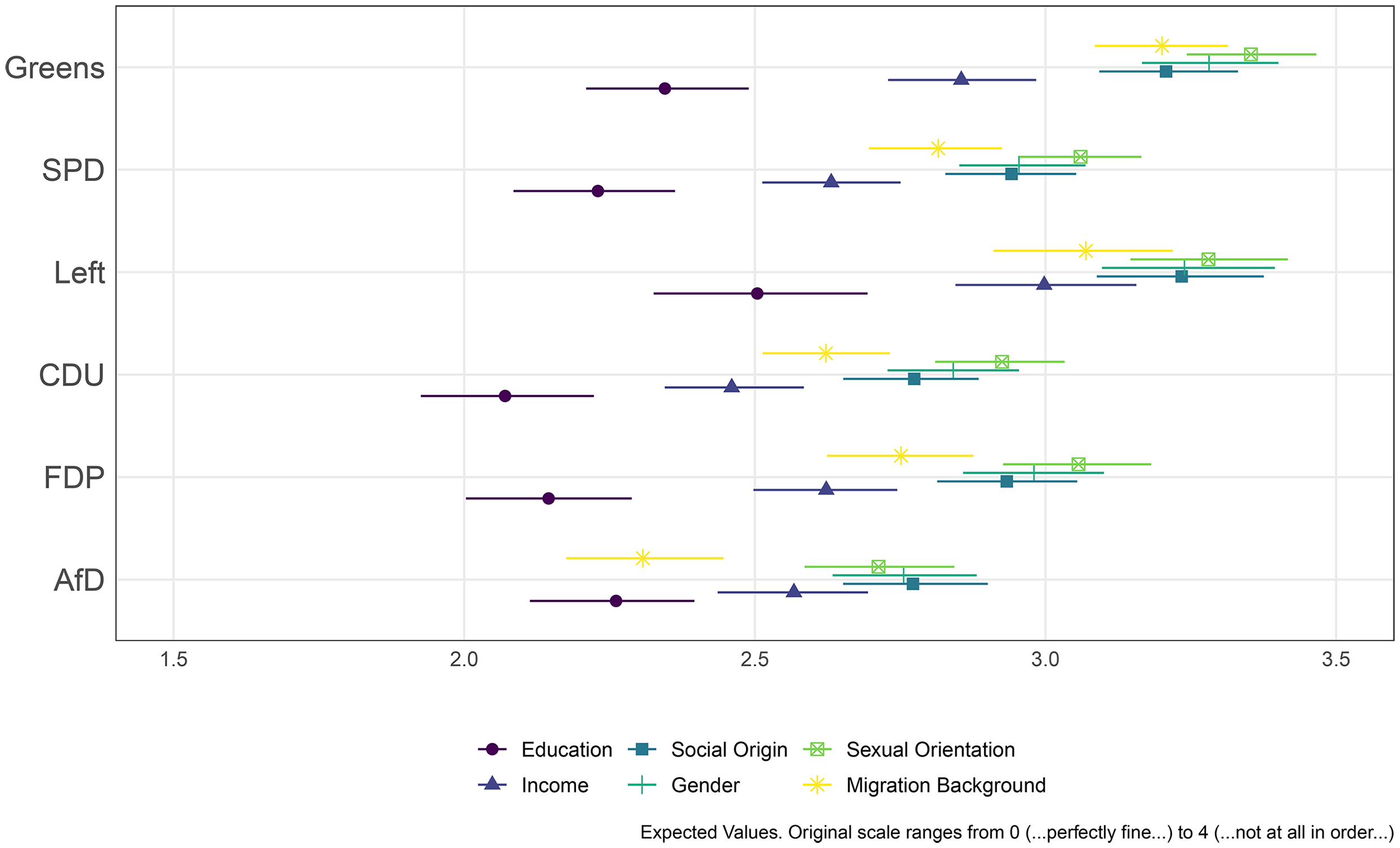
Inequality problematization by electoral groups (expected values).
What stands out in Figure 2 is that the new left Green electorate, along with the smaller electorate of Die Linke, shows the strongest inequality aversion overall (highest values for all dimensions of inequality). This is certainly the case for sexual orientation, gender, migration background, and social origin (in absolute values, predicted problematization for these inequalities and electorates is always higher than 3 on a 0–4 scale). Green voters find inequalities of income and education relatively less problematic, but still belong to the electorates that find these inequalities least acceptable (along with other left-wing parties). The far right (AfD) electorate, on the other hand, appears comparatively inequality accepting, especially regarding sociocultural inequalities. On these dimensions, the values for AfD voters are distinctly lower than for all other electorates, albeit still above the neutral midpoint of the problematization scale (=2). For (dis)advantages based on migration background, AfD supporters’ evaluation is almost an entire point lower (more accepting on a 5-point scale) than that of Green supporters. As we will later see when contrasting structural groups (e.g., by education or class) regarding the same outcomes, the differences in support levels between parties shown in Figure 2 are substantively large and important, despite controlling for the main sociodemographic attributes which differentiate these electorates.
Importantly with respect to our competing hypotheses, we see no clear reversal of the rank-order of inequalities deemed problematic if we contrast new left and far right electorates. In other words, it is not the case that Green party voters downplay economic inequalities (based on income, education, and social origin) at the expense of more sociocultural ones while far right voters do the opposite. An interesting exception concerns migration background as a basis for inequality, which far right voters deem relatively less problematic than income, for instance, while the reverse is true for Green voters. This specific piece of evidence would be in line with our tradeoff hypothesis. However, in general, inequalities based on gender, sexual orientation, or social origin are considered most problematic by both new left and far right electorates, albeit at very different levels. Inequalities based on education and income face less opposition by both groups. In absolute terms, the problematization of education in particular comes closest to “neutral” (or we might say more legitimizing) evaluations among all electorates, as does inequality by migration background in the eyes of far right voters.
Focusing on the two electorates of primary interest already points toward greater inequality aversion on the left and greater tolerance of stratification on the right. Looking at the remaining electorates strengthens the impression that we observe a single overarching dimension of inequality politicization. In line with the universalism-particularism hypothesis summarized in Table 2, a contrast emerges between a more inequality-averse left block and a more inequality-tolerant right block. However, differences between the mainstream left and mainstream right are smaller than between the new left on the one hand and the far right on the other, especially concerning sociocultural inequalities. Voting for the Social Democratic Party (SPD) is similarly, yet not as strongly as for the Greens, associated with a comparatively high problematization across all types of inequality. In particular, SPD voters view (dis)advantages due to income, social origin, gender, sexual orientation, and migration background as rather more problematic than supporters of any right-wing party do. As already noted, voters of the (smaller) Die Linke look very similar to Green party supporters. If anything, they consider inequalities of income and education to be somewhat more problematic relative to sociocultural dimensions of inequality. However, while Die Linke emerged from debates around economic policies (especially against the “third way” labor market reforms of the SPD), its electorate here appears aligned with the new left emphasis on both cultural and economic inequalities.
Acceptance of inequalities increases progressively as we move toward the right of the political spectrum: CDU (Christian democratic) and FDP (liberal) voters resemble AfD supporters in their relatively high tolerance (compared to the left) of educational and especially income inequalities, but they are clearly more critical than the AfD of inequalities related to sexual orientation, gender, social origin, and migration (in that order). Relatively less concerned evaluations of educational inequalities across all electorates indicate a powerful meritocratic narrative across the board, whereby educational achievements are considered a legitimate basis for advantages in life. 48 However, this lack of concern about educational inequalities seems to be particularly pronounced among mainstream right (CDU and FDP) supporters.
Structural Foundations of Inequality Perceptions
What are the structural underpinnings of these inequality perceptions? As outlined, we follow the literature and focus on educational groups, groups defined by the combination of education and income, educational field, and occupational class.
Figure 3 displays the results of linear regression models in which inequality problematization, that is, respondent assessment of how problematic (dis)advantages in society due to one of the six types of inequality are, is regressed on whether the respondent can be defined as a structural winner or loser (always in relative terms) based on either educational achievement, education and income level, occupational class, or field of education. We hold gender, sexual orientation, migration background, age, and whether or not a respondent lives in an urban area constant. The full regression results can be found in Appendix Tables A5, A6, A7, and A8.
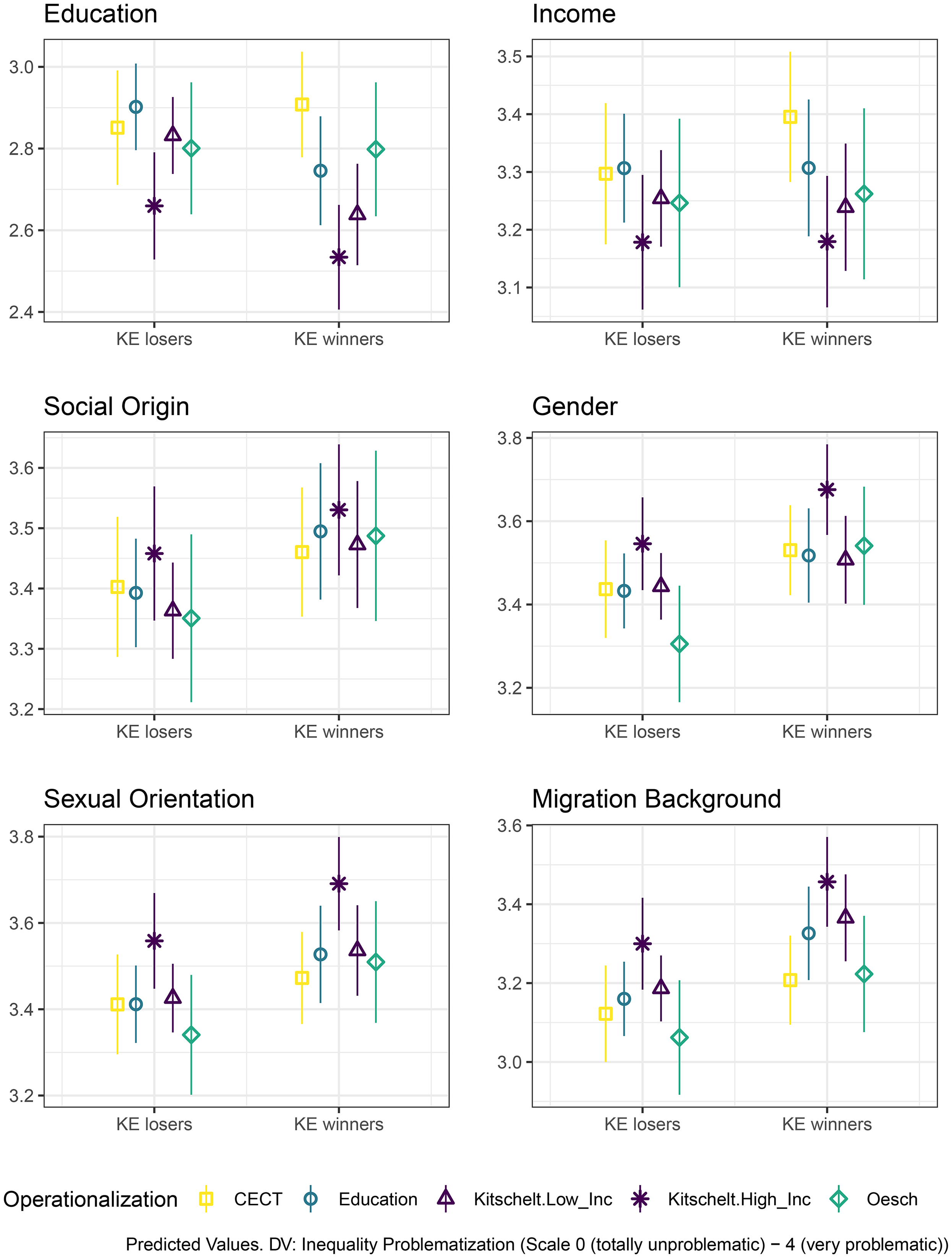
Problematization of inequalities by KE winners / KE losers (expected values). KE = knowledge economy.
Our interest is again in whether highly educated beneficiaries of the knowledge economy, those educated in fields emphasizing social values, or sociocultural professionals rate socioeconomic inequalities as less problematic than groups disadvantaged by the knowledge economy shift—and vice versa for sociocultural inequalities. Recall that these are different sociostructural ways of looking at the (“winning”) “new” middle class and (“losing”) “old” middle and working classes commonly associated with the progressive/green left and far right, respectively.
With one notable exception, the highly educated judge all considered inequalities to be at least as problematic as the lower-educated do. The higher-educated tend to take greater issue with (dis)advantages tied to social origin, gender, sexual orientation, or migration background (these differences are statistically significant). They also, on average, find inequalities based on income to be just as problematic as lower-educated respondents. In line with this, we find that relative “winners” according to alternative operationalizations are generally more concerned about social origin, gender, sexual orientation, and migration inequalities, while they hold similar views on income inequality as “losers” do. This goes against a tradeoff hypothesis.
Only when evaluating inequalities based on education (top left panel) do the higher-educated display a significantly higher tolerance for inequality. However, while this is an important finding, this partial evidence for the tradeoff hypotheses weakens when we consider alternative operationalizations of knowledge society “winners” and “losers.” Notably, this is the case when we look at the occupational (Oesch) classes typically associated with the far right and the new left respectively: production workers and sociocultural professionals working in interpersonal, client-interactive settings. These groups consider education to be similarly problematic as a basis for inequality. In other words, the core segment of the new, educated middle class that tends to support green/left-libertarian parties is no more accepting of educational (or income) inequality than the traditional working class is. In addition, sociocultural professionals are less tolerant of societal (dis)advantages linked to social origin, gender, sexual orientation, or migration background than production workers are.
In sum, the results presented in Figure 3 are more in line with the universalism-particularism hypothesis than with the tradeoff hypothesis. Structural factors are associated with perceptions of inequality in a way that is consistent with more sociological perspectives discussed above, indicating the role of socialization or new forms of social risks and discrimination as opposed to the more straightforwardly materialist mechanisms informing the tradeoff expectation. Sociologically significant markers of knowledge society “winners” (like Oesch's sociocultural professionals or high CECT scores) align with expectations from the universalism-particularism hypothesis, showing deep concern for all types of inequality among “new middle class” groups. Notably, relatively greater concern about educational inequalities among groups classified as “losers” of the shift toward a knowledge economy emerges only when we define winners/losers straightforwardly by education and income. However, those knowledge economy “winners” particularly well known to hold progressive values and face certain forms of material insecurity themselves are by no means indifferent to economic disparities.
Structural Groups Within the New Left and Radical Right
In a final empirical step, we look at sociostructural groups within new left and far right electorates. As an even harder test of the universalism-particularism hypothesis against the tradeoff hypothesis, we focus on those AfD voters who should be particularly likely to prioritize socioeconomic inequalities over sociocultural inequalities and those Green voters that should be most likely to do the reverse. In other words, we look at the clearer-cut, lower-educated “structural losers” within the AfD electorate and highly educated “winners” within the Green electorate. Ample research shows that specific groups (educational, occupational, etc.) are overrepresented in these electorates, but here we make use of the fact that these associations are always probabilistic and that party electorates are obviously heterogeneous.
Figure 4 shows how higher- and lower-educated groups within the Green and AfD electorates problematize our six dimensions of inequality. We immediately see that educational differences in inequality perceptions are significant within the AfD electorate but not within the Green electorate. Among AfD supporters, the lower-educated are indeed more inequality averse than their higher-educated copartisans (they perceive, e.g., inequalities of income and social origin as more problematic). Regardless of education, however, AfD voters appear particularly accepting of inequalities based on migration background and education (relative to other types of inequalities). Meanwhile, among the Greens, even those (lower-educated) groups with perhaps more reason to prioritize socioeconomic inequalities relative to sociocultural ones are highly sensitive to the problems associated with inequalities due to sexual orientation, gender, or a migration background—comparable to their more highly educated copartisans.
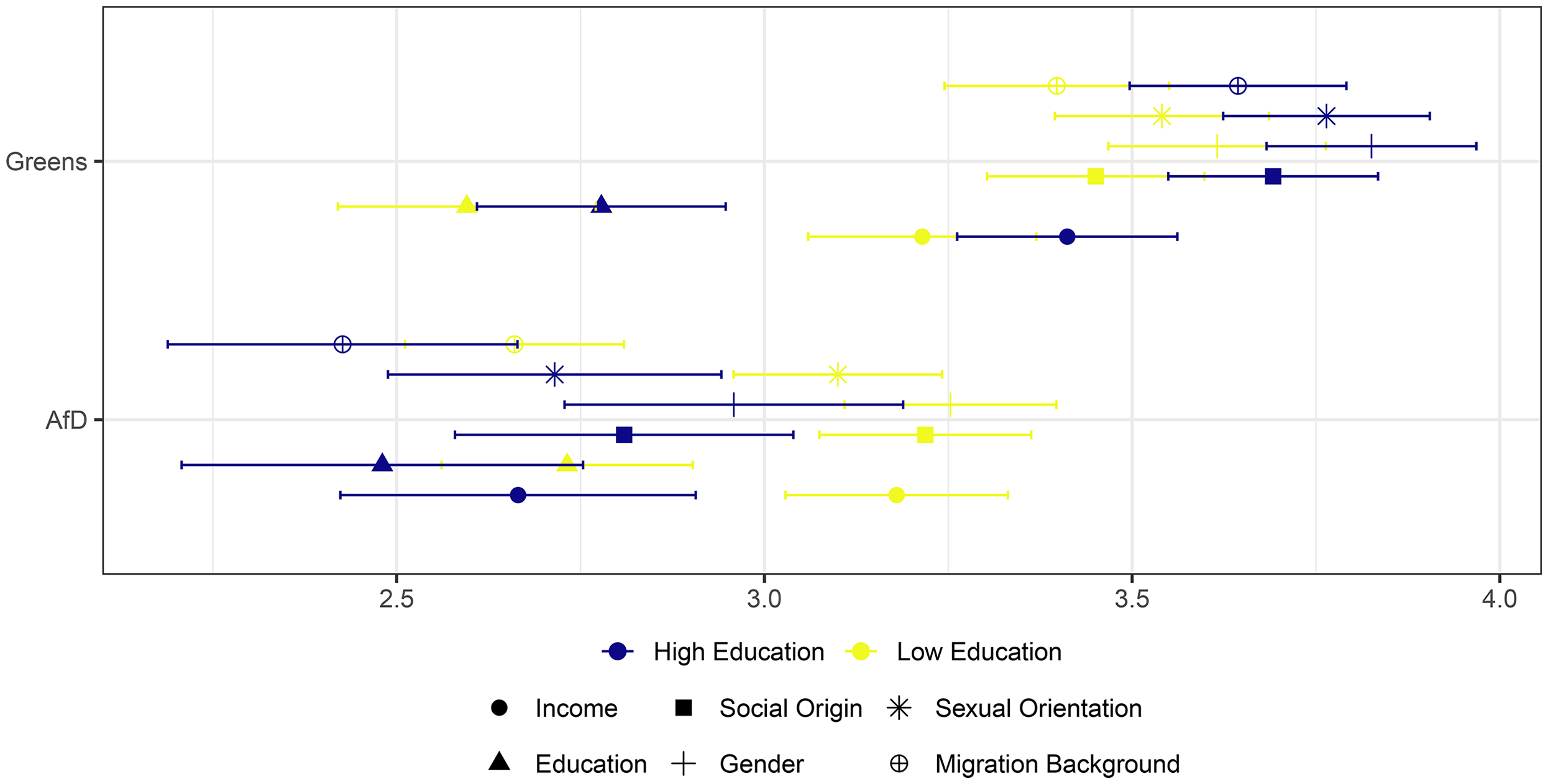
Inequality problematization of high- and low-educated new left and radical right voters (expected values).
Importantly for the evaluation of our hypotheses, highly educated green voters perceive inequalities of income or education to be similarly (or slightly more) problematic as lower-educated AfD voters. Although these Green “knowledge society winners” perceive sociocultural inequalities to be particularly problematic, they do not seem to downplay hierarchies and problems associated with socioeconomic factors. If anything, they even perceive inequalities rooted in social origin to be more problematic than lower-educated AfD voters. Even where evidence of a tradeoff would be most likely, we do not find it: The most disadvantaged AfD voters (here in educational terms) do not emerge as being more worried about socioeconomic inequalities than highly educated new left voters.
Breakdowns of the AfD and Green electorates along the lines of alternative sociostructural definitions of winners and losers (see Figures A4, A5 and A6, Appendix) are consistent with these patterns. Overall, the new left electorate tends to be consistently more averse to sociocultural inequalities, and at least as concerned about socioeconomic inequalities as relatively disadvantaged voters of the far right.
To account for the particular context of the German case, we lastly distinguish by residence in East and West Germany within the two electorates. Differences are generally very modest, especially within the AfD (see Figure A7, Appendix). West German Greens are rather more inequality averse than their East German counterparts. However, once again, Greens regardless of subgroup are more sensitive to sociocultural inequalities and at least as concerned about socioeconomic inequalities as AfD supporters are. In other words, it is not the case that East German AfD supporters problematize socioeconomic inequalities of education, income, or social origin more than West German Green voters would.
Conclusion
In this article, we asked whether and how the new electoral cleavage between the far right and new left inflects or integrates the politicization of different types of inequality. Drawing on various strands of scholarship on electoral politics in increasingly knowledge-based societies, we develop two competing hypotheses. On the one hand, we trace theoretical arguments that predict a tradeoff scenario, suggesting that there is a divergence in relative perceptions of different types of inequalities between the constituencies of the new left and the far right, with the former prioritizing sociocultural inequalities at the expense of economic differences and the latter prioritizing these economic inequalities. The alternative view, more grounded in the historical and sociological development of electoral politics, suggests that the politicization of inequalities relates to a single ideological/value dimension, with (new) left voters holding more universalist/inequality-averse attitudes on every dimension of stratification and the far right generally being more particularist/inequality accepting. We put these hypotheses to an empirical test with newly collected survey data from Germany that covers evaluations of six different types of inequalities.
The empirical evidence from our original survey provides clear support for the second, universalist-particularist framework. It challenges the notion that the new left/Green electorate predominantly emphasizes sociocultural factors like gender or sexual orientation, while overlooking economic-material inequalities. On the other side are the constituents of the far right who, as could be expected, are more inequality accepting regarding sociocultural inequalities. However, supporters of the far right (like other constituents of the right party camp) are also more accepting of economic inequalities. This contradicts narratives that the far right today succeeds in mobilizing a materially deprived working class whose primary concerns include combating income and education-related disadvantages, and who have been abandoned in this fight by left parties allegedly catering to a “woke” educated middle class. While far right voters are evidently attracted by a particularist sociocultural (including welfare chauvinist, etc.) program, our results suggest that this particularism extends to a comparatively high general tolerance for social stratification also in the economic domain.
Our analyses affirm that education likely plays an important role in driving this divide. Highly educated beneficiaries of structural transformation are more likely to voice concerns about inequalities, especially with regard to sociocultural stratification along the lines of gender or sexual orientation. However, these relative “winners” of societal change are not less concerned than the lower educated about differences due to material factors such as income or social origin, with the exception of education inequality. This is the only inequality where the highly educated are more accepting of differences than the less educated, pointing to underlying understandings and narratives about “earned,” legitimate differences. Alternative operationalizations of knowledge economy “winners” and “losers” confirm the structural underpinnings of inequality perceptions in society. Sociocultural professionals, educated in fields requiring more cultural-communicative skills and known core constituents of the new left/Green parties, are more inequality averse than production workers or those with an education background in more technical-economic fields.
Our findings on inequality perceptions provide us with valuable insights on electoral politics in the twenty-first century. On the one hand, the strength of the universalism-particularism divide regarding all types of inequality implies a positive message for the prospects of progressive politics. The overwhelming majority of the left electorate is clearly egalitarian across both sociocultural and socioeconomic issues. Progressive politics that resonates with progressive voters has to balance both the pursuit of more equality in the area of economic disparities in society and the deepened commitment to progressive, inclusive policies that enhance the position of women, LGBTQ+ groups, and those with a migration background. On the other hand, the implications of our findings regarding the politicization of economic class inequalities are more ambivalent. While there is widespread agreement across party electorates that differences in income, education, and social origin are highly consequential for life chances, they are on average perceived to be less problematic across all electorates. These inequalities are clearly less divisive and polarizing than sociocultural types of inequality.
In a context of heightened party competition and polarization—conditions that are now given across Western Europe, wherever far right and new left actors have become established and/or are shaping the competitive environment for mainstream parties—this pattern implies rather weak incentives for parties on either side of the political spectrum to prioritize socioeconomic inequalities in their programs. Compared to sociocultural inequalities, they are likely to have a weaker mobilizing effect among the respective electoral constituencies. Hence, while we do not see a tradeoff between different types of inequalities at the individual voter level on either the left or the right, the lower problematization and divisiveness of economic inequalities may entail a certain crowding out of attention to economic inequalities at the level of the party system. Both the new left and the far right may rationally have better chances to stand out and mobilize their voters with appeals about sociocultural inequalities (either positive or skeptical appeals) than with appeals to income and education inequalities. The same goes for these parties’ more established mainstream competitors. If the left, in particular, were to bring economic inequalities back to the forefront of electoral politics (for ideological, historical, or normative reasons), a framing strategy that ties them to a joint agenda of universalism, involving both sociocultural and socioeconomic dimensions, might thus be more promising than a narrower focus on economic inequalities.
Supplemental Material
sj-pdf-1-pas-10.1177_00323292251353374 - Supplemental material for Politicizing Inequality in Times of Sociocultural Conflict: How New Left and Far Right Voters Think About Inequality
Supplemental material, sj-pdf-1-pas-10.1177_00323292251353374 for Politicizing Inequality in Times of Sociocultural Conflict: How New Left and Far Right Voters Think About Inequality by Silja Häusermann, Tabea Palmtag, Delia Zollinger, Tarik Abou-Chadi, Stefanie Walter and Sarah Berkinshaw in Politics & Society
Footnotes
Acknowledgments
The authors thank Maximilian Filsinger, Lisbeth Hooghe, Yassine Khoudja, Thomas Sattler, Nadja Wehl, and Nicholas J. Ziegler for their insightful comments, as well as participants of the workshop The Right and Equality at the University of Konstanz (2023), the SVPW Annual Conference (2023), the APSA Annual Meeting (2023), the EPSA Annual Meeting (2023), the workshop How Divided Is Europe? (2023) at Goethe University in Frankfurt, and the workshop Perceptions of Inequality in Konstanz (2024) for valuable feedback on earlier versions of this paper.
Author Note
Silja Häusermann, Tabea Palmtag, and Delia Zollinger are listed in alphabetical order, which reflects equal contribution to the article. Sarah Berkinshaw participated in the data analysis. Tarik Abou-Chadi and Stefanie Walter participated in the conceptualization and data collection.
Declaration of Conflicting Interests
The authors declared no potential conflicts of interest with respect to the research, authorship, and/or publication of this article.
Funding
The authors disclosed receipt of the following financial support for the research, authorship, and/or publication of this article: We gratefully acknowledge funding from the UZH URPP Equality of Opportunity, University of Zurich.

Supplemental Material
Supplemental material for this article is available online.
Notes
Author Biographies
Supplementary Material
Please find the following supplemental material available below.
For Open Access articles published under a Creative Commons License, all supplemental material carries the same license as the article it is associated with.
For non-Open Access articles published, all supplemental material carries a non-exclusive license, and permission requests for re-use of supplemental material or any part of supplemental material shall be sent directly to the copyright owner as specified in the copyright notice associated with the article.
