



Abstract
Amid growing polarisation in European societies, civil society elites, encompassing resource-rich, influential and often liberal-oriented civil society organisations (CSOs), are under increased attacks by conservative and progressive actors alike. This article aims to understand who challenges civil society elites, on what grounds, and with what means do they do so in the United Kingdom, by drawing on the cultural theory of frontlash/backlash. The article portrays two ideologically opposed challengers: one coming from within the charity sector in the form of the #CharitySoWhite campaign and another from outside the charity sector led by Conservative MPs, the Common Sense group. While these two challengers are not directly connected, they are part of the broader frontlash/backlash dynamic polarising public debates, with spillover effects in civil society. By applying a frontlash/backlash perspective, the article puts an emphasis on cultural cleavages as one of the central sources of polarisation in the civil space.
Introduction
In September 2021, the international watchdog organisation CIVICUS placed the United Kingdom (UK) on its watchlist of countries in which civic freedoms are rapidly deteriorating. 1 While the UK remains a liberal democracy (V-Dem, 2021), its civic space is classified as narrowed (CIVICUS, 2021). A recent annual survey with campaigners conducted by the Sheila McKechnie Foundation found that almost two-thirds of civil society organisations (CSOs) reported that politicians are becoming increasingly negative towards social justice charities, launching media attacks, being closed for cooperation, and creating a hostile environment for campaigners (Butler and Siddique, 2021). Moreover, 90% of respondents agreed that there are threats to the civic space in the UK, and one of the most cited reasons for this belief included ‘the negative views of politicians on civil society campaigning’ and ‘negative media coverage on CSOs’ (Sheila McKechnie Foundation, 2020).
This might not come as a surprise, as the ‘shrinking of civil society space’, understood as narrowing down the space for the activity and manoeuvring of CSOs (Borgh and van der Terwindt, 2012: 1068; Buyse, 2018: 969), has become a central concern for Europe – a concern that is not limited to hybrid and authoritarian regimes only (Bolleyer, 2021; Swiney, 2019). Similar to other countries, the restrictions of CSOs in the UK are disproportionately affecting advocacy-oriented groups working on social justice, democracy and human rights issues (Ruzza and Sanchez Salgado, 2021: 472). Although the literature on civic space includes concrete cases of CSOs under attack, it fails to recognise that often these CSOs hold an elite status, and are indeed the most prominent and resource-rich actors in a given civil society, strategically targeted and framed by contesters as an integral part of the broader (liberal) establishment (Hummel, 2022). Civil society elites are contested by grassroots movements with weak ties to elite actors, but also from elite actors (e.g. government parties) with access to considerable political resources and public venues (della Porta and Steinhilper, 2021; Graff and Korolczuk, 2021).
The focus of this study is on the challengers of civil society elites in the UK, aiming to understand who, on what grounds and with what means challenges, that is, takes an active stand against, the position or activities of these elites. Civil society elites encompass major CSOs occupying the top layer or the ‘peak’ of organisational populations in terms of political and economic resources (Johansson and Uhlin, 2020; Lindellee and Scaramuzzino, 2020). The UK has a highly stratified civil society sector characterised by a smaller group of large CSOs (mainly charities 2 ) with extensive resources and regular access to decision-making venues at the national level (Dommett et al., 2017; NCVO, 2020). Such stratification makes it suitable for applying a positional approach of elite identification (Hoffmann-Lange, 2018), used for identifying dominant organisations in a sector (e.g. business or civil society) and their formal leadership. 3 Following this approach, recent mapping of civil society elites in the UK includes major charities (e.g. Barnardo’s, British Red Cross, Oxfam), infrastructure bodies representing CSO interests (e.g. NCVO, ACEVO), as well as grant-making bodies (e.g. Prince’s Trust, HALO Trust, etc.) (see Altermark et al., 2022). These CSOs are professionalised and bureaucratised organisations, often with significant access to state funding. The leadership (including governance and executive leaders) of ‘peak’ CSOs display similarity in demographic characteristics (Green Park, 2018; Inclusive Boards, 2018) and share extensive cultural capital (elite education), similar to political and business elites (Arvidson and Ivanovska Hadjievska, 2021). The use of the term ‘elites’ might not be accepted by civil society actors themselves as it can be perceived as too close to some of the rhetoric and criticism of its challengers. While being aware of this, the term is not used pejoratively here, but as an analytical category that distinguishes the top CSOs and their leaders from other CSOs based on resource stratification criteria as done elsewhere (see Altermark et al., 2022; Lindellee and Scaramuzzino, 2020).
Based on media coverage, websites, parliamentary debates and Charity Commission records in the UK, I identify two ideologically opposed challengers of civil society elites: one coming from within the charity sector in the form of the #CharitySoWhite campaign and another from outside of the charity sector in the form of a politically conservative alliance composed of Conservative Members of Parliament (MPs) known as the Common Sense group. Drawing on the cultural frontlash/backlash theory often used to account for the success of right-wing populist parties, I argue that the elite-driven and grassroots-driven contestation – from radically opposed ideological positions – of civil society elites in the UK is a manifestation of a broader, transnational clash of values between progressive (frontlash) and conservative (backlash) movements. While the two challengers are not directly connected in the sense that the Common Sense group does not respond to the #CharitySoWhite campaign, they are part of the broader frontlash/ backlash dynamic polarising public debates, with spill over effects in civil society.
This study is important because civil society is considered to be a space of social integration and dialogue, and a means to decrease political polarisation in societies (e.g. Duffy et al., 2021). If this space is turned into yet another site of the so-called ‘culture wars’, exacerbating instead of preventing the solidification of polarised political identities, this might erode trust in CSOs and create chilling effects on CSOs’ voices, negatively affecting the quality of democracy.
In the following, I first present the context of the ongoing culture wars in the UK as well as the contested political role of charities. Second, I present the theoretical approach, which is followed by a case study analysis of the two challengers. Finally, I conclude the article with a discussion of findings and potential avenues for further research.
Culture wars and the contested political role of charities in the UK
Since the Brexit vote, there has been a concern that the UK is following the path of the US in terms of political and social polarisation as identity issues about race and ethnic diversity have come to dominate public discussions (Sobolewska and Ford, 2019). There is a growing cultural cleavage between those who believe enough has been done to accommodate ethnic diversity and racial equality in the UK, and those who think that the work of ethnic accommodation has barely started (Sobolewska and Ford, 2020: 7). This identity cleavage predates Brexit, following the mobilisation by conservative media and politicians of a significant minority of voters who feel left out by the ‘liberal’ political establishment (Jennings and Lodge, 2019). The so-called ‘white backlash’, contributing to the Brexit vote, followed decades-long demographic changes towards more ethnic and racial diversity and the prevalence of positive views towards the accommodation of diversity related to the expansion of higher education in the UK (Sobolewska and Ford, 2020).
An analysis conducted by the Policy Institute at Kings College London revealed that newspaper articles in the UK covering the topic of culture wars (understood as fundamental disagreement in conservative vs progressive worldviews) rose from 21 in 2015 to 534 in 2020 (Duffy et al., 2021: 4). The most frequently covered culture war issues in the UK were those related to the country’s colonial past in reference to the removal of statutes prompted by the Black Lives Matter (BLM) protests; as well as race, ethnicity, and racism (Duffy et al., 2021: 19). Based on newspaper article mentions, the main protagonists of culture wars in the UK are the political establishment (Duffy et al., 2021: 21), making it an elite-driven phenomenon, in which political elites and conservative media are the main protagonists (Pilkington, 2021).
In the context of these debates, major charities, such as the National Trust and Barnardo’s, have been publicly and formally challenged by conservative politicians on the grounds of their political activities in response to debates on racial justice and the colonial legacy of charities. The contestation over the political role of charities is not new and is grounded in long-standing debates along party lines, in which the Conservative politicians have over the years articulated a stronger opposition against civil society stances on progressive issues (see the Baring Foundation reports 2011–2015; Snowdon, 2012). Even before issues of race and colonialism took centre stage in public debates, a series of reports on the independence of the third sector commissioned by The Baring Foundation recorded increased hostility of Conservative ministers and politicians towards charities’ political activities. Much of the criticism echoes the stance of Snowdon’s (2012) brief from the free-market think tank The Institute of Economic Affairs, that charities that are financially supported by the state (through direct funding or tax benefits) should not be allowed to lobby the government, as they are led by a left-leaning lobby, not reflecting the interests of ‘the people’ (The Baring Foundation, 2014: 33). The emergence of recent culture war narratives has provided further discursive tools for conservative elites to discredit charities’ engagement on social issues (e.g. gender and racial equality) – labelling them as ‘woke’ and divisive.
For context, charities enjoy special tax benefit status and are subject to high accountability demands and the oversight of a state regulator, the Charity Commission for England and Wales (Bolleyer, 2018; Ivanovska Hadjievska and Stavenes, 2020). Importantly, charities cannot be formed to pursue political (partisan) purposes but for the perusal of public interest purposes (broadly) defined in charity law (Dunn, 2008). In essence, charities can engage in lobbying and public advocacy as long as this is in furtherance of their public benefit purpose and as long as they do not support or oppose political parties and political candidates in elections (Bolleyer, 2018). There is ‘no limit on the extent to which charities can engage in campaigning for furtherance of their charitable purposes’; however, political activities cannot be the only method or type of activities that a charity performs for furthering its charitable purposes (Charity Commission, 2008). 4
Yet, despite the permissive guidance on political activities, in the past decade, under the Conservative government, CSOs have faced numerous attempts to restrict their voice including anti-gag clauses in public service contracts, restrictions on CSOs ability to use courts to challenge government decisions, on their campaigning activities during elections, and recently on their ability to protest (Bond Manifesto, 2019; The Baring Foundation, 2015). The Transparency of Lobbying, Non-Party Campaigning and Trade Union Administration Act enacted in 2014 (also known as the Lobbying Act), which regulates the campaigning activities of individuals and organisations in the pre-election period created ambiguity regarding the allowed spending thresholds on political activities of CSOs in election years (see Bolleyer, 2020). Most recently, the Conservative government passed a Police, Crime, Sentencing and Courts Bill which aims to give police more power to crack down on protests despite criticism of a widespread practice of disproportionate use of force and restrictions against supporters of anti-racism and environmental rights groups in the country (CIVICUS, 2021). Hence, while CSOs try to respond to calls for tackling the root causes of inequality, racism and the climate crisis, they become subject to increasing voice restrictions.
Frontlash and backlash movements: Emergence, discourse and tactics
One of the dominant stories in the global North in past years has been the politics of backlash – from both actors on the left and the right – against the so-called liberal elites, cosmopolitan elites or the establishment who have allegedly benefitted from the undermined national sovereignty under neoliberalism (Busher et al., 2018; Jennings and Lodge, 2019; Sobolewska and Ford, 2020). Authors have noted that while social liberal and progressive values have become predominant in high-income developed societies, there has been a reaction, a backlash of sorts, coming from social conservatives as they increasingly feel they are ‘becoming minorities stranded on the losing side of history’ (Norris and Inglehart, 2019: 47–48). The most dramatic manifestations of backlash politics have been the election of Donald Trump in the US and the Brexit vote in the UK (Alexander, 2019; Busher et al., 2018: 401).
In his essay, Frontlash/Backlash: The Crisis of Solidarity and the Threat to Civil Institutions Alexander (2019: 5) defines frontlash movements as those: whose vision is way ahead of their time, whose actions can be likened to provocative and destabilizing breaching experiments, and whose victories, even when they are small and quiet but especially when they are big and loud, are experienced as profoundly threatening to vested interests, both ideal and material, not just at the bottom but in the middle and even at the very top of society.
Discourse-wise, frontlash actors challenge the presumed ‘neutrality’ as feminists and anti-racists have done for decades, in different spheres in society, pointing at the gendered and racist nature of institutional practices. Frontlash is (almost) always accompanied by backlash, a countermovement that wants to undo the changes caused by the frontlash. Frontlash and backlash can be analysed with the conceptual toolkit developed in the literature on movement and countermovement dynamics (Meyer and Staggenborg, 1996; Zald and Useem, 1987). The link between theories of backlash and countermovements is theoretically fruitful as it might apply to a rage of empirical ‘backlash situations’ in which ‘one group reacts to another group’s attempts at social change’ (Mansbridge and Shames, 2008: 632).
Drawing on frontlash/backlash and movement/countermovement logic, this article argues that when civil society elites become responsive to demands of progressive (frontlash) movements such as environmental or racial justice movements, by adopting their claims and demands, they become a target of backlash. Political elites understand that contestation over the political role and progressive values of CSOs with significant access to resources, audiences and decision-making venues is ultimately part of a struggle about whose values will be represented and channelled in the public sphere and policy processes. The (perceived) ideological divergence between them and the civil society elites becomes a core mechanism that steers the backlash (Roggeband and Krizsán, 2021: 25).
Following Meyer and Staggenborg (1996: 1635), there are three conditions under which countermovements (backlash) emerge: (1) The frontlash movement shows signs of success. (2) The interests of backlash actors are threatened by the frontlash goals. (3) There are political allies that can support the backlash. Following this logic, first, attacks on civil society by political elites can be understood in relation to changes in the socio-cultural realm such as increased support for the racial and decolonial agenda by civil society elites and the broader public (reinforced by the BLM movement 5 ). The signs of success are, for instance, visible in the increased adoption of measures by major CSOs including formal diversity and inclusion strategies, changes in recruitment practices and re-examinations of colonial and slavery histories of some of the oldest charities (Civil Society Futures Inquiry, 2018; Pilkington, 2021).
Second, due to changes in social values, the backlash actors (conservative MPs) face a threat of lost status. Backlash entrepreneurs often construct narratives of a threat of status loss, and such discursive work might intensify with the rapid shifts in public opinion in support of frontlash movements (Freedman, 2020: 632; Norris and Inglehart, 2019: 46–47). Hence, there is often a lot of emotional work in evoking the nostalgic past and vilification of enemies (Zald and Useem, 1987). The main goal of backlash actors is not to change specific laws or policies but challenge dominant social scripts and values and reverse them to a retrograde state, by attempting to transform the public discourse (Alter and Zürn, 2020: 564; Freedman, 2020: 632). One of the core countermovement strategies of backlash actors is the establishment of so-called ‘epistemological control’ (see Corredor, 2019: 618). For instance, the anti-gender countermovement manufactured a gender ideology rhetoric as a main strategy to establish control over the concept of gender (Graff and Korolczuk, 2021), while the anti-environmentalist movement promotes environmental scepticism to undermine environmental science (Jacques et al., 2008). In the rhetoric of conservative elites challenging civil society elites’ adoption of measures tackling institutional racism and links to colonialism in the UK, the use of the word ‘woke’ 6 serves a similar function: to discredit and rhetorically oppose demands for racial and social justice, resulting in the weaponization of the term and pervasive negative connotations (Pilkington, 2021). Before woke, conservative politicians attacked ‘political correctness’, but the success of the BLM movement changed the language and intensified discursive contestation.
Third, while frontlash movements are often mobilised from below and against established interests, countermovements are often linked to established interests with access to resources (e.g. organisations, finances) and institutional venues (Zald and Useem, 1987: 255, 257). Consequently, the choice of venues and forms of action employed as part of the tactics repertoire differ between elite-driven backlash and the grassroots frontlash movement. Frontlash movements like the #CharitySoWhite are multi-institutional in nature, that is, they challenge other actors than the state (Wulff et al., 2014). They are contesting the institutional politics of major CSOs from below by building collective identity through personalised storytelling on social media and allyship with core infrastructure bodies representing civil society interests (Wilkins et al., 2019). The anti-woke backlash of conservative political elites, on the other hand, plays out in traditional media outlets and via public institutions (e.g. complaints through the Charity Commission).
Finally, when applying the frontlash/ backlash logic to the UK, it is important to highlight that the two challengers in the UK are not directly connected, in the sense that the Common Sense group does not respond to the #CharitySoWhite campaign. Instead, these actors are part of the broader forntlash/backlash dynamic that affects public debates and electoral politics in the UK.
Elite and non-elite challengers: Discourse, tactics and civil society elites’ responses
A challenger from within
The grassroots challenger #CharitySoWhite aims to tackle institutional racism within the charity sector. The hashtag became prominent on Twitter in August 2019 following discovery of training materials by the major charity Citizens Advice which contained racist stereotypes about communities of colour (#CharitySoWhite n.d.c). This event intensified a conversation on the experiences of institutional racism in the charity sector by people of colour either employed or engaged in the sector on a voluntary basis. The online campaign gained momentum and grew into a pressure group of 10–15 people who work in the charity sector, and actively demanded a ‘seat at the table after years of complacency and inaction from [charity] leaders’ (#CharitySoWhite n.d.c). They self-describe themselves as a grassroots movement with a flat structure and deliberative approach to decision-making through committee meetings (Hao, 2020). They are not interested in mere increases in diversity manifested in the number of people of colour included in the CSOs, but rather changing the discourse around power and privilege in the sector and particularly raising uncomfortable questions around colonial legacies and ‘white saviourism’: We wanna shift the conversation to the structures of oppression – white saviour complexes and the way that colonial power structures reflect in our organisations. It takes us to a much more uncomfortable place. . . We’re very much trying to start those more in-depth conversations across these organisations and across the sector, rather than having a particular, say, you have to do these 5 steps for your organisation to become anti-racist organisation! (Hao, 2020)
In an essay written by three of the organisers of #CharitySoWhite titled ‘Building a more equitable charity sector’, they argue that the charity sector and its leaders are in denial about the widespread institutional racism within the sector. They situate this inequality of power within the long tradition of charity as related to colonialism, philanthropy of the rich and the white-saviour complex of humanitarian organisations. As a consequence, they believe that: Charities too often maintain the structures of power and privilege in our society rather than striving to dismantle them. (Gardiner et al., 2021: 86)
In the spirit of the BLM movement, the #CharitySoWhite campaign is advocating for a complete ‘reconfiguration of power relations within the sector’ through integration of the ‘lived experiences’ of people of colour in decision-making processes (Gardiner et al., 2021: 87). While the activities of the group have reshaped debates around power structures in civil society, they have remained amicable towards the charity sector, playing a role of ‘challenger from within’ which ultimately wants to make the sector a better place: We don’t want to burn down the sector, we want to make it better. (#CharitySoWhite)
Tactics: Social media campaign and alliance with major CSOs
The main site for challenging civil society elites has been Twitter, where the campaign could gather experiences of racism in the sector and amass followers. Importantly, they have been very successful at building alliances with infrastructure bodies, donors and recruiters (e.g. Inclusive Boards and Beyond Suffrage) as they have articulated their agenda as an essential way through which the charity sector will become a better workplace. Kosova (2020: 61) considers the #CharitySoWhite movement as a ‘mode of exercising power in an upward direction (getting in towards getting on stage) thereby seeking to have an equal share in access to resources, positions, opportunities, benefits and rewards as their white counterparts’. The key to the movement’s success, in placing anti-racism at the centre of charity sector debates, is their ability to be critical while at the same time build strategic alliances with key players in the field. This practice of so-called ‘ally activism’ is characteristic of the broader BLM movement, that is, ‘the ability of disadvantaged groups to harness the support of members of privileged groups’ (Wilkins et al., 2019: 788). Following meetings with the leadership of the major infrastructure and umbrella body of CSOs the National Council of Voluntary Organisations (NCVO), they have articulated their desire to form partnerships with key charity bodies while in the same time act as their watchdog: Whilst it is important to see large organisations like NCVO taking steps to talk about and tackle racism in their organisation, we at #CharitySoWhite want these meetings to form part of a partnership where we work together to further our cause of tackling racism in the charity sector. Our role is to hold NCVO to account, as a sector watchdog. (#CharitySoWhite website, n.d.a)
For instance, they have explicitly asked NCVO to make a public statement regarding the #CharitySoWhite campaign and to act by acknowledging institutional racism in the charity sector and in NCVO itself. They have also asked for increased inclusion of BAME CSOs in the membership of CSOs, strengthening the NCVO Almanac with data on racism, as well as increased investment in training on power and privilege in the sector (#CharitySoWhite, n.d.b). The fact that NCVO themselves were experiencing internal scrutiny over harassment and discrimination claims of staff during 2020 (Hargrave, 2021) has potentially made them more receptive to the #CharitySoWhite demands. #CharitySoWhite has also engaged the leaders of other major infrastructure bodies and demanded to put the question of institutional racism on the top of the third sector agenda, which resulted in the proliferation of public debates, workshops and training programmes on diversity and equality practices in civil society since 2020.
An external challenger
The Common Sense Group is an informal party faction of 50 Conservative MPs chaired by Rt. Hon. Sir John Hayes, a British conservative politician, and pro-Brexit advocate who has held several ministerial roles in Conservative governments from 2010 to 2018. Accordingly, he is a member of the political elite and a figure with considerable political capital. The Common Sense group is an elitist actor with access to state institutions (Parliament, ministries) which mobilises available political resources to publicly challenge the legitimacy of charities’ political activities and portray them as narrow, unlawful and against the public interest. Starting with the name of the faction, the Common Sense group wants to contrast political correctness with common sense, as a way to appeal to the supporters’ base (Pilkington, 2021). Moreover, they employ a nostalgic and emotional discourse to mobilise the public behind the narrative of ‘restoration’ of national pride. The group is standing for what they call an ‘authentic conservativism’, an ideological position elaborated in a recent book of compiled essays ‘Common Sense Conservative Thinking for a Post-Liberal Age’. The Common Sense group aims to respond to the ‘will of the people’ by representing them on issues of national importance, and protecting the nation from the ‘distorted’ interests of the liberal elite and left-wing activists: The battle of ideas has been drawn into sharp focus with the emergence of extreme cultural and political groups, Black Lives Matter, Extinction Rebellion, Kill the Bill et al. – subversives fuelled by ignorance and an arrogant determination to erase the past and dictate the future. Our group, which has grown to around 50 Parliamentarians, meets regularly and, over the last year, has campaigned on issues as wide-ranging as the means by which charities have been misused for left-wing political ends, to championing British heroes.
The essay Turning the Tide – the Struggle for the Common Good, by Sir John Hayes articulates a call for conservative mobilisation in the so-called ‘culture war’ and portrays the BLM and the Extinction Rebellion, as cultural movements that threaten British values. Hence, while the Common Sense agenda is not limited to the contestation of civil society elites, their challenge on the leadership of the National Trust, a leading charity in the UK, for instance, is portrayed as a key success in protecting national heritage and history.
One of the key strategies of the Common Sense group is discrediting their opponents by building a negative narrative around the term ‘wokeness’. The backlash against the ‘woke ideology’ is framed as a fight for democracy and preservation of the right to free speech. In the essay ‘What is Wokeism and How Can it be Defeated’, Gareth Bacon MP and member of the Common Sense group portrays wokeism as a ‘broadly left wing, anti-British, anti-western and anti-capitalist rhetoric’ which poses a threat to British culture and history and reduces the history of the great British Empire to a ‘slave owning force for oppression and evil’. According to his reading, the ‘woke ideology’ is divisive for British society because in a pseudo-Marxist fashion it articulates new categories of oppressed and oppressors: [. . .] the ‘oppressed’ are not the economic proletariat but the combination of minorities or those otherwise disadvantaged by the ‘heteronormative cisgender white patriarchy’: BAME people, LGBT people, women etc.
An important aspect of this narrative is the construction of ‘woke campaigners’ as a minority that has trapped public and private institutions such as universities, charities, broadcasters, publishers and student unions, among others. Members of the group demand government action and legal changes to protect democracy from the ‘woke ideology’ including changes to the ‘definitive amendments to the 2010 Equality Act as well new laws guaranteeing the freedom of speech’ and demands that ‘[g]overnment funded institutions should be required to promote British values, traditions and history’. The latter also refers to charities that are tax exempt entities and are often recipients of funding through public grants and contracts.
Importantly, while the Common Sense group is the key challenger of civil society elites, the view that major charities in the UK are taken over by ‘wokery’ which diverts them from pursuing public benefit purposes is taking hold among other members of the Conservative party, providing for broader establishment support of the backlash actors. A former Conservative peer, Tina Stowell, when leaving the position of Chair of the Charity Commission warned charities that engage with culturally sensitive topics that they should expect scrutiny even if they act within the remit of the law. In a speech given at the Social Market Foundation, the Baroness articulated a neutral and depoliticised vision of the role of charities: If Charity is to remain at the forefront of our national life it cannot afford to be captured by those who want to advance or defend their own view of the world to the exclusion of all others. Charities can adapt to the latest social and cultural trends but there is a real risk of generating unnecessary controversy and division by picking sides in a battle some have no wish to fight. Many seek out charities as an antidote to politics and division not as another front on which to wage a war against political enemies, and they have the right to be respected. (Butler, 2021b)
There is a populist sentiment in the speech as she is claiming to represent ‘the people’, rather than the civil society elites. Specifically, in the speech she portrayed the Charity Commission as a defender of the silent majority and moderate public which does not have definitive opinions of the major issues of the day such as the root causes of inequalities. In a similar fashion, in an op-ed titled ‘It’s time to get Britain’s charities back on track’ the now former Secretary of State for the Department for Digital, Culture, Media and Sport (furthermore DCMS)
7
Oliver Dowden has suggested that electing a new chair of the Charity Commission should serve as a guarantee that ‘fantastic philanthropic institutions’ won’t ‘become subsumed by wokery’. In the piece he has referred to recent cases such as the National Trust which aimed to reassess it’s properties links with colonial history: This is just another example of a worrying trend in some charities that appear to have been hijacked by a vocal minority seeking to burnish their woke credentials. In so doing they not only distract charities from their core missions but also waste large amounts of time and money. I’m quite sure this is not what the millions of British people who donate to charities every year had intended their hard earned and thoughtfully donated cash to be spent on. (Dowden, 2021)
The quotes reflect a long-held view by Conservative politicians about the need to depoliticise charities (The Baring Foundation, 2015). At the same time, they show how conservative politicians occupying high party or government positions adopt the ‘anti-wokery’ discourse of the Common Sense group when discussing the role of charities in British society.
Main tactics: Media attacks and formal complaints against major civil society actors
In their activities, the Common Sense group have used a range of insider and outsider tactics: the backing of restrictive legal regulation on protests, regulatory initiatives through the Charity Commission, speeches in Parliament and media and press releases. The main strategy for targeting civil society elites who engage in issues related to racial justice and the decolonial practices has been the use of formal complaints to the Charity Commission on the grounds that charities engage in unlawful political activities in breach of their charitable purpose. Three major civil society actors, the National Trust, Barnardo’s and the Runnymede Trust were subject to formal complaints by the Common Sense group. 8 In the following section, I present the grounds on which these leading charities were challenged and the counter-response by civil society elites.
The contestation of the National Trust by the Common Sense group, one of the major heritage and membership organisations in the UK, has sparked widespread public attention. In 2020, The National Trust published the ‘Interim Report on the Connections between Colonialism and Properties now in the Care of the National Trust, including Links with Historic Slavery’ detailing the connections between 93 historic properties managed by the Trust and the history of colonialism and slavery, including the global slave trades, goods and products of enslaved labour, but also abolition and anti-colonial campaigns. The publishing of the report, written by the Trust curators and academics, drew widespread criticism and divided the public especially due to highlighting individual histories of property owners such as Winston Churchill (Brown, 2020).
The members of the Common Sense group supported by conservative media outlets accused the Trust of promoting Marxist views in the wake of the BLM movement (Butler, 2021a). They have demanded from the Charity Commission to remove the National Trust from its register and for cancelling of public funding for the Trust (Owen and Carlin, 2020). In response, the Charity Commission opened a compliance case to investigate if by commissioning the report the National Trust acted outside its charitable purpose and if the trustees have considered the potential risk to the charity from publishing the report. The Charity Commission did not find a breach of charity law, but the inquiry subjected the organisation to external oversight including a review of governing documents, annual reports and accounts and formal questioning of trustees and senior management by Charity Commissioners (Charity Commission, 2021b).
The contestation of Barnardo’s, 9 one of the major children’s charities in the UK, attracted similar attention as the case of the National Trust. Barnardo’s become a subject of regulatory action by the Charity Commission following the publishing of a blog post providing tips for parents on how to discuss ‘white privilege’ with children. The post aimed to raise awareness that beneficiaries from black and ethnic minority backgrounds faced additional challenges due to racial discrimination. The post drew public condemnation by the Common Sense group of Tory MPs, who wrote to Barnardo’s CEO and the Charity Commission to investigate this case of ‘ideological dogma’ which negatively impacted the charity purpose to help the poor and vulnerable. In the formal complaint to the Charity Commission, MPs claimed that the blog is in breach of: Campaigning and Political Activity Guidance for Charities, the EU Charter of Fundamental Rights and the Equality Act 2010. The MPs letter also suggested that Barnardo’s actions are part of a ‘woke’ profiteering (Gray, 2020). The Commission has found that the organisation acted reasonably and within the law’s remit and that the post was in line with the charity’s mission.
Finally, in April 2021 the Common Sense group formally demanded an inquiry into The Runnymede Trust due to the charity criticism of a public report by the Commission on Race and Ethnic Disparities ( ‘the CRED report’) (Parveen and Mohdin, 2021). The Runnymede Trust was one of the most vocal actors among academics and other leading social justice CSOs who publicly challenged the findings of the CRED report that denied the prevalence of institutional racism in the UK (Pilkington, 2021). Following this, the Charity Commission opened an investigation into the lawfulness of the political activity of The Runnymede Trust as well as investigating if trustees breached their duties by engaging with a watchdog CSO The Good Law Project which scrutinised public appointments. While there has been a wide public outcry questioning the findings of the CRED report, the Runnymede Trust has been singled out in the attacks of the Common Sense group. The Charity Commission did not find a breach of guidance on political activities, and the trustees of the charity were asked to ensure balanced engagement with political parties and politicians (Charity Commission, 2021a). The case was also discussed in the Parliament by Conservative MP Sir John Hayes from the Common Sense group, who demanded from the Equalities Minister to assure that publicly funded organisations like The Runnymede Trust will not be allowed to disseminate ‘weird, woke ideas’: I wish to report to the House and to you, Mr Deputy Speaker, that 20 Members of the House [. . .] have written to the Charity Commission complaining about the Runnymede Trust’s treatment of the commissioners and its response to the report, which, frankly, reflects the outrage of those who have had their long-standing bourgeois liberal prejudices challenged. It is important that the Minister give me an assurance today that she will make representations across Government to stop the worthless work – often publicly funded – of organisations that are promulgating weird, woke ideas and that, in doing so, are seeding doubt and fear and, more than that, disharmony and disunity. (Hansard, 2021)
Following the challenge made in parliament, ACEVO, a leading membership organisation for chief executives of CSOs, coordinated a joint statement signed by more than 90 leaders of major charities in the UK in defence of The Runnymede Trust (ACEVO, 2021). Civil society leaders expressed solidarity with the Trust and cited increasingly narrowed space for the operation of social justice organisations in the UK. The increased hostility of conservative political elites – among other reasons – has resulted in coalition formation of major infrastructure bodies and charities under the title The Civil Society Group, which aims to bring a unified voice of the third sector in their engagement with the government (Weakley, 2021). In other words, civil society elites have responded to the backlash by forming new alliances and mobilising counter-advocacy and legal challenges.
Discussion
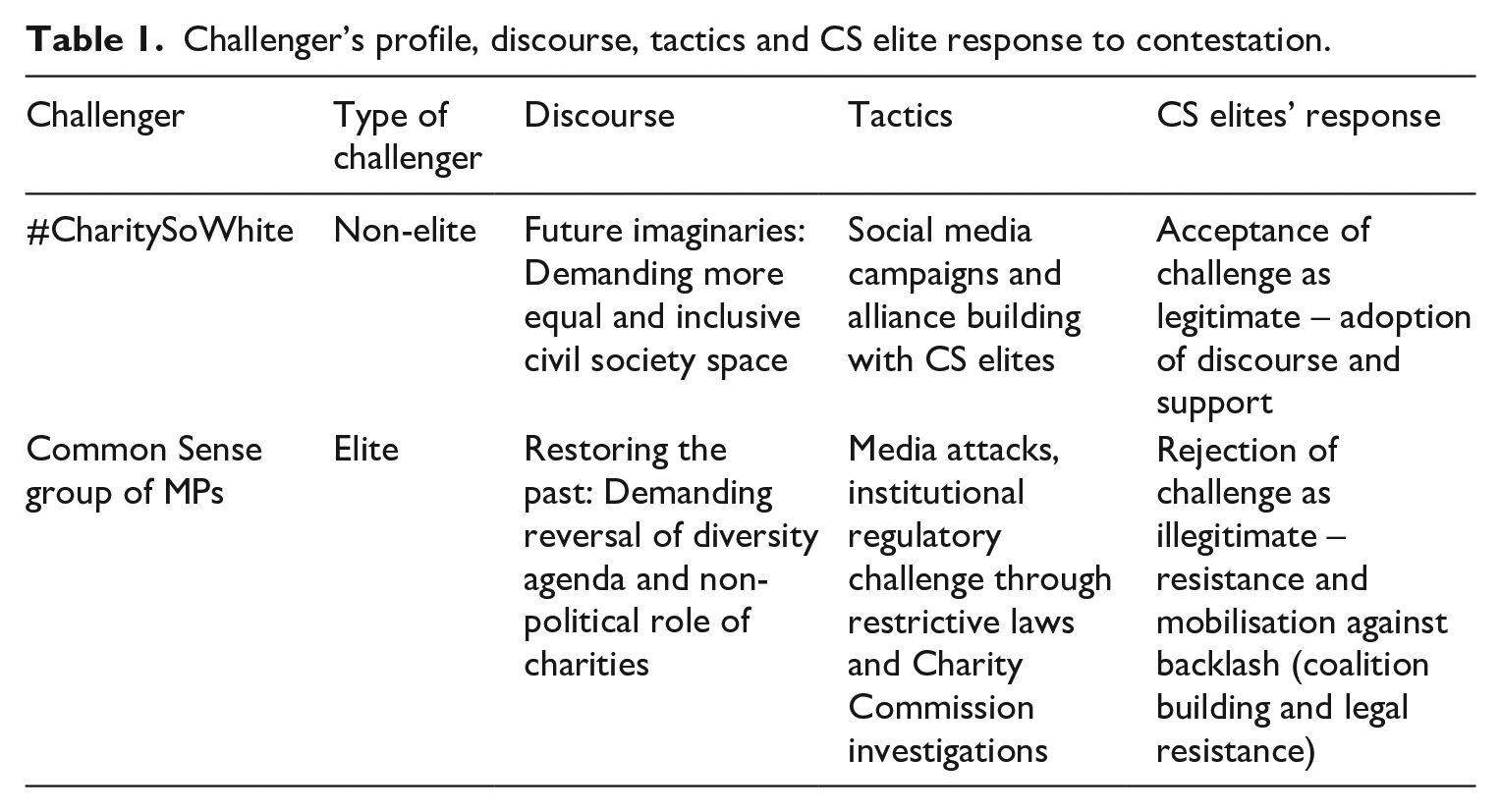
Based on theoretical insights from the frontlash/backlash and movement-countermovement literature, the study captures the profile, tactics and discourse of two challengers of civil society elites in the UK. Embodying the wider identity cleavage in post-Brexit Britain around the accommodation of racial and ethnic diversity, the two actors articulate contrasting ideas about the role of the charity sector in British society. Resonating with social conservatives, the Common Sense group maintains that CSOs should be non-political, avoid engaging in activities that question British history and demand a reversal of the racial justice agenda. The conservative challenger, through links with the media establishment and utilising its elite position, uses media attacks and legal-institutional challenges of civil society elites. On the other hand, #CharitySoWhite maintains that CSOs should act as an independent agent of change, fighting racial injustices and challenging power relations within the sector and society at large. To do so, similar to other frontlash movements, they utilise social media to mobilise support and build alliances with central actors such as infrastructure bodies for civil society (see Table 1).
Challenger’s profile, discourse, tactics and CS elite response to contestation.
The article introduces the concept of civil society elites to first draw attention to the inequality of resources and power relations within civil society, and second, to show that major CSOs due to their political and societal influence (elite status), similar to corporations and states, become a target of contestation. Civil society elites, including the most resource-rich CSOs (and their leaders) in terms of political and economic resources (Johansson and Uhlin, 2020), become the ‘perfect’ target of both progressive and conservative challengers since they provide for a highly publicised message, having (potentially) behavioural impact on other (less resourceful) CSOs and the broader public. Hence, in the age of populism and polarisation, the civil society space, often thought of as a space of inclusion and integration, turns into a political battlefield of values and ideas.
The composition, activities and attitudes of civil society elites serve as mechanisms that trigger the mobilisation of challengers. While there are admittedly difficulties to empirically delineate and isolate a discrete civil society elite, taking a positional approach and focusing on the demographic composition of those at the top of major resource rich CSOs can help us account for the mobilisation of the #CharitySoWhite. Specifically, there has been consistent evidence of the lack of ethnic and racial diversity in the governance and executive leadership team of major CSOs in the UK (Green Park, 2018; Inclusive Boards, 2018). This is a result of processes of homosocial reproduction which exclude racial and ethnic minorities from the upper echelons of organisational hierarchy. In light of the BLM protests in the UK and wider demands of racial justice, the #CharitySoWhite campaign mobilised to challenge the composition of civil society elites along with the practices that enable institutional racism and exclusion in the sector.
Similarly, understanding the civil society elites’ attitudes helps us account for their responsiveness to the #CharitySoWhite campaign. Despite barriers to class and racial diversity in the composition of civil society elites, value-wise leaders of major CSOs often resonate well with progressive values promoted by the #CharitySoWhite. 10 Hence, civil society elites positively respond to demands for diversification and decolonisation of charity legacy and elevate those issues at the top of the civil society agenda. At the same time, such progressive attitudes of civil society elites are recognised by conservative actors as a threat to traditional British values and a step too far in accommodating racial and ethnic diversity (Sobolewska and Ford, 2019). Therefore, activities of CSOs, such as a blog-post with advice on how to talk about ‘white privilege’ with children (Barnardo’s) or commissioning reports on the links between historical properties and their owners with slavery and colonialism (National Trust), trigger backlash by conservative actors, seeking to steer division as an electoral strategy to appeal to the socially conservative voters. Such external challenge is perceived as a threat to the voice of CSOs, hence civil society elites mobilise into new alliances to resist the shrinking of the space for manoeuvre (Borgh and van der Terwindt, 2012).
Conclusion
This article adds to the growing literature on the contestation of civic space in liberal democracies (della Porta and Steinhilper, 2021; Swiney, 2019), by analysing the contestation of civil society elites by elite and non-elite challengers alike. By applying a frontlash/backlash perspective, the article puts emphasis on cultural cleavages as the central source of polarisation of the civic space. Moreover, it opens the door for further studies on how the attitudes, activities and the composition of civil society elites may account for (a) the mobilisation of frontlash and backlash challengers and (b) civil society elites’ responses to challengers.
Admittedly, there are empirical challenges in clearly delimiting a discrete and stable civil society elite, and future studies can provide a more nuanced empirical delimitation building on the positional approach. At the same time, the two challengers highlight the existence of CSOs with an elite status. Another limitation is that the article does little to investigate the consequences of the contestation for specific organisations or the sector as a whole (e.g. changes in political activities, adjustment in recruitment practices, etc.). Hence, broader comparative research is needed to understand the extent to which the contestation towards civil society elites amid growing cultural cleavages in Europe poses a threat to the quality and maintenance of democracy, and to what extent this is part of the ‘regular’ (ideological) power struggle characteristic for liberal democracies.
Footnotes
Acknowledgements
I thank Håkan Johansson, Sara Kalm, Anders Uhlin, the participants at the workshop ‘Trajectories of civil society in a de-democratizing context’, Centre for Social Sciences, Hungarian Academy of Sciences Centre of Excellence, Budapest, 17–19 November 2021, and colleagues from the research programme ‘Civil society elites? Comparing elite composition, reproduction, integration and contestation in European civil societies’ at Lund University for their helpful comments and generous feedback. I also want to thank the two anonymous reviewers for their useful comments.
Funding
The author(s) disclosed receipt of the following financial support for the research, authorship, and/or publication of this article: This study is funded by the Riksbankens Jubileumsfond, project number M17-0188:1. This support is gratefully acknowledged.
